
Case Study
What Your EOR Actually Does (And Doesn't Do): The audit that asked questions nobody could answer

Tom Price-Daniel

12 minutes

May 6, 2026
Your developer in Warsaw just shipped a feature that doubles conversion rates. Legally, you might not own it.
IP ownership follows employment law, not intent, and employment law changes every time you cross a border. This guide covers the employment structures that protect ownership, the contract clauses that survive termination, and the technical controls that prove you treated IP as genuinely confidential.
Key Takeaways
Intellectual property, patents, copyrights, trademarks, and trade secrets, defines your competitive advantage. When you hire developers in Berlin, designers in Bangalore, or product managers in Buenos Aires, you're asking them to create assets that belong to your company. Local employment law doesn't automatically agree.
The core vulnerability is straightforward: IP ownership follows employment classification, and employment classification follows local law. A contractor relationship that looks compliant in the UK might fail scrutiny in Germany, and that misclassification doesn't just create tax exposure, it creates an ownership gap where your IP rights become contestable.
Different jurisdictions treat IP ownership in fundamentally incompatible ways. Some countries grant automatic assignment of employee-created work to employers. Others require explicit written agreements. A few protect employee "moral rights" that can't be waived even by contract.
Here's what changes by region:
Your standard UK employment contract might not protect IP created by your team in France. Your contractor agreement definitely doesn't protect work created in Germany if that contractor relationship fails a classification test.
Contractors and employees face different IP ownership frameworks in nearly every jurisdiction. Contractors typically retain ownership unless a written agreement explicitly transfers it. Employees working within their scope of employment often trigger automatic assignment, but only if the employment relationship is legally sound.
Mid-market companies hiring across 10+ countries often rely on contractor agreements for speed and simplicity, despite 10–30% of employers misclassifying at least some workers as independent contractors. The problem emerges during due diligence. When a contractor relationship fails an audit because the worker had fixed hours, used company equipment, or received performance management—the IP ownership fails too.
"When a contractor relationship fails an audit, the IP ownership fails too. You're not just facing tax penalties; you're facing questions about who actually owns the code your product runs on."
Financial services and defence sectors see this risk most acutely. Regulators and investors scrutinise IP ownership chains during funding rounds and compliance reviews, and gaps discovered at that stage can derail transactions worth millions. The risks are compounded as federal enforcement wanes, with the U.S. Department of Labor no longer enforcing its 2024 contractor classification rule as of May 2025.
Due diligence failures around IP ownership create three specific problems for scaling companies. First, they delay funding rounds whilst legal teams scramble to obtain retroactive assignments (which don't always work). Second, they reduce valuation when investors apply discounts for contested or unclear ownership. Third, they occasionally kill deals entirely when the IP risk is deemed unacceptable.
Clean IP ownership requires documentation that proves three things: proper employment classification under local law, explicit written assignment of IP rights, and ongoing compliance with jurisdictional requirements like inventor compensation.
This table reveals why your employment structure is just as important as your contract language. Better contract terms won't solve a misclassification problem.
Three main employment models exist for hiring abroad: direct contractor relationships, Employer of Record (EOR) arrangements, and owned legal entities. Each offers different levels of IP protection, setup complexity, and cost.
Don't ask which model is "best." Ask which model fits your risk tolerance and where you are operationally. A 150-person financial services company expanding into Germany has very different needs than a 50-person SaaS startup hiring its first Polish developer.
Contractor agreements offer speed and flexibility but deliver the weakest IP protection. The fundamental problem is that contractors are independent businesses, not employees, which means IP ownership doesn't automatically transfer even when contracts say it does.
Robust contractor IP clauses require several elements:
Even with perfect contract language, you're still exposed if the contractor relationship fails a classification test. Courts in most jurisdictions will reclassify workers as employees if the relationship looks like employment, and that reclassification can void your IP assignment clauses.
EOR arrangements create a proper employment relationship under local law whilst letting you avoid entity setup. The EOR becomes the legal employer, handling payroll, benefits, and compliance, whilst you retain day-to-day management and work direction.
For IP protection, EOR structures offer a significant advantage: they establish employment status from day one, which can trigger automatic IP assignment in many jurisdictions. The employment contract, drafted under local law by the EOR's legal team, includes invention assignment clauses that courts recognise as enforceable.
"EOR structures fix the classification problem that weakens contractor IP protection. Once you have clear employment status, IP assignment happens automatically in most jurisdictions."
The trade-off is cost. EOR services typically run £400–600 per employee per month, compared to £40–50 per month for contractor payment platforms. However, that cost includes legal certainty that contractor agreements can't provide.
Owned entities deliver the strongest IP protection because you're the direct employer under local law. There's no intermediary, no classification ambiguity, and no question about who owns employee-created work.
The barriers are setup cost and ongoing compliance burden. Entity formation in Germany might cost £8,000–15,000 and take 2–3 months. Annual compliance, corporate tax filings, statutory audits, local accounting, adds another £12,000–25,000 per year depending on jurisdiction.
Here's the typical path for mid-market companies: start with contractors for your first hires, switch to EOR when your team hits 3 to 5 people, then set up owned entities once you have 10 to 15 employees in one country.
IP protection goes beyond a single contract clause. It's a complete system combining legal agreements, technical controls, and ongoing compliance monitoring. Each layer strengthens the others to create defense in depth.
English-only contracts may face enforceability challenges in certain jurisdictions, especially where local language requirements exist, but this is not universally the case. A French court deciding IP ownership will interpret the agreement under French law, and if the contract isn't available in French, enforceability becomes questionable.
Dual-language agreements solve this by providing both an English version (for your internal use) and a local-language version (for legal enforceability). Both versions are signed, with a clause specifying that the local-language version governs in case of conflict.
Template clauses for key jurisdictions typically include:
Germany requires additional inventor compensation clauses. France mandates specific language about employee rights to inventions created outside working hours. The Netherlands recognises stronger employee ownership rights for inventions made without company resources.
You need local legal review to get this right. That's why most companies use EOR providers or local law firms to draft employment contracts instead of trying to adapt UK templates.
Written agreements protect ownership, while registration can strengthen enforceability of certain IP rights, such as patents and trademarks, though the impact depends on local law, the type of IP, and supporting documentation. Most countries operate on first-to-file systems, meaning whoever files a patent or trademark application first gets priority, regardless of who actually invented it.
This creates a specific vulnerability for global teams. If an employee in India files a patent application for an invention they created for your company, they might secure rights before you do, especially if your invention assignment agreement has gaps or wasn't properly executed.
Priority dates matter enormously. Filing a UK patent application establishes a priority date that you can claim in other countries within 12 months under international treaties. Miss that window, and you're starting from scratch in each jurisdiction.
For software companies, focus on:
Registration costs vary dramatically. A UK trademark might cost £200–400. An international patent portfolio covering Europe, US, and Asia can easily exceed £50,000. Most mid-market companies prioritise trademark protection and trade secret controls over aggressive patent filing.
Proper identity verification prevents IP theft before it starts. When you hire someone in Romania, you're trusting that they are who they claim to be, that their credentials are legitimate, and that they're not simultaneously working for a competitor under a different name.
Digital signature requirements combined with identity verification (passport checks, proof of address, right-to-work documentation) create an audit trail that proves who signed your IP assignment agreement. This matters during disputes when you're demonstrating that the person who created the work actually agreed to transfer ownership.
24-hour onboarding also closes the gap where work begins before paperwork completes. Every day a developer writes code without a signed employment contract is a day where IP ownership is ambiguous. Fast onboarding means IP protection starts immediately.
Teamed uses built-in Agents to automate document collection and verification, while human specialists handle the tricky cases, like candidates missing standard documentation or countries with unusual requirements. This creates fast, compliant onboarding, though actual completion times and when IP protection kicks in will vary by country and depend on how quickly all legal and documentation requirements are completed.
Technical safeguards support legal protections by limiting who can access sensitive IP and creating audit trails that show proper security practices. Courts and regulators view security controls as evidence of how seriously you take IP protection.
ISO 27001 alignment means implementing controls across several domains:
As this table shows, your control requirements grow with IP sensitivity. A design agency hiring a contractor for website work has much lighter security needs than a fintech company bringing on backend engineers who'll touch customer financial data.
Regular compliance reviews catch gaps before they become problems. An annual IP audit examines three areas: employment documentation, security controls, and ownership chains.
Employment documentation review verifies that every team member has a current, properly executed invention assignment agreement. Security controls review confirms that access permissions match current roles and that logging systems capture required data. Ownership chain review traces IP from creation through assignment to confirm clean title.
"Annual audits are cheaper than due diligence failures. Investors expect to see evidence of systematic IP protection, and 'we think we have the right contracts' doesn't satisfy their legal teams."
Audit frequency depends on your industry and growth stage. Financial services companies often run quarterly reviews. Defence contractors face continuous compliance monitoring. Most mid-market tech companies find annual audits sufficient, with event-triggered reviews when making acquisitions or entering new jurisdictions.
Strategic hiring decisions involve more than finding talent—they involve choosing legal jurisdictions that strengthen rather than complicate IP protection. Not all countries offer equal IP frameworks, and some actively undermine foreign companies' ownership rights.
Choice-of-law clauses in employment contracts specify which country's courts govern disputes. However, courts in most countries will apply local employment law to employment relationships physically located in their jurisdiction, regardless of what your contract says.
The practical implication is that hiring in Germany means German employment law applies, even if your contract specifies English law. What you can control is where disputes are litigated and which substantive IP law governs ownership questions.
The EU, US, and UK give you solid IP frameworks backed by established case law, reliable courts, and strong enforcement. Professional services, financial services, and defense companies especially benefit from hiring in these jurisdictions with clear IP protection.
Specific advantages by region:
Emerging markets present different trade-offs. India offers a massive talent pool and relatively strong IP law on paper, but enforcement can be inconsistent. Eastern Europe provides excellent technical talent with EU-aligned IP frameworks in member states.
Post-employment obligations protect IP after the working relationship ends. Continuing confidentiality obligations are enforceable in most jurisdictions with reasonable scope and duration. "Reasonable" typically means protecting genuinely confidential information (not general skills and knowledge) for a period matching how long the information remains commercially valuable.
Non-compete limitations vary dramatically by country:
Here's typical template language for post-termination clauses: "Employee's confidentiality obligations survive termination indefinitely for trade secrets and for [2-5 years] for other confidential information. Employee agrees not to [compete directly / solicit clients / solicit employees] for [6-12 months] following termination within [geographic scope]."
The brackets indicate variables that require jurisdictional customisation. What works in London won't work in Berlin, and what's enforceable in New York is void in San Francisco.
European moral rights give creators attribution and integrity protections that exist separately from economic ownership. Even after you own the copyright to code or designs, the creator retains the right to be identified as the author and to object to modifications that harm their reputation.
For software development, moral rights create a specific problem: they can't be waived in many European countries, which means your standard IP assignment clause that says "Employee waives all moral rights" is void in France, Germany, and several other EU jurisdictions.
Practical workarounds focus on contractual commitments rather than waivers:
In reality, moral rights rarely cause problems for software companies. Courts understand that code needs constant updates and that team authorship makes individual attribution impractical. Still, investors and acquirers want to see proof that you've addressed this in your European employment contracts.
Technical measures support legal IP protection by limiting exposure, creating audit trails, and demonstrating that you treat IP as genuinely confidential. Courts deciding trade secret cases examine security practices to determine whether information qualifies for protection.
The legal test is whether you took "reasonable measures" to maintain secrecy. What's reasonable depends on your industry and the value of the IP. A defence contractor protecting classified algorithms faces different standards than a marketing agency protecting client lists.
Zero-trust architecture assumes breaches will happen and builds systems to contain the damage. Rather than trusting anyone inside your network, you verify every access request, give only the minimum permissions needed, and constantly watch for anything unusual.
For distributed development teams, zero-trust means:
Essential security tools for remote tech teams include endpoint detection and response (EDR) software, privileged access management (PAM) systems, and security information and event management (SIEM) platforms that aggregate logs for analysis.
The cost of zero-trust tooling varies dramatically. Basic implementations using cloud-native tools might cost £50–100 per user per month. Enterprise-grade solutions with 24/7 monitoring can exceed £200 per user per month. Most mid-market companies start with cloud provider security features and add specialised tools as IP sensitivity increases.
Code access controls limit who can view, modify, and deploy your software. Repository segmentation means organising code so developers access only what their role requires, not your entire codebase.
Practical segmentation strategies include:
Key rotation schedules vary by key type and risk level. API keys for external services typically rotate every 90 days to limit exposure if keys leak. Database credentials rotate on the same schedule to reduce impact of credential theft. SSH keys for production systems rotate every 180 days, balancing security with operational stability.
Automated rotation using secrets management tools reduces the operational burden and ensures rotation actually happens. Manual rotation processes fail because they're easy to deprioritise during busy periods.
Multiple employment vendors create IP ownership gaps that emerge during transitions. When you use one platform for contractors, another for EOR, and a third for entity payroll, each transition point creates risk.
The problem isn't that individual vendors are incompetent, it's that handoffs between systems create documentation gaps, re-onboarding friction, and opportunities for IP assignment clauses to fall through the cracks.
A unified approach can help reduce potential friction between vendors by working to provide a centralised view of employment relationships. If questions regarding IP ownership, contract terms, or compliance history arise, this model can often minimize the need to piece together data from disparate platforms, typically allowing you to reference a more consolidated record.
This capability can be particularly valuable during due diligence. Investors often look for organized employment records that can demonstrate consistent IP protection across your team. While scattered vendor data may potentially complicate the verification of IP rights, a unified system can support greater clarity and confidence in this area.
No, device ownership doesn't determine IP ownership. Employment status and written agreements determine ownership. Proper IP assignment clauses in employment contracts cover work product regardless of where it's created or what equipment is used. However, using personal devices does create security risks that can undermine trade secret protection, so most companies require company-provided devices or security controls on personal devices used for work.
Yes, but success depends on contractor cooperation and local law. You can obtain retroactive assignments through supplemental agreements, often with compensation to incentivise cooperation. However, retroactive assignments don't always cover past work in jurisdictions that don't recognise them, and you can't obtain assignments from contractors you can't locate. It's far better to use proper employment structures and contracts from day one than to attempt cleanup later.
IP ownership typically transfers to the parent company during entity closure, but proper documentation is essential. You'll file IP assignment agreements, update registrations with patent and trademark offices, and ensure employment contracts specify that IP rights survive entity dissolution. Local legal requirements vary significantly, some jurisdictions require court approval for IP transfers during liquidation. Working with local counsel during entity closure prevents IP ownership gaps.
Enforceability depends on local courts and proper contract drafting in the local language. Some emerging markets have weak enforcement mechanisms regardless of contract quality, making technical controls (access restrictions, encryption) more reliable than legal remedies. NDAs work best when combined with proper employment structures, EOR or owned entities, that establish clear legal relationships under local law. Relying solely on contractor NDAs in jurisdictions with limited IP protection is risky.
Coverage depends on your industry and IP portfolio value, but most mid-market tech companies carry minimum £1–5 million coverage. Financial services and defence sectors often require £5–10 million or more. Professional indemnity insurance typically covers defence costs and damages if you're accused of infringing others' IP, whilst cyber insurance covers data breaches and trade secret theft. Consult with insurance specialists who understand tech sector risks to determine appropriate coverage levels for your specific situation.
.png)
Maybe you’re exploring a development hub in Macedonia, or hiring professional services talent in the Philippines or South Africa. For European SMBs, global hiring is a genuine opportunity to find specialist skills and test new markets.
But here’s the reality: 75% of employers across 21 European countries are struggling to find candidates with the right skills (Euronews). And for stretched people teams already juggling endless priorities, adding compliance, payroll, and onboarding across borders can feel like one weight too many.
If you’re wearing multiple hats and wondering how to make this work, let’s walk through what actually matters.
The right framework depends on your timeline, budget, and commitment level to a market. For most European SMBs testing new regions or needing to move quickly, an Employer of Record (EOR) offers the fastest path with the least risk—while establishing a local entity makes sense only when you’re certain a market is a long-term play.
Here are the three common pathways you’ll likely consider:
Each approach comes with its own benefits and challenges, and the right choice often depends on your long-term goals, budget, and operational needs.
Setting up a legal entity gives you full control over local operations, making it logical if you’re certain about a market. But this route is rarely simple, and the hidden weight can catch stretched teams off guard.
For SMBs testing a new market or needing to hire quickly, this delay can result in missed opportunities.
Tip: Before setting up an entity, ask yourself: is this market a long-term focus for your business, or are you testing its potential? If the latter, consider a more flexible solution.
Recruitment agencies can be a valuable resource for sourcing talent and understanding local hiring practices. Their expertise in identifying and attracting candidates can save your HR team time and effort.
However, their scope is often limited to recruitment. Employment contracts, compliance, payroll, and benefits typically remain your responsibility, adding to the workload of already stretched HR teams. For businesses seeking end-to-end solutions, this approach may fall short.
Tip: Recruitment agencies are a good fit if you have in-house HR capacity to manage contracts and compliance. If not, consider a partner that provides full employment support.
An Employer of Record (EOR) simplifies international hiring by taking on the legal and administrative weight so you don't have to carry it.
This approach is particularly useful for businesses looking to test a market or hire in multiple regions without committing to setting up legal entities or navigating the complexities of local compliance on their own.
"City Relay expanded their global workforce by 80% with Teamed and can now onboard global hires even within 24 hours, all without requiring additional in-house HR or compliance expertise."CityRelay
Tip: Use an EOR to scale quickly and test markets without the financial and legal commitment of a local entity. This is ideal for fast-growing businesses.
For many SMBs, the decision to expand into a new market is a test of viability. Setting up a local entity might seem like the ultimate solution, but it’s not always the best move if the market doesn’t deliver the results you expect.
In such cases, partnering with an EOR offers a flexible and faster solution that allows you to dip your toes into a market without the long-term financial and operational commitment of establishing a legal entity.
"Teamed has definitely helped us transform our hiring process. It allows us to cast the net so much further and target talent we know will be beneficial to our business, regardless of where they're based!"Luganodes
"Launching your own entity can be a complex process with numerous pitfalls," says Tom Hird, Co-founder of Teamed. "Costs range from thousands to hundreds of thousands of euros, and timelines can stretch from several months to over a year. For stretched teams testing new markets, alternatives like EORs often provide a smarter path, without adding more pressure to your people."
Hiring international talent isn't just about finding the right skills. It's about managing the hidden complexities that come with compliance, administration, and employee experience. For already stretched HR and finance teams, these challenges can lead to costly mistakes, inefficiencies, and disengaged employees.
"Thanks to Teamed's rapid response times and in-depth knowledge, we've been able to streamline our onboarding processes and eliminate a lot of the red tape we'd have previously struggled with. Now, we get to enjoy the advantages of a talented global workforce, without the administrative burden!"
Each country has its own labour laws, tax codes, and employment regulations. Missteps, such as misclassifying employees as independent contractors, can lead to significant financial penalties and damage your company's reputation.
For example:
Partnering with an Employer of Record (EOR) ensures compliance with local laws from day one, reducing risks and protecting your business.
Tip: Before expanding, review the classification laws in your target market. A partner like an EOR can help you stay compliant and avoid costly errors.
Managing multiple payrolls, tax filings, and employment contracts across borders requires significant time and expertise. For HR and finance teams already juggling multiple priorities, this workload can lead to burnout, inefficiencies, and costly errors. According to a survey by EY, 55% of HR professionals in global organisations feel burdened by the complexities of international hiring.
The weight of administrative overload shows up in familiar ways:
Tip: Streamline administrative tasks by working with an EOR. They handle compliance and payroll, reducing pressure on your internal teams.
Mistakes in payroll or benefits don't just create financial risks, they directly affect your employees. A missed salary payment or incorrect tax deduction can disrupt lives, leading to disengagement, dissatisfaction, and turnover.
When payroll runs smoothly and benefits arrive as promised, employees feel seen. That sense of being valued isn't soft, it shows up in the numbers:
An EOR helps ensure a seamless employee experience by managing compliance and payroll accurately. When employees feel valued and supported, they're more likely to stay engaged, perform better, and contribute to your organisation's success.
Tip: Prioritise employee experience with accurate, on-time payroll and benefits. Engaged employees are more productive and less likely to leave.
"One of the biggest hidden costs of global hiring is the impact on your team's bandwidth and focus," says Tom Hird, Co-founder of Teamed. "Managing compliance, payroll, and employee experience across multiple countries isn't just a drain on time, it can lead to an overwhelmed team, and costly, yet avoidable, mistakes. Partnering with an EOR simplifies the process and reduces these risks significantly."
Global hiring opens real doors for European SMBs, but it comes with weight that stretched teams shouldn't have to carry alone. The path forward isn't about doing more; it's about partnering with the right support so you can grow without burning out the people making it happen.
Ready to work with a partner that feels like an extension of your team? Let's help you simplify global hiring and support your growth.
Speak to us today to learn more. Let's chat!
An SMB job refers to employment within a small or medium-sized business, typically companies with fewer than 500 employees. These roles often require wearing multiple hats and juggling priorities across departments like HR, finance, and operations.
The right framework depends on your timeline and market commitment, an Employer of Record (EOR) offers the fastest path for testing new regions, while establishing a local entity makes sense only when you're certain a market is a long-term play.
Beyond salaries, global hiring carries compliance risks (fines for misclassification can reach tens of thousands of euros), administrative overload that burns out stretched teams, and employee experience issues that drive turnover when payroll or benefits go wrong.
Establishing a legal entity typically takes several months to over a year, depending on the country. Costs range from thousands to hundreds of thousands of euros, which is why many SMBs test markets first using an EOR before committing to a full entity setup.

Hiring talent in a new country meant mountains of paperwork, expensive consultants, and late nights pounding heads on desks to comply with local laws. Even then, you could never be sure you followed the correct procedures.
Today, Professional Employer Organisations (PEOs) and Employers of Record (EORs) make it easier, faster, and stress-free. But which one’s right for your mid-market businesses?
Choosing well means finding a trustworthy partner to hire foreign talent quickly and compliantly. Choosing wrong = all the figurative and literal headaches above.
In this article, you’ll learn how costs, compliance risks, speed, and scale differ between each hiring model so you can confidently pick the right one for you.
Both Professional Employer Organisations (PEOs) and Employers of Record (EORs) manage payroll, handle benefits, and take human resources (HR) admin off your plate. But your legal structure, responsibilities, and scalability will differ.
A Professional Employer Organisation (PEO) is a third-party company that outsources hiring and other HR functions through a co-employment model. The PEO doesn’t replace you as the employer — it shares the role.
The PEO handles admin work, payroll processing, tax and legal compliance, and benefits management. Meanwhile, you remain the official employer on employment contracts and hold legal liability.
The downside? You’ll need your own legal entity in the country where you want to hire.
An Employer of Record (EOR) is the legal employer of your staff in a foreign country.
Don’t have a legal entity, but still want to hire there? That’s where an EOR shines.
An EOR takes ownership of the employment contract, local tax filings, payroll processing, health insurance, and ensuring compliance with that country’s labour laws.
You can still track everything on a dashboard like the one below, though you won’t have to get stuck into paperwork.
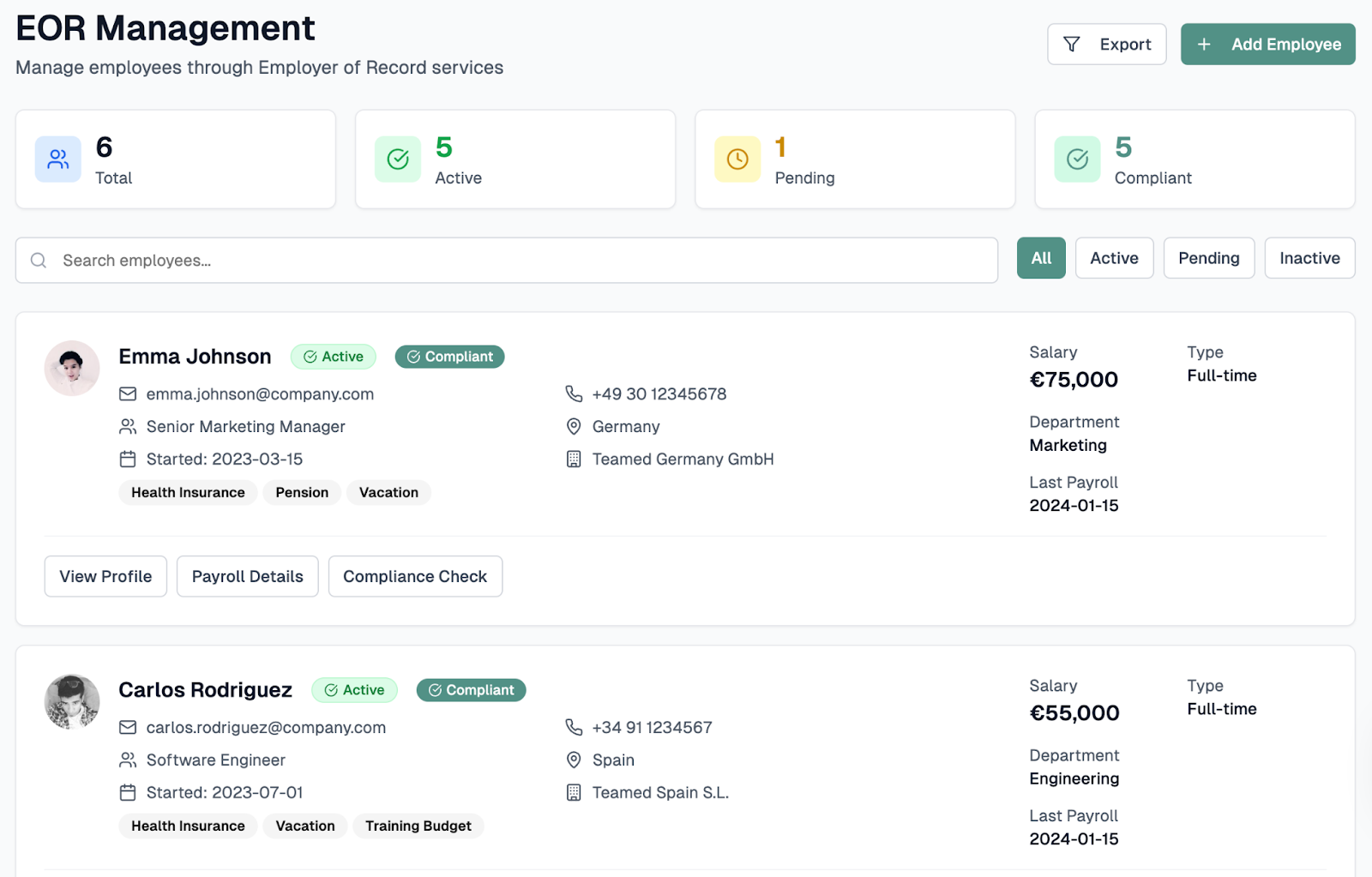
Instead, the client company (that’s you) dictates the employee’s day-to-day work, sets their goals, manages their performance, and controls company culture.
Here’s a quick reference table recapping the above and outlining other main differences between a PEO and an EOR:
An example hiring scenario can make the difference even clearer. Let’s check out the below.
Imagine you’re a London-based software development company that wants to offshore development to Romania.
If you only want to hire a handful of developers and don’t want the hassle of setting up a legal entity in the country, using an EOR is a great choice. It acts as the legal employer and handles payroll, taxes, compliance, and all related paperwork.
A PEO might be better if you already have a presence in Romania or want to set up shop there. It can provide legal advice, payroll support, and other HR services for your Romanian staff while you remain their official employer.
That also means the Romanian government will knock on your door if something goes wrong.
👉To learn more about how an EOR works, check out our article on Global Employer of Record Services (EOR).
An EOR helps you hire faster, removes compliance risks, and keeps costs low. A PEO gives you more control, so you’re on the hook for regulatory compliance.
Here’s how the benefits of hiring internationally through a PEO vs. an EOR compare.
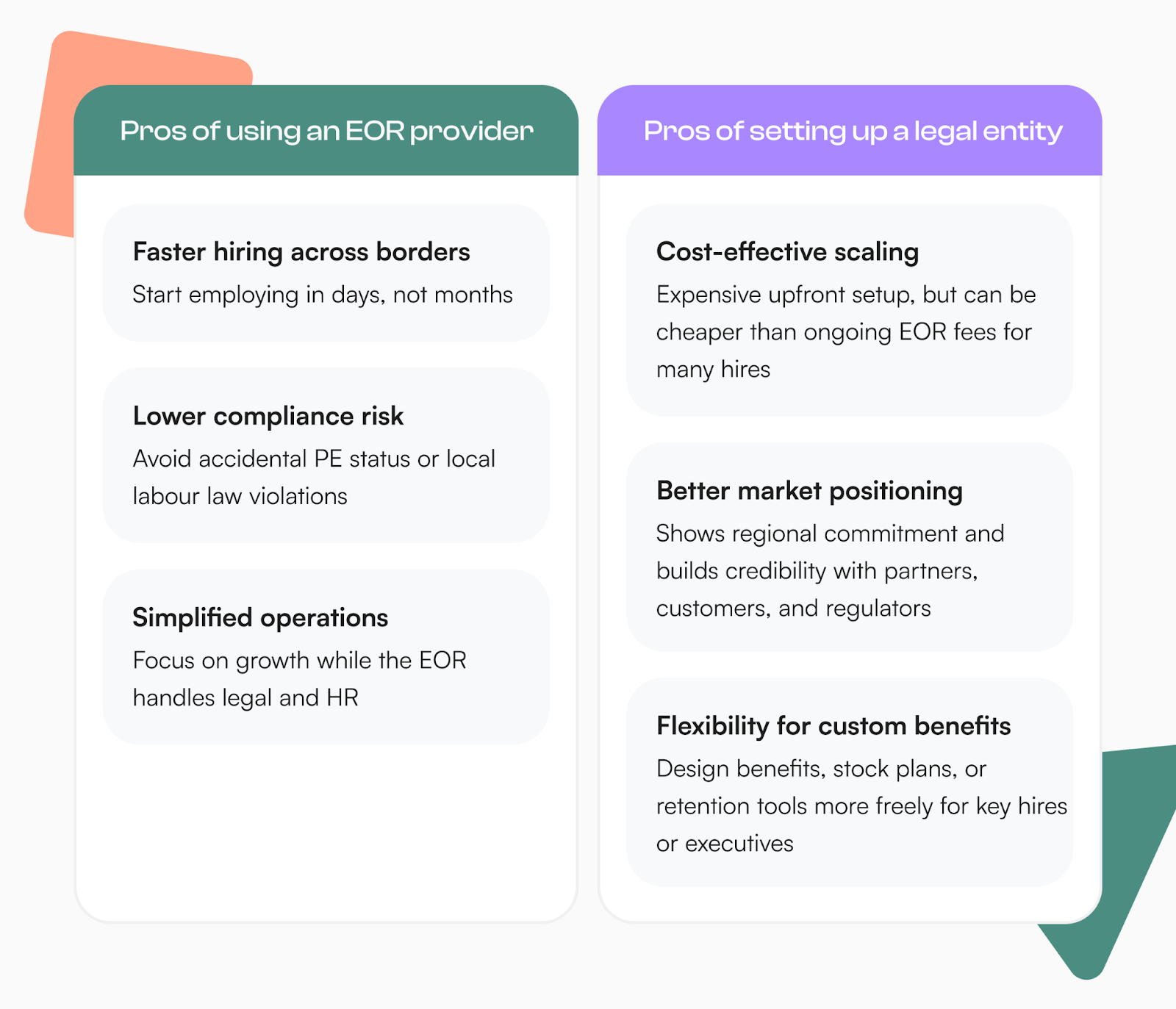
As you can see, an EOR is faster, simpler, and brings fewer compliance risks.
On the flip side, you’ll first need to establish a legal entity to hire through a PEO, though that doesn’t necessarily make it a bad choice. It all depends on your hiring needs.
Next, you’ll learn about the factors to consider when choosing between the two.
For mid-market companies, cost, speed, and complexity matter. You may not have the resources or budgets of enterprise competitors, so it’s essential to move fast and stay lean.
You’ll also have to consider how you balance control with compliance and the ability to scale.
Here’s a quick summary of how PEOs and EORs compare across key factors:
Here’s more information on each factor to help you make a considered decision.
An EOR offers much lower initial setup costs compared to a PEO.
That’s because a PEO requires you to form a legal entity, which can cost as much as $40,000 in some countries.
There are also ongoing costs to consider, including:
You don’t have to worry about any of these with an EOR, as it only charges a monthly fee per employee. With Teamed, for instance, you’ll pay £400 ($535) per employee, per month.
Note: EOR pricing often appears higher than PEO pricing because it bundles benefits administration, local payroll fees, and other services. You’ll need to settle these separately when using a PEO.
How to choose the right hiring model:
An EOR acts as the legal employer and assumes most of the risk. It’s responsible for complying with labour laws and applying the correct tax codes.
While you may still face minimal joint-employer exposure risk in rare cases, the EOR handles most compliance-related headaches.
When you share compliance duties with a PEO, legal responsibility ultimately sits with you. If your contracts violate local law, misclassify workers, or fail to meet statutory benefit requirements, you’ll be the one to face fines and legal action alone.
A PEO can advise and guide, but doesn’t absorb any liability.
How to choose the right hiring model:
On average, it takes around six weeks to hire a new employee. EORs let you hire employees in days.
Onboarding can happen within 24 hours in some cases because there’s no need to create a new entity, open bank accounts, or seek government approval. EORs already have the hiring infrastructure in place.
Hiring through a PEO can take much longer because you need to set up a new legal presence. That means:
All of this takes time. While a PEO can start processing payroll and handling other HR needs relatively quickly, the bottleneck is the initial setup.
How to choose the right hiring model:
EORs streamline the international hiring experience.
They handle contracts, payroll, taxes, benefits, and legal requirements through an end-to-end service. Even if you hire employees in 20 countries, all you have to manage is one relationship with your EOR service provider.
In most cases, you’ll manage everything through a single dashboard like the one below:

Hiring through a PEO is a little more complex and requires teamwork. Your co-employment relationship means you’ll need to align with your PEO’s workflows while also meeting local laws and policies.
Things get more complex as you expand. Every territory means creating a different entity, arranging a new PEO relationship, and complying with local labour laws.
How to choose the right hiring model:
The nature of EORs means you can quickly scale hiring efforts globally.
Want to hire one person in Tokyo, two in Sydney, and three in Toronto? An EOR can handle that without setting up separate entities.
You can quickly downsize, too, or exit a market altogether. An EOR can even help you establish your own foreign entity when the time comes.
PEOs are suitable for scaling within a single country.
Once you’ve established your entity, adding as many employees as you need is simple. PEOs often offer volume-based discounts as your global team grows. It’s only when you want to hire in a different country that PEOs struggle to keep up.
How to choose the right hiring model:
Think you know which model works best for your organisation? Use the following checklist-style questionnaire to confirm.
Making the right choice between a PEO and an EOR can be as simple as asking yourself a few questions.
If you’ve weighed up the factors above and you’re still not sure, then consider the following:
For most mid-market and small businesses, EORs offer more advantages than PEOs. They’re faster, easier, and provide greater legal protections, all without you setting up an entity.
Now, let’s look at how you can find the best EOR provider.
👉Learn what to consider before choosing an EOR partner in our handy guide.
Not all EORs are the same. You’ll find that customer support, compliance, and even technology can vary, so it’s crucial to fully assess an EOR vendor before signing a contract.
Here’s what you need to look for when choosing a solution.
Global employment touches multiple time zones, cultures, and regulatory systems. You need more than the ticketing systems and chatbots some providers think are a good “Deel.”
Human support is a must. That’s why, at Teamed, our experts are there for the good times and the messy times — from onboarding and growth to exits, disputes, and audits.
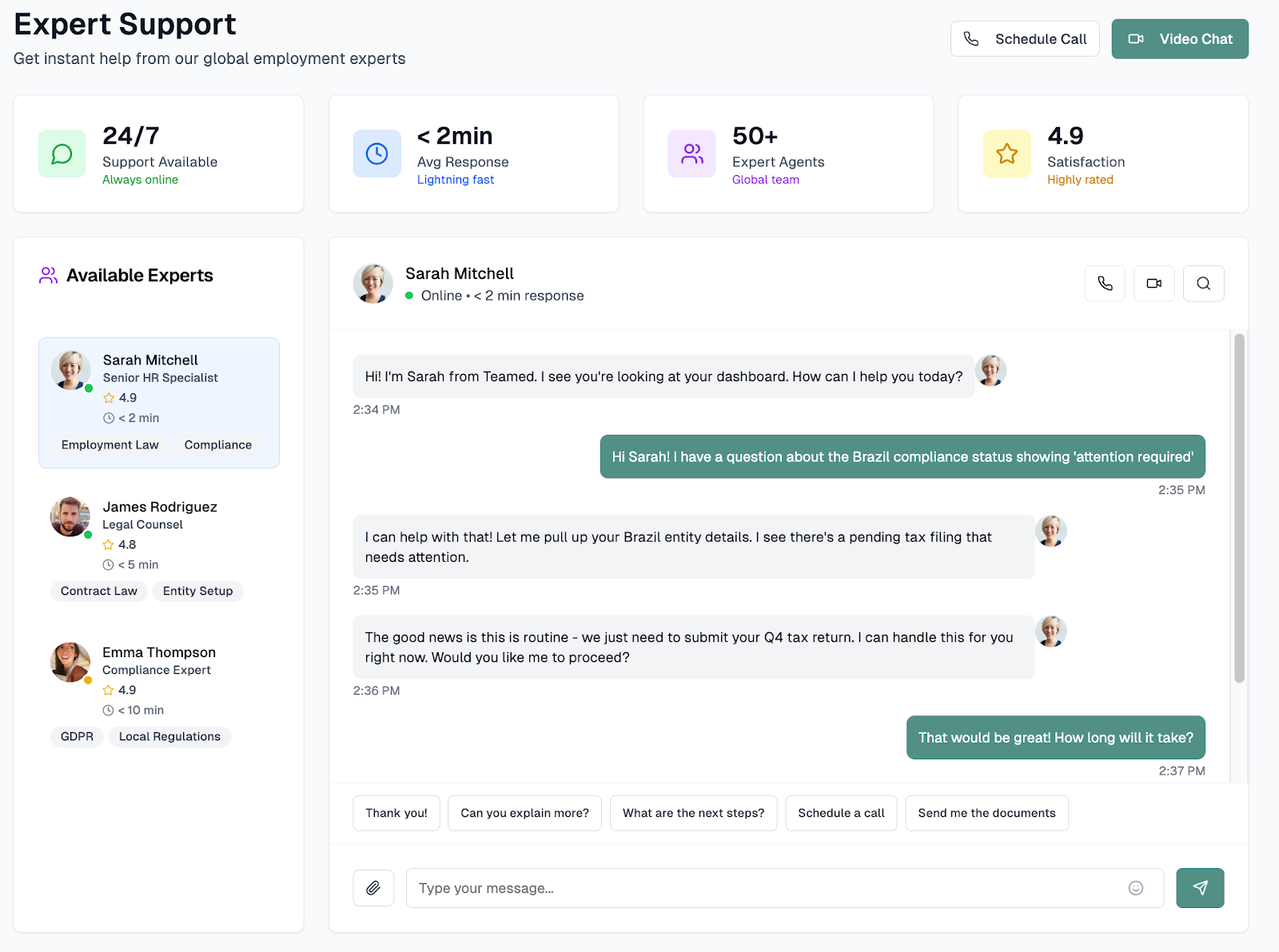
You get real experts on the line 24/5 — people who know global hiring inside out. And you can track everything in a handy dashboard like the image above.
👉Example in action: Discover how Teamed’s expert support quickly allowed Teker, an IT, aerospace, defence, and security technologies company, to expand hiring in France without a physical presence. And all while delivering an exceptional employee experience.
Local labour laws are a minefield. Statutory minimum wages change, pension contribution rates increase, and holiday entitlements shift.
Your EOR must proactively stay ahead of these changes to avoid penalties and lawsuits.
At Teamed, we make it easy to see any potential compliance risks in one handy dashboard:
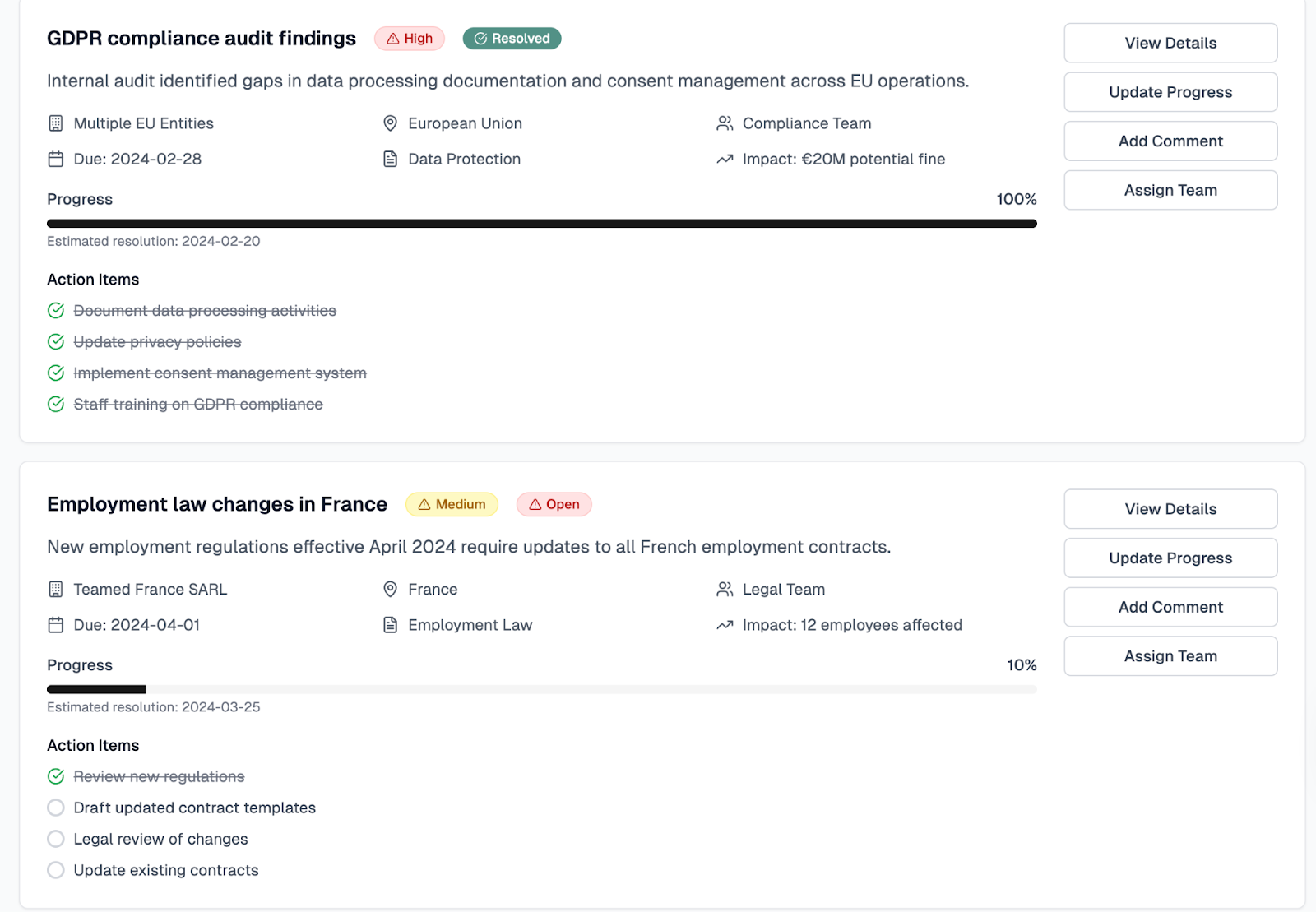
We handle all compliance risks, taxes, and benefits in 180+ countries, so you don’t have to worry. Plus, our dedicated compliance screen lets you keep track of everything.
👉Example in action: See how Teamed’s in-country experts guided Web3 company Luganodes to grow its global workforce by over 50% while paying employees in crypto and complying with local labour laws.
An efficient onboarding process builds trust and sets the tone for the employment relationship.
On the flip side, delays, confusion, or poor communication damage employee engagement and increase the risk of candidates backing out.
With Teamed, customers can save 30+ hours per hire and get new international team members up and running in 24 hours or less, with tailored benefits packages.
👉Example in action: Learn how property management company City Relay expanded its remote workforce by 80% and can onboard new hires in 24 hours, thanks to Teamed’s human-first approach.
Moving from one EOR to another shouldn’t impact your processes or employees. That’s why it’s critical to find an EOR that promises seamless migrations and fast transition timelines.
Switching to Teamed? We’ll create a step-by-step migration plan (backed by enterprise-level security) that fits your business, with no extra charges or surprises.
Happy employees work harder, stay longer, and refer top talent. Give them what they need in the form of great benefits, fast payouts, and an employee-centric experience.
At Teamed, we have an employee-first approach. We give all candidates equal opportunities and take care of everyone, no matter where they’re based.
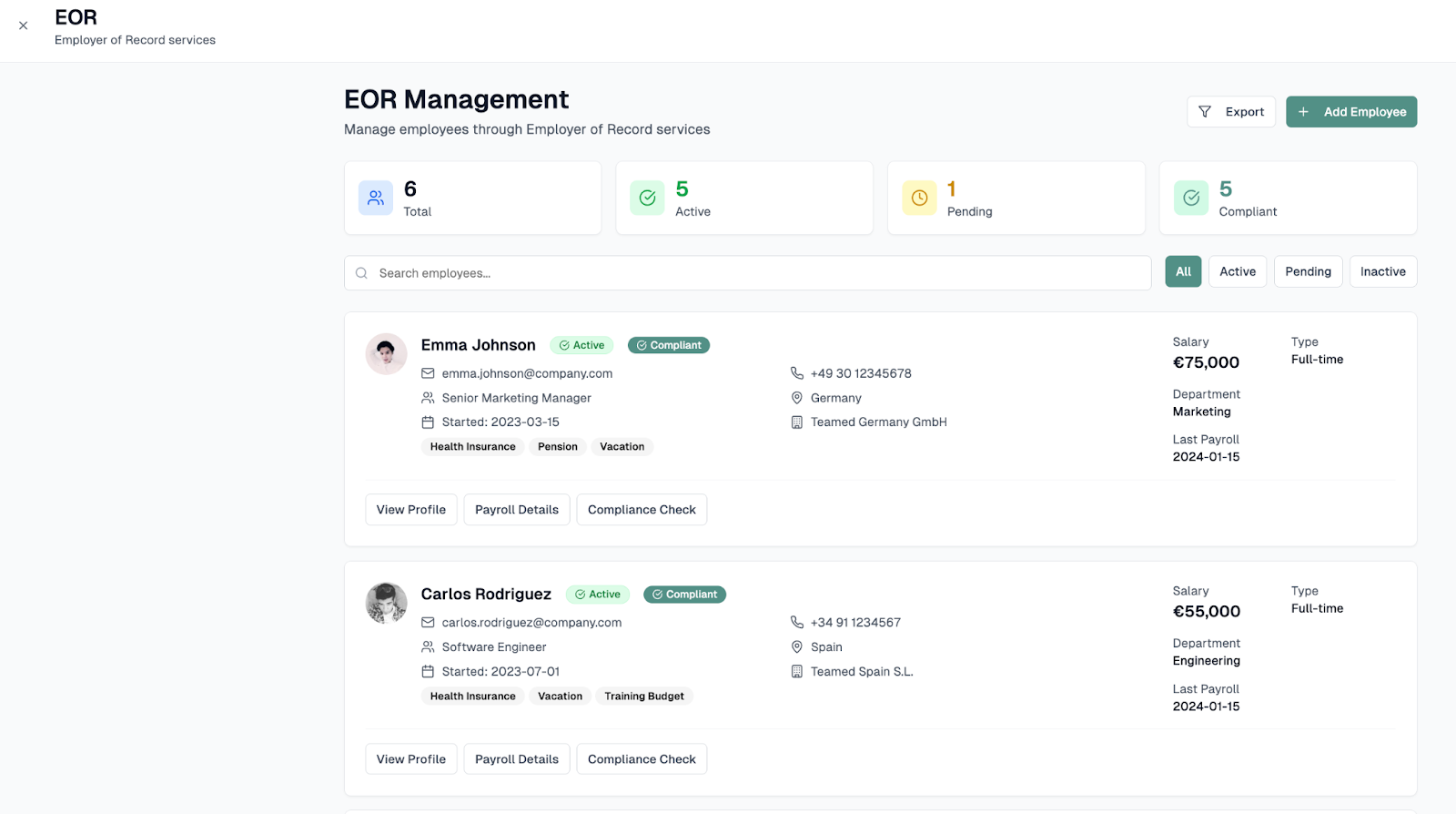
You can manage every EOR employee through a single dashboard and check their status at a glance.

We’re still completing Alex’s tax forms in the above example. But Maria is good to go.
👉Example in action: Discover how Teamed has helped accountancy firm CT manage HR inquiries — from holiday pay to maternity leave entitlements — and improve future planning.
Unpredictable pricing and hidden fees can destroy trust and wreck budgets.
It’s a particularly thorny problem for businesses rapidly scaling cross-border hiring. Many companies get locked with vendors whose pricing skyrockets with hidden fees or non-optional add-ons.
Teamed is different. We offer transparent, predictable pricing with no nasty surprises. No matter where you operate or how many employees you hire, EOR pricing will always be £400 ($535) per month.
👉Take our quick quiz to find out whether it’s time to look for a new global hiring partner.
Q: Is PEO the same as EOR?
A: No. Both manage workers’ compensation and offer HR support, but a PEO is a co-employer that supports your entity’s staff, while an EOR is the legal employer for workers abroad. An EOR offers a much more hands-off service to mid-sized businesses.
Q: What is co-employment?
A: Co-employment is an arrangement that means both your business and the PEO share employer responsibilities. You manage their workload, enforce workplace policies, and take ultimate responsibility for the employment contract. The PEO manages HR, payroll, and benefits administration.
Q: What types of businesses can benefit from EOR services?
A: Many businesses benefit from EOR services, particularly those pursuing global expansion, remote work, or testing new markets without committing to expensive entity setup. Examples include:
Q: How do I choose between PEO services and an EOR provider for my business?
A: Consider upfront costs, timelines, flexibility, and legal responsibility when choosing between a PEO and EOR. For the vast majority of mid-market businesses, an EOR will be the best choice.
Q: How do PEOs and EORs handle employee benefits differently?
A: Both PEOs and EORs manage employee benefits, but they do so in different ways. PEOs pool benefits across clients to offer group rates. EORs provide country-specific benefits.
Q: Are there other employment models?
A: Yes, several other employment models exist besides PEOs and EORs. Businesses can hire directly by creating a permanent establishment and managing HR internally, or enter into full-time or part-time contractor agreements with freelancers.
Global hiring has never been easier thanks to EORs.
Teamed makes the process even simpler. You get HR compliance, multi-country, and multi-modal payroll baked in, alongside effortless documentation and even entity setup help when you need it.
Add expert in-house support (available 24 hours a day, every working day) and fair, transparent pricing, and Teamed becomes a no-brainer.
It’s no wonder three in four customers who evaluate multiple providers pick us.
Book a call today and join 1,000+ growing teams like Globant and Williams Racing who trust Teamed to pay their global workforce, stay compliant, and scale with confidence.

An Employer of Record (EOR) is a third-party organization that legally employs workers on behalf of your company.
While you still control day-to-day operations, the EOR takes care of the admin, legal, and compliance aspects of employment.
But you still get an overview of everything going on using a service like Teamed:
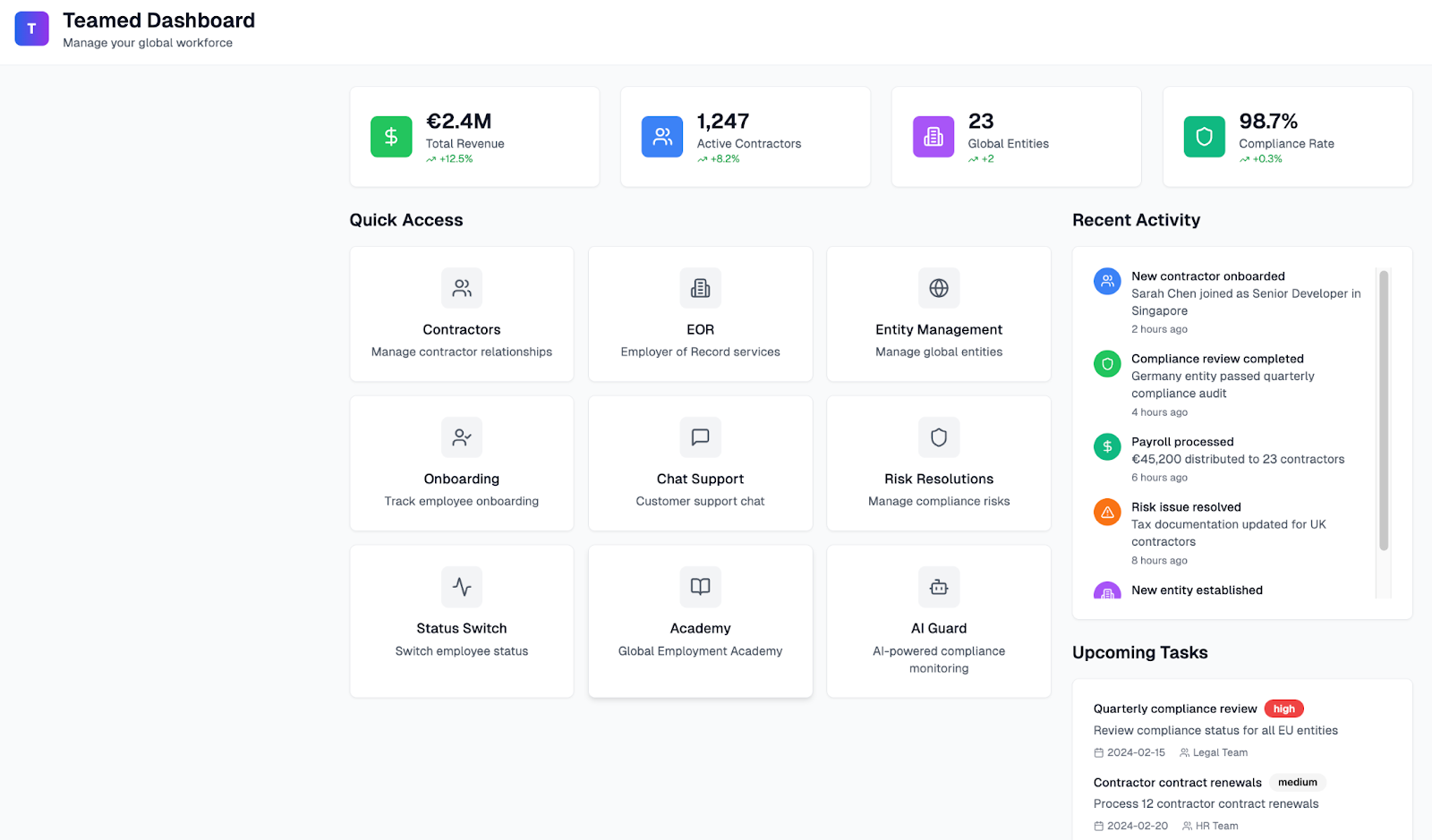
For mid-sized companies expanding globally, this setup removes a huge amount of friction.
Imagine you’re a 250-person SaaS company based in the US that’s found the perfect marketing lead in Germany.
When you partner with an EOR, it becomes the marketing lead’s legal employer. But you still manage their goals, workload, and culture like any other team member.
Here’s how an EOR relationship typically works:
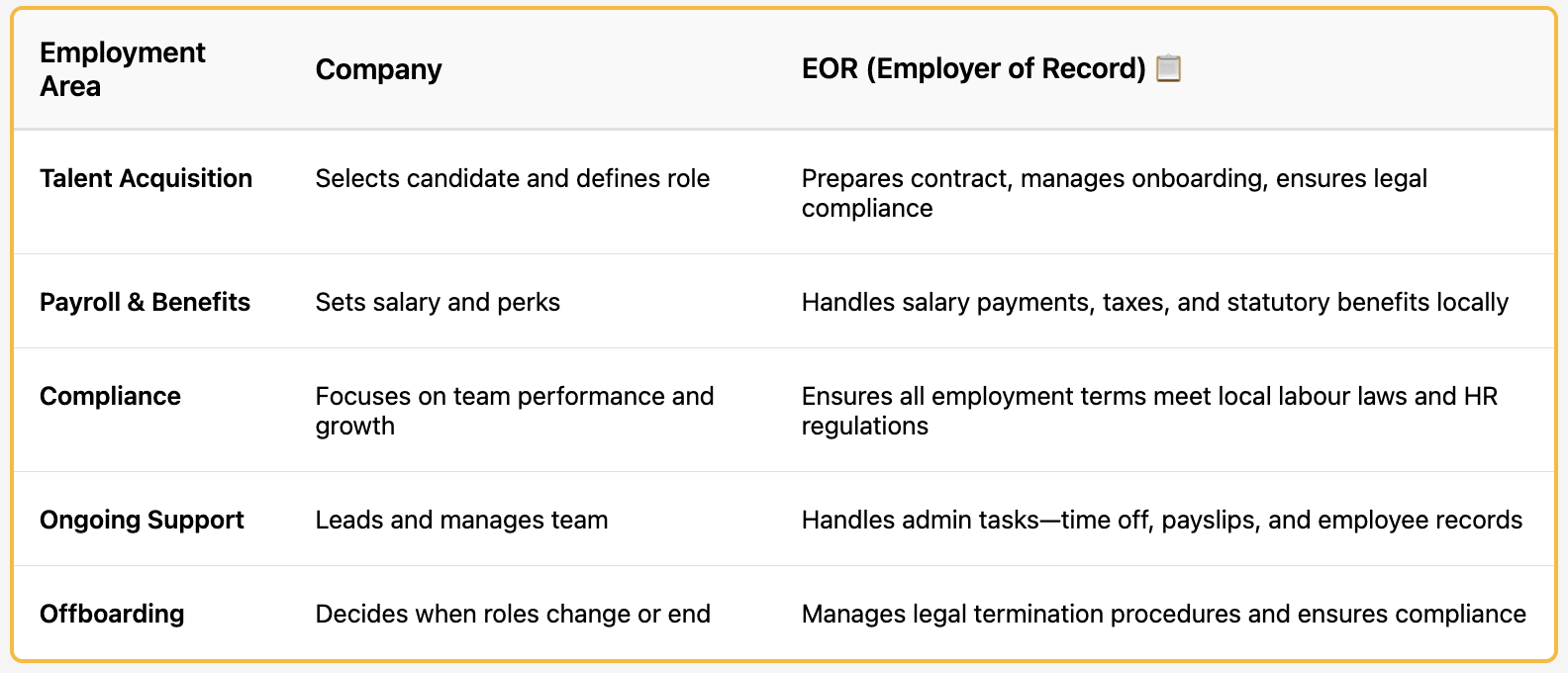
An EOR lets you hire without dealing with complex labour laws or worrying about compliance mistakes.
If you’ve never worked with an EOR before, it’s easy to confuse it with other HR outsourcing options like a PEO (Professional Employer Organisation) or a staffing agency.
However, each solves very different problems.
Here’s how the three service providers compare:
Scaling internationally, but don’t want to set up permanently in one place yet?
An EOR lets you hire from a global talent pool and pay them legally — while saving time and money and eliminating risk.
💡Pro tip: Teamed makes this process easier through its GEMO (Global Entity Management Operations) offering. Start with an EOR and seamlessly graduate to entity management when the time is right — no rehiring or disruptions.
A global EOR helps you hire faster, test new markets (without committing a huge amount of time or money), and ensure compliant employment.
Here are three of the biggest advantages:
International hiring through an EOR solution is often weeks (or even months) faster than doing it alone.
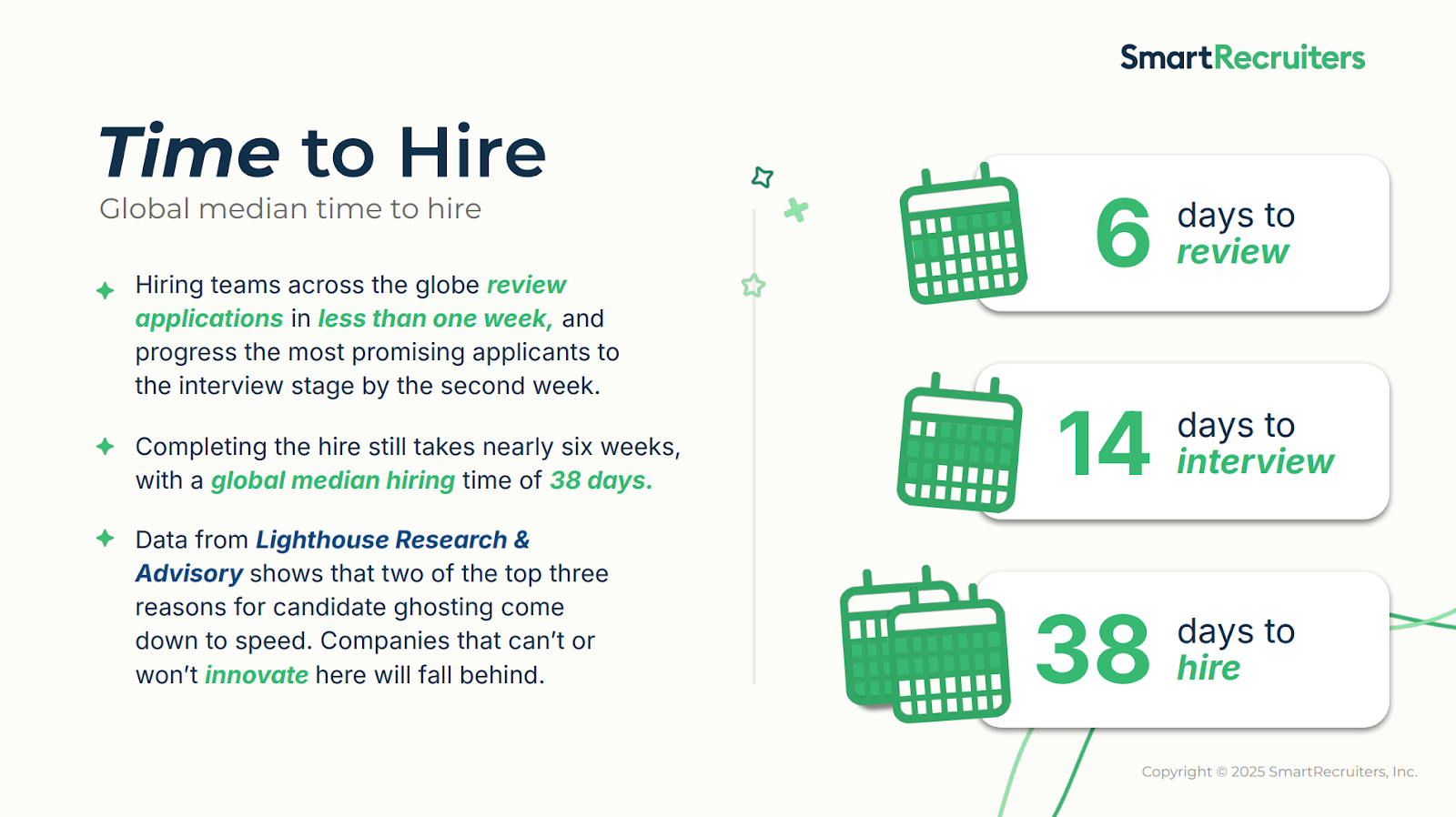
According to SmartRecruiters’ research, the global median time to hire is 38 days. But companies using artificial intelligence (AI) in their hiring processes (as many EORs do) can hire 26% faster.
Instead of waiting for entity registration, tax IDs, and local legal approvals, you can onboard the best talent in as little as 24 hours using the EOR’s existing infrastructure and technology.
Imagine you’re a rapidly growing fintech company about to launch in Asia.
You find a brilliant customer success lead in Singapore, but setting up a local entity to hire them would take 2–3 months.
With an EOR that uses AI-powered workflows (like Teamed), that fully compliant hire starts in under a week and gets paid in local currency.
For a scaling company, this can be the difference between losing top talent who drop out of slow HR processes and capturing market share early.
👉Example in action: Learn how Teamed’s local expertise helped property management company City Relay grow its team by 80%. No additional in-house human resources or compliance knowledge necessary.
An EOR takes on employer responsibilities (e.g., staying compliant with local labour, tax, and HR regulations) and reduces the risk of fines and legal disputes.
With peace of mind and fewer disruptions, you can focus on building teams and expanding into new markets without fear of compliance errors.
Say you’re a mid-sized analytics provider expanding into Spain and Brazil (the latter being one of the top 10 most complex jurisdictions for doing business).
Each country has different rules for:
While managing all of this internally could easily lead to costly mistakes, local experts who understand the nuances of each market back EORs.
You still manage your team’s work and goals. But the legal and administrative burden is off your plate.
A quality EOR lets you hire locally without committing to a full entity. Use one to test market entry, validate your product, and explore customer demand without long-term overhead.
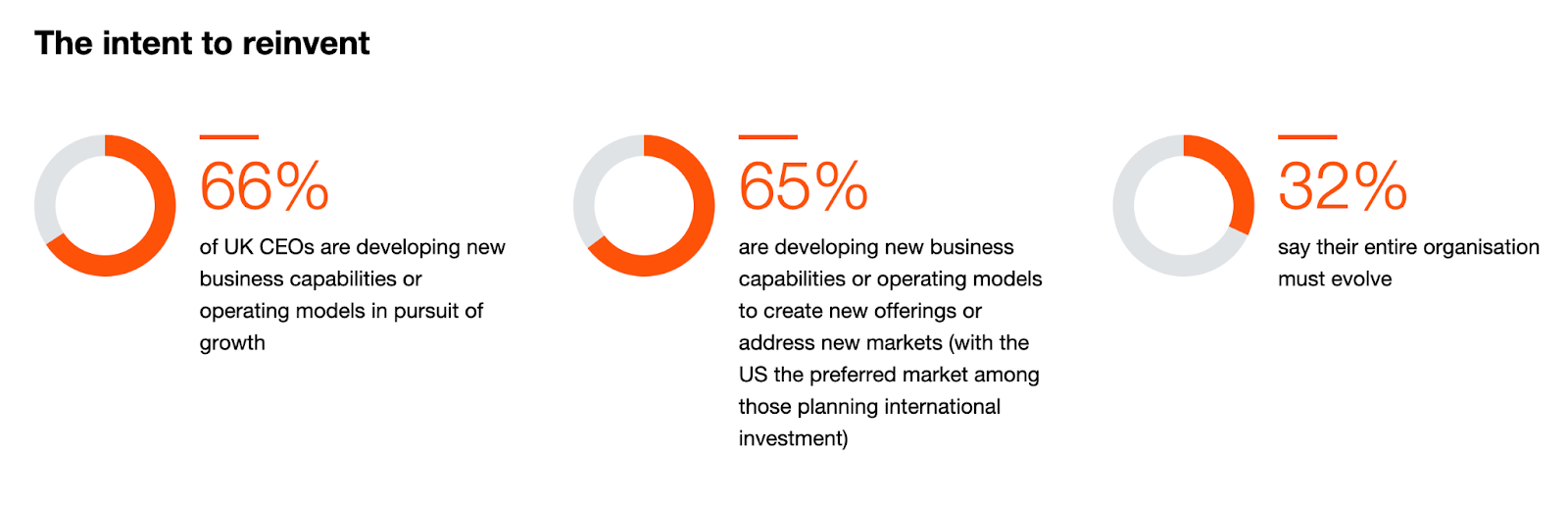
According to PwC research, 65% of British CEOs are actively planning to enter new markets (most notably, the US).
Rapidly growing businesses can use EORs to test multiple markets safely and strategically, learning what works before committing to a full legal presence.
For example, you may want to hire a small sales and support team to see if the Mexican market is viable.
Setting up a permanent establishment would take months and tens of thousands of pounds.
With an EOR, you can scale your team up or down quickly based on early results, experiment with different roles, and adjust your approach as you learn.
💡Pro tip: With software like Teamed, you’ll also save around £20,000 per country on setup costs and maintain full legal compliance.
The best EOR for your business depends on where you’re hiring, how fast you’re growing, and the level of support you need.
Whether you’re expanding into one new country or 10, a little structure in your decision-making process helps you narrow your options and find a provider that truly fits your needs.
Here are five crucial steps to do so successfully.
Before choosing an EOR, it’s essential to clarify exactly why you need one and what problems you want it to solve.
Start by outlining your target markets, expected headcount, and legal or payroll requirements.
Say you’re planning to hire five employees in France and 20 in Canada. France requires strict employment contracts and local benefits, while Canada’s payroll taxes vary by province.
Knowing this upfront helps you find a partner with the right country coverage and expertise in both markets (saving you compliance headaches later).
You likely need an EOR if you’re:
The clearer you are about your hiring and compliance needs, the easier it will be to compare providers, avoid hidden surprises, and select an EOR that fits your growth strategy.
To work out these requirements, ask questions and discuss the answers with your team.
For example:
→ This helps estimate costs and identify providers with the right expertise.
→ Sectors like healthcare, fintech, and life sciences have stricter rules around contracts, certifications, and data handling.
→ EORs can simply handle basic payroll and legal responsibilities. Or you can request onboarding, competitive benefits, and HR support.
By treating this initial research step like a blueprint for your entire hiring process, you’ll be more likely to choose an EOR that helps you scale globally with confidence.
👉Example in action: Learn how Web3 company Luganodes added 50% to its international workforce in a highly regulated industry. Teamed’s affordable, scalable systems (that also handled crypto payments) were a no-brainer.
The best-fit EOR for your business depends on your company size, industry, and growth goals.
Taking the time to find providers that actually fit your situation — not just the biggest names — saves you from expensive missteps later.
The right match leads to:
For example, European jurisdictions (like Greece) are highly complex. It’s no wonder McKinsey research indicates that European hiring is only successful around 46% of the time.
But it’s also why many US-based companies partner with providers who have a deep understanding of local employment laws.
That specific expertise makes a huge difference in avoiding regulatory gaps.
Once you have a clear idea of your hiring and compliance needs, arrange demos with promising EORs and ask targeted questions:
This stage narrows down 10+ generic vendors to two or three that can actually serve your business model.
For example, you may land on a platform like Teamed, which offers personalized support at a transparent, mid-market-friendly cost:
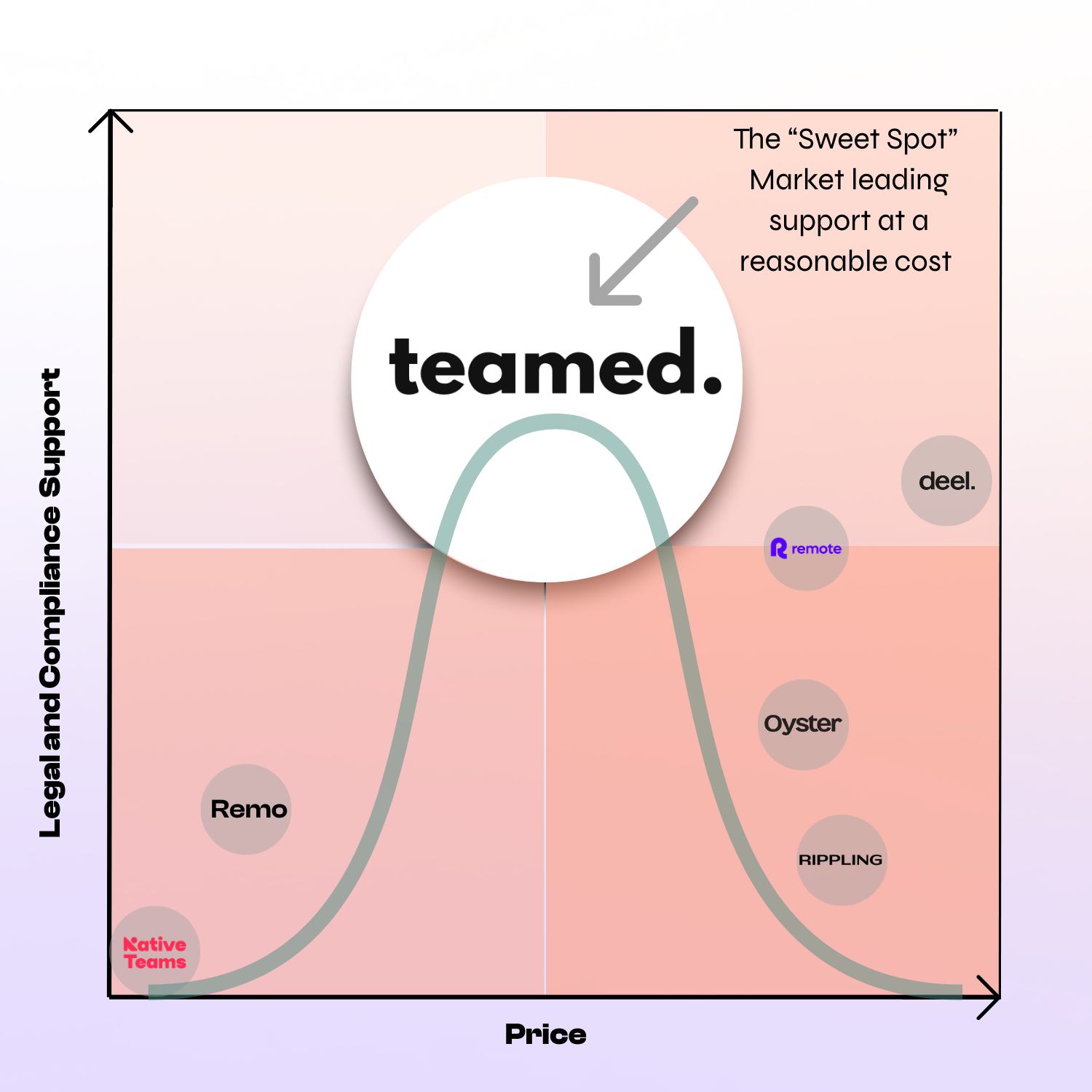
(Unlike some of the bigger players that prioritize scale over service.)
Once you have a shortlist, ask to see a sample contract or payroll report to get a feel for each provider’s transparency and accuracy.
👉Learn how to navigate EU employment compliance as a scaling business in our guide.
Ask more questions, read reviews, and talk to references to understand how each provider handles issue resolution and ongoing updates.
When you’re managing teams across time zones, support and communication can make or break your international hiring experience.
For example, service quality is one of the main reasons well-known EORs get one-star ratings like this:

Poor communication is more than inconvenient. It delays payroll, creates non-compliance risks, and frustrates employees abroad.
To avoid these consequences, test responsiveness early in the selection process by reaching out with questions through live chat, email, or phone call.
If you’re hiring across multiple regions, you’ll want an EOR partner who acts more like an extension of your HR team (not just a software platform).
Look beyond sales promises and ask:
For best results, run a request for proposal (RFP) to standardise your comparison and ask for country-specific references.
Keep it short, structured, and specific to quickly see which providers truly understand your needs.
Talking to companies that have used the EOR to hire in your target markets will also give you real proof of service quality.
Look for a partner that treats communication as part of their value, not an afterthought.
👉Example in action: Learn how recruitment firm Data Science Talent hired top South African talent while staying 100% compliant. Fast, human-centric support saved the hassle of setting up a local entity.
EOR costs may seem simple at first — usually a flat monthly fee per employee — but many providers add setup fees, currency markups, and admin charges that quickly add up as your team scales.
A provider that can’t clearly explain their pricing structure may also cut corners in service or compliance. So, transparency matters just as much as the base price.
Start by asking each provider for a complete cost breakdown before signing anything.
Key insights to request include:
Prioritize providers that are upfront about what you get and for how much.
Always choose to work with a company that’s happy to lay out pricing — with no surprise line items later.
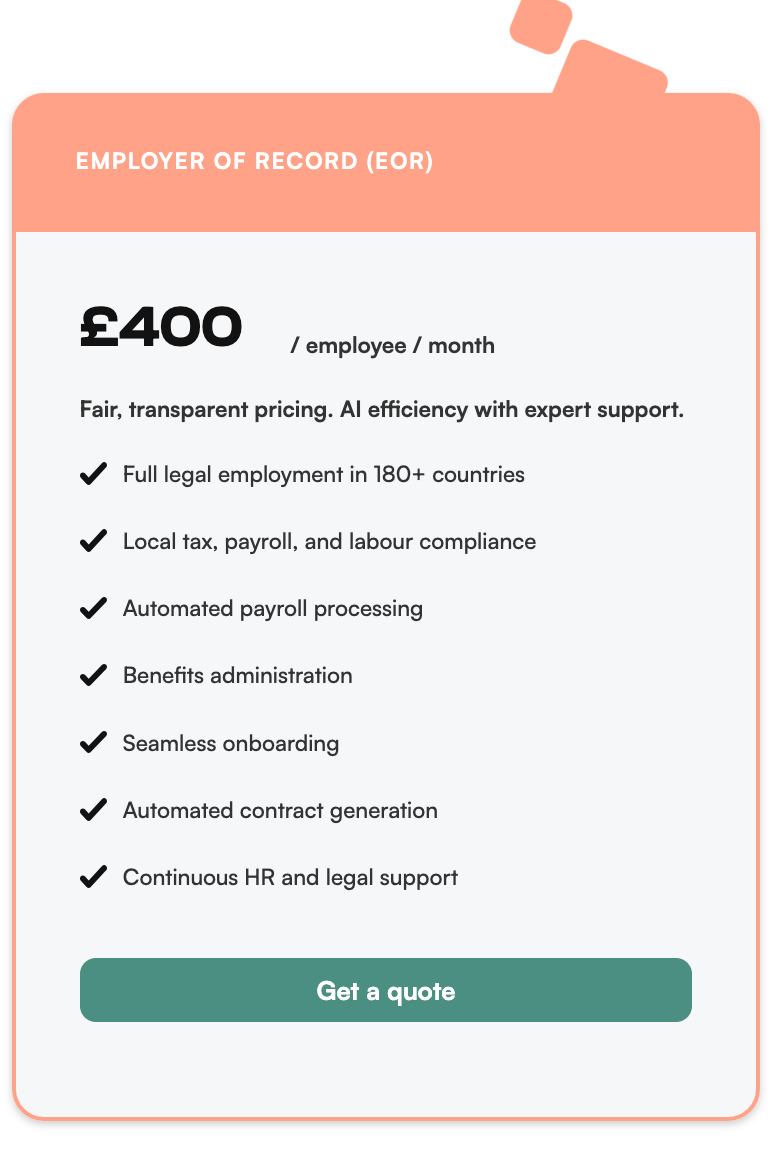
Imagine you’re expanding into France and comparing two EORs.
One charges £699 per employee per month, while another quotes £650. But the lower-priced option adds 3% in currency fees and separate social tax handling.
By year-end, that “cheaper” option can actually cost thousands more.
If cost predictability matters to you (and it always should), clarity beats low pricing every time.
💡Pro tip: Use Teamed’s cost calculator to see a realistic view of the cost to hire employees from different countries. It’s an easy way to plan budgets confidently and avoid hidden surprises.
A quality partner streamlines hiring, reduces admin time, and helps you enter new markets faster — all of which compound into measurable return on investment (ROI).
Let’s say you choose Teamed, a unified global employment platform built for mid-market and fast-scaling companies.
You want to combine AI-powered automation with real human expertise to handle everything from international contractors and EOR to payroll and entity setup:
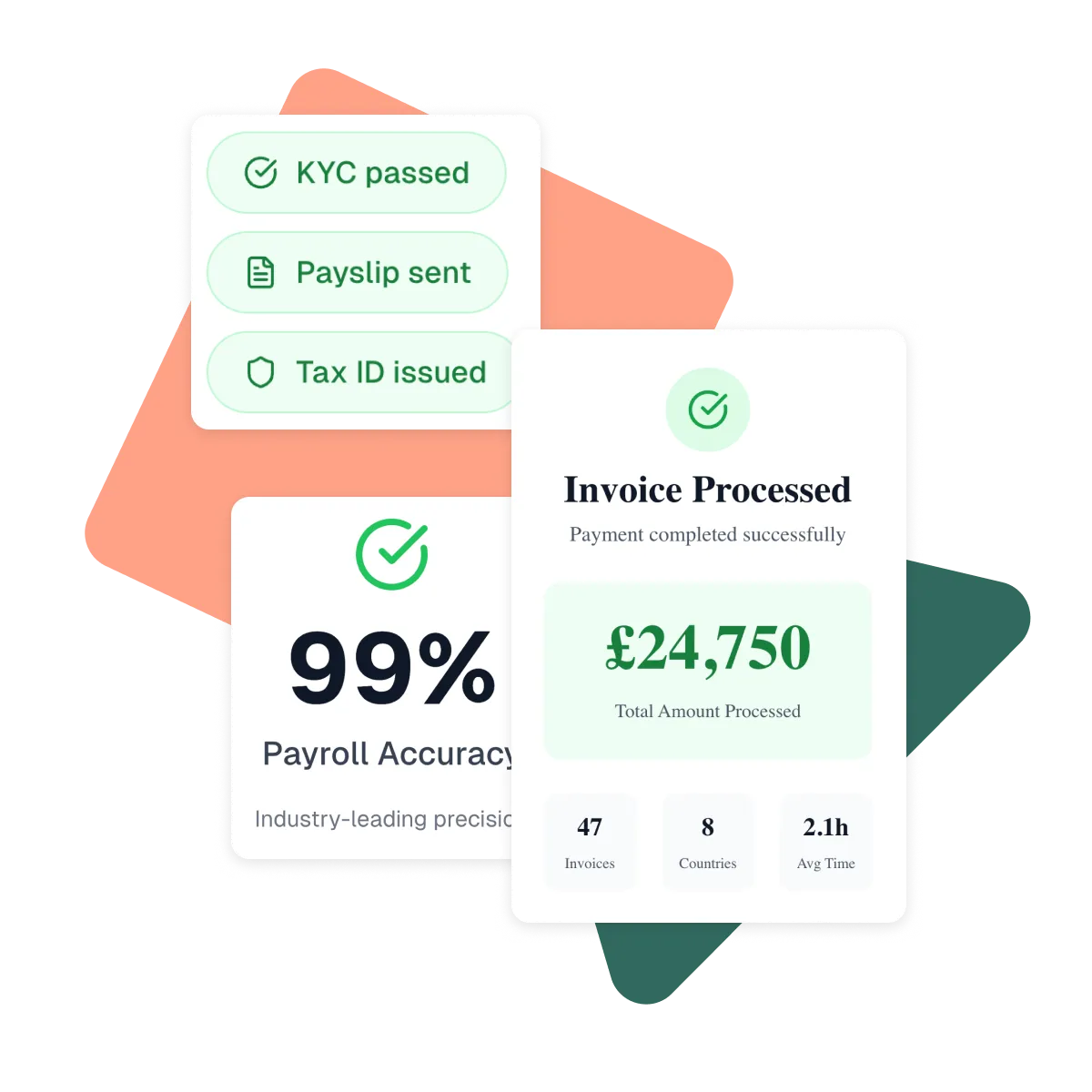
You settled on Teamed because you’re scaling into multiple regions at once and need to hire quickly while keeping compliance airtight.
Your HR team doesn’t have the bandwidth to juggle country-specific contracts, payroll systems, or filings — but you don’t want to risk fines or inconsistent employee experiences.
Unlike other providers, we have real people available 24/5 through Teamed’s support to answer questions, resolve issues, and guide you through unique scenarios:
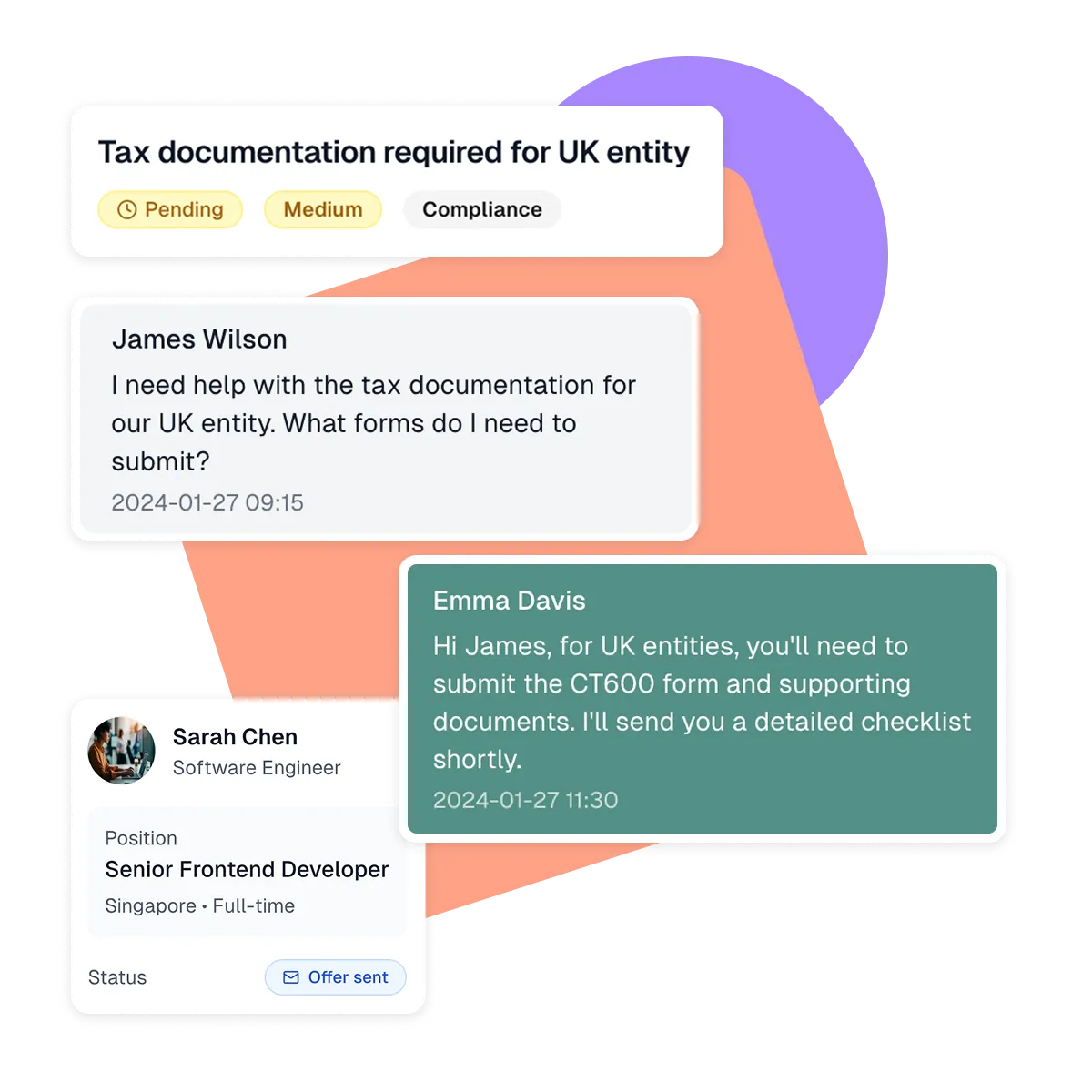
It’s not just a product, it’s a human-led service.
Teamed’s biggest strengths include:
Teamed isn’t a full-service HR suite, “set-it-and-forget-it” solution, or low-cost contractor-only tool.
But for a mid-sized, scaling company expanding globally, these limitations don’t matter. You’re laser-focused on compliance, speed, and expert support where it counts.
And the ROI speaks for itself. Companies using Teamed:
Compare this to setting up a legal entity, which can take anywhere from three days in the UK to around eight weeks in Germany (without even considering bank account delays, etc.).
Teamed is so much more than an EOR. It’s a global growth platform that combines automated workflows and expert support (from real humans) to help scaling companies expand with confidence.
👉Learn what to consider before choosing an EOR partner in this eye-opening guide.
By learning how to anticipate and manage common EOR challenges, you’ll avoid costly mistakes and keep your global teams running smoothly as your company scales.
Here are five typical challenges and how to stay ahead of them:
Imagine you’re the HR lead at a 300-person software company scaling into Australia and New Zealand.
You’ve hired your first few employees through an EOR.
But after a few months, you notice costs creeping up and minor compliance differences between countries creating confusion.
These issues are common and fixable with the right approach.
Transparency, strong communication, and proactive planning turn any potential roadblocks into opportunities to build a stronger, more scalable company.
Q: What doesn’t an EOR do?
A: An EOR doesn’t replace your HR team or manage day-to-day performance. You still direct global workforce management, culture, and goals.
The EOR handles global payroll, legal employment laws, and compliance in each new country — like a legal and administrative backbone.
Q: What are some common misconceptions about EORs?
A: Many assume EORs are only for startups or short-term hiring. But a quality provider like Teamed supports global expansion plans (from contractors to EOR to full entity), so you can scale without disruption.
Another misconception is that EORs remove control. They actually add structure and confidence in compliance, so you can focus on leading your team.
Q: What’s the difference between an EOR and setting up a local entity?
A: Setting up an entity gives you a permanent legal presence in a country. However, it can take months and cost thousands in registration fees, local tax filings, and legal expenses.
An EOR lets you hire in days — use its existing infrastructure while staying fully compliant. Later, if you outgrow the EOR model, a service like Teamed’s GEMO helps you move to entity ownership without rehiring or disrupting your team.
The right EOR lets you hire fast and focus on growing your business without getting bogged down in legal or admin work.
To maximise your investment, look for a provider that offers AI-powered automation, hands-on human support, and transparent pricing.
Plus, the ability to seamlessly transition from EOR to complete entity management as your company expands.
Book a call today and join 1,000+ scaling teams like Globant and Eventbrite who rely on Teamed to grow globally with minimal effort.

Key Takeaways
Working across borders brings real challenges when it comes to paying overtime. Some nations demand "time and a half" by law. Others let employers and workers negotiate it themselves. When you're hiring globally and get this wrong, the problem goes beyond simple payroll errors. You face legal trouble, lose your team's trust, and can pay substantial penalties. If you're moving into Europe, Asia, or the Americas, knowing how overtime works locally matters as much as understanding your core business. This guide takes you through the rules, explains the real risks, and shows how to stay within the law wherever your people work.
You'll hear "time and a half" mentioned regularly in hiring talks, particularly in North America. What it actually means changes depending on where your workers are located. When you're building a team that spans multiple countries, this isn't just a payroll detail anymore. It becomes a legal matter that can seriously hurt your business if mishandled.
Time and a half refers to payment at 150% of a worker's regular hourly rate for hours beyond a set threshold. In America, this threshold is typically 40 hours a week. If an employee earns £20 per hour normally, they'd receive £30 per hour for overtime.
This practice emerged from labour laws meant to stop people from working excessively long hours and to ensure fair compensation for that extra work. Yet not all countries follow this approach. Some nations mandate double pay instead. Others leave overtime rates entirely to whatever arrangement the employer and employee agree on.
The answer relies on what the local law says. America's Department of Labour divides workers into two types: exempt and non-exempt. Non-exempt staff qualify for overtime compensation. Exempt employees, typically those in management, professional roles, or senior positions earning a salary do not.
In Britain, there's no automatic legal entitlement to overtime payment. Employers cannot force people to work past 48 hours weekly on average unless those workers agree in writing. Many British companies do include overtime in contracts, though the law doesn't demand it the way the US does.
Across parts of Asia and Latin America, things work on a different basis entirely. If someone works more than eight hours in a single day, they get extra pay right away. The weekly total doesn't matter in those cases.
North America has fairly straightforward overtime laws in comparison to many regions, yet significant differences exist between the US and Canada, plus variations within each Canadian province.
Some workers fall outside these rules. People on a salary earning above certain thresholds while working in executive, administrative, or professional capacities often don't qualify. The same applies to independent contractors. That's precisely why government agencies examine company worker classifications so carefully.
Hiring across Canada means learning the specific rules for each province where you operate. A uniform policy simply won't work.
Worker protection sits at the centre of European employment law, but how Europe handles overtime differs from North America's approach. No universal "time and a half" rule exists across the EU, and post-Brexit, the UK maintains its own separate framework.
The EU doesn't dictate specific overtime rates. The Working Time Directive is what the EU does enforce, capping average working weeks at 48 hours measured over 17 weeks. Workers can choose to opt out, provided that the choice is genuinely voluntary rather than forced.
Individual member nations create their own overtime standards. Some demand premium pay for overtime. Some don't. You must examine the regulations of each specific country where you employ people.
While UK law does not require a premium for overtime, there are additional requirements regarding working time, rest breaks, and written agreements for exceeding 48 hours per week. Workers cannot be required to work beyond 48 hours per week on average except when they've given a written agreement to do so.
British employers typically address overtime through employment contracts. The rates differ between companies, but 133% (time and a third) or 150% (time and a half) appear commonly. Some organisations offer time off in lieu, known as TOIL, rather than additional payment.
France maintains tough overtime regulations. A 35-hour week is standard. Hours 36-43 are paid at 125% of normal wages. Anything beyond gets 150%. While employers can negotiate alternative rates through worker agreements, those agreements must satisfy minimum legal standards.
Germany permits more flexibility. No statutory overtime rate exists, though collective agreements often establish one. The law does restrict daily work to 10 hours maximum, averaging eight hours across six months. Companies must document hours and provide mandatory rest periods.
Both countries take enforcement seriously. Rule violations result in fines, litigation, and reputational damage.
Employment regulations in the Asia-Pacific area display tremendous variety. Certain countries enforce detailed overtime rules, while others have minimal regulation.
Overtime payment is legally required in Japan, but the mechanism proves more involved than a straightforward rate multiplication. Workers must receive no less than 125% for hours past eight daily or 40 weekly as per the Japan Labor Information . Weekend work earns 135%. Hours during late night (10 PM through 5 AM) carry an additional 25% surcharge.
A system called the 36 Agreement exists in Japan, requiring employers and worker representatives to agree beforehand on permissible overtime amounts. Without this agreement, requesting overtime carries no legal standing. Following high-profile karoshi cases (death from overwork), the government now cracks down on excessive overtime.
Modern Awards determine overtime rates in Australia by industry sector. The majority require time and a half for the first two overtime hours, then double time after according to the Fair Work Commission (AU) . Sunday and public holiday rates go higher still.
India's overtime provisions come from the Factories Act plus state legislation, creating variation by location. Standard practice involves paying double the ordinary rate for work beyond nine daily hours or 48 weekly hours.
In the Philippines, overtime receives 125% on regular workdays, 130% on rest days, with higher percentages for holidays. Hour documentation happens rigorously, and non-compliance creates labour disputes.
Latin America generally features strong worker protections and usually defines overtime clearly through legislation.
What overtime laws are in place across Brazil, Mexico, and Argentina?
Compliance involves more than simply knowing what laws exist. Systems must be in place for tracking time, computing payments, and disbursing funds correctly across various jurisdictions. Global teams need appropriate tools, reliable partners, and solid processes.
Payroll platforms that function well internationally combine time tracking features, currency conversion, and automatic tax calculation for each nation. They minimise human mistakes and produce audit documentation. Also, real-time automated systems capture hours as worked and alert you before overtime accumulates. Seek platforms supporting multiple countries that auto-update when regulations change.
An Employer of Record functions as your legal employer in countries where you lack an established office.
These partners maintain awareness of regulatory developments. Teamed observes the changes in employment law and revises payroll and contracts as required.
Worker misclassification represents a serious compliance threat. Document the specific duties of each role, typical working hours, and decision-making scope. Engage local legal specialists to validate classifications in each location.
Implement consistent global classification procedures while respecting local requirements. A role that qualifies as exempt in the US might not in Germany. Periodic audits identify inconsistencies before they escalate into legal crises.
An effective overtime policy protects your organisation and your staff simultaneously. Clear expectations prevent conflicts and guarantee legal compliance everywhere your people work. Creating one that functions globally demands considerable thought.
Begin with a universal section outlining your company's philosophy regarding work hours and compensation. Follow with country-specific sections addressing local requirements, overtime thresholds, and payment rates.
Define exempt versus non-exempt classifications. Specify whether overtime calculation operates daily, weekly, or both. Clarify payment versus time-off arrangements and their conditions.
Contracts require statements about standard hours, overtime eligibility, and applicable rates. If overtime demands managerial approval, specify this. For exempt classifications, explain the legal basis under local rules.
Outline your hour tracking and record-keeping process. Name timesheet submission deadlines and your method for resolving disputes. Precise language in contracts stops confusion and provides legal protection.
Your managers form the frontline against overtime violations. Educate them about who qualifies, approval procedures, and documentation requirements. Supply straightforward reference guides and flowcharts to handle intricate scenarios.
Provide systems for monitoring workload and identifying potential exhaustion. Overtime should stay occasional. When identical workers repeatedly work extended hours, that suggests your staffing or workload distribution requires adjustment.
Companies with genuine good intentions nonetheless frequently stumble with overtime. These represent the most frequent errors alongside prevention strategies.
Overtime regulations lack universality. As companies expand hiring across borders, this complexity either becomes an expensive headache or transforms into a competitive advantage.
Organisations that address overtime correctly do more than sidestep legal issues. They earn employee confidence, safeguard wellbeing, and build equitable systems functioning across locations. The foundation is recognising compliance as a strategic priority from day one.
Managing your first international hire or operating across multiple continents? Teamed simplifies compliance overtime and beyond. We give employers one platform for hiring, managing, and compensating teams across 180+ nations. Our embedded legal and HR specialists grasp local employment regulations thoroughly.
So no matter if you are bringing on your initial overseas employee or leading multi-country operations, Teamed makes overtime compliance plus everything else, straightforward, dependable, and ready to scale.
Key Takeaways
In present times, the actual take-home pay is what matters the most to the employees. And not the total that you go around telling people about. So the main thing is not the gross salary on paper but what gets credited to their bank account every month. Getting this right is not just any good practice, but it also builds trust, makes sure there is compliance, and helps to lessen such awkward conversations three months from now. But there is still an issue that many employers do not pay much attention to: how complex net pay calculations become when you are operating in many different countries. For e.g. the different tax systems, social contributions, and even local deductions can turn a simple salary offer into a big mess. So, this guide will break down everything you need to know about calculating net pay for global employees, which helps avoid common pitfalls. And also, it will help to make sure that your team gets paid right, wherever they are.
Getting payroll right means employees understand exactly what they'll receive in their bank account. This matters even more when hiring globally, as take-home pay directly impacts how people cover rent, bills, and everyday expenses.
For employers, calculating backwards from desired take-home pay is challenging. You must account for taxes, National Insurance, pension contributions, and local deductions; each country has different rules. Without a proper understanding of these regulations, mistakes are easy to make.
When employers and employees discuss payroll openly, discussing what's deducted and why, clarity emerges. This builds trust, particularly in global hiring.
Not sure what your new employees net pay will be? Dont worry we have you covered with our hiring cost calculator
Gross pay is the total amount before any deductions. Base salary is the agreed annual or monthly figure in an employment contract. Net pay is what remains after the tax authorities and other entities take their share.
The difference between net pay and gross pay can be shocking in high-tax countries. In Belgium or Denmark, net pay might be 50-60% of gross. In the UAE or Singapore, it could be 85-95%. That is why leading employers like Teamed don’t just share both figures upfront. They also make it easy for candidates to work out their own numbers using our cost calculator, which includes all extra costs and details.
Because trust breaks down fast when expectations don't match reality. Imagine recruiting a talented developer in Germany. You offer them €70,000, thinking that's generous. They accept. Then their first payslip shows €3,800 monthly instead of the €5,800 they calculated. They feel misled. You lose credibility. This happens more often than you'd think. According to OECD Taxing Wages, the tax wedge varies dramatically across countries. Understanding net pay also helps you budget well. If you're comparing the cost of hiring in Portugal to hiring in Switzerland, gross salaries alone won't give you the complete picture. You also need to consider employer contributions. Getting net pay right leads to happier employees, better retention, and fewer compliance issues.
To figure out the net pay, you take the total salary and deduct things like taxes and other things as the country rules suggest, and that's it.
Want to know what types of taxes and add on costs you have to pay in different countries? We have you covered with our cost calculator. Breaks down all relevant costs in all countries.
The basic formula looks like this:
Net Pay = Gross Pay - Income Tax - Social Security - Other Mandatory Deductions
Simple enough. But applying it requires knowing each country's specific rates. Income tax might be 0% in the UAE or 55% in Denmark for high earners. Social security could be capped at a certain threshold in Germany, but uncapped in the Netherlands. Some countries split contributions between employee and employer. Others put more burden on one side. The Global Payroll Management Institute provides frameworks for standardising these calculations, but local expertise is essential. That's why many companies partner with an Employer of Record like Teamed, which handles the complexity automatically.
In the EU, social security tends to be high but comprehensive. Employees get healthcare, pensions, and unemployment protection baked in. Tax rates vary widely, though. Estonia has a flat 20% tax. Belgium tops out at 50%. The USA has federal and state taxes, plus Social Security and Medicare. But no national healthcare contributions. Net pay varies enormously between Texas and California. APAC is even more diverse. Singapore has low taxes and mandatory pension savings. Australia has superannuation. India has complex tax slabs. Japan has high employer costs but moderate employee deductions. There's no one-size-fits-all approach. You need region-specific knowledge.
Common mistakes include using the wrong numbers for deduction like taking the wrong tax rates. Even experienced companies get this wrong.
Because payroll errors trigger investigations. Most countries have strict reporting requirements. Get the deductions wrong and you're looking at fines, back payments, and audits. The World Bank Doing Business – Tax Database tracks how many countries penalise payroll mistakes heavily.
But compliance is just half the problem. The bigger issue is trust. When an employee's take-home pay doesn't match what they expected, they blame you. Even if you explain the tax situation later, the damage is done. They start questioning other aspects of their employment. Are you transparent? Reliable? It erodes the relationship. Some employees quit over it. Others stay but become disengaged. Neither outcome is good.
You end up with unhappy employees or blown budgets. Often both.
Let's say you hire a designer in Portugal and one in the Netherlands, both at €50,000 gross. The Portuguese designer takes home roughly €37,000. The Dutch one takes home around €35,000. If they compare notes, someone feels shortchanged.
Or worse, you promise a certain lifestyle. "You'll earn €50K" sounds great until they realise €35K is what they actually get.
Another risk: you underestimate total costs. Gross pay isn't your only expense. Employer social contributions add 20–40% in many EU countries. And that’s not all, every country has different on-costs to consider: things like meal cards, state pension, mandatory 13th-month payments, social security, sick pay tax, and more. These can vary a lot and are easy to miss if you’re estimating manually.
That €50K salary might actually cost you €65K or even more all-in. Budget for gross only, and you'll overspend significantly.
This is where Teamed helps by showing you both employee net pay and employer costs upfront, including all those country-specific extras, so there are no surprises. You can even use our cost calculator to see exactly what you’ll pay yearly or monthly, with every on-cost automatically factored in.
Real-time data means you're working with current tax rates, updated thresholds, and accurate local rules. Tax laws change. Sometimes mid-year. Belgium adjusted contributions in 2024. The UK changed National Insurance rates twice in recent years.
If you're using last year's spreadsheet, you're already wrong. Real-time payroll systems pull fresh data continuously. They factor in regional variations automatically, including new on-costs or benefit changes and alert you to anything that affects your team.
This prevents errors before they happen. It also speeds up hiring. Instead of waiting days for a payroll provider to manually calculate net pay, you get instant estimates. Candidates can make informed decisions faster. Your HR team spends less time back-and-forth. Everyone wins.
Scaling globally means dealing with 180+ different tax systems. Doing this manually isn't realistic for most companies.
An Employer of Record operates legal entities in each country. They're not just calculating payroll. They're actually processing it through local systems. Teamed employs local payroll experts who understand regional nuances. They know about provincial taxes in Canada. Municipal charges in Switzerland. Industry-specific levies in France. These experts ensure deductions comply with current regulations. They file the necessary reports. They handle year-end adjustments. You don't need to become a payroll expert in 180 countries. Moreover, Teamed's platform also provides transparency.
Yes, and they should. Transparency prevents misunderstandings. Before anyone signs a contract, they deserve to know their actual take-home. Leading platforms show net pay estimates during the hiring process. Candidates enter their gross salary expectations. The system calculates estimated net pay based on their location. They see it immediately. No surprises. This builds trust from day one. Once hired, employees should access their payroll data anytime. View upcoming payments. Check deduction breakdowns. Download payslips. This level of transparency is standard with modern EORs like Teamed, where both employers and employees have full visibility into compensation details.
Global payroll adds another layer of complexity: currency. And increasingly, some companies are exploring crypto payments.
Currency swings can significantly impact take-home pay. Imagine you pay a Ukrainian employee $3,000 monthly. If the dollar strengthens 10% against the hryvnia, their local purchasing power drops. They're effectively taking a pay cut through no fault of their own. Some employers fix this by paying in local currency. You agree on a hryvnia amount, not a dollar amount. Their net pay stays stable locally. But this shifts currency risk to you. Others use currency hedging or adjust salaries quarterly based on exchange rates. Another approach: benchmark to local markets. Pay what's competitive locally, not a converted figure from your home currency. This ensures fair compensation regardless of forex movements.
Technically, yes. Some countries allow it. Others don't. The PwC Global Crypto Tax Scope outlines the rapidly evolving landscape. Crypto payments raise several questions. Is it treated as income? How is it taxed? What's the valuation date? Most tax authorities consider crypto as taxable income. Value is calculated at the time of payment. But rules vary wildly.
Crypto payments complicate net pay calculations. You need to convert to local currency for tax purposes. Report it correctly to the authorities. Withhold the right amount. Then there's the record-keeping. Every transaction must be documented. Exchange rates tracked. Year-end reporting prepared. Many payroll systems aren't set up for this yet. If you're considering crypto payments, work with specialists. Ensure you're compliant. And make sure employees understand the implications. They might end up with less take-home than expected if the market moves against them. For most companies, traditional fiat payments remain the simpler, safer option.
Managing global payroll shouldn't require a team of tax experts in every country. That's where the right partner makes all the difference.
Teamed combines local expertise with modern technology. You're not just getting software. You're getting a team of payroll professionals who live and breathe local compliance. They monitor regulatory changes. Update systems immediately. Ensure every calculation is accurate. The platform shows you transparent breakdowns. You see gross pay, employer costs, all deductions, and final net pay. Before you make an offer. Before anyone signs anything. No spreadsheets needed. No guesswork. Employees get the same transparency. Their payslips are detailed, localised, and easy to understand. They can see exactly where their money goes. Teamed also handles the admin burden, tax filings, social security registrations, year-end reporting. You focus on growing your team. They handle the complexity. And if anything does go wrong, Teamed takes responsibility. That's the EOR guarantee.
No. Due to tax rates, a $60,000 salary in Denmark yields far less take-home than in the UAE. In Denmark, high income tax and social contributions might leave the employee with around $32,000 net. In the UAE, with no income tax, they'd take home close to $57,000. Same gross. Massively different net. Your employee in Denmark would need roughly $110,000 gross to match the UAE employee's take-home. This is why smart employers benchmark to local markets rather than applying one global salary scale.
A hybrid approach is most common: core benchmarks plus cost-of-living indexing. You might set salary bands based on role and seniority. Then adjust for local market rates and purchasing power. This balances internal equity with external competitiveness. Some companies also offer location-based allowances. Housing stipends in expensive cities and transport allowances are given where needed. The key is transparency. Explain your compensation philosophy clearly. Employees accept localisation when it's logical and fair.
With Teamed: less than 24 hours. Their platform is built for speed. You can onboard an employee, set up payroll, and issue a compliant contract in under a day. Net pay calculations happen instantly. All local requirements are handled automatically. Traditional methods take weeks. Registering entities. Setting up bank accounts. Finding local payroll providers. Teamed removes those barriers. You can hire someone in Singapore on Monday and have them working by Tuesday, with payroll sorted and net pay guaranteed.
Net pay isn’t just a number on a payslip, it’s a promise to every employee, wherever they are. Get it wrong, and you damage trust, risk compliance penalties, and waste time firefighting payroll errors. Get it right, and you build a foundation for global growth and employee loyalty.
That’s why smart teams don’t try to do it alone. They partner with specialists who live and breathe global payroll, track legal changes, and guarantee accuracy, so your finance and HR teams don’t have to.
Teamed gives you one system for contractors, EOR hires, and your own-entity employees, across 180+ countries. Our platform combines local compliance automation with human expertise, so you can focus on building your team and growing your business, not decoding tax tables.
When you’re ready to hire globally without the payroll headache, explore how Teamed makes net pay calculations simple, accurate, and transparent, no matter where you operate.

Misclassification doesn't announce itself with a warning letter. It surfaces during Series B due diligence when investors discover £340,000 in contingent liabilities across eight contractors, or when HMRC launches a review that freezes your FCA licence application.
For fintechs scaling across borders, the question isn't whether to worry about contractor classification, it's how to build compliance into your workforce strategy before regulators, investors, or former contractors force the issue. This guide covers the regulatory tests that determine worker status, warning signs your arrangements have drifted into employment territory, and practical strategies Finance, Legal, and HR teams use to eliminate classification risk across 180 countries.
Key Takeaways:
The stakes are high: misclassification occurs when workers who legally qualify as employees are treated as independent contractors . Financial services firms face heightened scrutiny because regulators view employment compliance as a proxy for operational control and governance standards.
Financial regulators can suspend or restrict operating licences when employment compliance fails. In the UK, the Financial Conduct Authority examines workforce arrangements during authorisation reviews and ongoing supervision. A pattern of misclassification signals weak internal controls, raising questions about a firm's ability to meet regulatory obligations.
Misclassification creates contingent liabilities that surface during funding rounds. Investors treat employment risk as a balance sheet issue , every misclassified contractor represents potential back pay, tax arrears, and penalties. One fintech preparing for Series B discovered £340,000 in contingent liabilities across just eight contractors, forcing a three-month remediation before closing.
Backdated employment costs accumulate quickly. Employer National Insurance contributions, pension auto-enrolment, holiday pay, and statutory benefits can total 25–35% of gross salary. When applied retroactively over 18–24 months, costs erode runway and force budget reallocations. For a contractor paid £60,000 annually, backdated employer costs can exceed £50,000 over three years.
Different jurisdictions apply different tests to determine employment status. Fintechs operating across borders face the challenge of aligning working practices with multiple frameworks simultaneously.
This test assesses how much day-to-day direction the company provides over work methods, schedules, and location. If a fintech specifies when, where, and how work gets done rather than simply defining outcomes, the relationship starts resembling employment.
Control indicators include:
The integration test evaluates whether the worker's role is integral to core business operations or peripheral and project-based. A payments engineer building the transaction processing engine is more integrated than a designer creating marketing assets. The more essential the function, the stronger the case for employment status.
This test considers who bears financial risk and controls profit and loss. Does the contractor use their own equipment, invoice multiple clients, and absorb costs when projects overrun? Or does the company provide laptops, guarantee monthly payments, and reimburse expenses? The latter arrangement points toward employment.
Genuine contractors can send a qualified substitute to perform work without needing company approval. If a fintech insists on a specific individual and prohibits substitution, it indicates an employment relationship.
Identifying red flags early prevents regulatory issues and unexpected costs. Financial services firms operating in multiple jurisdictions face particular risk when working practices drift from contractual terms.
Contractors receiving detailed instructions on how, when, and where to work rather than being managed by deliverables and outcomes indicate an employment relationship. If your compliance team directs a contractor's daily schedule or requires attendance at standups, the arrangement has crossed into employment territory.
Clauses preventing contractors from working for competitors or other clients suggest employee-like control and economic dependency. Genuine contractors maintain multiple client relationships and market their services independently.
Monthly salaries or hourly rates, especially without clear project milestones, indicate employment rather than independent contracting. When payment structure mirrors employee compensation (regular monthly amounts with no variation for output), classification risk increases.
High-risk practices to avoid:
The business impact of misclassification extends beyond immediate financial penalties. Fintechs face a cascade of consequences affecting operations, reputation, and valuation.
Companies may owe backdated employer National Insurance contributions, pension contributions, and Apprenticeship Levy payments with interest and penalties over the entire misclassification period. HMRC can assess up to six years of arrears in cases of deliberate non-compliance.
Workers can claim backdated employment rights from their start date, including statutory holiday pay, overtime, notice periods, and unfair dismissal protection. Employment tribunals in the UK routinely award compensation for lost rights, with claims often settling between £15,000 and £40,000 per worker.
Public enforcement actions undermine reputation and depress valuations. Investors apply discounts to companies with unresolved employment issues. One payments platform saw its valuation cut by 18% after misclassification issues emerged during due diligence.
Fintechs frequently expand into markets where contractor rules are strict and actively enforced. Understanding jurisdiction-specific frameworks is essential for maintaining compliance across a distributed workforce.
Off-payroll working rules (IR35) may treat contractors like employees for tax purposes when they work like employees, shifting tax liability to the client. Medium and large companies engaging contractors through personal service companies bear responsibility for determining employment status.
Germany's formal status determination procedure allows authorities to decide worker classification proactively, with a strong presumption toward employment. The Deutsche Rentenversicherung examines working relationships and issues binding determinations. Once classified as an employee, backdated social security contributions become immediately due.
Many US states apply a strict three-part test: the worker is free from control, performs work outside the usual course of business, and is customarily engaged in an independently established trade. Failure on any prong triggers employee classification for labour and tax purposes.
The Monetary Authority of Singapore sets specific requirements for contractors in financial services, including fit-and-proper assessments and outsourcing controls. Material outsourcing arrangements require board approval and ongoing monitoring.
"Europe's patchwork of directives and national rules means similar roles can be classified differently across borders—consistency in working practices is critical." — Employment law specialist
HR, Finance, and Legal teams can implement strategies immediately to reduce risk and improve predictability across global operations.
Contracts reflect genuine contractor relationships with clear deliverables, autonomy, substitution rights, and limited control consistent with local law. Courts and tax authorities examine actual working practices, not contractual labels.
Essential contract elements:
Structure work around specific outcomes rather than ongoing roles or time-based tasks. Each statement of work defines what gets delivered, acceptance criteria, and payment triggers. This approach maintains the commercial nature of the relationship.
Regular reviews catch issues early and document a proactive compliance posture. The employee contractor quiz provides a structured framework for these assessments. For fintechs operating across 180 countries , automated monitoring tools track patterns that indicate classification drift.
EOR services handle employment compliance while preserving operational flexibility. When contractor arrangements no longer fit, EOR provides a compliant employment structure without establishing local entities. Teamed's 24-hour onboarding transitions contractors to compliant employment seamlessly across 180 countries.
Establish entities for functions requiring employee status or long-term presence. While entity setup involves upfront cost and ongoing administration, it provides maximum control and eliminates classification risk for core teams.
Talk to the experts about building a compliant global workforce structure.
Use a decision framework to determine when contractor arrangements no longer fit and employment solutions become necessary.
Transition when contractor fees plus compliance risk exceed the total cost of EOR or establishing an entity. EOR typically costs £400–£500 per employee monthly , while contractors command 20–40% premiums over employee salaries. When you factor in misclassification risk, EOR often becomes cost-neutral for long-term engagements beyond 12 months.
Functions subject to financial services or defence regulations typically require direct employment or EOR for regulatory compliance. Roles with access to customer data, transaction processing, or security-cleared information face heightened scrutiny.
Multiple contractors in the same location, long-term engagements exceeding 18 months, or core business roles signal the need to move to EOR or local employment. When contractor headcount in a single jurisdiction reaches 3–5 people, entity setup often becomes economically viable.
Technology reduces compliance burden while preserving human oversight where nuance matters most. Built-in AI Agents automate 70% of classification monitoring, documentation, and reporting across 180 countries, while in-country experts handle complex cases.
AI systems continuously track contractor arrangements against employment indicators and jurisdiction-specific tests. The technology flags arrangements where actual working practices diverge from contractual terms, monitoring email patterns, meeting attendance, equipment usage, and payment structures.
Contracts, SOWs, and status determinations update automatically as regulations change. AI tracks legislative amendments across jurisdictions and identifies which contractor agreements require revision.
Complex or borderline cases escalate to local employment specialists for human judgment. While AI handles routine monitoring, experts resolve edge cases involving works councils, collective bargaining agreements, and evolving regulatory interpretations.
Select employment platforms that prioritise compliance, transparency, and flexibility over transactional speed alone.
Global reach with proven local expertise in contractor and employment law matters when you're scaling across borders. Platforms with deep in-country knowledge navigate local nuances that generic solutions miss, with top providers covering 180+ countries .
Fair and transparent processes with complete documentation, status rationales, and evidence for regulatory reviews build confidence. Every classification decision comes with supporting documentation explaining the reasoning and jurisdiction-specific factors considered.
Seamless transitions from contractor to EOR to entity without disrupting worker access or resetting compliance timelines matter when your workforce strategy evolves. Not all compliance, contract, and payroll changes can be handled without client involvement or visible process steps, especially in complex jurisdictions.
Adopt a compliance-first approach, implement quarterly audits, and use EOR or local entities when roles or scale demand it. Fintechs that treat classification as a strategic priority build investor-grade compliance that withstands regulatory scrutiny and supports sustainable growth.
Teamed's 24-hour onboarding and compliance-first platform eliminates misclassification risk across 180 countries. Built-in AI Agents automate monitoring and documentation, while in-country experts handle complex cases requiring human judgment. Whether you're managing contractors, transitioning to EOR, or establishing entities, Teamed provides the certainty Finance, Legal, and HR teams need to scale with confidence.
Talk to the experts about building a compliant global workforce.
Yes. Misclassified workers may claim backdated rights to participate in share schemes if they were employees from the start. UK employment tribunals have awarded compensation for lost share option value when contractors were retrospectively reclassified.
Reclassification through EOR can be completed with 24-hour onboarding, though resolving past liabilities may take months depending on jurisdiction. Most fintechs resolve historical issues within 3–6 months.
Most European jurisdictions don't recognise hybrid arrangements. Workers are classified as either employees or genuine independent contractors based on the reality of the working relationship, not contractual creativity.
Maintain contractor agreements, project deliverables, payment records, and evidence of independence such as multiple client relationships and use of own equipment. Keep records for at least six years to cover potential HMRC assessment periods.
The EOR is the legal employer and signs local employment contracts, while your company maintains day-to-day management of the worker's tasks and outcomes. You direct the work; the EOR handles contracts, benefits, tax withholding, and statutory compliance.
Specialist nurses in Warsaw, radiologists in Madrid, clinical research associates across five European countries. The talent your healthcare organisation needs doesn't respect borders. Yet hiring internationally typically means months of entity setup, £30,000 in legal fees, and compliance risk that keeps Legal awake at night.
An Employer of Record eliminates that friction entirely by becoming the legal employer in the staff member's home country while you retain complete control over their clinical work. The global EOR market valued at USD 4.7 billion in 2025 reflects this growing demand for streamlined international hiring. This guide covers how EORs handle medical licensing, professional indemnity, patient data protection, and the step-by-step process to hire healthcare staff abroad in 24 hours.
An Employer of Record becomes the legal employer for your medical staff in their home country. They take on full employment responsibility while you retain complete control over clinical duties and day-to-day management.
The EOR appears as the employer on all official documents (contracts, tax filings, statutory registrations). They absorb the legal liability that comes with international employment. For your organisation, this means hiring a specialist nurse in Portugal or a radiologist in Poland without registering a legal entity or understanding local tax codes.
The EOR drafts locally compliant contracts, runs payroll in the correct currency , withholds appropriate taxes, and keeps employment practices aligned with both general labour standards and healthcare-specific regulations. You manage the employee's clinical work: shifts, protocols, performance reviews, patient care. The administrative burden and compliance risk transfer entirely to the EOR.
Healthcare organisations face acute talent shortages that don't respect borders. Specialist roles often have waiting lists measured in months, yet qualified professionals work across the channel or in Eastern Europe.
Traditional hiring routes demand entity setup , which typically takes three to six months and costs upwards of £30,000 before posting the role. An EOR eliminates that timeline entirely, enabling 24-hour onboarding once you've identified the right candidate.
Compliance complexity intensifies in healthcare because:
Consider a mid-sized pharmaceutical company running a Phase III trial across Europe. Rather than establishing entities in five countries to employ clinical research associates, they use an EOR to hire locally in each market. The trial launches on schedule, costs stay predictable, and Legal sleeps soundly knowing employment compliance sits with specialists.
Healthcare employment carries regulatory obligations beyond standard labour law. Missing a licensing requirement or insurance threshold doesn't just create an HR issue (it potentially compromises patient safety and invites regulatory scrutiny).
Medical professionals hold qualifications and registrations tied to their home jurisdiction. Employing them to work in or for another country often requires licence verification, conversion processes, or temporary practice permits.
Some European countries operate mutual recognition agreements for certain healthcare roles, particularly within the EU. A nurse registered in France may have a streamlined path to practise in Belgium, though the process still demands documentation, waiting periods, and sometimes additional training modules. Your EOR coordinates with local medical councils, chases documentation, and verifies the employee meets registration standards before their start date.
Hiring outside your home country often triggers visa requirements, even when using an EOR. The EOR can often sponsors the work permit application, providing employment contracts and supporting documentation that immigration authorities demand.
Healthcare roles sometimes qualify for expedited visa categories due to skills shortages. The UK's Health and Care Worker visa offers a faster route for medical professionals. Your EOR knows which categories apply and how to structure applications for approval.
Medical staff require professional indemnity insurance that meets local regulatory minimums and covers their scope of practice. Medical councils and healthcare regulators mandate this as a condition of registration.
The EOR can arrange appropriate cover as part of the employment package. They understand local insurance markets, know which providers meet regulatory standards, and verify policy limits align with the employee's role. For a hospital employing a surgeon through an EOR, this means the surgeon carries compliant indemnity cover from day one.
Hiring medical staff internationally through an EOR follows a clear sequence. Each step demands attention to healthcare-specific details that don't apply in other sectors.
Add process flow diagram showing the 5-step EOR hiring process for healthcare staff
Start by specifying the clinical role, required qualifications, and preferred location. Healthcare recruitment often targets countries with strong training programmes and available talent pools (Poland for nurses, Spain for physiotherapists, Ireland for doctors).
Your choice of country affects everything downstream: licensing requirements, salary expectations, tax obligations, and visa timelines. An EOR worth working with advises on talent availability and regulatory complexity before you commit to a specific market.
Medical qualifications demand primary-source verification (direct confirmation from the issuing university or medical council). A candidate's CV might list impressive credentials, but only primary-source checks confirm authenticity.
Your EOR typically partners with credentialing services that contact universities, medical boards, and professional bodies directly. For a consultant radiologist, this means verifying their medical degree, specialist training, and current registration status. Built-in AI Agents automate document collection and flag inconsistencies, while human experts interpret complex credentials and spot red flags that software misses.
Healthcare employment contracts include standard clauses (salary, notice periods, annual leave) plus healthcare-specific provisions around professional indemnity, clinical governance, mandatory training, and fitness-to-practise obligations.
The contract complies with local employment law in every detail. Minimum wage thresholds, maximum working hours, rest break requirements, and termination procedures vary significantly across jurisdictions. An EOR drafts contracts that satisfy local regulators while reflecting your organisation's requirements.
Once contracts are signed, onboarding moves quickly. The EOR collects tax forms, bank details, and right-to-work documentation, then sets up the employee in payroll systems and benefits platforms.
Twenty-four-hour onboarding means exactly that: from signed contract to system-ready employee in one business day. This speed matters when filling an urgent clinical gap or meeting a trial recruitment deadline.
The first payroll run tests everything (correct salary calculation, accurate tax withholding, timely payment in the right currency). An EOR's built-in AI Agents automate these calculations, cross-referencing tax tables and social security rates that change regularly.
Ongoing compliance doesn't stop after the first payslip. Tax rates change, social security thresholds adjust, and employment regulations evolve. Your EOR monitors these shifts and updates payroll calculations automatically, keeping every pay run compliant without requiring your HR team to track legislative changes across multiple countries.
Finance teams evaluating international healthcare hiring want transparent cost breakdowns. Surprise charges erode trust and make budgeting impossible.
Table shows approximate annual costs in GBP. Actual figures vary by experience level, location, and specific role requirements.
Healthcare salaries vary dramatically across Europe. A staff nurse in Warsaw earns roughly half what their London counterpart receives, yet both hold equivalent qualifications and experience.
Your EOR provides current salary data for specific roles and locations. This prevents underpaying (losing candidates to local employers) or overpaying (creating unsustainable cost structures). Some countries mandate additional payments like 13th or 14th month salaries, meal allowances, or transport subsidies that affect total compensation costs.
Teamed charges £400 per employee per month for EOR services, covering all employment administration, compliance monitoring, payroll processing, and expert support. Fair and transparent pricing means you can budget accurately.
When your finance team models the cost of hiring five nurses in Portugal, they know exactly what it costs: salaries, social contributions, insurance, and a fixed EOR fee per person. This clarity matters when presenting business cases to the board or comparing international hiring against local recruitment costs.
Healthcare organisations handle sensitive patient data governed by strict regulations. GDPR in Europe, HIPAA in the US, and equivalent frameworks globally all impose obligations on how patient information is collected, stored, and processed.
Employing medical staff internationally doesn't change your data protection obligations. If a radiologist employed through an EOR in Spain accesses UK patient records, your organisation remains the data controller responsible for GDPR compliance. The EOR handles employment records only (your IT and governance teams bear responsibility for secure access, appropriate training, and audit trails).
Clinical governance remains entirely your domain:
International employment carries risks that aren't immediately obvious. Legal teams evaluating EOR arrangements want assurance that these risks transfer effectively.
Employment misclassification: Treating an employee as a contractor exposes you to back-taxes, penalties, and employment tribunal claims. Healthcare roles almost always qualify as employment due to the level of control, integration, and ongoing relationship involved. A compliance-first EOR structures arrangements correctly from the start.
Permanent establishment risk: Employing staff in a foreign country can trigger tax residency, creating a "permanent establishment" that subjects your entire organisation to local corporate tax. EORs mitigate this risk because they're the legal employer.
Audit exposure: Tax authorities and labour inspectorates conduct audits. When they do, you need complete documentation: compliant contracts, accurate payroll records, proof of tax payments, and evidence of proper classification. A compliance-first EOR maintains this documentation as standard, providing audit-ready records that demonstrate full compliance.
"We hired clinical research associates across Europe for a multi-site trial. Teamed handled employment compliance in five countries simultaneously, giving our legal team confidence that every hire met local requirements. When one country's labour inspectorate requested documentation, Teamed provided everything within hours." — HR Director, mid-sized pharmaceutical company
Healthcare, defence, and financial services share a common characteristic: regulatory scrutiny that doesn't tolerate shortcuts. Your EOR partner needs to understand high-compliance sectors, not just basic employment law.
Geographic coverage matters, but depth matters more. An EOR operating in 180 countries provides flexibility as your organisation expands, but only if they maintain in-country expertise in each jurisdiction.
Teamed combines breadth with depth. We operate in 180 countries, backed by local specialists who understand employment law, tax obligations, and sector-specific regulations in each market. When you hire a nurse in Romania or a medical physicist in Sweden, you work with experts who know those markets intimately.
AI automates routine tasks brilliantly (payroll calculations, document collection, compliance checks against known requirements). 47% of EOR providers already embed AI for contract analysis, benefits modeling, and fraud detection. However, employment law includes grey areas, edge cases, and situations where local knowledge trumps algorithmic certainty.
Our in-country experts handle the 30% of cases where human judgement matters. A works council consultation in Germany, a collective bargaining agreement interpretation in France, or a complex visa situation in Poland (these scenarios demand specialists who understand local nuance).
Teamed charges £400 per employee per month for EOR services. That fee covers everything: employment contracts, payroll processing, tax compliance, benefits administration, and ongoing support. No percentage markups on salary, no surprise charges when tax rates adjust.
This transparency matters to Finance teams building business cases. When your CFO asks what it costs to hire ten nurses across Europe, you can provide an accurate figure without footnotes, exclusions, or "subject to additional fees" caveats.
Hiring medical staff internationally through an Employer of Record transforms an administratively complex, legally risky process into a manageable operation. You access global talent without establishing entities, maintain complete clinical control while transferring employment liability, and scale your healthcare workforce with confidence.
The right EOR partner (one with deep expertise in high-regulation sectors, transparent pricing, and the balance of AI automation with human expertise) becomes an extension of your team. They don't just process payroll; they provide the certainty that lets HR focus on talent, Finance forecast accurately, and Legal sleep soundly.
Ready to hire healthcare staff internationally without the compliance anxiety? Talk to the experts at Teamed and discover how 24-hour onboarding, coverage in 180 countries, and fair, transparent pricing make global healthcare recruitment straightforward.
Professional indemnity requirements vary by country but typically require coverage meeting local medical council standards. Your EOR arranges appropriate cover as part of the employment package, verifying policy limits align with the employee's role and scope of practice.
Licence verification involves primary-source checks with issuing medical boards and professional bodies. Most EORs partner with credentialing services to verify qualifications meet destination country standards, which can include mutual recognition processes within the EU or conversion requirements for non-EU qualifications.
Clinical supervision remains the hiring organisation's responsibility, though the EOR handles employment law compliance. You'll need qualified supervisors in the destination country to meet local clinical governance requirements and maintain professional standards.
Most reputable EORs offer seamless transition options when you establish your own entity. This typically involves transferring employment contracts without re-onboarding or losing service continuity, allowing natural progression as your international presence matures.
Overtime and on-call compensation follows destination country employment law, which varies significantly across jurisdictions. Your EOR calculates these payments according to local regulations and medical sector standards, keeping compliance with maximum working hours directives and rest period requirements that protect both employee wellbeing and patient safety.

Winning an EU government contract can transform your mid-market company's growth trajectory, but many bidders discover too late that "established in [Member State]" isn't just tender boilerplate. It's a compliance checkpoint that can disqualify your bid or delay mobilisation by months, costing you the contract entirely.
The rules around local entity requirements aren't uniform across the EU, and they vary sharply by sector, contract value, and specific tender wording. This article walks you through when local presence is truly required, which establishment model fits your timeline and budget, and how to mobilise compliant staff in 24 hours when the contract clock starts ticking.
Here's the truth: no EU-wide rule forces you to establish a local entity just to compete for public contracts. But contracting authorities can (and often do) require local presence when the work demands it.
The key term is "economic operator." Under Directive 2014/24/EU, this means any organisation capable of delivering works, goods, or services, whether based in the EU or not. When a tender specifies "established in [Member State]" or "significant local presence," you're looking at a local entity requirement.
Common triggers include in-country performance obligations, security or supply chain controls (especially in defence and pharma), tax and social charge compliance, and ongoing service delivery that requires immediate local accountability.
Watch for these phrases in tender documents:
If you spot these, start planning your establishment strategy before you submit. Waiting until after contract award can delay mobilisation by months.
Above-threshold contracts face stricter rules, and the category matters. Supplies contracts focus on delivery capability and after-sales service presence. Services contracts emphasise local workforce and regulatory registrations. Works contracts demand site presence and health and safety compliance.
For mid-market bidders in defence, pharma, or financial services, expect the tightest requirements because these sectors carry elevated compliance and security expectations.
Smaller lots can be your entry point. Contracting authorities may allow wider participation (including third-country bidders) with lighter establishment expectations for low-value scopes. Consider teaming with a local partner or using an EOR arrangement to meet presence expectations on small lots without immediate incorporation.
The legal framework shaping local entity expectations is built on several directives comprising 476 articles over 907 pages. Let's focus on what these rules mean for your ability to bid, win, and mobilise.
Directive 2014/24/EU governs most public procurement, while 2009/81/EC covers defence and security. Both set eligibility provisions that translate into what you demonstrate: registration, tax compliance, technical capacity, and financial standing.
Your local structure must avoid grounds for disqualification like unpaid taxes, criminal convictions, or breaches of labour law. Sometimes a branch suffices for straightforward service delivery. When liability, IP protection, or long-term presence matters, a subsidiary or joint venture becomes advisable.
Recent changes affecting defence contractors have tightened security of supply and performance location requirements. For defence bidders, local presence now often means vetted personnel, facility clearances, and demonstrable supply chain integrity. If you're a mid-market defence contractor, plan for these requirements early because retrospective compliance is costly and slow.
The Foreign Subsidies Regulation (FSR) affects non-EU companies bidding for EU public contracts above €250 million by requiring notification and documentation of financial contributions from non-EU governments.
For mid-market bidders, establishing a local entity simplifies the narrative and reduces perceived risk, especially given the Commission's first FSR investigation into a €610 million Bulgarian procurement involving a Chinese state-owned company.
Four establishment models exist, each with distinct trade-offs. The right choice depends on tender timing, sector constraints, and your risk appetite.
A branch offers full parent liability and direct control, with simpler setup. You register the branch, obtain tax and VAT numbers, and start operating (usually within weeks). The downside? Your parent company remains fully liable for all obligations, including employment claims and contract disputes.
A subsidiary creates a ring-fenced legal entity with separate liability. This signals commitment and credibility, especially in pharma and financial services where regulators expect distinct legal entities. Setup is slower due to notary, capital deposit, and banking requirements (typically two to three months).
A joint venture (JV) shares risk and control with a local partner. This can be useful when local knowledge, relationships, or regulatory approvals are critical. The trade-off? Partner dependency and potential conflicts over IP, decision-making, and profit distribution.
An Employer of Record (EOR) arrangement outsources employment liability to a third party that acts as the legal employer of your staff. This is the fastest route to operational readiness (often 24 hours for onboarding) and works well for service delivery contracts where direct control over IP and security is less critical.
When tender deadlines loom, speed matters. EOR arrangements offer 24-hour onboarding capability in many Member States, letting you mobilise staff immediately. A branch typically takes a few weeks. A subsidiary can take two to three months due to notary, capital, and banking steps.
For mid-market HR and Finance teams, this means planning your establishment route at the earliest tender stage, not after contract award.
Comparison of establishment models:
Setting up an entity is more than filing paperwork. It's about sequencing actions to hit bid and mobilisation milestones.
Start by evaluating corporate tax rates, labour law flexibility, banking ease, procurement track record, and sector-specific regulators. For defence contracts, jurisdictions with strong security infrastructure (France, Germany, Poland) may be preferred.
Prepare articles of association, shareholder resolutions, and director appointments. Avoid pitfalls like incomplete UBO (ultimate beneficial owner) disclosures and director residency requirements.
Satisfy KYC requirements and deposit minimum share capital. Banking can be slow, particularly in Southern and Eastern Europe, so start this process as soon as your entity is reserved.
Obtain tax IDs, VAT numbers, and employer social security accounts. Set up a payroll provider or internal payroll system.
Budgeting for EU entity setup means capturing one-off, ongoing, and opportunity costs.
Legal, notarial, and registry fees typically range from €2,000 to €10,000, depending on jurisdiction and complexity. Share capital requirements vary:
For mid-market bidders, total one-off costs typically fall between €10,000 and €30,000.
Monthly payroll processing, social filings, benefits administration, and compliance audits cost €150 to €500 per employee per month. For a team of ten, that's €18,000 to €60,000 annually.
Time-to-market matters. If entity setup delays your bid by three months, you've lost a quarter's revenue opportunity (potentially hundreds of thousands of pounds for mid-market contracts). Compare the cost of an EOR bridge (typically €400 to €600 per employee per month) against the lost margin from missed tenders. Often, the EOR route is cheaper and faster, letting you bid now and incorporate later.
Sector-specific layers influence your establishment model and staffing plans. Build compliance into your entity and HR architecture from day one.
Defence contracts demand personnel vetting, facility security clearances, and classified information handling protocols. For mid-market defence contractors, this means hiring staff who can obtain clearances (often requiring citizenship or long-term residency) and securing facilities that meet national security standards.
Pharma contracts require a Qualified Person (QP) for batch release, pharmacovigilance (PV) systems, and local safety officers. Your local entity will employ or contract these roles, and regulatory authorities expect them to be genuinely local.
Financial services contracts impose AML/KYC governance, fit-and-proper tests for directors, and local Money Laundering Reporting Officer (MLRO) roles. For Finance and Legal teams, this means your entity structure, governance, and staffing must meet regulator expectations from day one.
EOR arrangements can meet many establishment criteria, particularly where employment presence, payroll, and social security are the main requirements. However, they're less suitable for security-sensitive, defence, or IP-heavy scopes requiring direct control.
EOR works well when the contracting authority's concern is local employment, tax compliance, and immediate accountability for staff. Service delivery contracts, consultancy, and support services often fit this profile.
Your EOR will provide employer registrations, social security numbers, tax and VAT evidence, and local employment contracts. For mid-market HR teams, this means choosing an EOR provider who understands public procurement and can supply audit-ready documentation on demand.
IP assignment and confidentiality clauses may require direct employment or specific contractual addenda. Security and clearance clauses typically mandate in-house employment and facility control, ruling out standard EOR arrangements.
Winning the contract is just the start. Day-one compliance with local employment law and contract terms is non-negotiable.
Identify applicable sectoral or territorial collective agreements and implement wage scales, working hours, and benefits accordingly. In countries like France, Germany, and the Netherlands, collective agreements are legally binding and enforced through labour inspections.
If you're posting workers from another Member State, file notifications with the host country authority and secure A1 certificates proving social security coverage in the home state. Documentation must be available on-site during inspections.
Rapid deployment via standardised workflows is essential when contract start dates are tight. Teamed's built-in AI Agents automate 70% of payroll, HR, compliance, and onboarding tasks, while our in-country experts handle the complex 30%. This combination delivers 24-hour onboarding without compromising compliance, even in high-regulation sectors like defence and pharma.
Scaling across multiple Member States requires flexible infrastructure that lets you graduate from EOR to entity to multi-entity payroll without re-onboarding or data loss.
One system spanning EOR, contractors, payroll, and entities across 180 countries means seamless transitions between models without re-onboarding or data loss. For mid-market HR, Finance, and Legal teams managing 200 to 2,000 employees, this eliminates the complexity and risk of juggling multiple vendors.
If we can solve the hardest use cases (Europe, defence, finance, healthcare), the rest is easy. Connect with specialists at Teamed who understand public procurement, local entity requirements, and the compliance pitfalls that trip up mid-market bidders.
Contract termination and potential debarment from future tenders can occur. Most contracting authorities require proof of establishment before contract signature, so delays in entity setup can void the award or trigger liquidated damages clauses.
Yes, a properly registered branch with local staff and operations typically satisfies establishment requirements. However, liability remains with the parent company, which may be a concern for high-risk contracts.
EOR arrangements work indefinitely for many contracts, but security-sensitive or long-term agreements may require direct establishment. Contract terms usually specify requirements, so review these carefully during tender evaluation.
Yes, UK companies now face the same restrictions as other non-EU bidders since October 2023 unless specific trade agreement provisions apply. Local establishment often becomes necessary to compete on equal terms.
When you're a defence contractor expanding internationally, you're not just dealing with regular payroll headaches. You're navigating a minefield of export controls that can trigger million-pound fines, security clearance requirements that scrutinise every payment, and local tax laws that shift without notice.
One wrong move,misclassifying an engineer in Germany, accidentally creating permanent establishment in Poland, or routing controlled data through the wrong payroll processor—and you're looking at halted contracts, suspended clearances, and potential criminal penalties.
This article breaks down the eight most dangerous compliance failures in international defence payroll, the military-grade controls that prevent them, and how to pick the right employment model for your expansion.
For defence contractors, payroll compliance isn't just about paying people correctly and on time according to local laws. You've also got defence-specific rules around security clearances, export controls, and government contracts breathing down your neck.
The penalties are brutal. Export control violations such as International Traffic in Arms Regulations (ITAR) and Export Administration Regulations (EAR) can hit you with fines up to £1 million per violation and prison sentences up to 20 years. Every payment, data transfer, and employee record can trigger scrutiny from tax agencies, export control offices, and security clearance investigators.
If you're a mid-market defence company 200+ employees expanding into Europe or other regulated markets, this complexity multiplies fast.
Late contributions trigger automatic penalties across Europe. In France, URSSAF can impose fines within days of a missed deadline.
Your payroll records directly influence security clearance eligibility. Financial responsibility is a core factor, and payroll discrepancies can trigger adverse determinations.
Accurate payroll history supports financial responsibility checks and reduces vulnerability risk. Discrepancies, unexplained income, irregular payments, or third-party transfers, can trigger clearance suspension. Clear evidence of lawful employment, tax compliance, and consistent identity verification strengthens clearance applications.
For defence contractors, your payroll system isn't just HR infrastructure, it's a security component. Clearance investigators will review these records, and inconsistencies can delay or derail decisions.
Each compliance failure below can halt defence contracts, trigger investigations, or jeopardise clearances. Mid-market defence contractors can't afford these consequences.
Contractor vs. employee status reflects actual work control, integration, and continuity—especially critical in sensitive programmes. European tax authorities use strict tests, and defence contractors face additional scrutiny due to clearance requirements.
The consequences hit hard:
UK IR35 rules target "disguised employment" and shift liability to you. German Scheinselbständigkeit triggers social security backdating and fines. For defence contractors, misclassification also raises questions about controlled data access and clearance vetting.
"We've seen defence contractors lose offset credits worth millions because they classified local engineers as contractors when they were legally employees. The contract penalties were immediate."
Long-term work, fixed sites, or dependent agents can create a taxable presence (PE) in foreign jurisdictions. For defence contractors, this often happens through maintenance contracts, training programmes, or project offices exceeding time thresholds.
PE triggers corporate income tax filings, VAT registration requirements, and transfer pricing scrutiny. You can mitigate risk by tracking employee presence carefully, rotating personnel before thresholds, using local entities or EOR arrangements, and maintaining records of authority and decision-making.
Defence projects often involve fixed installations or embedded personnel. A six-month radar installation in Poland can trigger PE if not structured correctly, exposing you to Polish corporate tax on attributed profits.
Defence offsets often require local hiring credits as contract conditions. Governments track commitments closely, and failures result in contract penalties or tender disqualification.
Your payroll system must tag eligible roles, capture qualifying spend, and maintain auditable records linking spend to specific commitments. Errors trigger penalties for missed milestones, lost credit for legitimate hiring, and potential contract breach.
A UK contractor winning a Polish contract might commit to hiring 50 Polish engineers over three years. If payroll records don't clearly identify qualifying employees, or classification errors exclude eligible hires, you risk penalties and reputational damage.
Registration before first payroll is mandatory. Paying employees before registration triggers penalties and blocks filings.
Germany requires foreign employer and ELStAM setup before payments. France needs SIREN/SIRET and URSSAF registration with mandatory DSN submissions. The UK requires PAYE and RTI setup, with automatic HMRC penalties for delays.
Late registration doesn't just mean fines, it prevents filing returns, leaves employees without tax documentation, and creates clearance review issues.
GDPR and sovereignty laws govern payroll data with strict requirements. For defence contractors, these intersect with export controls and clearance requirements, creating complex obligations.
You need documented lawful basis for processing, minimal data collection, and proper transfer mechanisms (DPAs, SCCs, IDTAs) for EEA transfers. Some defence roles require in-country hosting for sovereignty compliance.
GDPR compliance isn't just about avoiding fines, it's about maintaining clearances and contract eligibility. Data breaches involving cleared personnel can trigger security reviews and contract suspension.
Exchange-rate movements can underpay statutory minimums. European markets impose automatic fines for late wages, and contractual SLAs may require same-day resolution.
Underpayment due to unfavourable rates creates legal exposure. Daily penalties in France for wage delays add up quickly. Late remittance penalties from authorities like URSSAF escalate fast.
Hedge currency exposure, build FX buffers into calculations, and monitor rates during payroll cycles. For defence contractors paying in multiple currencies, a 2% unfavourable movement on £500,000 monthly payroll means £10,000 in unplanned costs.
Notice periods and severance rules vary widely across Europe. For defence contractors, terminating cleared personnel requires immediate offboarding, access revocation, and final pay accuracy.
Notice periods range from one week to six months. Statutory severance calculations differ by country (TFR in Italy, indemnité de licenciement in France). Sectoral agreements may impose additional requirements.
Missteps lead to unfair dismissal claims, contract non-compliance reports, and clearance review issues. In Germany, improper dismissal can result in reinstatement orders—creating operational complications for cleared engineers on classified programmes.
You must screen all payment routes against AML, OFAC, EU, and UK sanctions lists. For defence contractors, using high-risk intermediaries or failing KYC/KYB checks can trigger severe penalties.
Screen all routes before every payroll run, avoid high-risk intermediaries, maintain transaction monitoring, and document screening results. Sanctions violations can result in contract termination, debarment, and criminal penalties.
Paying through a bank with sanctioned entity links, even unknowingly, can trigger enforcement action.
Military-standard processes keep you audit-ready and compliant. Here's how to build infrastructure that scales across 180 countries without adding headcount.
Automated pre-payroll registrations with country-specific checklists eliminate late registration risk. Local e-filing calendars with reminders and fail-safes keep you compliant.
Registration workflows trigger when adding countries, with specific checklists and requirements. E-filing calendars integrate with payroll systems, sending automatic reminders. 24-hour onboarding uses preconfigured pathways and verified banking rails. Fail-safes prevent payroll runs if registrations are incomplete.
This means onboarding a cleared German engineer Monday and running compliant payroll Friday, without hiring local HR staff.
Employment contracts with export-control clauses, nationality restrictions, and ITAR/EAR acknowledgements ensure defence compliance. GDPR-compliant data notices and cross-border terms are embedded from day one.
Export-control clauses state employee responsibilities, nationality restrictions specify clearance requirements, and compliance acknowledgements document understanding. Local-language addenda align with labour codes while ensuring enforceability.
This dual-layer approach satisfies both U.S. export-control authorities and European data protection regulators without conflicts.
AI agents track legislation and regulatory updates across 180 countries, automatically updating payroll rules for tax rates, contributions, deadlines, and data controls. Change logs document when and why rules changed.
This means you're always compliant, even when France changes URSSAF rates mid-year or Germany updates Kurzarbeit rules. Built-in AI automates 70% of payroll and compliance while experts handle complex cases.
ISO 27001 and defence-grade encryption with compartmentalised access controls protect payroll data. Immutable audit logs for every action provide evidence for audits and clearance reviews.
AES-256 encryption secures data at rest and in transit. Compartmentalised controls ensure staff see only what they need. MFA and immediate revocation protect sensitive data. Segregated environments offer in-country residency for classified projects.
Your payroll data meets classified programme security standards, and you can prove it during spot audits.
Mid-market defence contractors face a strategic choice: in-house payroll, Employer of Record (EOR), or local entities. Each has different implications for compliance, speed, and cost.
In-house gives full control but requires entity setup, local expertise, and ongoing management. EOR makes the EOR the legal employer while you retain operational and export-control responsibilities. Setup takes 24–72 hours with simultaneous multi-country onboarding.
Local entities offer control and lower per-employee costs once volume justifies infrastructure, but require ongoing management.
For defence contractors, EOR is often the fastest compliant path, especially when speed matters and you don't yet have volume for local entities.
The optimal strategy is often hybrid: EOR for new markets and pilots, then graduate to local entities once volume justifies it—without re-onboarding employees.
Defence contractors face audits from tax authorities, clearance investigators, and compliance officers. Your records must satisfy all three.
Statutory requirements vary, but defence contractors face longer periods due to contract and clearance requirements. Maintain records in secure, searchable formats with audit integrity.
Germany requires 10 years for payroll records. France requires 5 years for payslips. The UK requires 3+ years (HMRC recommends 6). Defence contracts often require 7 years for U.S. government work.
Store records in immutable formats with timestamps, version control, and access logs.
Payroll data sits at the intersection of export controls, data privacy, and employment law. Map data flows, minimise controlled data, and ensure lawful processing basis.
If payroll includes classified programme codes, those may be export-controlled. Transferring to non-U.S. processors without proper controls could constitute ITAR violations.
Maintain ready-to-present evidence packs with registrations, filings, receipts, access logs, and approval workflows. Keep registration documents, tax confirmations, contribution receipts, and access logs with timestamps.
Implement role-based access with MFA and immediate revocation for cleared staff. Run quarterly internal audits with corrective action tracking.
When compliance officers arrive unannounced, hand them complete evidence packs within minutes - not scrambled reconstructions from emails and spreadsheets.
Teamed specialises in defence contractor compliance with transparent pricing, built-in AI for real-time law monitoring, and deep experience in export-control and data-sovereignty cases.
We've been in global employment long enough to understand compliance pitfalls and real pain points - and we're nimble enough to adopt AI where it delivers value.
Our AI agents automate 70% of payroll, HR, and compliance while experts handle complex cases like works councils and security clearance coordination. We cover 180 countries with 24-hour onboarding, so you can hire cleared engineers without setting up entities or navigating bureaucracy.
Talk to our defence payroll experts and get compliant fast, at scale.
Yes, but eligibility depends on authority rules, project classification, and nationality restrictions. U.S. clearances typically require citizenship, while UK clearances may permit non-UK nationals for certain roles.
Maintain pristine payroll documentation - proof of lawful employment, timely taxes, and stable income - to support financial responsibility checks and continuous evaluation overseas.
Conduct risk-based audits quarterly, with monthly checks for high-risk roles or jurisdictions. Verify access controls, sanctions screening logs, export-licence coverage, and segregation of duties.
For classified programmes, audit frequency may be dictated by contract terms or security guides.
Paying in local currency doesn't itself trigger licence needs, but related data flows can. If payroll files include controlled technical data or are processed in restricted locations, you may need licences or approved transfer mechanisms.
Keep payroll data scoped to necessary fields and process it in compliant jurisdictions to avoid inadvertent violations.
Remote work has completely reshaped the way companies think about employee engagement. Questions that once worked in office settings often fall flat when your team is scattered across time zones, cultures, and working styles. According to Gallup's research on engagement, companies with highly engaged teams see 23% higher profitability. The challenge lies in defining what ‘engagement’ means within a remote-first setup. In fact, studies show 73% of companies struggle to measure engagement properly with distributed teams, and poorly designed surveys can actually drive participation down by as much as 40% year-over-year.
The issue goes beyond simply rewording a few survey questions. Remote engagement plays by an entirely different rulebook. For instance, an engineer in Singapore may experience collaboration differently from a customer success representative in São Paulo. Your surveys have to reflect these differences if you want meaningful results.
At Teamed Global, we support companies in managing the complexities of distributed workforces. Measuring and improving engagement across borders is one of the trickiest challenges, and this blog breaks down the questions that really work, why they matter, and how to design surveys that lead to action rather than frustration.
Let’s look at the strategies successful global organisations use to build strong, connected remote cultures.
Remote work fundamentally transforms the employee experience itself. Without a shared office, you lose the usual cues, casual conversations in the hallway, the quick read of body language, or the spontaneous collaboration that happens by the coffee machine. Rather, engagement hinges on the degree to which people connect via screens, the way they navigate time zones, as well as the way they stay motivated without a manager hovering nearby.
The stakes are higher too. An unhappy office worker might still pick up energy from colleagues around them or seek quick encouragement from colleagues.. An unhappy remote worker can slip into isolation, leading to faster burnout and higher turnover. Deloitte's Human Capital research shows that disconnected remote employees are 21% more likely to leave within six months compared to their office-based peers.
Several elements influence how remote employees connect with their work and colleagues. Instead of relying upon old office-based assumptions, surveys need to measure each of these actual drivers.
Remote engagement surveys present unique pitfalls that can undermine results if not handled carefully:
Designing questions for remote surveys means rethinking the fundamentals. You’re not just swapping “office” for “home office”, you’re building a framework that measures what remote work is really about.
The best questions emphasise outcomes over activities. Do not ask, “Did you attend this week’s team meeting?” but instead ask, “Do you feel you are well-informed about all team decisions?” Rather than monitoring office presence, satisfaction with flexible working arrangements as well as productivity should be measured.
To work globally, survey questions need thoughtful adaptation:
The format shapes the kind of insights you’ll get:
Research and experience show that effective remote surveys consistently explore five areas: trust, communication, inclusion, wellbeing, and HR support.
Trust is the bedrock of remote collaboration. Since managers can’t see work in progress daily, employees need to feel empowered and trusted:
Remote teams live and die by their communication practices. The goal isn’t just volume, it’s alignment.
Inclusion isn’t automatic; it takes effort when people rarely share a physical space.
Burnout is notoriously hard to spot when you don’t see employees daily.
For remote workers, HR processes are the backbone of day-to-day experience.
Collecting data is only the first step. The real impact comes from analysing results and, most importantly, taking action. This becomes more complex in global, distributed setups where cultural expectations and regional contexts differ. Qualtrics' engagement survey guide highlights that action planning is where many organisations fall short, particularly with remote teams.
Remote surveys generate a lot of data, but not all of it is equally valuable. HR teams should focus on metrics that truly capture the distributed employee experience:
Survey results are not very useful unless they lead to action. In remote environments, follow-up requires both cultural awareness and practical adjustments:
The right platforms can simplify the complex job of managing global feedback:
The timing holds a great value in remote work set-up. It is because problems only increase when no one's around to solve them. Employees may quickly become frustrated and isolated if issues go unaddressed.
Choosing how often to run surveys is all about balance:
Global teams don’t share the same rhythms, so timing surveys thoughtfully can make or break participation:
Remote surveys collect sensitive information, so handling compliance and privacy is critical. Regulations differ widely, and mistakes can lead to costly fines and lost employee trust.
Each country brings its own set of rules:
Employees will only respond honestly if they trust the process. HR leaders must set and communicate clear standards:
Navigating compliance across multiple countries requires both technology and expertise:
Building engagement in distributed teams means recognising why people choose remote work: flexibility, independence, and better balance between work and life. Surveys should strengthen these motives, not undermine them.
That means asking the right questions: productivity, satisfaction, connection, and support instead of outdated, office-centric measures. The data you collect should remove obstacles, improve collaboration, and build confidence. It should never be used to micromanage or unfairly monitor employees.
And if you’re running teams across multiple countries, the complexity multiplies. Local laws, cultural nuances, and compliance risks can turn a simple engagement survey into a global HR headache.
That’s where Teamed comes in. We’re built for mid-market companies expanding globally without big HR ops teams. Our platform unifies contractors, EOR hires, and own-entity staff in one system, with embedded HR and legal experts to ensure surveys, policies, and processes are locally compliant and culturally relevant across 180+ countries.
Done right, engagement surveys don’t just measure happiness, they create stronger, more sustainable working relationships.
Ready to take the next step? Book a quick fit call with Teamed and see how we help remote teams thrive.
A: Good engagement survey questions focus on communication, recognition, support, and growth. Examples include: “Do you feel your contributions are valued?” and “Do you have the tools to perform your job effectively?” Tailor questions to remote work contexts for accurate insights.
A: Five effective questions include:
A: The 4 P’s of engagement are Purpose, People, Process, and Performance. Ensuring employees understand the company’s purpose, have strong relationships, clear workflows, and measurable goals drives engagement, especially in remote teams.
A: Ten strong survey questions include:
A: Quarterly surveys are ideal for remote teams. Short, focused pulse surveys monthly or bi-monthly can supplement deeper quarterly surveys to track trends, adjust policies, and improve engagement continuously.
A: Yes. Anonymous surveys encourage honesty, especially in remote settings where employees may hesitate to share feedback openly. Ensure anonymity while providing context to maintain actionable insights.
A: Analyze results to identify areas like communication gaps, recognition issues, or workload challenges. Follow up with actionable steps, transparent communication, and continuous monitoring to boost engagement and retention in remote teams.
Tired of running payroll by hand, drowning in spreadsheets, or struggling to hire overseas?
It doesn’t have to be this hard.
The right platform slashes admin, eliminates errors, and elevates the employee experience, whether you’re a startup going global or already managing a remote team.
In this article, you’ll find honest reviews of the top HR and payroll tools, why they’re worth your time, and real user feedback to help you pick wisely.
Already got a shortlist? We’ll also highlight what to compare before you commit.
Here’s a summary of the best HR and payroll platforms on the market, their key features, USPs and pricing:
You’ll find more details on each tool in our detailed roundup below.
There’s no single best HR and payroll software. The right platform for your company is the one that fits your specific business needs, budget, and growth plans.
While tools vary in features, focus, and geographic coverage, you’ll want one that automates payroll processing, regulatory compliance, and document management.
Finding the right tool makes a big difference as it means:
Choose the wrong tool, and you might miss out on the perfect hire, incur penalties, and expose your company to legal risks.
So, which tool should you choose? Let’s consider a few top options.
Here’s our list of the best HR and payroll solutions, complete with details of pros and cons and what real users think, to help you evaluate fairly.
Teamed is a unified global employment platform built for mid-market and rapidly scaling companies. We combine AI-powered automation with hands-on experts to handle contractors, EOR, payroll, and entities so you can hire anywhere without compliance anxiety.
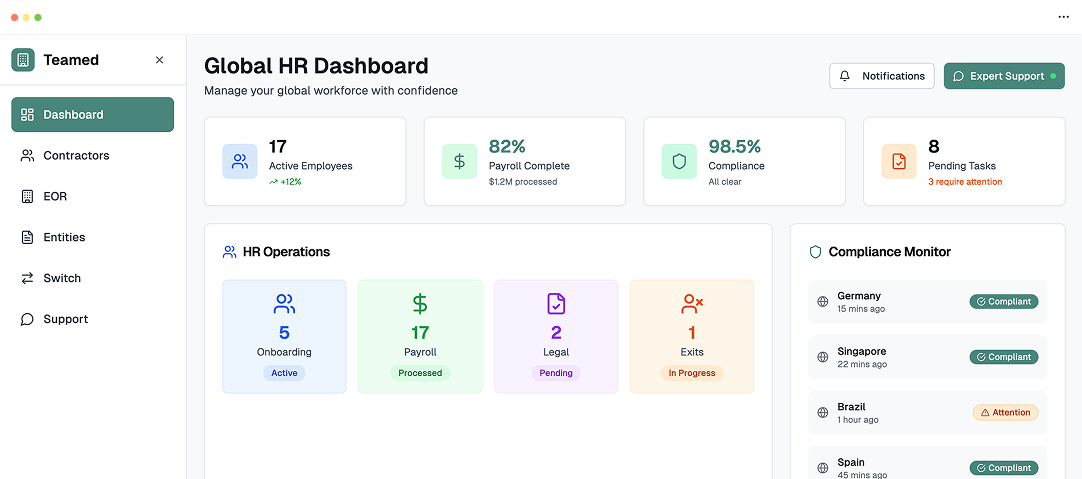
Finding the right talent locally can be hard. Going global adds layers of complexity around payroll, compliance, and local laws. That’s where Teamed steps in. We handle the risk and admin so you can focus on hiring the best people, wherever they are.
Teamed is more than a platform, we act as an extension of your team, with expert support and one-to-one guidance for cross-border HR challenges. And because we’ve been in the space long enough to know what matters, but are nimble enough to adopt the right technology, we’ve built in AI Agents to automate 70% of payroll and HR tasks. That means faster onboarding, fewer errors, and pricing that’s always fair and transparent.
Key features:
What we’re great at:
Why we might not be for everyone:
Not a do-everything HR suite. We focus on being the leading global employment platform, covering contractors, EOR, payroll, and entities, not every HR feature under the sun.
Pricing:
User feedback:
Here’s what Teamed reviewers on G2 had to say about us.
“The best thing about Teamed is their outstanding support and personalised approach, they truly make you feel valued and understood.”
“Our international employment requirements are taken care of in no time at all, and the support provided is exceptional.”
“The people at Teamed understand that setting up payroll for remote team members is not always a copy-and-paste job, and that unforeseen issues may arise. Thankfully, they have some very nice, helpful humans who go above and beyond to help you navigate those issues in a timely fashion.”
👉Tip: Learn what an EOR solution covers in our comprehensive EOR vs. legal entity guide.
Gusto is a full-service payroll provider that helps small and medium-sized businesses run payroll, administer employee benefits, and manage tax compliance.
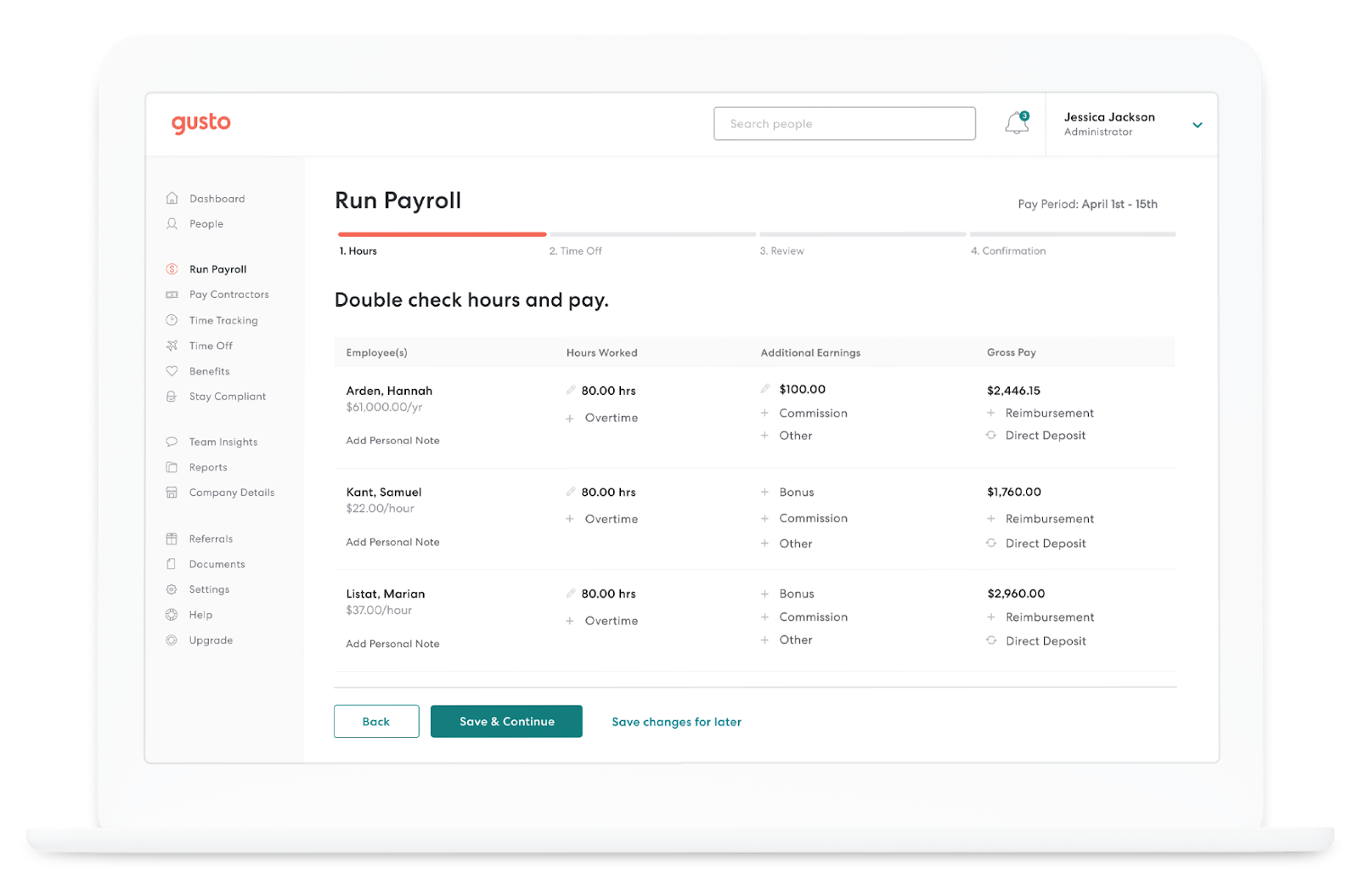
It’s a smart choice for startups and other companies that want to streamline HR management by integrating key functions into one platform.
Think payroll, employee benefits, hiring and onboarding, attendance tracking, and talent management.
This way, small businesses stay on top of payroll and HR tasks with automated compliance tools and minimal setup.
Key features:
What we like:
What we dislike:
Pricing:
User feedback:
Here’s what reviewers on G2 have to say about Gusto.
“As an employee, I find Gusto easy to use for tracking daily hours, planning time off, and budgeting. Correcting mistakes is straightforward, and the user interface is intuitive.”
“Gusto has a pretty clean and modern UI, making it easy to navigate. Clocking in and out is very simple, which is great for both employees and managers.”
“Customer support can be slow to respond during busy times like year-end or tax season. Reporting features could also be more customisable for businesses that want deeper insights. Pricing feels a little high for very small teams, and it would be nice if the platform had stronger international payroll support.”
Deel is an all-in-one global HR solution that helps remote companies manage payroll, HR, and IT.
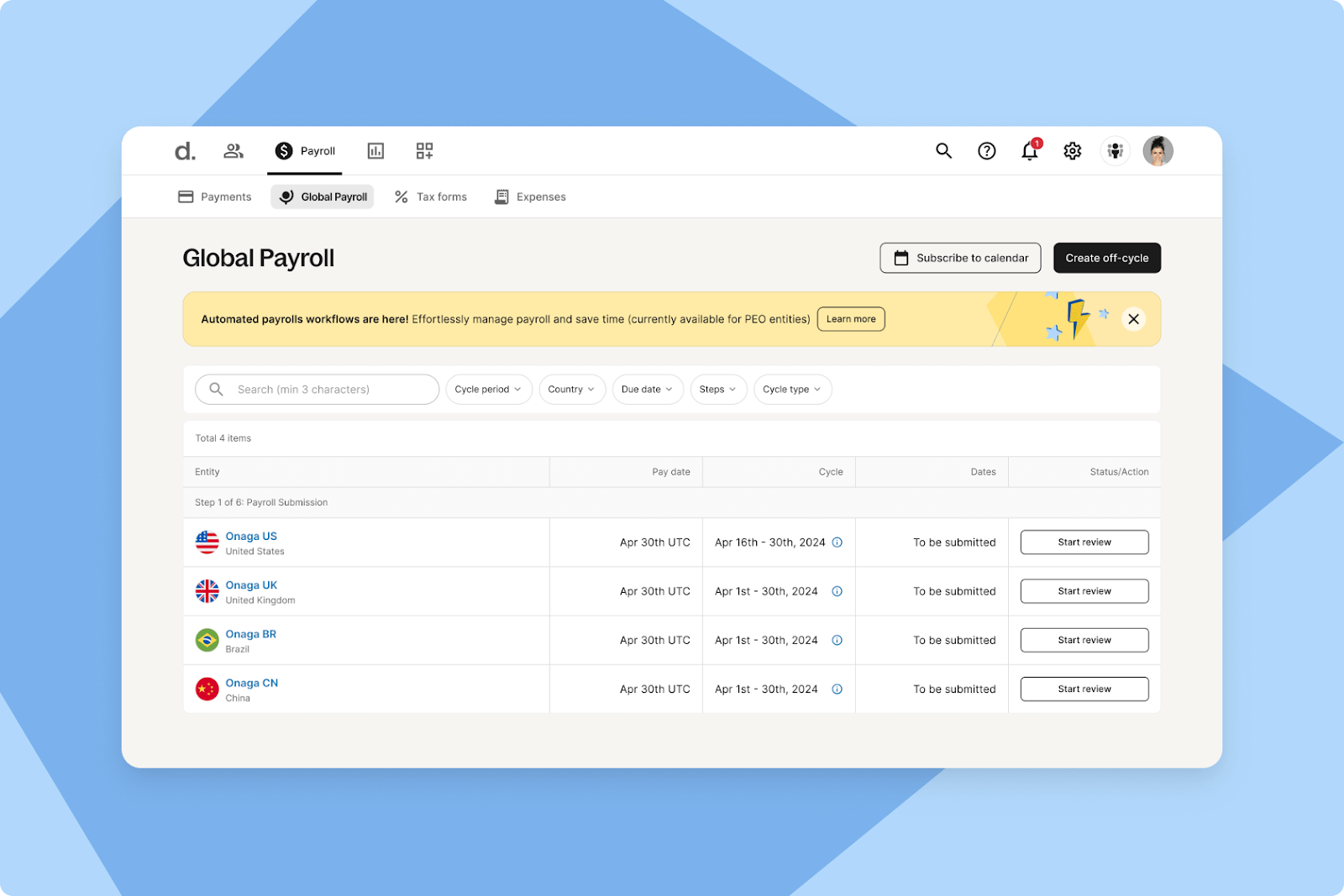
If you’re expanding across borders, Deel streamlines the hiring process so you won’t have to worry about local tax systems or banking complications.
The tool simplifies global hiring with flexible EOR services and fully compliant multi-country payroll.
Key features:
What we like:
What we dislike:
Pricing:
User feedback:
Here’s what users have to say about Deel.
“I find the multinational capabilities of Deel incredibly useful. It greatly assists in managing payments for a diverse team, including paying contractors in different countries.”
“Deel offers an incredibly efficient and user-friendly platform for managing international payroll, contracts, and compliance. I appreciate how easy it is to onboard contractors and employees across various countries without dealing with the complex legalities of global hiring.”
“High costs for smaller teams. While Deel offers great value for scaling companies, the flat per-contractor/employee fee may be costly for startups or small businesses. [...] Reporting features are somewhat basic. More advanced reporting or export customisation would be helpful for larger HR teams.”
👉Tip: Identify the right tool for your business’s HR and payroll needs with our detailed guide to the best Deel alternatives.
Rippling is an advanced all-in-one platform for HR, IT, payroll, and spend management. It combines the tools for managing and automating the employee lifecycle, from hiring to retiring.
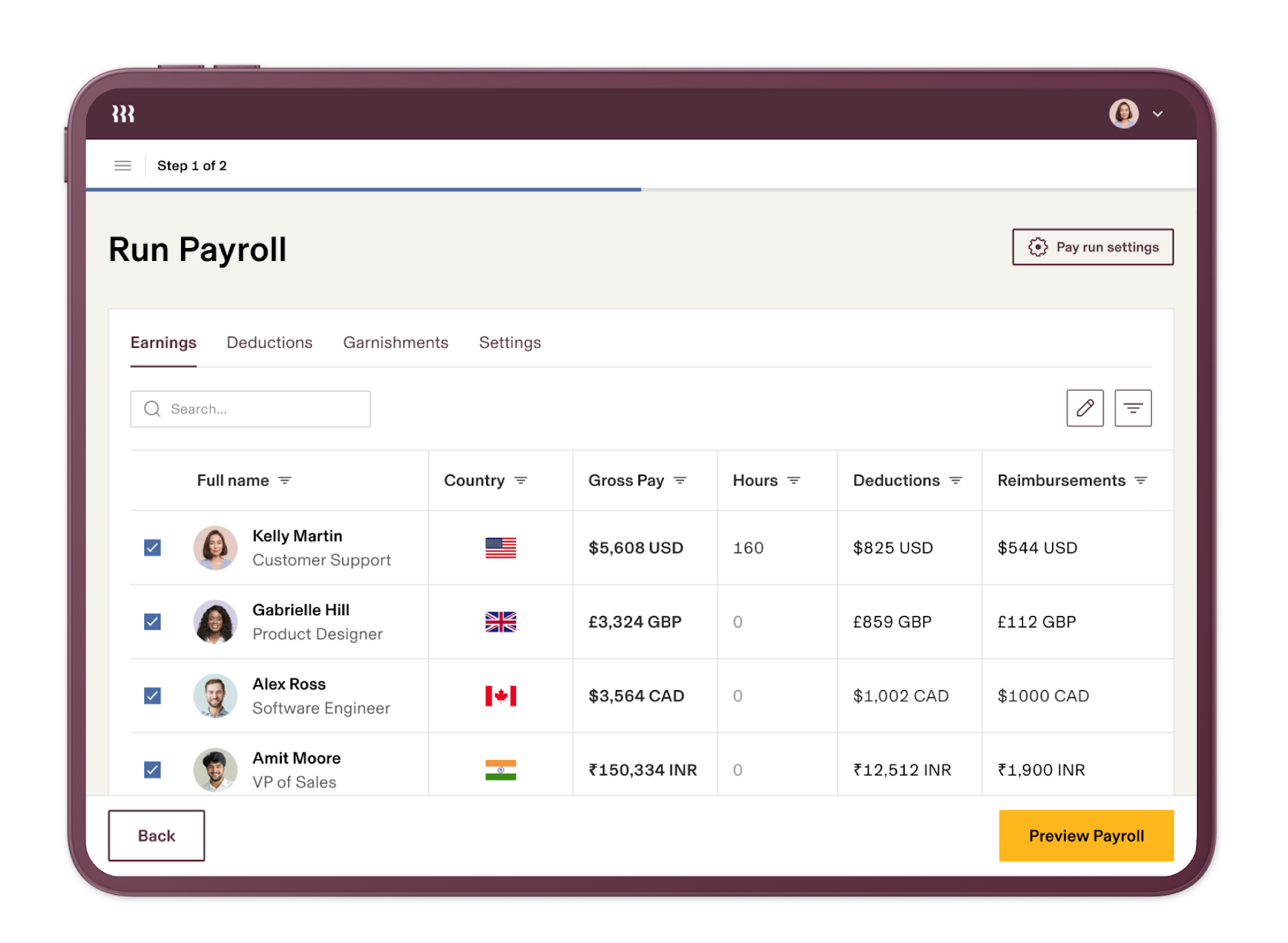
Finance teams will appreciate the spend management tools, which offer granular analysis of company-wide employee spending.
This single platform with a suite of tools for multiple operations gives companies peace of mind that nothing will slip through the cracks.
Key features:
What we like:
What we dislike:
Pricing:
User feedback:
Check out what users have to say about Rippling.
“Rippling is an incredibly convenient, all-in-one HR platform that makes managing people operations simple and seamless.”
“I really appreciate how Rippling brings everything, HR, IT, payroll, benefits, into one clean, intuitive dashboard. Reviewers consistently note its ‘sleek, modern UI’ and praise features like single sign-on and automated onboarding, which save hours each week.”
“Because Rippling does so much, the platform can feel a bit overwhelming at first, there’s a learning curve if you’re new to it. Some of the advanced reporting and customisation requires more setup than expected, and occasionally I need to lean on support or documentation to get it right. The product is evolving quickly (which is mostly a positive), but it means features sometimes feel a step ahead of the documentation.”
Justworks is a simple integrated payroll and HR solution designed for small businesses. It has most of the features these companies need without overwhelming HR teams with irrelevant features.
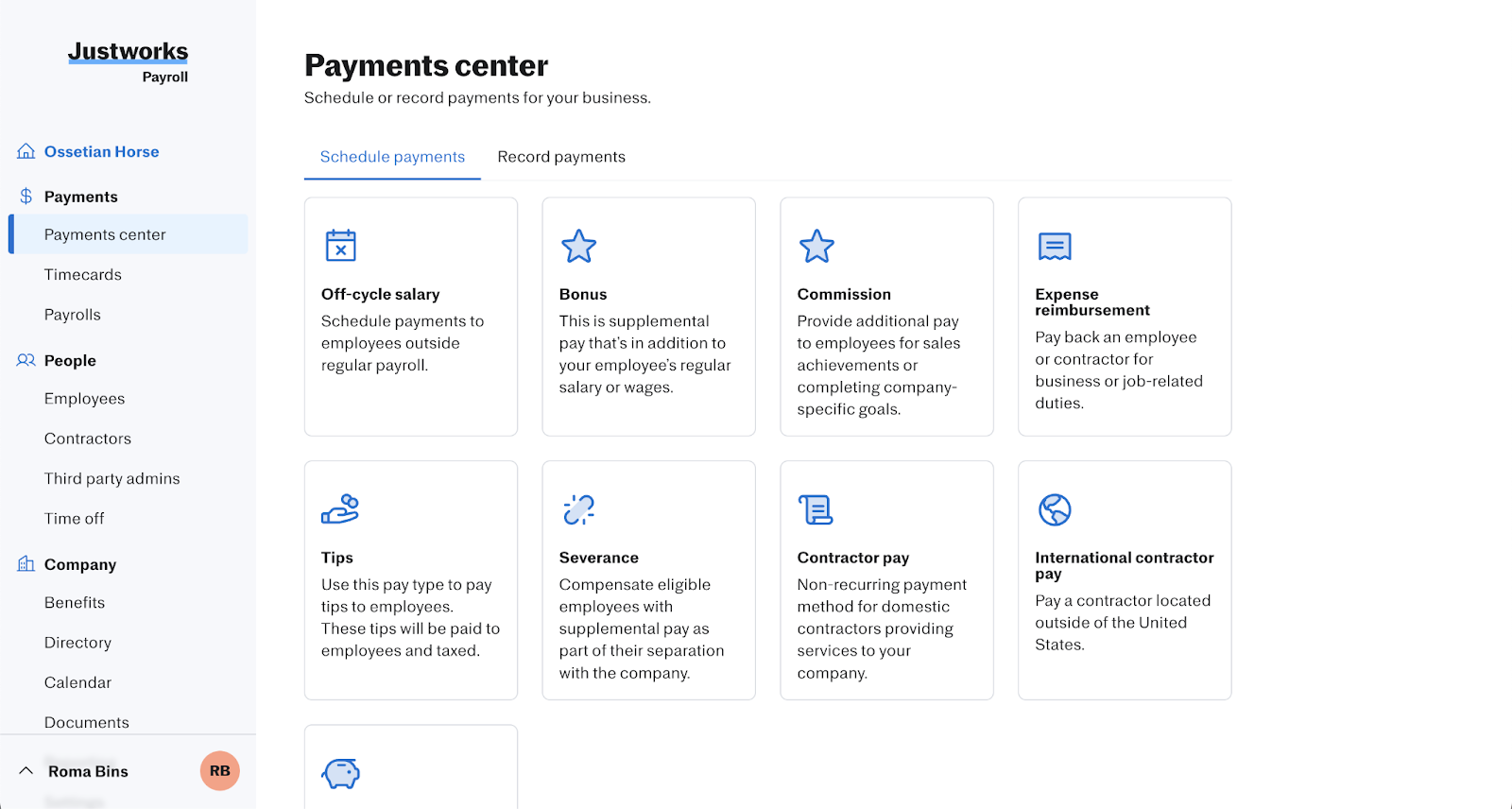
The platform also helps businesses expand internationally by acting as an EOR (which takes on full legal responsibility for your employees) or a PEO (which partners with companies to provide HR services).
In short, it’s an accessible solution for small businesses looking to manage payroll and benefits in one place.
Key features:
What we like:
What we dislike:
Pricing:
User feedback:
Here’s how users reviewed Justworks on G2.
“I appreciate the ability for my employees to control their time tracking, PTO requests, benefits, etc. It's easy for me to approve hours and PTO. I also like having it all under one site that's easy to access.”
“Justworks is a streamlined, user-friendly platform that makes managing payroll, benefits, and compliance surprisingly accessible for small teams.”
“There is a lack of flexibility in customising features to fit our organisation’s needs. For example, we operate on a 35-hour work week, but the platform is built around a 40-hour model, which creates challenges with time-off tracking. The reporting tools also need improvement, and our experience with the Account Manager has not met expectations.”
Remote is an all-in-one platform that simplifies the international recruitment process.

It comes with various tools to help you find the best candidate. Plus inventive compensation and payment features like the ability to offer company equity, to build an enticing package.
Remote supports efficient hiring and payroll management so teams can coordinate across borders.
Key features:
What we like:
What we dislike:
Pricing:
User feedback:
Find out what G2 reviews say about Remote below.
“I appreciate the ability to submit days off, view payslips, and add expenses easily. Remote facilitates my working relationship with the company by enabling us to maintain necessary legal contracts and employment records.”
“Remote makes it easy to hire and pay people in different countries. Everything is in one place, like contracts, documents, and payroll. We use it regularly to manage our international team.”
“The initial learning curve with Remote was slightly challenging for me due to not knowing how to use it initially. However, I managed to overcome this by learning on my own.”
BambooHR’s cloud-based HR management system simplifies people management by bringing employee data, benefits, timesheets and payroll in one space.
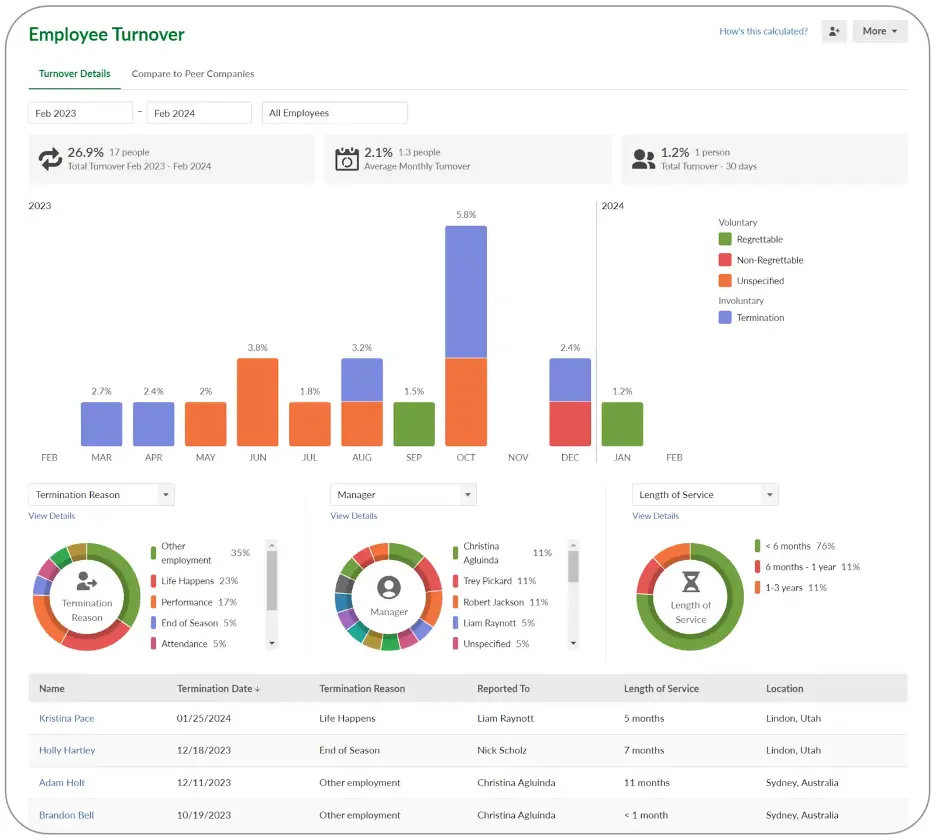
On this broad platform, HR professionals can manage processes from hiring and onboarding staff to improving the employee experience and managing performance.
BambooHR’s centralisation makes employee information easily accessible and trackable alongside workflow management.
Key features:
What we like:
What we dislike:
Pricing:
User feedback:
This is what BambooHR users have to say on G2:
“BambooHR has remained true to a lot of its claims of providing a clean interface and intuitive system with resources to help empower employee files, payroll, documents, etc., with ease.”
“Bamboo is easy to navigate for both administrators and employees. We've had great luck so far with calling the Bamboo help desk to answer any of our how-to questions.”
“We’ve [...] found that some features are not yet available in the mobile app, which presents a challenge for our field-based employees who don’t have regular access to a desktop. Expanding mobile functionality and enhancing benefits integrations would take BambooHR from great to exceptional.”
ADP Workforce Now’s HR management tool centralises payroll, benefits, talent management and analytics in a single platform.
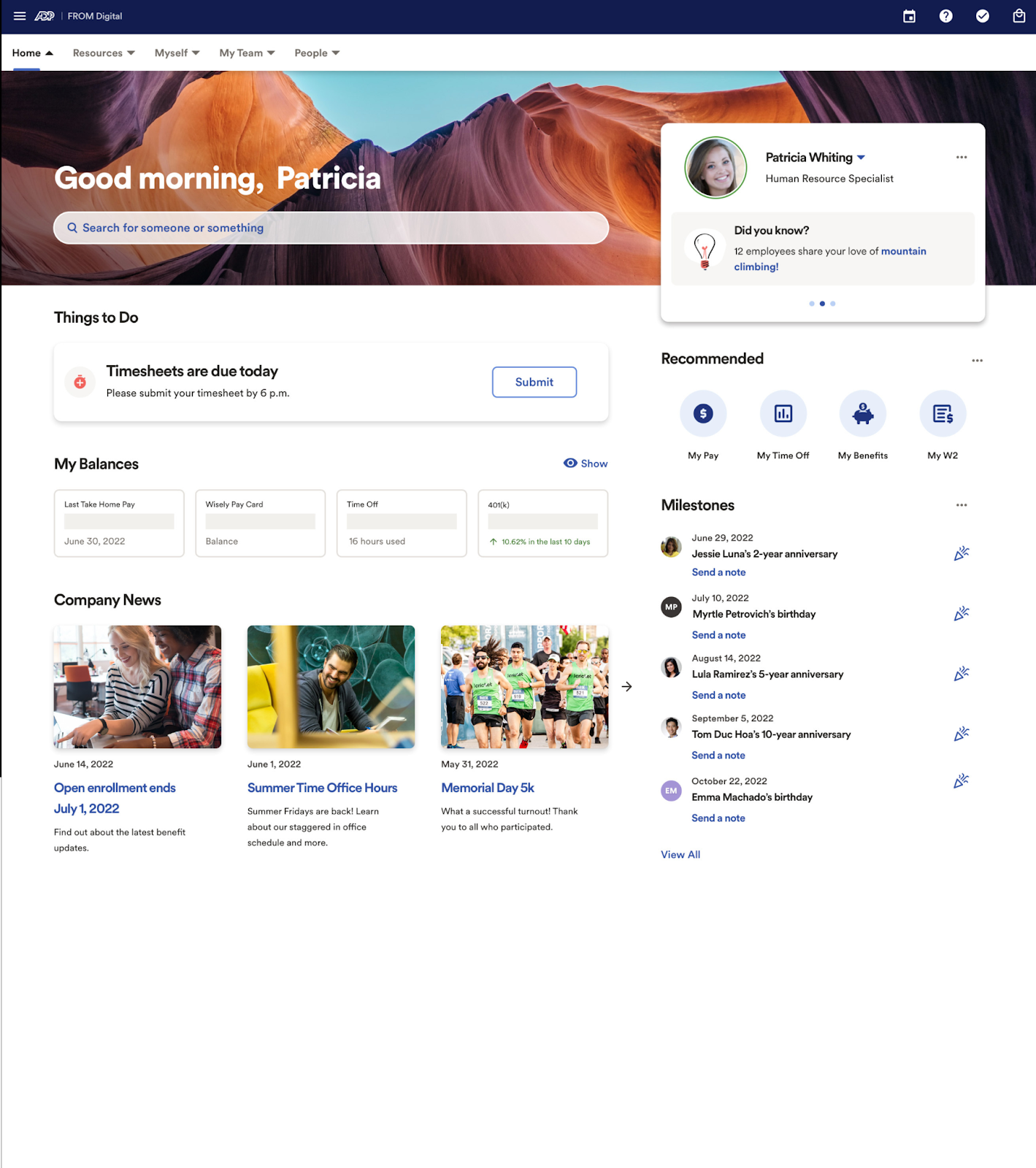
Despite its size, ADP does a reasonable job serving all kinds of businesses. You can even get custom packages so you only pay for the features you need.
Plus, its payroll and HR services come with extensive reporting and compliance capabilities.
Key features:
What we like:
What we dislike:
Pricing:
User feedback:
Here are some G2 reviews from ADP users.
“ADP Workforce Now offers a reliable and centralised solution for payroll, benefits, and employee record management. The reporting tools are powerful, and the integration with other HR systems streamlines administrative tasks.”
“The analytics that ADP provides is comparable to the best in the industry. I have been tracking the complete end-to-payment status for quite some time now, and the interface has only become better.”
“The system is not intuitive and requires navigating multiple disconnected areas to complete even basic tasks. It can feel overwhelming and inefficient, especially for managers and employees without system training.”
HiBob is a comprehensive human capital management platform emphasising reporting, forecasting, and analytics.
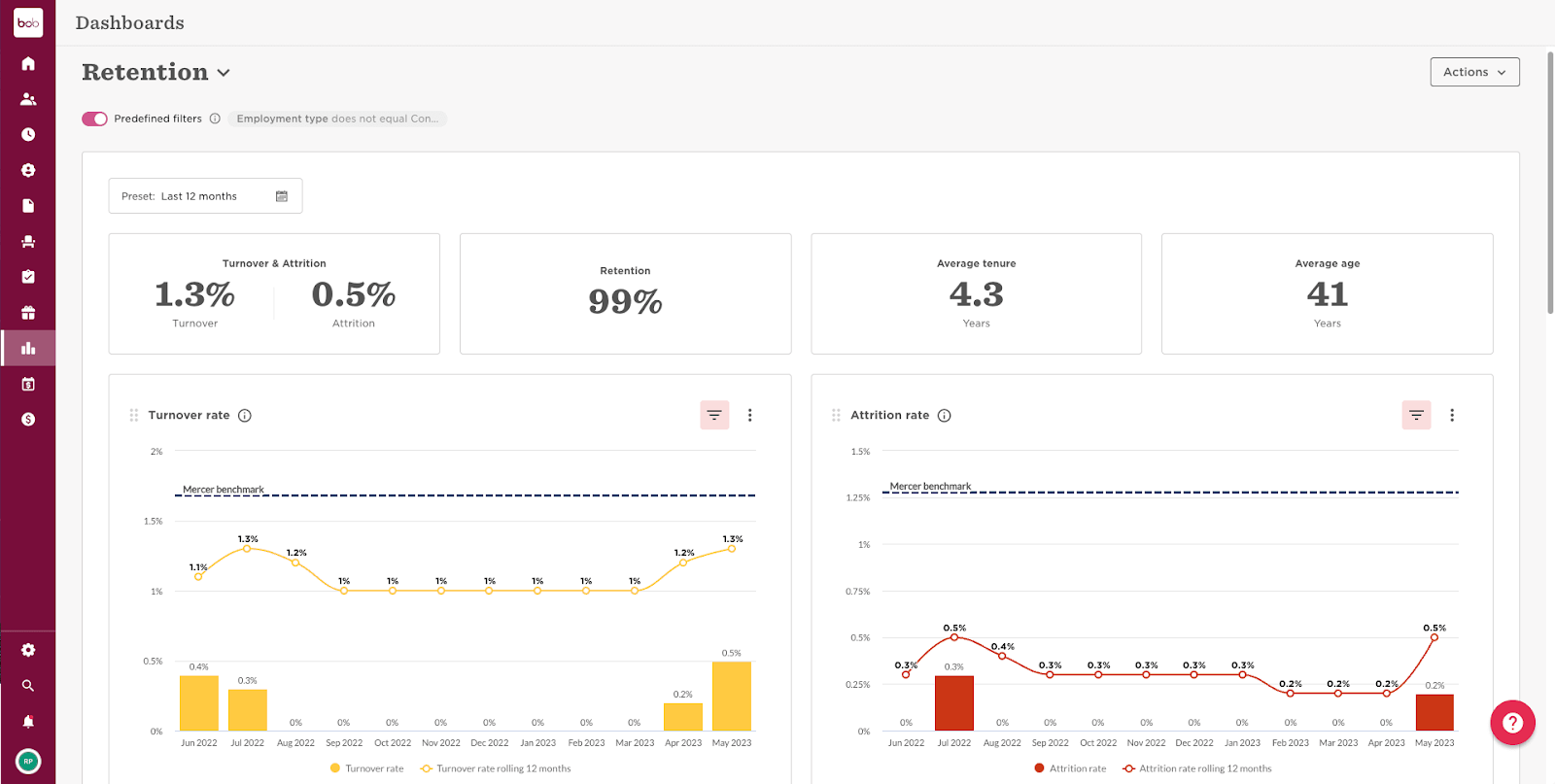
You can automate many day-to-day HR tasks, like onboarding and attendance tracking. It’s also pretty good at giving HR managers the information they need to make long-term decisions.
HiBob focuses on workforce planning and engagement, offering analytics to support HR decision-making.
Key features:
What we like:
What we dislike:
Pricing:
User feedback:
Find out what HiBob users have to say below.
“A simple but accurate and professional tool. Makes the recruitment process be more efficient and professional.”
“Being a new member to the company, HiBob made it really easy for me to know people and understand the org chart, so I can know who to reach out to when needed.”
“The admin reporting tools are great for producing simple, straightforward reports and work really well for day-to-day needs. However, creating more bespoke reports, for example, around absence data can be a bit more challenging. The platform is also less flexible when working within matrix management structures.”
Paylocity is an all-in-one HR and payroll platform that small and medium-sized businesses (SMEs) use to manage every part of the employment process.

It offers solutions for every department: HR can run payroll, finance teams can manage employee expenses, and IT can centralise asset management.
The combination of HR, payroll, and employee engagement tools in a mobile-friendly platform suits flexible and remote teams looking to scale.
Key features:
What we like:
What we dislike:
Pricing:
User feedback:
Find out what reviewers think of Paylocity.
“There are a lot of features for both employee and employer. When you hit a wall within the system, there are often quick workarounds to still get what is needed. Pretty easy to use across the board.”
“Paylocity is always updating itself, keeping ahead of requirements at the state and local level. The reporting functions are robust enough while not being too difficult to learn.”
“The customer service has declined over the past few years. Sometimes it may be a while before you get an answer or what you need.”
You’ve got a shortlist of tools, but how do you pick the right one for your brand? We cover the features you need to look for next.
You’ll want an HR and payroll provider that is competitively priced and scales with your business. It should be easy to use, with support available if anything goes wrong.
Here’s a quick checklist you can use when choosing between different options:
Below, you’ll find more information on each factor and why it’s essential, including specific features to look for.
Payroll and HR software are mission-critical systems. Even a minor issue can stop pay cheques or cause compliance issues.
Look for a provider that resolves issues quickly without disrupting business:
👉Example in action: See how property management company City Relay can onboard new hires within 24 hours thanks to Teamed’s in-country experts.
Your HR and payroll platform must grow with your business’s needs, employment strategy, and geographic expansion.
A rigid system that only works in a handful of countries will hinder your growth and operational efficiency.
Find a flexible platform by looking for the following features:
👉Example in action: Discover how Teamed has helped accountancy firm CT hire new employees in multiple countries and assist with a sensitive offboarding process.
Payroll and HR software is an ongoing investment that should generate a positive return.
Overpaying for unnecessary modules or hidden fees will strain budgets, especially for startups and small-to-medium-sized businesses.
Here’s how to find a platform that offers fair pricing now and in the future:
👉Example in action: See why affordability made Teamed the standout choice for blockchain infrastructure service provider Luganodes.
Employment law can change in a moment. Fail to keep up, and you could face financial penalties, audits, and lawsuits.
Find a provider that stays current with tax laws, labour regulations, and statutory requirements in every country you operate by looking for the following:
👉Example in action: Learn how Teamed has helped Data Science Talent fully comply with South African labour laws without lifting a finger.
Remote work and global hiring are becoming the norm. You need software that not only accommodates your current workforce but also paves the way for future expansion.
Here’s what to look for:
👉Example in action: Discover how Teamed helps IT, aerospace, defence, and security technologies company Tekever hire from across Europe and beyond.
Empowered employees who manage their own information reduce HR overhead and increase satisfaction and transparency.
Easy access to pay and benefits information also fosters trust and increases employee engagement.
Here’s what it should look like:
👉Decide if Teamed is right for you in our quick quiz.
Q: What is HR and payroll software?
HR and payroll software automates the management of human resources and payroll processes. It streamlines key tasks like payroll calculations, tax filings, and benefits administration, reduces manual errors, and ensures regulatory compliance.
Q: What is the best HR and payroll software for a small business?
For small businesses, the best HR and payroll software will balance usability, cost-efficiency, and core features. Teamed is ideal for small businesses with global ambitions thanks to our AI-native approach, rapid onboarding, and payroll compliance in 180+ countries.
Q: What is the best HR and payroll software for a medium-sized business?
Medium-sized businesses need scalable solutions with advanced features and dedicated support. Teamed is a solid choice due to our flexibility across contractor, EOR, and entity management. Plus, our exceptional on-hand support means an expert is always on hand to answer your questions.
Q: What is the most affordable HR and payroll software?
Teamed is one of the most affordable HR and payroll software solutions, costing just £39 ($49) per contractor per month and £400 ($450) per employee per month for EOR.
Teamed’s AI-powered global employment platform is more than just an HR and payroll provider.
With multi-country and multi-modal payroll, entity setup and management, and effortless document management, global teams get everything they need to hire, manage, and pay employees, all in one place.
When you throw in expert in-house support (available 24 hours a day, every working day) and fair, transparent pricing, choosing Teamed becomes a no-brainer.
It’s no wonder three in four customers who evaluate multiple providers pick us.
Book a call today and join 1,000+ growing teams like Eventbrite and Williams Racing who trust Teamed to pay employees, stay compliant, and scale with confidence.


© Copyright Teamed Ltd 2025 • All rights reserved