
Case Study
What Your EOR Actually Does (And Doesn't Do): The audit that asked questions nobody could answer

Tom Price-Daniel

12 minutes

May 6, 2026


Scaling globally without a clear employment strategy is how companies end up juggling five vendors, missing payroll deadlines, and fielding panicked calls from Legal about worker misclassification. The chaos isn't inevitable it's a symptom of outgrowing your current setup without a roadmap.
This article maps the five levels of global employment maturity, shows you where your company sits today, and outlines the practical steps to consolidate contractors, EOR, and entities onto one platform before vendor sprawl becomes a compliance crisis.
Global employment maturity is a framework that shows how well your company hires, pays, and manages people across borders. It covers contractors, employer of record (EOR) arrangements, and owned entities. For scaling companies in professional services, defence, and financial services with 200–2,000 employees, a segment that represents over 55% of global EOR adoption, the framework clarifies where you stand operationally, where compliance gaps exist, and how to move from fragmented tools to integrated, audit-ready operations.
Think of it as a diagnostic. Where you sit on the maturity curve determines your risk exposure, your team's admin burden, and how quickly you can enter new markets. Companies at lower levels often juggle multiple platforms, face worker misclassification risks, and struggle with payroll accuracy. Higher maturity brings consolidation, compliance confidence, and the ability to scale without operational chaos.
The model isn't prescriptive, there's no single correct path. A fintech scaling into Germany may prioritise EOR speed, while a defence contractor establishing entities in France faces stricter compliance requirements. Yet the underlying progression stays consistent: from reactive, fragmented hiring to proactive, unified global operations.
Below are the five stages, with common mid-market pain points at each step.
Scattered contractor arrangements get managed via spreadsheets, email, and different platforms. A UK fintech, for example, might hire developers in Eastern Europe on multiple marketplaces without standard contracts, IP assignment, or consistent onboarding. This leads to misclassification risk, inconsistent rates, and delayed payments.
At this level, compliance is reactive. You address issues only when they surface often during audits or investor diligence. Finance teams spend hours reconciling invoices from different platforms, and HR lacks visibility into who actually works for the company.
To hire compliantly without entities, companies adopt EORs in target markets. Defence contractors needing rapid deployment in Germany or France may use EORs to onboard within weeks, but still face fragmented data, policy inconsistency, and limited visibility into total costs across providers.
EOR solves the immediate problem legal employment without entity setup but introduces new complexity. Each provider has different onboarding processes, payroll schedules, and reporting formats. When you're using three EORs across five countries, consolidation becomes the next challenge.
Companies blend multiple providers contractor platforms, several EOR vendors, and local payrolls, plus point tools for timekeeping and expenses. Professional services firms juggling contractors and employees simultaneously feel the operational drag of duplicate entries, reconciliations, and vendor management overhead.
This level reflects growth without strategic planning. You've added tools as needs arose, but now those tools don't talk to each other. Payroll cut-offs get missed because data sits in different systems. Finance teams manually reconcile vendor invoices. HR spends more time managing platforms than managing people.
Legal entities get established in priority markets to gain control over employment, benefits, and branding. European expansion introduces local payroll, benefits, works councils, and statutory filings. Complexity rises as your internal team operationalises HR, payroll, and compliance in-country and coordinates across multiple jurisdictions.
Entities signal maturity and commitment, but they also demand deeper expertise. Germany requires works council consultation for certain decisions. France has strict termination procedures. Each country brings its own payroll nuances, tax filings, and employee protections. Without the right support, entities become a compliance burden rather than a strategic asset.
Employment models converge on a single platform with standardised policies, consolidated payroll data, automated workflows, and embedded compliance. Contractors, EOR hires, and entity employees get managed uniformly, enabling faster hiring, consistent experiences, transparent costs, and audit-ready reporting across the whole footprint.
At this level, your operations are proactive, not reactive. AI agents handle routine tasks, while human experts resolve complex compliance questions. Payroll processes are streamlined to reduce errors, and onboarding can be completed in as little as 24 hours in some cases.
Use a practical lens: count vendors, measure onboarding speed, review compliance incidents, and assess data quality. Warning signs include frequent payroll cut off misses, rising legal queries, manual reconciliations, and increasing finance time to close.
Start by mapping your current setup. How many platforms does HR log into each week? How long does it take to onboard a new hire in Spain versus Poland? When was the last time you had a misclassification scare or a late tax filing?
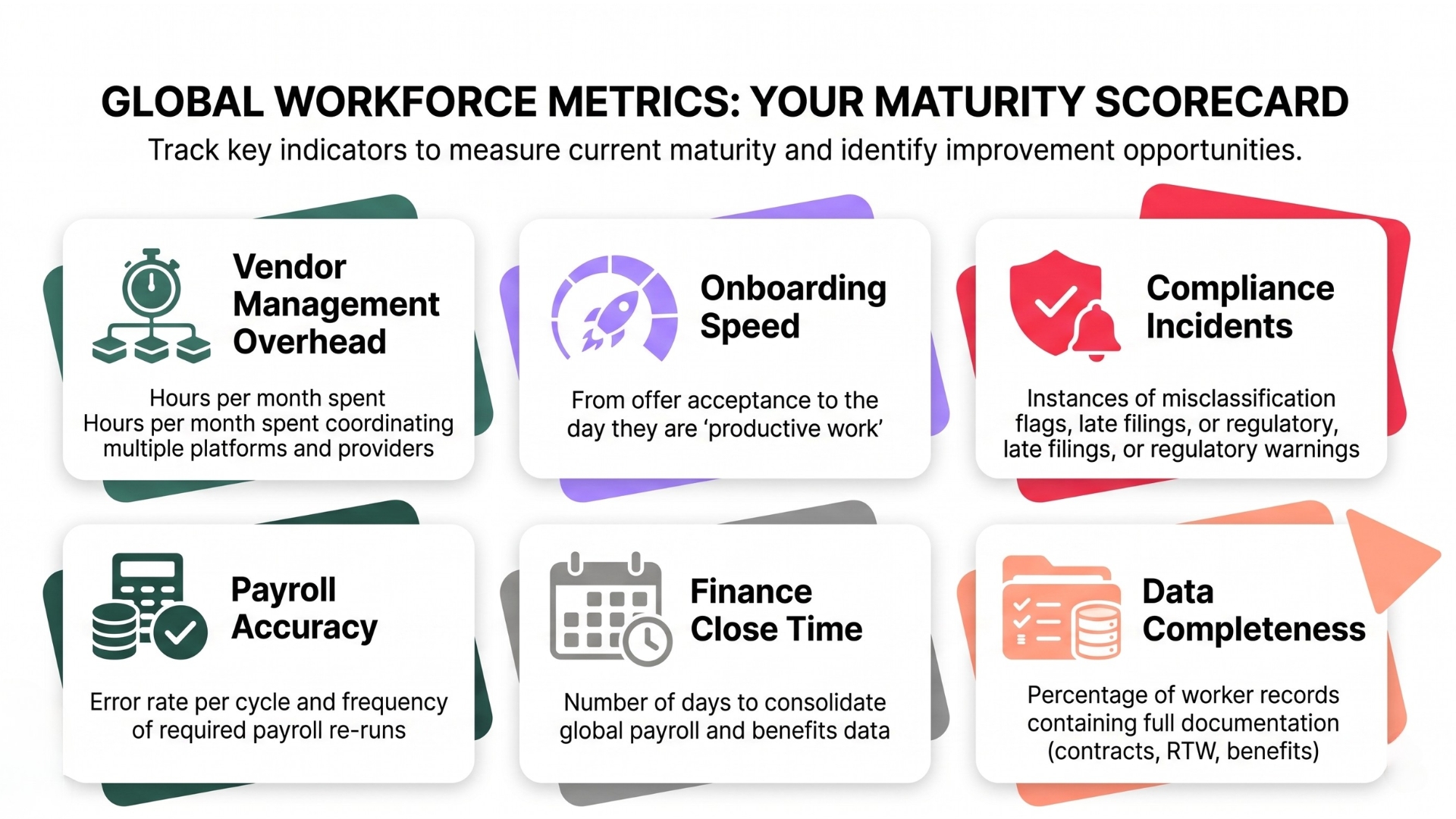
Operational pain is the clearest signal your current setup can't support growth.
When multiple vendors exchange data, cut-off misses cause delayed payments, damaging morale and trust, particularly in European markets with strict pay expectations and penalties for late remittance of taxes and social charges. One late payroll run in France can trigger employee complaints and regulatory scrutiny.
If HR, payroll, and finance re-enter the same data into different systems, time gets wasted and error rates rise. Mid-market finance teams feel this most acutely during month-end and audits. You're paying three people to do the same work three times and still catching mistakes.
An uptick in questions on classification, local benefits, terminations, or cross-border assignments indicates your risk profile has outpaced your internal capabilities especially in highly regulated sectors like financial services. When your legal team constantly fields questions about German works councils or French severance, you've outgrown your current setup.
Key moments force an evolution in approach. Plan ahead for triggers like worker reclassification, European expansion, and investor diligence.
Regulatory pressures (e.g., UK IR35, EU worker status tests) and business needs (IP protection, customer-facing roles) drive conversions. Proactive assessment avoids retroactive liabilities and ensures benefits and payroll compliance.
IR35 in the UK has made contractor relationships riskier. If HMRC determines your contractor relationship looks like employment, you're liable for unpaid taxes and penalties. Defence and financial services firms face even stricter scrutiny misclassification can jeopardise security clearances or regulatory approvals.
Use EOR for speed and testing new markets; move to entities for scale, employer branding, and cost control. The EOR model cuts entity setup costs by up to 60%, making it ideal for initial market entry before establishing permanent entities. Defence and financial services companies face additional considerations: export controls, security clearances, and regulated benefits come into play early in the decision.
EOR works brilliantly for your first few hires in Germany. But once you reach 10–15 employees, entity economics improve. You gain control over benefits, branding, and employee experience. The transition, however, requires planning payroll migration, contract novation, and works council consultation if thresholds are met.
Series B/C rounds and M&A processes scrutinise contracts, payroll records, IP assignment, and classification. Clean, centralised data and clear employment models reduce valuation haircuts and accelerate diligence.
Investors want to see that your global operations won't blow up post-funding. Fragmented data, missing contracts, and unclear classification create red flags. Companies with unified platforms and audit ready records close diligence faster and preserve valuation.
Assess whether your team has the depth and systems to operate globally at scale.
Compliance isn't a one-time setup. Laws change. France updates social charges. Germany revises works council thresholds. Your platform and team stay current without you chasing updates manually.
Auditors want to see clean data trails. If your payroll data lives in five different systems with inconsistent formats, you're setting yourself up for painful audit prep. Consolidation isn't just operational efficiency it's risk mitigation.
Consolidation delivers immediate relief. HR stops juggling logins. Finance closes the books faster. Legal has one place to pull contracts. The ROI is measurable in hours saved and errors avoided, EOR platforms have demonstrated reduction in onboarding time through consolidation.
Understand the European requirements that shape maturity progression.
HR systems handle sensitive employee data, home addresses, bank details, health information. GDPR requires lawful basis, minimisation, data subject request (DSR) handling, and secure transfers. Financial services and defence often require EU/EEA data residency and stricter access controls.
Evaluate the solution based on platform support, data portability (spreadsheet exports), and compliance measures specifically data residency and role-based access control (RBAC) for sensitive information.
When thresholds are met, employee representation triggers co-determination rights affecting working time, tech tools, and restructuring. Plan timelines and consultation obligations before organisational changes.
Works councils aren't optional in Germany. Once you hit five employees, they have consultation rights. Introducing new HR software? Changing working hours? Restructuring teams? You'll need works council approval. Companies that ignore this face legal challenges and employee relations issues.
Temporary assignments into EU member states require notifications, host-country minimums, and documentation. Professional services firms moving consultants across borders face pre-notifications and proof-of-compliance on site.
If you send a UK consultant to work in France for three months, they're a posted worker. France requires A1 certificates, pre-arrival notifications, and compliance with French minimum wage and working conditions. Failure to comply can trigger fines and project delays.
Focus on value drivers rather than headline rates.
Beyond salary: employer taxes, social contributions, benefits, payroll admin, legal support, and platform fees. Vendor sprawl creates hidden duplication; a consolidated approach in GBP/Euro terms improves predictability and budget control.
A £50,000 salary in Germany comes with roughly 20% employer social contributions, plus benefits, payroll processing, and compliance support. When you're using three different vendors, you're paying overlapping admin fees. Consolidation reduces duplications and gives finance a single, predictable cost per employee.
Time coordinating providers, resolving tickets, and reconciling reports is a real cost. Consolidation reduces context switching and meeting load for HR, payroll, and finance.
Calculate how many hours your team spends each month managing vendors. If your HR manager spends 10 hours coordinating between your EOR, contractor platform, and local payroll, that's £400–£600 in lost productivity per month. Multiply that across a year, and consolidation pays for itself.
Faster onboarding reduces vacancy costs, accelerates billable utilisation in services businesses, and improves offer acceptance by cutting friction.
Every week a role sits vacant costs you revenue. In professional services, that's billable hours lost. In defence, it's project delays. Cutting onboarding from four weeks to 24 hours means new hires contribute sooner and candidates don't drop out during drawn-out processes.
A pragmatic progression plan minimises disruption while raising maturity.
A single platform standardises data, automates workflows, and unifies contractors, EOR, and entity employment to keep operations stable as you scale.
Transitions from contractor to employee can be streamlined with preserved records, helping to reduce onboarding friction and support compliance, though some local requirements may still apply.
When your contractor platform and EOR are separate, converting a contractor to an employee means re-entering all their data, collecting documents again, and disrupting their experience. On a unified platform, you flip their status and update their contract done.
Predictable, transparent GBP pricing reduces surprises, improves cost allocation, and supports mid-market budgeting discipline.
Fair and transparent pricing means you have clear visibility into standard fees per contractor or EOR employee. Additional charges may apply for certain services, tax filings, or compliance support depending on jurisdiction and complexity.

Yes, hybrid models are possible. Centralising data improves reporting and compliance oversight, but full consolidation yields greater benefits: fewer reconciliations, consistent policies, and lower integration maintenance.
Processes vary by model: contractors require notice per contract; EOR and entity employees follow local termination law, notice, severance, and consultation requirements. Plan timelines and documentation to avoid disputes and penalties.
The stages are the same, but controls are stricter. Expect enhanced due diligence, data residency constraints, export controls, and regulator reporting making consolidation, audit trails, and local expertise even more critical.
Managing employees across multiple US states feels straightforward until you're facing five different tax registrations, conflicting meal break requirements, and a compliance audit in a state where you thought everything was handled. What works for a team in one location breaks down fast when your financial services analysts span California, your defence contractors work from Virginia, and your professional services group operates across three more states.
This guide walks through the registration requirements, tax withholding rules, handbook structures, and employment model decisions that mid-market companies face when scaling from one state to five and how to avoid the vendor sprawl that typically follows.
Managing employees across five different states means navigating five distinct regulatory frameworks at once. Each state maintains its own wage and hour laws, leave requirements, tax withholding rules, and mandatory benefits. And the rules change constantly.
For mid-market companies scaling past 200 employees, this complexity arrives faster than HR infrastructure can adapt. What worked when everyone sat in one office becomes unmanageable when your financial services team spans California, your defence contractors work from Virginia, and your professional services group operates across three more states.
Imagine you are the VP of People Ops at a thriving fintech company.
You’ve successfully scaled to 350 employees and entered five new states in just 18 months. But your backend systems haven't kept up. You are now stuck managing a patchwork ecosystem of three payroll providers and multiple benefits admins.
Meanwhile, your finance colleagues are frustrated. Instead of helping you forecast for the future, they are stuck looking backward, wasting countless hours reconciling invoices across this tangled web of vendors.
State employment laws change at an accelerating pace. California alone introduced over 30 new employment law requirements in 2024, covering everything from pay transparency to bereavement leave, with 5,100 PAGA lawsuits filed in 2023 alone highlighting enforcement intensity. When you're operating in five states, you're tracking regulatory changes across five legislatures, five labour departments, and dozens of local jurisdictions.
Manual tracking becomes impossible at scale. European companies expanding to US markets often experience this shock acutely they're accustomed to relatively harmonised EU employment frameworks, then encounter a fragmented system where even neighbouring states have contradictory requirements. The reverse challenge exists for US companies navigating European compliance, though with different complexity patterns.
Post Series B companies typically discover they've accumulated separate systems for each employment function. Contractors live in one platform, EOR employees in another, owned entity payroll in a third. Each vendor operates independently, creating gaps where employees fall through during transitions or conversions.
Multi-state employment doesn't require five completely separate systems. The following principles create a scalable framework that grows with your footprint:
Federal employment law provides minimum standards that apply everywhere. The Fair Labour Standards Act sets baseline wage and hour rules. Title VII establishes anti-discrimination protections. The Family and Medical Leave Act creates unpaid leave entitlements for qualifying employers.
Defence contractors already operate in this framework federal contract compliance requirements often exceed state minimums. Building your employment policies on this federal foundation means you're starting from a position of relative strength, then addressing state variations as exceptions rather than complete rewrites.
California requires meal breaks after five hours of work. New York mandates different paid sick leave accrual rates than Massachusetts. Texas follows federal standards for both.
Your employee handbook doesn't need five complete versions. It needs one comprehensive federal policy with targeted state addenda that address specific local requirements. This approach reduces maintenance burden when federal law changes, you update once rather than five times.
Fragmented payroll systems create expensive reconciliation work. When contractors, EOR employees, and owned-entity workers live in separate platforms, your finance team manually consolidates data for board reporting, audit preparation, and tax filings.
A single platform eliminates this overhead. More importantly, it prevents gaps during employment transitions when a contractor converts to W-2 status, their data moves seamlessly rather than requiring manual re-entry across systems.
Routine tasks like tax filings and new hire reporting shouldn't consume your internal resources. By outsourcing these to a tech-enabled partner, you ensure every deadline is met automatically across all states. This removes the burden of repetitive admin work, freeing your experts to focus on high-value strategy instead of paperwork.
Not every situation fits a template. Multi-state remote workers create tax withholding questions. Unusual compensation structures equity grants, deferred bonuses, commission splits require careful classification. Disputed contractor-versus-employee determinations demand legal analysis.
Built-in escalation protocols ensure complex cases reach specialists within hours rather than days. The combination of automated routine work and rapid expert access creates both efficiency and confidence.
Hiring your first employee in a new state triggers a cascade of registration requirements. The following sequence shows realistic timelines and common pitfalls to avoid.
Every state where you employ people requires a state tax identification number for withholding purposes. Some states issue these immediately through online portals. Others require paper applications with 2-4 week processing times.
California's Employment Development Department typically processes applications within 5-7 business days. New York's Department of Taxation and Finance can take up to three weeks during peak filing periods. Start this process before your employee's first day to avoid payroll delays.
State unemployment insurance systems fund benefits for workers who lose their jobs. New employers typically receive an initial tax rate based on industry classification, then experience-rated adjustments after a few years of claims history.
Registration deadlines vary some states require registration before hiring, others within 20 days of first wages paid. Missing deadlines triggers retroactive assessments and penalties that can exceed the actual tax liability.
Most states mandate workers' compensation insurance for employers with even one employee. A few states, Texas being the notable exception make coverage optional, though federal contractors generally require it regardless of state law.
Coverage costs vary dramatically by industry and job classification.
Obtain quotes early to avoid budget surprises.
Federal law requires employers to report new hires to state directories within 20 days of start date. Reports help states enforce child support orders and detect unemployment fraud.
Many states offer electronic reporting through their labour department websites. Some accept batch uploads for companies hiring multiple employees. Missing this deadline rarely triggers immediate penalties, but repeated violations can result in fines of £20-40 per unreported employee.
Some cities and counties require business licences or registration certificates for employers operating within their jurisdiction. Requirements often depend on physical presence maintaining an office, warehouse, or other facility rather than simply having remote employees who live in the area.
San Francisco requires business registration for companies with employees working in the city, even without a physical office. New York City has similar requirements. Research local rules early, as some jurisdictions impose penalties for late registration that exceed the actual licence fees.
Tax compliance failures create immediate financial liability. The following rules cause the most problems for multi-state employers, with a comparison of key state requirements.
Remote employees who live in one state but work for a company headquartered in another create withholding questions. Generally, you withhold based on where the employee performs the work their resident state not where your company is located.
The complexity arrives when employees split time between states. A financial services analyst who lives in New Jersey but travels to New York for client meetings might owe taxes in both states. Employers track work location and withhold accordingly, then employees sort out credits and refunds when filing their personal returns.
Bonuses, commissions, and equity compensation often face different withholding rates than regular wages. California withholds supplemental wages at 10.23% for amounts up to £1 million, then 13.3% above that threshold. Federal supplemental rates are 22% for most payments, 37% for amounts exceeding £1 million annually.
Rates matter for year-end bonus planning. A £10,000 bonus might net an employee £6,800 after withholding but if you miscalculate and under-withhold, your company remains liable for the shortfall.
Some neighbouring states maintain reciprocal tax agreements that simplify withholding for cross-border workers. Pennsylvania and New Jersey have reciprocity employees who live in one state and work in the other only pay tax to their resident state.
Agreements reduce administrative burden but require proper documentation. Employees file exemption certificates with their employer to avoid withholding in the work state. Missing this step means employees pay tax in both states, then claim refunds later creating unnecessary paperwork for everyone.
Get expert guidance on multi-state tax compliance →
Scalable handbooks balance consistency with local compliance. The following structure works across multiple states without creating maintenance nightmares.
Your core handbook covers federal requirements that apply everywhere equal employment opportunity policies, harassment prevention procedures, FMLA leave provisions for qualifying employers, wage payment timing, overtime calculation methods overtime calculation methods.
This foundation creates consistency in how you treat employees regardless of location. A defence contractor in Virginia and a professional services employee in California both see the same core policies, creating a unified company culture even across dispersed locations.
California employees receive an addendum covering meal and rest break requirements, paid sick leave accrual rates, and California-specific harassment prevention training mandates. New York employees get different paid sick leave provisions and information about New York's paid family leave programme.
Addenda reference the main handbook rather than duplicating content. "California employees receive all benefits described in Section 4 of the main handbook, plus the following state-mandated benefits..." This approach means updating the main handbook once rather than editing five separate documents.
Paper acknowledgements create gaps employees loose forms, HR files them inconsistently, and proving receipt becomes difficult during audits or disputes. Digital acknowledgement systems track exactly when each employee reviewed each policy version, creating clear audit trails.
A European fintech expanding to the US implemented digital acknowledgements after their first state labour audit. The auditor requested proof that California employees had received updated meal break policies. The company couldn't produce signed acknowledgements for 40% of their California workforce, resulting in penalties that exceeded their entire annual HR software budget.
State benefit mandates create minimum requirements beyond federal law. The following comparison shows the most significant state programmes affecting mid-market employers.
Thirteen states plus dozens of cities now mandate paid sick leave, with California requiring employees accrue at least 40 hours by day 200 of employment. Accrual rates, usage rules, and carryover requirements vary significantly. California requires one hour of paid sick leave for every 30 hours worked, with a 40-hour annual minimum. New York's requirements scale with employer size companies with 5-99 employees provide 40 hours, larger employers provide 56 hours.
Federal FMLA provides 12 weeks of unpaid leave for qualifying employees at companies with 50+ employees. Several states have gone further, creating paid family leave programmes funded through payroll taxes.
California's programme pays 60-70% of wages for up to eight weeks. New York provides 67% of average weekly wage for up to 12 weeks. Massachusetts splits costs between employers and employees. Programmes create administrative obligations processing claims, coordinating with state agencies, maintaining employee benefits during leave.
Five states, California, Hawaii, New Jersey, New York, and Rhode Island, plus Puerto Rico require short-term disability coverage for temporary illnesses or injuries unrelated to work. Most programmes are employee-funded through payroll deductions, though employers handle administration and claims processing.
Washington's Paid Family and Medical Leave programme combines family leave and disability coverage in one system. Employers with fewer than 50 employees don't contribute to premiums, but still handle claims administration and employee communications.
Hiring employees in new states can trigger corporate tax obligations beyond payroll compliance. The following situations show when multi-state employment creates broader tax exposure.
Physical presence maintaining an office, warehouse, or inventory clearly creates corporate tax nexus. Employee presence is less obvious but equally significant. Many states may treat having an employee working within their borders sufficient to establish nexus for corporate income tax purposes.
A financial services firm headquartered in Delaware hired a senior analyst in California. That single employee created California nexus, requiring the company to register with the California Franchise Tax Board, file annual tax returns, and potentially pay California corporate income tax on a portion of their nationwide revenue.
States with corporate income tax use apportionment formulas to determine what portion of your total income is taxable in their state. Traditional formulas weighted property, payroll, and sales equally. Modern formulas heavily weight sales, reducing the impact of employee presence.
California uses a single-sales-factor formula your California tax liability depends almost entirely on California sales, not California employees. New York uses a similar approach. However, having employees in a state still creates filing obligations and potential tax liability, even if the actual tax owed is minimal.
Multi-state operations eventually reach inflection points where your current employment structure becomes unsustainable. The following situations signal when to consider transitions.
Contractor relationships work well for project-based work with clear deliverables and genuine independence. They become risky when contractors work full-time hours, follow company direction, use company equipment, and function indistinguishably from employees.
Misclassification penalties scale with the number of contractors and duration of the relationship. A defence contractor recently faced a £2.4 million assessment after a state audit reclassified 40 long-term contractors as employees, triggering three years of back taxes, penalties, and interest across four states.
The conversion inflection point typically arrives when contractors represent more than 20% of your workforce or when the same contractors work continuously for more than 18 months. At that point, the compliance risk exceeds the flexibility benefit.
Professional Employer Organisations (PEOs) work well for companies entering new markets without established presence. You gain immediate access to benefits programmes, payroll infrastructure, and local compliance expertise without building capabilities internally.
The graduation point arrives when you have 30-50 employees in a single state. At that scale, owned-entity economics become favourable you're paying PEO fees on enough employees that building your own infrastructure costs less. More importantly, you gain control over benefits selection, policy decisions, and employee experience.
A professional services firm graduated from PEO to owned entity in their largest market when they hit 45 employees in that state. The transition took four months of planning but reduced their per-employee costs by 35% whilst improving benefits quality.
European companies expanding to US markets encounter regulatory fragmentation that contrasts sharply with EU harmonisation. The following areas create the biggest adjustment challenges.
European employment typically includes 20-30 days of paid annual leave, plus public holidays, plus statutory sick leave, plus parental leave measured in months. US federal law mandates none of this zero paid leave of any kind.
State paid leave laws create a patchwork that feels chaotic compared to EU-wide standards. Your California employees get paid family leave. Your Texas employees don't. Managing differences whilst maintaining perceived fairness requires careful communication and policy design.
GDPR creates comprehensive, EU-wide data protection standards. US privacy law fragments across states, California has CCPA, Virginia has VCDPA, Colorado has CPA, and a dozen more states have their own frameworks.
Employee data faces different rules than customer data in most US state laws, but the fragmentation still creates compliance complexity. European companies accustomed to one privacy framework suddenly need state-by-state analysis of data collection, storage, and employee rights.
Multi-state employment creates a forced choice between building infrastructure internally or partnering with external providers. The following comparison evaluates options based on company size and complexity.
Payroll software looks cheapest, £50-100 per employee per month. But this cost excludes compliance expertise, tax filing services, benefits administration, and the internal HR time required to manage everything. Total cost of ownership typically runs 3-4x the software licensing fee.
PEOs bundle services at £150-300 per employee per month. This includes payroll, benefits, workers' compensation, and compliance support. However, PEO arrangements create co-employment relationships that some industries, particularly defence contractors and financial services firms, find problematic for regulatory reasons.
EOR services cost £400-900 per employee per month but include everything, legal entity, payroll, benefits, compliance, tax filing, and expert support. For companies operating in multiple countries or highly regulated sectors, this comprehensive approach eliminates gaps and reduces risk.
Payroll software gives you maximum control but minimum compliance support. You make every decision, but you're also responsible for knowing every rule. This works well when you have experienced HR and legal teams who can handle multi-state complexity.
PEOs provide strong compliance support but reduce your control over benefits selection, policy decisions, and employee experience. You're operating within the PEO's established framework rather than designing your own.
EOR solutions offer the highest compliance support, you're essentially outsourcing the entire employment relationship to a provider with local expertise. Control is lower because you're working within the EOR's systems, but for companies prioritising risk reduction over customisation, this trade-off makes sense.
Most employment solutions force migration as you scale. Payroll software works until you need entity management. PEOs work until co-employment becomes problematic. EOR works until per-employee costs justify owned entities.
Migrations disrupt operations, employees re-onboard, benefits change, systems switch, and data transfers create gaps. A unified platform like Teamed is designed to minimise disruption by supporting contractors, EOR arrangements, and owned entities on the same system. When you’re ready to graduate from EOR to owned entity, employees stay in place whilst the back end employment structure changes seamlessly.
Multi-state employment creates compliance anxiety that distracts from strategic work. You're managing vendors, tracking regulatory changes, and hoping nothing falls through the gaps during employee transitions.
Teamed is built to take the complexity out of multi-state employment by bringing contractors, EOR arrangements, and entity management together on one platform. When you hire your first employee in a new state, we guide you through registration, tax setup, and compliance monitoring, providing the tools and expertise you need at every step. As contractors convert to W-2 status, the transition happens without re-onboarding or system changes. When you're ready to establish your own entity, we support your transition, helping you navigate requirements without unnecessary platform migrations.
We've supported companies in defence, financial services, and professional services as they've scaled from 50 to 500+ employees across multiple states and countries. Our experience with the toughest regulatory environments, European works councils, US government contractors, financial services compliance, means we can handle any employment situation you encounter.
Fair and transparent pricing. 24-hour onboarding for new employees. Support is available across 180+ countries when you're ready to expand beyond the US.
Talk to our specialists about consolidating your multi-state employment →
Yes, when an employee moves to a state where you don't currently have registrations, you'll complete the full registration sequence, state tax ID, unemployment insurance, workers' compensation, and new-hire reporting. However, if the employee moves to a state where you already employ people, you simply update their tax withholding and notify the relevant state agencies of the change. The key is tracking employee location changes promptly, as tax withholding errors create liability even when the mistake results from an employee's failure to report their move.
Federal law doesn't mandate expense reimbursement, but several states do. California requires employers to reimburse all necessary business expenses. Illinois, Massachusetts, and New York have similar requirements. Create a clear expense policy that meets the strictest state requirements, then apply it company-wide. This approach is simpler than maintaining state-specific reimbursement policies and ensures you're never under-reimbursing employees. Document reimbursement rates, particularly mileage rates and update them when IRS standard rates change.
State tax agencies don't automatically share audit findings, but they do participate in information-sharing agreements. If a California audit discovers you've been misclassifying employees, California may notify other states where you operate. More commonly, one state's audit reveals patterns, classification errors, overtime miscalculations, benefits violations, that likely exist in other states as well. Address audit findings comprehensively across your entire footprint rather than treating them as isolated to the audited state.
PEO co-employment creates complications for defence contractors holding security clearances or working on classified programmes. The co-employment relationship means the PEO is technically a joint employer, which can trigger additional security scrutiny and facility clearance requirements. Many defence contractors use EOR arrangements instead, where the EOR is the employer of record without co-employment status. This structure maintains clearer lines of authority whilst still outsourcing employment administration. Consult with your facility security officer before entering any PEO arrangement.
The decision to set up a legal entity depends on a mix of factors, employee count, business needs, and regulatory requirements. While some companies find that EOR arrangements are cost-effective below 50 employees in a state and that owned-entity economics improve as headcount grows, actual costs and breakeven points vary widely.

We have all sat in that finance meeting. The one where you are looking at the P&L, and the line item for "Global Expansion" does not match the budget you approved three months ago. Your EOR contract says £400 per head, but the effective rate is landing closer to £520.
It is frustrating, but it isn’t necessarily an error. It is the "convenience tax" inherent in the model. These are fees that live in the fine print or get categorized as "additional services."
When you are scaling fast, you pay for speed. But there comes a moment in every mid-market company's journey when the cost of speed starts eating into the budget for talent. This guide isn't about vilifying EORs. It is about giving you the context to read the bill correctly, knowing when it is time to graduate from renting to owning, and how to manage that transition without losing sleep over payroll.
Key Takeaways
EORs handle the heavy lifting of legal employment, including contracts, payroll, and tax. That is a valuable service. But the advertised monthly fee is rarely the whole story. Most providers use one of three pricing structures, and understanding them is key to avoiding surprises.
This is the most common model, a flat rate (e.g., £400 to £900) per employee. It offers predictable budgeting, which the board loves. However, it does not scale well. When you have 100 employees across France and Germany, you are paying hefty management fees for administrative tasks that don't actually get 100 times harder to do.
Some providers charge a percentage (3% to 15%) of gross salary. This feels fair until you hire senior talent. A lead engineer earning €80,000 costs the same to process as a junior support agent, but under this model, you pay a "success tax" on your highest performers. Plus, you are exposed to currency fluctuation twice: once on the salary, and once on the fee.
For larger teams over 500 people, you might see tiered pricing or volume discounts. These deals often come with "handcuffs," such as minimum commitments that lock you in even if your hiring plan changes. In a volatile market, flexibility is often worth more than a marginal discount.
The gap between your budget and your bill usually comes down to operational friction. These are the costs of doing business that don't make it onto the sales deck.
Onboarding isn't free. Between contract drafting and registration, you are often looking at £500 to £2,000 per head just to get started. Then there is the security deposit. Providers need to cover their liability, so they will hold 1 or 2 months of payroll costs.
It is not a fee, strictly speaking, as you get it back. But tying up £100,000 of working capital during a rapid expansion phase is a cash flow headache you don't need.
This is the most opaque part of the model. You convert GBP to EUR to fund payroll, and the EOR converts it again for local distribution. If the spread is 2% to 4% (which is common), you are bleeding thousands of pounds monthly just on moving money around. For a £1m payroll, that is a senior salary lost to exchange rates every year.
If you are in financial services, you know that bonuses and equity aren't just "perks." They are 30% to 50% of compensation. Processing these variable payments creates administrative drag, often incurring processing fees of 5% to 10%.
Furthermore, in markets like Germany or France, you aren't just managing people; you are managing institutions. Works Councils and collective agreements aren't optional extras. They are the license to operate. EORs charge premiums (£5k to £15k annually) to manage these relationships because the liability of getting it wrong is massive.
Off-boarding costs catch almost everyone off guard. In Europe, you cannot just let people go. Termination involves settlement calculations, regulatory filings, and strict protections. A contentious exit in France can easily spiral from a £1,000 admin fee to a £10,000 legal project.
Every market has its own personality. Knowing the character of the country helps you budget for the quirks.
There is a specific morning in every COO’s life when they realize the EOR bill could fund an entire internal HR department.
Mathematically, that break-even point is usually between 20 and 35 employees in a single country.
Setting up a German GmbH or French SAS costs time (6 to 12 weeks) and capital (€25k+). You take on the audit requirements and the liability. But in exchange, you gain control, better unit economics, and a sense of permanence in the market.
Moving from EOR to your own entity is a sign of success. It means you have won in that market. But the migration itself is delicate. You are touching people’s paychecks, so clarity is your best asset.
We built Teamed because we saw companies drowning in vendor chaos. You start with one EOR, add another for contractors, and a third for your new entity. Suddenly, your finance team is spending half the month just reconciling different data streams.
We wanted to bring some sanity to the process.
We unified contractors, EOR, and entity management on one platform. That means when you are ready to graduate from EOR to your own entity, you don't have to rip and replace your entire HR stack. Your employees stay on the same platform. We just change the legal plumbing in the background.
We don't hide the ball on pricing. No hidden FX markups, no surprise compliance fees. And because we understand high-stakes industries like FinTech and Defence, we bake compliance into the workflow, using AI to handle the routine so our experts can focus on the complex human questions.
Global expansion is hard enough. Your employment platform should be the one thing that gives you peace of mind.
Mid-market companies operating across borders need to answer one practical question: which banking platform handles international payments without eroding your margins through hidden FX markups?
The answer depends on your operational footprint. If your 200-person company primarily moves money across European borders, Wise's multi-currency accounts will save you thousands monthly. If you're a US-centric defence contractor with occasional sterling conversions, Mercury's domestic banking strength matters more.
This guide compares Wise against Mercury for companies with 200-2000 employees, covering costs, compliance, and when traditional banks still matter.
For a company paying quarterly bonuses to a 50-person European team, the FX margin difference represents £8,000-12,000 annually.
Key limitation: Mercury only serves US entities. UK or German companies need US subsidiaries to access Mercury.
Your banking requirements depend on how you employ people internationally.
The entity route makes economic sense once you employ 20-30+ people in a single country. Below that threshold, platforms deliver the same employment capability without the overhead.
Paying contractors through Wise versus traditional banks doesn't change employment classification. Under the EU Platform Work Directive, misclassification penalties in Germany, France, Spain, and the Netherlands can be substantial and may include fines and back taxes misclassification penalties in Germany, France, Spain, and the Netherlands can be substantial and may include fines and back taxes.
The payment method doesn't determine compliance. The employment relationship does.
Most mid-market companies use multiple banking providers: Wise for international payments, Mercury for US operations (if applicable), and traditional banks for commercial lending.
The challenge emerges when managing employment across multiple countries. If you're coordinating contractors in Brazil, employees in Singapore, and owned entities in Germany, banking complexity compounds quickly.
Platforms like Teamed work with whichever banking providers you choose. You approve payments through your existing Wise, Mercury, or traditional bank accounts whilst the platform handles employment contracts, tax compliance, and payroll processing across 180 countries. Onboarding is typically completed within 24 hours, subject to documentation and compliance checks payroll processing across 180 countries. Onboarding is typically completed within 24 hours, subject to documentation and compliance checks.
This approach works whether you're testing new markets (1-20 employees per country) or managing mixed employment models at scale. As you grow beyond 20-30 employees in a market, the platform can support your entity setup process and help coordinate banking relationships, subject to local regulatory requirements, and help coordinate banking relationships, subject to local regulatory requirements.
Speak to a specialist about coordinating your banking with global employment operations.

By the time your company hits 200 employees across five countries, you've probably accumulated three or four employment platforms one for contractors, another for EOR, a third for payroll, and maybe a fourth handling expenses. This isn't strategy; it's what happens when you solve immediate hiring problems without thinking three moves ahead.
Vendor sprawl quietly drains budgets, fragments compliance evidence, and forces your HR team to spend more time managing platforms than managing people. This guide walks you through why mid-market companies consolidate, what features actually matter, how to navigate European-specific migration pitfalls, and the five-step roadmap that gets you from five vendors to one.
Mid-market companies feel this pressure differently. You're too large to manage employment manually, but you lack the enterprise resources to absorb platform chaos. Your finance team reconciles invoices from multiple vendors each month. Your HR team re-onboards the same person twice when they convert from contractor to employee. Your legal team scrambles to piece together compliance evidence across disconnected systems when auditors show up.
European markets make this harder. GDPR data residency rules mean you can't simply migrate employee records without explicit consent. Works councils in Germany and France expect consultation before platform changes. Collective bargaining agreements dictate payroll processing timelines that don't bend for your migration schedule.
Regulatory complexity isn't a future worry it's a present liability. Misclassification audits, data protection fines, and statutory benefit errors all stem from fragmented systems where no single platform holds the complete employment picture.
Vendor sprawl doesn't announce itself with a crisis. It builds quietly an extra hour reconciling invoices here, a missed contractor payment there, a compliance question that takes three days and four vendor calls to answer.
By the time the pain becomes obvious, you've already normalised the inefficiency. Your finance team accepts that month-end close takes an extra week because payroll data lives in five places. Your HR team expects re-onboarding friction when contractors become employees because "that's just how it works." Your legal team braces for audit season because assembling compliance documentation means exporting reports from multiple platforms and hoping nothing contradicts.
Each employment platform charges separately for currency conversion, and those fees stack up fast when you're paying employees in eight currencies across different regions.
Here's what that looks like in practice:
Your finance team reconciles these charges monthly, but the cumulative cost hides in operating expenses. A 400-person company paying 150 international employees across three platforms can easily spend £15,000–£25,000 annually on duplicate FX fees alone—costs that vanish when you consolidate to a single platform with fair and transparent pricing.
Month-end close becomes a multi-day ordeal when payroll invoices arrive from different vendors on different schedules with different line-item breakdowns.
Your finance team manually matches invoices to headcount, cross-references contractor payments against timesheets, validates benefit deductions across systems, and investigates discrepancies that often trace back to timing differences between platforms rather than actual errors.
A professional services company managing 280 employees across Europe told us their finance team spent 40 hours per month reconciling vendor invoices. After consolidating to Teamed, that dropped to under six hours time their CFO immediately redirected toward strategic financial planning.
Contractor misclassification represents the highest-stakes risk of vendor sprawl. When employment data fragments across platforms, you lose visibility into working patterns that trigger reclassification risk.
European labour authorities don't care that your contractor platform and your EOR platform don't talk to each other. They care whether the person working 40 hours per week for 18 months with managerial oversight meets the legal definition of an employee and if they do, you're liable for back taxes, social contributions, and penalties regardless of which platform processed payments.
Defence sector companies face particularly acute exposure here. Security clearance requirements often mean the same person works as a contractor on one project, converts to EOR for another, then transitions to direct employment all within 24 months. Without a unified platform tracking that journey, you're one audit away from discovering you've been misclassifying employees for years.
👉 Tip: The UK's IR35 reforms, Germany's dependent contractor rules, and France's requalification provisions all create liability that compounds when employment data lives in silos. A single platform with complete employment history can significantly reduce misclassification risk by maintaining continuous records across all employment models. Compliance ultimately depends on how employment relationships are managed day-to-day.
Employment models exist on a spectrum, and most growing companies use all three simultaneously. The friction comes when you're forced to switch platforms every time an employment relationship evolves.
A unified platform reduces that friction by supporting contractors, EOR, and owned entities on the same system, so when your star contractor in Berlin accepts a full-time offer, nothing changes from their perspective. Same login, same payroll schedule, same support contact. Just a different contract type in the background.
Contractors give you speed and flexibility when entering new markets or testing project-based roles. You're not committing to entity setup, and you're not taking on employer liability.
But European contractor relationships come with strings attached. The UK's IR35 rules scrutinise working arrangements to prevent disguised employment. Germany's Scheinselbständigkeit laws presume contractor relationships are actually employment unless proven otherwise. France requires social security contributions even for genuine freelancers once they exceed certain thresholds.
A proper contractor management platform doesn't just process payments, it monitors working patterns, flags reclassification risk, and maintains documentation that proves the relationship meets local legal tests. When your contractor in Stockholm starts working full-time hours, the platform alerts you before Swedish tax authorities do.
EOR services let you hire employees in countries where you don't have a legal entity, typically enabling onboarding in as little as 24 hours versus the 3–6 months required for entity establishment. The EOR becomes the legal employer, handling contracts, payroll, taxes, and statutory benefits whilst you maintain day-to-day management.
Mid-market companies typically choose EOR when they're hiring 2–10 people in a new market and entity setup doesn't make economic sense yet. A financial services firm hiring three compliance specialists in Dublin doesn't want to establish an Irish entity, navigate Irish employment law, and register with Revenue, they want those specialists onboarded in 24 hours so they can meet regulatory deadlines.
The challenge comes later. Most EOR platforms assume you'll stay on EOR indefinitely, which means when you're ready to establish your own entity in that market, you're forced into a disruptive migration. Your employees re-onboard with new contracts, new payroll schedules, and new benefits providers, creating unnecessary friction at exactly the moment you're trying to scale.
A graduation-ready platform handles this transition whilst minimsing disruption. Same employees, same login, same support team. Just a different legal employer in the background.
Running payroll through your own entity means navigating local tax authorities, social security systems, statutory benefit providers, and labour law requirements. In Germany, that includes works council consultation rights. In France, it means collective bargaining agreement compliance. In the UK, it involves auto-enrolment pension schemes and HMRC Real Time Information submissions.
Most companies solve this by adding another vendor, a local payroll provider who understands the market. But now you're back to vendor sprawl, with entity payroll in one system, EOR employees in another, and contractors in a third.
A unified platform runs entity payroll alongside EOR and contractors, maintaining consistent employee experience and consolidated compliance reporting regardless of employment model.
Platform features only matter if they solve real problems. Here's what actually makes a difference when you're managing 200–2,000 employees across multiple countries and employment models.
Enterprise implementations take months because enterprise platforms assume you have months. Mid-market companies don't. You're hiring a critical role in Paris next week, and your current platform's "expedited onboarding" still requires three weeks and a dedicated project manager.
Rapid onboarding isn't about cutting corners, it's about eliminating unnecessary steps. Teamed aims to onboard new employees rapidly.
Chatbots work fine for password resets. They fail spectacularly when your German works council demands consultation before a payroll system change, or when French labour inspectors question a contractor's employment status, or when HMRC challenges your IR35 determination.
Complex employment issues require human judgement informed by local legal expertise. That means named specialists who know your company, understand your industry, and can make decisions without escalating through three support tiers.
Teamed assigns named country specialists to every client. When you have a question about Belgian social security contributions or Spanish collective bargaining obligations, you're talking to the same employment law expert who onboarded your team in that market. They know your company's risk tolerance, they understand your growth plans, and they can answer immediately rather than opening a ticket.
Enterprise platforms love complexity pricing. Per-employee fees vary by country. FX markups hide in fine print. Implementation costs appear after you've signed. Add-on features accumulate until your actual cost bears no resemblance to the initial quote.
Mid-market companies can't absorb that uncertainty. Your CFO needs predictable costs that scale linearly as you grow.
Teamed's pricing is deliberately simple:
No surprise implementation fees. No feature paywalls that force upgrades mid-contract.
European employment law doesn't translate to other markets, and most platform migration guides pretend it does. They'll walk you through data exports and API connections whilst completely ignoring the fact that your German works council has statutory consultation rights, or that French labour law requires specific payroll processing timelines, or that GDPR data transfers need explicit employee consent.
A professional services company migrating from three platforms to one discovered this during their German entity transition. They'd planned a clean cutover on the first of the month, only to learn their works council required 30 days' consultation before any payroll system change. The migration stalled, employees received late pay notifications, and the company spent six weeks unwinding a partially completed transition.
GDPR treats employee data migration as a new processing activity requiring explicit legal basis. You can't simply export employee records from Platform A and import them into Platform B without proper consent and documentation.
Here's what compliant data transfer actually requires:
Most companies discover these requirements mid-migration when their DPO flags the compliance gap. Proper planning means addressing GDPR transfer requirements before you begin, not after you've already moved half your employee data.
Germany and France mandate collective bargaining agreements (Tarifverträge and conventions collectives) that govern payroll processing, benefits provision, and employment terms. Your new platform has to support these agreements exactly as specified—you can't approximate or substitute equivalent benefits.
German works councils review and approve payroll system changes. That means presenting documentation, answering technical questions, and waiting for formal approval before proceeding. French labour law requires specific payroll processing schedules tied to collective agreements. Miss those deadlines during migration, and you're in breach of statutory obligations regardless of whether the delay was your fault or your vendor's.
👉 Tip: Before selecting a migration date, consult with works councils and review collective bargaining deadlines. Build those timelines into your project plan rather than discovering them mid-migration.
European statutory benefits don't map neatly across platforms. German social security contributions calculate differently than French cotisations sociales. UK auto-enrolment pension schemes have specific timing requirements. Spanish Seguridad Social contributions vary by contract type and industry.
When you migrate platforms, you're not just moving payroll calculations, you're ensuring every statutory benefit, every social contribution, and every tax withholding continues without interruption. That means your new platform has to integrate with local benefits providers, maintain contribution history, and handle mid-month transitions without creating gaps in coverage.
A financial services company migrating their French entity discovered their new platform couldn't integrate with their existing mutuelle (supplementary health insurance) provider. They had 60 days to find a new provider, re-enrol 45 employees, and ensure continuous coverage all whilst managing the broader platform migration.
Platform consolidation feels overwhelming because it is if you try to do everything at once. The companies that migrate successfully break the process into discrete phases, validate each step before proceeding, and maintain parallel systems until they're certain the new platform works.
Here's the roadmap that actually works for 200–2,000 employee companies.
Start by documenting your current state. Not what you think you have what you actually have.
That means:
Your CFO cares about cost reduction and audit readiness. Your legal team cares about compliance continuity and liability mitigation. Your HR team cares about employee experience and reduced administrative burden. Get all three aligned on why consolidation matters before you start planning the technical migration.
Your current platforms contain years of accumulated data errors. Incorrect tax codes, outdated addresses, missing benefit elections, and duplicated records all hide in systems no one's audited properly.
Fix these errors before migration, not after. Run data quality reports, validate employee information, and correct discrepancies whilst you still have access to historical context in your old platforms.
Then run parallel payroll. Process the same pay period in both your old platform and your new platform, compare outputs line by line, and investigate every discrepancy until you understand why they differ.
Parallel processing catches calculation errors, timing differences, and integration issues before they affect employees. It's extra work upfront that prevents emergency fixes later.
Employment contracts aren't universal templates they're legal documents governed by local law. German employment contracts require specific termination notice periods. French contracts have to reference applicable collective bargaining agreements. UK contracts need auto-enrolment pension language.
Your new platform generates locally compliant contracts automatically, but you'll still need legal review for employees with non-standard terms. That means identifying who has custom contracts, determining what provisions have to carry forward, and ensuring the new contracts maintain legal continuity.
European employees have statutory rights to review contract changes. In Germany, works councils review new contracts before employees sign. In France, contract modifications require employee consent. Build these consultation periods into your migration timeline rather than treating them as administrative formalities.
Employees don't care about your vendor consolidation project they care whether they'll get paid correctly and on time. Your communication plan addresses that concern directly.
Cutover day isn't when you flip a switch and hope for the best nit's the culmination of parallel processing, testing, and validation.
Your go-live checklist includes:
After the first live payroll, validate everything. Check that every employee received correct payment, that tax withholdings match expectations, that benefits deductions processed properly, and that statutory contributions filed correctly.
Then do it again the next pay period. And the one after that. Most issues surface in the first three pay cycles, so maintain heightened scrutiny until you're confident the new platform works reliably.
Consolidation delivers immediate operational relief HR teams stop juggling vendor logins, finance teams stop reconciling duplicate invoices, and legal teams stop piecing together compliance evidence from fragmented systems.
But the real ROI shows up in three areas CFOs care about deeply: reduced vendor spend, reclaimed strategic time, and audit readiness.
Vendor sprawl costs more than invoice totals suggest. You're paying duplicate FX markups, overlapping platform fees, and hidden charges that accumulate across multiple vendors.
Your savings will vary based on current vendor mix, but most mid-market companies see 15–30% cost reduction after accounting for eliminated FX markups, removed duplicate fees, and consolidated support costs.
Administrative burden doesn't show up on invoices, but it consumes your highest-value resources. Your HR Director spends four hours per week answering vendor questions instead of developing retention strategies. Your People Ops team spends two days per month reconciling contractor payments instead of improving onboarding experience. inefficiencies that consolidation can reduce by up to 70%.
After consolidating to a unified platform, that time returns to strategic work.
The companies that measure this carefully find consolidation returns 20–30 hours per month to People Ops teams—time immediately redirected toward employee experience, retention initiatives, and strategic workforce planning.
Auditors ask simple questions that become complicated when data lives in multiple systems. Show us all employees in Germany. Prove you calculated holiday pay correctly. Demonstrate GDPR compliance for data transfers.
Answering those questions with fragmented platforms means logging into multiple systems, exporting reports with different date ranges and formatting, manually reconciling discrepancies, and hoping nothing contradicts.
A unified platform can streamline audit processes by centralising data and documentation, making it easier to access and manage compliance information. All payroll calculations trace to one source of truth.
Platform consolidation isn't about technology it's about eliminating the operational friction that prevents you from scaling confidently.
When your employment data fragments across five vendors, every new hire becomes a decision about which platform to use. Every contractor conversion requires re-onboarding. Every audit request turns into a multi-day data reconciliation project. And every board meeting includes the uncomfortable question: "Are we sure we're compliant everywhere we operate?"
Teamed eliminates those questions by unifying contractors, EOR, and entities on one platform. Your contractor in Lisbon converts to an employee without re-onboarding. Your EOR team in Berlin transitions to your owned entity without disruption. Your audit evidence lives in one dashboard instead of scattered across vendor portals.
We've spent years solving the toughest global employment challenges works councils in Germany, collective bargaining in France, IR35 in the UK, defence sector security clearances, financial services regulatory compliance. If we can handle those, everything else becomes straightforward.
Fair and transparent pricing means you know exactly what consolidation costs. 24-hour onboarding means you're not waiting weeks to migrate. And our migration team handles the entire transition, including parallel processing, data validation, and post-go-live support.
Talk to our consolidation specialists and find out what your vendor sprawl actually costs and how much you'll save by eliminating it.
Most 200–2,000 employee companies complete consolidation within two pay periods with proper planning and parallel processing. The timeline depends on your current vendor mix, the number of countries you operate in, and whether you have complex European requirements like works council consultation or collective bargaining agreements. Companies with straightforward contractor-to-EOR transitions often finish faster, whilst those migrating owned entities with custom benefits arrangements may need an additional pay cycle for validation.
Hybrid approaches create the same vendor management complexity you're trying to eliminate.. If you have genuinely unique requirements that no unified platform can support like highly specialised industry-specific benefits in one country a hybrid approach might make sense. But in most cases, the operational cost of maintaining multiple vendors outweighs any perceived benefit of keeping local specialists.
Your best contractor just got a competing offer full employment, equity, benefits package. You've got 48 hours to match it or watch them walk. Converting contractors to employees isn't just about retention anymore; it's about eliminating misclassification risk that can cost £50,000 per worker in penalties.
Mid-market companies face a strategic choice around 200 employees: keep juggling contractor compliance across multiple countries, or convert your core team to proper employment before the next funding round exposes classification gaps. This guide walks through the legal tests that determine employment status, the Europe-specific rules that catch companies off guard, and the seven steps to convert contractors compliantly across 180+ countries without re-onboarding disruption.
The line between contractor and employee isn't just paperwork. It's a legal classification that determines tax obligations, benefit entitlements, and who carries liability when things go wrong. Getting it wrong triggers penalties, back taxes, and regulatory audits across 180+ countries where employment laws look completely different.
Three tests determine employment status in most jurisdictions. First, control and direction how much autonomy does the worker have over when, where, and how they complete work? Second, financial risk and opportunity who provides equipment, covers business costs, and profits or loses from the work? Third, integration into the organisation does the worker function as part of your permanent team with access to systems, meetings, and internal communications?
Employment status turns on how much instruction and supervision you provide. When you dictate working hours, specify methods for completing work, or require presence at particular locations, the relationship leans towards employment rather than independent contracting.
A financial services firm hiring a data analyst illustrates this clearly. A genuine contractor sets their own schedule, works from their chosen location, and determines the technical approach to deliverables. An employee receives assignments during core hours, attends team meetings, and follows company-mandated processes and tools.
True contractors bear business risk. They invest in their own equipment, cover professional insurance, and profit from efficient work or lose money on unprofitable projects. Employees receive guaranteed compensation regardless of project outcomes and use company-provided resources.
When your "contractor" uses a company laptop, relies on your software licences, and receives fixed monthly payments regardless of project success, employment indicators start stacking up. This becomes particularly relevant in professional services and defence sectors where equipment and security requirements blur traditional contractor boundaries.
The permanence and depth of the working relationship matters. Contractors typically work on defined projects with clear end dates. Employees integrate into ongoing operations, participate in company culture, and represent the organisation to external parties.
Consider whether this person attends all-hands meetings, appears on your organisational chart, uses a company email signature, and works exclusively for your business. Each yes answer strengthens the case for employment status.
Scaling companies hit a strategic inflection point around 200 employees. What worked as a nimble startup a flexible contractor workforce becomes a compliance liability and talent retention risk as you grow.
The board starts asking pointed questions about workforce classification during due diligence. Investors want clean cap tables without misclassification exposure. Your best contractors start fielding offers from competitors who provide employment benefits and equity participation.
Misclassification penalties aren't abstract risks. In the UK, HMRC imposes penalties ranging from £18,000–£30,000 per worker, up to 100% of unpaid tax plus interest. Germany's social security authorities demand backdated contributions spanning multiple years, easily reaching €50,000 per misclassified worker.
Financial services and defence companies face heightened scrutiny. Regulators in these sectors actively audit workforce classification as part of broader compliance reviews. One misclassified contractor can trigger a comprehensive workforce audit affecting your entire international team.
The calculation is straightforward: paying employer taxes and benefits for genuine employees costs less than misclassification penalties, legal fees, and reputational damage.
Your top contractors know their market value. When competitors offer permanent roles with equity, healthcare, and pension contributions, you're competing with one hand tied behind your back.
Conversion sends a clear message about commitment. You're investing in their long-term future rather than maintaining transactional flexibility. This matters particularly for senior technical roles and leadership positions where continuity drives business outcomes.
Employee-only benefits create powerful retention mechanisms that contractors can't access. Share option schemes, company pension contributions, and enhanced parental leave policies all require employment status under most jurisdictions' legal frameworks.
For mid-market companies in professional services, equity participation aligns incentives and builds ownership mentality. Contractors delivering excellent work deserve the opportunity to share in the value they create, but legal and tax frameworks restrict equity grants to employees in most European markets.
Conversion isn't always urgent until suddenly it is. Three scenarios force immediate action for scaling companies managing global teams.
Series B and C investors conduct thorough due diligence on workforce classification. Misclassified contractors surface as material risks that can delay or derail funding rounds. Smart companies clean up classification issues 6-12 months before anticipated funding conversations.
The process takes longer than expected. Mapping local employment law across five countries, negotiating terms with contractors, and executing compliant transitions requires dedicated project management and legal expertise in each jurisdiction.
Managing contractor compliance across one or two countries is manageable. When you reach five or more jurisdictions particularly across Europe where employment tests vary significantly the administrative burden and compliance risk multiply exponentially.
Each country applies different tests for employment status. Your German contractor might clearly qualify as self-employed under German law but trigger employment status under French rules if they work from Paris for extended periods.
Defence and financial services companies face strict intellectual property protection requirements. Regulatory frameworks often mandate that anyone creating core IP or accessing sensitive data holds employee status with enforceable confidentiality and IP assignment clauses.
Contractor agreements can include IP assignment provisions, but enforceability varies by jurisdiction. Employment contracts provide stronger protection and clearer chains of custody for sensitive innovations and proprietary information.
Converting contractors to employees requires methodical execution across legal, financial, and operational workstreams. Missing steps creates gaps that surface during audits or disputes.
Start by auditing existing contractor agreements for clauses that might complicate conversion. Notice periods, exclusivity provisions, and IP assignment terms all affect timing and negotiation parameters.
Pay particular attention to termination clauses. Some contractor agreements require 30-90 days' notice, which can delay conversion timelines. Others include non-compete provisions that need careful handling during the transition to employment.
Employment requirements vary dramatically across jurisdictions. What works in the UK won't satisfy German co-determination requirements or French subordination tests. Each country where you employ people demands specific contract terms, mandatory benefits, and statutory protections.
This isn't a DIY exercise. Local employment counsel in each jurisdiction ensures your employment contracts meet minimum requirements and avoid common pitfalls that trigger disputes or regulatory attention.
Converting a contractor isn't a simple salary translation. You're adding employer social security contributions, statutory benefits, pension contributions, and potentially equity participation. The total cost typically increases 25-45% depending on the country and benefit package.
The conversation with the contractor centres on total reward rather than just salary. Healthcare coverage, pension contributions, paid leave, and equity participation all carry value that offsets any reduction from their previous contractor day rate.
Two routes enable compliant employment: establishing a local legal entity or using an Employer of Record (EOR) service. The decision hinges on headcount, long-term plans, and speed requirements.
The smartest approach? Start with EOR for speed and flexibility, then graduate to owned entities as headcount justifies it without re-onboarding employees or disrupting operations.
Employment contracts in Europe require specific mandatory clauses covering probation periods, notice terms, termination procedures, and statutory rights. Template agreements downloaded from the internet rarely satisfy local law requirements and create enforcement risks.
IP assignment and confidentiality clauses deserve particular attention. German law, for example, limits the scope of non-compete clauses and requires compensation for post-employment restrictions.
Technical integration often gets overlooked until the first payroll deadline approaches. Converting contractors to employees means updating payroll systems, enrolling in statutory benefit schemes, and establishing tax withholding procedures.
If you're managing contractors on one platform and employees on another, conversion means re-onboarding extracting data, recreating profiles, and risking errors during the transfer. A unified platform eliminates re-onboarding friction. The same profile that managed contractor payments seamlessly transitions to employee payroll with updated tax treatment and benefit enrolment.
Speed matters for employee experience. Long conversion timelines signal uncertainty and create anxiety about payment continuity, benefit coverage, and employment security.
The fastest conversions happen when your employment platform handles contractors and employees on the same system. Update the contract type, adjust payment parameters, enrol in benefits all without the employee needing to re-enter personal information or verify their identity again.
European employment law isn't uniform. Each country applies distinct tests for employment status and imposes unique compliance requirements that affect conversion processes.
The UK's off-payroll working rules (IR35) create a middle ground between employment and self-employment for tax purposes. A contractor can be deemed an "employee for tax purposes" while remaining legally self-employed triggering tax withholding obligations without employment rights.
Converting contractors who fall inside IR35 to genuine employment clarifies the relationship and eliminates the administrative burden of IR35 assessments. You'll also need to address holiday pay UK employees accrue 5.6 weeks of paid leave annually, which represents a significant cost increase from contractor arrangements.
Germany's social security authorities aggressively pursue "bogus self-employment" (Scheinselbstständigkeit) arrangements. Germany's social security authorities aggressively pursue "bogus self-employment" (Scheinselbstständigkeit) arrangements, with the country classified as "Tier 1: Extreme Risk" for worker misclassification enforcement. The tests focus on economic dependency does the contractor derive most of their income from a single client? Do they work exclusively for your company?
Conversion eliminates Scheinselbstständigkeit risk and brings contractors into the German social security system. Employer contributions are substantial (approximately 20% of gross salary) but provide comprehensive healthcare, pension, and unemployment coverage that contractors value highly.
French employment law presumes employment status when a subordination relationship exists meaning one party gives instructions and the other follows them. The burden of proof falls on the company to demonstrate genuine independence.
Converting French contractors to employees aligns legal status with operational reality. French employment contracts require specific clauses covering probation periods (typically 2-4 months), notice periods, and works council consultation rights in companies above certain size thresholds.
Transparency about costs prevents surprises and enables accurate budget planning. The total cost of employment varies significantly across European markets due to different social security systems and statutory benefit requirements.
Social security contributions represent the largest cost differential between contractor and employee arrangements. These mandatory charges fund healthcare, pensions, unemployment insurance, and other statutory benefits.
These rates apply to gross salary and represent non-negotiable statutory obligations. Companies converting multiple contractors need accurate country-specific cost modelling to avoid budget shortfalls.
Competitive employment packages extend beyond statutory minimums. Mid-market companies in professional services and financial services typically offer enhanced benefits to attract and retain talent.
Common enhancements include:
The total reward package matters more than base salary for conversion conversations. A contractor earning £80,000 annually might accept a £65,000 employee salary when you add £8,000 in pension contributions, £2,000 in healthcare coverage, and £3,000 in equity value.
Finance teams managing contractors on one platform and employees on another spend 10-15 hours monthly reconciling invoices, chasing payment confirmations, and resolving discrepancies.
"We were paying three different vendors to manage our global workforce one for contractors, another for EOR, a third for entity payroll. The reconciliation nightmare was costing our finance team two days per month. Consolidating onto one platform freed up 200 hours annually." CFO, Defence Technology Scale-Up
Consolidation delivers immediate efficiency gains. One invoice, one reconciliation process, one point of contact when issues arise.
The EOR versus entity decision isn't permanent. Smart companies use EOR for speed and flexibility, then graduate to owned entities as headcount justifies the investment without forcing employees through disruptive re-onboarding.
EOR enables compliant employment in days rather than months. You're converting contractors in Germany, France, and Spain simultaneously? An EOR provider with local expertise in each market can execute all three conversions in parallel for each employee.
This speed matters for pre-funding scenarios where you're cleaning up classification issues before due diligence begins. It also matters for competitive talent situations where delays risk losing your best contractors to competitors offering immediate employment terms.
The financial crossover point typically occurs around 50 employees in a single country. Entity setup costs £15,000-40,000 depending on jurisdiction, with ongoing compliance and administrative costs of £2,000-5,000 monthly.
Compare this to EOR costs of £400 per employee monthly (£20,000 monthly for 50 employees). The entity route becomes cost-effective within 12-18 months for teams above this threshold.
However, entities carry hidden costs that many companies underestimate: local accounting, legal compliance, statutory filings, works council management (in Germany and France), and ongoing administrative overhead.
The most painful aspect of the EOR-to-entity transition is traditionally the employee disruption. Moving from an EOR provider to your owned entity meant terminating the EOR contract, establishing employment with your new entity, and re-onboarding every affected employee.
A unified platform can help minimize friction during EOR to entity transitions by maintaining employee profiles and payment details, but some changes or additional steps may be required depending on local legal and operational requirements.
Defense and financial services companies face heightened IP protection and data security requirements. Employment status affects enforceability of confidentiality and IP assignment provisions.
Contractor agreements can include IP assignment clauses, but enforceability varies significantly by jurisdiction. Many European countries limit the scope of IP assignment for self-employed workers, particularly for innovations created outside the specific contracted work.
Employment contracts provide stronger IP protection. Employees typically assign all work-related IP to their employer as a condition of employment, with clearer enforceability across jurisdictions.
Information security standards like ISO 27001 require documented controls over who accesses sensitive data. Employment status affects your ability to enforce security policies, conduct background checks, and maintain audit trails.
Converting contractors to employees brings them fully within your information security framework. You can mandate security training, enforce access controls, and conduct periodic security reviews as employment conditions rather than contractual negotiations.
Certain contracts particularly in defense and financial services explicitly require employee status for anyone accessing classified information or handling regulated data. Government security clearances often require employment relationships rather than contractor arrangements.
Converting affected contractors to employees isn't optional in these scenarios it's a compliance requirement that enables continued work on sensitive projects.
Smooth transitions preserve productivity and maintain morale. Rushed conversions create confusion and anxiety that can damage your relationship with valuable team members.
Start the conversation early and frame conversion as an investment in their future. Explain the benefits they're gaining healthcare coverage, pension contributions, paid leave, equity participation and address concerns about any changes to their working arrangements.
Some contractors worry that employment status means loss of flexibility or autonomy. Clarify that their day-to-day work, reporting relationships, and working patterns remain unchanged.
Conversion touches multiple departments:
Establish a conversion project plan with clear ownership for each workstream. The typical timeline spans 2-4 weeks from decision to first employee payslip longer if you're navigating multiple jurisdictions simultaneously.
Contractors value payment reliability and administrative simplicity. Conversion shouldn't introduce payment delays, complicated expense processes, or frustrating system access issues.
The smoothest conversions happen on unified platforms where contractors and employees use the same interface. Payment methods remain consistent, expense submission processes stay familiar, and support contacts don't change.
Vendor consolidation isn't just about cost savings it's about operational sanity. Managing contractors, EOR employees, and entity payroll across three different platforms creates administrative burden, integration headaches, and employee frustration.
Centralised document management means every employment contract, amendment, and termination notice lives in one searchable system. No more hunting through email threads or shared drives when auditors request documentation.
This matters particularly during due diligence or regulatory audits. Investors and auditors want to see clean, complete employment records.
Multiple payroll providers mean multiple payment schedules, cut-off dates, and approval workflows. Your finance team juggles different calendars, reconciles separate invoices, and fields employee questions about payment timing across different platforms.
A unified payroll calendar simplifies everything. One approval workflow, one payment schedule, one reconciliation process. Finance teams report saving 10-15 hours monthly after consolidating payroll onto a single platform.
Fair and transparent pricing means what you see is what you pay. £400 per employee monthly for EOR services no surprise fees for routine administrative tasks, no penalties for team changes, no hidden currency conversion margins.
Talk to Teamed's employment specialists to map your specific conversion requirements and timeline. We handle the complexity so you can focus on retaining your best people and scaling with confidence.
Converting a contractor to employee status in Germany typically takes 2-3 weeks from decision to first employee payslip. The timeline includes drafting compliant employment contracts, registering with social security authorities, and establishing payroll processes. Using an EOR provider with existing German infrastructure can reduce this to 24 hours for urgent conversions.
Yes, phased conversion approaches help manage the increased cost burden of employer social security contributions and benefits. Many companies convert senior or business-critical contractors first, then roll out broader conversion programmes over 6-12 months as budget allows. Just ensure your phasing criteria don't create legal risks by appearing to discriminate based on protected characteristics.
Contractors aren't obligated to accept employment terms. If they decline, you can continue the contractor relationship (if it genuinely meets independence tests in your jurisdiction) or end the engagement. However, declining conversion might indicate the relationship was genuinely independent all along a useful data point if classification ever gets challenged.
This varies by jurisdiction. UK employment law doesn't automatically recognise contractor service periods for statutory rights like unfair dismissal protection (which requires two years' continuous employment). However, tribunals can combine contractor and employee periods if they find the relationship was actually employment throughout. French law takes a more protective approach, often recognising prior service periods.
EOR employment enables equity participation that's typically unavailable to contractors. However, the mechanics depend on your company's domicile and the employee's location. UK employees of UK companies can participate in EMI schemes or standard option grants. Cross-border equity (US company granting options to European employees) requires careful tax planning and potentially local securities law compliance.
Your board wants to approve the German entity. They're just waiting for you to prove you've thought through what happens when payroll goes wrong at 11pm on a Friday, or when the Finanzamt sends a compliance notice you don't understand.
This guide walks you through exactly what CFOs present to secure entity approval without delays, from strategic rationale and five year P&L models to permanent establishment traps and director liability clauses that keep board members awake at night. You'll see the documentation boards expect, the mistakes that trigger endless follow-up questions, and how mid-market companies navigate the CapEx vs OpEx decision when expanding across Europe.
A board pack is the comprehensive documentation set that CFOs present to secure approval for significant business decisions in this case, establishing legal entities in new markets. For mid-market companies scaling from 200 to 2,000 employees, expansion mistakes at this stage are expensive to reverse.
The board expects a complete picture: why this market, why now, what it costs, what could go wrong, and how you'll execute. You're not selling a vision, you're presenting a risk-adjusted business case that demonstrates you've thought through the operational reality of running payroll, managing compliance, and employing people under foreign labour law.
Mid-market boards often include investors or advisors without deep operational experience in international expansion. They'll approve what feels rigorous and reject what feels rushed. Your board pack bridges that gap.
The difference between a board pack that gets approved in one meeting versus one that triggers endless follow up questions comes down to completeness. Boards don't want to discover risks later, they want to see you've already identified and planned for them.
Start with the commercial justification. Why does this market matter to revenue growth, and why does it require a legal entity rather than contractors or EOR arrangements?
For a professional services firm expanding into Germany, this might include access to a talent pool of 500,000 engineers, proximity to three major clients representing £12 million in pipeline, and competitive pressure from rivals already established locally. Include the hiring plan, how many employees in year one, what roles, and what revenue they'll support.
The board cares about whether this entity accelerates growth or simply adds operational complexity. Make that distinction clear.
This section addresses the regulatory obligations you're taking on. In Germany, that includes works council requirements once you hit certain employee thresholds, co-determination laws, and strict termination procedures. In Ireland, it's statutory director rules and personal liability for directors if payroll taxes aren't remitted correctly.
For defence or financial services companies, compliance gets more complex. You'll want to address data residency requirements, security clearances for local staff, and sector specific licensing. A UK-based defence contractor setting up in Germany, for instance, faces ITAR compliance, German export control laws, and NATO security protocols.
The board wants confidence you understand what you're signing up for, and that you've budgeted for the legal and compliance resources to manage it.
Present the financial reality in GBP or Euros, broken down by setup costs, ongoing operational expenses, and revenue contribution. The board wants to see when this entity becomes cash-flow positive and what assumptions underpin that timeline.
Include sensitivity analysis. What happens if hiring takes three months longer than planned? What if the first client deal slips? Boards appreciate CFOs who've stress-tested their assumptions.
Every international expansion carries risk. The board expects you to name them and explain how you'll manage them.
For financial services firms, regulatory risk includes licensing delays that prevent you from operating. Mitigation means beginning the licensing process in parallel with entity setup, not after.
Boards want a realistic timeline from approval to operational readiness.
Mention your onboarding capability. If you're using a partner with 24-hour onboarding, that accelerates hiring once the entity is live. If you're building everything in-house, factor in recruitment time for local HR and finance staff.
The entity vs EOR decision fundamentally shapes your financial model and risk profile. Traditional entity setup is a CapEx-heavy approach, you're building infrastructure upfront. EOR is OpEx, you're paying for flexibility and speed.
For mid-market CFOs, this trade-off matters because boards scrutinise capital allocation. Spending £100,000 to set up an entity in Germany makes sense if you're hiring 20+ employees and staying for years. It's harder to justify for an experimental market entry with three employees.
Setting up a GmbH (limited liability company) in Germany costs approximately £45,000-£65,000 in year one, broken down as follows:
Ongoing annual costs include statutory audits (£15,000-£20,000), tax filings (£8,000-£12,000), and compliance management. Add local HR and finance staff if you're managing payroll in-house, typically another £60,000-£80,000 per year.
Compare that to EOR: £400-£450 per employee per month, or approximately £48,000-£54,000 annually for 10 employees. EOR arrangements typically require less upfront capital and may reduce the need for statutory audits or permanent infrastructure.
Singapore offers faster setup, typically 4-6 weeks, but comes with different cost structures. Entity registration runs £6,000-£9,000, but you'll want a local registered address (£3,000-£5,000 annually) and a resident director if your board doesn't include one (£12,000-£18,000 annually).
Employment Pass requirements add complexity. If your hires don't qualify for passes, common in early-stage operations, you'll want EOR arrangements anyway, negating the entity's purpose.
The trade-off here is speed and simplicity versus control. Singapore's regulatory environment is transparent, but the operational overhead for a three-person team often doesn't justify entity setup.
Industry matters significantly. A SaaS company hiring engineers in Germany faces standard employment law and relatively straightforward compliance. Setup costs and timelines fall on the lower end of ranges.
Financial services firms face materially higher costs. Licensing requirements in Germany can take 6-12 months and cost £100,000+ in legal and advisory fees. You'll want local compliance officers, regulatory reporting systems, and potentially MiFID II or GDPR-specific controls before you can operate.
Defence contractors face even longer timelines due to security clearances and export control approvals. One defence spent 18 months establishing their German entity because NATO security protocols required facility inspections and personnel vetting before operations could begin.
Factor industry specific variables into your board pack. The board wants to understand why your timeline or costs might differ from a standard playbook.
Permanent establishment (PE) risk is the tax landmine most mid-market companies don't see coming, with German courts ruling in 2024 that even a shared office with a lockable drawer can trigger PE status.
The threshold varies by country, but common triggers include having employees working in-country for extended periods, maintaining an office or fixed place of business, or conducting sales activities that create "dependent agent" status. Germany and France are particularly aggressive in PE enforcement.
Germany's 183 day rule creates PE risk if contractors. Germany's 183 day rule creates PE risk if contractors or employees spend more than 183 days working in Germany within any 12 month period. Even if they're employed by your UK entity, their physical presence can trigger German tax obligations.
Once triggered, you're liable for German corporate income tax, trade tax, and employer social security contributions retroactively. We've seen companies face €200,000+ in unexpected liabilities because they didn't track employee days carefully.
Mitigation starts with day-tracking systems and clear policies on business travel, noting that home offices generally don't create PE unless the employer controls the premises.
If you're planning extended work in Germany, EOR arrangements can help reduce some permanent establishment (PE) risks by establishing a local employment relationship. However, PE exposure depends on the specific business activities and how local tax authorities interpret your presence.
Irish law requires every company to have at least one director who is resident in the European Economic Area. If you're a UK company post-Brexit, this means appointing an Irish or EU-resident director or posting a €25,000 bond.
The catch: Irish directors face personal liability for unpaid payroll taxes and social security contributions. If your company fails to remit PAYE correctly, Revenue can pursue directors personally. This isn't theoretical, Revenue actively enforces director liability, and we've seen directors face five-figure personal assessments.
The solution involves either appointing a professional director service (£12,000-£18,000 annually) or ensuring your finance team has bulletproof payroll controls and director indemnity insurance. Your board pack might want to address this explicitly boards don't like surprises about personal liability.
Spain requires works councils (comités de empresa) once you reach 50 employees, with elected employee representatives who are consulted on major business decisions including restructuring, working conditions changes, and redundancies.
This fundamentally changes your operational flexibility. Decisions that take days in the UK can take months in Spain due to consultation requirements. Terminations become significantly more complex and expensive, statutory redundancy payments can reach 33 days' pay per year of service, and unfair dismissal claims are common.
For mid-market companies used to UK employment flexibility, Spain's labour protections feel restrictive. Your board wants to understand this before approving entity setup, particularly if the growth plan involves rapid scaling and potential restructuring.
Once the board approves your entity setup, execution speed determines when you can actually hire. Mid-market CFOs often underestimate how long administrative processes take particularly in European jurisdictions where government agencies operate on their own timelines.
Here's the realistic sequence for a German entity setup, assuming no major complications.
Your board resolution approving the entity gets formally documented and, in some jurisdictions, notarised. In Germany, the notary reviews your articles of association, verifies identity documents for directors, and files with the commercial register (Handelsregister).
This typically takes 1-2 weeks but can stretch to 4 weeks if documents require translation or if the notary's schedule is full. Budget £5,000-£8,000 for notary fees and translations.
You can't complete entity registration without depositing share capital, which requires a German bank account. German banks are notoriously slow to open accounts for foreign companies, expect 3-6 weeks and extensive due diligence.
They'll request corporate documents, proof of business activity, director identification, and often a face to face meeting in Germany. For financial services or defence companies, add another 2-4 weeks for enhanced due diligence.
Some CFOs try to accelerate this by using international banks with German operations (HSBC, Barclays), but even those take 4+ weeks. Factor this into your timeline it's often the critical path item.
Once your entity is registered and capitalised, you'll want tax numbers, VAT registration, and social security registrations. In Germany, this involves the Finanzamt (tax office), Berufsgenossenschaft (accident insurance), and Krankenkasse (health insurance).
Each registration can take 2-4 weeks, though some can proceed in parallel. You can't run payroll until completion, attempting to do so creates compliance violations and potential penalties.
Engage local accountants or payroll specialists who know the process. Trying to navigate German bureaucracy from London without local expertise typically doubles the timeline.
German employment contracts require specific clauses around working time, holiday entitlement, notice periods, and data protection. Standard UK contracts won't comply with German law, you'll want localised templates reviewed by German employment lawyers.
Contracts get provided in German (English versions are supplementary) and include works council notification clauses even if you don't yet have a works council. Budget £2,000-£3,000 per contract for legal review if you're drafting your first German contracts.
Your first payroll run requires all statutory registrations complete, employment contracts signed, and payroll systems configured with German tax and social security rules. German payroll is complex mit includes income tax, solidarity surcharge, church tax (if applicable), and multiple social security contributions.
Errors in first payrolls are common and create compliance headaches. Late or incorrect social security remittances trigger penalties and can affect employees' benefit entitlements. This is where specialist support matters whether that's a local payroll bureau or a platform with built-in compliance for German payroll.
Once payroll runs successfully, you're operationally live. But expect the first 2-3 months to involve ongoing adjustments as you fine tune processes and address issues that only emerge in practice.
👉 Tip: Using a partner with rapid onboarding processes can help accelerate hiring once your entity is operational.
Choosing the wrong employment partner creates the exact problems you're trying to avoid, compliance failures, operational disruption, and board-level headaches. Mid-market CFOs face particular risk because you lack the procurement teams and vendor management resources that enterprise companies deploy.
Your due diligence determines whether a partner simplifies expansion or becomes another vendor to manage.
Understand who legally employs your people and where liability sits. Some EOR providers use third-party entities or partner networks, creating unclear accountability when issues arise. Others own their entities in each country, giving you direct recourse.
Ask: "If there's a payroll error or compliance failure, who is legally responsible?" The answer ought to be unambiguous. Shared liability models or partner networks often mean finger-pointing when problems occur.
For entity management partners, verify they have in country legal expertise and can provide locally qualified advice. A UK law firm offering German employment contracts drafted by UK solicitors creates compliance risk.
Employment data includes sensitive personal information, financial details, and in some cases, security clearances. For defence and financial services companies, data security isn't optional, it's a regulatory requirement and contractual obligation.
ISO 27001 certification provides baseline assurance that your partner has implemented proper information security controls. For defence contractors, you may want additional certifications like Cyber Essentials Plus or industry specific accreditations.
Ask about data residency. Where is employee data stored, and does it remain within the jurisdiction where they work? GDPR requires that personal data of EU employees stays within the EU unless specific safeguards are in place. Partners who store all data in US-based systems create compliance exposure.
Mid-market budgets can't absorb surprise fees or opaque pricing structures. You want to know exactly what you're paying per employee, per month, with no hidden charges for routine services.
Beware of pricing that seems too good to be true, it usually is. EOR services priced at £200-£250 per employee often exclude statutory benefits, payroll processing fees, or compliance support. You'll discover the real cost when invoices arrive.
Compare total cost of ownership.
For entity setup, get fixed price quotes for the full scope registration, statutory compliance, ongoing support. Hourly billing creates budget uncertainty and misaligned incentives.
When payroll fails or a compliance question arises, you want answers within hours, not days. Chatbot support and ticket queues don't cut it for mid-market companies managing board expectations and regulatory deadlines.
Look for partners offering named specialists, actual people who know your business and can make decisions. 24/5 human support means someone answers the phone when your German employee calls with a payroll question at 4pm UK time (5pm in Germany).
Ask about escalation paths. If your account manager can't resolve an issue, how quickly can you reach someone who can? Enterprise vendors often have multiple escalation tiers that add days to resolution. Mid-market companies want faster paths to expertise.
Managing employment across multiple countries and multiple vendors creates reporting chaos. Your finance team spends hours reconciling invoices, chasing data, and building consolidated reports for board meetings. This is the operational tax that vendor sprawl imposes.
A unified platform eliminates this by consolidating contractors, EOR arrangements, and owned entities in one system. You get single-source reporting, consolidated invoicing, and audit-ready data without manual reconciliation.
Instead of managing separate invoices from contractors platforms, EOR providers, and local payroll bureaus, each in different currencies with different payment terms, you receive one invoice in GBP covering all employment costs.
This simplifies accruals, budgeting, and variance analysis. Your FP&A team can track employment costs by country, department, or cost centre without building complex allocation models across multiple vendor systems.
For board reporting, consolidated invoicing means you can present total employment costs with confidence, rather than caveating that "we're still reconciling three vendor invoices."
Auditors want employment records, payroll journals, tax filings, and statutory compliance documentation. When information lives across multiple systems and vendors, gathering audit evidence becomes a multi-week project.
A unified platform aims to provide audit trails and standardised data exports for multiple countries, making it easier to access employment contracts, payroll registers, tax remittance confirmations, and compliance certifications with a few clicks.
This matters particularly for financial services and defence companies facing regular compliance audits. The ability to produce complete, accurate employment records on demand reduces audit costs and eliminates findings related to incomplete documentation.
Many mid-market companies start with contractors, convert successful ones to EOR arrangements, and eventually bring them onto owned entities as headcount grows. Each transition typically means re-onboarding, new contracts, new systems, new payroll setup.
On a unified platform, transitions happen in the background. The employee's profile, payment details, and work history carry forward. You're changing the employment model, not the employment relationship.
This eliminates the friction that causes companies to delay transitions. We've seen companies keep contractors on contractor status longer than optimal because the re-onboarding burden feels too high. A seamless platform removes that barrier.
👉 Example: Professional services firms often convert contractors to employees once they've worked 6-12 months and proven their value. On separate platforms, this means terminating the contractor relationship, onboarding as a new employee, and losing historical data. On Teamed, it's a status change that takes minutes, not weeks.
Even well prepared board packs can stall if they trigger concerns the CFO didn't anticipate. Here are the patterns we see repeatedly in mid-market expansion plans.
Many CFOs present entity setup as a straightforward corporate structure decision without addressing director liability. Then a board member asks, "Who's personally liable if we get German payroll taxes wrong?" and the conversation derails.
In Ireland, France, Germany, and other European jurisdictions, directors may face personal liability for unpaid employment taxes under certain circumstances. This isn't theoretical, tax authorities actively pursue directors when companies fail to remit correctly.
Your board pack might want to address this upfront: who will serve as local directors, what indemnity protections are in place, and what controls ensure payroll compliance. If you're using professional director services, explain the cost and why it's worthwhile.
A German entity with costs in Euros and revenue in GBP faces currency exposure that can materially impact your P&L. A 10% EUR/GBP movement translates directly to 10% variance in your employment costs when reported in GBP.
Boards want to know you've thought about this. Natural hedging through Euro-denominated revenue is ideal but not always possible. Forward contracts, currency options, or accepting the exposure as part of doing business in Europe are all valid approaches, but you want an approach.
Presenting a financial model that assumes static exchange rates without acknowledging currency risk suggests incomplete planning. Add a sensitivity analysis showing P&L impact at different exchange rates.
Entity setup timelines assume your vendors (banks, payroll providers, compliance advisors) respond promptly. In reality, vendor onboarding often takes longer than the legal entity registration itself.
Banks want extensive due diligence. Payroll bureaus require corporate documents, director information, and signed service agreements before they'll begin setup. Compliance advisors require detailed scope discussions and engagement letters.
Start vendor selection and onboarding before board approval if possible, or immediately after. Waiting until your entity is registered to begin vendor conversations adds 4-8 weeks to your timeline.
Your board pack might want to acknowledge vendor lead times and show you've factored them into your implementation roadmap. This demonstrates operational maturity and reduces the risk of missed hiring deadlines.
Entity setup decisions shape your company's operational flexibility for years. Get it right, and you've built infrastructure that scales cleanly from 10 employees to 100. Get it wrong, and you're managing compliance crises, vendor sprawl, and board questions about why international expansion is taking so long.
The CFOs who succeed treat this as a strategic platform decision, not a tactical vendor selection. They're looking for partners who eliminate the forced choice between speed and compliance, who can handle contractors today, EOR tomorrow, and owned entities next year without requiring platform migrations or operational disruption.
This is where Teamed's unified approach matters. We've built the employment platform that mid-market companies don't outgrow, handling contractors, EOR, and entity management on one system across 180+ countries. When you're ready to graduate from EOR to owned entities, your employees stay in place whilst we support your compliance efforts, guide you through contract updates, and assist with payroll changes in the background.
Our 24/5 specialists handle the complex cases, works councils, collective agreements, and regulatory edge cases that require human judgment. We've been in global employment long enough to understand the compliance pitfalls that catch mid-market companies, and we're nimble enough to adopt technology that delivers real value without the hype.
For defence, financial services, and professional services companies expanding across Europe, we solve for the toughest use cases. If we can handle German works councils, Irish director liability, and Spanish labour protections, the rest is straightforward.
Talk to our specialists about building your board pack with confidence and operational infrastructure that scales with your ambitions.
Aim for 15 pages of core content with detailed appendices available on request. Boards want comprehensive information presented concisely executive summary on page one, key decisions and risks by page three, detailed financials and implementation plans following. Longer packs risk losing board attention; shorter packs suggest incomplete planning.
Distribute board packs at least five business days before the meeting, ideally seven. This gives directors time to review properly, formulate questions, and seek clarification on complex points before the meeting. Last minute distribution often leads to deferred decisions whilst the board seeks additional information.
Yes, though it's often cleaner to approve them separately if timing or circumstances differ materially. A single resolution can authorise entity setup in Germany, France, and Ireland if the strategic rationale, financial model, and risk profile are similar. However, if one market is immediate and another is contingent on client wins, separate resolutions give you flexibility to proceed independently.
The entity's appointed directors sign bank mandates, as they have legal authority over the entity's operations. If you're using professional director services, they'll sign based on your instructions. Some banks accept dual signature arrangements requiring both local directors and parent company officers, providing additional control whilst maintaining local compliance.
European employment contracts require GDPR compliant data processing clauses explaining what personal data you'll collect, how it will be used, where it will be stored, and employees' rights regarding their data. Contracts reference your privacy policy and specify the legal basis for processing (typically contract performance and legal obligation). For defence and financial services roles involving security clearances, additional consent clauses for background checks and ongoing monitoring are standard.
Distributed teams generate R&D tax credit claims worth £50,000-£500,000+ annually, yet most mid-market companies leave money on the table because documentation falls apart across time zones and jurisdictions. The technical work qualifies engineers solving novel problems, architects testing multiple approaches, developers building proprietary systems but the evidence sits scattered across GitHub commits, Slack threads, and multiple payroll systems that don't talk to each other.
This guide walks through the four-part qualification test, jurisdiction-specific requirements across the US and Europe, and the systematic documentation workflow that turns your existing digital tools into an audit-ready evidence trail.
R&D tax credits provide immediate cash flow relief that scales with your technical workforce. For companies with 200-2000 employees performing qualifying research, credits typically return 10-15% of eligible wages and expenses.
Professional services firms building proprietary client solutions, defence contractors developing secure communication systems, and financial services companies engineering fraud detection algorithms all perform qualifying R&D. The question isn't whether your technical work qualifies it's whether you can prove it.
Every R&D tax credit claim rests on a four-part test. Your documentation proves each element was present during the work.
Remote work patterns don't change the test. A developer in Bucharest resolving a technical uncertainty faces the same qualification requirements as one in Birmingham. What changes is how you capture the evidence.
The work aimed to create or improve a product, process, software system, or technique. "New" doesn't mean globally novel, it means new to your business or representing a significant functional improvement.
A defence contractor developing a proprietary encryption protocol for classified communications meets this test. So does a professional services firm building an automated contract analysis system that reduces review time by 40%.
Technical uncertainty existed at the project's outset, you didn't know whether your approach would work or how to achieve the desired capability. "Will clients pay for this feature?" is a commercial question. "Can we reduce latency below 50ms while maintaining data integrity across distributed nodes?" is a technical uncertainty.
You evaluated alternatives, tested approaches, and iterated based on results. Version control systems, test logs, and architecture decision records all document experimentation. A financial services team testing three different algorithmic approaches to real time fraud scoring demonstrates systematic process.
The experimentation relied on hard sciences: computer science, engineering, physics, chemistry, or biology. Business process improvements and social science research don't qualify.
A professional services firm using machine learning to predict contract disputes qualifies because the work rests on computer science and statistics. The same firm redesigning its client onboarding workflow doesn't qualify, even if the new process is genuinely better.
Documentation standards and credit structures vary significantly between jurisdictions. Companies with distributed teams often qualify for credits in multiple countries, but each claim requires jurisdiction specific evidence.
You cannot claim the same wages in multiple jurisdictions. A developer in Paris working half time on a qualifying US project and half time on a qualifying UK project can have 50% of their wages claimed under France's CIR, but those same wages cannot appear in US or UK claims.
Proper time allocation documentation, captured weekly, not reconstructed annually, solves this.
Qualifying activities remain the same whether performed in an office or remotely. What changes is the evidence trail.
Activities that commonly qualify:
A financial services company building a real time risk assessment engine that processes 10,000 transactions per second qualifies. The team tested three different database architectures, evaluated in memory versus distributed caching, and ultimately built a custom query optimiser.
The same company's work updating the user interface to improve conversion rates doesn't qualify, even if the redesign required significant effort. The work wasn't technological in nature.
Mid-market companies with distributed teams often perform qualifying R&D across multiple locations without realising it.
Professional services:
Defence:
Financial services:
The common thread is technical uncertainty requiring systematic experimentation. Your documentation proves both elements were present.
Capturing R&D evidence across distributed teams requires a systematic approach that fits into existing workflows. Retrospective documentation rarely survives audit scrutiny.
At project inception, document what you're trying to achieve and why existing solutions don't work. A 30-minute kickoff meeting generates the evidence you need.
Capture three things: the business component you're creating or improving, the technical uncertainties you face, and your initial hypothesis about how to resolve them. Meeting notes, project briefs, or technical specification documents all work if they contain this information.
Engineers and technical staff log time against projects as work happens, with enough granularity to separate qualifying R&D from routine development or maintenance. Most project management tools already track time.
A simple rule: if you're experimenting, testing alternatives, or solving a problem where the solution isn't obvious, it's likely qualifying. If you're implementing a known solution or performing routine tasks, it's not.
Once per month, technical leads review completed work and ensure key decisions, test results, and iterations are documented. This 2 hour monthly review prevents end of year scrambling.
Look for evidence in tools your team already uses:
The goal isn't creating new documentation it's identifying and tagging existing documentation that proves the four-part test.
At quarter end, finance and technical teams validate that time tracking aligns with project documentation and payroll records. This 4 hour quarterly review catches allocation errors before they compound.
You're confirming three things: employees who logged R&D time actually worked on qualifying projects, their wage allocations match time logs, and contractor invoices reflect qualifying work. Mismatches between time tracking and payroll get corrected while memories are fresh.
In the final month of your financial year, compile all evidence into a structured audit pack. This typically takes 20-40 hours for a mid-market company with 10-20 qualifying projects.
The pack contains project summaries showing business component, technical uncertainties, and experimentation process, plus time tracking reports by employee and project, supporting technical documentation, payroll records and contractor invoices, and allocation schedules for multi-jurisdiction employees.
This pack supports your tax credit claim and prepares for potential audit. HMRC, the IRS, and other tax authorities increasingly request detailed documentation. The IRS revised Form 6765 to require more project-level detail for R&D credit claims effective for tax years beginning after December 31, 2024.
Distributed teams generate qualifying evidence through normal workflows.
The key is connecting tools. A Jira ticket describing a technical challenge, linked to a GitHub pull request showing three attempted solutions, referenced in a Slack thread discussing why the second approach failed that's a complete evidence chain.
US companies file Form 6765 with their federal tax return. UK companies claim RDEC through their CT600 and supporting CT600L form.
The most common error is including wages for employees who worked outside the US. Only wages paid to US-based employees performing qualifying research in the US qualify.
HMRC increasingly scrutinises claims that lack detailed technical narratives. Generic descriptions like "software development" trigger audits. Specific descriptions demonstrate qualifying work.
Here's how a mid-market financial services company with distributed technical teams calculated their R&D tax credit across three jurisdictions.
The company's effective tax credit rate across all jurisdictions was approximately 15% of total engineering costs. Critical success factors were contemporaneous time tracking, detailed project documentation created during work, and clear wage allocation across jurisdictions.
European R&D tax schemes vary significantly in structure, documentation requirements, and audit approach.
HMRC (UK) considerations:
HMRC's 2024 guidance emphasises contemporaneous documentation. Claims based on reconstructed evidence face rejection. The technical narrative carries significant weight.
Bpifrance (France) considerations:
France's CIR requires a detailed technical file for each qualifying project. The file explains the scientific or technical advances sought, the obstacles encountered, and the work performed to overcome them.
French tax authorities pay particular attention to the link between claimed wages and qualifying work. Time tracking showing which employees worked on which projects forms the foundation of every claim.
German Zuschuss considerations:
Germany's R&D grant programme requires pre-approval before starting qualifying work. You submit a project application describing the technical challenges and planned approach. Once approved, you claim eligible expenses quarterly.
The Zuschuss covers up to 25% of qualifying R&D personnel costs, capped at €1M per company per year.
Tax authorities increasingly scrutinise R&D claims, particularly for companies with distributed teams where wage allocation across jurisdictions creates complexity.
Conservative, well-documented claims withstand scrutiny better than aggressive claims with weak evidence.
Tax authorities can audit R&D claims for several years after filing.
File naming conventions:
A financial services company faced an HMRC audit 18 months after filing their claim. Because they'd organised evidence using this structure, they responded to HMRC's information request within 48 hours. The audit concluded in six weeks with no adjustments.
Managing R&D tax credit documentation across 180+ countries creates complexity that most mid-market finance teams aren't equipped to handle. Multiple payroll systems, inconsistent time tracking, and fragmented employee records make wage allocation across jurisdictions nearly impossible.
Fast compliant onboarding in as little as 24-hour means new employees cam be in the system immediately, with their wages tracked to the correct jurisdiction from day one.
Fair and transparent pricing means you're not paying enterprise rates for mid-market needs.
For companies managing complex European regulatory requirements, Teamed is ideally based to support these complex cases due to our grounding and experience in the region.
Talk to the experts to see how Teamed can support you on your R&D documentation for your distributed workforce.
You can claim credits in multiple jurisdictions for the same project, but you cannot claim the same wages twice. If a project involves engineers in both San Francisco and London, you claim US wages under Form 6765 and UK wages under CT600L. Each wage pound or dollar appears in exactly one jurisdiction's claim, based on where the employee physically performed the work.
Contractor costs qualify differently than employee wages, and the rules vary by jurisdiction. In the US, you can claim 65% of qualifying contract research payments. In the UK, contractor costs typically don't qualify for RDEC unless the contractor is an externally provided worker under specific circumstances. France's CIR allows contractor costs if the subcontractor is an approved research organisation.
US tax law now requires R&D expenses to be capitalised and amortised over five years, rather than deducted immediately. This significantly reduces the immediate tax benefit of R&D spending, making the R&D tax credit more valuable for cash flow. The credit provides immediate benefit in the year claimed, partially offsetting the cash flow impact of mandatory capitalisation.
AI tool subscriptions may qualify as supply costs if they're directly used in qualifying R&D activities. However, the primary qualifying activity remains the human work of experimentation and problem-solving. Using AI to generate code suggestions doesn't automatically make development work qualify the four part test still applies.
Retain digital communications for the full statutory audit period in each relevant jurisdiction typically six to seven years. Slack, Microsoft Teams, and similar platforms auto-delete messages after retention periods expire unless you configure enterprise retention policies. Set retention to at least seven years for channels where technical discussions occur.
The salary arbitrage gold rush is over. Companies that built their remote work strategy on paying people less based on postcodes are discovering that top talent in Porto, Warsaw, and Dublin now commands compensation closer to London and Paris rates.
What replaces the arbitrage play matters more: access to senior expertise that won't relocate, elimination of £15,000+ relocation packages, and consolidated employment platforms that can significantly reduce vendor management overhead, depending on your company’s structure and needs. This guide covers how mid-market companies in financial services, defence, and professional services build sustainable remote work advantages from role based compensation frameworks to navigating Europe's compliance requirements across GDPR, IR35, and Works Councils.
Salary arbitrage means paying employees based on their local cost of living rather than the value of their work. A developer in Lisbon earning 60% of a London salary seemed like free money for companies embracing remote work.
That gap is closing. Senior professionals in Porto, Warsaw, and Berlin now negotiate salaries closer to London or Frankfurt rates because they know their expertise isn't tied to their postcode. Companies that built growth plans on sustained 40-50% salary discounts are finding the maths no longer works.
Top talent in lower-cost European cities increasingly commands compensation benchmarked against major market rates. A compliance officer with FCA experience earns similar pay whether they're in Edinburgh or Manchester because location matters far less than expertise in financial services.
European employment law takes a dim view of paying people differently for identical work based solely on geography. Equal pay legislation across the EU means location based compensation carries legal risk, particularly when roles, responsibilities, and reporting lines are identical.
GDPR adds complexity. Processing employee location data to justify pay differences creates data protection obligations many mid-market companies haven't considered.
Senior professionals expect role based compensation. A Head of Legal with 15 years in defence contracting won't accept a 30% pay cut because they've chosen to live in Toulouse instead of Paris.
Remote work has made transparent compensation data more accessible, with 65% of global workers predicting continued remote work growth. Candidates now benchmark themselves against peers in similar roles, not similar cities.
The end of salary arbitrage doesn't mean the end of remote work advantages. The focus just shifts to sustainable competitive benefits.
Remote hiring opens access to experienced professionals who won't relocate but will absolutely take your role. A former Big Four audit partner living in the Cotswolds or a defence sector compliance specialist based in rural Scotland won't commute to your London office, but they'll work for you remotely.
For companies in financial services and professional services, access to senior expertise is transformative. You're no longer competing for the limited pool of qualified candidates willing to live near your office.
Office space in London costs £70-90 per square foot annually. Multiply that by 15-20 square feet per employee, and you're spending £1,050-1,800 per person per year before considering fit-out, utilities, or facilities management.
Relocation packages for senior hires routinely hit £15,000-25,000 when you include temporary accommodation, moving costs, and family support. Remote hiring can reduce or even eliminate office and relocation expenses, though some costs may still apply depending on company policies and employee needs.
The ability to onboard a new hire within 24 hours keeps momentum when you've found the right candidate. Traditional employment models involving entity setup, local payroll configuration, and benefits administration take weeks or months.
While competitors are still setting up infrastructure in a new market, you've already hired three people and they're delivering value. For mid-market companies competing against larger, slower-moving enterprises, this agility is a genuine competitive edge.
Here's how remote and on-site hiring compare across the metrics that matter for growing companies:
Expanding your candidate pool from a 30 mile radius to a 3,000 mile radius fundamentally changes recruitment maths. Instead of competing for the 12 qualified candidates in your city, you're selecting from 200+ across Europe.
Professional services firms hiring across the UK and EU consistently report 40-50% faster time to hire when they embrace remote first recruiting.
On site hiring's hidden costs add up quickly. Beyond the obvious relocation package, you're allocating office space (£1,500+ annually), providing equipment for a fixed workstation, and often paying a location premium if your office is in an expensive city.
Remote hiring eliminates most of these costs. The total compensation per role can drop 15-20% even when base salary remains constant.
Remote flexibility improves retention, particularly for senior professionals in financial services and defence who value autonomy and work life balance. When your Head of Compliance can work from their preferred location, they're far less likely to leave for a 10% pay rise elsewhere.
Companies offering genuine remote flexibility see 40-60% longer average tenure for senior roles compared to rigid office based competitors.
Managing contractors through one platform, EOR employees through another, and owned entity payroll through a third creates endless coordination overhead. Finance teams spend hours reconciling invoices. HR teams waste time re-onboarding people who transition from contractor to employee status.
Consolidated platforms can reduce vendor management overhead. One invoice, one support contact, one system to audit.
Fragmented employment records across multiple vendors create audit nightmares. When your auditor asks for employment contracts, payroll records, and benefits documentation for your European team, you're pulling data from three different systems with inconsistent formats.
Centralised platforms can improve audit documentation processes and may reduce preparation time.
Fair, sustainable compensation structures require moving beyond simplistic location based models. Here's how to build a framework that scales without creating internal equity problems or compliance risk.
Group roles by function, seniority, and scope rather than employee location. Your Senior Financial Controller in Dublin and your Senior Financial Controller in Berlin do fundamentally similar work.
Professional services firms typically create 8-12 role clusters spanning junior, mid level, senior, and leadership tiers across core functions. Each cluster has a defined compensation band based on market benchmarks for the role's skill requirements and impact.
Role based compensation doesn't mean ignoring market data entirely. A Senior Developer band might range from £65,000 to £85,000, with positioning within that band informed by local market competitiveness, individual experience, and specialised skills.
European market data sources like Figures, Ravio, and Mercer provide role-specific benchmarks across major markets. The goal is internal equity balanced with external competitiveness.
Compensation isn't just salary. Statutory benefits, pension contributions, and healthcare expectations vary dramatically across regions.
Your compensation framework accounts for regional variations in total rewards while maintaining salary equity for similar roles.
Compensation philosophy ambiguity breeds resentment. Clearly communicate how you determine pay bands, what factors influence positioning within bands, and how location does or doesn't affect compensation.
Most successful mid-market companies publish internal compensation frameworks showing role clusters, band ranges, and the criteria for progression.
European employment law is genuinely complex. Unlike the relatively uniform US system, Europe has 27+ distinct legal frameworks, each with unique requirements for contracts, terminations, and worker classification, contributing to 55-day hiring timelines in markets like Germany.
Every piece of employee data you process falls under GDPR. That means documented legal basis for processing, appropriate security controls, and clear data retention policies.
Payroll data is particularly sensitive because you're processing financial information, tax identifiers, and often health data for benefits administration. GDPR violations carry fines up to €20 million or 4% of global turnover, whichever is higher.
IR35 determines whether a contractor is genuinely self employed or actually a "disguised employee" who deserves employment rights and benefits. The test examines control (who directs the work), substitution (can they send someone else), and mutuality of obligation (is there an ongoing employment relationship).
Getting IR35 wrong means back taxes, penalties, and potential employment tribunal claims. Professional services firms hiring contractors in the UK face particular scrutiny.
Germany, France, and several other EU countries require Works Council consultation before certain employment decisions. Hiring above specific thresholds, implementing redundancies, or changing working conditions all trigger consultation obligations.
Many mid-market companies discover Works Council requirements only after they've already made decisions, creating legal exposure and damaged employee relations.
Most European countries require employee social security registration within days of employment start. France, for example, requires registration before the employee's first day of work.
Specialist employment platforms with in country expertise handle registration automatically, reducing the risk of missed deadlines and associated penalties.
Converting contractors to employees usually means offboarding from one system, setting up in another, and hoping nothing breaks during the transition.
Employment contracts vary dramatically by jurisdiction. A compliant contract in Poland looks nothing like a compliant contract in Singapore.
Built-in contract generation creates locally compliant agreements in minutes, pulling from templates drafted by in-country legal experts. Complex situations still get human legal review.
Contractor to employee transitions often create benefits gaps. The contractor loses access to their existing setup while waiting for employee benefits to activate.
Integrated platforms can support benefits transitions, but activation timelines and continuity depend on local regulations and provider processes.
Line managers don't want to think about employment classification nuances. A clear playbook for managing contractor to employee transitions keeps everyone focused on work, not admin.
Most successful transitions happen when the manager can tell their team member: "Your day to day work stays the same. Your access stays the same. Your pay stays the same. The only thing changing is your employment classification and benefits package."
Employment model evolution isn't binary. The right approach at 50 employees differs from the right approach at 500 employees.
Entity establishment makes financial sense when you have sufficient in-country headcount to justify setup and ongoing administrative costs. The break even point varies by country.
A rough rule: consider entity establishment when you have 15-20+ employees in a single country and expect that headcount to remain stable or grow.
Owned entities give you complete control over employment terms, benefits design, and operational decisions. They also create permanent establishment, meaning corporate tax obligations in that jurisdiction.
For financial services and defence companies, permanent establishment might trigger regulatory licensing requirements or create tax complexity that outweighs the benefits of direct employment.
Employment model affects workforce reduction flexibility significantly. EOR arrangements typically offer cleaner exits because the EOR handles redundancy consultation, statutory payments, and administrative closure.
Owned entities mean you're managing these processes directly, including Works Council consultation in countries where it's required.
Vendor sprawl isn't just annoying. Multiple platforms mean multiple invoices, multiple support contacts, and multiple opportunities for errors that create compliance risk.
Finance teams managing global employment across three or four vendors spend hours each month reconciling invoices, tracking currency conversions, and explaining variances to budget holders.
Consolidated platforms deliver one invoice covering all employment costs across all countries. For a 300-person company, that's 20-30 hours monthly redirected from reconciliation to analysis.
Chatbot support works fine for password resets. It fails catastrophically for complex employment issues.
Consolidated platforms with named support specialists mean you're talking to someone who knows your business, understands your employment footprint, and can navigate complex regulatory scenarios.
👉 Need specialist support for complex European employment? Talk to our team about how we handle the toughest compliance scenarios.
Build role clusters based on function and seniority, then set compensation bands using market data from sources like Figures, Ravio, or Mercer. Position individuals within bands based on experience and specialised skills while maintaining internal equity across locations, with adjustments for regional benefit costs rather than arbitrary location discounts.
Estonia and Ireland typically offer the quickest incorporation timelines, often completing within 2-3 weeks with proper documentation. However, entity setup speed matters far less than ongoing administrative burden because France and Germany require substantially more compliance overhead than the UK or Netherlands, even if initial incorporation takes similar time.
No. AI excels at routine compliance tasks like contract generation from approved templates, statutory filing submissions, and regulation monitoring. Complex employment matters like redundancy programmes, employment tribunal defence, executive terminations, or Works Council negotiations require human legal expertise and judgment that AI cannot replicate. The most effective approach combines AI for routine work with specialist human support for complex scenarios.

Entity setup costs appear deceptively simple in budget spreadsheets £5,000 for incorporation, £2,000 for legal counsel, perhaps another £3,000 for registered office services. The real expense never makes it into those line items: the 40+ hours founders spend navigating statutory registrations across Germany, France, and Spain when they could be closing funding rounds or signing enterprise contracts.
This guide examines why administrative complexity, not upfront fees, punishes mid-market companies hardest, how European regulatory requirements multiply founder involvement, and what consolidation strategies reclaim 10+ hours weekly for strategic work.
Most founders fixate on entity setup costs. The £5,000 incorporation fee, the legal counsel retainer, the registered office address. Line items that appear in budgets and get scrutinised during board meetings, yet 65% of businesses report compliance time as the real burden.
The real cost never makes it into a spreadsheet. It's the 40 hours a founder spends researching German works council requirements when they could be closing a Series B round. It's the three weeks of back and forth with French social security authorities whilst product roadmap decisions sit in limbo.
For companies scaling from 200 to 2000 employees in professional services, defence, or financial services, founder attention becomes the scarcest resource. Every hour spent deciphering statutory registration forms in Spain is an hour not spent on strategic partnerships or competitive positioning.
Founders don't simply "look up" employment law when expanding into new European markets. They immerse themselves in unfamiliar legal frameworks, translate government websites through browser plugins, and attempt to distinguish between mandatory and optional compliance steps.
German co-determination rules require different mental models than French collective bargaining frameworks. Each new market demands a complete reset of assumptions about employment relationships, and this cognitive load compounds across jurisdictions.
Whilst founders research payroll filing deadlines in three countries, competitors ship features and sign enterprise contracts. The strategic decisions that define market position get postponed because someone needs to understand Spanish digital time tracking requirements.
This delay rarely appears in post-mortems when companies miss growth targets. Yet the connection between administrative distraction and strategic stagnation shapes outcomes more than most founders acknowledge.
Setting up a legal entity sounds straightforward until you discover the invisible workload that follows incorporation. The ongoing obligations consume founder time long after the initial paperwork clears.
Each European jurisdiction requires multiple registrations with different government agencies. Germany demands separate applications for tax identification, social security registration, and commercial register entries each with distinct timelines and documentation requirements.
France adds employer contribution registrations with URSSAF (the French social security collection agency), whilst Spain requires coordination between the Tax Agency, Social Security Treasury, and regional authorities. Mid-market companies establishing entities in all three markets face nine separate registration processes.
Payroll compliance extends far beyond calculating net pay. German employers submit monthly social security reports, quarterly wage tax returns, and annual earnings statements each with different filing deadlines and penalty structures for late submission.
French payroll includes mandatory declarations to multiple agencies. Spain requires monthly contribution settlements and quarterly reconciliations with regional authorities, creating a continuous cycle of compliance tasks.
European employment law mandates specific benefits that require active employer setup. German entities arrange occupational pension schemes, whilst French employers navigate complex health insurance mutuelle requirements and meal voucher programmes.
Spanish employers coordinate social security coverage, unemployment insurance, and regional benefit schemes. Each benefit requires separate vendor relationships, ongoing administration, and compliance monitoring tasks that fall to founders when dedicated benefits teams don't yet exist.
Standard employment agreements don't transfer across borders. German contracts require specific clauses about works council rights, trial periods, and termination notice calculations based on tenure.
French contracts address collective bargaining agreement coverage, mandatory profit sharing thresholds, and specific termination procedures. Spain demands written contracts within 10 days of hire start dates, with prescribed language about working hours and overtime compensation.
European regulators expect meticulous documentation. German tax authorities conduct payroll audits examining three years of records, verifying social security calculations, and reviewing expense reimbursement policies.
French labour inspectors assess compliance with working time regulations, rest period requirements, and collective agreement provisions. Spanish authorities audit time tracking records, overtime payments, and contract modifications, creating ongoing documentation demands.
Early stage companies operate with founder led everything. One person handles payroll, compliance, and vendor management because the team fits in a single room.
Mid-market companies at 200 to 2000 employees occupy an uncomfortable middle ground. They've outgrown founder led administration but haven't yet built the specialised teams that enterprises deploy no dedicated international payroll manager, no in house employment counsel, no compliance automation specialists.
A three person HR team managing 500 employees across six countries faces impossible trade offs:
When entity complexity multiplies across Germany, France, and Spain, HR teams spend more time coordinating vendors than developing people strategy. The VP of People Operations at a 300 person financial services firm shouldn't be chasing down missing tax certificates from three countries, yet this becomes reality when vendor sprawl meets regulatory complexity.
Series B investors accept some operational chaos as the price of rapid growth. By Series C, they expect audit ready processes and demonstrable compliance controls.
Mid-market companies face mounting pressure to professionalise employment operations whilst lacking the resources to build enterprise grade systems. Board members ask pointed questions about regulatory exposure in European markets, expecting answers that require legal expertise most companies haven't yet hired.
European employment law varies dramatically by country. What works in one market creates compliance violations in another.
German employment law grants employees formal participation rights through works councils (Betriebsrat). Once a company reaches five employees in a single establishment, workers can elect council representatives with legal authority to review hiring decisions, approve overtime policies, and negotiate social plans during restructuring.
Founders accustomed to at will employment models find co-determination jarring. Works councils don't advise they co-decide on matters affecting the workforce, requiring legal counsel and ongoing management attention.
France imposes the highest employer social contributions in Europe, reaching 45% of labour costs when including health insurance, pension schemes, unemployment coverage, and training levies. The contributions fund comprehensive social protection but create significant cost differences compared to other markets.
French payslips itemise every contribution, from 13% health insurance to 4.05% unemployment and tiered pension contributions, resulting in documents that span multiple pages. Errors trigger penalties from URSSAF, the social security collection agency known for aggressive enforcement.
Since 2019, Spanish employers maintain digital records of daily working hours for every employee. The regulation responds to widespread overtime violations but creates administrative burden for companies used to exempt employee classifications.
Professional services firms struggle most with this requirement. Tracking billable hours differs from recording exact start and end times for compliance purposes, and Spain's labour inspectorate conducts surprise audits imposing fines up to £86,250 per employee for missing or incomplete time tracking records.
Finance leaders calculate entity setup costs as one-time expenses. They miss the ongoing burden that accumulates monthly.
A financial services company hiring 20 employees in Germany faces a choice: use EOR services at £500 monthly per employee or establish an owned entity.
The numbers appear comparable until you account for flexibility. EOR arrangements scale down instantly if market conditions shift, while entities create fixed costs and ongoing obligations that persist regardless of headcount changes.
Establishing and maintaining entities across Germany, France, and Spain demands different time investments per country:
Across three countries, founders invest 125 hours during setup and 25 hours monthly thereafter. That's three full working weeks upfront, then one week monthly time that scales linearly with each additional jurisdiction.
Most mid-market companies manage contractors through one platform, EOR employees through another, and owned entity payroll through a third system. Add benefits administration and compliance monitoring, and you're coordinating five vendor relationships.
Fragmentation creates hidden overhead that compounds weekly.
Finance teams at 500 person companies receive separate invoices from contractor platforms (itemised by individual), EOR providers (bundled by country), and payroll processors (split by entity). Reconciling invoices against budget forecasts requires manual effort each month.
Single platform consolidation delivers immediate benefits:
Data fragmentation creates compliance risk. When contractor records live in one system, EOR employee data in another, and entity payroll in a third, maintaining accurate headcount becomes surprisingly difficult.
Auditors and regulators expect complete employment records. Mid-market companies scramble to compile data from multiple sources, discovering discrepancies that require investigation. Defence and financial services firms face particular scrutiny incomplete records during regulatory audits trigger extended review periods and potential penalties.
Most employment platforms force artificial choices. Start with contractors, but when you're ready for EOR, move to a different vendor. Need to establish entities? Time for another migration.
Each transition disrupts operations. Employees re-enter personal information, banking details, and tax documentation whilst HR teams coordinate cutover dates and maintain payroll continuity.
Companies often hire contractors as trial arrangements before committing to full employment. When that contractor becomes a permanent hire, the transition becomes administrative, updating employment classification, adjusting benefits, revising contracts.
Traditional multi-vendor approaches force complete re-onboarding. The contractor offboards from one platform, then onboards as an employee in another system, re-entering the same information they provided months earlier.
Unified platforms can simplify the transition from contractor to EOR to entity employment by managing data updates in one place. However, legal and compliance requirements for onboarding employees versus contractors differ by jurisdiction, and additional documentation or processes may still be required to ensure compliance.
When mid-market companies establish owned entities to replace EOR arrangements, they typically face months of transition planning. Data exports from EOR systems, imports into new payroll platforms, and careful coordination to avoid payment gaps or duplicate processing.
Platforms designed for graduation can streamline much of the migration process employee records, payment history, and compliance documentation can often carry forward automatically. While this dramatically reduces manual work, actual entity onboarding timelines are determined by statutory processing times in each country, which can range from several days to several weeks.
Employment complexity hits hardest in industries where compliance failures carry severe consequences. Financial services firms face regulatory scrutiny of employment practices, defence contractors navigate security clearance requirements, and professional services companies manage client audit expectations.
Regulators and clients expect immediate access to employment documentation. When auditors request three years of payroll records across six countries, mid-market companies with fragmented systems spend weeks compiling responses.
Unified platforms with built-in compliance documentation can make it much easier to gather and organise the records needed for audits. However, true audit readiness depends on the accuracy and completeness of your data and ongoing compliance with local regulation.
Finance leaders need predictable employment costs for budget planning and investor reporting. Traditional multi-vendor approaches create forecasting complexity, contractor fees vary by platform, EOR rates differ by country, entity costs include both fixed and variable components.
Fair and transparent pricing models simplify planning. When employment costs scale predictably with headcount, regardless of classification or jurisdiction, CFOs build accurate models without hidden variables.
Entity setup complexity punishes mid-market companies because founder time gets consumed by administrative tasks that specialists handle routinely. The 40 hours you spend researching German works council requirements is time a compliance expert completes in 4 hours, because they've navigated identical situations dozens of times.
Teamed handles the toughest European compliance cases so you don't need to become an employment law expert across 180+ countries. Our built-in AI agents help automate routine tasks, whilst specialists manage the complex regulatory requirements that demand human judgement.
When you're establishing entities across Germany, France, and Spain, you get 24-hour onboarding and dedicated support from experts who understand co-determination rules, social charge calculations, and time tracking mandates.
Stop spending founder time on entity complexity. Contact Teamed to discuss how unified employment infrastructure eliminates vendor sprawl and reclaims 10+ hours weekly for strategic work.
European Union membership doesn't harmonise employment law, each country maintains distinct legal frameworks reflecting different social protection philosophies and labour market traditions. Germany's co-determination model differs fundamentally from France's collective bargaining approach and Spain's statutory minimum standards.
Most European jurisdictions allow dormant company status, which reduces ongoing obligations whilst maintaining legal existence. However, dormant entities still require annual filings, registered office maintenance, and statutory agent fees, costs that continue even with zero employees.
IP assignment requires careful contract drafting regardless of employment model. EOR arrangements include explicit IP assignment clauses that transfer work product to your company, and when transitioning to owned entities, new employment contracts maintain IP provisions to avoid ownership ambiguity.
Unified platforms eliminate most integration requirements by managing contractors, EOR, and entities natively. Legacy migrations may require HRIS connections for employee data and accounting system links for financial reporting, but ongoing integrations reduce dramatically compared to multi-vendor architectures.
Administrative burden reduction begins immediately after migration completes. The first payroll cycle on a unified platform eliminates vendor coordination overhead, reduced invoice reconciliation across multiple providers, reduced data synchronisation between systems, and most companies reclaim 8-10 hours monthly within the first quarter after consolidation.
Setting up a Brazilian entity can cost UK tech companies over £20,000 upfront and takes over five months to complete. The process involves navigating one of the world's most complex tax systems, appointing a resident director, and registering with multiple government agencies that each operate on different timelines.
Most UK companies underestimate the compliance burden once their entity is live. Monthly e-Social filings, quarterly tax estimates, and overlapping federal, state, and municipal levies create ongoing administrative work that can overwhelm Finance and Legal teams unprepared for Brazilian regulatory requirements.
This guide covers entity structure options, step-by-step incorporation procedures, complete cost breakdowns in GBP, tax obligations, compliance calendars, and when moving from EOR to your own subsidiary makes strategic sense.
Brazil offers 215 million consumers and Latin America's largest digital economy. For UK companies targeting growth beyond Europe, the country combines market scale with improving infrastructure and government procurement opportunities.
The time zone sits just three hours behind London. Morning meetings in the UK align with mid-morning in Brazil, whilst afternoon calls still catch Brazilian teams before end of day. Financial services firms value this overlap for client servicing and regulatory reporting. Defence contractors and professional services companies find it easier to coordinate secure communications during standard business hours.
Government contracts often require local entities. Without one, UK firms exclude themselves from opportunities in infrastructure, defence technology, and financial services. Brazil's Lei de Informática offers tax reductions for companies investing in local R&D, lowering effective tax burdens by 15–20% for software development activities.
The legal structure you choose affects liability exposure, setup complexity, and ongoing costs. Most UK tech companies select one of three paths: a private limited company (Ltda), a public corporation (S.A.), or a branch office.
The Sociedade Limitada (Ltda) functions like a UK private limited company. Shareholders' personal assets stay protected, with liability capped at capital contributions. This structure accounts for roughly 85% of foreign-owned Brazilian entities because it balances legal protection with manageable compliance.
You'll need at least two shareholders (which can be corporate entities). There's no mandatory minimum capital requirement, though banks typically expect £8,000–£20,000 deposited to open corporate accounts.
The Sociedade Anônima (S.A.) resembles a UK public limited company. Financial services companies often choose this structure because Brazilian banking regulations effectively require it for certain licences.
The S.A. comes with substantially higher compliance costs. Annual audits, quarterly financial publications, and rigorous corporate governance requirements make this unsuitable for most tech companies unless operating in regulated sectors or planning significant capital raising.
A branch office allows your UK parent company to operate directly in Brazil without creating a separate legal entity. This simplifies setup and reduces formation costs, but your UK parent remains fully liable for all Brazilian operations.
Professional services firms sometimes use branches for short-term projects or market testing. The liability exposure makes this unsuitable for most tech companies, particularly in defence or financial services where regulatory penalties can be substantial.
Joint ventures with Brazilian partners provide local market knowledge and share regulatory compliance burdens. This approach works well when entering highly regulated sectors or when your business model benefits from an established local player's distribution network.
The trade-off comes in governance complexity and exit provisions. Shareholder agreements require careful drafting to address decision-making authority, profit distribution, and buy-out mechanisms. Legal costs for properly structured joint ventures typically run £15,000–£30,000.
Employer of Record (EOR) services offer speed and simplicity for initial market entry. Several clear triggers signal when establishing your own entity makes strategic and financial sense.
EOR services typically cost £400–£800 per employee monthly. Once your Brazilian team reaches 8–10 people, the annual EOR expense (£48,000–£72,000) begins exceeding the cost of running your own entity.
Your own Ltda incurs roughly £6,000–£12,000 in annual compliance costs, plus payroll processing fees of £80–£120 per employee monthly. At scale, this represents 40–60% savings compared to EOR arrangements.
Defence contractors and financial services firms increasingly face client due diligence requirements that EOR arrangements don't satisfy. Government procurement processes often mandate that bidders maintain direct legal entities in-country.
Professional services companies report similar pressures when pursuing enterprise clients. A UK consultancy operating through an EOR may find itself excluded from RFPs that specify local entity requirements, even when perfectly capable of delivering the work.
Tax authorities scrutinise EOR arrangements to determine whether your operations constitute a permanent establishment (PE) for Brazilian tax purposes. If auditors conclude you've created a PE, your UK parent company could face unexpected Brazilian tax liabilities.
The risk escalates when you maintain Brazilian operations for extended periods, exercise significant control over day-to-day activities, or generate substantial revenue from Brazilian clients. Establishing a proper entity eliminates this ambiguity.
Setting up a Brazilian entity follows a defined sequence through multiple government agencies. Budget two to four months for complete incorporation, though expedited processes can sometimes compress this to six weeks.
Search Brazil's DREI (Department of Business Registration) system to confirm your preferred company name isn't already registered. Name availability rules prohibit duplicates and restrict certain terms, particularly those implying government affiliation. Once you've identified an available name, submit a reservation request through the local Junta Comercial (Board of Trade). The reservation typically remains valid for 30–60 days.
Your company's articles of association (Contrato Social) are drafted in Portuguese and specify share structure, director powers, and operational scope. Engaging a Brazilian lawyer ensures compliance with local legal requirements, even if you're fluent in Portuguese.
The articles define voting rights, profit distribution, director appointment procedures, and amendment processes. Getting these right initially avoids costly restructuring later.
Brazilian law requires at least one company director to be a Brazilian resident—either a citizen or a foreign national with permanent residency. This director holds significant legal responsibilities and potential personal liability for certain regulatory violations.
Many UK companies initially appoint a nominee director provided by their legal firm. Whilst this solves the residency requirement, the nominee signs documents but may lack operational knowledge, creating potential compliance gaps.
The Cadastro Nacional da Pessoa Jurídica (CNPJ) functions as your company's tax identification number, similar to a UK company registration number. You'll need it for virtually every business activity: opening bank accounts, signing contracts, issuing invoices, and filing tax returns. Register for your CNPJ through the Receita Federal (Federal Revenue Service) website after completing your Junta Comercial registration. Processing typically takes 3–5 business days.
File your articles of association and supporting documents with your state's Junta Comercial. Required documents include passport copies for foreign shareholders, proof of address, and notarised powers of attorney if you're not personally present. The Junta Comercial reviews submissions for compliance with commercial law requirements. Approval results in a registration certificate (Certidão Simplificada) that proves your company's legal existence.
Brazilian banks require extensive documentation to open corporate accounts: registration certificates, articles of association, director identification, and proof of business address. The process can take 2–4 weeks even after submitting complete paperwork.
You'll deposit your initial share capital into this account. Most banks require in-person appearances by directors or properly authenticated powers of attorney, which can complicate matters for UK-based founders.
Before hiring employees, register with INSS (social security) and FGTS (employment termination fund) systems. The electronic systems (e-Social and FGTS Digital) require digital certificates and specific software. Many companies engage payroll providers to handle technical requirements rather than managing them internally.
Brazil's electronic invoicing system (Nota Fiscal Eletrônica, or NFe) requires registration with state tax authorities and integration with approved accounting software. You cannot legally invoice clients without this capability. Setting up NFe involves obtaining digital certificates, configuring XML formats, and testing transmissions with tax authority systems.
Brazilian entity formation involves both one-off setup expenses and recurring annual costs. These figures reflect typical costs for a straightforward Ltda structure serving a UK tech company with 5–15 employees.
Legal fees represent your largest initial expense, typically £2,400–£4,800 depending on structure complexity and law firm rates. This covers articles drafting, regulatory filings, and coordination with government agencies. Notarisation costs vary based on document volume. Expect £40–£80 per document for notarised translations from English to Portuguese, plus £60–£120 for apostille certifications making UK documents valid in Brazil.
Brazil doesn't impose a statutory minimum capital requirement for Ltda structures. However, banks typically expect to see £8,000–£20,000 deposited as initial capital to open corporate accounts. This capital transfers from abroad and registers with the Central Bank as foreign direct investment. Currency conversion timing affects the amount in Brazilian reais, and transfer fees run 1–3%.
Monthly accounting services cost £400–£700 depending on transaction volume and complexity. This covers bookkeeping, monthly tax return preparation, payroll processing support, and regulatory filing management. Annual financial statements require preparation by qualified accountants and, for larger entities, external audit. Budget an additional £2,400–£4,800 annually for audit fees if your revenue or asset base triggers mandatory audit requirements.
Employer costs in Brazil extend well beyond gross salaries. Total employment costs typically run 80–100% above base salary when including mandatory contributions, benefits, and statutory provisions. For a software developer earning £24,000 annually, expect total employment costs of £43,200–£48,000 including INSS contributions (20%), FGTS deposits (8%), holiday provisions (33%), and mandatory 13th-month salary payments.
Brazil's tax system consistently ranks among the world's most complex, with overlapping federal, state, and municipal levies. Tech companies face a particularly intricate landscape when licensing software or providing technical services.
The IRPJ (Imposto de Renda da Pessoa Jurídica) applies at 15% on taxable profits up to £48,000 annually, with an additional 10% surcharge on profits exceeding this threshold. Most companies calculate tax using the presumed profit method (Lucro Presumido), which applies rates to gross revenue rather than actual profits. For software companies, the presumed profit margin is typically 32% of revenue. This means effective tax rates of roughly 4.8% on gross revenue for companies below the surcharge threshold, rising to 8% for higher earners.
PIS (Programme for Social Integration) and COFINS (Contribution for Social Security Financing) are social contribution taxes levied on gross revenue. Standard rates are 0.65% (PIS) and 3% (COFINS), though software licensing may qualify for reduced rates under certain circumstances. The taxes apply regardless of profitability, affecting cash flow even during loss-making periods.
The CIDE (Contribution for Intervention in the Economic Domain) applies specifically to technology transfer payments, royalties, and technical services provided by foreign entities to Brazilian subsidiaries. The standard rate is 10% of remitted amounts. This particularly affects UK tech companies licensing software to their Brazilian entity or charging management fees. The Brazilian subsidiary withholds CIDE before remitting payments to the UK parent, reducing net cash received.
Employer INSS contributions run 20% of gross payroll, covering pensions, disability insurance, and healthcare. Employees contribute an additional 7.5–14% depending on salary level, withheld from their pay. The rates apply to all compensation elements: base salary, bonuses, commissions, and certain benefits.
Brazilian corporate governance requirements impose specific obligations around director residency, registered addresses, and foreign capital registration. Non-compliance can invalidate contracts and trigger regulatory penalties.
At least one company director holds Brazilian residency with a valid CPF (individual tax ID). This director carries personal liability for certain regulatory violations, particularly tax compliance failures and labour law breaches. Appointing a nominee director (typically provided by your law firm) satisfies the legal requirement but introduces governance challenges. The nominee signs tax returns and regulatory filings based on information you provide, creating potential liability gaps if that information proves inaccurate.
Your entity requires a physical registered address in Brazil. PO boxes and foreign addresses don't satisfy regulatory requirements. Virtual office services typically cost £600–£1,200 annually and provide a legitimate address plus mail handling. Brazilian law mandates maintaining accounting records and supporting documentation in-country for at least five years. Cloud-based systems satisfy this requirement provided data remains accessible to Brazilian tax authorities upon request.
Foreign direct investment requires registration with the Central Bank through the RDE-IED (Electronic Declaratory Register of Foreign Direct Investment). This registration tracks capital inflows, profit distributions, and eventual repatriation. Failure to register properly can block profit repatriation and dividend payments back to UK shareholders. The registration process takes 2–3 weeks and requires documentation proving the source of funds and exchange rate at the time of transfer.
Brazilian compliance obligations follow a complex calendar with monthly, quarterly, and annual deadlines. Missing filing dates triggers automatic penalties, often calculated daily until you submit overdue returns.
The e-Social system requires monthly reporting of all employment events: hirings, terminations, salary payments, and benefit provisions. Submissions are due by the 15th of the following month, with late filing penalties starting at £200 and escalating based on company size. The DCTF (Federal Tax and Contribution Debits Statement) reconciles monthly tax withholdings and payments. This return cross-references against e-Social data, so inconsistencies trigger audit flags.
IRPJ and CSLL (social contribution on net profit) require quarterly estimated payments based on revenue or profits during each three-month period. Payments are due by the last business day of the month following each quarter. Underpayment triggers interest charges and penalties, whilst overpayment creates credits you can offset against future liabilities.
All Brazilian companies publish annual financial statements in official gazettes (Diário Oficial) by April 30th following the fiscal year-end. This includes balance sheets, income statements, and notes to accounts. For Ltda structures, publication requirements are less extensive than S.A. corporations, but the obligation still exists.
Expanding into Brazil introduces specific risks that UK companies often underestimate. Understanding hazards and implementing appropriate safeguards protects against costly surprises.
Key risk mitigation checklist:
Brazil maintains foreign exchange controls requiring Central Bank notification for transactions exceeding certain thresholds. Whilst not prohibitive, the rules can delay repatriating profits or dividends by 2–4 weeks. Currency conversion also introduces timing risk. The real's volatility means the GBP value of repatriated funds can vary significantly between when you initiate a transfer and when it completes.
Tax authorities increasingly scrutinise foreign companies' Brazilian operations to determine whether activities constitute a permanent establishment. A PE finding subjects your UK parent company to Brazilian corporate income tax on profits attributable to Brazilian activities. Key audit triggers include maintaining Brazilian operations for more than six months annually, exercising significant control over local employees, and generating substantial revenue from Brazilian clients.
Financial services and defence sector clients increasingly demand that certain data remain within Brazilian borders. The LGPD (Brazil's data protection law) imposes additional requirements when transferring personal data internationally. If your tech platform processes sensitive data, you'll likely need Brazilian-hosted infrastructure or cloud services with local data residency options.
One of the most disruptive aspects of graduating from EOR to your own entity is typically the employee transition. Contracts terminate with the EOR and restart with your new entity, potentially affecting service continuity and employee benefits. Teamed eliminates this friction through seamless entity transitions that maintain employment continuity whilst handling all regulatory requirements in the background.
When you establish your Brazilian entity, existing employees transfer from the EOR to your subsidiary through a legal process that preserves their employment rights. Brazilian labour law protects seniority, holiday entitlements, and notice period calculations. Teamed coordinates this transfer, preparing new employment contracts under your entity whilst ensuring employees experience no disruption to pay dates, benefits access, or service continuity calculations.
INSS contributions and FGTS deposits continue uninterrupted during entity transitions. Gaps in contribution records can affect employees' eventual pension entitlements and create regulatory compliance issues. Our platform maintains contribution continuity by coordinating final payments under the EOR structure and initial payments under your new entity, ensuring no gaps appear in government systems.
Teamed's built-in Agents automate 70% of payroll processing, enabling us to migrate employees to your new entity without missing pay cycles. Our in-country experts handle the complex regulatory filings whilst automated systems ensure payroll runs without errors. This capability proves particularly valuable for financial services companies where payroll disruptions affect regulatory capital calculations, and defence contractors where security clearances tie to continuous employment records.
Establishing a Brazilian entity delivers long-term strategic advantages, but the setup complexity and ongoing compliance burden can overwhelm mid-market companies. Teamed bridges this gap by combining entity formation support with ongoing employment operations management across 180 countries.
Our platform automates routine payroll tasks using built-in Agents that supprt processing data with a 99.8% accuracy. This automation handles the standard 70% of payroll operations, freeing your Finance team to focus on strategic planning rather than data entry. When edge cases arise, works council negotiations, collective agreement interpretations, or unusual tax situations, our in-country experts step in with the local knowledge software alone can't provide.
Brazil's regulatory environment generates constant edge cases that require human judgment: how to classify a specific role for tax purposes, whether certain benefits trigger additional contributions, or how to handle terminations during probation periods. Teamed maintains Brazilian employment law specialists who handle nuances daily. For defence contractors dealing with security clearance requirements or financial services firms managing regulatory capital calculations, this expertise proves invaluable.
We charge what's needed to deliver confidence in compliance. Our EOR service costs £400 per employee monthly. The rates include payroll processing, tax filing management, compliance monitoring, and access to our expert support team.
Talk to our team about your Brazil expansion plans and discover how Teamed simplifies entity setup and ongoing operations.
The Sociedade Limitada (Ltda) provides similar limited liability protection to a UK private limited company. Shareholders' personal assets remain protected, with liability capped at their capital contributions. This structure accounts for roughly 85% of foreign-owned Brazilian entities because it balances legal protection with manageable compliance requirements.
Complete incorporation takes five months from initial name reservation through final regulatory registrations. The timeline depends on document preparation speed, government agency processing times, and whether you're physically present in Brazil. Expedited processes can sometimes compress this to six weeks, though rushing increases the risk of errors requiring correction.
Foreign companies can own 100% of Brazilian subsidiary shares without restrictions or mandatory local partner requirements. This applies to Ltda structures in most sectors, though certain regulated industries (banking, aviation, media) impose foreign ownership limits or require specific government approvals.
CIDE is a 10% contribution tax on technology transfers, royalties, and technical services paid by Brazilian entities to foreign companies. It applies when your UK parent company licenses software to its Brazilian subsidiary or charges management fees for technical support. The Brazilian entity withholds CIDE before remitting payments abroad, reducing the net amount received in the UK.
Consider entity setup when your Brazilian headcount reaches 25 employees, when clients require a local legal presence for contract eligibility, or when tax authorities begin questioning whether your EOR arrangement constitutes a permanent establishment. The financial breakeven typically occurs around 15-25 employees, whilst regulatory and client compliance factors often drive the decision earlier.

Your Polish developer just committed code that could be worth millions. But here's the problem: if your EOR contract relies on a generic template, there’s a real risk you may not have clear ownership.
Mid-market tech companies hiring across Europe face a minefield of IP ownership rules that change dramatically between countries, and most EOR agreements aren't built to handle them. This article walks through the specific risks that emerge when your team operates in five or more countries, why boilerplate contracts fail during disputes, and the operational controls that protect your IP beyond what any contract can do alone.
Standard EOR contracts frequently fall short because they defer to whatever the local law says about IP ownership. When your engineering team spans Germany, Poland, France, and the UK, you're operating under four different legal systems, and each one treats code ownership differently.
In the US, "work-for-hire" typically means the company owns what employees create. Most European countries require you to spell this out explicitly in writing. Some grant developers "moral rights" that stick around even after you've secured ownership on paper.
For mid-market companies this isn't theoretical. A single unassigned patent from a departing French developer can stall a funding round. A moral rights claim from a German contractor can block a product launch. The complexity grows as you scale from 200 to 2,000 employees because you're no longer managing a handful of contractors, you're coordinating entire product teams across borders, each creating IP every single day.
European developers often retain certain rights even after signing over ownership. In Germany, developers keep the right to be credited as authors of their code. In France, they can object if you modify their work in ways that harm their professional reputation. These rights can't always be waived, even with strong contracts.
What this creates for scaling tech companies:
Your EOR contract might include a generic IP assignment clause. Unless it explicitly addresses moral rights jurisdiction by jurisdiction, you're exposed.
Remote developers often use third-party tools, open-source libraries, or freelance help without formal approval. If your contracts don't include "flow-down" clauses requiring developers to secure IP assignment from anyone they work with, you don't fully own what you're paying for.
Here's how this typically unfolds: Your Polish contractor hires a freelance designer in Ukraine to create UI mockups. The designer retains copyright because there's no contract between your company and them. When you try to commercialise the product, you discover you don't have clear ownership of a core visual element.
Mid-market companies in professional services often discover gaps like this during M&A due diligence, when acquirers demand proof of clean IP ownership across every jurisdiction.
If you're building software for defence or financial services, your source code may be subject to export controls. When a developer in Poland commits code to a repository accessible by a teammate in Serbia, you've potentially triggered an export that requires a licence.
Many standard EOR contracts focus on employment law and may not address export compliance, which falls under international trade regulations. It’s important to review your agreements and seek legal advice to ensure all regulatory bases are covered. Yet the penalties for violations can include criminal charges and loss of government contracts.
The operational challenge for HR leaders: You're managing payroll and compliance in 8+ countries, but you also need to know where your code gets accessed, who can see it, and whether cross-border collaboration triggers regulatory requirements. This is where specialist legal review becomes essential, template contracts can't anticipate the intersection of employment law, IP law, and export control regulations.
Distributed teams typically use 40 to 60 software tools. When developers retain access to repositories, cloud environments, or internal systems after changing roles or leaving the company, your IP sits at risk.
The problem compounds when you're using multiple employment platforms. One vendor manages your contractors in Germany, another handles EOR employees in France, and a third runs payroll for your UK entity. No single system tracks who has access to what.
For HR leaders, this creates an impossible administrative burden. You're manually coordinating offboarding across three platforms, hoping nothing falls through the cracks, a challenge compounded when 30% of IT leaders report using between 51 and 100 SaaS tools. Meanwhile, a former contractor still has admin access to your AWS environment because no one remembered to revoke it. Consolidated platforms significantly reduce this risk by centralising access management and automating offboarding workflows across all employment types.
Most EOR contracts get built for speed and scale, not for the IP complexity that mid-market tech companies face. The result is boilerplate language that looks comprehensive but crumbles under scrutiny during audits or disputes.
Companies scaling from 200 to 500 employees often discover gaps when they're least prepared to address them, during a funding round, an acquisition, or a regulatory investigation.
Many EOR contracts include a single governing-law clause that applies to all employees, regardless of where they work. This creates jurisdiction shopping risks when disputes arise.
Here's the scenario: Your EOR contract gets governed by UK law, but your French developer files a claim in French court. French courts often apply local law to employment disputes involving French residents, even if your contract specifies a different jurisdiction. If your IP assignment clause doesn’t meet French legal requirements, it may be at risk of being unenforceable, outcomes depend on the specific circumstances.
For professional services companies operating across European markets, this isn't hypothetical. A poorly drafted governing-law clause can mean your IP protections evaporate the moment a dispute crosses borders.
Template contracts often include vague language like "all work product created during employment belongs to the company." This might work in jurisdictions with strong work-for-hire doctrines, but it fails in countries that require explicit, prospective assignment of future inventions.
Strong assignment language specifies:
Weak assignment language leaves gaps:
The difference between approaches becomes painfully clear when investors ask to see your IP assignment documentation.
EOR contracts focus on the employment relationship between your company and the individual employee. They don't typically address the developer tools, cloud services, or open-source libraries your team uses daily.
The gap: When a developer contributes code to an open-source project or uses a third-party API, they may be granting licences or creating derivative works that affect your IP ownership. If your contract doesn't require developers to secure your company's rights in scenarios like this, you're building on a shaky foundation.
This is particularly acute in financial services, where regulators scrutinise software supply chains and third-party dependencies. A single open-source component with an incompatible licence can force you to rewrite core functionality.
European IP law is a patchwork of national regimes, each with distinct requirements that catch mid-market companies off-guard. What works in the UK often fails in Germany, and what's enforceable in Poland may be void in France.
For tech leaders building distributed teams beyond the UK, understanding jurisdictional nuances isn't optional, it's the difference between owning your IP and discovering you don't during due diligence.
German copyright law (Urheberrecht) treats authorship as a personal right that can never be fully transferred. Developers retain certain moral rights even when they've assigned economic rights to your company.
What this means operationally: You can own the right to commercialise the software, but the original author retains the right to be identified and to object to derogatory treatment. German law generally treats moral rights as inalienable, so the effectiveness of standard waivers depends on the specific context and contractual language.
For defence sector companies, this creates a specific problem. When you're building classified systems, you can't always credit individual developers. Yet German law gives them the right to attribution. The workaround involves explicit contractual language that addresses German moral rights, combined with company policies that manage attribution in ways that satisfy both legal requirements and operational security. This requires specialist legal review, not template contracts.
French law goes further than Germany, granting four distinct moral rights that persist even after assignment: the right of disclosure, the right of attribution, the right of respect (preventing modifications that harm reputation), and the right of withdrawal.
The right of withdrawal is particularly problematic. A developer can theoretically reclaim their work if they believe it's being used in ways that harm their reputation, even if they've been paid and signed an assignment agreement. In practice, French courts rarely allow withdrawal for commercial software developed during employment. But "rarely" isn't "never," and the uncertainty creates risk during investor due diligence.
For financial services companies, the solution involves:
You won't find elements like this in standard EOR templates.
Spanish employment law gives industry-wide collective agreements (convenios colectivos) precedence over individual employment contracts in many cases. For tech workers, this can affect IP assignment.
The challenge: Some collective agreements include provisions about intellectual property ownership that your individual employment contract can't override. If you're hiring developers in Spain without understanding which collective agreement applies, you may not own what you think you own.
For companies with 200 or more employees, this becomes acute when you're managing multiple collective agreements across different Spanish regions and industries. HR teams often lack visibility into which agreements apply and how they affect IP ownership. Platforms with local legal teams in each market can identify applicable collective agreements, flag IP provisions, and draft employment contracts that work within constraints like this. You can't automate this with template contracts.
Comprehensive IP protection starts with contract language that addresses multi-jurisdictional challenges explicitly. The clauses provide the legal foundation that prevents disputes and satisfies investor due diligence.
For HR and legal teams, the goal is audit-ready documentation that works across 180+ countries without requiring separate contracts for each jurisdiction.
Effective IP protection uses both work-made-for-hire language (where applicable) and explicit invention assignment clauses. This dual approach provides redundancy across jurisdictions.
Work-made-for-hire is a US legal concept that doesn't translate directly to most other countries. In the UK, the equivalent is "work created in the course of employment," which gives employers automatic ownership. But even in the UK, explicit assignment is recommended to eliminate ambiguity.
Invention assignment goes further by covering:
Jurisdiction-specific variations across 180+ countries include Germany's Employee Inventions Act requiring compensation for service inventions, France's persistent moral rights despite assignment, the Netherlands' automatic assignment with explicit language being clearer, and Poland's requirement for specific identification making prospective assignment more complex. Platforms with local legal expertise draft contracts that navigate variations like this without requiring HR teams to become IP law experts.
Where legally possible, comprehensive IP contracts include explicit moral rights waivers. Where waivers aren't enforceable, contracts acknowledge moral rights and define how they'll be managed.
Effective waiver language for European jurisdictions acknowledges the existence of moral rights under local law, waives rights to the maximum extent permitted by law, specifies how attribution will be handled, addresses modifications and derivative works explicitly, and includes consideration (compensation) that courts will view as reasonable.
For professional services companies, this might look like: "Employee acknowledges that the Work may be modified, adapted, or incorporated into derivative works without attribution. To the extent permitted by applicable law, Employee irrevocably waives all moral rights, including rights of attribution and integrity. Where waiver is not permitted, Employee consents to all modifications and agrees not to assert moral rights against the Company or its licensees."
This language won't work everywhere, but it provides maximum protection where it's enforceable and demonstrates good faith where it's not.
Prospective assignment clauses transfer ownership at the moment of creation, eliminating the need for separate assignment documents every time an employee creates something new.
Key elements of effective prospective assignment include automatic transfer where ownership vests in the company immediately upon creation, no further action required where the employee agrees that no additional documentation is needed for assignment to be effective, cooperation obligation where the employee agrees to execute confirmatory documents if requested, and survival where assignment obligations survive termination of employment.
For audit-ready processes, this means IP ownership is clear from day one with no gaps during employment, documentation exists showing employees understood and agreed to prospective assignment, records prove assignment occurred under valid contracts in each jurisdiction, and confirmatory assignments are available if needed for patent filings or litigation. Mid-market companies that get this right can answer investor IP questions in hours, not weeks.
Legal protections only work if you have operational systems that enforce them. For distributed tech teams, this means access controls, documentation workflows, and offboarding procedures that prevent IP leakage.
HR leaders face a practical challenge: You're managing employment compliance across multiple countries, but you also safeguard the company's most valuable assets. The right platform makes this seamless rather than adding to your administrative burden.
The principle of least privilege means developers only access the code and systems they need for their current role. When someone changes teams or leaves the company, access gets revoked immediately.
Best practices for distributed development teams include granular permissions where access ties to specific repositories (not blanket admin rights), automated provisioning where new hires get appropriate access on day one based on their role, regular audits where quarterly reviews identify and revoke unnecessary access, and integration with HR systems where access management ties to employment status so offboarding triggers automatic revocation.
For companies using multiple employment platforms, this becomes nearly impossible to manage manually. A contractor managed by one vendor, an EOR employee managed by another, and a direct employee in your owned entity, each requires separate offboarding procedures. Consolidated platforms eliminate this fragmentation by centralising access management across all employment types.
Documentation and backup procedures protect IP during team transitions and provide evidence of ownership if disputes arise.
Source code escrow means depositing code with a neutral third party who releases it to your company (or investors, or acquirers) under specified conditions. This is particularly important when using contractors or offshore teams.
Audit trails demonstrate:
For mid-market companies in financial services, regulators increasingly expect this level of documentation. It's not enough to own the IP, you need to prove you own it. The operational benefit: When an investor asks for IP documentation during due diligence, you can produce comprehensive records in hours. This speeds up funding rounds and increases valuation by reducing risk.
Secure team member transitions protect IP while reducing HR administrative burden. The goal is a systematic process that works the same way whether you're offboarding a contractor in Germany or an employee in France.
Step-by-step process for distributed teams: immediate access revocation where all system access gets disabled within hours of termination notification, device recovery where company equipment gets returned or remotely wiped according to local data protection laws, knowledge transfer where departing team members document their work and transfer institutional knowledge, exit interview where HR confirms IP assignment obligations and collects any outstanding work product, and confirmatory documentation where departing team members sign confirmatory IP assignment if needed.
The challenge for HR leaders: coordinating this across multiple countries, employment types, and vendor platforms while ensuring nothing falls through the cracks. This isn't just about security, it's about giving HR teams confidence that the process is complete.
Mid-market companies weighing EOR services against entity establishment face a strategic decision that affects IP protection, operational flexibility, and long-term costs.
The right choice depends on your growth trajectory, the countries where you're hiring, and how much control you need over employment terms and IP assignment.
Generic contract templates may not always account for local legal nuances, which can present challenges if disputes arise. It is often advisable to seek access to local legal insight for drafting contracts, prioritizing jurisdictional expertise in the countries where you are hiring. Experience with IP matters and regulatory inquiries, along with responsiveness during complex issues, can be significant assets.
For companies hiring across European markets, the value of specialist legal review often becomes clearer in the event of a dispute. For instance, local authorities may hesitate to enforce foreign-law contracts, and specific termination terms might be required by local councils. Teamed works to leverage local legal insight across European markets to help support companies in highly regulated sectors, aiming to assist in mitigating potential compliance risks.
IP protection isn't just about contracts—it's about operational security. When you're entrusting an EOR with access to employee data, payroll systems, and potentially sensitive business information, their security posture matters.
Financial protection and response times for IP disputes reveal how seriously an EOR takes IP risk. Many providers cap indemnity at a fraction of the actual damages a mid-market company would face if IP ownership gets successfully challenged.
Fair and transparent pricing includes indemnity caps that reflect actual risk (not arbitrary limits), service level agreements that specify response times for IP disputes, escalation procedures that connect you with senior legal counsel (not tier-one support), and proactive monitoring of regulatory changes that affect IP ownership.
When you're comparing EOR providers, ask specifically about IP indemnity. If the cap is £10,000 but your company's valuation depends on owning IP worth millions, you're not actually protected.
Transition processes need expert management to prevent IP gaps during company growth phases. When you convert a contractor to an employee, or graduate from EOR to an owned entity, the IP chain of title can break if specialists aren't handling the details.
For mid-market companies, vendor consolidation isn't just about administrative convenience, it's about maintaining clean IP ownership as your employment models evolve.
Maintaining IP chain of title when converting contractors to employees requires systematic documentation that proves continuous ownership.
The risk: A contractor creates valuable IP under one contract. When they convert to employee status, they sign a new employment agreement. If the new agreement doesn't explicitly reference and incorporate the prior IP assignment, you've created ambiguity about whether the contractor-created IP actually gets owned by the company.
Audit-ready documentation includes the original contractor agreement with IP assignment, conversion documentation that explicitly references prior work, confirmatory assignment that covers all work created during the contractor period, and records showing no gap in employment relationship.
For HR leaders, the operational challenge is coordinating this across multiple platforms. If your contractors get managed by one vendor and your employees by another, you're manually creating confirmatory documents and hoping you haven't missed anything. Single-platform solutions reduces the friction by maintaining consistent documentation across all employment types.
When you establish a local entity and transition employees from EOR to direct employment, IP ownership can become murky if the transition isn't handled correctly.
The mechanics: Under EOR, the EOR provider is the legal employer. When you establish your own entity, you become the legal employer. This is technically a change of employer, which in some jurisdictions requires new contracts and can affect IP assignment.
How sophisticated platforms enable smooth transitions: transfer agreements that explicitly assign all IP from the EOR period to your company, continuous employment recognition that treats the transition as a change in administrative arrangement (not a new employment relationship), coordinated documentation that maintains the IP chain of title without re-onboarding friction, and local law compliance that satisfies jurisdictional requirements for employer changes.
For companies scaling from 200+ employees, this transition often happens gradually, a few employees at a time as you establish entities in key markets. Managing it across multiple vendors creates enormous administrative burden and IP risk. The single-platform benefit: Employees stay in the same system with the same login, same benefits portal, same everything, while the legal employer changes in the background. However, maintaining IP protection through these transitions requires careful legal review to ensure there are no gaps.
Systematic approaches to IP documentation satisfy investors and auditors without creating extra work for HR teams.
What investors look for during due diligence: proof that IP assignment agreements were in place when IP was created, evidence that assignments comply with local law in each jurisdiction, documentation showing employees understood what they were assigning, confirmatory assignments for key IP if original documentation has any ambiguity, and clear chain of title for IP created by contractors, employees, and consultants.
Effective compliance processes include automated contract generation with jurisdiction-specific IP clauses, digital signature workflows that create timestamped records of agreement, centralised document storage that makes IP documentation instantly accessible, and regular audits that identify and remediate any documentation gaps. For mid-market companies preparing for Series B or C funding, having this documentation organised and accessible can accelerate funding timelines by weeks. The key is choosing systems and processes that maintain this documentation automatically as part of normal employment workflows, rather than requiring separate IP tracking efforts.
Proper IP protection enables confident scaling without the constant worry that you don't actually own what your team is building. For mid-market companies in financial services, defence, and professional services, this isn't theoretical, it's the foundation of your valuation.
The difference between template EOR contracts and comprehensive IP protection becomes clear during your first dispute, your first audit, or your first due diligence process. By then, it's often too late to fix documentation gaps.
Teamed can support with complex European employment and IP challenges that mid-market companies face when building distributed tech teams. Our local legal teams can draft jurisdiction-specific contracts, and our specialists handle the edge cases that template contracts can't address. Whether you're hiring your first developer in Germany or graduating from EOR to owned entities across five European markets, everything stays on one platform with continuous IP protection.
Talk to the experts about how Teamed can support in safeguarding your IP while you focus on building your product.
Yes, potentially. When developers contribute to open-source projects using company time or resources, they may be creating derivative works or granting licences that affect your IP. Your employment contracts can address open-source contributions explicitly, requiring approval for contributions and clarifying that company-developed IP doesn't get donated to open-source projects without authorisation. Many companies allow contributions but require review to ensure core IP isn't being inadvertently released.
UK law has always been more employer-friendly than most EU jurisdictions regarding IP. The Copyright, Designs and Patents Act 1988 gives employers automatic ownership of works created by employees in the course of employment, and UK courts rarely recognise moral rights claims in commercial contexts. Post-Brexit, this divergence is likely to continue, with the UK maintaining its pragmatic approach while EU countries preserve stronger moral rights protections. Companies with teams in both UK and EU markets need contracts that work under both regimes.
Yes, through confirmatory assignment agreements. Have affected employees sign new documents that explicitly assign all prior work product to your company, with appropriate consideration (even nominal payment demonstrates valid contract formation). This won't be as clean as having proper assignments from the start, but it significantly reduces risk. The key is acting before disputes arise, courts are more sceptical of assignments signed after termination or during litigation.
Investors typically request employment agreements showing IP assignment clauses, contractor agreements with assignment provisions, invention assignment agreements for key technical staff, documentation of any IP created before proper assignments were in place, and evidence that assignments comply with local law in each jurisdiction. They'll also want proof that former employees and contractors have signed confirmatory assignments if original documentation is weak. Companies that can produce this documentation within 48 hours demonstrate operational maturity that positively affects valuation.
Not necessarily. What matters is the quality of the IP assignment clauses and the expertise of the legal team drafting them, not whether you're using EOR or owned entity. A well-drafted EOR contract with jurisdiction-specific IP provisions provides better protection than a poorly drafted direct employment contract. The advantage of owned entities is control—you draft the contracts and manage the employment relationship directly. But for mid-market companies without in-house legal expertise in every market, specialist EOR providers often deliver better IP protection than DIY entity establishment.


© Copyright Teamed Ltd 2025 • All rights reserved