Global Employment Maturity Model: Find Your Stage

Global employment

Where Are You on Global Employment Maturity?

Scaling globally without a clear employment strategy is how companies end up juggling five vendors, missing payroll deadlines, and fielding panicked calls from Legal about worker misclassification. The chaos isn't inevitable it's a symptom of outgrowing your current setup without a roadmap.

This article maps the five levels of global employment maturity, shows you where your company sits today, and outlines the practical steps to consolidate contractors, EOR, and entities onto one platform before vendor sprawl becomes a compliance crisis.

Key Takeaways

  • Global employment maturity shows how well you manage contractors, EOR employees, and owned entities across borders—moving from scattered spreadsheets to unified operations.
  • Companies with 200–2,000 employees typically progress through five levels, each bringing different compliance risks and operational overhead.
  • Clear warning signs—missed payroll deadlines, duplicate data entry, rising legal questions—tell you when your current setup can't support growth anymore.
  • Consolidating onto one platform cuts vendor chaos, accelerates hiring, and supports audit-ready compliance efforts in over 180 countries—always subject to the specific legal requirements of each jurisdiction.
  • Knowing your maturity level helps you spot gaps, plan transitions, and avoid expensive mistakes while scaling globally.
  • What is global employment maturity?

    Global employment maturity is a framework that shows how well your company hires, pays, and manages people across borders. It covers contractors, employer of record (EOR) arrangements, and owned entities. For scaling companies in professional services, defence, and financial services with 200–2,000 employees, a segment that represents over 55% of global EOR adoption, the framework clarifies where you stand operationally, where compliance gaps exist, and how to move from fragmented tools to integrated, audit-ready operations.

    Think of it as a diagnostic. Where you sit on the maturity curve determines your risk exposure, your team's admin burden, and how quickly you can enter new markets. Companies at lower levels often juggle multiple platforms, face worker misclassification risks, and struggle with payroll accuracy. Higher maturity brings consolidation, compliance confidence, and the ability to scale without operational chaos.

    The model isn't prescriptive, there's no single correct path. A fintech scaling into Germany may prioritise EOR speed, while a defence contractor establishing entities in France faces stricter compliance requirements. Yet the underlying progression stays consistent: from reactive, fragmented hiring to proactive, unified global operations.

    The five levels of global employment maturity

    Below are the five stages, with common mid-market pain points at each step.

    1. Ad-hoc contractor hiring

    Scattered contractor arrangements get managed via spreadsheets, email, and different platforms. A UK fintech, for example, might hire developers in Eastern Europe on multiple marketplaces without standard contracts, IP assignment, or consistent onboarding. This leads to misclassification risk, inconsistent rates, and delayed payments.

    At this level, compliance is reactive. You address issues only when they surface often during audits or investor diligence. Finance teams spend hours reconciling invoices from different platforms, and HR lacks visibility into who actually works for the company.

    2. Basic EOR expansion

    To hire compliantly without entities, companies adopt EORs in target markets. Defence contractors needing rapid deployment in Germany or France may use EORs to onboard within weeks, but still face fragmented data, policy inconsistency, and limited visibility into total costs across providers.

    EOR solves the immediate problem legal employment without entity setup but introduces new complexity. Each provider has different onboarding processes, payroll schedules, and reporting formats. When you're using three EORs across five countries, consolidation becomes the next challenge.

    3. Integrated vendor stack

    Companies blend multiple providers contractor platforms, several EOR vendors, and local payrolls, plus point tools for timekeeping and expenses. Professional services firms juggling contractors and employees simultaneously feel the operational drag of duplicate entries, reconciliations, and vendor management overhead.

    This level reflects growth without strategic planning. You've added tools as needs arose, but now those tools don't talk to each other. Payroll cut-offs get missed because data sits in different systems. Finance teams manually reconcile vendor invoices. HR spends more time managing platforms than managing people.

    4. Entity-led operations

    Legal entities get established in priority markets to gain control over employment, benefits, and branding. European expansion introduces local payroll, benefits, works councils, and statutory filings. Complexity rises as your internal team operationalises HR, payroll, and compliance in-country and coordinates across multiple jurisdictions.

    Entities signal maturity and commitment, but they also demand deeper expertise. Germany requires works council consultation for certain decisions. France has strict termination procedures. Each country brings its own payroll nuances, tax filings, and employee protections. Without the right support, entities become a compliance burden rather than a strategic asset.

    5. Unified global people strategy

    Employment models converge on a single platform with standardised policies, consolidated payroll data, automated workflows, and embedded compliance. Contractors, EOR hires, and entity employees get managed uniformly, enabling faster hiring, consistent experiences, transparent costs, and audit-ready reporting across the whole footprint.

    At this level, your operations are proactive, not reactive. AI agents handle routine tasks, while human experts resolve complex compliance questions. Payroll processes are streamlined to reduce errors, and onboarding can be completed in as little as 24 hours in some cases.

    How mid-market companies diagnose their current level

    Use a practical lens: count vendors, measure onboarding speed, review compliance incidents, and assess data quality. Warning signs include frequent payroll cut off misses, rising legal queries, manual reconciliations, and increasing finance time to close.

    Start by mapping your current setup. How many platforms does HR log into each week? How long does it take to onboard a new hire in Spain versus Poland? When was the last time you had a misclassification scare or a late tax filing?

    Quick self-assessment table

    Indicator Level 1: Ad-Hoc Level 2: Basic EOR Level 3: Integrated Stack Level 4: Entity-Led Level 5: Unified Strategy
    Vendor count 5–10+ fragmented tools 3–5 incl. 1–2 EORs 6–12 incl. multiple EOR/local payroll 5–10 incl. in-country payrolls 1–3 with single orchestrating platform
    Onboarding time 3–8 weeks 2–6 weeks 2–6 weeks with bottlenecks 2–4 weeks, variable by country <1–2 weeks consistently
    Compliance confidence Low Moderate by country Mixed and situational Higher but uneven High and monitored
    Payroll accuracy Variable Better but siloed Inconsistent across vendors Good but manual reconciliations High with consolidated feeds
    Finance close impact Delays and adjustments Fewer adjustments Heavy manual work Moderate reconciliation Streamlined, audit-ready

    Common metrics to track

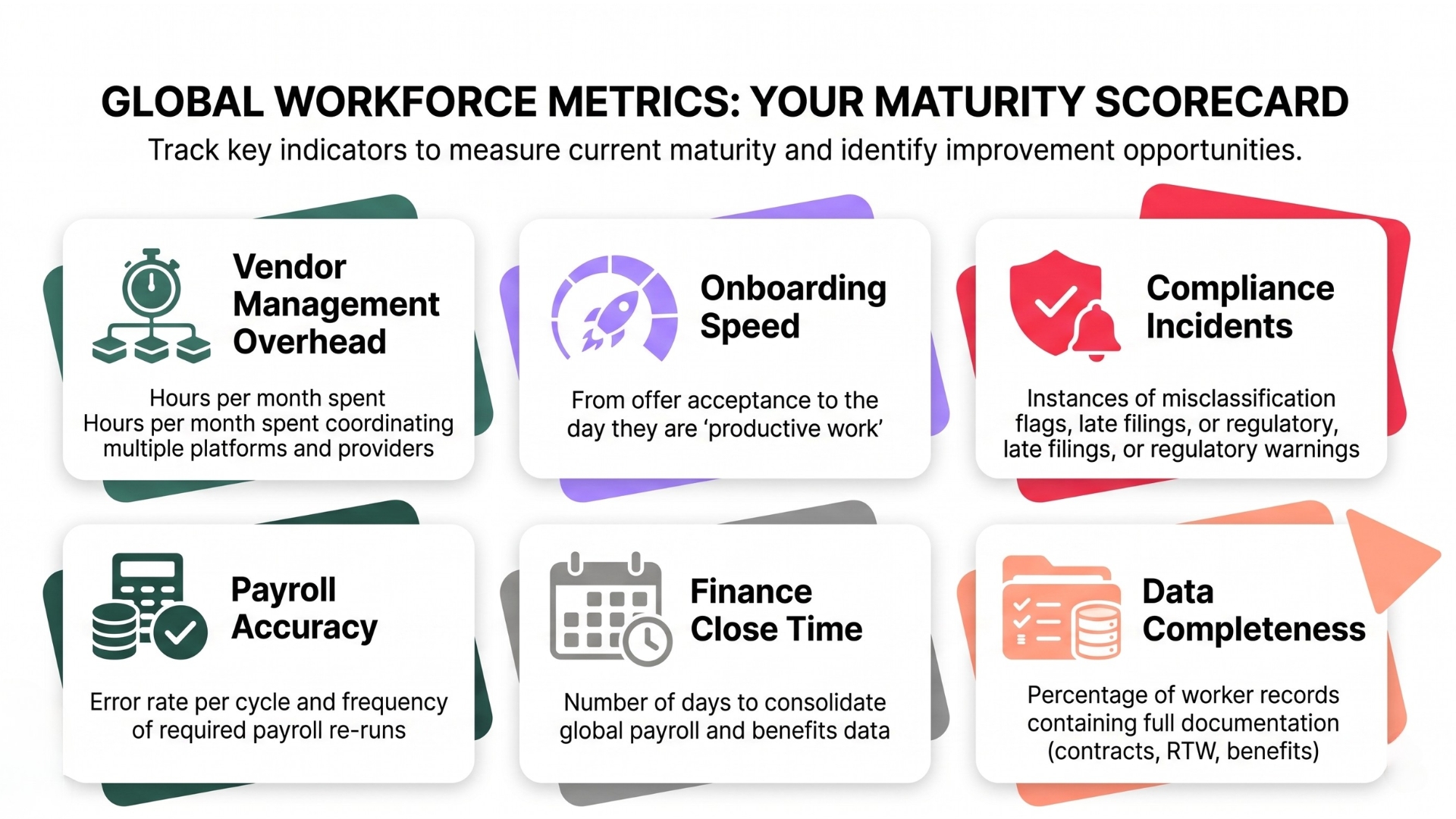
    Track indicators to measure your current maturity and identify improvement opportunities:

  • Vendor management overhead: hours per month coordinating multiple platforms and providers
  • Onboarding speed: offer acceptance to productive work
  • Compliance incidents: misclassification flagging, late filings, regulatory warnings
  • Payroll accuracy: error rate per cycle and re-run frequency
  • Finance close time: days to consolidate global payroll and benefits data
  • Data completeness: percentage of worker records with full documentation (contracts, right to work, benefits)
  • Red flags you have outgrown your employment vendors

    Operational pain is the clearest signal your current setup can't support growth.

    Missed payroll cut-offs

    When multiple vendors exchange data, cut-off misses cause delayed payments, damaging morale and trust, particularly in European markets with strict pay expectations and penalties for late remittance of taxes and social charges. One late payroll run in France can trigger employee complaints and regulatory scrutiny.

    Duplicate data entry

    If HR, payroll, and finance re-enter the same data into different systems, time gets wasted and error rates rise. Mid-market finance teams feel this most acutely during month-end and audits. You're paying three people to do the same work three times and still catching mistakes.

    Rising legal queries

    An uptick in questions on classification, local benefits, terminations, or cross-border assignments indicates your risk profile has outpaced your internal capabilities especially in highly regulated sectors like financial services. When your legal team constantly fields questions about German works councils or French severance, you've outgrown your current setup.

    Transition triggers for contractors, EOR and owned entities

    Key moments force an evolution in approach. Plan ahead for triggers like worker reclassification, European expansion, and investor diligence.

    Contractor-to-employee conversion

    Regulatory pressures (e.g., UK IR35, EU worker status tests) and business needs (IP protection, customer-facing roles) drive conversions. Proactive assessment avoids retroactive liabilities and ensures benefits and payroll compliance.

    IR35 in the UK has made contractor relationships riskier. If HMRC determines your contractor relationship looks like employment, you're liable for unpaid taxes and penalties. Defence and financial services firms face even stricter scrutiny misclassification can jeopardise security clearances or regulatory approvals.

    Scaling into Europe with an EOR or entity

    Use EOR for speed and testing new markets; move to entities for scale, employer branding, and cost control. The EOR model cuts entity setup costs by up to 60%, making it ideal for initial market entry before establishing permanent entities. Defence and financial services companies face additional considerations: export controls, security clearances, and regulated benefits come into play early in the decision.

    EOR works brilliantly for your first few hires in Germany. But once you reach 10–15 employees, entity economics improve. You gain control over benefits, branding, and employee experience. The transition, however, requires planning payroll migration, contract novation, and works council consultation if thresholds are met.

    M&A and investor due diligence

    Series B/C rounds and M&A processes scrutinise contracts, payroll records, IP assignment, and classification. Clean, centralised data and clear employment models reduce valuation haircuts and accelerate diligence.

    Investors want to see that your global operations won't blow up post-funding. Fragmented data, missing contracts, and unclear classification create red flags. Companies with unified platforms and audit ready records close diligence faster and preserve valuation.

    Capability checklist for HR and finance leaders

    Assess whether your team has the depth and systems to operate globally at scale.

    Compliance oversight

    Compliance isn't a one-time setup. Laws change. France updates social charges. Germany revises works council thresholds. Your platform and team stay current without you chasing updates manually.

    Audit-ready payroll data

    Auditors want to see clean data trails. If your payroll data lives in five different systems with inconsistent formats, you're setting yourself up for painful audit prep. Consolidation isn't just operational efficiency it's risk mitigation.

    Vendor consolidation impact

    Consolidation delivers immediate relief. HR stops juggling logins. Finance closes the books faster. Legal has one place to pull contracts. The ROI is measurable in hours saved and errors avoided, EOR platforms have demonstrated reduction in onboarding time through consolidation.

    Europe-first compliance shifts at each level

    Understand the European requirements that shape maturity progression.

    GDPR and data residency

    HR systems handle sensitive employee data, home addresses, bank details, health information. GDPR requires lawful basis, minimisation, data subject request (DSR) handling, and secure transfers. Financial services and defence often require EU/EEA data residency and stricter access controls.

    Evaluate the solution based on platform support, data portability (spreadsheet exports), and compliance measures specifically data residency and role-based access control (RBAC) for sensitive information.

    Works councils in Germany

    When thresholds are met, employee representation triggers co-determination rights affecting working time, tech tools, and restructuring. Plan timelines and consultation obligations before organisational changes.

    Works councils aren't optional in Germany. Once you hit five employees, they have consultation rights. Introducing new HR software? Changing working hours? Restructuring teams? You'll need works council approval. Companies that ignore this face legal challenges and employee relations issues.

    Posted worker directives

    Temporary assignments into EU member states require notifications, host-country minimums, and documentation. Professional services firms moving consultants across borders face pre-notifications and proof-of-compliance on site.

    If you send a UK consultant to work in France for three months, they're a posted worker. France requires A1 certificates, pre-arrival notifications, and compliance with French minimum wage and working conditions. Failure to comply can trigger fines and project delays.

    Cost and ROI benchmarks for 200–2,000 employees

    Focus on value drivers rather than headline rates.

    Total cost per employee

    Beyond salary: employer taxes, social contributions, benefits, payroll admin, legal support, and platform fees. Vendor sprawl creates hidden duplication; a consolidated approach in GBP/Euro terms improves predictability and budget control.

    A £50,000 salary in Germany comes with roughly 20% employer social contributions, plus benefits, payroll processing, and compliance support. When you're using three different vendors, you're paying overlapping admin fees. Consolidation reduces duplications and gives finance a single, predictable cost per employee.

    Vendor management overheads

    Time coordinating providers, resolving tickets, and reconciling reports is a real cost. Consolidation reduces context switching and meeting load for HR, payroll, and finance.

    Calculate how many hours your team spends each month managing vendors. If your HR manager spends 10 hours coordinating between your EOR, contractor platform, and local payroll, that's £400–£600 in lost productivity per month. Multiply that across a year, and consolidation pays for itself.

    Speed to hire savings

    Faster onboarding reduces vacancy costs, accelerates billable utilisation in services businesses, and improves offer acceptance by cutting friction.

    Every week a role sits vacant costs you revenue. In professional services, that's billable hours lost. In defence, it's project delays. Cutting onboarding from four weeks to 24 hours means new hires contribute sooner and candidates don't drop out during drawn-out processes.

    Step-by-step roadmap to level up in 180+ countries

    A pragmatic progression plan minimises disruption while raising maturity.

    Step 1: Map current contracts

    Inventory all contractors, EOR employees, and entity hires. Validate classification, IP assignment, notice terms, and right to work. Diagram current entity and vendor structures.

    Start with a spreadsheet. Who works for you? Where are they? What's their employment status? Do you have signed contracts? Is IP properly assigned? This audit surfaces gaps and risks before they become problems.

    Step 2: Consolidate payroll feeds

    Centralise payroll inputs and outputs across providers and jurisdictions. Standardise earning codes, cost centres, and GL mapping to become audit ready and accelerate monthly close.

    Payroll consolidation doesn't mean ripping out every vendor overnight. It means creating a single data layer that feeds your accounting system. Standardised codes, consistent formats, and automated feeds eliminate manual reconciliations.

    Step 3: Align legal entities with growth plan

    Prioritise markets by revenue, headcount projections, and regulatory complexity. Decide EOR versus entity per country, considering European benefits, works councils, and tax nexus.

    Not every country needs an entity. Use EOR where headcount is low or growth is uncertain. Establish entities in core markets where you have 10+ employees, need employer branding, or face regulatory requirements that favour local entities.

    Step 4: Consider Automation

    AI agents can support in areas from document collection, data validation, anomaly detection, and ticket triage, while human experts handle complex compliance decisions and local law interpretation.

    AI excels at repetitive tasks, chasing missing documents, validating data entry, flagging payroll anomalies. It doesn't replace human judgement; it frees experts to focus on complex questions: Is this contractor relationship compliant? How do we handle this termination in France?

    Step 5: Embed continuous compliance monitoring

    Track regulatory changes, update policies, and re-check classification on cadence. Maintain dashboards for incidents, filings, and expiries critical in regulated sectors.

    Compliance isn't static. France changes social charges. Germany updates works council thresholds. Your platform monitors changes and flags actions needed. Continuous monitoring means you're never caught off guard by regulatory shifts, 52% of top-tier EOR vendors now offer compliance toolkits with integrated labor law tracking across 150+ jurisdictions.

    Why one platform future proofs global growth

    A single platform standardises data, automates workflows, and unifies contractors, EOR, and entity employment to keep operations stable as you scale.

    Faster contractor conversion

    Transitions from contractor to employee can be streamlined with preserved records, helping to reduce onboarding friction and support compliance, though some local requirements may still apply.

    When your contractor platform and EOR are separate, converting a contractor to an employee means re-entering all their data, collecting documents again, and disrupting their experience. On a unified platform, you flip their status and update their contract done.

    Fair and transparent pricing

    Predictable, transparent GBP pricing reduces surprises, improves cost allocation, and supports mid-market budgeting discipline.

    Fair and transparent pricing means you have clear visibility into standard fees per contractor or EOR employee. Additional charges may apply for certain services, tax filings, or compliance support depending on jurisdiction and complexity.
    Talk to the experts at Teamed

    If you're encountering vendor sprawl, compliance uncertainty, or slow onboarding, talk to Teamed. We consolidate contractors, EOR, and entities on one platform built for European complexity and the toughest use cases in defence and financial services.

    FAQs about global employment maturity

    Can we keep local payroll providers whilst centralising employment data?

    Yes, hybrid models are possible. Centralising data improves reporting and compliance oversight, but full consolidation yields greater benefits: fewer reconciliations, consistent policies, and lower integration maintenance.

    What happens if we need to downsize operations in one jurisdiction?

    Processes vary by model: contractors require notice per contract; EOR and entity employees follow local termination law, notice, severance, and consultation requirements. Plan timelines and documentation to avoid disputes and penalties.

    Does the maturity model differ for defence or financial services organisations?

    The stages are the same, but controls are stricter. Expect enhanced due diligence, data residency constraints, export controls, and regulator reporting making consolidation, audit trails, and local expertise even more critical.

    Where Are You on Global Employment Maturity?

    Scaling globally without a clear employment strategy is how companies end up juggling five vendors, missing payroll deadlines, and fielding panicked calls from Legal about worker misclassification. The chaos isn't inevitable it's a symptom of outgrowing your current setup without a roadmap.

    This article maps the five levels of global employment maturity, shows you where your company sits today, and outlines the practical steps to consolidate contractors, EOR, and entities onto one platform before vendor sprawl becomes a compliance crisis.

    Key Takeaways

  • Global employment maturity shows how well you manage contractors, EOR employees, and owned entities across borders—moving from scattered spreadsheets to unified operations.
  • Companies with 200–2,000 employees typically progress through five levels, each bringing different compliance risks and operational overhead.
  • Clear warning signs—missed payroll deadlines, duplicate data entry, rising legal questions—tell you when your current setup can't support growth anymore.
  • Consolidating onto one platform cuts vendor chaos, accelerates hiring, and supports audit-ready compliance efforts in over 180 countries—always subject to the specific legal requirements of each jurisdiction.
  • Knowing your maturity level helps you spot gaps, plan transitions, and avoid expensive mistakes while scaling globally.
  • What is global employment maturity?

    Global employment maturity is a framework that shows how well your company hires, pays, and manages people across borders. It covers contractors, employer of record (EOR) arrangements, and owned entities. For scaling companies in professional services, defence, and financial services with 200–2,000 employees, a segment that represents over 55% of global EOR adoption, the framework clarifies where you stand operationally, where compliance gaps exist, and how to move from fragmented tools to integrated, audit-ready operations.

    Think of it as a diagnostic. Where you sit on the maturity curve determines your risk exposure, your team's admin burden, and how quickly you can enter new markets. Companies at lower levels often juggle multiple platforms, face worker misclassification risks, and struggle with payroll accuracy. Higher maturity brings consolidation, compliance confidence, and the ability to scale without operational chaos.

    The model isn't prescriptive, there's no single correct path. A fintech scaling into Germany may prioritise EOR speed, while a defence contractor establishing entities in France faces stricter compliance requirements. Yet the underlying progression stays consistent: from reactive, fragmented hiring to proactive, unified global operations.

    The five levels of global employment maturity

    Below are the five stages, with common mid-market pain points at each step.

    1. Ad-hoc contractor hiring

    Scattered contractor arrangements get managed via spreadsheets, email, and different platforms. A UK fintech, for example, might hire developers in Eastern Europe on multiple marketplaces without standard contracts, IP assignment, or consistent onboarding. This leads to misclassification risk, inconsistent rates, and delayed payments.

    At this level, compliance is reactive. You address issues only when they surface often during audits or investor diligence. Finance teams spend hours reconciling invoices from different platforms, and HR lacks visibility into who actually works for the company.

    2. Basic EOR expansion

    To hire compliantly without entities, companies adopt EORs in target markets. Defence contractors needing rapid deployment in Germany or France may use EORs to onboard within weeks, but still face fragmented data, policy inconsistency, and limited visibility into total costs across providers.

    EOR solves the immediate problem legal employment without entity setup but introduces new complexity. Each provider has different onboarding processes, payroll schedules, and reporting formats. When you're using three EORs across five countries, consolidation becomes the next challenge.

    3. Integrated vendor stack

    Companies blend multiple providers contractor platforms, several EOR vendors, and local payrolls, plus point tools for timekeeping and expenses. Professional services firms juggling contractors and employees simultaneously feel the operational drag of duplicate entries, reconciliations, and vendor management overhead.

    This level reflects growth without strategic planning. You've added tools as needs arose, but now those tools don't talk to each other. Payroll cut-offs get missed because data sits in different systems. Finance teams manually reconcile vendor invoices. HR spends more time managing platforms than managing people.

    4. Entity-led operations

    Legal entities get established in priority markets to gain control over employment, benefits, and branding. European expansion introduces local payroll, benefits, works councils, and statutory filings. Complexity rises as your internal team operationalises HR, payroll, and compliance in-country and coordinates across multiple jurisdictions.

    Entities signal maturity and commitment, but they also demand deeper expertise. Germany requires works council consultation for certain decisions. France has strict termination procedures. Each country brings its own payroll nuances, tax filings, and employee protections. Without the right support, entities become a compliance burden rather than a strategic asset.

    5. Unified global people strategy

    Employment models converge on a single platform with standardised policies, consolidated payroll data, automated workflows, and embedded compliance. Contractors, EOR hires, and entity employees get managed uniformly, enabling faster hiring, consistent experiences, transparent costs, and audit-ready reporting across the whole footprint.

    At this level, your operations are proactive, not reactive. AI agents handle routine tasks, while human experts resolve complex compliance questions. Payroll processes are streamlined to reduce errors, and onboarding can be completed in as little as 24 hours in some cases.

    How mid-market companies diagnose their current level

    Use a practical lens: count vendors, measure onboarding speed, review compliance incidents, and assess data quality. Warning signs include frequent payroll cut off misses, rising legal queries, manual reconciliations, and increasing finance time to close.

    Start by mapping your current setup. How many platforms does HR log into each week? How long does it take to onboard a new hire in Spain versus Poland? When was the last time you had a misclassification scare or a late tax filing?

    Quick self-assessment table

    Indicator Level 1: Ad-Hoc Level 2: Basic EOR Level 3: Integrated Stack Level 4: Entity-Led Level 5: Unified Strategy
    Vendor count 5–10+ fragmented tools 3–5 incl. 1–2 EORs 6–12 incl. multiple EOR/local payroll 5–10 incl. in-country payrolls 1–3 with single orchestrating platform
    Onboarding time 3–8 weeks 2–6 weeks 2–6 weeks with bottlenecks 2–4 weeks, variable by country <1–2 weeks consistently
    Compliance confidence Low Moderate by country Mixed and situational Higher but uneven High and monitored
    Payroll accuracy Variable Better but siloed Inconsistent across vendors Good but manual reconciliations High with consolidated feeds
    Finance close impact Delays and adjustments Fewer adjustments Heavy manual work Moderate reconciliation Streamlined, audit-ready

    Common metrics to track

    Track indicators to measure your current maturity and identify improvement opportunities:

  • Vendor management overhead: hours per month coordinating multiple platforms and providers
  • Onboarding speed: offer acceptance to productive work
  • Compliance incidents: misclassification flagging, late filings, regulatory warnings
  • Payroll accuracy: error rate per cycle and re-run frequency
  • Finance close time: days to consolidate global payroll and benefits data
  • Data completeness: percentage of worker records with full documentation (contracts, right to work, benefits)
  • Red flags you have outgrown your employment vendors

    Operational pain is the clearest signal your current setup can't support growth.

    Missed payroll cut-offs

    When multiple vendors exchange data, cut-off misses cause delayed payments, damaging morale and trust, particularly in European markets with strict pay expectations and penalties for late remittance of taxes and social charges. One late payroll run in France can trigger employee complaints and regulatory scrutiny.

    Duplicate data entry

    If HR, payroll, and finance re-enter the same data into different systems, time gets wasted and error rates rise. Mid-market finance teams feel this most acutely during month-end and audits. You're paying three people to do the same work three times and still catching mistakes.

    Rising legal queries

    An uptick in questions on classification, local benefits, terminations, or cross-border assignments indicates your risk profile has outpaced your internal capabilities especially in highly regulated sectors like financial services. When your legal team constantly fields questions about German works councils or French severance, you've outgrown your current setup.

    Transition triggers for contractors, EOR and owned entities

    Key moments force an evolution in approach. Plan ahead for triggers like worker reclassification, European expansion, and investor diligence.

    Contractor-to-employee conversion

    Regulatory pressures (e.g., UK IR35, EU worker status tests) and business needs (IP protection, customer-facing roles) drive conversions. Proactive assessment avoids retroactive liabilities and ensures benefits and payroll compliance.

    IR35 in the UK has made contractor relationships riskier. If HMRC determines your contractor relationship looks like employment, you're liable for unpaid taxes and penalties. Defence and financial services firms face even stricter scrutiny misclassification can jeopardise security clearances or regulatory approvals.

    Scaling into Europe with an EOR or entity

    Use EOR for speed and testing new markets; move to entities for scale, employer branding, and cost control. The EOR model cuts entity setup costs by up to 60%, making it ideal for initial market entry before establishing permanent entities. Defence and financial services companies face additional considerations: export controls, security clearances, and regulated benefits come into play early in the decision.

    EOR works brilliantly for your first few hires in Germany. But once you reach 10–15 employees, entity economics improve. You gain control over benefits, branding, and employee experience. The transition, however, requires planning payroll migration, contract novation, and works council consultation if thresholds are met.

    M&A and investor due diligence

    Series B/C rounds and M&A processes scrutinise contracts, payroll records, IP assignment, and classification. Clean, centralised data and clear employment models reduce valuation haircuts and accelerate diligence.

    Investors want to see that your global operations won't blow up post-funding. Fragmented data, missing contracts, and unclear classification create red flags. Companies with unified platforms and audit ready records close diligence faster and preserve valuation.

    Capability checklist for HR and finance leaders

    Assess whether your team has the depth and systems to operate globally at scale.

    Compliance oversight

    Compliance isn't a one-time setup. Laws change. France updates social charges. Germany revises works council thresholds. Your platform and team stay current without you chasing updates manually.

    Audit-ready payroll data

    Auditors want to see clean data trails. If your payroll data lives in five different systems with inconsistent formats, you're setting yourself up for painful audit prep. Consolidation isn't just operational efficiency it's risk mitigation.

    Vendor consolidation impact

    Consolidation delivers immediate relief. HR stops juggling logins. Finance closes the books faster. Legal has one place to pull contracts. The ROI is measurable in hours saved and errors avoided, EOR platforms have demonstrated reduction in onboarding time through consolidation.

    Europe-first compliance shifts at each level

    Understand the European requirements that shape maturity progression.

    GDPR and data residency

    HR systems handle sensitive employee data, home addresses, bank details, health information. GDPR requires lawful basis, minimisation, data subject request (DSR) handling, and secure transfers. Financial services and defence often require EU/EEA data residency and stricter access controls.

    Evaluate the solution based on platform support, data portability (spreadsheet exports), and compliance measures specifically data residency and role-based access control (RBAC) for sensitive information.

    Works councils in Germany

    When thresholds are met, employee representation triggers co-determination rights affecting working time, tech tools, and restructuring. Plan timelines and consultation obligations before organisational changes.

    Works councils aren't optional in Germany. Once you hit five employees, they have consultation rights. Introducing new HR software? Changing working hours? Restructuring teams? You'll need works council approval. Companies that ignore this face legal challenges and employee relations issues.

    Posted worker directives

    Temporary assignments into EU member states require notifications, host-country minimums, and documentation. Professional services firms moving consultants across borders face pre-notifications and proof-of-compliance on site.

    If you send a UK consultant to work in France for three months, they're a posted worker. France requires A1 certificates, pre-arrival notifications, and compliance with French minimum wage and working conditions. Failure to comply can trigger fines and project delays.

    Cost and ROI benchmarks for 200–2,000 employees

    Focus on value drivers rather than headline rates.

    Total cost per employee

    Beyond salary: employer taxes, social contributions, benefits, payroll admin, legal support, and platform fees. Vendor sprawl creates hidden duplication; a consolidated approach in GBP/Euro terms improves predictability and budget control.

    A £50,000 salary in Germany comes with roughly 20% employer social contributions, plus benefits, payroll processing, and compliance support. When you're using three different vendors, you're paying overlapping admin fees. Consolidation reduces duplications and gives finance a single, predictable cost per employee.

    Vendor management overheads

    Time coordinating providers, resolving tickets, and reconciling reports is a real cost. Consolidation reduces context switching and meeting load for HR, payroll, and finance.

    Calculate how many hours your team spends each month managing vendors. If your HR manager spends 10 hours coordinating between your EOR, contractor platform, and local payroll, that's £400–£600 in lost productivity per month. Multiply that across a year, and consolidation pays for itself.

    Speed to hire savings

    Faster onboarding reduces vacancy costs, accelerates billable utilisation in services businesses, and improves offer acceptance by cutting friction.

    Every week a role sits vacant costs you revenue. In professional services, that's billable hours lost. In defence, it's project delays. Cutting onboarding from four weeks to 24 hours means new hires contribute sooner and candidates don't drop out during drawn-out processes.

    Step-by-step roadmap to level up in 180+ countries

    A pragmatic progression plan minimises disruption while raising maturity.

    Step 1: Map current contracts

    Inventory all contractors, EOR employees, and entity hires. Validate classification, IP assignment, notice terms, and right to work. Diagram current entity and vendor structures.

    Start with a spreadsheet. Who works for you? Where are they? What's their employment status? Do you have signed contracts? Is IP properly assigned? This audit surfaces gaps and risks before they become problems.

    Step 2: Consolidate payroll feeds

    Centralise payroll inputs and outputs across providers and jurisdictions. Standardise earning codes, cost centres, and GL mapping to become audit ready and accelerate monthly close.

    Payroll consolidation doesn't mean ripping out every vendor overnight. It means creating a single data layer that feeds your accounting system. Standardised codes, consistent formats, and automated feeds eliminate manual reconciliations.

    Step 3: Align legal entities with growth plan

    Prioritise markets by revenue, headcount projections, and regulatory complexity. Decide EOR versus entity per country, considering European benefits, works councils, and tax nexus.

    Not every country needs an entity. Use EOR where headcount is low or growth is uncertain. Establish entities in core markets where you have 10+ employees, need employer branding, or face regulatory requirements that favour local entities.

    Step 4: Consider Automation

    AI agents can support in areas from document collection, data validation, anomaly detection, and ticket triage, while human experts handle complex compliance decisions and local law interpretation.

    AI excels at repetitive tasks, chasing missing documents, validating data entry, flagging payroll anomalies. It doesn't replace human judgement; it frees experts to focus on complex questions: Is this contractor relationship compliant? How do we handle this termination in France?

    Step 5: Embed continuous compliance monitoring

    Track regulatory changes, update policies, and re-check classification on cadence. Maintain dashboards for incidents, filings, and expiries critical in regulated sectors.

    Compliance isn't static. France changes social charges. Germany updates works council thresholds. Your platform monitors changes and flags actions needed. Continuous monitoring means you're never caught off guard by regulatory shifts, 52% of top-tier EOR vendors now offer compliance toolkits with integrated labor law tracking across 150+ jurisdictions.

    Why one platform future proofs global growth

    A single platform standardises data, automates workflows, and unifies contractors, EOR, and entity employment to keep operations stable as you scale.

    Faster contractor conversion

    Transitions from contractor to employee can be streamlined with preserved records, helping to reduce onboarding friction and support compliance, though some local requirements may still apply.

    When your contractor platform and EOR are separate, converting a contractor to an employee means re-entering all their data, collecting documents again, and disrupting their experience. On a unified platform, you flip their status and update their contract done.

    Fair and transparent pricing

    Predictable, transparent GBP pricing reduces surprises, improves cost allocation, and supports mid-market budgeting discipline.

    Fair and transparent pricing means you have clear visibility into standard fees per contractor or EOR employee. Additional charges may apply for certain services, tax filings, or compliance support depending on jurisdiction and complexity.

    Talk to the experts at Teamed

    If you're encountering vendor sprawl, compliance uncertainty, or slow onboarding, talk to Teamed. We consolidate contractors, EOR, and entities on one platform built for European complexity and the toughest use cases in defence and financial services.

    FAQs about global employment maturity

    Can we keep local payroll providers whilst centralising employment data?

    Yes, hybrid models are possible. Centralising data improves reporting and compliance oversight, but full consolidation yields greater benefits: fewer reconciliations, consistent policies, and lower integration maintenance.

    What happens if we need to downsize operations in one jurisdiction?

    Processes vary by model: contractors require notice per contract; EOR and entity employees follow local termination law, notice, severance, and consultation requirements. Plan timelines and documentation to avoid disputes and penalties.

    Does the maturity model differ for defence or financial services organisations?

    The stages are the same, but controls are stricter. Expect enhanced due diligence, data residency constraints, export controls, and regulator reporting making consolidation, audit trails, and local expertise even more critical.

    TABLE OF CONTENTS

    Take a look
    at the latest articles