
Case Study
What Your EOR Actually Does (And Doesn't Do): The audit that asked questions nobody could answer

Tom Price-Daniel

12 minutes

May 6, 2026


Expanding into Europe brings growth opportunities, but employment compliance can trip you up. This blog outlines why EU compliance matters, the five key risks you must manage, the impact of “compliance creep”, and real-world case studies showing what happens when it goes wrong.
Expanding your business across the European Union (EU) is a smart move, diverse talent, strong economies, and strategic location make it a prime growth destination. But hiring in the EU without understanding local European employment regulations can feel like walking a legal tightrope blindfolded. One misstep, and you’re dealing with fines, lawsuits, or reputational damage.
This guide is built for scaling businesses, especially those with limited in-house legal teams, and helps you navigate the complex world of EU employment compliance. From contracts to termination, it breaks down the real risks and what you can do to stay compliant while scaling fast.
Hiring across borders means navigating 27 different labour law systems. This complexity highlights the critical need for robust international labour law compliance. What’s legal in the Netherlands might be illegal in Spain. A mistake in France could cost you thousands in back pay or litigation fees.
The costs of cross-border hiring compliance failures are significant:

When you hire one person in a new country, compliance feels manageable. But things change fast:
Soon, your lean People Ops team is buried in legal reviews and urgent compliance fixes.
This is “compliance creep” - a slow buildup of risk that eventually breaks your HR stack or leads to fines. It’s especially common in Series A-B funded companies aggressively expanding into the EU.
These real-world examples highlight the tangible costs of neglecting EU employment compliance and international labour law compliance. Learning from these mistakes can help your scaling business avoid similar pitfalls.
Case 1: The Misclassified Contractor in Italy
Case 2: The Ignored Redundancy Process in Spain
Case 3: German Co-determination and Foreign Direct Employer (FDE) Risk
EU employment compliance is complex, fast-moving, and unforgiving. Whether you’re hiring one person or scaling into multiple markets, overlooking compliance can cost you time, money, and reputation. But handled well, it becomes a competitive advantage.
Q: What is EU employment compliance?
A: It refers to following the laws around hiring, contracts, payroll, benefits, and terminations in each EU country.
Q: Why does it vary so much by country?
A: The EU sets directives, but each country applies them differently. So you need to follow national laws, not just EU rules.
Q: What happens if I get it wrong?
A: You could face fines, legal disputes, invalid contracts, or employee claims for back pay or benefits.
Q: Do I need a legal entity to hire in the EU?
A: Not necessarily. You can hire through an EOR who acts as the legal employer on your behalf.
Q: What is compliance creep?
A: It’s the gradual buildup of risk as your hiring expands across borders without a proper compliance framework in place.

Global hiring offers incredible opportunities for businesses to expand, diversify, and access top talent. But for lean HR teams juggling compliance, payroll, and onboarding across multiple regions, it’s not just a challenge, it’s a balancing act.
According to Gallup, 60% of full-time employees report feeling overworked, and HR professionals often carry the heaviest burden, managing rising administrative and strategic demands.
The big question is: Should you take the do-it-yourself approach when your people strategy requires hiring talent across borders, or should you partner with an Employer of Record (EOR) to simplify the process and avoid stretching yourself too thin?
We think it’s best to learn from others. Here’s why businesses like City Relay, MyTutor, and Data Science Talent decided to do so for their global hiring needs.
Going it alone might seem like a straightforward option, but the reality is often far from simple. The challenges of doing it yourself:
👉 Read more: Our blog on employee or contractor highlights how misclassification risks could make a DIY approach even riskier.
Partnering with an EOR transforms a complex, time-consuming process into something smooth and scalable.
👉 Want to know how an EOR works? Check out our article: What is an EOR?
When City Relay decided to grow internationally, they needed a partner to navigate compliance and operational hurdles. With Teamed, they:
“Having Teamed as a partner made launching in a new market much easier. They handled onboarding, compliance, and everything else, so we could focus on our business.” – Amy, Head of People, City Relay
MyTutor wanted to retain employees relocating abroad but lacked the infrastructure to manage compliance and payroll internationally. With Teamed, they:
“Managing overseas employees feels easy now because of how intuitive the platform is.” – Leadership Team, MyTutor
This boutique recruitment firm needed to hire in South Africa without setting up a local entity. Our team partnered with Data Science Talent and delivered:
“Teamed feels like an extension of our team. Their human touch is rare and invaluable.” – Rachel, People Operations Manager, Data Science Talent
If your HR team is feeling stretched, we can help:
👉 Ready to simplify global hiring? Book a call today and discover how Teamed can support your growth.

In small and mid-sized businesses (SMBs), HR teams often bear the brunt of competing priorities. They’re asked to manage recruitment, payroll, onboarding, employee engagement, compliance, and more often with fewer than two HR professionals per 100 employees. This “lean and mean” approach might save on staffing costs in the short term, but the cracks in this model are beginning to show.
Recent research paints a clear picture of the pressure HR teams are under:
The problem isn’t just about having too few hands on deck. It’s a lack of strategic investment in HR as a business partner. As SMBs grow and adapt to hybrid workforces, global hiring, and increasingly complex compliance demands, HR needs more than time; people teams need tools, resources, and support to thrive.
This is a call to action. If businesses want to thrive in 2025, it’s time to rethink how their people function. Lean teams don’t just need more time; they need the right tools, partners, and strategies to shift from survival mode to proactive people planning.
Because when HR teams are supported, businesses gain the resilience and adaptability they need to succeed in today’s complex world.
The challenges facing HR teams aren’t just about doing more with less. They’re rooted in larger changes to how businesses operate and grow. Let’s break it down.
As companies expand and adapt to remote work, hybrid setups, and global hiring, the role of HR has grown far more complex over the past decade. Where historically an HR department might have been tasked with handling admin and strategic work for just one country or region, many people teams are now managing multiple countries and territories. They’re doing this with outdated tools and limited resources.
Let’s continue with remote work as an example. Global telecommuting has opened up incredible opportunities for hiring worldwide, but it’s also added layers of complexity. HR teams now find themselves navigating cross-border compliance, local tax laws, and onboarding requirements that differ from country to country. What used to be straightforward, like drafting a contract or running payroll, can now take hours of research and coordination. Even then, it might not be handled compliantly. When your people team is already stretched, this added complexity eats into the time they need for strategic initiatives.
Compliance is another growing pressure point. Employment laws are changing rapidly, and missteps can be costly. From worker misclassification to missed tax contributions, the risks of getting it wrong are higher than ever. Lean HR teams often end up stuck in reactive mode, trying to catch up with evolving regulations while balancing day-to-day tasks. This leaves little room for proactive planning, let alone supporting employee engagement and development.
What makes this even harder is that many businesses are scaling in chaos. Each new market, hire, or process introduces a fresh set of challenges. Instead of building scalable systems, HR teams are stuck reinventing the wheel for every new hire or region. Without the right tools or support, even simple tasks can become time-consuming bottlenecks, taking HR further away from the people strategy that drives long-term growth.
This isn’t just an issue for HR; it’s a challenge for the entire organisation. When HR is stretched too thin, engagement drops, compliance risks grow, and opportunities for growth slip through the cracks. The real problem is the lack of strategic investment in HR as a true business partner.
The truth is, asking lean HR teams to do more with less isn’t sustainable. These teams are already stretched thin, balancing compliance, recruitment, onboarding, and people strategies. Instead of pushing harder, businesses need to step back and ask how they can work smarter, not harder.
When repetitive tasks like payroll, benefits, and compliance are automated or managed externally, HR can focus on the big-picture priorities. For instance, an Employer of Record (EOR) can take on compliance-heavy responsibilities like managing local tax filings and employment laws, especially when businesses are expanding into new markets. This doesn’t just save time; it reduces risk and gives your team breathing room to focus on what matters.
It’s not enough to hire quickly. HR needs the space to think strategically about how each hire contributes to long-term goals. Testing markets with contractors, planning for growth in stages, and partnering with global experts for cross-border hiring are ways to reduce the pressure while maintaining momentum. These strategies aren’t about cutting corners; they’re about being deliberate with time and resources.
Many businesses still treat HR as a transactional function, yet research shows that employee engagement and retention hinge on how people feel about their workplace. Gallup found that over half of employees believe their companies have lost the human touch, and that impacts productivity, loyalty, and morale. The businesses thriving today are the ones that recognise HR as a critical driver of organisational health, not just an administrative necessity.
Finally, businesses need to stop normalising overstretching as a solution. It might feel like short-term gains are being made, but the reality is that constant overstretching leads to burnout, costly errors, and missed opportunities. Lean HR teams need support, whether that’s in the form of tools, additional hires, or strategic partnerships that lighten the load.
The solution isn’t about piling on more responsibilities and hoping for the best. It’s about focusing on the things that truly make a difference. That means streamlining processes where possible, investing in tools that empower teams, and building a culture that recognises and values the pivotal role HR plays. When HR has the capacity to think and plan strategically, the entire business benefits.
We can’t keep expecting more without giving HR the resources to succeed. It’s time to break the cycle, make smarter investments towards streamlining operations, and create an environment where people teams, and the people they support, can truly thrive.

When you’re part of a stretched HR team, choosing the right global hiring partner isn’t just about ticking boxes; it’s about finding a solution that works for your business and your people. Here’s what you need to know before making your decision.
The truth: EORs support businesses of all sizes. Whether you’re a scrappy startup or a scaling organisation, EOR services provide the infrastructure you need to grow globally without overburdening your team.
For lean teams, EORs like Teamed extend your HR capabilities, reducing admin workloads so you can focus on strategic goals.
👉 Example in action: City Relay grew their workforce by 80%, expanding from Spain to the Philippines, while cutting costs significantly by hiring abroad instead of in London.

The truth: Payroll is just the start. A strong EOR partner acts as the legal employer for your global hires, managing:
Teamed takes it further with personalised support and local expertise. From market insights to long-term hiring strategies, we’re here to help.
👉 Example in action: With Teamed’s guidance, Data Science Talent onboarded employees in South Africa seamlessly, staying 100% compliant while meeting tight timelines.
The truth: Compared to setting up a legal entity, an EOR is a cost-effective solution. Consider the savings:
Teamed simplifies it all. Our transparent pricing means no hidden fees, so you can budget confidently while expanding globally. Plus, by hiring in cost-effective regions, you can significantly reduce expenses.
👉 Example in action: City Relay saved up to 80% in employment costs by building a team in the Philippines, benefiting from lower regional costs without sacrificing quality.
The truth: High-quality EORs thrive on complexity. Whether it’s managing redundancies, performance improvement plans, or navigating local regulations, Teamed is built to help.
Our in-country experts ensure compliance while delivering a human-first service. For instance, when MyTutor faced employee relocations, we supported their team through seamless transitions and even helped implement a flexible “working abroad” policy.
The truth: A great EOR enhances the employee experience. With Teamed, employees benefit from:
👉 Example in action: MyTutor’s employees praised the simplicity and speed of Teamed’s platform, which supported relocations and improved overall engagement.

Partnering with the right EOR isn’t just about reducing admin, it’s about giving your team the support they need to thrive. With Teamed, you get:
Ready to see how Teamed can make global hiring stress-free for your HR team?
👉 Book a call with Teamed today to explore how you scale globally with confidence.

Expanding internationally can open up exciting opportunities, such as accessing new talent, markets, and skills, but it’s not without risks. For HR teams already stretched thin, tackling compliance across multiple regions can feel daunting. Missteps can lead to hefty fines, legal issues, or reputational damage.
To help, we’ve outlined five of the most common compliance challenges growing businesses face and some practical ways to navigate them. These aren’t scare tactics; they’re real challenges we’ve seen businesses struggle with, and we’re here to help you sidestep them.
What it is:
Employee lifecycle management is about more than just compliant hiring and contracts. It spans every phase of an employee’s journey, from onboarding and probation periods to certifications, promotions, redundancies, and even post-employment admin like deregistering with local authorities. Each stage is filled with opportunities for compliance issues, especially when scaling across multiple regions.
Why it matters:
Data spotlight:
How to manage it:
Pro tip: Start by streamlining one lifecycle stage, like probation periods. Aligning this with local laws can immediately reduce risks and improve employee trust.
👉 Check out our Hiring and Firing Guide for region-specific insights on navigating the entire employee lifecycle here.
What it is:
Misclassification happens when a worker is wrongly classified as a contractor instead of an employee, or vice versa. Each type has different legal rights and tax obligations, and the rules can vary widely by country.
Why it matters:
How to manage it:
Pro tip: If you’re unsure whether your current contracts are fully compliant or if a worker should be classified as an employee or contractor, we’ve built a simple tool to help. Our Contractor vs Employee Quiz can guide you through the key considerations and flag any potential risks.
What it is:
Each country has its own rules for taxes, social contributions, and payroll filings. Staying compliant requires keeping track of deadlines, calculating the right amounts, and filing the correct paperwork.
Why it matters:
How to manage it:
or,
Pro tip: Managing international taxes doesn’t have to be complicated. A trusted global hiring partner can handle compliance and contributions for you. Learn more about international payroll solutions.
What it is:
Labour laws vary by country, covering everything from benefits and working hours to probation periods and termination procedures.
Why it matters:
How to manage it:
What it is:
Managing employee data across multiple regions quickly becomes chaotic. Different countries often require separate systems for payroll, compliance, and record-keeping. Without a single source of truth, businesses risk losing track of critical information, like work permits, certifications, and local tax filings.
Why it matters:
Data Spotlight:
How to manage it:
Pro tip: Centralised platforms don’t just improve compliance; they save time and create consistency across the organisation. If you’re scaling quickly, this can be the difference between smooth growth and chaotic bottlenecks.
👉 Learn more about simplifying global hiring and chat with our team → book a call with our hiring experts here!
Global compliance can feel like a minefield, but you don’t have to tackle it alone. A reliable hiring partner can guide you through the complexity while keeping you compliant and your team focused on strategic growth.
Here’s how a great partner can help:
Global hiring doesn’t have to be overwhelming. By working with a partner like Teamed, you can focus on growing your team while we handle the complex details.
👉 Chat with our team to get started.
Rachel Gething, People Operations Manager at Data Science Talent:
“Teamed feels like an extension of our team. They just take care of compliance so seamlessly that we never have to worry about it. Their human touch and expertise make all the difference.”

Global hiring opens doors to untapped talent pools, new markets, and innovative perspectives. But for stretched HR teams, managing compliance, payroll, and onboarding across borders can feel overwhelming. According to Gallup, nearly 44% of U.S. professionals feel overworked, with HR leaders facing added stress in balancing administrative and strategic demands. One wrong move in global hiring can lead to costly fines, employee dissatisfaction, or reputational damage.
This means that the stakes are high. With every new hire, you’re not just building a team, you’re safeguarding compliance, maintaining company culture, and ensuring the success of your business in a new market.
To navigate this complexity, our team outlined 10 great questions which HR leaders should ask before hiring internationally. These aren’t just random suggestions, they’re rooted in years of practical experience and built around frameworks like the HR Systems Model and Ulrich’s HR Roles.
We’ve kept things simple (no jargon, no fluff). These questions span three key areas: strategic alignment, operational readiness, and employee experience. For each, you’ll find practical tips and examples, helping you make decisions that align with your big-picture goals, address logistical challenges, and ensure your people feel supported.
Understanding your goals upfront will help ensure that international hiring decisions align with your business strategy.
Purpose matters. Is this about accessing specialised skills, testing a new market, reducing costs, or workforce diversification? Without a clear “why,” it’s easy to get lost in the complexity, and you may not target the right regions.
Example: A fintech client recently partnered with Teamed to access blockchain talent in South East Asia. Their clear goal allowed us to refine their hiring strategy and deliver results quickly.
The right location depends on your objectives. Are you prioritising cost savings, specific skills, or proximity to existing markets? Consider regulations, talent pools, and cultural fit when choosing a region.
Example: A UK-based SaaS company used Teamed to hire developers in South Africa, combining cost-effective salaries with high-quality engineering expertise.
Define clear metrics for success. Is this about project delivery, long-term retention, or market entry? Aligning on these expectations ensures clarity for both your HR team and external partners.
Alice, Onboarding Lead at Teamed, says: “Defining success early allows us to design the onboarding experience and ongoing support to align perfectly with your goals.”
Effective global hiring depends on having the right infrastructure in place.
Setting up a local entity can take months and cost tens of thousands. Partnering with an Employer of Record (EOR) like Teamed bypasses this complexity, enabling you to hire quickly and compliantly.
Example: City Relay expanded their team in the Philippines without establishing a legal entity, saving both time and money.
Compliance is non-negotiable. Local tax laws, benefits, and probation periods vary widely. Working with a trusted EOR ensures you stay on the right side of the law while avoiding payroll errors.
Example: Data Science Talent onboarded employees in South Africa seamlessly with Teamed’s compliance expertise, meeting tight recruitment deadlines.
Consider base salaries, benefits, taxes, and EOR fees. A clear cost breakdown helps you budget effectively. Teamed’s hiring cost calculator can simplify this process.
Tip: Avoid unexpected costs by partnering with an EOR that offers transparent pricing and ongoing support.
Great hiring is about more than compliance, it’s about creating an environment where employees feel valued and supported, no matter where they’re located.
First impressions matter. Consider the onboarding process, cultural integration, and clarity around role expectations. A bespoke onboarding experience can make employees feel welcome and engaged from day one.
Example: MyTutor praised Teamed for delivering a seamless onboarding process, allowing employees relocating to Spain to hit the ground running.
Localised benefits, such as healthcare, paid time off, and pensions, are critical to attracting top talent. They show that you value your team and respect local norms.
Tip: Partnering with Teamed ensures your benefits packages are competitive and compliant in any market.
Global hires need ongoing support to thrive. Performance reviews, feedback loops, and career development opportunities are just as important for remote employees as for those at HQ.
Alice, Onboarding Lead at Teamed, adds: “We believe onboarding is just the beginning. Continuous support is how you build long-term success for your global hires.”
Hiring globally means navigating cultural differences. Tailored training and regular check-ins help bridge gaps and foster a cohesive team dynamic.
Example: A US-based professional services company partnered with Teamed to build a support team in Poland, relying on our in-country expertise to integrate cultural insights into their hiring strategy.
Global hiring doesn’t have to be overwhelming. By asking the right questions and partnering with an EOR like Teamed, you can navigate compliance, payroll, and employee engagement with confidence.
Here’s how Teamed supports HR leaders like you:
👉 Ready to make global hiring stress-free? Let's chat
.png)
Designing a global employee benefits package that works for a distributed team is one of those challenges that sounds straightforward until you're actually in it. The right mix of benefits can be the difference between a cohesive, motivated workforce and one that's quietly eyeing the door. That's where a thoughtful benefits strategy becomes essential, not as a box-ticking exercise, but as a genuine signal of how you value your people.
A well-crafted global employee benefits strategy isn't just a nice-to-have. It reflects an understanding that your team members are building lives alongside their careers, lives that look different in São Paulo than they do in Stockholm.
The right benefits package addresses those differences while demonstrating real commitment to your team's well-being. It should also align with your company's goals, support long-term growth, and keep you compliant with local labour laws.
In this guide, we'll walk through what global employee benefits actually include, why a strategy matters, and how to build a package that works across borders, without losing sleep over compliance.
Global employee benefits vary by company and region, but a well-balanced package often includes a mix of mandatory and supplementary benefits to meet the diverse needs and expectations of a global workforce.
A survey by Aon shows what employees expect from companies in terms of benefits:
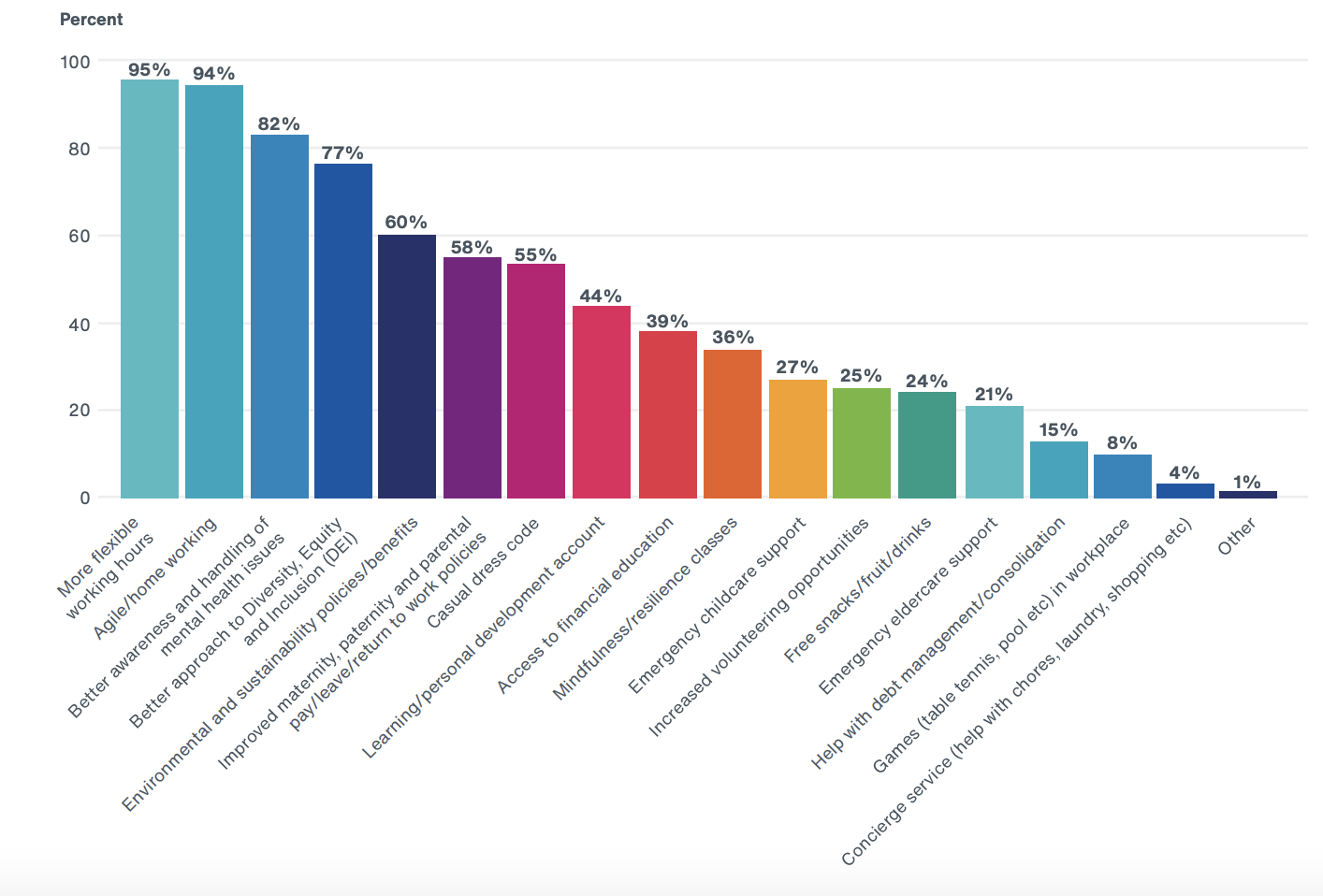
Here are a few steps to help you determine the right mix of benefits for your distributed workforce.
Before you design anything, get clarity on what you can actually spend. Consider:
If you're hiring in countries without a legal entity, an employer of record (EOR) can handle compliance so you don't have to.
You can use this free employment cost calculator by Teamed to compare the employment costs of different countries.
Research and understand the labour laws and regulations in each country where you have employees. Different countries have varying requirements for mandatory benefits, such as health insurance or retirement plans. For example, countries like South Africa require employers to mandatorily contribute to the Workers' Compensation Fund.
Understanding and complying with such laws from multiple countries can be challenging. An EOR like Teamed can help you by taking on the legal responsibilities of an employer, which includes compliance with local labour laws and regulations.
Look at what competitors offer, globally and in your target regions through proper salary benchmarking. This helps you understand industry norms and identify where you can differentiate.
LinkedIn, Glassdoor, and industry salary reports are useful starting points.
Thoroughly learn about the labour markets you're targeting, what workers expect, what governments require, and what competitors offer.
Here are a few factors to consider when deciding which benefits to include in your package:
Now you can start building your global employee benefits package:
Mandatory benefits: benefits required by local laws, such as health insurance and retirement plans
Core supplementary benefits: universally valued benefits, such as paid time off, flexible work schedules, and wellness programs
Tailored supplementary benefits: offerings like transportation allowances, childcare support, or supplementary healthcare programs
Communication and education: informational workshops, online guides, consultations with experts, and user-friendly benefits portals
The key to a cohesive global employee benefits strategy is to coordinate the links between different elements. This will help align the benefits package with organisational goals and satisfy the diverse needs of the workforce.

These benchmarks can help shape your priorities:
"Support for our candidates was hugely important. We wanted a solution that felt like just another branch of what we do internally but took care of things that are outside of our expertise. For this, Teamed delivers on all fronts!" - Marta Silva, Tekever
If you're expanding into multiple countries without legal entities in each, an EOR handles the parts that would otherwise keep you up at night: payroll, tax compliance, benefits administration, and labour law adherence.
Specifically, an EOR supports your benefits strategy by:
With an EOR by your side, you have a guide who understands all these factors and who has experience in it.

South Africa is gaining traction as a go-to destination for global hiring, thanks to its skilled workforce, cost-efficiency, and strategic time zone alignment. However, navigating the country’s unique employment landscape can be complex without the right support. In this blog, we explore how businesses are leveraging Employer of Record (EOR) services to hire talent in South Africa.
From compliance considerations to success stories, discover why partnering with an EOR like Teamed could be the key to expanding your team effortlessly.
With over 60 million people and a multilingual workforce, South Africa produces highly skilled professionals across sectors like IT, data science, and business development. Annually, its universities graduate 200,000+ candidates, including specialists in high-demand fields.
“Teamed has definitely helped us transform our hiring process. It allows us to cast the net so much further and target talent we know will be beneficial to our business, regardless of where they’re based.” – HR Team, MyTutor
South Africa operates in GMT+2, ideal for European businesses while overlapping with North American schedules for late-afternoon collaboration. This time zone convenience benefits industries requiring real-time communication, like customer support and software development.
Labour costs in South Africa are significantly lower than in Western markets, offering businesses opportunities to optimise their budgets without compromising on quality. Lower operating costs also make it a viable destination for scaling teams globally.
South Africa’s labour laws differ greatly from the “at-will” employment practices found in countries like the US. Employers need to account for:
“Teamed enabled us to navigate compliance challenges with ease. From probation periods to tax compliance, they take care of everything and allow us to focus on core business areas.” – Senior Manager, CT:
Employers in South Africa must navigate payroll intricacies, including:
Rather than navigating these complexities independently, businesses increasingly turn to an Employer of Record (EOR) to streamline payroll and compliance.
One unique aspect of South Africa is the ongoing challenge of load shedding (scheduled power outages). Businesses hiring in the country should:
These proactive measures ensure business continuity despite infrastructural challenges.
An EOR is a third-party service provider that handles all aspects of employment for international teams. Key benefits include:
“Teamed feels like an extension of our team. Their expertise and support ensure a smooth hiring experience.” – Rachel Gething, People Operations Manager, Data Science Talent
Establishing a local entity provides greater control but involves higher costs and time investments. This option is typically suited for businesses with long-term plans to operate in South Africa.
Facing talent shortages in the UK, CT partnered with Teamed to hire auditors in South Africa. Teamed managed compliance and onboarding seamlessly, allowing CT to expand globally without operational delays. “Teamed’s quick responses and in-depth knowledge have allowed us to streamline our onboarding processes and eliminate a lot of the red tape we would have previously struggled with.” – Senior Manager, CT:
Data Science Talent needed to hire a key business development professional in South Africa while navigating tight deadlines. Teamed provided flexibility and compliance expertise, making the process seamless. “They worked around our timelines and made the process smooth. Their human-centric approach feels like an extension of our own team.” – Rachel Gething, People Operations Manager, Data Science Talent
When a senior engineer at MyTutor moved to Spain, Teamed facilitated the transition, ensuring compliance and operational continuity. The partnership has also helped MyTutor hire globally.
“How quickly we can get things set up is a real plus for our team. The speed at which Teamed moves enables us to facilitate international moves, even at short notice.” - HR Team, MyTutor
Teamed’s Employer of Record (EOR) services are designed to simplify global hiring and compliance, offering:
Hiring in South Africa presents immense opportunities for businesses to access a skilled, cost-effective talent pool. With Teamed as your EOR partner, you can navigate the complexities of compliance and onboarding effortlessly, focusing on what matters most, growing your business.
Let’s chat about your hiring goals in South Africa!

Looking for software engineering talent? You’re not alone. Many companies are expanding their search into Eastern and Southern Europe, drawn by the prospect of high-quality tech skills at lower staffing costs. According to Precedence Research, the IT services outsourcing market is expected to hit around USD 1065.10 billion by 2030 with a CAGR of 8.06%. This growth indicates that more and more companies are turning to offshore and nearshore software development, primarily driven by cost considerations. But, as straightforward as it might seem, hiring across these regions comes with its own set of challenges.
At Teamed, we’ve seen firsthand how companies approach hiring in these cost-effective European markets. Often, the expectation of abundant technical skills at competitive costs meets the reality of navigating cultural, operational, and logistical complexities.
“When recruiting tech talent overseas, one of the biggest challenges is aligning expectations with the realities of emerging markets. For instance, Eastern Europe offers a rich pool of technical talent, but trying to transfer existing culture and working practices while expanding to new regions can pose challenges. What works culturally and professionally in a company’s home market doesn’t always translate easily into new regions,” explains one of our hiring experts at Teamed.
This article explores the most common hiring strategies and how businesses can effectively build and manage international remote teams.
Companies often look abroad for top-tier engineering talent as they scale. Regions like Eastern and Southern Europe are attractive due to their deep pools of highly skilled professionals and relatively lower costs compared to Western Europe or North America.
The European IT outsourcing sector is constantly growing, making it an attractive offshoring destination. According to Clutch, there are currently 3,016 firms specialising in software development in this region, including 913 IT firms in Ukraine, 1064 in Poland, and 112 in the Czech Republic. However, accessing this talent pool as a direct employer is fraught with challenges.
Numerous challenges prevent businesses from effectively accessing global engineering talent. The most common issue faced by companies looking to supplement their engineering teams with talent from countries like Poland, Lithuania, Romania, and North Macedonia is making the right logistical and strategic choices. In simple words, the way you look to engage talent. A key challenge is choosing the right hiring approach, which often was narrowed down to three traditional options: building local entities, partnering with software houses, or hiring local contractors.
Companies looking to tap into these markets typically face a decision: build their own local entities, partner with local software houses, or hire local contractors. Each option comes with its own draw-backs and benefits:
Establishing a local presence can be costly and time-consuming. It involves navigating foreign legal systems, adhering to local employment laws, and managing operational risks. While scaling up is feasible, scaling down can be equally challenging and expensive, making this option less flexible and more of a long-term commitment than some businesses are prepared for.
The downside: Establishing a local presence can be costly and time-consuming. According to McKinsey, setting up an entity can take upwards of 6-12 months and cost over $50,000 in legal and administrative fees alone.
The upside: Statista reports that Poland, for example, has over 500,000 ICT specialists, with a growing influx of over 13,000 IT graduates entering the market annually. These markets are filled with highly skilled talent, making them attractive locations.
This approach, while quicker and less burdensome in terms of initial setup, due to there being no need to source talent or build local entities, often results in less control over the quality and management of the workforce.
The downside: Companies can find themselves paying higher rates for the talent, yet they lack direct oversight and integration of these teams into their core operations.
The upside: Due to the ease of delivering outcomes without the need to acquire new talent or investing the time and cost involved in setting up local entities, this is a very popular method of acquiring staff for projects. E.g. N-iX reports that in Ukraine, 60% of tech professionals work for IT outsourcing and outstaffing companies, highlighting the prevalence and reliance on software houses.
Directly engaging with local freelancers and contractors can help you get set up fast and without the need of building local entities, offering flexibility and potentially lower costs but holding the risk of the unknown. Whilst it is more expensive than hiring your own resources it can be cheaper than using software houses.
The downside: There’s the element of the unknown, as it can be harder to vet contractors overseas. This can occasionally result in a lack of control and quality assurance if not managed properly. Additionally, hiring contractors often limits integration with your core team, and building trust can prove more challenging.
The upside: Hiring freelancers and contractors directly is cost-effective and can achieve cost savings of up to 20-30% services compared to using software houses (Deloitte Global Outsourcing Survey) and allows the flexibility to scale your team up and down quickly as needs require.
“One of the most common scenarios we encounter is companies looking to tap into global talent and income, but hesitating due to the complexity of establishing local entities and the risks of non-compliance. Some businesses even consider taking shortcuts by hiring contractors where they know they need employees, exposing themselves to significant risks,” says Tom, Co-Founder of Teamed.
“Luckily, there’s a better solution that sidesteps these challenges. By using an Employer of Record (EOR), businesses can hire both long- and short-term employees with minimal risk while retaining full control of their workforce. It’s a smarter, more sustainable approach that combines flexibility with compliance, ensuring companies can focus on growth without unnecessary complications.”
Amid these well-known approaches, the Employer of Record model offers a streamlined alternative. EORs simplify the process of building global remote teams by managing everything from local contracts to talent hiring, along with providing expert support and payroll services. They already have legal entities established in various countries, which means they can hire employees on behalf of another company.
Here’s how it addresses the core challenges related to hiring global remote talent:
Making the most out of the global talent pool requires more than just the intent to expand internationally; it demands a deep understanding of the options available and the strategic use of the right hiring models. Here at Teamed, we can show you firsthand how our service as an Employer of Record (EOR) can transform the process of integrating global talent into your operations.
“Many companies approach global hiring as a strategic way to access high-quality talent at a lower cost,” says Tom.
“However, without fully understanding their options, they often default to contracting through software houses. While this can be a viable solution, it often creates a disconnect between the company and its team. An Employer of Record provides a better alternative, enabling businesses to expand their teams globally without the complexities or high costs of setting up local entities.”
At Teamed, we encourage you to look beyond traditional hiring frameworks and explore how an EOR can offer a seamless, compliant, and cost-effective way to manage your global workforce. Whether it’s mitigating risks, simplifying compliance, or retaining control over your international teams, an EOR can be a strategic ally in your global expansion efforts.
Ready to streamline your international hiring and ensure your global teams thrive under one corporate culture? Let’s chat.
This topic was initially brought to us by our partners, Ernest Hunter Green, during early discussions about global hiring challenges their clients face. While we originally decided to co-author this piece, the timing didn’t align, so we’ve decided to publish it as a Teamed insights article. We appreciate their input and thank them for sparking this important conversation.
.png)
With the rise of remote work and the growing demand for specialised skills, mid-market companies face unique challenges when hiring internationally. Here’s how global EOR solutions simplify that process:
With the world more connected than ever, your business can cast a wider net and tap into top global talent through an Employer of Record (EOR). They handle all the local taxes, rules, and payroll headaches for you, keeping your risk to a minimum.
However, undertaking cross-border hiring and operations requires navigating the complex maze of local laws, taxes, and compliance. That’s why an Employer of Record (EOR) can help you hire quickly and easily.
This guide breaks down everything you need to know about EORs and helps you pick the right one for your business.
For companies in high-regulation industries like financial services, defence, or healthcare, Teamed combines built-in AI Agents with seasoned compliance experts. You can grow your business with confidence, knowing you're following all the rules that keep HR, Finance, and Legal happy.
Employer of Record (EOR) is the legal employer responsible for your overseas workers. You get the same reliable compliance and smooth payroll no matter where you're operating.
This removes the burden of establishing foreign legal entities, so you can hire top talent quickly, without corporate jargon or red tape standing in your way.
An EOR partner lets you dip your toes in new markets and grow smoothly, without the massive expense and hassle of creating foreign subsidiaries.
Employing overseas workers is complex. Labour laws, tax codes, and compliance rules all differ by country.
Some common pain points for businesses include:
The more countries you expand to, the more complicated these challenges become.
Teamed’s built-in AI Agents now automate up to 70% of routine HR, finance, and compliance tasks. Our experienced team tackles the tough stuff, so you never have to worry about compliance issues. "We blend human expertise with proven AI to give mid-market and regulated industries results they can count on."
For HR, Finance, and Legal teams, the true value of a global EOR is measured in lower admin loads, predictable cost structures, and unwavering compliance confidence—according to Deloitte’s 2024 Global Payroll Survey.
The biggest win with a Global Employer of Record? Smoother compliance and lower risk when you're expanding, especially if you're in financial services or defence where mistakes cost a fortune.
Setting up offices or subsidiaries abroad takes forever and costs more than most companies can afford.
EORs change the game completely. You can expand globally and start hiring right away. You can also rely on 24-hour onboarding services to keep your new hires on schedule.
Make sure to expand your talent search beyond aa0single geography. An Employer of Record (EOR) clears away all the legal and compliance roadblocks that slow down hiring in new markets.
While you hire, an EOR can handle the necessary paperwork permits to employ foreign staff legally.
EORs take the admin nightmare out of international hiring and HR management.
Your EOR partner handles everything: payroll, tax filings, legal compliance, employment contracts, and all those complex requirements while following local laws to the letter.
Using a Global EOR reduces operating risks, as they assume primary employer responsibilities and liability in foreign regions.
Plus, you dodge costly mistakes from regulations you didn't know about and sleep better knowing you're legally covered.
EORs have specialised in-country teams familiar with regional employment nuances.
They can provide localised HR services and expertise vital for smooth overseas hiring. That’s why an Employer of Record (EOR) is so valuable, ensuring every step is handled by regional experts.
The Employer of Record (EOR) model also offers unmatched flexibility to deploy talent swiftly across geographies, easing the pressure on HR, Finance, and Legal.
The European Commission’s guidance on employment regulations provides a framework for managing HR and payroll processes across borders. (European Commission: Employment, Social Affairs & Inclusion)
Using a global EOR makes onboarding and managing overseas employees so much simpler.
Here's an overview of how a global EOR works:
Here's what happens when you onboard new hires through an EOR:
Since an EOR is your company's legal representative in a particular region, it also takes a share of your responsibilities.
Global EOR services handle most of the legal and compliance heavy lifting when you hire internationally.
Key EOR responsibilities include:
On the other hand, you, a.k.a the Client, are responsible for duties directly related to day-to-day operations, workforce management, and performance oversight, while the Employer of Record (EOR) handles the rest.
At the end of the day, running an operation isn’t enough. An Employer of Record (EOR) keeps everything running smoothly and compliant from start to finish.
With the right technology stack and global expertise, Employer of Record (EOR) providers can deliver a seamless HR experience across defence or financial services markets, letting you focus on growth.
Teamed’s streamlined and cloud based EOR solution ensures outcomes HR, Finance, and Legal teams can trust: fast onboarding, predictable costs, and fully compliant payroll in 180 countries.
PWC’s 2023 Global Workforce Hopes and Fears Survey shows that compliance and expertise are key drivers for selecting an EOR partner in highly regulated industries. (PwC Global Workforce Report 2023)
Picking the right EOR partner means weighing several factors to keep your business secure and running like clockwork.
Here's what to evaluate when selecting an EOR partner:
Assess the provider's depth of expertise and years of experience managing international employer obligations, payroll, taxes, and compliance across various regions.
Look for:
Teamed provides seamless coverage in 180 countries. This means HR, Finance, and Legal teams in sectors like financial services or professional services can scale internationally with certainty and speed—knowing every market is accounted for, all under one fair and transparent platform.
Check if they can support you in the markets you're in now and where you're planning to go:
Find an EOR partner who can customize their approach to fit what you actually need:
The UK Financial Conduct Authority emphasises the importance of transparent and compliant hiring practices for firms expanding internationally. (FCA: Guidance for Overseas Firms)
The right partner brings together expertise, global reach, and flexibility to set you up for international success.
“Our need to convert two contractors to full-time employees in Spain was managed effortlessly through the Teamed platform and their accompanying services. What would have been a complex, costly and long drawn out process was made simple, and dare I say a pleasurable experience.” – Rachel Blezard, Head of People Operations, SpotQA.a0Read the full SpotQA case study.
If you want global hiring that actually works, Teamed offers a complete EOR solution that uses smart technology to make international employment straightforward. We handle all your worldwide expansion and compliance challenges so you can focus on growing your business without the stress.
An EOR is a provider that acts as the legal employer of staff hired overseas, removing the liabilities and complexities for HR, Finance, and Legal teams.
To hire abroad without establishing foreign legal entities, while meeting all local regulations and payroll obligations.
Accelerated global expansion, access to world-class talent, reduced HR administration, and peace of mind from compliance certainty.
An EOR becomes the official employer of record for your overseas staff, overseeing compliance, payroll, and regulations so you can focus on core operations.
Yes. Leading EORsa0like Teamed tailor services to meet each country’s legal, HR, and payroll rules, ensuring smooth operations for Finance and Legal teams.
Yes, EORs are ideal for mid-market and scaling companies that need to hire remote full-time employees without establishing foreign entities. Your HR, Finance, and Legal teams can tackle even the most challenging countries with confidence.
Teamed makes international employment simple, even when it seems complicated. Let's chat about how we can help you build your global team successfully. Get in Touch

With the Labour government’s new budget, UK companies are facing a double-edged challenge: higher National Insurance (NI) rates and a Minimum Wage hike that add immediate strain to hiring budgets. For many businesses, these changes can mean stretched resources, reduced growth potential, and a hard look at hiring priorities.
But with cost-effective, highly skilled talent pools around the world, businesses now have a smart alternative to local hiring. Let’s look at how global hiring, particularly with an employer of record (EOR) like Teamed, can offer UK businesses immediate relief from rising costs and a scalable pathway to future growth.
The latest Labour budget brings a series of changes that affect hiring strategies for UK companies of all sizes. Here’s a quick breakdown:
These cost increases push companies to find creative ways to attract and retain talent without overextending their budgets, and global hiring might be the smartest answer.
The recent budget challenges UK businesses of all sizes to find creative solutions to their hiring needs. From budding start-ups to fast-growing scale-ups and established mid-market firms, every business type has a unique set of pressures, and global hiring offers specific benefits tailored to each.
If you’re a start-up:
If you’re a scale-up:
For mid-market companies:
By making global hiring part of your strategy, you can control costs, access specialised skills, and grow sustainably - even with the latest budget pressures. Best EORs, like, Teamed, are driven by human touch, ensuring your remote team feels connected, supported, and aligned with your goals.
City Relay, a London-based property management company, needed to expand its customer support team while managing costs. Teamed helped City Relay build a remote team in the Philippines, providing skilled support at a fraction of the cost of London-based hires.
"One of the things that really stands out about Teamed is their personal touch. They’re not just a service provider — they’re a partner. I know I can always reach out to Paulina or Michael, and they’ll be quick to respond with whatever we need.” - Amy Pantlin, Head of People | City Relay
City Relay adopted global workforce operations since early 2020s, and they’re planning to increase that to and have increased their global staff numbers by 80% in the last two years, a move that enables cost-effective growth even as UK-based hiring costs continue to rise.
Scotland’s leading accounting firm, CT:, faced a shrinking pool of finance professionals in the UK and rising local hiring costs. Partnering with Teamed, CT: expanded to South Africa, where they could hire skilled finance professionals who met their standards without the geographic limitations.
"Teamed has empowered us to uphold our dynamic work policy while expanding our operations at the same time. Our South African and Australian colleagues have become indispensable assets, accelerating the pace at which we operate and creating more flexible working arrangements for our UK team members — something we don’t believe would have been possible without Teamed!" - Amanda Masuku
, HR & Resourcing Associate | CT:
Teamed’s seamless support allowed CT to maintain its growth trajectory, handling payroll, contracts, and compliance issues at ease. CT recommends Teamed to any organisation looking for a reliable partner to help streamline the hiring process and navigate challenges associated with a limited talent pool in the UK or abroad. Their team emphasises that there’s no need to risk your business or stunt your growth when there’s innovative solutions like Teamed available.
With rising hiring costs in the UK, global talent offers a powerful alternative—giving you the skilled professionals you need without stretching your budget. Through an employer of record (EOR) like Teamed, you gain access to top talent worldwide while staying fully compliant and supported at every step. Here’s why this approach works now more than ever:
The Labour budget has made one thing clear for UK companies: rising local hiring costs mean it’s time to think globally. With Teamed, businesses like yours can access skilled, cost-effective talent, just as our clients like City Relay and CT have done. By reducing operational expenses and eliminating the stress of local compliance through our expert EOR services, Teamed lets you focus on building a strong, resilient team.
What else is there to think about? Let’s chat about how we can help you grow with global talent today.

The Philippines stands as a beacon of growth and potential for businesses looking to expand. With its thriving economy and favourable conditions for expansion like an English-speaking workforce and a growing number of young workers, many companies are drawn to this dynamic market.
To capitalise on these opportunities, you must prioritise and implement effective hiring practices to attract, select, and retain the best Filipino talent available.
This article will explore the importance of effective hiring practices, how they align with the growing business opportunities in the Philippines, and the best practices to follow when growing your team in the Philippines.
A growing economy characterises the Philippines' labour market, a young worker population, and a favourable environment for the global expansion of foreign companies. The country has experienced steady economic growth in recent years, with a Gross Domestic Product (GDP) of 394.1 billion USD, consistently increasing.
One key advantage of the Philippines is its young and dynamic workforce. With a median age of 25, the country boasts a youthful demographic. This workforce is highly adaptable and tech-savvy, making them well-suited for the demands of the modern workforce.
The country also offers attractive incentives and policies to encourage foreign direct investment, such as tax breaks and streamlined business processes. The availability of cost-effective labour and a proficient English-speaking population further enhance its appeal as a business destination.
The trend of remote work has also gained traction in the Philippines. With advancements in technology and connectivity, many professionals and companies have embraced remote work arrangements. This trend offers numerous benefits, including increased productivity, reduced costs, and access to a broader talent pool.
The Philippines' skilled workforce and favourable time zone (GMT+8) make it an attractive option for companies looking to expand internationally.
The Philippines have unique laws in terms of employment regulations. Like any country, the Philippines has its own unique employment laws and as an employer, it is critical you understand these. Failing to adhere to employment regulations could result in legal issues.
Working hours: The working hours in a day must not exceed eight hours and should be exclusive of the one-hour daily lunch break. Any work performed beyond these limits is considered overtime and must be compensated accordingly.
Minimum wages: The minimum wage is currently at PhP610.00 for the private sector. This is approximately USD 340 per month.
Overtime pay: Overtime pay is generally calculated at a rate higher than regular pay, typically 125% to 200% depending on the circumstances.
Bonus: A 13-month bonus that equals a month's salary is provided by employers to the employees.
Paid time off: Employers are only required to provide service incentive leave (eligible after one year of service) rather than standard vacation or sick leave. Employees should be given five paid days off annually, which they can avail as sick or vacation leave. Employers with at most ten employees are not required to provide paid leaves.
Maternity leave: Pregnant employees in the Philippines may receive fully paid maternity leave of 60 days or more.
Notice and severance: When a company terminates an employee for just cause, they must provide at least 30 days of written notice.
Employee representation: The Labour Code of the Philippines recognises the right of employees to organise and form unions or employee associations.
A good Employer of Record (EOR) can ensure that your company aligns with these labour laws and keep you out of any compliance issues that may arise.
When hiring in the Philippines, following best practices is essential to ensure a successful and effective recruitment process.
Start by creating a clear and detailed job description that outlines the roles, responsibilities, and qualifications required for the position. Be specific about the skills, experience, and educational background needed.
This will help attract suitable candidates and align their expectations with the job requirements. If you're hiring for a role where English is not required, it's also best to put up the job description in the Philippine language.
According to a survey, Philippine workers value companies with a vital purpose or vision. So make sure you mention your culture as a company in the job description to attract the right talent.
Leveraging local recruitment channels in the Philippines is recommended to reach a wider pool of qualified candidates. This can include online job portals, social media platforms, and local career fairs.
You can get access to specialised talent pools and streamline the hiring process if you partner with an Employer of Record, like Teamed, or a local recruitment agency who are familiar with the hiring landscape in the Philippines.
“I was initially quite apprehensive about hiring in a market like the Philippines because I had no idea what to expect. But Teamed gave us all the tools and support we needed, and now I feel confident in navigating these markets. The personal support Teamed provides is what makes them different. I know I can reach out whenever I have a question, and I always get a quick, informed response. They’re always there for us” | Amy Pantlin, Head of People at City Relay
Using the right tools can help streamline the hiring process, especially if you are hiring remotely. You can use platforms for applicant tracking, video interview and background screening. Also, make sure your company website is optimised for mobile phones to make it easier for Filipino candidates.
During the interview stage, it's essential to conduct comprehensive assessments to evaluate the candidates' suitability for the role. This can include behavioural interviews, skills assessments, and technical evaluations.
Consider using a structured interview with a standardised set of questions to ensure consistency and fairness. When engaging in job discussions with candidates, it is advisable to incorporate the Filipino language whenever possible.
While most candidates will be proficient in English, making an effort to use their language will create a comfortable environment and ensure their comprehensive understanding of the job's requirements.
Negotiating salary and benefits can be a sensitive and crucial aspect of the hiring process. Research the market rates for similar roles in the Philippines to establish a competitive and fair compensation package.
Consider factors such as the candidate's qualifications, experience, and the local cost of living in that particular region of the Philippines. Engaging with legal and HR professionals familiar with local labour laws regarding minimum wages and benefits can help ensure compliance and avoid potential issues.
Make sure you convert all monetary values into Philippine pesos and mention compensation in terms of net salary rather than gross salary. This is to reframe your pay discussions to align with Filipino norms and prevent confusion.
Here are some tips to avoid hiring difficulties in the Philippines.
Job seekers also consider the company's reputation when applying - 75% of active job seekers are likely to apply for a job if the employer actively manages its employer brand.
So, ensure your company's digital footprint is up to the mark by updating your profiles, posting about company culture and employee stories, and responding to reviews. Communicate your company's mission, values, and culture through various channels, such as your website, social media platforms, and job advertisements.
Highlight unique selling points, such as a positive work environment, employee testimonials, or awards received. A strong employer brand can differentiate you from competitors and make your organisation an attractive workplace.
As mentioned above, the minimum wages in the Philippines are significantly lower compared to European countries. You have the potential to offer a better salary package to employees, giving you a competitive edge in the Philippine labour market.
Consider offering additional benefits, such as health insurance, performance bonuses, or employee development programs, to enhance your compensation package and attract top talent. You can also offer remote or hybrid work opportunities as Filipino workers become more interested in remote work.
According to a report, Filipino professionals value opportunities for growth and career advancement even more than salary packages.
Emphasise the potential for professional development within your organisation. Outline clear career paths, training programs, and mentorship opportunities that can help candidates enhance their skills and progress in their careers.
You can offer stipends to cover their education or training as part of their benefits package and offer coaching by senior members. This will attract ambitious individuals motivated to learn and grow with your company.
In the Philippines, work-life balance and employee well-being are increasingly valued by job seekers. This is probably because the laws regarding paid leave could be more generous, as we mentioned before. If you offer more leaves and flexibility, you can attract a more enthusiastic worker base.
Highlight your organisation's commitment to work-life balance initiatives, such as flexible work arrangements, wellness programs, or employee assistance programs. Communicate policies that promote a healthy work environment, such as reasonable working hours and supportive company culture.
Demonstrating a genuine concern for the well-being of your employees will make your organisation more appealing to potential candidates.
Promote diversity and inclusion in your hiring practices. Strive for a diverse workforce by seeking candidates from different backgrounds, genders, and ethnicities. Cultivate an inclusive work environment that values and respects different perspectives. This will attract top talent and contribute to a more innovative and dynamic workplace.
Generally, hiring in the Philippines market is similar to other countries. However, it would be best if you kept a few things in mind to ensure a smooth hiring process:
Although most Filipino workers are educated in English, it's always best to consider the language barrier. Provide clear job descriptions and communication materials in both English and Filipino.
This ensures that candidates with varying levels of English proficiency can understand the requirements and expectations.Utilise bilingual staff or language interpreters during interviews and assessments to facilitate effective communication with candidates. Even better, take the help of an EOR, like City Relay did when hiring in the Philippines, and they'll be able to handle the requirements for you.
"As a business, you have to put in the work too. We’ve worked hard to make sure our remote team feels like part of the company - including communication. That’s what makes this model of hiring work.” Amy Pantlin, City Relay
The Philippines is a culturally diverse country, which will also reflect in your workplace. Take measures to make sure your workplace remains culturally inclusive. Promote awareness and respect for different cultural backgrounds by providing cultural sensitivity training to employees.
Be mindful of cultural nuances during interviews and assessments. Avoid biases and ensure fairness by focusing on job-related competencies rather than personal preferences. Encourage open dialogue and celebrate cultural diversity.
Learning and staying updated on the labour and compliance laws and requirements for foreign companies can take time and resources.
To start expanding internationally without delay, consider partnering with an EOR, like Teamed, who is familiar with the local labour laws and culture. You can also seek legal counsel or consult with human resources professionals familiar with local labour laws to ensure compliance throughout the hiring process.
Professionals can help you maintain accurate records of employee documentation, such as contracts, benefits, and leave entitlements, to demonstrate adherence to labour laws and regulations.
The Philippines' growing economy, young workforce, and favourable business environment make it an ideal destination for global expansion.
By adopting these best practices and tips, businesses can effectively navigate the hiring landscape, establish a talented and diverse workforce, and contribute to long-term success. In addition to the best practices and tips mentioned earlier, another valuable consideration for businesses hiring in the Philippines is partnering with an Employer of Record (EOR) service provider, like Teamed.

We can take away all the concerns you may have around global hiring, including legal compliance, payroll and tax - just like we did with Amy and her team at City Relay! In addition, we can also advise you on competitive benefits packages according to your requirement.
Connect with our team to learn more about our services and quickly hire your first employee in the Philippines!


© Copyright Teamed Ltd 2025 • All rights reserved