
Global employment
Track Implementation Milestones: Global HR Deployment

Tom Price-Daniel

11 min

Mar 27, 2026

For globally distributed teams, questions about time off quickly highlight regional differences, such as summer breaks in London, sick leave in New York, or public holidays in Tokyo. In this scenario, basically each of your team members want to know about their holidays, those ones where they'll be still getting paid. To be precise, they have this question hovering over their mind, “how much time off do I get?” Here you have to understand that the answer couldn't be a one-liner as it differs country by country.
For example, In the U.S., workers get about 11 paid vacation days a year. In many European countries, employees get 25–30 days, plus public holidays. Another critical point to note is: almost every country requires paid time off by law except the U.S. on the federal level. For companies hiring worldwide, this means you can’t ignore PTO. It’s not just a “nice to have,” it’s a rule you have to follow.
At Teamed Global, we help companies deal with these challenges. We’ve seen how confusing PTO laws can feel, but also how good policies make a real difference. Done right, PTO isn’t just about compliance. It makes teams healthier, happier, and more loyal.
So, if you are willing to know more about it, keep reading this page.
Why Is PTO Important for Global Teams?
Paid time off is not merely just a perk. It plays a big role in trust being built, teams being kept productive, as well as compliance with local laws existing.
The challenge is that what feels standard in one country may be perceived as unfair in another. That’s why PTO is one of the hardest things to get right for global teams.
Employees who take breaks usually show improved performance over time. Employees who take regular rest are more likely to remain creative and problem-solve effectively. Rest also helps people focus better.
Also since remote teams can find work and personal life blurred. In such scenarios clear time-off rules would help people avoid feeling like they need to be “always available,” for late-night emails, weekend work, and eventually burnout could also be prevented.
When companies encourage PTO and leaders set the example, employees are more likely to use it. The result? Less stress, lower turnover, and better-quality work.
Ignoring local rules involves a certain amount of risk. For example, European governments treat leave laws with seriousness. Fines as well as audits can result from not following them. Lawsuits also can be a result of that.
Companies within some countries are sometimes required to pay employees for denied or unused leave. So, a large unexpected bill might be facing you later on if you do not plan for that.
In short: comply as you have no options. It safeguards both your business and staff.
It’s not just laws but culture plays a role too.
To global employers, the best move is to respect local customs but also send a clear global message that taking PTO is healthy, not a weakness.
PTO usually covers more than vacations. Depending on the country, it may include sick leave, parental leave, or even sabbaticals.
Here are the most common types:
Some companies say unused days expire at the end of the year (“use-it-or-lose-it”). Others let employees carry them over, but usually with limits. A middle approach is more common: limited rollover plus a rule that employees must use a certain amount each year. This keeps people from overworking and avoids financial risks for employers.
PTO rules are very different around the world.
The U.S. does not have any federal law that requires some paid vacation time, unlike most other developed countries. So, usually employers decide what they will offer. The rules about sick leave form a patchwork, although some states or cities require it.
PTO can be a big selling point when hiring within the U.S. for global companies. Companies become more attractive to candidates by offering more than the average.
The EU Working Time Directive sets a minimum of four weeks’ paid leave. Most countries go beyond that. In France and Germany, employees often get 25–30 vacation days, plus public holidays. That means many European workers enjoy 35–40 days off every year.
For employers, this means planning carefully. Leave is not just generous—it’s also legally protected.
There’s no single answer. Some companies choose one global policy, while others adapt to each country. The best approach depends on your size, culture, and goals.
Yes, though it usually means a single standard is set around everywhere. For example, if your strictest country requires 25 days, you might just offer 25 days globally. It keeps things simple and fair.
Public holidays, however, will always vary by country.
Because each country has unique laws. Some require carryover, some don’t. Some demand payout of unused leave, others forbid it. Training managers and setting up systems that reflect all this takes effort.
This is where an EOR like Teamed Global helps. Since we serve as your legal employer locally, local rules are followed. We handle leave calculations, we keep you compliant plus we track public holidays for you.
Remote teams need clear systems for time off. Without them, things fall through the cracks.
The best way is with software that knows local rules. It should calculate leave automatically, sync with calendars, and show managers who’s available at any time.
Self-service tools let employees check their balances and request leave without waiting on HR. For payroll teams, approved leave flows into pay runs without errors.
Integrations make things smooth. A Slack bot can handle requests, HR systems keep records, and calendars show when people are away. Project tools can also adjust deadlines based on leave.
Managers should lead by example. When they take breaks, employees feel more comfortable doing the same. Cross-training and clear documentation also help keep work moving when someone is out.
PTO laws change often. Getting it wrong can cost you.
Not always. In countries that require tracking, unlimited PTO still needs records. Employers should also watch for fairness—if some people take a lot and others don’t, it can cause problems.
Missing mandatory holidays can mean fines, lawsuits, or government inspections. Automated tracking reduces this risk.
In some countries, unused leave must be paid out when someone leaves. In others, it can be forfeited. Knowing the law and keeping records is key.
Keep everything - accruals, balances, requests, approvals, and payouts. Some countries require these for years. A digital trail makes audits much easier.
Teamed Global helps companies take the stress out of PTO management. By combining local expertise with technology, we make sure you stay compliant in every country.
Our platform updates automatically when laws change, handles accruals, and syncs with payroll. It also generates reports that are ready for audits.
We adapt policies to local calendars, religious holidays, and approval rules. Currency and language differences are handled too, so employees feel the system was built for them.
We support HR with setup, training, and communication. You’ll also get updates when laws change and best practice guidance to keep your team engaged.
Work culture is shifting, and leave policies are shifting with it.
It’s slowing down. Many companies now prefer flexible models with clear guidelines, so employees actually take breaks.
Trials in several countries show that shorter workweeks improve satisfaction. But companies need to rethink how PTO fits into this model.
Yes. Mental health leave is becoming more common, either by law or company policy. It helps employees stay healthy and often prevents bigger issues later.
Yes. Offering more than the minimum is a good way to attract talent. Just be careful about payout rules if someone leaves.
Rules vary. Some countries give a replacement day, others don’t. Many companies offer an extra day off to keep things fair. The ILO tracker is a good resource.
Normally no. But misclassification risks exist, and some regions now give contractors more rights. Teamed Global helps with proper classification to avoid surprises.
You need three things: a clear global policy, local adjustments, and regular monitoring. An Employer of Record like Teamed Global makes this easier.
Managing PTO isn’t just about counting days off, it’s about building a culture of balance, fairness, and compliance. For mid-sized companies expanding across borders, that gets complicated fast. Every country has its own rules on leave, carryover, pay and getting it wrong creates compliance risks, payroll errors, and unhappy employees.
That’s where Teamed helps. Our platform unifies contractors, EOR hires, and own-entity staff in one system, with embedded HR and legal experts to keep policies accurate across 180+ countries. From PTO tracking to payroll integration, we give lean People and Finance teams the guardrails, templates, and local expertise to get it right the first time.
With Teamed, you can stay compliant, simplify leave management, and give employees a consistent experience worldwide without building a big HR ops team.
Ready to make global PTO stress-free? Book a quick fit call with Teamed and see how we can help.

It’s performance review season again. You open your team list and realise just how global your crew is: someone in Manchester, a teammate logging in from Mumbai, and another helping clients from Mexico City. They’re all good at what they do, but they don’t all expect feedback the same way. Suddenly that neat, standard template you’ve used for years feels a little brittle.
This is often where challenges begin. Something that lands as a helpful comment in one country can sound harsh or confusing in another. Done poorly, a review doesn’t just bruise feelings, it can lead to legal headaches, lower morale, or even the loss of high performers. Fortunately, performance reviews remain valuable — they simply require adaptation to a global workforce.. You just need a system that’s consistent enough to be fair, and flexible enough to fit local realities. That’s the kind of system we build at Teamed Global. With the right approach, reviews can become a moment for growth rather than stress.
And it’s not just intuition. According to the CIPD’s Global Talent Strategy, organisations that align talent management with cultural and regulatory realities keep employees more engaged and retain top performers across borders. Below I’ll walk through how to design review templates that work for truly global teams.
When everyone sits in the same country, then the laws are just the same and expectations are very similar: reviews are simpler, and then managers and staff share many workplace customs. But the neatness of your team disappears once it stretches across the continents.
You’re managing different labour laws, distinct cultural norms, mixed expectations about feedback, and a thousand small logistics problems, time zones being only the most obvious.
Think about fairness. A blunt comment meant to be constructive in the Netherlands can feel offensive in parts of Asia. Language differences can change tone. And the little informal check-ins that happen in an office, the hallway clarifications, the quick coffees, often don’t exist for remote, cross-border teams. Without those informal interactions, feedback can appear harsher than intended.
Common friction points include:
The legal landscape is a major reason global reviews are tricky. Employment rules aren’t small variations, they can be fundamentally different.
In Germany or France, for example, you often need detailed documentation and formally defined steps before disciplinary action. Privacy protections add another layer, where you must be careful what performance data you collect and how long you keep it. In some countries, you even need an employee’s explicit consent to hold certain types of performance information.
Data protection adds further complexity, with UK GDPR and similar regulations governing how performance records are stored, accessed, and transferred across borders. Dumping everything into one central system without checking legal grounds is a fast route to trouble, fines, disputes, and a lot of wasted time.
Bottom line: legal details aren’t optional. They protect your company and your people. If you’re not sure about a jurisdiction, get local counsel or a partner who knows the rules.
Culture shapes how feedback is heard. If you ignore it, even well-meant reviews can backfire.
These ideas help explain why the same sentence can be read so differently across regions; they're part of the patterns mapped out in Hofstede’s Cultural Dimensions. Tune into those differences, and feedback becomes constructive instead of alienating.
A useful template combines consistent measurement with space for local context. At minimum, include:
That mix keeps reviews comparable across your operation while letting managers tailor how they document and deliver feedback.
Don’t force teams to measure culture-specific behaviors. Focus on outcomes people can reach in different ways.
Flexibility wins. Instead of one fixed review slot, aim for a flexible schedule. Additionally, misunderstanding lessens when materials get translated into local languages. Give varied participation options: video responses, phone calls, or writing. Also, a bit more time could be given to those non-native speakers for preparation. Last but not least, you must consider the tech limits so you can make sure that your process works by phone too.
Compliance must not only form part of the review process but also be embedded throughout. It affects what you write within an evaluation. Collection, storage, and sharing of data are also affected. Due to the fact that many jurisdictions give employees the right to access their files, transparency is both a legal requirement as well as a best practice.
Most companies are better off working with local legal experts or partnering with a global provider like Teamed Global. That way, someone is keeping an eye on jurisdictional quirks and regulatory changes so your managers can focus on coaching and development.
Europe generally leads on documentation. Germany requires detailed records before making employment decisions; France demands structured processes; and the UK stresses fairness and consistency backed by good records. Australia and Canada also emphasize fairness and often require consultation. Elsewhere, rules vary, but the safest approach is consistent, thorough documentation everywhere.
When you expand quickly, an Employer of Record (EOR) can take much of the compliance weight off your plate. A partner like Teamed Global provides local expertise, keeps templates up to date, and helps manage disputes according to local law. That means your managers spend less time wrestling with paperwork and more time supporting employees.
A once-a-year sit-down usually won’t cut it for distributed teams. Best practice mixes formal reviews with frequent, lighter touch check-ins. Offer multiple channels, video, phone and written, and create a rhythm that fits different time zones and work styles. The most effective systems use a blend of methods rather than relying on a single meeting.
Each has strengths:
In practice, use both: asynchronous for preparation and documentation, synchronous for relationship-building and sensitive conversations.
Peer and 360-degree reviews are valuable when managers don’t see day-to-day work. But cultural norms matter. In some places, direct critique is fine; in others, it’s awkward. To make 360s work globally, try anonymous feedback where appropriate, structured questionnaires that guide comments, and optional participation. Managers should interpret results in context, a blunt comment from one culture might be normal, but in another it could signal a problem with the phrasing rather than the performance.
A practical template usually includes:
A template like this shifts the focus from grading to growth.
You don’t need a separate process for every culture. You do need to adapt delivery.
As Erin Meyer’s The Culture Map illustrates, communication styles vary widely. Train managers to keep the message consistent while changing how they say it.
Reviews can show to people that you invest within their future. That means highlighting opportunities like international projects plus cross-cultural leadership roles for remote and international employees. Frequent, meaningful feedback also combats isolation and keeps work connected to company goals. As Gallup’s global workplace research shows, employees who receive regular, helpful feedback are more engaged and less likely to leave.
Managing people across borders is more than technical skill. The best managers combine cultural awareness, strong communication, and a baseline knowledge of local employment rules. That looks like:
When cultural sensitivity, compliance, and communication skills come together, managers give feedback that feels fair and useful everywhere.
Automation can surface patterns and standardise metrics, which helps reduce some bias. But numbers never tell the full story, context matters. The best reviews mix objective data with human insight: how someone collaborates, how they problem-solve, and how culture shapes their style.
For mid-market organisations, managing cross-border performance reviews can be especially challenging - compliance rules differ, cultural expectations vary, and lean HR setups often lack the resources to manage it effectively. Teamed solves this by giving mid-market companies a single system to manage contractors, EOR hires, and own-entity staff with real HR and legal experts on tap.
Instead of juggling multiple vendors or risking misclassification, you get compliant processes, policy templates, and practical tools built for lean teams. Our embedded specialists ensure reviews meet local labour laws, while our cultural experts help managers deliver feedback that lands well in each region.
That way, your managers can focus on developing people, not firefighting compliance. With Teamed’s platform + people approach, global reviews become a growth driver strengthening performance, improving retention, and keeping finance and legal risk under control.
Want to take the stress out of review season? Book a quick fit call with Teamed and see how we make scaling across countries simpler, safer, and faster.
A: Start by assessing each employee’s goals, achievements, and collaboration within their local context. Use clear metrics, avoid cultural bias, and provide actionable feedback. Templates can help standardize evaluations across regions.
A: The steps include goal setting, self-assessment, manager assessment, 360-degree feedback, performance discussion, development planning, and follow-up. Using templates ensures consistency, especially for global teams.
A: Treat each review with fairness, transparency, and clarity. Focus on objective metrics, constructive feedback, and actionable recommendations to support employee growth. Templates help maintain uniformity across departments.
A: Factor in time zones, cultural differences, and local work contexts. Use digital templates, structured scoring rubrics, and video or written feedback to ensure every team member receives equitable evaluations.
A: Many HR platforms and professional resources offer free Word, Excel, or PDF templates tailored for global evaluations. Downloadable templates help save time while keeping feedback consistent and compliant across countries.
A: Yes. Most templates allow sections for role-specific KPIs, local regulations, or team-specific goals, making them ideal for multinational companies managing diverse teams.
A: They standardize the evaluation process, reduce bias, save time, and ensure that employees in different regions are assessed fairly using consistent criteria.
An Employer of Record (EOR) is a third-party company that legally hires employees for you in a foreign country. A permanent establishment (PE) is when your business sets up a formal, taxable presence in that country.
Note: PE is a tax concept indicating a business’s taxable presence. A legal entity is the structure you set up in a country. Most, but not all, PEs require a full entity, for instance, a dependent agent signing contracts.
While you still run the day-to-day, an EOR like Teamed deals with all local HR, payroll, and compliance:
On the other hand, a PE is a fixed place of business, an office, branch, or subsidiary you fully own in a host country.
Here, you’re on the hook for all employment processes, payments, and every other business activity that comes with running a company there.
An EOR arrangement may reduce the likelihood of creating a permanent establishment, but it does not guarantee avoidance of PE risk. PE status depends on the specific facts, activities, and local tax authority interpretations.
The right choice usually comes down to speed, budget, and how much control you want. And it’s becoming a bigger consideration for 47% of employers who want to tap into more diverse talent pools.
Imagine you’re running a UK software company and you’ve found the perfect sales rep in Germany.
With an EOR, you send over an agreement today. By next week, they’re legally employed in Germany, paid on time, and fully compliant with local laws.
Go the PE route, and the story looks very different.
First, you register a German entity. Then, you open a local bank account, find an accountant, set up payroll, register for taxes, and keep up with every single employment rule and deadline. (Cue late-night “What’s a Betriebsnummer?” Googling.)
Months go by before your new hire can even start.
A good EOR is like having a local HR, finance, and compliance team rolled into one. It’ll streamline:
EORs are easier ways to hire and pay people abroad without getting tangled in legal red tape or creating permanent entities before you’re ready.
👉 To learn more about how an EOR works, check out our article: What is an EOR?
An EOR is quick to set up, doesn’t tie you down long-term, and keeps costs lighter .
Setting up a PE gives you more control and a stronger local presence. But it comes with in-depth setup and costs, slowing ramp-up to a crawl.
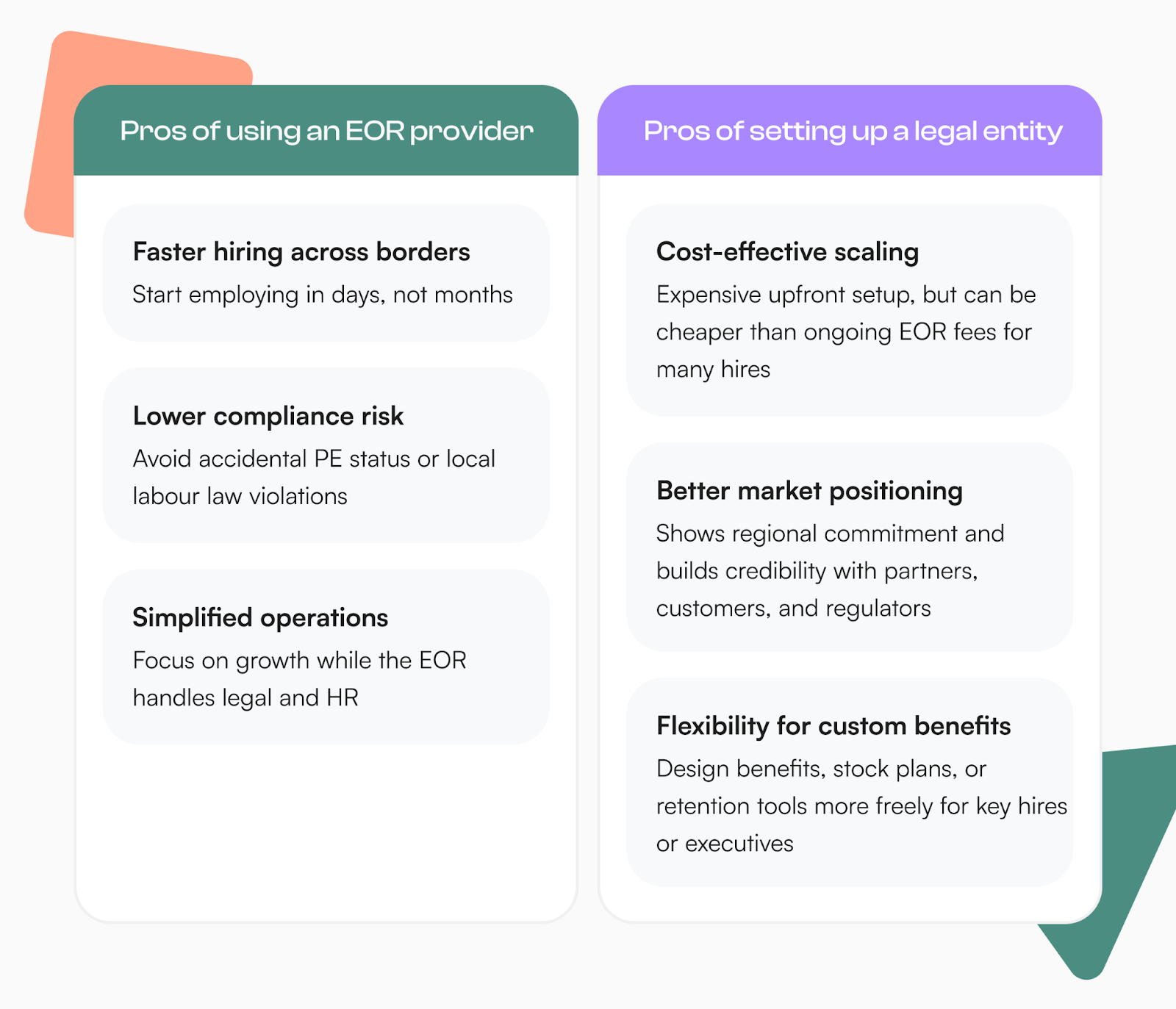
Here’s how the main benefits stack up for international hiring :
According to McKinsey research, successful European hiring only happens around 46% of the time. That shows just how tricky navigating local rules and processes can be.
Add 38 days to fill the average role, and you see the problem: mid-sized businesses need to grow faster without getting bogged down in bureaucracy.
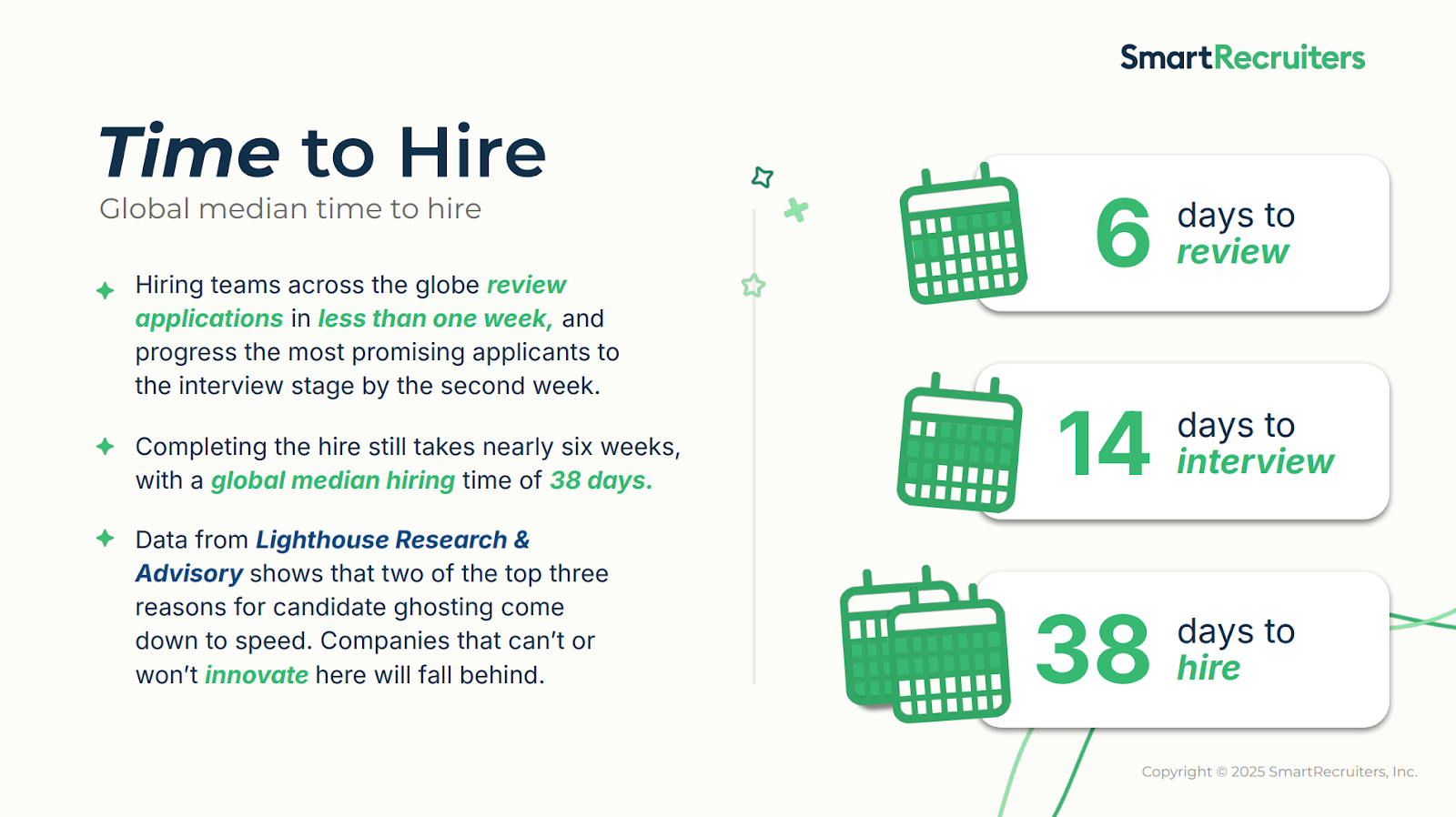
But global expansion doesn’t have to mean paperwork nightmares or months of delays.
EOR services remove the roadblocks. You can hire fully compliant local talent in days, while the third-party company handles everything from contracts to payroll.
EORs can offer a faster and potentially lower-risk alternative to entity setup in many cases, but this is not universally true and depends on the specific country and business activities.
Legal entities are a better fit when you’re ready for long-term investment or a physical presence in a specific market.
👉 Use our employment calculator to compare hiring costs across countries in seconds
Global employment comes with many opportunities, but also a few hidden traps. One of the biggest? PE risks.
Unexpected bills from local tax authorities, compliance challenges , and operational miscommunications can catch mid-sized businesses off guard.
Here are four of the most common risks and how an EOR arrangement helps.
Note: An EOR greatly reduces the risk of creating a PE, but can’t erase it entirely. If your parent company is signing contracts or generating revenue locally, tax authorities may still view you as having a presence there.
Hiring someone locally can accidentally trigger permanent establishment (PE) rules, meaning your company suddenly owes corporate taxes you weren’t expecting.
How an EOR solves this: By being the legal employer on paper, an EOR manages all international employee finances and stays on top of tax liability.
For mid-sized businesses, one unexpected tax notice can tie up resources and distract leadership. All while your team is trying to scale internationally.
Let’s say your US-based marketing firm hires a remote designer in France.
Suddenly, your company faces double taxation, fines, and paperwork, derailing growth plans.
With an EOR, the local provider legally employs the designer. This setup shields your business by:
The result? You avoid frantic calls to accountants and scale into France knowing you’re compliant from day one.
👉 Example in action: Learn how Web3 company Luganodes increased its global workforce by over 50% with no drama in a highly regulated industry.
Hiring abroad means navigating each country’s specific employment rules. Contracts, holidays, benefits, termination, every region plays by its own rulebook.
Mess up by misclassifying a Brazilian employee, or skip mandatory UK pension contributions?
You’ll find yourself staring down lawsuits, fines, or even a ban on doing business locally. Basically, it’s the HR version of stepping on a legal landmine.
How an EOR solves this: A good EOR ensures contracts, payroll, and benefits are fully compliant with country-specific laws. Plus, it keeps up with changes so you don’t have to.
Take Singapore, for example. You hire a customer success manager there, slap together an English contract with at-will termination (very US-style), and think you’re set.
A few months later, you discover Singapore requires specific notice periods, Central Provident Fund (CPF) contributions, and mandatory annual leave.
Suddenly, you’re facing back payments, potential penalties, and one very unhappy employee.
With an EOR, that hire is compliant from day one. The third-party company:
You build a stronger relationship with your new employee from the get-go, while you scale without worrying that your contracts and benefits will come back to bite you later.
👉 Example in action: Learn how property management company City Relay expanded its global team by 80% with Teamed’s in-country experts handling local labour laws.
Setting up a foreign entity isn’t a quick win. It takes months of navigating registrations, banking, legal, and accounting requirements before you can even post the job ad.
For a growing business, those delays stall projects and frustrate teams waiting on reinforcements .
Meanwhile, that dream hire you set your heart on might already be working for a competitor.
How an EOR solves this: An EOR is already established in the country and can employ people on your behalf almost immediately. Instead of waiting on red tape, you hire talent in days.
Take a Canadian fintech company eager to expand into Japan.
It identifies a brilliant local product manager but quickly realises that establishing a Japanese entity could take 6–9 months. Not to mention ongoing legal retainers and accounting fees.
An EOR hires the PM within a week, pays her locally, and covers the right benefits .
Testing in the Japanese market starts right away without sky-high setup costs or sacrificing speed.
👉 Example in action: Learn how boutique recruitment firm Data Science Talent hired in South Africa in 13 days with zero compliance issues.
Managing multiple legal entities can quickly become a logistical nightmare. Especially when each country has its own payroll calendars, reporting standards, and compliance requirements.
Instead of focusing on strategy, leadership becomes the world’s most expensive admin team.
How an EOR solves this: Instead of building a patchwork of entities and advisors, one partner manages a streamlined process across every market.
Imagine a fast-growing SaaS company scaling into Hong Kong, Brazil, and Spain.
Each country has its own reporting requirements, legal holidays, and benefits structures. Coordinating this internally drains bandwidth and creates room for error.
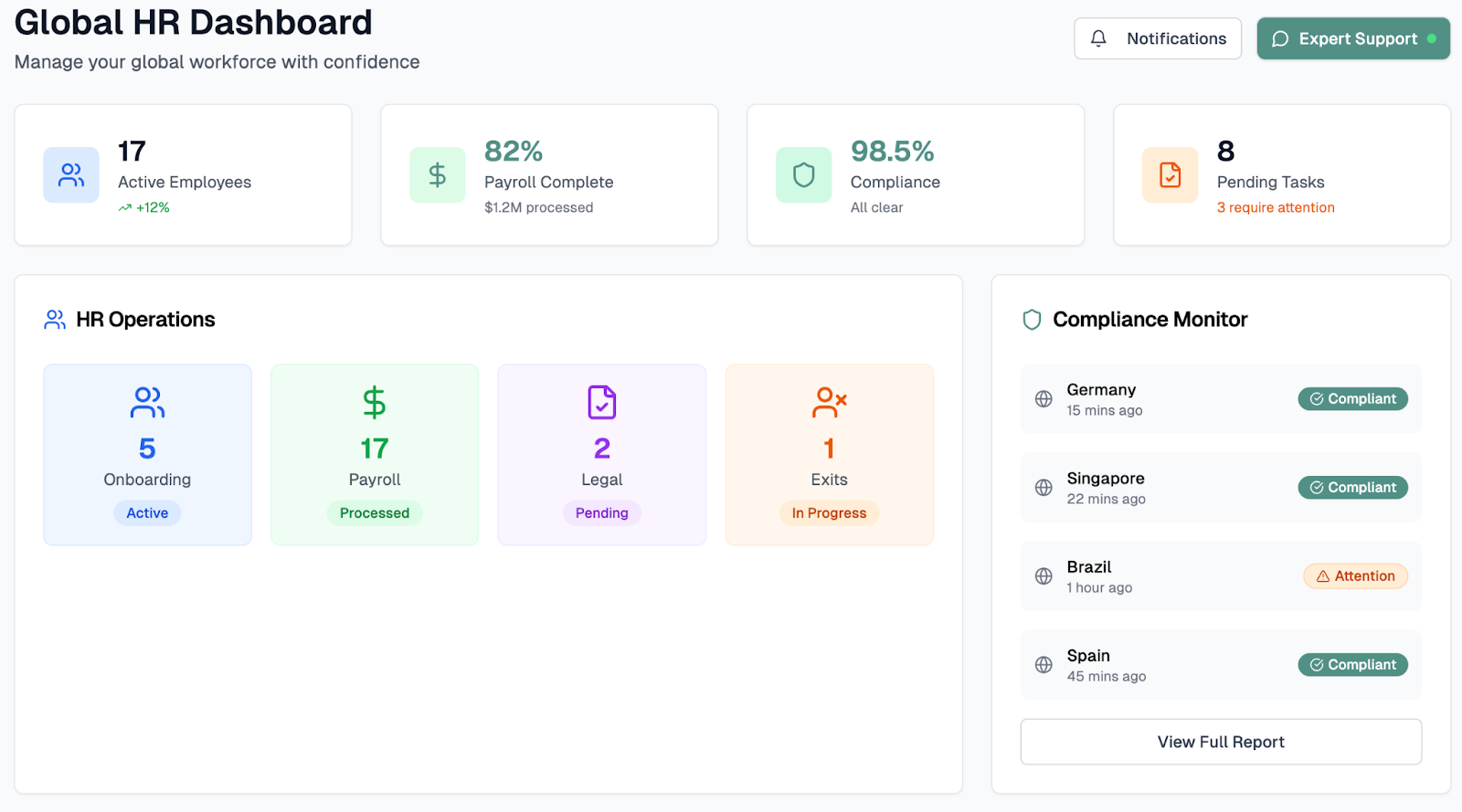
With an EOR, the SaaS team can hire employees in all three countries using one contract and a centralised dashboard.
Without one, the same company would have to:
The difference is night and day.
One path feels like scaling. The other feels like babysitting a never-ending trail of spreadsheets in multiple languages.
👉 Learn how to navigate EU employment compliance as a scaling business in our handy guide.
The choice between an EOR or a foreign legal entity depends on where you are in your growth journey, how many hires you’re planning, and whether you’re testing or committing to a market.
Most companies work through the decision in three steps:
Layer those decisive steps with a few
Your answers help map your growth strategy to the right approach, whether that’s the flexibility of an EOR or the long-term control of a local entity.
To make your decision less abstract, here’s a quick side-by-side comparison of common scenarios and the best hiring setup in each case:
According to Kantata research, 53% of senior execs struggle with hiring full-time employees, and 61% spend a third of their days dealing with turnover problems.
Before expanding globally, you need to streamline how you hire, support, and retain talent. Otherwise, you’ll just be multiplying problems across borders.
An EOR can help with that. But here’s the thing: not all are created equal.
Others stop at payroll. Teamed brings it all together, one platform for every worker type, powered by AI for speed and guided by people for judgment.
The result? Fair, transparent pricing with no surprises, and expert support through every stage of employment.
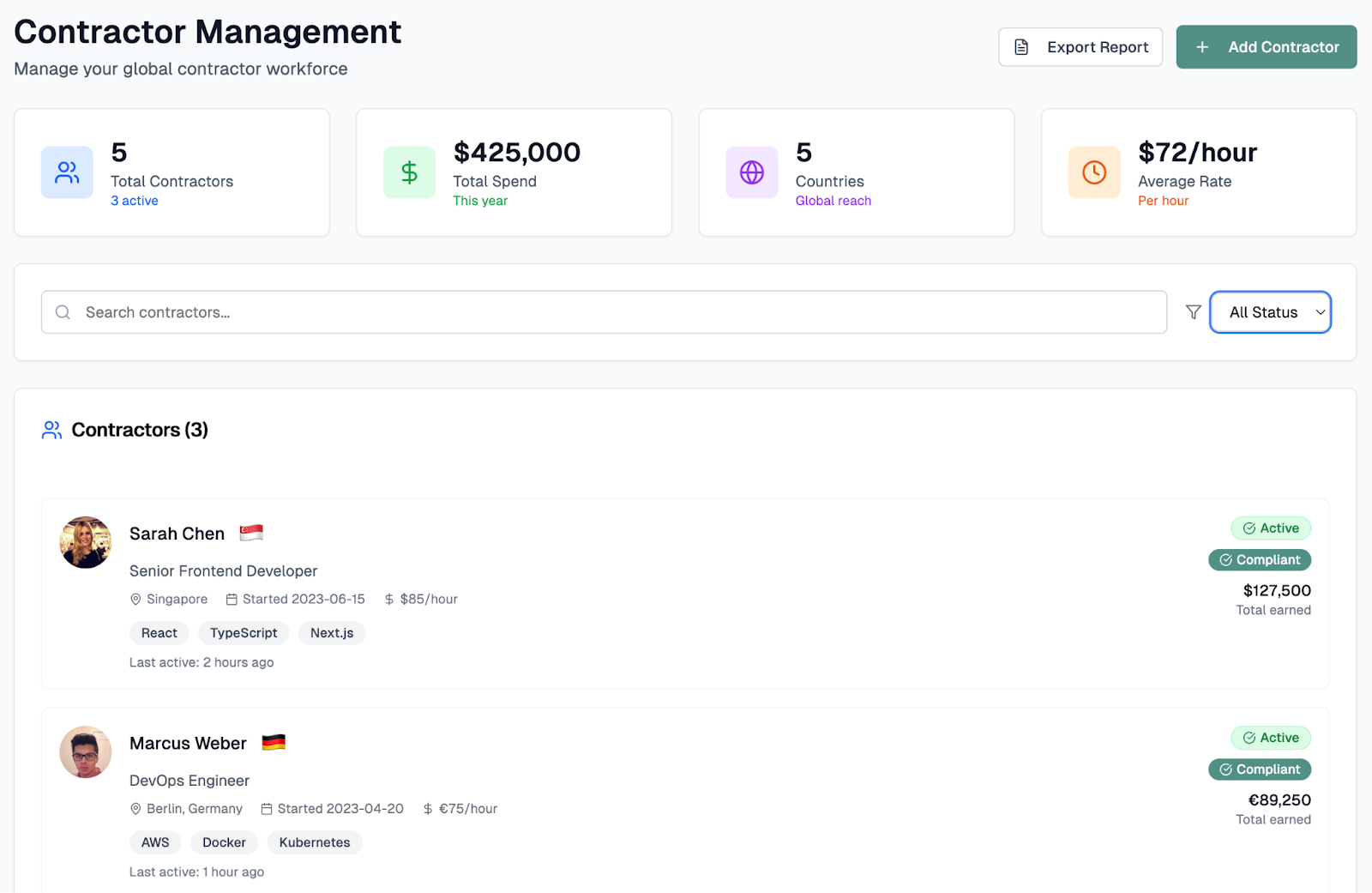
More on that in the next section.
Take a Portugal-based accounting platform that wants to hire two customer support reps in the Philippines to test out a 24/7 model. An EOR is the fastest , lowest-risk path.
But if the same business later decides to build a 60-person engineering hub in India ?
Setting up an entity makes more financial sense and signals a long-term commitment to the region.
👉 Learn what to consider before choosing an EOR partner in this snappy guide.
Some EORs are great at payroll but vanish when things go sideways. Others promise full-service support but hit you with confusing pricing and hidden fees.
Almost half (46%) of small business leaders say operational inefficiencies are one of their biggest challenges.
But don’t go leaping into a contract with any old software that promises the world before thoroughly assessing it .
Compliance, technology, customer support, these can vary wildly. So, it pays to be totally sure of what you’re getting before signing anything.
For example, Teamed isn’t just another EOR. We’re there for the good times and the messy times, from onboarding and growth to exits, disputes, and audits.
The supposedly “Deel-uxe” providers push those moments into bots, rigid workflows, or buried small print. We don’t.
You get real experts on the line 24/5, people who know global hiring inside out.
The result: clear answers, flexibility when you need it, and fair, transparent pricing that doesn’t shift when the pressure’s on.
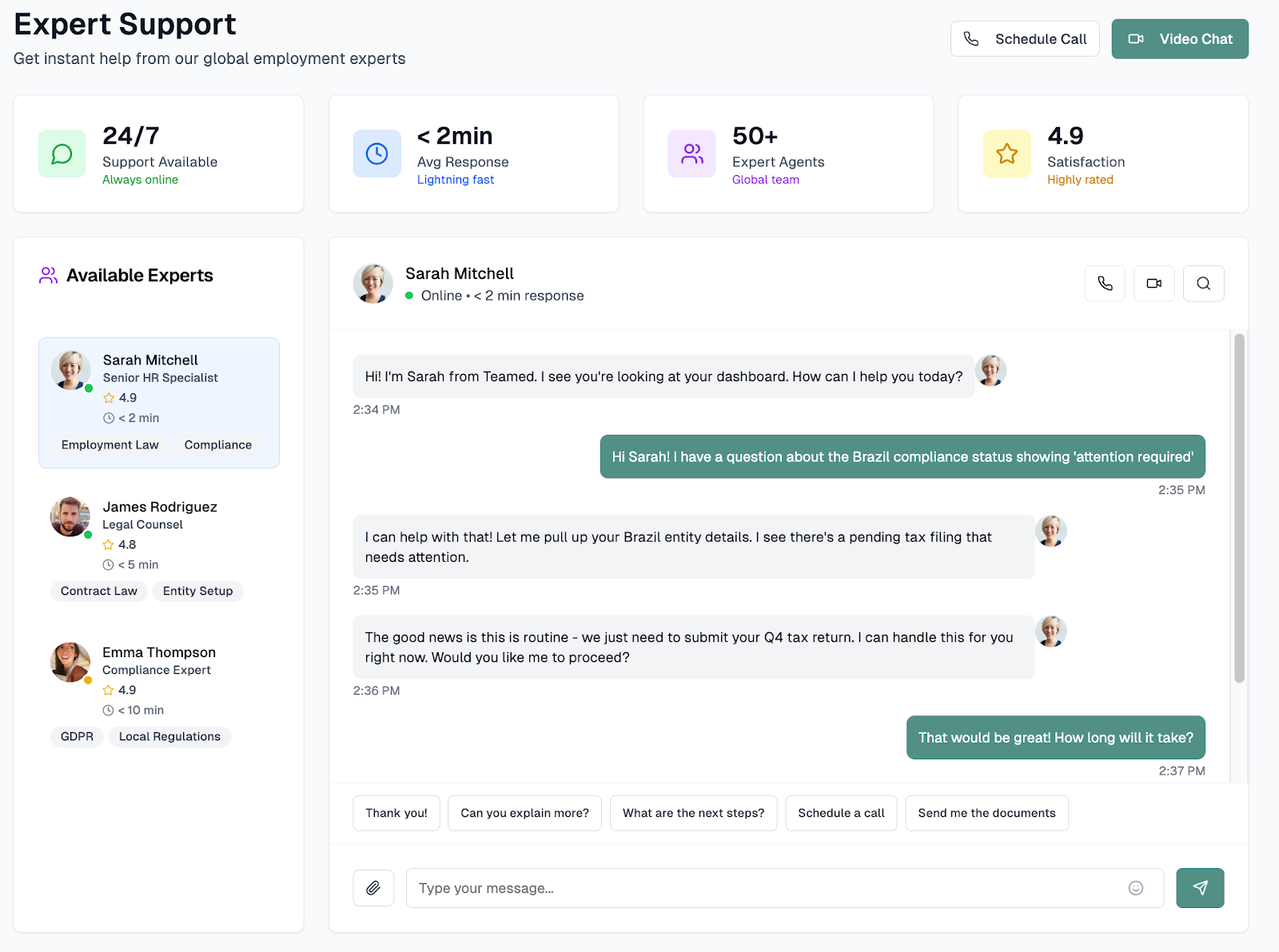
We want to grow with you at every stage. And we strive to ensure remote workers feel just as valued as your home-country team members.
Here’s what makes Teamed different:
Whether you’re testing a market with a few hires or building a full local team, Teamed’s flexible, human-focused approach keeps you compliant, connected, and moving fast.
Even if you’re sure a legal entity is the way to go, Teamed can help set one up and manage it for you.
We can also assist as foreign direct employers (FDE), you hire directly while we cover payroll, compliance, and benefits.
Whichever option you choose, you get technology that works, people who care, and processes that scale globally.
All without the stress of managing multiple EORs or legal entities yourself.
Before you lock in an EOR or commit to setting up your own entity, run through this quick checklist to save headaches and choose the path that actually fits your growth plans.
Here are seven crucial considerations:
Imagine this process through the lens of a mid-sized SaaS company in the US. It eyes growth in Asia, starting with one hire in Indonesia and a couple of engineers in Bangladesh.
Without thinking ahead, the company risks bouncing between providers and losing valuable time.
Because switching between EORs or closing your own entity isn’t as simple as flicking a switch. You may need to re-issue contracts, reset employee benefits, and align payroll systems with local rules.
The difference with Teamed is that we can support you through this transition, moving from EOR to entity with a clear plan that makes it feel as close to flicking a switch as possible.
Plan early, and we’ll help you avoid downtime, stay compliant, and keep employees happy during the change.
👉 Take our quick quiz to find out whether it’s time to look for a new global hiring partner
Q: What are the most common employer of record vs. permanent establishment risks?
A: The biggest risks are triggering a taxable presence (PE) in the country, misclassifying remote work employees , and non-compliance checks. An EOR helps reduce those risks by acting as the local legal employer.
Q: Does the parent company always handle international tax treaties?
A: Not always. Tax obligations depend on the structure. An EOR manages local tax laws, while your parent company still reports profits in its home country.
Q: What’s a dependent agent?
A: A dependent agent is someone in a country who habitually makes contracts on behalf of your core business. If regulators see them as creating business in that market, it can trigger a permanent establishment (PE) and local tax liability.
Q: What’s a global PEO (professional employer organisation)?
A: A global PEO is similar to an EOR, both help you hire abroad and manage revenue-generating activities without setting up entities. The key difference is that an EOR becomes the legal employer. With a PEO, you typically need a local entity already in place.
Q: Is switching between EORs or from an EOR to an entity complicated?
Yes. It can mean reissuing contracts, resetting benefits, and handling payroll transitions. In some countries, switching employers also impacts social security contributions or tenure, which can affect employees’ benefits.
That’s why Teamed has a dedicated migration team to manage the process end-to-end. We handle the heavy lifting, from contracts and payroll alignment to employee communications, so the transition feels seamless and stress-free for you and your team. Planning ahead with Teamed means reduced or no downtime, no compliance gaps, and no unnecessary disruption.
EORs give you speed and flexibility. Entities give you permanence and control. With Teamed, you don’t have to choose too early. Start lean with an EOR, then transition to an entity when the time is right, with our dedicated migration team making it feel seamless and stress-free.
We’re not just an EOR. We’re a global employment platform that unifies every worker type, powered by AI where it helps and people where it matters.
Add in fair, transparent pricing and hands-on support through the good times and the messy times, and you’ve got a partner that grows with you.
Book a call today and join 1,000+ growing teams like Globant and Eventbrite who rely on Teamed to hire fast, stay compliant, and scale with confidence.

The World Bank says that on average, setting up a company abroad takes about 20 days and costs nearly a quarter of the average income in that country. For businesses in the UK looking to expand, that’s already a big challenge. But in reality, the time and money needed don’t stop there. You also face legal paperwork, compliance checks, and ongoing admin tasks that take up resources.
For years, the only way that you could expand overseas was through setting up a subsidiary or local office. It worked previously, yet it is often too expensive and slow today. Nowadays, markets change quickly. And in this scenario, businesses need faster movement. Thus more companies investigate options, grow across borders, and avoid registering a complete business locally everywhere.
The good news is, you can build up a presence within a market, hire some staff, and serve more customers through working alongside specialist partners, but without facing endless amounts of local paperwork. Teamed Global is one provider that helps companies do exactly that.
In this article, let’s get into how businesses can expand overseas without the headache of creating a legal entity.
To relocate without setting up a legal entity simply means you don’t create a branch, subsidiary, or representative office in the new country. Instead, you keep your company structure at home and operate abroad using different methods. This might include working with contractors, teaming up with local providers, or using employment solutions like an Employer of Record.
It’s worth pointing out how this differs from other approaches. Traditional foreign expansion usually involves registering a permanent office or even acquiring another company. Decentralisation, on the other hand, spreads out decision-making but doesn’t change the legal setup. Running without a legal entity is a more flexible option in the middle. It allows you to test the waters without making a long-term commitment.
A legal entity is simply a structure recognised by law, it has its own rights and responsibilities, separate from its owners. Most countries require foreign firms to set up such entities if they’re doing a significant amount of business locally. That’s how governments make sure taxes are paid and laws are followed.
The OECD’s Model Tax Convention explains when business activities cross the line and require a permanent presence.
But here’s the key: not all activities fall into that category. You may operate efficiently remaining under those limits. Set up the right structure in order to do so.
In this section we will get a detailed answer to this commonly asked question!
An EOR is a company that becomes the official employer of your staff in another country. The EOR handles all the legal work, payroll, taxes, benefits, as well as following local labour laws on paper. But in practice, you still manage all of the employees’ work, you set all goals, and you run all operations.
Think of the EOR as a shield. They deal with local compliance and act as the legal employer, while you stay focused on your business. This setup avoids the need to create a new local entity.
There are many benefits of using an EOR for this business relocation purpose:
Expanding into multiple countries brings a lot of rules, and every country is different. Here’s where an EOR steps in:
EORs aren’t for every situation. But they’re ideal when:
Choosing the right partner is critical. Here’s what to look for:
Here are some major considerations that you have to be very mindful of when operating without a legal entity.
Plenty of businesses are already using this approach. Some examples:
Well, you can and many other companies just like yours are already doing it. You just have to be with the right partner and have a clear plan to follow. Basically, using an Employer of Record, contractors and getting into strategic partnerships, companies can expand quite easily. The best part remains that these options reduce the risks, saves time and gives you an opportunity as well.
At Teamed Global, we help businesses get into the new markets easily and safely. If speed, flexibility, and cost savings are priorities for your company, this model is definitely worth considering.
You can relocate your business by setting up a local entity, partnering with a global Employer of Record (EOR), or using international PEO services. EORs allow you to hire, pay, and manage employees abroad without opening a foreign subsidiary.
This process is often called business relocation or global expansion. When done without setting up a local company, it’s known as hiring through an Employer of Record or using international expansion services.
Yes, in many cases. You can either register a legal entity abroad or use an EOR solution to operate without establishing a local company. An EOR handles payroll, compliance, and employment law while you focus on business growth.
Yes, an LLC can operate internationally. However, running global operations directly can require navigating complex compliance rules. Many LLCs use an EOR to legally hire international employees without creating multiple foreign entities.
Using an EOR or global PEO service saves time, lowers costs, ensures compliance with local labor laws, and allows you to expand into new markets quickly without the burden of setting up a subsidiary.
Key challenges include tax compliance, labor law differences, payroll management, and cultural integration. Partnering with an EOR helps mitigate these risks and streamlines global onboarding.

Every year, businesses in the United States collectively lose an estimated £3–4 billion because of worker misclassification. That number is huge, but the real issue isn’t just the money. It’s the confusion and complexity behind figuring out who counts as what. For many HR teams, one of the trickiest categories is the statutory employee.
At first glance, the rules can seem unnecessarily complex. Where does a statutory employee sit compared to an independent contractor? Or a regular employee? Mix-ups are common, and when they happen, the consequences can be expensive. For companies abroad, the challenge is even bigger when trying to expand into the US. They are using rules that do not always match their norms back home.
This guide will break everything down in plain language. We’ll cover who counts as a statutory employee, the IRS rules you need to know, the risks of getting it wrong, and how new 2025 updates change the picture. Along the way, you’ll also see why organisations like Teamed step in to help companies avoid costly mistakes and stay compliant.
The idea of a statutory employee is a bit odd. It’s a sort of halfway point between an independent contractor and a regular employee.
The IRS says statutory employees are technically independent contractors in most ways, but when it comes to Social Security and Medicare taxes, they’re treated like employees. This hybrid setup often creates uncertainty, especially small business owners who are handling payroll on their own.
Here’s the catch: certain rules must all apply at once before someone can qualify as a statutory employee.
So why does this matter? Because proper classification isn’t just about ticking boxes. It directly affects:
For businesses with complicated teams, some remote, some freelance, some on payroll, the statutory employee question pops up more than you’d think.
Want to cut through the confusion? Teamed’s compliance experts can step in.
The IRS doesn’t leave this open-ended. Only four types of workers qualify, and each has its own quirks.
Employers often make the mistake of going by job title alone, but that’s not how the IRS works. What matters is the actual relationship and the nature of the work, not what’s written on a business card. And yes, documentation is everything if you can’t show why you classified someone a certain way, audits get messy fast.
Here’s where statutory employees differ most from independent contractors and regular W-2 staff: payroll taxes.
The IRS Publication 15 (Circular E, 2024) stresses the importance of solid recordkeeping. If you’re ever audited, being able to show contracts, payment records, and the reasoning behind your classification could save your business a lot of trouble.
Here’s the part that keeps CFOs awake at night: getting it wrong costs money and not a little.
If you misclassify, you could be on the hook for:
But the risks aren’t just financial. Misclassification can spark:
The smart move? Prevent problems before they start. That means regular compliance reviews, training HR teams on classification, keeping meticulous documentation, and calling in tax or employment law pros when you’re unsure. Not sure about your current setup? Teamed can run a compliance review for you.
If worker classification already feels complicated, here’s the kicker: it's evolving. Fast.
A few big shifts are shaping 2025 and the years ahead:
For businesses expanding into the US, these changes add another layer of risk. It’s no longer enough to classify once and move on; you need to revisit classifications regularly to stay aligned with current rules.
Yes. Each relationship is judged separately. A salesperson might be freelance as an independent contractor but statutory for their main employer elsewhere.
They get a W-2, with box 13 marked. Independent contractors get a 1099-NEC.
It depends on the state. Some states cover them; others don’t. Always check with the state labour department.
You’ll need to fix it moving forward and possibly pay back taxes, penalties, and interest. Sometimes relief programmes exist, but it’s best to talk to a tax professional.
That’s down to the employer. Some benefit plans allow it, others don’t. Always review the policy documents carefully.
Overall, Compliance isn’t a one-and-done exercise. To stay on the right side of IRS rules, businesses should:
For global companies, the challenge of double rules at home doesn’t always line up with US law. That’s where Teamed comes in. We help companies understand statutory employee requirements across multiple countries, reducing risk while making sure teams stay compliant.
Talk to Teamed today to simplify statutory employee classification and reduce compliance headaches.
A statutory employee is a worker who receives a W-2 but is treated like self-employed for Social Security and Medicare tax purposes. Employers must withhold Social Security and Medicare but not federal income tax.
According to the IRS, a statutory employee is someone in specific job categories—like certain salespeople, drivers, or insurance agents—who is treated differently from regular employees for tax purposes.
Examples include:
Check your W-2. If box 13 (“Statutory employee”) is checked, you fall into this category. You can also confirm by reviewing your work arrangement against IRS statutory employee guidelines.
Regular employees have income tax, Social Security, and Medicare taxes withheld by their employer. Statutory employees only have Social Security and Medicare withheld, and they report business expenses on Schedule C.
Yes. Statutory employees file Schedule C (Profit or Loss from Business) to report their income and deduct business-related expenses, unlike regular employees who use Schedule A for deductions.
Independent contractors get a 1099 form and handle all self-employment taxes themselves. Statutory employees get a W-2 with “statutory employee” checked, and only part of their taxes are withheld by the employer.
The IRS 20-point checklist helps determine whether a worker is an employee or independent contractor. Statutory employees fall into a special category—they’re not fully independent contractors but aren’t treated as traditional employees either.

“Recent studies show that 42% of today’s workforce is made up of companies with global remote teams.”
Well, despite this growth, 67% of organisations still face issues with international employee onboarding. To be precise, in reality, onboarding often continues for several weeks. But the consequences aren’t just administrative headaches. Businesses lose an average of £3,200 per employee for every week that productivity is delayed. And that represents a significant financial loss.
That is why for companies scaling internationally, waiting that long simply isn’t an option. It is essential that new hires are able to start contributing immediately. But as we are already aware of the fact that old onboarding models are not created in a way to match the pace. Businesses in 2025 need fast, compliant solutions that bring new hires on board within a day. That’s exactly where global employment partners like Teamed step in, turning what feels impossible into standard practice.
Now, if you’re someone who wants to onboard new hires quickly without running into compliance issues, this guide will help you do it while keeping things legally sound and making sure every employee feels genuinely welcomed.
Hiring employees across borders brings challenges that local hires rarely bring. Moreover, a lot of companies do tend to underestimate this process, but it can get extremely complicated later on.
Making 24-hour onboarding work isn’t about cutting corners; it’s about preparation and the right infrastructure. The key is partnering with Employer of Record (EOR) providers that already have compliant entities set up around the world.
The process typically starts with standardised contracts tailored to local laws, ready to send out immediately. Digital signature tools make contracts legally binding within minutes. Payroll integration is handled automatically, so employees are paid correctly from day one.
Beyond the legal side, practical steps are equally important: shipping equipment in advance, setting IT systems for instant access, and assigning onboarding coordinators who know both local regulations and company processes.
Companies like ours (Teamed) specialise in this kind of rapid onboarding. Their advantage lies in being ready before the hire is made, rather than scrambling to put compliance in place afterwards.
Your ability to hire quickly abroad depends on your EOR partner’s coverage and expertise. The best providers operate in 180+ countries, covering major hubs such as the UK, Germany, Australia, Canada, and Singapore—each with its own employment requirements.
For example:
According to the OECD Tax Rules Database, tax registration timelines vary significantly. Meanwhile, the SHRM Global Workforce Management guidelines highlight that probation periods can range anywhere from zero months (in some US states) to six months (in parts of Europe).
Countries like France and Italy have particularly complex labour laws, while others, such as the Netherlands and Switzerland, offer smoother processes. Teamed’s legal teams stay up to date with these changes so that your hires can start working without delay.
A great first day isn’t just about logistics, but it’s about ensuring employees feel supported in being seen, regardless of location. Welcome packages, including office details along with cultural perceptions, plus local resources, begin the start of the process.
Then, the tech setup must be flawless. Everything, including accounts, email, and platforms, should be ready to go the moment the employee logs in.
Scheduling also matters. Welcome calls and team introductions should take time zones into account so that the employee feels included, not inconvenienced. Many companies assign cultural mentors, colleagues who share similar backgrounds and can help bridge cultural differences.
Balancing the first day involves completing necessary paperwork as well as building personal connections. For holidays or adapting communication styles to regional norms, recognition creates local touches that go a long way.
Teamed’s onboarding specialists focus on these details because they help to ensure international hires do not only start work quickly but also feel truly part of the team from day one.
Getting payroll right immediately is non-negotiable. Missing deadlines or making errors can cause fines. This also shakes employee confidence at the start.
Here are the essentials:
Some countries add further requirements. For instance, German employers need Betriebsstätten registration, while in France, URSSAF declarations must be filed promptly. Teamed’s payroll systems handle these steps in advance, so there’s no risk of late compliance.
Cultural onboarding often is that specific thing that determines which of the employees thrive and which depart prematurely. New recruits need a personal connection, alongside fulfilling the legal and technical demands.
Effective strategies include:
These gestures create a lasting impression, ensuring new employees feel valued from day one. Many organisations also form regional employee groups to sustain cultural support long after onboarding.
Research consistently shows that employees who feel culturally valued report 73% higher engagement and stay 45% longer. In other words, cultural integration pays off in retention and performance.
The right EOR can make international hiring seamless. The wrong one can create compliance headaches that take months to fix. Asking the right questions up front is critical.
Key questions include:
Go beyond the sales pitch. Ask for proof of 24-hour onboarding they’ve handled, including challenges and how they resolved them. Teamed provides client references, clear service agreements, and detailed demonstrations so you know exactly what to expect.
The returns on rapid onboarding are measurable. Companies that manage to get employees started within 24 hours see revenue acceleration of about £15,000 per hire due to earlier productivity and faster project timelines.
The benefits don’t stop there. Faster onboarding helps secure top talent before competitors, as well as satisfies employees plus retains them at an average of 34%. HR teams can also free up time by avoiding the long, complex onboarding processes. Therefore, they can focus on strategy instead of admin work.
For many organisations, the cost savings from reduced overhead alone offset the investment in EOR services within the first quarter. On top of that, faster onboarding helps companies seize market opportunities that demand immediate staffing.
Expanding globally no longer needs to be a slow, complex, or high-risk process. Traditionally, hiring abroad means months of entity setup, duplicated vendors, or worse — contracts that don’t hold up locally. But with Teamed, you can welcome your next international hire in as little as one day, without sacrificing compliance or control.
Here’s how:
💡 Proof you can trust:
Whether you’re a mid-market scale-up needing legal-clean onboarding across multiple jurisdictions, or a founder-led growth team needing speed and transparent pricing, Teamed is built to take global hiring off your plate so you can focus on building your team.
Ready to simplify global hiring and launch in days, not months? Contact Teamed today and see how quickly your next international hire can start making an impact.
The 5 C’s of onboarding are Compliance, Clarification, Culture, Connection, and Check-ins. For international team members, this means ensuring legal paperwork is completed quickly (Compliance), explaining roles clearly across time zones (Clarification), immersing them in company values (Culture), fostering team relationships despite distance (Connection), and following up regularly (Check-ins).
The 4 C’s - Compliance, Clarification, Culture, and Connection - are crucial for global onboarding. By digitizing compliance steps, offering clear orientation materials, sharing culture through welcome sessions, and connecting new hires with mentors, you can make international employees feel included from day one.
To welcome a new international hire, send a personalized welcome message, provide a digital onboarding kit, schedule a virtual introduction with the team, and assign a buddy or mentor. This ensures they feel supported and connected within the first 24 hours.
Global onboarding is the process of integrating new employees across different countries and cultures into your company. It’s important because it ensures consistency in training, cultural alignment, and compliance while helping new hires feel engaged, no matter where they are located.
HR can create a strong international onboarding program by using digital platforms for training, preparing a new hire checklist tailored to international needs, clarifying communication expectations, and ensuring local compliance. Adding cultural awareness training also builds a sense of belonging.
A global onboarding checklist should cover compliance documents, role-specific training, IT access setup, team introductions, cultural orientation, time zone support, and regular check-ins. This ensures the employee is ready to contribute while feeling connected.
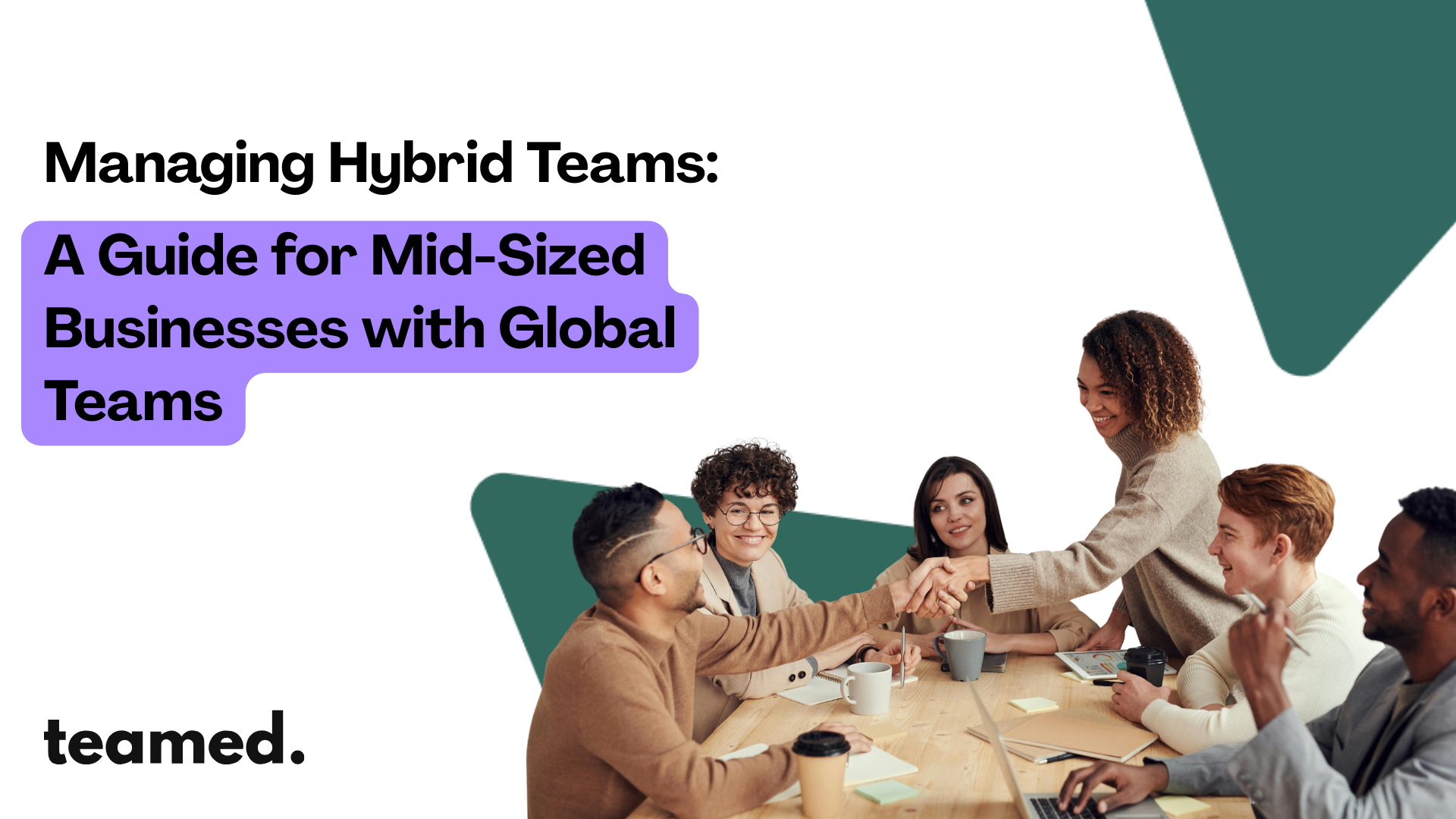
Think of a scenario where your marketing manager logs in from London, as your developer in Berlin is finishing up for the day. At the same time, your sales team is checking in from home offices across Spain, France, and Italy, while a small group is gathered in your Amsterdam hub trying to keep meetings on track.
If that sounds familiar, you’re not alone. For mid-sized businesses, this is quickly becoming the norm — teams spread across borders, employees expecting flexible setups, and leaders trying to hold it all together without losing productivity, culture, or compliance.
How do you make sure everyone feels connected when some have never met in person? How do you pay people in different currencies without going mad over exchange rates? And what about local labour laws, how do you avoid costly mistakes there?
At Teamed, we work with mid-sized businesses dealing with these exact challenges. We’ve seen the good, the bad, and the ugly of managing hybrid global teams. The companies that get it right don’t just survive, they achieve growth opportunities they never imagined.
This guide lays out the biggest challenges and the strategies that actually work. So, if you are interested to know, go read this page.
Running a hybrid team in just one city can feel tricky. Now imagine adding different countries, time zones, and cultural dynamics into the mix; suddenly, the challenge looks very different.
The upside is that when you know the common roadblocks ahead of time, you can prepare for them and deal with issues before they get in your way. Here are a few of the challenges most leaders run into:
Try setting up a call between New York, London, and Manila. No matter what, someone’s joining either at dawn or late at night. Over time, that takes a toll, people tune out, decisions get delayed, and productivity dips.
Culture shows up in little ways that catch you off guard. A blunt email that feels normal in Germany may come across as rude in Brazil. An American manager who says “just call me by my first name” might unintentionally confuse colleagues in Japan who value formal titles. None of this is malicious, but it can cause friction if you don’t address it.
One of the least glamorous but most important issues: compliance. Each country has its own labor laws, tax rules, and benefits requirements. What’s standard in the U.S. could be illegal in France. For a mid-sized company without in-house global HR, this becomes overwhelming fast.
Remote employees need access to systems, but not every country has the same security laws or infrastructure. Think about GDPR in Europe versus more flexible regions, the rules aren’t consistent, which means your policies can’t be one-size-fits-all.
It’s easy to “see” productivity in an office. Not so much when people are spread across time zones. How do you measure success fairly between someone working from a kitchen table in Portugal and another sitting in your New York office?
Company culture is what really holds everything together. The tricky part is figuring out how to build trust and genuine connections when your team hardly ever meets in person or maybe never at all. It can be done, but it doesn’t just happen by accident. It takes intentional effort.
Hybrid teams don’t just “work out” on their own. When they succeed, it’s usually because leaders made very deliberate choices to set them up for that success.
The first thing that makes a difference is clarity. Everyone needs to know not only their role but also how their work connects with others. In a hybrid setup, vague job descriptions create confusion fast, and confusion in distributed teams usually leads to frustration.
One simple but powerful tactic I’ve seen work well is setting core hours. For example, you might say, “Everyone needs to be online between 10 AM and 2 PM GMT.” That block gives teams in London, New York, and São Paulo enough overlap to actually collaborate in real time. Outside those hours, people are free to work flexibly, but at least they know exactly when they can count on their teammates being around.
It also helps to organise teams by projects rather than geography. When you put people together based on location, they tend to work in silos. But mix perspectives across time zones and skill sets, and the output is usually much stronger. Just make sure your project leads aren’t only good at the technical stuff, they also need to understand the cultural nuances of working across borders.
Another thing many companies overlook: redundancy. Picture this, your lead developer in Ukraine is sound asleep when a critical issue pops up. Who’s covering in the meantime? Building in backups across time zones [maybe someone in Mexico, for instance] keeps work moving and prevents people from burning out.
And finally, set clear communication rules. Decide what’s for Slack, what belongs in email, and when something warrants a video call. Without these boundaries, it’s easy for things to slip through the cracks or for people to feel overwhelmed by nonstop notifications.
This is where many mid-sized businesses get burned. The International Labour Organisation (ILO) clearly mentions that labour regulations vary widely across countries. And that compliance is not optional. For instance,
At Teamed, we take this off our clients’ plates. We make sure every employment relationship meets local standards without the business owner needing to become a part-time legal expert.
Onboarding is more than sending a welcome kit. For hybrid global employees, it starts with contracts, tax registration, and compliance paperwork, all tailored to their country.
But don’t underestimate the “softer” side. A new hire in Singapore may not naturally understand how your U.S. team collaborates, and vice versa. That’s why many successful companies build in:
A smart move is creating location-specific checklists. That way, the legal and admin details are covered while ensuring every employee still gets the same quality introduction to your company culture.
Payroll is where theory meets reality, and it gets messy fast. And as mentioned in Deloitte’s Global Payroll Guide, managing payroll across multiple countries demands careful consideration.
After all, every country has its own rules for minimum wage, overtime, and benefits. Paid time off alone varies drastically (think four weeks minimum in much of Europe vs. two weeks in the U.S.).
Currency adds another layer. Exchange rates move constantly, which can impact both your costs and your employees’ satisfaction. Many companies choose local currency contracts to give employees stability and themselves predictable costs.
Then there are taxes and social contributions. Each country has its own way of calculating and collecting them. A mistake here isn’t just a minor error, it can result in penalties or even legal trouble.
And finally, the payment systems. Direct deposit may be normal in the U.S., but some regions use completely different networks. Get this wrong, and you risk delays that erode employee trust.
Culture doesn’t happen by accident. You have to work at it, especially when your team is spread across the globe.
We also lean on tools like Loom to share knowledge and explain reports, and we keep an open-door policy for huddles (unless the stop sign is up). Local teammates meet up in person within their countries, and once a year the whole team gathers to strengthen bonds and tackle big-picture issues.
Remember, small gestures like publicly acknowledging someone’s contribution often mean more in hybrid teams than in traditional offices.
Success can’t be measured only in output. The smartest companies track these metrics:
The mix of hard numbers and “softer” signals gives you a fuller picture of how your hybrid team is doing.
If you’re constantly researching local laws, getting warnings from tax authorities, or losing weeks onboarding new hires, it may be time for outside help.
An Employer of Record (EOR) basically handles all the heavy-lifting things like legal requirements, payroll, and compliance, so you don’t have to. For mid-sized businesses, this route usually ends up being far more cost-effective than trying to set up separate legal entities in every country you want to hire in.
Teamed isn’t a one-size-fits-all EOR. We’re the employment platform built for mid-market companies - lean, scaling global teams that need clarity and speed without hiring a big HR back office.
For People & HR Leaders: Scale without building a large internal team.
For Finance & Ops Leaders: Keep payroll accurate and close books faster.
For Legal & Compliance Leads: Lower risk with contracts, policies, and governance built-in.
With Teamed, you don’t just outsource complexity, you gain a partner who keeps you moving fast while staying compliant.
Overall, according to the OECD’s Future of Work trends, hybrid and globally distributed teams are expected to become the new normal. But fret not!
With better remote collaboration tools, AI helping bridge time zone gaps, and real-time translation breaking down language barriers, working across borders is becoming easier than ever.
Still, technology alone isn’t enough. The companies that win will be those that double down on trust, culture, and compliance.
Governments are still catching up to the reality of remote work, so compliance won’t get easier overnight. Businesses that invest in robust systems now, whether internally or through an EOR like Teamed, will be ahead of the curve.
And perhaps the biggest shift? Companies will stop seeing hybrid global teams as a “challenge” and start seeing them as a strategic edge. Access to worldwide talent, cost flexibility, and employee satisfaction aren’t just perks, they’re competitive advantages.
The takeaway, don’t wait. Build the systems, partnerships, and culture now. The businesses that prepare today are the ones that will thrive tomorrow.
Think of a situation where you have recently welcomed your very first U.S. employee to the growing team of your company. You’re excited, the paperwork looks manageable, and then you hit the payroll section. And then suddenly, you come across words like OASDI, FICA, and Medicare. At this point, you’re not the only one feeling confused.
With remote work becoming more common in 2025, around 40% of U.S. jobs now offer some kind of work-from-home flexibility, and more global companies are hiring American employees than ever before. And with that comes the need to understand U.S. payroll taxes.
Among all the acronyms, OASDI is one you can’t afford to misunderstand. It’s not only one of the most common payroll taxes but also one with serious compliance requirements. This means, if you skip it or miscalculate, penalties and headaches follow. But don't worry, as the OASDI tax is simple to understand and work with.
At Teamed, we specialise in helping international companies handle payroll correctly. This blog will walk you through OASDI from top to bottom. So, let's get into it.
The abbreviation OASDI has its full form, which is Old-Age, Survivors, and Disability Insurance. Although many only know that it's social security.
In layman's terms, it is a federal program that gets its funding through payroll taxes and helps provide financial security to millions of Americans. For more details, employers can review official guidance from the Social Security Administration’s Employer Page.
Here’s what all OASDI tax covers:
You can think of it as a safety net. Current employees and employers contribute today, and those funds go toward supporting people already drawing benefits. In turn, today’s contributors will be supported later when they qualify.
Unlike Medicare, which is a separate program for healthcare, OASDI is focused on financial security. On employee pay stubs, you’ll usually see it listed under “Social Security” deductions.
One of the defining features of OASDI is that the responsibility doesn’t rest on just one party, but it is split between employer and employee.
Here’s a deeper look at how it works in different scenarios:
Whether someone is full-time, part-time, or even temporary, their paychecks will automatically have 6.2% (up to an annual limit) withheld for OASDI.
You can’t shift your share to the employee. By law, employers must match contributions dollar for dollar and send both payments to the federal government.
If you’re running a business solo, you’ll pay the entire 12.4% as part of self-employment tax. The good news is you can deduct half of it when filing income taxes, which helps soften the blow.
If a foreign worker has valid U.S. work authorisation (say, an H-1B visa or a green card), they’ll typically pay OASDI like everyone else. Certain treaties may create exceptions, but most international employees contribute.
For global businesses, this is where payroll providers like Teamed make life easier—we ensure contributions are correctly calculated for both U.S. and international hires.
The IRS also explains these responsibilities in detail in Publication 15, Employer’s Tax Guide.
Calculating OASDI tax is not a big deal. Basically, both the employee and the employer contribute 6.2% of wages. Together, this makes 12.4% going into Social Security.
But there’s one important detail, the wage base limit. OASDI tax only applies to earnings up to a certain annual cap. For 2025, that cap is $176,100.
So, if your income goes above that amount, no more OASDI tax is withheld for the rest of the year.
The following example will help you understand better:
For companies based outside the U.S., payroll can feel like a maze. OASDI compliance is just one piece of the puzzle—but it’s a critical one.
Here are a few things international employers need to keep in mind:
To hire American workers directly, you usually need a registered U.S. entity. That entity is responsible for payroll taxes, including OASDI.
Many countries maintain totalisation agreements with the U.S. This eventually prevents double taxation. Without one, a worker might have to pay into both locations.
Knowing the difference between an employee and a contractor is necessary. Employees must have OASDI withheld, while contractors handle their own self-employment taxes. By any chance, if you have any confusion, you own the risk of penalties.
OASDI is federal, but states add another layer like income taxes, unemployment insurance, workers’ comp, and so on. Every state has its own set of rules.
Since OASDI must be paid in U.S. dollars through U.S. banks, international employers need the right infrastructure to manage payments.
Collecting OASDI is only step one. Employers also need to report and file payments correctly. Here's how the reporting and filing tasks work.
If you own an international business, taking care of U.S. payroll can feel challenging and you might end up making mistakes. But that’s why Teamed exists.
Ultimately, we remove the stress from U.S. payroll so you can focus on building your business.
Q: Do international remote employees pay OASDI?
Usually no. If they work outside the U.S. and are employed by a non-U.S. entity, they’re not subject to OASDI. Different rules may apply if a U.S. entity employs them.
Q: What if I miscalculate?
Underpayments mean penalties and interest. Overpayments can usually be refunded or applied to future liabilities. Keeping clean payroll records helps catch errors fast.
Q: How often do OASDI rates change?
The 6.2% tax rate is fairly stable. The wage base limit, however, adjusts every year to reflect wage growth. The new limit is typically announced each October for the following year.
Q: Can employees opt out of OASDI?
For almost everyone, the answer is no. Only very limited groups, like certain religious workers or some student employees, may qualify for exemptions.
Key Takeaways
Consider this scenario where you just hired a marketing manager and you're paying this person $40,000 a year and treating them as exempt from overtime. Now, three months have passed. Then you get a call from the Department of Labor. They want to investigate. But why? And what's the result of this investigation? Well, unfortunately, you owe thousands in back pay, penalties, and legal costs. This may sound like quite a big deal, but it happens to businesses quite often these days.
Getting employee classification wrong is expensive. Really expensive! With new federal rules and different state laws, you can't afford to guess anymore. To be specific, one mistake can cost your company serious money and time.
That's why understanding the difference between exempt and non-exempt status is crucial. This guide will teach you how to classify your workers correctly. And if you need an expert partner to ensure it's done right, that's what we do at Teamed.Global . Now, let's get into the details.
To be precise, the main difference is overtime pay.
Non-exempt employees get extra pay when they work more than 40 hours in a week. You pay them time and a half for those extra hours. Exempt employees don't get overtime pay. As salaried employees, their focus is on completing their job duties, not on a set number of hours.
This rule comes from the Fair Labor Standards Act (FLSA). Non-exempt workers get minimum wage protection and overtime pay. Exempt workers don't get these protections because they usually have higher-level jobs with more responsibility.
You'll see other differences too. Non-exempt employees often track their hours carefully. They might use time clocks or fill out timesheets. Many get paid by the hour. Exempt employees usually get a fixed salary. They have more flexible schedules but need to get their work done regardless of time.
Many employers want exempt employees because the costs are predictable. But you can't just decide someone is exempt because it's easier for you. The FLSA has strict rules about who qualifies.
The duties test is the key to exempt status. Your employee must do specific types of work that fit into exempt categories. The main ones are executive, administrative, and professional jobs, as explained by the Department of Labor (fact sheet 17A) .
Computer workers have their own category. They must work as systems analysts, programmers, or software engineers. Their job must involve designing or analysing computer systems. Outside sales people also get exemption when they regularly work away from your office making sales.
Remember this: the duties test looks at what people actually do every day. Not their job titles. A person called "manager" who doesn't really manage people won't qualify as exempt.
In this section, you'll read some typical roles in each group, exempt and non-exempt that'll help you understand the terms better.
Some jobs cause confusion. Office managers might be exempt if they make important business decisions. But they're non-exempt if they just do routine paperwork. Team leaders could be exempt if they truly manage other people. But they're non-exempt if they're just experienced workers without real authority.
Tech jobs also create problems. A senior software developer might qualify for a computer exemption. A junior developer doing basic coding might not. You need to look at what each person actually does, not just their title or skill level.
Getting classification wrong leads to serious money problems and legal trouble. The costs pile up fast when someone discovers your mistakes.
The Department of Labor can make you pay all the overtime money you should have paid. This goes back two years for regular mistakes. For wilful violations, it goes back three years. You pay the overtime you owed plus an equal amount as a penalty.
Fines for willful FLSA violations can reach up to $10,000, and criminal prosecution is possible for repeat offenders, but the application and amount of fines depend on the circumstances and are subject to judicial discretion.
Misclassified workers often sue as a group. These class action cases can cost hundreds of thousands or millions in settlements and lawyer fees.
Many states add their own penalties on top of federal ones. Some states make you pay double or triple damages. California has especially tough rules and big penalties.
Misclassified employees might be entitled to benefits they didn't get. This includes health insurance, retirement money, and unemployment benefits. The IRS might also penalise you for unpaid employment taxes.
Yes, state laws often protect workers more than federal rules do. You must follow whichever law helps employees more. This makes compliance tricky because rules vary a lot between states.
California has the strictest rules. More details are available on the California Labor Commissioner’s DLSE overtime FAQ page .
California law generally requires exempt employees to spend more than half their time on exempt duties and to earn at least twice the state minimum wage for full-time employment, but requirements may vary by role and are subject to change.
New York has salary requirements that often beat federal minimums. The state also requires specific ratios between exempt and non-exempt duties. Pennsylvania, Illinois, and Washington have their own overtime rules that differ from federal ones.
Some states don't accept certain federal exemptions. Several states don't allow the federal computer worker exemption. Others have changed requirements for outside sales exemptions. Some states have special rules for certain industries.
This patchwork means a classification that works in one state might break another state's rules. Employers operating in multiple states must comply with each state's specific requirements, and while applying the strictest standard may reduce risk, it is not a legal requirement and may not always be practical or necessary.
International companies face extra challenges when they hire American workers. U.S. rules are very different from employment laws in other countries. This creates compliance traps for global employers.
Many countries have simpler systems or stronger worker protections that make overtime exemptions unusual. Global employers often think they can use the same practices in the U.S. But American law requires careful analysis of each job against specific rules.
Job titles and duties that work for exemptions in other countries might not meet U.S. requirements. A "manager" in the UK might not qualify as exempt in the U.S. They might not supervise enough people or lack real authority over hiring and firing.
Global employers also need to think about how their pay structures work with U.S. rules. Stock options, bonuses, and other variable pay might not count toward salary requirements for exempt status. This could mean restructuring pay packages for U.S. workers.
You need experienced U.S. employment lawyers or specialised global employment services. These experts help international companies follow federal and state rules while keeping consistent global practices where possible. Teamed.Global provides the fractional HR support international businesses need to build compliant and effective U.S. employment practices.
Checking job classifications on a regular basis isn’t just about avoiding fines, it’s about keeping up as roles naturally change over time. Think of it as a health check for your business.
A good place to start is with job descriptions, but don’t stop at whatever’s written down years ago. Sit with employees, chat with their managers, and pay attention to what the work really looks like day to day. Who’s making decisions? How’s the time being spent? Those details matter more than outdated paperwork.
Create a system by sorting positions into clear exempt and non-exempt groups. Mark questionable classifications for deeper review. Think about how jobs have changed since you first classified them. Job duties often evolve without anyone formally recognising it.
When you find misclassifications, fix them quickly. Tell affected employees about the changes and update your payroll systems right away. Calculate any back pay you owe and make a plan for handling past violations. Consider voluntary compliance with the Department of Labor if violations are serious.
Keep detailed records of your classification decisions. Document how you applied the duties test and salary requirements to each position. This paperwork becomes crucial if anyone challenges your classifications later.
Other than the U.S. Employment Classification, here are a few other classification terms you should know about.
Teamed.Global helps companies handle all these classification complexities. We make sure your employment practices follow current federal and state requirements while supporting your business goals.
Can you change an employee from non-exempt to exempt without a promotion?
You can reclassify employees if their actual duties and salary meet exemption requirements. But you cannot simply change classification because it's convenient.
Do exempt employees have to work a minimum number of hours?
No federal law requires exempt employees to work specific hours. But they must complete their job duties regardless of time needed. Some companies set minimum hour expectations, but these aren't legally required.
Can exempt employees get overtime pay?
Yes, you can pay exempt employees overtime even though you don't have to. Some companies do this to keep good employees or be fair. But paying overtime doesn't change their exempt classification.
What if state and federal laws disagree on classification?
Always follow the law that protects workers more. If state law requires higher salary minimums or stricter duties tests, those requirements beat federal minimums.
At the end of the day, in case of incorrect employee classification, your business might end up suffering from penalties and fines.
So, if you have a startup or your company is expanding into a new state, making sure roles are classified correctly should be one of the first things on your list. To take expert assistance on this issue, get in touch with Teamed.global.
Imagine you’ve built something that works, for example, real customers, a growing team, and revenue that isn't just a hopeful slide in a pitch deck. Now the next obvious step is “International expansion”. But exactly where? Canada and the United States are the two most common first moves for English-speaking companies. After all, they look similar on paper. But the right choice depends on details you won’t spot in a headline, payroll rules, tax quirks, and labour law differences that can cost you time and money if you don’t plan for them.
If you’re a 75-person tech startup hiring your first international employee, your decision will look very different from a 300-person services firm rolling out a satellite office. But don't feel confused, as this guide will help you pick the market that fits your budget, timeline, and appetite for complexity.
According to the World Bank Doing Business rankings, both Canada and the U.S. rank in the top 15 for starting a business, but the U.S. edges ahead on time to register and process permits.
North America is a natural first stop. If you are wondering why, it is because the markets are mature, the business infrastructure is modern, and the culture is familiar, which reduces friction when you scale.
To be precise, you get access to excellent talent pools in tech, finance, and professional services. Time zones line up well with most of Europe and the U.S., so collaboration is easier. And frankly, the legal and banking systems are predictable — so you can plan rather than guess.
And just as importantly, North America offers one of the world’s strongest consumer economies, with high levels of disposable income that make it easier to sell and scale new products.
Before you fall in love with a headline stat (bigger market = always better), pause. There are trade-offs. The U.S. wins on sheer market size; Canada often wins on predictability and lower upfront total compensation costs.
Here are the business environment differences that actually matter.
Canada’s federal corporate rate is 15%, and provincial top-ups typically move your effective rate into the mid-20s (roughly 23–31% depending on province). Ontario — where many companies open first — lands around 26.5%.
The U.S. has a 21% federal rate, but state taxes vary widely. Delaware is favoured for incorporations and has beneficial rules for non-operating companies, while states like California can push total rates above 29%. Canada’s Small Business Deduction (9% on the first CAD $500k of active income) is a substantial perk for smaller and growing firms. The U.S. answers with targeted credits (R&D, investment zones) rather than a universal small-business cut.
In Canada, federal incorporation is usually a 2–3 week process; add another week or two for provincial registrations. Most of it is online and straightforward via the Canada Business Network.
In the U.S., some states (Delaware, for example) can incorporate you in 24–48 hours if you pay for fast processing. But don’t forget the follow-up steps: EINs, state registrations, and local permits can add time.
Canada runs coordinated programs — think Invest in Canada, the Strategic Innovation Fund, and province-level incentives that make introductions and funding easier.
The U.S. is decentralised: the federal government offers limited targeted help, but states aggressively compete with customised incentive packages (tax credits, training grants, property incentives).
Hiring and compliance are where the rubber meets the road. Small mistakes here create outsized problems.
Before getting into specifics, remember: labour rules affect hiring cost, termination flexibility, and your HR paperwork load. Read that again — it’s not just legalese; it’s cashflow and risk.
Canada applies a consistent, multi-factor test (control, ownership of tools, chance of profit/loss, integration) — the Canada Revenue Agency takes this seriously. Misclassification can lead to back taxes and penalties.
The U.S. uses a patchwork of tests depending on the IRS, Department of Labour, and state law. That inconsistency means lawyer time. In short, Canada’s rules are more predictable; the U.S. is more flexible but requires more local legal checks.
Canadian employment standards lean employee-friendly: 2–3 weeks’ vacation is common, and statutory holidays vary by province (usually 9–12 days). Termination often requires notice or severance tied to service length.
Most U.S. states are employment-at-will, offering employers more flexibility on termination, but federal protections (FMLA, ADA) and state-specific rules still apply. Health benefits in the U.S. are a major line item you cannot ignore.
Canada’s 13 jurisdictions differ, but the differences are manageable. The U.S., with 50 states (and many local ordinances), can feel like 50 mini-markets. Expand coast-to-coast and expect to play by many rulebooks.
Talent is why many companies expand. But cost, availability, and the kind of talent you need will decide where you start.
The U.S. workforce is huge (many tens of millions more people than Canada), so specialisation is deeper in certain sectors. Canada has concentrated talent hubs — Toronto, Vancouver, Montreal — and strong immigration channels for skilled workers. If you need niche expertise (AI engineers, fintech compliance leads), the U.S. hubs still dominate. If you want a high-quality, lower-cost engineering bench, Canada is compelling.
As a rule of thumb, Canadian salaries convert roughly 15–25% lower than U.S. equivalents (in USD). A Toronto software engineer might sit around CAD $90–120K; in San Francisco, you’re often looking at USD $130–180K. But remember the benefits: universal healthcare in Canada reduces the employer’s benefits burden.
Canadian employer costs include CPP, EI, and workers’ comp (roughly 7–12% extra). In the U.S., payroll taxes are similar, but private health insurance often adds another 15–25% to total employer cost.
Cross-border payroll logistics are boring but critical; get them wrong and payroll becomes a crisis.
Canada pays in CAD — provinces set pay frequencies and final-pay rules. The U.S. pays in USD, but payroll quickly becomes a state-by-state puzzle: some states (like California) mandate specific pay frequencies and strict rules on final paychecks; others (like New York) require additional state disability insurance contributions; while states such as Texas have no income tax at all but still require unemployment insurance filings. Withholding, remittance schedules, and reporting obligations vary widely, meaning multi-state payroll is often as complex as running payroll in multiple countries.
USD is the global reserve currency and is widely stable. CAD trades lower (often around 0.70–0.80 USD), which can make Canadian payroll cheaper if your revenue is USD.
Canada requires frequent remittances for payroll taxes, especially for larger employers. In the U.S., deposit schedules depend on liability size and state rules — multi-state payroll increases reporting complexity.
If speed matters, entities cost time. In Canada, even a straightforward incorporation means 4–8 weeks to set up an entity, business number, payroll registration, and bank accounts. In the U.S., timelines vary wildly, from a few days in a single state to 12+ weeks if you need registrations across multiple states.
But timelines are just the start. Setting up your own entity also means:
• State-by-state complexity (U.S.) — Each state has its own employment laws, tax rates, leave rules, and workers’ comp requirements. Hiring in New York is not the same as hiring in Texas or California.
• Taxes & payroll — In Canada, you’re juggling federal and provincial tax (with Québec’s separate rules). In the U.S., you’ll face federal, state, and often city/county taxes — easy to miscalculate, with fines if you get it wrong.
• Benefits & leave — In Canada, CPP, EI, and statutory leave are mandatory. In the U.S., some states (like California and New York) have strict paid leave laws, while others don’t.
• Ongoing costs — Local accountants, legal advisors, registered offices, and compliance monitoring quickly add overhead, even for a small team.
• Risk of mistakes — Misclassifying employees as contractors, or missing a filing, can trigger penalties, back taxes, or lawsuits.
That’s why many companies start with an EOR (Employer of Record). An EOR lets you:
✅ Hire in days, not months
✅ Stay compliant across states/provinces
✅ Avoid payroll and tax headaches
✅ Test the market with minimal commitment
✅ Get one simple monthly invoice instead of juggling multiple vendors
In short: entities give you control, but EORs give you speed, safety, and flexibility when entering the U.S. or Canadian markets.
Let's be clear at this point
Choose both if you can afford parallel testing and want to hedge currency and market bets.
Start with an EOR if: time-to-hire beats owning a local entity, and you want to reduce initial compliance risk.
Teamed doesn’t just “tick the boxes” on payroll and compliance, we’re built for companies that are scaling across borders and can’t afford distractions.
• For mid-market teams : You get legal-clean onboarding, reliable payroll, and named specialists who know both U.S. state-by-state rules and Canada’s provincial systems. No ignored tickets, no “you’re too small for us” treatment.
• For founder-led growth companies : We make hiring in North America fast, clear, and risk-free. Contracts are compliant from day one, onboarding happens in as little as 24 hours, and our honest pricing means no nasty surprises when you’re watching every dollar.
Unlike big-box platforms, Teamed combines:
✅ One platform for EOR, contractors, and direct hires :- with one-click switches as your team structure evolves
✅ Transparent pricing :- what you see is what you pay
✅ In-market expertise :- local payroll and legal specialists in every region you hire
✅ Human-first support :- a named specialist picks up when you call
Overall, there’s no universally “best” choice. Canada gives you cost control and predictability; the U.S. offers scale and specialist talent.
Start where your immediate goals point, measure real outcomes, then expand based on evidence, not clouded projections.
Guess the best part? We can help you out! Teamed (or any reputable EOR) handles contracts, payroll, benefits, and statutory compliance, freeing you to find and manage talent. Transparent pricing matters here, surprise fees are the usual trap. If you want to test both markets quickly, an EOR lets you hire within days instead of months.
So, treat expansion as iterative. Start small, learn fast, and scale when the data supports it.
Canada Pros: Lower corporate tax rates (15% federal), universal healthcare reducing benefits costs, predictable regulations, easier immigration for skilled workers, and 15-25% lower salary costs. Canada Cons: Smaller market size (38M vs 330M people), limited specialist talent pools, stricter employment laws.
USA Pros: Massive market size, deeper talent pools, faster business setup (24-48 hours), employment-at-will flexibility. USA Cons: Complex multi-state regulations, higher healthcare costs (15-25% of payroll), inconsistent worker classification rules.
Canada typically costs 15-25% less for total employee compensation due to universal healthcare and lower salaries. However, Canada has higher payroll taxes (7-12% vs 7-8%) and stricter termination requirements. USA offers larger market potential but higher setup complexity across multiple states.
For startups: Canada offers predictable regulations, lower initial costs, and small business tax deductions (9% on first CAD $500K). For scaling companies: USA provides larger markets, deeper funding pools, and faster growth potential. Consider your risk tolerance, capital requirements, and target market size.
Canada offers universal healthcare, better work-life balance, 2-3 weeks standard vacation, and strong employment protections. The USA provides higher salaries (15-25% more), larger job markets, and more career advancement opportunities. Tax burden and cost of living vary significantly by location in both countries.
Both are highly developed economies with different strengths. The USA has a larger GDP ($26T vs $2.1T) and more global influence. Canada ranks higher on quality of life indices, has lower income inequality, universal healthcare, and stronger social safety nets. Infrastructure and business environments are comparable.
The technology sector leads with 5.6% annual growth, followed by clean energy, fintech, AI/machine learning, and e-commerce. The Cannabis industry grew rapidly post-legalisation. Healthcare technology and digital services accelerated during COVID-19. Toronto, Vancouver, and Montreal are primary tech hubs.
Canada: Federal incorporation takes 2-3 weeks, plus 1-2 weeks for provincial registration. Total setup time: 4-8 weeks. USA: Delaware incorporation can be 24-48 hours with expedited processing, but multi-state setup, EINs, and permits can extend to 12+ weeks depending on complexity.
Canada: 15% federal corporate rate + provincial taxes (total 23-31%). Small business deduction: 9% on first CAD $500K. USA: 21% federal rate + state taxes (0-13.3%). Delaware favors incorporations; California can reach 29% total. USA offers more targeted R&D and investment credits.
Canada offers clearer pathways through Start-up Visa Program, Self-employed Persons Program, and Provincial Nominee Programs. Express Entry system prioritises skilled workers. USA has EB-5 investor visas ($800K-$1.05M investment) and E-2 treaty trader visas, but processes are longer and more complex.
Canada: Consistent federal/provincial framework, mandatory notice periods for termination, 2-3 weeks standard vacation, universal healthcare. USA: Employment-at-will in most states, complex federal/state/local regulations, private healthcare burden on employers, more termination flexibility.
Canada: Universal healthcare system means minimal employer healthcare costs, reducing total compensation by 15-25%. USA: Private healthcare typically adds 15-25% to total employee costs. Large companies may negotiate better rates, but healthcare remains a major expense line item.
Canada: More predictable regulatory environment, single currency, bilingual requirements in some provinces, smaller but stable market. USA: Larger market opportunity but complex multi-state regulations, varying local laws, higher competition, and more legal complexity for compliance.
USD is the global reserve currency with greater stability. CAD typically trades at 0.70-0.80 USD, creating potential cost advantages if your revenue is USD-based. Currency hedging strategies can mitigate exchange rate risks in both markets.
USA: Larger absolute numbers, deeper specialisation in tech hubs (Silicon Valley, Boston, Austin), extensive university system. Canada: Strong immigration policies attract global talent, concentrated in Toronto/Vancouver/Montreal, government-supported tech training programs, slightly lower competition for talent.
Canada: Strategic Innovation Fund, Invest in Canada programs, provincial incentives, R&D tax credits up to 35%. USA: State-level competition with customised packages, federal R&D credits, opportunity zones, but less coordinated federal support.
Only if you have sufficient capital and management bandwidth. Most companies succeed by choosing one market first, validating their approach, then expanding to the second. EOR services can help test both markets quickly without full entity setup.
Common mistakes include underestimating compliance complexity in the USA, overestimating market size benefits, ignoring healthcare cost differences, misunderstanding employment law differences, and choosing based on headlines rather than specific business needs and target customers.
Both offer sophisticated banking systems. Canada: "Big Six" banks dominate, more regulated, stable fees. USA: More competitive banking market, easier business credit access, more fintech options, but complex multi-state banking regulations for businesses operating across states.
Both countries offer strong IP protection. USA: Larger patent office, established IP law precedents, higher litigation costs. Canada: Streamlined patent process, lower legal costs, strong IP enforcement. Consider where your primary markets and competitors are located.
USA: Dramatically larger VC ecosystem ($330B+ annually), more late-stage funding, established tech investor networks. Canada: Growing VC scene ($7B+ annually), government co-investment programs, tax incentives for angel investors, but smaller overall pool and fewer mega-rounds.
Last month, we got what our sales team called a “hair on fire” lead. The prospect in question had gone with one another provider who did not have the depth of knowledge on the European market. Only to find out the contract they’d used in the UK didn’t hold up in the Netherlands. They hadn’t followed the local process for ending employment, and now they were staring down the risk of paying that employee for another two years.
Suddenly, you’re in dispute mode. Costs are piling up, and the excitement of hiring has been replaced by “How did we miss this?”
It happens a lot. In fact, more than half of companies expanding overseas run into contract trouble in their first year. And the culprit is almost always the same; they just reused the domestic employment contract they’ve always used and assumed it would “probably be fine.”
Here’s the problem: what works in New York might break the law in Germany. What’s standard in Singapore could be illegal in France. To be precise, contracts aren’t just legal documents; they’re cultural, financial, and regulatory minefields.
This guide will walk you through these minefields that are global employment contracts without losing a foot. We’ll break down why localisation matters, what clauses you can’t skip, and the sneaky mistakes that sink companies before they’ve even settled into their new market.
Hiring internationally is not just about overcoming a time zone difference or converting salaries into local currency. You’re stepping into a whole new rulebook.
Every country has its own legal code for employment. Some lean heavily toward protecting employees, others balance things more evenly. But in all cases, using a one-size-fits-all contract is the fastest way to end up on the wrong side of the law.
The risks? Let’s see below
Imagine offering a role in Spain but forgetting to include their legally mandated 14 public holidays. Or drafting a Singapore contract that skips the Central Provident Fund contributions. At best, it makes you look unprofessional. At worst, you’re breaking the law.
Here’s why localisation isn’t just a “good practice”, it’s survival:
Sure, details change country by country, but there’s a backbone of clauses you should never skip. Without them, your contract is a shaky table with one leg missing; it might stand for a while, but it’s going to fall over eventually.
Make sure you’ve got these covered:
💡 How Teamed helps: From drafting these core clauses to handling the full contract lifecycle, including onboarding, ongoing compliance, and managing terminations at the end. Teamed takes care of the heavy lifting so you don’t have to.
If you think one little phrase in a contract can’t cause trouble, ask any company that’s tried to enforce a non-compete in California (spoiler: it won’t work). The same thing happens globally; minor wording differences can completely change the enforceability of your terms.
A few examples that might make you rethink “close enough”:
Now, unless you’ve got a team of in-house lawyers with global expertise (and deep pockets), keeping up with these differences can be exhausting. That’s where an Employer of Record comes in.
An EOR acts as the legal employer for your team members in other countries. You still manage their work, but they handle:
It’s like having a local HR and legal department in every country, without setting up entities or filing endless paperwork. And, by the way, it usually costs far less than hiring local lawyers every time you expand.
The working world moves fast. Remote work, hybrid setups, digital nomadism, the contracts we write today need to handle tomorrow’s trends.
To future-proof yours:
And please, review regularly. Laws change more often than you think. An annual check-up, or a review whenever you expand to a new country, can save you from last-minute legal scrambles.
When you know the common mistakes beforehand, you avoid making them!
We know global hiring is complicated. Every country has its own rules on contracts, payroll, benefits, and terminations. If you try to navigate it alone, it feels like a never-ending legal marathon. But with the right partner, it doesn’t have to drain your time or keep you up at night.
That’s where Teamed comes in. We’ve helped companies hire and stay compliant in over 150 countries, delivering localised, watertight contracts without the usual back-and-forth with law firms or big-box platforms that don’t pick up the phone.
Unlike “automated-only” providers, Teamed is the unified employment platform that supports every worker type - contractors, EOR, and direct hires, with one-click model switches, built-in compliance safeguards, and real human support.
✅ Contracts, payroll, and filings handled for you
✅ Stay compliant across 150+ countries
✅ One platform, one bill, no re-papering
✅ Named specialists when you call, not bots
The outcome? Peace of mind that compliance is covered, faster hiring timelines, and the confidence to scale globally without getting lost in the paperwork.
👉 Your next great hire could be on contract tomorrow. Visit Teamed and see how we make global hiring simple.
A valid employment contract requires offer and acceptance, consideration (payment), legal capacity of parties, mutual consent, lawful purpose, and written documentation. Employment contracts must also include job duties, salary, working hours, benefits, and termination procedures while complying with local labor laws.
Contract employees work for fixed periods with defined deliverables, handle their own taxes, and typically receive no benefits. Permanent employees have ongoing employment, receive benefits, job security protections, and employers handle tax withholdings and social contributions.
No. Each country has unique labor laws, mandatory benefits, and legal requirements. Using a single template can result in non-compliance, fines, and unenforceable terms. Contracts must be localised for each jurisdiction where employees work.
Non-compliant contracts can result in government fines, back-payments for benefits, legal disputes, unenforceable clauses, and potential employee lawsuits. You may also face reputational damage and difficulty hiring in that market.
Yes. International remote employees need contracts addressing work location, equipment provision, data security, tax implications, visa requirements, and which country's laws apply. Cross-border employment often requires compliance with the employee's location laws.
Required benefits vary significantly: Germany mandates 24 vacation days and works council participation; Brazil requires 13th-month salary and 30 days annual leave; Singapore requires Central Provident Fund contributions; UK requires pension auto-enrollment and statutory sick pay.
Include clauses stating work-related creations belong to the company, confidentiality agreements, invention assignment provisions, and non-disclosure terms. Some countries like Germany have specific inventor compensation requirements that must be addressed.
Termination clauses must specify notice periods, severance calculations, grounds for dismissal, resignation procedures, and final pay requirements. Notice periods range from 2 weeks (US) to 6+ months (Germany) depending on local laws and tenure.
Enforceability varies dramatically: California bans most non-competes, Europe heavily restricts them, UK requires garden leave compensation, and Asia has specific duration limits. Always check local laws and ensure reasonable geographic and time restrictions.
Review contracts annually and immediately when local laws change. Major updates needed when expanding to new countries, changing business models, or when labor law reforms occur. Subscribe to legal updates for each jurisdiction.
EOR (Employer of Record) contracts make the EOR the legal employer handling compliance, payroll, and benefits while you manage day-to-day work. Direct employment requires establishing local entities, handling all legal obligations, and managing compliance yourself.
Currency changes can increase payroll costs by 10-20% annually. Contracts should specify payment currency, adjustment mechanisms, and review periods. Some companies hedge currency risk or adjust salaries quarterly based on exchange rates.
Contracts must comply with local data protection laws (GDPR, LGPD, etc.) including employee data collection purposes, processing methods, storage duration, employee rights, consent requirements, and cross-border data transfer provisions.
Contract changes require written amendments and often employee consent. Some changes need union consultation (Germany), regulatory approval, or specific notice periods. Unilateral changes without proper process can trigger wrongful termination claims.
Probation periods vary: 3-6 months in most European countries, up to 12 months in Australia/New Zealand, 90 days typical in US states, and some countries like Italy have strict limitations or prohibit probation for certain roles.
Digital nomad contracts must address visa compliance, tax obligations in multiple countries, equipment shipping, time zone expectations, approved work locations, and which jurisdiction's laws apply. Consider tax equalisation and visa sponsorship costs.
Misclassifying employees as contractors (can cost 30% in back taxes), omitting mandatory benefits, using unenforceable termination clauses, failing to register with local authorities, and not updating contracts when laws change.
Startups must still comply with all local employment laws regardless of size. However, some countries offer reduced bureaucracy for small companies, different benefit thresholds, or startup visa programs with modified employment requirements.
Disputes typically involve labour tribunals, mediation, or employment courts depending on the country. Resolution can take 6-18 months, cost thousands in legal fees, and may result in reinstatement orders or substantial compensation awards.
Use specialised global employment platforms, partner with local legal experts, implement compliance monitoring systems, subscribe to legal update services, conduct regular audits, and consider EOR services for smaller markets to reduce complexity.
Here’s a surprise statistic you might not have expected to witness in 2025:
“82% of UK businesses now offer some form of remote work”
And yet, two-thirds of managers still say they’re not fully prepared for the legal, cultural, and operational challenges of running global teams. Well, it’s all true!
If you’ve ever tried managing people (or employees) across countries, you’ll know it’s more than a “time zone” confusion. There’s payroll in multiple currencies, country-specific employment laws, tax deadlines, and even cultural habits that affect how people work. And of course, the primary goal remains the same, that is, you still need to keep everyone productive and happy.
Basically, remote work isn’t just about sending someone a laptop and hoping they stay online. But it’s about putting systems in place that actually function across borders, legal frameworks, and different ways of working.
Whether you have just started or you have been managing remote for years, you will learn everything about managing remote work from this guide.
Think back to those early COVID pandemic days when “remote work” meant turning on your laptop on the kitchen countertop.
No, that’s not today’s reality anymore!
Now, it’s a deliberate, structured way of working, with 66% of employees having returned to full-time office work by 2023, yet 41% still preferring hybrid arrangements and with teams that might be spread across three, five, or even ten countries. For instance, our core team at Teamed is spread across 10 countries, from European time zones to LATAM and India.
In the traditional office model, everyone followed the same tax rules, had the same public holidays, and worked similar hours.
Now, things are far more varied. You might have:
To be specific, this shift isn’t only about flexibility, but it’s about tapping into the world’s best talent. But the companies thriving in this space aren’t just “allowing” remote work. They’re building remote-first systems designed for efficiency, compliance, and culture, following proven frameworks like GitLab’s all-remote methodology.
If you’re thinking you can just take your UK employment contract, change the country name, and send it to a worker overseas, you’re in for a surprise.
Let's be clear, the fact is, International hiring is a different ballgame.
Every country has its own rules about what counts as an employee or contractor, as documented in OECD remote work studies.
Not understanding these differences can lead to unexpected tax bills or legal trouble.
To be more precise, what your country calls a “freelancer” might be considered an employee elsewhere, and that can mean mandatory benefits, social security contributions, and more paperwork.
In the past, if you wanted to hire in a new country, you had to set up a legal entity there. That could take months and cost thousands. But things have taken a different turn altogether today.
Now, Employer of Record (EOR) services handle this complexity. They become the legal employer, sort out contracts, run payroll, and make sure you’re compliant, all while you manage the person’s actual work. This approach can cut your hiring timeline from 6–12 months to just 24–48 hours.
The difference between a contractor and an employee matters a lot, both financially and legally. It is also because many countries have tightened their rules.
For example:
Get this wrong, and you could face fines, back payments, and reputational damage.
Paying a team spread around the world is about more than just currency conversion.
You have to think about:
Exchange rates can also throw off your budget. A salary agreed in USD might be fine today but cost 10% more in GBP next quarter. Many companies take care of this risk by hedging currency or adjusting salaries every few months.
And then there’s the paperwork. A team of 50 spread over 10 countries could generate 500+ compliance documents every year.
Trying to keep up with every country’s laws one by one is a recipe for stress. At this point, we all ask ourselves, is there any solution?
The answer is: a compliance system!
If you set your processes to meet the strictest country’s requirements, you often exceed others automatically.
Culture doesn’t magically appear when people work remotely, but you have to create it intentionally using established remote-first practices that have been tested at scale. You have to make efforts to create a virtual environment that everyone enjoys.
Overall, strong documentation ties it all together, helping teams in different time zones stay aligned.
Being a manager, you have to understand the truth that the best tools for a local team aren’t always the best for a global one.
Here are some right tools that can make things easier for you!
Integrated tool suites help avoid the chaos of juggling 10 different apps.
Lastly, managing a global remote team is exciting but complex. But don’t worry, because checklists make it easier.
You can keep these checklists in hand to make things work for you better.
When you are hiring internationally, you have to keep in mind more than just a candidate's skills.
Compliance is not just a one-time thing, but a continuous responsibility that you have to be responsible for!
A strong culture keeps remote teams engaged and connected. Measuring the right factors helps you spot issues before they grow.
When challenges hit, quick action keeps operations steady. Having clear protocols ensures your team knows what to do in any situation:
Managing global teams doesn’t have to be a maze of red tape, hidden fees, and sleepless nights. With Teamed, you get a simpler way to build across borders - fast, compliant, and human-first.
• If you’re a mid-market company scaling globally (200–1,000 employees): We give you legal-clean onboarding across the U.S., Canada, and 150+ other countries. Payroll runs correctly, filings land on time, and you get named specialists who understand state-by-state U.S. rules and Canada’s provincial systems, no tickets disappearing into a help desk queue.
• If you’re a founder-led growth company (50–200 employees): You need speed and clarity. That’s why Teamed onboards hires in as little as 24 hours, with honest pricing starting at €299 per employee and zero hidden costs. We keep compliance watertight so you can hire confidently without an in-house legal team.
Unlike “automated-only” platforms, Teamed is the unified employment platform:
✅ Hire via EOR, contractors, or your own entity, and switch models without re-papering
✅ Stay compliant across 150+ countries with built-in safeguards
✅ One platform, one bill, no messy workarounds
✅ Human-first support, a real specialist answers when you call
That means fewer payroll errors, predictable costs, and peace of mind that nobody falls through the cracks. You focus on growing your teams. We handle the contracts, compliance, and payroll.
Ready to see how Teamed makes global hiring simple? Let’s talk.
Remote employees work from home or other locations using digital tools like video calls, project management software, and cloud platforms. They follow structured schedules, attend virtual meetings, and deliver work online while maintaining regular communication with managers and teammates.
Not always. Remote work includes work from home, work from anywhere (coffee shops, co-working spaces), digital nomad roles, and hybrid arrangements that combine remote and office time. The key is eliminating the daily office commute.
Common remote roles include software developers, customer service reps, content writers, virtual assistants, data analysts, graphic designers, project managers, sales reps, and accountants. Most knowledge-based jobs can be done remotely.
Hybrid work splits time between remote and office locations. Common models include 3-2 splits (3 days office, 2 remote), fixed schedules, or flexible arrangements where employees choose when to visit the office.
Remote workers get paid through direct deposit, digital platforms (PayPal, Wise), international transfers, or contractor payments. Payment frequency varies (weekly, bi-weekly, monthly) and remote employees typically receive the same benefits as office workers.
Yes. Studies show 54% of remote workers are more productive at home, with productivity increases of 13-50%. Remote workers often work 1.4 extra days per month and report better work-life balance, though success depends on individual discipline and proper management.
Remote work requires high-speed internet, video conferencing tools, cloud file sharing, and project management platforms. Workers follow defined schedules, have regular check-ins, meet virtual deadlines, and focus on results rather than hours worked.
Challenges include isolation and loneliness, difficulty switching off from work, family interruptions, fewer networking opportunities, technical issues, distractions at home, and difficulties building team culture remotely.
Fully remote companies have no physical office requirements. Employees work from anywhere, all meetings are virtual, and operations are completely digital. Companies like GitLab and Buffer prove this model works across industries while accessing global talent and reducing costs.
Essential remote work equipment includes a reliable computer, high-speed internet (minimum 25 Mbps), a webcam, noise-canceling headphones, and an ergonomic chair. Many companies provide laptops and stipends for home office setup.
Remote jobs typically pay the same as office positions, with salaries ranging from $35,000-$200,000+ depending on role and experience. Some companies adjust pay based on location, while others maintain consistent global salaries.
Top remote-first companies include GitLab, Buffer, Zapier, Automattic, InVision, and Basecamp. These companies offer competitive salaries, strong remote culture, and comprehensive benefits for distributed teams.
Use reputable job boards like FlexJobs, Remote.co, We Work Remotely, and AngelList. Avoid job postings requiring upfront payments or promising unrealistic earnings. Research companies thoroughly and verify job offers.
Key remote work skills include strong communication, self-discipline, time management, digital literacy, problem-solving, and adaptability. Technical skills vary by role but basic proficiency with video calls and collaboration tools is essential.
Yes. 82% of UK businesses now offer remote work options, and 74% of companies plan to permanently maintain remote policies post-pandemic. The trend toward flexible work arrangements continues growing globally.
Manager challenges include maintaining team communication, measuring productivity, building company culture, onboarding new hires virtually, and coordinating across time zones. Success requires adapting leadership styles for digital environments.
Create a dedicated workspace, establish daily routines, set clear boundaries, take regular breaks, minimise distractions, and use productivity tools. Schedule focused work blocks and maintain regular communication with your team.
Asynchronous work means team members work at different times rather than simultaneously. Communication happens through written messages, recorded videos, and shared documents rather than real-time meetings, embracing asynchronous communication strategies allowing for global collaboration across time zones.
Build culture through regular virtual coffee chats, team-building activities, clear communication guidelines, celebrating achievements, creating informal chat channels, and ensuring equal participation in meetings regardless of location.
Remote workers may face different tax obligations based on their location and employer's location. Some can deduct home office expenses, while others working across state or country lines may owe taxes in multiple jurisdictions.
Prevent burnout by setting clear work boundaries, taking regular breaks, maintaining social connections, exercising regularly, and communicating workload concerns with managers. Separate work and personal spaces when possible.
The future includes hybrid models, AI-powered collaboration tools, virtual reality meetings, outcome-based performance metrics, and greater focus on work-life integration. Remote work will become more sophisticated and globally accessible.


© Copyright Teamed Ltd 2025 • All rights reserved