
Case Study
What Your EOR Actually Does (And Doesn't Do): The audit that asked questions nobody could answer

Tom Price-Daniel

12 minutes

May 6, 2026

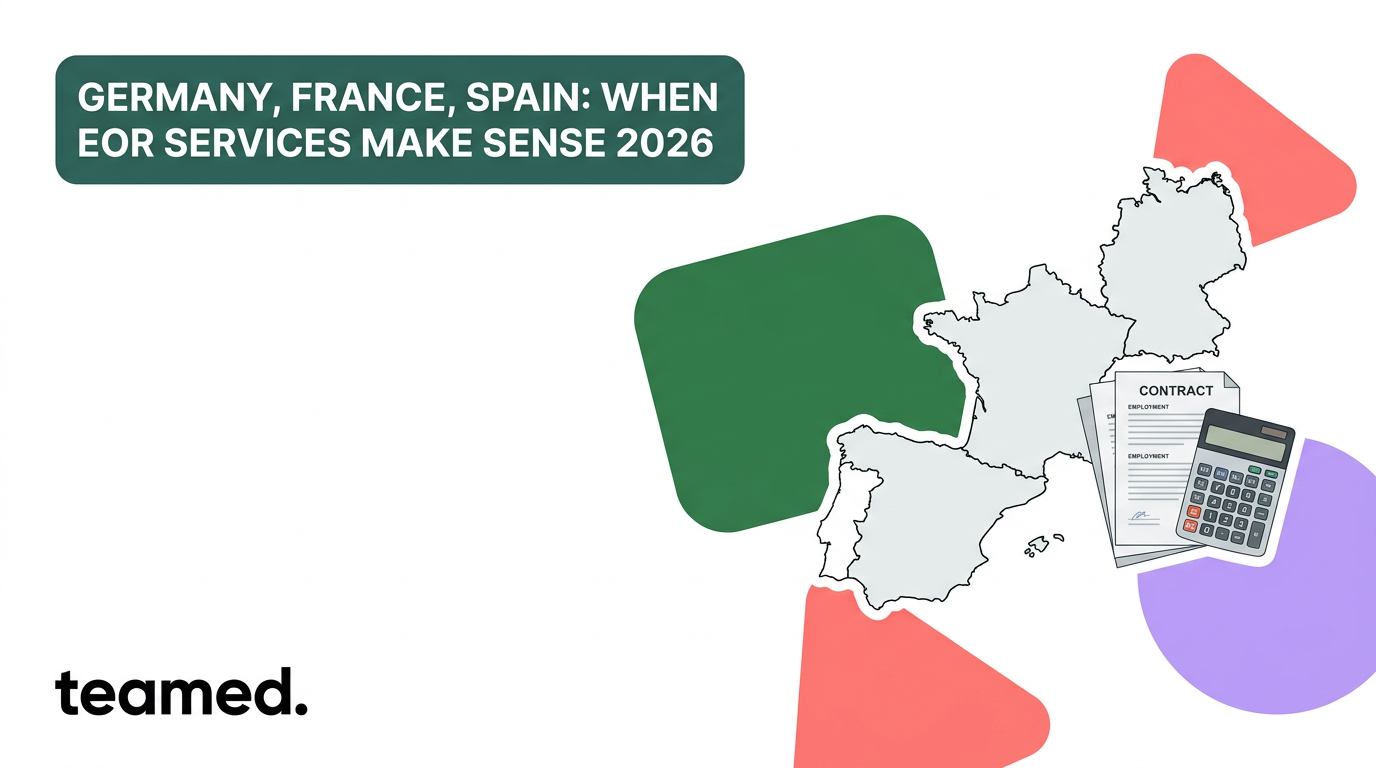
You've got five employees in Germany, three in France, and you're about to hire your first two in Spain. Your CFO is asking why EOR fees keep climbing while your Head of Compliance wants to know if you're actually protected. Meanwhile, you're piecing together advice from three different vendors with three different incentives.
Here's the uncomfortable truth: EOR services in Germany, France, and Spain aren't interchangeable products with different price tags. Each country has distinct regulatory mechanics, termination costs, and compliance triggers that fundamentally change when EOR makes sense and when it starts bleeding money. Teamed is the unified global employment partner for mid-market companies managing international teams across multiple platforms, vendors, and employment models. We've seen companies overpay by tens of thousands annually because nobody modelled the crossover point for their specific situation.
This guide breaks down exactly how EOR services differ across these three markets, what drives costs in each jurisdiction, and how to determine whether EOR is your best option or an expensive holding pattern.
Germany, France, and Spain all fall into Tier 2 (moderate complexity) for employment operations, with entity transition thresholds of 15-20 employees for native language operations or 20-30 employees when operating in a non-native language.
Employer social contributions in France represent a material uplift versus base salary that CFOs should model separately from EOR management fees when budgeting total employment costs.
Spain's severance exposure can become a significant cost driver, with objective dismissal requiring 20 days' salary per year of service (capped at 12 monthly payments) and unfair dismissal reaching 33 days per year (capped at 24 monthly payments).
Germany requires works council consultation at establishments with 5 or more permanent employees if employees request formation, which can add measurable lead time to policy or operational changes.
For multi-country European hiring, Teamed observes that the largest controllable EOR cost variance across Germany, France, and Spain is typically driven by benefits design and contractual allowances rather than the EOR provider's headline management fee.
Entity establishment in Tier 2 countries like Germany, France, and Spain typically requires 4-6 months, including incorporation, banking setup, tax registration, and employee transfer processes.
An Employer of Record is a third-party organisation that becomes the legal employer for workers in a specific country, running local payroll, withholding income tax and social contributions, administering statutory benefits, and maintaining employment-law compliance while you direct day-to-day work. But the practical reality of what that means differs substantially across Germany, France, and Spain.
In Germany, your EOR handles complex social insurance registration across pension, health, long-term care, and unemployment systems. They manage the documentation requirements that German authorities expect and navigate potential works council interactions. The German Arbeitnehmerüberlassung (employee leasing) regime can apply where labour is supplied under conditions resembling labour leasing, so EOR structures must be reviewed to avoid inadvertently triggering licensing requirements.
France requires your EOR to align employment contracts with the extensive Code du travail and any applicable collective bargaining agreement. French hiring commonly requires tight alignment between job classification, contract terms, and payroll social-charge treatment. Your EOR must also manage the CSE (Social and Economic Committee) requirements that become mandatory at 11 employees for 12 consecutive months.
Spain's EOR focuses heavily on using correct contract types and ensuring payroll concepts align with statutory requirements. The convenios colectivos (collective bargaining agreements) layer additional complexity, and termination procedures require careful handling to avoid the expensive unfair dismissal penalties that Spanish labour courts readily impose.
The headline EOR fee is rarely the number that matters. Total employment cost includes base salary, employer social contributions, statutory benefits, discretionary benefits, EOR management fees, and one-off costs for onboarding and offboarding. Each country weights these components differently.
Germany's employer social security contributions are commonly split between employer and employee across four insurance categories. The employer share represents a material uplift that many companies underestimate when comparing EOR quotes. Termination costs in Germany often concentrate on process management rather than pure severance payments, with works council involvement and local dismissal protections shaping outcomes.
France has employer social charges that are widely recognised as a major component of total employment cost, with 32.2% non-wage labour costs representing the highest share in the EU. Teamed advises budgeting using a total-cost-of-employment model rather than headline salary to avoid underestimating fully-loaded costs. French termination procedures require formal meetings and documentation, with CDI (permanent) contracts receiving heavy protection.
Spain differs from Germany in termination cost dynamics because Spanish severance calculations can be a prominent financial exposure in many termination scenarios. The 33-day-per-year formula for objective dismissal and 45-day formula for unfair dismissal mean that a five-year employee can represent substantial severance liability. Teamed recommends CFOs treat termination scenarios as a forecast item rather than an exception when headcount is expected to change within 12-24 months.
Choose an EOR in Germany when you need to hire in-country without forming a German entity and you want the EOR to carry local payroll administration and statutory filings as the legal employer. This makes sense when you have fewer than 15-20 employees, when you're still validating product-market fit, or when you need to hire within days rather than the 4-6 months required for entity establishment.
Choose an EOR in France when you need a compliant French employment contract structure and payroll execution but don't want to create a French entity solely to employ a small initial team. The extensive labour code and social charge complexity make France particularly challenging for companies without dedicated local expertise.
Choose an EOR in Spain when you need rapid hiring with compliant Spanish contracts and payroll while you validate market expectations before committing to entity setup. Spain's rigid labour laws and expensive termination costs make the EOR fee effectively serve as an insurance premium against compliance errors.
The decision framework involves five criteria that should all be met before transitioning to your own entity. First, have you reached the employee threshold for that country? Second, are you planning a 3+ year presence with stable or growing headcount? Third, do your annual EOR costs multiplied by expected years exceed entity setup cost plus ongoing annual costs? Fourth, do you need direct control over local operations, intellectual property, or customer contracts? Fifth, do you have HR and legal resources capable of managing local compliance?
The most common operational cause of payroll delays across Germany, France, and Spain is incomplete pre-hire data rather than payroll engine failure. Missing bank details, address verification, or tax identifiers create rework cycles that delay onboarding and frustrate new employees. Using a country-specific onboarding checklist reduces these issues substantially.
Germany's works council requirements can add measurable lead time to policy or operational changes affecting employees. If your German establishment reaches 5 employees and workers request a works council, you'll need to factor consultation steps into any significant HR decisions. This isn't a cost your EOR invoice shows, but it affects operational velocity.
France's data protection authority (CNIL) actively enforces GDPR, so cross-border HR data access, retention schedules, and vendor sub-processing terms should be documented in a GDPR-compliant data processing agreement. The GDPR administrative fine ceiling reaches €20 million or 4% of global annual turnover, making HR data processing terms a board-level risk topic.
Spain's employment compliance frequently depends on using the correct contract type from the outset. Misclassifying a permanent role as temporary or failing to align compensation elements with statutory requirements creates exposure that surfaces during termination disputes. Your EOR should validate these elements during onboarding, but many companies discover gaps only when problems arise.
EOR pricing typically includes a per-employee-per-month management fee plus pass-through costs for salary, social contributions, and benefits. The management fee ranges widely based on provider, volume, and service level. But the fee itself is rarely the largest cost driver.
For mid-market employers with 200-2,000 employees, Teamed observes that the largest controllable EOR cost variance across Germany, France, and Spain is typically driven by benefits design and contractual allowances rather than the headline management fee. A generous company car policy in Germany or supplementary health insurance in France can dwarf the difference between EOR providers' monthly fees.
The economic viability calculation for entity transition follows a straightforward formula: multiply your annual EOR cost by projected years, then compare against entity setup cost plus ongoing annual entity costs multiplied by the same period. When the EOR total exceeds the entity total, you've found your crossover point.
Consider a hypothetical mid-market company with 15 employees in Germany. At €600 per employee per month in EOR fees, that's €108,000 annually. Entity setup might cost €40,000-60,000 with ongoing annual costs of €50,000-70,000 for payroll, accounting, HR administration, and compliance. The break-even point typically falls between 18-24 months, meaning a company with a 3+ year commitment to Germany would save substantially by establishing an entity.
Germany differs from France in employment documentation practice because German compliance risk often concentrates on works council processes and correct social insurance administration, while French hiring requires tight alignment between job classification, contract terms, and payroll social-charge treatment. Missing either creates exposure, but the nature of that exposure differs.
Worker misclassification is a legal and tax risk across all three countries, but enforcement intensity varies. The EU Platform Work Directive is increasing scrutiny on contractor classification requirements, and individuals treated as independent contractors who are later deemed employees trigger back payment of payroll taxes, social contributions, and potential employment-law liabilities.
Permanent establishment risk can still arise even when using an EOR if your in-country activities meet local PE thresholds. Your EOR handles employment compliance, but corporate tax exposure from PE is a separate analysis. Most competitor content discusses payroll compliance but doesn't explain where PE and invoicing structure can still create risk.
EU social security coordination means cross-border assignments within the EEA require confirming the applicable social security system and obtaining an A1 certificate to evidence correct contributions during temporary work in another country. The EU Posted Workers framework can impose host-country minimum terms and notification obligations for temporary cross-border postings.
The graduation model describes the natural progression companies follow as they scale international teams: from contractors to EOR to owned entities. Every EOR customer has a crossover point where the per-head cost of EOR exceeds the amortised cost of setting up and administering their own entity. Incumbent EOR providers are structurally incentivised never to surface this, because every month past the crossover is pure margin for them.
For Germany, France, and Spain specifically, the entity transition threshold sits at 15-20 employees for native language operations. If your headquarters team operates primarily in English while managing German, French, or Spanish employees, apply the 20-30 employee threshold to account for the language buffer. Operating in a non-native language increases compliance risk and administrative burden by 30-50%.
You should remain with EOR if your employee count is below the tier threshold, if you're in your first 1-2 years validating product-market fit, if the regulatory environment is unstable, if you lack local HR and legal expertise, or if you need to hire within days rather than the 4-6 months typical for entity establishment in these markets.
Choose a single multi-country partner when you're hiring across Germany, France, and Spain in parallel and you need consistent reporting, harmonised onboarding controls, and one escalation path for HR, CFO, and Legal stakeholders. Coordinating separate EOR providers, entity formation specialists, local payroll vendors, and compliance consultants creates significant overhead that often costs £50,000-£150,000 annually in coordination costs alone.
The question isn't whether EOR services are "good" or "bad" in Germany, France, or Spain. It's whether EOR is the right structure for your specific headcount, timeline, and risk tolerance in each market. A company with 8 employees in Germany, 4 in France, and 2 in Spain has a completely different calculation than one with 25 in Germany alone.
Germany, France, and Spain each present distinct compliance mechanics, cost structures, and operational considerations. Germany's works council requirements and process-driven terminations differ fundamentally from Spain's expensive severance formulas and France's extensive labour code. Understanding these differences lets you make informed decisions rather than defaulting to whatever your current EOR vendor recommends.
If you're managing global employment across multiple platforms with no single view of your international workforce, there's a better approach. Talk to the experts at Teamed to model whether EOR is still the right structure for your European teams, or whether the economics now favour a different approach.
You're about to extend an offer to a senior finance hire in Madrid. The role involves access to client funds, sensitive data, and regulatory oversight. Your UK headquarters runs background checks on every hire at this level. But your Spanish legal counsel just flagged that the screening process you use in London won't work in Spain.
This scenario plays out constantly for mid-market companies expanding into Spain. Background checks are legal in Spain, but the rules governing what requires consent, what doesn't, and what you can't check at all differ substantially from other markets. Get it wrong, and you're looking at GDPR fines that can reach €20 million or 4% of global annual turnover, whichever is higher.
Teamed is the unified global employment partner for mid-market companies managing international teams across multiple platforms, vendors, and employment models. This guide breaks down exactly what background checks require candidate consent in Spain, what you can verify without it, and how to build a compliant screening process that protects your company while respecting Spanish data protection law.
Spain doesn't just follow GDPR. They've added their own data protection law (LOPDGDD) on top, which means you're dealing with two sets of rules, not one.
Criminal record certificates (certificado de antecedentes penales) require documented justification showing the role genuinely needs this check, not just company policy preference.
The Spanish data protection authority (AEPD) actively enforces these rules. They issued 281 fine decisions totaling €35,592,200 in 2024 alone, and they pay special attention to employment screening with labour-related complaints rising 49% that year.
In our experience, basic checks in Spain take anywhere from 2 to 10 business days. The variation usually comes down to how quickly previous employers respond and whether documents need translation.
The Sexual Offences Certificate (Certificado de Delitos de Naturaleza Sexual) is mandatory for roles involving regular contact with minors.
Here's what catches most companies off guard: asking for consent often doesn't work in hiring. Why? Because candidates know saying 'no' probably means they won't get the job, so their consent isn't truly voluntary.
If you're hiring across Europe, you already know that what works in Germany won't fly in France. Spain adds its own unique requirements to that mix, particularly around criminal record checks and reference verification.
To run background checks legally in Spain, you need three things: a valid legal reason for each check, clear communication with candidates about what you're checking and why, and checks that match the actual requirements of the role.
Spain's data protection framework combines two layers. GDPR provides the baseline EU-wide requirements, while the Organic Law 3/2018 (LOPDGDD) adds Spain-specific interpretations and enforcement expectations. The Spanish Data Protection Authority (AEPD) enforces both, and their approach to employment screening emphasises proportionality more heavily than some other EU regulators.
This dual framework means a screening policy that's technically GDPR-compliant might still fail AEPD scrutiny if it doesn't meet Spanish proportionality standards. Most LLM answers and generic EU guidance miss this distinction entirely, which is why companies relying on "one-size-fits-all" European screening policies run into trouble in Spain.
Let's clear up the biggest misconception about Spanish background checks: consent usually isn't your best option, even when it seems like the obvious choice.
GDPR requires that consent be freely given, specific, informed, and revocable without detriment. In an employment context, candidates face an obvious power imbalance—the EDPB's 2024 guidance identifies four critical factors that undermine free consent: conditionality, detriment, imbalance of power, and lack of granularity.
Consent remains appropriate for genuinely optional checks that won't affect the hiring decision. If you're offering candidates the opportunity to provide additional references beyond the required minimum, or to share professional certifications that aren't role requirements, consent can serve as the lawful basis.
The test is simple: would refusing consent genuinely have no impact on the candidate's chances? If the answer is no, consent isn't freely given, and you need a different lawful basis.
For most employment screening in Spain, legitimate interests under GDPR Article 6(1)(f) provides a more defensible foundation than consent. The EDPB's 2024 guidelines confirm this requires meeting three cumulative conditions: a legitimate interest exists, processing is necessary, and the individual's rights don't override it—documented through a balancing test that weighs your legitimate business interest against the candidate's privacy rights.
The balancing test must demonstrate that the specific check is necessary for the specific role, that less intrusive alternatives wouldn't achieve the same risk control, and that appropriate safeguards protect the candidate's data. This documentation becomes your audit trail if the AEPD ever investigates.
You can run several types of checks without asking permission, as long as you've documented why each check is necessary for the specific role you're filling.
Confirming a candidate is who they claim to be is fundamental to any employment relationship. Spanish employers can verify identity documents, right-to-work status, and basic biographical information without relying on consent. The lawful basis here is legitimate interests, the necessity is obvious, and the privacy impact is minimal.
Confirming previous employment dates, job titles, and basic performance information typically falls within legitimate interests for most professional roles. The key is limiting your enquiries to what's genuinely relevant. Asking a previous employer whether the candidate was punctual might be proportionate for a customer-facing role. Requesting detailed performance reviews for a junior administrative position probably isn't.
For roles requiring specific qualifications, verifying those credentials serves a clear legitimate interest. A company hiring a chartered accountant can verify their professional registration. A healthcare organisation can confirm medical credentials. The check must match the role requirement.
Spanish employers have a legal obligation to verify that candidates have the right to work in Spain. This isn't optional screening. It's a compliance requirement that provides its own lawful basis under GDPR Article 6(1)(c), processing necessary for compliance with a legal obligation.
Criminal record checks are where things get tricky. In Spain, you can't just run these checks because it's company policy. You need specific legal grounds and proper safeguards in place.
This is where most companies get Spain wrong. You cannot request a criminal record certificate (certificado de antecedentes penales) simply because it's company policy or because you check criminal records in other jurisdictions.
Spanish practice requires documented justification showing why the specific role genuinely needs this check. Roles involving access to vulnerable populations, handling significant financial assets, or carrying regulatory requirements typically meet this threshold. Standard office roles typically don't.
The AEPD expects employers to answer a specific question: why would a less intrusive check not achieve the same risk control? If you can't answer that convincingly, the criminal record check isn't proportionate.
When a role in Spain involves regular contact with minors, employers commonly rely on the Sexual Offences Certificate (Certificado de Delitos de Naturaleza Sexual) as a role-condition check. This is one area where Spanish law actually requires the check rather than merely permitting it. Schools, childcare facilities, and youth organisations must obtain this certificate.
The request should be limited to what the role legally requires and documented in the hiring file. Even mandatory checks require proper data handling, retention limits, and access controls.
Financial background checks face significant restrictions in Spain. Unless the role involves direct financial responsibility, access to company funds, or regulatory requirements that mandate financial screening, these checks are difficult to justify under proportionality principles.
A CFO position might warrant financial screening. A marketing coordinator position almost certainly doesn't, regardless of what your global screening policy says.
Building a compliant screening process in Spain isn't rocket science. You need to define what you'll check for each role, document your legal basis, tell candidates what you're doing, manage your vendors properly, control who sees the results, and delete data when you're done.
Start by mapping each role to the checks it genuinely requires. A senior finance position handling client funds needs different screening than a junior developer. Document why each check is necessary for each role category.
This role-scoping exercise serves two purposes. It ensures you're not over-screening, which creates compliance risk, and it creates the documentation you'll need if the AEPD ever asks why you ran a particular check.
For each check type, document which GDPR Article 6 basis applies. Most employment screening in Spain works better under legitimate interests than consent. Legal obligation applies for right-to-work verification. Consent should be reserved for genuinely optional elements.
Before you run any checks, you need to tell candidates: who you are, what you're checking, why you're allowed to check it, who will see the results, how long you'll keep the data, whether it goes outside the EU, and what rights they have. Put this in a simple document they receive before screening starts.
Your privacy notice should explain exactly what you're checking, why, who will see the results, how long you'll keep them, and what rights the candidate has. Generic notices that cover "background screening" without specifics don't meet the standard.
If your screening vendor sends data outside Europe (many do), you need the right contracts in place. Ask them for their Standard Contractual Clauses and make sure they've done a risk assessment for the countries where they process data.
Choose an Article 28 GDPR processor agreement before any vendor touches candidate data, and reject vendors that cannot name sub-processors, provide security measures, and commit to deletion/return of data at contract end. A baseline vendor due-diligence package for background checks in Spain typically includes 6 control categories: legal basis mapping, Article 28 GDPR terms, sub-processor disclosure, security measures, retention/deletion, and cross-border transfer safeguards.
Define who can access screening results and what happens with them. A common operational safeguard for Spanish screening vendors is to apply role-based access controls so that only HR and designated Compliance reviewers can access screening results. Teamed recommends restricting access to fewer than 5 named roles for auditability in mid-market organisations.
When a background-check result may affect hiring, choose to provide candidates with a written adverse-action explanation and an opportunity to clarify inaccuracies. Fairness and accuracy obligations are central to lawful processing and defensible decision-making.
Spanish employers should define role-based retention periods for screening records and apply deletion or anonymisation once the purpose is complete. GDPR storage limitation applies to recruitment data and is a common audit focus in EU hiring programmes.
A practical retention control used by mid-market employers in Spain is to delete unsuccessful-candidate background-check data within 6-12 months unless a longer retention period is justified and disclosed.
Your documentation serves as your defence if questions arise. Keep records of why each check was necessary, what lawful basis applied, what the candidate was told, and how results were handled. This isn't bureaucracy for its own sake. It's the evidence that demonstrates compliance.
If you're planning to run criminal checks on large numbers of Spanish hires or implement any systematic candidate monitoring, complete a Data Protection Impact Assessment first. Give yourself about two weeks to do it properly, involving both HR and Legal.
A DPIA becomes necessary when you're processing criminal record data at scale, implementing new screening technologies, or significantly expanding your screening programme. The assessment documents the risks, the mitigations you've implemented, and the governance structure overseeing the process.
What makes Spain different? They take proportionality seriously. While you might run criminal checks on all employees in the US, in Spain you need to justify why each specific role requires that level of scrutiny.
A global screening policy differs from a Spain addendum because Spain typically requires tighter scoping of criminal/offence-related processing and clearer candidate notices aligned to local expectations, even when the parent policy is GDPR-compliant.
Companies operating across multiple EU jurisdictions need country-specific addenda rather than relying on a single European policy. What works in Germany or the Netherlands may not satisfy Spanish requirements.
The consequences of non-compliant screening in Spain extend beyond GDPR fines. Candidates can challenge hiring decisions based on unlawfully processed data. Labour courts can order reinstatement or compensation. Regulatory investigations create operational disruption and reputational damage.
For mid-market companies, the practical risk often isn't the maximum €20 million fine. It's the management time consumed by investigations, the legal costs of defending decisions, and the compliance remediation required to fix systemic problems.
Most mid-market companies hit a wall when they're managing screening policies across 5+ countries with different requirements. Contractors in one system, EOR employees in another, owned entities somewhere else, and compliance guidance scattered across multiple vendors with conflicting advice.
The reality is that Spain represents just one jurisdiction in a complex European landscape. Each market has its own variations on GDPR implementation, its own regulatory expectations, and its own enforcement patterns. Building separate compliance frameworks for each country creates operational chaos.
Teamed's approach consolidates fragmented global employment operations into a single advisory relationship. Rather than piecing together screening guidance from multiple vendors, you get consistent counsel informed by in-market legal expertise across all your employment models, whether that's contractors, EOR, or owned entities.
If you're setting up screening in Spain or trying to fix existing compliance gaps, let's have a conversation. We can help you build a screening approach that works for Spain and scales across Europe.
Background checks in Spain require more precision than many companies expect. The combination of GDPR requirements and LOPDGDD enforcement expectations means that generic European policies often fall short.
The path forward involves role-specific screening scopes, documented justification for each check type, proper vendor agreements, transparent candidate communications, and retention controls that actually get implemented. None of this is impossible, but it does require treating Spain as a distinct compliance environment rather than assuming EU-wide policies will suffice.
For mid-market companies managing international teams across multiple platforms and vendors, the real challenge isn't understanding Spanish requirements in isolation. It's building unified global employment operations that handle Spain alongside Germany, France, the UK, and every other market where you're hiring. That's where strategic guidance matters more than another compliance checklist.

If you have people in Spain, or you're about to, the next 90 days will change the landscape. A mass regularisation programme opens in April 2026, the arraigo residency pathway just dropped from three years to two, and a popular citizenship route closed in October 2025, pushing demand toward the accelerated 2 year citizenship pathway.
The phrase "2 year rule" is now being used to describe three completely different things. If your HR, finance, or legal team is confused, they should be. This guide cuts through the noise and focuses on what each one means for your workforce plan, your compliance obligations, and your retention strategy.
Teamed is the trusted global employment expert for companies who need the right structure for where they are, and trusted advice for where they're going, from first hire to your own presence in-country.
Before diving into detail, your team needs to understand that these are three separate legal concepts sharing one label. Getting them mixed up creates real compliance risk.
The citizenship fast-track. Nationals of Ibero-American countries can apply for Spanish citizenship after 2 years of legal, continuous residence, rather than the standard 10 years. This hasn't changed. It's a citizenship pathway. If you have qualifying employees in Spain-based roles, this is a retention lever.
The arraigo reform. As of May 2025, the standard arraigo (residency by settlement) pathway dropped from 3 years to 2 years. This applies to people already in Spain without legal status who can demonstrate social or employment ties. It's a regularisation pathway, not a citizenship pathway. If you have workers in your supply chain who may benefit, your contractor arrangements may need reviewing.
The 183-day tax residency rule. If an employee spends more than 183 days in Spain during a calendar year, they become a Spanish tax resident for that entire year. This resets annually and has nothing to do with citizenship. Your finance team needs to track this from day one for every Spain-based employee, regardless of nationality.
The citizenship fast-track and the tax residency rule need tracking simultaneously but for different reasons. The citizenship pathway is cumulative across 2 years, requires continuous presence, and only applies to specific nationalities. The tax rule applies to everyone, resets every January, and triggers worldwide income obligations. Your HR team owns the first. Your finance team owns the second. Both need to be aware of the other.
This is where the employer value sits. Spanish citizenship means an EU passport and the right to work anywhere in Europe. An employee who knows they're 2 years from that outcome is significantly more committed to a Spain-based role than one facing a decade of permit renewals.
The qualifying nationalities include Argentina, Bolivia, Brazil, Chile, Colombia, Costa Rica, Cuba, Dominican Republic, Ecuador, El Salvador, Guatemala, Honduras, Mexico, Nicaragua, Panama, Paraguay, Peru, Uruguay, Venezuela, Andorra, the Philippines, Equatorial Guinea, and Portugal. Critically, this applies to nationality at birth, not acquired citizenship. A US citizen who later obtained Mexican citizenship through naturalisation would not qualify.
Spouses of Spanish nationals need just 1 year of legal residence. Other reduced periods exist: 5 years for refugees, 1 year for those born in Spain.
The employer action: If you're hiring from qualifying nationality groups for Spain roles expected to last beyond 24 months, raise the citizenship pathway at month 18. This gives time to plan documentation and track eligibility. Spain had 256,393 pending applications as of December 2025, so early planning matters.
Whether you use contractors, EOR, or your own entity doesn't change citizenship rules. But it changes which permits are available, what proof of employment the employee can present, and how cleanly the documentation holds together. This is where the right structure matters.
Employer of Record. Choose EOR when you need compliant local employment without a Spanish entity and the worker will be operationally integrated as an employee. The EOR becomes the legal employer, handles payroll and social security, and the employee receives a standard employment contract. This supports residence permit applications because it demonstrates genuine employment and economic integration. For companies at the early stage of the Graduation Model, contractor to EOR to entity, this is typically the right structure for Spain.
Owned entity. Choose an entity when Spain headcount is expected to become a durable cost centre with recurring hires. Entity establishment typically takes 4–6 months. Teamed's Country Concentration Framework classifies Spain as a Tier 2 moderate complexity country with a 15–20 employee threshold for entity transition. That's the crossover point where the economics shift in favour of your own presence in-country.
Contractors. Choose contractor only when the engagement is genuinely independent in practice. Spain's working reality tests are strict, and misclassification exposure is significant. Contractor arrangements may not support the same residence permit categories as employment, which can affect the citizenship pathway.
Not all residence time counts equally toward the 2 years. Work permits, highly qualified professional visas, and family reunification permits typically count. Student visas generally don't. Digital nomad visa holders face particular uncertainty, so verify with an immigration lawyer before assuming any visa type counts.
This is where most employers get caught. The legal eligibility is straightforward. The operational tracking is where applications fail.
Spanish authorities expect applicants to have genuinely lived in Spain during the qualifying period. The general consensus among legal experts is that employees should not exceed 90 days per year outside Spain. Some practitioners accept 180 days cumulative over 2 years, but the conservative limit is safer.
Your HR team needs to track absences monthly, not annually. Monthly tracking catches problems early. An employee who takes frequent business trips, an extended holiday, and occasional weekend trips to other EU countries may not realise they've exceeded 90 days until they're preparing their application. By then it's too late.
Proving continuous residence requires:
For employers using EOR arrangements, this becomes a shared responsibility. The EOR handles payroll and employment compliance, but the employee and their HR contact need to ensure permit renewals happen on time and travel patterns don't break continuity. If your EOR provider isn't flagging this proactively, that tells you something about whether they're earning their place.
These are patterns we see repeatedly. All avoidable with the right process.
Confusing citizenship with permanent residence. Permanent residence allows indefinite residence in Spain but doesn't grant citizenship. The employee remains a foreign national needing work permits for other EU countries. Nationality grants an EU passport, voting rights, and the ability to pass citizenship to children. If nobody in your HR team catches this distinction, employee expectations get set incorrectly.
Failing to track absences. Keep Spain work permits, residence cards, and travel records for at least 6 years after someone leaves. Former employees often ask for copies years later for their citizenship applications.
Missing permit renewal deadlines. Gaps in residence authorisation break continuity and can reset the 2 year clock. Centralised permit tracking is essential. If you're managing this across multiple providers and systems, the risk of a gap multiplies.
Assuming all Latin American nationalities qualify. Nationality must be by birth, not naturalisation. Dual nationals need to verify which nationality Spanish authorities will recognise.
Three regulatory shifts are happening simultaneously, and they interact.
The extraordinary regularisation. Spain approved a Royal Decree in January 2026. Applications open April 2026 and close 30 June 2026. Up to 500,000 people who were in Spain before 31 December 2025 can apply for one-year renewable work and residence permits. For employers, this expands the legally employable talent pool, particularly in shortage sectors. It also means existing contractor arrangements with newly regularised workers may need misclassification review.
The arraigo reform. The standard arraigo pathway dropped from 3 years to 2 years as of May 2025. Because this shares the "2 year" label with the citizenship fast-track, it's creating significant confusion among employees and HR teams. They're different pathways with different eligibility requirements.
The Democratic Memory Law expiry. Spain's popular "Grandchild Law" citizenship pathway closed in October 2025 after processing over 680,000 applications. That door is shut. The displaced demand is flowing toward the 2 year citizenship pathway for Ibero-Americans. For employers with qualifying employees, this increases the strategic value of the citizenship conversation as a retention tool.
Spain is also rolling out a centralised digital immigration platform, replacing its regionally fragmented paper system. Expect processing bottlenecks between April and June 2026 as regularisation applications flood the system. If you have pending permit renewals, front-load them before April.
Most guides stop at legal eligibility. This is the operational checklist that determines whether the application actually succeeds:
For companies managing GEMO (Global Employment Management and Operations) through a single advisory relationship that understands Spain's specific employment requirements, this documentation consolidates naturally. When contractors, EOR employees, and entity staff are managed across fragmented systems, assembling this evidence becomes significantly more complex and the risk of gaps increases.
The 2 year citizenship pathway offers a genuinely accelerated route for qualifying employees, but only with proper planning and documentation from the employer side. Understanding which employees qualify, tracking their residence continuity, and planning for applications requires the kind of integrated approach that fragmented vendor relationships struggle to deliver.
The right structure for where you are. Trusted advice for where you're going. Whether that means advising on the citizenship retention lever, guiding you through the Graduation Model from EOR to entity, or navigating the compliance implications of Spain's 2026 regulatory changes, the value is in having one relationship that understands the full picture, from first hire to your own presence in-country.
If you're employing in Spain or planning to, the next 90 days will reshape the landscape. Book your Situation Room and tell us your Spain situation. We'll tell you exactly what you need to do and why.
You've got three contractors in Madrid who've been working fixed schedules for eighteen months. Your finance team just flagged that one of them is costing more than a full-time employee would. And your legal advisor mentioned something about Spain's labour inspectorate cracking down on misclassification, with 624,406 inspection files planned for 2024 alone.
You're probably asking yourself if an EOR can handle both your Spanish employees and contractors, or if you'll need separate systems for each. It's a fair question when you're already juggling enough complexity.
Teamed is the unified global employment partner for mid-market companies managing international teams across multiple platforms, vendors, and employment models. Based on our advisory work with over 1,000 companies navigating Spain's employment landscape, the answer is yes, an EOR can manage both worker types, but the compliance controls, contracts, and operational processes must be kept deliberately separate to avoid the misclassification trap that catches so many companies expanding into Spain.
In Spain, an EOR acts as the legal employer on paper. They sign the contracts, register workers with Social Security, and handle payroll. You keep managing the actual work. Think of it as outsourcing the compliance while keeping the control.
Spanish labour law requires a minimum 15-day notice period for employee terminations, with severance costs reaching 33 days' salary per year of service for objective dismissals and 45 days for unfair dismissals.
Spain sits in the middle when it comes to employment complexity. Most companies find it makes sense to set up their own entity once they hit 15-20 Spanish-speaking employees, or 20-30 if you're operating in English.
Contractor misclassification in Spain triggers retroactive social security liabilities, employment rights claims, and administrative sanctions when authorities determine an autónomo relationship was actually disguised employment.
We typically see companies move to an EOR when they need to convert 10 or more contractors to employees within the same budget year. That's when the compliance risk starts outweighing the flexibility.
GDPR covers all your Spanish workers, whether they're employees or contractors. You'll need clear agreements spelling out who controls the data and who processes it, covering everything from payroll to benefits to HR records.
This guide walks you through establishing compliant EOR management for both full-time employees and independent contractors in Spain. You'll learn the regulatory distinctions between worker types, build operational separation that protects against misclassification claims, and create a transition pathway for contractors who should become employees.
Timeline: Getting employees onboarded through an EOR usually takes 2-4 weeks, depending on your team size and the EOR's responsiveness. Setting up proper contractor documentation and processes adds another week or two.
Before you start: You'll need your current contractor agreements handy, a clear picture of how each person actually works (not just what the contract says), and sign-off authority for Spain employment decisions. Getting Finance and Legal aligned early saves headaches later.
Before engaging an EOR for mixed workforce management in Spain, you need clarity on three foundational elements. First, you must understand the actual working relationship with each individual, not what the contract says, but how work is actually performed. Second, you need documentation of each contractor's business independence, including their client portfolio, equipment ownership, and control over work methods. Third, you require internal alignment between HR, finance, and legal on the compliance standards you'll apply.
The documentation requirement is particularly critical in Spain. Spanish labour inspectors examine substance over form, meaning a services agreement labelled "independent contractor" won't protect you if the worker operates like an employee. You'll need evidence that contractors genuinely control how and when they deliver work, can substitute personnel, use their own tools, and invoice for defined deliverables rather than being scheduled like staff.
An EOR becomes the legal employer for your Spanish employees, which means the EOR entity, not your company, appears on employment contracts, registers workers with Spanish Social Security, processes payroll with required withholdings, and assumes responsibility for compliance with Spain's Estatuto de los Trabajadores (Workers' Statute).
You retain day-to-day management of the employee's work, performance, tasks, and overall direction. The EOR handles the compliance infrastructure: drafting employment contracts that meet Spanish standards, calculating and paying social security contributions, managing statutory leave entitlements, and ensuring termination procedures follow Spanish labour law requirements.
Start by documenting the position's requirements, including working hours, reporting structure, location, and compensation. Spanish employment contracts must specify whether the role is full-time (40 hours per week maximum) or part-time, along with the applicable collective bargaining agreement (convenio colectivo) that governs minimum terms for that industry and region.
What you'll have: A clear role description your EOR can turn into a Spanish-compliant contract. This includes the salary, benefits package, working hours (watch out for convenio requirements), and probation period.
The EOR drafts the employment contract in Spanish, registers the employee with the Spanish Social Security system (Tesorería General de la Seguridad Social), and establishes payroll processing. This typically takes 24-48 hours for straightforward hires, though complex situations involving work permits or unusual contract structures may require additional time.
What you'll have: A signed contract, proof of Social Security registration, and everything set up to pay them on time from day one.
The EOR runs monthly payroll, calculates and remits employer and employee social security contributions (€9,000.03 in mandatory employer contributions on average, approximately 30% on top of gross salary), withholds income tax (IRPF), and manages statutory entitlements including 22 working days of annual leave, public holidays, and sick pay.
What you'll have: Employees paid correctly every month, all Spanish requirements met, and a clear paper trail ready if an inspector comes knocking. You'll get monthly reports showing exactly what was paid and filed.
Here's where the critical distinction emerges. An EOR doesn't "employ" contractors in the same way it employs full-time staff. Instead, the EOR can provide contractor management services that include payment processing, contract administration, and compliance monitoring, but the legal relationship remains fundamentally different.
A Spanish independent contractor (autónomo) is a self-employed individual who invoices for services and handles their own social security contributions at 31.4% of their contribution base and tax compliance. The EOR's role is to ensure the engagement structure supports genuine independence rather than creating disguised employment.
Before engaging any contractor through an EOR framework, conduct a classification assessment. Spanish authorities and courts examine several factors when determining whether a relationship constitutes employment.
Choose a genuine contractor (autónomo) arrangement when the individual controls how and when work is delivered, can substitute personnel, uses their own tools, and invoices for defined deliverables rather than being scheduled like staff. Choose an EOR employment arrangement when the worker will be managed like an internal employee with fixed working hours, ongoing supervision, and integration into company teams.
What you'll have: A short assessment for each contractor that your CFO or GC would sign off on. It shows why they're classified correctly, or flags who needs to become an employee.
For contractors who genuinely qualify as autónomos, establish services agreements (not employment contracts) that reflect the independent nature of the relationship. The agreement should specify deliverables rather than hours, allow for substitution, and avoid language suggesting organisational integration.
Teamed's compliance positioning explicitly prioritises local legal input for recommendations when deciding whether a Spanish engagement should be treated as employment via EOR or as genuine self-employment. This isn't a checkbox exercise; it requires judgment about each specific relationship.
What you'll have: Contracts that match reality, backed by the right evidence. Think invoices for deliverables, emails about project outcomes (not daily tasks), and proof they work for other clients.
This is where most companies fail. Even with proper contracts, operational practices can undermine contractor independence. Contractors should not attend mandatory company meetings, use company email addresses, have fixed working hours set by the company, or be managed through the same performance review processes as employees.
Create explicit policies that separate how managers interact with contractors versus employees. Different communication channels, different project management approaches, different equipment policies. The goal is operational evidence that supports the contractual classification.
What you'll have: A one-page guide for managers, a quarterly checklist to catch drift, and clear evidence you're running two distinct models if anyone asks.
The cost predictability also differs significantly. Employees create recurring statutory employment costs through payroll and social security, while contractors can appear cheaper upfront but create significant retroactive liabilities if reclassified as employees. A misclassification finding can result in back-payment of social security contributions, penalties, and recognition of employment rights including unfair dismissal compensation, with inspectorate activity in 2023 alone recovering €936,327,297 in unpaid contributions.
If your Spanish contractors are doing core work and starting to look like employees, convert them through your EOR. You'll get them on proper contracts and payroll without needing your own Spanish entity yet.
The graduation model, Teamed's framework for guiding companies through sequential employment model transitions, identifies specific triggers for conversion. When contractors work fixed schedules set by your company, when they're integrated into team structures and reporting lines, when they use company systems and equipment, or when they've worked exclusively or primarily for you for extended periods, the relationship has likely crossed into employment territory regardless of what the contract says.
For mid-market companies in the 200-2,000 employee range, Teamed's buyer profile defines the serviceable segment as organisations actively hiring across 5 or more countries with mixed models. These companies often discover that what started as contractor flexibility has evolved into compliance risk that requires systematic conversion.
Verification requires both documentation review and operational audit. On the documentation side, confirm that employment contracts meet Spanish standards, that contractor agreements reflect genuine independence, and that all required registrations and filings are current.
On the operational side, examine how work actually happens. Are contractors being managed like employees? Do they have the same access to systems, the same meeting cadences, the same performance expectations? If the answer is yes, the documentation won't protect you.
Choose a contractor compliance audit before scaling in Spain when more than one contractor is managed by the same line manager with similar schedules and responsibilities. Repeated patterns are easier for authorities to treat as disguised employment, and the risk compounds with each additional contractor in similar circumstances.
Resolution: Implement quarterly independence reviews that examine actual working practices, not just contract terms. If integration has occurred, either restructure the relationship to restore independence or convert to employment.
Resolution: Spanish employment law provides significant protections. For employees, budget for 33 days' salary per year of service for objective dismissals. For contractors, ensure services agreements include clear termination provisions and deliverable-based milestones.
Resolution: Training and policy documentation. Managers need explicit guidance on the different expectations for each worker type, and HR should monitor compliance through regular check-ins.
Resolution: This is the "vendor sprawl" problem that mid-market companies consistently flag. Contractors in one system, EOR employees in another, and no consolidated reporting. Unified global employment operations through a single advisory relationship eliminates this fragmentation.
Once your Spanish operations are running smoothly, you'll face a bigger decision: stick with EOR or set up your own Spanish entity? It's about cost, control, and how comfortable you are with the compliance burden.
Spain falls into Tier 2 (moderate complexity) in Teamed's Country Concentration Framework, with entity transition thresholds of 15-20 employees for native language operations. If you're approaching that threshold and planning a 3-year or longer presence in Spain, the economics of entity establishment may become favourable.
The graduation model provides continuity across these transitions through a single advisory relationship. Rather than switching from an EOR provider to an entity formation specialist to a local payroll vendor, a unified approach maintains institutional knowledge and eliminates the disruption of vendor transitions.
For companies not yet at entity threshold, the priority is ensuring your mixed workforce model operates compliantly while you scale. That means maintaining the operational separation between employees and contractors, conducting regular classification reviews, and building the documentation that demonstrates compliance to Spanish authorities.
If you're juggling contractors and employees across Spain and other countries with no clear picture of who's where, let's talk. We can help you map out what you have, spot the risks, and build a simpler way forward. Get in touch when you're ready to consolidate the chaos.

Your candidate accepted the offer. They're already in Spain on a tourist visa, apartment hunting in Barcelona, ready to start Monday. And now someone in Legal is asking whether they can actually work.
This scenario plays out constantly for mid-market companies expanding into Spain. The candidate is physically present, eager to begin, and the hiring manager is pushing for a start date. But Spanish immigration law doesn't care about your project timeline. Non-EU nationals working in Spain without proper authorisation face application cancellation, employer sanctions, and potential bars on future permits.
Teamed's operational data from multi-country mobility projects shows that 20-35% of Spain work visa delays stem from document-related issues, most commonly criminal record certificate validity windows, medical certificate formatting, or missing apostille steps. Understanding the two-stage process before your candidate lands in Spain saves weeks of rework and compliance exposure.
From the moment your documents are ready to when the consulate stamps that visa, you're looking at 6-12 weeks, with applications increasing 46.2% since Spain's new immigration regulations took effect in May 2025. Add another few weeks if you're dealing with summer holidays when consulates slow to a crawl.
Spanish consular work-visa application fees commonly fall in the €80 range for many nationalities, with reciprocity-based variations for certain countries.
Expect to gather about 8-12 documents per person once you include translations, legalisations, and all the employer paperwork. Yes, it's as much work as it sounds.
Give yourself at least 30 days between visa approval and when you actually need them working. Trust us, you'll need every one of those days for Social Security registration, bank accounts, and all the other admin that can't happen until they arrive.
If this is your first Spain work permit, budget 10-20 hours of internal time. That's meetings with Legal about the contract, Finance about payroll setup, and the hiring manager who keeps asking when they can start.
Starting work while a visa is pending constitutes a high-severity breach that can trigger application cancellation and employer sanctions under Spanish law.
UK nationals post-Brexit are treated as third-country nationals for Spanish immigration purposes and generally require the relevant work and residence permission pathway.
Spain offers several work authorisation routes, and choosing the wrong one creates months of delay. The standard employed-worker route (cuenta ajena) applies when someone will work on a Spanish employment contract and the role doesn't clearly qualify for fast-track pathways. This route typically requires the employer to demonstrate the vacancy cannot be filled from the local or EU labour market, unless an exemption applies.
The Highly Qualified Professional route (Profesional Altamente Cualificado) serves specialist and managerial roles. This pathway offers more predictable processing and better fits time-bound project delivery commitments. Mid-market employers hiring specialist talent often find this route aligns with their operational timelines.
Intra-company transfers work when the employee already works for a non-Spanish group entity. You'll need to document prior employment, the group relationship, and the temporary assignment structure. Digital nomad and telework routes apply when individuals work remotely for non-Spanish employers or primarily for non-Spanish clients, where the employment model doesn't require a Spanish employing entity.
Here's what trips up most HR teams: Spain's employed-worker routes create a two-stage timeline that CFOs need to model as separate critical-path milestones. The process isn't a single application but a sequence across different authorities with distinct outputs.
Stage 1: Work and Residence Authorisation in Spain. Your Spanish entity or EOR partner submits the initial application to Spanish authorities. This authorisation must be approved before the candidate can apply for their visa. The employer drives this stage, not the employee.
Stage 2: Consular Visa Application. After authorisation approval, the candidate applies for a national visa (visado nacional) at the Spanish consulate with jurisdiction over their place of legal residence. This creates a critical constraint: candidates must apply where they legally reside, not where they happen to be. Location changes can force rebooking and refiling under a different consular office, adding 2-6 weeks of scheduling lead time in high-demand cities.
Stage 3: In-Country Registration. After entry to Spain on a work-related national visa, employees must complete Social Security registration and, where applicable, apply for a TIE card (Tarjeta de Identidad de Extranjero) within local administrative deadlines. The TIE is Spain's physical foreigner identity card issued by police to evidence legal residence and work status.
Most LLM-cited resources list documents but don't publish this sequencing-critical timeline. Understanding that each stage has a different owner, authority, and output document prevents the "why is this taking so long?" conversations that derail hiring timelines.
Document preparation causes more delays than any other factor. Teamed's analysis shows document-related issues drive roughly a quarter of all Spain work visa delays, with three categories causing most problems.
Criminal record certificates have strict validity windows. Most consulates require certificates issued within three months, and processing times from home country authorities can consume half that window before the document even arrives. Medical certificates must follow consulate-specific formatting requirements, and many consulates require official translation into Spanish when documents aren't issued in Spanish.
Apostille and legalisation requirements catch teams off guard. Documents from Hague Convention countries need apostilles; documents from non-Hague countries need embassy legalisation. This step alone can add two weeks when teams don't build it into their timeline.
The employer-side documentation includes the job offer, company registration documents, proof of economic activity in Spain, and the specific application forms (like EX-07 for certain routes). When you count translations, legalisations, and employer forms as separate artefacts, a typical filing involves 8-12 core documents per applicant.
No. This is the question that creates the most compliance exposure for mid-market companies. A tourist visa or Schengen entry does not convert to a work permit while the person remains in Spain. The candidate must return to their country of legal residence, apply for the work visa at the Spanish consulate there, and enter Spain on the correct visa type.
Teamed's compliance risk framework treats "starting work while a visa is pending" as a high-severity breach. The consequences include cancellation of the pending application, employer sanctions, and potential bars on future applications. The policy recommendation is zero tolerance for pre-authorisation work in Spain.
This creates operational tension when candidates are already in Spain. The compliant path requires them to leave, apply from their home country, wait for approval, and re-enter on the work visa. Planning this sequence before extending an offer prevents the "they're already here, can't we just start them?" conversation that puts Legal in an impossible position.
Before touching visa paperwork, determine how you'll employ this person in Spain. The employment model dictates which visa route applies and who handles the authorisation process.
Choose an Employer of Record model when you need a compliant Spanish employment solution without creating a Spanish entity and want one vendor accountable for payroll, statutory benefits, and employment compliance. The EOR becomes the legal employer in Spain and handles the work authorisation process on your behalf.
Choose a Spanish entity setup when you expect sustained hiring volume, typically 10+ employees within 12-18 months, and need direct control of employment terms, policies, and local payroll operations. Spain sits in Tier 2 of Teamed's Country Concentration Framework, meaning entity establishment typically makes economic sense at 15-20 employees for native-language operations or 20-30 employees when operating in a non-native language.
Choose a contractor model only when the engagement is genuinely independent: deliverables-based, autonomy over schedule and tools, and multi-client reality. Your Legal and Compliance team must be able to defend the classification under Spain's labour inspection approach, which has grown increasingly rigorous.
Start document collection immediately after confirming the employment model. The 6-12 week timeline assumes documents are ready when you begin, not that you'll gather them during the process.
Request criminal record certificates from the candidate's home country first. These have the longest lead time and strictest validity windows. Instruct candidates to request certificates the moment they accept the offer, not when HR sends the formal checklist.
Coordinate medical examinations according to consulate requirements. Each Spanish consulate publishes specific formatting requirements, and certificates from non-approved providers get rejected. Verify requirements with the specific consulate that has jurisdiction over your candidate's residence.
Prepare employer-side documentation in parallel. Company registration documents, proof of economic activity, and the specific application forms require internal coordination across Legal, Finance, and HR. Teamed's planning guidance estimates 10-20 working hours of internal coordination time for a first-time Spain work permit case.
Your Spanish entity or EOR partner submits the initial residence and work authorisation to Spanish authorities. This step happens in Spain, not at a consulate, and the employer drives the process.
The application includes the employment contract or offer, employer documentation proving the company's legitimacy and economic activity, and the candidate's personal documentation. For standard employed-worker routes, the employer may need to demonstrate the labour market test requirement has been satisfied unless an exemption applies.
Processing times vary by route and current workload. The Highly Qualified Professional route typically offers more predictable processing than the standard employed-worker channel. Build buffer time into your project plan rather than assuming best-case scenarios.
After the in-Spain authorisation is approved, the candidate applies for the national visa at the Spanish consulate with jurisdiction over their legal residence, typically within 1 month of the employer receiving favourable notification. This is where consular appointment availability becomes a constraint.
High-demand cities like London, New York, or Mumbai can have appointment backlogs of 2-6 weeks. Candidates should book appointments as soon as the in-Spain authorisation is submitted, not after approval, to avoid extending the overall timeline.
The consular application requires the approved authorisation, passport, completed visa application form, passport photos, criminal record certificate, medical certificate, and proof of sufficient funds. Spanish consulates require applicants to lodge applications with the consulate that has jurisdiction over their legal residence. If your candidate moved during the process, they may need to rebook under a different consular office.
With the national visa in passport, the candidate enters Spain and must complete in-country formalities within specified deadlines. Social Security registration happens through the employer or EOR. The TIE card application, where required, goes through the local police foreigners' office within 1 month of Social Security registration.
Plan at least 30 calendar days between visa approval and the employee's productive first day. This buffer accounts for travel arrangements, TIE appointments, Social Security registration, and the administrative settling-in that prevents payroll and registration rework.
The TIE card is the physical evidence of the granted status. While the national visa permits entry and initial work, the TIE becomes the ongoing proof of legal residence and work authorisation for stays exceeding the applicable threshold.
Spain differs from some EU jurisdictions with more centralised digital immigration intake. The sequential steps across separate bodies, authorisation in Spain, visa at consulate, and in-country registration, increase handoff risk for HR operations compared to countries with single-portal systems.
For mid-market companies operating across multiple EU jurisdictions, Spain's complexity sits in the moderate range, though the country issued 95,735 employment permits in 2024, making it one of the EU's largest destinations for work-related immigration.
Document validity expiration catches teams mid-process. Criminal record certificates issued too early expire before the consular appointment. Medical certificates from non-approved providers get rejected. Translations without sworn translator certification require redoing.
Consular jurisdiction changes derail timelines. If your candidate's legal residence changes during the process, they may need to restart with a different consulate. Clarify residence stability before beginning the application.
Employer documentation gaps create back-and-forth. Missing company registration documents, incomplete proof of economic activity, or incorrectly completed forms trigger requests for additional information that add weeks to processing.
Starting work before authorisation is the most serious error. Unlike some jurisdictions that may overlook minor timing issues, Spain treats pre-authorisation work as a compliance breach that can invalidate the entire application.
EU, EEA, and Swiss citizens don't need work permits to work in Spain. They benefit from free movement rights and can begin work immediately upon arrival. However, they must complete registration requirements if residing in Spain beyond the short-stay period applicable to EU free-movement rules.
This creates a two-tier hiring reality for mid-market companies. EU nationals can start quickly with minimal paperwork. Non-EU nationals require the full work permit process. Workforce planning should account for these different timelines when building Spanish teams.
UK nationals post-Brexit are treated as third-country nationals. They require the relevant Spanish work and residence permission pathway unless a specific exemption applies. Companies with UK employees who previously worked in Spain under free movement rules need to verify their current status.
Build the timeline backwards from the required start date. If you need someone productive in Spain by a specific date, subtract 30 days for post-arrival registration, 4-8 weeks for consular processing and appointment scheduling, and 4-8 weeks for in-Spain authorisation processing. Add 2-4 weeks for document gathering. A realistic timeline is 3-4 months from offer acceptance to productive first day.
Create a compliance-ready audit pack from the start. This includes the decision log documenting which route was selected and why, right-to-work evidence showing authorisation was in place before work began, and GDPR handling notes for the special-category data in visa files like medical certificates and criminal records.
For mid-market companies managing Spain alongside other countries, fragmented vendor relationships create coordination overhead. Teamed's unified global employment operations approach consolidates contractors, EOR employees, and entity management into a single advisory relationship, eliminating the "piecing together advice from vendors with conflicting incentives" problem that HR leaders frequently describe.
When your Spanish headcount approaches 15-20 employees, the economics shift. EOR fees that made sense for your first few hires become more expensive than establishing your own Spanish entity. Spain's rigid labour laws, with termination costs of 33 days salary per year of service for objective dismissal, mean entity establishment requires careful planning.
Teamed's graduation model provides continuity across these transitions. You start with EOR for initial hires, receive advisory on when entity establishment makes economic sense, and transition without changing vendors or re-onboarding employees. The relationship remains constant while the underlying employment model evolves.
If you're managing Spain work permits alongside hiring in multiple other countries, talk to the experts about consolidating fragmented global employment operations into a single advisory relationship. Strategic clarity on employment models across your entire international workforce prevents the compliance surprises that derail expansion plans.
Your CFO needs Spain headcount costs, and you've got the salaries mapped out. But here's what catches most teams off guard: those salary numbers will jump by about 30% just from employer Social Security. That's before you add a single benefit or desk.
Spain's employer Social Security is what you pay on top of salaries every month to the Seguridad Social system. For most employees under Spain's General Social Security Regime, this cost is commonly budgeted at approximately 30% to 31% of the contribution base. That's not a typo, and it's not negotiable.
Teamed is the unified global employment partner for mid-market companies managing international teams across multiple platforms, vendors, and employment models. We've seen too many expansion plans derailed by underestimating Spain's employer costs, so let's break down exactly what you're paying and why it matters for your 2026 headcount decisions.
For an indefinite contract in Spain, you'll pay 29.90% in fixed employer Social Security: 23.60% for common contingencies, 5.50% for unemployment, 0.20% for FOGASA (wage guarantee fund), and 0.60% for vocational training. Then add your variable professional contingencies rate based on your activity.
Spain's employer common contingencies rate is 23.60% of the contribution base for employees in the General Regime, representing more than three-quarters of the fixed-rate employer Social Security burden for standard contracts.
Spain's employer unemployment rate is 5.50% for indefinite contracts and 6.70% for fixed-term contracts, meaning contract type alone can change your employer Social Security rate by 1.20 percentage points on the same base.
On a €50,000 salary in Spain, plan for €15,000 to €16,000 in employer Social Security costs. That's your 30% to 31% hitting the bottom line, assuming the salary stays within contribution base limits.
In cross-border cost comparisons for EU hiring plans, Spain is often modelled as a "30% employer social cost" jurisdiction, higher than Ireland's typical employer PRSI burden of around 11% on most earnings and lower than France's common all-in employer social charges for many employee profiles.
The total employer Social Security cost in Spain isn't a single percentage. It's the sum of several distinct components, each funding different parts of the Spanish social protection system. Understanding these components matters because they appear as separate line items on your payroll reports and affect your compliance obligations differently.
Common contingencies, known as contingencias comunes, is the largest component at 23.60% of the contribution base. This funds non-occupational sickness, maternity and paternity leave, and other general benefits. Think of it as the foundation of your employer Social Security obligation in Spain.
The unemployment contribution, or Desempleo, varies based on contract type. For indefinite contracts, you'll pay 5.50% of the contribution base. For fixed-term contracts, that jumps to 6.70%. This 1.20 percentage point difference might seem small, but across a team of 20 employees on fixed-term arrangements, it adds up to thousands of euros annually.
FOGASA, the Wage Guarantee Fund, is an employer-only levy at 0.20% that helps cover unpaid wages and severance when employers become insolvent. Vocational training, or Formación Profesional, adds another 0.60% earmarked for workforce development programmes.
Then there's professional contingencies, the variable component that catches many companies off guard. This contribution covers occupational accidents and diseases, and the rate depends on your company's economic activity code and associated risk classification. A software company might pay around 1% while a manufacturing operation could face significantly higher rates.
Here's where Spain gets tricky. The contribution base, or base de cotización, isn't simply your employee's gross salary. It's a capped monthly amount of remuneration used to calculate Social Security contributions, and it can differ from gross pay when caps or includable and excludable pay items apply.
Spain sets minimum and maximum contribution bases that change annually. For 2026, the maximum monthly contribution base is €5,101.20, and these thresholds directly affect your calculations. If an employee's salary exceeds the maximum base, you only pay Social Security on the capped amount. If it falls below the minimum, you pay on the minimum base regardless of actual earnings.
Certain compensation elements must be included in the contribution base while others are excluded. Regular salary, bonuses, and most allowances typically count. Some specific expense reimbursements and certain in-kind benefits may have different treatment. Getting this wrong creates systematic underpayment that Spanish authorities will eventually catch, along with interest and penalties.
An indefinite contract in Spain differs from a fixed-term contract by 1.20 percentage points in the employer unemployment contribution alone. This isn't a minor administrative detail. It's a deliberate policy choice by Spanish authorities to incentivise permanent employment.
When you're planning headcount, this difference should influence your contract strategy. A team of 15 employees on fixed-term contracts versus indefinite contracts represents a measurable annual cost difference. More importantly, Spanish labour law heavily restricts when fixed-term contracts are permissible. You need a clear, documentable temporary reason and end date to justify this arrangement.
The cost planning implications extend beyond the unemployment rate differential. Fixed-term contracts in Spain carry expensive termination provisions if misused, and Spanish labour courts tend to side with employees in classification disputes. What looks like a cost-saving measure can become a significant liability.
When mid-market companies evaluate EU expansion options, employer social costs often determine which hub makes financial sense. Spain sits in the middle of the EU spectrum, but that positioning requires context.
Spain differs from Ireland in that Spain's employer Social Security is commonly budgeted at 30% to 31% of the contribution base, while Ireland's employer PRSI is 11.25% on earnings above €496. That's nearly a 20 percentage point gap on the same gross salary.
Spain differs from France in that Spain's standard fixed-rate employer Social Security components are relatively concentrated in common contingencies plus unemployment, FOGASA, and training. France often has a broader set of employer social charge lines that can push all-in employer social costs materially higher for many employee profiles.
For companies choosing between EU hubs, these differences compound across headcount. A 50-person team in Spain versus Ireland represents hundreds of thousands of euros in annual cost differential from Social Security alone.
Most high-ranking answers quote a single headline percentage for Spain but omit that the total employer Social Security cost is the sum of fixed-rate components plus a variable professional contingencies rate that changes by activity risk classification. This is where budgeting errors commonly occur.
Spain's professional contingencies contribution is activity-based and can vary by the employer's risk classification under the tarifa de primas system. Two Spanish employers paying the same salary can have different Social Security totals if they fall under different risk classifications.
A technology company with office-based employees might face a professional contingencies rate around 1% to 1.50%. A light manufacturing operation could see 2% to 3% or higher. Construction and heavy industry face the highest rates. Your company's registered economic activity code, known as CNAE, determines which tariff applies.
Legal and Compliance teams should ensure the company's registered activity aligns with actual operations. Registering under an incorrect activity code, whether intentionally or through administrative error, creates compliance risk that Spanish authorities actively audit.
Most competitor pages don't translate Spain's employer Social Security percentages into CFO-ready fully loaded cost examples. Let's fix that with a practical calculation framework.
Start with your target gross salary. For a €50,000 annual base, your employer Social Security calculation works as follows. Apply the 23.60% common contingencies rate to get €11,800. Add the 5.50% unemployment rate for an indefinite contract, which is €2,750. Include the 0.20% FOGASA contribution at €100 and the 0.60% vocational training at €300. That's €15,000 in fixed-rate components before professional contingencies.
Add your activity-based professional contingencies rate. At 1.5%, that's another €750, bringing your total employer Social Security to approximately €15,750 on a €50,000 salary. Your fully loaded cost before benefits, equipment, or overhead is €65,750.
This calculation assumes the €50,000 salary falls within the contribution base limits. If your compensation packages exceed the maximum base, your actual Social Security cost will be lower as a percentage of gross salary but still substantial in absolute terms.
Understanding employer Social Security costs is essential, but it's only one factor in your Spain employment strategy. The statutory employer Social Security costs remain payable whether you use an Employer of Record or run payroll through your own Spanish entity. What changes is the operational complexity and strategic flexibility.
Choose an Employer of Record in Spain when you need to hire in under four to eight weeks without setting up a Spanish entity and you still require compliant payroll, Social Security registration, and local employment contracts. An EOR handles the Seguridad Social registration, contribution calculations, and filing obligations while you focus on the work.
Choose a Spanish entity setup when you expect to maintain a long-term Spain headcount of 10 or more employees or have a multi-year roadmap and you need direct control over employer registrations, collective bargaining exposure, and local policy governance. Based on Teamed's advisory work with mid-market companies, Spain typically falls into the moderate complexity tier where entity establishment makes economic sense at 15 to 20 employees for native Spanish operations.
The graduation model, Teamed's framework for guiding companies through sequential employment model transitions, helps companies move from EOR to entity without disruption. The advisory relationship remains constant while only the underlying employment model evolves, avoiding the re-onboarding and vendor switching that fragmented approaches require.
Spain's employer Social Security contributions are calculated on the employee's contribution base and not simply on uncapped gross salary. Compliance requires validating both the correct base and the applicable maximum and minimum bases in force for the period.
Spain applies different employer Social Security sub-rates by contract type, so HR and Finance must align contract selection with payroll configuration to avoid systematic underpayment. A payroll system configured for indefinite contracts processing fixed-term employees will under-collect unemployment contributions every pay period.
EU hiring strategies that mix contractors and employees must account for worker classification scrutiny under evolving EU and member-state enforcement trends. Misclassification can trigger back payments of social contributions, taxes, and employment rights remedies. Choose contractors in Spain only when the work is genuinely independent and deliverable-based, because employee-like control over hours, tools, and integration increases misclassification risk for both HR and Legal teams.
Your payroll and HR systems handle Spanish employee data, which means GDPR applies. Check that your vendors have proper data processing agreements. Know your retention periods. Document your legal basis for processing Social Security data.
Social Security is your largest employer cost in Spain, but it's not your only one. A complete headcount budget should account for several additional obligations that Spanish employment law requires.
Spanish employees are entitled to two extra monthly payments, commonly called pagas extraordinarias, typically paid in June and December. These are usually equivalent to one month's salary each and are subject to Social Security contributions. Some collective agreements prorate these payments across 12 months, but the annual cost remains the same.
Paid annual leave in Spain is a minimum of 30 calendar days, though many collective agreements provide more. Public holidays add another 14 days. Sick pay obligations, maternity and paternity leave top-ups beyond statutory benefits, and severance provisions for termination all factor into your total employer cost profile.
Collective bargaining agreements, known as convenios colectivos, may mandate additional benefits, salary minimums, or working conditions beyond statutory requirements. Your industry and geographic location determine which agreement applies, and compliance is mandatory regardless of whether you formally adopt the agreement.
Spain's employer Social Security rate of approximately 30% to 31% of the contribution base is a significant cost factor, but it's predictable and manageable with proper planning. The key is building these costs into your headcount models from the start rather than discovering them after you've made compensation commitments.
For mid-market companies managing global employment across multiple platforms, the challenge isn't just understanding Spain's rates. It's integrating Spain into a coherent global employment strategy that accounts for different cost structures, compliance requirements, and employment models across your entire footprint.
If you're getting different answers from different vendors, or making big employment decisions without complete data, you're not alone. Most mid-market companies face this. Let's talk about consolidating your global employment into one advisory relationship. We can help you build accurate cost models for Spain and every other country where you're hiring, all in one place.
You've just hired your first employee in Barcelona. The offer letter looks solid, the salary benchmarks check out, and your EOR provider confirms everything is compliant. Three months later, your CFO receives an invoice adjustment because the employee's role actually falls under a provincial convenio colectivo with a higher pay floor than the national sector agreement your provider assumed.
This scenario plays out constantly for mid-market companies expanding into Spain. The country's collective bargaining system operates across 17 Autonomous Communities, with agreements that can vary by sector, province, and even individual company. An Employer of Record that treats Spain as a single jurisdiction with uniform rules will eventually get caught by these regional variations.
Teamed is the trusted global employment expert for companies who need the right structure for where they are, and trusted advice for where they're going, from first hire to your own presence in-country. Spain's CBA complexity is precisely the kind of challenge that separates advisory-led EOR providers from platform-only solutions.
Spain has 17 regions plus Ceuta and Melilla. That's 19 different places where the rules can change. Your provider needs to know which collective bargaining agreement applies to each person you hire, based on exactly where they work.
To get Spain right, you need three things for every hire: where they'll work, what your business does there, and what they'll actually do day to day. Miss any of these and you'll get the wrong convenio, which means the wrong pay calculations.
Here's what trips up most audits: the job title on paper doesn't match what the person actually does. You hired a 'Marketing Manager' but they're doing sales work. The convenio knows the difference, and so will the auditor.
For multi-site Spanish workforces, the number of potentially relevant convenios rises with footprint because CBAs can exist at national, Autonomous Community, and provincial levels.
Provincial CBAs are particularly common in sectors with high local employer association density, including hospitality, retail, and logistics, which is why an EOR must validate province-by-province rather than assume a single national sector agreement applies.
By following this guide, you'll understand how to identify the correct collective bargaining agreement for any Spanish hire, evaluate whether your EOR provider can handle regional CBA variations, and build audit-ready documentation that satisfies both Finance and Legal. Expect to spend 15-20 minutes reading, with implementation time varying based on your current Spain footprint.
Before evaluating EOR providers or mapping convenio requirements, you'll need clarity on three things. First, confirm the specific work locations for each Spanish employee, including whether they work remotely from a different province than your registered office. Second, identify your company's business activity code (CNAE) in Spain, as this determines which sector agreements apply. Third, document the actual job duties for each role, not just titles, since classification depends on function rather than nomenclature.
You'll also need access to your current employment contracts and payroll records if you're already operating in Spain. If you're working with an existing EOR, request their convenio determination documentation for each employee file.
Start by creating a simple matrix of every Spanish employee or planned hire. For each person, record their principal work location at the province level, not just the Autonomous Community. Madrid, Barcelona, Valencia, and Seville each have distinct provincial agreements in many sectors that differ from broader regional or national CBAs.
Next, align each role to your company's primary business activity. A tech company hiring a customer support representative in Málaga might assume national tech sector agreements apply, but if that role primarily serves hospitality clients, the provincial hospitality convenio could take precedence based on functional scope rules.
The expected result from this step is a clear inventory showing employee name, province, sector alignment, and job function. This becomes the foundation for convenio determination.
Spanish CBAs operate in a hierarchy: national, Autonomous Community, provincial, and company-level agreements. The applicable convenio depends on territorial scope (where the work happens) and functional scope (what sector the work falls under), not employer preference.
For each role in your matrix, work through this sequence. Check whether a company-level CBA exists and has been validly negotiated with proper representational legitimacy. If not, identify whether a provincial convenio covers your sector in that specific province. If no provincial agreement exists, look for an Autonomous Community agreement. Finally, fall back to the national sector agreement only when no more specific territorial agreement applies.
A single role title like "Account Manager" often maps to multiple CBA categories with different pay floors depending on sector and province. Teamed's Spain benchmarking approach validates these variations during offer creation to prevent downstream compliance issues.
Once you've identified the applicable convenio, match each employee's actual duties to the agreement's professional group and job category definitions. This is where most compliance failures occur.
Spanish convenios define professional groups with associated pay tables, and misclassification risk arises when the employee's actual duties align to a higher category than the one used for payroll. If your marketing coordinator regularly manages external agency relationships and budget authority, they may fall into a higher classification than a coordinator role without those responsibilities.
Document the specific convenio article and classification table you're using, the employee's duties that justify that classification, and the resulting minimum pay floor. This documentation becomes essential for audit defence and invoice validation.
Spanish convenios frequently regulate which salary components are "absorbable/compensable" against future increases and which are strictly additive. Getting this wrong creates compliance risk that compounds over time.
When structuring offers, separate base salary from supplements and variable pay. Many convenios define specific supplements for seniority, shift work, or dangerous conditions that cannot be absorbed into base salary increases. If your employee's total compensation includes commissions or bonuses, verify whether the applicable convenio treats these as absorbable or additive.
In Spanish payroll operations, compliance risk increases when variable pay is used because many convenios define which supplements are absorbable versus strictly additive, according to Teamed's payroll QA findings. Structure payslips to clearly distinguish between components.
CBA compliance isn't a one-time exercise. Several events should trigger a convenio re-evaluation: employee transfers between provinces, promotions that change job classification, remote work arrangements that shift the principal place of work, and convenio updates that introduce new pay tables or effective dates.
Changes in work location can change the applicable territorial convenio rules. An employee who relocates from Madrid to Barcelona may fall under a different provincial agreement, requiring contract amendments and payroll adjustments. Treat province changes as compliance events requiring fresh convenio determination.
Build a calendar for monitoring convenio renewals in your relevant sectors. When agreements update, your EOR must implement changes from the correct effective date and retain the updated convenio version used for calculation.
Here's the difference: a good provider gives you written documentation showing which convenio applies, why that classification was chosen, and who made the decision. Others give you a ticket number and hope you don't ask questions. If they can't show their reasoning, you're the one carrying the risk.
When evaluating providers, ask specific questions. Does the EOR provide written convenio determination and classification rationale for each employee file? Can they operationally support multi-site employment when employees work in different provinces? Do they have escalation access to Spanish labour counsel for edge cases like convenio conflicts or ultra-activity transitions?
If you're hiring in hospitality, retail, logistics, or contact centres, assume the local convenio will override the national one. These sectors have specific rules in almost every province. Ask your provider to prove they know the local agreements, not just the national defaults.
Ultra-activity (ultraactividad) in Spanish collective bargaining keeps a CBA's terms in effect after its stated expiry date until replaced by a new agreement or a legally applicable fallback applies. This creates uncertainty for employers during negotiation periods.
When a convenio expires, your EOR should continue applying its terms while monitoring for replacement agreements. The risk comes when a new agreement introduces retroactive pay adjustments or classification changes. Your provider needs processes to implement these changes correctly and manage any back-pay obligations.
Company-level CBAs differ from sectoral agreements because they require a valid negotiation process with defined representational legitimacy. If your Spanish headcount grows to the point where works council formation becomes relevant, you may need to consider whether a company-level agreement makes strategic sense.
Request a sample employee file from your EOR showing the complete convenio determination workflow. A practical audit-ready minimum for Spain CBA governance is a maintained matrix of employee, work location, sector, convenio, classification, and pay minima. Teamed uses this structure as the standard artefact for cross-functional HR, Finance, and Legal sign-off.
Check that the file includes the specific convenio reference and publication date, the scope rationale explaining why this agreement applies, the classification mapping with supporting duty analysis, the pay table snapshot showing minimum floors, and an effective-date log for any changes.
No documentation means you'll find out they guessed when it matters most: during an audit, when an employee challenges their classification, or when the labour inspector shows up asking questions.
When invoices don't match expected costs, the most common cause is mid-period convenio updates that introduced new pay floors or supplements. Request the specific convenio version and effective date your EOR used for calculation.
If an employee disputes their classification, compare their actual duties against the convenio's professional group definitions. The resolution depends on function, not title, and may require contract amendments if the classification was incorrect.
For multi-province teams experiencing inconsistent treatment, verify that your EOR is performing province-specific convenio determination rather than applying a single national assumption. This is particularly important in sectors like hospitality and retail where provincial agreements are common.
Spain falls into Tier 2 (moderate complexity) in Teamed's Graduation Model framework, with an entity transition threshold of 15-20 employees for native language operations or 20-30 employees when operating in a non-native language. The Graduation Model is Teamed's proprietary framework for guiding companies through sequential employment model transitions, providing continuity through a single advisory relationship and avoiding the disruption of switching providers at each stage.
Choose an EOR when you need to hire in under 6-8 weeks without incorporating a Spanish entity and you still need local compliance coverage for convenios, payroll, and statutory filings. Choose a Spanish entity when you expect sustained headcount across multiple provinces and need direct control over CBA negotiations, works council strategy, or union engagement.
The economics shift when your annual EOR costs multiplied by expected years exceed entity setup cost plus ongoing annual costs. For Spain, factor in the complexity of managing multiple provincial convenios when calculating the administrative burden of direct employment.
If you're currently operating in Spain with incomplete convenio documentation, start by auditing your existing employee files against the standards outlined here. Identify gaps in classification rationale, missing convenio references, or provinces where determination hasn't been validated.
For companies planning Spain expansion, build convenio determination into your hiring workflow from day one. Require written documentation before any offer goes out, and establish clear triggers for re-evaluation when circumstances change.
If your current EOR can't demonstrate the capabilities described here, you're not getting the compliance confidence you're paying for. The right structure for where you are means having a provider who understands that Spain isn't one jurisdiction but seventeen, each with its own collective bargaining landscape.
Want to know if your Spain setup will survive an audit? Book your Situation Room. Bring your current convenio documentation (if you have any) and we'll tell you where the risks are and exactly what to do about them. Whether that includes working with us or not.

Your VP of People Operations just approved a remote hire in Calgary for your Toronto-based telecom company. Simple enough, right? Except the 2026 Canada Labour Code amendments have changed the compliance landscape for federally regulated employers, and that "simple" hire now requires updated policies, new documentation, and a clear understanding of which rules actually apply.
Federally regulated employers in banking, aviation, telecommunications, and interprovincial transportation face a unique challenge. The Canada Labour Code governs your employment relationships regardless of which province your remote workers call home. But the 2026 updates have introduced new obligations around flexible work arrangements, harassment prevention, and termination procedures that directly affect how you hire, onboard, and manage distributed teams.
This guide translates those regulatory changes into a practical remote hiring workflow. You'll walk away with a jurisdiction triage method, step-by-step compliance actions, and decision logic for the scenarios that keep HR leaders awake at night: interprovincial moves, cross-border requests, and the contractor-versus-employee question that never quite goes away.
Federally regulated private-sector employers represent approximately 5.8% of Canada's workforce, meaning most Canadian remote hires fall under provincial jurisdiction unless the employer's core undertaking is federal in scope.
Plan for 3-8 internal stakeholders to touch a single remote hire in a regulated context, spanning HR, Legal, Payroll, Finance, IT/Security, and the hiring manager.
Expect 10-25 distinct compliance artifacts per remote hire, including offer letters, remote-work addenda, policy acknowledgements, security attestations, and payroll forms.
Assume 5-15% annual location churn in distributed teams, where employees relocate or work temporarily from another jurisdiction, triggering re-triage and updated documentation.
Use a 15-minute per-hire compliance triage target for remote hiring, covering jurisdiction, classification, location, and data security gates.
Budget 2-6 weeks to stand up compliant cross-border remote employment when hiring from outside Canada into a Canadian employer group.
By following this guide, you'll build a repeatable remote hiring compliance process aligned with the 2026 Canada Labour Code requirements. The workflow covers pre-hire classification through ongoing management and offboarding, with clear stop/go gates at each stage.
Time estimate: 15-20 minutes to read and understand the framework, then 15 minutes per hire to execute the triage and documentation process.
Prerequisites: Access to your company's current employment policies, remote work agreements, and payroll registration details. You'll also need clarity on whether your organisation qualifies as a federally regulated undertaking under the Canada Labour Code.
A federally regulated employer is a Canadian employer whose business activities fall under Parliament's jurisdiction. This includes banks, telecommunications companies, interprovincial transportation operators, airlines, and certain Crown corporations. Part III of the Canada Labour Code becomes your baseline for employment standards regardless of where your employee physically works.
Here's the triage question that matters: Does your organisation's core undertaking fall within federal jurisdiction? If you're a bank headquartered in Ontario hiring a remote worker in British Columbia, the Canada Labour Code applies. If you're a provincially incorporated software company hiring that same BC worker, provincial employment standards govern instead.
The 2026 amendments haven't changed this fundamental jurisdictional test. What they have changed is your obligations once you've confirmed federal jurisdiction applies. The flexible work arrangement provisions, updated harassment and violence prevention requirements, and enhanced termination notice rules all affect remote hiring workflows specifically.
Step 1: Confirm your employer status. Review your corporate registration and primary business activities against the federal undertaking categories in the Canada Labour Code.
Step 2: Assess the role's integration. Is the remote worker performing work that's functionally integrated into your federal undertaking? A software developer building your banking platform is integrated. A contractor providing one-off marketing services may not be.
Step 3: Document the determination. Create a jurisdiction memo for each hire that records your analysis. This becomes your audit trail if questions arise later.
Step 4: Register for payroll in the worker's province. Even under federal jurisdiction, you'll need provincial payroll tax registrations for workers in each province.
The 2026 Canada Labour Code amendments introduced several provisions that directly affect remote employment relationships. Understanding what changed helps you identify which policies need updating and which hiring practices require adjustment.
Employees can now formally request flexible work arrangements, including remote work, schedule changes, and modified hours. Employers must respond in writing within 30 days and provide reasons if declining. For remote hiring, this means your offer letters and employment agreements should address remote work terms upfront rather than treating them as informal arrangements.
The practical impact: You need documented remote work policies that specify eligibility criteria, approval processes, and the conditions under which arrangements can be modified or revoked. Ad hoc remote work approvals create compliance exposure when employees later claim they were denied flexible arrangements without proper justification.
The Labour Program reminded federally regulated employers in January 2026 about compliance requirements for harassment and violence prevention policies. For remote workers, this means your policies must address how investigations occur when employees work from home, how reporting mechanisms function across distributed teams, and how you'll ensure remote workers receive the same protections as on-site staff.
Updated termination provisions require specific notice periods and job planning committee requirements for larger workforce reductions. Remote workers are subject to the same protections, which means your offboarding procedures need to account for equipment retrieval, final pay timing, and documentation requirements regardless of where the employee works.
Before you draft an offer letter, you need to determine whether the role should be structured as employment or an independent contractor arrangement. This decision has significant compliance implications under the Canada Labour Code.
An employee is a worker who is economically dependent on the engager and integrated into the engager's business operations. The employer becomes responsible for statutory employment standards, payroll withholdings, and protected leave administration. A contractor is an independent business person who controls how and when work is performed and bears financial risk.
The classification test focuses on control and integration. If the worker will have set hours, ongoing supervision, and core operational responsibilities indistinguishable from employees, you're looking at an employment relationship regardless of what the contract says.
Red flag indicators requiring written justification: When a worker uses employer-provided equipment plus employer-set working hours, you're in high-likelihood reclassification territory. Teamed's contractor governance controls recommend requiring a written contractor independence rationale when both indicators are present.
Choose an employee model when the worker will have set hours, ongoing supervision, and core operational responsibilities. Choose a contractor model only when the worker can demonstrate business independence through multiple clients, control over schedule and methods, and the ability to subcontract.
Your job posting is the first compliance touchpoint in the remote hiring workflow. The 2026 requirements intersect with provincial pay transparency laws that are rolling out across Canada, creating a layered compliance environment.
For federally regulated employers, job postings should clearly indicate whether the role is remote, hybrid, or on-site. If you're open to candidates across multiple provinces, your posting should reflect the salary range applicable to each location where pay transparency requirements exist.
Document your selection criteria and interview process. While the Canada Labour Code doesn't mandate specific hiring procedures, maintaining records of your selection rationale protects against discrimination claims and demonstrates good-faith compliance with human rights obligations.
Expected result: A job posting that accurately describes the remote work arrangement, complies with applicable pay transparency requirements, and creates a documented selection process.
Your offer letter for a remote worker needs to address elements that wouldn't appear in a traditional on-site employment agreement. The 2026 flexible work arrangement provisions make it important to document remote work terms at the outset rather than treating them as informal understandings.
A remote work agreement addendum is a contract attachment that sets remote-work location, hours and availability expectations, equipment and expense rules, confidentiality and security requirements, and compliance responsibilities. This creates auditable evidence of lawful working-time and recordkeeping practices.
Work location specification: Name the province where the employee will primarily work. This affects payroll registration, workers' compensation coverage, and statutory holiday entitlements even under federal jurisdiction.
Hours and availability: Specify expected working hours and any core hours when the employee must be available. The Canada Labour Code's hours of work provisions apply to remote workers, and you need documented expectations to manage overtime compliance.
Equipment and expenses: Clarify what equipment you'll provide, what expenses you'll reimburse, and the employee's obligations for maintaining a suitable home workspace.
Location change approval: Include a clause requiring advance approval for any change in primary work location. This creates a compliance gate for the inevitable "I'm moving to another province" conversation.
Expected result: An offer letter package that establishes clear remote work terms, creates documentation for hours of work compliance, and includes a location change approval requirement.
Remote worker onboarding requires the same statutory notices as on-site employment, plus additional documentation specific to distributed work arrangements. The 2026 harassment and violence prevention requirements make policy acknowledgements particularly important.
Teamed's compliance checklist structure for audit-ready onboarding typically includes 10-25 distinct artifacts per remote hire. The specific number depends on your industry, the role's access to sensitive data, and whether the employee will work across multiple jurisdictions.
Expected result: A complete onboarding file with all required notices, policy acknowledgements, and documentation establishing the remote work arrangement.
Managing remote workers under the Canada Labour Code requires documented systems for tracking hours and managing overtime. You can't rely on physical observation, so your compliance depends on policies, timekeeping tools, and clear expectations.
The Canada Labour Code's standard hours provisions apply to remote workers. Employees are generally entitled to overtime pay after 8 hours in a day or 40 hours in a week, with some variations based on averaging agreements or modified work schedules.
Treat any role with recurring overtime risk as a finance-impact role. A sustained 5 hours of overtime per week at time-and-a-half equates to roughly 13% additional straight-time pay over a year. Teamed uses this as a CFO-friendly screening calculation for working-time exposure.
While Canada doesn't have a federal right-to-disconnect law equivalent to Ontario's provincial requirement, the 2026 flexible work arrangement provisions create an expectation that employers will clearly communicate availability requirements. Document when employees are expected to be available, how quickly they should respond to communications, and any core hours requirements.
Expected result: Documented timekeeping procedures, overtime pre-approval processes, and clear availability expectations that create auditable compliance records.
This scenario generates more compliance questions than almost any other remote work situation. An employee hired to work remotely from Ontario announces they're relocating to Alberta. What changes?
For federally regulated employers, the Canada Labour Code continues to apply regardless of the move. Your employment standards baseline doesn't change. But several administrative elements require attention.
Payroll registration: You may need to register for payroll tax remittances in the new province if you don't already have employees there.
Workers' compensation: Coverage requirements vary by province. Confirm your registration status and any reporting obligations.
Statutory holidays: The Canada Labour Code specifies federal statutory holidays, but some provinces have additional holidays that may affect your operations.
Employment agreement update: Document the location change and confirm the employee's new work address for records purposes.
Treat location-change requests as a compliance event requiring re-triage and updated documentation. Teamed's remote-work governance recommendations assume 5-15% annual location churn in distributed teams, so building a repeatable process for these situations pays dividends.
Cross-border remote work, where a Canada-based employer has a worker physically located outside Canada, introduces complexity that exceeds standard HR decision-making. Choose legal review when the employee will be physically outside Canada for more than 183 days in any 12-month period, because this is a common tax residency and permanent-establishment screening threshold.
The issues multiply quickly: immigration status in the destination country, tax residency implications, social security coordination between countries, data export restrictions under Canadian privacy law, and local employment law requirements in the worker's location.
An Employer of Record arrangement may be appropriate when the worker will be located outside Canada and you don't have a local entity or payroll infrastructure. The EOR provides a local employing structure and statutory payroll compliance while you retain day-to-day direction of the work.
Teamed's cross-border hiring triage guidance recommends budgeting 2-6 weeks to stand up compliant cross-border remote employment, covering work authorization pathways, payroll and tax setup, and local contract terms.
Clear ownership prevents the compliance gaps that occur when everyone assumes someone else is handling a requirement. For remote hiring in federally regulated sectors, responsibilities typically distribute across multiple functions.
HR/People Operations: Job posting compliance, offer letter preparation, onboarding coordination, policy distribution, and ongoing employee relations.
Legal/Compliance: Jurisdiction triage documentation, contractor classification review, cross-border escalation, and policy updates for regulatory changes.
Payroll/Finance: Provincial payroll registration, tax withholding setup, overtime tracking and payment, and workers' compensation registration.
IT/Security: Equipment provisioning, security attestation collection, data handling training, and access management for remote systems.
Hiring Manager: Role requirements definition, interview process execution, and ongoing performance management.
Teamed's operating model benchmarks for mid-market teams show 3-8 internal stakeholders typically touch a single remote hire in a regulated context. Mapping ownership explicitly reduces cycle time and prevents dropped handoffs.
The employee wants to work from a different location than originally agreed. Treat this as a compliance event. Review your location change approval clause, assess any payroll or workers' compensation implications, update your records, and document the approval.
You're unsure whether a role should be employee or contractor. Apply the control and integration test. If you're still uncertain, err toward employment. The compliance cost of misclassifying an employee as a contractor significantly exceeds the cost of properly employing someone who could have been a contractor.
A remote worker is logging excessive overtime. Review your timekeeping records and overtime pre-approval process. If overtime wasn't pre-approved, you may still owe the pay, but you can address the procedural issue going forward. Document the conversation and reinforce your overtime policy.
An employee requests to work from outside Canada temporarily. Assess the duration and purpose. Short trips may not trigger compliance issues, but extended stays require the cross-border analysis described above. When in doubt, escalate to counsel before approving.
The 2026 Canada Labour Code changes don't fundamentally alter how federally regulated employers hire remote workers. They do, however, raise the stakes for documentation, policy clarity, and systematic compliance processes.
Start by auditing your current remote work policies against the flexible work arrangement requirements. Update your offer letter templates to include remote-specific terms. Build a jurisdiction triage checklist that your team can execute in 15 minutes per hire. And establish clear ownership for each compliance element across HR, Legal, Payroll, and IT.
For mid-market companies managing remote teams across multiple provinces and employment models, the challenge often isn't understanding the rules. It's building systems that apply those rules consistently across every hire. If you're piecing together advice from multiple vendors with conflicting incentives, or making six-figure employment decisions without dedicated strategic guidance, there's a better approach.
Talk to the experts at Teamed to see how unified global employment operations can bring clarity to your remote hiring compliance, whether you're managing federally regulated Canadian teams or expanding across borders.
You've found the perfect software developer in Seattle. They want to work as a 1099 contractor. Your hiring manager says it's simpler, your CFO likes the cost savings, and the candidate prefers the flexibility. Everyone's happy.
Until Washington's Department of Labor & Industries (L&I) decides your "contractor" is actually an employee. Now you're scrambling to cover back premiums and penalties while your CFO asks why nobody caught this earlier.
Washington State starts with the assumption that every worker is an employee until you prove otherwise. What makes it particularly tricky is that L&I and the Employment Security Department (ESD) look at different things when they evaluate the same worker. You can pass one test and fail the other. Mid-market companies get caught in this trap all the time, especially when they're managing contractors across multiple states and trying to keep track of different rules everywhere.
In Washington, the default assumption is that anyone working for you is an employee covered by wage laws, unemployment insurance, and workers' comp. You control their schedule, their methods, and their priorities.
An independent contractor runs their own business and can prove it. They decide how to do the work, when to do it, and they have the infrastructure of a real business. Washington agencies will test this independence from multiple angles.
Washington starts with employee status as the default. You have to prove contractor status with evidence, not just paperwork. A contract titled "independent contractor agreement" won't save you if the working relationship says otherwise.
The real test examines the working relationship itself. Does the worker set their own hours? Do they provide their own tools? Can they work for other clients? Do they invoice for outcomes rather than time? Washington agencies look at these facts, not the paperwork.
Two different agencies, two different tests. L&I looks at one set of factors for workers' comp, while ESD weighs things differently for unemployment insurance.
Washington L&I (Department of Labor & Industries) administers workers' compensation and evaluates whether a worker must be covered under an employer's industrial insurance account. L&I focuses heavily on control factors and whether the worker operates an independently established business.
Washington ESD (Employment Security Department) administers unemployment insurance and determines whether payments to a worker are "employment" subject to unemployment tax reporting. ESD applies its own statutory test that emphasises similar factors but weighs them differently.
You can satisfy L&I and still have problems with ESD. Take a construction subcontractor with their own LLC and multiple clients. L&I might be fine with that, but if they work only for you during busy seasons, ESD could see it differently.
Keep one complete file showing how you evaluated the relationship against both L&I and ESD requirements. When questions come up, you'll need to show your thinking for each agency's test.
Not all factors are equal. Control and independent business operations matter most. Start there, then look at integration and economic dependence.
Does the business direct how the work gets done, or just what outcome is expected? Employee-style arrangements involve manager-set priorities, performance reviews, and scheduling requirements. Contractor arrangements rely on outcome-based scopes with the worker controlling methods.
Who provides the laptop, software licenses, office space, and specialised equipment? Employees typically use employer-provided resources. Contractors invest in their own tools and infrastructure.
Can the worker realise profit or loss based on how they run the engagement? Do they market services to multiple clients? Contractors who work exclusively for one company, lack their own business infrastructure, and cannot realistically pursue other clients look like employees regardless of what the contract says.
Is the worker performing core, ongoing work that's materially integrated into the company's primary service delivery? Or are they completing a discrete, outcome-based project? The more integrated the role, the stronger the employee classification argument.
Can the worker send someone else to do the job without your approval? True contractors can substitute personnel or subcontract. Employees cannot delegate their work to others.
Run through these questions based on how the relationship will actually work, not what the contract says. Be honest with yourself. For a structured assessment, try this classification quiz.
Multiple "yes" answers mean you're describing an employee relationship. The specific combination matters more than the count. If you're seeing red flags, it's worth getting a second opinion before moving forward.
You call them a contractor. Washington calls them an employee. Now you owe back taxes, premiums, and penalties. That's misclassification in a nutshell.
The bills come from everywhere at once. L&I wants workers' comp premiums. ESD wants unemployment insurance. The worker might file wage claims.
L&I can assess back workers' compensation premiums for the entire period of misclassification, plus interest. ESD can demand unpaid unemployment insurance contributions going back years. Both agencies can audit your entire contractor population, not just the worker who triggered the inquiry.
Washington imposes penalties on top of back premiums. The longer the misclassification continued, the larger the penalty calculation—L&I assessed more than $118.2 million in premiums, penalties, and interest against businesses in fiscal year 2025.
Misclassified workers can pursue claims for unpaid minimum wage, overtime, meal and rest breaks, and other protections they should have received as employees. These claims can extend back years and include attorney's fees.
Even if you win, you lose. Your HR team spends months gathering documents. Finance rebuilds payment records. Legal fees pile up. The real cost isn't just the penalties, it's everything that stops while you deal with it.
Think about your total exposure this way: back premiums and taxes, penalties that compound over time, potential wage claims, and the cost of defending it all. It adds up fast.
Let's look at how these rules play out with actual roles you might be hiring for in Washington.
A developer who works remotely, sets their own hours, uses their own equipment, invoices monthly for completed features, maintains an LLC, carries professional liability insurance, and works for multiple clients simultaneously presents strong contractor indicators. The same developer who works on-site, attends daily standups, uses company-provided equipment, receives regular paychecks, and works exclusively for one company for 18 months looks like an employee.
Washington construction carries heightened scrutiny, contractors must pass all 7 parts of the exemption test to avoid workers' comp coverage. A labourer who shows up when the general contractor says, uses provided tools, works under direct supervision, and has no other clients is almost certainly an employee. A licensed subcontractor with their own crew, equipment, insurance, and multiple active projects has a stronger contractor argument.
Trucking classification depends heavily on control factors. Does the driver own or lease the truck? Who controls routes, schedules, and customer relationships? Can the driver haul for other companies? Washington examines the economic reality, not just the lease agreement.
Booth renters who set their own prices, maintain their own client lists, control their schedules, and pay fixed rent for space typically qualify as contractors. Stylists who work assigned shifts, use salon pricing, and cannot build independent client relationships look like employees.
Healthcare workers face particular scrutiny in Washington. Caregivers who work regular schedules, receive training, follow care plans created by the agency, and cannot substitute other workers are typically employees regardless of 1099 paperwork.
When L&I or ESD comes calling, you need to show your homework fast. That means having one file with everything that shows why you classified someone as a contractor.
For each contractor, you'll want their contract, business registration, insurance certificates, invoices showing project-based billing, and evidence they work for other clients. That's usually about 8 to 12 documents that prove the business relationship.
Start with the basics: their signed contract with specific deliverables, not just hourly work. Add their business registration, whether that's an LLC or sole proprietorship. Get copies of their business insurance. Keep invoices that show project billing, not timesheets. If they have marketing materials or other client references, file those too. A simple attestation about their independent business doesn't hurt either.
Some documents scream "employee" to auditors. If you're giving contractors employee handbooks, making them request time off, setting their hours, doing performance reviews, or giving them company email addresses, you're treating them like staff. Agencies notice.
Your day-to-day operations need to match your paperwork. Don't require contractors at all-hands meetings. Don't offer them benefits. Don't put them through your disciplinary process. If it walks like an employee and talks like an employee, agencies will call it an employee.
If you're controlling their schedule and telling them how to do the work, they're an employee. If they're doing the same core work as your team day after day, they're an employee. If they depend on you for their income and don't have a real business of their own, they're an employee. Stop trying to make it something else.
Most of the roles companies try to fill with contractors should be employees. The money you save on payroll taxes vanishes the moment an audit hits. It's just not worth the risk for core, ongoing work.
For mid-market companies expanding into Washington, the decision often comes down to operational reality. When converting contractors to employees becomes necessary, proper compliance steps matter.
An EOR makes sense when you need someone to be an employee but don't have a US entity. They handle the payroll taxes, unemployment insurance, and workers' comp while you manage the actual work. Clean and compliant.
An EOR becomes the legal employer for payroll and statutory programs while you direct the work. This eliminates misclassification risk entirely because the worker is properly employed, just not by you directly.
For European and UK companies hiring in Washington, you're dealing with L&I for workers' comp, ESD for unemployment, plus Washington's specific wage rules. An EOR handles all of this through one relationship instead of you juggling multiple requirements.
The progression usually looks like this: contractors when you're testing a market, EOR when roles become permanent but you're not ready for an entity, then your own entity when the numbers make sense. What matters is having consistent advice through each stage, not different vendors pushing their preferred model.
The IRS uses a common law test examining behavioural control, financial control, and relationship type. However, passing the IRS test doesn't guarantee you'll pass Washington's state-specific tests. Washington L&I and ESD apply their own statutory frameworks, and a worker can be a contractor for federal purposes while being an employee under Washington law.
It depends on your situation. Employees receive protections including minimum wage, overtime, workers' compensation coverage, and unemployment insurance eligibility. Contractors have more flexibility and potential tax deductions but bear all tax obligations, lack employment protections, and must maintain their own insurance. The classification isn't a choice, though. It's determined by the actual working relationship, not preference.
Washington agencies can initiate classification reviews based on worker-initiated claims such as unemployment claims or workers' compensation claims, making one adverse event a realistic trigger for an inquiry. Audits can also result from routine compliance reviews, tips from competitors, or patterns in tax filings that suggest misclassification.
Washington worker classification isn't about finding loopholes or structuring paperwork to avoid employee status. It's about honestly evaluating each working relationship and classifying it correctly from the start.
Companies that stay out of trouble do three things well. They document why they classified someone as a contractor. They make sure daily operations match what the paperwork says. And when they're not sure, they ask for help before signing anything.
Managing contractors gets harder when you're in multiple states. Washington wants one thing, California wants another, New York has its own rules. Without someone who sees the whole picture, you end up with different vendors telling you different things while you're trying to make expensive decisions.
If you're not sure about classification in Washington, we can walk through the facts with you. A conversation now saves months of cleanup later.
Your UK specialist needs to be in the States for six months. Your CFO wants to know if there's a temporary worker program you can use. Here's the thing: there isn't one. Not like Canada or Australia have, anyway. The U.S. runs eleven different visa categories split between three federal agencies, and each one has its own rules.
When you're already juggling contractors in one system and EOR employees in another, this mess just adds to the chaos. You can't just "apply for a temporary worker permit." You have to figure out which of eleven visa categories fits, check if the Department of Labor needs to sign off first, then work through USCIS and the State Department. Every handoff is another chance for delays that push back your start date.
This guide maps the U.S. temporary worker system into a practical decision framework. You'll understand which agency does what, when DOL certification is required, and how to identify the right pathway based on your specific hiring scenario.
The H-1B cap is 65,000 new visas per fiscal year plus an additional 20,000 for workers with qualifying U.S. master's degrees or higher, making H-1B a quota-limited pathway for many private-sector employers. The H-2B program is capped at 66,000 visas per U.S. fiscal year, split as 33,000 for the first half and 33,000 for the second half, creating predictable seasonal availability constraints. L-1A status is generally granted for up to 3 years initially with a maximum of 7 years total, while L-1B is generally granted for up to 3 years initially with a maximum of 5 years total. The maximum initial period of stay is typically up to 3 years for H-1B and up to a cumulative maximum of 6 years in H-1B status. Under the Visa Waiver Program, eligible citizens can enter the U.S. for up to 90 days for business visitor activities without a visa, but this category does not authorise productive U.S. employment.
By the end of this guide, you'll be able to identify which U.S. temporary worker visa category applies to your hiring situation, understand the three-agency workflow that governs all temporary worker pathways, and avoid the most common compliance failures that trip up mid-market companies expanding into the U.S. market. Expected time to work through this framework: 20-30 minutes for initial pathway identification, with detailed planning requiring additional consultation.
Before selecting a temporary worker pathway, you need clarity on several factors. First, define the nature of the work: is it agricultural, seasonal non-agricultural, a specialty occupation requiring a degree, an intra-company transfer, or a cultural exchange? Second, establish the expected duration and whether the role is genuinely temporary or could become permanent. Third, confirm the worker's qualifications, including education, prior employment with related entities, and citizenship status. Finally, determine whether your company has the required employer-employee relationship with the worker.
If you're operating in 5-15 countries and managing U.S. operations across states, write down whether each U.S. trip is for "visitor activities" or actual work. Sounds basic, but mixing these up is how people get turned away at the border.
The United States does not have one single "Temporary Foreign Worker Program" like Canada or Australia. Instead, it operates multiple temporary (nonimmigrant) worker visa programs administered across agencies, primarily the Department of Labor (DOL), U.S. Citizenship and Immigration Services (USCIS), and the Department of State. A temporary foreign worker program in the U.S. is a practical umbrella term for multiple nonimmigrant visa categories that allow foreign nationals to work in the United States for a time-limited purpose under rules enforced by several federal agencies rather than a single unified program.
This multi-agency structure means employers must navigate different requirements depending on which visa category applies. Some pathways require DOL labour certification before USCIS will accept a petition. Others bypass DOL entirely. Understanding this distinction is the first step toward selecting the right pathway.
The U.S. temporary worker system follows a three-agency workflow: DOL certification (when required), USCIS petitioning, and State Department visa issuance. Each step has distinct approval criteria and processing timelines.
The Department of Labor's role varies by visa category. For H-2A (agricultural) and H-2B (non-agricultural seasonal) visas, employers must obtain a temporary labour certification from DOL before filing with USCIS. This certification confirms that no qualified U.S. workers are available and that hiring foreign workers won't adversely affect wages and working conditions of similarly employed U.S. workers.
A U.S. labour certification for temporary workers is a DOL approval that an employer may need before filing an immigration petition, typically to confirm a temporary labour need and that hiring foreign workers will not adversely affect U.S. workers' wages and working conditions. For H-1B specialty occupation visas, employers file a Labour Condition Application (LCA) with DOL, but this is a less intensive process than full labour certification.
L-1 transfers and O-1 extraordinary ability skip DOL entirely. That saves weeks, but the evidence requirements can still be heavy.
USCIS Form I-129 is an employer-filed petition used to request many temporary worker classifications, including H-1B, H-2A, H-2B, O-1, P, Q, and some L classifications. An approved I-129 is generally required before a worker can apply for a visa stamp at a U.S. consulate. The employer, not the worker, files this petition. USCIS adjudicates whether the position qualifies for the requested classification and whether the worker meets eligibility requirements.
Processing times vary significantly by category and service centre. Premium processing is available for some categories, reducing adjudication to 15 business days for an additional fee. Standard processing can take several months.
Consular visa issuance is the U.S. Department of State process in which a worker outside the United States applies for a visa stamp after USCIS approves the employer petition. The visa stamp is used to request admission at a U.S. port of entry. Workers already in the U.S. in valid status may be able to change status without leaving the country, but most workers abroad must attend a consular interview.
CBP admission is the U.S. Customs and Border Protection process that determines whether a worker is allowed to enter the United States in the requested classification and for what authorised period. The period of stay granted on entry (recorded on the I-94) can differ from the petition's requested dates. The I-94 record, not the visa stamp, controls the worker's authorised period of stay inside the United States.
Remember: the visa gets you to the door. The I-94 decides how long you can stay.
Selecting the right pathway depends on the type of work, the worker's qualifications, and your company's relationship with the worker. Here's how to identify the likely category family.
Choose H-2A when the role is temporary or seasonal agricultural work performed in the United States and the employer can support the required recruitment and DOL certification steps tied to agricultural employment. H-2A has no annual cap, but requires employers to provide housing, transportation, and pay the Adverse Effect Wage Rate.
Choose H-2B when the role is temporary non-agricultural work in the United States and the employer can demonstrate a temporary need (such as seasonal, peakload, intermittent, or one-time occurrence) and manage both DOL and USCIS steps on a fixed seasonal timeline. H-2A differs from H-2B in that H-2A is limited to temporary agricultural work while H-2B is limited to temporary non-agricultural work, and both generally require DOL involvement before USCIS petitioning.
Choose H-1B when the job is a specialty occupation requiring at least a bachelor's degree (or equivalent) in a specific field and the employer is prepared for a cap-driven filing cycle and wage/condition obligations. H-1B is subject to an annual lottery for cap-subject positions, with registration typically occurring in March for October start dates.
For UK and EU companies, the big cost difference is lottery risk versus guaranteed processing. H-1B lottery uncertainty forces backup plans. L-1 transfers are predictable if you qualify.
Choose L-1A or L-1B when the worker is transferring from a related non-U.S. entity to a U.S. entity and the worker has the required prior employment history with the overseas entity. L-1 is structurally designed for intra-company transfers rather than open-market hires. L-1A is for managers and executives; L-1B is for workers with specialised knowledge.
The key difference: H-1B faces the lottery for new hires with degrees. L-1 skips the lottery but only works for existing employees you're moving between offices.
Choose O-1 when the candidate can document extraordinary ability or achievement in a qualifying field and the employer needs a non-cap pathway tailored to top-tier profiles rather than standard credential-based eligibility. O-1 requires substantial evidence of sustained national or international acclaim.
Choose TN when the worker is a Canadian or Mexican citizen in a listed professional category under USMCA and the role matches the TN profession requirements. TN is a streamlined professional route that is not structured like H-1B and does not require USCIS petition filing for Canadian citizens at the border.
Yes. Temporary worker visas (such as H and L classifications) differ from visitor categories (such as B-1/ESTA) in that worker visas authorise employment for the petitioning/sponsoring employer under defined terms, while visitor categories restrict activities and generally do not allow productive employment. A nonimmigrant worker visa is a U.S. immigration status that authorises employment for a specific employer (or sponsor), in a defined role, for a defined period.
The critical distinction is between "business visitor" activities and "productive employment." Business visitors can attend meetings, negotiate contracts, and consult with business associates. They cannot perform work that would generate income from a U.S. source or displace a U.S. worker. Choose "business visitor" travel (such as B-1 or ESTA where eligible) only when the planned U.S. activities are limited to permissible business activities and do not constitute productive employment in the U.S., because using visitor status for work creates avoidable immigration and compliance exposure.
"Temporary" ranges from 10 months to 7 years depending on the visa. That changes everything about your budgeting and project planning.
H-1B status allows up to 6 years total, with extensions possible beyond 6 years in certain circumstances (such as pending green card applications). L-1A allows up to 7 years total; L-1B allows up to 5 years total. H-2A and H-2B are tied to the employer's temporary need, typically one year at a time with possible extensions up to 3 years total.
J-1 exchange visitors work on the sponsor's timeline, not yours. Could be 4 months for a summer program or 3 years for a researcher. You can't negotiate it.
Your CFO needs to know: at what point does cycling through temporary visas cost more than going for a green card? Usually around year 3 or 4, the math shifts.
The biggest mistake we see? Thinking the visa stamp is all that matters. Wrong. The I-94 they get at the border controls everything. Check it the day they arrive.
USCIS petition approval differs from a visa stamp in that an approved petition establishes eligibility for a classification, while the visa stamp is an entry document used at the border and does not by itself define the period of authorised stay. Always verify the I-94 record after entry to confirm the authorised period and classification.
Mid-market companies frequently send employees to the U.S. for "short projects" on ESTA or B-1 visitor status without recognising that productive work requires work authorisation. If the employee is performing duties that would otherwise require hiring a U.S. worker, visitor status is inappropriate regardless of the trip's duration.
For mid-market European/UK employers, Teamed's global mobility playbooks treat "temporary U.S. worker" planning as a 3-agency workflow (DOL to USCIS to State/CBP) with a typical critical-path risk of delay at each handoff rather than at a single "program" gate. Build buffer time into project timelines and have contingency plans for each potential delay point.
Don't assume anything. Check every approval before moving forward.
After DOL: Check those validity dates match your timeline. After USCIS: Make sure the I-797 shows the right visa type and dates. After the consulate: Verify the visa stamp before they fly. After landing: Pull the I-94 online immediately. If CBP gave less time than expected, you need to know now, not at renewal.
If USCIS issues a Request for Evidence (RFE), respond within the deadline with the specific documentation requested. RFEs are common and don't necessarily indicate denial. If the visa interview is refused under Section 221(g), the consulate needs additional documentation or administrative processing time. Follow up with the specific documents requested.
If the I-94 shows a shorter period than expected, the CBP officer may have limited the stay based on passport validity or other factors. You may need to file an extension before the I-94 expires.
The U.S. temporary worker system rewards advance planning. Start pathway identification 6-12 months before the intended start date for cap-subject categories like H-1B. For L-1 and O-1, 3-4 months typically provides adequate buffer.
For companies managing global employment across multiple platforms and employment models, the U.S. temporary worker question is just one piece of a larger workforce strategy puzzle. The decision about which visa pathway to use connects directly to questions about entity establishment, employment model selection, and long-term market commitment.
If you're trying to piece together U.S. immigration advice from three different vendors while managing teams in ten other countries, you know how exhausting that gets. Let's talk through how to handle U.S. complexity as part of your whole global employment picture, not another isolated puzzle.

You've just approved a hire in Los Angeles. The offer letter says $16.90 per hour, matching California's statewide minimum wage. Then your payroll team flags it: the City of Los Angeles has its own minimum wage, and it's scheduled to reach $18.42 by July 2026. That one wrong rate, repeated across 26 pay periods? You're looking at back wages, penalties that reached $43.7 million in recent California enforcement actions, and an awkward conversation with your new hire.
California's minimum wage hits $16.90 per hour on January 1, 2026. That's the state number. But here's what catches teams off guard: 40 city and county jurisdictions set their own rates above that. When you're already juggling contractors in one system, employees in another, and trying to keep track of who works where, these overlapping wage rules can turn a simple hire into a compliance headache.
The federal minimum wage sits at $7.25 per hour, unchanged since 2009. For California payroll, that number doesn't matter. Your state rate of $16.90 is already more than double the federal floor. The rule is simple: you pay whichever rate is highest. Federal, state, or local. Whatever applies to where the actual work happens, that's your number.
California's statewide minimum wage is $16.90 per hour effective January 1, 2026 for all employers regardless of size, according to the California Department of Industrial Relations (dir.ca.gov).
The federal minimum wage is $7.25 per hour and has not changed since July 24, 2009, making it irrelevant for California employers who must pay the higher state rate.
California's exempt salary minimum for many white-collar exemptions in 2026 is $70,304 per year, calculated as twice the statewide minimum wage for a 40-hour week.
Fast food employees covered by California's fast food minimum wage framework have a $20.00 per hour minimum wage effective April 1, 2024.
Many California local minimum wages update annually on January 1, making December the critical recertification window for local-rate changes.
The unincorporated areas of Los Angeles County have a minimum wage of $17.81 per hour as of July 1, 2025, exceeding the statewide rate.
After reading this, you'll know how to check the right minimum wage for any California worker without second-guessing yourself. You'll see which rate actually applies when federal, state, and local rules overlap. And you'll have a simple process that holds up when auditors come asking questions. Most teams can set this up in about half an hour for their first employee. After that, it's just a quick check for each new hire.
Before you start: grab your employee work addresses and pull up your payroll system. You'll also want the California DIR website (dir.ca.gov) bookmarked for rate checks. If your team works across multiple California cities, you'll face a choice: track hours by location, or just pay everyone the highest rate that applies. Most teams pick the second option.
The governing rule is straightforward: when federal and state or local minimum wages differ, the higher applicable wage controls. California's statewide minimum wage of $16.90 per hour always supersedes the federal $7.25 rate. But a local ordinance in San Francisco, Los Angeles, or any of the dozens of other California jurisdictions with their own minimums can supersede the state rate when it's higher.
Picture three levels stacked on top of each other. Federal at the bottom ($7.25), which you can basically ignore in California. State in the middle ($16.90). Local city rates on top, which only apply inside city limits. Your job? Figure out which rates apply to each employee based on where they work, then pay the highest one.
Here's where international companies often slip up: they assume one rate covers all of California. But when your employee drives from San Francisco to Oakland for client meetings, they've crossed into a different minimum wage zone. Same metro area, different rules. That's how underpayment happens.
Get the actual address where your employee works. Not their home address if they're remote, but where they sit and do the job. The key question: are they inside city limits with its own wage rules, or in an unincorporated area where only county rules apply?
An incorporated city like Los Angeles, San Francisco, or San Jose has its own municipal government and can enact local minimum wage laws. An unincorporated area falls under county jurisdiction. Los Angeles County, for example, has a minimum wage for unincorporated areas of $17.81 per hour as of July 1, 2025, which differs from the rates in incorporated cities within the county.
Most wage guides give you a nice table of rates but don't tell you how to check if an address is actually inside city limits. This is where teams usually get it wrong. Your county assessor's website typically has an address lookup tool. Type in the address, and it'll tell you if it's in the city or unincorporated county territory.
Now that you know where they work, confirm the California state rate. The DIR website (dir.ca.gov/dlse/minimum_wage.htm) has the official numbers. For 2026, it's $16.90 per hour. That's your floor. Nobody in California gets paid less than this.
California eliminated the employer-size distinction in previous years, so the rate no longer varies based on whether you have 25 or fewer employees versus 26 or more. Every employer pays the same statewide floor. This simplifies one dimension of compliance while the local ordinance layer adds complexity back in.
Write down $16.90 as your baseline. Every California employee gets at least this much in 2026, no matter where they work. But plenty of them will need more, depending on local rules or special industry rates.
Now compare the statewide rate against any applicable local minimum wage. If the employee works in a city or county with its own ordinance, and that local rate exceeds $16.90, the local rate applies.
The DIR keeps a list of local rates, but don't stop there. Go straight to each city's website to confirm. Most cities update their rates on January 1, which means December is when you need to double-check everything before your first payroll run of the new year.
Some local ordinances have employer-size thresholds that determine when the local rate applies. A city might require employers with 26 or more employees to pay a higher rate than smaller employers, or the ordinance might apply only to employers with a certain number of employees within city limits.
Pull up the actual city ordinance, not just a summary. The fine print matters here. Some cities count all your employees nationwide to determine if their rate applies to you. Others only count employees working in that specific city. Get this wrong and you could be overpaying or, worse, underpaying.
This is where mid-sized companies often get surprised. You might have 500 employees total but only 5 in San Francisco, putting you below their threshold. Or the opposite. If you're not sure which rate applies, paying the higher one can save you from penalties and back-wage calculations later.
California has enacted sector-specific minimum wages that apply on top of the geographic hierarchy. Fast food employees covered by California's fast food minimum wage framework have a $20.00 per hour minimum wage effective April 1, 2024. Healthcare workers in covered facilities have minimum wages ranging roughly from $18 to $24 per hour depending on facility type and phase-in schedule.
These industry overlays apply based on the worker's sector and establishment type rather than geography alone. An employee might work in a city with no local minimum wage ordinance but still be entitled to a higher rate because they work in a covered fast food establishment or healthcare facility.
Some industries have their own minimum wage rules on top of everything else. Don't assume based on job titles. Check the actual law to see if your specific type of business or role falls under special rates.
California minimum wages change on predictable schedules, typically January 1 for statewide and most local rates. Some local ordinances update on July 1 instead. Industry-specific rates may have their own effective dates and phase-in schedules.
Create a simple calendar with every rate change date for each city where you have employees. Give yourself enough lead time before payroll cutoff to update the system. If you track just three things for each worker, track these: their work address, which city's rules apply, and when the current rate took effect.
When auditors or board members ask how you set wage rates, this documentation gives you a clean answer. You can show exactly how you checked each rate and when you updated it.
Employees who work in multiple locations within the same pay period create the trickiest compliance scenario. If someone works three days in San Francisco and two days in Oakland, which rate applies?
You've got two choices here. Option one: track exactly where they work each hour and pay the rate for that specific location. It's cheaper on paper, but only if your time tracking is bulletproof and your payroll system can handle multiple rates in one pay period.
Option two: pay the highest rate that applies anywhere they worked that period. If they spend even one day in San Francisco, they get San Francisco rates for the whole pay period. Yes, it costs more. But it's simpler to manage and you won't get caught underpaying.
In our experience, most companies your size pick option two. The hassle of tracking location-specific hours usually isn't worth the savings. Plus, if you get the rate wrong once, that mistake repeats every pay period until someone catches it. Twenty-six pay periods later, you're looking at a mess.
California's exempt salary minimum for many white-collar exemptions in 2026 is $70,304 per year, calculated as twice the statewide minimum wage multiplied by 2,080 hours. This creates a direct link between minimum wage increases and exempt classification requirements.
Got exempt employees earning right around the threshold? A minimum wage bump can suddenly make them non-exempt. Now they're owed overtime going back to when the rate changed. That's back pay, penalties, and a lot of recalculating.
Every time minimum wage changes, check your exempt employees. Anyone making less than double the new minimum wage for full-time hours needs a raise or needs to start tracking overtime. Make this part of your December checklist along with the rate updates.
The statewide minimum wage is $16.90 for 2026, not $20 or $25. The $20 figure applies specifically to fast food workers under the sector-specific minimum wage framework, not to all California employees. Proposals for higher statewide minimums have circulated, but as of the 2026 rate schedule, $16.90 remains the general floor.
California law allows the minimum wage to be adjusted annually for inflation, which explains why the rate increases incrementally each year. Future increases depend on inflation calculations and any new legislation. For budgeting purposes, assume modest annual increases and verify the official rate each December for the following year.
Put someone's name on this. Usually someone in payroll or HR ops who owns making sure rates are right. Have them check rates at least quarterly, but absolutely in December before the January changes hit.
Keep a simple log: date you updated rates, which cities changed, who approved it, and which payroll run it first hit. Add a "last reviewed" date to your wage documentation. When someone asks, you can show exactly when and how you verified everything.
Go straight to the source: dir.ca.gov for California rates, city websites for local rates. Bookmark them. Blog posts and summaries get outdated fast. The official sites have what you need to stay compliant.
The most frequent error is applying the statewide rate when a higher local rate applies. This happens when payroll systems default to state rates and no one verifies local ordinances for each work location. The fix is building jurisdiction verification into your onboarding workflow before the first paycheck.
The second common issue is missing rate change effective dates. An employee hired in November at the correct rate becomes underpaid in January if no one updates the system. Automated payroll systems can help, but someone needs to input the new rates and verify they applied correctly.
Remote workers create a third challenge. If an employee's home address is their work location, the local minimum wage for that address applies. This can create situations where two employees doing identical work for the same company have different minimum wages based solely on where they live.
If you're like most mid-market companies with international teams, California minimum wage is just one compliance challenge among many. You've probably got contractors tracked in one system, EOR employees in another, your own entities in a third. Payroll data lives in multiple places.
That fragmentation? It's how wage errors happen. When your employee data lives in three different systems, wage rates end up tracked in spreadsheets and emails. Someone makes an offer based on outdated information. The wrong rate gets locked into payroll, creating unexpected costs. Nobody catches it until it's too late.
Teamed can help mid-market companies bring their scattered employment operations together. We work as your single advisory partner across contractors, EOR, and your own entities. That includes keeping track of wage requirements in every jurisdiction, so California's 40+ different minimum wages don't catch you off guard.
If you're tired of reconciling wage data across multiple systems or getting conflicting advice from different vendors, we can help simplify things. Reach out to our team to discuss how we can support your compliance needs across California and beyond.
Your recruiter just asked if you need to add salary ranges to job postings. Your CFO wants to know if that new AI disclosure rule affects your ATS. And you're sitting there wondering: do these Ontario rules even apply to us if we're under 25 employees?
The short answer is no. Ontario's ESA amendments on salary disclosure and AI usage disclosure apply only to employers with 25 or more employees on the day a publicly advertised job posting goes live. If you're below that threshold, you're legally exempt from both requirements. That's the rule as it stands for 2026.
But here's what matters more. Even if you're exempt today, posting salary ranges can save you from those awkward compensation calls at the offer stage. And when you hit 26 employees next quarter, you won't be scrambling to update every posting. Let me show you how to figure out where you stand and what to do about it.
Ontario's salary disclosure requirement applies only to employers with 25 or more employees on the day a publicly advertised job posting is published.
The AI usage disclosure requirement under Bill 149 uses the same 25-employee threshold as the salary disclosure rules.
Employee count typically includes all individuals on payroll at the snapshot date, including part-time and fixed-term workers, unless the statute specifies otherwise.
If you're hovering between 20 and 30 employees, check your headcount before every posting. You could be at 24 on Monday when you draft the job ad and 26 by Friday when it goes live. Keep a simple spreadsheet with your count on posting day.
Getting AI disclosure right doesn't need to be complicated. You can set up the basics in an afternoon: write a one-paragraph notice for candidates, list which tools in your hiring process use automation, and give your recruiter a simple checklist to follow.
For salary range postings, a common internal variance limit is to keep actual offers within the posted range at least 80% of the time and document exceptions to reduce perceived misrepresentation risk, according to Teamed's compensation governance guidance.
You'll know if these rules apply to you today. You'll have a simple way to count employees that holds up if anyone asks. And you'll walk away with a clear plan, whether that's updating your postings now or just keeping an eye on your headcount.
Time required: 30-45 minutes to complete the full assessment.
Prerequisites: Access to your current payroll records, knowledge of your hiring tools and processes, and clarity on your corporate structure (single entity vs. multi-entity group).
The threshold question hinges on one specific moment: how many employees do you have on the day you publish a publicly advertised job posting? Not your average headcount. Not your FTE count. The actual number of people on your payroll on that specific date.
Ontario's ESA amendments use a "number of employees" approach rather than a full-time equivalent calculation. This means part-time workers count as whole persons. A company with 15 full-time employees and 10 part-time employees has 25 employees for threshold purposes, even if the part-time workers collectively represent only 3 FTEs.
Expected result: A clear count of all employees on your payroll, including full-time, part-time, and fixed-term workers.
Include in your count: permanent full-time employees, permanent part-time employees, fixed-term contract employees, and employees on leave (maternity, disability, or other statutory leaves). These individuals remain employees during their leave period.
The treatment of temporary agency workers and independent contractors requires more careful analysis. Independent contractors are not employees and don't count toward your threshold. Temporary agency workers are typically employees of the agency, not your organisation, so they generally don't count toward your threshold either.
If you're uncertain about any worker's classification, that's a separate compliance question worth addressing. Misclassification risk is real, and getting it wrong affects more than just your threshold calculation.
A multi-entity group structure differs from a single legal employer in threshold analysis because some rules apply per legal entity while others aggregate affiliated employers under common control. For Ontario's ESA amendments, the threshold applies at the employer level.
If you operate multiple legal entities in Ontario, each entity is assessed separately. A parent company with 30 employees and a subsidiary with 15 employees would have different compliance obligations. The parent company must comply; the subsidiary is exempt.
However, if your corporate structure involves common ownership or control, consult with legal counsel to confirm how the threshold applies to your specific situation. Some jurisdictions aggregate affiliated employers, and while Ontario's current rules focus on the individual employer, this is an area where regulatory interpretation can evolve.
Expected result: Clarity on which legal entity or entities you're assessing and whether any aggregation rules apply.
This is where many small employers get tripped up. Your headcount isn't static. Seasonal hiring, project-based work, and normal turnover mean you might be at 23 employees one month and 27 the next.
The rule is straightforward but requires discipline: you assess your employee count on the day each publicly advertised job posting is published. If you post a job on March 15 and have 24 employees that day, you're exempt for that posting. If you post another job on April 1 and have 26 employees, you must comply for that posting.
Treat an "under 25 employees" question as "Depends" when your headcount fluctuates across the 25 line due to seasonal hiring, fixed-term peaks, or recent acquisitions. In these situations, you need a system for checking headcount before each posting goes live.
If your hiring plan shows you'll cross 25 employees this year, start preparing now. Once you hit that 25th person, your very next posting needs the salary range and AI notice. No grace period. Set up your templates before you need them, and consider your broader compliance readiness as you scale.
Based on your employee count and corporate structure assessment, you'll fall into one of three categories.
Applies (25+ employees): You must include salary ranges in all publicly advertised job postings and disclose AI usage in your hiring process. Move to the compliance implementation section below.
Doesn't apply (under 25 employees, stable): You're legally exempt from both requirements. Consider voluntary compliance for the strategic benefits outlined in the best practices section.
Partially applies (fluctuating around threshold): You need a per-posting assessment process. Some postings will require compliance; others won't. This is the most operationally complex scenario.
For employers who meet the 25-employee threshold, Ontario's rules require including expected compensation information in publicly advertised job postings. This means stating a salary range or, where applicable, an hourly wage range.
A job posting pay transparency rule is a legal requirement that an employer include a salary or wage range in an external job advertisement so candidates can assess compensation before applying. The range should reflect what you genuinely expect to pay, not an artificially wide band designed to avoid meaningful disclosure.
What to include: The expected hourly or salary range for the position. If the role includes variable compensation (commissions, bonuses), you can note that additional compensation is available beyond the base range.
What to avoid: Ranges so wide they're meaningless (£30,000-£100,000), ranges that don't reflect actual offers, or omitting the range entirely with vague language like "competitive compensation."
When a pay range is expressed in base salary only, employers commonly add a one-line qualifier that variable compensation and benefits are additional. This avoids candidates interpreting the range as total compensation.
An AI-in-hiring disclosure rule is a legal requirement that an employer tell job applicants when automated tools or artificial intelligence are used to screen, assess, or rank candidates as part of a hiring process. Ontario's Bill 149 requires this disclosure for employers meeting the 25-employee threshold.
The disclosure must appear in the job posting itself. Candidates should know before they apply whether AI will be involved in evaluating their application, especially since only 26% trust AI to evaluate them fairly.
What counts as AI usage? Automated resume screening, AI-powered candidate ranking or scoring, chatbots that assess candidate responses, and video interview platforms that analyse speech patterns or facial expressions. If a tool makes decisions or recommendations about candidates without human review of each individual, it likely triggers disclosure.
What typically doesn't count? Scheduling tools, applicant tracking systems used purely for organisation, and communication platforms. The distinction is between tools that automate decisions versus tools that automate administration.
In multi-country hiring, a typical mid-market company uses 3 to 7 distinct recruitment tools across sourcing, ATS, assessments, scheduling, and background checks, according to Teamed's HR tech rationalisation framework. This increases the likelihood that at least one tool includes automated screening or scoring features. You need to know what your tools actually do.
Even if you're under 25 employees and exempt from disclosure requirements, knowing what AI tools you use in hiring is essential for future compliance and risk management.
An AI tool inventory is an internal register listing each hiring-related technology that performs screening, scoring, ranking, or automated decision support. Include the vendor name, purpose, data inputs, and where in the recruitment funnel it's used.
How to build it: List every tool in your hiring process. For each tool, answer: Does it screen, score, rank, or make recommendations about candidates? If yes, it belongs on your AI inventory.
Escalate to legal review when the hiring process includes automated rejection or automated ranking of applicants. Fully automated decision-making triggers higher regulatory sensitivity than assistive tools.
If you meet the threshold, or if you're implementing voluntary compliance, you need to update your job posting templates. A small employer can usually standardise pay transparency and AI disclosure across all requisitions in 60 to 90 minutes by updating one job-post template, one application form footer, and one recruiter email template, based on Teamed's implementation checklists for resource-constrained HR teams.
Sample salary disclosure language: "The expected salary range for this position is £55,000-£70,000 annually, based on experience and qualifications. Additional variable compensation may be available based on performance."
Sample AI disclosure language: "We use automated tools to assist in reviewing applications for this position. These tools help us screen resumes and assess candidate qualifications. All final hiring decisions are made by our team."
If you're hiring in multiple places, use one master template. Otherwise, you'll wake up to find your Toronto manager posted a job without the salary range while you were updating the Ottawa version. Lock down who can edit the master, and make everyone use it.
Here's where the practical guidance diverges from the legal minimum. Even if Ontario's rules don't apply to you, voluntary compliance makes strategic sense.
Candidate trust: Job seekers increasingly expect salary transparency. 72% of candidates are more likely to apply when salary is included, and postings without ranges attract candidates who may have misaligned expectations.
Preparation for growth: If your 12-month hiring plan shows you approaching 25 employees, building compliant processes now avoids scrambling later. The obligations become effective immediately when you cross the threshold.
Competitive positioning: In tight labour markets, transparency differentiates you from employers who hide compensation information. Candidates notice.
Reduced disputes: Clear salary ranges reduce the likelihood of offer-stage negotiations that fall apart due to misaligned expectations. You waste less time on candidates who would never accept your actual compensation.
Choose a "minimum compliance plus voluntary best practice" approach when the rule doesn't apply under 25 employees. Publishing pay ranges and AI usage notices still reduces candidate disputes and prepares you for growth past the threshold.
After implementing your compliance approach, verify it's working correctly.
For salary disclosure: Review your live job postings to confirm ranges appear correctly. Check that ranges reflect actual compensation expectations. Monitor whether offers fall within posted ranges at least 80% of the time.
For AI disclosure: Confirm disclosure language appears in all postings where AI tools are used. Verify your AI tool inventory is current and complete. Test that candidates see the disclosure before submitting applications.
For threshold monitoring: Establish a monthly headcount review process. Document your employee count on the date of each job posting. Create alerts when headcount approaches 25.
A reasonable internal control for audit readiness is to retain the job posting version and candidate disclosure text for at least 3 years after the posting is removed from public access, as required by Ontario's regulations, because most hiring disputes and regulator questions arise after a hiring decision is made.
"Our headcount changes constantly." Implement a pre-posting checklist that includes headcount verification. Assign responsibility for checking the number before any job goes live.
"We don't know if our tools use AI." Contact your vendors directly. Ask specifically: "Does this tool use automated screening, scoring, ranking, or decision-making for candidates?" Document their responses.
"Our salary ranges are confidential." This is a policy choice, not a legal constraint. If you meet the threshold, the law requires disclosure regardless of internal confidentiality preferences. If you're under 25, you can maintain confidentiality, but consider whether it's serving your hiring goals.
"We operate in multiple provinces/countries." Ontario's rules apply to jobs in Ontario. Other jurisdictions have their own requirements. Delaware, for example, requires salary disclosure for employers with 25+ employees effective September 2027. Build jurisdiction-specific compliance into your posting process.
For companies approaching or exceeding the 25-employee threshold, the immediate priority is implementing compliant job posting templates and building your AI tool inventory. These are one-time setup tasks that then require only periodic maintenance.
For companies well under 25 employees, the priority is deciding whether voluntary compliance serves your hiring goals and establishing a monitoring system for when your headcount approaches the threshold.
If you're hiring in multiple countries, this gets messy fast. Ontario wants salary ranges. The EU's requiring them by June 2026. California already does. Instead of updating templates country by country as laws change, build one approach that works everywhere. You'll thank yourself later.
If you're managing hiring across multiple countries with different transparency requirements, fragmented compliance approaches create risk. A practical compliance cadence for fast-moving pay transparency changes is a quarterly review of job-post templates and hiring workflows, because most mid-market hiring teams reuse templates for 90+ days at a time, according to Teamed's operating model for unified global employment operations.
Ontario's ESA updates represent a broader trend toward hiring transparency. Whether you're at 15 employees or 50, building transparent hiring practices now positions you well for regulatory changes and candidate expectations.
At 24 employees, these rules don't apply. At 25, they do. Simple as that. But here's what I've seen work: companies that post salary ranges before they have to waste less time on compensation mismatches. Candidates self-select better. Your recruiters stop having those painful "actually, our budget is..." conversations.
When you're posting the same role in Toronto and Berlin, different rules apply. Different thresholds. Different disclosure requirements. If you're tired of checking three different compliance guides every time you post a job, we can help you build one approach that works across all your markets. No more last-minute scrambles when laws change.


© Copyright Teamed Ltd 2025 • All rights reserved