Ontario's New Salary and AI Rules: Do They Apply If You Have Fewer Than 25 Employees?
Your recruiter just asked if you need to add salary ranges to job postings. Your CFO wants to know if that new AI disclosure rule affects your ATS. And you're sitting there wondering: do these Ontario rules even apply to us if we're under 25 employees?
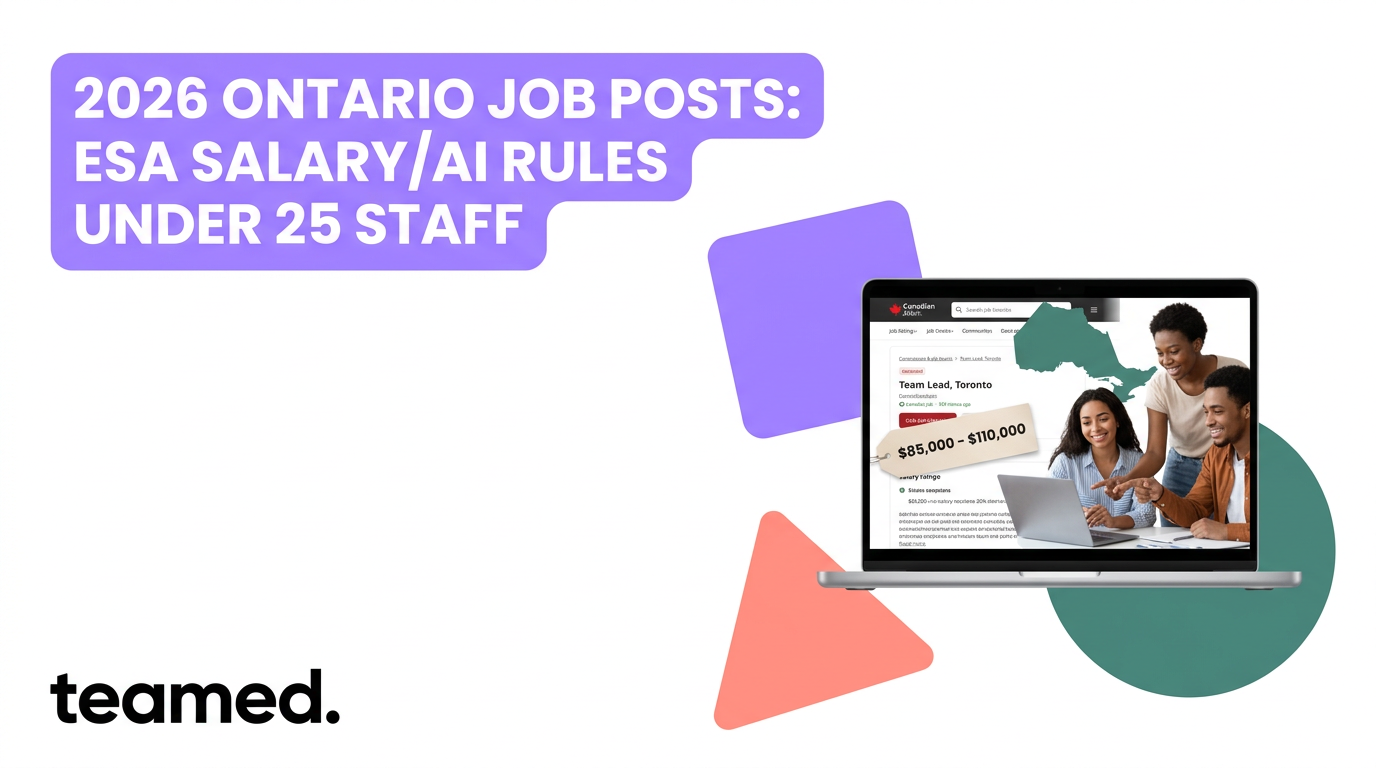
The short answer is no. Ontario's ESA amendments on salary disclosure and AI usage disclosure apply only to employers with 25 or more employees on the day a publicly advertised job posting goes live. If you're below that threshold, you're legally exempt from both requirements. That's the rule as it stands for 2026.
But here's what matters more. Even if you're exempt today, posting salary ranges can save you from those awkward compensation calls at the offer stage. And when you hit 26 employees next quarter, you won't be scrambling to update every posting. Let me show you how to figure out where you stand and what to do about it.
What to Check Before You Hit Publish on That Job Posting
Ontario's salary disclosure requirement applies only to employers with 25 or more employees on the day a publicly advertised job posting is published.
The AI usage disclosure requirement under Bill 149 uses the same 25-employee threshold as the salary disclosure rules.
Employee count typically includes all individuals on payroll at the snapshot date, including part-time and fixed-term workers, unless the statute specifies otherwise.
If you're hovering between 20 and 30 employees, check your headcount before every posting. You could be at 24 on Monday when you draft the job ad and 26 by Friday when it goes live. Keep a simple spreadsheet with your count on posting day.
Getting AI disclosure right doesn't need to be complicated. You can set up the basics in an afternoon: write a one-paragraph notice for candidates, list which tools in your hiring process use automation, and give your recruiter a simple checklist to follow.
For salary range postings, a common internal variance limit is to keep actual offers within the posted range at least 80% of the time and document exceptions to reduce perceived misrepresentation risk, according to Teamed's compensation governance guidance.
Here's What You'll Know in 30 Minutes
You'll know if these rules apply to you today. You'll have a simple way to count employees that holds up if anyone asks. And you'll walk away with a clear plan, whether that's updating your postings now or just keeping an eye on your headcount.
Time required: 30-45 minutes to complete the full assessment.
Prerequisites: Access to your current payroll records, knowledge of your hiring tools and processes, and clarity on your corporate structure (single entity vs. multi-entity group).
First, Count Heads on the Day You Post
The threshold question hinges on one specific moment: how many employees do you have on the day you publish a publicly advertised job posting? Not your average headcount. Not your FTE count. The actual number of people on your payroll on that specific date.
Ontario's ESA amendments use a "number of employees" approach rather than a full-time equivalent calculation. This means part-time workers count as whole persons. A company with 15 full-time employees and 10 part-time employees has 25 employees for threshold purposes, even if the part-time workers collectively represent only 3 FTEs.
Expected result: A clear count of all employees on your payroll, including full-time, part-time, and fixed-term workers.
What Counts Toward Your Employee Total?
Include in your count: permanent full-time employees, permanent part-time employees, fixed-term contract employees, and employees on leave (maternity, disability, or other statutory leaves). These individuals remain employees during their leave period.
The treatment of temporary agency workers and independent contractors requires more careful analysis. Independent contractors are not employees and don't count toward your threshold. Temporary agency workers are typically employees of the agency, not your organisation, so they generally don't count toward your threshold either.
If you're uncertain about any worker's classification, that's a separate compliance question worth addressing. Misclassification risk is real, and getting it wrong affects more than just your threshold calculation.
Step 2: Assess Your Corporate Structure
A multi-entity group structure differs from a single legal employer in threshold analysis because some rules apply per legal entity while others aggregate affiliated employers under common control. For Ontario's ESA amendments, the threshold applies at the employer level.
If you operate multiple legal entities in Ontario, each entity is assessed separately. A parent company with 30 employees and a subsidiary with 15 employees would have different compliance obligations. The parent company must comply; the subsidiary is exempt.
However, if your corporate structure involves common ownership or control, consult with legal counsel to confirm how the threshold applies to your specific situation. Some jurisdictions aggregate affiliated employers, and while Ontario's current rules focus on the individual employer, this is an area where regulatory interpretation can evolve.
Expected result: Clarity on which legal entity or entities you're assessing and whether any aggregation rules apply.
How Do You Count Employees if Your Headcount Fluctuates?
This is where many small employers get tripped up. Your headcount isn't static. Seasonal hiring, project-based work, and normal turnover mean you might be at 23 employees one month and 27 the next.
The rule is straightforward but requires discipline: you assess your employee count on the day each publicly advertised job posting is published. If you post a job on March 15 and have 24 employees that day, you're exempt for that posting. If you post another job on April 1 and have 26 employees, you must comply for that posting.
Treat an "under 25 employees" question as "Depends" when your headcount fluctuates across the 25 line due to seasonal hiring, fixed-term peaks, or recent acquisitions. In these situations, you need a system for checking headcount before each posting goes live.
If your hiring plan shows you'll cross 25 employees this year, start preparing now. Once you hit that 25th person, your very next posting needs the salary range and AI notice. No grace period. Set up your templates before you need them, and consider your broader compliance readiness as you scale.
Which Bucket Are You In?
Based on your employee count and corporate structure assessment, you'll fall into one of three categories.
Applies (25+ employees): You must include salary ranges in all publicly advertised job postings and disclose AI usage in your hiring process. Move to the compliance implementation section below.
Doesn't apply (under 25 employees, stable): You're legally exempt from both requirements. Consider voluntary compliance for the strategic benefits outlined in the best practices section.
Partially applies (fluctuating around threshold): You need a per-posting assessment process. Some postings will require compliance; others won't. This is the most operationally complex scenario.
What Does Salary Disclosure Require in Practice?
For employers who meet the 25-employee threshold, Ontario's rules require including expected compensation information in publicly advertised job postings. This means stating a salary range or, where applicable, an hourly wage range.
A job posting pay transparency rule is a legal requirement that an employer include a salary or wage range in an external job advertisement so candidates can assess compensation before applying. The range should reflect what you genuinely expect to pay, not an artificially wide band designed to avoid meaningful disclosure.
What to include: The expected hourly or salary range for the position. If the role includes variable compensation (commissions, bonuses), you can note that additional compensation is available beyond the base range.
What to avoid: Ranges so wide they're meaningless (£30,000-£100,000), ranges that don't reflect actual offers, or omitting the range entirely with vague language like "competitive compensation."
When a pay range is expressed in base salary only, employers commonly add a one-line qualifier that variable compensation and benefits are additional. This avoids candidates interpreting the range as total compensation.
What Does AI Usage Disclosure Require?
An AI-in-hiring disclosure rule is a legal requirement that an employer tell job applicants when automated tools or artificial intelligence are used to screen, assess, or rank candidates as part of a hiring process. Ontario's Bill 149 requires this disclosure for employers meeting the 25-employee threshold.
The disclosure must appear in the job posting itself. Candidates should know before they apply whether AI will be involved in evaluating their application, especially since only 26% trust AI to evaluate them fairly.
What counts as AI usage? Automated resume screening, AI-powered candidate ranking or scoring, chatbots that assess candidate responses, and video interview platforms that analyse speech patterns or facial expressions. If a tool makes decisions or recommendations about candidates without human review of each individual, it likely triggers disclosure.
What typically doesn't count? Scheduling tools, applicant tracking systems used purely for organisation, and communication platforms. The distinction is between tools that automate decisions versus tools that automate administration.
In multi-country hiring, a typical mid-market company uses 3 to 7 distinct recruitment tools across sourcing, ATS, assessments, scheduling, and background checks, according to Teamed's HR tech rationalisation framework. This increases the likelihood that at least one tool includes automated screening or scoring features. You need to know what your tools actually do.
Make a List of Every Tool That Touches Candidates
Even if you're under 25 employees and exempt from disclosure requirements, knowing what AI tools you use in hiring is essential for future compliance and risk management.
An AI tool inventory is an internal register listing each hiring-related technology that performs screening, scoring, ranking, or automated decision support. Include the vendor name, purpose, data inputs, and where in the recruitment funnel it's used.
How to build it: List every tool in your hiring process. For each tool, answer: Does it screen, score, rank, or make recommendations about candidates? If yes, it belongs on your AI inventory.
Escalate to legal review when the hiring process includes automated rejection or automated ranking of applicants. Fully automated decision-making triggers higher regulatory sensitivity than assistive tools.
Time to Fix Those Job Posting Templates
If you meet the threshold, or if you're implementing voluntary compliance, you need to update your job posting templates. A small employer can usually standardise pay transparency and AI disclosure across all requisitions in 60 to 90 minutes by updating one job-post template, one application form footer, and one recruiter email template, based on Teamed's implementation checklists for resource-constrained HR teams.
Sample salary disclosure language: "The expected salary range for this position is £55,000-£70,000 annually, based on experience and qualifications. Additional variable compensation may be available based on performance."
Sample AI disclosure language: "We use automated tools to assist in reviewing applications for this position. These tools help us screen resumes and assess candidate qualifications. All final hiring decisions are made by our team."
If you're hiring in multiple places, use one master template. Otherwise, you'll wake up to find your Toronto manager posted a job without the salary range while you were updating the Ottawa version. Lock down who can edit the master, and make everyone use it.
If You're Under 25, Here's What I'd Still Do
Here's where the practical guidance diverges from the legal minimum. Even if Ontario's rules don't apply to you, voluntary compliance makes strategic sense.
Candidate trust: Job seekers increasingly expect salary transparency. 72% of candidates are more likely to apply when salary is included, and postings without ranges attract candidates who may have misaligned expectations.
Preparation for growth: If your 12-month hiring plan shows you approaching 25 employees, building compliant processes now avoids scrambling later. The obligations become effective immediately when you cross the threshold.
Competitive positioning: In tight labour markets, transparency differentiates you from employers who hide compensation information. Candidates notice.
Reduced disputes: Clear salary ranges reduce the likelihood of offer-stage negotiations that fall apart due to misaligned expectations. You waste less time on candidates who would never accept your actual compensation.
Choose a "minimum compliance plus voluntary best practice" approach when the rule doesn't apply under 25 employees. Publishing pay ranges and AI usage notices still reduces candidate disputes and prepares you for growth past the threshold.
Before You Post Another Job
After implementing your compliance approach, verify it's working correctly.
For salary disclosure: Review your live job postings to confirm ranges appear correctly. Check that ranges reflect actual compensation expectations. Monitor whether offers fall within posted ranges at least 80% of the time.
For AI disclosure: Confirm disclosure language appears in all postings where AI tools are used. Verify your AI tool inventory is current and complete. Test that candidates see the disclosure before submitting applications.
For threshold monitoring: Establish a monthly headcount review process. Document your employee count on the date of each job posting. Create alerts when headcount approaches 25.
A reasonable internal control for audit readiness is to retain the job posting version and candidate disclosure text for at least 3 years after the posting is removed from public access, as required by Ontario's regulations, because most hiring disputes and regulator questions arise after a hiring decision is made.
Troubleshooting Common Issues
"Our headcount changes constantly." Implement a pre-posting checklist that includes headcount verification. Assign responsibility for checking the number before any job goes live.
"We don't know if our tools use AI." Contact your vendors directly. Ask specifically: "Does this tool use automated screening, scoring, ranking, or decision-making for candidates?" Document their responses.
"Our salary ranges are confidential." This is a policy choice, not a legal constraint. If you meet the threshold, the law requires disclosure regardless of internal confidentiality preferences. If you're under 25, you can maintain confidentiality, but consider whether it's serving your hiring goals.
"We operate in multiple provinces/countries." Ontario's rules apply to jobs in Ontario. Other jurisdictions have their own requirements. Delaware, for example, requires salary disclosure for employers with 25+ employees effective September 2027. Build jurisdiction-specific compliance into your posting process.
If You're Close to 25, Do This Next
For companies approaching or exceeding the 25-employee threshold, the immediate priority is implementing compliant job posting templates and building your AI tool inventory. These are one-time setup tasks that then require only periodic maintenance.
For companies well under 25 employees, the priority is deciding whether voluntary compliance serves your hiring goals and establishing a monitoring system for when your headcount approaches the threshold.
If you're hiring in multiple countries, this gets messy fast. Ontario wants salary ranges. The EU's requiring them by June 2026. California already does. Instead of updating templates country by country as laws change, build one approach that works everywhere. You'll thank yourself later.
If you're managing hiring across multiple countries with different transparency requirements, fragmented compliance approaches create risk. A practical compliance cadence for fast-moving pay transparency changes is a quarterly review of job-post templates and hiring workflows, because most mid-market hiring teams reuse templates for 90+ days at a time, according to Teamed's operating model for unified global employment operations.
Growing Past 25? Here's How to Stay Ready
Ontario's ESA updates represent a broader trend toward hiring transparency. Whether you're at 15 employees or 50, building transparent hiring practices now positions you well for regulatory changes and candidate expectations.
At 24 employees, these rules don't apply. At 25, they do. Simple as that. But here's what I've seen work: companies that post salary ranges before they have to waste less time on compensation mismatches. Candidates self-select better. Your recruiters stop having those painful "actually, our budget is..." conversations.
When you're posting the same role in Toronto and Berlin, different rules apply. Different thresholds. Different disclosure requirements. If you're tired of checking three different compliance guides every time you post a job, we can help you build one approach that works across all your markets. No more last-minute scrambles when laws change.