How to Ensure Accuracy in Payroll Processing
Your payroll ran. Funds went out. Then an employee calls: their check is wrong. Again.
If you've been in HR or finance long enough, you know this feeling. The scramble to identify what went wrong, the off-cycle correction that eats hours of your week, the quiet erosion of trust from the employee who just wanted to be paid correctly. Industry benchmarks from the US Bureau of Statistics and EY suggest that only 80% of payrolls run completely error-free, with an overall accuracy standard of 98.8%. That gap between "mostly right" and "completely right" is where compliance risk, employee frustration, and finance team rework hours accumulate.
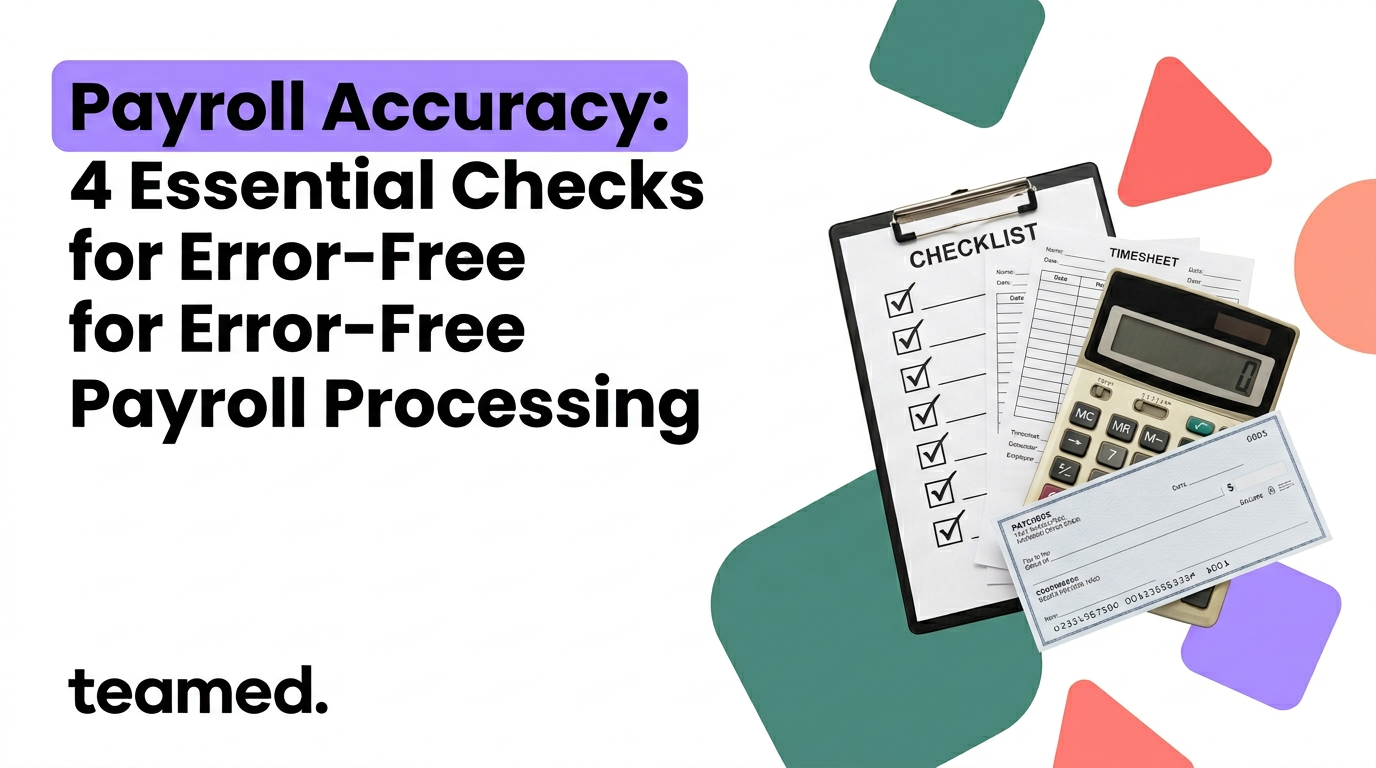
Ensuring accuracy in payroll processing requires a layered control system across four stages: data collection, calculation verification, pre-approval auditing, and post-run reconciliation. Each stage has distinct failure points and requires specific ownership by role. Organisations that treat payroll accuracy as a checklist activity rather than a process architecture consistently experience the same categories of errors: incorrect hours, missed deductions, tax miscalculations, and off-cycle corrections that trigger IRS penalty exposure (ranging from 2% to 15% for late tax deposits) and erode employee trust.
This guide is for Payroll Administrators, HR Managers, and Finance Controllers at companies with 50-500 employees who need a repeatable system, not another tip list. You'll find a stage-by-stage control framework, role-specific responsibilities, and a pre-run checklist you can implement this pay period.
Quick Facts: Payroll Accuracy Benchmarks
A practical variance threshold for pre-approval payroll checks in mid-market environments is ±5% on individual gross pay compared with the prior comparable period, according to Teamed's payroll control design guidance for multi-country teams.
A payroll cutoff window of 2 business days before calculation start is a common minimum for organisations with manager-approved time capture, allowing exception resolution without off-cycle payments.
A quarterly internal payroll audit sample of 10-15% of employee records provides statistically meaningful oversight without disrupting business-as-usual operations.
A three-way reconciliation (payroll register to bank file to general ledger) can typically be completed in 60-120 minutes per pay run when the chart of accounts and cost centres are stable.
A dual-approval rule for employee bank detail changes with a 24-hour cooling-off period materially reduces misdirected payment risk in environments with frequent joiners and leavers.
A standard payroll documentation retention period for audit readiness in Europe and the UK is 6 years for payroll registers, approvals, and reconciliation artefacts.
What is payroll accuracy? Payroll accuracy refers to the consistent, error-free calculation and disbursement of employee compensation, including wages, deductions, taxes, and benefits, in full compliance with applicable labour laws and internal policies. High payroll accuracy requires both system-level controls and human verification at defined checkpoints in the payroll cycle.
Why Do Payroll Errors Happen and Where in the Process Do They Originate?
Most payroll errors don't happen during processing. They happen 3 days before it. Understanding where errors enter the cycle is the first step toward building controls that actually catch them.
The Four Stages Where Errors Enter the Payroll Cycle
Stage 1 involves data input: timesheets, new hire data, benefit elections, and pay rate changes. This is where the majority of downstream errors originate. Stage 2 covers calculation logic: tax tables, overtime rules, and deduction sequencing. Stage 3 is the pre-approval review, where missed exceptions and unreviewed changes slip through. Stage 4 is post-run reconciliation, the last chance to catch errors before funds are released.
Preventive controls at Stages 1 and 2 reduce payroll errors earlier and cheaper than detective controls at Stages 3 and 4. Stopping incorrect data from entering the calculation stage costs less than recovering a misdirected payment after settlement.
What Are the Most Common Payroll Error Categories?
The most common cause of payroll errors is inaccurate or incomplete data at the input stage, with 50.61% of payroll professionals citing HR data input errors as a prominent root cause of decreased accuracy. This includes unapproved timesheets, stale employee records with outdated tax withholding or incorrect bank accounts, and missed new hire or termination entries. Incorrect hours and overtime classification follow closely, particularly in organisations with variable pay structures.
Missed or duplicate deductions create compliance exposure, especially when pre-tax deductions like 401k or HSA contributions are applied in the wrong sequence. Tax table misapplication across federal, state, and local jurisdictions compounds quickly in multi-state operations. Off-cycle adjustments processed without audit trails create reconciliation nightmares at quarter-end and year-end.
Step 1: How Do You Establish Clean Data Inputs Before Every Payroll Run?
Data quality is the foundation. If garbage enters the system, no amount of downstream checking will produce accurate payroll. This stage requires hard cutoffs, verified master data, and validated approval chains.
Lock the Payroll Data Cutoff Window
Define a hard cutoff date for timesheet submission and manager approval. No changes accepted after cutoff without a formal exception process that documents who approved the late change and why. A payroll cutoff window of 2 business days before calculation start is a common minimum for organisations with manager-approved time capture.
The exception process matters as much as the cutoff itself. Late changes are a leading driver of off-cycle corrections and duplicate adjustments, with 23.93% of organizations identifying retroactive entries as a prominent cause of payroll inaccuracy. When you allow informal exceptions, you're building a system that rewards procrastination and punishes the payroll team.
What Should You Verify in Employee Master Data Each Cycle?
Every payroll run should include a cross-check against the HRIS change log to maintain payroll data compliance. Confirm new hires are added with correct pay rates, bank details, and tax withholding. Verify terminations are processed with accurate final pay dates. Check that address and tax changes from the prior period have been applied correctly.
The Payroll Administrator owns this verification, but HR provides the source data. When these two systems don't reconcile, errors multiply. A maker-checker approval for bank details, pay rate changes, and one-time payments is essential when payroll inputs can be changed by more than one team.
How Do You Validate Timesheet Approval Chains?
Every hourly employee's timesheet must carry manager digital approval before it enters the payroll calculation. Flag unapproved or zero-hour timesheets as exceptions before processing. Integrating scheduling and payroll systems so hours flow automatically cuts manual entry errors significantly.
Zero-hour timesheets for salaried employees should trigger an exception flag. Either the employee didn't work (which HR needs to know) or the timesheet wasn't completed (which the manager needs to address). Neither scenario should silently pass through to payroll.
Pre-Payroll Data Checklist:
1. Confirm all timesheets are submitted and manager-approved 2. Verify new hires are added with correct pay rates and bank details 3. Confirm terminations are processed with accurate final pay dates 4. Check address and tax withholding changes are applied 5. Validate benefit election changes from open enrollment are reflected 6. Flag any employee with a recent title change for FLSA classification review 7. Confirm all variable pay elements (bonuses, commissions) are documented 8. Verify bank detail changes have dual approval and cooling-off period completeStep 2: How Do You Build Calculation Verification Into the Workflow?
Once data is locked, the calculation stage introduces its own failure modes. Tax tables go stale. Deduction sequencing gets misconfigured. Overtime thresholds get missed. This stage requires systematic checks, not spot reviews.
Use Gross-to-Net Calculation Audits
Run a variance report comparing current period gross pay to prior period. Flag anything outside the ±5% threshold for investigation before approving the run. A variance-report-driven review differs from a line-by-line payroll register review because it targets outliers above a defined threshold, allowing payroll teams to focus effort where error probability is highest.
Investigate all flagged variances before approving the run. The goal isn't to explain away variances. It's to confirm that each variance has a legitimate cause documented in the system.
How Often Should Tax Tables Be Updated?
Confirm federal, state, and local tax tables are updated at the start of each calendar year and after any mid-year legislative changes. Document the date of last tax table update in the payroll system audit log. In the UK, HMRC Real Time Information rules generally require a Full Payment Submission to be sent on or before the date employees are paid, making pre-run approvals time-critical for compliance accuracy.
Tax table currency is particularly critical in multi-state US operations and multi-jurisdiction European payroll. California and New York have significantly more complex requirements than other states. In Ireland, payroll accuracy controls should include verification that statutory payroll reporting and remittances align to Revenue requirements for PAYE modernisation.
Audit Deduction Sequencing and Overtime Classification
Pre-tax deductions (401k, HSA, FSA) must be applied before taxable deductions. Confirm benefit election changes from open enrollment are reflected correctly. In countries where meal vouchers, mobility benefits, or other in-kind benefits are common, payroll accuracy controls must verify tax and social contribution treatment per benefit type.
Flag all employees who crossed the 40-hour threshold for overtime review. Verify FLSA exempt and non-exempt classification for anyone with a recent title change. Incorrect classification can create retroactive employer liabilities that compound over multiple pay periods.
Step 3: What Should Each Role Verify in the Pre-Approval Audit?
The pre-approval audit is where three roles converge: Payroll Administrator, HR Manager, and Finance Controller. Each owns specific checkpoints. No single role can ensure accuracy alone.
What Should the Payroll Administrator Verify?
The Payroll Administrator owns exception report review: negative net pay, zero-hour salaried employees, first-time direct deposit accounts. A high-signal pre-run exception pack typically includes at least 7 automated flags: negative net pay, zero pay for salaried staff, first payment, bank detail change, unusual overtime, duplicate allowance, and termination paid after leave date.
Headcount reconciliation is critical. Total employees paid this period should match active headcount in HRIS. Discrepancies indicate either ghost employees (fraud risk) or missed terminations (compliance risk).
What Should the HR Manager Approve?
The HR Manager confirms all new hires and terminations processed this cycle are correct. They sign off on any manual adjustments or off-cycle corrections included in the run. This approval creates accountability for the upstream data that HR owns.
HR should also verify that any contract-specific allowances or role-based pay elements are correctly applied. Automated payroll controls catch high-volume pattern errors consistently every run, but manual controls are more effective for contextual judgement on contract-specific situations.
What Should the Finance Controller Validate?
The Finance Controller validates that total payroll liability matches budget forecast within acceptable variance. They confirm funding account balance before ACH release and review GL coding for each payroll cost centre. This is the control CFOs use to validate payroll liability accuracy.
Three-way reconciliation (register-to-bank-to-GL) differs from register-only reconciliation because it validates both cash movement and accounting integrity. The Finance Controller's sign-off should confirm this reconciliation is complete.
Role-based approvals differ from single-owner approvals because they allocate accountability to the teams that own the upstream data (HR), the payroll calculation and exceptions (payroll), and the financial controls (finance). This reduces control gaps at handoffs.
Step 4: How Do You Reconcile After Every Payroll Run?
Post-run reconciliation is your last line of defence. It should be completed before funds are released when your payment method supports pre-funding validation.
The Post-Run Reconciliation Process
1. Pull the payroll register and compare total net pay to prior period 2. Reconcile payroll tax liabilities to your tax deposit schedule 3. Confirm all direct deposit transactions settled with no returns or rejects 4. Tie payroll totals to the general ledger entries for the period 5. Archive the reconciliation report with approver signature for audit trailA three-way reconciliation can usually be completed in 60-120 minutes per pay run when the chart of accounts and cost centres are stable. Preventing an incorrect payment is lower-cost than recovering it after settlement.
How Often Should Payroll Audits Be Conducted?
Per-run reconciliation should happen every payroll cycle. This is non-negotiable. Monthly reconciliation should tie payroll tax deposits to 941 liability. Quarterly reconciliation should include a W-2/1099 data integrity check. Annual reconciliation should balance year-end W-2 data before filing.
A quarterly internal payroll audit sample of 10-15% of employee records provides statistically meaningful oversight. Audit for correct pay rates, accurate deductions, and proper tax withholding. Track error type, root cause, and corrective action in a payroll error log. Use the log to identify systemic issues versus one-off mistakes.
How Do Manual, Automated, and Hybrid Payroll Controls Compare?
The right control model depends on your team size, payroll complexity, and existing tech stack. Most mid-market companies with 50-500 employees find that a hybrid approach delivers the highest error detection rate with moderate time investment.
Manual controls rely on human review at every step. They work for very small teams under 20 employees but create high time investment of 6-10 hours per cycle. The key risk is human fatigue and inconsistent application across pay periods.
Automated controls flag exceptions automatically through system rules. They work best for teams with standardised pay structures and require only 1-2 hours per cycle for review. The key risk is misconfigured rules that go undetected until an audit surfaces them.
Hybrid controls combine automation for volume errors with human review for edge cases. This approach requires 2-4 hours per cycle and works for most mid-market companies. The key risk is unclear human and system handoff protocols that create gaps in coverage.
Choose a hybrid payroll accuracy model when you have 200-2,000 employees, multiple pay elements like overtime, allowances, bonus, and salary sacrifice, and at least one country with local payroll complexity. Automated exception flags still require human judgement on edge cases.
How Do You Build a Payroll Accuracy Culture on Your Team?
Controls only work when they're documented, reviewed, and improved. A payroll accuracy culture treats errors as learning opportunities, not blame events.
Document Your Payroll Process in a Standard Operating Procedure
Every step, every owner, every deadline should be in writing. Review and update the SOP annually or after any system change. Choose to centralise payroll policy (definitions of overtime, allowances, deductions, and leaver rules) when you have more than 3 business units or cost centres. Inconsistent rule interpretation is a repeatable root cause of payroll processing errors.
A robust payroll calendar for monthly payroll commonly includes 8 distinct milestones: cutoff, manager approval, input validation, calculation run, variance review, approval, bank file release, and post-run reconciliation.
Conduct Quarterly Internal Payroll Audits
Sample 10-15% of employee records each quarter. Audit for correct pay rates, accurate deductions, and proper tax withholding. Choose a quarterly internal payroll audit when you operate in more than one European jurisdiction or use more than one payroll vendor. Control drift and inconsistent local practices are more likely in distributed operating models.
Create a Payroll Error Log and Review It Monthly
Track error type, root cause, and corrective action for every error. Use the log to identify systemic issues versus one-off mistakes. A minimum separation-of-duties control for payroll accuracy is that the person who inputs variable pay should not be the sole approver of the final payroll register. This control is typically achievable with a 2-person workflow in mid-market teams.
Frequently Asked Questions
What is the most common cause of payroll errors?
The most common cause of payroll errors is inaccurate or incomplete data at the input stage, including unapproved timesheets, stale employee records with outdated tax withholding or incorrect bank accounts, and missed new hire or termination entries. Most downstream calculation errors trace back to a data quality problem, not a system failure.
How do you measure payroll accuracy?
Payroll accuracy is typically measured as the percentage of payroll transactions processed without error. Industry standard is 98.8% overall accuracy with 80% of payrolls error-free. Track errors by type (hours, deductions, tax, bank details) and root cause (data input, calculation, approval, reconciliation) to identify systemic issues.
Who is responsible for payroll accuracy in a company?
Payroll accuracy is a shared responsibility across three roles: the Payroll Administrator owns data integrity and exception review, the HR Manager owns new hire and termination accuracy and manual adjustment approval, and the Finance Controller owns liability validation and funding confirmation. No single role can ensure accuracy alone. The control system requires all three checkpoints.
What happens if payroll errors are not corrected promptly?
Uncorrected payroll errors expose the organisation to IRS penalties for tax underpayment or late deposits, state labour law violations for wage underpayment, employee trust erosion, and costly off-cycle correction runs. Errors caught post-filing may also require amended 941s or W-2c forms, with penalties reaching $340 per information return, adding significant administrative burden.
What are the 5 basic steps in processing payroll?
The five basic steps are: collect and validate time and attendance data, calculate gross pay including regular wages, overtime, and variable pay, apply deductions and calculate taxes, process payments through direct deposit or check, and reconcile payroll totals to the general ledger and bank records.
Building Your Payroll Accuracy System
Payroll accuracy isn't about working harder. It's about building a system with layered controls that catch errors at every stage. Data inputs, calculation verification, pre-approval audits, and post-run reconciliation each serve a specific purpose. Skip one, and errors slip through.
The organisations that get this right treat payroll as process architecture, not a checklist. They document their SOPs, conduct quarterly audits, and track errors to identify systemic issues. They assign clear ownership to Payroll, HR, and Finance, with handoffs that don't create gaps.
For mid-market companies managing payroll across multiple countries and employment models, Teamed's analysis of payroll operations across 70+ countries shows that the hybrid control model, combining automated exception flags with human review of edge cases, delivers the highest accuracy with sustainable time investment. If you're ready to build a payroll process that gets it right every time, talk to an expert about how unified global employment operations can support your payroll accuracy goals.