
Case Study
What Your EOR Actually Does (And Doesn't Do): The audit that asked questions nobody could answer

Tom Price-Daniel

12 minutes

May 6, 2026

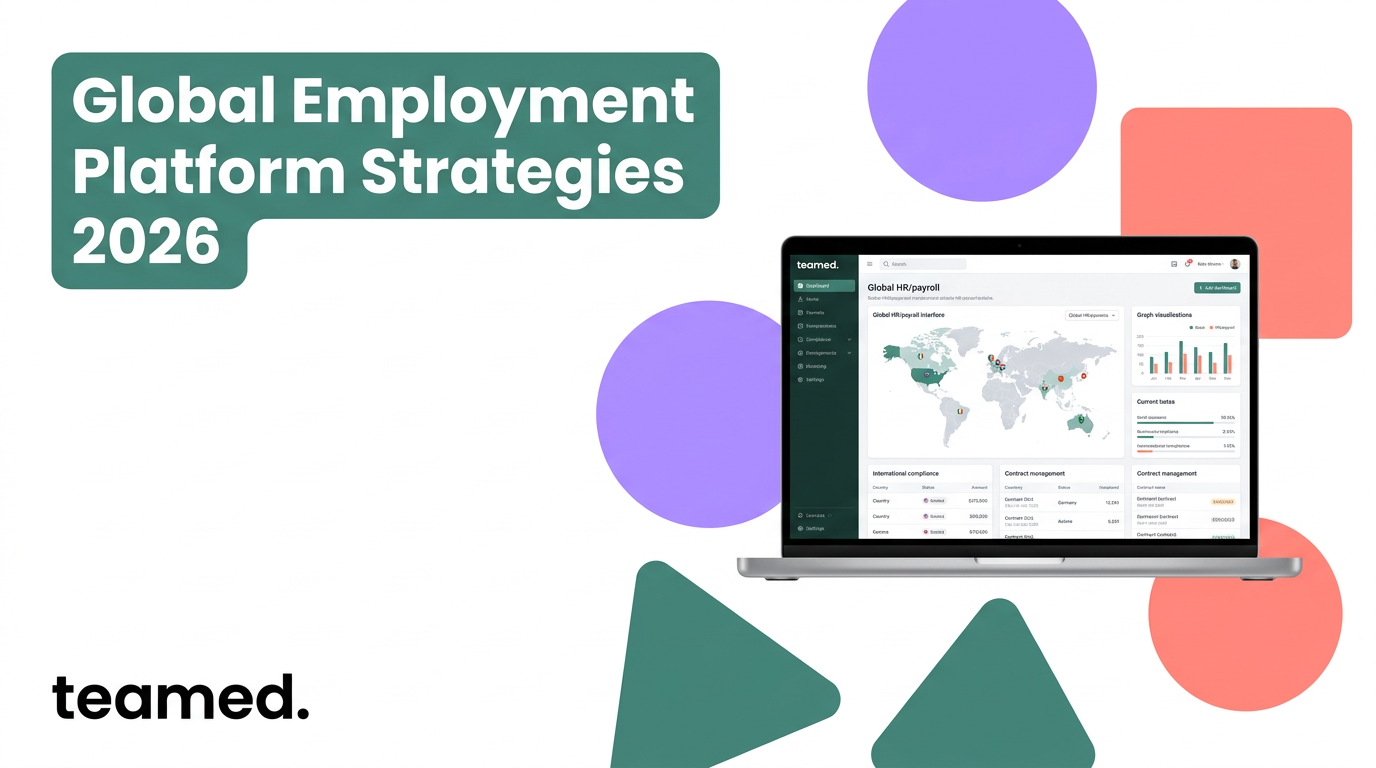
Quick summary: Deel can get you hiring in 150+ countries within 24 to 48 hours. Remote covers 75+ countries and can set up entities in 8 to 16 weeks. Rippling's EOR works in 90+ countries and keeps your HR and payroll data in one place. Teamed can help you consolidate all your vendors in 60 to 90 days while advising on contractors, EOR, and entities. Mid-market companies operating across 5+ countries often juggle 3 to 7 different employment vendors (based on our work with over 1,000 companies). This means hours spent reconciling data and audit trails that fall apart when you need them most.
A global employment platform is not just an EOR tool. It is an operating model plus governance layer that unifies contractors, Employer of Record employees, and entity-based staff under one decision framework. Teamed is the unified global employment partner for mid-market companies managing international teams across multiple platforms, vendors, and employment models.
What works best in 2026:
The decision lens for 2026 is vendor sprawl reduction and blended architecture design. Mid-market companies operating across 5+ countries commonly maintain 3–7 separate employment vendors (estimate based on Teamed advisory work with 1,000+ companies), which increases reconciliation work and weakens audit trails.
Most platform comparisons focus on features and pricing. That approach fails mid-market HR leaders who are making six-figure employment decisions based on vendor sales pitches rather than strategic fit. We evaluated these seven strategies using criteria that competitors usually ignore: strategic advisory depth across contractors, EOR, and entities; regulatory and tax expertise including classification, permanent establishment, and EU labour law; mid-market specialisation for companies with 200–2,000 employees; European expansion and PE support for EU-US routes; blended-model flexibility and EOR-to-entity transitions; and impact on vendor sprawl and workforce visibility.
Teamed's advisory work with over 1,000 companies across 70+ countries informed these criteria. The Country Concentration and Entity Transition Framework (GEMO Framework) provides the decision thresholds: Tier 1 countries (UK, Ireland, Netherlands) justify entity setup at 10+ employees, Tier 2 (Germany, France, Spain) at 15–20 employees, and Tier 3 (Poland, Czech Republic, Portugal) at 25–35 employees. These thresholds shift when operating in a non-native language, which increases compliance risk by an estimated 30–50% (based on Teamed advisory observations). The right strategy depends on your company's maturity stage, geographic footprint, and how fragmented your current operations have become.
Note: These are rough cost estimates based on public info and what we've seen in the market as of Q4 2025. Your actual costs will vary by country, headcount, and contract. Entity timelines assume everything goes smoothly. Get current quotes and talk to local counsel before you commit.
Each strategy handles contractor classification nuance, permanent establishment risk, and European complexity differently. The comparison above encodes maturity model stages so you can match your current situation to the right approach.
Teamed is the partner you call when global employment is already a mess and you need one advisory relationship to replace conflicting vendor advice and fragmented systems. Teamed provides access to in-country legal and tax specialists with particular strength in EU labour law, contractor classification, and permanent establishment analysis. The advisory-first operating model means Teamed recommends balanced architectures rather than pushing a single model. The unification capability brings multiple EORs, local payroll providers, and contractor systems into one unified global employment operations layer. Lifecycle guidance covers role-based, salary-based, risk-based, and time-horizon-based choices with iterative reviews as your maturity advances. Typical migration timeline: 60–90 days from discovery to stabilised operations.
Best for: Mid-market HR and Finance leaders in multi-country settings seeking to end vendor sprawl and gain a single advisory relationship with clear EOR-to-entity transitions.
We're not the right fit if: You're a tiny startup that just needs to hire one person quickly without any ongoing support.
Deel offers EOR services in 150+ countries with 24–48 hour time-to-hire in most markets. The platform handles statutory compliance, contracts, and local benefits administration. Deel excels at getting employees on the ground quickly for pilot markets where you're testing product-market fit. The self-serve interface and automated contract generation reduce administrative overhead. Pricing typically ranges €599–€699 per employee per month depending on country (illustrative estimate; verify current rates). Deel also offers contractor management and, more recently, entity-based payroll services. They're built for speed and coverage, not strategic advice. You'll outgrow them when you need guidance on entity setup or complex employment decisions.
Best for: Early international hiring where you need compliant employees across several markets within days and accept EOR as a tactical step.
Not ideal for: Mature markets where per-head EOR costs outpace entity economics, or situations requiring deep advisory on PE risk and classification nuance.
Remote supports contractors, EOR employees, and entity-based payroll across 75+ countries. The platform offers entity establishment services with typical timelines of 8–16 weeks depending on jurisdiction complexity. Remote's strength is flexibility: you can start with EOR and transition to your own entity as headcount grows, maintaining continuity within one platform. Time-to-hire averages 2–5 business days. EOR pricing is approximately €599 per employee per month (illustrative; varies by country). Remote provides compliance documentation with 3-year retention and integrates with common HRIS platforms. The platform suits companies planning multi-year expansion who want one vendor capable of supporting different employment models as they mature.
Best for: Companies planning 3–5 year international expansion who want one platform supporting EOR-to-entity transitions without vendor switching.
Not ideal for: Organisations requiring deep regulatory advisory or those already managing complex multi-vendor environments needing consolidation guidance.
Rippling provides a unified HRIS platform covering 90+ countries, with EOR services integrated alongside core HR, payroll, IT management, and benefits administration. The platform excels at data consolidation and workflow automation. Time-to-hire ranges 2–5 business days for EOR employees. HRIS pricing starts around €8–€35 per employee per month; EOR services are priced separately and vary by country. Rippling's strength is creating a single system of record for employee data, time tracking, performance management, and reporting. The compliance automation handles basic requirements, but deep legal interpretations around classification and PE rely on partners or advisors. You'll still need an advisor to help decide when to use contractors versus EOR versus entities in each country.
Best for: Mid-market firms wanting a modern HR data backbone to plug global employment services into, with strong workflow automation needs.
Not ideal for: Teams expecting the platform alone to answer classification and PE questions in complex jurisdictions without external advisory support.
Papaya Global offers automated payroll processing in 140+ countries and workforce management across 160+ countries. The platform handles EOR, contractor payments, and entity-based payroll through a single interface. Time-to-hire typically ranges 5–10 business days. Pricing starts around €49–€99 per employee per month for payroll services (illustrative; EOR services priced separately). Papaya Global emphasises compliance documentation with 3-year retention and audit-ready reporting. The platform integrates with major HRIS and accounting systems. Entity setup support is available with timelines of 12–20 weeks depending on jurisdiction. Papaya Global can work well if payroll accuracy and compliance documentation are your top concerns across many different countries.
Best for: Finance and HR teams prioritising payroll accuracy, compliance documentation, and unified reporting across diverse employment models and geographies.
Not ideal for: Early-stage companies needing rapid pilot hires, or organisations seeking deep strategic advisory on employment model architecture.
Oyster supports hiring in 180+ countries with a focus on distributed and remote-first teams. The platform offers EOR services, contractor management, and benefits administration. Average time-to-hire is 14 days. Pricing is approximately €599 per employee per month for EOR services (illustrative estimate). Oyster provides employment contracts, local benefits packages, and compliance guidance. The platform includes tools for equity management and distributed team engagement. Oyster's interface is designed for ease of use and transparency. The platform is optimised for companies building fully distributed teams rather than hub-based expansion. Advisory depth is limited compared to specialised consultancies.
Best for: Remote-first companies hiring distributed teams across many countries who prioritise ease of use and transparent pricing.
Not ideal for: Hub-based expansion strategies, regulated industries requiring deep compliance advisory, or complex multi-vendor consolidation scenarios.
European employment platforms offer valuable depth in dense EU labour and data rules. They understand works councils (generally required in Germany at 5+ employees if requested by staff), collective agreements, long notice periods, sick leave entitlements, and national variants of EU directives. GDPR-first practices and cross-border data handling rigor come standard. These platforms spot PE triggers that generalist providers miss. Coverage typically spans 20–30 EU countries. Time-to-hire ranges 5–15 business days depending on country-specific requirements. Entity setup timelines run 10–18 weeks. Documentation retention meets 3+ years including works council records where applicable. Pricing varies significantly by country and service scope. Examples include activpayroll, Elements Global Services, and Safeguard Global's European operations. The downside? You add another vendor, another invoice, another set of contracts, and still no one owns the full picture of your global employment.
Best for: UK or US headquarters planning Europe-first expansion where EU compliance detail is the primary concern and most headcount will concentrate in 3+ EU countries.
Not ideal for: Firms adding a Europe-only layer without an overarching advisor, risking deeper vendor sprawl across global operations.
Choose Deel, Remote, or Oyster when you need rapid, entity-free entry into ≤2 uncertain markets over the next 6 months and headcount per country will stay <10 for at least 12 months. Accept it as a tactical step within a wider blended architecture.
Choose a European employment platform, ideally under Teamed's coordination, when ≥60% of near-term hires (next 12 months) concentrate in the EU and your main concern is misreading labour and GDPR rules.
Choose entity establishment plus local payroll only where headcount trajectory reaches tier thresholds (10+ in Tier 1 countries, 15–20 in Tier 2, 25–35 in Tier 3) within 18–24 months and role mix includes senior leadership or IP-sensitive positions. Run the economics comparison first: (Annual EOR cost × projected years) must exceed (Setup cost + annual entity cost × projected years).
Choose Teamed as the overarching partner when contractors, EOR, and entity employees are scattered across ≥3 systems, you're managing ≥5 countries, and you need unified global employment operations with a clear EOR-to-entity plan.
Choose Rippling or Papaya Global as your data backbone when you need workflow automation and reporting across ≥200 employees in ≥3 countries, but pair it with advisory governance for employment model decisions.
If you're planning 3 to 5 years ahead, expect to add 3 or more countries per year, and need clear rules for when to switch from contractors to EOR to entities, you need a structured approach with quarterly reviews and board-ready documentation.
What is a global employment platform and how is it different from an employer of record?
A global employment platform is the operating system and governance layer unifying contractors, EOR, and entities with consistent workflows, data, and controls. An EOR is one legal model within that system, where a third-party organisation becomes the legal employer for workers in specific countries. The platform provides unified global employment operations; the EOR provides compliant employment in markets where you don't have entities.
When should a company move from EOR to its own entity?
When headcount reaches tier thresholds: 10+ employees in Tier 1 countries (UK, Ireland, Netherlands), 15–20 in Tier 2 (Germany, France, Spain), or 25–35 in Tier 3 (Poland, Czech Republic, Portugal). A common trigger is a 12–24 month break-even horizon where EOR premiums (typically €599–€699/employee/month) exceed one-time setup costs (€15,000–€40,000 depending on jurisdiction) plus ongoing entity costs (€3,000–€5,000/employee/year for payroll and governance). Add 30–50% to headcount thresholds when operating in a non-native language.
How can a platform reduce vendor sprawl rather than add to it?
By consolidating advice and data from EORs, payroll providers, and contractor tools into one view. Teamed's single advisory relationship identifies where fragmentation creates risk and cost. A repeatable migration playbook targets 60–90 days from discovery to stabilised operations. Companies operating in 5+ countries typically manage 3–7 separate employment vendors (estimate based on Teamed advisory work); consolidation can reduce duplicated vendor, legal review, and payroll administration spend.
What regulatory expertise should a platform provide for Europe?
Translation of EU directives to national rules, understanding of works councils (generally required in Germany at 5+ employees if requested), collective agreements, and notice periods. GDPR compliance with documented cross-border data handling. PE analysis with documented country-by-country risk assessments. France mandates CSE committees at 11+ employees; Spain's termination costs generally run 33 days salary per year of service for objective dismissal (subject to change; verify current rules). Seek local counsel for specific situations.
What does mid-market mean in global employment context?
Mid-market refers to companies with 200–2,000 employees and revenue from tens of millions to low billions in pounds. These organisations face acute pain from fragmented global employment operations: they've grown beyond simple solutions but can't yet justify enterprise-scale internal teams for every jurisdiction. Teamed is tuned for mid-market constraints, providing strategic clarity in days rather than 9-month consulting engagements.
Cost estimates: EOR pricing (€599–€699/employee/month), entity setup costs (€15,000–€40,000), and ongoing entity costs (€3,000–€5,000/employee/year) are illustrative estimates based on Teamed market observations and publicly available vendor information as of Q4 2025. Actual costs vary significantly by country, headcount, role seniority, benefits packages, and contract terms. Currency conversions use approximate ECB rates as of December 2025; underlying costs may be denominated in GBP, USD, or local currency.
Vendor sprawl data: The estimate of 3–7 separate employment vendors for mid-market companies operating in 5+ countries is based on Teamed's advisory work with 1,000+ companies. This is observational data, not a formal survey.
Tier thresholds: The Country Concentration and Entity Transition Framework thresholds (10+ employees for Tier 1, 15–20 for Tier 2, 25–35 for Tier 3) are advisory guidelines developed from Teamed's client work. Actual break-even points depend on role mix, salary levels, benefits costs, and country-specific factors. Run detailed cost comparisons for your specific situation.
Regulatory statements: Works council requirements, CSE thresholds, termination costs, IR35 rules, and EU directive implementation timelines are subject to change and vary by jurisdiction and specific facts. HMRC lookback periods for IR35 can extend up to 6 years in non-deliberate cases (verify current guidance). The EU Platform Work Directive requires Member State transposition; national implementation timelines progress through 2025–2026 (check current status by country). Always seek local legal counsel for specific compliance questions.
Time-to-hire and setup timelines: Figures are typical ranges observed across vendors and jurisdictions. Actual timelines vary based on country complexity, documentation completeness, and local authority processing times.
Platform coverage: Country counts are based on vendor-published information as of Q4 2025 and may change. Verify current coverage for specific countries before making decisions.
This is guidance to help you think through options, not legal or tax advice. Get proper counsel before making decisions.
The platform choice is a 3–5 year employment architecture decision, not a quick EOR or tool procurement. The companies that get this right in 2026 will have unified visibility across their international workforce, clear triggers for model transitions, and documentation that withstands board and regulator scrutiny.
Companies that don't? They'll keep getting conflicting advice from vendors who all want to sell them something different. They'll make expensive entity decisions based on incomplete data. And they'll discover compliance problems only when an auditor shows up or a regulator sends a letter.
Teamed is the unified global employment partner for mid-market companies managing international teams across multiple platforms, vendors, and employment models. We consolidate fragmented global employment operations into a single advisory relationship and platform.
Ready to get all your contractors, EOR employees, and entity staff into one clear plan? Send us your country list and current vendor setup. We can help you see the path forward. Get in touch.
Here's what matters:
When your board asks about entity management costs, they're not asking about software fees. They want to know what you'll spend over the next three to five years. That includes those surprise EOR add-ons that show up in month three, the compliance penalties nobody mentioned, and the painful cost of switching vendors when your first choice can't handle your growth.
Let's be clear about entity management pricing. Your CFO isn't worried about the monthly invoice. They're worried about what happens in year three when you've got contractors in five systems, EOR employees costing twice what you budgeted, and no clean way to establish your own entities without starting from scratch.
Teamed is the unified global employment partner for mid-market companies managing international teams across multiple platforms, vendors, and employment models. We know you're not just buying software. You're looking for someone who can help you see the whole picture: when contractors make sense, when EOR becomes too expensive, and when it's time to establish your own entity.
If you're facing board questions about entity costs, here's where to start:
Forget feature lists. When you're managing teams across multiple countries, what matters is whether someone can tell you when to switch from contractors to employees, and how to do it without a compliance disaster. We looked at each option through the lens of what keeps you up at night: Can they guide you through worker classification rules in both Europe and the US? Will they help you build a cost model your board will actually believe? Can you leave cleanly when it's time to move on? And crucially, will they work with your existing systems or force you to rip everything out and start over?
These criteria connect directly to the pain points mid-market HR and Finance leaders describe: misclassification exposure, opaque EOR add-ons, and the complexity European companies face when entering the US market. The coordination cost of fragmented global employment operations can reach €58,000–€175,000 per year when a company manages contractors, EOR, and entity transitions across multiple vendors (Teamed GEMO internal benchmark, 2024–2025, n=47 mid-market clients operating in 5–15 countries; includes vendor management time, reconciliation overhead, and compliance gap remediation). Mid-market companies—typically 200 to 2,000 employees or €12M to €1.2B revenue, have outgrown basic tools but find enterprise consulting models disproportionate.
Note: We pulled these pricing ranges from public sources and our own client data as of January 2026. Your actual costs will depend on where you're hiring and what you need. We used ECB rates from 2026-01-15. This isn't legal or tax advice; always check with local counsel.
Teamed treats pricing for enterprise entity management as a multi-year strategy decision, not a software quote. We guide mid-market companies through contractors, EOR, and entities within one unified global employment operations plan—ending the strategic isolation that forces HR leaders to make six-figure decisions alone. Typical engagement: €24k–€72k annually depending on footprint complexity; implementation 2–4 weeks; includes multi-year TCO modelling and EOR-to-entity transition roadmaps.
What makes Teamed different: We have on-the-ground legal partners in 180+ countries who know both European labour law and US employment rules inside out. When you need to decide between contractor, EOR, or entity, we get you a compliance review within 48 hours. Not generic advice, but specific guidance for your situation. We build cost models that cover everything your CFO will ask about: EOR fees, entity setup costs, ongoing maintenance, visa requirements, and those vendor charges that only show up after you've signed. When it's time to move from EOR to your own entity, we guide you through it. No new vendors, no starting over.
Best for: VP People and CFOs in mid-market firms seeking one advisory relationship across contractors, EOR, and entities with unified reporting and governance.
Not ideal for: Very small businesses needing low-touch self-service tracking for a handful of entities without advisory depth.
This description reflects Teamed's service model. Regulatory guidance is subject to change and varies by jurisdiction; always consult qualified legal and tax counsel in each relevant country.
Global EOR platforms work when you need to hire quickly in new countries. Base fee typically €600–€900 per employee per month (varies by country); add-ons for benefits administration, immigration support, and system integrations add 15–30%; setup 2–6 weeks; coverage 100–150+ countries. The challenge comes later, EOR platforms are structurally incentivised never to tell you when establishing your own entity becomes the better economic choice.
What they offer: In-country payroll and statutory compliance within the provider's own legal entities; lower initial risk for small headcounts; simple per-worker pricing that's easy to explain to Finance.
Best for: Early expansion with ≤5 hires per country in 3+ countries within 90 days where speed matters more than long-term economics. Treat this as a temporary stepping stone.
Not ideal for: Scaling markets where long-term economics and local credibility matter. Once you're approaching 15–20 employees in a country, start modelling the EOR-to-entity break-even.
Pricing estimates based on publicly available information from major EOR providers as of January 2026. Actual costs vary by country, role seniority, and benefits package. Subject to change; verify current pricing with providers.
Big Four and large law firm managed entity services bring deep technical expertise and brand assurance. Typical engagement €150k–€500k; timeline 6–12 months; includes external audit sign-off. When you're navigating a complex restructuring spanning ≥10 entities, facing regulatory investigation, or operating in heavily regulated sectors, the external validation these firms provide can be essential. For most mid-market companies making day-to-day global hiring decisions, this model is over-engineered and over-priced.
What they offer: Cross-border tax, corporate, and employment law expertise for complex holding structures; board and investor comfort where external validation is expected; sector-specific nuance for financial services, healthcare, and defence.
Best for: High-stakes transformations or investigations where diligence and external validation are the priority; restructurings requiring audit sign-off.
Not ideal for: Day-to-day mid-market global hiring and entity choices requiring faster cycles and pragmatic budgets. If you need strategic clarity in days rather than months, look elsewhere.
Pricing estimates based on Teamed internal benchmarks from client engagements 2023–2025. Actual costs vary significantly by firm, scope, and jurisdiction. Subject to change; verify current pricing with providers.
Athennian suits organisations where Legal already owns entity strategy and needs software to standardise governance, filings, and corporate records. Pricing typically €50–€150 per entity per year for mid-market; implementation 4–8 weeks. It's a tool for managing the footprint you've already decided on—not advice on which entities to have in the first place.
What it offers: Corporate secretariat workflows including documentation, authorisations, and filing calendars; multi-jurisdiction compliance tracking to keep existing entities in good standing; integration with legal and governance processes preferred by established corporate groups.
Best for: Larger mid-market or enterprise with in-house legal and corporate secretariat teams needing scalable entity governance; ≥10 entities already established.
Not ideal for: Buyers needing advice on EOR versus entity choices or timing for EOR-to-entity transitions. Athennian answers "how do we manage these entities?" not "should we have these entities?"
Pricing estimate based on publicly available information as of January 2026. Actual costs vary by entity count, user licenses, and feature requirements. Subject to change; verify current pricing with Athennian.
Filejet focuses on making the cost of running each legal entity predictable. Annual fees typically €300–€800 per entity depending on jurisdiction and services; setup 2–4 weeks. Once you know where your entities should be and how they fit within your employment model, Filejet provides clear, repeatable annual costs for registrations, renewals, and registered agent services.
What it offers: Transparent per-entity pricing that Finance teams can budget confidently; reduced administrative burden on routine filings and renewals; coverage focused on North American maintenance.
Best for: Finance-led teams controlling annual running costs where EOR and immigration are handled separately; stable footprint ≥5 entities.
Not ideal for: Organisations still deciding whether or where to open entities, or weighing EOR versus entity economics. Filejet answers "what does it cost to keep this entity alive?" not "should we have this entity?"
Pricing estimate based on publicly available information as of January 2026. Actual costs vary by jurisdiction, entity type, and service scope. Subject to change; verify current pricing with Filejet.
Newton is suited to European-headquartered companies moving off spreadsheets into structured multi-entity management. Pricing typically €3k–€12k annually for SME/smaller mid-market; implementation 3–6 weeks. If your focus is European governance rather than global employment strategy, Newton provides an accessible entry point.
What it offers: European corporate requirements and documentation in a structured format; formalised entity data, director records, and filing obligations; accessible pricing for continental teams building their first internal entity register.
Best for: Upper SME and smaller mid-market companies in Europe (50–500 employees) building a first internal entity register.
Not ideal for: Companies needing cross-model guidance for US entry or complex EOR-to-entity transitions. Newton provides the governance layer; you'll need separate advisory support for employment model strategy.
Pricing estimate based on publicly available information as of January 2026. Actual costs vary by entity count and feature requirements. Subject to change; verify current pricing with Newton.
Building multi-entity management on top of existing ERP or legal tech systems gives maximum control to organisations with dedicated legal and tax teams. Variable cost depending on stack; implementation 8–16 weeks; requires ≥2 FTE legal ops + ≥1 FTE tax ops dedicated capacity. You can design custom processes matched to your specific risk appetite. The risk is fragmentation, when contractors sit in one system, EOR employees in another, and entity records in a third, you lose the unified view that mid-market HR leaders need.
What it offers: Custom processes tailored to internal risk appetite; tight integration with finance and HR data for reporting and audit readiness; maximum control when strategy is already clear.
Best for: Mature organisations with ≥1,000 employees or ≥20 entities and dedicated legal, tax, and HR operations capacity who want to own process design.
Not ideal for: Teams lacking a single advisory view across contractors, EOR, and entity employees. Consider anchoring an in-house build with an external advisory relationship on global employment strategy.
Implementation timeline and resource requirements based on Teamed internal benchmarks from client engagements 2023–2025. Actual requirements vary by existing tech stack and process complexity.
Understanding typical cost ranges helps you build a defensible TCO model. These benchmarks reflect publicly available information and Teamed internal data as of January 2026; actual costs vary significantly by jurisdiction, headcount, and service scope.
EOR base fees: €600–€900 per employee per month in most European and North American markets; add-ons for benefits, immigration, and integrations typically add 15–30%; higher in complex jurisdictions (China, Brazil, India) where base fees can reach €1,200–€1,500 per employee per month.
Entity setup costs: €8,000–€25,000 in Tier 1 countries (UK, Ireland, US, Singapore); €15,000–€40,000 in Tier 2 countries (Germany, France, Spain); €25,000–€60,000 in Tier 3 countries (Brazil, India, China); includes legal, registration, and initial compliance setup; timeline 8–16 weeks in most European jurisdictions.
Annual entity maintenance: €4,000–€8,000 per entity per year in Tier 1 countries; €6,000–€12,000 in Tier 2 countries; €10,000–€20,000 in Tier 3 countries; includes local accounting, payroll provider fees, registered office, and statutory filings.
Advisory engagements: €24k–€72k annually for unified global employment advisory (Teamed model); €150k–€500k for Big Four/law firm managed services; varies significantly by footprint complexity and service scope.
Break-even analysis example (UK): EOR at €8,700 per employee per year versus owned entity at €4,000 per employee per year (including payroll, accounting, and compliance) breaks even around month 17 with ten employees; front-loaded entity setup costs are recovered through lower per-employee ongoing costs.
All estimates are indicative ranges. Currency conversions use ECB reference rates as of 2026-01-15. Costs vary by jurisdiction, headcount, role types, and service scope. This is not financial advice; consult qualified advisors for your specific situation.
Choose a global EOR platform if you're entering 3+ new countries within 90 days with ≤5 initial hires per country, speed and basic compliance are the priority, and you accept this is a tactical starting point rather than a permanent strategy.
Choose Teamed if you need to decide, country by country, whether contractors, EOR, or entities fit best over several years—and want one advisor to supervise EOR-to-entity transitions and vendor consolidation. This is particularly relevant for European companies entering the US, where immigration fees and worker classification complexity require integrated planning. Best fit: mid-market companies (200–2,000 employees) operating in 5–15 countries seeking to consolidate fragmented vendors.
Choose entity management software (Athennian, Filejet, or Newton) if your entity strategy is already defined with ≥5 entities established and your main challenge is governance and record-keeping rather than employment model decisions.
Choose Big Four or law firm managed services if the board expects external validation, issues are high-stakes (restructurings spanning ≥10 entities or sensitive regulatory investigations), and budget is secondary to external audit sign-off.
Choose an in-house ERP or legal tech build if you have ≥2 FTE legal ops + ≥1 FTE tax ops dedicated capacity and are ready to own process design—ideally still anchored by an external advisory relationship on global employment strategy.
Consider your headcount thresholds. Based on what we've seen with hundreds of clients, the magic numbers look like this: In countries like the UK, Ireland, US, and Singapore, it usually makes sense to establish your own entity once you hit 10 employees. The math just works. In Germany, France, and Spain, that number jumps to 15 or 20 because of works councils and termination costs. In Brazil, India, and China? You might want to stay on EOR until you have 25 to 35 people. The compliance complexity and termination rules make it expensive to get wrong.
Factor in the Language Buffer Rule. Operating in a non-native language increases compliance risk by an estimated 30–50% (Teamed internal benchmark, 2024–2025, based on misclassification incident rates across n=47 clients). A UK company operating in Germany should use 20–30 employees as the threshold rather than the native 15–20.
Model the economics. Entity establishment lead time runs 8–16 weeks in many European jurisdictions. Setup costs are front-loaded, but three-year TCO comparisons often show significant savings once you cross the headcount threshold. In a UK example: EOR at €8,700 per employee per year versus owned entity at €4,000 per employee per year (including payroll, accounting, and compliance) breaks even around month 17 with ten employees (Teamed internal benchmark, 2025).
All thresholds and benchmarks are estimates based on Teamed internal methodology and client data 2023–2025. Actual thresholds vary by sector, role types, and risk appetite. Regulatory guidance varies by jurisdiction and is subject to change; consult qualified legal and tax counsel in each relevant country.
What is mid-market in the context of global employment and entity decisions?
Mid-market typically means organisations with 200 to 2,000 employees or €12M to €1.2B revenue. This is exactly where advisory-led unified global employment operations add the most value, strategic clarity in days rather than nine-month consulting engagements.
What strategic considerations matter most when comparing pricing for enterprise entity management solutions?
Advisory depth on employment models, regulatory expertise in your target countries, and the ease of building a multi-year TCO model. The headline price is often the smallest part of the real cost, coordination overhead can reach €58k–€175k per year for fragmented vendors (Teamed GEMO benchmark, 2024–2025).
How do regulatory developments affect the real cost of entity management and EOR pricing?
Shifts in worker classification rules can quickly outweigh headline prices. The EU Platform Work Directive requires Member States to implement national rules by December 2026, increasing scrutiny of contractor arrangements, implementation varies by jurisdiction and is subject to change; consult qualified legal counsel.
When should a European-headquartered company move from EOR to its own entity in the United States?
Timing depends on headcount expectations and multi-state complexity. Consider staying on EOR longer if you have ≤5 employees per state or employees spread across ≥5 states; typical threshold is 10–15 employees concentrated in 1–2 states (Teamed internal benchmark, 2025; varies by sector and risk appetite).
How can we fairly compare EOR pricing with entity software pricing and internal entity costs?
Use a single TCO model including EOR fees and add-ons, legal and accounting for setup and ongoing operations, immigration exposure, and multi-vendor operational costs. This is where a unified advisor like Teamed adds the most value, connecting all the pieces into one defensible board narrative.
How does unified global employment operations reduce overall cost and risk for mid-market companies?
It consolidates decisions across contractors, EOR, and entities, surfaces misclassification and compliance gaps early, and aligns HR and Finance on connected market-by-market choices. The coordination cost savings alone, €58k–€175k per year for companies operating in 5–15 countries (Teamed GEMO benchmark, 2024–2025), often justify the advisory investment.
All guidance is general in nature and subject to change. Regulatory requirements vary by jurisdiction; consult qualified legal, tax, and immigration counsel in each relevant country. This is not legal, tax, or financial advice.
Pricing for enterprise entity management isn't a procurement exercise. It's a board-level strategy question that connects your contractor, EOR, and entity decisions into one coherent global employment plan.
The companies that get this right build a defensible TCO story that Finance, Legal, and People can all align around. They avoid the strategic isolation that forces HR leaders to make six-figure decisions based on vendor sales pitches. And they consolidate fragmented vendors into a single advisory relationship that evolves as their global footprint grows.
Top picks restated:
If you're tired of managing six different vendors and want a clearer picture of your global employment costs, let's talk. We can help you build a three-year plan that shows exactly when to use contractors, when to move to EOR, and when to establish entities. You'll get numbers you can take to your board and a roadmap that actually makes sense.
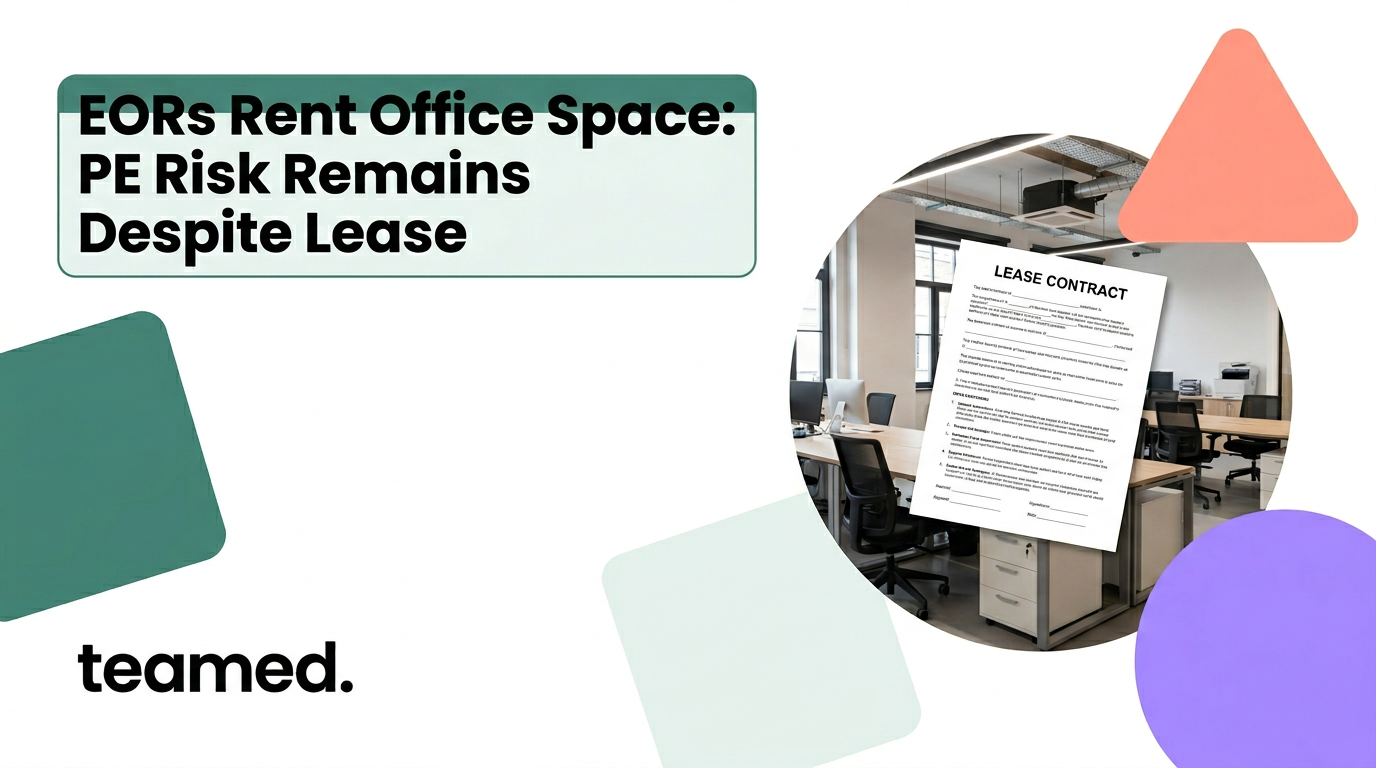
Having an EOR rent office space in their name does not automatically shield you from permanent establishment risk. Tax authorities care about the substance of what happens in that space and who benefits from it, not whose name appears on the lease. Typical entity establishment takes 2–12 months depending on country tier (estimate based on common timelines). Mid-market companies need to treat office decisions, EOR arrangements, and entity strategy as one connected question.
Before evaluating EOR office strategies, you need clarity on what creates permanent establishment. PE arises in two main ways: fixed place of business or dependent agent activity. Both can exist regardless of who holds an office lease.
Fixed place PE occurs when your business maintains a location at its disposal where substantive business activities occur. Tax authorities look at whether the space is used regularly, whether your employees work there consistently, and whether core business functions happen there. The OECD Model Tax Convention Article 5 provides the framework, but interpretation varies by bilateral treaty and local law. Home offices, coworking spaces, and serviced offices can all create fixed place PE depending on usage patterns and the nature of work performed. Seek qualified tax and legal advice for your specific jurisdictions and treaties.
Dependent agent PE arises when a person habitually exercises authority to conclude contracts in your name, or habitually plays the principal role leading to contracts that you routinely conclude without material modification. This can happen even without a fixed office. A "country manager" with pricing authority working from home can trigger dependent agent PE. The OECD's 2017 BEPS Action 7 updates tightened these tests, and the 2024 OECD Transfer Pricing Guidelines commentary addresses factors some tax authorities consider around remote and hybrid work arrangements, though these are not bright-line rules and application varies by jurisdiction.
The substance-over-form principle means authorities will look past the EOR's name on a lease to assess who truly benefits from the space and what activities occur there. This is why office decisions must align with your overall PE posture, not exist in isolation.
We evaluated these approaches through the lens of what a VP People or CFO actually needs when office space enters the global employment conversation. These criteria separate providers who treat PE as a governance model from those who treat it as a sales talking point. Our assessment draws on advisory experience with mid-market companies managing international teams across multiple employment models, though specific client data and case studies are not disclosed.
When assessing EOR office space practices, we focused on depth of PE advisory beyond generic disclaimers, whether the provider addresses fixed place, home office, coworking, and dependent agent risks with actionable guidance. We examined the ability to translate OECD guidance into practical policies, recognizing that OECD commentary provides factors for consideration rather than universal rules, and that application varies by bilateral treaty and local interpretation. We prioritized fit for mid-market companies: realistic pricing, response times measured in hours not weeks, and strategy that doesn't require six-month consulting engagements. We valued experience with EU-headquartered companies expanding to the US and across Europe, which requires understanding EU labour law, GDPR implications, and specific PE treaty interpretations. Finally, we assessed capacity to unify contractors, EOR hires, and entities into coherent advice, and clarity on when EOR-to-entity transition makes strategic sense, because office decisions shouldn't be siloed from your broader employment model.
Teamed connects office space decisions, EOR usage, contractor strategy, and entity timing into one coherent PE posture. We interpret PE across fixed place, home office, coworking, and dependent agent scenarios, aligning role design and office use with your declared tax position. When you need external tax and legal opinions, we coordinate them into day-to-day operating policies. Coverage spans 180+ countries for EOR, 90+ countries for entity support. Tier-based transition thresholds: 10+ employees in Tier 1 countries (UK, Ireland, Netherlands, Singapore), 15–20 in Tier 2 (Germany, France, Spain), 25–35 in Tier 3 (Brazil, India, China), internal benchmarks based on typical compliance complexity and cost-benefit analysis. Entity setup takes 2–4 months (Tier 1), 4–6 months (Tier 2), 6–12 months (Tier 3) as estimates including incorporation, banking, and tax registration.
Best for: Mid-market HR and Finance leaders (200–2,000 employees, €12M–€1.2B revenue) seeking one accountable advisor across 5+ countries.
Not ideal for: Very small firms with minimal cross-border exposure or enterprises seeking standalone formal tax opinions without operational integration.
Limitation: We implement and operationalize PE strategy but are not a replacement for formal tax and legal advice on complex treaty questions. Confirm all thresholds and timelines with qualified advisers for your specific jurisdictions.
Large EOR platforms excel at rapid compliant hiring. Onboarding typically within 24–48 hours. Coverage across 150+ countries. Pricing €400–€700 per employee per month depending on jurisdiction. PE input is high-level: country summaries, generic notes, headcount dashboards for internal tracking. Strong on payroll, social security, benefits; lighter on substantive PE governance. The assumption is you have in-house or retained tax teams owning PE analysis.
Best for: Organisations prioritising scale and automation with internal tax capability leading PE decisions.
Not ideal for: Mid-market teams expecting deep PE and office strategy from the EOR alone, or firms without access to independent tax advice.
Limitation: Risk of treating PE as a checkbox. Can increase vendor sprawl without a coordinator aligning office, role, and entity decisions. Confirm PE guidance scope before relying on platform advice alone.
Some providers market office or coworking packages alongside EOR services. Serviced offices typically €500–€2,000 per month per desk depending on city. They keep the client off the lease and can arrange space within local norms. Attractive when your board wants visible in-country presence quickly. Useful for early meetings without immediate entity formation. But the office space fallacy applies: authorities may deem a fixed place of business regardless of who pays rent. If your team works there consistently and conducts substantive business, you may create PE. Internal risk heuristic: when an in-country team spends 50% or more of working time in a single identifiable location over a sustained period (estimate; varies by jurisdiction and treaty, seek qualified advice).
Best for: Mid-market firms needing small, visible bases for sales or client service, who will invest in external PE analysis and strict role design.
Not ideal for: Scenarios with core operations or local management performed from the space.
Limitation: Substance over form. Sustained usage patterns and activities performed matter more than lease structure. Pair with independent tax review and clear escalation triggers.
When revenue, leadership presence, or scrutiny become strategically material, you need formal PE opinions. Independent advisers bring mastery of OECD commentary, bilateral treaties, and local case law. Formal PE opinions typically cost €5,000–€25,000 depending on complexity and jurisdiction (estimate based on common market rates). They provide defendable positions, documentation, and audit readiness. Compliance documentation should be retained for at least 6 years to align with common tax authority record expectations across Europe (confirm locally; retention periods vary by jurisdiction).
Best for: Mid-market companies with growing in-country revenue or leadership footprint, especially regulated sectors like financial services or healthcare.
Not ideal for: Teams seeking execution of day-to-day role and office policies without an operational integrator.
Limitation: Advice can remain at policy level without translation to HR, role design, and workspace operations. A unified operations partner bridges formal opinions into executable, tracked policies across employment models.
This is a deliberate strategy: start with EOR and light office use, then pre-agree triggers that move you to entity formation. Define triggers explicitly: appointing a country manager, signing a multi-year lease (internal heuristic: any lease exceeding 24 months should prompt formal PE review and entity timeline, estimate based on typical commitment thresholds), revenue exceeding a threshold, headcount reaching 10–15 employees (common internal benchmark for Tier 1 countries; adjust for Tier 2/3). Entity establishment takes 2–4 months (Tier 1), 4–6 months (Tier 2), 6–12 months (Tier 3) as estimates. A common trigger in structured frameworks is to reassess EOR vs entity once a country reaches 10–15 EOR employees or a locally led commercial team.
Best for: Companies expecting to scale if market signals are positive.
Not ideal for: Static or one-off hires with no scaling intent, or markets where entity is required from day one.
Limitation: Requires investment in tax advice and change management. Impacts governance and benefits on transition. But it creates shared visibility for HR, Finance, and Legal, avoiding rushed entity decisions. Confirm all triggers and timelines with qualified advisers for your jurisdictions.
Intentionally keep most work remote. Use limited, policy-bound coworking aligned to OECD guidance on home and flexible work (noting that OECD commentary provides factors for consideration, not bright-line rules, and application varies by jurisdiction and treaty). Define which activities occur in shared spaces, cap frequency, document usage and travel. Internal control heuristic: cap client-branded, dedicated desk allocation in coworking spaces to 0 dedicated desks for Tier 1–2 markets when operating without an entity (estimate based on defensibility model; confirm with qualified tax and legal advisers). Coworking costs typically €200–€800 per month per employee for occasional use.
Best for: Early market entry for product, engineering, or support roles with minimal in-person client needs.
Not ideal for: Heavy client-facing or local decision-making roles, or markets needing permanent presence.
Limitation: Not a zero-risk approach. Roles and activities can still trigger PE even without a dedicated office. A unified operations partner coordinating multi-country policy adds value. Seek qualified advice to align policies with applicable treaties and local law.
Certain patterns should trigger immediate PE review, regardless of EOR lease arrangements. These are internal risk indicators based on common audit triggers; confirm thresholds with qualified tax and legal advisers for your specific jurisdictions and treaties.
Sustained physical presence: Any in-country team spending 50% or more of working time in a single identifiable location over 3+ consecutive months (estimate; varies by jurisdiction).
Long-term lease commitments: Any lease exceeding 24 months, especially if client-branded or exclusive-use (internal heuristic).
Local decision-making authority: Employees with titles like "Country Manager" or "Regional Director" who negotiate pricing, approve contracts, or make binding commitments (dependent agent risk).
Material local revenue: In-country sales exceeding 10–15% of global revenue or absolute thresholds defined in bilateral treaties (varies widely; seek advice).
Client-facing activities from fixed locations: Regular client meetings, presentations, or negotiations conducted from the same office or coworking space.
Dedicated desks or branded spaces: Any coworking arrangement with permanent desk allocation, signage, or reception services in the client's name.
If you recognise two or more of these patterns, schedule a formal PE review with independent tax and legal advisers. The cost of a formal opinion (€5,000–€25,000 per jurisdiction, estimate) is far lower than the cost of an adverse PE determination.
Choose Teamed if you're managing 5+ countries with 200-2,000 employees and want one advisor who connects all the dots: when to use contractors vs EOR, which offices make sense, and when entities become necessary. We cover 180+ countries for EOR and 90+ for entities.
Choose a large EOR platform if speed matters most and you've got tax advisers handling PE strategy. They'll onboard someone in 24-48 hours for €400-€700 monthly across 150+ countries. Just remember: they won't tell you when that sales hire needs different contract terms to avoid PE.
Choose specialist office-plus-EOR providers if visible local presence is essential for a small team (serviced offices €500–€2,000/month per desk), and you will pair it with independent PE advice and strict usage policies limiting time in location to below 50% (estimate; confirm locally).
Choose independent tax advisers if you're about to appoint a country director, local revenue is becoming material, or you're in financial services or healthcare. Formal opinions run €5,000-€25,000 per country but give you documented positions for the board.
Choose a planned EOR-to-entity pathway if you're testing a market with potential to scale and want explicit triggers: 10–15 employees (Tier 1), 15–20 (Tier 2), 25–35 (Tier 3), or lease terms exceeding 24 months (internal benchmarks; confirm with advisers).
Choose remote-first with controlled coworking if you're entering a market early with roles that don't require physical presence (coworking €200–€800/month per employee occasional use) and want to minimize fixed place risk by capping dedicated desk allocation to 0 desks in non-entity markets (internal heuristic).
Choose to prohibit local staff from representing the business as an in-country branch when using an EOR without an entity. Target 0 local employees with contract-signing authority in non-entity countries (internal control).
Choose an owned entity when you will maintain a dedicated office (lease >24 months, estimate), employ local management with decision-making authority, or allow in-country personnel to negotiate or finalize customer terms. Entity setup: 2–12 months depending on country tier (estimate).
All thresholds and timelines are internal benchmarks or estimates based on common patterns. Application varies by jurisdiction, bilateral treaty, and specific facts. Seek qualified tax and legal advice for your circumstances.
Can EORs rent office space to help clients avoid permanent establishment?
Yes, an EOR can hold the lease, but PE risk depends on the substance of activities conducted there and who benefits. Tax authorities apply substance-over-form principles under OECD Model Tax Convention Article 5 and bilateral treaties (interpretation varies by jurisdiction). If your business is effectively carried on from that location, the lease holder's identity is secondary. Seek qualified tax and legal advice for your specific jurisdictions and treaties.
When should a mid-market company move from EOR to its own entity if renting offices?
When committing to dedicated offices (lease >24 months, internal heuristic), appointing local leaders with decision-making authority, or generating material in-country revenues (>10–15% of global revenue or treaty-defined thresholds, varies widely). Tier-based thresholds suggest entity evaluation at 10+ employees (Tier 1: UK, US, Netherlands), 15–20 (Tier 2: Germany, France), 25–35 (Tier 3: Brazil, India), internal benchmarks; confirm with advisers. Entity setup takes 2–12 months depending on tier (estimate).
Which roles create the highest PE risks in an EOR plus office model?
Country managers with broad authority, sales staff with pricing or negotiation authority, and anyone habitually concluding contracts locally create dependent agent PE risk under OECD BEPS Action 7 guidance (application varies by jurisdiction and treaty). Target 0 local employees with contract-signing authority in non-entity countries (internal control). Seek qualified advice to design roles and authority limits aligned with your PE posture.
How can hybrid and remote work policies help manage PE risk?
Define where work occurs, frequency of coworking or office use, permissible activities per location, and tracking consistent with OECD guidance. The 2024 OECD Transfer Pricing Guidelines commentary addresses factors some tax authorities consider around time thresholds and commercial reasons for presence, though these are not bright-line rules and application varies by jurisdiction and bilateral treaty. Internal heuristic: cap time in single location to <50% over sustained periods in non-entity markets (estimate; confirm locally). Seek qualified advice to align policies with applicable treaties and local law.
The question "can EORs rent office space to help clients avoid permanent establishment?" is the wrong starting point. The right question is: how do I design my office, role, and employment model decisions together so they're defensible under applicable tax treaties and local law?
Office space, EOR arrangements, and entity strategy are one connected PE question, not disconnected vendor choices. Treating them separately is how mid-market companies end up with fragmented systems, conflicting advice, and compliance exposure they didn't see coming. You need a partner who can see the whole picture and guide you through the trade-offs.
Top picks for PE-conscious office strategy: Teamed offers unified advisory across 180+ countries (EOR) and 90+ countries (entity support) with tier-based transition thresholds starting at 10+ employees in Tier 1 markets. Global EOR platforms deliver speed (24–48 hours onboarding, €400–€700/employee/month, 150+ countries) for teams with in-house tax capability. Independent tax and legal advisers provide formal PE opinions (€5,000–€25,000 per jurisdiction, estimate) when revenue or leadership presence becomes material. Specialist office-plus-EOR providers offer visible presence (€500–€2,000/month per desk) paired with external PE advice. Remote-first with controlled coworking minimises fixed place risk through policy-bound usage (€200–€800/month occasional use, 0 dedicated desks in non-entity markets as internal heuristic). Planned EOR-to-entity pathways create explicit triggers (10–15 employees or 24-month lease as internal benchmarks) to embrace PE when warranted.
Teamed unifies fragmented global employment operations into a single advisory relationship. We help you determine the right employment model for each market, then execute it. As strategy evolves, we evolve with you, maintaining continuity across every transition. If you're making six-figure employment decisions based on vendor sales pitches, or piecing together advice from providers with conflicting incentives, there's a better way. Talk to the experts and map your roles, markets, and office plans into a coherent PE and employment model.
All thresholds, timelines, and cost ranges in this article are internal benchmarks or estimates based on common patterns and should not be relied upon as legal or tax advice. Permanent establishment determination depends on specific facts, applicable bilateral tax treaties, and local law interpretation. Seek qualified tax and legal advice for your circumstances.
Most mid-market companies cannot produce a reconcilable global headcount within 10 business days because contractors, EOR employees, and entity staff sit in different systems. Before you add another borderless EOR platform to the mess, you need one clear picture of your workforce and a plan that addresses vendor sprawl, not just features.
Teamed's Unified Audit delivers a complete workforce inventory across 70+ countries in 10 business days, surfacing misclassification, permanent establishment, and data residency gaps. Our Model Choice Framework provides decision rules grounded in EU Platform Work Directive presumptions, Canadian CRA tests, and PE triggers. The GEMO approach consolidates fragmented operations into a single advisory relationship, with typical coordination savings of €58,000 to €175,000 annually for mid-market companies managing multi-country vendor sprawl.
Strategic picks for 2026:
A borderless EOR strategy is an operating model design challenge, not a product choice. Mid-market companies managing contractors in one system, EOR employees in another, and entities in a third need unified global employment operations before adding another platform to the mess.
Teamed is the unified global employment partner for mid-market companies managing international teams across multiple platforms, vendors, and employment models. We help you determine the right employment model for each market, then execute it, maintaining continuity across every transition.
The real problem is vendor sprawl and operating model confusion, not EOR feature gaps. These seven steps address that root cause.
Most "borderless EOR" content compares platform features. That misses the point. Mid-market companies with 200 to 2,000 employees are not shopping for software. They are trying to design a safe, cost-rational operating model that lets them hire anywhere without creating compliance chaos.
After working with over 1,000 companies across 70+ countries, we know what trips up mid-market teams. You need real guidance, not just automated workflows. You need someone who understands misclassification risk in Germany is different from France. You need help deciding when to move from EOR to entity without triggering PE issues. Most importantly, you need one partner who can handle contractors, EOR, and entities without adding to your vendor chaos.
Each step was assessed on whether it provides measurable outputs, clear decision thresholds, and advisory depth appropriate for mid-market companies making six-figure entity establishment decisions without deep in-house legal and tax teams. We prioritised steps that reduce the time Finance and People leaders spend reconciling data across systems and making critical employment decisions with incomplete information.
Borderless hiring becomes sustainable only when you can see your entire global workforce in a single advisory view. Teamed reviews contracts and models across 70+ countries in 10 business days, flagging misclassification risk, Platform Work Directive exposure (subject to member-state transposition and applicability to platform-mediated work), and local labour law hotspots. The audit surfaces permanent establishment questions, data residency gaps, and pay transparency issues that point solutions miss. The output is a clear map of who is engaged where, under which model, and with which vendors, your factual baseline for every decision that follows.
Best for: HR and Finance leaders with 3+ EOR vendors and contractor tools who cannot produce a reconcilable global headcount within 10 business days.
Not ideal for: Leaders seeking immediate cost or risk changes without first establishing a verified operating picture.
You cannot run a safe borderless EOR model without written rules for when a role is a contractor, an EOR hire, or belongs in your entity in each country. Teamed grounds rules in concrete triggers: EU Platform Work Directive presumptions (subject to member-state transposition), control and dependency tests, Canadian Revenue Agency two-step assessments, and works council expectations. A structured decision tree evaluates 6 dimensions, role criticality, duration, headcount trajectory, market commitment, control level, and regulatory environment, then maps each to a recommended model. Delivered in 5 business days, the framework covers jurisdiction-specific tests for 12+ countries.
Best for: Companies converting 10+ contractors within 90 days or entering 3+ new markets in the next 12 months.
Not ideal for: Teams unwilling to validate decisions against up-to-date local legal advice as tests and enforcement evolve.
Per-head EOR pricing is visible cost. The real total cost of ownership sits in duplicated systems, HR time, and audit risk. Teamed's TCO model factors 8 cost categories over 12/24/36-month horizons: EOR fees, internal HR and payroll effort across platforms, legal reviews, entity setup costs (€15,000–€45,000 by tier), and annual entity admin costs. The model includes non-compliance cost estimates for misclassification remediation, late permanent establishment planning, and added advisory fees. For example, in a Tier 1 country like the UK, entity break-even typically occurs around month 17 when comparing illustrative EOR costs of approximately £75,000 annually (10 employees at £7,500 each) against £25,000 entity setup plus £35,000 annual entity costs, an internal estimate based on typical mid-market scenarios.
Best for: CFOs with EOR spend exceeding €100,000 annually or considering entity setup in 2+ countries within 24 months.
Not ideal for: Leaders seeking a binding financial forecast without complementary tax and accounting analysis.
A credible European borderless EOR strategy starts by accepting each EU and UK jurisdiction's hard edges on status, collective rights, and data. The ruleset addresses Platform Work Directive impacts (subject to member-state transposition and applicability to platform-mediated work), country-specific notice periods, collective agreements, and works council consultation triggers. Works councils in Germany become mandatory at 5+ employees if employees request them (rules vary by circumstances; confirm with local counsel). France requires a CSE (Social and Economic Committee) at 11+ employees. Spain triggers formal worker representation at 50+ employees. Teamed provides practical guidance covering when to prefer EOR over contractors, when an entity is unavoidable, and which data residency questions to ask any EOR under GDPR.
Best for: EU and UK headquartered mid-market firms hiring in 3+ EU jurisdictions or managing 20+ EU employees across EOR and entities.
Not ideal for: Teams expecting a ruleset to replace in-country legal advice on unions, works councils, or sector-specific regulation.
Borderless EOR simplifies payroll in the US and Canada but does not erase tax presence or classification rules auditors care about. Permanent establishment risk is a corporate tax exposure that can arise when business activities in a country meet local thresholds for a taxable presence. Using an EOR does not automatically eliminate that exposure because PE tests depend on the substance of activities, not just who issues the payslips. Canadian classification tests differ from EU assumptions about contractors. The Canada Revenue Agency applies a two-step analysis examining control and dependency that catches European companies assuming contractor arrangements will transfer cleanly. Teamed recommends involving corporate tax advisers before headcount reaches 5 to 10 in a single US state or Canadian province when roles include sales, deal negotiation, or client delivery.
Best for: EU People and Finance leaders building US or Canada teams of 5–10+ employees or roles involving sales and client delivery activities.
Not ideal for: Readers seeking tax advice without case-specific analysis. PE outcomes are fact-dependent and require qualified tax counsel.
Platform choice is about legal structure, data posture, and exit path you will live with for years, more than features. Score vendors on owned entities versus partner networks, responsibility for local filings, and handling regulatory changes in frontier markets. Evaluate IP protection clauses, data residency under GDPR, audit trail completeness, and termination and dispute handling under local law. Delivered in 7 business days, the scorecard groups vendors by advisory depth, stance on EOR-to-entity transitions, and transparency about subcontractors. Teamed selects in-country partners by compliance track record and mid-market fit, not cheapest cost. Key questions include: Does the provider own entities or rely on partner chains? What happens to your data and compliance history if you need to migrate?
Best for: Companies operating 3+ global employment vendors in the same region or planning vendor consolidation within 6 months.
Not ideal for: Teams assuming any scorecard can replace diligence and peer references in comparable jurisdictions.
A mature borderless EOR strategy includes a plan for when and how to graduate core markets into your own entities. Consider when regulators, customers, or works councils expect local presence, especially in regulated or relationship-driven sectors. Teamed's GEMO Framework sets tier-based thresholds: Tier 1 countries (UK, Ireland, US, Canada, Singapore) justify entity setup at 10+ employees sustained for 12+ months. Tier 2 countries (Germany, France, Spain, Italy) warrant entities at 15 to 20 employees. Tier 3 countries (Brazil, China, India) may justify staying on EOR until 25 to 35 employees. Entity establishment timelines run 2 to 4 months for Tier 1 countries, 4 to 6 months for Tier 2, and 6 to 12 months for Tier 3. EOR-to-entity transitions impact contracts, benefits, data transfers, and historical compliance records.
Best for: Post-funding mid-market companies with 10+ employees in a Tier 1 country for 12+ months, 15–20+ in Tier 2, or 25–35+ in Tier 3.
Not ideal for: Leaders treating entity setup purely as a cost-cutting shortcut. Entities introduce governance and reporting duties.
Choose the Teamed Unified Audit first if you operate 3+ EOR vendors or contractor tools and cannot produce a reconcilable global headcount within 10 business days.
Choose the Model Choice Framework when converting 10+ contractors within 90 days or entering 3+ new markets in the next 12 months so every hire is intentionally placed into contractor, EOR, or entity based on risk, role, and horizon.
Choose the TCO Calculator if your annual EOR spend exceeds €100,000 or you are considering entity setup in 2+ countries within 24 months. Pair with the Vendor Scorecard when planning vendor consolidation within 6 months.
Choose the European Ruleset if you are EU or UK headquartered and hiring in 3+ EU jurisdictions or managing 20+ EU employees across EOR and entities. Works councils, collective agreements, and GDPR constraints require explicit planning.
Choose the North American Reality Check if you are a European company building US or Canada teams of 5–10+ employees or roles involving sales and client delivery. Permanent establishment and CRA classification tests differ from EU assumptions.
Choose the Vendor Scorecard when operating 3+ global employment vendors in the same region or evaluating borderless EOR platforms. Score on legal structure, data posture, and exit path, not features.
Choose the Graduation Plan once specific countries become strategic hubs with 10+ employees sustained for 12+ months in Tier 1, 15–20+ in Tier 2, or 25–35+ in Tier 3. The economics shift in favour of entities at different thresholds by country tier.
Choose a GEMO approach if you want one supplier managing global employment from initial EOR hiring through entity transition and ongoing entity management. GEMO-style coordination savings from consolidating fragmented operations typically fall in a €58,000 to €175,000 annual range for mid-market companies with multi-country vendor sprawl, an internal estimate based on reduced reconciliation effort, consolidated advisory fees, and streamlined audit preparation.
What should mid-market companies actually worry about with global employment?
Whether you have a single view across all models, written rules for contractors versus EOR versus entities, and a graduation path for core markets. Mid-market companies in the 200 to 2,000 employee range commonly operate at least three concurrent worker categories by the time they are hiring in 5+ countries. These structure more risk and cost than any feature.
How do European regulations change the way I should think about borderless hiring and EOR?
EU worker status, collective consultation, and data protection demand tighter contractor guardrails, careful EOR selection, and explicit data residency checks. The EU Platform Work Directive (subject to member-state transposition and applicability to platform-mediated work) makes it harder to rely on contractors for long-term, core roles because authorities can presume a worker is an employee. GDPR applies to HR data regardless of whether workers are engaged via EOR or entity employment.
When is an EOR-to-entity transition strategically preferable to staying with a borderless EOR provider?
When a market is strategically important, headcount is material (10+ employees in Tier 1 countries sustained for 12+ months, 15–20+ in Tier 2, or 25–35+ in Tier 3), and direct control and tax and regulatory alignment outweigh convenience. A tier-based graduation rule commonly sets a strong entity-bias threshold at 25+ employees because ongoing EOR fees, multi-vendor administration, and local employment complexity typically outweigh the fixed costs of an entity at that scale.
Does a borderless EOR solution eliminate permanent establishment risk?
Using an EOR can reduce some administrative burdens but it does not automatically remove permanent establishment risk. Tax authorities look at the substance of activities in a country, not just who issues the payslips. Finance leaders still need a clear PE strategy, supporting documentation, and coordination with qualified tax advisers before headcount reaches 5 to 10 in a jurisdiction where roles include sales, deal negotiation, or client delivery.
Treat borderless EOR as a redesign of how your organisation hires and employs everywhere, not as a shortcut to avoid entities. Ensure one trusted advisor looks across contractors, EOR hires, and subsidiaries.
Teamed is the unified global employment partner for mid-market companies managing international teams across multiple platforms, vendors, and employment models. We combine advisory services with operational infrastructure, helping you determine the right employment model for each market, then execute it.
If you are spending hours reconciling data across systems, making critical employment decisions with incomplete information, or piecing together advice from vendors with conflicting incentives, there is a better way. We consolidate fragmented global employment operations into a single advisory relationship and platform.
Want to see where your current setup has gaps? Let's have a conversation about bringing your global workforce into one clear view. You'll leave knowing exactly what needs fixing and how to fix it.
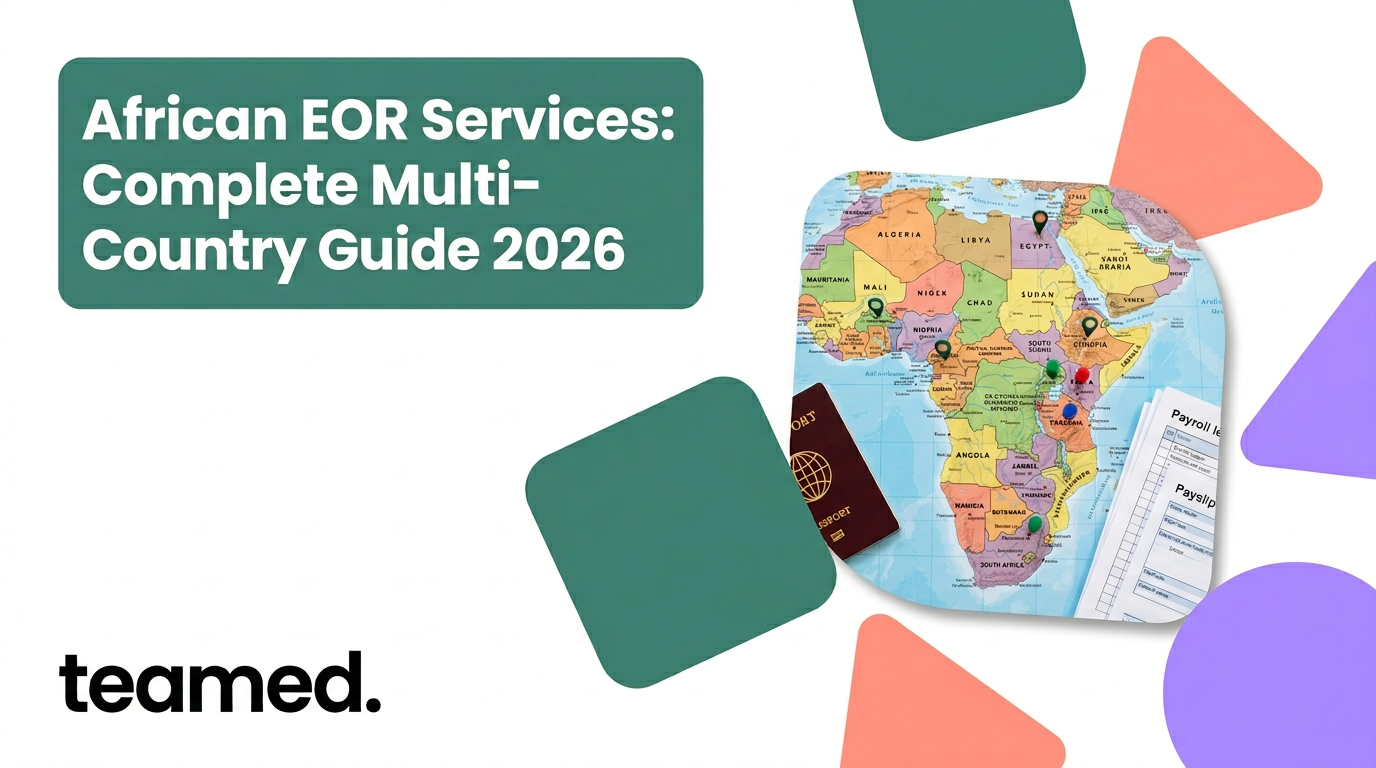
Choosing an African EOR service is not a vendor decision. It is an employment model decision that shapes your compliance posture, cost structure, and operational flexibility for years. Teamed is the unified global employment partner for mid-market companies managing international teams across multiple platforms, vendors, and employment models. We help you determine where EOR fits within your broader African strategy, when contractors remain appropriate, and when entity establishment makes more sense.
African EOR services let you hire employees in countries like South Africa, Nigeria, Kenya, and Ghana without establishing your own legal entity. Mid-market companies typically pay €400–700 per employee per month for EOR services across African markets, with onboarding timelines ranging from 24 hours to 4 weeks depending on the provider model. The right choice depends on whether you need deep Africa-only expertise, unified advisory across regions, or maximum legal defensibility in regulated sectors.
Most African EOR comparisons focus on country counts and platform features. That approach misses what actually matters for mid-market HR and Finance leaders: advisory depth on employment models, country-specific regulatory expertise, and the ability to consolidate vendors into unified global employment operations. We evaluated African EOR services against criteria drawn from real mid-market challenges, South African co-employment exposure, Nigerian wage inflation and classification pressure, and frontier markets with variable enforcement patterns.
Our selection methodology prioritised providers serving mid-market companies (200–2,000 employees, €10M–€1B revenue) operating across 3+ countries with mixed employment models. We assessed advisory depth on contractor-versus-EOR-versus-entity decisions, in-country legal relationships beyond operational presence, support for European-headquartered structures, and power to reduce vendor sprawl. We excluded providers focused exclusively on startups or enterprises, and those without genuine African legal partnerships. Pricing data reflects February 2026 market rates gathered from provider websites, direct quotes for mid-market scenarios (10–50 employees per country), and anonymised client reports. Onboarding timelines and support SLAs are based on standard service levels; expedited options may be available at additional cost.
The providers below represent distinct strategic approaches rather than a ranked list. Your right choice depends on geographic footprint, risk tolerance, and how fragmented your current vendor relationships have become. Regulatory statements reflect general patterns as of February 2026; employment law varies by jurisdiction and specific facts, consult local counsel and tax advisors before making hiring decisions.
Pricing as of February 2026 for mid-market scenarios (10–50 employees per country). Employer statutory costs (social security, payroll taxes, mandatory insurance) add 10–35%+ on top of base salary depending on jurisdiction. Onboarding timelines assume standard documentation; complex cases may extend timelines. All providers deliver local employment contracts, statutory benefits enrolment, and payroll filings unless otherwise noted.
Teamed unifies African EOR decisions with contractor and entity planning under one advisory relationship. Rather than treating Africa as a separate project, we integrate your African hiring into unified global employment operations alongside your European, North American, and other regional teams. Coverage spans 180+ countries including 40+ African markets. Pricing starts at €450/employee/month with 3–5 business day onboarding and named specialist support. Our regulatory expertise comes from in-country legal partners selected for mid-market relevance and compliance rigour. We advise on South African co-employment exposure, Nigerian wage inflation and classification risk, and model selection per country. For European-headquartered companies, we align African execution with EU obligations including GDPR, collective agreements, and works council considerations. Teamed's GEMO framework provides clear thresholds for when entity establishment makes sense, South Africa sits in Tier 2 (moderate complexity), where entity transition typically becomes viable at 15–20 employees. Limitation: Not ideal for very small teams seeking self-serve, click-to-hire speed without strategic engagement.
Africa HR Solutions offers strong country-by-country payroll, social security, and contract knowledge across 42 African markets. Coverage includes South Africa, Nigeria, Kenya, Ghana, Egypt, Morocco, and 36 additional countries. Pricing ranges €400–550/employee/month with 5–7 business day onboarding and regional support teams plus local payroll specialists. Their strength lies in day-to-day compliance where enforcement varies, with deep local practice and cultural fluency. On-the-ground talent insights help you set realistic salary and benefit expectations in markets where published benchmarks are scarce. Delivers local employment contracts, statutory benefits enrolment, in-country payroll filings, and monthly compliance reporting. Limitation: If you operate across Europe, Africa, and other regions, an Africa-only specialist may deepen silos rather than reduce them. You will still need separate advisory for your European employment decisions, creating the vendor sprawl that mid-market companies struggle to manage.
Remote offers a single interface across 50+ countries including 15 major African markets (South Africa, Nigeria, Kenya, Egypt, Ghana, Morocco, Tunisia, Uganda, Tanzania, Rwanda, Senegal, Côte d'Ivoire, Mauritius, Botswana, Zambia). Pricing ranges €500–650/employee/month with 24–48 hour onboarding and 24/7 chat support plus 72-hour legal response SLA. Their central teams track high-level legal shifts and maintain standard templates across many countries. For straightforward roles under moderate risk tolerance, Remote works well. They provide consolidated payroll and headcount views if most of your EOR sits on their platform. Delivers local employment contracts, statutory benefits enrolment, payroll filings, and compliance dashboard. Limitation: Advisory depth is lighter than specialist providers. Global platforms are built for scale, not for navigating South African co-employment nuance or Nigerian classification enforcement patterns. When complex cases arise, you may find yourself routed to a support queue rather than a specialist who understands your specific situation.
Clyde & Co Employment Services provides deep statutory interpretation and co-employment analysis across 8 major African jurisdictions (South Africa, Nigeria, Kenya, Egypt, Ghana, Morocco, Mauritius, Botswana). Pricing ranges €700–1,000+/employee/month with 2–4 week onboarding and dedicated legal counsel per jurisdiction. They provide formal opinions on EOR suitability versus entity establishment, with written defensibility before hiring in new African markets. For regulated industries where hiring or classification mistakes affect licences, regulators, or investors, this model makes sense. Financial services, healthcare, and defence companies often need written legal opinions that reassure boards about employment model choices. Delivers local employment contracts, statutory benefits enrolment, payroll filings, formal legal opinions on co-employment risk, and cross-border legal linkage between African and European obligations. Limitation: Execution is slower than platform-based providers, often 2–4 weeks for onboarding rather than days. Higher cost structure may not suit companies testing multiple African markets.
Deel provides structured conversion pathways for companies with existing African contractor relationships. Coverage spans 35 African countries with pricing €480–620/employee/month, 48-hour onboarding, and automated compliance monitoring plus support tickets. Their hybrid contractor-plus-EOR model maps where contractor use remains acceptable versus where it is increasingly treated as employment. Structured audits identify which roles should migrate to EOR to shore up compliance, while true project-based or intermittent work stays flexible. Clear criteria define the boundary: keep genuine project work as contractors, convert core employee-like roles to EOR. Delivers local employment contracts, statutory benefits enrolment, payroll filings, contractor classification audits, and conversion documentation trails. Limitation: Without a unifying advisor, you risk tool fragmentation across contractor management platforms, EOR providers, and eventually entity administration. Contractor misclassification becomes high-risk when engagements exceed 6–12 months with fixed hours, line management, and business-critical deliverables.
Globalisation Partners helps you determine when the EOR-to-entity tipping point arrives across 25 African markets. Pricing ranges €550–750/employee/month with 3–5 business day onboarding and entity formation project management plus EOR advisory. They explain employment, tax, and social security shifts upon incorporation in each country. They preserve employee rights, tenure, and benefits during the EOR-to-entity transfer. They model headcount, spend, and revenue stability to identify when the numbers justify the investment. Entity establishment in Tier 2 countries (including South Africa) typically takes 4–6 months including incorporation, banking setup, tax registration, and employee transfer. A realistic planning window for the migration itself is 6–12 weeks after the local entity is operational. Delivers local employment contracts, statutory benefits enrolment, payroll filings, entity formation project management, employee transfer documentation, and multi-year cost modeling. Limitation: Not ideal for very early, experimental hiring where incorporation planning would distract from market validation. Best suited for teams with 15–20+ employees per country and visible long-term intent.
Here's how to think through the decision when everyone's watching:
Choose Teamed if you operate across 3+ regions, need country-by-country advice in Africa on contractors versus EOR versus entities, want EOR-to-entity planning at 15–20 employees per country, and must align with EU consultation or GDPR requirements under unified global employment operations.
Choose Africa HR Solutions if 70%+ of your workforce and leadership are in Africa, you operate across 10+ African countries, and other regional strategies are already separate and stable with dedicated vendors.
Choose Remote if you prefer tech-first operations, hire in fewer than 5 African markets, need 24–48 hour onboarding speed, and accept lighter advisory on local nuance for straightforward roles.
Choose Clyde & Co Employment Services if you operate in financial services, healthcare, or defence sectors requiring written legal opinions before hire, your board demands formal co-employment analysis, and you can accommodate 2–4 week onboarding timelines.
Choose Deel if you currently engage 10+ African contractors for longer than 9 months, face board or tax scrutiny on classification, and need structured conversion pathways with audit trails and compliance documentation.
Choose Globalization Partners if you have 15–20+ employees in one or more African countries, plan to operate for 3+ years in those markets, and want entity formation project management with employee transfer support.
Stay on EOR longer if you're in your first 1 to 2 years in a new African market, have fewer than 15 employees per country, face upcoming elections or regulatory overhauls, or don't have local HR and legal support ready.
What is mid-market in the context of African EOR services?
Mid-market typically means organisations with 200–2,000 employees or revenue between €10M and €1B. These companies face cross-border employment trade-offs without in-country specialists everywhere, but not yet at enterprise scale with dedicated teams for every jurisdiction.
When should a mid-market company move from African EOR to setting up a local entity?
Once teams reach 15–20 employees in Tier 2 countries like South Africa with stable, strategic operations and 3+ year horizons. Entity establishment typically takes 4–6 months including incorporation, banking, tax registration, and employee transfer. Model economics and risks with advisors before committing.
How do regulatory requirements in Africa affect whether I use contractors or EOR employees?
Classification rules, co-employment concepts, and enforcement vary by jurisdiction and specific facts. South Africa has CCMA processes creating moderate complexity; Nigeria has wage inflation and classification pressure. Consult local counsel and tax advisors to decide where contractors remain appropriate versus where roles should shift to EOR or entities.
What are the typical costs for African EOR services?
EOR fees range €400–700/employee/month depending on country and provider (pricing as of February 2026 for mid-market scenarios). Employer statutory costs (social security, payroll taxes, mandatory insurance) add 10–35%+ on top of base salary depending on jurisdiction. Law firm-led models cost €700–1,000+/employee/month with additional fees for formal legal opinions.
How can we avoid vendor sprawl when expanding into multiple African markets?
Centralise via a unified advisory partner coordinating contractors, EOR, and entities with a single risk and cost view for HR, Finance, and Legal. Teamed's GEMO approach eliminates the need to switch providers at each stage, maintaining one advisory relationship as your employment models evolve across 180+ countries.
African EOR choices are long-term employment model decisions that shape risk, cost, and flexibility across your organisation. They are not just vendor picks to be evaluated on features and price.
The mid-market companies we work with share a common pattern: they started with contractors, added EOR in one or two African markets, and now manage fragmented systems with no single view of their international workforce. HR spends hours on manual reconciliation. Finance makes six-figure entity establishment decisions based on vendor sales pitches. Legal worries about classification exposure but lacks the in-market expertise to assess it properly.
Top picks for African EOR services:
Teamed exists to end fragmentation. We unify contractors, EOR, and entities under one advisory relationship and platform. We advise on when to use each model in each market, plan transitions without disrupting continuity, and align African decisions with European requirements.
If you're ready to stop the vendor juggling and get one clear view of your global workforce, let's talk. We can map your current setup, identify the biggest risks, and show you a path to sanity.
You've just acquired a team of 15 in Germany. The board wants them on compliant contracts within 30 days. Your CFO is asking why the EOR quotes range from $200 to $600 per employee per month. The $400 difference per head looks like easy savings on paper.
Here's what that spreadsheet won't show you: the missed payroll cut-off that triggers €3,000 in bank recall fees, the offboarding in France that drags on for four months because nobody picks up the phone, or the FX margin buried in your invoice that adds €60,000 annually to a €250,000 monthly payroll (with 83% of companies citing FX risk as their most critical economic exposure). The performance and service level differences between budget and premium EOR providers aren't visible until something goes wrong. And in global employment, something always goes wrong.
Teamed is the trusted global employment expert for companies who need the right structure for where they are, and trusted advice for where they're going. Based on advisory work with over 1,000 companies across 70+ countries, we've seen how the budget-versus-premium decision plays out across different hiring scenarios. This guide breaks down where the real gaps emerge and when each tier makes sense.
A price gap of roughly $300 per employee per month between budget EORs ($200-$300) and premium EORs ($500-$600) equates to approximately $3,600 per employee per year before considering FX, add-ons, and one-time fees.
For a mid-market company employing 25 people via EOR, a $300 monthly fee difference translates to approximately $90,000 per year in headline fee variance.
A 2.0% FX margin on a €250,000 monthly payroll creates €5,000 of additional cost per month, or €60,000 per year, even when the EOR fee looks lower.
Budget EOR providers commonly route queries through pooled ticket queues, while premium tiers more often provide named points of contact and defined escalation paths.
A single cross-border employment dispute can exceed the annual premium-versus-budget fee delta for one employee once local counsel, translation, and management time are included.
Premium providers are more likely to itemise pass-throughs rather than bundling them into opaque "management" or "compliance" lines.
Premium EOR providers win for mid-market companies with complex hiring plans. Budget providers can work for simple, low-volume situations. The decision depends on your headcount concentration, workforce complexity, and tolerance for operational risk.
Choose a budget EOR provider when you have fewer than 5 EOR employees in total, no country has more than 2 employees, and you can tolerate ticket-based support with non-urgent response expectations. This profile describes early-stage market testing, not sustained international operations.
Choose a premium EOR provider when you operate in 5+ countries or expect to add new countries quarterly. Multi-jurisdiction change management across contracts, benefits, payroll calendars, and terminations becomes a recurring operational workload that budget service models struggle to handle predictably.
Choose a premium EOR provider when your workforce includes high-risk profiles such as sales leaders with commission plans, employees with equity, or senior hires with bespoke clauses. Templated contracts and standard workflows frequently fail these edge cases, and the cost of getting them wrong far exceeds the monthly fee difference.
The table reveals a pattern. Budget providers standardise processes to reduce delivery cost. Premium providers fund higher-touch service, faster escalation, and deeper in-country advisory capacity. The question isn't which approach is better in the abstract. It's which approach matches your operational reality.
The monthly per-employee fee is the visible cost. Total cost of ownership includes all payroll pass-throughs, implementation charges, FX costs, benefits administration fees, offboarding costs, and the internal time spent managing exceptions and provider errors.
Teamed's Three Layers of Opacity framework identifies how the EOR industry obscures costs. The first layer is hidden FX margins. A 1.5% FX margin on a €100,000 monthly payroll creates €1,500 of additional cost per month that may not appear as an itemised line. The second layer is bundled compliance fees that combine multiple charges into a single opaque line item. The third layer is undisclosed in-country partner markups when the EOR uses local partners rather than owned entities.
A €200 offboarding administration fee charged once per termination equals the monthly fee of many budget EORs. If your workforce has normal turnover, these one-time fees materially change your TCO even when monthly pricing appears flat, especially considering 93% of off-cycle payments are triggered by employee terminations.
Internal rework is another measurable cost driver. Reducing even 2 hours of HR, payroll, and admin effort per employee per month at a blended £45/hour internal cost equates to £90 per employee per month of operational savings. Premium providers that get things right the first time often pay for themselves in reduced internal overhead.
Service Level Agreements define measurable service targets and specify remedies if the provider fails to meet them. The difference between budget and premium contracts often comes down to enforceability.
Budget contracts more often use "commercially reasonable efforts" language. This sounds reasonable until you're trying to hold a provider accountable for a missed payroll. Premium contracts are more likely to specify measurable response and resolution targets with actual remedies, such as fee credits or expedited escalation.
Ask these questions before signing any EOR contract. What is the guaranteed response time for payroll issues? What happens if payroll is processed late? Who is accountable when the provider uses in-country partners rather than owned entities? What are the offboarding fees and timelines? How are FX rates determined and disclosed?
The answers to these questions reveal more about service quality than any feature list. HR leaders on Reddit frequently describe frustration with providers who "promise expertise and deliver a platform" - a sentiment echoed by EY research showing only 24% of organizations are highly satisfied with their current payroll, mobility, and labor-law service providers. The contract is where you find out which one you're actually getting.
Consider a hypothetical mid-market company with 20 employees in the Netherlands. A payroll cut-off is missed due to a data entry error. Under a budget service model, the issue enters a ticket queue. Response comes within 48 hours. The fix requires a manual payment run, which triggers bank recall fees and expedited payment charges. The employee relations escalation costs management time. Total impact: easily €2,000-€5,000 plus internal hours.
Under a premium service model, the named account manager catches the error before cut-off because they're reviewing the payroll run proactively. If it slips through, the escalation path is immediate. The provider has contractual remedies that incentivise getting it right. The same error costs a fraction of the budget scenario because it's caught earlier and resolved faster.
This pattern repeats across complex leave cases, contested terminations, and cross-border relocations. The premium fee funds the capacity to handle exceptions. The budget fee assumes exceptions are rare. For mid-market companies with complex hiring plans, exceptions are the norm.
The Graduation Model describes the natural progression companies follow as they scale international teams: contractor to EOR to entity. Every EOR customer has a crossover point where the per-head cost of EOR exceeds the amortised cost of establishing and administering their own entity.
Teamed's Crossover Economics framework calculates when entity setup becomes cheaper than EOR. For Tier 1 low-complexity countries like the United Kingdom, Ireland, and the Netherlands, the entity threshold is typically 10+ employees. For Tier 2 moderate-complexity countries like Germany, France, and Spain, the threshold rises to 15-20 employees. For Tier 3 high-complexity countries like Brazil, China, and India, companies may warrant staying on EOR until 25-35 employees.
The calculation method is straightforward: if your annual EOR cost multiplied by projected years exceeds entity setup cost plus ongoing annual entity costs, it's time to consider graduation. A UK company paying £7,500 per year per employee via EOR would spend £225,000 over three years for 10 employees. An owned entity with £25,000 setup cost and £3,500 per employee per year costs £130,000 over the same period. The break-even point is month 17.
The graduation model advantage is continuity. When your EOR provider also handles entity formation and ongoing entity administration, you avoid the £15,000-£30,000 per country transition costs that come from switching providers at each stage.
The right EOR provider for complex hiring plans isn't necessarily the cheapest or the most expensive. It's the one that matches your operational reality and growth trajectory.
Choose either tier only when the provider will contractually commit to SLA targets for response, escalation, and payroll issue remediation. "Best efforts" language is not an operational control for regulated or audited companies. Your CFO and legal team need documented controls, approval workflows, and audit trails.
Choose a provider that offers structure advice beyond EOR when your roadmap includes converting contractors to employees or moving to an owned entity.
Germany's works council requirements, France's Code du travail termination procedures, and the Netherlands' UWV dismissal approval process all require in-market expertise. Budget providers relying on templated workflows struggle with these edge cases. Premium providers resource for them.
The budget-versus-premium decision isn't about finding the lowest price. It's about matching service capacity to operational complexity.
Budget EOR makes sense for market testing with 1-3 employees, simple employment profiles without commission or equity, and situations where you can tolerate 48-72 hour response times. The savings are real if your needs stay simple.
Premium EOR makes sense for 5+ countries or quarterly expansion, high-risk employee profiles, board-visible payroll KPIs, and regulated industries requiring documented controls. The premium funds the capacity to handle the complexity that mid-market companies face.
Neither tier makes sense indefinitely. The Graduation Model recognises that EOR is one stage in a progression. The best providers proactively advise when the economics and risk profile shift in favour of your own entity, even when that means moving off EOR.
The performance gaps between budget and premium EOR providers are invisible on a feature comparison. They become visible when payroll goes wrong, when an offboarding drags on, or when your invoice includes €60,000 in hidden FX costs.
For mid-market companies with complex hiring plans, the question isn't whether to pay $200 or $600 per employee per month. It's whether your provider has the capacity to handle your operational reality, the transparency to show you the true cost, and the advisory relationship to tell you when EOR stops being the right answer.
If you're evaluating EOR providers and want an honest assessment of what structure makes sense for your situation, book your Situation Room. We'll review your global employment setup and tell you what we'd recommend, whether that includes us or not.
You've just hired your first employee in Barcelona. The offer letter looks solid, the salary benchmarks check out, and your EOR provider confirms everything is compliant. Three months later, your CFO receives an invoice adjustment because the employee's role actually falls under a provincial convenio colectivo with a higher pay floor than the national sector agreement your provider assumed.
This scenario plays out constantly for mid-market companies expanding into Spain. The country's collective bargaining system operates across 17 Autonomous Communities, with agreements that can vary by sector, province, and even individual company—creating labour cost variations as significant as €44,458 in Madrid versus €30,542 in Extremadura. An Employer of Record that treats Spain as a single jurisdiction with uniform rules will eventually get caught by these regional variations.
Teamed is the trusted global employment expert for companies who need the right structure for where they are, and trusted advice for where they're going, from first hire to your own presence in-country. Spain's CBA complexity is precisely the kind of challenge that separates advisory-led EOR providers from platform-only solutions.
Spain has 17 regions plus Ceuta and Melilla. That's 19 different places where the rules can change. Your provider needs to know which collective bargaining agreement applies to each person you hire, based on exactly where they work.
To get Spain right, you need three things for every hire: where they'll work, what your business does there, and what they'll actually do day to day. Miss any of these and you'll get the wrong convenio, which means the wrong pay calculations.
Here's what trips up most audits: the job title on paper doesn't match what the person actually does. You hired a 'Marketing Manager' but they're doing sales work. The convenio knows the difference, and so will the auditor.
For multi-site Spanish workforces, the number of potentially relevant convenios rises with footprint because CBAs can exist at national, Autonomous Community, and provincial levels.
Provincial CBAs are particularly common in sectors with high local employer association density, including hospitality, retail, and logistics—with 4.1 million workers under provincial sector agreements compared to 3.9 million under national ones—which is why an EOR must validate province-by-province rather than assume a single national sector agreement applies.
By following this guide, you'll understand how to identify the correct collective bargaining agreement for any Spanish hire, evaluate whether your EOR provider can handle regional CBA variations, and build audit-ready documentation that satisfies both Finance and Legal. Expect to spend 15-20 minutes reading, with implementation time varying based on your current Spain footprint.
Before evaluating EOR providers or mapping convenio requirements, you'll need clarity on three things. First, confirm the specific work locations for each Spanish employee, including whether they work remotely from a different province than your registered office—a critical consideration given 47.7% of eligible Spanish workers teleworked in 2025. Second, identify your company's business activity code (CNAE) in Spain, as this determines which sector agreements apply. Third, document the actual job duties for each role, not just titles, since classification depends on function rather than nomenclature.
You'll also need access to your current employment contracts and payroll records if you're already operating in Spain. If you're working with an existing EOR, request their convenio determination documentation for each employee file.
Start by creating a simple matrix of every Spanish employee or planned hire. For each person, record their principal work location at the province level, not just the Autonomous Community. Madrid, Barcelona, Valencia, and Seville each have distinct provincial agreements in many sectors that differ from broader regional or national CBAs.
Next, align each role to your company's primary business activity. A tech company hiring a customer support representative in Málaga might assume national tech sector agreements apply, but if that role primarily serves hospitality clients, the provincial hospitality convenio could take precedence based on functional scope rules.
The expected result from this step is a clear inventory showing employee name, province, sector alignment, and job function. This becomes the foundation for convenio determination.
Spanish CBAs operate in a hierarchy: national, Autonomous Community, provincial, and company-level agreements—with higher-than-company agreements covering 11.3 million workers versus only 749,510 under company-specific agreements. The applicable convenio depends on territorial scope (where the work happens) and functional scope (what sector the work falls under), not employer preference.
For each role in your matrix, work through this sequence. Check whether a company-level CBA exists and has been validly negotiated with proper representational legitimacy. If not, identify whether a provincial convenio covers your sector in that specific province. If no provincial agreement exists, look for an Autonomous Community agreement. Finally, fall back to the national sector agreement only when no more specific territorial agreement applies.
A single role title like "Account Manager" often maps to multiple CBA categories with different pay floors depending on sector and province. Teamed's Spain benchmarking approach validates these variations during offer creation to prevent downstream compliance issues.
Once you've identified the applicable convenio, match each employee's actual duties to the agreement's professional group and job category definitions. This is where most compliance failures occur.
Spanish convenios define professional groups with associated pay tables, and misclassification risk arises when the employee's actual duties align to a higher category than the one used for payroll. Understanding Spain's mandatory benefits and pay structures becomes essential when these classifications affect total compensation obligations. If your marketing coordinator regularly manages external agency relationships and budget authority, they may fall into a higher classification than a coordinator role without those responsibilities.
Document the specific convenio article and classification table you're using, the employee's duties that justify that classification, and the resulting minimum pay floor. This documentation becomes essential for audit defence and invoice validation.
Spanish convenios frequently regulate which salary components are "absorbable/compensable" against future increases and which are strictly additive. Getting this wrong creates compliance risk that compounds over time.
When structuring offers, separate base salary from supplements and variable pay. Many convenios define specific supplements for seniority, shift work, or dangerous conditions that cannot be absorbed into base salary increases. If your employee's total compensation includes commissions or bonuses, verify whether the applicable convenio treats these as absorbable or additive.
In Spanish payroll operations, compliance risk increases when variable pay is used because many convenios define which supplements are absorbable versus strictly additive, according to Teamed's payroll QA findings. Structure payslips to clearly distinguish between components.
CBA compliance isn't a one-time exercise. Several events should trigger a convenio re-evaluation: employee transfers between provinces, promotions that change job classification, remote work arrangements that shift the principal place of work, and convenio updates that introduce new pay tables or effective dates.
Changes in work location can change the applicable territorial convenio rules. An employee who relocates from Madrid to Barcelona may fall under a different provincial agreement, requiring contract amendments and payroll adjustments. Treat province changes as compliance events requiring fresh convenio determination.
Build a calendar for monitoring convenio renewals in your relevant sectors. When agreements update, your EOR must implement changes from the correct effective date and retain the updated convenio version used for calculation.
Here's the difference: a good provider gives you written documentation showing which convenio applies, why that classification was chosen, and who made the decision. Others give you a ticket number and hope you don't ask questions. If they can't show their reasoning, you're the one carrying the risk.
When evaluating providers, ask specific questions. Does the EOR provide written convenio determination and classification rationale for each employee file? Can they operationally support multi-site employment when employees work in different provinces? Do they have escalation access to Spanish labour counsel for edge cases like convenio conflicts or ultra-activity transitions?
If you're hiring in hospitality, retail, logistics, or contact centres, assume the local convenio will override the national one. These sectors have specific rules in almost every province. Ask your provider to prove they know the local agreements, not just the national defaults.
Ultra-activity (ultraactividad) in Spanish collective bargaining keeps a CBA's terms in effect after its stated expiry date until replaced by a new agreement or a legally applicable fallback applies. This creates uncertainty for employers during negotiation periods.
When a convenio expires, your EOR should continue applying its terms while monitoring for replacement agreements. The risk comes when a new agreement introduces retroactive pay adjustments or classification changes. Your provider needs processes to implement these changes correctly and manage any back-pay obligations.
Company-level CBAs differ from sectoral agreements because they require a valid negotiation process with defined representational legitimacy. If your Spanish headcount grows to the point where works council formation becomes relevant, you may need to consider whether a company-level agreement makes strategic sense.
Request a sample employee file from your EOR showing the complete convenio determination workflow. A practical audit-ready minimum for Spain CBA governance is a maintained matrix of employee, work location, sector, convenio, classification, and pay minima. Teamed uses this structure as the standard artefact for cross-functional HR, Finance, and Legal sign-off.
Check that the file includes the specific convenio reference and publication date, the scope rationale explaining why this agreement applies, the classification mapping with supporting duty analysis, the pay table snapshot showing minimum floors, and an effective-date log for any changes.
No documentation means you'll find out they guessed when it matters most: during an audit, when an employee challenges their classification, or when the labour inspector shows up asking questions.
When invoices don't match expected costs, the most common cause is mid-period convenio updates that introduced new pay floors or supplements. Request the specific convenio version and effective date your EOR used for calculation.
If an employee disputes their classification, compare their actual duties against the convenio's professional group definitions. The resolution depends on function, not title, and may require contract amendments if the classification was incorrect.
For multi-province teams experiencing inconsistent treatment, verify that your EOR is performing province-specific convenio determination rather than applying a single national assumption. This is particularly important in sectors like hospitality and retail where provincial agreements are common.
Spain falls into Tier 2 (moderate complexity) in Teamed's Graduation Model framework, with an entity transition threshold of 15-20 employees for native language operations or 20-30 employees when operating in a non-native language. The Graduation Model is Teamed's proprietary framework for guiding companies through sequential employment model transitions, providing continuity through a single advisory relationship and avoiding the disruption of switching providers at each stage.
Choose an EOR when you need to hire in under 6-8 weeks without incorporating a Spanish entity and you still need local compliance coverage for convenios, payroll, and statutory filings. Choose a Spanish entity when you expect sustained headcount across multiple provinces and need direct control over CBA negotiations, works council strategy, or union engagement.
The economics shift when your annual EOR costs multiplied by expected years exceed entity setup cost plus ongoing annual costs. For Spain, factor in the complexity of managing multiple provincial convenios when calculating the administrative burden of direct employment.
If you're currently operating in Spain with incomplete convenio documentation, start by auditing your existing employee files against the standards outlined here. Identify gaps in classification rationale, missing convenio references, or provinces where determination hasn't been validated.
For companies planning Spain expansion, build convenio determination into your hiring workflow from day one. Require written documentation before any offer goes out, and establish clear triggers for re-evaluation when circumstances change.
If your current EOR can't demonstrate the capabilities described here, you're not getting the compliance confidence you're paying for. The right structure for where you are means having a provider who understands that Spain isn't one jurisdiction but seventeen, each with its own collective bargaining landscape.
Want to know if your Spain setup will survive an audit? Book your Situation Room. Bring your current convenio documentation (if you have any) and we'll tell you where the risks are and exactly what to do about them. Whether that includes working with us or not.
Your CFO just asked why the Spain EOR invoice came in €15,000 higher than expected. The termination you thought would cost two months' salary somehow ballooned into a six-month payout. And now you're wondering what other liabilities are sitting in your Spanish workforce that nobody warned you about.
Here's the uncomfortable truth about using an Employer of Record in Spain: the EOR becomes the legal employer on paper, but you don't escape liability. Spanish labour authorities, courts, and tax inspectors can still pursue your company for co-employment violations, permanent establishment triggers, and operational control issues. The EOR model shifts administrative burden, not legal exposure.
Teamed is the unified global employment partner for mid-market companies managing international teams across multiple platforms, vendors, and employment models. Based on our advisory work with companies operating in Spain, we've seen how the gap between expected and actual EOR liabilities catches even experienced HR leaders off guard. This guide breaks down exactly what liabilities remain with your company when using an EOR in Spain, and how to plan for them in 2026 and beyond.
Spanish unfair dismissal claims must be filed within 20 working days of the effective termination date, creating fast-moving settlement exposure for both the EOR and client company.
Spain's statute of limitations for serious labour infringements extends to 3 years, meaning Social Security contribution issues remain actionable for up to 36 months after the violation.
Spanish labour authorities can impose fines ranging from €7,501 to €225,018 for illegal assignment of employees, with both the EOR and client company potentially liable.
Spain requires 20 days' salary per year of service for objective dismissal, or 33 days for unfair dismissal, making termination costs among the highest in Europe.
Spanish collective bargaining agreements (convenios colectivos) set binding minimum pay, job classifications, and working conditions that override individual contract terms.
What gets missed on Spain termination invoices: severance multiplies by years of service, unused holiday gets paid out at termination, and one wrong word in the dismissal letter can add 40% to the bill.
An Employer of Record (EOR) is a third-party entity that hires workers through its local Spanish entity, runs Spanish payroll and statutory filings, and issues employment contracts while your company directs day-to-day work. The EOR handles Social Security registration, tax withholding, and compliance with Spain's Workers' Statute (Estatuto de los Trabajadores).
The client company in an EOR arrangement controls the role, duties, performance management, and business decisions. This operational control creates the core tension in Spanish EOR arrangements: you're directing the work, but someone else is the legal employer. Spanish authorities look past the contractual structure to examine who actually controls the employment relationship, similar to misclassification assessments in other jurisdictions.
Spain's labour framework doesn't have a specific EOR regulation. Instead, EOR arrangements operate in a grey area between direct employment and temporary staffing, which is heavily regulated under Spain's Temporary Employment Agency (ETT) rules. This ambiguity creates liability exposure that many companies don't anticipate until a dispute arises.
The EOR takes on payroll administration and statutory compliance, but your company retains significant liability exposure across several categories. Understanding this split is critical for accurate financial planning and risk management.
Co-employment risk occurs when Spanish authorities or courts determine that your company functions as the actual employer despite the EOR's formal role. The "control test" examines who sets working hours, who disciplines employees, who approves leave requests, who provides tools and equipment, and who establishes performance targets.
If your company exercises substantial control over these elements, Spanish courts can declare a de facto employment relationship. The consequences include joint and several liability for unpaid wages, Social Security contributions, and severance obligations. Both the EOR and your company become responsible for the full amount, and claimants can pursue either party.
HR leaders on Reddit frequently describe discovering this exposure only after a termination dispute escalates. One recent thread detailed a termination through an EOR in Spain where the company faced potential fines up to €225,000 for illegal assignment of employees, with both parties named in the complaint.
Spanish termination costs catch many companies off guard. The standard severance for objective dismissal (redundancy, economic reasons) is 33 days' salary per year of service, capped at 24 months' pay. For unfair dismissal, the rate jumps to 45 days per year for pre-2012 service and 33 days for subsequent service.
Your company retains exposure to these costs in several ways. First, if the EOR mishandles the termination procedure, the dismissal may be declared unfair, triggering the higher severance rate. Second, if your company directed the termination decision without following proper Spanish procedures, you may share liability for the outcome.
Spain's procedural requirements are strict. Terminations require written notice specifying the exact legal grounds, a 15-day minimum notice period, and simultaneous payment of accrued severance. Procedural errors that seem minor, like imprecise language in the termination letter, can convert an objective dismissal into an unfair one.
The EOR handles Social Security contributions and tax withholding, but your company isn't fully insulated from compliance failures. Spain's statute of limitations for very serious labour infringements extends to 5 years, meaning certain high-severity compliance failures remain actionable for up to 60 months.
If the EOR miscalculates contributions or misclassifies workers, Spanish authorities can pursue both parties. This becomes particularly relevant when your company directs changes to compensation structures, such as adding bonuses, equity components, or benefits in kind, without assessing the Spanish contribution treatment.
The most common trigger for Spain EOR compliance escalations is a mismatch between the worker's actual job duties and the convenio colectivo job classification used in the employment contract, according to Teamed's contract-to-payroll alignment audits. Getting the professional group wrong can create underpayment claims and reclassification disputes that extend back years.
Using an EOR doesn't automatically prevent Spanish corporate tax presence. If your Spain-based staff materially negotiate contracts, habitually conclude deals, or operate as dependent agents for your company, you may trigger permanent establishment (PE) status.
PE triggers Spanish corporate tax obligations on profits attributable to Spanish activities, subjecting companies to Spain's 25% corporate tax rate. The EOR relationship doesn't shield you because the PE analysis focuses on your company's activities in Spain, not the employment structure. Companies with sales teams, business development roles, or client-facing positions in Spain face elevated PE risk regardless of how those workers are employed.
Spain's convenio colectivo system creates binding obligations that many EOR arrangements fail to address properly. These sector-specific or regional agreements set minimum pay scales, job classifications, working time rules, and allowances that override individual contract terms.
Most Spanish workers are covered by some form of collective agreement, with 10.15 million workers falling under 3,366 registered collective agreements as of December 2025. The applicable convenio depends on the company's primary activity and the worker's location, not the EOR's classification. If the EOR applies the wrong agreement, or structures the contract without reference to any convenio, the worker can claim underpayment for the entire employment period.
Spanish annual bonus practice commonly involves 14 salary payments in many sectors: 12 monthly payments plus 2 extra payments (pagas extraordinarias), with the 2026 minimum wage set at €1,221 per month in 14 payments. Misalignment between the employee's expected pay structure and the EOR's payroll setup is a recurring cause of disputes. Workers who expected 14 payments but received 12 higher monthly payments may still have claims if the total doesn't match convenio minimums.
Your company retains exposure here because you typically define the role, salary, and working conditions before the EOR drafts the contract. If your specifications don't align with convenio requirements, the resulting underpayment claim can extend to both parties.
Finance leaders need visibility into Spain EOR cost variance items that frequently surprise companies. The highest-frequency variance items are variable compensation (bonus/commission), expenses reimbursement, and equity event payroll reporting, according to Teamed's CFO cost-variance framework for EOR spend.
Spanish severance calculations require careful accrual planning. For a worker earning €60,000 annually with 5 years of service, objective dismissal severance would be approximately €27,500 (33 days × 5 years × daily rate). Unfair dismissal could push this to €37,500 or higher depending on pre-2012 service.
Accrued holiday adds to termination costs. Spanish employees receive at least 30 calendar days of paid holiday annually, and unused days must be paid out at termination. Companies that don't track holiday accruals accurately face unexpected payouts.
The gap between objective and unfair dismissal costs represents pure procedural risk. A termination that should cost €27,500 can become €37,500 or more if the EOR or your company makes procedural errors. This 35-40% cost increase is entirely avoidable with proper process.
Social Security contribution errors, convenio underpayments, and working time violations can create back-pay obligations extending up to 5 years. Add penalty interest and administrative fines, and a seemingly minor compliance gap can generate six-figure exposure.
The EOR versus entity decision in Spain depends on your headcount, time horizon, and operational requirements.
Choose an EOR in Spain when you need to hire in under 6-8 weeks and don't have a Spanish entity or appetite to manage Spanish payroll, Social Security registration, and ongoing labour compliance internally. EOR works well for market testing with unclear 12-18 month revenue visibility, because it allows exit without entity wind-down, local director appointments, and ongoing corporate filings.
EOR works when the manager sits outside Spain and you route everything through the EOR: leave approvals, discipline, schedule changes. Document every request.
Set up an entity when you're building a real Spanish team. Frequent contract changes? Complex commission plans? Regular HR issues? You need direct control.
If your team closes deals in Spain, assume tax scrutiny. Entity or EOR, you'll likely have permanent establishment. Plan accordingly.
The signs it's entity time: constant contract amendments, monthly payroll exceptions, your sales team needs local signing authority. It's not just about headcount.
Teamed's graduation model provides continuity across employment model transitions, moving companies from contractors to EOR to owned entities through a single advisory relationship. This approach eliminates the disruption, re-onboarding, and vendor switching that fragmented approaches require.
When Spain hiring reaches 15-20 employees with a 3+ year market commitment, the economics typically favour entity establishment. A unified global employment partner can advise on optimal timing based on your specific cost structure, risk tolerance, and operational requirements, then execute the transition without losing institutional knowledge.
Misconception: The EOR assumes all employment liability. Reality: The EOR assumes administrative and payroll liability, but your company retains exposure for operational control, termination decisions, and PE triggers. Joint and several liability means both parties can be pursued for the same obligation.
Misconception: EOR arrangements are clearly legal in Spain. Reality: Spain doesn't have specific EOR legislation. EOR arrangements operate in a grey area, and aggressive enforcement of temporary staffing rules could challenge some EOR structures. The legal landscape remains uncertain.
Misconception: Termination costs are predictable and capped. Reality: Procedural errors can convert objective dismissals into unfair dismissals, increasing costs by 35-40%. Accrued holiday, convenio-mandated payments, and back-pay claims add further variance.
Misconception: Using an EOR prevents permanent establishment. Reality: PE analysis focuses on your company's activities in Spain, not the employment structure. Sales and business development roles can trigger PE regardless of how workers are employed.
Three things can reduce your Spain liability: clear rules about who decides what, keeping every email and approval, and checking convenio compliance before issues arise.
Define which decisions the EOR makes versus which your company makes. Document this split clearly. Avoid direct management of Spanish workers' schedules, leave approvals, or disciplinary actions, as these activities strengthen de facto employer arguments.
EOR governance failures most often originate in three operational handoffs: offer letter to contract, contract to payroll setup, and payroll changes to finance approval. Establish clear approval workflows for each handoff and maintain audit trails.
Review convenio colectivo alignment annually. Verify that job classifications match actual duties, pay structures meet convenio minimums, and working time recording complies with Spanish requirements. Proactive audits cost far less than back-pay claims.
Mid-market companies making six-figure employment decisions need guidance, not just software. If you're piecing together advice from vendors with conflicting incentives, you're increasing rather than managing risk. Talk to the experts who can provide strategic counsel on Spain employment model selection and help you navigate the liability landscape with confidence.
Spain EOR liabilities aren't deal-breakers, but they require honest assessment and proactive management. The companies that succeed with Spain EOR arrangements are those that understand the retained liability exposure, plan for realistic termination costs, and maintain operational discipline that supports the EOR structure.
For mid-market companies managing international teams across multiple platforms, the bigger question isn't whether to use an EOR in Spain. It's whether your current approach gives you visibility across your entire workforce, accurate cost forecasting, and strategic guidance on when to graduate from EOR to entity. Unified global employment operations, with one advisory relationship across all markets and models, eliminate the fragmentation that creates compliance gaps and cost surprises.
Start here: list your Spain EOR liabilities, check your convenio classifications, and budget for unfair dismissal costs. Then decide if you need better advisory support.
Your CFO just asked why you're paying €600 per employee per month for an EOR in Spain when you've got eight people there and plans to hire six more. You don't have a good answer because nobody's ever shown you the actual break-even math.
Spain sits in an awkward middle ground for international employment decisions. The labour laws are rigid enough to make entity setup genuinely complex, but the market is attractive enough that most scaling companies end up with meaningful headcount there. Teamed is the unified global employment partner for mid-market companies managing international teams across multiple platforms, vendors, and employment models, and we see this Spain decision point constantly.
Here's what you actually need to know: the EOR vs entity decision in Spain isn't about which option is "better" in the abstract. It's about which option is better for your specific headcount, time horizon, and operational requirements right now, with a clear plan for when that calculus changes.
Here's the math that matters: You'll generally break even on an entity at 8-12 employees over two years. That assumes EOR fees of €400-€700 per person monthly, entity setup costs of €2,000-€6,000, and monthly running costs of €1,500-€4,000. These are real numbers from our mid-market clients.
Setting up a Spanish S.L. takes 4-8 weeks if everything goes smoothly. The bank account alone can take three weeks. The notary needs appointments booked in advance. And the tax registrations have their own timeline. Plan accordingly.
With an EOR, you can get someone on payroll in Spain in 5-15 business days. That's from offer acceptance to first paycheck, assuming the EOR has their Spanish contracts and benefits ready to go.
Running your own entity in Spain costs €20,000-€60,000 in the first year, all in. That covers setup, accounting, payroll services, and compliance. These costs stay roughly the same whether you have 5 employees or 15.
EOR providers charge either a flat monthly fee (€400-€700 per employee) or a percentage of payroll (8%-15%). Convert everything to annual cost per person so you can compare apples to apples. A €500 monthly fee equals €6,000 per employee per year.
An Employer of Record (EOR) is a third-party organisation that employs a worker on its local payroll in Spain, assumes day-to-day employer compliance obligations, and leases the worker's services to the client company that directs the work. A local Spanish entity is a Spain-registered legal company (commonly an S.L.) that directly employs workers in Spain and must run Spanish payroll, tax withholdings, and social security contributions under its own registrations.
The fundamental difference comes down to who holds legal employer status on the Spanish employment contract. With an EOR, the EOR provider is the employer of record, handles all statutory obligations, and invoices you a fee. With your own entity, you're the direct employer, which means you own the compliance burden but also the operational control.
This distinction matters more in Spain than in many other European markets. Spanish labour law is notably protective of employees, with termination costs running 33 days salary per year of service for unfair dismissal capped at 24 monthly payments. Whether you're operating through an EOR or your own entity, you'll face these same statutory requirements, but who manages the process and absorbs the operational risk differs significantly.
Choose an EOR in Spain when you need a compliant hire in under 30 days and you don't already have Spanish payroll, tax, and social security registrations in place. The speed advantage is substantial: 5-15 business days versus 4-8 weeks minimum for entity establishment.
Choose an EOR when your planned Spain headcount is 1-5 employees over the next 12-18 months and you want to avoid fixed entity overhead while validating market demand. At this scale, the variable cost structure of EOR (€400-€700 per employee per month) almost always beats the fixed cost structure of entity ownership.
Choose an EOR when you expect role or location uncertainty. If you might shift from Madrid to Barcelona, or pivot from sales to engineering hires, the EOR absorbs the sunk setup costs that would otherwise be wasted if your Spain strategy changes.
Reddit discussions about Spain EOR arrangements frequently surface a critical point: the EOR acts as your official employer in Spain, handling payroll, taxes, and local compliance, while you do your job directing the work for the foreign parent company. This arrangement works well when you need compliant employment without the infrastructure investment.
Choose a local Spanish entity when you plan to hire 10+ employees in Spain within 12-24 months and you want the lowest long-run per-employee admin cost under a fixed-cost operating model. The economics flip decisively at this scale.
Choose an entity when you require direct control over payroll policy, equity plan administration, expense policy, or signatory authority that your governance model doesn't permit through an EOR. Some enterprise customers require contracting with local entities, and certain IP structures mandate own-entity employment.
Choose an entity when Spain will be a long-term operational hub (typically 24+ months) and you need repeatable processes for high-volume hiring, internal mobility, and standardised global payroll governance. The upfront investment pays off through operational consistency and cost predictability.
Teamed's Country Concentration Framework classifies Spain as a Tier 2 (moderate complexity) country, with an entity transition threshold of 15-20 employees for native language operations or 20-30 employees for non-native language operations. This threshold accounts for Spain's rigid labour laws, expensive terminations, and mandatory collective bargaining through convenios colectivos that cover 86.7% of workers.
The break-even point for Spain typically falls at 8-12 employees over a 24-month horizon. Changing the EOR fee assumption by €100 per employee per month shifts a 24-month break-even point by roughly 1-3 employees in typical mid-market models, according to Teamed's sensitivity analysis.
A conservative internal resourcing assumption for running a Spanish entity is that HR/payroll, finance, and legal stakeholders will spend a combined 4-12 hours per month on Spain employer administration after stabilisation, excluding one-off events like terminations and audits. Factor this internal cost into your comparison.
Setting up a standard Spanish S.L. requires company incorporation with the Commercial Registry, obtaining a tax identification number (NIF) from the Agencia Tributaria, registering with Spanish Social Security (Seguridad Social) for employer contribution account codes, opening a local bank account, and establishing payroll operations.
Operating through an owned Spanish entity typically requires maintaining ongoing statutory books, local accounting and annual filing processes, and auditable payroll records. Spanish payroll requires employer-managed monthly social security contribution reporting and payment processes at 28.30% total contributions, and errors in contribution bases, employee categories, or leave treatment can create arrears exposure that must be corrected through formal adjustment filings.
The 4-8 week timeline assumes you're sequencing these registrations efficiently and have responsive local advisors. Internal procurement and legal review commonly adds 2-6 weeks to any route (EOR or entity) when data processing terms, liability clauses, and signing authority aren't pre-aligned, according to Teamed's deal-cycle observations.
Spain follows GDPR rules. Make sure your EOR has a proper data processing agreement that covers how they handle employee data and which subprocessors they use for payroll and benefits.
Spanish employment documentation must be locally compliant. Employers operating through an entity or an EOR should expect Spanish-language employment contracts and locally compliant policies to be required for enforceability and audit readiness.
Spain has strong employee protection norms around dismissals. Termination handling typically requires careful process discipline, documentation of grounds, and correct settlement calculations to reduce dispute risk regardless of whether the employer is an EOR or an owned entity.
A critical point often missed: cross-border hiring into Spain can trigger permanent establishment and corporate tax considerations when senior personnel have authority to conclude contracts or run revenue-generating operations in-country. An EOR does not automatically eliminate permanent establishment risk if the factual business activity creates it.
This matrix separates legal employer duties from client-retained duties. The EOR absorbs operational employer compliance execution risk (payroll processing, statutory registrations, and filings) while the client retains role-level and conduct-level risks (supervision, performance management, and factual termination grounds).
Yes, and this is often the smartest approach. Choose an EOR first and plan an entity later when speed-to-hire is urgent but you can commit to a defined migration trigger, such as reaching 8-12 employees or crossing a 24-month hiring horizon in Spain.
The migration path involves establishing your Spanish S.L., transferring employees from the EOR's payroll to your entity's payroll (which requires new employment contracts), updating social security registrations, and managing the employee communication process. Spanish labour law provides strong continuity protections, so tenure and accrued benefits typically transfer.
Teamed's graduation model provides continuity across these transitions through a single advisory relationship. When a customer graduates from EOR to entity management, they don't leave the relationship. They move to a different service model with lower per-head fees but the same operational support. This eliminates the hidden costs of provider transitions (typically 3-6 months of management overhead per country) and maintains institutional knowledge throughout the transition.
Single senior sales hire: Use EOR. You need someone on the ground quickly to validate the market. The €400-€700 monthly fee is trivial compared to the opportunity cost of waiting 4-8 weeks for entity setup. If Spain works out, you can transition later.
Small engineering pod (3-5 developers): Use EOR initially, but model your break-even point. If you're confident you'll stay at 5+ employees for 24+ months, start entity planning now while the EOR handles immediate hiring.
Post-acquisition employee transfer: Evaluate carefully. If you're acquiring a Spanish company with existing employees, you may inherit an entity. If you're absorbing employees from a target without Spanish operations, an EOR provides a clean transition path while you assess long-term structure.
Replacing multiple contractors with employees: This is a compliance trigger that often forces the decision. Spain's labour inspectorate has increased scrutiny of contractor arrangements, and converting 10+ contractors to FTE status typically justifies entity establishment from day one.
Even with an EOR handling payroll and statutory compliance, you retain responsibility for work direction, performance management, and the factual basis for any employment decisions. If you terminate an employee for performance reasons, you need to have documented the performance issues. The EOR executes the termination process, but you own the underlying facts.
Equity and incentive treatment for Spain-based employees often requires Spain-specific tax and payroll handling decisions. Companies should validate whether awards create employer reporting or withholding obligations depending on plan structure and taxable events. Your EOR may or may not have expertise here.
You also retain responsibility for ensuring your Spain operations don't create unintended permanent establishment exposure. The EOR employment structure doesn't shield you from corporate tax obligations that arise from how you actually conduct business in Spain.
Start with three questions: How many employees do you expect in Spain over the next 24 months? How certain are you about that number? And do you have specific control requirements that an EOR can't satisfy?
If your answer is "fewer than 8 employees" and "reasonably uncertain," use an EOR. The flexibility is worth the per-employee premium.
If your answer is "10+ employees" and "highly confident," model the entity economics. At 15 employees over 24 months, you're likely looking at €50,000+ in cumulative savings from entity ownership.
If you're in the middle ground (8-12 employees, moderate confidence), consider starting with an EOR and defining a clear migration trigger. This gives you speed now and optionality later.
The EOR vs entity decision in Spain isn't permanent. The best approach for most mid-market companies is to start where the economics and speed requirements point, then evolve as your Spain presence matures.
Pick your switch point now. And make sure whoever you work with can support both models, so you don't have to start from scratch when you transition.
If you're making this decision now and want to model the specific economics for your situation, talk to the experts at Teamed. We'll help you build a Spain hiring path recommendation based on your actual headcount plans, timeline, and control requirements, not a generic sales pitch.
Your CFO just asked why you're paying €600 per employee per month to an EOR when you've had 15 people in Madrid for three years. You don't have a good answer. The EOR was the right call when you hired your first Spanish developer, but now you're running payroll for a team that's clearly permanent, and the economics stopped making sense eighteen months ago.
Teamed is the unified global employment partner for mid-market companies managing international teams across multiple platforms, vendors, and employment models. We've guided over 1,000 companies through exactly this decision point, and the answer isn't always "establish an entity." Spain offers several compliant alternatives to EORs, each suited to different scenarios, timelines, and risk profiles.
Here's the verdict: if you need local contracts and full operational control in Spain, your best options are establishing a Spanish subsidiary (Sociedad Limitada) for permanent teams, using a licensed Temporary Work Agency (ETT) for genuinely temporary needs, or registering as a non-resident employer for specific situations. The right choice depends on your headcount, timeline, and how long you're committed to the Spanish market.
Most companies find it makes sense to establish an entity in Spain when they hit 15-20 employees if the team speaks Spanish, or 20-30 if they're operating in another language.
Temporary Work Agencies (ETTs) in Spain are regulated under Ley 14/1994, which establishes the legal regime for hiring workers through ETTs and assigning them to user companies under temporary assignment contracts.
Spain's Estatuto de los Trabajadores (Royal Legislative Decree 2/2015) sets baseline rules on contracts, working time, termination, and employee rights that apply to all employment relationships performed in Spain.
Termination costs in Spain run 33 days salary per year of service for objective dismissal and 45 days for unfair dismissal, making employment model decisions financially significant.
Entity establishment in Spain typically requires 4-6 months including incorporation (though 84.32% of S.L.s using standard bylaws are incorporated in 5 days or less), banking setup, tax registration, and employee transfer processes.
From what we've seen, you'll need buy-in from HR, Finance, Legal, and often Procurement and IT before you can change your employment setup in Spain.
The critical distinction most articles miss: ETTs are specifically licensed for temporary assignments under Spanish law. They're not a general alternative to EORs for permanent hiring. Using an ETT for roles that are clearly permanent creates the same compliance exposure you're trying to avoid.
A Temporary Work Agency (Empresa de Trabajo Temporal, ETT) is a licensed Spanish staffing agency that hires workers as its employees and assigns them to client companies under a temporary assignment contract called a "puesta a disposición." The ETT remains the legal employer while the worker performs services at your direction.
An Employer of Record (EOR) is a broader legal-employer outsourcing model that isn't inherently limited to temporary staffing. EORs can employ workers indefinitely on your behalf, handling payroll, benefits, and local compliance while you direct day-to-day work.
The practical boundary condition matters enormously. ETTs operate under Ley 14/1994, which specifies permitted temporary assignment scenarios: covering absent employees, handling temporary workload increases (with duration limits of 90 days to 12 months depending on circumstances), or filling genuinely time-limited project needs. Assigning workers through an ETT for roles that are permanent in nature violates the spirit and potentially the letter of Spanish employment law.
This question comes up in nearly every advisory conversation Teamed has with mid-market companies expanding into Spain. The answer depends on five criteria that must all be met before entity establishment makes sense.
Employee concentration is the first threshold. For Spain, Teamed's Country Concentration Framework recommends transitioning to your own entity at 15-20 employees if your team operates in Spanish, or 20-30 employees if you're operating in a non-native language. The language buffer rule accounts for the 30-50% increase in compliance risk when your team can't read local employment directives and contracts firsthand.
Long-term commitment matters because entity setup costs in Spain (legal fees, banking, tax registration, ongoing compliance infrastructure) require a 3+ year presence to justify the investment. If you're testing product-market fit or might exit the Spanish market within two years, stay on EOR.
Economic viability requires running the numbers. Calculate your annual EOR costs multiplied by projected years, then compare against entity setup cost plus ongoing annual entity costs. For a team of 15 employees at €600/month EOR cost, you're spending €108,000 annually. A Spanish S.L. with outsourced payroll and compliance might cost €40,000-50,000 per year after a €25,000-35,000 setup investment, noting that employer social security contributions alone run 30.57% before work-accident premiums. The break-even point typically falls around month 14-18.
Control requirements drive some decisions regardless of economics. Enterprise customers sometimes require contracting with local entities. Certain IP structures need own-entity ownership. Direct bank account control and local invoicing capabilities matter for some business models.
Operational readiness is the criterion most companies underestimate. Do you have access to local accounting, payroll expertise, HR advisory, and legal counsel? If not, and you have no budget to acquire it through outsourced support, the entity path creates more risk than it solves.
A Spanish subsidiary (Sociedad Limitada, S.L.) is a locally incorporated company that can directly employ Spanish workers, register for social security, run Spanish payroll, and contract locally under Spanish employment law. This is the gold standard for permanent presence.
Strengths: Full control over employment policies, benefits design, and workplace culture. Lowest per-employee cost at scale. Direct employment relationship eliminates intermediary risk. Local invoicing and contracting capabilities. No ongoing third-party margin on every employee.
Weaknesses: 4-6 month establishment timeline. Upfront investment of €25,000-35,000 for incorporation, banking, and initial compliance setup. Requires ongoing local accounting, payroll processing, and HR administration. Termination costs are directly on your books (33-45 days salary per year of service).
Makes sense when: You have 15+ people in Spain, you're staying for the long haul, and you've got someone who can handle Spanish payroll and compliance.
Spain has 17 autonomous communities, and HR policies and documentation practices often need localization even when national employment law applies uniformly. This increases rollout complexity for centralized People Ops teams but doesn't change the fundamental economics of entity ownership.
A Temporary Work Agency (ETT) is a specifically licensed entity under Spanish law that employs workers and assigns them to client companies for temporary needs. The ETT handles payroll, social security contributions, and assumes employer liability during the assignment.
Strengths: Rapid deployment for temporary needs. ETT assumes employer liability and handles compliance. Useful for seasonal demand, project peaks, or interim coverage. Workers receive equal treatment to permanent employees under EU Temporary Agency Work Directive (Directive 2008/104/EC).
Weaknesses: Legally limited to temporary assignments. Using ETTs for permanent roles creates compliance exposure. Higher per-head cost than direct employment. Less control over employment terms and benefits. Assignment duration limits apply.
Best for: Genuinely temporary needs like seasonal retail staff, project-based technical resources with defined end dates, or interim coverage for parental leave or long-term illness.
The compliance trap: some companies try to use ETTs as a permanent staffing solution by rolling assignments or cycling workers, despite ETTs representing only 4.0% of total employment in Spain. Spanish labour inspectors and courts see through this. If the underlying need is permanent, the arrangement should be permanent employment, either through your own entity or an EOR.
An EOR remains the right choice for many Spain operations, particularly when you're below the entity threshold or testing the market.
Strengths: Speed to hire (often under 24 hours for onboarding). No entity establishment required. Exit flexibility if market conditions change. Compliance responsibility sits with the EOR. Single invoice for employment costs.
Weaknesses: Higher per-employee cost than entity ownership at scale. Less control over employment terms and benefits. Potential for vendor lock-in if provider doesn't support entity transition. Some enterprise customers won't contract with EOR-employed staff.
Best for: Companies with fewer than 15 employees in Spain, first 1-2 years in the market while validating fit, or situations where speed and flexibility outweigh cost optimization.
The graduation model that Teamed uses helps companies navigate this decision systematically. Rather than staying on EOR indefinitely (which benefits the EOR provider's revenue but not your economics), or rushing to entity establishment before you're ready, the graduation model identifies the crossover point where entity economics become favorable while managing compliance risk appropriately.
No, EORs are not illegal in Spain. This question appears frequently in People Also Ask results, and the confusion stems from Spain's strict regulations around labour intermediation and temporary work.
Spain regulates employment relationships carefully. The concern isn't that EOR arrangements are prohibited, but that poorly structured arrangements might be reclassified as illegal labour lending (cesión ilegal de trabajadores) if they don't meet certain criteria. A properly structured EOR relationship, where the EOR is the genuine employer handling payroll, benefits, and compliance while the client directs day-to-day work, operates within Spanish law.
The risk increases when EOR arrangements look like disguised direct employment or when the EOR has no genuine presence or substance in Spain. Working with established EOR providers who have proper Spanish infrastructure and legal standing mitigates this concern.
Spain's data protection regime applies the EU GDPR alongside Spain's Organic Law 3/2018 (LOPDGDD), requiring employers and employment vendors to implement GDPR-grade controls for employee data processed in HR and payroll operations. This affects how you share payroll and identity documentation with any third-party provider.
Moving from EOR to your own Spanish entity isn't a simple vendor switch. It's an employment model transition that affects every employee's contract, benefits, and legal relationship with your company.
Timeline: Allow 4-6 months minimum. This includes entity incorporation (6-8 weeks), banking setup (2-4 weeks), tax and social security registration (2-3 weeks), and employee transfer process (4-6 weeks including consultation and new contract execution).
Employee transfer mechanics: Spanish law requires proper handling of employment relationship changes. Employees don't automatically transfer from an EOR to your entity. You'll need to terminate the EOR employment relationship and establish a new direct employment relationship, typically with continuity of service recognition to preserve employee rights.
Data handover: Payroll history, benefits enrollment, leave balances, and personnel files need proper transfer. GDPR requires documented cross-border data transfer safeguards when data is accessed outside the EEA/UK.
Cost considerations: If switching from one EOR provider to a different entity management provider, add €15,000-€30,000 per country in transition costs (management overhead, knowledge transfer, process recreation). Working with a unified global employment partner that supports both EOR and entity operations eliminates these costs by maintaining continuity through the transition.
Teamed's graduation model provides this continuity. When you graduate from EOR to entity management, you don't leave Teamed. You move to a different product within the same advisory relationship, avoiding the disruption and re-onboarding that fragmented approaches require.
Project-based technical roles (6-12 month duration): ETT is appropriate if the project has a genuine end date. If you're calling it a "project" but expect to keep the person indefinitely, use EOR or direct employment.
Permanent engineering or product roles: Entity or EOR depending on headcount. Below 15 employees, EOR makes sense. Above 15 with 3+ year commitment, entity economics favor direct employment.
Sales and customer-facing roles: These roles often require local contracting capabilities and customer-facing credibility. Entity establishment may be justified at lower headcount thresholds if enterprise customers require it.
Executive or country manager: Non-resident employer registration can work for a single senior hire, though this is a limited use case. Most companies find it simpler to use EOR for the first executive, then establish an entity as the team grows.
Seasonal or demand-driven roles: ETT is designed for exactly this scenario. Retail, hospitality, and logistics companies use ETTs legitimately for seasonal peaks.
What should be in my EOR contract so I'm not stuck later?
The best EOR agreement includes clear termination provisions, transparent pricing without hidden FX margins, defined service levels for payroll accuracy and timing, and explicit provisions for transitioning employees to your own entity when you're ready. Look for EOR providers who proactively advise on entity transition timing rather than keeping you on EOR indefinitely.
Which companies in Spain hire foreigners?
This question typically comes from job seekers, but for employers: Spain has no restrictions on hiring foreign nationals who have work authorisation. EU/EEA citizens have automatic work rights. Non-EU nationals require work permits, which your entity, EOR, or ETT can sponsor depending on the arrangement.
Can I use contractors instead of these options?
An independent contractor in Spain is a self-employed individual (autónomo) who invoices for services and is not subject to employee subordination, fixed schedules, or integration into the client's organisation. Contractors are appropriate only when the individual controls how and when work is performed, can work for multiple clients, and the engagement can pass a Spanish "dependence and alienation" risk test without resembling employment. Using contractors for roles that look like employment creates misclassification exposure that's increasingly enforced across the EU.
The choice between EOR, ETT, and entity establishment in Spain isn't primarily about cost. It's about matching your employment structure to your actual business reality.
If you're getting different advice from every vendor, or you can't see all your Spanish employees in one place because they're spread across different systems, your real problem might be vendor sprawl, not employment structure.
Mid-market companies operating across 5+ countries need unified global employment operations, not another point solution adding to the sprawl. The right partner helps you determine the appropriate employment model for Spain based on your specific situation, then executes it, whether that's EOR today and entity establishment in eighteen months, or ETT for your seasonal team and direct employment for your permanent staff.
Get in touch with our team at Teamed. We'll walk through your Spain situation and help you figure out what makes sense, including when it's time to move beyond EOR.
You've found the perfect candidate for your Spain expansion. They're relocating from the UK, salary expectations are reasonable, and they're ready to start in six weeks. Then your CFO asks the question that stops the conversation cold: "Can we get them on the Beckham Law through our EOR?"
The answer isn't straightforward. And getting it wrong can cost your new hire thousands of euros in unexpected taxes while creating compliance headaches that follow your company for years.
Teamed is the unified global employment partner for mid-market companies managing international teams across multiple platforms, vendors, and employment models. We've guided hundreds of companies through exactly this scenario, and the intersection of Spain's Beckham Law with EOR employment is one of the most misunderstood areas in European hiring. Here's what you actually need to know to get this right in 2026.
Spain's Beckham Law applies a 24% flat tax rate to qualifying employment income up to €600,000 per year, with income above €600,000 taxed at 47%.
The Beckham Law eligibility window spans 6 tax years: the year of arrival plus the following 5 tax years.
Spanish tax residency is typically assessed using the 183-days presence test within a calendar year.
EOR employees in Spain can qualify for Beckham Law treatment if the EOR provider has a genuine Spanish entity and the employee meets all eligibility criteria.
Teamed's EOR readiness checklist assumes a minimum lead time of 4-8 weeks to complete Spain onboarding steps when all worker documents are provided on day one.
A missed Beckham Law application deadline can shift an employee from flat-rate taxation to progressive resident rates, materially changing net pay and requiring re-gross-up decisions.
The Beckham Law application must be submitted within 6 months of the employee's Spanish social security registration date.
The Beckham Law (formally régimen fiscal aplicable a los trabajadores desplazados a territorio español) is a special Spanish tax regime that allows eligible inbound workers to be taxed as non-residents for a limited period. Instead of progressive resident tax brackets applied to worldwide income, qualifying employees pay a flat rate on Spanish-source employment income.
The practical impact is significant. A senior hire earning €200,000 annually would face marginal rates up to 47% under standard Spanish resident taxation. Under the Beckham Law, that same income is taxed at a flat 24%. For your employee, that's a difference of tens of thousands of euros in take-home pay each year.
Named after footballer David Beckham (who benefited from an earlier version when he joined Real Madrid), the regime was designed to attract international talent to Spain. Recent reforms have expanded eligibility to include remote workers, entrepreneurs, and digital nomads, making it increasingly relevant for mid-market companies building distributed teams across Europe.
Yes, EOR employees can qualify for Beckham Law treatment, but eligibility depends on specific conditions that many providers gloss over. The critical requirement is that the EOR must have a genuine Spanish legal entity that becomes the worker's formal employer. An EOR operating through a partner network or without proper Spanish establishment cannot support Beckham Law applications.
The employee must also meet the standard Beckham Law eligibility criteria. They cannot have been Spanish tax resident in the 5 years preceding their move to Spain. Their relocation must be connected to employment with a Spanish employer (the EOR entity in this case). And they must apply within the strict 6-month window following their Spanish social security registration.
Reddit discussions among expats frequently flag this exact issue. As one user noted, "As long as you have an employment contract in Spain and you meet the other criteria for Beckham, you should normally be able to qualify." The key phrase is "employment contract in Spain." Your EOR must provide a genuine Spanish employment contract, not a service agreement or contractor arrangement.
The eligibility criteria for Beckham Law are specific and non-negotiable. Missing any single requirement disqualifies the employee from the regime entirely.
First, the employee must not have been a Spanish tax resident during the 5 tax years immediately preceding their move to Spain. This is assessed using the 183-days presence test and centre of economic interests criteria. Someone who spent significant time in Spain as a contractor or on extended business trips may have inadvertently triggered residency and lost eligibility.
Second, the relocation must result from an employment contract with a Spanish employer or, under recent reforms, from acquiring director status in a Spanish company, performing entrepreneurial activity, or working remotely for a foreign employer while residing in Spain. For EOR arrangements, the employment contract with the Spanish EOR entity satisfies this requirement.
Third, the work must be performed in Spain. While some remote work for foreign clients is permitted under recent reforms, the employee's primary work location must be Spanish territory.
Fourth, income from the employment cannot derive from a permanent establishment in Spain. This creates complexity for senior commercial roles where the employee might have authority to negotiate or sign contracts on behalf of the client company.
Under standard Spanish resident taxation, individuals pay progressive rates on their worldwide income. The marginal rate reaches 47% on income above approximately €300,000, with regional variations adding additional complexity. Resident taxpayers must also declare and pay tax on foreign assets, investment income, and capital gains regardless of source.
The Beckham Law changes this calculation fundamentally. Qualifying employment income up to €600,000 is taxed at a flat 24%. Income above €600,000 is taxed at 47%. Non-employment income from Spanish sources (dividends, capital gains, rental income) is taxed at non-resident rates, which are often more favourable than resident rates.
Perhaps most significantly, Beckham Law beneficiaries are only taxed on Spanish-source income. Foreign investment income, rental income from properties outside Spain, and capital gains on non-Spanish assets are generally not subject to Spanish taxation during the regime period. For employees with significant investment portfolios or property holdings abroad, this exclusion can be more valuable than the employment income rate reduction.
Teamed's Spain compensation modelling notes highlight that CFO teams frequently use the €600,000 income breakpoint as a compensation-structure threshold because income above the cap is modelled at a materially higher marginal rate than income below it.
Before extending an offer contingent on Beckham Law benefits, verify that your candidate actually qualifies. Request documentation of their tax residency history for the preceding 5 years. Ask directly whether they've spent more than 183 days in Spain in any recent calendar year.
The expected result from this step is a clear yes or no on baseline eligibility. If the candidate has any Spanish tax history, engage specialist Spanish tax counsel before proceeding. The cost of a pre-hire assessment is trivial compared to the compensation adjustment required if Beckham Law proves unavailable.
For candidates with equity compensation, carried interest, or significant foreign investment income, this verification step becomes even more critical. Non-employment income streams can change both the effective benefit and the compliance steps required under the Beckham Law framework.
Not all EOR providers operate the same way in Spain. Some maintain their own Spanish Sociedad Limitada (SL) or Sociedad Anónima (SA). Others work through partner networks or professional employer organisations that may not support Beckham Law applications.
Ask your EOR provider directly: "Do you have your own Spanish legal entity that will be the formal employer on the Spanish employment contract?" Request the company name, CIF (tax identification number), and confirmation that they can support Beckham Law applications.
The expected result is documentation confirming the Spanish entity details and explicit confirmation of Beckham Law support capability. If your provider hesitates or offers vague responses, treat this as a red flag. Teamed's analysis of EOR vendor consolidation projects in Europe shows that 4+ systems involved in global employment is a practical indicator of vendor sprawl risk, and unclear Beckham Law support is often a symptom of fragmented provider relationships.
Timing is everything with Beckham Law applications. The 6-month application window begins from the date of Spanish social security registration, not the employment contract signature date or the employee's physical arrival in Spain.
Work backwards from your target start date. The employee should arrive in Spain and establish residency before their employment start date. Social security registration happens as part of the onboarding process, typically within the first few days of employment. The Beckham Law application must then be submitted within 6 months of that registration date.
The expected result is a coordinated timeline where the employee's arrival, employment start, social security registration, and Beckham Law application all align properly. Teamed's internal control guidance treats the first 30 days of employment as the critical window to complete identity, right-to-work, and payroll data validation to avoid delayed registrations and corrective filings.
The Beckham Law application requires specific documentation that the employee must provide and the employer must support. The employee needs their NIE (foreigner identification number), proof of prior non-residency in Spain, their employment contract, and evidence of their relocation to Spanish territory.
The employer (your EOR provider) must provide documentation confirming the employment relationship, the Spanish entity details, and the employee's social security registration. Some EOR providers handle this documentation as part of their standard service. Others require additional fees or don't offer support at all.
The expected result is a complete documentation package ready for submission well before the 6-month deadline. Don't wait until month five to start gathering documents. Build a buffer for delays, missing paperwork, and administrative backlogs at the Spanish Tax Agency (Agencia Tributaria).
The Beckham Law application (Form 149) is submitted to the Agencia Tributaria. The employee or their representative files the application, not the employer, though the employer's documentation is essential to the submission.
After submission, the tax authority reviews the application and issues a resolution. This process can take several weeks to several months depending on workload and complexity. During this period, the employer should apply Beckham Law withholding rates to payroll, but must be prepared to adjust if the application is denied.
The expected result is a positive resolution confirming Beckham Law status. If the application is denied, the employer must recalculate withholdings retroactively and may need to gross up the employee's compensation to maintain the promised net pay.
This is where many companies get caught out. Spanish payroll withholding (retenciones) must begin from the first salary payment. But which rate should the employer apply before the Beckham Law application is resolved?
Most EOR providers apply Beckham Law withholding rates from day one if the employee appears eligible and has submitted their application. This approach assumes approval and avoids over-withholding that would need to be refunded later. However, if the application is ultimately denied, the employer faces a shortfall that must be recovered from subsequent paychecks or absorbed as a cost.
The alternative is applying standard resident withholding rates until approval is confirmed, then adjusting subsequent paychecks. This approach is more conservative but creates cash flow timing issues for the employee and administrative complexity for payroll.
Teamed advises aligning EOR payroll data cutoffs to the calendar-year tax cycle to reduce year-end reconciliation issues. Whichever approach you choose, document the decision and communicate clearly with the employee about potential adjustments.
Application denial triggers immediate consequences. The employee becomes subject to standard Spanish resident taxation from their first day of employment. All prior withholdings were insufficient, creating a tax debt that must be settled.
The employer has two options. First, recover the shortfall from the employee through reduced net pay in subsequent periods. This is legally permissible but damages the employment relationship and may violate the compensation terms you agreed. Second, gross up the employee's compensation to cover the additional tax burden. This maintains the promised net pay but increases your employment costs significantly.
Teamed's budgeting templates for Spain EOR hiring assume that a missed Beckham Law application deadline can shift the employee from a flat-rate model to progressive resident rates for the relevant tax year, materially changing net pay and requiring a re-gross-up decision. Build this contingency into your compensation planning from the start.
The most common failure is missing the 6-month application deadline. This happens when onboarding is delayed, documentation is incomplete, or nobody tracks the deadline proactively. Build calendar reminders at 30, 60, and 90 days post-registration.
The second pitfall is misaligned start dates. If the employee arrives in Spain and triggers tax residency before their employment contract begins, the timeline becomes complicated. Coordinate arrival and employment start dates carefully.
The third pitfall is assuming all EOR providers can support Beckham Law. They can't. Verify capability before signing any agreement, and get confirmation in writing.
The fourth pitfall is ignoring equity compensation complexity. Stock options, RSUs, and other equity instruments have specific tax treatment under Beckham Law that differs from standard employment income. Engage specialist counsel before making equity grants to Beckham Law beneficiaries.
The fifth pitfall is creating permanent establishment risk. Even when using an EOR, your company can trigger PE exposure if the Spanish employee has authority to negotiate or sign contracts on behalf of the client company.
After the Beckham Law application is approved and payroll is running, verify the setup is correct. Request a copy of the Agencia Tributaria resolution confirming Beckham Law status. Review the first Spanish payslip to confirm withholding rates match Beckham Law treatment (24% on employment income up to €600,000).
Confirm social security contributions are being calculated and paid correctly. Spanish social security is separate from income tax and applies regardless of Beckham Law status. The employer contribution is approximately 30% of gross salary, and the employee contribution is approximately 6.35%.
Verify that the employment contract reflects Spanish employment law requirements including probation periods, notice periods, and statutory benefits. Spain has strong employee protections, and the contract must comply regardless of the employee's tax treatment.
EOR is the right choice when you're hiring your first few employees in Spain, testing the market, or need to move quickly. But as your Spanish headcount grows, the economics shift.
Teamed's Country Concentration Framework classifies Spain as a Tier 2 (moderate complexity) country with an entity transition threshold of 15-20 employees for native Spanish speakers or 20-30 employees for non-native language operations. Spain's rigid labour laws, expensive terminations (33 days salary per year of service for objective dismissal), and mandatory collective bargaining through convenios colectivos add complexity that justifies staying on EOR longer than in simpler jurisdictions.
The graduation model that Teamed uses helps companies navigate this transition through a single advisory relationship. Rather than switching from one EOR vendor to a separate entity formation specialist to a different payroll provider, unified global employment operations maintain continuity across every transition. This matters particularly for Beckham Law beneficiaries, where employment continuity affects ongoing eligibility.
If you're planning to hire in Spain and want to offer Beckham Law benefits, start the eligibility verification process now. Don't wait until you've extended an offer to discover your candidate doesn't qualify or your EOR provider can't support the application.
For mid-market companies managing global teams across multiple platforms, the complexity of Spain hiring is just one piece of a larger puzzle. You're probably also dealing with contractors in one system, EOR employees in another, and owned entities somewhere else. The Beckham Law question is a symptom of a broader challenge: making critical employment decisions without unified visibility or strategic guidance.
Talk to the experts at Teamed to understand how unified global employment operations can simplify your Spain expansion while ensuring Beckham Law benefits are properly structured from day one.
You've just received the invoice from your EOR provider for terminating an employee in Spain. The number is €16,000 higher than you budgeted. I've seen this exact moment play out dozens of times: the CFO calls, the board asks questions, and suddenly everyone wants to know why Spanish terminations cost so much more than expected.
Here's what catches most companies: Spanish termination pay isn't just severance. It's severance (indemnización) plus notice pay plus the finiquito, which covers vacation days, prorated extra payments, and other accrued amounts. Miss any piece, and you're looking at disputed exits, audit questions, and that uncomfortable conversation with your CFO about why the budget was so far off. At Teamed, we guide mid-market companies through these exact calculations every week. Spain's rules trip up more companies than almost any other EU market.
Let me show you how to calculate what you'll actually pay, what to check with your EOR, and which procedural steps can turn a €20,000 termination into a €33,000 surprise.
Statutory severance for an objective dismissal in Spain is 20 days of salary per year of service, capped at 12 months of salary.
Statutory severance for an unfair dismissal is 33 days of salary per year of service for service accrued from 12 February 2012 onward, capped at 24 months of salary.
Spain requires a minimum 15-day notice period for objective dismissals, though collective agreements may extend this requirement.
The finiquito settlement is payable regardless of dismissal type and covers outstanding salary, unused vacation, and prorated extra payments (pagas extra).
Here's the budget reality: if a dismissal gets classified as unfair instead of objective, you're paying 65% more in severance. That's the difference between 20 days per year (objective) and 33 days per year (unfair). Most dismissals that start as 'objective' end up challenged and reclassified.
Collective redundancy (ERE) processes are triggered when dismissals reach 10 employees in companies with 100-299 employees within a 90-day period.
You'll know how to sanity-check that EOR invoice, spot which dismissal category you're actually in (not what you hope you're in), and avoid the procedural mistakes that turn a planned termination into an unfair dismissal claim. Takes about 15 minutes to read, and you can use the calculations immediately to check any Spain termination quote.
Pull these documents first. You need the employment contract with the start date and any amendments. Find the collective agreement (convenio colectivo) that applies, your EOR should have this on file. With 86.7% of workers covered by collective agreements in Spain, there's almost certainly one affecting your termination costs. Get the latest payslip showing base salary, any regular commissions or bonuses, and whether the extra payments (pagas extra) are paid monthly or as lump sums in June and December. Finally, gather whatever documentation supports your termination reason, because if you can't prove it on paper, you're probably looking at the higher severance rate.
Also check unused holiday days, unpaid expenses, and any commissions due. These go into the finiquito settlement, which is separate from severance. Most budget surprises come from forgetting the finiquito exists, then seeing it as an extra line item on the invoice.
The range is huge: from zero (if you can prove serious misconduct) to 24 months of salary (unfair dismissal with long tenure). Most terminations fall into two buckets. Objective dismissals for business reasons cost 20 days' salary per year of service, capped at 12 months. But if the employee challenges and wins, or if you can't prove your grounds, it becomes an unfair dismissal at 33 days per year, capped at 24 months.
The trap many fall into: trying for a disciplinary dismissal (zero severance) without bulletproof documentation. If you can't prove serious misconduct with dates, warnings, and policy violations, the court reclassifies it as unfair. Now you're paying 33 days per year instead of zero. I've seen companies bet on disciplinary dismissal and lose, turning a €0 budget into a €40,000 invoice.
The finiquito is separate from statutory severance and includes earned salary through the termination date, unused vacation days, and prorated portions of extra payments if not already distributed monthly. This amount is payable regardless of dismissal type.
You have four options. Objective dismissal works when you can show real business reasons: losing money, reorganising teams, closing a product line. You need documents that prove it. Disciplinary dismissal only works with serious misconduct that you've documented as it happened: written warnings, investigation notes, clear policy breaches. Collective redundancy (ERE) kicks in automatically if you're terminating enough people in 90 days, which means consultation requirements and longer timelines. Mutual agreement is when you negotiate an exit package together.
Go with objective dismissal when you want predictable costs and can show genuine business reasons. The 20 days per year is expensive but certain. Only attempt disciplinary dismissal if your documentation is rock solid. If you're not absolutely sure you can prove misconduct, don't risk it. The difference between getting it right (€0) and getting it wrong (33 days per year) is built into Spanish law, not something you can negotiate away.
Spain calculates severance using a daily rate, not monthly salary. Most companies divide annual salary by 365, but check what your payroll provider uses and what the collective agreement says. Some agreements specify different divisors or which pay elements to include.
Include base salary and anything that shows up regularly: monthly commissions, shift allowances, regular bonuses. Skip one-off payments unless the convenio specifically says to include them. If the employee gets their extra payments as lump sums in June and December rather than spread monthly, you need to add those into the annual total before calculating the daily rate.
For an employee earning €50,000 annually with two extra monthly payments, the calculation includes 14 months of pay divided by 365 days, yielding a daily rate of approximately €191.78.
For objective dismissals: daily salary × 20 × years of service. Any partial year over six months rounds up to a full year. If your total goes above 12 months of salary, cap it there.
For unfair dismissals (hired after February 2012): daily salary × 33 × years of service. Cap at 24 months of salary if you hit that ceiling.
For employees who started before February 2012, it gets complicated. Pre-2012 service counts at 45 days per year. Post-2012 service counts at 33 days per year. The total caps at 720 days unless their pre-2012 calculation alone already exceeded that. These long-tenured employees can get expensive fast.
The finiquito covers all earned amounts through the termination date and is separate from statutory severance. Calculate outstanding salary for days worked in the final month. Add unused vacation days at the daily rate. Since Spanish workers are entitled to at least 30 calendar days annually, this can represent significant additional cost if not properly tracked. Include prorated extra payments if not distributed monthly.
For an employee terminated mid-month with 10 unused vacation days and one prorated extra payment outstanding, the finiquito might include 15 days of salary, 10 days of vacation pay, and one-twelfth of an extra monthly payment. This amount is payable regardless of dismissal type and is commonly overlooked in termination budgets.
At Teamed, we see the finiquito catch companies off guard constantly. They budget for severance but forget this final settlement exists. The finiquito lists every penny owed: final salary, holiday pay, prorated bonuses. The employee must sign it, and they can sign 'no conforme' if they disagree while still acknowledging receipt.
Spain isn't at-will employment. You need a written letter stating exactly why you're terminating, with specific facts and dates. For objective dismissals, deliver this letter at least 15 days before the termination date, and have the severance money ready that same day. No letter means no valid termination.
The employee has 20 working days to challenge the dismissal in court. In 2024, these challenges affected 148,783 workers with average judgments of €10,680 per successful claim. The judge decides if it's fair (you win), unfair (you pay 33 days per year), or null (discrimination or rights violation, they get their job back plus back pay). That tight timeline means your paperwork needs to be perfect from day one.
If your disciplinary dismissal file is thin or you missed a procedural step, assume you'll pay unfair dismissal rates. Courts don't give second chances on documentation.
Spain's minimum notice period for objective dismissals is 15 days. However, collective agreements frequently extend this requirement, and some specify notice periods of 30 days or more for senior roles or longer tenure.
If you terminate effective immediately without proper notice, you pay salary in lieu of notice. Reddit discussions confirm this pattern: "If you terminate effective immediately, you pay salary in lieu of notice. Notice can range from 15 days to 6 months."
Ask your EOR or local counsel for the exact notice period in the applicable collective agreement. Only the written letter starts the notice clock, not a conversation or email heads-up.
Draft the dismissal letter with specific grounds, dates, and facts. Review it with legal counsel before sending. For objective dismissals, have the severance payment ready the day you deliver the letter. Prepare the finiquito listing each payment clearly: final salary, holiday days, prorated pagas extra.
Deliver both documents to the employee and obtain signature confirmation. The employee may sign "no conforme" (not in agreement) while still acknowledging receipt. This preserves their right to challenge the dismissal while documenting that you followed required procedures.
Store everything securely with limited access. Keep it long enough to defend against any claim (typically 4 years for employment disputes). Make sure your storage meets GDPR requirements.
Check the severance against the caps. Objective dismissals max out at 12 months of salary. Unfair dismissals cap at 24 months (or 720 days for pre-2012 employees). If the invoice shows more, something's wrong.
Confirm the finiquito includes all components: outstanding salary, unused vacation, and prorated extra payments. Verify the daily salary basis aligns with collective agreement definitions.
Before you start any termination, calculate both scenarios: what it costs if everything goes perfectly (objective) and what it costs if challenged (unfair). Give your CFO both numbers. They need the range, not just the optimistic case.
What if the employee has variable compensation? Include regular variable pay in the daily salary calculation. Exclude irregular bonuses unless the collective agreement specifies otherwise.
Not sure if your reasons qualify as objective? Get Spanish employment counsel to review before you issue any letters. The law sets the cost difference: 20 days versus 33 days per year. That's not negotiable.
What if you're approaching collective redundancy thresholds? Monitor headcount reductions across a rolling 90-day window. If dismissals reach 10 employees in companies with 100-299 employees, 10% of headcount in companies with 300-999, or 30 employees in companies with 1,000+, you trigger the ERE consultation process.
Spain's formula-based approach actually makes budgeting easier than markets like Germany, where severance gets negotiated case by case. Germany requires works council involvement and mountains of documentation. France adds layers of payroll taxes and social charges on top of severance. Each country has its own expensive quirks.
Spain's fixed formulas mean fewer surprises than negotiation-heavy markets. Once you know the rules, you can budget accurately. Most companies find it makes sense to consider their own entity in Spain around 15-20 employees, especially if you need native Spanish speakers for customer-facing roles.
First, clarify who's actually doing the termination. Your EOR is the legal employer, so they handle the paperwork and compliance. But you're paying the bill. Ask your EOR these questions: What's included in their termination fee? Do they handle all documentation? How long before costs hit your invoice? What happens if the employee challenges?
If you're terminating across multiple EU countries, the complexity multiplies. Different notice periods, different documents, different settlement calculations, different dispute timelines. Having one advisor who knows all your markets means fewer surprises, consistent documentation, and someone who can spot when German timing conflicts with Spanish requirements.
If you're facing terminations in Spain or need to understand your costs across multiple EU countries, reach out. We can review your calculations, check your approach, and help you avoid the expensive surprises.
Spanish termination pay combines statutory severance, notice pay, and finiquito settlement. The severance formula depends entirely on dismissal classification: 20 days per year for objective dismissals, 33 days for unfair dismissals. Getting the classification wrong inflates costs by approximately 65%.
Document your grounds thoroughly before initiating any termination. A failed disciplinary case converts to unfair dismissal exposure. The finiquito is payable regardless of dismissal type and is frequently overlooked in budget planning.
Spain's rules are predictable once you know what's included. The hard part is managing Spain alongside Germany's works councils, France's social charges, and Italy's notice periods. When you're juggling different vendors with different advice, that's when expensive mistakes happen. One advisor across all markets means clearer budgets and fewer surprise invoices.


© Copyright Teamed Ltd 2025 • All rights reserved