{}
Get the full picture before you hire globally. Salaries, taxes, contributions, the lot. → Try our free calculator

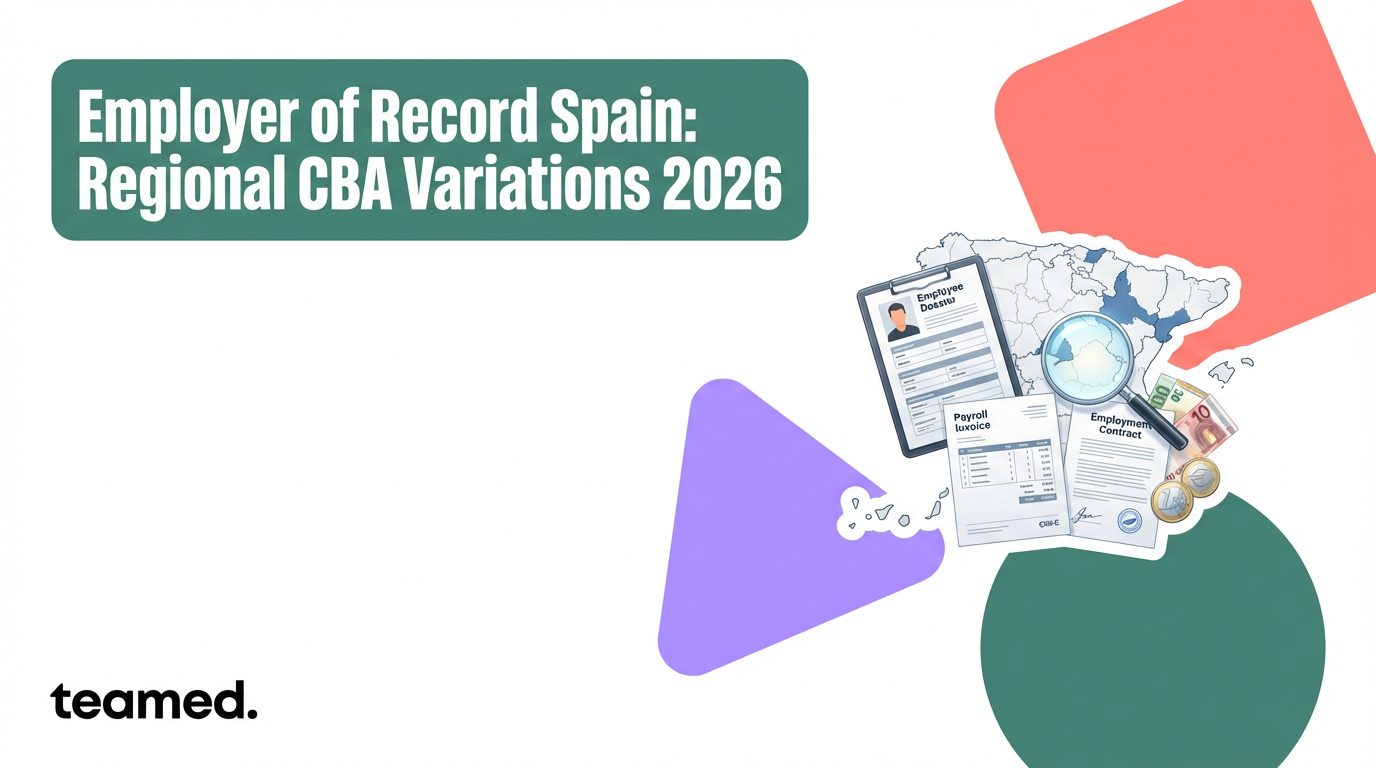
Employer of Record in Spain: Regional Variations in Collective Bargaining Agreements for 2026

Compliance
This article is for informational purposes only and does not constitute legal, tax, or compliance advice. Always consult a qualified professional before acting on any information provided.

Employer of Record in Spain: Regional Variations in Collective Bargaining Agreements for 2026

You've just hired your first employee in Barcelona. The offer letter looks solid, the salary benchmarks check out, and your EOR provider confirms everything is compliant. Three months later, your CFO receives an invoice adjustment because the employee's role actually falls under a provincial convenio colectivo with a higher pay floor than the national sector agreement your provider assumed.

This scenario plays out constantly for mid-market companies expanding into Spain. The country's collective bargaining system operates across 17 Autonomous Communities, with agreements that can vary by sector, province, and even individual company—creating labour cost variations as significant as €44,458 in Madrid versus €30,542 in Extremadura. An Employer of Record that treats Spain as a single jurisdiction with uniform rules will eventually get caught by these regional variations.

Teamed is the trusted global employment expert for companies who need the right structure for where they are, and trusted advice for where they're going, from first hire to your own presence in-country. Spain's CBA complexity is precisely the kind of challenge that separates advisory-led EOR providers from platform-only solutions.

What Actually Matters About Spain's CBAs in 2026

Spain has 17 regions plus Ceuta and Melilla. That's 19 different places where the rules can change. Your provider needs to know which collective bargaining agreement applies to each person you hire, based on exactly where they work.

To get Spain right, you need three things for every hire: where they'll work, what your business does there, and what they'll actually do day to day. Miss any of these and you'll get the wrong convenio, which means the wrong pay calculations.

Here's what trips up most audits: the job title on paper doesn't match what the person actually does. You hired a 'Marketing Manager' but they're doing sales work. The convenio knows the difference, and so will the auditor.

For multi-site Spanish workforces, the number of potentially relevant convenios rises with footprint because CBAs can exist at national, Autonomous Community, and provincial levels.

Provincial CBAs are particularly common in sectors with high local employer association density, including hospitality, retail, and logistics—with 4.1 million workers under provincial sector agreements compared to 3.9 million under national ones—which is why an EOR must validate province-by-province rather than assume a single national sector agreement applies.

What You'll Accomplish

By following this guide, you'll understand how to identify the correct collective bargaining agreement for any Spanish hire, evaluate whether your EOR provider can handle regional CBA variations, and build audit-ready documentation that satisfies both Finance and Legal. Expect to spend 15-20 minutes reading, with implementation time varying based on your current Spain footprint.

Before You Trust Anyone with Spain Payroll

Before evaluating EOR providers or mapping convenio requirements, you'll need clarity on three things. First, confirm the specific work locations for each Spanish employee, including whether they work remotely from a different province than your registered office—a critical consideration given 47.7% of eligible Spanish workers teleworked in 2025. Second, identify your company's business activity code (CNAE) in Spain, as this determines which sector agreements apply. Third, document the actual job duties for each role, not just titles, since classification depends on function rather than nomenclature.

You'll also need access to your current employment contracts and payroll records if you're already operating in Spain. If you're working with an existing EOR, request their convenio determination documentation for each employee file.

First: Know Where Your People Are and What They Do

Start by creating a simple matrix of every Spanish employee or planned hire. For each person, record their principal work location at the province level, not just the Autonomous Community. Madrid, Barcelona, Valencia, and Seville each have distinct provincial agreements in many sectors that differ from broader regional or national CBAs.

Next, align each role to your company's primary business activity. A tech company hiring a customer support representative in Málaga might assume national tech sector agreements apply, but if that role primarily serves hospitality clients, the provincial hospitality convenio could take precedence based on functional scope rules.

The expected result from this step is a clear inventory showing employee name, province, sector alignment, and job function. This becomes the foundation for convenio determination.

Which Convenio Actually Applies (And Why It Matters)

Spanish CBAs operate in a hierarchy: national, Autonomous Community, provincial, and company-level agreements—with higher-than-company agreements covering 11.3 million workers versus only 749,510 under company-specific agreements. The applicable convenio depends on territorial scope (where the work happens) and functional scope (what sector the work falls under), not employer preference.

For each role in your matrix, work through this sequence. Check whether a company-level CBA exists and has been validly negotiated with proper representational legitimacy. If not, identify whether a provincial convenio covers your sector in that specific province. If no provincial agreement exists, look for an Autonomous Community agreement. Finally, fall back to the national sector agreement only when no more specific territorial agreement applies.

A single role title like "Account Manager" often maps to multiple CBA categories with different pay floors depending on sector and province. Teamed's Spain benchmarking approach validates these variations during offer creation to prevent downstream compliance issues.

Where Most Providers Get Burned: Job Classifications

Once you've identified the applicable convenio, match each employee's actual duties to the agreement's professional group and job category definitions. This is where most compliance failures occur.

Spanish convenios define professional groups with associated pay tables, and misclassification risk arises when the employee's actual duties align to a higher category than the one used for payroll. Understanding Spain's mandatory benefits and pay structures becomes essential when these classifications affect total compensation obligations. If your marketing coordinator regularly manages external agency relationships and budget authority, they may fall into a higher classification than a coordinator role without those responsibilities.

Document the specific convenio article and classification table you're using, the employee's duties that justify that classification, and the resulting minimum pay floor. This documentation becomes essential for audit defence and invoice validation.

The Absorbability Trap (And How to Avoid It)

Spanish convenios frequently regulate which salary components are "absorbable/compensable" against future increases and which are strictly additive. Getting this wrong creates compliance risk that compounds over time.

When structuring offers, separate base salary from supplements and variable pay. Many convenios define specific supplements for seniority, shift work, or dangerous conditions that cannot be absorbed into base salary increases. If your employee's total compensation includes commissions or bonuses, verify whether the applicable convenio treats these as absorbable or additive.

In Spanish payroll operations, compliance risk increases when variable pay is used because many convenios define which supplements are absorbable versus strictly additive, according to Teamed's payroll QA findings. Structure payslips to clearly distinguish between components.

When to Revisit the Convenio (Before It Becomes a Problem)

CBA compliance isn't a one-time exercise. Several events should trigger a convenio re-evaluation: employee transfers between provinces, promotions that change job classification, remote work arrangements that shift the principal place of work, and convenio updates that introduce new pay tables or effective dates.

Changes in work location can change the applicable territorial convenio rules. An employee who relocates from Madrid to Barcelona may fall under a different provincial agreement, requiring contract amendments and payroll adjustments. Treat province changes as compliance events requiring fresh convenio determination.

Build a calendar for monitoring convenio renewals in your relevant sectors. When agreements update, your EOR must implement changes from the correct effective date and retain the updated convenio version used for calculation.

What a Good Provider Will Actually Show You in Spain

Here's the difference: a good provider gives you written documentation showing which convenio applies, why that classification was chosen, and who made the decision. Others give you a ticket number and hope you don't ask questions. If they can't show their reasoning, you're the one carrying the risk.

When evaluating providers, ask specific questions. Does the EOR provide written convenio determination and classification rationale for each employee file? Can they operationally support multi-site employment when employees work in different provinces? Do they have escalation access to Spanish labour counsel for edge cases like convenio conflicts or ultra-activity transitions?

If you're hiring in hospitality, retail, logistics, or contact centres, assume the local convenio will override the national one. These sectors have specific rules in almost every province. Ask your provider to prove they know the local agreements, not just the national defaults.

Capability Platform-Led EOR Advisory-Led EOR
Convenio documentation Ticket-based, often undocumented Written rationale per employee
Classification validation Automated matching by title Duty-based analysis with legal review
Multi-province support Single national assumption Province-specific determination
Convenio update implementation Reactive, often delayed Someone watches renewal dates and tells you what changes
Legal escalation Chatbot or offshore queue Named Spanish counsel access

What Happens When Convenios Conflict or Expire?

Ultra-activity (ultraactividad) in Spanish collective bargaining keeps a CBA's terms in effect after its stated expiry date until replaced by a new agreement or a legally applicable fallback applies. This creates uncertainty for employers during negotiation periods.

When a convenio expires, your EOR should continue applying its terms while monitoring for replacement agreements. The risk comes when a new agreement introduces retroactive pay adjustments or classification changes. Your provider needs processes to implement these changes correctly and manage any back-pay obligations.

Company-level CBAs differ from sectoral agreements because they require a valid negotiation process with defined representational legitimacy. If your Spanish headcount grows to the point where works council formation becomes relevant, you may need to consider whether a company-level agreement makes strategic sense.

How to Check Your Provider Isn't Guessing

Request a sample employee file from your EOR showing the complete convenio determination workflow. A practical audit-ready minimum for Spain CBA governance is a maintained matrix of employee, work location, sector, convenio, classification, and pay minima. Teamed uses this structure as the standard artefact for cross-functional HR, Finance, and Legal sign-off.

Check that the file includes the specific convenio reference and publication date, the scope rationale explaining why this agreement applies, the classification mapping with supporting duty analysis, the pay table snapshot showing minimum floors, and an effective-date log for any changes.

No documentation means you'll find out they guessed when it matters most: during an audit, when an employee challenges their classification, or when the labour inspector shows up asking questions.

When the Invoice Suddenly Changes

When invoices don't match expected costs, the most common cause is mid-period convenio updates that introduced new pay floors or supplements. Request the specific convenio version and effective date your EOR used for calculation.

If an employee disputes their classification, compare their actual duties against the convenio's professional group definitions. The resolution depends on function, not title, and may require contract amendments if the classification was incorrect.

For multi-province teams experiencing inconsistent treatment, verify that your EOR is performing province-specific convenio determination rather than applying a single national assumption. This is particularly important in sectors like hospitality and retail where provincial agreements are common.

When to Stop Using EOR and Set Up Your Own Spanish Entity

Spain falls into Tier 2 (moderate complexity) in Teamed's Graduation Model framework, with an entity transition threshold of 15-20 employees for native language operations or 20-30 employees when operating in a non-native language. The Graduation Model is Teamed's proprietary framework for guiding companies through sequential employment model transitions, providing continuity through a single advisory relationship and avoiding the disruption of switching providers at each stage.

Choose an EOR when you need to hire in under 6-8 weeks without incorporating a Spanish entity and you still need local compliance coverage for convenios, payroll, and statutory filings. Choose a Spanish entity when you expect sustained headcount across multiple provinces and need direct control over CBA negotiations, works council strategy, or union engagement.

The economics shift when your annual EOR costs multiplied by expected years exceed entity setup cost plus ongoing annual costs. For Spain, factor in the complexity of managing multiple provincial convenios when calculating the administrative burden of direct employment.

How to Stop This Becoming a Recurring Spain Problem

If you're currently operating in Spain with incomplete convenio documentation, start by auditing your existing employee files against the standards outlined here. Identify gaps in classification rationale, missing convenio references, or provinces where determination hasn't been validated.

For companies planning Spain expansion, build convenio determination into your hiring workflow from day one. Require written documentation before any offer goes out, and establish clear triggers for re-evaluation when circumstances change.

If your current EOR can't demonstrate the capabilities described here, you're not getting the compliance confidence you're paying for. The right structure for where you are means having a provider who understands that Spain isn't one jurisdiction but seventeen, each with its own collective bargaining landscape.

Want to know if your Spain setup will survive an audit? Book your Situation Room. Bring your current convenio documentation (if you have any) and we'll tell you where the risks are and exactly what to do about them. Whether that includes working with us or not.
Employer of Record in Spain: Regional Variations in Collective Bargaining Agreements for 2026

You've just hired your first employee in Barcelona. The offer letter looks solid, the salary benchmarks check out, and your EOR provider confirms everything is compliant. Three months later, your CFO receives an invoice adjustment because the employee's role actually falls under a provincial convenio colectivo with a higher pay floor than the national sector agreement your provider assumed.

This scenario plays out constantly for mid-market companies expanding into Spain. The country's collective bargaining system operates across 17 Autonomous Communities, with agreements that can vary by sector, province, and even individual company—creating labour cost variations as significant as €44,458 in Madrid versus €30,542 in Extremadura. An Employer of Record that treats Spain as a single jurisdiction with uniform rules will eventually get caught by these regional variations.

Teamed is the trusted global employment expert for companies who need the right structure for where they are, and trusted advice for where they're going, from first hire to your own presence in-country. Spain's CBA complexity is precisely the kind of challenge that separates advisory-led EOR providers from platform-only solutions.

What Actually Matters About Spain's CBAs in 2026

Spain has 17 regions plus Ceuta and Melilla. That's 19 different places where the rules can change. Your provider needs to know which collective bargaining agreement applies to each person you hire, based on exactly where they work.

To get Spain right, you need three things for every hire: where they'll work, what your business does there, and what they'll actually do day to day. Miss any of these and you'll get the wrong convenio, which means the wrong pay calculations.

Here's what trips up most audits: the job title on paper doesn't match what the person actually does. You hired a 'Marketing Manager' but they're doing sales work. The convenio knows the difference, and so will the auditor.

For multi-site Spanish workforces, the number of potentially relevant convenios rises with footprint because CBAs can exist at national, Autonomous Community, and provincial levels.

Provincial CBAs are particularly common in sectors with high local employer association density, including hospitality, retail, and logistics—with 4.1 million workers under provincial sector agreements compared to 3.9 million under national ones—which is why an EOR must validate province-by-province rather than assume a single national sector agreement applies.

What You'll Accomplish

By following this guide, you'll understand how to identify the correct collective bargaining agreement for any Spanish hire, evaluate whether your EOR provider can handle regional CBA variations, and build audit-ready documentation that satisfies both Finance and Legal. Expect to spend 15-20 minutes reading, with implementation time varying based on your current Spain footprint.

Before You Trust Anyone with Spain Payroll

Before evaluating EOR providers or mapping convenio requirements, you'll need clarity on three things. First, confirm the specific work locations for each Spanish employee, including whether they work remotely from a different province than your registered office—a critical consideration given 47.7% of eligible Spanish workers teleworked in 2025. Second, identify your company's business activity code (CNAE) in Spain, as this determines which sector agreements apply. Third, document the actual job duties for each role, not just titles, since classification depends on function rather than nomenclature.

You'll also need access to your current employment contracts and payroll records if you're already operating in Spain. If you're working with an existing EOR, request their convenio determination documentation for each employee file.

First: Know Where Your People Are and What They Do

Start by creating a simple matrix of every Spanish employee or planned hire. For each person, record their principal work location at the province level, not just the Autonomous Community. Madrid, Barcelona, Valencia, and Seville each have distinct provincial agreements in many sectors that differ from broader regional or national CBAs.

Next, align each role to your company's primary business activity. A tech company hiring a customer support representative in Málaga might assume national tech sector agreements apply, but if that role primarily serves hospitality clients, the provincial hospitality convenio could take precedence based on functional scope rules.

The expected result from this step is a clear inventory showing employee name, province, sector alignment, and job function. This becomes the foundation for convenio determination.

Which Convenio Actually Applies (And Why It Matters)

Spanish CBAs operate in a hierarchy: national, Autonomous Community, provincial, and company-level agreements—with higher-than-company agreements covering 11.3 million workers versus only 749,510 under company-specific agreements. The applicable convenio depends on territorial scope (where the work happens) and functional scope (what sector the work falls under), not employer preference.

For each role in your matrix, work through this sequence. Check whether a company-level CBA exists and has been validly negotiated with proper representational legitimacy. If not, identify whether a provincial convenio covers your sector in that specific province. If no provincial agreement exists, look for an Autonomous Community agreement. Finally, fall back to the national sector agreement only when no more specific territorial agreement applies.

A single role title like "Account Manager" often maps to multiple CBA categories with different pay floors depending on sector and province. Teamed's Spain benchmarking approach validates these variations during offer creation to prevent downstream compliance issues.

Where Most Providers Get Burned: Job Classifications

Once you've identified the applicable convenio, match each employee's actual duties to the agreement's professional group and job category definitions. This is where most compliance failures occur.

Spanish convenios define professional groups with associated pay tables, and misclassification risk arises when the employee's actual duties align to a higher category than the one used for payroll. Understanding Spain's mandatory benefits and pay structures becomes essential when these classifications affect total compensation obligations. If your marketing coordinator regularly manages external agency relationships and budget authority, they may fall into a higher classification than a coordinator role without those responsibilities.

Document the specific convenio article and classification table you're using, the employee's duties that justify that classification, and the resulting minimum pay floor. This documentation becomes essential for audit defence and invoice validation.

The Absorbability Trap (And How to Avoid It)

Spanish convenios frequently regulate which salary components are "absorbable/compensable" against future increases and which are strictly additive. Getting this wrong creates compliance risk that compounds over time.

When structuring offers, separate base salary from supplements and variable pay. Many convenios define specific supplements for seniority, shift work, or dangerous conditions that cannot be absorbed into base salary increases. If your employee's total compensation includes commissions or bonuses, verify whether the applicable convenio treats these as absorbable or additive.

In Spanish payroll operations, compliance risk increases when variable pay is used because many convenios define which supplements are absorbable versus strictly additive, according to Teamed's payroll QA findings. Structure payslips to clearly distinguish between components.

When to Revisit the Convenio (Before It Becomes a Problem)

CBA compliance isn't a one-time exercise. Several events should trigger a convenio re-evaluation: employee transfers between provinces, promotions that change job classification, remote work arrangements that shift the principal place of work, and convenio updates that introduce new pay tables or effective dates.

Changes in work location can change the applicable territorial convenio rules. An employee who relocates from Madrid to Barcelona may fall under a different provincial agreement, requiring contract amendments and payroll adjustments. Treat province changes as compliance events requiring fresh convenio determination.

Build a calendar for monitoring convenio renewals in your relevant sectors. When agreements update, your EOR must implement changes from the correct effective date and retain the updated convenio version used for calculation.

What a Good Provider Will Actually Show You in Spain

Here's the difference: a good provider gives you written documentation showing which convenio applies, why that classification was chosen, and who made the decision. Others give you a ticket number and hope you don't ask questions. If they can't show their reasoning, you're the one carrying the risk.

When evaluating providers, ask specific questions. Does the EOR provide written convenio determination and classification rationale for each employee file? Can they operationally support multi-site employment when employees work in different provinces? Do they have escalation access to Spanish labour counsel for edge cases like convenio conflicts or ultra-activity transitions?

If you're hiring in hospitality, retail, logistics, or contact centres, assume the local convenio will override the national one. These sectors have specific rules in almost every province. Ask your provider to prove they know the local agreements, not just the national defaults.

Capability Platform-Led EOR Advisory-Led EOR
Convenio documentation Ticket-based, often undocumented Written rationale per employee
Classification validation Automated matching by title Duty-based analysis with legal review
Multi-province support Single national assumption Province-specific determination
Convenio update implementation Reactive, often delayed Someone watches renewal dates and tells you what changes
Legal escalation Chatbot or offshore queue Named Spanish counsel access

What Happens When Convenios Conflict or Expire?

Ultra-activity (ultraactividad) in Spanish collective bargaining keeps a CBA's terms in effect after its stated expiry date until replaced by a new agreement or a legally applicable fallback applies. This creates uncertainty for employers during negotiation periods.

When a convenio expires, your EOR should continue applying its terms while monitoring for replacement agreements. The risk comes when a new agreement introduces retroactive pay adjustments or classification changes. Your provider needs processes to implement these changes correctly and manage any back-pay obligations.

Company-level CBAs differ from sectoral agreements because they require a valid negotiation process with defined representational legitimacy. If your Spanish headcount grows to the point where works council formation becomes relevant, you may need to consider whether a company-level agreement makes strategic sense.

How to Check Your Provider Isn't Guessing

Request a sample employee file from your EOR showing the complete convenio determination workflow. A practical audit-ready minimum for Spain CBA governance is a maintained matrix of employee, work location, sector, convenio, classification, and pay minima. Teamed uses this structure as the standard artefact for cross-functional HR, Finance, and Legal sign-off.

Check that the file includes the specific convenio reference and publication date, the scope rationale explaining why this agreement applies, the classification mapping with supporting duty analysis, the pay table snapshot showing minimum floors, and an effective-date log for any changes.

No documentation means you'll find out they guessed when it matters most: during an audit, when an employee challenges their classification, or when the labour inspector shows up asking questions.

When the Invoice Suddenly Changes

When invoices don't match expected costs, the most common cause is mid-period convenio updates that introduced new pay floors or supplements. Request the specific convenio version and effective date your EOR used for calculation.

If an employee disputes their classification, compare their actual duties against the convenio's professional group definitions. The resolution depends on function, not title, and may require contract amendments if the classification was incorrect.

For multi-province teams experiencing inconsistent treatment, verify that your EOR is performing province-specific convenio determination rather than applying a single national assumption. This is particularly important in sectors like hospitality and retail where provincial agreements are common.

When to Stop Using EOR and Set Up Your Own Spanish Entity

Spain falls into Tier 2 (moderate complexity) in Teamed's Graduation Model framework, with an entity transition threshold of 15-20 employees for native language operations or 20-30 employees when operating in a non-native language. The Graduation Model is Teamed's proprietary framework for guiding companies through sequential employment model transitions, providing continuity through a single advisory relationship and avoiding the disruption of switching providers at each stage.

Choose an EOR when you need to hire in under 6-8 weeks without incorporating a Spanish entity and you still need local compliance coverage for convenios, payroll, and statutory filings. Choose a Spanish entity when you expect sustained headcount across multiple provinces and need direct control over CBA negotiations, works council strategy, or union engagement.

The economics shift when your annual EOR costs multiplied by expected years exceed entity setup cost plus ongoing annual costs. For Spain, factor in the complexity of managing multiple provincial convenios when calculating the administrative burden of direct employment.

How to Stop This Becoming a Recurring Spain Problem

If you're currently operating in Spain with incomplete convenio documentation, start by auditing your existing employee files against the standards outlined here. Identify gaps in classification rationale, missing convenio references, or provinces where determination hasn't been validated.

For companies planning Spain expansion, build convenio determination into your hiring workflow from day one. Require written documentation before any offer goes out, and establish clear triggers for re-evaluation when circumstances change.

If your current EOR can't demonstrate the capabilities described here, you're not getting the compliance confidence you're paying for. The right structure for where you are means having a provider who understands that Spain isn't one jurisdiction but seventeen, each with its own collective bargaining landscape.

Want to know if your Spain setup will survive an audit? Book your Situation Room. Bring your current convenio documentation (if you have any) and we'll tell you where the risks are and exactly what to do about them. Whether that includes working with us or not.
TABLE OF CONTENTS

Take a look
at the latest articles