
Case Study
What Your EOR Actually Does (And Doesn't Do): The audit that asked questions nobody could answer

Tom Price-Daniel

12 minutes

May 6, 2026
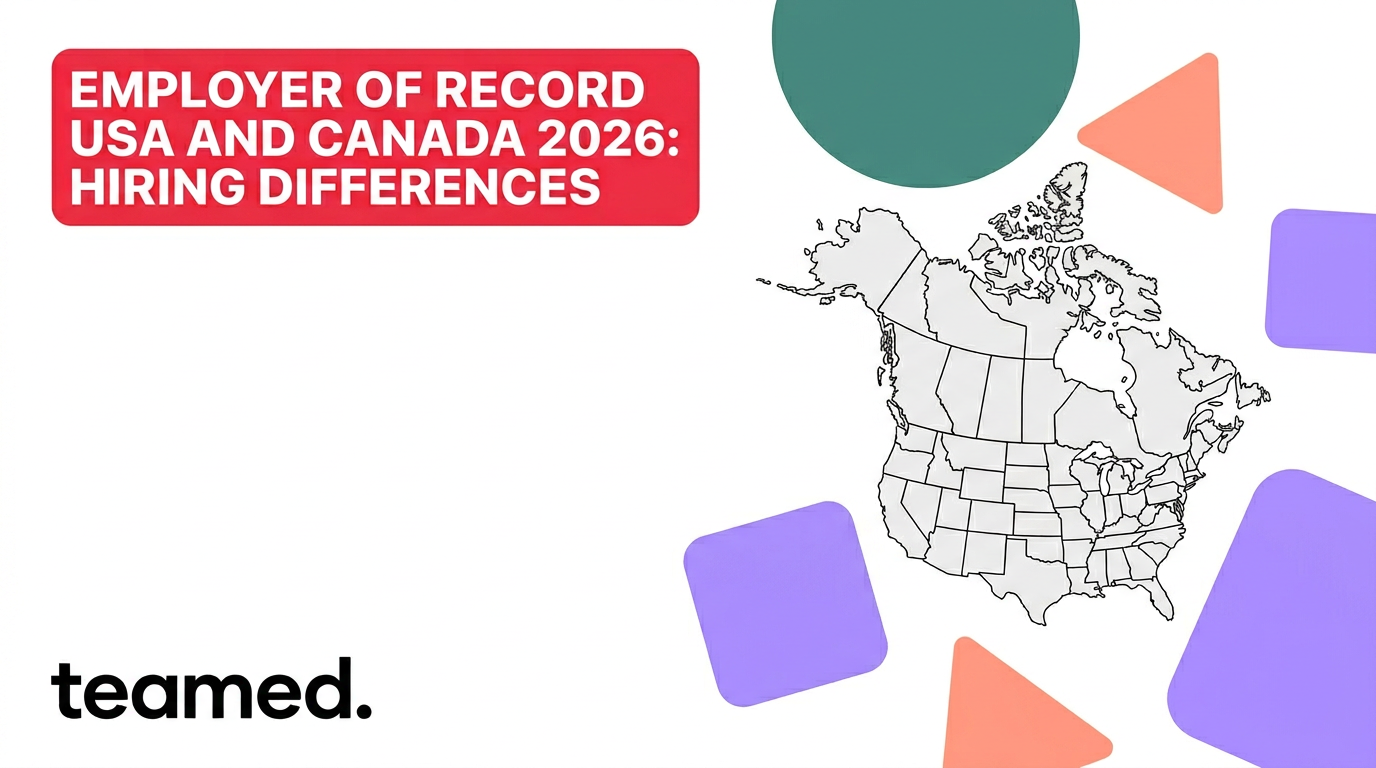
Your CFO just approved headcount for both the US and Canada. The job descriptions are ready, candidates are in pipeline, and someone in HR is now staring at a spreadsheet trying to figure out how to make one hiring plan work across two countries with different payroll systems, tax structures, and benefits expectations.
Teamed is the unified global employment partner for mid-market companies managing international teams across multiple platforms, vendors, and employment models. We've guided over 1,000 companies through exactly this scenario, and the pattern is consistent: teams that treat US and Canada as "basically the same" run into payroll failures, benefits gaps, and compliance surprises within the first 90 days.
By the end of this guide, you'll know exactly where US and Canada hiring breaks down, which vendors can actually handle both markets, and how to get first payroll right without the usual chaos.
If you want first pay to land on time in both countries, budget at least two to three weeks once you've handed over clean employee data. That's based on what we've seen across hundreds of implementations.
US payroll processing cutoffs are often 2-5 business days before pay date, and missing the cutoff typically pushes payment to the next cycle even if onboarding is otherwise complete.
Canadian direct deposit prenote or banking validation commonly takes 3-5 business days when a new employee bank account is added, which is a frequent cause of first-payroll exceptions if started late.
A dual-country EOR rollout usually requires collecting 20-35 unique data fields per hire before payroll can be configured without manual rework.
A practical vendor shortlist for US and Canada EOR selection is usually 3-5 providers because each additional provider adds security review, legal redlining, and parallel payroll validation work that typically extends timelines by 1-2 weeks.
An Employer of Record (EOR) is a third-party organisation that becomes the legal employer of a worker in a specific country, running local payroll, statutory tax filings, and employment administration while the client controls day-to-day work. The EOR handles payroll, taxes, and compliance with local employment law, while your team still reports to you and works on your projects.
For companies hiring in both the US and Canada without established entities in either country, an EOR typically makes sense when you need to hire in under 30 days, when you're testing market demand before committing to entity formation, or when you have fewer than 10 employees planned per country over the next 12 months.
The alternative is establishing your own legal entity in each country. Choose a local entity when you expect sustained hiring of 10+ employees in either the US or Canada within 12 months and you need direct control over benefits plan design, signatory authority, and local policies. Entity establishment in both the US and Canada typically takes 2-4 months and requires ongoing compliance infrastructure.
A third option exists for the US specifically: a Professional Employer Organisation (PEO). Choose a PEO in the US when you already have a US entity and want co-employment access to broader group benefits and HR administration while retaining primary employer status. An EOR differs from a PEO in risk allocation because an EOR is the legal employer of the worker in-country, while a PEO typically relies on the client's local entity and a co-employment structure.
The assumption that US and Canada employment works similarly because both are North American markets causes more first-payroll failures than any other misconception. Here's what actually differs.
US payroll is materially state- and sometimes city-specific. An employee in California faces different withholding requirements than an employee in Texas, and New York City adds local income tax of 3.078% to 3.876% on top of state requirements. Your EOR must support state-level tax registration and remittance for every state where you have employees.
Canadian payroll is primarily federal plus province-based with fewer local withholding layers. The Canada Pension Plan (CPP) and Employment Insurance (EI) deductions apply nationally, with provincial income tax calculated based on the employee's province of residence. Quebec operates its own pension plan (QPP) with a 6.30% contribution rate versus 5.95% for CPP, and requires separate registration.
Running US and Canadian payroll together differs from running either alone because each country uses distinct statutory deductions, remittance schedules, and year-end reporting formats. A provider must support two parallel compliance calendars without forcing one country's workflow onto the other.
US employment administration differs from Canadian employment administration in benefits expectations because US hires often expect employer-sponsored medical coverage as a primary hiring criterion, with 87% of full-time private-industry workers having access to medical care benefits. In the US, health insurance is frequently the deciding factor in whether a candidate accepts an offer.
Canadian hires typically treat supplemental health and dental plans as the key add-on to public healthcare, with 66.8% of employees having workplace medical or dental benefits. The provincial healthcare systems cover most medical expenses, so employer-sponsored benefits focus on prescription drugs, dental, vision, and extended health services.
A US and Canada EOR rollout that includes benefits enrollment typically needs at least 7-10 calendar days of lead time before the intended coverage start date because carrier rules and eligibility windows can delay effective dates beyond the hire date.
US termination compliance in most states follows at-will employment principles, meaning employers can terminate without cause in most circumstances. However, California and New York have significantly more complex requirements including final-pay timing rules and extensive leave entitlements.
Canadian termination compliance requires careful handling of notice or pay-in-lieu concepts at the province level. Ontario, for example, requires written notice or pay-in-lieu based on length of service, and common law notice periods can exceed statutory minimums significantly.
Start by documenting what you actually need, not what vendors want to sell you. Map your hiring timeline, expected headcount by country, benefits requirements, and integration needs with existing HR systems.
For US and Canada specifically, clarify whether you need the same provider for both countries or whether country-specialist providers make more sense. Choose a single EOR vendor for both the US and Canada when you require unified reporting, one invoice cadence, consistent onboarding workflows, and one support escalation path across both countries.
Choose separate country-specialist providers when benefits competitiveness is a priority and you need deeper carrier choice, region-specific HR advisory, or province/state-specific policy support that a generalist may not offer.
A practical vendor shortlist for US and Canada EOR selection is usually 3-5 providers. Each additional provider adds security review, legal redlining, and parallel payroll validation work that extends timelines.
EOR selection projects in mid-market companies commonly involve 3 core stakeholders (HR, Finance, and Legal/Compliance) and 6-12 total approvers or contributors once security, IT, and procurement are included.
Ask specific questions about state-level US compliance. Can the provider support employees in California with its meal and rest break requirements? What about New York's final pay on termination day rules?
For Canada, verify Quebec capabilities separately. The QPP, QPIP, and French-language documentation requirements mean Quebec operations require distinct compliance infrastructure.
On benefits, understand exactly what plans are available and how enrolment timing works. Generic statements about "competitive benefits" don't tell you whether the medical plan will meet candidate expectations in your target markets.
Before committing to a full rollout, run a pilot hire in each country. This surfaces integration issues, payroll timing problems, and support responsiveness before they affect your entire workforce.
The pilot should include a complete payroll cycle with all deductions, benefits enrollment with actual coverage verification, and at least one support escalation to test response times.
Once the pilot validates the provider's capabilities, scale to your full hiring plan. Maintain the same data collection discipline and payroll cutoff awareness that made the pilot successful.
Red flags to watch for include opaque fee structures where you can't see line-item costs, limited benefits options that won't meet candidate expectations, and support models that route you to chatbots or offshore queues for complex questions.
HR responsibilities: Finalise job descriptions and compensation structures for both countries. Collect employee data including identity documents, tax residency indicators, bank details, and emergency contacts. A dual-country EOR rollout usually requires collecting 20-35 unique data fields per hire.
Finance responsibilities: Confirm budget allocation by country. Establish invoice processing workflows. Verify currency handling for CAD and USD payments.
Legal/Compliance responsibilities: Review employment contracts for both jurisdictions. Confirm worker classification rationale. Document right-to-work verification requirements.
Expected outcome: Complete data handoff to EOR provider with all required fields populated.
HR responsibilities: Complete benefits enrolment with adequate lead time. Verify onboarding documentation is signed and filed. Confirm work location accuracy for tax purposes.
Finance responsibilities: Validate payroll preview reports before processing. Confirm banking details are verified in both countries. Establish gross-to-net reconciliation process.
Legal/Compliance responsibilities: Verify employment contracts are compliant with provincial/state requirements. Confirm I-9 completion for US employees. Document SIN collection for Canadian employees.
Expected outcome: First payroll runs accurately in both countries with no payment delays.
HR responsibilities: Conduct employee experience check-ins. Document any onboarding friction points. Establish ongoing support escalation procedures.
Finance responsibilities: Complete first payroll reconciliation. Verify all statutory remittances were filed correctly. Establish ongoing reporting cadence.
Legal/Compliance responsibilities: Audit employment documentation for completeness. Verify benefits coverage is active as expected. Document any compliance gaps for remediation.
Expected outcome: Stable ongoing operations with documented processes for future hires.
Late cutoff submission: US payroll processing cutoffs are often 2-5 business days before pay date. Missing the cutoff pushes payment to the next cycle. Prevention: Build cutoff dates into your project timeline with 2-day buffer.
Banking validation delays: Canadian direct deposit prenote commonly takes 3-5 business days. Starting this process late causes payment failures. Prevention: Collect bank details during offer acceptance, not after start date.
Missing tax forms: US employees need W-4 completion. Canadian employees need TD1 forms for both federal and provincial withholding. Prevention: Include tax form completion in pre-boarding checklist.
Incorrect work location: State and provincial tax withholding depends on where the employee actually works, not where the company is headquartered. Prevention: Verify physical work location during onboarding.
Benefits deduction timing: Coverage effective dates and payroll deduction start dates don't always align. Prevention: Confirm benefits enrolment timing with carrier rules before communicating coverage dates to employees.
Teamed's graduation model provides a framework for this decision. The transition from EOR to owned entity typically makes economic sense when you reach 10+ employees in either the US or Canada, when you're planning a 3+ year presence in the market with stable or growing headcount, and when your annual EOR costs exceed what entity setup plus ongoing administration would cost.
Both the US and Canada are classified as Tier 1 (low complexity) jurisdictions in Teamed's Country Concentration Framework, meaning the entity threshold is 10+ employees for native English operations. The common law systems, English operating language, and predictable regulatory frameworks in both countries make entity establishment relatively straightforward compared to higher-complexity markets.
The graduation model advantage is continuity. Working with a single advisory relationship that supports you from EOR through entity transition eliminates the disruption of switching providers and re-onboarding employees when your employment model evolves.
Hiring across the US and Canada with a single EOR strategy is entirely achievable, but it requires understanding the operational differences between the two systems and planning for them explicitly. The companies that struggle are the ones that assume similarity and discover the differences during their first payroll run.
The companies that succeed build their implementation timeline around the actual requirements: 10-15 business days minimum from data handoff to pay-date readiness, separate attention to state-level US compliance and provincial Canadian requirements, and realistic expectations about benefits enrollment timing.
If you're evaluating EOR providers for US and Canada hiring and want to validate your approach before committing, talk to the experts at Teamed. We can review your specific situation and help you build an implementation plan that accounts for the operational realities of both markets.
Last month, a UK fintech's CFO called us in a panic. Their lead developer had been working from their New York office for four months, and suddenly their payroll provider was asking about U.S. tax withholding. Nobody had tracked the days. Nobody knew who owned what. The scramble to fix it cost them weeks and thousands in penalties.
The answer depends almost entirely on one thing most HR leaders don't fully understand until it's too late: U.S. tax residency status. The IRS doesn't care about your passport or visa type. It cares about whether you're a "resident alien" or "nonresident alien" for tax purposes, and that single classification determines whether the U.S. taxes your worldwide income or just your U.S.-source earnings.
Teamed is the unified global employment partner for mid-market companies managing international teams across multiple platforms, vendors, and employment models. We've seen European companies stumble into unexpected U.S. tax obligations because nobody mapped the residency rules to their actual workforce movements. This guide gives you the decision framework to avoid that.
If you're paying dividends, royalties, or interest to a nonresident, the starting withholding rate is 30% unless you have treaty paperwork on file that says otherwise.
The IRS counts days using a three-year weighted formula: all current year days, plus one-third of last year's days, plus one-sixth of the year before that. Hit 183 total, and you're a U.S. tax resident. This is the calculation HR should run before any assignment extension.
A person must be physically present in the U.S. for at least 31 days in the current year to potentially meet the substantial presence test.
U.S. federal payroll taxes for employees include Social Security tax of 6.2% and Medicare tax of 1.45% withheld from wages, with matching employer contributions at the same rates.
Nonresidents file Form 1040-NR for U.S.-source income only. Residents file Form 1040 for worldwide income.
If your finance team is paying a non-U.S. person, you'll need a W-8BEN (individuals) or W-8BEN-E (entities) to justify any treaty rate reduction. Without it, you withhold at 30%.
A foreigner for U.S. tax purposes is an individual who is not a U.S. citizen and is classified by the IRS as either a resident alien or a nonresident alien for federal income tax rules. This classification has nothing to do with immigration status, visa type, or where your employer is headquartered.
The distinction matters because it determines the scope of U.S. taxation. Resident aliens are generally taxed on worldwide income, just like U.S. citizens. Nonresident aliens are generally taxed only on U.S.-source income and certain income effectively connected with a U.S. trade or business.
Here's where European HR teams often get tripped up: many visa holders become resident aliens under the substantial presence test without realising it. A UK employee on a short-term U.S. assignment can accidentally trigger U.S. tax residency through accumulated days, creating unexpected withholding obligations for the employer.
The IRS uses two primary tests to determine whether a non-citizen is a resident alien: the green card test and the substantial presence test. Meeting either one makes you a U.S. tax resident.
The green card test is straightforward. A person is a U.S. tax resident for any calendar year in which they are a lawful permanent resident (green card holder) at any time, unless a treaty position is properly claimed and documented. This applies regardless of how many days they actually spend in the U.S.
The substantial presence test catches more people than most expect. You meet this test if you're physically present in the U.S. for at least 31 days during the current year AND at least 183 days using a weighted three-year formula.
The formula works like this: count all days present in the current year, plus one-third of the days present in the prior year, plus one-sixth of the days present in the second prior year. If that total reaches 183, you've met the test.
Consider a German project manager who spent 120 days in the U.S. in 2025, 90 days in 2024, and 60 days in 2023. The calculation: 120 + (90 × 1/3) + (60 × 1/6) = 120 + 30 + 10 = 160 days. Not a resident. But add another 25 days in 2025, and suddenly they've crossed the threshold.
Teamed highlights this as the most common "unexpected tax residency" trigger for short-term U.S. assignments from Europe. The 31-day minimum in the current year is a practical trip-planning control that HR teams should monitor.
Nonresident aliens face a different tax regime than residents. They're generally taxed only on U.S.-source income, but the rules for how that income is taxed vary significantly by income type.
Nonresidents deal with two income buckets: wages and business income from U.S. work (called ECI), and passive payments like dividends, interest, and royalties (called FDAP).
Effectively connected income is income connected with the conduct of a U.S. trade or business. This includes wages for work performed in the U.S., even if paid by a foreign employer. ECI is taxed at graduated federal income tax rates (10% to 37% in 2026), and the nonresident can claim deductions against this income.
FDAP income (fixed, determinable, annual, or periodical income) includes U.S. dividends, certain interest, rents, royalties, and similar passive payments. FDAP is typically subject to a flat 30% withholding tax on the gross amount, with no deductions allowed. Tax treaties can reduce this rate significantly.
Here's what catches European employers: states don't care about federal residency tests. They look at where the work happens. Work in California for a week? California wants its cut, regardless of your federal status.
California and New York are particularly aggressive. A nonresident who works even a few days in these states may trigger filing requirements and withholding obligations. California requires 7% withholding on California-source payments to nonresidents exceeding $1,500 annually.
For European companies, state tax creates a practical problem: you need state withholding registration, payroll infrastructure, and W-2 capability. Without a U.S. entity, that often means working through a U.S. payroll provider or EOR to handle the compliance properly.
Resident aliens face the same tax obligations as U.S. citizens. This means worldwide income reporting on Form 1040, including income earned outside the U.S.
Resident aliens report all income from all sources, whether earned in the U.S., the UK, Germany, or anywhere else. Federal income tax rates for 2026 range from 10% to 37%, depending on taxable income and filing status.
The good news: resident aliens can claim the Foreign Earned Income Exclusion (up to $132,900 in 2026) if they meet certain requirements, and they can use the Foreign Tax Credit to offset U.S. taxes with taxes paid to other countries. This prevents true double taxation in most cases.
Both resident and nonresident aliens working as employees in the U.S. generally owe payroll taxes. Social Security tax is 6.2% of wages up to the annual wage base ($184,500 for 2026). Medicare tax is 1.45% on all wages, with an additional 0.9% on wages exceeding $200,000.
Some nonresident aliens are exempt from FICA under specific visa categories (F-1 students, J-1 scholars for limited periods) or under totalization agreements between the U.S. and their home country. The UK, Germany, France, and most EU countries have such agreements.
The practical reality for most foreigners is that U.S. tax outcomes are driven by withholding at payment time, not by year-end tax computation. Understanding which income types trigger which withholding rules is essential for HR and Finance teams managing cross-border payments.
For U.S. federal self-employment tax, the combined Social Security and Medicare rate is 15.3% (12.4% Social Security + 2.9% Medicare) on net self-employment income. Teamed uses this figure when comparing U.S. employee versus contractor cost models for European companies expanding into the U.S.
Federal income tax differs from withholding tax because federal income tax is the final liability computed on a tax return, while withholding tax is a prepayment mechanism collected at the time of payment that can exceed or fall short of the final tax owed.
This distinction creates reconciliation problems for HR and Finance teams. A nonresident alien who had 30% withheld on U.S. dividends may owe less (if a treaty applies) or may have other income that wasn't subject to withholding. Either way, they typically must file a U.S. tax return to reconcile.
Nonresident aliens file Form 1040-NR. Resident aliens file Form 1040. The filing deadline is generally April 15 for residents and June 15 for nonresidents (with extensions available).
The document that controls withholding is often more important than the tax return filed months later. Getting this wrong creates immediate compliance exposure.
Form W-8BEN (for individuals) and W-8BEN-E (for entities) document foreign status and claim treaty benefits. Payers use these forms to determine whether to withhold at 30% or a reduced treaty rate. Without a valid W-8, payers must withhold at the full 30% rate.
These forms are critical for FDAP payments: dividends, royalties, certain interest, and similar passive income. They're also used for independent contractor payments to foreign persons.
Form W-9 is for U.S. persons, including resident aliens. If someone provides a W-9, the payer treats them as a U.S. person for withholding purposes. This means no automatic 30% withholding, but it also means the person is certifying U.S. tax status.
Form W-2 reports wages paid to employees. Form 1099 (various types) reports payments to non-employees. Both are information returns that help the IRS match reported income to tax returns.
Tax treaties between the U.S. and other countries can significantly change tax outcomes, but they don't change everything. Understanding what treaties typically modify, and what they don't, prevents costly assumptions.
Treaties commonly reduce FDAP withholding rates. The U.S.-UK treaty, for example, reduces dividend withholding from 30% to 15% (or 0% for certain pension funds). The U.S.-Germany treaty has similar provisions.
Treaties also provide exemptions for certain categories: students, trainees, teachers, and researchers may be exempt from U.S. tax on specific income types for limited periods. And treaties provide "tie-breaker" rules when someone might be considered a tax resident of both countries.
Treaties don't eliminate the need for documentation. You still need valid W-8 forms to claim treaty benefits. Treaties don't override state tax obligations, which operate independently. And treaties don't change payroll tax requirements unless a totalisation agreement specifically addresses social security.
Pull in tax counsel when someone's claiming treaty benefits for: reduced dividend or royalty withholding, student or trainee exemptions, residency tie-breakers, or the short-term business visitor exemption. These situations need careful documentation to hold up under scrutiny.
F-1 students are generally exempt from the substantial presence test for five calendar years. During this period, they're nonresident aliens with specific IRS classification rules taxed only on U.S.-source income. They're also exempt from FICA on wages paid for on-campus employment or employment authorised under their visa.
H-1B workers are not exempt from the substantial presence test. Most H-1B holders become resident aliens within their first or second year in the U.S. and are then taxed on worldwide income. They owe FICA like any other employee.
A UK executive visiting the U.S. for a two-week client meeting generally remains a nonresident alien. If they receive no U.S.-source wages (their salary continues from the UK employer for UK-based duties), they may have no U.S. tax obligation. But if they're paid specifically for U.S. work, that income is U.S-source ECI.
Rental income from U.S. real property is U.S-source income. Nonresident aliens can either accept 30% gross withholding or elect to treat the rental income as ECI, allowing deductions and graduated rates. Most choose the net election because it typically results in lower tax.
Most search results explain IRS residency tests and filing forms but don't provide a CFO-ready map linking residency status, income category, default withholding rate, and the specific document that controls withholding in a single decision flow. That's the gap that creates compliance failures.
Your U.S. tax checklist: Track cumulative U.S. days for each worker (HR owns this). Determine state payroll registration needs based on work location (Finance/Legal owns this). Coordinate UK/EU payroll with U.S. withholding to avoid gaps (Payroll owns this). Collect W-8 forms before any payments (Finance owns this).
Don't stop UK PAYE just because someone's working in the U.S. You'll often run both countries' withholding simultaneously, at least until you sort out the tax treaty position and residence status.
The complexity of U.S. taxes for foreigners isn't the rules themselves. It's the interaction between residency status, income type, withholding requirements, treaty positions, and state obligations. Getting any one of these wrong creates exposure for both the individual and the employer.
Mid-market companies managing international teams across multiple countries face this challenge constantly. Contractors in one system, EOR employees in another, owned entities somewhere else, and tax compliance scattered across all of them. The operational reality is that U.S. tax outcomes for nonresidents are often driven by gross withholding at payment time rather than by year-end tax computation, which is the key reconciliation problem HR and Finance teams face when paying non-U.S. workers or vendors.
If you're making decisions about U.S. employment structures without a clear map of the tax implications, you're taking on risk you don't need to carry. Talk to the experts at Teamed to see how unified global employment operations can give you visibility and control across your entire international workforce.
Your finance team just flagged a contractor who's been with you for eighteen months. She uses a company laptop, attends your weekly standups, and reports to your engineering manager. The question isn't whether she's doing good work. The question is whether she's actually an employee under US law and what happens next.
Contractor conversion in the USA means changing a worker from 1099 independent contractor to W-2 employee. It's a complete shift: you'll withhold taxes, provide benefits, apply company policies, and take on employer obligations. For mid-market companies juggling contractors here, EOR employees there, and entities somewhere else, a botched conversion can trigger audits, back taxes, and penalties that ripple through every country where you operate.
We'll show you what contractor conversion actually involves, why companies pull the trigger, and how to handle the transition so you're not scrambling when the auditor calls. You'll know what documents to prepare, which decisions need legal input, and what breaks if you get the timing wrong.
US FICA payroll taxes total 15.3% of wages, with employers paying half (7.65%) and withholding the other half from employee pay. A 1099 contractor pays the full 15.3% self-employment tax on net earnings.
A typical US contractor-to-employee conversion takes 10-20 business days once you factor in background checks, I-9 verification, and benefits enrollment windows. That's if everything goes smoothly and nobody's on vacation.
EU and UK companies often hit the conversion trigger around 6-12 months, especially when the contractor follows a fixed schedule and takes daily direction from a manager. That's when your US counsel starts getting nervous about classification risk.
Converting to W-2 status means the employer withholds federal and state income taxes, pays employer portions of FICA, and provides statutory coverage including workers' compensation and unemployment insurance.
Health coverage typically starts on the first of the month after hire or following a 30-60 day waiting period. Pick the wrong conversion date and someone waits an extra month for their benefits to kick in.
Contractor conversion moves someone from 1099 independent contractor to W-2 employee. You stop paying them like a vendor and start treating them like staff: withholding taxes, providing workers' comp and unemployment insurance, and applying your employee handbook. They go from invoice to payroll.
A 1099 independent contractor is a non-employee service provider paid gross without payroll withholding. They handle their own federal and state income tax payments and self-employment taxes. A W-2 employee is a worker treated as an employee for federal and state payroll purposes, meaning the employer withholds income taxes, withholds and matches FICA taxes, and reports wages on Form W-2.
The distinction matters because misclassification brings real pain. The IRS, Department of Labor, and state agencies can hit you with back taxes, penalties, and interest when they decide you got it wrong. Beyond the money, you're stuck with duplicate records, broken reporting, and no clear picture of who works where under what arrangement.
People mix these terms up all the time, which leads to wrong paperwork, surprise fees, and confused workers wondering why their first paycheck looks different.
A staffing temp-to-perm conversion differs from a 1099-to-W-2 conversion because the worker is typically already a W-2 employee of the agency. The legal change is the employer of record rather than contractor status. A conversion fee is a contractual charge in a staffing or agency agreement that becomes payable if you hire a supplied worker within a defined period. It's not inherently part of a direct 1099-to-W-2 conversion.
Companies convert contractors for two main reasons: to reduce legal risk and to keep good people. Usually it's both at once.
When contractors start looking like employees, you're building risk. The Department of Labor checks who controls the work, who pays for equipment, and what the relationship really looks like. If your contractor uses your laptop, works your hours, only works for you, and takes daily direction from your managers, you're no longer buying a service. You're managing an employee.
When you realise you've been treating a contractor like an employee, you need to fix it fast, recent DOL cases have recovered over $319,000 in back wages for misclassified workers.
Contractors who've been with you for years often want the stability of employment. Benefits eligibility, paid time off, and career development pathways matter to people building their lives around your company. Converting strong performers signals investment in the relationship.
W-2 employees typically sign more comprehensive confidentiality and IP assignment agreements than contractors. For companies in regulated industries or those handling sensitive data, the employment relationship provides clearer legal frameworks for protecting intellectual property.
Some enterprise customers won't let contractors touch their projects. Government contracts often specify that only employees can do certain work. Converting contractors can make you eligible for contracts you couldn't bid on before.
The IRS and DOL look at three main areas when deciding if someone's really a contractor. Here's what catches their attention.
Does the company control how the work is done? Key indicators include whether the worker receives detailed instructions about when, where, and how to work. Training provided by the company suggests an employment relationship. If the worker must attend regular meetings, follow specific processes, or get approval before making decisions, these point toward employee status.
Does the worker have a significant investment in their own business? Can they realise profit or loss? Do they offer services to the general market? Contractors typically have unreimbursed business expenses, provide their own tools, and work for multiple clients. When your company provides equipment, reimburses expenses, and represents the worker's primary income source, the financial control factors lean toward employment.
What's the nature of the relationship? Written contracts matter, but they don't override reality. Employee benefits, permanency of the relationship, and whether the services are integral to the business all factor into the analysis. A contractor who's been with you for three years, uses your email domain, and is introduced to clients as part of your team looks like an employee regardless of what the contract says.
Once you spot these warning signs, you have a choice: fix it now on your terms or fix it later under audit pressure. Converting proactively lets you control the narrative. You can show the auditor exactly when and why the relationship changed, with all the right documents dated and filed.
A realistic contractor-to-employee conversion takes 10-20 business days from decision to first paycheck. Here's what needs to happen, in order.
Start by documenting why you're converting this contractor. Pull their agreement, look at how they actually work, and list the factors that point toward employment. Keep this assessment. You'll need it if anyone asks why you made the change.
Bring in your legal team now, not later. They'll assess your actual exposure and tell you if you need to worry about back wages or just fix it going forward. If you have contractors in multiple states, each state has its own rules that could trip you up.
Go with direct W-2 conversion when you'll manage this person like any other employee: regular one-on-ones, team meetings, performance reviews, and daily priorities from their manager. This works best for contractors who've basically been acting like employees already.
Use an Employer of Record when your EU or UK company doesn't have a US entity but needs to put someone on proper US payroll. The EOR becomes the legal employer, handles taxes and benefits, while your managers still direct the work. It's faster than setting up your own US subsidiary.
Convert to an agency model when headcount caps or hiring freezes mean you can't bring them in-house, but you still need to fix the classification risk. The staffing firm becomes the employer while you keep directing the work.
Your offer letter needs the basics: salary, start date, when benefits kick in, who they report to, and at-will language where required. Don't just multiply their hourly rate by 2,000 and call it a salary. Factor in what benefits are worth and what the market pays for this role as an employee.
Many companies reduce contractor rates by 10-15% when converting to salary, accounting for benefits and employer taxes. But that's just a starting point. Your actual offer depends on your benefits package value, their current rate, and what similar employees make in your market.
Close out the contractor relationship completely before starting employment. Send formal termination notice, pay final invoices, and document the end date. No overlap between contractor and employee status, not even one day. Auditors look for clean breaks between the two relationships.
W-2 onboarding includes I-9 work authorization verification, W-4 tax withholding elections, and policy acknowledgments. The I-9 must be completed within three business days of the start date. State-specific forms may also apply depending on where the employee works.
For teams across multiple states or countries, get these details right before the first payroll run: start date, which entity employs them, where they physically work, and their tax elections. Missing any of these means payroll corrections, amended filings, and annoyed employees wondering why their check is wrong.
Set them up in payroll with the right tax withholding based on their W-4 and where they actually work. This matters because state taxes and unemployment insurance are based on work location, not where your company is headquartered. Get it wrong and you'll be filing corrections for months.
Check with HR about benefits enrollment deadlines. Every company has different waiting periods and enrolment windows. Miss the window and your new employee waits another month for coverage while sending frustrated Slack messages about their insurance situation.
Build a file that tells the conversion story: your initial assessment, the contractor termination, the job offer, their acceptance, and all onboarding forms. Date everything. This packet shows any future auditor that you spotted a problem and fixed it properly, not that you got caught and scrambled.
The day someone becomes an employee, everything changes operationally. Here's what's different starting day one.
The employer begins withholding federal income tax, state income tax (where applicable), and the employee portion of FICA (7.65%). The employer also pays the employer portion of FICA (7.65%), federal unemployment tax (FUTA), and state unemployment insurance. Year-end reporting moves from Form 1099-NEC to Form W-2.
W-2 employees can join your health plan, get workers' comp coverage, and qualify for unemployment if things don't work out. Depending on your size and location, they might also have FMLA rights, COBRA continuation options, and other protections contractors don't get.
Your employee handbook now applies to them. They might need to track time differently. Expenses go through HR instead of accounts payable. They'll probably get a company email, broader system access, and equipment that you wouldn't give a contractor.
Employee agreements usually claim broader rights to intellectual property than contractor agreements. Work with counsel to update IP assignment, confidentiality terms, and any non-compete clauses that apply in your state.
The right choice depends on how they actually work and what your business needs. Consider these factors.
Choose direct W-2 conversion when the worker is expected to be managed like an employee for more than six months, when the role requires company-controlled working hours or mandatory attendance at internal meetings, or when the current relationship already shows multiple employment-like characteristics.
Choose to keep a worker as a 1099 contractor only when they have meaningful control over how work is done, can work for multiple clients, and provide their own tools, equipment, and business insurance as a bona fide independent business.
If you've already crossed the line, giving them company email, equipment, and treating them like staff for months or years, work with counsel to fix it carefully. You need documentation showing when and why the relationship changed, not just a new contract slapped on an old problem.
When your contractors live in one system, EOR employees in another, and entity payroll somewhere else, you can't see the full picture. You're making expensive employment decisions blind: missing duplicate workers, misaligned costs, and classification risks that multiply across every country where you operate.
Every HR leader faces this question during conversion negotiations. Contractor rates and employee salaries aren't apples to apples because the underlying costs are completely different.
As a contractor, the worker pays the full 15.3% self-employment tax, provides their own benefits, and handles their own business expenses. As an employee, the employer covers half of FICA, provides benefits, and handles equipment and expenses.
A rough starting point: take their hourly rate times 2,000 hours, then reduce by 15-25% to account for benefits and employer taxes. But that's just to get you in the ballpark. The real number depends on your benefits value, market rates for the role, and what matters most to the person across the table.
Some contractors will take less cash for good health insurance and stability. Others want maximum flexibility and every tax deduction they can find. Talk total compensation: salary, benefits value, time off, and what employment means for their situation.
Here's what you need to complete for a clean 1099 to W-2 conversion.
If you're converting contractors every few months, the problem isn't individual classification decisions. It's your employment model. When you're operating across multiple countries with contractors here, EOR there, and entities elsewhere, these one-off conversions point to a bigger structural issue.
Most companies follow a natural progression as they grow in each market. They start with contractors for flexibility and speed. When compliance risk rises or headcount grows, they move to EOR for proper employment without entity setup.
The benefit? Your people stay in place while the employment structure evolves around them. No re-onboarding every time you change models. No gaps in payroll records or compliance coverage. One consistent view of your workforce instead of three different vendor dashboards that don't talk to each other.
If you're tired of reconciling contractor invoices against payroll reports and EOR statements every month, or making employment decisions without seeing the full picture, we can help. Talk to the experts about consolidating your fragmented employment operations into one clear view.
Contractor conversion in the USA means taking someone from 1099 independent contractor to W-2 employee status. Done right, it takes 10-20 business days, involves HR, payroll, legal, benefits, IT, and the hiring manager, and creates a paper trail that protects you in an audit.
Convert because the relationship has become employment, not because it's convenient or cheaper this quarter. The longer you wait after crossing that line, the more evidence builds up: email threads, meeting invites, performance reviews, equipment orders. Fix it now with proper documentation while you control the timeline.
For mid-market companies with global teams, these individual conversions usually point to a bigger problem. When you can't see who's employed where under what model, every conversion becomes a fire drill. Yes, get this conversion right. But also fix the underlying chaos of managing three different systems for what should be one workforce view.
Your company added 47 employees across Germany, the Philippines, and the UK last quarter. Payroll ran on time. Nobody complained.
Then the audit letter arrived.
The German tax authority wants documentation for overtime calculations dating back 18 months. Your UK HMRC records show inconsistent National Insurance categories. And the Philippine 13th month salary calculations? Three employees received the wrong amounts, and now you're facing back pay plus employer contributions on the corrections.
This is what payroll mistakes look like in 2026. They don't announce themselves with bounced payments or angry Slack messages. They compound silently in the background while your team focuses on the next hire, the next market, the next deadline. Teamed's payroll operations benchmarks show that a single payroll correction cycle typically consumes 3-8 internal hours across HR, Payroll, and Finance when you include root-cause investigation, recalculation, approvals, employee communications, and reissuing payslips.
When you're managing contractors, EOR employees, and owned entities across multiple countries, payroll mistakes can quickly hit four figures. Take a single underpayment: you'll pay the missing wages, plus employer social contributions on the correction amount, plus any late payment interest, plus the cost of reprocessing everything. All in the same month.
The payroll mistakes that create four-figure and five-figure exposure share a common pattern: they're invisible until they're expensive. Unlike a missed payment that triggers an immediate employee complaint, these errors accumulate across pay periods, jurisdictions, and employment models.
We're talking about errors in pay calculations, tax withholdings, social contributions, or statutory filings that cost you real money. Not just the penalties and back pay, but the hours your team spends fixing them and the trust you lose with employees.
The mistakes we see hit hardest: misclassifying contractors as employees (or vice versa), botching overtime calculations, getting tax withholdings wrong, missing filing deadlines, forgetting pension deductions, miscalculating holiday pay, and making manual adjustments without proper documentation.
Misclassification is the compliance failure that occurs when a worker is treated as a contractor despite operating under conditions that regulators associate with employment, such as control, integration, and economic dependence. UK IR35 rules require medium and large organisations to make and document contractor status determinations, and HMRC can assess unpaid tax and NIC with potential lookback periods of up to 6 years.
The exposure calculation isn't just the tax differential. It includes employer National Insurance contributions you should have paid, potential penalties, interest, and the administrative cost of reclassifying workers mid-engagement.
Overtime errors compound quickly because they affect multiple pay periods before anyone notices. The root cause is usually disconnected time tracking, where hours logged in one system don't flow automatically into payroll calculations. In Germany, works councils can have codetermination rights over certain working-time arrangements, which can delay time-tracking changes and indirectly increase payroll error risk if controls aren't agreed early.
Incorrect tax withholdings create liability on both sides. Underwithhold, and you face penalties plus the awkward conversation with employees about back taxes. Overwithhold, and you've created cash flow problems for your team and administrative burden for corrections.
Across EU member states, statutory leave entitlements and public holiday treatment vary materially by jurisdiction. Applying home-country leave rules to cross-border employees is a recurring root cause of PTO payout and accrual errors.
The cost framework for payroll errors has five layers that stack on top of each other. Understanding this structure helps you prioritise which controls matter most.
Direct penalties and interest form the first layer. Late payroll tax deposits can trigger penalties ranging from 2-15% depending on how late the payment arrives. HMRC, the IRS, and equivalent authorities across Europe apply escalating penalty structures that punish repeat offenders more severely.
Back pay and corrections create the second layer. When you underpay an employee, you owe the difference plus employer contributions on that difference. In jurisdictions with mandatory social insurance, the employer portion can add 15-30% to the correction amount.
Reprocessing time is the third layer that organisations consistently underestimate. Teamed's process assessments show that manual payroll input workflows commonly add 10-30 minutes of handling time per employee per month when changes are collected by email or spreadsheets rather than system-to-system sync. Multiply that by the number of corrections, and you've consumed significant HR and Finance capacity.
Employee relations costs form the fourth layer. A two-day payroll delay can trigger measurable employee support load because most payroll-related query spikes occur within 48 hours of payday and concentrate in "missing payment" and "wrong tax" tickets. Beyond support tickets, payroll errors erode trust and contribute to turnover risk.
Audit and legal exposure is the fifth layer. In the UK, employers must keep payroll records for at least 3 years from the end of the tax year, which makes searchable audit trails and retrievable registers a compliance requirement rather than a convenience. When disputes arise, you need to prove who approved what, when, and why.
Every payroll mistake traces back to a root cause. Identifying the root cause matters because it determines which control will prevent recurrence.
Manual data entry causes errors because humans make mistakes, especially when copying information between systems or transcribing from emails. The error rate increases with volume and complexity.
Disconnected time tracking means someone exports hours every pay period, manipulates them in Excel, then uploads to payroll. Each manual step is a chance for overtime to go missing or get doubled.
Stale tax tables cause withholding mistakes because tax rates change and systems don't always update automatically. If your payroll platform relies on manual rate table maintenance, you're carrying ongoing defect risk.
No approval workflow means changes to payroll-impacting data happen without oversight. When more than 10 people can change salary, bank details, time, or commissions without approval, you've created both fraud risk and untraceable error risk.
No exception alerts means outlier changes slip through unnoticed. A duplicate bank account, an unusual net pay variance, or an unexpected overtime spike should trigger review before the pay run finalises, not after.
Vendor sprawl is the operational state where payroll, time tracking, benefits, contractor payments, and compliance advisory are split across multiple providers. This increases manual reconciliation and the likelihood of inconsistent employee data.
A payroll platform with built-in approvals and audit logs can show exactly who approved each change and when. Try reconstructing that from email threads six months later when HMRC asks about a suspicious payment.
Exception reporting is a payroll control that automatically flags outlier changes for review before a pay run is finalised. This includes unusual net pay variance, duplicate bank accounts, negative net pay, or unexpected overtime spikes.
Choose a unified payroll and workforce platform when your company operates in 5+ countries and payroll inputs currently arrive from three or more systems or spreadsheets. The consolidation eliminates reconciliation overhead and reduces the data inconsistencies that cause errors.
Choose automated tax and social contribution updates when your payroll relies on manual rate table maintenance or ad hoc "check the rules" steps. That process doesn't scale past roughly 200-300 employees without recurring defects.
Choose configurable approval workflows when more than 10 people can change payroll-impacting data. Uncontrolled edits increase both fraud risk and untraceable errors.
Choose system-to-system time-to-payroll sync when overtime or shift premiums affect pay for 20% or more of your workforce. Manual imports create version-control risk each pay cycle.
A unified global employment partner differs from a payroll-only vendor because it can align worker classification decisions with payroll execution instead of treating classification as an external assumption. This matters because misclassification is often the most expensive payroll mistake, and it happens before payroll even runs.
The short answer: the employer. Even when you outsource payroll processing to a third party, the legal responsibility for correct tax withholdings, timely filings, and accurate employee payments remains with your organisation.
This creates an uncomfortable reality for mid-market companies. You're accountable for compliance across every jurisdiction where you employ people, but you may not have the in-house expertise to verify that compliance is actually happening.
The practical solution is building relationships with partners who have genuine in-market expertise, not just operational capabilities. When your German payroll provider can explain works council implications and your UK provider understands IR35 nuances, you're better positioned to catch problems before they become expensive.
In our experience working with mid-market companies, those with the cleanest payroll operations have simplified their vendor relationships. They work with one partner who sees the complete picture: contractors, employees, entities, compliance. When questions arise, they get consistent answers from someone who understands their full setup.
If you recognise any of these situations, payroll errors are probably one audit away from landing on your desk:
Variable pay arrives via spreadsheet. Picture this: sales sends their commission spreadsheet on Thursday. HR updates it Friday morning. Finance finds an error Friday afternoon. By Monday, three versions exist and someone gets paid from the wrong one.
Approvals happen in email threads. Six months later, when auditors ask who approved that salary increase, you're searching through email threads trying to piece together the decision. Half the people have left. The email trail goes cold.
Tax tables are updated manually. Miss one update and you've got systematic withholding errors affecting everyone for two full pay cycles before someone notices.
Overrides happen without logging. Manual adjustments should be rare. When they're common and nobody documents why they happened, you can't explain them during an audit. "I don't know why we paid that amount" isn't an answer HMRC accepts.
You manage 3+ payroll vendors. Different cut-off dates, different approval processes, different report formats. Someone misses the UK deadline because they're focused on the German one. Nobody owns the global reconciliation. Errors hide in the gaps between vendors.
Running parallel payrolls for 1-2 cycles lets you catch discrepancies before they affect employees. Check net pay matches, verify tax calculations align, and confirm the statutory reports contain everything HMRC or local authorities require.
The migration itself is a high-risk period for payroll errors. Bank file or payment instruction errors frequently create same-day operational firefighting because most payroll payment cut-offs for UK/EU banking rails are measured in hours, not days, once a BACS or SEPA file is released.
A clean migration starts with validating your data before the first parallel run. Set up approvals that match how your team actually works. Configure alerts for the specific issues that matter for your workforce: large overtime payments, international transfers, backdated changes.
The companies that migrate successfully treat the transition as a compliance project, not just a technology implementation. They document the evidence trail from day one, knowing that the first audit question will be "show me who approved this change."
When HMRC comes calling or an employee disputes their pay from six months ago, you need specific evidence that many payroll systems don't automatically keep.
Change logs show who modified payroll inputs, what changed, and when. This matters because "I don't know who changed that" is not an acceptable answer during an HMRC enquiry.
Approval history demonstrates that changes went through proper authorisation. This is your defence against both fraud allegations and honest mistakes.
Versioned payroll registers let you reconstruct what the payroll looked like at any point in time. When an employee disputes a payment from 18 months ago, you need to show exactly what was calculated and why.
Filing confirmations prove that statutory reports were submitted on time. Late filing penalties are entirely avoidable with proper documentation.
Exception reports show what was flagged for review and how it was resolved. This demonstrates that your controls are actually functioning, not just configured.
I've noticed something about companies with clean payroll operations. They run the same checks every month, even when nothing seems wrong. They review exception reports before approving runs. They document decisions as they make them, not six months later when auditors ask. It's not about perfection; it's about catching issues while they're still small.
For mid-market companies managing global employment across multiple platforms, the path forward usually involves consolidation.
Teamed works with mid-market companies to unify fragmented global employment operations into a single advisory relationship and platform. That includes helping you determine the right employment model for each market, whether that's contractors, EOR, or owned entities, and then executing payroll with the controls that prevent the mistakes we've discussed.
If you're spending hours reconciling data across systems or making employment decisions with incomplete information, let's look at your current setup and identify where the breaks typically happen.
The expensive payroll mistakes aren't the obvious ones. They're the small errors that nobody notices until an audit reveals six months of compounded problems. Check your exception reports this month. Your future self will thank you.
Your first U.S. payroll run sits somewhere between a compliance exam and a cash flow exercise, and most guides treat it like neither. They walk you through the theory of withholding taxes without telling you that your first direct deposit won't clear if you haven't prenoted your bank account four business days earlier. Or they list the forms you need without mentioning that California requires final pay on the termination day while Texas gives you six days.
Running payroll in the USA requires an Employer Identification Number from the IRS, state tax registrations in every state where employees work, completed W-4 and I-9 forms for each hire, and a funding workflow that moves money before payday arrives. For mid-market companies expanding from the UK or EU, the complexity multiplies when you're managing U.S. payroll alongside contractors in one system, EOR employees in another, and owned entities somewhere else entirely.
I'll walk you through exactly what needs to happen before your first U.S. payday, what can go wrong during that first run, and how to close the books cleanly so you're not scrambling when the auditors show up.
U.S. payroll means you're responsible for calculating net pay, withholding the right taxes at federal, state, and sometimes local levels, then filing returns that prove you did it correctly. Get any piece wrong and the penalties start immediately.
Miss an IRS tax deposit deadline and you'll pay 2% to 15% in penalties on top of what you owe. That's real cash out of your operating budget because someone forgot to check the calendar.
Your bank may take 2 to 4 business days to process that first ACH payroll transfer. Plan for it, or your employees won't get paid on time.
U.S. employers must generally retain Form I-9 records for 3 years after the date of hire or 1 year after employment ends, whichever is later.
From our experience with mid-market companies expanding from Europe, you'll need 2 to 6 weeks to get all your tax registrations sorted before that first payday. The IRS moves slowly, and state agencies move even slower.
U.S. overtime under the FLSA is calculated at 1.5 times the employee's regular rate of pay for hours worked over 40 in a workweek for non-exempt employees.
You cannot run a compliant U.S. payroll without completing specific registrations and collecting mandatory employee documentation first. Missing any of these creates immediate compliance exposure and can delay your first pay run by weeks.
An Employer Identification Number is the U.S. federal tax identifier that the IRS issues to an employer and that is required to report and remit federal payroll taxes. You can apply online through the IRS website and receive your EIN immediately if you have a U.S. address and responsible party with a Social Security Number or Individual Taxpayer Identification Number.
Foreign companies without a U.S. presence face a longer timeline. The IRS requires Form SS-4 submitted by fax or mail, and processing takes 4-6 weeks. This single registration often determines whether your first payroll runs on schedule or slips by a month.
Federal payroll tax compliance differs from state payroll tax compliance because federal obligations are administered by the IRS under a single EIN framework, while state obligations require separate registrations and filings in each state where employees work. If you have employees in California, Texas, and New York, you need three separate state withholding registrations and three separate SUTA accounts.
A common first-payroll error pattern is missing state tax setup for remote hires. Teamed flags multi-state work location mapping as a mandatory pre-payroll control for any company with employees in 2 or more U.S. states. The employee's work location, not your company headquarters, typically determines which state's withholding and unemployment rules apply.
A Form W-4 is the U.S. employee withholding certificate that instructs an employer how to calculate federal income tax withholding from an employee's wages. Without a completed W-4, you must withhold at the highest rate, which creates employee dissatisfaction and administrative corrections later.
A Form I-9 is the U.S. work authorization verification record that employers must complete for each employee by reviewing acceptable identity and work eligibility documents. Section 1 must be completed by the employee's first day of work, and Section 2 must be completed within three business days of the start date. There's no grace period here, and penalties for I-9 violations range from $288 to $2,861 per form for first offences.
With your registrations done and paperwork in hand, you need to set up how money actually moves from your account to employees' pockets, plus all the reports and filings that prove you did it right.
U.S. employers can choose weekly, biweekly, semi-monthly, or monthly pay schedules, but state laws often restrict options. California requires semi-monthly or more frequent pay for most employees. Some states mandate specific pay dates relative to the work period.
Choose a biweekly pay schedule when most employees are hourly or overtime-eligible, because biweekly cycles align more cleanly to timekeeping approval and reduce mid-cycle corrections compared to monthly cycles. The 26 pay periods per year also simplify overtime calculations since each period covers exactly two workweeks.
Choose a separate payroll funding account when your CFO requires tighter cash control, because isolating payroll cash reduces the risk that operating payments cause payroll returns or late tax deposits. This is particularly important for UK-based finance teams managing U.S. payroll remotely.
Your bank needs to prenote your account before the first ACH transaction clears. This verification process confirms the routing and account numbers are valid and typically requires 2-4 business days. Schedule your prenote at least one week before your first intended payday.
Your payroll system needs earnings codes for regular pay, overtime, bonuses, and commissions. Each code carries different tax treatment, and misconfigured codes create errors that compound across every pay period until corrected.
Pre-tax deductions like 401(k) contributions and health insurance premiums reduce taxable wages. Post-tax deductions like garnishments and Roth contributions come out after taxes are calculated. The sequencing matters for compliance and for your employees' net pay.
Before your first payroll run, validate every employee record against a complete dataset checklist. For a first U.S. payroll run, Teamed's implementation checklists assume 10-15 minutes per employee to validate a complete dataset including legal name, Social Security Number, address, W-4 elections, I-9 status, and bank details when data is already collected.
The legal name must match the Social Security card exactly. Middle name variations, hyphenation differences, and nickname usage all create W-2 mismatches at year-end that trigger IRS notices. Verify against the actual Social Security card, not the employee's recollection.
Bank account details require the routing number, account number, and account type. Many employees confuse their routing number with their account number, and a single digit error means a returned payment and a missed payday. Consider requiring a voided check or bank letter for verification.
A pay period differs from a workweek because a pay period is the employer's payroll cycle for paying wages, while the FLSA overtime threshold is assessed per workweek regardless of the pay period length. If your biweekly pay period spans two workweeks, you must calculate overtime separately for each workweek, not across the full pay period.
For salaried exempt employees, enter the salary amount divided by the number of pay periods. For hourly employees, enter actual hours worked including any overtime hours. Your system should automatically apply the 1.5x multiplier for hours over 40 in a workweek, but verify this calculation manually for your first few pay runs.
One-time payments like signing bonuses or commission payouts require careful tax treatment. Bonuses can be taxed using the percentage method at a flat 22% federal rate or aggregated with regular wages. The method you choose affects the employee's net pay and their perception of your payroll accuracy.
Gross-to-net payroll differs from payroll tax filing because gross-to-net is the calculation that determines an individual's net pay on a pay date, while filing is the reporting and remittance process to federal and state agencies on prescribed schedules. Your payroll system handles gross-to-net automatically, but you need to understand the components to catch errors.
FICA taxes are U.S. payroll taxes that fund Social Security and Medicare and that are withheld from employees and matched by employers. The employee pays 6.2% for Social Security on wages up to $184,500 in 2026 and 1.45% for Medicare on all wages. You match both amounts, making your total FICA cost 7.65% of wages.
Federal income tax withholding depends on the employee's W-4 elections, filing status, and pay frequency. State income tax varies dramatically. Nine states have no state income tax, while California's top rate exceeds 13%. Your system must apply the correct state's withholding tables based on where the employee works.
Never approve a payroll without reviewing the gross-to-net summary for each employee. Look for anomalies: negative net pay, unusually high or low tax withholding, missing deductions, or significant changes from the prior period.
A practical first-payroll control standard is to reconcile 100% of employee net pay plus employer taxes to the payroll funding account on payday. Teamed recommends treating any unreconciled difference above 0.5% of gross payroll as an exception requiring investigation.
For your first payroll, build in an extra day for review. Errors caught before submission are corrections. Errors caught after submission become amendments, voids, and off-cycle payments that consume far more time and create compliance documentation requirements.
Your payroll funding must clear before the pay date. If you're using ACH direct deposit, initiate the funding transfer at least 2-3 business days before payday. Wire transfers clear faster but cost more and may not be practical for recurring payroll.
Direct deposit is the standard for U.S. payroll, but you must accommodate employees who don't have bank accounts, 4.2% of U.S. households remain unbanked.
Paper checks remain an option, though some states require employers to offer direct deposit. Payroll cards provide a third alternative for unbanked employees.
Pay stubs must include specific information depending on the state. California requires detailed itemization of hours, rates, deductions, and accrued leave balances. Other states have minimal requirements. Configure your system to generate compliant pay stubs for each state where you have employees.
Running payroll doesn't end when employees receive their pay. The post-payroll closeout process determines whether you stay compliant and audit-ready.
Federal payroll taxes must be deposited on a schedule determined by your total tax liability. New employers typically start as monthly depositors, meaning taxes must be deposited by the 15th of the following month. Once your liability exceeds $50,000 in a lookback period, you become a semi-weekly depositor with much tighter deadlines.
State deposit schedules vary. California requires deposits within specific timeframes based on your deposit schedule assignment. Texas has no state income tax but still requires unemployment tax deposits. Track each state's requirements separately.
Quarterly filings include Form 941 for federal taxes and equivalent state forms. Annual filings include Form 940 for federal unemployment tax and W-2s for each employee. Missing these deadlines triggers penalties that compound quickly.
A payroll closeout is the post-pay-period control process that reconciles payroll outputs to general ledger, validates tax liabilities and payments, and documents any corrections to keep payroll audit-ready. Complete this process within 48 hours of each pay date while details are fresh.
Reconcile your payroll register to your bank statement. The total net pay plus tax payments should match your funding transfer exactly. Investigate any discrepancy immediately, as small errors often indicate systemic issues.
Retain payroll records according to federal and state requirements. The IRS generally limits the assessment period for additional payroll taxes to 3 years from the date a return is filed, but the window extends to 6 years if income is understated by more than 25%. State retention requirements may be longer.
Payroll errors happen. The question is how quickly and cleanly you correct them.
Regular payroll follows your normal schedule. Off-cycle payroll is everything else: fixing mistakes, final paychecks for departing employees, or emergency payments. They need special handling and usually cost more.
Choose to run an off-cycle payroll when a correction materially changes net pay and waiting until the next scheduled payroll would cause wage payment timing risk under the applicable state law. California's requirement for immediate final pay on termination means you'll run off-cycle payments more frequently than in states with longer timelines.
Voiding a payment reverses the entire transaction and requires reissuing a corrected payment. Adjustments on the next regular payroll work for small errors but create employee confusion and may violate state timing requirements for larger amounts.
If someone works in a different state than your headquarters for more than a few days, you probably need to register there. States want their tax money based on where the work happens, not where your company sits.
High-complexity states like California and New York have significantly more complex requirements than other states. California requires meal and rest break compliance, final pay on termination day, and extensive leave entitlements. New York has its own withholding tables and paid family leave requirements.
Consider staying on EOR longer if you have fewer than 5 employees per state or if employees are spread across 5 or more states. The multi-state compliance burden often exceeds the cost savings of running payroll directly until you reach meaningful headcount concentration.
Choose an Employer of Record when you need to hire in the U.S. without forming a U.S. entity and you want the EOR to be the legal employer responsible for payroll tax filings and employment compliance.
Choose running payroll through your own U.S. entity when you already have a U.S. corporation or LLC registered to employ staff and you can register for federal and state payroll tax accounts in every state where employees work. This gives you direct control but requires internal expertise or outsourced payroll processing.
For UK-based finance teams paying U.S. employees, U.S. wage payments must generally be made in accordance with the employee's state wage payment rules, which can impose different pay frequency and final pay timing requirements by state even when payroll is centrally managed from Europe. EU and UK employers using a U.S. EOR should confirm which party is the employer of record for U.S. wage statements and tax forms, because the legal employer is typically the party responsible for issuing Form W-2s and maintaining payroll tax accounts.
Your first U.S. payroll establishes patterns that persist for years. Invest the time upfront to configure systems correctly, validate employee data thoroughly, and document your processes clearly. The 2-6 weeks of preparation before your first pay run prevents months of corrections afterward.
For mid-market companies managing global employment across multiple platforms, U.S. payroll adds another layer to an already fragmented landscape. If you're already juggling contractors in one system, EOR employees in another, and owned entities elsewhere, adding U.S. payroll complexity compounds the challenge of maintaining visibility and control.
When you're ready to consolidate fragmented global employment operations into a single advisory relationship, talk to the experts at Teamed. We help mid-market companies determine the right employment model for each market, including whether to run U.S. payroll directly or use an EOR, and execute that strategy with compliance confidence across 180 countries.

You've just closed the deal. The champagne's been poured, the press release is out, and now someone in HR is staring at a spreadsheet wondering which of the acquired company's employment practices need to change by Monday.
Acquisitions create a compliance pressure cooker that most mid-market companies aren't prepared for. The acquired workforce brings its own employment contracts, benefit structures, classification decisions, and policy gaps. Your existing compliance framework wasn't built for this. And the 2026 regulatory environment across US states has only made the stakes higher.
Teamed is the unified global employment partner for mid-market companies managing international teams across multiple platforms, vendors, and employment models. We've guided companies through post-acquisition employment integration across dozens of jurisdictions, and the pattern is consistent: companies that prioritise the right compliance changes first avoid the costly remediation that catches everyone else six months later.
If you've got people in 10 states, that's 10 different minimum wage rates to track, plus whatever Seattle, Denver, or San Francisco decided to add on top. Seattle's minimum wage reaches $21.30 per hour in 2026. Your payroll team needs those wage tables updated yesterday.
The Fair Labor Standards Act sets a federal minimum wage of $7.25 per hour and requires overtime at 1.5 times the regular rate for non-exempt employees for hours worked over 40 in a workweek.
Form I-9 must generally be retained for 3 years after the date of hire or 1 year after employment ends, whichever is later. Recent ICE enforcement in Denver resulted in over $8 million in fines for employment verification violations.
Once you hit 15 employees, Title VII kicks in. When the EEOC investigator asks for harassment training records and you can't produce them, that missing spreadsheet becomes expensive fast. The EEOC secured over $469.6 million in monetary relief during FY 2024's administrative process alone.
The Affordable Care Act employer shared responsibility provisions generally apply at 50 or more full-time equivalent employees.
Keep payroll records for 3 years minimum under FLSA, wage calculations for at least 1 year. Missing records in a wage audit means you lose negotiating leverage before discussions even start.
Worker classification errors represent the highest-risk compliance gap in most acquisitions. The acquired company's contractor relationships were structured under their risk tolerance, not yours. A worker classification audit tests whether each worker is correctly treated as an employee (W-2) or independent contractor (1099) under applicable federal and state tests, recording the facts relied on, the decision owner, and remediation actions.
California, New York, and several other states apply stricter classification tests than federal standards. If the acquired company operated primarily in Texas but you're headquartered in California, those contractor relationships now face scrutiny under ABC test standards they were never designed to meet.
Wage and hour compliance comes next. The acquired company's overtime exemption classifications, meal break policies, and timekeeping practices may not align with your existing framework. The Department of Labor recovered more than $259 million in back wages for wage and hour violations in fiscal year 2025. Multi-state employers face particular complexity because the controlling law typically follows where the employee performs work, not where headquarters sits.
Benefit plan integration creates immediate obligations. If the combined entity crosses the 50 full-time equivalent employee threshold, Affordable Care Act reporting requirements change. Existing benefit plans may need consolidation or termination, each with its own compliance timeline.
A US employment law compliance inventory is a controlled register of federal, state, and local obligations mapped to each worker population, work location, and business unit. This includes the owner, evidence required, and review cadence for each obligation.
Start by mapping every state and locality where acquired employees perform work. Remote workers create particular complexity because a remote-work nexus assessment must evaluate whether having employees working from a specific state or city creates payroll tax registration, employment law coverage, or notice/posting duties in that jurisdiction.
Federal law creates the baseline, but state and local laws commonly impose higher standards on minimum wage, paid leave, pay statements, and final pay timing based on the employee's work location. A federal-versus-state preemption check confirms whether a state or local rule can lawfully set a higher standard than federal law.
The inventory should capture every employment relationship type: W-2 employees, 1099 contractors, temporary workers, and any workers provided through staffing agencies. Each category carries different compliance obligations and different risk profiles post-acquisition.
A checklist says 'update posters quarterly.' A control map says 'Sarah updates posters every March 1st using the state website links in our compliance folder, saves PDFs with dates, and emails confirmation to Legal.'
Checklists tell you what needs to happen. Control maps tell you who owns it, how it gets done, when it gets reviewed, and what evidence proves it happened. Post-acquisition, you need control maps.
An audit-ready compliance control is a repeatable process step that produces time-stamped evidence suitable for regulator inquiries, litigation discovery, or due diligence. This means your timekeeping rules, posting updates, training assignments, and policy acknowledgements all generate documentation you can produce on demand.
Here's the disconnect I see constantly: the handbook says employees get overtime after 40 hours, but payroll is set to calculate it daily because someone misunderstood California rules three years ago. The handbook is just paper. The payroll settings are what actually happen.
Choose direct US employment when you will hire 10 or more employees in the same state within 12 months or when your industry requires direct control over benefits, safety programmes, or regulated role approvals. The acquisition may have pushed you past these thresholds in specific states.
Choose a US Employer of Record when you need to maintain compliant employment in a state where you don't have payroll registration or HR infrastructure and you need the relationship established in weeks rather than months. This becomes relevant when the acquired company had employees in states where your entity isn't registered.
Only use contractors when it's truly project work: building your website, not running it daily. They need their own LLC, other clients, and real control over how they deliver. If you're telling them when to log on and which meetings to attend, they're probably employees.
Teamed's graduation model provides a framework for these decisions. Companies progress naturally from contractors to EOR to owned entities as their presence in each market matures. Post-acquisition, you're inheriting someone else's progression decisions and need to evaluate whether they still make sense for the combined organisation.
A 30/60/90-day compliance rollout compresses risk reduction into three measurable phases: assessment, remediation, and monitoring. Teamed recommends allocating 2-4 weeks to build the jurisdiction inventory, 3-6 weeks to remediate payroll and policy gaps, and 2-4 weeks to complete manager training and evidence capture.
Month One: Figure Out What You've Got
HR owns the workforce mapping: every employee, contractor, and contingent worker by location, classification, and employment model. Legal owns the contract review: employment agreements, contractor agreements, and any collective bargaining obligations. Payroll owns the wage and hour audit: exemption classifications, overtime calculations, and pay statement compliance by state.
By day 30, you'll know which fires need water now (misclassified contractors in California) versus which can smolder until next quarter (updating your anti-harassment training format).
Month Two: Fix What Can't Wait
Payroll configuration changes happen here. State tax registrations get filed. Benefit plan integration decisions get executed. Worker reclassifications that can't wait get processed with appropriate documentation.
Policy harmonisation begins. You're not trying to unify every policy in 30 days, but the policies that create immediate liability exposure need attention. Harassment prevention training, accommodation request procedures, and leave administration processes typically fall into this category.
Month Three: Build Systems That Last
Manager training gets completed and documented. The Americans with Disabilities Act generally applies to employers with 15 or more employees and requires an interactive process for reasonable accommodations that should be documented from the first request through implementation or denial.
Evidence capture systems get established. Every control in your map should now be generating the documentation you'll need for audits, claims, or future due diligence.
A multi-state posting programme typically requires separate federal, state, and sometimes city postings for wage, safety, and anti-discrimination topics. Teamed recommends treating postings as a quarterly control because state agencies update templates without synchronised release cycles.
The acquired company's posting compliance may have been adequate for their footprint but inadequate for yours. If they operated in three states and you operate in twelve, the combined entity now needs posting compliance across fifteen jurisdictions.
Electronic posting rules vary by state. Some states permit electronic-only postings for remote workers. Others require physical postings at any location where employees regularly report. Your posting programme needs to account for both the acquired company's work locations and any remote workers who may have been overlooked.
Notice requirements extend beyond postings. Pay statement requirements, final pay timing rules, and separation notice obligations all vary by state. California requires final pay on the termination day. Illinois gives you until the next regular payday. Getting this wrong creates individual liability exposure that compounds across every affected employee.
Keep a simple list: time records (3 years, in payroll system, owned by Payroll), pay statements (3 years, employee self-service, owned by HRIS), investigation files (7 years, Legal's secured folder, owned by Legal). Know what you have and where it lives.
Time records need to show hours worked, breaks taken, and any overtime calculations. Pay statements need to comply with state-specific itemisation requirements. Leave logs need to track accrual, usage, and any carryover or forfeiture. Accommodation files need to document the interactive process from request through resolution.
Investigation files deserve particular attention. If the acquired company had pending complaints, incomplete investigations, or unresolved harassment allegations, those become your liability. Documentation of how investigations were conducted, what conclusions were reached, and what remedial actions were taken becomes critical evidence.
The federal Family and Medical Leave Act generally applies to private employers with 50 or more employees within a 75-mile radius and provides up to 12 weeks of job-protected leave in a 12-month period for qualifying reasons. Post-acquisition, you need to evaluate whether the combined entity's geographic footprint changes FMLA eligibility for employees who weren't previously covered.
Tools give you checklists. Advisors tell you which classification decision will blow up in California versus Texas. Tools track changes. Advisors explain what those changes mean for your specific situation. Tools generate reports. Advisors stand behind their guidance when things go sideways.
Checklist tools tell you what's required but don't own the execution. Payroll providers handle wage calculations but typically don't advise on classification decisions or policy harmonisation. HRIS platforms centralise employee data but may not track compliance obligations by jurisdiction.
Advisory-led models provide strategic guidance on which employment model fits each situation, then execute the operational details. This matters most during transitions like acquisitions, where the decisions aren't routine and the stakes are highest.
Choose a quarterly classification review when more than 10% of your US workforce is non-employee labour, because changes in supervision level, tools provided, or schedule control can invalidate prior contractor determinations. Post-acquisition, you're inheriting someone else's classification decisions and need to validate them against your own risk tolerance.
Choose a single national policy with state addenda when you operate in 3 or more US states, because state-specific leave, pay statement, and final pay rules typically cannot be enforced correctly through a single uniform handbook.
If you can only address three things in the first 30 days, prioritise worker classification, wage and hour compliance, and I-9 documentation. These create the highest liability exposure and the most immediate regulatory risk.
Choose manager-led training as a tracked control when your US footprint includes states with mandated harassment training for certain employers, because policy text alone does not create defensible compliance evidence. California, New York, Illinois, and several other states have specific training requirements that may not have been met by the acquired company.
Choose an annual pay-practice audit before merit and bonus cycles when you employ staff in pay-transparency jurisdictions, because job posting and pay-range rules can be violated by legacy templates and ad-hoc recruiter outreach.
The compliance work you do in the first 90 days shapes your employment model decisions for years. If you discover the acquired company's contractor relationships can't survive reclassification scrutiny, you're making EOR or direct employment decisions under pressure.
Teamed's analysis of post-acquisition integrations shows that companies with unified global employment operations complete compliance harmonisation faster and with fewer remediation costs than companies managing fragmented vendor relationships. The difference isn't just efficiency. It's having a single advisory relationship that understands both your existing compliance framework and the acquired company's gaps.
Mid-market companies often inherit employment structures that made sense for a smaller organisation but create unsustainable complexity at scale. The acquisition is an opportunity to consolidate fragmented operations into a coherent strategy, but only if you approach compliance integration as a strategic exercise rather than a box-checking exercise.
The companies that get this right treat post-acquisition compliance as the foundation for their employment model strategy, not an obstacle to getting back to business as usual. They build control maps that serve them through the next acquisition, not just this one.
If you're navigating post-acquisition employment compliance and want strategic guidance rather than just operational tools, talk to the experts at Teamed. We help mid-market companies make the right structural decisions at every stage, from first contractor to hundredth entity.

You've found someone brilliant in Helsinki. They can start in three weeks. Your EOR says yes, no problem. But I've seen this movie before: Finland doesn't have a minimum wage like other countries. Instead, your new hire's pay floor comes from whichever collective agreement covers their role. And if your EOR can't tell you which one that is, you're already in trouble.
Get this wrong, and you're not just underpaying someone. You're creating a compliance liability that could surface during an audit, a termination dispute, or worse. Finland's labour law framework operates differently from most countries where EOR providers claim coverage, and the gap between "we operate in Finland" and "we understand Finnish employment law" can cost mid-market companies months of rework and significant legal exposure.
Teamed is the unified global employment partner for mid-market companies managing international teams across multiple platforms, vendors, and employment models. This guide translates Finnish minimum wage practices, union dynamics, and non-discrimination obligations into concrete decisions you'll need to make when using an Employer of Record in Finland.
Finland determines minimum pay through generally applicable sectoral collective agreements rather than a single national wage floor, making "which agreement applies" the primary compliance question for every hire.
Getting someone from offer to first paycheck in Finland takes anywhere from two to five weeks. The variable? How long it takes to nail down which collective agreement applies and set up the right benefits structure. Rush this, and you'll spend twice as long fixing it later.
Before you can draft that contract, you need the basics: what sector you're in, exactly what this person will do, where they'll work, their hours, and their experience level. Miss any of these and you're looking at another week of back-and-forth to get the contract right.
EU equal treatment and non-discrimination principles apply to all employment relationships in Finland regardless of whether the worker is hired directly or via an EOR.
Every quarter, spot-check a few Finnish payslips against the collective agreement requirements. Takes two hours, saves you from discovering problems during an actual audit.
If you're like most of our clients before they consolidated, you're burning half a week every month just trying to figure out who works where, which invoices match which people, and whether that contractor in Helsinki should have been converted to employment six months ago.
By the end of this guide, you'll understand exactly where Finnish labour law requirements touch your EOR process from offer through exit. You'll have a framework for determining which collective agreement applies to any role, a checklist for verifying your EOR's Finland capability, and clear allocation of responsibilities between your company and your EOR provider for non-discrimination compliance.
Getting this right takes an afternoon upfront, then a couple hours each quarter to keep it clean. Worth it to avoid the alternative.
Finland differs from countries with a national minimum wage because minimum pay is commonly set through sectoral collective agreements that cover 88.8% of employees. This makes "which agreement applies" a primary operational question for EOR onboarding rather than a simple rate lookup.
The Finnish Ministry of Economic Affairs and Employment (tem.fi) treats collective agreements as the key instrument for minimum employment terms. When an agreement is declared "generally applicable," its minimum terms bind all employers in that sector, even those not members of the relevant employer association. This means your EOR must implement pay floors, allowances, and working-time rules from the correct agreement, not just process payroll.
For a software engineer joining a technology company, the applicable agreement might be the Technology Industries collective agreement. For a warehouse worker at a logistics firm, it's likely the Transport and Logistics agreement. Each sets different minimum pay scales, shift allowances, overtime calculations, and annual leave entitlements. Your EOR's contract and payroll configuration must reflect these differences accurately.
A collective agreement applicability assessment is a documented determination of which Finnish collective agreement governs minimum terms for a role based on the employer's sector and the employee's job duties. This isn't optional paperwork. It's the foundation of compliant employment in Finland.
Start with the EOR entity's registered business activity in Finland, not your company's global industry classification. The EOR is the legal employer, so their sectoral classification matters for agreement applicability. If your EOR operates across multiple sectors, the specific business unit employing your worker becomes relevant.
Review the actual job duties against the scope definitions in potentially applicable agreements. A software developer embedded in an industrial manufacturing company might fall under either the Technology Industries agreement or the relevant industrial agreement depending on how the role is structured and supervised.
Your EOR must be able to evidence which collective agreement applies (or does not apply) to a specific role. This documentation should include the rationale for selection, the specific agreement provisions that set minimum terms, and confirmation that contract and payroll reflect those terms. Finnish government guidance from tem.fi and valtioneuvosto.fi treats this documentation as part of the compliance evidence set.
The employment contract must reference the applicable collective agreement and reflect its minimum terms. Payroll configuration must implement the correct pay components, including any mandated allowances, overtime rates, and working-time rules. These items are minimum terms rather than discretionary perks.
A collective agreement-based pay model differs from an individual-contract pay model because the collective agreement prescribes minimum pay scales, allowances, and working-time rules that are not optional terms. This makes payroll configuration and time tracking a compliance requirement rather than a preference.
When a generally applicable agreement covers your employee, your EOR must implement specific contract clauses covering minimum salary by job classification, any sector-specific allowances such as shift premiums or travel compensation, working-time arrangements including maximum hours and overtime triggers, annual leave entitlements beyond statutory minimums, notice periods that may exceed statutory requirements, and any probationary period limitations.
Payroll must be configured to calculate overtime according to agreement rules, which often differ from statutory overtime provisions. Time tracking becomes essential because many agreements require specific documentation of hours worked, breaks taken, and overtime approved within 138 hours per four-month period limits.
Consider a hypothetical mid-market SaaS company hiring a customer success manager in Finland through an EOR. If the Technology Industries collective agreement applies, the contract must reflect minimum salary for the relevant job classification, the agreement's working-time provisions, and any applicable allowances. The EOR's payroll system must calculate overtime according to the agreement's formula, not just statutory rules.
Finland has 58.8% union membership among employees, and the tripartite system involving government, employer associations, and trade unions is embedded in Finnish labour law. For EOR usage, this creates specific operational requirements beyond simply "running payroll."
Union presence affects EOR operations in several ways. First, collective agreements negotiated by unions set the minimum terms your EOR must implement. Second, employees have the right to join unions and participate in union activities, which your policies must accommodate. Third, union representatives may have specific rights regarding workplace access and information that apply even when the legal employer is an EOR.
Your EOR arrangement must account for these dynamics. The EOR's employment contract should acknowledge the applicable collective agreement. HR policies should reflect union membership rights. And your company, as the day-to-day manager, should understand that certain decisions may trigger consultation requirements even when the EOR is the legal employer.
Non-discrimination compliance in Finland is an employer obligation to prevent and address discriminatory practices in recruitment, pay, working conditions, promotion, and termination. This applies regardless of whether the worker is hired directly or via an EOR, as confirmed by EU equal treatment principles referenced on europa.eu.
Here's what keeps me up at night about EOR setups: your EOR is the employer on paper, but you're managing the person day-to-day. Both of you have compliance duties, but most contracts don't spell out who does what. That gap? That's where problems hide.
Your company typically controls hiring decisions, including who gets interviewed, evaluated, and offered a role. You control day-to-day supervision, performance feedback, and decisions about role scope or advancement. You control the working environment and culture the employee experiences.
Your EOR controls the employment contract, payroll, and formal HR documentation. They control the formal complaint intake process if structured that way. They control termination execution and documentation.
Non-discrimination risk differs from wage-floor risk in that discrimination exposure can arise even when pay is above sector minimums. Inconsistent recruitment criteria, unequal pay for comparable work, or poor accommodation handling can trigger liability independent of base salary level.
A Finland EOR must operate with a defined division of responsibilities for non-discrimination controls covering recruitment decisions, pay-setting rationale, performance management, and grievance handling. Your MSA or SOW with your EOR should explicitly allocate these responsibilities.
For recruitment, document the criteria used to evaluate candidates and ensure those criteria are applied consistently. For pay decisions, document why specific salary levels were set and ensure comparable roles receive comparable pay regardless of protected characteristics. For performance management, ensure feedback and evaluation processes are consistent and documented. For complaint handling, establish clear escalation paths and ensure both your company and your EOR know who investigates what.
Teamed's analysis of EU cross-border employment programs finds that the most common compliance root cause category is "missing documentation" rather than missing intent. This typically appears in four places: pay-setting rationale, working-time records, policy acknowledgements, and termination files.
A Finland EOR compliance map is an end-to-end workflow that ties legal requirements to operational steps across offer, contract, payroll, working time, performance management, and exit. This ensures collective agreement minimum terms and non-discrimination controls are implemented in repeatable processes.
Before extending an offer, confirm the applicable collective agreement and verify the proposed salary meets or exceeds the agreement's minimum for the job classification. Document the pay-setting rationale, including how the salary compares to similar roles and why any premium or discount applies.
The EOR's employment contract must reference the applicable collective agreement, reflect its minimum terms, and include required clauses on working time, leave, and notice periods. Verify the contract before the employee signs.
Collect policy acknowledgements for non-discrimination, harassment, and complaint handling. Ensure the employee understands their rights under the applicable collective agreement and Finnish law.
Configure payroll to implement agreement-specific calculations for overtime, allowances, and leave accrual. Implement time tracking that captures the data needed to verify compliance with working-time rules.
Apply consistent evaluation criteria and document feedback. Ensure any performance-related decisions are supported by documented evidence and applied consistently across comparable employees.
Terminations must comply with both statutory requirements ranging from 14 days to 6 months depending on tenure and any enhanced protections in the applicable collective agreement. Document the termination rationale and ensure it does not constitute discrimination. Retain records for the required period.
When you're vetting an EOR for Finland, here are the questions that separate real capability from checkbox coverage. If they stumble on these, keep looking:
How do you determine which collective agreement applies to a specific role, and can you show me documentation from a recent Finland hire? What happens if the role could plausibly fall under multiple agreements? How is your payroll system configured to implement agreement-specific overtime calculations? What time-tracking capabilities do you provide, and how do you verify compliance with working-time rules?
Who handles discrimination complaints from Finland-based employees, and what's the escalation path? How do you document pay-setting rationale for audit purposes? What's your process for updating contracts and payroll when collective agreement terms change? Can you provide a sample Finland employment contract showing how agreement terms are incorporated?
No clear answers? Then you're not buying Finland expertise. You're buying Finland risk. Time to find someone who knows what they're doing.
Choose an EOR in Finland when you need to hire in under 30 days and you cannot justify entity formation for fewer than 5 planned hires in the next 12 months. Choose an EOR over a contractor model when the worker will have set working hours, be managed like an internal employee, or perform core business tasks under ongoing supervision, because these are practical indicators of employee-like control that increase misclassification risk.
Choose an EOR provider with in-country collective agreement capability when the role is in a sector where generally applicable collective agreements are common. Choose a "collective agreement-first" pay-setting process when job duties plausibly map to multiple sectors.
For mid-market companies planning 10 or more employees in Finland within 12-18 months, the economics and operational control benefits of establishing your own entity begin to outweigh EOR costs. Teamed's graduation model helps companies navigate this transition through a single advisory relationship, maintaining continuity as your Finland presence grows from first hire through potential entity establishment.
When pay disputes arise, the first question is always whether the applicable collective agreement was correctly identified and implemented. Review the original applicability determination, verify contract terms match agreement minimums, and check payroll calculations against agreement formulas.
When working-time compliance is questioned, verify that time-tracking data supports the hours recorded and that overtime was calculated according to agreement rules. Many disputes stem from inadequate documentation rather than actual violations.
When discrimination complaints surface, immediately clarify the division of responsibilities between your company and your EOR. Ensure the investigation process is documented and that both parties understand their roles. Missing audit trails create more liability than the underlying conduct in many cases.
If you're hiring in Finland through an EOR or evaluating providers, start by mapping your current state. Which collective agreement applies to your existing or planned roles? Is your EOR implementing agreement terms correctly? Do you have documented responsibility allocation for non-discrimination compliance?
For mid-market companies managing international teams across multiple platforms and vendors, Finland's complexity is a microcosm of the broader challenge: every country has specific requirements that generic EOR coverage glosses over. Consolidating fragmented global employment operations into a single advisory relationship eliminates the gaps that create compliance exposure.
Let's review your Finland plans. Send us your planned roles and sectors. We'll send back a one-page note on which collective agreements likely apply, what to watch for in your non-discrimination policies, and the exact questions to ask any EOR before you commit. Usually takes us 48 hours.

Your engineering lead just found the perfect candidate. She's based in Berlin, has exactly the technical skills you've been searching for, and she's ready to relocate. The hiring manager wants an offer out by Friday.
The first thing to nail down: Is your new hire actually coming to the US, or will they stay in Germany and work remotely? This single decision changes everything about how you proceed.
That single question triggers entirely different compliance pathways. Get it wrong, and you're looking at missed start dates, wasted legal fees, and a frustrated candidate who may walk away. Teamed's operational reviews of cross-border hiring workflows consistently show that the longest immigration delays happen during document collection and role-to-visa fit assessment, not during the USCIS filing step itself. The companies that avoid these delays are the ones that answer the location question before the offer letter goes out.
The H-1B lottery caps new visas at 65,000 annually, plus 20,000 for those with US master's degrees. Translation: even if you win the lottery in March with 339,000 competing applicants, your new hire can't start until October.
The earliest typical start date for a cap-subject H-1B is 1 October of the federal fiscal year, meaning candidates selected in the lottery often cannot start in H-1B status before Q4 even if recruited months earlier.
One US hire pulls in recruiting, immigration counsel, HR for onboarding and I-9 verification, payroll, tax, and IT for data privacy. That's six teams who need to coordinate, and they rarely talk to each other.
When the business asks for a start date, give them a range, not a promise. Until that petition approval comes through (and the visa gets stamped if they're abroad), everything's tentative.
Mid-market companies with five or more countries in scope commonly carry at least three parallel engagement models (contractors, EOR employees, and entity hires) simultaneously, and US hiring decisions are often constrained by that pre-existing vendor stack.
US work authorisation is an immigration status or document set that permits a non-US citizen to perform work while physically in the United States. This is fundamentally different from hiring someone to work remotely from another country.
When someone will physically work in the United States, Form I-9 employment eligibility verification applies. Every employer must verify the identity and work authorisation of every individual hired for US-based employment, regardless of citizenship. The compliance obligations, timelines, and costs are entirely different from hiring someone who remains abroad.
When someone will work remotely from Europe, the UK, or elsewhere outside the US, you're not dealing with US immigration at all. Instead, you're managing local labour law, tax obligations, and permanent establishment risk in their country of residence. Many mid-market companies confuse these two scenarios, which creates compliance problems in both directions.
Hiring someone to work physically in the United States differs from hiring someone to work remotely from Europe or the UK in that US physical work triggers Form I-9 and US immigration status requirements, while remote work abroad primarily triggers local labour law, tax, and permanent establishment risk management.
If your candidate will be in the US, you need to either confirm they already have work authorisation or sponsor them for a visa. If they'll stay abroad, you need compliant local employment through an Employer of Record, a correctly structured contractor arrangement, or your own entity in that country.
The first decision in any cross-border hire is location. Everything else follows from that.
Not every candidate qualifies for every visa category. The match between candidate profile, job requirements, and your corporate structure determines which routes are realistic. Here's how to evaluate the most common employer-sponsored pathways.
H-1B is a US nonimmigrant visa classification for specialty-occupation roles that generally require at least a US bachelor's degree or equivalent in a specific field. It typically requires a Department of Labor Labor Condition Application (LCA) before USCIS petition filing.
Choose H-1B when the role is a specialty occupation with a degree-linked requirement and you can tolerate cap timing risk, or when the role qualifies as cap-exempt. The structural challenge is that cap-subject H-1B hiring is constrained by an annual quota and start-date seasonality.
H-1B differs from L-1 in that H-1B is role-and-labour-market driven with LCA wage and notice obligations, while L-1 is corporate-relationship driven and hinges on prior employment abroad with a qualifying entity.
L-1 is a US nonimmigrant visa classification for intracompany transferees that allows a multinational organisation to transfer an eligible employee to a US entity in a managerial, executive, or specialised-knowledge capacity.
Choose L-1 when the candidate is already employed by your non-US entity and has at least one continuous year of qualifying employment abroad within the prior three years. The eligibility depends entirely on the intracompany employment history and the qualifying relationship between your entities.
This route works well for companies with established European or UK operations who want to bring existing team members to the US. It doesn't work for external candidates you're recruiting fresh.
O-1 is a US nonimmigrant visa classification for individuals who can evidence extraordinary ability or achievement in their field. It's commonly used for high-impact technical, scientific, or creative hires with strong documentation.
Choose O-1 when the candidate can document sustained national or international acclaim through third-party evidence. This is an evidence-heavy route that is most realistic for top-tier specialists with strong objective credentials, including published work, awards, significant salary premiums, or documented industry recognition.
O-1 differs from H-1B in that O-1 is evidence-of-excellence driven and not tied to the annual H-1B numerical cap, while H-1B commonly faces lottery-driven availability for cap-subject employers.
For candidates from Canada, Mexico, or Australia, treaty-based options may provide faster pathways. TN status is available for Canadian and Mexican citizens in qualifying professions. E-3 is specifically for Australian nationals in specialty occupations.
These routes can offer more predictable timelines than cap-subject H-1B, but they have their own eligibility requirements and limitations.
Most available guidance skips the operational reality of how employers actually execute cross-border US hires. Here's the end-to-end workflow that connects immigration steps to operational onboarding.
Before you extend an offer, assess whether the role itself qualifies for the visa categories you're considering. For H-1B, this means confirming the position genuinely requires a bachelor's degree in a specific field. For L-1, it means verifying the role is managerial, executive, or requires specialised knowledge.
This assessment should happen during requisition intake, not after the offer is signed. For mid-market European and UK companies hiring into the US, the highest avoidable cost is often "false starts" caused by choosing a visa path after the offer is signed instead of during requisition intake, according to Teamed's advisory experience consolidating global employment operations.
Determine the candidate's current immigration status and work authorisation. Some candidates already have valid US work authorisation through a spouse's visa, Optional Practical Training from a US degree, or a previous employer's sponsorship. Others will require full sponsorship from scratch.
Give yourself two weeks to figure out the visa path before making an offer. Yes, it feels slow. But it's faster than unwinding an offer three months later when immigration counsel says it won't work.
For H-1B petitions, you'll need to file a Labor Condition Application with the Department of Labor before submitting the USCIS petition. The LCA requires you to attest to paying the prevailing wage for the position and working conditions. US employers must retain a public access file for each H-1B LCA, and the file must include required documentation that can be requested in a Department of Labor audit.
Once DOL steps are complete (where required), you file the petition with USCIS. Processing times vary significantly based on the visa category, whether you pay for premium processing, and current USCIS workloads.
If the candidate is outside the US, they'll need to attend a consular interview to receive the actual visa stamp after petition approval. This adds another variable to your timeline.
Only after the petition is approved and (where applicable) the visa is issued can you confirm a start date. On day one, you complete Form I-9 verification, set up US payroll, and handle tax registration.
A cap-subject H-1B strategy differs from a cap-exempt H-1B strategy in that cap-subject hiring is constrained by an annual quota and start-date seasonality, while cap-exempt hiring can be filed outside the cap cycle when the employer and role meet exemption conditions.
The delays that derail start dates rarely happen where employers expect. Document collection, role-to-visa fit assessment, and LCA sequencing consume more time than the USCIS filing itself. Requests for Evidence (RFEs) from USCIS can add weeks or months. Consular visa issuance introduces another unpredictable variable.
Tell the business: 'Best case October, realistic case December, worst case we start them remotely and transfer later.' Set expectations early.
Sometimes business needs can't wait for immigration timelines. In these cases, parallel-path planning reduces business interruption risk.
Choose an interim non-US engagement model when the US start date is highly time-sensitive and immigration timing is uncertain. This might mean keeping the candidate employed through your European entity while the US petition processes, engaging them through a compliant Employer of Record arrangement in their current country, or structuring a correctly classified contractor relationship abroad.
Direct US employment differs from interim non-US engagement in that direct US employment requires US payroll setup and I-9 completion for US work location, while interim non-US engagement requires local country payroll and contract compliance with cross-border data and process controls.
This approach lets you secure the candidate and begin productive work while the immigration pathway resolves.
Here's what I'd ask before committing to any provider. Their answers tell you whether they actually understand mid-market hiring reality.
On eligibility screening, ask how they assess role-to-visa fit before you commit to a pathway. Ask what documentation they need from you and the candidate, and how quickly they can provide a realistic timeline range.
On case visibility, ask how you'll track case status throughout the process. Ask what their escalation process looks like when issues arise, and whether you'll have a named specialist or rotate through a support queue.
On cost transparency, ask for a complete fee breakdown including government filing fees, legal fees, and any pass-through costs. Ask what triggers additional charges and how they handle cases that require more work than initially estimated.
On contingency planning, ask what happens if the primary visa route fails. Ask how they handle RFEs and what their approval rates look like for cases similar to yours.
For mid-market companies already managing contractors in one system, EOR employees in another, and owned entities in a third, adding US immigration complexity to the mix creates another layer of fragmentation.
The companies that handle this well are the ones that treat US hiring decisions as part of their broader global employment strategy, not as isolated immigration projects. They assess visa pathways during requisition intake, not after offers go out. They maintain visibility across all their international workforce arrangements. They have clear escalation paths when situations get complex.
Teamed is the unified global employment partner for mid-market companies managing international teams across multiple platforms, vendors, and employment models. When US hiring is part of a larger global expansion, having a single advisory relationship that understands your full footprint prevents the coordination failures that derail start dates.
Knowingly hiring someone without valid US work authorisation exposes your company to significant penalties of up to $28,619 per unauthorized worker. Civil fines can reach $288 to $2,861 per violation. Criminal penalties apply in cases of pattern or practice violations. Beyond legal exposure, I-9 audit failures damage your ability to win government contracts and can trigger broader compliance scrutiny.
US cross-border hiring requires getting the fundamentals right before you get into visa categories and filing timelines. Start with the location question. Assess role eligibility during requisition intake. Screen candidate work authorisation early. Build realistic timeline ranges, not fixed dates.
For mid-market companies managing global teams across multiple countries and employment models, the challenge isn't just immigration compliance. It's maintaining visibility and strategic coherence across an increasingly complex workforce footprint.
If you're tired of piecing together advice from vendors who each see only their slice of your global employment, or if immigration surprises keep pushing back your US start dates, we should talk. Connect with our team to discuss how we can help simplify your cross-border hiring and give you one clear view of your global workforce.
You've got employees in California, Texas, and New York. Maybe a few contractors scattered across the Midwest. Your CFO wants to know why you're paying three different vendors, and your compliance team can't sleep because nobody's quite sure if those California workers are classified correctly.
Multi-state hiring in the USA creates a compliance burden that most EOR lists completely ignore. An Employer of Record (EOR) is a third-party organisation that becomes the legal employer of a worker in a specific jurisdiction, handling payroll tax filings, state registrations, and benefits administration while you direct the day-to-day work. The challenge? Each of the 50 states plus DC has distinct payroll tax requirements, unemployment insurance rules, and employment regulations. California alone has meal and rest break compliance, final pay on termination day, and extensive leave entitlements that trip up even experienced HR teams.
Teamed is the unified global employment partner for mid-market companies managing international teams across multiple platforms, vendors, and employment models. Based on Teamed's advisory work with over 1,000 companies, the EOR providers that excel at multi-state US hiring share specific characteristics that generic "top EOR" lists consistently miss.
A mid-market company hiring across multiple US states should assume separate state payroll tax and unemployment registrations in each employee work state. Teamed treats "50 states plus DC capability" as a baseline eligibility check for any EOR claiming US coverage.
Compliance mistakes are what wake you up at 3 AM. A single worker misclassification in California can trigger a $25,000 penalty. Wrong overtime calculations compound daily. Benefits errors mean retroactive corrections and angry employees. That's why we look hardest at who actually knows the rules, not who has the prettiest dashboard.
Your CFO will approve the base EOR fee, then get blindsided by the invoice three months later. Benefits markup, off-cycle payroll charges, amendment fees, termination costs, all buried in the fine print. Ask for a sample invoice showing every possible charge, or prepare for budget surprises.
You can narrow your shortlist to 3-5 vendors in about two weeks if you know where your people will work, whether they're W-2 or 1099, and what benefits you need. Add union states or complex PTO policies, and it takes longer. Skip this homework, and you'll spend months in vendor demos that go nowhere.
If they won't put onboarding dates in writing, expect delays. A standard W-2 employee should be live in 10-20 business days. Any vendor who hedges on timeline commitments will leave your new hire waiting and your hiring manager furious.
Your EOR will have every employee's SSN, bank account, and home address. When your security team asks for SOC 2 Type II or ISO 27001 certification, the vendor better have it ready. No cert means your employee data sits on servers that nobody's auditing.
Most "top EOR companies in the USA" lists fail to separate two distinct intents. Some buyers need an EOR to employ workers in the US. Others are US companies using EOR to hire internationally. This evaluation focuses specifically on EOR providers that can compliantly employ workers across multiple US states on behalf of foreign or domestic companies without local entities.
The scoring methodology weights six criteria based on what actually matters for multi-state compliance. Coverage scope receives 20% because state-by-state operational readiness determines whether you can hire where your candidates live. Compliance depth gets the highest weight at 30% because payroll tax accuracy, benefits administration, and worker classification controls create the most significant audit and dispute exposure.
Pricing transparency accounts for 15% because hidden fees on benefits, amendments, and terminations cause more vendor relationship failures than base pricing. Onboarding speed receives 15% because implementation timelines directly affect your ability to secure candidates. Support model gets 10% because complex multi-state situations require human expertise, not chatbot responses. Platform and security receives 10% because SOC 2 or ISO 27001 certification is non-negotiable for companies processing employee financial data.
Providers were evaluated based on publicly available documentation, product pages, customer reviews on G2 and Reddit, security certifications, and pricing transparency. Any provider that could not demonstrate 50-state plus DC capability was excluded from consideration.
Hiring in the USA via EOR differs fundamentally from international EOR because US hiring emphasises state-by-state payroll tax, unemployment insurance, and benefits compliance. California requires employers to provide meal breaks within the first five hours of work and rest breaks every four hours. New York has complex paid family leave requirements providing up to 12 weeks at 67% of average weekly pay. Texas has no state income tax but requires specific unemployment insurance handling with rates ranging from 0.32% to 6.32%.
The cumulative compliance burden increases exponentially with each additional state. A company with employees in five states faces five distinct sets of payroll tax filings, unemployment insurance registrations, and employment law requirements. HR leaders on Reddit frequently describe this as "global employment is a mess" even when the "global" footprint is entirely domestic.
Consider staying on EOR longer if you have fewer than 5 employees per state, or if employees are spread across 5 or more states. The multi-state threshold adjustment recognises that cumulative compliance burden often exceeds what internal teams can manage efficiently. This is where Teamed's graduation model becomes relevant. The graduation model is Teamed's proprietary framework for guiding companies through sequential employment model transitions, from contractors to EOR to owned entities, through a single advisory relationship that maintains continuity across every transition.
The top EOR providers for multi-state US hiring demonstrate operational readiness across all 50 states plus DC, not just the major markets. Here's how the leading providers compare on the criteria that matter most.
Deel offers coverage across all 50 US states with a platform-first approach that appeals to companies prioritising self-service. Their strength lies in speed of onboarding and a user-friendly interface that G2 reviewers consistently praise. Pricing typically starts around $599 per employee per month for US EOR services.
Best for: Companies with straightforward multi-state needs who prefer self-service platforms over advisory relationships. Tech-forward organisations comfortable managing compliance through automated workflows.
Limitations: Reddit discussions frequently mention that complex compliance situations get routed to offshore support queues. Companies in regulated industries may find the chatbot-first support model insufficient for nuanced state-specific questions.
Remote operates its own legal entities in all 50 US states rather than relying on partner networks, which provides more direct control over compliance. Their pricing is typically more transparent than competitors, with fewer hidden fees for amendments and off-cycle payrolls.
Best for: Companies who hate invoice surprises and want the same experience whether they're hiring in Maine or California. Their pricing is clear, and they don't play the partner lottery with your employees.
Limitations: Implementation timelines can extend beyond the 10-20 business day benchmark for companies with complex benefits requirements.
Rippling combines EOR capabilities with broader HR and IT management, making it attractive for companies wanting to consolidate multiple systems. Their platform integrates payroll, benefits, device management, and app provisioning.
Best for: Companies already using Rippling for other HR functions who want to add EOR without introducing another vendor. Organisations prioritising platform consolidation over specialised EOR expertise.
Limitations: The breadth of Rippling's platform means EOR is one product among many rather than a core focus. Companies needing deep multi-state compliance expertise may find the generalist approach insufficient.
G-P has the longest track record in the EOR space and extensive experience with complex compliance situations. Their support model emphasises human expertise over automation, which matters for states like California with intricate employment requirements.
Best for: Companies who'll pay more to sleep better. You get experienced people, proven processes, and someone who's dealt with your exact situation before. Not cheap, but neither are compliance failures.
Limitations: Pricing sits at the higher end of the market. Smaller companies may find the enterprise-focused approach doesn't match their needs.
Velocity Global offers strong multi-state coverage with particular expertise in managing distributed workforces. Their platform provides visibility across employee locations and compliance status.
Best for: Companies tired of logging into five systems to see where their people are and what they cost. One dashboard, one report, less Excel gymnastics at month-end.
Limitations: Less platform sophistication than Deel or Rippling for companies prioritising self-service capabilities.
EOR differs from PEO because an EOR can legally employ workers without the client having a local entity, while a PEO generally requires the client to already have a local employing entity and registrations. This distinction matters for foreign companies entering the US market or domestic companies without state-specific registrations.
The standard demo questions miss what actually matters for multi-state compliance. Here's what to ask instead.
On state-specific compliance: "Walk me through exactly how you handle California meal and rest break tracking. What happens if an employee misses a break?" If they stumble here, they're winging it. California compliance isn't theoretical.
On pricing structure: "Show me a complete invoice for a California employee earning $150,000 annually, including all benefits, taxes, and fees." Watch how long this takes. Transparent providers have it ready. Others start talking about 'customised quotes' and 'it depends.'
On support escalation: "If I have a complex worker classification question in New York, who answers it and what are their qualifications?" The answer reveals whether you'll get chatbot responses or access to people with actual employment law expertise.
On implementation: "What's your written SLA for onboarding a standard employee, and what happens if you miss it?" Get the SLA in writing and ask about their track record. Promises are nice, but performance matters when your new hire is waiting.
Providers confident in their processes will commit to specific timelines.
On termination handling: "Walk me through the termination process for a California employee, including final pay timing and documentation requirements." California requires final pay on the termination day. Providers who hesitate on this question lack operational readiness.
On indemnification: "What's your liability position if a compliance error on your side results in penalties or back taxes?" Read their actual contract language on this. Some providers indemnify fully, others cap liability at a few months of fees. Know who pays when mistakes happen.
This question separates providers who stand behind their work from those who push risk back to clients.
Choose an EOR for hiring in the USA when you need to employ in 2 or more US states within the next 90 days and you don't want to set up multi-state registrations, payroll tax filings, and state benefits administration internally. The EOR absorbs the compliance complexity while you focus on the work.
Choose to open a local entity when you expect 10 or more hires in a single country within 12-18 months and you need full control over benefits design, equity administration, and local HR policy enforcement. The economics shift in favour of your own entity at different thresholds depending on the state and your industry.
Teamed's analysis of entity transition patterns shows that companies typically reach the crossover point when per-head EOR costs exceed the amortised cost of setting up and administering their own entity. For US operations, this threshold often sits around 10-15 employees in a concentrated geographic footprint. Companies with employees scattered across many states may find EOR remains economically sensible at higher headcounts because the multi-state compliance burden doesn't scale linearly.
Using multiple country-specific EORs differs from unified global employment operations because multi-vendor setups create non-standard employment terms and inconsistent reporting. Companies managing contractors in one system, EOR employees in another, and owned entities in a third spend hours on manual reconciliation and make critical decisions with incomplete data.
An EOR that cannot demonstrate current SOC 2 Type II or ISO 27001 certification should be treated as a disqualifying red flag for companies processing employee financial data. Teamed treats "no independent security assurance" as a non-starter for regulated or audit-heavy buyers.
Providers who cannot produce a written onboarding timeline of 10-20 business days for standard employee hires signal high execution risk. If they can't commit to basic implementation benchmarks, complex situations will create significant delays.
Pricing structures that require extensive negotiation to understand should raise concerns. Mid-market CFOs most often fail vendor selection on opaque pass-throughs rather than base pricing. If you can't get a clear answer on total cost during the sales process, you won't get clarity after signing.
Support models that route all questions through chatbots or offshore queues indicate the provider isn't equipped for complex multi-state compliance questions. California alone has enough regulatory nuance to require human expertise.
Providers who cannot explain their approach to worker classification in specific states lack the compliance depth required for multi-state operations. Worker misclassification is the compliance risk that occurs when a person treated as an independent contractor is legally deemed an employee, triggering back taxes, social contributions, benefits liabilities, and potential penalties.
Start by mapping your specific requirements. Which states do you need coverage in? How many employees per state? What benefits expectations do your candidates have? What's your timeline for first hires?
Filter providers against the baseline requirements. Any EOR claiming US coverage must demonstrate 50-state plus DC capability with state registration and payroll tax handling in each location. Eliminate providers who can't confirm this in writing.
Request structured pricing from 4-5 providers using a consistent scenario. Same employee count, same states, same salary levels. This creates comparable data for decision-making.
Schedule demos with your top 3-4 candidates and use the questions above to assess operational depth. Bring your compliance or legal stakeholder to these conversations because they'll catch gaps that HR may miss.
Check references specifically for multi-state implementations. Ask about onboarding timelines, support responsiveness, and any compliance issues that arose.
Choose a unified global employment operating model when you have 3 or more vendors across EOR, contractor management, and local payroll. Vendor sprawl creates inconsistent contracts, inconsistent policy enforcement, and fragmented reporting that increases audit and finance reconciliation effort.
The right EOR for multi-state US hiring depends on your specific situation. Companies with straightforward needs and strong internal HR capabilities may thrive with platform-first providers like Deel or Rippling. Organisations in regulated industries or with complex compliance requirements often need the human expertise that G-P or Velocity Global provide.
What matters most is matching the provider's strengths to your actual requirements. A provider excellent for a 10-person startup may be wrong for a 500-person mid-market company with employees in 30 states. The evaluation criteria and questions above help you make that determination based on evidence rather than marketing claims.
If you're tired of vendors pushing their solution whether it fits or not, or you're about to make a big employment model decision based mostly on sales demos, let's talk. Reach out to our team at Teamed. We'll help you figure out your multi-state EOR strategy, find the right provider for your situation, bring scattered vendors together, or plan your path to setting up your own entities. First call is about understanding your situation, not selling you something.
You've found the perfect candidate in Texas. Your UK-based company is ready to make an offer. Then someone asks the question that stops everything: "Do we have a US entity to employ them?"
The answer determines whether you need a Professional Employer Organisation (PEO) or an Employer of Record (EOR) in the USA. Get this wrong, and you're either paying for infrastructure you can't legally use or exposing your company to misclassification risk that can take years to surface. The IRS can assess additional tax, penalties, and interest for payroll tax underpayments within a typical federal statute of limitations period of 3 years, extending to 6 years for substantial omissions.
The fundamental difference is legal employer status. A Professional Employer Organization (PEO) is a US HR and payroll outsourcing model that creates a co-employment relationship in which the client remains the worksite employer and the PEO becomes an employer-of-record for specified administrative purposes under a services agreement. An Employer of Record (EOR) is a third-party employment model in which the provider is the legal W-2 employer of the worker in the USA, while the client directs the worker's day-to-day duties and performance.
Here's the simplest test: ask who appears on the W-2 form. If it's your company name and FEIN, you're using a PEO. If it's the provider's name and FEIN, you're using an EOR. This distinction affects everything from benefits sponsorship to unemployment insurance claims to how you exit the arrangement.
Most competitor comparisons stay high-level on this point. But mid-market buyers making six-figure employment decisions need to understand exactly where liability sits. The PEO model shares responsibility through co-employment. The EOR model transfers the legal employer role entirely to the provider.
Yes. A PEO arrangement assumes you have an existing US legal entity that can be the worksite employer. The PEO handles payroll administration, benefits access, and HR compliance support, but your company remains central to the employment relationship. Your FEIN appears on federal tax filings. Your company name appears on offer letters.
For Europe and UK headquartered companies expanding into the USA, this creates a sequencing problem. You cannot use a PEO until you've incorporated a US entity, registered for state taxes in every state where you have employees, set up unemployment insurance accounts, and established banking relationships. Teamed's US hiring readiness analysis shows these dependencies can take weeks rather than days when done directly by a newly formed entity.
If you already have a US entity with established tax accounts and want to outsource HR administration while maintaining employer identity, a PEO makes sense. If you don't have a US entity and need to hire quickly, you need an EOR.
Choose an EOR for US hiring when you do not have a US entity but need a worker to be employed as a W-2 employee under a third party's legal employment infrastructure. The EOR becomes the legal employer, handles all tax filings under their FEIN, sponsors benefits, and manages compliance across states.
Three scenarios make EOR the clear choice. First, you're testing the US market with 1-5 hires and don't want to commit to entity establishment until you've validated demand. Second, you need to hire within days or weeks rather than the 2-4 months typical for entity setup. Third, your employees are spread across multiple states and you lack the internal resources to manage multi-state compliance.
US employment law is split across federal, state, and local rules. A single remote hire in California triggers meal and rest break compliance, final pay on termination day, and extensive leave entitlements that don't apply in Texas. An EOR absorbs this complexity. You direct the work; they handle the compliance infrastructure.
Most PEO vs EOR pages don't provide a responsibility matrix that names who appears as the W-2 employer, whose FEIN is used for payroll filings, and who administers unemployment insurance claims. This is the fastest way for CFO and Legal reviewers to spot risk transfer assumptions.
This matrix matters because it determines what happens during audits, claims, and transitions. When the Department of Labor investigates wage and hour compliance, they look at who controls the work and who appears as the employer. The answers differ significantly between PEO and EOR arrangements.
Multi-state complexity is often the decisive factor for mid-market companies. Each additional US state requires its own withholding registration, unemployment insurance account, wage notices, and state-specific new-hire reporting. 30 states plus D.C. have minimum wages above the federal $7.25 floor, reinforcing how quickly multi-state wage compliance diverges.
With a PEO, your company still owns the multi-state compliance burden. The PEO administers payroll and provides guidance, but registrations and accounts tie to your entity. If you have employees in 10 states, you need 10 sets of state tax accounts, unemployment insurance registrations, and ongoing compliance monitoring.
With an EOR, the provider's existing infrastructure handles multi-state complexity. They already have registrations, accounts, and compliance systems across all 50 states. You pay a per-employee fee that includes this infrastructure rather than building it yourself.
Teamed's analysis of mid-market expansion patterns shows companies should consider staying on EOR longer if they have fewer than 5 employees per state or if employees are spread across 5+ states. The administrative overhead of managing multi-state compliance often exceeds the cost savings of entity-based employment until you reach meaningful concentration in specific states.
PEO pricing typically ties to payroll volume and employee count, often structured as a percentage of payroll (commonly 2-12%) plus benefits administration fees. EOR pricing is usually per-employee-per-month plus pass-through costs for salary, taxes, and benefits.
The comparison isn't straightforward because you're comparing different things. PEO costs assume you've already absorbed entity setup costs, state registration fees, and ongoing entity maintenance. EOR costs include the infrastructure you'd otherwise build yourself.
For a fair comparison, calculate total cost of employment over 3 years. Include entity setup costs (typically $15,000-$50,000 depending on complexity), ongoing entity maintenance ($10,000-$30,000 annually for accounting, registered agent, and compliance), plus PEO fees. Compare this to EOR fees that bundle everything.
Benefit plan design is a primary driver of total employment cost variance in the USA. Employer-sponsored medical, dental, vision, life, and disability offerings can change both employer contributions and compliance administration load, with average premiums reaching $26,993 for family coverage in 2025.
Worker classification exposure often concentrates in the first 6-12 months of US market entry. Companies typically start with contractors to test the market, then realise they need W-2 employment to reduce misclassification risk or offer competitive benefits.
If you don't have a US entity, EOR is the only compliant path for contractor-to-employee conversion. The EOR becomes the legal employer, issues proper W-2s, and handles the tax transition. You can convert contractors within days rather than waiting months for entity establishment.
If you have a US entity, you can convert contractors directly or through a PEO. The PEO route adds benefits access and HR support but requires your entity to be the worksite employer. Direct conversion gives you full control but requires internal HR and payroll capabilities.
The critical point: don't leave contractors in ambiguous status while you decide. The IRS and state agencies look at the substance of the relationship, not the label. If someone works like an employee, they should be classified as one, regardless of which model you use to employ them.
Most competitor content omits exit planning. But mid-market buyers need a concrete transition playbook because EOR is often a bridge, not a destination.
Transitioning from EOR to your own entity requires new offer letters, benefit re-enrolment, and state tax account changes. Employees technically change employers, which triggers COBRA notifications, benefits portability considerations, and potential service date resets depending on how you structure the transition.
The graduation model, Teamed's framework for guiding companies through sequential employment model transitions, identifies when this transition makes economic sense. For the USA (a Tier 1 low-complexity country), the threshold is typically 10+ employees. At that point, the annual cost savings from entity-based employment usually exceed the setup costs within 17-18 months.
The advantage of working with a unified global employment partner is continuity across this transition. Instead of switching from an EOR provider to an entity formation specialist to a local payroll vendor, a single advisory relationship manages the entire progression. This eliminates the $15,000-$30,000 per-country transition costs that come from provider switching.
A PEO typically makes sense when:
An EOR usually fits better when:
The decision isn't permanent. Many companies start with EOR for speed, then graduate to their own entity (potentially with PEO support) once they've validated the market and reached sufficient headcount to justify the investment.
Reality: PEO is co-employment, not outsourcing. You retain control over hiring, firing, compensation, and day-to-day management. The PEO handles administrative functions and provides HR support, but you're still the worksite employer making employment decisions.
Reality: Staffing agencies provide temporary workers for specific assignments. An EOR employs your permanent team members who work exclusively for you, just under the EOR's legal employment infrastructure. The worker reports to you, follows your direction, and is part of your team.
Reality: The term "global PEO" is often marketing language for EOR services. True PEO co-employment requires a client entity in the jurisdiction. If a provider says they can employ US workers for you without a US entity, they're functioning as an EOR regardless of what they call themselves.
Save yourself the back-and-forth. Here are the questions your finance and legal teams will want answered:
The answers tell you if you're really getting PEO or EOR, and whether they've dealt with companies like yours before.
The PEO vs EOR decision in the USA ultimately depends on whether you have a US entity and how long you plan to operate without one. Neither model is inherently better. They serve different situations with different trade-offs.
For Europe and UK headquartered companies entering the US market, EOR typically makes sense for the first 1-2 years while you validate demand and build headcount. Once you reach 10+ employees with a 3+ year commitment to the market, establishing your own entity (potentially with PEO support for HR administration) usually becomes more economical.
The worst outcome is making six-figure employment decisions based on vendor sales pitches rather than strategic analysis. If you're piecing together advice from multiple providers with conflicting incentives, you're likely missing the full picture.
Talk to our team at Teamed. We'll review your US hiring plans, entity timeline, and state spread to help you figure out whether PEO or EOR makes sense, and map out what the transition looks like as you grow.

I've watched too many People leaders make Germany hiring decisions based on global star ratings. The problem? A provider that works brilliantly in Singapore might completely miss German payroll deadlines. Most reviews won't tell you that.
Germany isn't just another market with a 47.9% tax wedge that's second-highest in the OECD, and hiring certain roles like sales can trigger permanent establishment risk. Works councils can form at 5 employees. Dismissal protection starts after 6 months. Notice periods run up to 7 months. You need to know if G-P or Skuad can handle German payroll on time, provide contracts in German, and actually answer the phone when it's 4pm in Berlin.
At Teamed, we help mid-market companies consolidate their fragmented global employment into one advisory relationship and platform. After advising over 1,000 companies on global employment, we've learned exactly what questions to ask about Germany. This guide shows you what reviews miss, shares real scenarios from companies like yours, and gives you the exact questions to ask references.
To properly evaluate a Germany EOR, you need specific answers about payroll deadlines, how fast they fix mistakes, whether German benefits are included in the quote, and who you call when something goes wrong at 4pm CET.
Most EOR reviews don't mention which country they're about. A glowing review from someone hiring in Mexico tells you nothing about German payroll accuracy. Always filter by country and ask for Germany-specific references.
From my experience, choosing a Germany EOR takes 3-8 weeks once you factor in legal review, security checks, and getting your CFO comfortable with the contract. Plan accordingly if you have hiring deadlines.
Don't scale your Germany team until you've seen at least 3 clean payroll runs. That's usually 3 months of watching for issues with tax calculations, benefits deductions, and payment timing.
Germany's statutory minimum employer notice period is 4 weeks to the 15th or month-end, increasing with tenure to up to 7 months after 20 years of service under German Civil Code §622.
Dismissal protection under Germany's Protection Against Dismissal Act typically applies once an employee has 6 months of tenure and the establishment regularly employs more than 10 employees.
When companies compare G-P and Skuad for Germany, they're usually in one of four situations. Each one needs a different approach to evaluation.
First, you need to hire in Germany but don't want to set up a GmbH yet. You have 1-10 hires to make in the next couple of months. You're willing to pay per employee each month to avoid the complexity of running your own German entity. This is what EOR was built for.
The second scenario is contractor-to-employee conversion. You've been engaging someone as a contractor, but they're working fixed hours, reporting to an internal manager, using company tools, and filling an ongoing role. German misclassification exposure and social contribution back-payment risk make conversion urgent.
Third, you're hiring across multiple countries and Germany is one of your biggest markets. You need a provider who can handle German works councils and vacation calculations while keeping your payroll dates, support, and reporting consistent across all countries.
The fourth scenario is Germany-first hiring before broader European expansion. Germany is your beachhead for the EU market. You need a provider who understands works councils, collective agreements, and the specific requirements of German employment law before you expand further.
Just because a provider works in 150 countries doesn't mean they'll get German payroll right. Real Germany capability shows up in hitting payroll deadlines, calculating vacation and sick pay correctly, and providing contract changes in German when your employee asks.
Here's what I check before trusting anyone with German payroll:
Onboarding time to first hire matters because Germany requires specific documentation. Before that first payroll, you need identity verification, tax registration, social insurance setup, bank details, contract attachments, data protection agreements, policy sign-offs, and benefits choices. Miss one, and payroll fails.
Payroll accuracy and cadence is critical because German employees expect precision. You need to understand the provider's cut-off dates, their process for corrections, and their SLA for fixing errors. One payroll mistake in Germany can damage employee trust permanently.
German statutory benefits handling gets complex fast. The Federal Vacation Act mandates at least 20 days for full-time employees. Sick pay rules change after 6 weeks - employers must pay full wages for the first 6 weeks. Parental leave calculations can trip up providers who don't know German law. Ask exactly how they handle each of these.
Contract generation and translation is non-negotiable. German employment contracts must comply with local requirements, and employees have the right to receive documentation in German. Ask about turnaround time for contract amendments and whether German-language versions are standard or an upcharge.
Support responsiveness in CET makes the difference between fixing a payroll issue today or waiting until tomorrow. If their support team is asleep when Berlin is working, you'll feel that pain every time something urgent comes up.
Escalation process for German-specific edge cases reveals whether the provider has genuine local expertise or just a global playbook. Ask about their experience with works council formation, termination settlements, and parental leave returns.
G2 and Trustpilot ratings differ from reference-validated outcomes because star ratings aggregate global experiences. A Germany reference call can confirm country-specific details that reviews simply don't capture.
From the reviews that do mention Germany, here's what stands out:
Implementation and onboarding reviews for G-P generally highlight their established infrastructure and process documentation. Reviewers from enterprise companies frequently mention structured onboarding timelines. However, few reviews specifically mention Germany onboarding speed or the quality of German-language contract generation.
Support quality reviews are mixed. Some reviewers praise dedicated account managers, while others note that complex questions get routed through multiple layers before reaching someone with local expertise. The critical question for Germany buyers is whether support can handle German-specific queries during CET hours.
Compliance confidence reviews tend to be positive overall, with reviewers citing G-P's global compliance infrastructure. However, reviews rarely specify how G-P handles German works council requirements or dismissal protection procedures.
Platform usability reviews are generally favourable, with reviewers noting a professional interface and reasonable reporting capabilities. Few reviews address Germany-specific features like German-language employee self-service or German tax document generation.
Pricing transparency reviews vary significantly. Some reviewers appreciate clear per-employee pricing, while others mention unexpected fees for contract amendments or off-cycle changes. Germany buyers should specifically ask about change-order triggers and correction costs.
Skuad handles employment in over 160 countries without requiring local entities. Here's what their reviews suggest about Germany capability:
Implementation and onboarding reviews for Skuad often highlight speed and simplicity. Reviewers from smaller companies appreciate the streamlined process. However, Germany-specific onboarding details are rarely mentioned in public reviews.
Support quality reviews frequently praise responsiveness and personal attention. Skuad's smaller scale relative to G-P means some reviewers report more direct access to decision-makers. The question for Germany buyers is whether this translates to genuine German employment law expertise.
Compliance confidence reviews are positive but general. Reviewers trust that Skuad handles local requirements, but few reviews demonstrate specific knowledge of German compliance execution.
Platform usability reviews tend to emphasise ease of use and intuitive design. Again, Germany-specific features are rarely addressed in public reviews.
Pricing transparency reviews generally note competitive pricing, particularly for companies hiring in multiple countries. Germany buyers should verify whether German statutory benefits are included in quoted rates or billed separately.
This comparison gives you a framework, but you'll need to verify every claim through Germany references and your actual contract terms.
A UK SaaS company with 350 employees needed 8 engineers in Berlin fast. Six-week deadline. No German entity. No one in-house who understood German employment law. The product launch depended on these hires.
Why Germany was hard: The hiring timeline coincided with a product launch. Any delays would impact their roadmap. They also needed to offer competitive benefits packages to attract senior talent in Berlin's competitive market where IT professionals earn €83,565 on average, which meant understanding German statutory minimums plus market expectations.
Vendor selection criteria: They prioritised onboarding speed, German-language contract capability, and support availability during CET hours. They evaluated both G-P and Skuad alongside two other providers.
Implementation timeline: Initial vendor calls took 2 weeks. Contract negotiation and legal review added another 3 weeks. First employees were onboarded in week 6, meeting their deadline.
Outcomes: All 8 employees were successfully onboarded. First payroll ran accurately. One contract amendment was needed in month 2, which took 5 business days to process.
Lessons learned: The company underestimated how long legal review would take. They also discovered that benefits questions from candidates required faster turnaround than their provider initially delivered.
What they'd do differently: Start the vendor selection process 2 weeks earlier and establish a direct escalation contact for benefits questions before onboarding begins.
Problem: A financial services firm based in Frankfurt had been engaging 6 contractors for 18+ months. Internal audit flagged misclassification risk. They needed to convert these contractors to employees within 90 days.
Why Germany was hard: Contractor-to-employee conversion in Germany requires careful handling of existing relationships, proper termination of contractor agreements, and compliant employment contract issuance. The firm also needed to ensure continuity of work during the transition.
Vendor selection criteria: They prioritised compliance expertise, specifically experience with German misclassification remediation. They also needed a provider who could handle the sensitive communication with affected workers.
Implementation timeline: Vendor selection took 4 weeks due to extensive compliance due diligence. Conversion planning took 3 weeks. All 6 contractors were converted to employees within the 90-day window.
Outcomes: Successful conversion with no disruption to work. Social insurance registration completed correctly. No back-payment claims from authorities.
Lessons learned: The conversion required more communication with affected workers than anticipated. Some contractors initially resisted the change, requiring careful explanation of benefits and protections.
What they'd do differently: Involve affected workers earlier in the process and provide clearer documentation of how their total compensation would change (or not change) under employment.
G2 and Trustpilot ratings won't tell you whether a provider can execute in Germany. Reference calls will. Here are the questions to ask:
Payroll execution questions: What is your payroll cut-off date for Germany? What is your SLA for payroll corrections? How do you handle off-cycle payments for bonuses or termination settlements?
Contract management questions: What is your turnaround time for employment contract amendments? Do you provide German-language contracts as standard? How do you handle contract changes that require employee consent?
Compliance questions: How have you handled works council formation at a client company? Walk me through a recent termination you managed in Germany. How do you calculate and administer German statutory leave entitlements?
Support questions: Who is my escalation contact for urgent Germany issues? What are your support hours in CET? How quickly can you get a German employment law expert on a call if needed?
Pricing questions: What triggers additional fees beyond the per-employee rate? How do you handle payroll correction costs? Are German statutory benefits included in your quoted rate?
These red flags suggest a provider might struggle with Germany:
No Germany-specific references available. If a provider can't connect you with a current customer running German payroll, that's a problem. Global references don't validate Germany execution.
Vague answers about works council experience. Works councils can form at 5+ employees if employees request them - with 41% of West German employees working in establishments with works councils.
Support hours that don't cover CET. If urgent issues can only be addressed during US business hours, you'll face delays that damage employee trust.
Contract amendment timelines measured in weeks. German employment situations change. Promotions, role changes, and salary adjustments all require contract updates. Slow turnaround creates compliance exposure.
Unclear pricing for corrections and changes. If the provider can't clearly explain what triggers additional fees, expect surprises.
Germany is classified as a Tier 2 (moderate complexity) country in Teamed's Country Concentration and Entity Transition Framework. This means the entity transition threshold is 15-20 employees for native German speakers operating the business, or 20-30 employees when operating in a non-native language.
For mid-market companies, the question becomes: when does it make sense to stop paying EOR fees and set up your own GmbH?
The answer depends on your headcount trajectory, your long-term commitment to the German market, and your internal capacity to manage German compliance. Companies planning to employ 10+ Germany-based employees within 12-18 months should begin evaluating entity establishment alongside their EOR relationship.
The graduation model, which guides companies through sequential employment model transitions from contractors to EOR to owned entities, provides continuity through a single advisory relationship. This avoids the disruption and re-onboarding that fragmented approaches require when you outgrow EOR.
If you're comparing G-P and Skuad for Germany, here's what I'd do in your position:
First, define your scenario clearly. Are you hiring without an entity, converting contractors, or expanding multi-country operations with Germany as a key market? Your scenario determines your evaluation criteria.
Second, filter reviews ruthlessly. Ignore any review that doesn't specifically mention Germany. Global ratings predict nothing about German payroll accuracy or German employment law expertise.
Third, request Germany-specific references. Ask each provider for 2-3 customers currently running German payroll. Prepare your reference call questions in advance.
Fourth, verify support coverage. Confirm CET support hours and escalation paths before you sign. Get the name and contact details of your Germany escalation contact.
Fifth, understand your long-term trajectory. If you're likely to exceed 15-20 German employees within 2-3 years, factor entity establishment into your planning now.
Mid-market companies managing global employment across multiple platforms, vendors, and employment models deserve strategic guidance, not just operational tools. If you're piecing together advice from vendors with conflicting incentives, there's a better way.
Talk to the experts to get clarity on your Germany shortlist and the exact questions to ask each provider based on your specific needs.
You've got employees scattered across Texas, California, New York, and three other states you're still trying to figure out. Each state has its own unemployment insurance rates, workers' compensation requirements, and wage-hour rules that vary significantly - 30 states plus DC now have minimum wages above the federal $7.25 rate. Your finance team wants cost transparency. Your legal team wants compliance confidence. And you're stuck piecing together advice from vendors who seem more interested in closing deals than solving problems.
Here's the reality: choosing a PEO for multi-state US hiring isn't about finding the provider with the longest feature list. It's about finding one that can handle the cumulative compliance burden that comes with operating across state lines while giving you the pricing transparency and service model your CFO and legal team actually need.
A US Professional Employer Organization (PEO) is a co-employment provider that becomes the employer of record for US payroll tax filing and certain HR administration while you retain day-to-day management and worksite control. This guide ranks the best PEO providers in the USA by the criteria that matter most for multi-state operations: benefits strength, compliance coverage, pricing transparency, service model, and implementation speed.
A practical US PEO selection rubric for 200-2,000 employee buyers can weight benefits strength at 30%, compliance coverage at 25%, pricing transparency at 20%, service model at 15%, and implementation speed at 10% to mirror buyer risk priorities, according to Teamed's evaluation methodology for HR, CFO, and Legal stakeholders.
Mid-market companies evaluating US PEOs should plan for a typical implementation window of 4-8 weeks from contract signature to first live payroll when benefits enrolment, state registrations, and payroll parallel runs are included.
Companies operating US payroll in 5+ states should expect state-by-state setup to require multiple agency registrations and rate notices, making multi-state onboarding materially slower than single-state launches by at least 2-4 weeks in typical project plans.
A realistic first-year comparison should separate recurring admin fees from variable pass-through costs because benefits premiums, workers' compensation, and state taxes can represent the majority of total employment cost even when PEO fees look low on a per-employee basis.
A common US PEO contract risk threshold is any termination notice period longer than 60-90 days because long notice periods can trap a company through benefits renewal cycles and increase switching costs.
For European-headquartered finance teams, a useful budget sensitivity test is to model US PEO fees at $100-$200 per employee per month plus pass-through benefit premiums as a planning range before vendor-specific quotes.
Before diving into specific providers, you need to understand what separates a PEO that handles multi-state complexity well from one that creates more problems than it solves. The difference shows up in three areas: how they manage state-by-state compliance, whether their benefits actually compete with what larger employers offer, and whether you get a dedicated team or a helpdesk queue when things get complicated.
Choose a US PEO when you have a US entity and W-2 employees but need shared HR administration, access to more competitive group benefits, and centralised multi-state payroll and compliance support. Choose a dedicated service team model when you operate in 10+ US states, have complex benefits eligibility rules, or require documented response-time expectations that pooled helpdesks often cannot guarantee.
A multi-state US compliance scope check should explicitly cover ACA measurement and reporting with potential penalties reaching $5,010 per full-time employee in 2026, SUI registrations and rate management, workers' compensation policy administration, and wage-hour rule monitoring because gaps in any one area can create downstream tax and claims exposure.
ADP TotalSource consistently ranks as the largest PEO in the US by worksite employees, and that scale translates into genuine benefits purchasing power. For companies with 50+ employees spread across multiple states, ADP's infrastructure handles the compliance complexity that smaller providers struggle with.
Best for: Companies with 100-1,000 US employees across 10+ states who prioritise benefits quality and need a provider with established state-by-state compliance infrastructure.
Strengths: ADP's benefits packages rival what Fortune 500 companies offer, including access to Blue Cross Blue Shield, Aetna, and other major carriers. Their state unemployment insurance management is particularly strong, with dedicated teams handling rate negotiations and claims management. Implementation typically runs 6-8 weeks for multi-state setups.
Limitations: Pricing transparency is a consistent complaint in HR forums and G2 reviews. The per-employee-per-month fees often don't include all pass-through costs, making true cost comparison difficult. Smaller companies (under 50 employees) may find the service model less attentive than they expect.
Service model: Dedicated account teams for larger clients, pooled support for smaller ones. Reddit discussions frequently mention that ADP TotalSource has "by far the best onboarding" but that ongoing support quality varies by account size.
Justworks has built its reputation on pricing transparency, which matters enormously when your CFO is trying to model US employment costs. Their flat per-employee pricing includes most services that competitors charge extra for, making budget planning straightforward.
Best for: Companies with 25-200 US employees who value pricing predictability and a modern platform interface over extensive customisation options.
Strengths: Transparent pricing structure with two tiers (Basic and Plus) that clearly state what's included. The platform is genuinely easy to navigate, which reduces the HR admin burden. Strong customer support ratings on G2, with users consistently praising the "solid interface that is easy to navigate" and responsive support team.
Limitations: Benefits options are more limited than ADP or TriNet, particularly for companies wanting highly customised plans. Multi-state compliance support is adequate but not as deep as providers with longer track records in complex jurisdictions like California.
Service model: Pooled support with 24/7 availability. Works well for straightforward cases but may frustrate companies with complex compliance situations requiring specialist knowledge.
Insperity positions itself as a premium PEO, and the benefits quality reflects that positioning. For companies where attracting and retaining talent depends on competitive benefits packages, Insperity's offerings often exceed what mid-market companies could access independently.
Best for: Companies with 50-500 US employees in competitive talent markets where benefits quality directly impacts hiring and retention.
Strengths: Benefits packages consistently rank among the best in the PEO industry. HR advisory services go beyond basic compliance into strategic workforce planning. Reddit users note that "Insperity was the cheapest for insurance" in some comparisons, though this varies by company demographics and location.
Limitations: Higher base pricing than Justworks or some Paychex options. Implementation can run longer (6-10 weeks) due to the depth of benefits setup. Some users report that the premium positioning doesn't always translate into premium service responsiveness.
Service model: Dedicated HR business partners for most clients, with specialist teams for benefits, payroll, and compliance. This model works well for companies that want ongoing strategic HR guidance, not just administrative support.
Paychex offers more flexibility in how you structure your PEO relationship than most competitors. This matters for companies whose needs don't fit neatly into standard packages or who want to start with basic services and add capabilities over time.
Best for: Companies with 20-500 US employees who want flexibility to customise their service package and may need to scale services up or down as the business evolves.
Strengths: Modular service options let you pay for what you actually need. Strong payroll infrastructure with reliable multi-state tax filing. Good integration options with common accounting and HRIS systems.
Limitations: The flexibility that's an advantage for some creates complexity for others. Pricing can be harder to compare because packages vary significantly. Some G2 reviews note that the platform feels dated compared to newer entrants like Justworks or Rippling.
Service model: Varies by package selected. Can range from largely self-service with support access to dedicated account management for larger clients.
TriNet has built specialised expertise in specific industries, including technology, financial services, and professional services. For companies in regulated industries where compliance requirements go beyond standard employment law, this specialisation can be valuable.
Best for: Companies with 25-500 US employees in industries with specific compliance requirements, particularly technology, life sciences, and professional services.
Strengths: Industry-specific HR expertise that goes beyond generic PEO services. Strong benefits options with multiple carrier choices. Established multi-state compliance infrastructure. Reddit users mention TriNet alongside Rippling and Justworks as the "big 3 tier 1 players" for PEO services.
Limitations: Pricing is on the higher end, and some users report unexpected fee increases at renewal. The industry specialisation is valuable if you're in a covered industry but provides no advantage if you're not.
Service model: Dedicated teams organised by industry vertical, which can improve relevance of advice but may create handoff issues for companies that don't fit neatly into one category.
Rippling approaches PEO differently, building from a technology-first foundation rather than adding technology to traditional PEO services. For companies that prioritise system integration and automated workflows, Rippling's platform capabilities stand out.
Best for: Companies with 25-500 US employees who have existing HR tech stacks and want their PEO to integrate seamlessly rather than operate as a separate system.
Strengths: Superior integration capabilities with hundreds of business applications. Automated workflows reduce manual HR administration significantly. Modern interface that IT and HR teams both appreciate. Strong for companies already using Rippling's broader HR platform.
Limitations: The PEO offering is newer than established players, which means less track record in complex compliance situations. Benefits options, while improving, don't yet match the depth of ADP or Insperity. Some users report that the technology-first approach can feel impersonal when human guidance is needed.
Service model: Primarily technology-enabled with support access. Works well for companies comfortable with self-service platforms but may frustrate those wanting high-touch advisory relationships.
Sequoia One has carved out a niche by focusing intensively on benefits cost management. For companies where health insurance costs are the primary driver of PEO evaluation, Sequoia's approach to benefits procurement often delivers measurable savings.
Best for: Companies with 50-300 US employees where health insurance costs are a significant budget concern and benefits competitiveness is critical for talent retention.
Strengths: Benefits cost management is genuinely differentiated. Reddit users note that "Sequoia One was very close and almost as cheap" as the most competitive options for insurance costs. Strong focus on benefits education and employee communication.
Limitations: Smaller than the major players, which can mean less infrastructure for complex multi-state compliance. Geographic coverage and service depth may be more limited in some regions.
Service model: Dedicated benefits specialists with broader HR support. Works well for companies whose primary PEO need is benefits access and management.
Understanding PEO pricing requires separating what you're paying for administration from what you're paying for pass-through costs, similar to EOR pricing structures. Most PEO pricing falls into two models: per-employee-per-month (PEPM) flat fees or percentage-of-payroll pricing.
PEPM pricing typically ranges from $100-$200 per employee per month for administrative services, but this rarely includes the full cost. Benefits premiums averaging $26,993 for family coverage, workers' compensation insurance, and state unemployment taxes are usually pass-through costs that can dwarf the administrative fee. A $150 PEPM fee might represent only 20-30% of your total monthly cost per employee once all pass-throughs are included.
Percentage-of-payroll models typically run 2-12% of gross payroll, with the wide range reflecting differences in what's included. Lower percentages usually exclude benefits administration or have limited compliance services.
The critical question for your CFO isn't "what's the PEPM fee?" but "what's my fully-loaded cost per employee per month, including all pass-throughs, and how does that compare to managing this in-house or through alternative structures?"
A US PEO differs from a global EOR because a PEO generally requires you to have a US entity and uses co-employment, while an EOR employs workers through the provider's local entity so you can hire without entity setup. An ASO differs from a PEO because an ASO does not create co-employment and typically leaves payroll tax filing and employer-of-record responsibilities entirely with you.
Choose a PEO when you have a US entity and want access to better benefits, multi-state compliance support, and shared HR administration. Choose a global EOR when you need to hire in the US without forming a US entity and you accept that the EOR, not your company, is the legal employer for US-based workers. Choose an ASO when you want outsourced HR administration but must remain the sole employer because co-employment is not acceptable to Legal or your insurer.
A minimum viable US PEO due-diligence pack typically includes 12-15 RFP questions, 5 contract red flags, and a 1-page scoring summary to support internal approval with HR, Finance, and Legal. Here are the questions that actually matter:
Compliance coverage questions: How do you handle SUI rate management and appeals? What's your process for workers' compensation claims? How do you monitor and implement wage-hour law changes across states? What ACA measurement and reporting services are included?
Benefits questions: Which carriers do you offer, and can we see actual plan documents? How are renewal rates determined, and what's our historical renewal experience? What happens to our benefits if we terminate the relationship?
Pricing questions: What's included in the base fee versus pass-through? How are workers' compensation rates determined for our specific classifications? What fees apply for adding or removing employees mid-month?
Service model questions: Will we have a dedicated account team or pooled support? What are your documented response time commitments? How do you handle complex compliance questions that require specialist knowledge?
Contract questions: What's the termination notice period? Who controls benefits renewal decisions? Are there minimum employee counts or revenue commitments? What fee escalators exist at renewal?
A buyer-facing contract red flags list should include concrete thresholds that drive switching cost and risk. Watch for termination notice periods longer than 60-90 days, which can trap you through benefits renewal cycles. Automatic renewal clauses with short opt-out windows create similar problems.
Benefits renewal control is critical: some PEO contracts give the provider unilateral authority to change carriers or plan designs at renewal, leaving you with no leverage if costs spike or coverage changes. Fee escalator language that allows "reasonable" increases without caps can result in significant cost creep over multi-year relationships.
Scope exclusions matter too. If the contract excludes certain states from compliance coverage or carves out specific services you assumed were included, you'll discover the gaps at the worst possible time.
A vendor shortlisting process that starts with 7-10 providers and narrows to a final 3 after service-model and benefits-fit screening is typically faster than running full RFPs for every vendor and can reduce evaluation cycle time by 2-4 weeks in mid-market buying motions.
Start by filtering on deal-breakers: Does the provider cover all your current and planned states? Do they have experience with your industry's specific compliance requirements? Is their service model (dedicated vs pooled) aligned with your support expectations?
Then evaluate on weighted criteria. Based on Teamed's evaluation methodology, weighting benefits strength at 30%, compliance coverage at 25%, pricing transparency at 20%, service model at 15%, and implementation speed at 10% mirrors how most mid-market buyers actually prioritise risk.
Finally, reference check specifically on multi-state complexity. Ask references how the provider handled state-specific issues, what their experience was with benefits renewals, and whether the service model delivered what was promised during sales.
Choose to avoid a PEO when your workforce is primarily non-US and your core requirement is consolidating cross-border EOR, contractor management, and entity strategy into unified global employment operations rather than US-only co-employment.
If you're a European or UK company expanding into the US as part of a broader international hiring strategy, a US PEO solves only one piece of a larger puzzle. You'll still need separate solutions for your other markets, creating the fragmented vendor landscape that makes global employment operations so difficult to manage.
For companies operating across multiple countries with mixed employment models, the graduation model provides a framework for determining when each market warrants its own entity versus EOR versus contractor arrangements.
If your US hiring is part of a broader international expansion, talk to the experts about how unified global employment operations can consolidate your fragmented vendor relationships into a coherent strategy.
The best PEO for your multi-state US operations depends on your specific priorities. If benefits quality drives your decision, Insperity or ADP TotalSource offer the deepest options. If pricing transparency matters most, Justworks provides the clearest cost structure. If technology integration is critical, Rippling's platform capabilities stand out.
But the evaluation process matters as much as the final choice. Document your requirements clearly, weight your criteria explicitly, and reference check specifically on the scenarios that matter most to your business. The PEO relationship typically lasts 3-5 years, and switching costs are real. Taking an extra two weeks to evaluate thoroughly is almost always worth it.


© Copyright Teamed Ltd 2025 • All rights reserved