
Global employment
Track Implementation Milestones: Global HR Deployment

Tom Price-Daniel

11 min

Mar 27, 2026
.png)
Portugal's R&D tax incentives can transform your European expansion strategy, but only if you understand how they actually work in practice. For CFOs and VP People at scaling tech companies, these aren't just tax reliefs - they're strategic tools that can justify establishing a Portuguese hub, influence your employment model choices, and support board-level decisions about where to build your next engineering team.
The challenge isn't finding information about Portugal's incentives. It's understanding how SIFIDE, the patent box regime, and newer innovation incentives interact with your employment strategy, entity decisions, and compliance requirements across Europe. This guide connects the technical details to the strategic choices mid-market companies face when considering Portugal as an R&D destination within the broader EU compliance landscape.
Portugal offers several government-backed corporate tax reliefs designed to encourage innovation and research activities within its borders. These incentives can significantly reduce the effective cost of R&D operations for companies that structure their activities appropriately.
The main schemes include SIFIDE (the corporate R&D tax credit system), the Portuguese patent box regime for intellectual property income, and the newer Incentive for Scientific Research and Innovation (IFICI). Each targets different aspects of the innovation process, from development costs to IP commercialisation to talent attraction.
For mid-market businesses expanding engineering and product teams across Europe, these incentives often become material considerations when weighing Portugal against other EU locations. The key insight is that accessing these benefits typically requires thoughtful alignment between your employment model, entity structure, and operational setup.
Key takeaways for scaling companies:
• SIFIDE can offset substantial R&D costs but generally requires a Portuguese corporate taxpayer
• Patent box benefits apply to qualifying IP income, not development costs
• IFICI focuses on attracting qualified research talent through favourable tax treatment
• Employment model choices (EOR, contractors, local entity) directly impact incentive access
• Benefits become more compelling as R&D headcount and spend reach certain thresholds
Portugal's position within the EU, competitive talent costs, and supportive regulatory environment make it an attractive R&D hub. The tax incentives can provide additional justification for establishing a meaningful presence, particularly when compared to other European alternatives.
SIFIDE (Sistema de Incentivos Fiscais à Investigação e Desenvolvimento Empresarial) serves as Portugal's cornerstone R&D tax relief system. It operates as a corporate income tax credit that can offset qualifying R&D expenditure against your Portuguese tax liability.
The mechanism is straightforward in concept: Portuguese companies that invest in qualifying R&D activities can claim a percentage of their eligible costsThe mechanism is straightforward in concept: Portuguese companies that invest in qualifying R&D activities can claim 32.5% of their eligible costs as a credit against corporate income tax, with additional incremental benefits available. Unused credits can typically be carried forward to future tax years, providing flexibility for companies that may not have immediate tax liabilities.
SIFIDE particularly benefits product-led software companies, fintech firms, healthtech businesses, and advanced manufacturing operations with ongoing development activities in Portugal. The relief applies to genuine innovation work - developing new algorithms, creating novel technical solutions, or materially improving existing products and processes.
Core SIFIDE feature
• Available to Portuguese corporate income tax payers
• Covers qualifying R&D costs including salaries, materials, and certain subcontracted work
• Provides tax credits that can be used against corporate tax liabilities
• Unused credits can be carried forward to future periods
• Requires proper documentation and project qualification
The critical limitation is that SIFIDE claims must be made by the Portuguese entity that actually bears the R&D costs. This has direct implications for companies considering different employment models. A US software company hiring Portuguese developers through an EOR arrangement typically cannot access SIFIDE benefits directly, while the same company with a Portuguese subsidiary employing those developers can potentially claim substantial relief.
For growing tech companies, SIFIDE often represents the primary tax incentive opportunity. Other schemes like the patent box become relevant later as companies generate licensing income from their innovations.
SIFIDE eligibility operates on two levels: your company must qualify, and your projects must meet specific R&D criteria. Both requirements must be satisfied to access the relief.
Company-level eligibility centres on Portuguese corporate income tax liability. Your business must be properly registered and conducting activities that include research and development. Certain sectors may face restrictions, and companies receiving substantial state aid may need to consider interaction effects with other support schemes.
Project-level qualification requires demonstrating that your work aims to create new knowledge or technology, resolve scientific or technical uncertainty, or materially improve products or processes. Routine maintenance, cosmetic updates, or standard implementation work typically doesn't qualify.
Software development can qualify when it delivers genuine technical advancement. Creating new machine learning models, developing novel algorithms, or building innovative architectures often meets the criteria. Simply configuring existing systems or updating user interfaces typically doesn't.
Common qualifying R&D characteristics:
• Clear technical objectives addressing specific uncertainties
• Systematic investigation using recognised methodologies
• Evidence of new knowledge or capability creation
• Advancement beyond current state of the art
• Documented approach to resolving technical challenges
Cross-border teams present particular considerations. Generally, only R&D work performed and paid for by the Portuguese entity can be included in a Portuguese SIFIDE claim. This means careful structuring is required for companies with distributed development teams across multiple countries.
Grant funding can affect eligibility. Subsidised costs may reduce the base for tax credit calculations, so companies should coordinate their funding strategy to optimise the overall benefit from both grants and tax incentives.
SIFIDE covers several categories of R&D-related expenditure, with staff costs typically representing the largest component for technology companies. Understanding what qualifies helps finance teams structure their operations and accounting to maximise available relief.
Typically qualifying costs include:
• Salaries and social security contributions for R&D personnel
• Consumables and materials used directly in research projects
• Certain subcontracted R&D work with unrelated Portuguese suppliers
• Some capitalised development costs and intellectual property investments
• Equipment and facilities dedicated to R&D activities
Staff costs require careful categorisation. Engineers, data scientists, and researchers working on qualifying projects can typically be included. Support functions, sales teams, and general administration usually cannot. Companies need clear processes to distinguish genuine R&D roles from other activities.
Subcontracting gets tricky. If you hire independent Portuguese suppliers at market rates, that usually qualifies. But work done by related companies or overseas contractors often hits roadblocks. This matters if you're thinking about a hybrid model with some local outsourcing.
Cost categories requiring careful treatment:
• Mixed-use assets serving both R&D and commercial purposes
• Staff working part-time on qualifying projects
• Overhead costs that support but don't directly contribute to R&D
• Cross-border cost allocations within multinational groups
The credit calculation can include both baseline and incremental investment concepts. Companies may benefit from carrying forward unused credits when current tax liabilities are insufficient to absorb the full relief.
Getting your accounting right from day one makes claims easier and keeps auditors happy. Your finance team should set up clear coding in your ledger and payroll systems to separate what qualifies from what doesn't.
Your employment model directly impacts access to Portugal's R&D incentives, making this a strategic consideration rather than just an operational choice. The interaction between how you hire and what relief you can claim often influences the timing of entity establishment decisions.
EOR arrangements typically limit incentive access because the third-party employer bears the employment costs and tax obligations. While you control the work and benefit from the output, the EOR provider is the legal employer making it difficult to include those costs in your SIFIDE claim.
Contractor relationships vary in their treatment. Genuine freelancers providing R&D services may qualify as subcontracted costs, but this requires careful structuring to ensure the arrangements meet arm's length requirements and Portuguese tax rules.
Local entity employment provides the clearest path to SIFIDE benefits. When your Portuguese subsidiary directly employs R&D staff and bears the associated costs, those expenditures can typically be included in tax credit calculations.
The tipping point often comes when R&D spend reaches levels where the tax credit value exceeds the additional cost and complexity of establishing a Portuguese entity. Companies frequently start with EOR arrangements for speed, then transition to local employment once the scale justifies the administrative overhead.
Teamed can model these trade-offs across different employment approaches, factoring in incentive benefits, compliance requirements, and operational considerations. The analysis often reveals that entity establishment becomes compelling sooner than initially expected when R&D tax benefits are properly valued.
Mid-market companies face unique challenges when accessing Portugal's R&D incentives. Unlike large enterprises with dedicated tax teams, or startups with simple structures, scaling businesses must balance administrative burden against benefit while maintaining lean operational teams.
Typical mid-market characteristics include operations across multiple regulated sectors, distributed engineering teams, and limited internal tax expertise. These companies value straightforward processes that deliver material benefits without overwhelming their finance and HR functions.
Most companies follow a similar path: hire a few people to test the waters, run pilot projects to prove the location works, establish a permanent presence, then start claiming SIFIDE once operations are humming along.
Early-stage considerations centre on whether the administrative burden justifies the benefit. Small teams or loss-making operations may find the compliance costs exceed the tax relief value. However, once R&D spend and headcount reach certain thresholds, the benefits become material enough to warrant board attention.
Signs your company is ready for Portugal R&D incentives:
• Sustained R&D projects with clear technical objectives
• Growing Portuguese engineering team (typically 10+ people)
• Predictable development cycles and project documentation
• Finance team capacity to manage additional compliance requirements
• Clear strategic rationale for Portuguese operations
Successful implementation requires collaboration between finance, people operations, and technical leadership. Someone must own the qualifying scope definition, time tracking processes, and documentation requirements. This often falls to finance teams who may need additional support to manage the technical aspects of R&D qualification.
For EU-headquartered software and fintech companies, Portugal often competes with Ireland, Spain, and Central European locations. The R&D incentives can serve as a meaningful differentiator when other factors like talent availability and costs are roughly comparable.
Portugal's patent box regime provides favourable tax treatment for income derived from qualifying intellectual property, operating alongside but separately from the SIFIDE R&D credit system. While SIFIDE reduces the cost of developing IP, the patent box reduces tax on income generated from that IP.
The regime applies to income from qualifying intellectual property including patents, utility models, and certain registered software. The benefit comes through a reduced effective tax rate on eligible IP income compared to standard corporate income tax rates of approximately 3.15% on eligible IP income compared to standard corporate income tax rates.
Key patent box features:
The nexus principle requires that benefits link to real R&D activity and substance in Portugal. This prevents companies from simply moving IP registrations without underlying development work. The connection between where R&D occurs and where IP income benefits are claimed helps ensure the regime supports genuine innovation activity.
Patent box benefits become most relevant for companies generating recurring licensing or royalty income from protected innovations. Pre-revenue companies or those commercialising products directly rather than licensing technology may find limited immediate value.
Potentially qualifying IP types:
• Registered patents and patent applications
• Supplementary protection certificates for pharmaceuticals
• Protected software meeting specific criteria
• Utility models and certain design rights
Setting up IP ownership across different countries gets complicated fast. You need to think about transfer pricing, substance requirements, and how different tax systems play together. Once your IP starts generating serious income, bring in specialist advisors. The rules are complex and mistakes are expensive.
The Incentive for Scientific Research and Innovation (IFICI) represents Portugal's newest approach to supporting innovation, focusing specifically on attracting and retaining qualified scientific and research talent rather than funding R&D costs or IP income.
IFICI differs fundamentally from both SIFIDE and the patent box regime. While SIFIDE reduces company R&D expenditure and the patent box benefits IP income, IFICI provides tax advantages tied to employing qualified researchers and scientists. through a flat 20% tax rate for qualifying individuals over a 10-year period.
Primary applications include:
• Relocating senior researchers or principal engineers to Portugal
• Establishing research centres with university partnerships
• Attracting talent for major EU research programme participation
• Supporting collaboration between private companies and academic institutions
Portugal wants to become a magnet for high-value research by making it more attractive for top talent to work there. It's a smart move that fills a gap, tackling the talent piece of the innovation puzzle alongside the other incentives.
SIFIDE vs Patent Box vs IFICI comparison:
IFICI rules are still being fine-tuned as the program develops. If you're planning major research hiring in Portugal, get up-to-date advice instead of relying on general information that might be outdated.
When to explore IFICI:
• Planning to relocate senior research personnel to Portugal
• Establishing formal R&D laboratories or research centres
• Bidding for major European research grants requiring Portuguese participation
• Developing partnerships with Portuguese universities or research institutions
Teamed can help you figure out if IFICI makes sense for your hiring plans and show you how talent incentives affect your employment setup. These benefits might change how you think about compensation packages and when to establish an entity.
Portugal sits within a competitive European landscape for R&D incentives, each country offering different combinations of generosity, administrative complexity, and strategic advantages. Understanding where Portugal fits helps inform location decisions for companies evaluating multiple European R&D hubs.
European R&D incentive spectrum ranges from highly generous but documentation-heavy regimes to more modest but simpler systems. Portugal generally offers competitive relief levels with reasonable administrative requirements, though specific comparisons depend on company circumstances and project types.
Ireland provides substantial R&D credits with a strong IP regime but faces higher operational costs and intense competition for talent. Spain offers generous R&D incentives with lower costs but potentially more complex administrative processes. France provides significant support but with extensive documentation requirements that may challenge mid-market companies.
Portugal's competitive strengths:
• Competitive R&D relief rates without excessive complexity
• Growing talent pools in technology and life sciences
• EU time zone alignment with reasonable English proficiency
• Generally lower operational costs than Western European alternatives
• Supportive regulatory environment for innovation activities
Potential challenges include:
• Portuguese-language documentation requirements for some processes
• Varying interpretations of technical qualification criteria
• Smaller talent pool compared to major European tech hubs
• Less mature ecosystem for certain specialised sectors
Key comparison factors:
Companies should evaluate R&D incentives alongside labour law complexity, hiring ease, data protection requirements, and sector-specific regulations. For financial services, healthcare, and defence companies, regulatory alignment often weighs as heavily as tax considerations.
Often it boils down to Portugal versus a couple of other European spots, with tax incentives tipping the scales when everything else is pretty equal.
Establishing a successful Portugal R&D hub requires strategic planning that integrates tax incentives with employment models, IP strategy, and operational scaling. The incentives should support your strategy, not drive it.
Strategic sequencing typically begins with clarifying why Portugal fits your broader European expansion plans. Which functions will be based there? How does this align with your product development roadmap? What are the success metrics beyond just cost savings?
Your early employment choices stick with you. EOR gets you up and running fast with flexibility, but you might miss out on some incentives. Setting up an entity right away unlocks full SIFIDE benefits but means more upfront costs and ongoing compliance work.
Portugal R&D hub planning roadmap:
• Explore: Market research, talent assessment, regulatory review
• Pilot: Small team via EOR, test operations, validate assumptions
• Commit: Entity establishment, formal R&D program launch Expand headcount, optimise incentive claims, integrate with global operations
Sort out your IP strategy early. Where will you own the intellectual property? How will you split development costs and licensing income between countries? How does this work with Portugal's patent box and IP incentives elsewhere?
Get your governance and reporting systems right from the start. Build time tracking, project documentation, and cost categorisation into your daily operations instead of scrambling to add them later for tax claims.
Teamed helps you smoothly transition from pilot phase to full entity setup, handling employment changes without disrupting your team. This continuity really pays off when you're ready to move from testing the waters to planting permanent roots.
Successfully claiming Portugal R&D tax incentives requires systematic preparation throughout the year, not just at filing time. Finance and people teams need clear processes to capture the right information while maintaining normal business operations.
Scope identification starts with agreeing which projects and team members qualify for R&D treatment. This requires collaboration between technical leadership and finance to ensure claims are both aggressive enough to capture available benefits and conservative enough to withstand scrutiny.
Documentation processes should capture contemporaneous records rather than reconstructing information later. Time tracking systems, project descriptions, technical logs, and cost categorisation need to happen during the work, not months afterward.
Essential documentation elements:
• Technical project descriptions explaining objectives and uncertainties
• Contemporaneous time records showing R&D versus other activities
• Cost breakdowns reconciling to general ledger and payroll systems
• Evidence of systematic investigation and knowledge creation
• Change logs documenting technical evolution and problem-solving
Most mid-market companies lack full in-house capability to manage Portuguese R&D claims. Engaging local specialists early in the process helps establish proper procedures and avoid common pitfalls. Teamed can connect you with in-country experts who understand both the technical requirements and practical implementation challenges.
Annual claim cycle:
Risk management requires retaining proper records and training new team members on documentation requirements. Companies should prepare for potential authority questions by maintaining clear audit trails and being able to explain technical decisions.
For multinational groups, coordination across countries helps maintain coherent positions and avoid double-counting issues that could trigger transfer pricing scrutiny.
Portugal's R&D incentives represent one component of a broader strategic decision about where and how to build your European operations. The most successful companies integrate these benefits into a coherent employment and entity strategy rather than chasing tax relief in isolation.
The fundamental question isn't whether Portugal offers attractive incentives - it does. The question is whether those incentives align with your talent strategy, operational requirements, and compliance capabilities. Companies that answer yes to this broader question often find the tax benefits provide compelling additional justification for their Portugal investment.
Strategic integration checklist:
• Align incentives with long-term employment strategy across Europe
• Choose employment models that balance speed, control, and benefit access
• Plan IP and entity structures together rather than separately
• Build documentation and compliance processes that scale with growth
• Maintain flexibility to adjust as regulations and business needs evolve
For regulated sectors including financial services, healthcare, and defence, employment decisions carry heightened compliance risk. These companies need advisors who understand both the incentive opportunities and the sector-specific requirements that constrain their choices.
Teamed guides you through contractor, EOR, and entity decisions in any market or model. We don't just optimize for one thing. We help you see the whole picture: incentives, compliance, operational efficiency, and strategic flexibility. Once you know your strategy, we execute it through our single platform, cutting down on vendor chaos and keeping things consistent as you grow.
You don't have to navigate Portugal's R&D and employment choices alone. Talk to the experts who help mid-market companies turn tax incentives into confident global employment strategies every day.
Grants and tax incentives both help with innovation, but here's the catch: subsidised costs might shrink what you can claim in tax credits. Grants and tax incentives both help with innovation, but here's the catch: subsidised costs might shrink what you can claim in tax credits, though SIFIDE can still allow recovery of up to 82.5% of net R&D investment not co-funded by the State. If you're getting Horizon Europe money or Portuguese grants, map out all your funding and check how it affects SIFIDE before filing claims. The rules get tangled when you mix funding sources, so bring in specialists to help sort it out.
Most Portugal R&D incentives require Portuguese corporate income tax payer status, which typically means having a local entity. Companies hiring through EOR arrangements or using only contractors often cannot claim SIFIDE directly. This limitation frequently triggers evaluation of local entity establishment when R&D activities reach meaningful scale.
R&D tax benefits typically arise through the corporate tax return cycle, which may include review periods by Portuguese tax authorities. The practical cash impact often materialises over several tax periods rather than immediately, particularly for companies with limited current tax liabilities. Unused credits can usually be carried forward, providing value over time even when immediate benefit is limited.
Portuguese authorities expect technical project descriptions demonstrating genuine uncertainty, contemporaneous time records showing R&D activities, and detailed cost breakdowns reconciling to accounting systems. Evidence of systematic investigation and new knowledge creation is essential. Companies should embed light but disciplined documentation processes from the start rather than attempting to reconstruct records later.
In principle, companies can benefit from both R&D tax credits on development expenditure and patent box relief on qualifying IP income. However, detailed interaction rules and nexus requirements apply, particularly around the connection between where R&D occurs and where IP benefits are claimed. Specialist advice becomes important once IP income reaches material levels.
Alignment between R&D activities, employment location, and IP ownership is increasingly important for both transfer pricing compliance and substance requirements. Misalignment can raise questions about whether benefits are properly claimed and whether arrangements reflect genuine commercial substance. Companies should decide IP structures early with input from tax, legal, and people teams rather than adjusting reactively.
Mid-market means companies with 200 to 2,000 employees and revenues between about £10 million and £1 billion. These businesses deal with complex international employment and tax issues but don't have the huge in-house teams that big corporations do. They need practical advice that finds the sweet spot between maximizing opportunities and keeping things simple and compliant.
.png)
Portugal has emerged as one of Europe's most digitally progressive countries, and its banking sector reflects this transformation. Whether you're an expat planning a move to Lisbon, a digital nomad considering Portugal as your base, or a mid-market company expanding your European operations, understanding how digital banking works in Portugal can save you significant time and compliance headaches.
The short answer is yes, you absolutely can use digital banking in Portugal for most of your financial needs. But the nuances matter, especially if you're running payroll for a growing team or navigating the regulatory requirements that come with hiring across Europe. This guide walks you through everything from daily payments to corporate banking strategies, helping you make informed decisions that won't need unwinding six months down the line.
Yes, digital banking works exceptionally well for everyday payments in Portugal. The country has embraced digital payment infrastructure more rapidly than many of its European neighbors, making it surprisingly easy to run your financial life through banking apps and digital platforms with online banking penetration reaching 64% in 2024, making it surprisingly easy to run your financial life through banking apps and digital platforms.
Digital banking in Portugal encompasses everything from mobile apps provided by traditional Portuguese banks to international digital-only providers like Revolut, N26, and Wise. You can manage accounts, make transfers, pay bills, and handle most financial tasks without ever visiting a physical branch.
For daily life, you'll find digital banking covers these essential use cases:
The key advantage is Portugal's integration with MB Way, the country's popular mobile payment system. The key advantage is Portugal's integration with MB Way, the country's popular mobile payment system with over 6 million users. Most digital banks that operate in Portugal can connect to MB Way, giving you access to instant transfers between Portuguese users and QR code payments at local merchants.
"I've been living in Lisbon for two years using only Revolut and a German N26 account," explains Sarah, a remote marketing manager. "The only time I needed a Portuguese bank was when my landlord insisted on direct debit for utilities, but even that was sorted within a week."
Mobile banking in Portugal operates on two levels: the banking apps themselves and the mobile payment acceptance infrastructure. Both are remarkably well-developed, making Portugal one of the more mobile-friendly banking environments in Europe.
Portuguese banks and international digital providers typically offer mobile apps with English language options, covering standard functions like:
The acceptance infrastructure is equally robust. Contactless payments work virtually everywhere in Lisbon and Porto, with good coverage in smaller cities. The Multibanco network (Portugal's national ATM system) accepts most international cards, though some digital banks may charge withdrawal fees.
MB Way deserves special mention as Portugal's homegrown mobile payment solution. It allows instant transfers between phone numbers and QR code payments at participating merchants. Most residents use it regularly, and many digital banks can integrate with the system., accounting for up to 45% of e-commerce transactions. Most residents use it regularly, and many digital banks can integrate with the system.
One practical consideration: while urban areas have excellent digital payment acceptance, some rural areas and traditional establishments still prefer cash or physical card payments. It's worth carrying some cash for markets, small cafes, or when traveling outside major cities.
The security infrastructure is also strong, with most mobile banking apps supporting biometric login and two-factor authentication. Portuguese banks use mobile banking for strong customer authentication under EU regulations, making your phone an essential part of the security process.
The digital banking landscape in Portugal offers three main categories of providers, each with distinct advantages depending on your situation and needs.
Portuguese banks with strong digital platforms include Millennium BCP, Caixa Geral de Depf3sitos, and ActivoBank. These offer the advantage of local presence, Portuguese customer support, and seamless integration with local systems like MB Way and direct debits. They're often the preferred choice for long-term residents who want a primary banking relationship in Portugal.
Portuguese digital-only banks such as Banco CTT provide modern interfaces and competitive fees while maintaining local regulatory oversight. They often combine the convenience of app-based banking with the credibility that comes from Portuguese banking licenses.
International digital banks like Revolut, N26, Wise, and Starling are popular with expats and digital nomads. They offer multi-currency capabilities, excellent English support, and the ability to manage finances across multiple countries from a single app.
The key factors expats typically prioritize include transparent fee structures, responsive English-language support, easy remote onboarding, and compatibility with both Portuguese systems (like MB Way) and their home country banking needs.
"I started with Revolut when I moved to Porto, but added a Millennium BCP account after six months," shares James, a software developer from London. "Revolut handles my day-to-day spending and international transfers perfectly, but having the Portuguese account made dealing with my landlord and the tax office much smoother."
For most expats, a combination approach works well: an international digital bank for flexibility and travel, paired with a Portuguese account for local obligations and official matters.
Opening a digital bank account in Portugal as a non-resident involves two main pathways, each with different requirements and timelines.
Route 1: Portuguese bank with digital onboarding Most major Portuguese banks now offer online account opening, though some may require a brief branch visit for final verification. You'll typically need:
Route 2: International digital bank with EU operations Banks like Revolut, N26, or Wise often have simpler onboarding processes that don't require a NIF initially. The process typically involves:
The NIF (Nfamero de Identificae7e3o Fiscal) deserves special attention. This Portuguese tax number is required for most official transactions including tax filings, property rentals, and utility contracts. While not always required to open a bank account, having one significantly simplifies life in Portugal.
The step-by-step process for most digital providers follows this pattern:
For visitors planning to become residents, starting with an international digital bank can provide immediate functionality while you sort out Portuguese documentation for a local account later.
Portugal's banking environment for foreigners sits comfortably within European norms while offering some distinct advantages. The country's EU membership means familiar frameworks around deposit protection, SEPA transfers, and regulatory oversight that work consistently across the eurozone.
What feels familiar: Euro accounts, low-cost SEPA transfers, widespread card acceptance, and strong consumer protection laws mirror what you'd find in Spain, France, or Germany. The documentation requirements for account opening are also standard EU practice.
What's distinctly Portuguese: The NIF system is more central to daily life than tax numbers in some other EU countries. MB Way's popularity means mobile payments are more embedded in local culture than in markets where banking apps dominate. The Multibanco ATM network is also uniquely comprehensive.
Compared to other major European markets:
Many foreigners adopt a hybrid approach: maintaining their home country banking for international needs while opening a Portuguese account for local obligations. This strategy works particularly well because SEPA makes euro transfers between EU accounts fast and inexpensive.
Portuguese landlords and utility companies are generally flexible about accepting payments from EU bank accounts, though some prefer Portuguese accounts for direct debits. Government services and tax payments typically require Portuguese banking details for efficiency.
"Moving from Berlin to Lisbon, I was surprised how much more straightforward the banking was," notes Maria, a UX designer. "The Portuguese banks seemed more welcoming to foreigners, and the digital infrastructure felt more modern than what I'd experienced in Germany."
The regulatory environment is also foreigner-friendly, with clear rules about non-resident accounts and transparent fee structures that avoid the complexity sometimes found in larger European banking markets.
Understanding the fee structure for digital banking in Portugal can help you avoid unexpected costs and choose the right combination of providers for your needs.
Common fee categories include monthly account maintenance (often waived for digital banks), transaction fees for certain payment types, foreign exchange margins when converting currencies, and ATM withdrawal charges. Portuguese banks typically charge €822-5 for international ATM withdrawals, while some digital banks offer free withdrawals up to monthly limits.
SEPA transfers within the eurozone are typically free or very low cost (under €821), making it inexpensive to move money between Portugal and other EU countries. Non-euro transfers or SWIFT payments to countries outside SEPA can be significantly more expensive and slower.Portugal processed approximately 353 million SEPA Credit Transfers in 2022, demonstrating the heavy reliance on this payment mechanism. Non-euro transfers or SWIFT payments to countries outside SEPA can be significantly more expensive and slower.
Currency exchange becomes relevant if you're receiving income in non-euro currencies. Traditional Portuguese banks often apply margins of 2-4% above the interbank rate, while specialized digital banks like Wise typically offer rates within 0.5% of the mid-market rate.
Limits and restrictions vary significantly between providers:
For companies managing payroll, watch for bulk payment fees, transfer timing (same-day vs. next-day processing), and any limits on the number of beneficiaries you can pay simultaneously.
Key questions to ask providers before committing:
For tourists and short-term visitors, be particularly careful about dynamic currency conversion at ATMs and point-of-sale terminals. Always choose to be charged in euros rather than your home currency to avoid poor exchange rates.
The safety and regulation of digital banking in Portugal depends largely on where your chosen bank is licensed and which deposit protection scheme covers your funds.
Portuguese banks are supervised by Banco de Portugal and covered by the Portuguese deposit guarantee scheme, which protects eligible deposits up to €82100,000 per depositor per bank. This includes both traditional banks and Portuguese digital-only providers.
EU-licensed digital banks operating in Portugal (such as those licensed in Germany, Lithuania, or Ireland) are supervised by their home country regulators but can operate across the EU under passporting rules. Your deposits are protected by the deposit guarantee scheme of the licensing country, not Portugal.
E-money institutions offer a different level of protection. They're regulated for payment services but don't take deposits in the traditional banking sense. Instead, they typically hold customer funds in segregated accounts at licensed banks.
Security features across digital banking providers typically include two-factor authentication, biometric login options, real-time transaction alerts, and the ability to freeze cards instantly through mobile apps. Portuguese banks use mobile banking for strong customer authentication under EU Payment Services Directive requirements.
For companies in regulated sectors (financial services, healthcare, defense), expect higher scrutiny from auditors and regulators regarding your banking arrangements. Document your rationale for using specific providers and ensure you can demonstrate adequate controls and oversight.
"As CFO of a fintech, I need to be able to explain our banking choices to regulators," explains David, whose company operates across five EU countries. "We use a mix of local banks and EU digital providers, but everything has to be documented with clear risk assessments and compliance controls."
The practical security advice remains consistent: enable all available security features, monitor accounts regularly, and understand exactly which regulatory scheme protects your funds. For significant amounts, consider spreading deposits across multiple institutions to stay within protection limits.
Mid-market companies (typically 200-2,000 employees) can often run effective payroll and expense operations through digital banking platforms, though the approach requires more strategic consideration than individual banking needs.
Payroll requirements for growing companies include reliable SEPA transfer capabilities, bulk payment file processing, detailed reconciliation reporting, and integration with payroll software. Many Portuguese banks and EU digital providers can handle these needs effectively, though some payroll service providers may prefer working with established Portuguese business accounts.
Employee payment flexibility is generally excellent. Portuguese employees can typically receive salaries into any EU bank account with an IBAN, whether that's a traditional Portuguese bank, a digital-only provider, or an international digital bank. The key is ensuring reliable SEPA processing and clear audit trails.
Expense management through digital banking often works well for distributed teams. Company cards from digital providers can offer real-time spending controls, automated receipt capture, and detailed categorization for accounting purposes.
Key considerations for Finance leaders evaluating digital banking for payroll:
The strategic question often isn't whether digital banking can handle the technical requirements (it usually can), but whether it fits your broader European employment strategy and regulatory environment.
"We run payroll for 300 people across six European countries through a combination of local banks and a pan-EU digital platform," shares Lisa, VP People at a SaaS company. "The key was finding one approach that could scale consistently rather than managing six different banking relationships."
For companies expanding across Europe, aligning your banking approach with your employment model decisions (contractors vs. EOR vs. owned entities) can prevent costly restructuring later as you scale.
Companies expanding into Portugal often encounter predictable banking challenges that can delay hiring, complicate compliance, or create unnecessary operational overhead.
Key pitfalls to watch for:
These issues frequently surface in advisory work with scaling companies. The pattern is usually the same: what worked for the first few hires becomes problematic as headcount grows and regulatory expectations increase.
Practical prevention strategies:
The regulatory environment in Portugal is generally business-friendly, but it expects proper documentation and clear employment structures. Having the right banking infrastructure in place supports these expectations rather than creating additional compliance burden.
As companies scale beyond 50 employees and expand across multiple European markets, banking strategy becomes increasingly important for operational efficiency and compliance management.
Early-stage approach: A single digital banking platform can often handle initial hiring across several European countries, providing centralized treasury management and simplified reporting. This works well when you're managing contractors or using EOR services that don't require local business accounts.
Scaling considerations: By 200-2,000 employees, most companies need to align banking infrastructure with their entity structure, payroll providers, and audit requirements. This often means transitioning from purely digital solutions to a mix of local business accounts and centralized digital platforms.
Trade-offs between centralized and localized banking:
Centralized digital banking offers simplified treasury management, consistent reporting across countries, and reduced operational complexity. However, it may limit local payment method options and can complicate entity establishment or regulatory compliance in some markets.
Decentralized local banking provides full local integration, easier regulatory compliance, and better relationships with local authorities. But it increases operational overhead, complicates cash management, and can create inconsistent processes across markets.
Critical questions for CFOs as headcount increases:
The key insight is that banking infrastructure should evolve intentionally with your employment strategy, not by accident. Companies that plan these transitions tend to avoid the costly migrations that come from outgrowing their initial banking choices.
Banking decisions in Portugal don't exist in isolation - they're part of a broader European employment and entity strategy that affects compliance, costs, and operational complexity across your entire footprint.
Employment model implications: Your banking needs vary significantly depending on whether you're using contractors, EOR arrangements, or owned entities in Portugal. Contractors require lighter banking infrastructure, EOR reduces the need for local business accounts, but owned entities typically require Portuguese business banking relationships.
Entity establishment timing: Many companies delay opening Portuguese business accounts, not realizing this can become the bottleneck for entity activation and transitioning employees off EOR arrangements. Portuguese entities generally need local banking relationships for share capital deposits, tax payments, and payroll processing.
European hub considerations: If you're planning Portugal as part of a broader European strategy (perhaps alongside Spain, France, or the Netherlands), your banking choices should support cross-border treasury management while meeting local compliance requirements.
Staged evolution timeline:
The strategic advantage comes from coordinating these decisions rather than handling them reactively. Banking infrastructure often has the longest lead times, so planning it alongside entity and employment model transitions can prevent delays in scaling your Portuguese operations.
"We learned the hard way that banking was the constraint on our European expansion," explains Tom, Head of Operations at a cybersecurity company. "Now we start the banking process as soon as we decide to enter a new market, not when we need to pay the first employee."
This coordination becomes particularly important when you're managing employment model transitions. Moving employees from contractor status to EOR to local entity employment can be seamless from an HR perspective, but requires banking infrastructure that supports each stage without creating compliance gaps.
Despite the convenience of digital banking, certain scenarios make traditional Portuguese bank accounts the more practical choice for companies operating in Portugal.
Clear triggers for traditional banking:
The comfort factor shouldn't be underestimated. Portuguese authorities, large suppliers, and auditors often prefer working with well-known local banks. This can smooth interactions around contract negotiations, compliance reviews, and dispute resolution.
Branch relationship value becomes apparent when dealing with complex issues like signatory changes, large transaction approvals, or regulatory inquiries. Having a relationship manager who understands your business can resolve problems that might take weeks through digital-only channels.
Common hybrid model: Many successful companies use traditional Portuguese banks for core operations (payroll, taxes, major suppliers) while maintaining digital banks for expenses, travel, and treasury management. This approach combines compliance confidence with operational flexibility.
Decision triggers to consider:
"We started with Revolut for everything, but opened a Millennium BCP business account when we established our Portuguese subsidiary," shares Rachel, CFO of a logistics company. "The local account made entity management and tax compliance much more straightforward, while we kept the digital bank for day-to-day expenses."
The key is recognizing that traditional doesn't mean non-digital. Portuguese banks now offer sophisticated online and mobile banking experiences - you're choosing local presence and regulatory relationships, not giving up modern banking features.
Teamed doesn't sell banking products, which means our guidance on Portuguese banking strategy comes without vendor bias. Instead, we help HR and Finance leaders align banking decisions with employment models and compliance requirements across Portugal and 180+ other countries.
Independent advisory approach: We assess whether digital-only banking setups fit your risk profile, sector requirements, and headcount projections. When traditional Portuguese business accounts make more sense, we explain why and help you understand the timing and documentation requirements.
Employment model coordination: Our expertise lies in guiding transitions from contractors to EOR to owned entities in Portugal, ensuring banking infrastructure supports each stage. This prevents the common scenario where banking becomes the bottleneck for employment model evolution.
European strategy integration: Portugal is often part of broader European expansion plans. We help companies understand how Portuguese banking choices affect operations in Spain, France, the Netherlands, and other key markets, ensuring decisions support rather than complicate your multi-country strategy.
Regulatory expertise: Our in-market legal teams across Europe (including Portugal) provide ongoing monitoring of employment and compliance requirements. This human expertise, supported by AI-driven regulatory tracking, ensures banking recommendations align with current and anticipated regulatory expectations.
Strategic outcomes we support:
For mid-market companies expanding across Europe, banking strategy shouldn't be an afterthought to employment decisions. The companies that get this right treat banking infrastructure as part of their broader European employment strategy, not a separate operational concern.
Talk to the experts to discuss how your Portuguese banking choices can support rather than complicate your European expansion plans.
Can I keep using a non-Portuguese digital bank account after becoming tax resident in Portugal?
Often yes, particularly if you have a euro account with an EU IBAN. Portuguese tax authorities generally accept payments from EU bank accounts, though you should verify that your employer and any direct debit arrangements (utilities, insurance) can work with your chosen bank. Some official processes may be easier with a Portuguese account.
Will Portuguese landlords and visa authorities accept payments from digital-only banks?
Many Portuguese landlords and service providers readily accept payments from recognized EU digital banks, especially for rent and deposits. However, some may prefer or require Portuguese bank accounts for direct debits or ongoing payments. It's worth checking requirements upfront and being prepared to open a local account if needed.
Can a UK or US mid-market company pay all Portuguese employees into foreign digital banks?
Technically feasible via SEPA transfers for euro payments, but you should confirm that your payroll provider supports this approach and that employees' chosen banks can reliably receive salary payments. Portuguese compliance expectations and audit requirements may also favor more traditional banking arrangements for larger employee populations.
How is my money protected if my digital bank is licensed outside Portugal?
Your deposits are protected by the deposit guarantee scheme of the country where your bank is licensed, not Portugal's scheme. For example, if you use a German-licensed digital bank, German deposit protection applies. Check your bank's regulatory status and confirm the coverage limits and protection mechanisms.
Do regulated industries in Portugal face extra rules when using digital-only banking?
Yes, companies in financial services, healthcare, defense, and other regulated sectors often face stricter expectations from regulators and auditors regarding banking arrangements. You may need to document your rationale for using specific providers and demonstrate adequate risk management controls. Consider seeking specialist compliance advice if you're unsure.
How does digital banking interact with EOR and entity decisions when hiring in Portugal?
EOR arrangements can reduce your immediate need for Portuguese business banking since the EOR provider handles local payroll and compliance. However, if you plan to establish a Portuguese entity later, you'll typically need local business banking relationships. Planning this transition early can prevent delays in moving employees from EOR to your own entity.
What is mid-market?
Mid-market typically refers to companies with 200-2,000 employees or roughly a310 million to a31 billion in annual revenue. These companies face unique challenges because they're large enough to need sophisticated employment and banking strategies but often lack the dedicated resources that enterprise companies have for managing global operations.
.png)
If you're expanding into Portugal or converting contractors to employees, understanding the social security registration process isn't just administrative housekeeping. It's the foundation of compliant hiring that can protect your company from penalties and ensure your team members receive the benefits they're entitled to.
Portugal's social security system requires both employers and employees to register with Segurança Social, the country's social security authority. The process involves obtaining a NISS (Número de Identificação da Segurança Social) for each worker and ensuring proper employer registration. For mid-market companies scaling across Europe, getting this right from the start can save significant time, cost, and compliance headaches down the road.
Portugal social security registration centres around the NISS, which serves as each worker's unique identifier within the Portuguese social protection system. Here's what busy HR and Finance leaders need to know:
For mid-market companies hiring 200-2,000 employees across multiple countries, Portugal registration fits within broader European employment strategy decisions around contractors, EOR arrangements, and entity establishment.
Portugal's social security system operates as a comprehensive social protection framework that funds pensions, healthcare, unemployment benefits, and disability coverage for workers. The system is compulsory for most employees and self-employed individuals working in Portugal.
At the heart of this system is the NISS (Número de Identificação da Segurança Social), Portugal's social security number. Think of it as similar to a National Insurance number in the UK or Social Security number in the US. Every person covered by Portuguese social security receives a unique NISS that follows them throughout their working life.
The registration process creates a three-way connection: the individual worker, their NISS, and their employer. This linkage ensures that social security contributions are properly tracked and that workers can access benefits when needed.
Segurança Social is the government authority that oversees the entire system. Employers report to Segurança Social, make contributions through their systems, and maintain compliance with Portuguese labour law requirements.
Without proper NISS registration, employees cannot be correctly added to Portuguese payroll systems. This creates practical problems - payroll providers cannot calculate contributions accurately, and workers cannot accrue statutory benefits or access social protections.
For European companies expanding into Portugal, this system operates similarly to other EU social security frameworks, but with Portugal-specific processes, forms, and requirements that must be followed precisely.
NISS registration is required for several categories of workers and situations. Understanding these requirements can help HR teams plan onboarding processes and avoid compliance gaps.
Employees on Portuguese contracts must have a NISS. This includes both Portuguese nationals and foreign workers hired under Portuguese employment law. The registration typically needs to be completed before or immediately upon starting work.
Self-employed individuals operating in Portugal generally need their own NISS to make contributions and access benefits. This applies to genuine freelancers and contractors working independently.
Company directors and certain managers may require NISS registration depending on their role and how they're compensated. The specific requirements can vary based on the company structure and the individual's responsibilities.
Foreign nationals working in Portugal under Portuguese social security coverage need a NISS, regardless of their nationality. However, there are important exceptions for certain cross-border situations.
Temporary assignments from other EU countries may not require immediate Portuguese registration if the worker remains covered by their home country's social security system through an A1 certificate. These arrangements are typically limited in duration and scope.
Companies expanding into Portugal must also register as employers with Segurança Social. This employer registration is separate from individual employee NISS applications but is equally important for compliance.
The timing of registration can be critical. While there may be brief grace periods in practice, NISS should ideally be confirmed before adding employees to payroll to ensure contributions start on the correct date and avoid administrative complications.
Foreign companies hiring in Portugal face specific obligations that go beyond simply obtaining employee NISS numbers. Understanding these requirements can help avoid costly compliance mistakes.
Employer registration with Segurança Social is typically required even for companies without a Portuguese legal entity. This registration establishes the company as a recognised employer in Portugal's system and enables proper contribution reporting and payment.
New hire notifications must be submitted to Segurança Social when adding employees to payroll. These notifications link the employee's NISS to their employment relationship and trigger the start of social security coverage.
Contribution calculations and payments follow Portuguese rates and schedules. Employers must understand both the employer and employee portions of contributions and ensure accurate calculation and timely remittance.
Record keeping requirements can be extensive. Portuguese authorities may request employment contracts, payroll records, contribution payment evidence, and other documentation during audits or inspections.
For mid-market companies, clear ownership of these processes is essential. HR, Finance, and Legal teams should understand their respective responsibilities for Portugal registration, ongoing compliance, and audit preparation.
Local payroll providers or Employer of Record services can handle the operational aspects of registration and compliance, but the ultimate responsibility for accuracy and timeliness often remains with the hiring company. Clear service agreements should specify who handles what aspects of the registration process.
Companies should also consider how Portugal registration fits within their broader European employment strategy. Decisions about direct employer registration versus EOR arrangements can affect long-term flexibility and cost as headcount grows.
The NISS application process involves several clear steps, though the specific requirements can vary based on the applicant's situation and nationality.
Step 1: Confirm existing NISS status. Some individuals may already have a NISS from previous work or residence in Portugal. Checking existing status can save time and avoid duplicate applications.
Step 2: Gather required documentation. This typically includes valid identification, proof of address, employment contract or employer statement, and any immigration documents for non-EU nationals.
Step 3: Submit the application. Applications can be submitted online through the Segurança Social website, in person at local offices, or through authorised representatives such as employers or legal advisors.
Step 4: Await processing and NISS assignment. Processing times can vary, but applicants should receive confirmation and their NISS number once the application is approved.
Step 5: Confirm NISS with employer. The final step involves providing the NISS to the employer so it can be included in payroll systems and contribution reporting.
Many HR teams find it helpful to build NISS confirmation into their standard onboarding checklists for Portuguese hires. This ensures the process doesn't get overlooked during busy hiring periods.
Online applications are often the fastest route, but some situations may require in-person visits or additional documentation. The Segurança Social website provides detailed guidance, though much of it is in Portuguese.
Employer assistance can streamline the process. Companies can apply for NISS on behalf of foreign nationals with signed employment contracts, or work with local HR partners who can guide employees through the requirements.
The documentation requirements for NISS applications vary based on the applicant's nationality, residence status, and employment situation. Having the right documents ready can significantly speed up the process.
Identity documents form the foundation of any NISS application. EU/EEA nationals can typically use their national ID card or passport. Non-EU nationals generally need a valid passport.
Proof of address in Portugal is usually required. This might include rental agreements, utility bills, or official correspondence. Some categories of applicants may be able to use alternative address documentation.
Employment documentation connects the NISS application to the work situation. This could include an employment contract, letter from the employer confirming the role, or other evidence of the employment relationship.
Immigration status documents are essential for non-EU nationals. This includes residence permits, work visas, or other documentation proving the right to work in Portugal.
Additional documents may be required in specific situations. For example, individuals with previous Portuguese residence or work history might need to provide additional background information.
HR teams can support new hires by providing clear, role-specific checklists of required documents. This reduces delays and ensures applications are complete when submitted.
For mid-market companies hiring both EU and non-EU nationals, it's helpful to understand the different document requirements for each group. This enables more accurate timeline planning and smoother onboarding experiences.
Understanding Portugal's social security contribution structure is essential for accurate budgeting and payroll management. The system splits contributions between employers and employees, with each bearing specific responsibilities.
Employer contributions are paid on top of gross salary at 23.75% of gross pay and represent a significant additional employment cost. These contributions fund various social protections and benefits for employees.
Employee contributions are deducted from gross pay at 11% with no ceiling, reducing take-home salary but providing access to unemployment benefits, healthcare, pensions, and other social protections.
Contribution rates can vary based on employment type, industry, and specific circumstances. Standard employees, managers, and self-employed individuals may face different rates and calculation methods.
Payroll systems must be configured to handle Portuguese contribution calculations accurately. This includes understanding the contribution basis, applying correct rates, and ensuring proper reporting to Segurança Social.
Payment schedules follow Portuguese requirements, with contributions remitted between the 10th and 20th day of the following month along with detailed reporting of employee information and contribution amounts.
For companies expanding into Portugal, social security contributions represent a material additional cost beyond base salaries. Finance teams should factor these costs into headcount planning and budget forecasts.
Employee communication about contributions can help set proper expectations about net pay. Workers should understand that while contributions reduce take-home pay, they provide valuable social protections and benefits.
The total employment cost in Portugal includes both the gross salary and employer social security contributions, making accurate calculation essential for competitive positioning and budget management.
Companies can hire in Portugal through several different models, each with distinct implications for social security registration and compliance responsibilities.
Trade-offs between models include control, speed to hire, cost, and risk allocation. Contractors offer flexibility but carry misclassification risk. EOR provides compliance certainty but less direct control. Foreign employer registration offers more control but requires significant compliance capability.
For mid-market companies, the choice often depends on projected headcount, timeline for expansion, and available internal resources for compliance management. A three-year view of Portuguese hiring plans can inform the optimal initial approach.
Transition planning is also important. Many companies start with contractors or EOR arrangements and later establish their own entity as headcount grows. Understanding how to manage these transitions can prevent disruption and compliance gaps.
At mid-market scale, Portugal social security registration becomes a strategic process requiring clear governance and systematic approaches rather than ad-hoc handling.
Employment model strategy should define when to use contractors, EOR services, and owned entities as Portuguese headcount grows. Clear criteria help ensure consistent decision-making and proper resource allocation.
Cross-functional ownership across HR, Payroll, Finance, and Legal teams prevents important steps from falling through cracks. RACI matrices can clarify who is responsible for NISS verification, employer registration, contribution payments, and audit preparation.
Standard operating procedures for onboarding should include NISS confirmation steps, employer registration requirements, and documentation standards. This ensures consistency as hiring volumes increase.
Forward planning involves mapping projected Portuguese headcount against the cost and complexity of different employment models. This helps determine optimal timing for transitions from EOR to entity or other strategic changes.
Audit readiness requires maintaining proper documentation of all registrations, contributions, and employment decisions. Regular internal reviews can identify gaps before they become compliance issues.
Technology integration ensures that NISS information flows properly between HR systems, payroll platforms, and compliance reporting tools. Manual processes that work for small numbers can break down at scale.
Vendor management becomes more important as complexity increases. Whether using EOR services, local payroll providers, or legal advisors, clear service agreements and regular performance reviews help maintain quality and compliance.
Portugal registration decisions should fit within broader European employment strategies, particularly given EU social security coordination rules and cross-border working arrangements.
EU coordination principles generally ensure that workers are covered by only one country's social security system at a time. This prevents double coverage but requires careful planning for multi-country assignments and remote work situations.
Permanent relocations to Portugal typically require Portuguese social security coverage and NISS registration, regardless of the employee's previous coverage in other EU countries.
Temporary assignments may allow workers to maintain home country coverage through A1 certificates, avoiding immediate Portuguese registration requirements. However, these arrangements have time limits and specific conditions.
Remote work scenarios where employees live in Portugal but work for employers in other EU countries can be complex. The determination of which country's system applies depends on various factors including work location, employer location, and duration of arrangements.
Cross-border commuting and other special situations may have specific rules that affect social security coverage and registration requirements.
For mid-market companies operating across multiple European countries, consistent policies and clear decision criteria can help ensure appropriate coverage while minimising administrative complexity.
Documentation requirements for cross-border situations often exceed standard domestic hiring. Proper record-keeping becomes even more important when multiple countries' rules may apply.
Integrating Portugal into existing European HR and payroll operations requires understanding how Portuguese requirements differ from home country processes and other EU markets.
System differences mean that existing HR processes may not translate directly to Portugal. Different authorities, forms, reporting schedules, and compliance requirements require Portugal-specific procedures.
Payroll and HRIS configuration must accommodate Portuguese social security categories, contribution rates, and reporting requirements. This often requires system updates or new integrations with local providers.
Employee experience consistency can be challenging when Portugal has different registration processes, documentation requirements, or benefit structures compared to other countries where the company operates.
Audit and documentation standards should be harmonised across European operations to ensure consistent quality and accessibility during inspections or reviews.
Provider coordination becomes important when using different payroll, EOR, or legal services across multiple countries. Ensuring consistent service levels and communication can prevent gaps or duplicated efforts.
Reporting consolidation for group-level analysis requires understanding how Portuguese data integrates with information from other European operations.
For companies in regulated industries, ensuring that Portuguese operations meet the same compliance standards as other European locations can be particularly important for group-wide audits and regulatory reviews.
Several registration mistakes appear frequently during Portuguese expansions, but most can be prevented with proper planning and clear processes.
For companies with 200-2,000 employees, Portugal social security decisions carry material financial and compliance implications that extend well beyond administrative processes.
Strategic integration means treating Portugal registration within a coordinated global employment approach rather than as an isolated compliance task. Decisions about NISS, EOR arrangements, and entity timing can affect long-term flexibility and cost as European operations scale.
Risk management requires understanding not just the registration process but the broader compliance landscape, audit expectations, and potential penalties for non-compliance. This is particularly important for companies in regulated sectors where employment compliance can affect broader regulatory standing.
Cost optimisation involves balancing immediate registration and compliance costs against long-term operational efficiency and strategic flexibility. The right approach for first hires may not be optimal for larger teams.
Transition planning helps companies move smoothly from contractors to EOR to entities as Portuguese operations mature. Understanding these pathways from the beginning can prevent costly disruptions later.
Board and investor communication often requires clear explanations of employment model choices and compliance approaches. Having defensible rationale for Portugal registration decisions supports broader strategic discussions.
Audit preparation should consider not just Portuguese requirements but how Portugal operations fit within group-wide compliance frameworks and regulatory expectations.
For scaling companies navigating these decisions, expert guidance can help evaluate options, understand trade-offs, and implement approaches that support both immediate needs and long-term strategic objectives. Talk to the experts at Teamed for tailored guidance on Portugal registration and European expansion strategy.
NISS registration timelines can vary significantly based on the application method and documentation completeness. Online applications with complete documentation often process faster than in-person submissions, but employers should plan for potential delays and start the process before employment start dates when possible.
Starting work before NISS completion can create payroll delays and contribution reporting complications. While brief gaps may be manageable with proper documentation of application status and submission dates, minimising this timing gap reduces compliance exposure and administrative complexity.
Existing contractors typically retain their NISS when converting to employee status. However, the employer must register the individual as an employee with Segurança Social to ensure payroll contributions start correctly and employment status is properly recorded.
Social security coverage generally follows where work is usually performed, meaning Portugal-based workers typically need Portuguese coverage regardless of employer location. However, EU coordination rules can maintain home country coverage in structured temporary assignment situations with proper A1 documentation.
Essential documentation includes NISS confirmations for all employees, employer registration evidence, new hire notifications, payroll reports showing contribution calculations, remittance payment proofs, and employment contracts. This documentation should be stored centrally and remain easily retrievable for audit requests.
EOR arrangements transfer operational responsibility for NISS registration and social security compliance to the local partner, but client companies should understand the model, monitor compliance quality, and plan for potential transitions to owned entities as operations scale.
Mid-market companies typically employ 200-2,000 people with revenues in the tens of millions to low billions. At this scale, Portugal social security decisions carry meaningful financial impact and regulatory consequences, requiring more sophisticated planning than smaller operations but without the dedicated resources of large enterprises.
.png)
When you're scaling across Europe and Portugal appears on your hiring roadmap, the employment contract requirements can feel like navigating a maze blindfolded. You're not alone in this. Most mid-market HR and Finance leaders find themselves piecing together advice from fragmented sources, wondering if their templates will actually hold up under Portuguese labour law.
The stakes are real. Get the contracts wrong, and you're looking at potential fines, employee disputes, and uncomfortable conversations with auditors who want to see proof of compliance. But get them right, and Portugal becomes a strategic advantage in your European expansion, offering access to skilled talent in a market that values employment stability and clear contractual relationships.
Before approving Portugal headcount alongside your other European markets, here's what you need to know:
As one Finance Director recently told us: "Our board wanted to be sure our Portugal contracts were fully compliant before we committed to the headcount budget."
The Portuguese Labour Code forms the backbone of all employment relationships in Portugal, and it's more prescriptive than many UK or US frameworks that HR teams are used to. Understanding this foundation can help you avoid the common mistake of assuming your global templates will work without modification.
Employment in Portugal is typically defined by three key elements: personal service, subordination to the employer, and regular remuneration. If these elements are present, Portuguese authorities will usually treat the relationship as employment rather than contracting, regardless of what your contract says.
This matters because Portuguese courts and labour authorities generally apply Portugal employment law to people physically working in Portugal, even if your contract specifies foreign governing law. The practical reality is straightforward: if it looks and feels like employment, Portugal will usually treat it as employment.
Some rights are mandatory and cannot be waived, including minimum wage entitlements, basic holiday provisions, and protections against unfair dismissal. These form the floor of what any employment contract must provide.
Social security registration and payroll obligations must align with contract terms such as salary structure and working time, with employers contributing approximately 23.75% and employees 11% to social security. This is an area where foreign employers often encounter issues, particularly around the 13th and 14th month payments that are standard in Portuguese salary structures.
For mid-market companies used to UK or US frameworks, it's worth noting that Portugal, Spain, and France place stronger emphasis on statutory rights and collective bargaining agreements that can add more favourable terms for employees at sector or company level.
While open-ended employment can theoretically be formed verbally in limited circumstances, written contracts are legally required for fixed-term, short-duration, part-time, and remote or teleworking arrangements. For scaling employers, treating written contracts as mandatory for all employees in Portugal is the prudent approach.
Written contracts are strongly advisable for senior roles, cross-border situations, and any hire where the employer is based outside Portugal. This helps evidence the agreed terms and reduces the risk of disputes about what was actually promised during the hiring process.
The timing matters: provide written terms on or before the start date. Avoid backdating contracts or delays that labour authorities view negatively. Portuguese employment law takes a dim view of employers who appear to be creating documentation after the fact.
Situations where written contracts are legally required:
Where written contracts are best practice:
Temporary agency work and some project-based arrangements require specific written documentation that's often misunderstood by foreign employers. The requirements go beyond a simple employment contract and may include specific disclosures about the temporary nature of the work.
As one HR Director recently reflected: "We realised our verbal offers in Portugal would not stand up in an audit, so we moved to written contracts for everyone."
A compliant Portugal employment contract must identify the parties with full legal names and addresses, including any Portuguese entity that will be the legal employer. This seems basic, but it's crucial for establishing the proper legal relationship.
Include a clear job title or function and specify the place of work. Be specific about whether work is office-based, remote, or hybrid, and whether the work in Portugal is occasional or permanent. This affects tax and social security obligations.
Mandatory or strongly expected terms:
Recommended strategic clauses:
Detail the remuneration structure carefully. Portuguese salary and benefits often use more than twelve instalments to reflect 13th and 14th month pay, so express salary consistently with how payroll will actually operate. Specify the currency, pay frequency, and any variable compensation.
Set normal working hours, weekly schedule, and reference overtime rules or the relevant Labour Code provisions. Portuguese law has specific limits on working time that must be reflected in the contract.
For mid-market employers aiming for one European master template with Portugal-specific annexes, this approach can work well. Keep salary, holidays, and termination terms in local annexes while maintaining standard IP and confidentiality clauses across markets.
The indefinite employment contract is the default for permanent roles and is often expected in regulated sectors that value employment stability. This should be your go-to choice for most scaling scenarios.
Fixed-term contracts have a defined end date and must be tied to objective reasons like specific projects, seasonal work, or temporary replacement of an absent employee. Portuguese law requires genuine justification for using fixed-term contracts rather than indefinite ones.
Contracts of unspecified duration are linked to task or project completion rather than calendar end dates. These must be justified by a genuine temporary need and cannot be used as a way to avoid the protections that come with indefinite contracts.
Very short duration contracts are for brief assignments (typically up to 15 days) and are tightly regulated. They're rarely suitable as a standard scaling model for mid-market companies.
Part-time contracts reduce working time below the standard full-time hours and proportionally impact pay, leave entitlements, and social security contributions. Ensure your contracts and payroll systems reflect this accurately.
As one General Counsel noted: "We learned that rotating fixed-term contracts in Portugal can quickly backfire when authorities start asking questions about the genuine temporary nature of the work."
Probation periods provide a trial period with more flexible termination rules, but the length varies by role and seniority within limits set by law or applicable collective bargaining agreements. Typically, probation periods range from 90 days for most roles to 180 days for senior positions.
Standard working time in Portugal follows European norms with typical weekly hours capped at 40 hours and daily rest requirements. Overtime should be limited and properly compensated or offset according to Labour Code provisions or relevant collective bargaining agreements.
Portugal's minimum wage operates nationally at €870 per month for 2025, with many sectors offering higher floors through collective agreements. Ensure your agreed salary exceeds both statutory and sector minimums to avoid compliance issues.
As one CFO recently asked: "Our CFO needed clarity on how 14th month pay works before signing off the Portugal budget, so we built it into our contract templates from the start."
Termination in Portugal must rely on lawful grounds such as disciplinary reasons, redundancy, expiry of a legitimate fixed-term contract, or mutual agreement. Arbitrary dismissal carries significant risk and potential liability.
Notice periods generally increase with length of service, and while contracts may offer more generous notice than statutory minimums, they cannot undercut the legal requirements. During probation, termination can be faster but still requires proper documentation.
As one legal team reminded their HR colleagues: "Portugal does not recognise employment at will, so we need to build proper processes into our management approach."
Overusing fixed-term and short-duration contracts without genuine temporary justification is perhaps the most common mistake. Portuguese authorities may deem these relationships indefinite with all associated rights and potential backdated liabilities. The business impact can include unexpected severance obligations and regulatory scrutiny.
Copying home country templates into Portugal creates misalignment on salary structure, working time, leave entitlements, and termination procedures. Invalid or misleading clauses can fuel employee disputes and create audit issues. To reduce this risk, always adapt templates to reflect Portuguese legal requirements.
Using English-only contracts where employees cannot fully understand terms increases dispute risk. While English may work for senior international roles, bilingual or Portuguese versions are generally safer for compliance and enforceability.
Creating mismatches between offer letters and employment contracts leads to inconsistent promises that fuel disputes. Ensure all documents align with what was actually communicated during the hiring process.
Contractor misclassification remains a significant risk when employment-style control and integration exist. This can trigger backdated tax and social security liabilities plus penalties.
Ignoring collective bargaining agreements in sectors like hospitality or manufacturing can result in underpayment of wages and benefits. Research applicable sector agreements before finalising contract terms.
For companies expanding across Europe where standardisation is tempting, it's worth noting that Portugal has a more active enforcement culture than some neighbouring countries. Labour authorities take compliance seriously and have the tools to investigate and penalise non-compliance.
As one HR leader reflected: "We assumed our global template would be fine in Portugal. It was not, and the cleanup process was more expensive than getting it right the first time."
At this scale, you need a Portugal employment contract playbook that includes standard templates, clear approval workflows, and guidance notes for HR teams and hiring managers. This systematic approach prevents ad hoc decisions that create compliance risk.
Choose a default contract type (typically indefinite) for most hires and reserve fixed-term contracts for genuinely justified cases. Document the criteria for when fixed-term contracts are appropriate to ensure consistent application.
One-time strategic decisions:
Ongoing operational tasks:
Set clear policies on probation periods, salary structure (including how to handle 13th and 14th month payments), and standard benefits to ensure consistent offers and predictable payroll costs.
When managing transitions from contractors to employees, plan communications carefully, choose appropriate contract types, and ensure alignment with both global policies and local Portuguese law requirements.
When managing transitions from contractors to employees, plan communications carefully, choose appropriate contract types, and ensure alignment with both global policies and local Portuguese law requirements.
Define governance clearly: establish who can approve deviations from standard terms (such as extra notice periods or enhanced severance) and how to document these decisions for audit readiness.
Teamed can advise on balancing compliance requirements, talent attraction needs, and cost predictability while helping execute these policies consistently across your Portugal operations.
As one People Operations Director noted: "At this scale, we needed one consistent contract approach for Portugal that our managers could understand and apply reliably."
When comparing Portugal with Spain, France, Germany, or the Netherlands, decision makers often focus on termination complexity, benefits norms, and flexibility around fixed-term contracts. Portugal generally aligns with European standards on strong dismissal protection and written contract requirements.
Portugal stands out for the widespread use of 13th and 14th month payments, which affects how you structure compensation packages and budget for total employment costs. This is more common in Portugal than in some other European markets.
As one expansion team noted: "We picked Portugal over other European markets partly because we understood the employment contract landscape and felt confident we could manage it properly."
Understanding how contract requirements interact with different employment models can help you make strategic decisions about your Portugal presence.
As one expansion team shared: "We moved from contractors to an EOR in Portugal once the team became more permanent, then to our own entity when we hit 20 employees."
Our advisory approach starts with understanding your current presence in Portugal and broader European plans, including whether you're using contractors, EOR arrangements, or considering entity establishment.
We can advise on appropriate Portugal contract structures that balance compliance requirements, talent expectations, cost predictability, and alignment with your global employment policies. This strategic guidance helps avoid costly mistakes and ensures your contracts support your business objectives.
Our advisory process:
Our counsel is backed by local legal expertise and current knowledge of enforcement trends, such as how Portuguese authorities view repeated fixed-term contracts or English-only agreements in different contexts.
We support operational rollout by coordinating with existing EOR providers, updating contract templates, and guiding entity-based hiring so your teams aren't left to interpret legal advice alone.
Our AI tools support decision-making by monitoring regulatory changes across 180+ countries, including Portugal. However, final recommendations always come from experienced human advisors who understand your business context and risk appetite.
We often hear from HR leaders who say they feel isolated navigating Portugal employment law. Our role is to remove that isolation by providing clear, actionable guidance backed by deep local expertise.
When you're ready to gain strategic clarity on Portugal employment contracts before making irreversible commitments, talk to the experts at Teamed. We can help you build a sustainable approach that supports your European expansion goals.
A single core template can often work across European markets, but Portugal typically needs local annexes or adaptations for 13th and 14th month pay, leave entitlements, and termination procedures. The key is defining what can be standardised without breaching local laws. Expert input can help identify which clauses need localisation and which can remain consistent across your European operations.
English-only contracts may work for senior or international roles where employees clearly understand the terms, but risk increases if employees cannot fully comprehend their rights and obligations. Bilingual contracts or Portuguese versions are generally safer for compliance and dispute resolution. Consider your specific workforce and the complexity of the roles when making this decision.
Regular reviews are advisable considering legal changes, collective bargaining agreement updates, and policy shifts within your organisation. Many companies opt for scheduled annual reviews with ad hoc updates for significant regulatory changes. The key is maintaining templates that reflect current law while supporting your operational needs.
Expect potential fines from labour authorities, complications in employment disputes, and a legal presumption favouring the employee's version of terms and conditions. This also signals poor compliance practices to auditors and investors during due diligence processes. The administrative burden of resolving these issues typically exceeds the cost of proper documentation.
With proper planning, transitions can usually preserve employment continuity, seniority rights, and accumulated benefits. The key is careful documentation, appropriate timing, and ensuring the new employment contract reflects the employee's existing rights and service history. Professional guidance can help structure these transitions to minimise legal and practical complications.
Investors and buyers routinely review employment contracts for compliance, consistency, and hidden liabilities. Clear, lawful templates reduce friction in due diligence processes and support company valuation by demonstrating proper governance and risk management. Non-compliant contracts can trigger price adjustments or deal complications.
Mid-market companies typically employ between 200 and 2,000 people or generate revenue between roughly £10 million and £1 billion annually. These organisations are complex enough to need sophisticated employment guidance but lean enough to value pragmatic, responsive advice over lengthy consulting engagements. They often operate across multiple countries but lack the dedicated resources of true enterprise companies.
.png)
The way we work is shifting, from time-in-seat to the value people bring, regardless of where they sit. For companies building global teams, this means navigating a maze of employment models, legal structures, and acronyms that weren't covered in any business school curriculum.
At Teamed, we support your global vision. As an employer of record (EOR) company, we aim to help you focus on the important stuff–growing your team–by taking on the hassles of international hiring, payroll, and compliance.
Companies choose us for our simplicity, agility, and flexibility. We believe in what matters most - the customer and their remote team.
When you look for a partner to help you expand your business in a foreign country, you may come across a variety of terms that are used interchangeably, such as EOR, AOR, and GEO.
What do they mean and how is EOR vs GEO vs AOR different from each other? That's what we're going to explore in this article.
An employer of record (EOR) is a third-party organisation that becomes the legal employer of your legal entity in each country. The EOR handles payroll, tax compliance, benefits administration, and local labour law adherence, while you retain full control over the employee's day-to-day work and to provide a more detailed and self-contained answer to 'What is an EOR?' employees and takes on administrative, HR, payroll, and complianceinternational hires, allowing you to build a global team without establishing a legal entity in each country. The EOR handles payroll, tax compliance, benefits administration, and local labour law adherence, while you retain full control over the employee's day-to-day work and responsibilities.
With an EOR like Teamed, you can:
Thus, an EOR is like an extension of your global team, helping you stay compliant with country-specific rules and regulations.
Let's see how an EOR can benefit you and what are some of the downsides of partnering with one:
ProsConsEnables you to hire employees from overseas talent pools without having to establish a legal entity in those countriesYou may feel like you have less control over the onboarding process since you're dependent on the EOR to run your company in a foreign location.Allows you to focus on growth while the EOR takes the full responsibility of adhering to labour laws, tax compliances, and offering localised statutory benefitsIf the EOR works with third-party vendors in the country, then there is a risk of non-compliance. Also, there are challenges working with different partners in different countries. The EOR service may not be smooth and seamless as in a wholly-owned entity system.Offers a localised experience to remote employees so that they don't feel like second-class citizensPartnering with an EOR can add some friction to your daily workflow. There may be changes in company culture that you're not comfortable with.Protects you from risks through intellectual property protection-Offers 24/7 customer support to help you through issues with payroll, administrative, or IT tasks-
One concern we hear often: "Will I lose control?" With Teamed, you retain full authority over every aspect of the employment contract. Our only requirement is adherence to local labour laws, and we'll guide you through exactly what that means for each country.
A global employment organisation (GEO) is a service provider that helps businesses manage international workforce operations—particularly recruitment, HR administration, and market expansion research. Unlike an EOR, a GEO typically supports companies that already have (or plan to establish) their own legal entities abroad.
A GEO typically handles:
How will partnering with a GEO benefit you? And what are the pitfalls you should be aware of?
Take a look:
ProsConsHelps you find employees who are a good fit for your companyEnterprises with an existing legal entity in the host country often need help integrating the GEO with their current HR systems.Enables you to reach a diverse talent pool and find candidates with a good cultural fitThere is a potential for data breaches since GEOs require access to a company's global workforce data.Assists you to research new markets, build a go-to-market strategy, and streamline the market entry process
agent of record (AOR) is a legal entity that manages the contractual and payment relationship between your company and independent contractors. The AOR initiates contracts, handles invoicing, processes payments, and ensures compliance with local regulations—protecting you from misclassification risks when engaging freelance talent internationally.
An AOR helps you with the following:
Hiring an international contractor varies from country to country, and different legal considerations come into the picture. Employers who treat contractors as employees might face legal challenges related to misclassification.
To understand how you can benefit from partnering with an AOR and what the potential risks could be, take a look at the table below:
ProsConsSaves time spent on sourcing independent contractors and doing the paperworkRisk of IP leaks since independent contractors have access to your proprietary dataSaves money as employers are charged a fixed amount based on the number of quality contractorsBiased hiring of independent contractors due to partnerships between AORs and contractorsIncreases your productivity since contractor management is fully taken off your hands
Now that you have an understanding of the core objective of each type of platform, let's see how they measure up to each other. This should also give you a good idea of which type of service to take on.
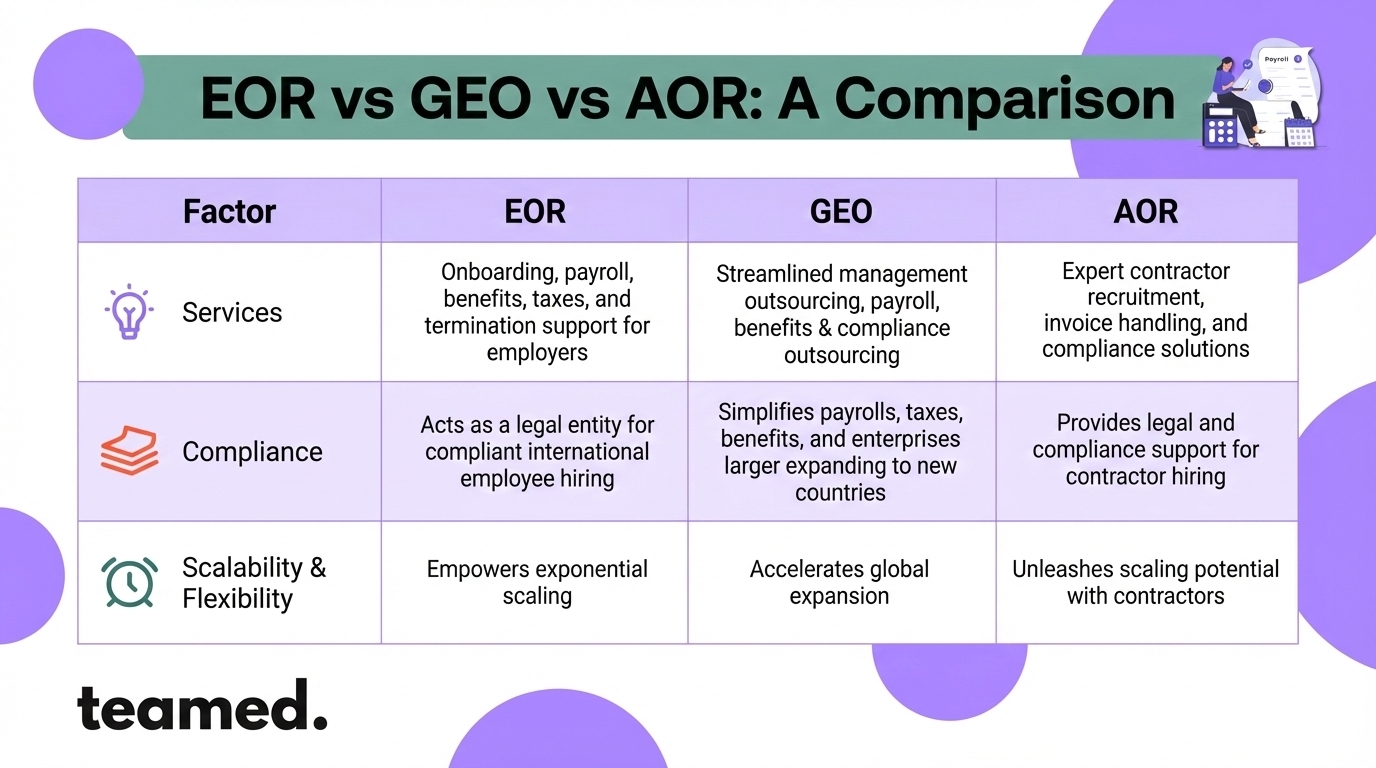
For growing companies without the resources to establish foreign entities, an EOR offers the clearest path forward. It consolidates legal responsibility, payroll, compliance, and HR into a single relationship, no patchwork of vendors, no fragmented accountability.
This streamlined approach means you can deploy talent in new markets quickly, stay compliant without becoming a local employment law expert, and keep your focus where it belongs: building something that lasts.
An employer of record (EOR) is a third-party organisation that becomes the legal employer of your international hires, handling payroll, tax compliance, benefits administration, and local labour law adherence while you retain full control over the employee's day-to-day work and responsibilities.
An EOR becomes the legal employer and handles all compliance for companies without foreign entities, while a GEO typically supports companies that already have (or plan to establish) their own legal entities abroad by managing recruitment, HR administration, and market expansion research.
An agent of record (AOR) manages the contractual and payment relationship between your company and independent contractors, handling contracts, invoicing, payments, and compliance with local regulations to protect you from misclassification risks.
Companies use an EOR when they lack the resources to establish a foreign entity, don't have legal and finance teams in the new country, or need to quickly onboard employees who relocate internationally.
While EORs primarily handle full-time employee relationships, an AOR specifically manages independent contractor engagements, handling contracts, invoicing, and compliance to prevent misclassification issues.
No, you retain full authority over employment contracts, hiring decisions, and day-to-day work management; the EOR simply ensures adherence to local labour laws and handles administrative tasks like payroll and benefits.
.png)
When you're expanding into Brazil, you'll quickly discover that employee benefits look different from what you might expect in Europe or North America. Food and meal vouchers aren't just nice-to-have perks - they're a cornerstone of Brazilian employment culture that can make or break your ability to attract and retain talent.
For mid-market companies scaling internationally, understanding these vouchers isn't just about compliance. It's about designing a benefits strategy that works across your global footprint while meeting local expectations. Whether you're hiring your first Brazilian employee or refining your approach for hundreds more, this guide will help you navigate the strategic choices that matter.
Food vouchers (vale alimentação) and meal vouchers (vale refeição) are prepaid electronic benefits that Brazilian employers provide to help employees cover food costs. While not universally mandated by federal law, they're deeply embedded in market practice and often required by collective bargaining agreements.
These vouchers sit alongside base salary as part of your Brazil employee benefits package. When structured correctly under Brazil's PAT programme, which serves over 25 million formal workers (about 54% of the formal workforce), they can offer tax advantages for both employers and employees. Food vouchers typically cover groceries and unprepared food, while meal vouchers are restricted to ready-to-eat meals at restaurants and canteens.
For mid-market companies with 200 to 2,000 employees, voucher decisions affect everything from payroll costs to internal equity across countries. The key is developing a clear policy that aligns with your global compensation philosophy while meeting Brazilian market expectations.
Strategic choices around voucher amounts, eligibility, and administration can support your broader employment model decisions - whether you're using contractors, EOR arrangements, or establishing your own Brazilian entity. Companies operating across 180+ countries often find that having expert guidance helps navigate these nuances while maintaining compliance confidence.
Food vouchers and meal vouchers are electronic prepaid benefits that Brazilian employers provide to help employees cover food-related expenses. Think of them as specialized debit cards that can only be used for specific types of food purchases.
Food vouchers, known locally as vale alimentação, are designed for purchasing groceries and unprepared food items. Employees can use these cards at supermarkets, grocery stores, and other retailers that sell food for home preparation.
Meal vouchers, called vale refeição, are specifically for ready-to-eat meals. These work at restaurants, cafeterias, food courts, and workplace canteens where employees can buy prepared meals during their workday.
Both types of vouchers are separate from Brazil salary and form part of the broader Brazil employee benefits package. They're typically funded entirely by the employer, though some arrangements allow limited employee contributions within legal parameters.
Unlike cash compensation, these vouchers are in-kind benefits with built-in restrictions. Employees can't convert them to cash or use them for non-food purchases. The cards are personal to each employee and come with specific merchant category restrictions that prevent misuse.
The two voucher types differ in their intended use and acceptance. Food vouchers (vale alimentação) are designed for groceries and unprepared food, accepted at supermarkets and grocery stores. Meal vouchers (vale refeição), on the other hand, are for ready-to-eat meals and work at restaurants, canteens, and food courts.
These benefits sit alongside other mandatory elements like 13th salary and paid leave, creating a comprehensive employment package that reflects Brazilian market expectations.
From an employee's perspective, food and meal vouchers operate like specialized prepaid cards that arrive loaded with funds each month alongside their regular Brazil payroll.
When employees receive their vouchers, they get a physical or digital card from the employer's chosen provider. The employer loads these cards monthly with the agreed voucher amount, typically synchronized with payroll cycles.
Using the vouchers is straightforward. Employees present their card at eligible merchants, and the payment terminal automatically recognizes whether it's a food or meal voucher transaction. The system checks the merchant category to ensure compliance with voucher restrictions.
For food vouchers, employees can shop at supermarkets and grocery stores for ingredients, household food items, and other unprepared food products. Meal vouchers work at restaurants, workplace canteens, and food service establishments where employees can purchase ready-to-eat meals.
The cards typically allow balances to roll over month to month within certain limits, though specific terms vary by provider. If a card is lost or stolen, employees can usually request replacement cards through their employer or directly with the voucher provider.
From a value perspective, employees appreciate vouchers because they provide dependable support for food costs without affecting their base salary, with 74.42% of workers indicating meal vouchers are among the benefits they most value.
On payslips, vouchers appear as separate line items distinct from salary, making it clear to employees that these are additional benefits rather than part of their taxable compensation.
The mandatory status of food and meal vouchers in Brazil isn't straightforward - it depends on the intersection of national law, collective bargaining agreements, and market practice.
At the federal level, Brazil's labour code (CLT) doesn't universally require employers to provide food or meal vouchers. However, this doesn't mean they're optional in practice.
Many collective bargaining agreements (CBAs) negotiated between unions and employer associations make vouchers effectively mandatory for specific sectors, regions, or job categories. These agreements often specify minimum voucher amounts and can vary significantly across industries and locations.
Brazil's PAT (Programa de Alimentação do Trabalhador) programme creates additional complexity. While PAT participation is voluntary for employers, it provides tax incentives that make voucher programmes more attractive. Companies that register for PAT must follow specific rules about voucher amounts, eligible providers, and usage restrictions.
Even when vouchers aren't legally mandated, they've become such a standard part of Brazilian employment that omitting them can create significant competitive disadvantages. Removing or reducing existing voucher benefits can also create employee relations issues and potential legal risks.
Legal Framework Breakdown:
For regulated sectors like financial services, healthcare, and technology, vouchers are typically expected regardless of strict legal requirements. The safest approach is to treat vouchers as a competitive necessity while ensuring compliance with applicable CBAs and PAT requirements where relevant.
Food and meal vouchers receive different tax treatment compared to regular salary, which can make them more cost-effective than equivalent cash increases when structured correctly.
Under Brazil's PAT programme, compliant voucher arrangements can reduce both employer social security contributions and employee income tax impact. This creates a win-win scenario where employers save on payroll taxes while employees receive more value than equivalent salary increases.
PAT compliance requires several conditions. Employers must register with the programme, use approved voucher providers, and ensure vouchers are used only for eligible food purchases. The programme also sets guidelines for voucher amounts relative to employee salaries and requires proper documentation.
When vouchers don't qualify for PAT benefits - either because the employer hasn't registered or doesn't meet compliance requirements - they may still receive more favorable tax treatment than salary, but the advantages are reduced.
On Brazil payroll, vouchers appear as separate line items from base salary, affecting how payroll taxes are calculated and reported. This separation is important for both compliance reporting and employee understanding of their total compensation.
The tax advantages differ significantly between approaches. Standard salary increases carry normal payroll tax rates and standard income tax for employees, with basic payroll compliance requirements. In contrast, PAT-compliant vouchers offer reduced social security impact for employers and potential income tax benefits for employees, though they require PAT registration and ongoing compliance monitoring.
Finance teams should model the total cost impact of vouchers versus salary increases, considering both immediate tax effects and ongoing compliance requirements. Working with local tax advisors can help ensure voucher structures maximize available benefits while maintaining compliance with evolving regulations.
While both types of vouchers support employee food costs, food vouchers and meal vouchers serve distinct purposes with different usage patterns and compliance considerations.
Food vouchers (vale alimentação) are designed for unprepared food purchases that employees take home. These work at supermarkets, grocery stores, and other retailers selling ingredients, packaged foods, and household food items. Employees typically use food vouchers for weekly shopping and meal preparation at home.
Meal vouchers (vale refeição) focus specifically on ready-to-eat meals consumed during the workday. These cards work at restaurants, workplace canteens, food courts, and other establishments serving prepared meals. The intent is to support employees' daily meal needs during work hours.
The merchant acceptance networks differ significantly. Food voucher terminals are common in supermarkets and grocery chains, while meal voucher acceptance is concentrated in food service establishments. Some merchants accept both types, but many specialize in one category.
From an employee value perspective, preferences often depend on work arrangements and personal circumstances. Employees with families or those working from home may prefer food vouchers for grocery shopping flexibility. Office-based employees near restaurants might value meal vouchers more highly.
Key Differences Summary:
The primary distinctions between the two voucher types include their purpose, typical merchants, best-suited employee groups, and usage timing. Food vouchers are intended for groceries and unprepared food, accepted at supermarkets and grocery stores, best suited for employees with families or remote workers, and used for weekly or monthly shopping. Meal vouchers are designed for ready-to-eat meals, accepted at restaurants, canteens, and food courts, best suited for office workers near food service establishments, and used for daily meal purchases.
Under PAT and other compliance frameworks, the two voucher types may have different reporting requirements or usage restrictions. Some employers offer both types to maximize employee satisfaction, while others choose one based on workforce preferences and administrative simplicity.
Voucher amounts in Brazil vary significantly based on location, industry, company size, and seniority levels, but they represent meaningful support for employees' food costs rather than token gestures in a market projected to grow by USD 9.96 billion from 2025 to 2029.
Most competitive employers target voucher values that provide substantial coverage of weekday meals or grocery expenses. The amounts are typically calculated based on working days per month and local cost of living, with adjustments for different cities and regions.
Industry benchmarks show considerable variation. Technology companies, financial services firms, and multinational corporations often provide more generous voucher amounts compared to smaller local businesses or traditional industries. Senior roles may receive higher voucher values, though many companies standardize amounts across job levels for simplicity.
Vouchers are almost always provided on top of base salary rather than as a substitute for cash compensation. Some programmes allow limited employee contributions within legal parameters, but employer-funded vouchers are the norm for competitive packages.
Market Practice Levels:
Companies typically adopt one of three approaches to voucher provision. At the minimal level, employers focus on basic compliance, meeting collective bargaining agreement minimums where applicable. At the market competitive level, companies benchmark against industry peers to match sector standards and attract talent effectively. At the premium level, employers position themselves above market rates to differentiate themselves in competitive hiring situations.
Companies should document their voucher strategy rationale for audit purposes and stakeholder communications. This includes explaining how amounts are set, review frequency, and alignment with overall compensation philosophy.
Benchmarking against sector peers and similar-sized companies helps ensure competitive positioning while managing costs. Regular market reviews can identify when adjustments are needed to maintain talent attraction and retention effectiveness.
Food and meal vouchers form a core pillar of Brazilian total rewards alongside base salary, health plans, transport benefits, and the mandatory 13th salary. Understanding how they integrate with other benefits is crucial for creating coherent employment packages.
From a payroll perspective, vouchers may receive different tax treatment than salary increases, making them potentially more cost-effective for both employers and employees. This tax efficiency can support budget optimization while delivering higher perceived value to staff.
Internal equity considerations become important for companies operating across multiple countries. Brazilian voucher practices may seem unusual compared to European meal card programmes or North American benefit structures, requiring clear communication about regional differences and rationale.
The benefits package should support your employer brand and talent positioning. In competitive sectors like healthcare, financial services, and technology, comprehensive voucher programmes signal commitment to employee wellbeing and market awareness.
Strategic Integration Questions:
Creating a documented Brazil benefits philosophy helps maintain consistency as headcount grows and provides clear guidance for future decisions. This should address voucher positioning within total rewards, change governance, and alignment with broader company values.
The interplay between vouchers and other benefits also affects employee communications and satisfaction. A well-integrated benefits package feels coherent to employees and supports overall engagement and retention objectives.
Mid-market companies need voucher policies that can scale consistently while maintaining flexibility for future changes. A well-designed policy prevents ad hoc decisions that create inequities or compliance risks as headcount grows.
Start by defining core policy elements early, even if you only have a few Brazilian employees. Key decisions include eligibility criteria, voucher mix (food versus meal), value-setting principles, treatment of part-time and temporary staff, and review frequency.
Geographic variation requires careful consideration. Some companies maintain single national voucher levels for simplicity, while others adjust for city-specific cost differences. Each approach has implications for equity, administration, and employee perception.
Governance structures should clarify decision ownership and approval processes. Typically, HR leads policy design with Finance input on costs and tax implications, while Legal reviews compliance requirements. Employee communications should explain the rationale and positioning clearly.
Essential Policy Sections:
Design policies to work across employment models. If you're currently using EOR but planning to establish a Brazilian entity, ensure voucher structures can transfer seamlessly without creating perceived benefit cuts.
Regular policy reviews help maintain market competitiveness and compliance. Annual benchmarking against sector peers and periodic legal reviews can identify needed adjustments before they become urgent.
Post-Series B companies often discover that early voucher decisions were made without sufficient strategic consideration, creating pressure points as they scale and face increased scrutiny from investors and auditors.
Common challenges include inconsistent voucher levels across hiring waves, weak documentation of decision rationale, and tension between Finance and HR over cost control versus competitive positioning. These issues become more visible during fundraising due diligence or audit processes.
Early-stage ad hoc approaches rarely align with maturing global compensation strategies. What worked for 20 employees may not make sense for 200, especially when trying to maintain consistency across multiple countries and employment models.
Scaling companies need to stress-test their voucher approach for investor presentations and board discussions. Clear documentation of policy rationale, market benchmarking, and cost controls demonstrates mature people operations and strategic thinking.
European companies expanding into Brazil need to bridge the gap between familiar European benefit structures and Brazilian market expectations, particularly around the prominence of food and meal vouchers.
The first step is educating European leadership about how Brazilian vouchers differ from European meal cards or canteen subsidies. While European programmes often supplement existing food options, Brazilian vouchers carry much greater weight in total compensation and employee expectations.
Prepare an internal position paper explaining voucher mechanics, competitive necessity, and alignment with global pay philosophy. This helps European Finance, HR, and Legal teams understand why Brazilian practices may look different from home country approaches while maintaining strategic coherence.
Internal equity concerns often arise when European employees compare their benefits to Brazilian voucher programmes. Clear communication about regional market differences and total compensation positioning can help address these perceptions.
European vs. Brazilian Comparison:
Several key differences distinguish typical European meal benefit practices from Brazilian voucher programmes. In terms of their role in compensation, European meal benefits typically serve as supplementary conveniences, while Brazilian vouchers are core compensation elements. Employee expectations also differ significantly—European programmes are generally viewed as nice-to-have conveniences, whereas Brazilian vouchers are standard competitive requirements. Tax treatment varies by country in Europe, but Brazil offers significant advantages under the PAT programme. Finally, cultural importance is moderate in European contexts but high in Brazil, where vouchers signal employer commitment to employee wellbeing.
Involve European stakeholders early in Brazilian voucher decisions to ensure alignment with group policies and avoid later conflicts. This includes getting appropriate approvals for voucher amounts and structures before implementation.
The goal is creating a Brazilian voucher approach that meets local market needs while fitting coherently within your European-headquartered company's global benefits framework and governance processes.
Brazilian food and meal vouchers occupy a more central role in total compensation compared to most European meal benefit programmes, reflecting different cultural expectations and regulatory frameworks.
European meal benefits vary significantly by country. French meal vouchers (tickets restaurant) and German canteen subsidies serve similar functions to Brazilian programmes but typically represent smaller portions of total compensation. Nordic countries often rely more on subsidized workplace canteens than individual voucher programmes.
The tax advantages available under Brazil's PAT programme often exceed what's available for European meal benefits, making Brazilian vouchers more attractive from a total cost perspective. This can create internal discussions about benefit equity across regions.
Statutory benefit baselines also differ significantly. Brazil's 13th salary requirement and other mandatory benefits create a different foundation for voluntary benefits like vouchers compared to European social security systems.
Regional Comparison Framework:
When comparing Brazilian and European approaches across several key dimensions, important differences emerge. The legal baseline in Brazil consists of the CLT labour code plus collective bargaining agreements, while Europe varies by country with generally higher statutory minimums. Voucher importance is central to competitive packages in Brazil but supplementary to other benefits in most European countries. Tax advantages are significant under Brazil's PAT programme, while European benefits offer moderate advantages that vary by jurisdiction. Cultural expectations in Brazil reflect strong employer responsibility for daily meals, whereas European attitudes are mixed and often workplace-focused.
For companies operating across both regions, the key is developing a global benefits matrix that explains regional differences transparently. This helps maintain employee understanding and stakeholder confidence in benefit equity approaches.
Document the rationale for regional benefit variations in board materials and employee communications. This demonstrates strategic thinking rather than ad hoc regional decisions and supports consistent governance across your global footprint.
When hiring through an EOR in Brazil, voucher decisions remain strategically important even though the EOR handles administrative implementation. Many companies treat EOR voucher recommendations as starting points rather than fixed requirements.
EOR providers often propose standard voucher packages based on their experience with similar clients. While these defaults can provide useful benchmarks, they may not align with your specific positioning strategy or long-term plans for Brazilian operations.
Maintain control over voucher strategy to ensure consistency with your global compensation philosophy and future scalability. If you plan to establish your own Brazilian entity later, design voucher structures that can transfer seamlessly without creating perceived benefit reductions.
Key questions for EOR discussions include how vouchers are treated in payroll processing, whether PAT registration applies, how changes are implemented, and what documentation is provided for audit purposes.
EOR Voucher Considerations:
When working with an EOR, several decision areas require strategic consideration beyond default approaches. For voucher amounts, EOR providers typically offer market standard recommendations, but strategic clients should ensure amounts align with their global pay positioning. Regarding policy flexibility, EOR providers usually work within their standard terms, while strategic clients benefit from customization that supports their specific strategy. For future transitions, EOR providers naturally focus on current arrangements, but forward-thinking clients design voucher structures with entity migration in mind. Finally, for compliance documentation, EOR providers offer basic compliance support, but strategic clients often need more comprehensive documentation to meet their audit and governance requirements.
Independent advisory support can help evaluate EOR voucher proposals against your strategic objectives and ensure decisions support rather than constrain future options. This becomes particularly valuable when comparing multiple EOR providers or planning transitions to owned entities.
Remember that voucher decisions made during EOR arrangements often set employee expectations that become difficult to change later. Strategic consideration upfront can prevent costly adjustments down the road.
The treatment of food and meal vouchers for contractors versus employees in Brazil requires careful consideration of misclassification risks and compliance requirements.
Vouchers are typically associated with employment relationships under Brazilian labour law (CLT). Extending employee-style benefits to contractors can create evidence of employment integration that increases misclassification risk, particularly in regulated sectors where authorities scrutinize contractor arrangements closely.
Offering vouchers to contractors may suggest that the working relationship resembles employment rather than independent contracting. This is especially risky when combined with other employee-like treatment such as fixed schedules, direct supervision, or exclusive work arrangements.
The safer approach is maintaining clear distinctions between contractor and employee treatment. For contractors, consider adjusting service fees to reflect local cost considerations as commercial terms rather than providing employee-style benefits.
Risk Assessment Framework:
The treatment of vouchers differs significantly based on employment type, with important implications for misclassification risk. For CLT employees, vouchers are standard practice, workers receive full labour law protections, and misclassification risk is not applicable. For independent contractors, providing vouchers is a high-risk practice, workers have only commercial law protections, and misclassification risk becomes elevated if vouchers are provided.
When transitioning contractors to employee status, voucher introduction becomes part of the employment package design. This transition should be handled carefully to ensure compliance with both contractor termination and employee onboarding requirements.
Companies operating in regulated industries like financial services, healthcare, or defense should be particularly cautious about contractor benefit arrangements. Regulatory scrutiny in these sectors makes clear employment model distinctions essential for compliance confidence.
Brazilian authorities have updated regulations affecting meal voucher operations, focusing on increased transparency, fee structures, and alignment with nutrition policy objectives.
Recent changes have addressed provider fee structures, requiring more transparency in charges to merchants and setting limits on transaction fees at 3.6% merchant discount rate.
Usage restrictions have also evolved, with authorities seeking to strengthen the connection between voucher programmes and their intended nutritional support objectives. This includes clearer guidelines about eligible merchants and purchase categories.
For employers, these changes may require reviewing provider contracts, PAT registration status, and internal voucher policies. Some modifications could affect which providers offer the best combination of service, cost, and compliance support for mid-market employers.
Areas of Regulatory Change:
Recent regulatory updates have affected several key areas. Provider fees now face caps on merchant charges, requiring employers to review provider contracts and costs. Usage transparency has been enhanced through new reporting requirements, making it essential for employers to ensure policy documentation remains current. Compliance monitoring has been strengthened with enhanced enforcement, prompting employers to verify their PAT registration and compliance status.
The evolving regulatory environment reinforces the importance of working with providers and advisors who monitor compliance requirements proactively. Regular policy reviews can identify when adjustments are needed to maintain compliance and optimize programme effectiveness.
Companies should treat regulatory changes as normal evolution rather than crisis management. Building relationships with local expertise helps navigate updates smoothly while maintaining programme continuity for employees.
Developing an effective voucher strategy requires balancing compliance requirements, competitive positioning, and operational efficiency while aligning with your broader global employment approach.
Start by confirming your legal baseline through applicable collective bargaining agreements and considering PAT programme participation. This establishes the minimum framework within which you can make strategic choices about positioning and generosity.
Benchmark against sector peers and similar-sized companies to understand competitive expectations. This benchmarking should consider both voucher amounts and the mix between food and meal vouchers based on your workforce characteristics.
Strategic Decision Framework:
Align voucher decisions with your employment model strategy. Whether you're using contractors, EOR arrangements, or establishing entities, voucher approaches should support rather than complicate your operational model transitions.
Getting vouchers right affects multiple business dimensions - compliance confidence, cost management, talent attraction, and internal equity. This is particularly important in regulated sectors where employment decisions carry material risk and compliance isn't negotiable.
For mid-market companies operating across Europe, Brazil, and beyond, having strategic guidance can help navigate these decisions with confidence. Talk to the experts who understand how Brazilian voucher strategies fit within global employment frameworks and can support your expansion with compliance confidence.
No, Brazilian food and meal vouchers are designed as in-kind benefits that cannot be converted to cash. This restriction is fundamental to their tax-advantaged status under PAT and other compliance frameworks. The voucher system uses merchant category restrictions to ensure funds are used only for eligible food purchases, maintaining the programme's intended purpose of supporting employee nutrition.
Treatment of unused voucher balances upon termination varies by provider terms and local regulations. Typically, employees retain access to existing balances for a limited period after termination, allowing them to use accumulated funds. Some arrangements may require employer reconciliation of unused amounts, while others allow natural expiration. Specific terms should be clarified in voucher provider contracts and employee communications.
Generally, food and meal vouchers are treated separately from base salary for overtime, bonus, and severance calculations under Brazilian labour law. However, specific treatment can vary based on how programmes are structured and applicable collective bargaining agreements. Companies should confirm this treatment with local employment counsel, as case law and regulatory interpretation can affect how vouchers are classified in different compensation calculations.
Remote employees typically receive the same voucher entitlements as office-based staff, though some companies adjust the mix toward food vouchers since remote workers may have less access to restaurants during work hours. The key is maintaining consistent policy application regardless of work location while considering practical usage differences. Some employers survey remote staff preferences to optimize the food versus meal voucher balance.
Providing food or meal vouchers to contractors in Brazil can increase misclassification risk by suggesting an employment-like relationship. Brazilian labour authorities may view voucher provision as evidence of employment integration, particularly when combined with other employee-like treatment. The safer approach is adjusting service fees to reflect local costs rather than extending employee-style benefits that could complicate the independent contractor classification.
Brazilian vouchers typically play a more central role in total compensation compared to European meal benefits. While European programmes like French meal vouchers or German canteen subsidies serve similar functions, Brazilian vouchers often represent larger portions of total rewards and carry stronger cultural expectations. The tax advantages available under Brazil's PAT programme also often exceed what's available for European meal benefits, making Brazilian vouchers more significant from both employee and employer perspectives.
Mid market typically refers to companies with approximately 200 to 2,000 employees and revenue in the range of about £10 million to £1 billion. These businesses have outgrown startup-stage simplicity but haven't yet reached enterprise-scale resources and complexity. In the context of global employment, mid-market companies often need sophisticated guidance and compliance support while maintaining operational agility and cost efficiency.
When your London-based fintech company lands its first major US client and needs to hire a sales team in New York, the excitement quickly turns to confusion. How exactly does US healthcare work for employees? What are you legally required to provide? And why does every benefits broker seem to be speaking a different language?
You're not alone in this maze. European mid-market companies expanding into the US often find themselves navigating a healthcare system that feels completely foreign. Unlike the statutory systems you know in Europe, US healthcare is largely employer-driven, creating both opportunities and obligations that can make or break your hiring strategy. Understanding these dynamics isn't just about compliance - it's about building a competitive advantage in the US talent market.
At its core, US employer-sponsored healthcare is a partnership between your company, insurance carriers, and your employees. Unlike European systems where healthcare is largely funded through taxation, US employees rely heavily on their employers to provide access to affordable medical care.
Here's how it works in practice: Your company selects one or more health insurance plans from carriers like Blue Cross Blue Shield, Aetna, or Cigna. Employees then choose which plan works best for their needs during enrolment periods. The monthly cost (called a premium) is typically split between your company and the employee, with the employee's portion deducted from their pay-check before taxes.
Essential terms every European employer should know:
The employee experience typically follows this path: During onboarding, new hires elect their benefits, decide whether to cover dependents, and authorise payroll deductions. They receive ID cards and provider directories, then use in-network providers to minimise costs. Each year during open enrolment, they can review options and make changes.
This system creates a cultural dynamic that European employers often underestimate. In the US, healthcare benefits weigh heavily in job decisions because losing employment often means losing healthcare access. This makes your benefits package a critical recruitment and retention tool, particularly when family coverage can exceed $35,000 annually.
The contrast between US and European benefits systems can be jarring for European employers. Where European employees typically receive generous statutory benefits funded through taxation, US employees depend on their employers for healthcare, retirement savings, and many other protections.
This creates several practical implications for European employers. First, US candidates will scrutinize your healthcare offerings in ways European candidates might not. They'll want to understand deductibles, network coverage, and prescription drug benefits because these directly impact their family's financial security.
Second, the administrative burden is higher. European employees might simply present a health card for care, while US employees navigate plan networks, prior authorisations, and cost-sharing calculations. Your HR team will field more benefits-related questions and need deeper expertise.
Finally, achieving equity across regions requires thoughtful design. Rather than offering identical benefits globally, successful European employers aim for comparable value and security.
Understanding your legal obligations helps you make informed decisions about what to offer and when. The regulatory landscape combines federal requirements with state-specific mandates that can vary significantly across your US footprint.
Key frameworks to understand:
The ACA employer mandate applies to companies with a certain number of full-time equivalent employees, requiring them to offer affordable, minimum-value health coverage or pay penalties. However, the practical reality is that competitive benefits are often necessary regardless of legal requirements.
State laws add another layer of complexity. California requires disability insurance contributions, while New York has paid family leave requirements, creating multi-state employment challenges. Some states mandate specific health coverage elements or impose additional reporting obligations.
Employment model choices affect how these obligations apply. If you hire through an Employer of Record (EOR), they typically handle compliance as the legal employer. With your own US entity, you bear direct responsibility for meeting all requirements.
Strategic advisors can help you frame the right questions for legal counsel and ensure your global employment strategy aligns with US regulatory requirements. This guidance becomes particularly valuable as you scale and face more complex compliance scenarios.
Mid-market companies in your size range typically offer comprehensive packages that balance competitiveness with cost control, with 97% of firms with 200-999 employees offering health benefits to at least some workers. Understanding these norms helps you position appropriately in the US talent market while maintaining global consistency.
Plan design creates the biggest cost variation. Plans with lower deductibles and broader networks cost more in premiums but reduce employee out-of-pocket expenses. The right choice depends on your talent market and employee preferences.
Geographic differences can be substantial. Healthcare costs in New York or San Francisco significantly exceed those in smaller markets. This affects both premium costs and the competitiveness of your offering.
Your workforce profile influences costs in ways that might surprise European employers. Younger, single employees typically cost less than older employees with families. As your US team matures, expect gradual cost increases.
Key questions for Finance teams:
Building scenarios around different growth trajectories helps Finance prepare for the reality that benefits costs will evolve with your team composition and market conditions.
Your choice of employment model significantly impacts how you provide healthcare benefits, the level of control you have, and the employee experience. Each approach has distinct advantages and limitations that should align with your broader global employment strategy.
Contractors handle their own healthcare arrangements, which keeps your obligations minimal but limits your ability to offer competitive packages. Providing employee-style benefits to genuine contractors can create misclassification risks, so any support should be carefully structured as business expenses or professional development.
EOR arrangements place the legal employment responsibility with your EOR provider. They typically offer standardized benefits packages that meet market expectations but may not reflect your specific company culture or values. This approach works well for initial market entry or when testing demand in new regions.
US entity employment gives you complete control over benefits strategy and vendor selection. You can align US offerings with your global philosophy and differentiate in the talent market. However, this comes with higher administrative responsibility and compliance obligations.
Transition considerations become critical as you scale. Moving contractors to EOR or EOR to entity status requires careful planning to maintain healthcare coverage continuity. Employees shouldn't experience gaps in coverage during these transitions.
Decision framework questions:
Strategic advisors can help evaluate these trade-offs and plan transitions that maintain employee satisfaction while supporting your broader business objectives.
Creating an effective benefits strategy requires balancing US market expectations with your global company values and financial constraints. The goal isn't to copy what large enterprises do, but to design an approach that works for your specific context and growth trajectory.
Step-by-step framework:
Positioning matrix for mid-market constraints:
Example guiding principles:
The key is making deliberate choices rather than defaulting to whatever your EOR or broker recommends. Your benefits package should reflect your company's values and support your talent acquisition goals, not just check compliance boxes.
Learning from others' experiences can help you avoid costly missteps that damage your employer brand or create compliance risks. These patterns emerge repeatedly among European companies expanding into the US market.
The pattern across these mistakes is often the same: European employers either underestimate the importance of benefits in US talent decisions or overcomplicate their approach by trying to replicate enterprise-level sophistication.
Independent advisory input can provide an external perspective before you lock in decisions that are expensive or difficult to change later.
As your global workforce grows within the mid-market range, specific triggers should prompt you to reevaluate your US benefits approach. Recognising these moments helps you stay ahead of problems rather than reacting to them.
Talent triggers:
Financial triggers:
Strategic triggers:
Operational triggers:
The key is establishing a regular review rhythm rather than waiting for crisis moments. Annual evaluations aligned with renewal cycles allow you to make proactive adjustments based on workforce changes, market shifts, and strategic evolution.
Governance maturity timeline:
Coordinating employment model reviews with benefits evaluations ensures your employee experience remains coherent as you scale and evolve your US presence.
Converting your understanding into action requires a structured approach that aligns US benefits decisions with your broader global employment strategy. These steps can help you move from confusion to confidence in your US healthcare approach.
Immediate action items:
The goal isn't to have perfect answers immediately, but to create a framework for making informed decisions as your US presence grows. This includes understanding when your current approach might need to evolve and having a plan for managing those transitions.
Strategic advisors can support this process by providing independent counsel that isn't tied to selling specific products or services. They can help you evaluate trade-offs between different employment models and ensure your benefits strategy supports rather than hinders your growth objectives.
When you're ready to discuss your specific situation and explore how strategic guidance can support your US expansion, consider reaching out to advisors who understand the complexity of global employment decisions. Talk to the experts who can help you navigate these choices with confidence.
Plans are typically tied to provider networks and state regulations, so relocating employees often need to review or change their coverage during permitted enrollment windows. Your HR team should guide relocating employees through their options and any required plan changes.
Employees can usually decline coverage if they have other acceptable insurance (such as through a spouse's plan or government programs). Expect to document these decisions and communicate any implications for cost-sharing or compliance requirements.
HSAs and FSAs are tax-advantaged accounts that help employees pay for eligible healthcare expenses. Whether to offer these depends on your plan design and overall benefits strategy, as they can provide additional value while managing costs.
For this context, mid-market refers to organisations with roughly 200-2,000 employees and comparable revenue scale. This size brings complexity that requires strategic guidance while maintaining cost consciousness that enterprise solutions often ignore.
Start with your global values around employee wellbeing and financial security, then use US-appropriate mechanisms to deliver comparable peace of mind. This might mean different structures but similar outcomes across regions.
Most health plans renew annually with potential changes to premiums, deductibles, and coverage terms. Plan for structured yearly reviews and build budget flexibility to adjust plan design based on cost changes and workforce evolution.
Focus on providing consistent access to quality coverage rather than identical usage. Communicate the rationale behind your plan design choices and ensure all employees understand their options and how to maximize their benefits.
Setting up an entity in Poland has become a strategic priority for mid-market companies expanding across Europe. With its robust legal framework, competitive costs, and position as a Central European hub, Poland offers an attractive alternative to more expensive Western European markets.
But navigating Polish entity formation isn't just about filling out forms. For companies with 200 to 2,000 employees, the decision to establish a Polish entity often signals a shift from contractor arrangements or EOR services to direct employment. Understanding the requirements, costs, and strategic implications can help you make informed decisions about when and how to proceed.
Setting up a Polish entity involves several key considerations that can significantly impact your expansion strategy:
• Poland LLC (Sp. z o.o.) requirements: Minimum PLN 5,000 share capital, registered office address, and at least one shareholder. This structure aligns well with fast Poland business registration processes for EU operations.
• Timeline expectations: Typical 2-4 weeks from application to operational readiness, including banking setup. This timeline is often faster than many EU peers when documentation is properly prepared.
• Foreign ownership rules: No residency requirements for shareholders, making starting a business in Poland accessible to international companies. However, management board composition and local representation rules require careful attention.
• Cost structure: Registration fees, court costs, notary expenses, legal and accounting services, plus ongoing compliance obligations. These costs should be evaluated against EOR expenses when starting a business in Poland at scale.
• Strategic timing: Companies often graduate from EOR when monthly fees exceed entity setup and maintenance costs, and when they need greater control, employer branding, and EU mobility for their workforce.
Poland functions as an effective Central European hub for companies with 200-2,000 employees scaling across multiple EU markets, offering both cost advantages and operational flexibility.
When considering company formation in Poland, understanding the available legal structures helps you select the most appropriate option for your business needs.
Limited Liability Company (Sp. z o.o.)
The Sp. z o.o. is the default choice for foreign investors and represents the most practical option for multinational employers. This structure offers limited liability protection, flexible ownership arrangements, and efficient setup processes that work well for pan-EU hiring strategies.
Joint Stock Company (S.A.)
Joint stock companies involve higher capital requirements and more complex governance obligations. They're typically suited for large enterprises, companies seeking financing, or those on pre-IPO paths rather than mid-market operational entities.
Branch Office vs Subsidiary
Branch offices can be established more quickly but expose the parent company to liability. Subsidiaries (typically structured as Sp. z o.o.) provide liability protection and simplify local compliance and financing arrangements.
Partnership Structures
Various partnership forms (sp.k., sp.j.) exist but are rarely ideal for multinational employers due to their tax-transparent nature and governance complexities.
For most mid-market companies, the Sp. z o.o. structure provides the optimal balance of liability protection, operational flexibility, and governance simplicity. This structure positions well against UK Ltd companies and German GmbHs for consistent governance across European entities.
The company registration Poland process follows a structured sequence that can be managed efficiently with proper preparation:
1. Name Reservation (1-2 days) Check availability through CEIDG/KRS databases and reserve your chosen company name. This step should be handled by your legal advisor or can be completed directly by the client.
2. Articles of Association (1-3 days) Draft articles of association in Polish. Standard templates can often be used with the S24 online system, while bespoke articles typically require notarisation. Legal counsel or notary services handle this step.
3. KRS Registration (5-10 business days) File with the National Court Register (KRS), submitting shareholder and board data, share capital proof, and registered office documentation. Legal representatives typically manage this filing process.
4. Tax Registrations (3-5 business days) Obtain NIP and REGON numbers, plus VAT/CIT registrations as applicable. Some registrations can be completed simultaneously through KRS integration. Advisory services usually coordinate these filings.
5. Social Security Registration (1-3 days) Register with ZUS (social security) before your first payroll. HR or payroll specialists typically handle this requirement.
6. Corporate Banking (1-2 weeks) Open a corporate bank account using your KRS extract, articles of association, identification documents, and UBO forms. Finance teams coordinate this process, though it often requires the longest timeline.
7. Operational Setup (parallel process) Prepare for e-invoicing compliance (KSeF), establish accounting systems, and set up payroll processes. Finance and HR teams work on these elements in parallel with other steps.
Required Documents Checklist: • Passports and proof of address for beneficial owners and directors • Articles of association (in Polish) • Share capital confirmation • Registered office agreement • Board resolutions and powers of attorney (with apostille if from non-EU countries) • KRS application forms and UBO register filings
Poland's digital filing system (S24) offers competitive advantages compared to other European jurisdictions, though offline notarisation remains common for customised articles of association.
Understanding the financial and documentation requirements helps you plan effectively for your Poland llc establishment.
Share Capital Requirements
The minimum share capital for a Sp. z o.o. is PLN 5,000 (approximately £1,000). This capital must be deposited either before or immediately after KRS registration, depending on your chosen approach. Banks typically require confirmation of this deposit.
Essential Documentation
Foreign corporate documents may require apostille or consular legalisation plus sworn translation into Polish. Key documents include:
• Corporate extracts and certificates (apostille required for non-EU entities)
• Powers of attorney and board resolutions (apostille required)
• Identity documents for all beneficial owners and directors
• Proof of registered office address
• Bank statements confirming share capital
Cost Breakdown
Payment Timeline
Name reservation and translation costs are typically paid upfront. Notary and KRS fees are due at filing. Government publication costs are charged after KRS approval. Professional services often require retainers at engagement, with banking and VAT costs arising post-approval.
Total setup costs in Poland compare favourably to Germany and France, with similar cost structures to Czech Republic, though Polish banks may have more stringent scrutiny processes.
Realistic timeline planning helps you coordinate your expansion effectively while managing expectations across your organisation.
Pre-Registration Phase (1-2 weeks) Name reservation, document preparation, translations, and apostille processes consume the initial period. Incomplete documentation at this stage often causes the most significant delays later.
KRS Filing and Approval (5-10 business days) Court review periods vary, but the S24 template system can accelerate approval for standard structures. Complex ownership arrangements or non-standard articles may extend this timeline.
Tax Registration (3-5 business days) NIP and REGON registrations can often run parallel to KRS approval. VAT registration may require additional verification, particularly for companies with complex business models.
Banking Setup (1-2 weeks) KYC processes and beneficial ownership verification can extend banking timelines. In-person meetings or qualified electronic signatures may be required depending on the bank's policies.
Potential Delays and Mitigation
Common delay factors include holiday seasons, incomplete apostille or translation documentation, VAT risk assessment reviews, and extended bank compliance queries.
To accelerate the process, consider using S24 templates when acceptable, pre-collecting KYC and beneficial ownership documentation for banking, and preparing VAT substantiation materials including contracts, website information, and lease agreements.
Warning signs of potential delays include multiple bank information requests, VAT desk requests for additional economic substance documentation, and returned KRS filings due to missing attachments.
Poland's registration timeline compares favourably to Southern European countries and aligns with Baltic state timelines when documentation is complete and properly prepared.
Post-registration requirements involve several critical steps that determine your operational readiness.
Corporate Banking Requirements
Banks require your KRS extract, articles of association, identification documents, beneficial ownership forms, and office lease agreements. Minimum deposit requirements vary by institution, and anti-money laundering questionnaires are standard. Some banks may require PESEL numbers or Trusted Profile access for certain transactions.
VAT Registration Process
Understanding VAT thresholds and voluntary registration options helps you plan compliance obligations. EU VAT (VIES) registration supports cross-border transactions, while the e-invoicing system (KSeF) requires separate onboarding with specific timelines.
Corporate Income Tax (CIT)
Standard CIT rates apply with registration requirements for advance payments. Transfer pricing documentation thresholds should be understood early, particularly for companies with intercompany transactions.
Social Security (ZUS) Registration
Employer registration with ZUS must be completed before your first payroll. Employee onboarding requires specific filings, and health insurance contributions follow established calculation methods.
Ongoing Compliance Calendar
Banking documentation should include signatory rules, KYC packages, and beneficial ownership declarations. The tax registration process flows from KRS approval through NIP/REGON assignment to VAT and VIES registration, culminating in KSeF onboarding.
Aligning your Polish tax and ZUS compliance calendar with broader EU payroll operations can create efficiencies and leverage EU VAT simplifications for cross-border sales.
Foreign ownership and management requirements in Poland are generally accommodating, though practical considerations require attention.
Shareholder Requirements
No residency restrictions apply to shareholders, allowing 100% foreign ownership. This makes starting a business in Poland as a foreigner accessible without complex ownership structures.
Management Board Considerations
While no legal residency requirement exists for directors, practical needs often arise for local addresses, PESEL numbers, or Trusted Profile access for electronic filings. Some banks prefer at least one EU-resident director for operational efficiency.
Proxy and Local Representative Options
Procurent or attorney in fact arrangements can address local representation needs, though these require careful consideration of mandate scope, revocation terms, and governance controls. Directors' and officers' insurance and indemnity arrangements should be evaluated.
Registered Office Requirements
Physical addresses are required, though virtual offices are acceptable if they meet substance requirements and banking expectations. The registered office must be capable of receiving official correspondence.
Ongoing Compliance Obligations
Directors face personal liability for unpaid taxes and social contributions in certain circumstances. UBO register filings, KSeF/ePUAP access, and timely statutory filings remain ongoing requirements regardless of residency status.
Poland's approach offers more flexibility than France or Spain regarding foreign ownership, with governance tools similar to Czech and Slovak practices.
The decision to establish a poland llc rather than continuing with EOR services requires careful analysis of costs, control, and strategic objectives.
Cost Analysis Framework
Compare EOR per-employee fees against entity setup costs, ongoing payroll expenses, accounting fees, and legal costs over 12-36 month periods. Most companies find break-even points between 8-20 employees, depending on EOR pricing and local cost structures.
Headcount Thresholds
Multi-function teams or employee counts exceeding 15-20 people often justify entity establishment. The complexity of managing diverse roles through EOR arrangements can create operational inefficiencies that entities resolve.
Control and Compliance Considerations
Direct employment enables IP assignment, customised benefits design, and stronger employer branding. Entities support audit requirements, transfer pricing documentation, intercompany billing, and financing arrangements that EOR structures may complicate.
Transition Planning
Moving from EOR to entity requires careful coordination of employment novations, benefit harmonisation, payroll system changes, and operational cutover. Timeline planning should allow 6 weeks for entity preparation and 2-4 weeks for employment migration.
Cost Comparison Scenarios
For 15 employees over 24 months, EOR costs often exceed entity establishment and operation expenses. At 30 employees, entities typically provide clear cost advantages while offering operational benefits.
Teamed can guide HR and Finance leaders through break-even analysis and provide counsel on transition timing and execution strategy, helping companies navigate this critical decision point effectively.
Poland's role in broader European employment strategies requires understanding regional dynamics and coordination opportunities.
Regional Hub Potential
Poland serves effectively as a Central and Eastern European base, leveraging strong shared service centre ecosystems and multilingual talent pools. The country's position supports operations across the broader CEE region.
EU Single Market Advantages
Labour mobility considerations, social security coordination, and posting worker rules create opportunities for efficient workforce deployment across EU markets. Poland's EU membership facilitates these arrangements.
Tax Treaty and Transfer Pricing
Poland's robust double taxation treaty network supports intercompany service arrangements. Aligning these with OECD and Polish transfer pricing rules requires early planning but creates operational efficiencies.
Talent Access and Compensation
Competitive compensation levels compared to Western Europe, combined with strong university pipelines and multilingual capabilities, support talent acquisition strategies across multiple markets.
Compliance Coordination
Harmonising payroll calendars, benefit standards, and employment practices across 5+ European markets requires careful planning. Posted worker notifications, permanent establishment risks, and regulatory reporting coordination become important considerations.
Hub and spoke models offer scale and governance benefits but require attention to local labour law nuances and cultural considerations in each market.
Teamed often recommends Poland as part of coordinated European employment strategies and can advise on entity establishment timing across multiple markets, helping companies build coherent regional approaches.
Companies in regulated industries face additional considerations when starting business in Poland that require early attention and specialist guidance.
Financial Services Considerations
Payment services, investment advice, and other financial activities may trigger licensing requirements with KNF (Polish Financial Supervision Authority). Outsourcing arrangements and data handling requirements add complexity layers.
Healthcare and Life Sciences
GDPR compliance and data residency requirements intersect with medical device regulations and clinical trial constraints. Telemedicine activities may require specific authorisations.
Defence and Dual-Use Technologies
Export control regulations, dual-use item restrictions, security clearance requirements, and facility security considerations can significantly impact operational planning.
Professional Licensing Requirements
Engineers, architects, auditors, and legal professionals may require local practice rights or partnership arrangements with licensed local practitioners.
Cross-Border Risk Indicators
Remote teams delivering services across borders may create permanent establishment risks. Mandatory notifications and sectoral reporting requirements vary by industry and activity type.
Mitigation Strategies
Early regulatory scoping with specialist counsel, data minimisation and localisation planning, and clear intra-group agreements with transfer pricing documentation help address these challenges proactively.
Teamed provides counsel on regulatory implications and can guide companies through sector-specific compliance requirements, connecting you with appropriate specialist advisors when needed.
Understanding realistic cost and timeline expectations helps mid-market companies plan their company formation in poland initiatives effectively.
Setup Cost Ranges
Government fees remain modest across all company sizes, while professional services costs vary based on complexity, language requirements, and speed expectations. Standard Sp. z o.o. formations typically cost between PLN 5,000-15,000 total.
Ongoing Cost Considerations
Monthly accounting and payroll subscription costs, registered office fees, statutory audit requirements as revenue thresholds are met, and legal retainer arrangements create predictable ongoing expenses.
Timeline Planning
The 2-4 week timeline to operational status assumes proper banking coordination. Additional time should be allocated for VAT scrutiny processes or complex beneficial ownership structures.
Resource Allocation Planning
Internal legal and finance team time, signatory availability for banking processes, director onboarding requirements, and external provider coordination require advance planning.
Critical Path Milestones
Beneficial ownership documentation, bank KYC processes, and VAT review windows often determine overall timeline success. Having these elements prepared in advance significantly improves predictability.
Resource Planning Checklist
Identify internal document owners, establish decision gates and approval processes, coordinate signatory logistics across time zones, and plan for potential delays in critical path items.
Teamed helps evaluate total cost of ownership and provides benchmarking against similar mid-market expansions, offering realistic planning assumptions based on extensive experience across the region.
Learning from common pitfalls can help you start a company in Poland more efficiently while avoiding costly delays and complications.
Documentation Errors
Missing apostilles on foreign corporate documents, outdated corporate extracts, and untranslated materials create the most frequent delays. Quality control processes and translation planning prevent these issues.
Banking Process Delays
Insufficient beneficial ownership evidence, unclear business activity descriptions, and lack of local address proof commonly extend banking timelines. Pre-preparing comprehensive KYC packages and activity narratives helps avoid these delays.
Compliance Oversights
Late ZUS or VAT registrations, missed beneficial ownership filings, and KSeF unreadiness can create operational problems. Establishing compliance calendars before KRS approval ensures nothing falls through gaps.
Operational Readiness Gaps
Missing payroll cutoff dates, benefits packages not aligned with local market expectations, and lack of Polish-language HR policies can disrupt employee onboarding. Parallel preparation of operational systems prevents these issues.
Strategic Structure Misalignment
Choosing branch structures over subsidiaries (or vice versa) without proper liability and tax analysis can create long-term problems. Early structure review with tax and legal counsel prevents costly corrections later.
Prevention Strategies:
• Implement document quality control and translation planning processes
• Pre-prepare banking KYC packages with clear activity narratives
• Establish compliance calendars with named owners and deadlines
• Conduct payroll dry runs and test file processing
• Complete structure reviews with qualified tax and legal advisors
Common Delay Scenarios and Solutions:
VAT audit requests can be addressed by providing contracts, invoices, lease agreements, and website information demonstrating economic substance. Bank information requests respond well to pre-prepared organisational charts and transfer pricing policies. KRS rejections often result from attachment issues that S24 templates or prompt corrections can resolve.
Quality assurance frameworks should include gate reviews at document preparation, filing, banking, and first payroll stages, with named owners and escalation paths for each milestone.
Establishing an entity in Poland represents a significant strategic decision that extends far beyond paperwork and compliance requirements. The choice between continuing with EOR services or establishing direct operations affects your cost structure, operational control, and long-term European expansion strategy.
At Teamed, we provide strategic guidance that helps you navigate these decisions with confidence. Our approach focuses on entity versus EOR decision-making, break-even modeling, and timing optimisation. We can help you understand how Poland fits within your broader 5+ country European footprint and address sector-specific considerations for financial services, healthcare, and defence companies.
Once your strategy is confirmed, our execution capability spans 180+ countries, ensuring seamless implementation of your decisions. We offer advisory continuity as your long-term partner through setup, scaling, and optimisation phases.
Rather than simply processing transactions, we provide strategic decision support with clear, actionable recommendations. Our advisors can guide critical employment decisions and provide counsel on entity establishment timing, backed by execution capability once your strategy is determined.
Talk to the experts to discuss your Poland expansion strategy and receive personalised guidance on entity establishment timing and execution.
Can I register a Polish company entirely online?
Yes, through the S24 portal using standard articles of association and qualified electronic signatures. However, bespoke articles or complex ownership structures often require notary involvement for proper execution.
Do I need a resident director or proxy in Poland?
While not legally mandatory for ownership, practical considerations including banking relationships and electronic filing requirements often benefit from local representation or directors with PESEL/Trusted Profile access.
How do I transfer current EOR employees into my new Poland entity?
Execute termination and rehire processes or novation agreements where legally permissible. Coordinate benefits alignment, policy harmonisation, and payroll start dates to avoid employment gaps or compliance issues.
Are there tax incentives for tech or R&D companies in Poland?
Yes, including IP Box regimes and R&D relief programmes. Eligibility requirements and documentation standards should be assessed case-by-case with qualified tax advisors.
What is mid-market?
Companies with 200-2,000 employees or revenue between £10 million and £1 billion, representing the space between startups and large enterprises with distinct advisory and operational needs.
How long does banking setup take after company registration?
Typically 1-2 weeks, depending on beneficial ownership complexity and whether signatories can complete in-person verification requirements or qualified electronic processes.
Can foreign companies own 100% of a Polish LLC?
Yes, 100% foreign ownership of Sp. z o.o. structures is permitted without shareholder residency requirements, making Poland accessible for international expansion strategies.
.png)
Your board wants better margins. Your CFO is questioning every line item. And your HR budget keeps climbing as you add countries and headcount.
If you're running a company with 200-2,000 employees across multiple markets, you've likely hit the complexity trap - where every new hire seems to require another vendor, another system, and another compliance headache. The good news? Mid-market companies are uniquely positioned to achieve dramatic cost reductions through strategic consolidation and smarter employment models. With the right approach, cutting international HR expenses by 40% isn't just possible - it's a realistic target that companies achieve within 12-18 months, with research showing automating indirect HR costs can deliver 15-20% reduction in that timeframe alone.
Before diving into the specifics, here are the core strategies that can help mid-market businesses achieve substantial HR cost reductions:
These aren't just cost-cutting measures - they're strategic moves that can create operational efficiency while supporting sustainable growth.
Mid-market companies (typically 200-2,000 employees with £10-100 million in revenue) face a unique challenge. They've outgrown startup-friendly solutions but haven't reached the scale where enterprise-grade efficiencies kick in naturally, consistently incurring 3-5 percentage points higher cost ratios than large-cap peers.
This creates what we call the "complexity trap" - a period where each new market and hire multiplies your operational overhead faster than your revenue can absorb it.
Each new country often means a new payroll provider, each with their own setup fees, monthly minimums, and per-employee charges. What starts as a manageable £200 monthly fee for your first German employee quickly becomes £2,000+ when you're processing payroll for 20 people across Germany, France, and Spain.
The real cost isn't just the base fees. It's the administrative overhead of managing multiple vendor relationships, reconciling different data formats, and ensuring compliance across fragmented systems. German social insurance administration alone can add 15-20% to your total employment costs when handled through separate providers rather than consolidated platforms.
As companies expand internationally, they often accumulate overlapping systems without realising it. You might have:
This redundancy can easily add £50-100 per employee per month across your global workforce - costs that become significant as you scale.
Perhaps the most expensive surprise for growing companies is contractor misclassification. As teams exceed 100 distributed workers, European markets like Germany, France, and Spain have become increasingly strict about enforcement.
Misclassification can trigger back taxes, interest, forced employment conversions, and penalties that often exceed £10,000 per affected worker. The administrative cost of resolving these issues - including legal fees and audit preparation - can consume months of HR budget and leadership attention.
A 40% reduction in international HR costs isn't about cutting corners or compromising compliance. It's about operational maturity - moving from reactive, fragmented processes to strategic, unified systems.
Here's what success typically looks like: fewer vendor relationships (often consolidating from 8-12 providers down to 2-3), unified payroll coverage across your key markets, a rationalised HR tech stack with clear integrations, and transparent employment model transitions based on business logic rather than vendor convenience.
Companies that achieve these savings often report additional benefits: faster onboarding (24-48 hours instead of 2-3 weeks), improved compliance confidence, and HR teams that can focus on strategic initiatives rather than administrative firefighting.
The timeline is usually 12-18 months to fully realise these savings, with initial reductions appearing within two to three pay periods as consolidation takes effect.
While some HR costs are fixed (statutory contributions, minimum wage requirements), others offer immediate optimisation opportunities. These five areas can often deliver quick wins while setting the foundation for longer-term strategic improvements.
Multiple local payroll vendors create obvious cost duplication, but the hidden expenses are often larger. Each provider requires separate data management, different reporting formats, and distinct compliance procedures.
Consolidation benefits in European markets can include:
The key is finding providers who can handle true multi-country processing rather than simply reselling local partnerships with markup.
Duplicate medical, pension, and ancillary benefits often inflate both administrative costs and broker fees without improving employee satisfaction. This is particularly common in European markets where statutory coverage already provides baseline protection.
Common redundancies include:
Rationalising these schemes can reduce benefits administration costs by 25-35% while often improving employee experience through clearer, more generous consolidated packages.
Employer of Record services provide essential speed and compliance for initial market entry, but they become cost-ineffective as headcount and tenure grow in core markets. Many companies continue using EOR arrangements long after entity establishment would deliver better economics.
For sustained teams in major European markets like France, Germany, and Spain, the breakeven point is often 8-12 employees or 18-24 months of operation. Beyond these thresholds, entity setup plus local payroll and benefits typically reduces total employment costs by 30-40%.
The decision requires modelling fixed setup costs against ongoing per-employee savings, but companies that make strategic transitions often recover implementation costs within 6-9 months.
Replacement costs for distributed employees often exceed £15,000-25,000 per departure when you factor in recruiting, onboarding, training, and productivity ramp time. In competitive European markets, retention challenges can quickly erode any payroll savings, with mid-market companies experiencing 9% annual attrition versus 7% for large-cap companies.
Strategies that can support retention in distributed teams include:
Improving retention by even 10-15% can deliver cost savings equivalent to major payroll optimisation projects.
Tracking statutory changes across 180+ countries manually creates enormous administrative overhead. Companies often pay advisory fees for routine updates that could be automated, while also carrying the risk of missing critical changes.
Policy engines, automated filings, and centralised document management can reduce compliance-related advisory spend by 40-60% while improving accuracy and response time. The key is finding solutions that provide proactive monitoring rather than reactive support.
Achieving substantial cost reductions requires a systematic approach that balances quick wins with longer-term strategic changes. This framework can guide HR and Finance leaders through the process while maintaining operational stability.
Before optimising anything, you need a complete picture of your current spend. This means going beyond obvious payroll fees to capture the full cost of international employment.
Create a comprehensive cost analysis that includes:
This analysis often reveals surprising patterns - markets where you're overpaying for services, employment models that no longer make economic sense, or administrative costs that exceed payroll processing fees.
Not all markets offer equal optimisation opportunities. Focus first on countries with the highest absolute costs or the clearest path to model optimisation.
European markets often provide the best starting points because of regulatory harmonisation and mature service provider ecosystems. Germany and France typically offer immediate consolidation opportunities, while Spain and Italy can benefit from benefits rationalisation and employment model optimisation.
The goal is to achieve 60-70% of your target savings from 2-3 key markets before expanding optimisation to smaller operations.
Execute consolidation systematically, starting with payroll and benefits administration. The key is negotiating unified contracts that provide transparency and volume leverage.
Critical negotiation points include:
This step often delivers the most immediate savings - typically 20-25% reduction within two pay periods.
Make strategic decisions about contractors, EOR, and entities based on business logic rather than vendor recommendations. This requires understanding the true breakeven points in each market and the compliance implications of different models.
For guidance on market-specific compliance and cost modelling across 180+ countries, advisory services like those Teamed provides can help ensure these transitions happen smoothly and cost-effectively.
Track realised savings monthly against your baseline, but don't stop there. Reinvest portions of the savings into automation tools, retention programs, and compliance infrastructure that can sustain reductions while supporting future growth - a strategy aligned with 48% of HR leaders who planned to increase HR technology spending in 2024.
Companies that treat cost optimisation as an ongoing discipline rather than a one-time project often achieve savings that exceed their initial targets.
Understanding when to use external providers versus building internal capabilities is crucial for sustainable cost management. The decision isn't just about immediate fees - it's about total cost of ownership over time.
For smaller teams (under 50 employees per country), EOR services typically provide the best economics. The fixed costs of entity establishment and local infrastructure don't justify the ongoing per-employee savings.
Mid-scale teams (50-150 employees) often represent the sweet spot for strategic transitions. Entity establishment becomes economically attractive while still maintaining manageable complexity.
Large country operations (150+ employees) almost always benefit from owned entities with centralised payroll and benefits, assuming the regulatory environment supports efficient operations.
Common cost traps that can undermine outsourcing economics include:
Transparent providers should be able to justify every fee component and provide audit rights for cost verification.
French employer social contributions typically range from 25-45% of gross salary, depending on company size and industry. For sustained teams, the breakeven point for entity establishment versus EOR is often 10-15 employees or 12-18 months of operation.
The key variables are the availability of reduced-rate social charges for smaller employers and the efficiency of local benefits brokerage versus EOR-provided packages.
German wage tax and social insurance structures create clear breakeven points for different employment models. Mini-job thresholds, social insurance contribution limits, and regional variations all affect the economics.
Entity establishment typically becomes attractive at 8-12 employees, particularly when combined with regional payroll consolidation across German operations.
Spanish employment law creates significant financial commitments for permanent employment, but these can be managed cost-effectively through proper structuring and local expertise.
The key is understanding contract types, severance calculations, and the insurance options available to mitigate dismissal costs. Companies that plan for these obligations often find Spanish employment more cost-effective than EOR arrangements after 12-18 months.
Technology consolidation often provides the fastest path to measurable savings while improving operational efficiency. The goal isn't necessarily fewer systems, but rather more strategic relationships with transparent, integrated providers.
A single dashboard aggregating payroll, benefits, headcount, and compliance metrics across all markets can drive accountability and identify variance patterns that indicate optimisation opportunities.
Key metrics to track include cost per employee by country, variance from budget by employment model, compliance incident rates, and vendor performance against service level agreements.
Successful vendor consolidation requires disciplined negotiation focused on long-term partnership rather than short-term discounts. Effective tactics include:
The goal is creating vendor relationships that improve economics as you scale rather than penalising growth.
Sustainable cost reductions require maintaining high standards for compliance and employee experience. Cutting costs by compromising these areas typically creates larger expenses through penalties, turnover, or operational disruption.
Cost-effective retention initiatives for international teams can include:
These investments typically pay for themselves through reduced replacement costs and improved productivity.
Maintaining compliance confidence requires systematic controls rather than reactive responses. Essential elements include:
Companies that invest in these systems often find they reduce both compliance costs and operational risk while supporting sustainable growth.
Achieving 40% cost reductions in international HR requires strategic thinking, operational discipline, and often external expertise to navigate complex transitions. The companies that succeed typically combine internal leadership with advisory support that understands both the regulatory landscape and the practical challenges of mid-market growth.
Whether you're evaluating employment model transitions, consolidating vendor relationships, or optimising compliance processes, the right advisory partner can help you avoid costly mistakes while accelerating your timeline to results.
For strategic guidance on global employment optimisation, talk to the experts who understand the unique challenges facing mid-market companies expanding internationally.
Mid-market companies typically have 200-2,000 employees and revenue between £10 million and £1 billion. They require specialised guidance beyond startup solutions but haven't reached enterprise-scale infrastructure needs.
Currency volatility can impact multi-currency payroll and vendor fees significantly. Companies can reduce exposure through hedging strategies, central treasury management, and local entity structures that minimise cross-border fund transfers.
Yes, many companies retain core payroll engines while consolidating adjacent services like benefits administration or compliance management. The key is ensuring integration capabilities and eliminating duplicate processing fees.
Yes, regulatory structures and labour cost patterns vary significantly. European markets often provide more predictable savings opportunities through entity consolidation and standardised processes compared to some APAC markets with more complex regulatory environments.
Initial savings often appear within two to three pay periods as new pricing takes effect. Full benefits typically materialise within six months as processes stabilise and integration efficiencies develop across all markets.
Picture this: your sales team has just closed three major deals across Europe, your revenue targets are within reach, and your board is thrilled with the expansion momentum. Then your CFO receives a letter from German tax authorities questioning whether your Frankfurt based sales rep has created a permanent establishment. Suddenly, what looked like a growth success story becomes a compliance nightmare with potential tax liabilities that can reach up to €10 million in serious non-compliance cases.
This scenario plays out more often than you'd think for mid-market companies scaling internationally. The pressure to hit ambitious revenue targets often outpaces the careful compliance design needed to avoid permanent establishment (PE) risk. For companies with 200-2,000 employees expanding across multiple markets, the challenge isn't just about finding the right talent or closing deals. It's about building sustainable global coverage without accidentally triggering tax obligations that can derail your entire expansion strategy.
Permanent establishment risk isn't just a technical tax concept. It's a material business threat that can transform your expansion success into a compliance crisis overnight.
At its core, PE arises when your activities in a foreign jurisdiction create sufficient nexus to trigger local corporate tax obligations, even without establishing a local entity. For sales teams, this means that direct customer engagement, deal negotiation, pricing approvals, and revenue collection activities can meet local thresholds faster than finance teams realize.
The business impact extends far beyond unexpected tax bills. PE exposure can trigger back taxes with interest, penalties that compound quickly, and potential restrictions on future market access or tender eligibility. In regulated industries like financial services or healthcare, PE complications can also affect licensing requirements and regulatory standing.
The timing sensitivity makes this particularly dangerous for growing companies. PE exposure can arise quickly as sales intensity increases, often catching finance teams unprepared when sales scale ahead of governance frameworks.
European expansion adds another layer of complexity. UK companies expanding into Germany, France, or the Netherlands face immediate exposure despite centralising booking in London. Each jurisdiction applies different thresholds, and what passes as preparatory activity in one country may constitute core revenue generation in another.
Consider these common PE triggers that catch sales teams off guard:
The shift from traditional presence models to modern distributed sales makes this more complex. Where companies once needed obvious markers like leased offices or registered entities, today's sales activities through co-working spaces, remote negotiations, and distributed reps can still create PE exposure.
Understanding PE triggers requires moving beyond theoretical definitions to practical, scannable criteria that sales, HR, and finance leaders can apply to their specific situations.
Physical presence thresholds remain foundational but have evolved with modern work patterns. Offices and regular meeting locations still count, but recurring co-working arrangements and habitual use of client facilities can also establish fixed place risk. The key isn't ownership or formal lease agreements. It's continuity and business purpose.
Activity-based triggers focus on what your people actually do, not just where they do it. Authority to bind contracts creates immediate exposure, but the definition extends beyond formal signature rights. Price negotiation, term modification, and account ownership decisions can all constitute essential business functions that trigger PE.
Time-based factors vary dramatically across European jurisdictions, making this particularly complex for multi-country strategies. Some focus on cumulative days in-country, others on cadence of visits, and many consider continuity of activity over specific time thresholds. The OECD's 2025 update introduced a 50% time threshold for remote workers - if less than half of working time is spent at a location abroad over 12 months, it generally doesn't constitute a fixed place of business.
Dependent agent risks emerge when local reps habitually conclude contracts or negotiate essential terms on behalf of headquarters. This doesn't require formal employment relationships. Contractors and consultants can create dependent agent exposure if their activities cross from preparatory to revenue-generating functions.
The jurisdictional nuance across Europe makes this especially challenging:
The same sales motion can have different PE outcomes depending on jurisdiction, making standardised approaches risky for multi-country expansion.
Key trigger categories to monitor include:
Mid-market companies face disproportionate PE exposure compared to large enterprises, not because of the complexity of their operations, but because of the resource constraints that limit their compliance design capabilities.
Resource constraints create the first vulnerability. Companies with 200-2,000 employees rarely have dedicated in-house tax or legal capacity across multiple markets. While enterprises maintain country-specific counsel and compliance teams, mid-market firms often rely on headquarters-based advisors who may not fully understand local PE enforcement trends.
Growth pressure compounds this challenge. Ambitious revenue targets and board expectations can drive sales decisions that outpace compliance review. When quota attainment depends on closing deals in Q4, the temptation to have local reps "just handle the negotiation" can create PE exposure before anyone realises the implications.
Vendor confusion adds another layer of complexity. EOR providers, tax advisors, and legal counsel often give different guidance based on their own service limitations and risk tolerance. Mid-market companies find themselves piecing together advice from vendors with conflicting incentives rather than receiving unified strategic guidance.
Scale timing creates a particular challenge for post-Series B companies. Contractors no longer provide the control and consistency needed for complex sales processes, but entities feel premature given market uncertainty and setup costs. EOR sits in the middle but requires clear guardrails around authority and activities to avoid creating the very PE risk it's meant to mitigate.
Consider this scenario: A 300-employee fintech company expanding across Europe discovers their German sales rep has been negotiating contract terms for six months. The rep was hired through an EOR specifically to avoid entity setup, but inadequate authority limits and unclear approval processes created dependent agent exposure. The company now faces potential PE attribution for all German revenue during that period.
Common mid-market risks include:
"We realised our German sales rep had been negotiating contracts for six months before anyone questioned the PE implications," reflects the experience of many mid-market leaders who discover compliance gaps only after exposure has been created.
Effective PE risk management requires a systematic approach that moves beyond ad hoc assessments to regular, structured evaluation of exposure across all markets and activities.
Current state audit forms the foundation. Map all sales representatives, their activities, authority levels, travel cadence, meeting locations, and any use of co-working or client sites. This isn't a one-time exercise but an ongoing inventory that should be updated as roles and responsibilities evolve.
Activity classification distinguishes between preparatory or auxiliary functions and core revenue-generating activities. Preparatory activities like market research, lead generation, and initial customer contact typically carry lower PE risk. Core functions like pricing negotiation, contract finalisation, and ongoing account management create higher exposure.
Documentation requirements provide the evidence base for defending your position during audits. Written limits on authority, internal approval processes, rationale for travel and meetings, and records of remote-first selling approaches all support arguments that activities remain preparatory rather than revenue-generating.
Regular monitoring ensures that PE risk assessment stays current with business evolution. Quarterly reviews should align with regulatory updates and sales plan changes, integrating with GDPR and data flow considerations where customer data crosses borders.
Use these yes/no prompts to assess current exposure:
Documentation should vary by activity type:
"The checklist helped us realise we had three different interpretations of what our Frankfurt sales rep was authorised to do," captures the value of systematic assessment in identifying governance gaps before they create compliance exposure.
Employment model selection becomes critical for companies scaling beyond 200 employees, where the stakes of PE exposure increase alongside revenue attribution and potential tax liabilities.
Contractors work best for preparatory activities with clearly defined scope limitations. They offer lower control but also lower PE risk when properly structured. The key is maintaining genuine independence and avoiding agency relationships that could create dependent agent exposure. Monitor misclassification risks carefully, as employment law violations can compound PE problems.
EOR arrangements provide professional employment with built-in compliance support, making them suitable for active selling roles where you need more control than contractor relationships allow. The ongoing costs are higher than contractor arrangements, but the setup risk is lower than entity establishment. However, Germany restricts EOR arrangements beyond 18 months and France imposes tighter labor and tax obligations on EOR setups, requiring careful jurisdiction-specific planning.
Entity establishment offers full control and potential cost efficiency at scale, but represents explicit acceptance of PE in that jurisdiction. This requires local tax, payroll, and HR capabilities that many mid-market companies aren't ready to manage. The decision should be based on long-term commitment rather than short-term convenience.
Transition timing typically follows a contractor to EOR to entity progression as markets mature and revenue justifies the increasing complexity and cost. The key is planning these transitions strategically rather than reacting to immediate needs or vendor pressure.
Regional nuances affect model selection significantly:
Decision criteria should include:
A comparison of PE risk levels shows contractors typically carrying the lowest exposure for preparatory work, EOR providing moderate risk with better control, and entities accepting PE risk in exchange for full operational flexibility and potential cost efficiency.
Teamed can guide finance leaders through employment model evaluation based on specific PE risk tolerance, helping companies match their expansion strategy to appropriate compliance frameworks.
The decision to graduate from EOR to entity establishment requires balancing operational needs, compliance requirements, and strategic permanence in ways that many mid-market companies find challenging to navigate alone.
Revenue indicators provide the clearest signal for entity readiness. Stable, predictable pipeline and booked revenue demonstrate market viability, while partner commitments and integration requirements often necessitate local legal presence. The threshold isn't absolute but should reflect sustainable business rather than opportunistic expansion.
Operational complexity becomes a factor when headcount exceeds EOR efficiency points or when you need local benefits, leadership presence, or regulated activities that require direct employment relationships. If you're managing 10+ people through EOR with frequent authority and approval bottlenecks, entity establishment may streamline operations while providing better cost control.
Compliance readiness means having the capability to manage VAT, corporate income tax, payroll taxes, statutory benefits, and local reporting requirements. This often requires dedicated finance or HR resources with multi-country experience, or reliable local partners who can handle ongoing obligations.
Strategic permanence reflects multi-year growth plans, local support footprint requirements, and ecosystem engagement that justify the investment and complexity of entity management. This isn't about current headcount but about sustained commitment to market development.
For UK companies expanding into Europe, common first-entity choices typically include Germany, France, or the Netherlands based on market size, regulatory familiarity, and operational infrastructure.
Readiness indicators include:
The timeline typically progresses from contractor arrangements for initial market testing, to EOR for active selling and team building, to entity establishment when scale and permanence justify the complexity.
"We knew it was time for a German entity when our EOR costs exceeded what local employment would cost, and we were constantly hitting authority limits that slowed deal closure," reflects the experience of many companies that successfully navigate this transition.
Dependent agent status represents one of the most significant PE risks for sales driven expansion, creating tax exposure that many companies don't recognise until audit situations arise.
Dependent agent definition focuses on representatives who habitually conclude contracts or negotiate essential terms on behalf of the company. This doesn't require formal authority or signature rights. Regular pricing discussions, term modifications, or customer commitment decisions can establish dependent agent status even when final approval occurs at headquarters.
Attribution rules become critical when dependent agent status is established. Profits attributable to local activities may be subject to local taxation, even when revenue is booked at headquarters. This can create significant tax liabilities that weren't anticipated in expansion planning or pricing strategies.
Double taxation risk emerges when both home and host jurisdictions claim taxing rights over the same income. While tax treaties often provide relief mechanisms, the process requires careful documentation and may involve lengthy resolution procedures that create cash flow and compliance burdens.
Mitigation strategies focus on maintaining clear authority limitations and approval processes that keep local activities within preparatory boundaries. This requires explicit contract structures, documented approval workflows, and careful compensation design that doesn't incentivise binding authority.
European agency tests can establish PE despite US-style independent contractor classifications, making it essential to design roles based on local law requirements rather than home country frameworks.
Effective mitigation approaches include:
A comparison of agency versus employment versus independent contractor characteristics shows that the risk isn't in the employment classification but in the scope of authority and decision making responsibility.
Teamed often recommends specific contract structures that maintain sales effectiveness while limiting PE exposure, helping companies design roles that support revenue growth without creating unintended tax obligations.
Controlling agent relationships effectively reduces the risk of permanent establishment by maintaining clear boundaries between preparatory activities and core business functions that trigger tax obligations.
Scaling companies need governance systems that support growth while maintaining compliance across multiple jurisdictions with varying PE requirements and enforcement approaches.
Documentation standards provide the foundation for audit defence. Clear records of activities, authority matrices, and rationale for market presence create the evidence base needed to support preparatory activity claims and demonstrate compliance with local thresholds.
Regular assessment processes ensure that PE risk evaluation stays current with business evolution. Quarterly reviews should sync with sales planning cycles and legal updates, incorporating changes in local enforcement trends and regulatory guidance.
Cross-functional coordination aligns HR, legal, finance, and sales teams around consistent authority frameworks, territory planning, and travel policies. This prevents the governance gaps that often create PE exposure when different teams make decisions without understanding compliance implications.
Professional guidance becomes essential for grey area situations and regulatory changes. Local tax counsel provides jurisdiction-specific expertise that headquarters teams often lack, while treaty analysis can support arguments for reduced exposure or elimination of double taxation risks.
Multi-jurisdiction execution requires coordinating varying European reporting and audit expectations across different markets, each with distinct documentation requirements and enforcement approaches.
Essential governance components include:
Audit preparation essentials vary by jurisdiction but typically require consistent documentation of authority limits, activity classification, and business rationale across all markets.
Teamed provides access to local legal expertise across 180+ countries for complex PE assessments, helping companies navigate jurisdiction-specific requirements without maintaining expensive in-house counsel in every market.
Proactive PE management transforms from a compliance burden into a competitive advantage that enables faster, more confident international expansion.
Strategic clarity emerges when PE risk frameworks are established upfront. Coverage planning becomes more predictable when you understand the authority and activity boundaries that maintain compliance, eliminating the uncertainty that often slows expansion decisions.
Operational efficiency improves when employment models are matched appropriately to market needs and risk tolerance. Right-fit structures scale more effectively with revenue growth, avoiding the costly migrations and compliance disruptions that result from reactive approaches.
Investment protection comes from avoiding the penalties, back taxes, and market access restrictions that can result from PE exposure. The cost of proactive compliance design is typically far lower than the potential liabilities from reactive audit defence.
Competitive advantage develops when PE frameworks enable faster market entry while competitors navigate compliance uncertainties. Companies with clear governance can move quickly on opportunities while maintaining audit readiness.
European expansion success often correlates with PE framework sophistication. Firms that invest in compliance design upfront typically scale across multiple EU markets more reliably than those that address PE risk reactively.
Key benefits include:
"Once we understood our PE risk profile, we could focus on sales execution instead of worrying about compliance surprises," reflects the experience of companies that successfully balance growth ambitions with regulatory requirements.
The transformation from PE risk management as a constraint to PE frameworks as an enabler represents a maturity transition that many mid-market companies can achieve with appropriate guidance and systematic implementation.
Navigating permanent establishment risk while building global sales coverage requires expertise that extends beyond traditional EOR services or generic tax advice.
Teamed's advisory approach begins with tailored PE assessment and employment model selection that aligns with your specific risk tolerance and growth strategy. Rather than one-size-fits-all solutions, we help mid-market companies design compliance frameworks that support their expansion objectives without creating unnecessary constraints or costs.
Our mid-market expertise reflects deep understanding of companies scaling from 200-2,000 employees in regulated industries where PE exposure carries material consequences. We've guided over 1,000 companies through employment model decisions that balance growth speed with compliance requirements.
European specialisation provides particular value for UK companies expanding into continental markets. Our knowledge of varying PE rules and enforcement trends across European jurisdictions helps companies avoid the costly mistakes that result from applying uniform approaches to diverse regulatory environments.
Unified execution means that once your employment strategy is clear, we can implement contractor, EOR, or entity arrangements without forcing you to manage multiple vendor relationships or navigate conflicting advice from different service providers.
Our value proposition centers on transparent pricing and consolidation of fragmented vendor relationships that often create more confusion than clarity for growing companies.
We can support your expansion with a comprehensive permanent establishment checklist and market-by-market risk assessment that identifies current exposure and provides clear recommendations for compliance improvement.
Talk to the experts to schedule a PE readiness workshop and employment model review that can help transform compliance uncertainty into strategic clarity for your international expansion plans.
What is mid-market? Companies with 200-2,000 employees or revenue between £10m-£1bn. They've moved beyond startup constraints but haven't yet reached enterprise scale with dedicated compliance teams in every jurisdiction.
Can permanent establishment risk exist without local revenue? Yes. PE determination focuses on activities and substance, not booking location. Negotiations, account management, and customer relationship activities can create exposure even when revenue is recognised at headquarters.
How do we audit existing sales arrangements for PE exposure? Review representative authority levels, negotiation scope, meeting frequency and locations, and duration of presence in each market. Apply the permanent establishment checklist systematically to identify potential triggers that may have developed over time.
How long can we rely on EOR before an entity becomes more cost-effective? Typically until sustained local headcount and tenure push total EOR costs above an in-house operational run-rate. Reassess when multiple long-term hires are planned and authority limitations create operational bottlenecks.
Does commission-heavy compensation increase permanent establishment risk? Not inherently, but risk increases when commission structures align with authority to negotiate or conclude deals. Manage this through explicit approval steps and documentation that maintains headquarters control over essential terms.
How quickly do European tax authorities investigate PE situations? Investigation timelines vary by jurisdiction, but increasing cross-border scrutiny and information sharing mean proactive assessments are safer than reactive audit defence. Some authorities can initiate inquiries within months of identifying potential exposure.
What employment model provides the best PE risk protection?
For preparatory activities, contractors usually carry the lowest PE exposure when properly structured. For active selling roles, EOR arrangements can provide structured compliance with controlled authority, while entities explicitly accept PE in exchange for operational flexibility.
Building a global team in Italy can feel like navigating a regulatory maze, especially when you're scaling from 200 to 2,000 employees and every hiring decision carries material risk. One wrong classification, and your company could face retroactive social security contributions, administrative fines, and even criminal penalties that make headlines in ways no CFO wants to explain to the board.
Italy's contractor classification rules are built on a simple principle: substance over form. It doesn't matter what you call the relationship in your contracts. What matters is how much control you exercise, how integrated the worker is into your operations, and whether the arrangement looks like genuine independence or disguised employment. Understanding these rules isn't just about compliance - it's about building a sustainable European expansion strategy that won't implode during your next funding round.
Italian labour law operates on a fundamental principle: the actual working relationship trumps whatever you write in contracts. Courts and labour inspectors focus on subordination versus autonomy, looking beyond surface-level agreements to understand how work actually gets done.
Article 2094 of the Italian Civil Code defines subordinate work (employment) as work performed under the direction and for the benefit of an employer. Meanwhile, Article 2222 covers autonomous work (contractors), describing individuals who "carry out business independently" without hierarchical control.
This distinction matters because Italian authorities have seen every creative contract structure imaginable. Calling someone a "consultant" or "freelancer" provides zero protection if the working relationship exhibits employment characteristics.
The European Union's influence on platform work directives is also shaping enforcement trends. Italian inspectors increasingly scrutinize international companies, particularly those managing distributed teams across multiple EU states, to ensure compliance with local employment standards.
When Italian labour authorities investigate worker classification, they apply five practical tests that reveal the true nature of working relationships. These tests focus on real world indicators rather than contractual language.
Test 1: Organisational Integration - Italian inspectors examine whether workers are embedded in company hierarchy through recurring team meetings, compliance with internal procedures, and participation in performance reviews. Contractors who attend daily stand-ups, follow company dress codes, or receive annual evaluations often fail this test.
Test 2: Economic Dependence - Authorities calculate what percentage of a worker's income comes from a single client, reviewing invoicing patterns and pricing autonomy. Workers who derive 80% or more of their revenue from one company, especially with predictable monthly payments, raise red flags for economic subordination.
Test 3: Functional Autonomy - This test evaluates professional discretion and decision-making latitude. Genuine contractors choose their methods, set project timelines, and exercise professional judgment. Workers who need approval for basic decisions or follow detailed task instructions typically fail this assessment.
Test 4: Time and Location Control - Inspectors distinguish between flexible arrangements and disguised employment. Fixed hours, mandatory office presence, or required availability during specific times suggest employment. True contractors maintain schedule flexibility and location autonomy, even when coordination is necessary.
Test 5: Tools and Resources - The test examines who provides equipment, software, and workspace access. Contractors typically use their own laptops, software licenses, and work environments. Company-issued email addresses, internal system access, and dedicated office space often indicate employment relationships.
International companies managing distributed teams face extra scrutiny under these tests, particularly when contractors work exclusively for one client across multiple EU jurisdictions.
Italy recognises several middle-ground employment categories that offer flexibility while carrying specific risks and obligations. These arrangements can support strategic workforce planning but require careful management to avoid reclassification.
Coordinated and Continuous Collaboration (Co.co.co) Co.co.co contracts allow for ongoing collaboration with some coordination while preserving worker autonomy. These arrangements work well for project-based engagements requiring regular communication but not hierarchical control. Duration and exclusivity levels require monitoring to prevent subordination creep.
Project-Specific Collaboration (Co.co.pro) Largely phased out after 2015 reforms, co.co.pro contracts covered specific projects with defined deliverables and timelines. Limited use cases remain for highly specialised, time-bound engagements. Legacy references in older contracts may still create compliance obligations.
Occasional Collaboration Short-term, specific engagements for discrete tasks fall under occasional collaboration rules. These arrangements work for consulting projects, training delivery, or specialised advisory work. Strict duration limits and minimal coordination requirements apply.
Risk Management Considerations All quasi-subordinate categories carry reclassification risk if coordination slides into subordination. Regular monitoring of working relationships, documentation of genuine independence, and clear project boundaries help maintain compliant arrangements.
Co.co.co vs Standard Contractor Comparison
European scale-ups entering Italy often find co.co.co arrangements useful during market entry phases when they need coordination flexibility without full employment commitments.
Misclassification penalties in Italy can escalate quickly from administrative fines to criminal liability, particularly for systematic violations or intentional evasion schemes.
Social Security Contributions (INPS) - Retroactive employer and employee social security contributions represent the largest financial exposure. Companies must pay both portions plus interest and penalties from the relationship's start date. For a worker earning €50,000 annually, total INPS exposure can exceed €15,000 per year of misclassification.
Tax Implications - VAT corrections, IRPEF withholding obligations, and payroll tax liabilities create additional financial burdens. Late-payment penalties and interest compound these costs, with non-regularised evasion penalties reaching 30% annually, up to 60% of unpaid contributions. Companies also face potential disputes over deductible business expenses previously claimed for contractor payments.
Administrative Penalties - Labour inspection fines range from €100 to €500 per misclassified worker, with additional penalties for inaccurate tax returns and improper documentation. Repeat violations or systematic patterns trigger enhanced monitoring regimes and increased penalty multipliers.
Criminal Liability - Intentional misclassification to avoid social security contributions can result in fines up to €50,000 and prison sentences up to three years. Directors and officers face personal exposure for systematic evasion schemes. Criminal thresholds typically involve multiple workers and substantial contribution amounts.
Reputational and Operational Risk - Public disclosure of violations can affect tender eligibility, certification renewals, and investor relations. Cross-EU compliance implications may trigger investigations in other jurisdictions where the company operates.
The financial impact extends beyond immediate penalties. Retroactive employee status entitles workers to paid leave, severance pay, and other employment benefits from their original hire date.
Mid-market companies face heightened scrutiny when managing contractor relationships at scale. Pattern-based indicators often trigger investigations that can expose systematic classification issues.
Volume Threshold Risks (High Risk) - Companies with contractors representing more than 30% of their Italian workforce face increased inspection likelihood. Authorities view high contractor ratios as potential avoidance schemes, particularly in regulated industries like financial services and technology.
Duration Pattern Concerns (Medium Risk) - Multi year contractor renewals for ongoing operational roles suggest permanent employment needs. Workers performing the same functions for 18+ months, especially with automatic renewal clauses, often trigger reclassification reviews.
Integration Warning Signs (High Risk) - Company email addresses, internal system access, performance reviews, and participation in company events indicate employment integration. Contractors who attend regular team meetings, follow internal procedures, or receive company training raise immediate red flags.
Geographic Concentration Issues (Medium Risk) - Clusters of contractors in specific Italian regions, particularly when combined with shared workspace or regular in-person coordination, suggest permanent establishment activities that may require local entity considerations.
Industry-Specific Risks (Variable) - Technology companies, financial services firms, and regulated sectors face enhanced scrutiny due to complex compliance requirements and potential for systematic arrangements. Healthcare and defence contractors often trigger specialised reviews.
Series B and later-stage companies expanding into Southern Europe should establish monitoring systems for these indicators before they become compliance liabilities.
The decision to move from contractors to an Employer of Record (EOR) in Italy typically emerges around specific business triggers that signal increased integration and compliance risk.
Sustained Headcount Triggers - Companies consistently engaging 10+ contractors for ongoing operational work often reach the tipping point where EOR arrangements provide better risk-adjusted value. The coordination overhead and compliance monitoring required for multiple contractor relationships frequently exceeds EOR administrative costs.
Integration Necessity - When business requirements demand employee-like availability, participation in team processes, or access to proprietary systems, contractor arrangements become difficult to maintain compliantly. EOR solutions enable proper integration while maintaining compliance certainty.
Compliance Risk Threshold - The risk-reward calculation shifts when contractor arrangements require extensive legal monitoring, documentation management, and ongoing classification assessments. EOR providers assume these compliance obligations, transferring risk from the scaling company to specialised employment experts.
Cost Optimisation Timing - EOR arrangements often become cost-competitive with contractor management when factoring in risk premiums, legal advisory costs, and administrative overhead. Companies should evaluate total cost of employment, including insurance and compliance management expenses.
Strategic Milestone Alignment - Funding rounds, regulatory approvals, and market expansion milestones often trigger employment model reviews. EOR transitions align with due diligence requirements and investor expectations for compliant international operations.
The transition timing often aligns with Southern Europe expansion strategies post-Series B when companies need operational certainty for continued growth.
The choice between EOR services and establishing an Italian SRL (Società a Responsabilità Limitata) depends on headcount projections, operational control requirements, and long-term market commitment.
EOR Advantages and Considerations EOR solutions provide immediate market entry with full compliance certainty and administrative simplicity, with services typically ranging from $179 to $599 per employee per month. Setup takes days rather than months, with transparent monthly fees covering all employment obligations. Scalability supports rapid team growth without legal entity management overhead.
SRL Benefits and RequirementsItalian SRL entities offer long-term cost efficiency, complete operational control, and enhanced market credibility. Direct employment relationships support complex organisational structures and strategic flexibility for future expansion or acquisition activities.
Break-Even Analysis FactorsThe financial crossover typically occurs between 12-18 employees, depending on role seniority and benefit requirements. SRL setup costs ranging from €1,500 to €3,500, ongoing compliance obligations, and management bandwidth requirements must be weighed against EOR monthly fees and service limitations.
Hidden Cost ConsiderationsEOR arrangements include compliance management, payroll processing, and regulatory monitoring in monthly fees. SRL entities require separate investments in legal counsel, accounting services, tax advisory, and ongoing compliance management that can add €2,000-€5,000 monthly in professional service costs.
Strategic Decision FrameworkMarket commitment timeline, revenue generation plans, and operational complexity requirements influence the optimal choice. Companies planning significant Italian operations, local revenue generation, or complex organisational structures often benefit from entity establishment despite higher initial costs.
EOR vs SRL Comparison
European companies evaluating long-term Italian market commitment often find entity establishment worthwhile once they reach sustainable headcount levels and revenue projections.
Effective contractor management requires systematic processes and clear accountability to prevent classification drift and ensure ongoing compliance across multiple jurisdictions.
Documentation Standards and Templates
Monitoring and Risk Assessment
Cross-Border Alignment and Strategy
Companies managing contractors across 5+ EU jurisdictions can adapt this framework for consistent compliance management while respecting local legal requirements and cultural expectations.
Navigating Italy's contractor classification rules requires more than understanding the law - it demands strategic insight into how these rules apply to your specific business model, growth trajectory, and European expansion plans.
Teamed's employment specialists can support mid-market companies with comprehensive risk assessments that evaluate your current contractor arrangements against Italian labour law requirements. Our 180+ country expertise includes deep European knowledge and practical experience helping companies transition from contractors to EOR arrangements or local entity establishment.
Our advisory approach often includes contractor audit services, gap analysis against the five practical tests, and tailored transition planning for companies ready to move beyond contractor only models. We can advise on the optimal timing for entity establishment, EOR implementation, or hybrid approaches that balance compliance requirements with operational flexibility.
For companies managing complex European expansion strategies, our regulatory monitoring services can provide proactive updates on Italian enforcement trends, EU-wide employment directive changes, and cross-border compliance implications that affect your broader international operations.
The complexity of Italian employment law, combined with the financial and reputational risks of misclassification, often makes specialist guidance a strategic necessity rather than a luxury for scaling companies.
Talk to the experts to discuss your Italian contractor strategy and explore how Teamed can support your European expansion with confidence and compliance certainty.
Effective contractor agreements should emphasise deliverable-based work, flexible scheduling arrangements, and clear professional boundaries. Include provisions allowing contractors to work for other clients, use their own methods and tools, and maintain professional discretion over project execution.
Italian law doesn't specify fixed duration limits, but risk increases significantly with subordination indicators. Exclusive relationships exceeding 12-18 months, especially with predictable monthly payments and integrated work patterns, often trigger reclassification reviews.
While partita IVA (VAT registration) demonstrates business intent, it provides limited protection against reclassification. Italian authorities focus on actual working relationships rather than tax registration status when evaluating employment characteristics.
Entity establishment typically makes sense around 15+ employees when companies need operational control, plan significant local revenue generation, or require complex organisational structures. Long-term cost efficiency and strategic flexibility often justify the additional setup complexity.
Co.co.co arrangements allow moderate coordination and ongoing collaboration while preserving worker autonomy. Standard contractor relationships require minimal coordination and greater independence. Both carry reclassification risk if subordination characteristics appear.
Italian authorities often focus on pattern-based reviews, examining contractor concentrations, systematic arrangements across multiple workers, and integration indicators that suggest permanent establishment activities requiring local compliance.
Mid-market companies typically employ 200-2,000 people with revenues between £10 million and £1 billion. These organisations face unique challenges balancing growth speed with compliance requirements while lacking dedicated international employment resources.

You hired a talented sales representative to explore the German market. Six months later, they're negotiating enterprise contracts with local banks, managing key client relationships, and generating significant revenue. What started as market exploration has quietly evolved into something much more substantial and potentially risky.
This scenario plays out across mid-market companies every day. What begins as a single overseas sales hire can inadvertently trigger "doing business" obligations, creating permanent establishment risks, tax liabilities, and compliance headaches. For HR leaders managing distributed teams across multiple countries, spotting these triggers early can mean the difference between strategic growth and expensive regulatory surprises.
Before diving into the warning signs, here are the core insights every HR leader should understand:
The line between market exploration and "doing business" isn't always clear, but certain activities consistently signal when a sales role has crossed into riskier territory.
Contract Authority and Negotiation Power
When your sales representative moves beyond presenting pre-approved proposals to actively negotiating terms, you're entering dangerous waters. This includes adjusting pricing, modifying contract clauses, or making commitments that bind your company without home office approval.
Market exploration typically involves gathering information, presenting standard offerings, and forwarding serious inquiries back to headquarters. Doing business means your representative has the authority to close deals locally.
Client Relationship Ownership
A clear shift occurs when your sales hire transitions from prospecting to owning ongoing client relationships. This includes managing renewals, handling customer service issues, and becoming the primary point of contact for strategic accounts.
If local clients view your representative as their dedicated account manager rather than a liaison to your main office, you've likely crossed the threshold.
Revenue Generation Responsibility
When your overseas hire becomes quota-carrying with commissions tied to local performance, regulatory authorities often view this as evidence of substantial business activity. This is particularly true if they're responsible for a significant portion of regional revenue.
Physical Presence Indicators
Regular local office hours, even from a home office, can create permanent establishment risk. The OECD's 2025 Model Tax Convention now establishes that working more than 50% of time from a home or relevant place abroad in a rolling 12-month period may constitute a permanent establishment. This includes maintaining a dedicated workspace, using a local address for business purposes, or conducting frequent in-person meetings with clients.
The key isn't just presence - it's the nature of activities conducted during that presence.
Decision-Making Autonomy
Perhaps the strongest indicator is when your representative can approve discounts, customise offerings, or make operational commitments without seeking approval. This level of autonomy suggests they're conducting core business functions, not auxiliary activities.
Geographic Integration Example
Consider a UK-based fintech whose Amsterdam sales representative initially conducted market research and qualified leads. Within eight months, they were negotiating enterprise contracts with Dutch banks, managing implementation timelines, and handling customer support escalations. This evolution prompted immediate EOR evaluation to manage the permanent establishment risk that had developed.
Mid-market companies operate under different scrutiny levels than early-stage startups, making early detection of "doing business" triggers even more critical.
Revenue Visibility Creates Presumptions
When your company generates significant revenue, regulatory authorities presume commercial substance behind overseas activities. A 500-employee company with a sales representative in Germany faces different assumptions than a 15 person startup testing the market.
Tax authorities often view scaling firms as sophisticated operators who should understand compliance obligations, reducing tolerance for "we didn't know" explanations.
Compliance Infrastructure Expectations
Regulators expect mid-market companies to have proper compliance frameworks in place. The informal approaches that work for startups can create liability when applied at scale.
This includes maintaining proper documentation, understanding local employment laws, and having clear policies around overseas activities.
Audit Likelihood Increases
Companies in regulated sectors like financial services, healthcare, and defence face heightened audit probability as they scale. A single overseas sales role that triggers permanent establishment can expose the entire organisation to scrutiny.
Penalty Severity Scales
Back taxes, fines, and interest charges scale with company size and revenue. What might be a manageable penalty for a startup can become a material financial impact for a mid-market company.
Investor Due Diligence Standards
Series B and later funding rounds typically include thorough employment structure reviews. Clean international employment design becomes a competitive advantage, while compliance issues can derail fundraising.
Contrast Example
German tax authorities approach a 50-person SaaS company's Frankfurt sales activities very differently than a 5-person startup's market testing. The established company faces presumptions of permanence, substance, and sophistication that don't apply to early-stage ventures.
European jurisdictions each have specific triggers that can catch unprepared HR teams off guard. Understanding these nuances can help you stay ahead of compliance risks.
1. Germany - Physical Presence Test
Germany's 183-day rule isn't just about calendar days. Frequent client visits, regular meetings, and maintaining business relationships can imply fixed presence even without a formal office. Recent rulings have lowered this bar further, Germany's Federal Tax Court determined that even a six-month period of fixed place plus activity triggers PE status.
The key consideration is whether activities constitute more than auxiliary or preparatory functions. Active sales negotiations typically cross this threshold.
2. France - Revenue Attribution
French authorities focus heavily on where value is created and revenue is generated. If your sales representative is attributing significant revenue to French activities, this can create taxable presence regardless of where contracts are formally signed. With France maintaining a 36.1% corporate tax rate, among the highest globally, the financial implications of triggering permanent establishment can be severe.
This is particularly relevant for enterprise sales where local relationship building drives deal closure.
3. UK - Business Substance Post-Brexit
The UK has shifted emphasis toward examining what the person actually does rather than mere presence. Substantial business activities like client management, deal negotiation, and revenue generation can trigger obligations, potentially exposing companies to the UK's 25% corporation tax rate for profits over £250,000.
Post-Brexit changes have made UK authorities more focused on genuine business substance rather than formal structures.
4. Netherlands - Profit Attribution
Dutch tax authorities examine whether sales activities generate attributable profit that should be taxed locally. This can include commission structures, deal margins, and the economic value created through local activities.
The focus is on economic substance rather than just physical presence.
5. EU-wide Employment Law Considerations
Beyond tax obligations, sales roles can trigger employment law requirements across the EU. This includes local benefits, working time rules, and termination protections that vary by jurisdiction.
Healthcare Tech Example
A 200-employee healthcare technology company could trigger each threshold through common sales expansion steps. Initial market research in Germany becomes permanent establishment when the representative starts negotiating with hospital systems. French revenue attribution kicks in when local deals close. UK business substance develops through ongoing client management. Dutch profit attribution applies when commissions reflect local deal value.
When your overseas sales activities start triggering "doing business" concerns, choosing the right employment model becomes critical. Each option offers different levels of protection and control.
Contractor Suitability
Contractors work best for limited scope activities with minimal control. This includes market research, lead qualification, and presenting standard proposals. The key is maintaining genuine independence and avoiding contractor misclassification.
True contractor relationships require non-exclusive arrangements, project-based work, and limited integration with your business operations. Understanding contractor compliance requirements helps avoid misclassification risks.
EOR Transition Triggers
Consider moving to an Employer of Record when your sales hire becomes quota carrying, owns ongoing client relationships, or maintains regular local presence. EOR arrangements can provide employment law protection while you evaluate longer term strategy.
EOR services can help manage the transition period when activities have escalated beyond contractor scope but don't yet justify entity establishment.
Entity Establishment Timing
Your own entity becomes attractive when you have local revenue targets, growing headcount, need for local invoicing and contracts, or regulatory license requirements. This provides maximum control but requires ongoing compliance obligations.
Hybrid Models and Staged Transitions
Many successful companies use staged approaches piloting through EOR arrangements, then establishing entities when revenue and headcount justify the investment. This avoids compliance gaps while managing costs.
Cost-Benefit Analysis
Compare total costs including fees, taxes, and administrative overhead against operational control and compliance protection. The cheapest option isn't always the most cost effective when compliance risks are considered.
German Fintech Scenario
A 300-employee fintech expanding into Germany might follow this progression:
This staged approach manages risk while building toward long-term strategic goals.
The financial consequences of missing permanent establishment triggers can be severe, particularly for mid-market companies with substantial revenue streams.
Back-Tax Calculations
Tax authorities typically attribute profit to local activities over deemed operational periods. This can result in significant back-tax liabilities based on revenue generated through local sales activities.
Calculations often include deemed profit margins applied to local revenue, creating substantial financial exposure.
Penalty Structures in Key Markets
Germany: Penalties can include interest charges, late filing fees, and potential surcharges for non-compliance. German authorities are particularly focused on substance over form.
France: French penalties can be severe, with additional charges for failure to register and file required returns. Revenue based penalties can scale quickly.
UK: Post-Brexit enforcement has intensified, with penalties for failure to register and ongoing non-compliance. The UK focuses on business substance and economic reality.
Operational Disruption
Beyond financial penalties, enforcement actions can disrupt sales operations. This might include contract holds, customer relationship impacts, or restrictions on business activities while compliance issues are resolved.
Reputational Impact
In regulated industries, compliance failures can damage customer trust and competitive positioning. Enterprise clients often require clean compliance records from vendors.
Ongoing Obligations
Once permanent establishment is established, companies face heightened audit frequency, ongoing monitoring requirements, and additional reporting obligations across jurisdictions.
Cross-Border Spillover Effects
Issues in one jurisdiction can trigger scrutiny in others across Europe. A permanent establishment determination in Germany might prompt reviews in France and the UK.
When potential "doing business" triggers emerge, coordinating across HR, finance, and legal teams becomes essential for rapid response.
Documentation Collection Process
Start by gathering comprehensive activity logs showing what your overseas representative actually does day-to-day. Include deal stages, approval workflows, client interaction records, and revenue attribution data.
Travel records, office arrangements, and local business development activities provide additional evidence of business substance.
Risk Assessment Timeline
Establish clear service level agreements for triage - typically 48 to 72 hours for initial assessment, followed by one to two weeks for deeper jurisdictional review involving local counsel.
Quick triage can help determine urgency level and resource allocation for more detailed analysis.
Decision Rights and Escalation
Map clear escalation paths for employment model changes and budget approvals. Define who can authorise EOR arrangements, entity establishment, or other compliance measures.
This prevents delays when rapid action is needed to address emerging risks.
External Counsel Engagement
Engage local experts when activities approach threshold triggers or when sector-specific rules apply. This is particularly important for regulated industries with additional compliance layers.
Local counsel can provide jurisdiction-specific guidance that internal teams might miss.
Implementation Coordination
Coordinate across HR, finance, and legal to execute EOR onboarding or entity setup without compliance gaps. This includes managing employment transitions, payroll changes, and regulatory filings.
Defence Contractor Example
A 500-employee defence contractor coordinates rapid review when their Berlin representative begins negotiating government contracts. The 72-hour triage identifies immediate permanent establishment risk, triggering local counsel engagement and EOR transition within two weeks.
Knowing when to move from EOR arrangements to your own entity can optimise costs while maintaining compliance protection.
Headcount Thresholds
When your local team includes sales plus customer success plus marketing functions, entity overhead often becomes justified. Multiple employees in different functions typically signal permanent market commitment.
The exact threshold varies by jurisdiction, but 3-5 employees often represents the tipping point for entity consideration.
Revenue Attribution Analysis
Local booking and recurring revenue can make entity structures more tax-efficient than ongoing EOR fees. This is particularly relevant when local revenue exceeds certain thresholds or represents significant portions of total company revenue.
Operational Complexity Indicators
Need for local contracts, government tender participation, banking relationships, and procurement requirements often justify entity establishment. These operational needs can outweigh pure cost considerations.
Compliance Evolution
Industry licenses, sector-specific rules, and local benefits frameworks are sometimes better managed through owned entities rather than EOR arrangements.
Strategic Timing Considerations
Align entity establishment with funding rounds, audit cycles, and market entry milestones. This can optimize both operational efficiency and investor perception.
Multi-Country Comparison
A 400-employee SaaS firm might compare Germany, France, and Netherlands markets, graduating to entities first where revenue and headcount hit thresholds earliest while maintaining EOR arrangements in developing markets.
Navigating the complexity of international employment strategy requires expertise that matches your company's sophistication level.
Mid-Market Specialisation
Working with advisors who understand the unique challenges facing 200 to 2,000 headcount organisations can provide insights that generic solutions miss. These companies need strategic guidance, not just operational execution.
Mid-market firms face different regulatory expectations, audit probabilities, and investor scrutiny than early-stage startups or large enterprises.
Strategic Advisory Beyond Transactions
The best advisory relationships focus on model selection, graduation timing, and risk management rather than just processing paperwork. This includes guidance on when to move from contractors to EOR to entities based on your specific growth trajectory.
Cross-Jurisdiction Expertise
Access to local legal insight across multiple countries can help you understand jurisdiction-specific nuances before they become problems. This is particularly valuable for European expansion where each country has distinct requirements.
Unified Relationship Management
Managing employment strategy through one strategic partner across markets and models can provide continuity that fragmented vendor relationships cannot match. This becomes increasingly valuable as your international footprint grows.
Rapid Implementation Capability
Once strategy is clear, the ability to execute transitions and onboarding within 24 hours can be critical when compliance timelines are tight.
Teamed combines strategic advisory with operational infrastructure, helping mid-market companies navigate the transition from overseas sales exploration to established international operations. Our advisors can support your evaluation of employment models, guide graduation timing decisions, and execute rapid transitions when compliance requirements demand immediate action.
Whether you're spotting early "doing business" triggers or planning strategic expansion, talk to the experts who understand the unique challenges facing growing companies in regulated industries.
What defines a mid-market company for employment strategy purposes?
Mid-market typically refers to companies with 200 to 2,000 employees or revenue between £10 million and £1 billion. These are scaling firms that need sophisticated employment guidance but don't have enterprise-level resources for dedicated global employment counsel.
Does one salesperson automatically create permanent establishment risk?
Not automatically, but potentially. The risk depends on what activities the salesperson performs rather than just their presence. Contract negotiation, client ownership, and revenue generation can trigger permanent establishment even with a single individual.
How do European permanent establishment thresholds differ from US nexus rules?
Europe typically emphasizes business substance and profit attribution, focusing on the economic reality of activities performed. US nexus rules often center on physical presence thresholds and sales volume, though this varies by state.
Can an EOR arrangement fully eliminate doing business risk?
EOR arrangements can reduce employment law risk but may not completely remove permanent establishment risk if the activities themselves constitute doing business. The nature of work performed often matters more than the employment structure.
How long does entity establishment typically take if risk is imminent?
Entity establishment in Europe typically takes 2 to 6 weeks, though some structures can be expedited. EOR arrangements can often be implemented within days to provide interim protection while entity setup proceeds.
What documentation helps prove limited sales activity to authorities?
Activity logs showing scope of work, approval workflows demonstrating limited authority, revenue attribution records, travel documentation, and clear job descriptions can help demonstrate auxiliary rather than core business activities.
How can advisory services support ongoing compliance monitoring?
Advisory services can provide regular risk assessments, regulatory update monitoring, and threshold guidance to help prevent triggers before they arise. This proactive approach is often more cost effective than reactive compliance remediation.


© Copyright Teamed Ltd 2025 • All rights reserved