

EOR vs GEO vs AOR: A Detailed Breakdown From Our Hiring Experts

Global employment

Key Takeaways

  • An employer of record (EOR) becomes the legal employer of international hires and handles payroll, tax compliance, and benefits while companies retain full control over day-to-day work management.
  • A global employment organisation (GEO) supports companies that already have foreign legal entities by managing recruitment, HR administration, and market expansion research rather than serving as the legal employer.
  • An agent of record (AOR) manages contractual and payment relationships between companies and independent contractors, handling invoicing and compliance to prevent worker misclassification risks.
  • Companies use EORs when they lack resources to establish foreign entities or legal teams abroad, while GEOs work with businesses that have existing international subsidiaries.

EOR vs GEO vs AOR: Key Differences Explained

The way we work is shifting—from time-in-seat to the value people bring, regardless of where they sit. For companies building global teams, this means navigating a maze of employment models, legal structures, and acronyms that weren't covered in any business school curriculum.

At Teamed, we support your global vision. As an employer of record (EOR) company, we aim to help you focus on the important stuff–growing your team–by taking on the hassles of international hiring, payroll, and compliance.

Companies choose us for our simplicity, agility, and flexibility. We believe in what matters most - the customer and their remote team.

When you look for a partner to help you expand your business in a foreign country, you may come across a variety of terms that are used interchangeably, such as EOR, AOR, and GEO.

What do they mean and how is EOR vs GEO vs AOR different from each other? That's what we're going to explore in this article.

Employer of record (EOR)

An employer of record (EOR) is a third-party organisation that becomes the legal employer of your legal entity in each country. The EOR handles payroll, tax compliance, benefits administration, and local labour law adherence—while you retain full control over the employee's day-to-day work and' to provide a more detailed and self-contained answer to 'What is an EOR?'.">employees and takes on administrative, HR, payroll, and complianceinternational hires, allowing you to build a global team without establishing a legal entity in each country. The EOR handles payroll, tax compliance, benefits administration, and local labour law adherence—while you retain full control over the employee's day-to-day work and responsibilities.

With an EOR like Teamed, you can:

  • onboard employees within 24 hours
  • manage localised contracts and offer best-in-class curated benefits
  • streamline invoices, taxes, and social security contributions
  • source candidates, process their VISAs, or help them relocate through a network of vetted vendors.

Thus, an EOR is like an extension of your global team, helping you stay compliant with country-specific rules and regulations.

Pros and cons of an EOR

Let's see how an EOR can benefit you and what are some of the downsides of partnering with one:

ProsConsEnables you to hire employees from overseas talent pools without having to establish a legal entity in those countriesYou may feel like you have less control over the onboarding process since you're dependent on the EOR to run your company in a foreign location.Allows you to focus on growth while the EOR takes the full responsibility of adhering to labour laws, tax compliances, and offering localised statutory benefitsIf the EOR works with third-party vendors in the country, then there is a risk of non-compliance. Also, there are challenges working with different partners in different countries. The EOR service may not be smooth and seamless as in a wholly-owned entity system.Offers a localised experience to remote employees so that they don't feel like second-class citizensPartnering with an EOR can add some friction to your daily workflow. There may be changes in company culture that you're not comfortable with.Protects you from risks through intellectual property protection-Offers 24/7 customer support to help you through issues with payroll, administrative, or IT tasks-

One concern we hear often: "Will I lose control?" With Teamed, you retain full authority over every aspect of the employment contract. Our only requirement is adherence to local labour laws—and we'll guide you through exactly what that means for each country.

When does an EOR work best?

  • When an employer doesn't have the resources to build a local entity in a new country
  • When an employer doesn't have legal and finance teams in the new country
  • When an existing employee relocates to their home country or a new country

Global employment organisation (GEO)

A global employment organisation (GEO) is a service provider that helps businesses manage international workforce operations—particularly recruitment, HR administration, and market expansion research. Unlike an EOR, a GEO typically supports companies that already have (or plan to establish) their own legal entities abroad. 

A GEO typically handles:

  • Recruitment: Sourcing candidates across multiple countries and talent markets.
  • Administration outsourcing: Managing payroll, benefits, and tax compliance for companies with existing foreign entities.
  • Global expansion strategy: Conducting market research to identify optimal locations for new subsidiaries.

Pros and con of a GEO

How will partnering with a GEO benefit you? And what are the pitfalls you should be aware of?

Take a look:

ProsConsHelps you find employees who are a good fit for your companyEnterprises with an existing legal entity in the host country often need help integrating the GEO with their current HR systems.Enables you to reach a diverse talent pool and find candidates with a good cultural fitThere is a potential for data breaches since GEOs require access to a company's global workforce data.Assists you to research new markets, build a go-to-market strategy, and streamline the market entry process

Agent of record (AOR)

agent of record (AOR) is a legal entity that manages the contractual and payment relationship between your company and independent contractors. The AOR initiates contracts, handles invoicing, processes payments, and ensures compliance with local regulations—protecting you from misclassification risks when engaging freelance talent internationally.

An AOR helps you with the following:

  • Recruitment and payment of independent contractors
  • Initiation and negotiation of contracts with contractors
  • Ensuring that the contractor has submitted all necessary documents to avoid the risk of misclassification.

Hiring an international contractor varies from country to country, and different legal considerations come into the picture. Employers who treat contractors as employees might face legal challenges related to misclassification.

Pros and cons of an AOR

To understand how you can benefit from partnering with an AOR and what the potential risks could be, take a look at the table below:

ProsConsSaves time spent on sourcing independent contractors and doing the paperworkRisk of IP leaks since independent contractors have access to your proprietary dataSaves money as employers are charged a fixed amount based on the number of quality contractorsBiased hiring of independent contractors due to partnerships between AORs and contractorsIncreases your productivity since contractor management is fully taken off your hands

EOR vs GEO vs AOR: A comparison

Now that you have an understanding of the core objective of each type of platform, let's see how they measure up to each other. This should also give you a good idea of which type of service to take on.
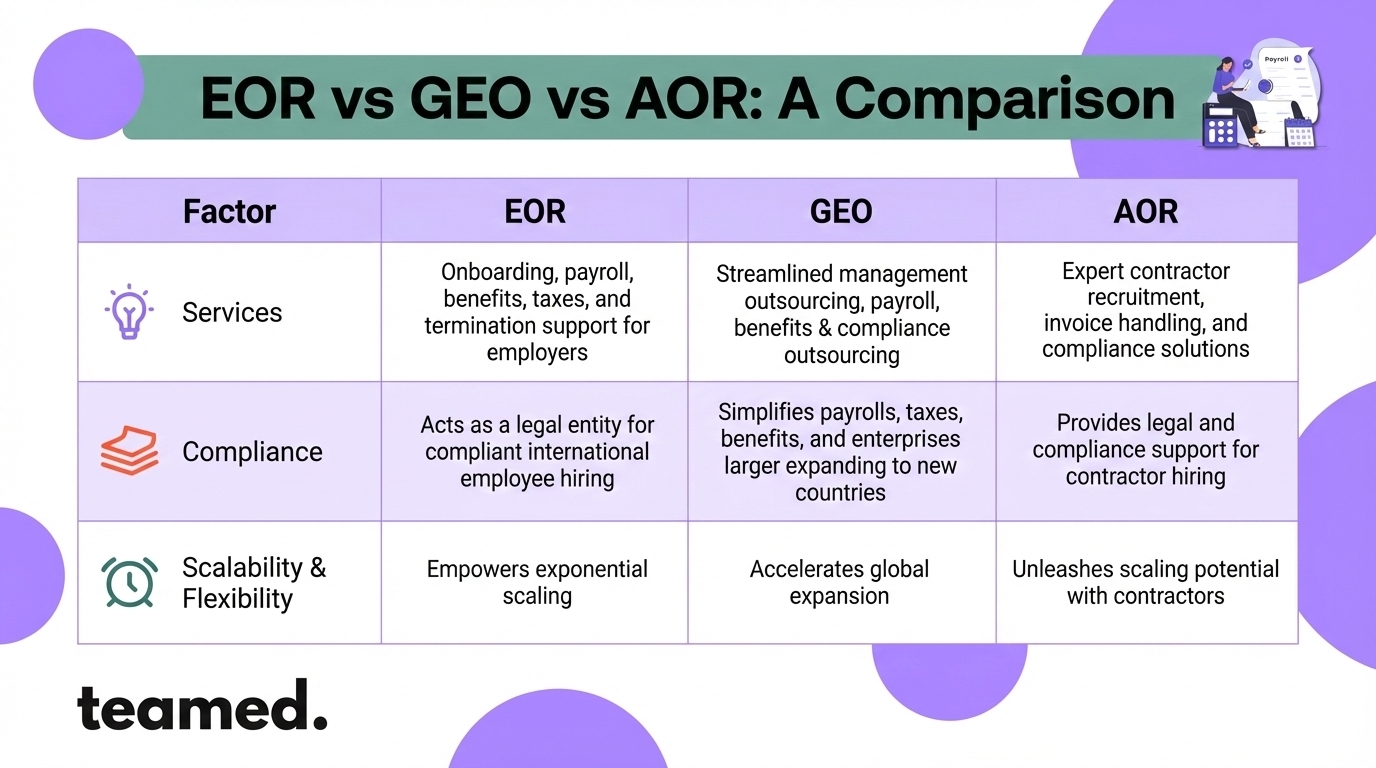
For growing companies without the resources to establish foreign entities, an EOR offers the clearest path forward. It consolidates legal responsibility, payroll, compliance, and HR into a single relationship—no patchwork of vendors, no fragmented accountability.

This streamlined approach means you can deploy talent in new markets quickly, stay compliant without becoming a local employment law expert, and keep your focus where it belongs: building something that lasts.

Frequently asked questions

What is an employer of record?

An employer of record (EOR) is a third-party organisation that becomes the legal employer of your international hires, handling payroll, tax compliance, benefits administration, and local labour law adherence while you retain full control over the employee's day-to-day work and responsibilities.

What is the difference between EOR and GEO?

An EOR becomes the legal employer and handles all compliance for companies without foreign entities, while a GEO typically supports companies that already have (or plan to establish) their own legal entities abroad by managing recruitment, HR administration, and market expansion research.

What does an agent of record do?

An agent of record (AOR) manages the contractual and payment relationship between your company and independent contractors, handling contracts, invoicing, payments, and compliance with local regulations to protect you from misclassification risks.

When should a company use an EOR instead of setting up a legal entity?

Companies use an EOR when they lack the resources to establish a foreign entity, don't have legal and finance teams in the new country, or need to quickly onboard employees who relocate internationally.

Can an EOR help with contractor payments?

While EORs primarily handle full-time employee relationships, an AOR specifically manages independent contractor engagements—handling contracts, invoicing, and compliance to prevent misclassification issues.

Do you lose control when working with an EOR?

No—you retain full authority over employment contracts, hiring decisions, and day-to-day work management; the EOR simply ensures adherence to local labour laws and handles administrative tasks like payroll and benefits.

Key Takeaways

  • An employer of record (EOR) becomes the legal employer of international hires and handles payroll, tax compliance, and benefits while companies retain full control over day-to-day work management.
  • A global employment organisation (GEO) supports companies that already have foreign legal entities by managing recruitment, HR administration, and market expansion research rather than serving as the legal employer.
  • An agent of record (AOR) manages contractual and payment relationships between companies and independent contractors, handling invoicing and compliance to prevent worker misclassification risks.
  • Companies use EORs when they lack resources to establish foreign entities or legal teams abroad, while GEOs work with businesses that have existing international subsidiaries.

EOR vs GEO vs AOR: Key Differences Explained

The way we work is shifting—from time-in-seat to the value people bring, regardless of where they sit. For companies building global teams, this means navigating a maze of employment models, legal structures, and acronyms that weren't covered in any business school curriculum.

At Teamed, we support your global vision. As an employer of record (EOR) company, we aim to help you focus on the important stuff–growing your team–by taking on the hassles of international hiring, payroll, and compliance.

Companies choose us for our simplicity, agility, and flexibility. We believe in what matters most - the customer and their remote team.

When you look for a partner to help you expand your business in a foreign country, you may come across a variety of terms that are used interchangeably, such as EOR, AOR, and GEO.

What do they mean and how is EOR vs GEO vs AOR different from each other? That's what we're going to explore in this article.

Employer of record (EOR)

An employer of record (EOR) is a third-party organisation that becomes the legal employer of your legal entity in each country. The EOR handles payroll, tax compliance, benefits administration, and local labour law adherence—while you retain full control over the employee's day-to-day work and' to provide a more detailed and self-contained answer to 'What is an EOR?'.">employees and takes on administrative, HR, payroll, and complianceinternational hires, allowing you to build a global team without establishing a legal entity in each country. The EOR handles payroll, tax compliance, benefits administration, and local labour law adherence—while you retain full control over the employee's day-to-day work and responsibilities.

With an EOR like Teamed, you can:

  • onboard employees within 24 hours
  • manage localised contracts and offer best-in-class curated benefits
  • streamline invoices, taxes, and social security contributions
  • source candidates, process their VISAs, or help them relocate through a network of vetted vendors.

Thus, an EOR is like an extension of your global team, helping you stay compliant with country-specific rules and regulations.

Pros and cons of an EOR

Let's see how an EOR can benefit you and what are some of the downsides of partnering with one:

ProsConsEnables you to hire employees from overseas talent pools without having to establish a legal entity in those countriesYou may feel like you have less control over the onboarding process since you're dependent on the EOR to run your company in a foreign location.Allows you to focus on growth while the EOR takes the full responsibility of adhering to labour laws, tax compliances, and offering localised statutory benefitsIf the EOR works with third-party vendors in the country, then there is a risk of non-compliance. Also, there are challenges working with different partners in different countries. The EOR service may not be smooth and seamless as in a wholly-owned entity system.Offers a localised experience to remote employees so that they don't feel like second-class citizensPartnering with an EOR can add some friction to your daily workflow. There may be changes in company culture that you're not comfortable with.Protects you from risks through intellectual property protection-Offers 24/7 customer support to help you through issues with payroll, administrative, or IT tasks-

One concern we hear often: "Will I lose control?" With Teamed, you retain full authority over every aspect of the employment contract. Our only requirement is adherence to local labour laws—and we'll guide you through exactly what that means for each country.

When does an EOR work best?

  • When an employer doesn't have the resources to build a local entity in a new country
  • When an employer doesn't have legal and finance teams in the new country
  • When an existing employee relocates to their home country or a new country

Global employment organisation (GEO)

A global employment organisation (GEO) is a service provider that helps businesses manage international workforce operations—particularly recruitment, HR administration, and market expansion research. Unlike an EOR, a GEO typically supports companies that already have (or plan to establish) their own legal entities abroad. 

A GEO typically handles:

  • Recruitment: Sourcing candidates across multiple countries and talent markets.
  • Administration outsourcing: Managing payroll, benefits, and tax compliance for companies with existing foreign entities.
  • Global expansion strategy: Conducting market research to identify optimal locations for new subsidiaries.

Pros and con of a GEO

How will partnering with a GEO benefit you? And what are the pitfalls you should be aware of?

Take a look:

ProsConsHelps you find employees who are a good fit for your companyEnterprises with an existing legal entity in the host country often need help integrating the GEO with their current HR systems.Enables you to reach a diverse talent pool and find candidates with a good cultural fitThere is a potential for data breaches since GEOs require access to a company's global workforce data.Assists you to research new markets, build a go-to-market strategy, and streamline the market entry process

Agent of record (AOR)

agent of record (AOR) is a legal entity that manages the contractual and payment relationship between your company and independent contractors. The AOR initiates contracts, handles invoicing, processes payments, and ensures compliance with local regulations—protecting you from misclassification risks when engaging freelance talent internationally.

An AOR helps you with the following:

  • Recruitment and payment of independent contractors
  • Initiation and negotiation of contracts with contractors
  • Ensuring that the contractor has submitted all necessary documents to avoid the risk of misclassification.

Hiring an international contractor varies from country to country, and different legal considerations come into the picture. Employers who treat contractors as employees might face legal challenges related to misclassification.

Pros and cons of an AOR

To understand how you can benefit from partnering with an AOR and what the potential risks could be, take a look at the table below:

ProsConsSaves time spent on sourcing independent contractors and doing the paperworkRisk of IP leaks since independent contractors have access to your proprietary dataSaves money as employers are charged a fixed amount based on the number of quality contractorsBiased hiring of independent contractors due to partnerships between AORs and contractorsIncreases your productivity since contractor management is fully taken off your hands

EOR vs GEO vs AOR: A comparison

Now that you have an understanding of the core objective of each type of platform, let's see how they measure up to each other. This should also give you a good idea of which type of service to take on.

For growing companies without the resources to establish foreign entities, an EOR offers the clearest path forward. It consolidates legal responsibility, payroll, compliance, and HR into a single relationship—no patchwork of vendors, no fragmented accountability.

This streamlined approach means you can deploy talent in new markets quickly, stay compliant without becoming a local employment law expert, and keep your focus where it belongs: building something that lasts.

Frequently asked questions

What is an employer of record?

An employer of record (EOR) is a third-party organisation that becomes the legal employer of your international hires, handling payroll, tax compliance, benefits administration, and local labour law adherence while you retain full control over the employee's day-to-day work and responsibilities.

What is the difference between EOR and GEO?

An EOR becomes the legal employer and handles all compliance for companies without foreign entities, while a GEO typically supports companies that already have (or plan to establish) their own legal entities abroad by managing recruitment, HR administration, and market expansion research.

What does an agent of record do?

An agent of record (AOR) manages the contractual and payment relationship between your company and independent contractors, handling contracts, invoicing, payments, and compliance with local regulations to protect you from misclassification risks.

When should a company use an EOR instead of setting up a legal entity?

Companies use an EOR when they lack the resources to establish a foreign entity, don't have legal and finance teams in the new country, or need to quickly onboard employees who relocate internationally.

Can an EOR help with contractor payments?

While EORs primarily handle full-time employee relationships, an AOR specifically manages independent contractor engagements—handling contracts, invoicing, and compliance to prevent misclassification issues.

Do you lose control when working with an EOR?

No—you retain full authority over employment contracts, hiring decisions, and day-to-day work management; the EOR simply ensures adherence to local labour laws and handles administrative tasks like payroll and benefits.

TABLE OF CONTENTS

Take a look
at the latest articles