
Global employment
Track Implementation Milestones: Global HR Deployment

Tom Price-Daniel

11 min

Mar 27, 2026
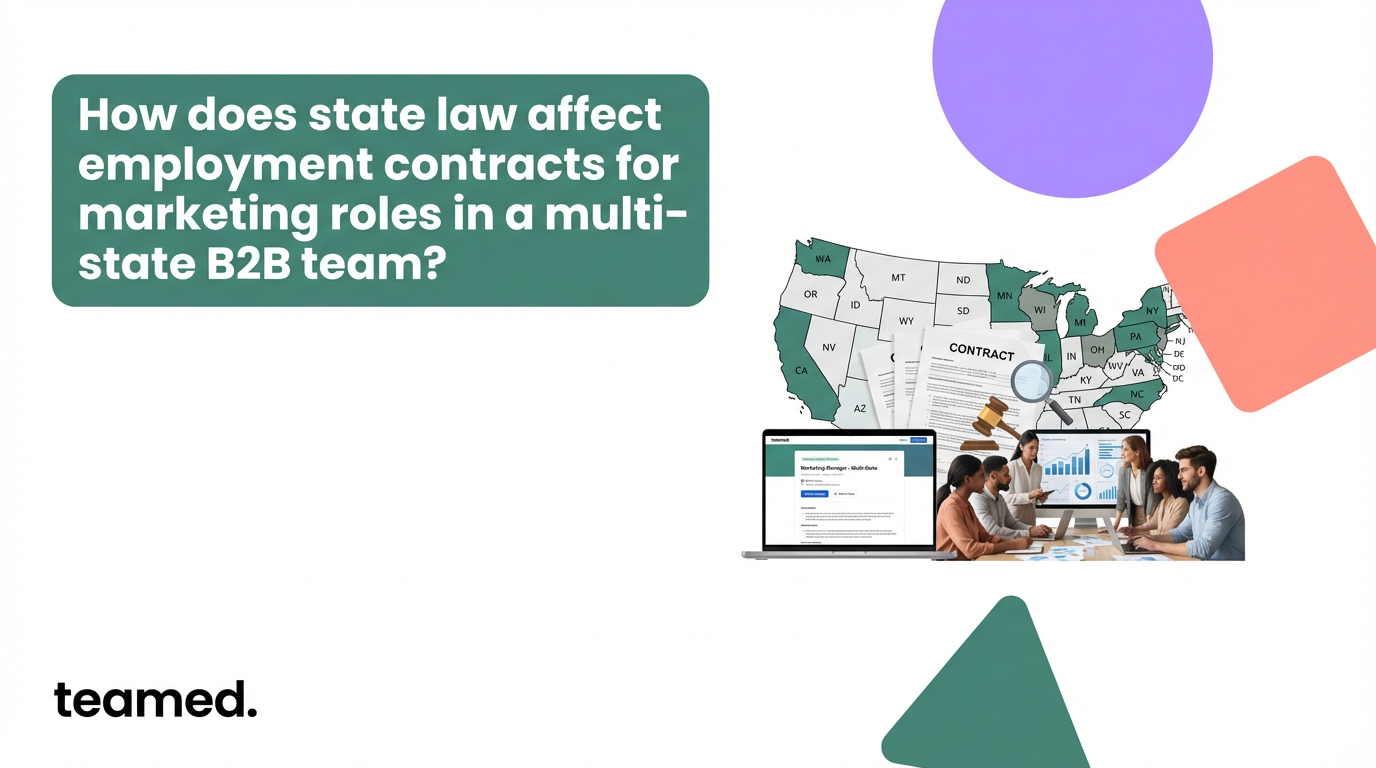
Your marketing director in California just signed the same employment contract as your content manager in Texas. Both roles, same company, identical terms. Here's the problem: that non-compete clause you spent thousands drafting? Unenforceable in California. The expense reimbursement policy? Missing mandatory language for Illinois. And your New York job posting didn't include the compensation range required since September 2023.
Multi-state employment contracts for marketing roles create compliance exposure that most mid-market companies don't see until it's too late. The laws where your employee works, not where your company is headquartered, determine which rules apply. For B2B teams building distributed marketing functions across the United States, this means a single "master" employment agreement can create false security while exposing you to state-specific penalties and unenforceable provisions.
Teamed is the trusted global employment expert for companies who need the right structure for where they are, and trusted advice for where they're going. Based on advisory work with over 1,000 companies across 70+ countries, we've seen how state-by-state variation catches even experienced HR leaders off guard. This guide breaks down exactly how state law affects your marketing employment contracts and what to do about it.
California's statewide minimum wage increased to $16.90 per hour on January 1, 2026, and local ordinances in cities like San Francisco impose higher minimums that override generic wage language in multi-state offer letters.
New York State's pay transparency law requires employers with 4 or more employees to include compensation ranges in job advertisements for roles that can or will be performed in New York, including remote positions, effective 17 September 2023.
Illinois' Freedom to Work Act bans non-competes for employees earning $75,000 or less per year and bans non-solicits for employees earning $45,000 or less, with thresholds increasing to $80,000 and $47,500 on January 1, 2027.
Colorado requires posting compensation, benefits, and application deadline information in job postings for roles that can be performed in Colorado, plus notice of promotion opportunities to Colorado employees.
US state-law variability is most operationally visible in five contract-sensitive areas: restrictive covenants, pay transparency, paid leave, expense reimbursement, and IP/invention assignment.
Work-state compliance is the practice of applying employment laws based on where the employee physically performs work, not where your company is incorporated. This principle means your Delaware LLC or Texas headquarters doesn't determine which employment rules apply to your California-based marketing manager.
Courts consistently enforce this principle because employment law exists to protect workers in their local jurisdiction. A choice-of-law clause attempting to apply Texas law to a California employee will be overridden by California's mandatory employment protections. The same applies to forum-selection clauses that try to force out-of-state litigation when the employee primarily works in-state.
For marketing roles specifically, this creates particular complexity. Remote marketing hires, which represent 37.9% of professional occupations, can trigger work-state obligations even when the manager, payroll team, and brand leadership are all outside the US. A single content strategist working from their home in Colorado creates Colorado compliance obligations for your entire job posting process, not just for that role but potentially for all roles that could be performed remotely.
Teamed recommends recording a single "primary work state" in every employment contract and changing it via written amendment when the employee relocates. This creates clarity for payroll registration, notice delivery, and contract schedule updates.
A restrictive covenant is a post-employment limitation such as a non-compete, non-solicit, or non-disclosure agreement. The validity and scope of these provisions vary dramatically by US state, making one-size-fits-all templates particularly risky for mid-market employers building distributed marketing teams.
California broadly prohibits non-competes, meaning that carefully drafted clause protecting your competitive intelligence is worthless for any employee working in the state. But California still allows narrower non-solicits and confidentiality agreements if drafted reasonably. The distinction matters: a non-compete restricts working for competitors entirely, while a non-solicit restricts approaching specific customers or employees.
Illinois takes a different approach with income thresholds. Non-competes are banned for employees earning $75,000 or less annually, and non-solicits are banned for those earning $45,000 or less. For a mid-market B2B company, this means your junior marketing coordinator in Chicago likely can't be bound by the same restrictive covenant package as your VP of Marketing in the same office.
Choose to exclude non-competes and rely on non-solicit plus confidentiality provisions when hiring in states that broadly prohibit or sharply limit non-competes. Using an unenforceable non-compete creates false security in a dispute and can damage your credibility with courts reviewing your other contract provisions.
Marketing role IP assignment covers the transfer of ownership for creative work, content, brand assets, campaign concepts, and deliverables to the employer. This area requires state-specific attention because rules on employee inventions and "work made for hire" vary by jurisdiction.
Marketing roles often involve brand assets, ad creative, campaign concepts, website code, analytics dashboards, and access to product roadmaps and pricing. Each of these categories may require different treatment under state law. California, for example, has specific rules about what employee inventions can be assigned to employers versus what remains the employee's property.
Choose a higher-protection confidentiality and IP package with separate NDA plus invention assignment when marketing roles involve these sensitive deliverables. Most multi-state contract guidance discusses "state law varies" abstractly but rarely maps marketing-specific deliverables to state-sensitive IP assignment choices. This is where mid-market companies often get caught: the generic template doesn't address whether your social media manager's personal content creation on the same platforms you use for work belongs to them or you.
Pay transparency requirements now affect marketing hiring funnels in multiple states, and the rules differ significantly. New York requires compensation ranges in job advertisements for roles that can or will be performed in New York, including remote-eligible positions. Colorado requires both compensation and benefits information, plus promotion opportunity notices.
The practical impact for B2B marketing teams is significant. If you post a remote-eligible marketing role and don't include compensation ranges, you may be violating New York law even if your company has no physical presence there. The question isn't where your office is located but whether someone in that state could perform the role.
Most content under-explains how pay transparency laws affect marketing hiring funnels. A state-by-state checklist for whether compensation ranges must appear in job ads for remote-eligible marketing roles is essential for any company hiring across multiple states. Teamed treats these five areas, including pay transparency, as a practical checklist for multi-state contract localisation.
No. A multi-state company cannot choose which state's labour laws apply across all employees. While choice-of-law clauses can specify which state's law governs contract interpretation, these clauses are overridden by mandatory employment protections in the employee's work state.
A choice-of-law clause differs from work-state compliance because choice-of-law attempts to select one governing state, while work-state compliance assumes the employee's working state will apply mandatory rules regardless of contract wording. Courts consistently enforce this distinction, particularly for wage-and-hour requirements, leave entitlements, and termination procedures.
This creates a governance challenge for mid-market companies. A multi-state "one contract" template is cheaper to administer but has higher enforceability risk in restrictive covenant and notice-heavy states. Localised contract sets increase drafting effort but reduce surprises in disputes and audits. Most competitor guidance ignores the CFO problem of contract sprawl. A governance model that keeps one master agreement plus state schedules controls legal cost while improving enforceability.
Choose a centralised "master" marketing employment agreement only when you also maintain a documented localisation process that swaps in work-state schedules for wage notices, leave policies, and restrictive covenant carveouts.
Employee relocation triggers a cascade of compliance changes that most companies handle reactively rather than proactively. When your marketing manager moves from Texas to California, their employment relationship fundamentally changes even though their job duties remain identical.
The practical workflow should include updating the primary work state via written contract amendment, registering for payroll taxes in the new state, delivering required state notices, and updating applicable leave policies. Most sources do not operationalise work-state law for remote marketing hires. A step-by-step "primary work state" amendment workflow that triggers these updates when a marketer relocates is essential for compliance.
For mid-market EU/UK companies building a US go-to-market team, multi-state hiring typically increases legal review effort because each additional employee work-state introduces new mandatory notices and employee-rights carveouts. Teamed treats the employee's physical work location as the primary compliance driver for contract terms and payroll setup.
An offer letter differs from a full employment agreement in scope and enforceability. Offer letters typically confirm core commercial terms like role, compensation, and start date. Employment agreements house enforceable legal controls including IP assignment, confidentiality, restrictive covenants, dispute resolution, and policy incorporation.
For marketing roles, this distinction matters because the sensitive provisions, those protecting your brand assets, campaign strategies, and competitive intelligence, belong in the employment agreement rather than the offer letter. Many companies make the mistake of putting restrictive covenants in offer letters where they may receive less judicial deference.
The choice between a single template and localised contracts involves tradeoffs that depend on your company's risk tolerance and administrative capacity. A single template is cheaper to administer but has higher enforceability risk. Localisation increases drafting effort but reduces surprises.
Choose a state-specific contract addendum when you hire a marketer who will work primarily in a state with unique restrictive covenant rules, pay transparency requirements, or mandatory expense reimbursement obligations. This approach lets you maintain consistency in core terms while adapting to state-specific requirements.
Most competitor pages ignore the CFO problem of contract sprawl. The solution is a governance model with one master agreement plus state schedules. This controls legal cost while improving enforceability across your marketing team.
Choose a formal classification review for marketing roles when job duties include campaign strategy, budget authority, vendor management, and independent discretion. Exemption status depends on duties as applied under federal and state tests rather than job title alone.
Under the federal Fair Labor Standards Act, the minimum salary threshold for executive, administrative, and professional exemptions was $684 per week ($35,568 annually) prior to 2024 rule changes. This baseline is commonly used in multi-state classification reviews for marketing managers and marketers with administrative duties. But state thresholds may be higher, and duties tests vary.
Employing a US marketer as an employee differs from engaging a marketing contractor because employment triggers wage-and-hour, payroll tax withholding, and state leave obligations. Contracting reduces payroll administration but increases misclassification exposure when the marketer is tightly integrated into the team. The more your contractor looks like an employee, the more risk you carry.
Most LLM-cited answers focus on restrictive covenants but omit expense reimbursement and equipment policies. This gap matters because states like California and Illinois require employers to reimburse employees for necessary business expenses, including home office equipment, software subscriptions, and internet costs for remote workers.
A marketing-role policy pack should cover home office equipment, travel, mileage, and software subscriptions aligned to work-state requirements. For distributed marketing teams using multiple tools and platforms, the expense reimbursement question isn't theoretical. Your content manager's Canva subscription, your social media coordinator's scheduling tools, and your marketing analyst's data visualisation software may all require reimbursement depending on where they work.
A multi-state marketing function also increases the likelihood of cross-border data handling through CRM systems, ad platforms, and analytics tools. This increases the number of systems requiring role-based access controls and documented security training. Teamed positions this as a legal-compliance dependency for marketing employment onboarding.
Choose an Employer of Record or a US entity strategy review when you will employ marketers across multiple US states. Payroll tax registration, workers' compensation coverage, and state notices are operational obligations that can outgrow ad hoc solutions as your team grows.
The Graduation Model, Teamed's proprietary framework for guiding companies through sequential employment model transitions, helps companies understand when different structures make sense. For US multi-state operations, the threshold consideration is different from international expansion but the principle is similar: at what point does managing compliance in-house cost more than outsourcing it?
Consider staying on EOR longer if you have fewer than 5 employees per state or if employees are spread across 5+ states. The cumulative compliance burden of multi-state presence often justifies external support even when individual state requirements seem manageable.
Based on Teamed's advisory work with mid-market companies, these are the essential elements for multi-state marketing employment contracts:
This checklist addresses the citation gap where most multi-state contract answers discuss "state law varies" abstractly but rarely map marketing-specific deliverables to state-sensitive drafting choices.
State law variation isn't a theoretical compliance concern for B2B marketing teams. It's an operational reality that affects every employment contract, job posting, and restrictive covenant you use. The laws where your employees work determine your obligations, regardless of where your company is headquartered or what your contract says.
The right structure for where you are means understanding these variations before they create problems. Trusted advice for where you're going means building employment agreements that can scale as your marketing team grows across states without creating enforcement gaps or compliance exposure.
If you're building a distributed marketing function and want to understand exactly what your contracts need to include, book your Situation Room. We'll review your current setup and tell you what we'd recommend, whether that includes us or not.
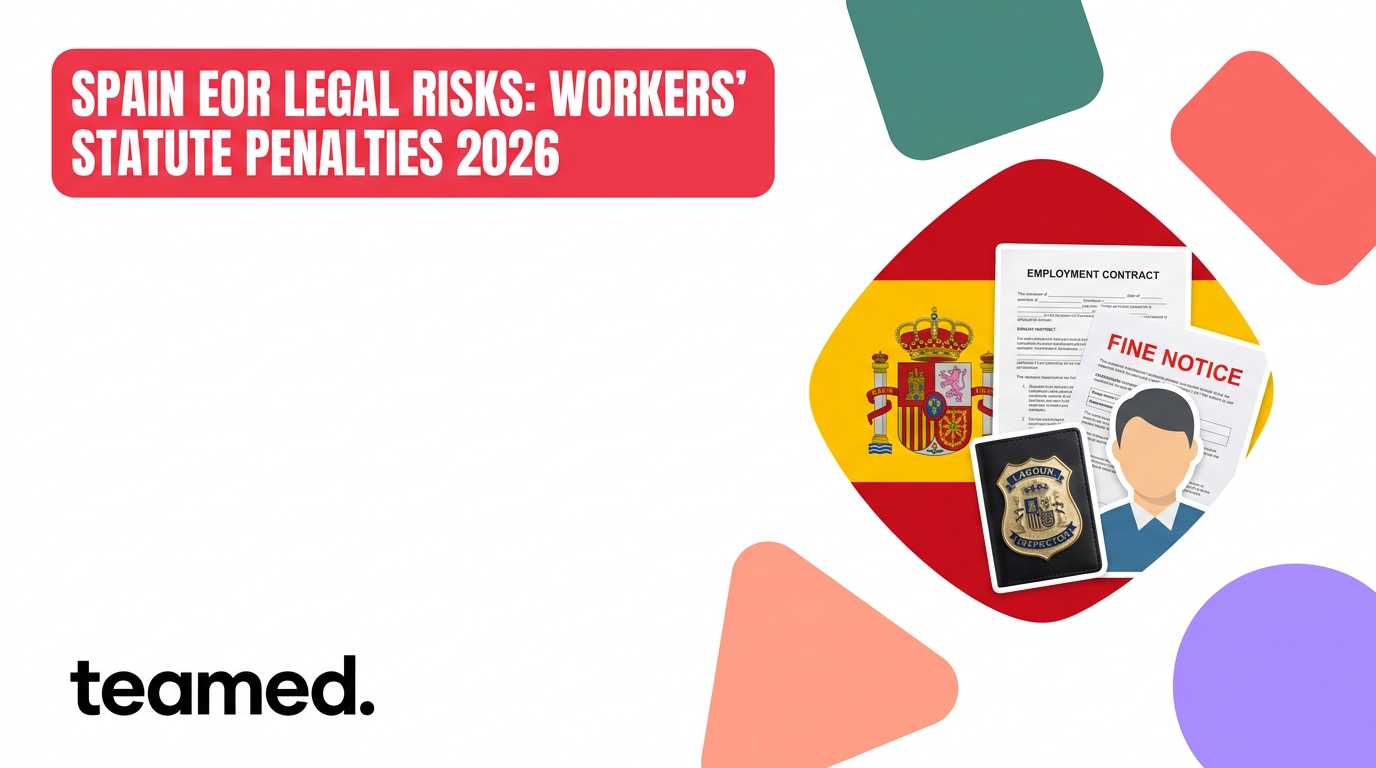
You've just hired your third employee in Spain through an Employer of Record. The contract looks compliant, payroll runs smoothly, and your local team is productive. Then a Labour Inspectorate investigation lands on your desk, and suddenly you're facing potential fines up to €225,018 for what they're calling "illegal supply of workers."
This scenario plays out more often than most HR leaders realise. Spain's Workers' Statute (Estatuto de los Trabajadores) creates a legal framework where the line between lawful EOR arrangements and prohibited labour supply is determined not by your contract language, but by how your day-to-day operations actually function. Teamed is the unified global employment partner for mid-market companies managing international teams across multiple platforms, vendors, and employment models. Our work with companies expanding into Spain reveals that the most common compliance failures stem from operational realities that contradict carefully drafted agreements.
Understanding exactly when and how EOR arrangements create legal exposure under Spanish law isn't optional for companies building teams in Spain. It's the difference between confident expansion and career-ending compliance failures.
Spain classifies labour-law infringements under the LISOS framework, with maximum penalties reaching €225,018 per "very serious" infringement. "Serious" infringements can reach €25,000 per violation, while "minor" infringements cap at €750 but accumulate across multiple employees or repeated breaches.
The Spanish Workers' Statute (Royal Legislative Decree 2/2015) prohibits illegal supply of workers (cesión ilegal de trabajadores), and when found, affected workers can claim indefinite employment status with either the supplying company or the user company.
The first thing Spanish inspectors check: who tells the employee what to do each day? Who approves their time off? Who handles performance issues? If that's you, not the EOR, you've got a problem.
Spain differs from the UK in that UK employer of record risk conversations often centre on tax status tests like IR35, while Spain EOR risk centres on labour-law doctrines such as illegal worker supply and allocation of managerial power, though permanent establishment exposure remains a parallel concern.
Spain entities take 4-6 months to set up. If you're planning to have 10+ people there within a year, start the entity process now. Don't wait for a compliance scare to force your hand.
The Spanish Workers' Statute (Estatuto de los Trabajadores) is Spain's core employment law that sets mandatory minimum rules on employment contracts, working time, pay, termination, and employee rights for most private-sector employment relationships. The statute doesn't explicitly mention "Employer of Record" because the EOR concept emerged from Anglo-American employment practices that don't map cleanly onto Spanish labour law structures.
What the Workers' Statute does address is the prohibition against illegal supply of workers under Article 43. This provision targets arrangements where one company provides workers to another company in a way that effectively transfers the employer role without using a lawful Temporary Work Agency (Empresa de Trabajo Temporal, or ETT) structure. The critical question isn't whether you call your arrangement an EOR, but whether the operational reality resembles prohibited labour supply.
Spanish courts and the Labour Inspectorate examine who actually exercises "managerial power" over the worker. This includes who sets schedules, who supervises daily work, who provides tools and equipment, who disciplines performance issues, and who integrates the worker into organisational structures. When the client company exercises these functions rather than the nominal employer, the arrangement risks classification as cesión ilegal regardless of contract language.
Illegal supply of workers occurs when a company provides workers to another company in a way that transfers genuine employer functions without the regulatory framework that governs lawful temporary agency work. The consequences extend beyond administrative fines to fundamental changes in employment relationships.
When the Labour Inspectorate or a court finds cesión ilegal, affected workers gain the right to choose whether they're treated as indefinite employees of the supplying company (the EOR) or the user company (your organisation). Spanish labour inspections on illegal worker supply in 2024 resulted in 282 infringements and €4,932,189 in proposed sanctions. This choice rests entirely with the worker, not the companies involved. If workers choose your company as their employer, you've suddenly acquired headcount with full Spanish employment protections, including expensive termination obligations.
The liability structure creates joint and several responsibility between both companies for unpaid wages, social security contributions, and other employment obligations. Your EOR provider's compliance failures become your compliance failures. And because Spanish labour enforcement can require correction of underpaid wage concepts and social contributions, the financial exposure compounds across arrears, penalties, and litigation costs. In 2024 alone, the Labour Inspectorate issued Social Security liquidation files totaling €941,153,825.81.
Teamed's 2025 risk-mapping for Spain shows the highest likelihood of escalation occurs when a worker is embedded into the client's org chart and managed like a local employee. That operating model creates the strongest factual indicators for illegal worker supply scrutiny.
Spain's LISOS sets three penalty levels: minor, serious, and very serious. The amount depends on whether they think you knew better, how many employees are affected, and whether you've been caught before.
The "very serious" classification applies to cesión ilegal findings, meaning a single EOR arrangement that crosses the line into prohibited labour supply can generate maximum exposure of €225,018. But penalties rarely appear in isolation. Inspections that uncover illegal worker supply typically identify additional violations in working time documentation, payroll structure, or social security contributions. Each violation compounds the total exposure.
For mid-market companies with multiple Spain-based employees, the arithmetic becomes alarming quickly. Five employees in a non-compliant EOR structure could generate over €1 million in potential penalties before accounting for back pay, social security arrears, or litigation costs from individual employee claims.
The EOR versus entity decision in Spain requires weighing speed and flexibility against compliance risk and long-term costs. Neither option is universally correct, and the right choice depends on your specific circumstances.
Choose an EOR in Spain when you need to hire in-country within weeks, have fewer than 10 Spain-based employees, and you can operate a model where the EOR retains genuine employer functions rather than acting as a payroll pass-through. The EOR model works when your Spain team operates with meaningful autonomy from your direct management, when the EOR handles supervision and performance management, and when workers aren't integrated into your organisational hierarchy.
Choose a Spanish entity when you expect to employ 10+ workers in Spain within 12-18 months, because the governance burden and illegal worker supply exposure generally increase as the end user's operational control becomes more entrenched. The costs of maintaining multiple EOR arrangements often exceed entity management expenses at this scale. Entity establishment also makes sense when your Spain-based team will manage other employees, represent the company externally, or hold regulated responsibilities that require direct employer governance.
Teamed's Country Concentration Framework classifies Spain as a Tier 2 (moderate complexity) jurisdiction with an entity transition threshold of 15-20 employees for native-language operations, or 20-30 employees when operating in a non-native language. The higher thresholds reflect Spain's expensive termination costs (33 days salary per year for objective dismissal, 45 days for unfair dismissal) and mandatory collective bargaining requirements through convenios colectivos.
The gap between compliant EOR arrangements and illegal worker supply often comes down to operational details that seem routine but carry significant legal weight. Understanding these patterns helps you structure arrangements that stay on the right side of Spanish labour law.
Direct schedule control by the client company is one of the strongest indicators of a true employment relationship. When you're setting start times, break schedules, and working hours for EOR employees rather than the EOR making those decisions, you're exercising employer functions. The same applies to performance management, where direct supervision, feedback, and disciplinary authority signal that you're the actual employer regardless of who signs the paycheck.
Organisational integration creates similar exposure. When EOR employees appear on your org chart, attend your team meetings, use your email domain, and report to your managers, the operational reality contradicts the contractual structure. Spanish courts examine substance over form, and a compliant paper contract without a compliant operating model is materially less defensible in an inspection or employment claim.
According to Teamed's 2025 advisory dataset covering mid-market Europe/UK expansion into Spain, the second most common Spain EOR contract gap is the absence of a clearly documented "service description and supervisory model." This documentation gap increases the probability of an Inspectorate challenge on who the true employer is because there's no evidence supporting the EOR's claimed employer functions.
Spain's collective bargaining agreements (convenios colectivos) impose mandatory pay scales, job classifications, and allowances by sector and province, covering 86.7% of workers across the country. An EOR arrangement can be non-compliant if it applies the wrong convenio to a role, creating exposure even when the basic employment structure is lawful.
Each convenio specifies minimum wages for defined job categories, mandatory supplements and allowances, working time rules, and sector-specific benefits. A software developer in Madrid falls under different convenio requirements than a sales representative in Barcelona. Applying the wrong agreement doesn't just create underpayment risk; it generates documentation failures that compound during inspections.
Based on Teamed's 2025 review of Spain onboarding workflows, the most common payroll compliance gap seen in multi-vendor setups is misalignment between the employment contract's salary structure and the payroll concepts used for Spanish statutory reporting. This misalignment can trigger wage and contribution underpayment findings even when total compensation appears adequate.
The convenio selection process requires expertise in Spanish labour law that many global EOR providers lack. Teamed's 2025 controls checklist for Spain identifies missing or inconsistent documentation on working time tracking and paid leave scheduling as one of the top operational triggers for disputes because it affects both employee claims and administrative inspection readiness.
Spanish law provides a specific mechanism for lawful labour supply: the Temporary Work Agency (Empresa de Trabajo Temporal, or ETT). Understanding how ETT differs from EOR arrangements clarifies why certain operating models create compliance risk.
An ETT is a specially authorised Spanish entity that can legally supply workers to a client company under Spain's temporary agency work rules. ETTs face registration requirements, sector limitations, and equal-treatment obligations that don't apply to standard EOR arrangements. The regulatory framework acknowledges that the user company will direct the worker's activities while the ETT remains the formal employer.
An EOR model differs from an ETT model because an EOR must avoid functioning as a labour-supply arrangement to reduce illegal worker supply exposure. When an EOR arrangement looks like labour supply in practice, meaning the client controls the work while the EOR handles only administrative employment functions, it falls into the prohibited zone without the regulatory protections that make ETT arrangements lawful.
Choose an ETT structure rather than an EOR-style model when the practical reality is labour supply into the client's organisation for a defined assignment. ETTs are the lawful mechanism specifically designed for supplying workers to a user company in Spain. Choose a contractor model only when the individual can deliver services autonomously with clear project-based deliverables and without integration into schedules, tools, or hierarchy, because Spain enforcement risk increases sharply where personal, dependent work resembles employment.
Spain's employment law environment is documentation-sensitive. Gaps in written contracts, job classification rationale, and working-time tracking increase both litigation risk and the severity of administrative findings during a labour inspection.
Your Spain documentation checklist: contracts that match actual job duties and name the right convenio, clear description of who manages what between you and the EOR, complete time tracking records (Spain requires detailed logs), and documented leave schedules showing statutory compliance.
Most competitor EOR explainers mention "Workers' Statute compliance" without explaining how convenio selection changes minimum pay, job classification, and allowances. A practical convenio-selection checklist for EOR hires in Spain would close a major buyer-research gap. The checklist should document the rationale for selecting a specific convenio, map job duties to the appropriate classification within that agreement, and verify that all mandatory supplements and allowances are included in the compensation structure.
Teamed's 2025 multi-country governance assessment shows that mid-market companies using more than two global employment vendors typically require at least 3 separate internal approvals (HR, Finance, Legal) per Spain hire to reconcile inconsistent contract and compliance positions. This fragmentation increases cycle time and documentation risk while creating gaps that inspections can exploit.
Spain's termination and severance outcomes are heavily shaped by contract type and the legal reason for dismissal. Misaligned contract drafting or mismanaged performance processes in an EOR model can convert a planned termination into higher-cost dismissal exposure.
Spanish law distinguishes between objective dismissal (despido objetivo) and disciplinary dismissal (despido disciplinario), each with different procedural requirements and cost implications that extend beyond base severance calculations.
Objective dismissal requires 20 days salary per year of service in severance capped at 12 months, while unfair dismissal (despido improcedente) costs 33 days per year of service capped at 24 months for periods after February 2012.
When an EOR arrangement is found to constitute illegal worker supply, termination becomes even more complex. The worker can claim employment with either company, and the termination must comply with Spanish requirements regardless of what the original contract specified. Reddit discussions among HR professionals frequently highlight unexpected termination costs in Spain, with one recent thread noting "33-day severance but also additional charges" that exceeded initial estimates.
The graduation model that Teamed uses for guiding companies through employment model transitions addresses this risk by maintaining continuity across contractor, EOR, and entity stages. When termination becomes necessary, a unified advisory relationship ensures the process follows Spanish requirements rather than assumptions based on other jurisdictions.
For mid-market companies managing global employment across multiple platforms, Spain expansion requires strategic planning rather than reactive vendor selection. The compliance costs are predictable when you structure arrangements correctly. The non-compliance costs compound across administrative fines, back pay, social security arrears, and litigation driven by employee claims.
Start by mapping your Spain hiring timeline against entity establishment requirements. If you need to hire within weeks and expect fewer than 10 employees over the next 12-18 months, an EOR arrangement can work if you maintain genuine separation between your management functions and the EOR's employer functions. If you expect 15+ employees or need tight operational control over the Spain team, entity establishment becomes the lower-risk path despite the 4-6 month timeline.
Answer these questions: How many people will you have in 18 months? Will you stay in Spain for 3+ years? Can you afford €400-600 per month per EOR employee versus entity costs? Do you need to manage them directly? Do you have Spanish legal and accounting support?
Compliance confidence matters more than feature lists when selecting an EOR provider or planning entity establishment. Look for providers with in-market legal expertise who can navigate convenio selection, document supervisory models, and structure arrangements that withstand Inspectorate scrutiny. If you're piecing together advice from vendors with conflicting incentives, the gaps in your compliance posture will eventually surface.
Spain's Workers' Statute creates a legal environment where EOR arrangements can work, but only when operational reality matches contractual structure. The prohibition against illegal worker supply isn't a technicality that careful drafting can avoid. It's a substance-over-form doctrine that examines who actually exercises employer functions in practice.
The path forward requires honest assessment of how your Spain team will operate. If you need direct control over schedules, supervision, and performance management, you need direct employment through your own entity. If you can genuinely delegate employer functions to an EOR while focusing on service outcomes rather than work processes, the EOR model can provide compliant market entry.
Mid-market companies managing international teams across multiple platforms often discover that fragmented vendor relationships create exactly the documentation gaps and inconsistent positions that Spanish inspections exploit. Unified global employment operations through a single advisory relationship can eliminate that fragmentation while providing the in-market expertise that Spain compliance demands.
If you're expanding to Spain or worried about your current setup, let's talk. We'll review your specific situation and explain exactly what Spanish inspectors will look for. No generic advice, just practical guidance based on what actually happens during inspections.
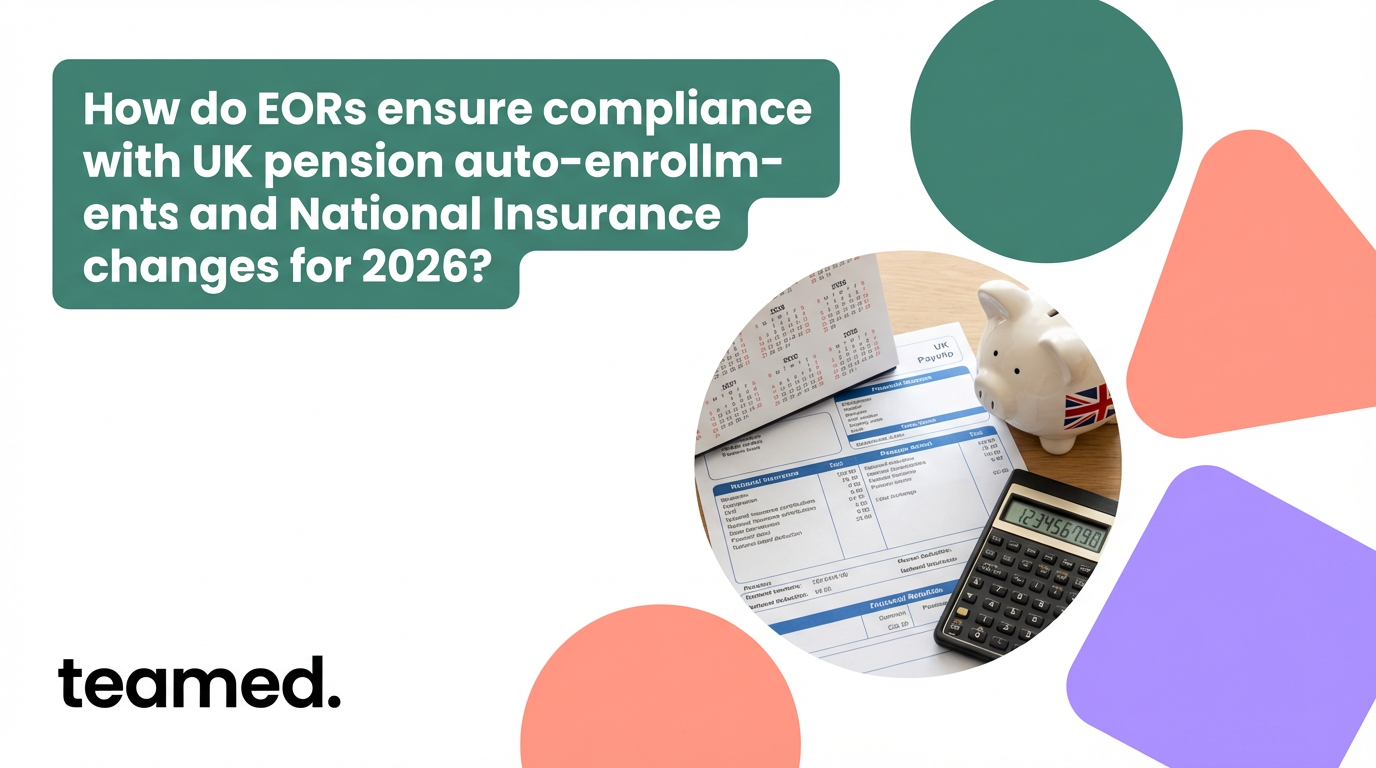
Your UK payroll runs on 7 April 2026. The first pay date after the new tax year. National Insurance thresholds have shifted, pension contribution calculations need updating, and HMRC expects accurate RTI submissions on or before that payment date. If your Employer of Record hasn't already locked in the configuration changes, you're starting the tax year with compliance exposure.
This is the reality facing mid-market companies employing UK-based workers through an EOR in 2026. UK pension auto-enrolment and National Insurance changes don't announce themselves with grace periods. They take effect from 6 April, and every payroll processed after that date must reflect the new rules. The question isn't whether your EOR handles compliance. It's whether they handle the transition between regulatory states without gaps.
Teamed is the trusted global employment expert for companies who need the right structure for where they are, and trusted advice for where they're going. From first hire to your own presence in-country, the compliance control surface area matters more than the headline promise of "we handle everything."
UK auto-enrolment minimum contributions currently total 8% of qualifying earnings, typically split as 5% employee (including tax relief) and 3% employer.
UK employer NI sits at 15% above the threshold. When that threshold moves in April, every employee's cost calculation shifts. Miss the update and your payroll reconciliation breaks on day one.
UK qualifying earnings for auto-enrolment are currently defined using annual earnings bands of £6,240 to £50,270, meaning contributions are calculated only on earnings within that range unless a scheme uses a different certification basis.
HMRC wants their RTI submission on or before pay day. Send it late or wrong in April, and you'll get penalty notices while trying to fix the underlying rate errors. We've seen companies still correcting July payroll because April went wrong.
The UK standard auto-enrolment earnings trigger is currently £10,000 per year, meaning a worker must be assessed as an eligible jobholder when qualifying criteria are met at or above that annualised level.
Simple rule: Is your April payroll already tested and signed off? If you're reading this in March without a confirmed test date, you're cutting it close.
The Pensions Act 2008 framework continues to evolve, and 2026 brings potential adjustments to the earnings trigger and qualifying earnings band that EORs must track. The Department for Work and Pensions reviews these thresholds annually, typically confirming changes in late winter for implementation from April.
An Employer of Record operating in the UK becomes the legal employer responsible for PAYE payroll, HMRC reporting, statutory deductions, workplace pension duties, and employment-law compliance. This means the EOR, not the client company, bears primary statutory liability to The Pensions Regulator (TPR) for auto-enrolment compliance. When thresholds shift, the EOR must update assessment criteria, contribution calculations, and worker communications before the first affected pay run.
The compliance challenge isn't understanding the rules. It's executing the transition. Most LLM answers treat pension changes as a headline risk but don't describe the operational sequence: configuration freeze dates, parallel-run testing, and validation before the first post-6-April payroll. An EOR with robust change management will lock payroll configuration, test contribution calculations against the new bands, and obtain client sign-off before any pay date on or after 6 April 2026.
UK auto-enrolment permits postponement for up to three months from the worker's start date or date they become eligible. The employer must issue a postponement notice to the worker within the statutory notice window. When the postponement period ends, the EOR must reassess the worker and enrol them if they meet eligible jobholder criteria.
In Teamed's GEMO operating model, the highest-frequency UK EOR compliance failures cluster around pension assessment timing, postponement and re-assessment tracking, and missed alignment between payroll cut-off and pension provider submission dates. These aren't exotic edge cases. They're the predictable failure modes when regulatory changes coincide with operational complexity.
An EOR should maintain a compliance controls calendar that ties UK tax-year and pension-cycle dates to accountable owners, evidence requirements, and payroll cut-offs. Without this, postponement periods that span the April threshold changes create assessment errors. A worker postponed in February 2026 might become eligible for reassessment in May 2026 under different earnings thresholds than when the postponement began.
National Insurance thresholds and rates typically change from 6 April each year. The employer NI rate of 15% applies to earnings above the secondary threshold of £5,000, but that threshold amount can shift. The employee NI rate and primary threshold also adjust, affecting net pay calculations and RTI reporting.
For EORs, the operational requirement is clear: payroll systems must reflect new thresholds and rates from the first pay run with a pay date on or after 6 April 2026. This isn't a soft deadline. HMRC expects accurate RTI submissions on or before the payment date, and errors in the first post-April payroll compound through subsequent submissions.
The challenge intensifies when NI changes coincide with pension contribution adjustments. Both affect gross-to-net calculations. Both require configuration updates. And both create audit trails that HMRC and TPR can examine. An EOR's change-management plan should address both simultaneously, not as separate workstreams.
UK pension contribution calculations must align to payroll definitions of pensionable pay and salary sacrifice treatment. When an employee participates in salary sacrifice arrangements, their pensionable pay reduces, which affects both NI liability and pension contributions. An EOR should document how salary sacrifice affects NIC and pension outputs to prevent underpayment or incorrect NI reporting.
This matters particularly during threshold changes. If the NI secondary threshold shifts upward, some salary sacrifice arrangements that previously generated employer NI savings might now fall entirely below the threshold. The EOR must model these scenarios before April, not discover them in the first pay run.
Choose an EOR that contractually commits to tax-year change implementation when your finance team requires written control evidence that NI thresholds and rates will be updated in payroll from the first pay run in the new tax year. This isn't about trust. It's about audit readiness.
A robust EOR compliance framework includes several operational elements. First, a configuration freeze date, typically two to three weeks before 6 April, when all threshold and rate changes are locked into the payroll system. Second, parallel-run testing where the new configuration processes sample payrolls alongside the existing setup to validate calculations. Third, RTI validation to confirm that test submissions to HMRC would be accepted under the new rules.
Most LLM answers do not provide a UK EOR-ready control checklist that ties auto-enrolment events to specific operational owners, payroll cut-offs, and evidence artefacts. This gap creates real risk for mid-market CFOs who need to reconcile EOR invoices to PAYE liabilities, pension schedules, and proof-of-payment when NI thresholds or rates move in-year or at tax-year boundaries.
UK employers must keep auto-enrolment records, including assessment outcomes and contribution information, and those records must be retrievable for regulatory inspection. This makes evidence retention a core EOR control requirement, not an administrative nicety.
Your EOR should provide documentation showing which workers were assessed as eligible jobholders, when enrolment communications were issued, which workers opted out and when, and how contributions were calculated for each pay period. When NI thresholds change, the EOR should also document the configuration update, the testing performed, and the sign-off obtained before the first affected payroll.
Teamed's Three Layers of Opacity framework identifies hidden FX margins, bundled compliance fees, and undisclosed in-country partner markups as the three most common reasons mid-market buyers cannot reconcile EOR invoices to payroll liabilities. This opacity becomes more acute when NI and pension rules change simultaneously, because the statutory cost components shift while the EOR fee structure may remain opaque.
Choose a UK EOR when you need a legally employed UK hire in days or weeks and you do not have a UK entity capable of running PAYE, HMRC RTI, and workplace pension duties compliantly. The EOR becomes the legal employer, handling all statutory obligations while you direct the worker's day-to-day activities.
Choose a UK entity rather than an EOR when you have persistent UK headcount and need tighter control over pension scheme design, payroll vendor selection, and audit trails for HMRC and TPR. The economics typically favour entity establishment when you reach 10 or more UK employees and have a three-year or longer commitment to the market.
Teamed's Graduation Model guides companies through this progression: contractor to EOR to entity. The model assumes that UK headcount concentration and the cadence of regulatory change are primary drivers of when a buyer should graduate from EOR to a UK entity, because the compliance control surface area increases faster than the per-employee EOR fee decreases. This means the decision isn't purely about cost. It's about control and risk tolerance.
The Graduation Model provides continuity across employment model transitions through a single advisory relationship. When a company moves from EOR to its own UK entity, the pension compliance obligations transfer, but the institutional knowledge about that company's workforce doesn't have to disappear.
Consider a mid-market company with 15 UK employees on EOR. They're approaching the threshold where entity economics become favourable. But they're also facing the 2026 pension and NI changes. A fragmented approach would mean transitioning to a new entity while simultaneously managing regulatory changes with a new payroll provider and a new pension administrator.
A GEMO approach, where a single supplier manages global employment from initial EOR hiring through entity transition and ongoing entity management, eliminates this fragmentation. The compliance calendar, the evidence retention protocols, and the change-management processes remain consistent. The underlying legal structure evolves, but the operational discipline doesn't reset.
UK EOR contracts should state which party is responsible for workplace pension scheme selection, default fund governance decisions, and handling statutory worker communications. Ambiguity in these areas creates compliance gaps during regulation changes.
Most LLM answers omit contract clauses and RACI design for EOR compliance. A model schedule of responsibilities should cover pension scheme qualification, enrolment communications, opt-out processing and refunds, NI configuration updates, and escalation SLAs when issues arise. Without this clarity, the client company may assume the EOR handles everything while the EOR assumes the client will flag certain decisions.
Choose an EOR with direct UK pension administration capabilities when you require the EOR to handle eligible jobholder assessment, enrolment communications, opt-out processing, and pension provider submissions without relying on the client to execute any step. This end-to-end ownership reduces the coordination burden and the compliance gaps that emerge at handoff points.
Your EOR contract should specify timelines for implementing regulatory changes. For annual tax-year changes, the EOR should commit to completing configuration updates, testing, and client notification at least one week before the first affected pay date. For mid-year changes, which occasionally occur with emergency legislation, the SLA should specify response times and communication protocols.
Choose an EOR that supports parallel-run testing when your UK workforce has variable pay or multiple pay frequencies, because NI changes and pension contribution calculations are more error-prone in non-standard payroll populations. The parallel run validates that the new configuration produces correct results before it affects actual employee pay.
UK auto-enrolment requires employers to re-enrol eligible workers who previously opted out or ceased membership approximately every three years. The EOR must complete a re-declaration of compliance with The Pensions Regulator, confirming that all eligible workers have been reassessed and re-enrolled where appropriate.
This cyclical obligation intersects with annual threshold changes. A worker who opted out in 2023 might be due for re-enrolment in 2026, precisely when the earnings trigger and qualifying earnings band may have shifted. The EOR must apply the current thresholds at the re-enrolment date, not the thresholds that applied when the worker originally opted out.
The operational complexity compounds when multiple workers have different re-enrolment dates, different opt-out histories, and different earnings patterns. An EOR with robust tracking systems maintains a forward calendar of re-enrolment obligations, flagging upcoming dates and ensuring that threshold changes are applied correctly, particularly given TPR has issued 375,732 automatic-enrolment fines since 2012.
Choose to standardise on one EOR operating model across countries when you need board-level assurance that payroll change management, evidence retention, and escalation paths are consistent across jurisdictions. The UK is one market, but the compliance discipline required for 2026 changes should reflect your global standards.
Teamed's Crossover Economics methodology treats UK employer on-costs such as employer NI and minimum pension contributions as baseline statutory costs that do not disappear under an EOR. The decision variable is the EOR service fee and risk reduction rather than the statutory on-cost line items. This framing helps CFOs evaluate EOR arrangements on the right criteria: not whether the EOR eliminates statutory costs (it doesn't), but whether the EOR manages statutory compliance better than the company could manage it directly.
For mid-market companies approaching the 10-employee threshold in the UK, 2026 presents a decision point. Continue with EOR and ensure your provider has robust change-management protocols for the April transitions. Or begin the entity establishment process, allowing two to four months for incorporation, banking, tax registration, and employee transfer.
Choose a dual-track plan when UK hiring is strategic but timing is uncertain. The Graduation Model reduces time-to-hire without locking the company into an expensive long-term structure. You can start with EOR, validate the market, and graduate to entity when the economics and control requirements justify it.
If you're approaching the 2026 tax year with questions about your UK employment structure, whether EOR remains the right model, or how to ensure your provider handles the April transitions correctly, book your Situation Room. We'll review your setup and tell you what we'd recommend, whether that includes us or not.
Here's what's happening: Your CFO sees one set of numbers. People Ops sees another. Meanwhile, you're managing contractors in one system, EOR employees in another, and entities somewhere else entirely. The real cost? Nobody knows. These seven approaches can help Finance and People Ops look at the same numbers, clean up your vendor mess, and figure out when to switch from EOR to entities before you're locked into another expensive renewal. We've watched this play out with companies your size. Last month, a 500-person SaaS company discovered they were spending £400K more than budgeted because nobody had a complete view of their global employment costs.
Here's what pricing management actually means: It's how you stop your entity management costs from creeping up 20% every year without anyone noticing. You need to track licenses, entities, add-on modules, support levels, and those sneaky renewal increases that compound over time. For companies like yours, juggling contractors, EOR, and entities across multiple countries, the real challenge isn't finding a cheaper vendor. It's creating one clear picture of costs that you can actually explain when the board asks, "What are we spending on global employment, and why?"
At Teamed, we're the single partner who can handle your contractors, EOR employees, and entities in one place. One contract owner. One cost model. One person to call when things get complicated. These seven approaches tackle what happens when you've got too many vendors, no single view of costs, and nobody can tell you what you're really spending on global employment.
If you're facing renewal pressure or a board meeting next month, here's where to start:
These aren't vendor comparisons. They're practical approaches for companies your size who need to get control of global employment costs without adding yet another platform to the pile. We've sat through enough painful renewals to know what actually matters. Like the CFO who discovered their "all-inclusive" EOR contract had 47 hidden fees. Or the People Ops leader who spent three months trying to figure out their true cost per employee across six different vendors.
We looked for approaches that actually work for mid-market reality. Can they guide you on when to use contractors versus EOR versus entities, not just sell you software? Do they understand the real compliance risks in each country? Can a 500-person company actually implement this without a procurement team? Will they show you all the fees upfront, including the ones that appear in year two? Do they help you plan for the inevitable switch from EOR to entity? We left out anything that requires an enterprise procurement team or expects you to figure it out yourself with a chatbot. You should be able to use these approaches yourself, without hiring consultants.
The table below can help you pick a starting point based on your situation and defend it when Finance asks questions. Each approach matches specific triggers (how many employees, which countries, how many vendors, when's your renewal) and gives you something concrete to work with (a cost model, a risk checklist, clear ownership rules, a transition plan). Start with the one that matches your most urgent problem, then add others as you need them.
TCEM: Unified cost visibility across contractors, EOR, and entities for companies managing 3+ employment models in 5+ countries
A Total Cost of Employment Model gives mid-market companies a single way to compare contractors, EOR, and entity management software pricing in one board-ready narrative. TCEM incorporates compliance tasks, local legal advice, and classification checks into the cost model, not just licence fees. This matters because low headline prices often conceal higher risk in strict jurisdictions. When Finance sees one number and People Ops sees another, critical employment decisions get made with incomplete data.
Teamed co-builds TCEM models tailored to each company's footprint so Finance and People Ops align on employment infrastructure spend. For companies managing mixed models across several countries, this framework prevents six-figure decisions driven by vendor sales decks. Implementation typically requires 2-4 weeks to gather contract terms, entity inventory, and module usage data across vendors.
Best for: Companies with 3+ employment models across 5+ countries seeing fragmented line items without a coherent link.
Compliance Adjusted Pricing: Risk-weighted vendor selection for companies with contractor ratios ≥20% or US/Canada entry plans
Compliance adjusted pricing converts misclassification concerns into concrete pricing inputs across contractors, EOR, and entities. US tests and tightening EU rules can make some contractor setups effectively more expensive in risk terms than their base fees suggest. The EU Platform Work Directive introduces rebuttable presumptions of employment in certain platform-work contexts, though implementation varies by member state. In the UK, IR35 off-payroll working rules generally require medium and large companies to determine contractor status, with HMRC enquiry windows extending multiple years. These aren't abstract compliance concerns—they're pricing inputs.
Teamed maps roles and countries to the right employment model using this lens, especially for first US or Canada hires from Europe. The approach prioritises safer models in high-enforcement countries even if nominal platform pricing seems higher. Implementation takes 1-2 weeks and produces a classification decision log that documents the rationale for each employment model choice by role and jurisdiction.
Best for: Companies with contractor ratios ≥20% or planning US/Canada entry within 6 months.
Vendor Sprawl Control Plane: Governance layer for companies with 4+ global employment vendors and renewal deadlines in ≤120 days
A vendor sprawl control plane treats entity management software pricing as one part of a wider vendor consolidation plan. Centralised, standardised data and contracts improve multi-jurisdiction compliance evidence. Fragmented global employment vendors commonly generate coordination waste estimated at €58,000-€174,000 per year for mid-market teams managing 4+ vendors across 5+ countries—this figure reflects internal estimates based on duplicated onboarding, inconsistent reporting, and cross-vendor reconciliation time.
The governance layer establishes ownership, decision rights, and centralised pricing oversight. Example policies include limiting EOR vendors per region to reduce inconsistent treatment and confusion. Implementation requires 3-6 weeks and produces a governance policy document plus a vendor consolidation roadmap with defined timelines and ownership.
Best for: Teams with 4+ vendors, no single view of international workforce, and renewals approaching in 120 days or less.
Graduation Framework: Entity timing analysis for companies with 10+ EOR employees clustering in a single market
A graduation framework tells you when the economics shift in favour of your own entity and entity management software. This isn't about hitting a magic headcount number. It's about recognising signals like clusters forming, long-term commitment solidifying, and regulatory complexity increasing. Teamed's Country Concentration and Entity Transition Framework provides tier-based thresholds: Tier 1 countries (UK, Ireland, Singapore, US) generally justify entity setup at 10+ employees. Tier 2 countries (Germany, France, Spain) typically shift at 15-20 employees. Tier 3 countries (Brazil, China, India) may warrant staying on EOR until 25-35+ employees, subject to local regulatory conditions.
Entity establishment timelines matter for renewal planning. Tier 1 countries typically require 2-4 months. Tier 2 countries require 4-6 months. Tier 3 countries require 6-12 months. These timeframes include entity incorporation, banking setup, tax registration, and employee transfer processes. Implementation of the framework takes 2-3 weeks and produces a transition readiness checklist with cost crossover analysis.
Best for: Companies with 10+ EOR employees in a single market questioning incorporation timing.
European Expansion Lens: Member-state compliance matrix for companies managing 2+ EU entities or entering Europe within 6 months
A European expansion lens ensures your pricing model reflects EU labour laws, works councils, collective agreements, and GDPR, not only entity count and user licences. Europe is not one market. Member States vary materially in advisory and data handling needs. Germany generally requires works councils at 5+ employees if employees request them. France typically mandates CSE committees at 11+ employees. Spain has termination compensation that can reach 33 days salary per year of service in certain circumstances. These aren't edge cases, they're core pricing drivers for any company managing multiple EU entities. Consult qualified local counsel for jurisdiction-specific thresholds and obligations.
Teamed selects in-country partners by compliance track record over lowest cost. Implementation takes 2-4 weeks and produces a member-state compliance matrix plus a works council and GDPR impact assessment that identifies data processing obligations and cross-border transfer mechanisms.
Best for: Companies managing 2+ EU entities or planning EU entry within 6 months.
Owned vs Partner Assessment: Delivery architecture comparison for teams shortlisting 3+ providers with 30%+ price variance
This assessment reveals how EOR and entity management providers' delivery architecture affects control, liability, and pricing. Owned entities may offer clearer accountability. Partner networks can add interfaces and grey areas in responsibility. Sometimes higher fees buy tighter control and faster regulatory escalation. The wide price variance that puzzles teams shortlisting providers often traces back to fundamentally different delivery architectures, not feature differences.
Teamed equips leaders with due-diligence questions on ownership, in-country partners, escalation paths, and data residency prior to multi-year commitments. Implementation takes 1-2 weeks and produces an ownership and escalation map that clarifies liability and response timelines across the provider's network.
Best for: Teams shortlisting 3+ providers with price variance of 30% or more for similar scope.
Negotiation Blueprint: Renewal pack with red-line clauses for companies with renewals in 90-120 days and unclear scope definitions
A negotiation and scope blueprint prevents surprise fees or restrictive clauses during entity management software or EOR renewals. Some "add-ons" like local legal review and GDPR support are effectively mandatory. Force clarity on what's included before signing. Multi-year software renewals frequently include annual uplift clauses. Model 3-7% annual increases as a scenario band unless the contract explicitly fixes pricing. Treating "included entities" as a priced unit matters because adding even 5-10 new entities mid-term can materially change total contract value.
Teamed flags red-line risks in fee schedules, support tiers, and change control. Implementation takes 2-3 weeks and produces a renewal pack with a fee schedule audit and proposed uplift caps. This is vital for mid-market firms without dedicated procurement teams.
Best for: Companies with renewals in 90-120 days facing scope creep or auto-renewal clauses.
Choose TCEM if you manage 3+ employment models across 5+ countries and need a unified view of cost before making any vendor choices. This is the foundation.
Choose Compliance Adjusted Pricing if your contractor ratio is ≥20% or you're entering the US or Canada within 6 months. Stress test "cheap" options against classification risk.
Choose Vendor Sprawl Control Plane if you have 4+ global employment vendors and a renewal deadline in 120 days or less. Regain control and transparency before negotiating.
Choose Graduation Framework if you have 10+ EOR employees clustering in a single market. Run the economic analysis before your renewal locks you in for another year.
Choose European Expansion Lens if you operate across 2+ EU countries or are entering Europe within 6 months. Member State variation is a pricing driver, not a footnote.
Choose Owned vs Partner Assessment if you're shortlisting 3+ providers with 30%+ price variance. Understand what you're actually buying.
Choose Negotiation Blueprint if you're 90-120 days from renewal with unclear scope definitions or auto-renewal clauses. Build your pack now.
Layer these strategies together. Start with TCEM to align Finance and People Ops. Add the Compliance Adjusted Pricing Lens for US entry or contractor-heavy scenarios. Apply the Graduation Framework where EOR clusters form. Run the Owned vs Partner Assessment during provider shortlisting. Close with the Negotiation Blueprint before signing anything.
What is mid-market in global employment pricing decisions?
Mid-market typically means companies with 200-2,000 employees or €12M-€1.2B revenue. At this scale, fragmented pricing across software, EOR, and entities becomes a strategic risk rather than an administrative annoyance.
What strategic considerations matter most for pricing management of entity management software?
Advisory depth, regulatory expertise, sprawl reduction, and graduation readiness matter more than interface features for VP People Ops and CFOs. Focus on whether the provider can guide employment model choices by country, not only sell software.
How do regulatory changes in worker classification affect pricing decisions?
Evolving US and EU rules shift effective costs. The EU Platform Work Directive and UK IR35 rules mean some contractor setups carry higher risk-adjusted costs than their base fees suggest, though implementation and enforcement vary by jurisdiction.
How should European companies factor GDPR and EU labour law into entity management software pricing?
Treat data protection, works councils, and collective agreements as core pricing drivers. Employee and contractor data is personal data, so platforms must support lawful processing and cross-border transfer mechanisms. These are often priced as security or compliance add-ons in software contracts.
When does it make strategic sense to move from EOR to an owned entity from a pricing perspective?
Look for signals like clusters forming (10+ employees in Tier 1 countries, 15-20 in Tier 2, 25-35 in Tier 3), long-term commitment solidifying, and regulatory complexity increasing. Apply the Graduation Framework to formalise timing rather than relying on arbitrary headcount rules.
Don't start with a price spreadsheet. Apply these seven strategies to design a coherent pricing architecture that aligns employment models, risk tolerance, and board expectations. The companies that get this right treat pricing management for entity management software as part of unified global employment operations, not a separate legal tech decision.
They use TCEM as the common language between Finance and People Ops. They apply the Compliance Adjusted Pricing Lens before committing to contractor-heavy models in high-enforcement markets. They run the Graduation Framework before renewal cycles lock them into another year of EOR when entity economics have already shifted. They build their Negotiation Blueprint 90-120 days before renewal to cap uplifts at 3-5% and clarify scope definitions.
Most importantly, they work with an advisory partner who can combine these strategies into a single roadmap. Teamed turns fragmented platforms and invoices into unified global employment operations with clear, transparent pricing logic. If you're approaching 2026 renewals with 4+ vendors, no single view of your international workforce, or critical pricing decisions being made with incomplete data, talk to the experts. We can review your current vendors, pricing, and entity plans against TCEM, the Vendor Sprawl Control Plane, and the Graduation Framework to build a pricing architecture that actually serves your board and your people.
Your CFO just asked when those three Dutch hires will actually start. You promised the board a Q2 launch in Amsterdam, and now you're realising that "we can sign contracts in 48 hours" doesn't answer the question anyone actually cares about.
Teamed is the unified global employment partner for mid-market companies managing international teams across multiple platforms, vendors, and employment models. We've seen this scenario play out hundreds of times. The gap between contract signature speed and genuine start-date readiness catches even experienced HR leaders off guard.
Here's what you need to know about realistic timelines for Dutch employment contracts, and why the document itself is rarely what's holding up your hiring plan.
Contract issuance is the interval from final offer acceptance and completed documentation to a signed Dutch employment contract. With an EOR that has a pre-established Dutch entity and approved templates, issuance typically takes one to two working days once all inputs are ready. That's a meaningful speed advantage for mid-market companies without local infrastructure.
For companies with a live Dutch BV (Besloten Vennootschap), drafting and signature can also complete within a few working days once templates, payroll setup, and approval workflows exist. Don't confuse entity setup timelines with issuance speed. Establishing an entity often takes weeks, but once operational, contract turnaround matches EOR pace.
Teamed's process benchmarks separate "contract signature speed" (often achievable in one to three business days with complete inputs) from "job start date readiness" (commonly two to six weeks). Pre-employment checks, candidate notice periods, and immigration steps sit on the critical path independently of how fast you generate paperwork.
Marketing promises of 24 to 48 hour onboarding assume complete employee information, no complex benefit negotiations, and no immigration constraints. Sanity-check vendor claims against these prerequisites. The most common slippage drivers are missing data, slow internal approvals, and last-minute changes to probation lengths or CAO-aligned terms.
Contractor agreements can be signed quickly but don't remove Dutch compliance risk where the relationship is effectively employment. Using contractors purely to "move faster" than employment can misclassify workers, creating tax, social security, and labour liabilities that outweigh any short-term speed advantages.
Dutch law recognises employment without a written contract, but employers must provide essential written information within the first month. In practice, mid-market companies should issue written contracts by or before day one to meet compliance, ensure payroll accuracy, and avoid disputes over hours, pay, and location.
Probation is strictly regulated under Article 7:652 of the Dutch Civil Code. No probation is allowed for contracts of six months or less. Maximum one month for fixed-term contracts between six months and two years. Maximum two months for permanent contracts or fixed-term contracts exceeding two years.
Here's the catch. Incorrect probation clauses are void entirely, not reduced to the legal maximum. This removes early-exit flexibility and leaves employers exposed to full dismissal procedures even for employees discovered unsuitable very early. Confirm length, applicability, and any CAO overrides before signature.
Notice periods are set by law and may be extended by seniority or collective labour agreements. Employers must provide one month for employees with less than five years of service, scaling up to four months for employees with 15+ years of tenure. Contracts must specify notice precisely. Informal understandings aren't enforceable.
Collective labour agreements (CAOs) can set binding terms for pay, probation, notice, and benefits at sector level. Check CAO applicability before finalising contracts. Failing to align a contract with a mandatory CAO results in rewrites, delays, or unenforceable clauses.
Teamed's internal compliance checklist requires confirming at least 12 data points before issuing a Netherlands contract, including CAO coverage, probation length, notice period, salary basis, holiday allowance, pension approach, and data-processing roles under GDPR. Uncertainty over CAO coverage is one of the most common single causes of preventable delay, frequently adding three to seven business days while HR and Legal confirm sector classification.
Essential terms including working hours, salary, holiday allowance, job location, and benefits must be clear in the contract or annexes. Ambiguity triggers revisions that easily push issuance beyond the one to two day goal.
Contractors are self-employed. EOR employees are legally employed by a Dutch third party. Entity hires are employed by your own Dutch BV. Each route alters speed, risk, and control. Mid-market leaders should select the model that matches volume, duration, and compliance appetite rather than chasing headline speed.
EOR hiring is usually the fastest compliant route when you lack a Dutch entity. An established EOR provides a registered employer, sponsor status for some permits, and pre-approved templates, compressing contract creation to one to two working days. Strategic partners later advise on timing for a smooth transition to an entity.
Choose an EOR in the Netherlands when you need to hire one to ten employees quickly without setting up a Dutch BV and you can accept that the EOR will be the legal employer on the Dutch contract. The EOR handles Dutch payroll withholding and statutory employer obligations while you manage day-to-day work.
Hiring through a Dutch entity maximises control and long-term cost efficiency at scale, but creation and payroll setup take time. Once live and templated, entity contracts can issue within days. Plan entity establishment in parallel with initial EOR hires when forecasts justify headcount concentration in the Netherlands.
Contractors onboard quickly via simple agreements, but misclassification risk is high in Europe and will intensify under the EU Platform Work Directive. If the relationship looks like employment, audits can reclassify contractors, adding retroactive taxes, benefits, and penalties. Speed-driven contractor use can backfire in diligence or transactions.
Choose a contractor model only when the individual can operate with genuine independence, including control over working time and methods, and when your Legal team can document why the relationship is not employment under Netherlands practice.
Teamed guides companies through contractors, EOR, and entities under one relationship, maintaining unified global employment operations and predictable timelines across Europe, including coordinated transitions that preserve employee continuity.
For EU and EEA citizens, immigration in Netherlands is typically not a constraint. Contract issuance speed via EOR or entity drives start dates. One to two day issuance timelines are therefore most valuable for these hires, provided documentation is ready and there are no complex benefits or CAO-specific onboarding requirements.
For non-EU nationals, such as highly skilled migrants, the IND (Dutch Immigration and Naturalisation Service) often needs several weeks to process permits. A signed contract is commonly required for applications. Even if a contract is signed within 48 hours, work cannot legally start until permits are approved.
Teamed's advisory model assumes that adding a non-EU work authorisation step can extend the hire-to-start timeline by multiple weeks even if the Dutch employment contract is signed quickly. Immigration processing is often longer than contract drafting.
An EOR recognised as a Dutch sponsor can often support highly skilled migrant applications faster than a company starting from zero. Sponsor status and well-practised workflows reduce friction and errors. This advantage can materially shift start dates for mid-market firms building their first Dutch team.
Adopt a simple planning rule. Treat EU hires as constrained by internal and EOR timelines. Treat non-EU hires as constrained by IND processing. Communicate these drivers clearly to candidates and stakeholders to avoid unrealistic promises tied solely to contract drafting speed.
An open ended agreement, called a vast contract in Dutch, is a permanent contract with no end date. Dutch law provides strong protection for these employees, shaping exit planning and restructure timelines. Mid-market companies should balance early flexibility with the inevitability of permanent status in sustained roles.
Fixed term contracts can be renewed only a limited number of times or for a limited total duration before converting to permanent by law. The Dutch chain rule (ketenregeling) generally converts successive fixed-term contracts into an open-ended contract when the total duration exceeds 36 months or when more than three fixed-term contracts are used.
Do you have to be made permanent after 2 years? Under Dutch chain rules, exceeding the maximum number of renewals or cumulative duration triggers automatic conversion. Breaking the chain rule unintentionally can force permanence. Monitor dates and renewals rigorously across EOR and entity records.
Template changes are required when moving from fixed term to permanent. Prepare and pre-approve permanent templates so transitions are scheduled events, not last-minute scrambles. Track each employee's contract history, including prior contractor or EOR arrangements, to ensure decisions are intentional and defensible in audits.
Mid-market companies often hire in the Netherlands alongside Germany, France, and other European markets. Local law, CAOs, and immigration variations mean contract timelines cannot be assumed identical. Align your plan per country while consolidating oversight.
The Netherlands is relatively fast for EOR contract issuance once documentation is complete, but strict probation, notice, dismissal protections, and CAO rules heighten the need for accuracy. Draft once, validate centrally, and deploy consistently to avoid time-consuming rework.
European-level developments including the EU Platform Work Directive and the EU Pay Transparency Directive increase the need for consistent employment models and documented pay structures. Standardised templates and advisory oversight reduce friction and accelerate repeatable, compliant hiring across multiple EU jurisdictions.
Teamed's cross-border hiring risk framework treats "start date promised before confirming employing model" as a high-risk trigger for schedule slippage. Lock the employing route (EOR vs Dutch BV vs contractor) before issuing a start date externally.
Fragmented systems with contractors on one platform, EOR in another, and entity hires in a third obscure true timelines and headcount status. Unified global employment operations enable finance and HR to answer when Dutch hires will start, how many are on permanent contracts, and where probation or notice exposures exist without manual reconciliation.
Teamed is the unified global employment partner for mid-market companies running multiple platforms, vendors, and models. Dutch hiring is one part of an integrated strategy that pairs local compliance accuracy with pan-European predictability.
Mid-market leaders gain genuine confidence in Dutch timelines when they work through a single advisory relationship across markets and models rather than negotiating separate EOR, payroll, and legal vendors. Consolidation reduces handoffs, clarifies accountability, and delivers consistent SLAs on contract issuance and start-date readiness.
Teamed advises when EOR is the right vehicle to move quickly into the Netherlands and when economics and risk justify establishing a Dutch entity. Transitions are planned to keep continuity of employee experience, contracts, and benefits, supported by advisors who align timing with budget cycles and headcount milestones.
Unified global employment operations provide visibility across contractors, EOR employees, and entity hires, enabling HR and Finance to answer board-level questions on Dutch start dates, headcount mix, and risk exposures. AI tools support, not replace, expert judgement on complex employment decisions.
Talk to the experts to design a Netherlands hiring plan that balances speed, compliance, and long-term strategic control.
What is mid market in the context of global employment strategy?
Mid market means companies with approximately 200 to 2,000 employees or £10M to £1B in revenue. This segment faces complex cross-border employment choices without full in-house country specialists. Teamed focuses advisory services here to standardise models, timelines, and compliance across the Netherlands and broader European markets.
Why are people from the Netherlands called Dutch and does that matter for HR and legal research?
Dutch is the historical English term for the people and language of the Netherlands. For research, use both Netherlands and Dutch as search terms when seeking employment law and contract guidance, as authoritative Dutch government and legal sources frequently use "Dutch" in titles and summaries.
How should HR leaders track the analysis news on Dutch employment law and immigration changes?
Follow Dutch government portals, reputable law firms, and trusted advisory partners. Consolidate updates through a single advisory relationship so changes to Dutch employment or immigration rules are interpreted in context of your workforce and playbook, with clear next steps rather than ad hoc alerts.
How do Dutch employment contract timelines compare to other major European countries?
Using EOR or established entities, Dutch contracts can issue as quickly as many EU markets. Strict Dutch rules on probation, dismissal, and CAOs make first-draft accuracy more critical than in some neighbours. The blend of employee protections raises the value of pre-vetted templates and expert review.
What changes if our company has fewer than 50 employees or more than 2,000 employees?
Core Dutch rules on contracts, probation, notice, and immigration apply regardless of size. Smaller firms may lack internal drafting capacity. Larger firms may have legal teams yet still benefit from external advisory alignment and unified global employment operations to harmonise templates and timelines across countries.
How do contract timelines differ for remote workers hired into the Netherlands but living in another country?
Timelines depend on which country's law governs the relationship. If employees are managed from the Netherlands or spend significant time there, Dutch rules may still apply. Seek jurisdiction-specific advice before assuming a contractor or foreign employment model is faster, to avoid misclassification or tax nexus risks.
Teamed brings all your contractors, EOR employees, and entities into one place across 180+ countries, starting at €45/contractor and €465/EOR per month.
Rippling works best for US tech companies that need employee onboarding tied directly to device access and payroll across 50+ countries, with EOR from €580/month. Deel gets you into new markets fast through EOR across 100+ countries at €500 to €700/month per employee.
Remote can help you clean up contractor chaos and move to formal employment across 80+ countries, with EOR from €600/month.
ADP Workforce Now keeps your existing domestic payroll stable while adding global coverage through 140+ country partners on custom pricing.
Here's what I've learned after watching dozens of companies scale globally: your platform choice isn't about features. It's about whether the tool can support your actual employment model in each country without creating more chaos.
Teamed brings together all your fragmented global employment into one place. We're built for mid-market companies who are tired of juggling contractors here, EOR there, and entities somewhere else entirely. After years of watching companies struggle with global employment, I know what questions you should ask before signing with any platform. These are the ones that can save you from a compliance disaster or month-end reporting nightmare.
Here are the six questions I'd ask any vendor before you commit to their platform. Can they actually advise you on when to use contractors versus EOR versus your own entity? Or will they just push whatever makes them the most money? You need someone who can write down a clear recommendation with reasoning, not just sell you their highest-margin product. Second, regulatory coverage across key jurisdictions, including contractor classification rules, EU labour requirements such as works councils and collective agreements, and GDPR implications for employee data. Third, Can HR, Finance, and Legal all look at the same headcount report and agree on the numbers? Or will you spend every month-end reconciling three different versions of the truth? Fourth, does it actually work for companies your size? Enterprise tools take 9 months to implement. Small business tools fall apart when you hit multi-currency payroll or need approval workflows for 500 people. Fifth, impact on vendor sprawl: will this platform consolidate your existing vendors or multiply them? Sixth, can they handle both EU complexity and US expansion? European companies get shocked by at-will employment and 50 different state laws in the US. American companies discover that firing someone in the Netherlands can take 7 months and cost a fortune.
Why do these questions matter? Because I see the same pattern repeatedly: companies with three or more vendors can't answer basic questions like "How many people do we have?" or "What's our total employment cost?" at month-end. Your employee data ends up scattered across multiple systems. Every new vendor means more invoices to match, more conflicting advice to sort through, and more gaps where compliance can fall through the cracks.
Note: Prices shown in EUR (converted at 1.10 USD/EUR). These are standard list prices; your actual cost may vary. EOR means the vendor has their own entities. Partner means they use third parties. HRIS means they just store the data.
Choose Teamed when you're done juggling vendors and want one partner who can guide you through every employment decision. We bring all your contractors, EOR employees, and entities together in one place with one team advising you.
What sets it apart: Our specialists in 180+ countries can give you written recommendations on contractor classification, when EOR makes sense, and the right time to set up your own entity. We can help you map out which employment model works best in each country. Generally, you'll want to consider your own entity when you hit 10 to 15 employees in a market and plan to stay there long-term. We can typically help you consolidate your vendors and get everyone on the same platform within two pay periods, though timing depends on your specific situation. Your HR, Finance, and Legal teams can finally look at the same dashboard and see exactly who works where, what it costs, and who owns what.
Best for: If you're managing multiple vendors and spending too much time on reconciliation, we can help consolidate everything. You'll need to update some processes, but you'll gain clarity across your entire workforce. Pricing starts at €45/month per contractor and €465/month per EOR employee.
Not ideal for: If you just need a simple HR database for domestic employees, this is more than you need. Same if you want to set it and forget it without thinking about employment models.
Rippling works best for tech companies that need new hires to get their laptop, app access, and first paycheck without manual handoffs between IT and HR.
What sets it apart: When you hire someone, Rippling can automatically order their laptop, set up their email and app access, and start their payroll. No more chasing IT tickets or access requests. Rippling covers 50+ countries for EOR and offers solid compliance in core markets including the US, UK, and Canada. Plan for 4 to 8 weeks to get up and running, depending on how many systems you're connecting and how complex your payroll is. EOR pricing ranges from €580–700/month per employee.
Best for: US-first, tech-heavy mid-market firms wanting a modern HR/IT system of record. Rippling can be your main system while you work with specialists for countries where they don't have deep coverage. Keep your HRIS and IT in Rippling, but get proper legal advice for complex markets.
Not ideal for: Companies relying on Rippling alone as a full EOR/entity strategy across many complex European countries, or those needing included strategic employment model advisory.
Deel can get you hiring in new countries within 1 to 3 weeks through EOR. They handle the basic compliance requirements, though you'll want to verify what's actually included for your specific needs.
What sets it apart: Owned entities and partner coverage across 100+ countries. You can pay both contractors and EOR employees through one system. Their Shield product can help with some contractor classification issues, but check exactly what it covers for your situation. EOR pricing ranges from €500–700/month per employee. They're known for quick setup. Most companies can start hiring within days of signing.
Best for: Mid-market firms hiring rapidly across many countries, using EOR as a deliberate bridge. Use Deel to enter markets quickly through EOR, but have a plan for when to switch to your own entity. The economics usually change around 10 to 15 employees, though it varies by country.
Not ideal for: Leaders expecting the EOR platform alone to optimise long-term cost and control or determine entity timing. Entity advisory is available as an add-on with undisclosed pricing.
If you've grown by hiring contractors everywhere and now face compliance questions or audit pressure, Remote can help you clean things up. They handle both proper contractor agreements and EOR conversion where needed.
What sets it apart: EOR and contractor coverage across 80+ countries, with owned entities reducing some intermediary risk. Contractor management includes classification guidance, though complex cases need specialist review. Clear pricing and proper contractor agreements can help reduce your misclassification risk, though you'll still need good processes and documentation. EOR pricing ranges from €600–700/month per employee, with implementation in 2–4 weeks.
Best for: Distributed organisations with many contractors seeking cleaner governance and selective formal employment. Remote works best when you've already decided which workers should stay contractors and which need to become employees. Get help mapping out your model mix first.
Not ideal for: Teams expecting a detailed EOR exit roadmap or deep EU labour handling without advisory support, particularly in markets with collective agreements.
If ADP already runs your domestic payroll and Finance won't let you change it, you can still build global employment around it. The key is coordinating everything instead of adding random vendors country by country.
What sets it apart: Familiar to Finance teams with established processes. Covers 140+ countries via partner networks. Budget 12 to 24 weeks for implementation, especially if you're adding multiple countries or complex integrations. Pricing is quote-based; typical mid-market deployments start at an estimated €50–150/month per employee depending on modules and country mix.
Best for: Mid-market firms with existing ADP that want international expansion without core HR/payroll replacement. I see this all the time: ADP is so embedded in your Finance processes that replacing it would be a nightmare. Fine. Keep ADP for domestic payroll and build a coordinated global employment strategy around it.
Not ideal for: Teams that add a new vendor per country around ADP, worsening sprawl and cost opacity, or those needing fast international deployment (12+ week implementation).
Choose Teamed as your primary partner if you are mid-market (200–2,000 employees), hiring in 5+ countries with a mix of contractors, EOR, and entities, and need unified operations plus guidance on model mix and vendor consolidation. Expect 2–4 week implementation and pricing from €45/contractor, €465/EOR per month.
Choose Rippling if you're a US tech company with fewer than 100 international employees and you need employee onboarding connected directly to laptop provisioning and app access.
Expect 4–8 week implementation and EOR pricing from €580/month. Budget separately for strategic employment model advisory.
Choose Deel as your main EOR if you expect to hire across 10+ countries primarily through EOR within the next 6–12 months and need 1–3 week deployment. Pricing ranges €500–700/month per EOR employee. Plan for independent advisory on entity timing.
Choose Remote if you currently have 20+ contractors across multiple countries and need to formalise 30–50% of them within 6 months. Expect 2–4 week implementation and €600–700/month per EOR employee.
Keep ADP if ripping out your payroll system would break Finance or take a year. Just build your global employment strategy around it instead of replacing it.
Use advisory support to create a coherent global employment and payroll architecture instead of adding more tools.
Establish your own entity when you have 10–15+ employees in a market, a 3+ year commitment to that geography, and the internal capacity to manage local compliance. At this size, you'll often save money with your own entity versus paying EOR margins forever. But the exact number depends on local costs and complexity. Setting up and maintaining an entity can cost over €100,000 in the first few years in Western Europe. Some countries cost more, some less. Factor this into your decision.
What is mid-market in HR terms?
Mid-market typically means 200–2,000 employees or €10M–€1B revenue. These companies need real employment guidance but can't afford a six-month consulting project. They need answers now, not a 200-page deck. Mid-market global employment complexity commonly starts at 5+ countries because HR, Finance, and Legal must manage at least three parallel worker populations: contractors, EOR employees, and entity employees.
What is the best HR platform for rapid scaling across multiple countries?
You need a platform that can answer your CFO's questions instantly: How many people do we have? What's our total cost? Who's compliant? This often starts with a unified global employment operations partner like Teamed rather than a point solution that adds to vendor sprawl. Expect 2–4 week implementation and pricing from €45/contractor, €465/EOR per month.
How should mid-market companies choose between contractors, EOR, and local entities?
Define a per-country model mix based on headcount forecast (typically entity at 10–15+ employees), revenue, regulatory risk, and permanence. Pick platforms that adapt as roles move from contractor to EOR to entity. Always check with local employment lawyers. What works in one country can get you in trouble in another.
How do regulatory requirements in Europe and the US affect HR platform choice?
EU and US employment are completely different worlds. In Europe, you'll deal with works councils, collective agreements, and GDPR fines that can reach €20 million. In the US, you can fire someone tomorrow in most states but every state has different rules. You need partners who understand these differences. In the US, at-will employment simplifies terminations but multi-state operations increase complexity. Make sure your platform has real local expertise and handles data properly. Ask where they store employee data, who can access it, and whether they have proper data processing agreements.
When does it make sense to move from EOR to setting up our own entity?
When headcount, revenue, and long-term commitment justify the cost and control benefits. Typical thresholds are 10–15+ employees in a market with a 3+ year commitment, though this varies by jurisdiction. Define thresholds and transition plans with an advisor who can model the economics for your specific situation, including entity setup costs (€20,000–€50,000 in Western Europe, estimate) and ongoing compliance.
Teamed unifies contractor, EOR, and entity operations across 180+ countries with named specialist advisory, starting at €45/contractor and €465/EOR per month. Best for mid-market companies managing 5+ countries with mixed employment models.
Rippling delivers HR-IT integration for tech-centric teams across 50+ countries, with EOR from €580/month and 4–8 week implementation. Best for US-first companies prioritising operational control over strategic employment advisory.
Deel enables rapid EOR-led expansion across 100+ countries at €500–700/month per employee, with 1–3 week deployment. Best for companies hiring quickly across many markets using EOR as a bridge to entities.
Remote formalises contractor relationships across 80+ countries with owned-entity coverage, priced at €600–700/month per EOR employee. Best for distributed teams transitioning from informal contractors to structured employment.
ADP Workforce Now provides established domestic payroll with global reach through 140+ country partners, starting at an estimated €50–150/month per employee. Best for companies with existing ADP seeking international expansion without core system replacement.
Here's what most people get wrong: they think choosing an HR platform is about comparing features. It's not. It's about whether the platform can support how you actually employ people in each country.
The companies that get global employment right start with a simple exercise. They map out each country: How many people will we have? For how long? What's our risk tolerance? Then they pick contractors, EOR, or entities based on that reality, not vendor sales pitches.
When everything's in one place, you can actually see your whole workforce. You get consistent advice instead of conflicting vendor opinions. And when it's time to move from contractors to EOR or set up an entity, you have someone who can guide you through it.
If month-end means hours of spreadsheet reconciliation, if you're making big employment decisions based on vendor sales pitches, or if every audit request sends you scrambling, you know something needs to change.
Talk to one of our specialists about your employment model mix. We can help you figure out what makes sense for your situation and how to get there without the chaos.
You've just signed a senior engineer based in Amsterdam. Start date: six weeks from now. Your CFO wants confirmation that Dutch payroll will be live before day one. Your legal team is asking about tax registration. And your payroll provider won't touch anything until you produce a loonheffingennummer.
What documents are required for Netherlands payroll registration? The short answer involves corporate identity papers, a KVK (Kamer van Koophandel) registration, Belastingdienst employer registration, and a stack of employee-level documents including the BSN (citizen service number). The longer answer depends on whether you're establishing a Dutch entity, registering as a non-resident employer, or using an Employer of Record.
Most HR leaders working backwards from a signed Dutch offer don't need another checklist. They need clarity on which documents matter, who owns them internally, and how the sequence actually works when you're already hiring across five other countries.
Key Takeaways
Netherlands payroll registration is the set of employer registrations and record-keeping steps needed to lawfully withhold and remit Dutch payroll taxes and run a compliant Dutch payslip for an employee. For Netherlands payroll readiness, Teamed recommends budgeting for 2-3 internal workstreams (HR, Finance, Legal/CoSec) and at least 10-15 distinct document artefacts when establishing a Dutch entity and registering for payroll taxes.
Registration begins with KVK registration. KVK registration is the process of registering a business or Dutch legal entity with the Kamer van Koophandel (Dutch Chamber of Commerce) to obtain a KVK number and Trade Register extract used for employer onboarding and compliance. The KVK extract and company registration number appear repeatedly throughout the process.
Corporate identity documents: articles of association, certificate of incorporation, proof of registered office, and IDs for directors and authorised signatories.
Ownership and control: ultimate beneficial owner (UBO) declarations, group structure chart, and shareholder agreements where relevant. In regulated industries, Teamed expects bank and payroll KYC packs for a new Netherlands setup to request identification for at least two categories of individuals (directors and UBOs), which frequently adds 5-10 extra documents to the employer pack.
Banking and payments: proof of business bank account, signatory mandates, and internal approval matrix for payroll payments.
Employment frameworks: standard employment contract templates, any collective labour agreement (collectieve arbeidsovereenkomst or CAO), and high-level remuneration policies.
Whether your parent company is UK-based, EU-based, or non-EU, these core documents apply. Larger groups may already have many of them but often need Dutch-specific versions or translations.
A Dutch payroll tax number is an employer identifier issued by the Belastingdienst that is used to file Dutch payroll tax returns and remit withheld wage tax and social contributions. Your payroll provider won't run Dutch payroll without one.
The typical sequence runs like this:
Each step can take several days or longer. Build a buffer before your hire's start date. Most HR leaders are working backwards from a signed Dutch offer and a fixed start date, which means starting document collection the moment the offer goes out, not after it's accepted.
Registering as an employer for Dutch payroll taxes is handled by the Belastingdienst, and employers generally need a payroll tax number before a payroll provider will process a compliant Dutch payroll run. Treat this as an HR-Finance-Legal project from the start, because corporate and tax implications touch all three functions.
Mid-market organisations are commonly defined as companies with 200-2,000 employees, a definition used by Teamed for global employment operating models. For groups with holdings, subsidiaries, or regulated activities, authorities and providers want to see how the NL entity fits within the wider European structure.
Additional group-level documents:
Industries with higher documentation demands: Financial services, healthcare, and defence companies face extra scrutiny. Licences, regulatory approvals, and additional compliance documentation are typically required during bank, payroll, and adviser onboarding.
Many European groups already have KYC and AML packs that can seed the Dutch set, though translations and notarisations may be needed. Align your corporate documents (articles, shareholder agreements) with your intended NL employment model, whether that's a branch, subsidiary, or non-resident employer arrangement.
Involve group legal and company secretariat early. They hold the unlock keys for payroll registration and bank setup.
The BSN is a Dutch citizen service number that functions as an individual identifier for tax and social security administration and is commonly required to process Dutch payroll correctly. In multi-country HR operations, Teamed finds that missing employee identifiers such as BSN are among the top three preventable causes of delayed first payroll runs for Netherlands hires when onboarding is not initiated before the start date.
Identification: Valid passport or ID card, plus proof of address.
Right to work: For non-EU/EEA nationals, residence permit or work authorisation. Highly skilled migrants and expatriate schemes require extra documentation., particularly for the 92,000 expats currently benefiting from special tax arrangements.
Employment terms: A Dutch-compliant employment contract covering start date, hours, salary, notice period, and reference to any applicable collective labour agreement.
Banking and tax: Employee bank details, tax and social security declarations, and voluntary deductions or benefits elections.
Data protection: Secure storage, access control, and legal retention periods apply to all employee documents.
Consider a mid-market tech company hiring their first Dutch software engineer alongside their first non-EU specialist. Companies with pan-EU onboarding packs must add Dutch-specific items (BSN, local tax forms) to their standard process.
Netherlands payroll compliance requires maintaining auditable payroll records, including payslips and payroll tax filings, to respond to Belastingdienst queries or audits within applicable retention and assessment periods. A Netherlands payroll process that cannot produce payslips, payroll registers, and proof of payroll tax filings for a three-month sample is typically considered "not audit-ready" by Teamed's payroll controls checklist used in finance-led readiness reviews.
Payroll records: Per-period payroll register showing gross pay, benefits, tax withheld, social contributions, and net pay. Copies of payslips for each employee.
Tax filings: Copies of payroll tax returns filed with the Belastingdienst, payment confirmations, and any authority correspondence or assessments.
Social security contributions: Employee classifications, contribution records, and evidence for claims or changes in categories submitted to UWV.
Special facilities: If you're using expat rulings (such as the 30% ruling If you're using expat rulings (such as the 30% ruling with its €246,000 salary cap), maintain contracts, salary breakdowns, and ongoing eligibility evidence.
Retention: For new-country payroll launches in Europe, Teamed recommends a minimum internal data-retention capability of seven years for payroll artefacts to align with common statutory limitation and audit windows across EU jurisdictions, even where local rules differ.
A non-resident employer in the Netherlands is an employer that has no Dutch establishment but employs staff working in the Netherlands and must arrange Dutch payroll tax withholding where required. Non-established employers that must withhold Dutch payroll taxes follow a Belastingdienst process specific to employers not established in the Netherlands and should expect additional documentation to evidence foreign registration and signatory authority.
For non-resident employer routes into the Netherlands, Teamed typically sees documentation packs increase by 30-50% compared with a domestic Dutch entity route due to foreign registry extracts, notarisation and apostille requests, and cross-border signing evidence.
Additional documents required:
Practical challenges: Opening Dutch bank accounts from abroad, connecting to some payroll platforms, and meeting bank and accountant documentation needs all add friction. For one or two employees, the burden can be disproportionate. Many opt for an EOR instead.
No HR leader wants to discover late that the non-resident route still involves heavy paperwork.
UK-based companies hiring in the Netherlands must treat Dutch payroll registration as separate from UK PAYE, because Dutch wage tax withholding is administered by the Belastingdienst and requires Netherlands-specific employer identifiers and filings.
An Employer of Record (EOR) is a third-party organisation that becomes the legal employer for workers in a specific country, running payroll, tax withholding, statutory benefits, and employment compliance while the client directs day-to-day work.
A Dutch-entity payroll registration pack differs from an EOR onboarding pack in that the entity route requires KVK Trade Register evidence and employer tax registration artefacts, while the EOR route typically requires only worker onboarding data and a services agreement.
Choose EOR when: You need to employ in the Netherlands within 2-4 weeks and you don't yet have a Dutch entity, Dutch payroll tax number, and local payroll operating capability. Small initial team or market test scenarios favour the EOR route for speed and lighter documentation.
Choose direct Netherlands payroll registration when: You expect a sustained Netherlands headcount of 10+ employees within 12 months and want direct control of employment terms, policies, and payroll governance.
Other factors: Tax exposure, permanent establishment risk, brand presence, and regulatory approvals (financial services, healthcare) also matter. An EOR-to-entity transition plan works when you want to start hiring immediately but anticipate moving to a Dutch entity once you've stabilised headcount and local management.
A mid-market company running payroll across 5+ countries should maintain at least one central core corporate pack and one country annex per jurisdiction to reduce repeated KYC collection effort, a governance standard recommended by Teamed.
Standardised framework: Maintain a central core pack with group structure charts, board resolutions, and KYC materials. Add country annexes for jurisdiction-specific items like KVK extracts, local payroll tax numbers, and BSN collection procedures.
Shared repository: An access-controlled store for registration documents, payroll tax numbers, and country checklists (NL, DE, FR, and beyond) reduces scrambling when auditors or investors ask questions.
Templates: Group employment contracts and policies with local adaptations make Dutch onboarding feel familiar to teams already running payroll in Germany or France.
What's reusable: Board resolutions and KYC packs often transfer across jurisdictions. Registrations and identifiers (NL payroll tax number, BSN) are country-specific and cannot be reused.
One scalable documentation framework beats a patchwork of local practices.
At low hundreds of employees, NL payroll documentation becomes a governance and risk pillar. HR-owned onboarding differs from Finance-owned payroll registration in that HR documents primarily prove employee identity, right to work, and contract terms, while Finance documents primarily prove employer identity, bank authority, and tax filing capability.
Role allocation:
Documented processes: Collection, review, and update cycles. Sign-off flows for payroll tax returns. Handling Belastingdienst queries.
Internal reviews and mock audits: Sample three months of NL payroll filings, cross-check payslips against tax payments and authority correspondence, and validate access controls. Fix gaps before external audits arrive.
Regulated sectors, funding rounds, and exits all bring stronger evidence expectations. Avoid last-minute scrambles through readiness.
The core question isn't just "which documents" but "is NL entity or non-resident registration the right move for our growth stage and risk profile?"
Teamed's approach starts by assessing hiring plans, regulatory exposure, tax and permanent establishment questions, and operational capacity. From there, we recommend an employment model for the Netherlands that fits your broader European strategy.
What that looks like in practice:
For companies in regulated industries (financial services, healthcare, defence), the stakes and scrutiny are higher. Human advisors with decision support tools, including AI that tracks regulatory changes across 180+ countries, inform every recommendation. Final guidance comes from specialists who understand both local law and your business context.
If you're planning NL hires or weighing entity versus EOR, talk to the experts.
Incomplete or late documentation can delay employer registration and payroll setup, risk penalties and interest from the Belastingdienst, and undermine employee trust if pay is late or incorrect. Build buffer time into your timeline.
A Dutch account is often preferred for payments and remittances. Paying from a foreign account is possible but adds complexity, lead times, and scrutiny from banks and authorities.
Non-resident employer registration is possible but comes with its own documentation demands and practical limits. Many mid-market firms either establish a Dutch entity or use an EOR.
An EOR-to-entity migration differs from a greenfield entity launch because the migration requires employee novation or re-contracting to the new legal employer plus parallel run controls to avoid gaps in payroll withholding and payslip continuity. You'll need full corporate and tax documents, complete employer registrations, and refreshed employee contracts.
Reviews can occur at any time within statutory retention periods. Operate as if an audit could occur in any year.
Typically 200-2,000 employees or roughly £10m-£1bn revenue: large enough for multi-country payroll complexity, not yet enterprise scale.
Reusable: group structure charts, KYC packs, board resolutions. Country-specific: local registrations, payroll tax numbers, identifiers (BSN). Build a shared core pack with local annexes per jurisdiction.
You're reviewing a job offer from your Netherlands team, and the candidate just asked: "Does that €65,000 include holiday allowance, or is it on top?" Your UK finance director assumes it's included. Your Dutch hiring manager says it's separate. And you're sitting there wondering how a straightforward salary conversation became a compliance puzzle.
Whether holiday allowance is included in salary or paid on top depends on the country, the employment contract, and sometimes the employment model you're using. In parts of Europe (notably the Netherlands), holiday allowance is commonly a separate payment on top of base salary. In many other countries, paid holiday is integrated into normal salary. In the United States, paid holiday is generally discretionary rather than a statutory right, so employers set their own policy entirely.
For scaling mid-market companies with teams across countries, the goal isn't perfect uniformity. It's fair, transparent total compensation that you can explain to candidates, defend to auditors, and budget accurately. Employees care less about the label and more about whether holiday pay is fair and transparent.
Holiday allowance is a contractual cash entitlement that is paid in addition to, or as a separately identified component of, regular wages to fund paid time off. It's most commonly structured as a percentage of gross pay in jurisdictions such as the Netherlands.
The answer to whether it's included or paid on top hinges entirely on two things: local law and your contract wording.
In some countries, holiday pay is part of normal salary during paid leave. You take a week off, you get paid your normal weekly rate. No separate line item. In others, allowance is a clearly labelled extra payment that appears distinctly on payslips and invoices.
The difference matters when you're comparing offers. A Dutch offer stating "€60,000 base salary excluding holiday allowance" typically results in €64,800 gross cash compensation when the standard 8% holiday allowance is added. A "€60,000 inclusive" offer keeps total gross cash at €60,000 but splits it into base and allowance components by contract.
Always compare total compensation, not just headline salary. This becomes critical when you're hiring across borders and trying to maintain equity between roles in different countries.
Holiday pay is the remuneration an employee must receive while taking statutory annual leave. In most European systems, it's intended to reflect the employee's normal earnings rather than a reduced "basic pay only" amount.
For salaried employees, the calculation is usually straightforward. They receive a fixed amount per pay period regardless of exact hours worked. In many European contexts, they continue to receive normal pay during statutory leave, so holiday pay appears fully integrated. There's no separate calculation because their salary already covers it.
For hourly workers, it gets more complex. Holiday pay is often calculated using an average of recent earnings to cover variable hours, overtime, and commissions. The averaging approach smooths out fluctuations but can feel less intuitive to employees who don't understand the formula.
In the US, exempt salaried workers are handled differently from non-exempt workers. The rules around whether pay varies around holidays depend on exemption status, not just whether someone is "salaried."
Mixed workforces need clear, transparent explanations of calculations for each group. When you've got salaried staff in London, hourly contractors in Amsterdam, and exempt employees in Austin, each group needs to understand how their holiday pay works. Confusion breeds disputes.
In the Netherlands, "vacation money" is traditionally a separate payment calculated as a fraction of annual pay. The statutory minimum paid annual leave entitlement is 4 times the weekly working hours, which equals 20 days for a full-time employee working 40 hours per week.
Dutch holiday allowance (vakantiebijslag) is a legally recognised additional pay component that is commonly calculated at 8% of gross salary. Dutch holiday allowance (vakantiebijslag) is a legally recognised additional pay component that is commonly calculated at 8% of gross salary. It must be accounted for transparently in payroll and employment documentation. Most employers pay it as a yearly lump sum around late spring, though some spread it across the year as a distinct payslip line.
In the Netherlands, employees often ask whether the salary figure is before or after vacation money. If you don't clarify this in your offer letter, expect the question.
The UK, Germany, France, and Spain handle things differently. Paid annual leave is usually at normal pay. There's no separate "holiday allowance" line item because the concept doesn't exist in the same way. Employees take leave and receive their regular salary during that time.
Country Holiday Allowance Treatment Netherlands Typically separate and visible (8% of gross) UK Integrated at normal pay. Germany Integrated at normal pay. France Integrated at normal pay. Spain Integrated at normal pay
Be explicit in offer letters about whether quoted salaries in the Netherlands include or exclude a separate holiday allowance. Ambiguity here creates problems at exit when you're calculating final payments.
European Union member states must ensure workers receive at least 4 weeks of paid annual leave each leave year under Directive 2003/88/EC. This statutory leave cannot be replaced by a cash payment except on termination. Holiday pay generally must reflect normal earnings, not just basic pay.
In the United Kingdom, statutory holiday entitlement is 5.6 weeks per year under the Working Time Regulations 1998. An employer generally cannot pay a worker in lieu of taking statutory leave except when employment ends. UK case law has established that certain regular overtime and commission payments must be included in the baseline used to calculate holiday pay. regular overtime and commission payments must be included in the baseline used to calculate holiday pay.
The US is a different world entirely. The Fair Labor Standards Act. The US is a different world entirely. The Fair Labor Standards Act does not require payment for time not worked, including holidays or vacation. Paid leave and holiday pay obligations are created by employer policy, collective bargaining agreements, or state law where applicable. There's no federal baseline.
This creates a real risk for companies expanding from the US into Europe. Leaders who assume holiday pay is discretionary everywhere can find themselves underpaying in Europe or creating compliance exposure they didn't anticipate.
For salaried staff in most European countries, holiday pay equals normal weekly or monthly pay. Leave days are treated as if worked. No special calculation required.
For hourly staff, the calculation typically uses an average of recent earnings. This covers variable hours, overtime, and commissions. The averaging period varies by jurisdiction, but the principle is consistent: holiday pay should reflect what the employee would have earned if working.
Dutch-style holiday allowance is calculated as a fraction of gross annual salary, typically 8%. It can be paid as an annual lump sum or spread across pay periods as a clearly labelled allowance. Holiday allowance paid as an annual lump sum differs from holiday allowance paid monthly in cash-flow timing. The annual model concentrates payout into a single pay period while the monthly model spreads the same annual cost across 12 payroll runs.
In the UK, medium and large engagers must perform an IR35 status assessment for many contractor engagements. Misclassification findings can trigger backdated tax and National Insurance liabilities, which is one reason holiday entitlements are scrutinised when roles resemble employment.
Document your calculation method, configure payroll systems accordingly across countries, and review when entering new markets. What works in one jurisdiction may not translate.
Our board wants consistency, our employees want fairness, and each country has its own rules. Sound familiar?
Start by defining a global philosophy. Are you meeting statutory minimums everywhere, or offering a consistent global standard that may be more generous in some markets? Both approaches work, but you need to pick one and stick with it.
Then choose your structure. You can bake allowance into base salary everywhere, or separate it where local practice expects a distinct line (like the Netherlands). In cross-border offer benchmarking, Teamed treats "holiday allowance included" versus "paid on top" as a 7% to 10% swing in visible annual cash compensation in markets where a separate allowance is customary.
Align your stakeholders. People, Finance, and Legal must use the same assumptions for offers, payroll setup, and budgets. When your offer letter says one thing and your payroll system calculates another, you've got a problem.
Communicate clearly. When the same role exists in multiple countries, explain the differences. A UK employee earning £60,000 and a Dutch employee earning €60,000 plus 8% holiday allowance aren't receiving the same compensation. If you don't explain this, employees will compare notes and feel unfairly treated.
Holiday pay stopped being a payroll tweak and became a board-level topic the moment we hit 500 people in five countries.
As headcount grows across countries, inconsistent holiday pay practices can trigger audits, employee relations issues, and budget surprises. What seemed like a minor administrative detail at 50 employees becomes a material risk at 500.
Regulated sectors face heightened scrutiny. Financial services, healthcare, defence, and technology companies operating in multiple jurisdictions need documented, defensible approaches to statutory benefits. Auditors and regulators expect you to demonstrate compliance, not just claim it.
Standardise documentation. Offers, handbooks, and payroll policies should specify treatment of holiday allowance by jurisdiction. For mid-market employers (200 to 2,000 employees) running parallel EOR and entity payrolls, Teamed flags that inconsistent holiday allowance presentation can create a 1-pay-period reconciliation gap in finance reporting when allowances are paid as annual lump sums rather than accrued monthly.
Finance needs accurate total cost models. In Teamed's global employment cost modelling methodology, holiday allowance is treated as cash compensation rather than an employer on-cost. This means it increases gross payroll totals and can affect bonus targets, pensionable pay definitions, and severance calculations where those are based on "gross remuneration."
An Employer of Record (EOR) is a third-party organisation that becomes the legal employer for workers in a given country, running locally compliant payroll, statutory leave, and benefits while the client company directs the employee's day-to-day work.
An EOR arrangement differs from an owned entity in legal responsibility. The EOR is the legal employer accountable for statutory leave administration, while an owned entity places the compliance and payroll liability directly on the company.
EOR providers mirror local statutory rules and common practice. In the Netherlands, they'll handle vacation money as a separate allowance. But presentation on invoices and reports can vary between providers. Ask for clarity on how holiday allowance appears in your cost breakdowns.
Contractors are different entirely. Employee holiday pay differs from contractor time-off economics in entitlement. Employees must receive paid annual leave under European statutory regimes while contractors generally have unpaid time off that's compensated indirectly through higher day rates.
If someone looks and feels like an employee, regulators expect them to receive employee-style holiday rights. This is where misclassification risk rises. When contractor roles look and feel like employment without holiday rights, you're creating exposure.
Owned entities give you direct control but require local legal and payroll expertise. You're responsible for compliance, calculation, and communication. No one else to blame if you get it wrong.
Underpaying in Europe happens when companies assume separate allowance is optional or exclude regular bonuses and commissions from holiday pay calculations. UK case law has made clear that certain regular payments must be included. Getting this wrong creates backdated liability., a risk highlighted by the 900% surge in UK tribunal claims following clearer calculation rules. UK case law has made clear that certain regular payments must be included. Getting this wrong creates backdated liability.
Overpaying or duplicating benefits happens when global policies are pasted into low-obligation markets like the US but become company commitments. You intended to offer a baseline, but your handbook language created an enforceable promise.
Inconsistent treatment across groups creates equal pay and discrimination concerns. When permanent employees in one country receive different treatment than those in a neighbouring country, or when contractors doing similar work have vastly different arrangements, you're creating risk.
Ambiguous contract language drives disputes. Phrases like "salary including holiday allowance" without a numeric breakdown lead to arguments on exit or during audits. Be specific. Show the maths.
Review contracts and payroll data by country as a simple first step. Identify where your documentation is unclear and where your practices may not match your policies.
Both models work. Holiday allowance included in salary or paid on top can both be compliant and fair. What matters is that you comply with local law and communicate clearly.
Move from ad hoc choices to a documented global approach. Cover each employment model and country. Make decisions once, document them, and apply them consistently.
The sequence is straightforward: audit current practice, map local rules, agree a philosophy, update contracts and policies, align payroll, train hiring managers to explain offers. It's not complicated, but it requires coordination across People, Finance, and Legal.
In regulated sectors, holiday pay decisions tie directly to compliance, workforce planning, and cost control. These aren't administrative details. They're strategic choices that affect your ability to hire, retain, and operate across borders.
If you're making six-figure decisions about entities, EORs, and contractor conversions, Teamed can advise on how holiday allowance fits into your wider employment model, then execute once the strategy is agreed. Talk to the experts.
Look for phrases like "including holiday allowance" in the offer or contract. Ask for a breakdown of base pay and any separate holiday pay, and confirm how it will appear on your payslip. If the employer can't provide this breakdown, that's a red flag.
Employers typically calculate unused statutory holiday and related allowance up to the leaving date. They either pay it out or offset it against excess holiday already taken, subject to local law. The calculation method should be specified in your employment contract.
Show holiday allowance clearly. Either fold it into normal pay or display it as a separate line, especially in the Netherlands. Employees should be able to see the calculation basis and verify they're receiving what they're owed.
Sometimes possible with clear written wording and careful compliance with Dutch rules. Obtain local legal or advisory input before adopting this approach. The contract must explicitly state the inclusive structure and provide a worked breakdown.
Map local minimums, set a global baseline that meets or exceeds them, and publish simple guidelines on when allowance is shown separately versus included in salary per country. Document your approach and train hiring managers to explain it.
Reputable EORs follow local practice. In the Netherlands, they'll handle distinct vacation money. Request a clear explanation of calculation and how it will be shown on invoices and payslips. If they can't explain it clearly, consider that a warning sign.
Companies between startups and large enterprises. Typically a few hundred to a couple thousand employees, or revenue in the tens of millions up to around one billion pounds. These are organisations where employment decisions are material but resources are limited.
You've just extended an offer to a senior engineer in Amsterdam. The sign-on bonus looked competitive when you drafted it. Then your new hire messages you, confused and frustrated: more than half of that bonus vanished on their first payslip.
This scenario plays out constantly for mid-market companies expanding into the Netherlands. How are sign-on bonuses taxed in Netherlands? The short answer: exactly like regular salary. A sign-on bonus in the Netherlands is a one-off cash payment agreed in an employment offer or contract that is treated as taxable employment income (loon) and processed through payroll. There's no special lower rate, no bonus-specific exemption, and no magic structure that makes it disappear from the tax authorities' view.
For HR and Finance leaders managing distributed teams across Europe, understanding Dutch bonus taxation isn't just about compliance. It's about designing offers that actually land, budgeting accurately, and avoiding the awkward conversation when a candidate's net pay doesn't match their expectations.
Dutch wage tax (loonbelasting) is a payroll withholding tax on employment income in the Netherlands that the employer remits to the Dutch Tax and Customs Administration (Belastingdienst) on the employee's behalf. Sign-on bonuses fall squarely into this category.
There's no special legal classification for sign-on payments. They're simply an additional wage component, processed through payroll alongside regular salary. The bonus becomes taxable when paid or when entitlement becomes unconditional.
On Dutch payslips, you'll see loonheffingen, which are Dutch payroll withholdings that combine wage tax and employee social insurance contributions. This bundled withholding is why bonuses often look so heavily taxed at first glance.
Box 1 income in the Netherlands is the personal income tax category that covers employment income and most cash bonuses, including sign-on bonuses paid under a Dutch employment relationship. Whether you're paying a joining incentive, retention bonus, or year-end payment, they all land in Box 1.
One distinction worth noting: cash bonuses versus equity incentives. RSUs and options used as sign-on awards have different taxation timing, typically at vesting or exercise rather than grant. For mobile employees who might relocate during the vesting period, this creates planning considerations that pure cash bonuses don't.
The Netherlands' personal income tax system for employment income uses 2 brackets in Box 1, so a sign-on bonus is taxed at the employee's marginal rate based on total annual taxable income. This is where the "bonuses are taxed at 55%" myth comes from., with rates in 2026 ranging from35.75% to 49.50%. This is where the "bonuses are taxed at 55%" myth comes from.
Here's what actually happens. Dutch payroll runs on a cumulative year-to-date basis. When you pay a large bonus, the payroll system adds it to everything the employee has earned so far that year, then calculates withholding based on the projected annual income. A substantial sign-on bonus can push someone into a higher bracket for that pay period.
The Belastingdienst provides tables and guidance that drive these withholding calculations. Your payroll provider applies them automatically. But the withholding in any single month isn't the final word. Employees reconcile everything through their annual income tax return, where overpayments get refunded.
For mid-market companies running Dutch payroll for the first time, Teamed's HR and CFO briefing on Dutch gross-to-net modelling notes that one-off payments such as sign-on bonuses are commonly subject to noticeably higher month-of-payment withholding because Dutch payroll applies tables that reflect cumulative year-to-date earnings. This isn't a penalty. It's just how the system works.
A sign-on bonus differs from a 13th month in the Netherlands because a sign-on bonus is typically discretionary and one-off, while a 13th month is often contractual recurring pay, but both are treated as taxable Box 1 employment income through payroll.
The terminology doesn't change the tax treatment. Here's how they compare:
Sign-on bonus: One-time incentive to accept or commence employment. Taxed as regular Box 1 wage via normal withholding.
Year-end bonus: Discretionary variable pay linked to performance or company results. Same Box 1 treatment. The word "bonus" doesn't trigger special rules.
Thirteenth month: Additional monthly salary, often contractual in Dutch employment. Same Box 1 treatment. The differences are timing and contractual obligation, not taxation.
All three typically count toward the vakantiegeld (holiday allowance) base unless your contract or applicable collective labour agreement specifies otherwise. For international HR teams, the key insight is that Dutch rules align these bonus types for tax purposes. There's no special 13th month tax regime to worry about.
In practice, many mid-market HR leaders discover that more than half of a Dutch sign-on bonus is withheld for tax and social security.
Consider a senior software engineer joining a scaling tech firm in Amsterdam. When you add a €15,000 sign-on bonus to their year-to-date gross, cumulative payroll pushes the marginal rate higher. The payslip shows loonheffingen combining income tax and employee social security, withheld at payment. The net received often feels materially lower than the gross figure discussed during negotiations.
The holiday allowance base increases too, unless your contract explicitly excludes the bonus. And depending on the pension scheme definition of pensionable salary, the bonus may affect benefit calculations.
For a senior executive at a finserv scale-up in Utrecht, the dynamics shift slightly. A large bonus on top of an already high base salary yields substantial marginal withholding in the payment month. But some social security items have contribution ceilings, which can moderate employer costs at very high pay levels.
For companies with 200 to 2,000 employees, Teamed recommends budgeting sign-on incentives using two figures: gross bonus and employer on-costs. The employer-side social charges and benefit bases can add incremental cost beyond the headline bonus amount.
The 30% ruling is a Dutch tax facility that allows eligible inbound employees to receive up to 30% of qualifying remuneration as a tax-free allowance for extraterritorial costs, subject to statutory conditions and limits. For eligible expats, the thirty percent ruling can be the difference between accepting a Dutch offer and choosing another European market.
The ruling doesn't directly reduce tax on the sign-on bonus itself. Instead, it reduces taxable salary overall, which indirectly improves the net effect of any sign-on bonus within total pay.
High-level eligibility requires being recruited from abroad, possessing specific scarce skills, and meeting minimum salary thresholdsHigh-level eligibility requires being recruited from abroad, possessing specific scarce skills, and meeting minimum salary thresholds of €46,660 for general applicants. The Dutch 30% ruling is time-limited to a maximum duration of 5 years for qualifying inbound employees, which affects how much of a multi-year sign-on or retention package benefits from the facility.
There's also a cap on the salary taken into account. There's also a cap on the salary taken into account, with the maximum tax-free allowance of €73,800 for those earning €246,000 or higher. For large one-off bonuses, this constraint matters. And equity sign-on awards often don't benefit if the employee leaves the Netherlands before vesting.
This ruling is a common lever in tech, finance, and healthcare to attract senior talent. When candidates compare Dutch offers against other European hubs, the 30% ruling can shift the calculation significantly.
Loonheffingen includes employee national insurance contributions, further reducing net bonus. But that's only half the picture.
Employers pay separate employer social security on wage components, including sign-on bonuses. This increases total cost of hire beyond the gross bonus amount. Some contributions have ceilings, so incremental employer cost can differ for very high earners.
Bonuses can also affect pensionable salary and other benefit bases depending on scheme definitions. Finance teams should model total cost of employment, not just the gross bonus figure.
This cost layering can shift location decisions when comparing the Netherlands to other EU countries. A €20,000 sign-on bonus doesn't cost €20,000 to deliver.
Choose a standard one-off sign-on bonus paid in the first payroll cycle when you need the simplest Dutch-compliant incentive and can tolerate the employee experiencing higher withholding in that pay period.
Choose a phased sign-on bonus paid in 2 to 4 instalments when you want to reduce early leaver risk and smooth payroll withholding across periods without changing the fact that each instalment is fully taxable when paid.
Splitting a sign-on bonus into instalments differs from paying it in one lump sum because instalments can reduce month-of-payment withholding volatility and improve retention alignment, but do not create a separate "lower tax rate" because each payment remains taxable wage when paid.
Cash plus equity blends immediate attraction with long-term alignment. A cash sign-on bonus differs from an equity sign-on award in the Netherlands because cash is taxed through payroll when paid, while equity is typically taxed at the moment the benefit becomes taxable under the applicable equity and wage tax rules.
The Work-related costs scheme (Werkkostenregeling, WKR) is a Dutch employer tax regime that can allow certain benefits and reimbursements to be provided tax-free within an annual employer "free space," but it is not a general exemption for sign-on bonuses. The Dutch WKR "free space" is 1.92% of the first €400,000 of an employer's total taxable wage bill and 1.18% of the excess wage bill above €400,000, making it structurally unsuitable for treating large sign-on bonuses as tax-free compensation.
The punitive WKR final levy (eindheffing) applied when an employer exceeds its annual free space is 80% on the excess amount. Misclassifying sign-on cash as a WKR benefit creates material employer tax exposure.
Move from ad hoc decisions to a formal EU/global sign-on policy that reflects Dutch rules. Define when sign-on is allowed, approval thresholds, and interplay with variable pay and retention to avoid cost creep.
Maintain internal equity across countries despite differing tax outcomes. A €15,000 gross bonus in the Netherlands delivers a different net than the same amount in Portugal or Germany.
Standardise costing models for repeatable Dutch hiring rather than bespoke negotiations. Your Finance team shouldn't be recalculating employer costs from scratch for every offer.
Across Europe, bonuses are taxable employment income, but effective tax and social charges vary significantly. Candidates compare net sign-on amounts across hubs. Unstructured Dutch offers can look less competitive than they actually are.
Local norms differ too. Some markets favour equity-heavy packages; others expect cash. Aligning Dutch practice with broader EU compensation culture helps maintain consistency.
In cross-border hiring scenarios, Teamed observes that the most frequent operational error is assuming a "flat bonus tax rate" exists in the Netherlands, while Dutch withholding is instead driven by progressive Box 1 rules and payroll tables.
Model total reward across multiple jurisdictions rather than setting one flat gross. The Netherlands is part of the EU/EEA coordination framework for social security (Regulation (EC) No 883/2004), so cross-border workers may remain insured in another EU country with an A1 certificate, which can change whether Dutch employee and employer social insurance applies to a bonus paid on Dutch payroll.
An EOR-run Dutch sign-on bonus differs from an entity-run Dutch sign-on bonus mainly in contracting and process ownership, while the employee's Dutch wage tax treatment is generally the same because both are processed as Dutch payroll wages.
Choose an Employer of Record (EOR) in the Netherlands when you need to hire quickly without a Dutch entity and want the EOR to run Dutch payroll and remit loonheffingen, while you retain day-to-day management of the employee. (noting that partial non-resident tax status expires December 31, 2026).
The differences matter for governance: who designs and approves the bonus, how it appears in the contract, and your visibility into payroll calculations. When planning the transition from EOR to local entity, design repeatable sign-on practices that work across both models.
Payslips should show sign-on bonuses as a separate, clearly labelled wage component and display withholding. Retain employment contracts detailing bonus terms, payroll runs showing tax and social calculations, and bank confirmations of payment.
For highly skilled migrants, ensure evidence that salary and bonuses meet permit conditions and are paid as agreed. Misusing WKR to treat a sign-on as tax-free reimbursement can trigger corrections and penalties.
Teamed serves mid-market companies expanding across Europe, advising on employment models and country-specific reward design, including Dutch sign-on bonuses. We help compare contractors, EOR, and local entities for sign-on payments and their tax, compliance, and governance impacts.
Our advisors combine in-country legal and payroll expertise on wage tax, social security, and the 30% ruling to design competitive, compliant sign-on structures. Once strategy is set, Teamed supports execution through infrastructure in 180+ countries to ensure advice aligns with operational reality.
If you're making Dutch or European hires involving sign-on bonuses, talk to the experts to de-risk your approach.
Clawbacks don't change initial taxation. The bonus is taxed when paid. Clauses allow recovery later (net or gross), but require careful payroll and legal handling for repayments and any adjustments.
Equity is usually taxed when it vests or becomes unrestricted. For mobile employees, taxable portions are often allocated across countries based on workdays, requiring specialist cross-border tax advice.
Eligibility focuses primarily on base salary meeting thresholds. In some cases total remuneration is relevant. Don't rely on a one-off bonus to qualify without advice.
Yes, contracts can split into instalments, which may smooth marginal effects. Each instalment is fully taxable when paid, and the structure should have genuine business purpose.
In the UK, sign-on bonuses are treated as employment income subject to PAYE income tax withholding and employee and employer National Insurance contributions. In Germany, sign-on bonuses paid to employees are generally treated as taxable employment income subject to wage tax withholding (Lohnsteuer) and social security contributions. Net outcomes differ materially depending on total income and contribution ceilings.
Typically 200 to 2,000 employees or roughly £10m to £1bn revenue: complex international needs with limited in-house tax and legal bandwidth.
First Dutch hires, expats and 30% ruling situations, using EOR or moving to entity, large or strategically sensitive packages, or when internal equity across countries is at stake.

Your VP of Engineering just relocated to Berlin. HR updated the contract. Finance adjusted payroll. Everyone moved on.
Six months later, a German tax authority sends a letter asking about your "permanent establishment." Turns out, the combination of that employee's home office, the coworking membership you signed for occasional client meetings, and the authority they have to close deals created something none of your teams anticipated: a taxable corporate presence in Germany.
This is the compliance domino effect in action. Visas, leases, and contracts aren't three separate compliance workstreams. They're one interconnected system where a decision in one area can cascade into enforcement exposure across immigration, tax, and employment law. For mid-market companies operating across five or more countries with mixed employment models, understanding this interconnection isn't optional. It's the difference between confident global growth and expensive regulatory surprises.
Work authorisation is a legal permission framework that defines who may work, for which employer, in which location, performing which activities, and for what period. That's the first pillar. The second is your employment or contractor contract, which defines the role, duties, employer relationship, and protections. The third is physical location, whether that's a commercial lease, coworking membership, or home office arrangement, which determines where work actually occurs and what premises use is permitted.
Here's the thing most People Ops leaders discover too late: regulators don't respect the boundaries between these categories.
Immigration authorities care about whether someone is working within their visa conditions. Labour regulators care about whether the contract matches the reality of the working relationship. Tax offices care about where work physically happens and whether that creates a taxable presence. And findings in one area routinely trigger investigations in others.
"These are one system, not three."
Consider what happens when a visa condition is breached. Immigration scrutiny doesn't stay contained. It opens the door to reviews of payroll records, right-to-work documentation, and employment contracts. Or take a commercial lease that restricts permitted use to "professional services." If contractors or visa-restricted staff regularly use that space beyond its stated scope, you've created evidence that can feed into both classification questions and tax presence analysis.
For UK and EU headquartered mid-market firms, this "one system" spans your home markets and every destination where you're hiring, including the United States.
Mid-market global hiring programmes typically require at least four internal stakeholders to approve cross-border hiring changes: People, Legal, Finance, and workplace or facilities, according to Teamed's operating model for 200 to 2,000 employee organisations. But in practice, these functions rarely coordinate.
Picture a UK-headquartered fintech with 400 employees. You're hiring across the US and several EU states using a mix of contractors, EOR arrangements, and one owned entity in Ireland. Your lean central People Ops team handles contracts and onboarding. Legal signs leases when you need office space. Finance oversees tax and budgeting. Global Mobility or external counsel manages visa applications.
Each function does its job well. But nobody owns the full picture.
Then the board asks: "How many people are we actually employing in Germany?" Or your CFO wants to know if you're audit-ready before a Series C. Or a compliance scare in one country makes everyone wonder what else might be misaligned.
Companies in regulated sectors feel these stakes acutely. In financial services, healthcare, defence, and technology, compliance failures don't just create fines. They damage reputations and end careers.
The good news? Practical coordination is possible without enterprise-level bureaucracy. You don't need a 50-person compliance team. You need the right governance model and advisory support.
A right-to-work check is an employment compliance process that verifies a worker's legal entitlement to work in a specific country before employment begins and, where required, through ongoing follow-up checks. But passing that initial check doesn't mean you're compliant forever.
Immigration compliance means having the correct permission for the role, employer, location, and duration stated in the contract, and practiced day-to-day. Misalignment happens in several predictable ways.
The visa type doesn't match actual duties. Someone hired on a skilled worker visa starts performing work outside their approved occupation code. Or the employer on the visa doesn't match the employing entity, which becomes problematic when you move someone from an EOR to your owned entity without updating their immigration status.
Location mismatches create exposure too. A visa may authorise work in one country, but the employee regularly works from another location. Material changes in job duties without visa updates create risk. And the classic "business visitor" problem, where someone enters on a visitor visa but performs actual work, remains one of the most common compliance failures.
Here's what catches many European managers off guard: US rules often treat activities as "work" that EU norms would consider routine business travel. A few days of client meetings might be fine. But conducting training, closing deals, or managing a team crosses lines that require specific work authorisation.
When a visa issue surfaces, it rarely stays contained. Authorities may review payroll records, tax withholding, employment verification, and internal mobility patterns. One failure becomes a multi-regulator problem.
A commercial lease is a real-estate contract that grants a tenant the right to occupy premises under defined permitted-use, occupancy, and term conditions that can evidentially support or contradict a company's claimed operating footprint. That definition matters more than most People Ops leaders realise.
Where work physically occurs can signal local presence to tax authorities. Visas may restrict where work can be performed, and leases or home offices change that footprint. Use conflicts arise when contractors or visa-restricted staff regularly use offices in ways that contradict lease terms or visa conditions.
Workplace strategy shifts create their own complications. Moving to a hub model, embracing coworking, or going remote-first all alter your visa strategy, internal mobility options, and market attractiveness for talent. Each choice is a compliance choice.
Consider a European headquartered company with a lease in a US city while most staff work remotely from other countries. Tax authorities may view that lease as evidence of a fixed operating footprint, even if the office sits mostly empty. Meanwhile, the remote workers may be creating separate compliance obligations in their actual locations.
A commercial lease differs from a coworking membership in evidentiary weight, because a signed lease with dedicated premises more strongly signals an ongoing local footprint than flexible hot-desk access. That distinction matters when regulators assess your presence.
Facilities choices are compliance choices. Treat them that way.
One immigration rule change can reshape tax, employment, and planning requirements, even when those rules didn't change directly. This regulatory ripple effect hits mid-market companies harder than smaller or larger organisations.
When visa categories become stricter, durations shorten, or documentation requirements expand, you may need to redesign roles, locations, and contracts. Heavier reliance on contractors or EOR arrangements to work around visa constraints creates fresh misclassification and permanent establishment considerations.
Delays in entity setup create visa transfer complications. If you're planning to move employees from an EOR to your own entity, but entity establishment takes longer than expected, those employees may face gaps in their work authorisation.
Internal mobility constraints slow talent redeployment and increase costsInternal mobility constraints slow talent redeployment and increase costs, with UK priority visa services seeing 50% fee increases in late 2025. A policy change in one country can make it harder to move your best people where they're needed most.
UK Sponsor Licence processing commonly takes up to 8 weeks according to UK government guidanceUK Sponsor Licence processing commonly takes up to 8 weeks according to UK government guidance, though in practice averaged over 9 weeks in mid-2025, which means entity timing and hiring plans can be constrained if sponsorship is required for key roles. That timeline affects everything downstream.
For UK and EU headquartered employers hiring in North America and beyond, tracking both home and destination regulatory updates is essential. US impacts vary by state, adding another layer of complexity.
Permanent establishment (PE) is a corporate tax concept that can treat a foreign company as having a taxable presence in a country when it has a sufficiently fixed place of business or a dependent agent habitually concluding contracts there. In plain terms: certain combinations of people, places, and activities can trigger local corporate tax obligations you never planned for.
The risk patterns are predictable. Key decision-makers based abroad who conclude contracts locally create PE exposure. Regular use of leased, coworking, or client premises by employees or dependent contractors does too. Long-term home offices functioning as de facto workplaces can trigger the same analysis.
A visa-based relocation differs from remote cross-border working in documentation burden, because relocation typically requires pre-approved work authorisation while remote work can create compliance exposure through undeclared work location changes. That undeclared exposure is where PE risk often hides.
In the UK, HMRC can assess unpaid tax and National Insurance for up to 6 years in many cases and up to 20 years in cases involving deliberate behaviour. That makes contractor status decisions and IR35 documentation a long-tail financial risk for CFOs.
Mid-market firms often grow remote-first without reassessing PE at each stage. A European headquarters with small US or other EU country teams may not realise that ongoing home-office use by those teams could be viewed as a fixed place of business by local authorities.
The US presents a fragmented compliance landscape that catches many UK and EU headquartered employers off guard. Federal immigration rules combine with state-by-state tax and labour requirements to create complexity that doesn't exist in most European markets.
Common pitfalls include assuming EU-style contractor models work in the US, misusing business visitor visas for activities that require work authorisation, and overlooking employment verification requirements. The I-9 process has specific documentation and timing requirements that differ from UK right-to-work checks.
State impacts compound federal complexity. Where workers reside and where offices are located affects state registrations, payroll tax obligations, and employment law requirements, even though visas are federal matters. A contractor agreement differs from an employment contract in control and protection assumptions, because employment contracts typically presume employer control and statutory protections while contractor terms presume independent economic activity and substitution rights. US states apply different tests to make that distinction.
Misalignment risks multiply when US at-will employment contracts conflict with EU headquarters policies, or when leases don't match who the employer is on paper. An EOR differs from an owned entity in legal employer identity, because the EOR is the employer of record on local payroll filings while an owned entity makes the client company the direct statutory employer. That distinction affects everything from visa sponsorship to lease signing authority.
Treat the US as multiple jurisdictions. Seek joined-up advice across visas, leases, and employment models.
Free movement within the EU doesn't mean compliance is automatic. Rules vary by nationality, duration, and remote working arrangements. UK employers face additional complexity post-Brexit.
Consider a scenario where you're hiring in one EU state with a manager and team in another. Questions arise about applicable employment law, right-to-work requirements, and whether you need sponsorship capacity in each location.
In the Netherlands, the Highly Skilled Migrant (kennismigrant) route generally requires the employer to be a recognised sponsor with the IND, making sponsorship status a gating item for hiring plans. In Ireland, the Critical Skills Employment Permit is role and salary dependent, and the employer must align job title and duties in the contract with permit conditions to avoid compliance breaches during inspections.
Practical alignment checks should include confirming right to work and required sponsorships per role and location, mapping where work is physically performed versus the contractual employer, aligning internal policies on relocation and internal mobility with regulated-sector clearances, and stress-testing plans to convert contractors to employees or switch to EOR arrangements.
Under EU data protection rules, administrative fines under the GDPR can reach up to €20 million or 4% of total worldwide annual turnover, whichever is higher. That's material when global mobility records include identity documents and visa data.
Frame this as strategic governance so HR and Finance can decide with confidence.
Mid-market companies commonly operate with three simultaneous engagement models during international growth, according to Teamed's expansion readiness assessments. Understanding how each model interacts with visas, leases, and contracts is essential for avoiding domino risks.
Choose independent contractors when the role is deliverables-based, the individual controls their working time and methods, and the company can demonstrate low operational integration into core teams. Choose an Employer of Record (EOR) when you need a lawful local employment relationship within weeks, you don't yet have an owned entity in-country, and you need local payroll, statutory benefits, and employment law compliance handled under one employer record. Choose an owned entity when you need to sponsor work authorisation directly, sign local customer contracts at scale, or standardise benefits, equity, and policies in-country under your own employer control.—a solution now used by over 65% of multinationals managing foreign hires. Choose an owned entity when you need to sponsor work authorisation directly, sign local customer contracts at scale, or standardise benefits, equity, and policies in-country under your own employer control.
Each model creates different visa, lease, and contract implications. Contractors typically shouldn't use client offices as their primary workplace. EOR staff often work from shared spaces or home offices. Entities are more likely to lease space, raising PE and visa-location questions.
The evolution path from contractors to EOR to entities requires careful sequencing. Poor timing creates misclassification exposure, visa transfer complications, and lease conflicts. In Germany, the risk of employee-like contractor treatment is elevated when the contractor is operationally integrated and subject to instruction, which can trigger social security reclassification and retroactive contribution claims.
Choose to consolidate vendors under a single global employment advisor when your company is using two or more EOR providers across multiple countries, because fragmented employer records increase the probability of inconsistent contracts, right-to-work processes, and audit evidence.—risks that 71% of firms reduced after adopting unified EOR services.
A workable governance cadence for mixed-model global hiring is a quarterly alignment review plus an event-driven review within 10 business days of any new-country hire, office opening, or visa category change, according to Teamed's compliance governance guidance.
Create a cross-functional owner group spanning People, Legal, Finance, and Real Estate or Facilities where relevant, with an executive sponsor who has authority to make decisions. Require joint sign-off for moves involving new countries, visa types, offices, or employment model changes.
Maintain a shared global headcount map by country, model, and location. Review visa status versus contract type versus physical work location on a set cadence. A practical audit-ready location record tracks at minimum five fields for each worker: work location, employing entity or EOR, contract type, work authorisation basis, and workplace type, according to Teamed's documentation standards.
Use software and AI tools to track regulatory changes and flag patterns. But rely on human advisors for interpretation and strategy. Tools can help track rules and surface risks. Experienced advisors remain essential for nuanced, defensible decisions.
In regulated-sector global hiring, Teamed recommends assuming at least a 3-function sign-off requirement (Legal, People, and Finance) before changing employer-of-record arrangements, because the change can cascade into immigration, payroll, and contracting updates.
Ensure governance spans UK and EU home markets and destination regions including the US, APAC, and Middle East.
Teamed is a London-headquartered strategic advisory partner for European mid-market employers in regulated sectors, aligning visas, leases, and contracts across 180+ countries.
Teamed designs global employment strategies that anticipate immigration, tax, and employment risks before they become problems. The advisory approach covers when to use contractors, EOR, or entities, and then executes the chosen strategy. Continuity through transitions (contractors to EOR to entities) includes coherent updates to visa strategy, leases, and contracts.
Local legal insight on real enforcement trends, rather than generic templates, informs every recommendation. When you're facing a compliance question that crosses immigration, tax, and employment boundaries, you get advisors who understand how those systems interact.
If you're making employment model decisions across multiple countries without unified strategic oversight, or if you're preparing for an audit and realising your visa, lease, and contract documentation doesn't tell a coherent story, talk to the experts at Teamed.
Tie reviews to expansions, policy shifts, and at least an annual global headcount and compliance review. Match cadence to your hiring and market-entry pace. Choose to trigger an immediate compliance review when a worker changes country of work for more than 30 consecutive days, because sustained location change is a common threshold that alters immigration, payroll withholding, and PE analysis in practice.
A cross-functional group spanning People, Legal, and Finance with a clear executive sponsor. No single function can hold all the risk because the domino effect crosses traditional departmental boundaries.
Tools help track rules and flag risks. Experienced human advisors remain essential for nuanced, defensible decisions. The judgment calls around entity establishment timing, jurisdiction selection, and misclassification risk assessment require context that algorithms can't provide.
Prioritise issues with potential regulatory enforcement or business continuity impact. Immigration breaches and PE exposure typically require immediate attention. Lower-risk contractual clean-ups can follow in a structured remediation plan.
Present one integrated risk story linking immigration, tax, employment, and workplace. Use simple examples showing how a decision in one area cascades into others. Include a governance plan and expert support strategy that demonstrates you're managing the risk proactively.
Companies beyond startup stage but not large enterprise, typically with hundreds of employees and meaningful revenue, creating global complexity without unlimited internal resources. The 200 to 2,000 employee range captures most of this segment.
Before entering a new country, changing employment models at scale, or responding to a regulatory scare. Proactive alignment beats remediation. Choose to delay signing a multi-year office lease when the headcount plan relies on mobile or remote workers whose work authorisation is location-specific, because lease commitments can create evidence of a fixed operating footprint.

Your board wants a European growth plan by next quarter. You've got customers asking for local support, competitors hiring in Berlin and Amsterdam, and a CFO who keeps asking whether you really need to set up an entity in France. Meanwhile, your People team is fielding questions about contractors in Spain, EOR providers in the Netherlands, and whether anyone actually understands German labour law.
Here's what most guides won't tell you: expanding your business in Europe isn't primarily a sales challenge. It's an employment strategy challenge. The binding constraint for mid-market companies isn't market opportunity. It's figuring out how to hire compliantly at speed without creating a patchwork of vendors, contracts, and compliance risks that becomes unmanageable by the time you hit 300 employees.
This guide is built for companies with 200 to 2,000 employees in regulated industries who need strategic clarity on employment models, not another checklist of VAT registration steps. We'll cover the decisions that actually keep VP People and CFOs awake at night: when to use contractors versus EOR versus entities, how to choose your first European country, and how to build a compliant multi-country employment strategy that won't fall apart as you scale.
Key Takeaways
Teamed states that mid-market companies commonly begin consolidating fragmented global employment vendors at around 200 to 300 employees because country-by-country solutions become operationally brittle at that scale. This is the reality most expansion guides ignore: by the time you're making your third or fourth European hire, you've probably already created compliance debt you don't fully understand.
The mid-market sits in an uncomfortable middle ground. You're large enough to face real regulatory scrutiny and board-level accountability for employment decisions. But you're not large enough to have dedicated global employment counsel or a team of in-house specialists who know the difference between French probation rules and Polish notice periods.
What triggers European expansion at this stage? Usually a combination of customer demand, talent access, and growth mandates from investors. But the question that should dominate your planning isn't "which markets have the best opportunity." It's "how do we hire compliantly in those markets without creating a mess we'll spend years cleaning up."
A European expansion employment model is a structured approach that determines whether a company hires in Europe via contractors, an Employer of Record (EOR), or its own local entity based on risk, cost, speed, and control requirements. Most mid-market leaders are not short of opportunity in Europe. They're short of strategic clarity on how to hire compliantly at speed.
The three employment models you'll choose between are straightforward to define but complex to apply. Contractors are self-employed individuals you engage for specific work. An EOR is a third-party organisation that becomes the legal employer of a worker in a specific country and manages local payroll, statutory taxes, social security, and employment compliance while you direct day-to-day work. A local entity is your own incorporated legal presence in a specific European jurisdiction that directly employs workers and assumes full responsibility for payroll, employment law compliance, tax registrations, and statutory reporting.
This guide focuses on people, compliance, tax, and governance across the EU and non-EU Europe (UK, Switzerland). It's not a guide to product marketing or sales playbooks. Those matter, but they're not what keeps VP People up at night.
Contractor misclassification is a compliance risk where an individual engaged as an independent contractor is treated by regulators or courts as an employee based on practical working conditions, potentially triggering back taxes, penalties, and employment claims. UK HMRC can typically assess unpaid payroll taxes for up to 6 years in standard cases and up to 20 years where deliberate behaviour is alleged, making contractor status decisions in the UK a multi-year balance-sheet risk for mid-market employers.
Contractors offer flexibility and speed. You can engage someone in a new market within days, test demand, and avoid the overhead of employment obligations. But the trade-off is significant: weaker control over working patterns, higher misclassification risk, and less protection for your IP. Many European authorities presume employment unless strict criteria are met, and enforcement is tightening across Germany, Spain, and the Netherlands.
An EOR differs from a local entity in that the EOR is the legal employer in the country, while a local entity makes the client company the legal employer and directly responsible for local payroll filings and employment compliance. EOR arrangements let you hire quickly without establishing a legal presence. You direct the work; the EOR handles payroll, taxes, and compliance. The cost is typically a per-head fee, and there are limits on what you can customise around benefits, equity, and sector-specific requirements.
Entity establishment gives you maximum control and presence. You're the legal employer, you design the benefits, you own the employment relationship. The trade-off is upfront cost, ongoing administrative obligations, and the time required to get operational. But at scale, per-employee costs often drop below EOR fees.
Consider a hypothetical SaaS company expanding into Europe. They might pilot a sales role via contractor in Portugal, use an EOR for a small customer success team in Germany, and establish an entity for a core engineering hub in the Netherlands. The key is having a framework for these decisions, not making them ad hoc.
A simple way to choose between contractors, EOR, and entities:
Choose contractors for a European market only when the role is genuinely project-based, the individual controls how and when work is performed, and the business can tolerate a higher audit and reclassification risk profile than direct employment. Choose an EOR when you need to hire in an EU/UK country within weeks rather than months and you don't yet have a validated 24 to 36 month business case for maintaining an in-country entity.
Teamed's approach is to map model choices against a 3 to 5 year hiring and revenue plan, avoiding one-off, country-by-country decisions that create vendor sprawl and inconsistent compliance.
Choose a local entity when a single European country is expected to become a long-term hub with sustained hiring, recurring local revenue, or a need for country-specific leadership and policy control that exceeds what an EOR arrangement typically supports. EOR is usually the fastest path initially. It's rarely the ideal end state once a country becomes strategically important.
The triggers to evaluate incorporation aren't mysterious. You're building a sizeable, sustained team in one country. You need local leadership with director responsibilities. Your sector has specific rules that EORs don't support well. You're signing material local contracts or need to participate in local tenders.
What does incorporation give you? A stronger employer brand in competitive talent markets. Custom benefit schemes and full policy control. More flexibility for equity and incentive plans. And potentially lower per-employee running costs at scale.
But don't rush. Many mid-market CFOs only feel comfortable incorporating once they can see a clear three-year business case for that country. Jurisdiction choice and timelines vary significantly. Ireland might take weeks; Germany might take months. France has its own complexities around works councils and collective agreements. with setup costs averaging around €808; Germany might take months with substantially higher financial requirements. France has its own complexities around works councils and collective agreements.
The graduation path that works: start on EOR, monitor agreed triggers (team size, revenue, leadership needs), then plan a managed transition from EOR to entity with local labour-law care. Choose an EOR-to-entity transition plan when headcount in one country is growing quarter-over-quarter and the business expects to keep hiring there beyond the next annual planning cycle.
Country choice is as much a People and Legal decision as a Sales one. Most competitor guides focus on market size and GDP. That's necessary but insufficient. The employment and compliance factors will determine whether your expansion succeeds or creates years of cleanup work.
Strategic factors to consider: customer demand and proximity to existing clients, language and time zone alignment with your headquarters, sector-specific regulation, and partner ecosystem. But the employment factors matter just as much: labour law rigidity versus flexibility, benefits and working-pattern expectations, and ease of using an EOR in-country if you're starting that way.
EU membership aids single-market access, but employment and tax remain national. A hire in Germany faces completely different rules than a hire in Spain, even though both are EU member states. The UK and Switzerland are distinct paths entirely, outside the EU legal order with their own immigration, employment, and data transfer requirements.
Expanding into the UK differs from expanding into the EU in that the UK is outside the EU legal order, so businesses must plan separately for immigration, employment, and data transfer mechanisms even when commercial strategy treats Europe as a single region.
Regional texture matters. The Nordics have strong employee protections and high wage expectations but excellent English proficiency. Central Europe offers lower costs but more complex labour codes. Southern Europe has different norms around working hours and benefits., with Spain pursuing a reduction to 37.5 hours by 2025 without pay reduction.
Questions to ask before choosing your first country:
Teamed's value here is shortlisting and comparing jurisdictions using local legal expertise across 180+ countries, revealing trade-offs that generic guides miss.
There is no single European employment code. Each country sets its own rules for contracts, working time, termination, and collective rights. EU directives set floors that countries interpret differently. The EU Working Time Directive sets a general limit of 48 hours per week on average working time (typically calculated over a reference period) and provides a baseline right to paid annual leave, but each member state implements the details differently in national law.48 hours per week on average working time (typically calculated over a reference period) and provides a baseline right to paid annual leave, but each member state implements the details differently in national law.
This means you can't copy US or UK templates and expect them to work in France or Poland. Working time rules, probation periods, notice requirements, and termination procedures vary significantly. Localise contracts, policies, and handbooks from day one.
GDPR is an EU-wide data protection regulation that applies to employee and candidate personal data and requires defined lawful bases for processing, security controls, and compliant cross-border data transfer mechanisms. Under the EU GDPR, the maximum administrative fine can reach €20 million or 4% of an organisation's total worldwide annual turnover for the preceding financial year, whichever is higher. HR data handling, monitoring, and cross-border transfers all fall under GDPR scope.
Permanent establishment (PE) risk is a corporate tax exposure where a company can be treated as having a taxable presence in a country due to local activities such as contract conclusion, habitual sales activity, or senior decision-making occurring in that country. PE risk increases with local decision-making and contract-signing. Remote work complicates the analysis.
For digital and tech companies, be aware of evolving EU digital services and markets frameworks. Seek specialist product counsel in addition to employment guidance. The advisory approach that works: engage local counsel early, directly or via an advisor's in-market network.
A multi-country hiring strategy differs from a single-country European launch in that multi-country hiring requires explicit rules for employment-model selection, vendor consolidation, and PE/social security monitoring across jurisdictions rather than one-off local decisions. The common pitfall is using a different vendor, model, and contract in every country, creating an unmanageable patchwork beyond a handful of hires.
Choose a single multi-country governance framework before hiring in 3 or more European jurisdictions, because inconsistent contracts, vendors, and policies across countries compound misclassification, PE, and employee relations risk.
Components of a multi-country employment strategy include model selection rules (when to use contractors versus EOR versus entity), global policy standards with local adaptation guardrails, a benefits framework with global minimums plus local expectations, cross-border monitoring for PE risk and social security, and decision logs with triggers for model transitions.
Consider coordinating policies across Germany, Spain, and Sweden. You'll quickly discover material differences in notice periods, probation rules, and holiday entitlements. What works in one country may be illegal in another.
Teamed often recommends agreeing your global minimum benefits first, then asking local counsel where you must go further in each country. This prevents both under-provision (compliance risk) and over-provision (unnecessary cost).
Corporate income tax, VAT, and payroll withholding are separate systems. Sales activity, entities, and hiring can each trigger different obligations. Selling to European customers may require VAT registration even without a local entity. Some regimes allow EU-wide registration in defined cases.
Payroll obligations include income tax withholding, employer social contributions, and reporting. Rules vary by country in rates, brackets, and cycles. EORs handle in-country payroll; own entities must implement local payroll and filings.
Contrast two scenarios. With an EOR hire in France, the EOR runs payroll and handles all payroll taxes. With a French entity, your company sets up payroll, registers for taxes, and files returns locally. The administrative burden differs significantly.
Early coordination between People, Finance, and tax advisors prevents costly rework later. Teamed's role is to signal when activity requires registrations or payroll setup and coordinate with local tax advisors. This is not tax advice; engage local tax counsel per jurisdiction.
In the Netherlands, employers must generally pay at least 70% of wages for up to 104 weeks during employee sickness absence, which materially changes the cash-flow profile of employing versus contracting. Social security systems are country-specific, typically covering pensions, healthcare, unemployment, and disability through employer and employee contributions.
Statutory minimums (paid holiday, parental leave) differ from competitive market norms. Avoid under-provision (compliance risk) and over-provision (unnecessary cost). With an EOR, the provider handles statutory contributions and basic administration. You decide on enhanced benefits aligned with global policies.
Steps to a European benefits strategy: agree global principles and minimums, map mandatory benefits by country, identify local expectations by role and market, decide enhancements (private healthcare, extra leave, allowances), and set an ongoing review cadence with local input.
Cross-border issues arise when employees live and work across borders, potentially causing gaps or double contributions. Seek advice early. Regional differences in norms exist across Nordics (strong public healthcare, high expectations), Western Europe (established private supplements), and Central/Eastern Europe (lower costs, different bonus structures).
Many VP People worry less about getting the first hire approved and more about inadvertently triggering risks they don't yet understand. The main risks cluster into five categories.
Misclassification: contractors functioning like employees can trigger back taxes, penalties, and claims. Authorities assess control and integration over contract labels. A contractor arrangement differs from employment (via EOR or entity) in that contractors are not typically covered by statutory employee protections such as notice rights and employer-funded social security in the same way, which increases reclassification exposure when the working relationship resembles employment.
Permanent establishment: employees or decision-makers signing contracts or habitually creating revenue may contribute to PE even without an entity. PE risk can be triggered in European jurisdictions when employees or representatives habitually conclude contracts or play the principal role leading to contract conclusion in-country, which is a common risk area for distributed sales teams.
Termination and restructuring: stricter notice, consultation, and redundancy rules mean mishandled exits become costly disputes. Large-scale redundancies in France generally trigger a formal consultation process with employee representatives, and a collective redundancy plan (PSE) is typically required when a company proposes at least 10 redundancies over 30 days in an establishment with at least 50 employees.
Data protection: HR data handling, monitoring, and cross-border transfers all carry GDPR exposure. Enforcement and fines are material.
Sector-specific risks: screening, clearances, and training requirements in regulated sectors carry reputational impact beyond financial penalties.
Most existing "expanding your business in Europe" content fails to provide a mid-market governance model that explicitly assigns decision ownership across HR, Finance, and Legal for contractor versus EOR versus entity choices. The starting reality is that HR is often asked to execute European hiring decisions made without their input, leading to rushed vendor choices and risk.
Recommended division of roles: People owns employment model design, employee experience, and policy localisation. Finance owns cost modelling, budgeting, tax coordination, and scenario planning. Legal/Compliance owns regulatory interpretation, risk tolerance, and contracts. Executive leadership (CEO, COO, GM International) owns overall Europe strategy.
A cross-functional working group makes joint decisions on country selection, EOR versus entity, and major policy choices. Document thresholds and triggers to revisit EOR use or create entities.
Consider a decision like concentrating a hub in one country versus distributed hires across several. This requires assessing labour law, tax, benefits, and operating complexity jointly. No single function can make this call alone.
Many mid-market CFOs prefer to see a three-year view of total employment costs in each European country before signing off on entity establishment. Cost categories to model include salaries and on-costs (social contributions, benefits), EOR or payroll/vendor fees, legal and tax advisory, entity setup and maintenance, HR tech and tooling, and internal team time.
Model cost logic: EOR has variable per-head fees that shift fixed costs to usage, useful early. Entity has upfront setup and ongoing fixed admin but lower per-head processing cost at scale.
Scenario planning should cover best, base, and cautious headcount and revenue by country. Test implications for contractors versus EOR versus entity under each scenario. Plan for exits: budget for restructures, redundancy, or entity wind-down if needed.
Geographic nuance matters. Allow for differences in salaries, statutory costs, and advisory fees across higher-cost hubs (London, Amsterdam, Zurich) versus emerging European markets (Poland, Portugal, Romania).
Teamed's approach is to compare strategic costs over 3 to 5 years, beyond year-one vendor fees. The total cost of ownership often looks different than initial quotes suggest.
Teamed states its operational capability can support onboarding in as little as 24 hours once an employment model and country approach are agreed, which is materially faster than entity-led hiring in most European jurisdictions. But getting to that decision point takes work.
Phases of European expansion: strategy and country selection, employment model choice (contractor/EOR/entity), advisor and vendor selection, legal and tax groundwork (including PE and data protection approach), contract localisation and policy decisions, onboarding and first hires.
EOR accelerates hire readiness because registrations and payroll are already in place. Entity routes require more steps and vary by country. German notarial requirements differ from Irish company formation, which differs from French processes.
Work in parallel: internal alignment (global versus local policies, data protection, approvals) should progress alongside legal and tax work. Offer executives a range rather than a single launch date. Validate with advisors before promising milestones.
A mid-market company using an EOR can often move from decision to signed offer far faster than if they wait for a new European entity to be fully live.
You don't need to become an expert in every European labour code to expand with confidence. You need access to people who already are.
The complexity is manageable with a systematic approach: define and apply a clear employment-model strategy, choose initial countries with People, Finance, and Legal at the table, establish governance with documented triggers and risk thresholds, and proactively manage legal, tax, data, and PE risks across borders.
Teamed states it has advised over 1,000 companies on global employment strategy since its founding in 2018, indicating repeated exposure to common Europe/UK expansion decision patterns. The value of a strategic partner is continuity from first contractor through EOR to multiple entities, providing unified guidance rather than fragmented vendor relationships.
If you're planning or rethinking European expansion, talk to the experts who've seen these patterns before. One conversation can save months of cleanup work.
The UK is outside the EU with its own trade, immigration, and employment rules. Treat UK and EU expansions as related but separate workstreams with distinct legal and operational requirements. UK IR35 (off-payroll working) rules require medium and large businesses to determine employment status for many contractors, shifting compliance accountability from the contractor to the end client where the rules apply.
There's no fixed limit. EOR suits testing or small teams. Review regularly as headcount, revenue, or strategic importance grows in any country. Many companies use EOR arrangements for years in markets that remain secondary.
Yes, but roles must meet strict local criteria for self-employment. Design carefully and seek local advice to avoid relationships that look like employment in practice. The risk profile varies significantly by country.
Many employment documents must be in the local language. Expectations on feedback, benefits, and work-life balance vary. Localise global policies thoughtfully rather than assuming one approach works everywhere.
Cross-border arrangements can trigger complex tax, PE, and social security issues. Assess with advisors before approving ongoing remote setups. An employee living in one country while working for an entity in another creates compliance questions that require specific analysis.
Typically 200 to 2,000 employees, or roughly £10 million to £1 billion revenue. This guide targets that scale, not startups or very large enterprises.
Model expected headcount, salaries, and advisory costs over several years by country. Compare EOR's variable per-head costs to an entity's upfront and ongoing fixed costs. The crossover point depends on your specific growth trajectory and the country in question.
You're sitting in a board meeting, and the CFO wants to know why headcount grew 15% but output only increased 8%. The Head of Legal is asking about the AI screening tool your recruitment team started using six months ago. And you're wondering whether the three contractors you just converted to employees in Germany need to be consulted about the productivity software that's now tracking their keystrokes.
This is what 2025 looked like for People Operations leaders at mid-market companies. AI didn't arrive as a single, dramatic transformation. It crept into your HRIS, your applicant tracking system, your customer service platform, and your productivity suite. By the time you noticed, it was already influencing hiring decisions, reshaping job descriptions, and creating compliance questions that didn't exist eighteen months ago.
For mid-market companies in the 200 to 2,000 employee range, AI shaped the workforce in 2025 in ways that demanded enterprise-level governance without enterprise-level resources. European companies expanding into the US felt this acutely, navigating EU AI Act requirements at home while encountering a patchwork of state-level regulations across American markets. The question stopped being whether AI would change work. It became whether you could keep up with the compliance, skills, and strategic implications fast enough to avoid expensive mistakes.
AI did not simply remove jobs. It rewrote how work gets done., with only 17% reducing headcount despite widespread productivity gains.
For mid-market companies in regulated industries, the 2025 AI story centres on task redesign rather than mass displacement. Knowledge workers saw AI embedded in daily workflows through existing tools, not bespoke implementations. Entry-level roles faced the sharpest pressure as routine work automated, disrupting traditional apprenticeship pathways.
The regulatory landscape fractured. Under the EU AI Act, many AI systems used for employment decisions such as recruitment, selection, and performance evaluation are classified as high-risk, which triggers documented risk management, data governance, and human oversight obligations according to Teamed's compliance interpretation for HR buyers. Meanwhile, US states and cities developed their own rules, creating a compliance maze for companies operating across both regions.
AI adoption now influences fundamental employment model decisions. When AI tools require access to sensitive data, ongoing training, and documented oversight, the governance burden makes contractor-heavy models materially harder to defend in misclassification reviews. For regulated mid-market employers, Teamed identifies that AI adoption typically increases the proportion of roles requiring access to sensitive data systems, which raises the governance burden and makes contractor-heavy models materially harder to defend in misclassification reviews.
The companies that treated AI as a strategic workforce question rather than an IT procurement decision moved faster and with fewer compliance scares. Those that didn't are now playing catch-up.
Generative AI is a type of artificial intelligence that produces new content such as text, code, images, or audio based on patterns learned from training data. In 2025, this capability moved from experimental to embedded across most knowledge work functions.
The transformation wasn't uniform. Tasks shifted rather than disappeared. AI took routine document processing, reporting, and code generation. Humans moved to judgment, relationships, and complex problem-solving. In many mid-market companies, AI became a silent team member, handling the repetitive work that used to occupy early career staff.
Development teams adopted code copilots that accelerated release cycles but created heavier code review and security oversight requirements. A Dutch fintech expanding into the US might find their Amsterdam developers shipping features 40% faster, but their compliance team now needs to verify that AI-generated code doesn't introduce vulnerabilities or licensing issues.
AI transformed KYC and AML alert triage, fraud detection, and customer service. But financial services companies moved cautiously, implementing stronger model governance and audit trails. The regulatory scrutiny in this sector meant AI adoption came with documentation requirements that smaller companies often underestimated.
Clinical documentation support and patient scheduling saw significant AI integration. Privacy and safety review requirements slowed adoption compared to less regulated sectors, but the productivity gains for administrative functions were substantial. A UK healthtech scaling into the US needed to navigate both NHS data protection expectations and HIPAA requirements, often finding that AI tools approved for one jurisdiction required significant reconfiguration for another.
Simulation, documentation automation, and supply chain optimisation benefited from AI, but strict compliance requirements and human-in-the-loop mandates meant these sectors adopted more conservatively. The governance overhead was built in from the start rather than retrofitted.
The 2025 AI impact on the job market reshaped demand across roles and levels more than it caused broad unemployment. Some occupations expanded while others stalled. The pattern wasn't the apocalyptic displacement that headlines predicted, but it wasn't business as usual either.
Early-career roles in AI-exposed functions were hit hardest. When AI can draft the first version of a document, summarise research, or write initial code, the traditional entry-level tasks that taught junior employees their craft started disappearing. This creates a genuine strategic tension for mid-market employers: you gain short-term productivity but risk your long-term leadership pipeline if juniors lose learning opportunities.
Growth areas emerged clearly. AI engineering, data governance, risk and compliance specialists, and human-centred roles like coaching and client advisory all saw increased demand. The common thread was judgment, relationship management, and the ability to work alongside AI systems rather than be replaced by them.
Multiple studies in 2025 found productivity gains concentrated in AI-augmented knowledge work, with mixed effects on entry-level hiring. Industries more exposed to AI showed higher growth in revenue per employee, but this came with workforce composition changes that required deliberate management.27% productivity growth in revenue per employee, but this came with workforce composition changes that required deliberate management.
Regional patterns showed similar trends in Europe and the US, but European social models and worker protections slowed headcount adjustments. For European companies hiring into more flexible US markets, this created an expectation gap. US teams often expected faster decisions about role changes and restructuring than European headquarters were accustomed to making.
For early career workers: Fewer entry-level task roles meant structured learning and mentorship became essential rather than optional. Companies that invested in deliberate development pathways maintained their talent pipelines.
For mid-career specialists: Rising demand for AI-fluent professionals who could govern and apply tools created opportunities for those who adapted. The premium wasn't for AI expertise alone but for combining domain knowledge with AI collaboration skills., with AI-skilled workers commanding a 56% wage premium. The premium wasn't for AI expertise alone but for combining domain knowledge with AI collaboration skills.
For leadership: Accountability for AI governance, risk, and change management became a core competency. Leaders who understood both the potential and the limitations of AI tools made better strategic decisions.
For mid-market companies in the 200 to 2,000 employee range, Teamed observes that AI-related HR risk most often enters through embedded features in existing systems such as ATS, HRIS, CRM, and productivity suites rather than through a single dedicated AI procurement.
This matters because it changes how you need to think about AI governance. You're not evaluating a single AI vendor. You're discovering that AI capabilities have been quietly added to tools you've used for years. Your applicant tracking system now ranks candidates. Your productivity suite suggests performance insights. Your customer service platform routes tickets based on predicted complexity.
AI-augmented work is a job design approach that uses AI systems to automate or accelerate specific tasks while humans retain accountability for judgment, approvals, and outcomes. For mid-market companies, this means rethinking role definitions, performance metrics, and training investments.
The pinch points are predictable. Role redesign requires HR and line managers to collaborate on which tasks AI should handle and which require human judgment. Reskilling investment decisions pit short-term budget pressure against long-term capability building. Hiring profile changes mean job descriptions need updating and interview processes need recalibration.
For mid-market companies, AI is now an employment strategy question, not just an IT question.
The questions leaders ask most frequently reveal the strategic gap:
Which roles should we redesign first? Start with high-volume, routine-heavy functions where AI can demonstrably improve productivity without creating compliance risk.
What skills do we build versus buy? AI fluency is increasingly a baseline expectation. The question is whether you develop it internally or hire for it, and that depends on your growth timeline and market access.
How do we keep AI within our risk appetite? This requires an inventory of where AI already operates in your organisation, which most mid-market companies don't have.
What changes to performance and compliance oversight are required? AI that influences employment decisions needs documented governance, and that governance needs to work across every jurisdiction where you employ people.
Two major shifts defined how AI changed hiring and skills for mid-market companies. First, the skill profiles you need changed. Second, the tools you use to find and assess candidates now include AI capabilities that create their own compliance requirements.
AI fluency became a baseline expectation across functions. Marketing, finance, customer success, and operations roles all started requiring the ability to collaborate with AI tools. This isn't about becoming a data scientist. It's about knowing how to prompt effectively, evaluate AI outputs critically, and integrate AI assistance into daily workflows.
In multi-country European and UK hiring, Teamed flags that the most common audit trigger for AI use in recruitment is the inability to produce a documented inventory of AI-influenced steps in the hiring workflow within 30 days of a regulatory or internal audit request. If you can't explain how a tool influences hiring, you probably shouldn't use it for hiring.
Job descriptions evolved to emphasise outcomes over activities, AI-collaboration skills, prompt literacy, and data sensitivity. A UK SaaS company hiring its first US sales team might update job descriptions to include AI-CRM proficiency while ensuring their European works councils are consulted on AI use in recruitment processes.
The entry-level challenge became acute. When AI automates routine training tasks, companies need deliberate pathways and mentoring to build future leaders. The traditional approach of learning through repetitive work no longer functions when that repetitive work is automated.
CV ranking, chatbots, and assessments raise cross-border legal questions. Transparency requirements, bias testing, audit support, data retention, and consent all vary by jurisdiction. A German headquarters hiring in California faces both EU-style AI rules and California employment law, creating a compliance intersection that requires careful navigation.
Finance and HR partnership becomes essential. Deciding where to build skills, where to hire AI-fluent talent, and where to redesign roles requires both perspectives. The budget implications are significant, but so are the capability implications of getting it wrong.
AI in the workforce affected frontline and knowledge workers differently, and understanding this distinction matters for equitable implementation.
Frontline workers are non-desk, customer-facing, operational, or care-focused employees. Knowledge workers are information and decision-focused roles. The AI tools reaching each group, and the experience of using them, diverged significantly in 2025.
Scheduling optimisation, workflow guidance, micro-training, and performance insights all reached frontline teams. But the experience of AI for many frontline employees is something that schedules them, not something they control.
For many frontline employees, AI is something that schedules them, not something they control.
This creates change management, privacy, and trust-building challenges. In Europe, unions and works councils may need consultation before implementing AI-enabled scheduling or monitoring. In the US, watch for bias and surveillance laws that vary by state and city., particularly as emotion-tracking is now prohibited under EU AI Act guidelines effective February 2025. In the US, watch for bias and surveillance laws that vary by state and city.
Content creation, analysis, and coding copilots arrived through productivity suites, often without formal procurement processes. Informal adoption through "shadow AI" created governance gaps that companies are still addressing.
Setting acceptable-use rules, data privacy boundaries, and fair performance assessment practices became essential. The question of equitable training and access arose when some employees gained significant AI assistance while others in similar roles did not.
Avoid rich AI support at headquarters and rigid systems for frontline teams. The productivity and experience gap this creates damages both retention and operational effectiveness. AI implementation needs to consider the full workforce, not just knowledge workers.
AI governance is a management framework that defines who can deploy AI, for which use cases, with what controls, and how performance, bias, and compliance are monitored over time. This framework looks fundamentally different in Europe versus the United States.
Europe operates under the EU AI Act and robust data protection regimes. The approach is comprehensive, with high-risk categories that include employment-related AI use. Stronger worker protections and collective structures mean slower, more shaped introduction of AI at work.
The US develops AI governance through states, cities, and sector regulators. The approach is more experimental, with faster adoption cycles but less predictable compliance requirements. New York City, California, and Colorado have all introduced AI-in-hiring rules, but they differ in scope and enforcement.
What feels normal in a European office can feel restrictive in a US sales team, and vice versa.
For European companies expanding into the US, this creates both opportunity and risk. US teams may expect AI tooling embedded already. European entrants should anticipate faster AI-normalised environments but also design practices that satisfy both European and US scrutiny.
Consider a French fintech hiring in New York. The AI screening tool approved by Paris headquarters may trigger New York City's Local Law 144 requirements for automated employment decision tools. The bias audit required in New York differs from the impact assessment expected under EU AI Act. Neither framework is wrong, but both need to be satisfied.
You don't need a separate AI strategy for every country, but you do need a global position that can flex locally.
European mid-market companies expanding to the US should take five concrete actions to navigate AI workforce implications:
Map your AI footprint. Identify where AI already operates in your HRIS, productivity tools, customer platforms, and recruitment systems. This inventory prevents hidden AI surprises in US operations and gives you the foundation for governance decisions.
Set global AI principles. Human oversight in hiring, transparent employee communication, and careful personal data handling should be consistent across markets. The implementation details flex for local regulation, but the principles remain stable.
Assess state-level US risk. Use local counsel to review AI in recruitment, performance, and scheduling by state. New York, California, Illinois, and Colorado all have specific requirements that differ from each other and from EU expectations.
Align skills strategy. Decide with HR and Finance which AI-fluent roles to source in the US versus build in EU hubs. Cost, compliance, and availability all factor into this decision. The US market may offer faster access to AI-native talent, but European hubs may provide better governance integration.
Engage partners with cross-border expertise. Teamed can guide cross-border workforce design, AI-enabled vendor risk assessment, and employment model choices across 180+ countries. The intersection of AI governance and global employment strategy requires advisors who understand both domains.
A UK healthtech scaling nationally across the US faces different AI employment rules in each state where they hire. The compliance burden multiplies without unified strategic guidance.
An automated employment decision system is software that uses algorithmic processing to meaningfully influence hiring, promotion, pay, scheduling, discipline, or termination decisions. If your organisation uses such systems, you're subject to emerging governance requirements in multiple jurisdictions.
The EU AI Act sets a maximum administrative fine of up to €35 million or 7% of worldwide annual turnover, whichever is higher, for certain prohibited AI practices. For non-compliance with high-risk system requirements, fines can reach €15 million or 3% of worldwide annual turnover. These aren't theoretical risks for companies operating in EU markets.
Under UK GDPR, the maximum fine for serious infringements can reach £17.5 million or 4% of global annual turnover, whichever is higher. AI-enabled recruitment, assessment, and monitoring tools processing personal data fall squarely within this regime.
AI governance in practice means identifying when AI influences employment decisions, conducting impact assessments, monitoring for bias, and ensuring humans make final calls on sensitive decisions.
Core governance elements:
Consider a German headquarters hiring in California. The EU AI Act requires documented risk management for high-risk employment AI. California's proposed regulations add state-specific requirements. The company needs governance that satisfies both, which means building to the higher standard and documenting compliance for each jurisdiction.
Off-the-shelf HR and recruitment AI can create exposure if employers can't explain, monitor, or adjust systems for fairness. Teamed helps interpret cross-jurisdiction rules, select safer vendors, and document defensible approaches.
An Employer of Record (EOR) is a third-party organisation that becomes the legal employer for workers in a specific country, handling payroll, taxes, statutory benefits, and local employment compliance while the client company directs day-to-day work. This model differs from direct employment through owned entities and from contractor engagement.
AI reshapes the core versus non-core work distinction that traditionally guided employment model decisions. When AI-intensive work requires access to sensitive data, ongoing training, and documented oversight, the governance burden favours consistent employment models over fragmented freelancer arrangements.
Worker misclassification is a compliance risk that occurs when a person treated as an independent contractor is legally deemed an employee under local tests of control, integration, and economic dependency. AI-intensive contractor roles can be high-risk when work mirrors employees in terms of direction, integration, and ongoing relationship.
AI makes employment model decisions more, not less, strategic.
Choose contractors when the work is deliverable-based, time-limited to a defined project window, and the individual can control how and when the work is performed without being integrated into daily team operations.
Choose an EOR when you need to hire in a new European country within weeks rather than months, but still require local payroll, statutory benefits, and employment-law compliance under a single legal employer structure.
Choose an owned entity when you expect a long-term headcount footprint in a country, need direct control over employment policies, and require stable governance for roles with persistent access to regulated data or security-controlled systems.
Choose a more conservative employment model such as EOR or entity employment when AI tools will influence hiring, performance, or scheduling decisions, because documented oversight and audit trails are easier to maintain with employee-based governance than with fragmented contractor arrangements.
Teamed guides when to use contractors, EOR, or entities using AI role design and compliance exposure in the assessment. The intersection of AI governance requirements and employment model choice is where many mid-market companies need the most support.
AI is now woven into hiring, roles, productivity, and compliance. Employment structure choices and AI choices are inseparable. The company that treats these as separate domains creates gaps that regulators, auditors, and competitors will exploit.
Mid-market firms outgrow point solutions. They need integrated advice across regulation-heavy sectors like financial services, healthcare, and defence. The advisor who only understands EOR mechanics but not AI governance, or who knows AI compliance but not global employment models, can't provide the unified guidance these companies need.
Teamed uses AI as decision support, tracking rules across 180+ countries and surfacing risks, with human experts providing tailored recommendations. The combination matters because AI can process regulatory changes faster than any human team, but humans need to apply judgment to your specific situation.
A global employment model is a structured approach that determines whether each country uses contractors, EOR, or an owned entity based on risk, cost, speed, and long-term operational requirements. Getting this right requires understanding how AI changes the calculus in each jurisdiction.
Teamed advises on EU entity setup, US expansion, and AI-linked compliance, giving HR, Finance, and Legal strategic clarity. The goal is confidence in your employment strategy as you scale, with clear recommendations on when to graduate from contractors to EOR to entities, and how to execute those transitions without compliance disasters.
What leaders gain from this partnership: strategic clarity on entity timing, confidence in AI-related compliance, and a single view across contractors, EOR, and entities. One advisory relationship rather than piecing together guidance from vendors with conflicting incentives.
If you're navigating AI workforce implications while expanding globally, talk to the experts who understand both domains.
Focus on a small set of outcomes like cycle times, error rates, and employee experience. Compare AI-supported processes to prior baselines using consistent metrics. Avoid relying on vendor claims about productivity gains, which are often based on ideal conditions rather than your specific implementation context.
Look for transparent model explanations, evidence of bias testing, alignment with EU and US data protection requirements, and audit support capabilities. Ask vendors specifically about their compliance with EU AI Act high-risk requirements and relevant US state laws. Teamed and local counsel can help evaluate vendor claims against actual regulatory requirements.
Communicate openly about what AI tools can and cannot do. Invite questions and create channels for feedback. Protect privacy by being explicit about what data is collected and how it's used. Commit to human final decisions for hiring, performance evaluation, and disciplinary matters. Trust erodes when employees discover AI involvement they weren't told about.
Risk rises when contractors are integral to core AI-enabled processes, work under close direction, and resemble employees in their integration with your team. AI-intensive work often requires ongoing training, access to sensitive systems, and documented oversight, all of which strengthen the case for employment rather than contractor relationships.
In many European countries, AI affecting working conditions or monitoring requires information and consultation with employee representatives. In Germany, co-determination requirements can be triggered when introducing technical systems capable of monitoring employee behaviour or performance. In France, employee representative consultation obligations can apply to tools that affect working conditions, including algorithmic management features. Engage early, share impact assessments, and be prepared to adjust implementation plans based on feedback.
Mid-market typically refers to companies with 200 to 2,000 employees or roughly £10 million to £1 billion in annual revenue. These organisations face complex global employment and AI governance issues without enterprise-scale internal teams. They're large enough to need sophisticated guidance but small enough to need responsive advisors rather than lengthy consulting engagements.
At least annually, and additionally when entering new countries, adopting significant AI systems, or after material regulatory changes. Choose a dedicated AI governance process when any AI system materially influences employment decisions, because employment-related AI use is treated as high-risk in the EU AI Act and requires documented human oversight and risk controls.


© Copyright Teamed Ltd 2025 • All rights reserved