From Offer to Signed Dutch Employment Contract: Realistic Timelines for Global Teams Hiring in the Netherlands
Key Takeaways
- Dutch employment contracts can be issued within one to two working days via an Employer of Record once all employee information is complete, while entity-based contracts require similar timeframes post-setup but entity establishment itself takes weeks.
- Contract issuance speed and actual start dates are different planning units. Immigration processing, notice periods, and internal approvals often define when work begins, not how fast you can generate a document.
- Dutch law doesn't require a written contract for employment to exist, but employers must provide essential written terms within the first month. Issue contracts on or before day one as a non-negotiable compliance standard.
- Probation periods are strictly regulated with zero flexibility. Invalid clauses void entirely, leaving employees with immediate dismissal protections from day one.
- Mid-market companies with 200 to 2,000 employees gain predictability by consolidating contractors, EOR employees, and entity hires under unified global employment operations with a single advisory relationship.
Your CFO just asked when those three Dutch hires will actually start. You promised the board a Q2 launch in Amsterdam, and now you're realising that "we can sign contracts in 48 hours" doesn't answer the question anyone actually cares about.
Teamed is the unified global employment partner for mid-market companies managing international teams across multiple platforms, vendors, and employment models. We've seen this scenario play out hundreds of times. The gap between contract signature speed and genuine start-date readiness catches even experienced HR leaders off guard.
Here's what you need to know about realistic timelines for Dutch employment contracts, and why the document itself is rarely what's holding up your hiring plan.
How Quickly Can Employment Contracts Be Issued In The Netherlands From Offer To Signature?
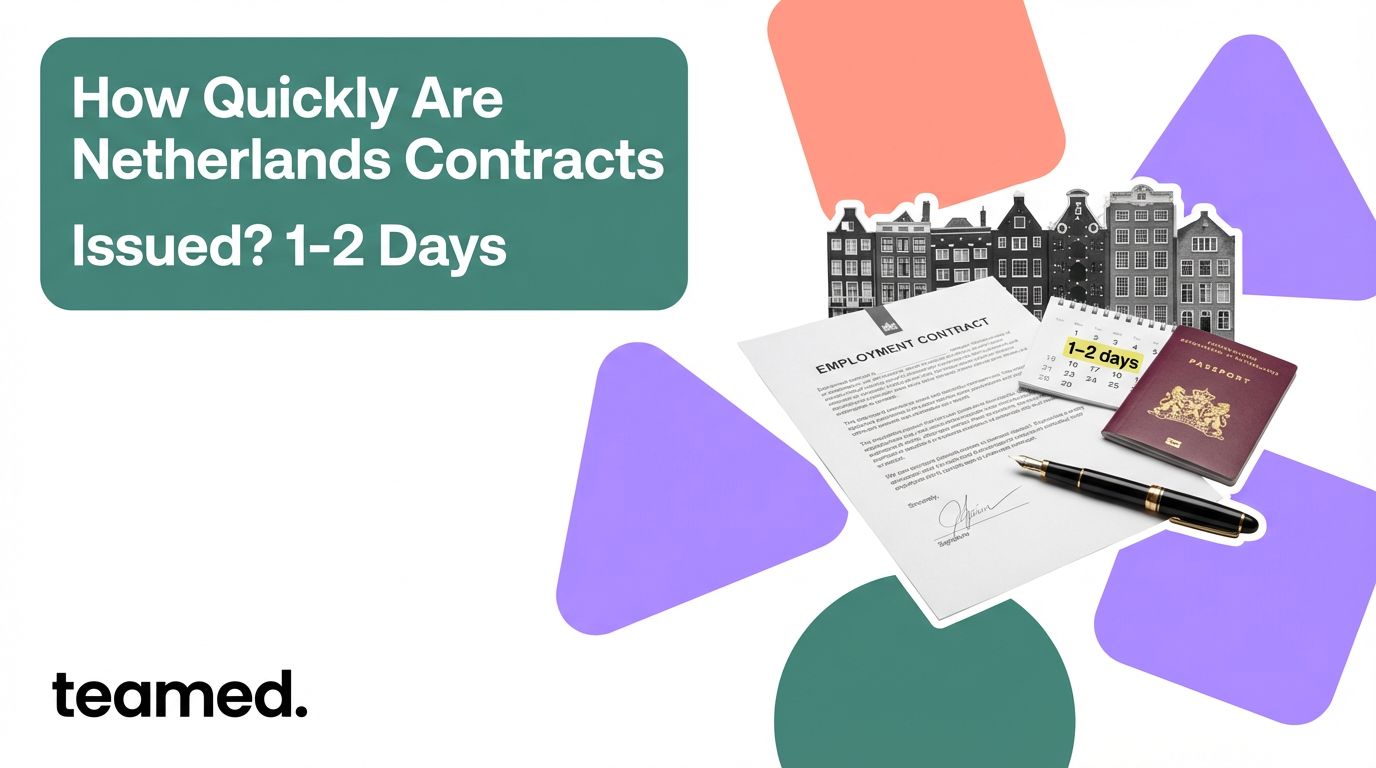
Contract issuance is the interval from final offer acceptance and completed documentation to a signed Dutch employment contract. With an EOR that has a pre-established Dutch entity and approved templates, issuance typically takes one to two working days once all inputs are ready. That's a meaningful speed advantage for mid-market companies without local infrastructure.
For companies with a live Dutch BV (Besloten Vennootschap), drafting and signature can also complete within a few working days once templates, payroll setup, and approval workflows exist. Don't confuse entity setup timelines with issuance speed. Establishing an entity often takes weeks, but once operational, contract turnaround matches EOR pace.
Teamed's process benchmarks separate "contract signature speed" (often achievable in one to three business days with complete inputs) from "job start date readiness" (commonly two to six weeks). Pre-employment checks, candidate notice periods, and immigration steps sit on the critical path independently of how fast you generate paperwork.
Marketing promises of 24 to 48 hour onboarding assume complete employee information, no complex benefit negotiations, and no immigration constraints. Sanity-check vendor claims against these prerequisites. The most common slippage drivers are missing data, slow internal approvals, and last-minute changes to probation lengths or CAO-aligned terms.
Contractor agreements can be signed quickly but don't remove Dutch compliance risk where the relationship is effectively employment. Using contractors purely to "move faster" than employment can misclassify workers, creating tax, social security, and labour liabilities that outweigh any short-term speed advantages.
What Legal Requirements In The Netherlands Control Employment Contract Timelines?
Dutch law recognises employment without a written contract, but employers must provide essential written information within the first month. In practice, mid-market companies should issue written contracts by or before day one to meet compliance, ensure payroll accuracy, and avoid disputes over hours, pay, and location.
Why Do Probation Period Rules Create Compliance Risk?
Probation is strictly regulated under Article 7:652 of the Dutch Civil Code. No probation is allowed for contracts of six months or less. Maximum one month for fixed-term contracts between six months and two years. Maximum two months for permanent contracts or fixed-term contracts exceeding two years.
Here's the catch. Incorrect probation clauses are void entirely, not reduced to the legal maximum. This removes early-exit flexibility and leaves employers exposed to full dismissal procedures even for employees discovered unsuitable very early. Confirm length, applicability, and any CAO overrides before signature.
Notice periods are set by law and may be extended by seniority or collective labour agreements. Employers must provide one month for employees with less than five years of service, scaling up to four months for employees with 15+ years of tenure. Contracts must specify notice precisely. Informal understandings aren't enforceable.
How Do Collective Labour Agreements Affect Contract Timelines?
Collective labour agreements (CAOs) can set binding terms for pay, probation, notice, and benefits at sector level. Check CAO applicability before finalising contracts. Failing to align a contract with a mandatory CAO results in rewrites, delays, or unenforceable clauses.
Teamed's internal compliance checklist requires confirming at least 12 data points before issuing a Netherlands contract, including CAO coverage, probation length, notice period, salary basis, holiday allowance, pension approach, and data-processing roles under GDPR. Uncertainty over CAO coverage is one of the most common single causes of preventable delay, frequently adding three to seven business days while HR and Legal confirm sector classification.
Essential terms including working hours, salary, holiday allowance, job location, and benefits must be clear in the contract or annexes. Ambiguity triggers revisions that easily push issuance beyond the one to two day goal.
How Do EOR, Contractors And Dutch Entities Affect Hiring Speed For Mid Market Companies?
Contractors are self-employed. EOR employees are legally employed by a Dutch third party. Entity hires are employed by your own Dutch BV. Each route alters speed, risk, and control. Mid-market leaders should select the model that matches volume, duration, and compliance appetite rather than chasing headline speed.
When Should You Choose EOR Over Your Own Entity?
EOR hiring is usually the fastest compliant route when you lack a Dutch entity. An established EOR provides a registered employer, sponsor status for some permits, and pre-approved templates, compressing contract creation to one to two working days. Strategic partners later advise on timing for a smooth transition to an entity.
Choose an EOR in the Netherlands when you need to hire one to ten employees quickly without setting up a Dutch BV and you can accept that the EOR will be the legal employer on the Dutch contract. The EOR handles Dutch payroll withholding and statutory employer obligations while you manage day-to-day work.
Hiring through a Dutch entity maximises control and long-term cost efficiency at scale, but creation and payroll setup take time. Once live and templated, entity contracts can issue within days. Plan entity establishment in parallel with initial EOR hires when forecasts justify headcount concentration in the Netherlands.
What Are The Risks Of Using Contractors For Speed?
Contractors onboard quickly via simple agreements, but misclassification risk is high in Europe and will intensify under the EU Platform Work Directive. If the relationship looks like employment, audits can reclassify contractors, adding retroactive taxes, benefits, and penalties. Speed-driven contractor use can backfire in diligence or transactions.
Choose a contractor model only when the individual can operate with genuine independence, including control over working time and methods, and when your Legal team can document why the relationship is not employment under Netherlands practice.
Teamed guides companies through contractors, EOR, and entities under one relationship, maintaining unified global employment operations and predictable timelines across Europe, including coordinated transitions that preserve employee continuity.
How Does Immigration In Netherlands Shape Contract Issuance And Start Dates For International Hires?
For EU and EEA citizens, immigration in Netherlands is typically not a constraint. Contract issuance speed via EOR or entity drives start dates. One to two day issuance timelines are therefore most valuable for these hires, provided documentation is ready and there are no complex benefits or CAO-specific onboarding requirements.
For non-EU nationals, such as highly skilled migrants, the IND (Dutch Immigration and Naturalisation Service) often needs several weeks to process permits. A signed contract is commonly required for applications. Even if a contract is signed within 48 hours, work cannot legally start until permits are approved.
Teamed's advisory model assumes that adding a non-EU work authorisation step can extend the hire-to-start timeline by multiple weeks even if the Dutch employment contract is signed quickly. Immigration processing is often longer than contract drafting.
An EOR recognised as a Dutch sponsor can often support highly skilled migrant applications faster than a company starting from zero. Sponsor status and well-practised workflows reduce friction and errors. This advantage can materially shift start dates for mid-market firms building their first Dutch team.
Adopt a simple planning rule. Treat EU hires as constrained by internal and EOR timelines. Treat non-EU hires as constrained by IND processing. Communicate these drivers clearly to candidates and stakeholders to avoid unrealistic promises tied solely to contract drafting speed.
How Do Open Ended Agreements, Vast Contracts And The Two Year Rule Work For Dutch Employees?
An open ended agreement, called a vast contract in Dutch, is a permanent contract with no end date. Dutch law provides strong protection for these employees, shaping exit planning and restructure timelines. Mid-market companies should balance early flexibility with the inevitability of permanent status in sustained roles.
Fixed term contracts can be renewed only a limited number of times or for a limited total duration before converting to permanent by law. The Dutch chain rule (ketenregeling) generally converts successive fixed-term contracts into an open-ended contract when the total duration exceeds 36 months or when more than three fixed-term contracts are used.
Do you have to be made permanent after 2 years? Under Dutch chain rules, exceeding the maximum number of renewals or cumulative duration triggers automatic conversion. Breaking the chain rule unintentionally can force permanence. Monitor dates and renewals rigorously across EOR and entity records.
Template changes are required when moving from fixed term to permanent. Prepare and pre-approve permanent templates so transitions are scheduled events, not last-minute scrambles. Track each employee's contract history, including prior contractor or EOR arrangements, to ensure decisions are intentional and defensible in audits.
What Should Mid Market Companies Hiring Across Europe Know About Dutch Employment Contract Timelines?
Mid-market companies often hire in the Netherlands alongside Germany, France, and other European markets. Local law, CAOs, and immigration variations mean contract timelines cannot be assumed identical. Align your plan per country while consolidating oversight.
The Netherlands is relatively fast for EOR contract issuance once documentation is complete, but strict probation, notice, dismissal protections, and CAO rules heighten the need for accuracy. Draft once, validate centrally, and deploy consistently to avoid time-consuming rework.
European-level developments including the EU Platform Work Directive and the EU Pay Transparency Directive increase the need for consistent employment models and documented pay structures. Standardised templates and advisory oversight reduce friction and accelerate repeatable, compliant hiring across multiple EU jurisdictions.
Teamed's cross-border hiring risk framework treats "start date promised before confirming employing model" as a high-risk trigger for schedule slippage. Lock the employing route (EOR vs Dutch BV vs contractor) before issuing a start date externally.
Fragmented systems with contractors on one platform, EOR in another, and entity hires in a third obscure true timelines and headcount status. Unified global employment operations enable finance and HR to answer when Dutch hires will start, how many are on permanent contracts, and where probation or notice exposures exist without manual reconciliation.
How Unified Global Employment Operations Give Mid Market Leaders Confidence In Dutch Hiring Plans
Teamed is the unified global employment partner for mid-market companies running multiple platforms, vendors, and models. Dutch hiring is one part of an integrated strategy that pairs local compliance accuracy with pan-European predictability.
Mid-market leaders gain genuine confidence in Dutch timelines when they work through a single advisory relationship across markets and models rather than negotiating separate EOR, payroll, and legal vendors. Consolidation reduces handoffs, clarifies accountability, and delivers consistent SLAs on contract issuance and start-date readiness.
Teamed advises when EOR is the right vehicle to move quickly into the Netherlands and when economics and risk justify establishing a Dutch entity. Transitions are planned to keep continuity of employee experience, contracts, and benefits, supported by advisors who align timing with budget cycles and headcount milestones.
Unified global employment operations provide visibility across contractors, EOR employees, and entity hires, enabling HR and Finance to answer board-level questions on Dutch start dates, headcount mix, and risk exposures. AI tools support, not replace, expert judgement on complex employment decisions.
Talk to the experts to design a Netherlands hiring plan that balances speed, compliance, and long-term strategic control.
FAQs About Dutch Employment Contracts And Global Hiring
What is mid market in the context of global employment strategy?
Mid market means companies with approximately 200 to 2,000 employees or £10M to £1B in revenue. This segment faces complex cross-border employment choices without full in-house country specialists. Teamed focuses advisory services here to standardise models, timelines, and compliance across the Netherlands and broader European markets.
Why are people from the Netherlands called Dutch and does that matter for HR and legal research?
Dutch is the historical English term for the people and language of the Netherlands. For research, use both Netherlands and Dutch as search terms when seeking employment law and contract guidance, as authoritative Dutch government and legal sources frequently use "Dutch" in titles and summaries.
How should HR leaders track the analysis news on Dutch employment law and immigration changes?
Follow Dutch government portals, reputable law firms, and trusted advisory partners. Consolidate updates through a single advisory relationship so changes to Dutch employment or immigration rules are interpreted in context of your workforce and playbook, with clear next steps rather than ad hoc alerts.
How do Dutch employment contract timelines compare to other major European countries?
Using EOR or established entities, Dutch contracts can issue as quickly as many EU markets. Strict Dutch rules on probation, dismissal, and CAOs make first-draft accuracy more critical than in some neighbours. The blend of employee protections raises the value of pre-vetted templates and expert review.
What changes if our company has fewer than 50 employees or more than 2,000 employees?
Core Dutch rules on contracts, probation, notice, and immigration apply regardless of size. Smaller firms may lack internal drafting capacity. Larger firms may have legal teams yet still benefit from external advisory alignment and unified global employment operations to harmonise templates and timelines across countries.
How do contract timelines differ for remote workers hired into the Netherlands but living in another country?
Timelines depend on which country's law governs the relationship. If employees are managed from the Netherlands or spend significant time there, Dutch rules may still apply. Seek jurisdiction-specific advice before assuming a contractor or foreign employment model is faster, to avoid misclassification or tax nexus risks.