Expanding Your Business in Europe: Mid-Market Guide

Global employment

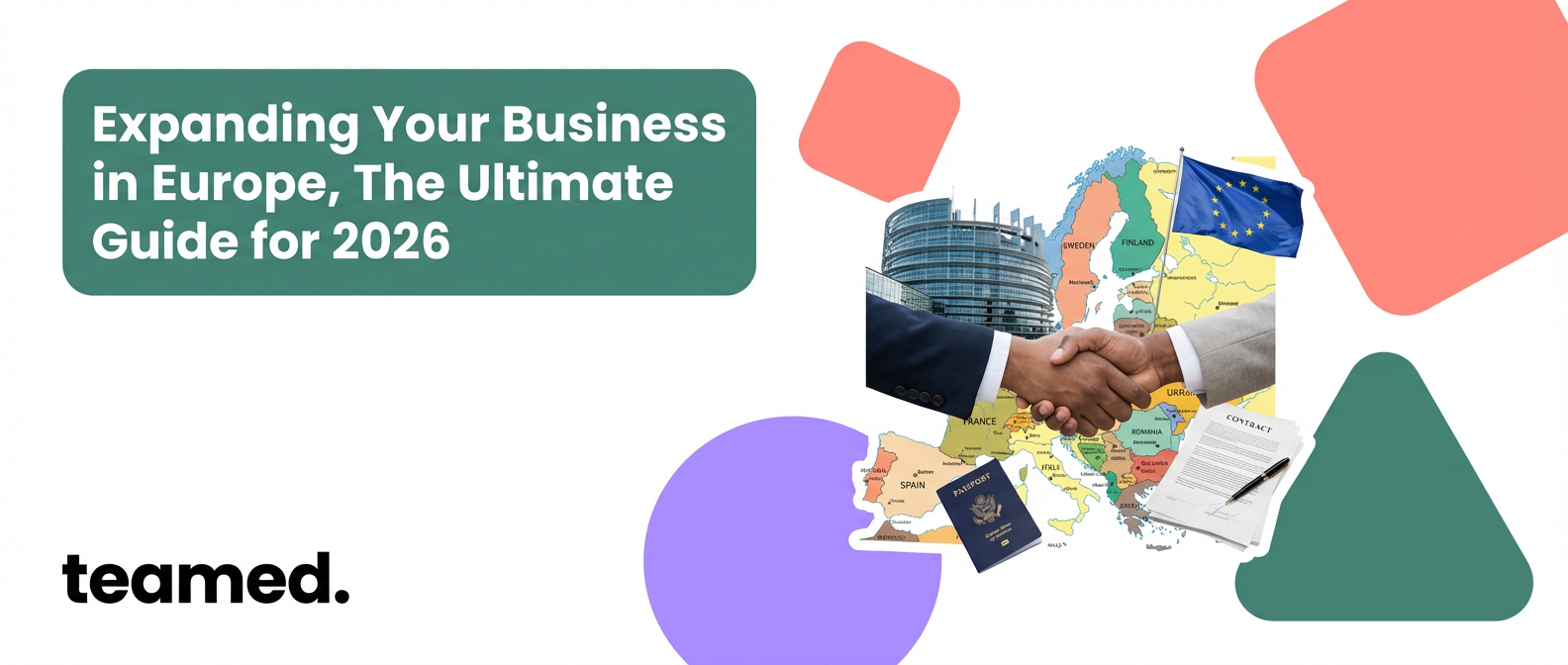
Expanding Your Business in Europe: The Ultimate Guide for 2026

Your board wants a European growth plan by next quarter. You've got customers asking for local support, competitors hiring in Berlin and Amsterdam, and a CFO who keeps asking whether you really need to set up an entity in France. Meanwhile, your People team is fielding questions about contractors in Spain, EOR providers in the Netherlands, and whether anyone actually understands German labour law.

Here's what most guides won't tell you: expanding your business in Europe isn't primarily a sales challenge. It's an employment strategy challenge. The binding constraint for mid-market companies isn't market opportunity. It's figuring out how to hire compliantly at speed without creating a patchwork of vendors, contracts, and compliance risks that becomes unmanageable by the time you hit 300 employees.

This guide is built for companies with 200 to 2,000 employees in regulated industries who need strategic clarity on employment models, not another checklist of VAT registration steps. We'll cover the decisions that actually keep VP People and CFOs awake at night: when to use contractors versus EOR versus entities, how to choose your first European country, and how to build a compliant multi-country employment strategy that won't fall apart as you scale.

Key Takeaways

  • Employment model choice (contractors, EOR, or entity) is the strategic decision that shapes your entire European expansion, not an afterthought
  • Teamed defines the mid-market global employment segment as approximately 200 to 2,000 employees, a range where companies typically face multi-country hiring needs without dedicated in-house global employment counsel
  • Start with one or two well-chosen countries rather than scattershot hires across many jurisdictions
  • Document explicit triggers for transitioning from EOR to entity based on headcount, revenue, and strategic importance
  • People, Finance, and Legal must share decision ownership from day one to avoid HR isolation and compliance anxiety

European Expansion Strategy for Mid-Market Companies with 200 to 2,000 Employees

Teamed states that mid-market companies commonly begin consolidating fragmented global employment vendors at around 200 to 300 employees because country-by-country solutions become operationally brittle at that scale. This is the reality most expansion guides ignore: by the time you're making your third or fourth European hire, you've probably already created compliance debt you don't fully understand.

The mid-market sits in an uncomfortable middle ground. You're large enough to face real regulatory scrutiny and board-level accountability for employment decisions. But you're not large enough to have dedicated global employment counsel or a team of in-house specialists who know the difference between French probation rules and Polish notice periods.

What triggers European expansion at this stage? Usually a combination of customer demand, talent access, and growth mandates from investors. But the question that should dominate your planning isn't "which markets have the best opportunity." It's "how do we hire compliantly in those markets without creating a mess we'll spend years cleaning up."

A European expansion employment model is a structured approach that determines whether a company hires in Europe via contractors, an Employer of Record (EOR), or its own local entity based on risk, cost, speed, and control requirements. Most mid-market leaders are not short of opportunity in Europe. They're short of strategic clarity on how to hire compliantly at speed.

The three employment models you'll choose between are straightforward to define but complex to apply. Contractors are self-employed individuals you engage for specific work. An EOR is a third-party organisation that becomes the legal employer of a worker in a specific country and manages local payroll, statutory taxes, social security, and employment compliance while you direct day-to-day work. A local entity is your own incorporated legal presence in a specific European jurisdiction that directly employs workers and assumes full responsibility for payroll, employment law compliance, tax registrations, and statutory reporting.

This guide focuses on people, compliance, tax, and governance across the EU and non-EU Europe (UK, Switzerland). It's not a guide to product marketing or sales playbooks. Those matter, but they're not what keeps VP People up at night.

Choosing Between Contractors, EOR, and Incorporation in Europe

Contractor misclassification is a compliance risk where an individual engaged as an independent contractor is treated by regulators or courts as an employee based on practical working conditions, potentially triggering back taxes, penalties, and employment claims. UK HMRC can typically assess unpaid payroll taxes for up to 6 years in standard cases and up to 20 years where deliberate behaviour is alleged, making contractor status decisions in the UK a multi-year balance-sheet risk for mid-market employers.

Contractors offer flexibility and speed. You can engage someone in a new market within days, test demand, and avoid the overhead of employment obligations. But the trade-off is significant: weaker control over working patterns, higher misclassification risk, and less protection for your IP. Many European authorities presume employment unless strict criteria are met, and enforcement is tightening across Germany, Spain, and the Netherlands.

An EOR differs from a local entity in that the EOR is the legal employer in the country, while a local entity makes the client company the legal employer and directly responsible for local payroll filings and employment compliance. EOR arrangements let you hire quickly without establishing a legal presence. You direct the work; the EOR handles payroll, taxes, and compliance. The cost is typically a per-head fee, and there are limits on what you can customise around benefits, equity, and sector-specific requirements.

Entity establishment gives you maximum control and presence. You're the legal employer, you design the benefits, you own the employment relationship. The trade-off is upfront cost, ongoing administrative obligations, and the time required to get operational. But at scale, per-employee costs often drop below EOR fees.

Consider a hypothetical SaaS company expanding into Europe. They might pilot a sales role via contractor in Portugal, use an EOR for a small customer success team in Germany, and establish an entity for a core engineering hub in the Netherlands. The key is having a framework for these decisions, not making them ad hoc.

A simple way to choose between contractors, EOR, and entities:

Question Contractor EOR Entity
How many hires? 1-2 project-based 3-15 in a country 10+ sustained
Expected duration? Under 12 months 12-36 months 3+ years
Regulatory scrutiny? Low Medium High
Need custom benefits/equity? No Limited Yes
Strategic importance? Testing Growing Critical

Choose contractors for a European market only when the role is genuinely project-based, the individual controls how and when work is performed, and the business can tolerate a higher audit and reclassification risk profile than direct employment. Choose an EOR when you need to hire in an EU/UK country within weeks rather than months and you don't yet have a validated 24 to 36 month business case for maintaining an in-country entity.

Teamed's approach is to map model choices against a 3 to 5 year hiring and revenue plan, avoiding one-off, country-by-country decisions that create vendor sprawl and inconsistent compliance.

When Mid-Market Companies Should Incorporate in Europe Instead of Using an EOR

Choose a local entity when a single European country is expected to become a long-term hub with sustained hiring, recurring local revenue, or a need for country-specific leadership and policy control that exceeds what an EOR arrangement typically supports. EOR is usually the fastest path initially. It's rarely the ideal end state once a country becomes strategically important.

The triggers to evaluate incorporation aren't mysterious. You're building a sizeable, sustained team in one country. You need local leadership with director responsibilities. Your sector has specific rules that EORs don't support well. You're signing material local contracts or need to participate in local tenders.

What does incorporation give you? A stronger employer brand in competitive talent markets. Custom benefit schemes and full policy control. More flexibility for equity and incentive plans. And potentially lower per-employee running costs at scale.

But don't rush. Many mid-market CFOs only feel comfortable incorporating once they can see a clear three-year business case for that country. Jurisdiction choice and timelines vary significantly. Ireland might take weeks; Germany might take months. France has its own complexities around works councils and collective agreements. with setup costs averaging around €808; Germany might take months with substantially higher financial requirements. France has its own complexities around works councils and collective agreements.

The graduation path that works: start on EOR, monitor agreed triggers (team size, revenue, leadership needs), then plan a managed transition from EOR to entity with local labour-law care. Choose an EOR-to-entity transition plan when headcount in one country is growing quarter-over-quarter and the business expects to keep hiring there beyond the next annual planning cycle.

How to Choose Your First European Country for Expansion

Country choice is as much a People and Legal decision as a Sales one. Most competitor guides focus on market size and GDP. That's necessary but insufficient. The employment and compliance factors will determine whether your expansion succeeds or creates years of cleanup work.

Strategic factors to consider: customer demand and proximity to existing clients, language and time zone alignment with your headquarters, sector-specific regulation, and partner ecosystem. But the employment factors matter just as much: labour law rigidity versus flexibility, benefits and working-pattern expectations, and ease of using an EOR in-country if you're starting that way.

EU membership aids single-market access, but employment and tax remain national. A hire in Germany faces completely different rules than a hire in Spain, even though both are EU member states. The UK and Switzerland are distinct paths entirely, outside the EU legal order with their own immigration, employment, and data transfer requirements.

Expanding into the UK differs from expanding into the EU in that the UK is outside the EU legal order, so businesses must plan separately for immigration, employment, and data transfer mechanisms even when commercial strategy treats Europe as a single region.

Regional texture matters. The Nordics have strong employee protections and high wage expectations but excellent English proficiency. Central Europe offers lower costs but more complex labour codes. Southern Europe has different norms around working hours and benefits., with Spain pursuing a reduction to 37.5 hours by 2025 without pay reduction.

Questions to ask before choosing your first country:

  • Where is near-term demand and referenceability?
  • Can we hire the skills we need at competitive cost?
  • What sector-specific constraints exist (licensing, data residency)?
  • Is EOR available and established in this market?
  • What's the payroll complexity and language/localisation requirement?

Teamed's value here is shortlisting and comparing jurisdictions using local legal expertise across 180+ countries, revealing trade-offs that generic guides miss.

Legal and Regulatory Essentials for Doing Business in the EU

There is no single European employment code. Each country sets its own rules for contracts, working time, termination, and collective rights. EU directives set floors that countries interpret differently. The EU Working Time Directive sets a general limit of 48 hours per week on average working time (typically calculated over a reference period) and provides a baseline right to paid annual leave, but each member state implements the details differently in national law.48 hours per week on average working time (typically calculated over a reference period) and provides a baseline right to paid annual leave, but each member state implements the details differently in national law.

This means you can't copy US or UK templates and expect them to work in France or Poland. Working time rules, probation periods, notice requirements, and termination procedures vary significantly. Localise contracts, policies, and handbooks from day one.

GDPR is an EU-wide data protection regulation that applies to employee and candidate personal data and requires defined lawful bases for processing, security controls, and compliant cross-border data transfer mechanisms. Under the EU GDPR, the maximum administrative fine can reach €20 million or 4% of an organisation's total worldwide annual turnover for the preceding financial year, whichever is higher. HR data handling, monitoring, and cross-border transfers all fall under GDPR scope.

Permanent establishment (PE) risk is a corporate tax exposure where a company can be treated as having a taxable presence in a country due to local activities such as contract conclusion, habitual sales activity, or senior decision-making occurring in that country. PE risk increases with local decision-making and contract-signing. Remote work complicates the analysis.

For digital and tech companies, be aware of evolving EU digital services and markets frameworks. Seek specialist product counsel in addition to employment guidance. The advisory approach that works: engage local counsel early, directly or via an advisor's in-market network.

Building a Compliant Employment Strategy Across Multiple European Countries

A multi-country hiring strategy differs from a single-country European launch in that multi-country hiring requires explicit rules for employment-model selection, vendor consolidation, and PE/social security monitoring across jurisdictions rather than one-off local decisions. The common pitfall is using a different vendor, model, and contract in every country, creating an unmanageable patchwork beyond a handful of hires.

Choose a single multi-country governance framework before hiring in 3 or more European jurisdictions, because inconsistent contracts, vendors, and policies across countries compound misclassification, PE, and employee relations risk.

Components of a multi-country employment strategy include model selection rules (when to use contractors versus EOR versus entity), global policy standards with local adaptation guardrails, a benefits framework with global minimums plus local expectations, cross-border monitoring for PE risk and social security, and decision logs with triggers for model transitions.

Consider coordinating policies across Germany, Spain, and Sweden. You'll quickly discover material differences in notice periods, probation rules, and holiday entitlements. What works in one country may be illegal in another.

Teamed often recommends agreeing your global minimum benefits first, then asking local counsel where you must go further in each country. This prevents both under-provision (compliance risk) and over-provision (unnecessary cost).

Tax, VAT, and Payroll Basics for Expanding Your Business in Europe

Corporate income tax, VAT, and payroll withholding are separate systems. Sales activity, entities, and hiring can each trigger different obligations. Selling to European customers may require VAT registration even without a local entity. Some regimes allow EU-wide registration in defined cases.

Payroll obligations include income tax withholding, employer social contributions, and reporting. Rules vary by country in rates, brackets, and cycles. EORs handle in-country payroll; own entities must implement local payroll and filings.

Contrast two scenarios. With an EOR hire in France, the EOR runs payroll and handles all payroll taxes. With a French entity, your company sets up payroll, registers for taxes, and files returns locally. The administrative burden differs significantly.

Early coordination between People, Finance, and tax advisors prevents costly rework later. Teamed's role is to signal when activity requires registrations or payroll setup and coordinate with local tax advisors. This is not tax advice; engage local tax counsel per jurisdiction.

Managing Social Security and Employee Benefits When Starting a Business in Europe

In the Netherlands, employers must generally pay at least 70% of wages for up to 104 weeks during employee sickness absence, which materially changes the cash-flow profile of employing versus contracting. Social security systems are country-specific, typically covering pensions, healthcare, unemployment, and disability through employer and employee contributions.

Statutory minimums (paid holiday, parental leave) differ from competitive market norms. Avoid under-provision (compliance risk) and over-provision (unnecessary cost). With an EOR, the provider handles statutory contributions and basic administration. You decide on enhanced benefits aligned with global policies.

Steps to a European benefits strategy: agree global principles and minimums, map mandatory benefits by country, identify local expectations by role and market, decide enhancements (private healthcare, extra leave, allowances), and set an ongoing review cadence with local input.

Cross-border issues arise when employees live and work across borders, potentially causing gaps or double contributions. Seek advice early. Regional differences in norms exist across Nordics (strong public healthcare, high expectations), Western Europe (established private supplements), and Central/Eastern Europe (lower costs, different bonus structures).

Key Employment Risks for Growing Companies Expanding into Europe

Many VP People worry less about getting the first hire approved and more about inadvertently triggering risks they don't yet understand. The main risks cluster into five categories.

Misclassification: contractors functioning like employees can trigger back taxes, penalties, and claims. Authorities assess control and integration over contract labels. A contractor arrangement differs from employment (via EOR or entity) in that contractors are not typically covered by statutory employee protections such as notice rights and employer-funded social security in the same way, which increases reclassification exposure when the working relationship resembles employment.

Permanent establishment: employees or decision-makers signing contracts or habitually creating revenue may contribute to PE even without an entity. PE risk can be triggered in European jurisdictions when employees or representatives habitually conclude contracts or play the principal role leading to contract conclusion in-country, which is a common risk area for distributed sales teams.

Termination and restructuring: stricter notice, consultation, and redundancy rules mean mishandled exits become costly disputes. Large-scale redundancies in France generally trigger a formal consultation process with employee representatives, and a collective redundancy plan (PSE) is typically required when a company proposes at least 10 redundancies over 30 days in an establishment with at least 50 employees.

Data protection: HR data handling, monitoring, and cross-border transfers all carry GDPR exposure. Enforcement and fines are material.

Sector-specific risks: screening, clearances, and training requirements in regulated sectors carry reputational impact beyond financial penalties.

Roles of People, Finance, and Legal in European Expansion for Mid-Market Companies

Most existing "expanding your business in Europe" content fails to provide a mid-market governance model that explicitly assigns decision ownership across HR, Finance, and Legal for contractor versus EOR versus entity choices. The starting reality is that HR is often asked to execute European hiring decisions made without their input, leading to rushed vendor choices and risk.

Recommended division of roles: People owns employment model design, employee experience, and policy localisation. Finance owns cost modelling, budgeting, tax coordination, and scenario planning. Legal/Compliance owns regulatory interpretation, risk tolerance, and contracts. Executive leadership (CEO, COO, GM International) owns overall Europe strategy.

A cross-functional working group makes joint decisions on country selection, EOR versus entity, and major policy choices. Document thresholds and triggers to revisit EOR use or create entities.

Consider a decision like concentrating a hub in one country versus distributed hires across several. This requires assessing labour law, tax, benefits, and operating complexity jointly. No single function can make this call alone.

Budgeting and Forecasting for European Expansion at Mid-Market Scale

Many mid-market CFOs prefer to see a three-year view of total employment costs in each European country before signing off on entity establishment. Cost categories to model include salaries and on-costs (social contributions, benefits), EOR or payroll/vendor fees, legal and tax advisory, entity setup and maintenance, HR tech and tooling, and internal team time.

Model cost logic: EOR has variable per-head fees that shift fixed costs to usage, useful early. Entity has upfront setup and ongoing fixed admin but lower per-head processing cost at scale.

Scenario planning should cover best, base, and cautious headcount and revenue by country. Test implications for contractors versus EOR versus entity under each scenario. Plan for exits: budget for restructures, redundancy, or entity wind-down if needed.

Geographic nuance matters. Allow for differences in salaries, statutory costs, and advisory fees across higher-cost hubs (London, Amsterdam, Zurich) versus emerging European markets (Poland, Portugal, Romania).

Teamed's approach is to compare strategic costs over 3 to 5 years, beyond year-one vendor fees. The total cost of ownership often looks different than initial quotes suggest.

Timeline from Strategy to First Hire When You Expand Your Business in Europe

Teamed states its operational capability can support onboarding in as little as 24 hours once an employment model and country approach are agreed, which is materially faster than entity-led hiring in most European jurisdictions. But getting to that decision point takes work.

Phases of European expansion: strategy and country selection, employment model choice (contractor/EOR/entity), advisor and vendor selection, legal and tax groundwork (including PE and data protection approach), contract localisation and policy decisions, onboarding and first hires.

EOR accelerates hire readiness because registrations and payroll are already in place. Entity routes require more steps and vary by country. German notarial requirements differ from Irish company formation, which differs from French processes.

Work in parallel: internal alignment (global versus local policies, data protection, approvals) should progress alongside legal and tax work. Offer executives a range rather than a single launch date. Validate with advisors before promising milestones.

A mid-market company using an EOR can often move from decision to signed offer far faster than if they wait for a new European entity to be fully live.

How Mid-Market Leaders Can Approach European Expansion with Strategic Confidence

You don't need to become an expert in every European labour code to expand with confidence. You need access to people who already are.

The complexity is manageable with a systematic approach: define and apply a clear employment-model strategy, choose initial countries with People, Finance, and Legal at the table, establish governance with documented triggers and risk thresholds, and proactively manage legal, tax, data, and PE risks across borders.

Teamed states it has advised over 1,000 companies on global employment strategy since its founding in 2018, indicating repeated exposure to common Europe/UK expansion decision patterns. The value of a strategic partner is continuity from first contractor through EOR to multiple entities, providing unified guidance rather than fragmented vendor relationships.

If you're planning or rethinking European expansion, talk to the experts who've seen these patterns before. One conversation can save months of cleanup work.

FAQs About Expanding Your Business in Europe

How does Brexit change expansion decisions between the UK and the EU?

The UK is outside the EU with its own trade, immigration, and employment rules. Treat UK and EU expansions as related but separate workstreams with distinct legal and operational requirements. UK IR35 (off-payroll working) rules require medium and large businesses to determine employment status for many contractors, shifting compliance accountability from the contractor to the end client where the rules apply.

How long can a company realistically rely on an EOR in Europe?

There's no fixed limit. EOR suits testing or small teams. Review regularly as headcount, revenue, or strategic importance grows in any country. Many companies use EOR arrangements for years in markets that remain secondary.

Can we test a European market using contractors without misclassification risk?

Yes, but roles must meet strict local criteria for self-employment. Design carefully and seek local advice to avoid relationships that look like employment in practice. The risk profile varies significantly by country.

How do language and cultural differences affect HR policies in Europe?

Many employment documents must be in the local language. Expectations on feedback, benefits, and work-life balance vary. Localise global policies thoughtfully rather than assuming one approach works everywhere.

How does remote work across European borders affect tax and social security?

Cross-border arrangements can trigger complex tax, PE, and social security issues. Assess with advisors before approving ongoing remote setups. An employee living in one country while working for an entity in another creates compliance questions that require specific analysis.

What is mid-market?

Typically 200 to 2,000 employees, or roughly £10 million to £1 billion revenue. This guide targets that scale, not startups or very large enterprises.

How should we compare total cost of EOR versus setting up a European entity?

Model expected headcount, salaries, and advisory costs over several years by country. Compare EOR's variable per-head costs to an entity's upfront and ongoing fixed costs. The crossover point depends on your specific growth trajectory and the country in question.or

Expanding Your Business in Europe: The Ultimate Guide for 2026

Your board wants a European growth plan by next quarter. You've got customers asking for local support, competitors hiring in Berlin and Amsterdam, and a CFO who keeps asking whether you really need to set up an entity in France. Meanwhile, your People team is fielding questions about contractors in Spain, EOR providers in the Netherlands, and whether anyone actually understands German labour law.

Here's what most guides won't tell you: expanding your business in Europe isn't primarily a sales challenge. It's an employment strategy challenge. The binding constraint for mid-market companies isn't market opportunity. It's figuring out how to hire compliantly at speed without creating a patchwork of vendors, contracts, and compliance risks that becomes unmanageable by the time you hit 300 employees.

This guide is built for companies with 200 to 2,000 employees in regulated industries who need strategic clarity on employment models, not another checklist of VAT registration steps. We'll cover the decisions that actually keep VP People and CFOs awake at night: when to use contractors versus EOR versus entities, how to choose your first European country, and how to build a compliant multi-country employment strategy that won't fall apart as you scale.

Key Takeaways

  • Employment model choice (contractors, EOR, or entity) is the strategic decision that shapes your entire European expansion, not an afterthought
  • Teamed defines the mid-market global employment segment as approximately 200 to 2,000 employees, a range where companies typically face multi-country hiring needs without dedicated in-house global employment counsel
  • Start with one or two well-chosen countries rather than scattershot hires across many jurisdictions
  • Document explicit triggers for transitioning from EOR to entity based on headcount, revenue, and strategic importance
  • People, Finance, and Legal must share decision ownership from day one to avoid HR isolation and compliance anxiety

European Expansion Strategy for Mid-Market Companies with 200 to 2,000 Employees

Teamed states that mid-market companies commonly begin consolidating fragmented global employment vendors at around 200 to 300 employees because country-by-country solutions become operationally brittle at that scale. This is the reality most expansion guides ignore: by the time you're making your third or fourth European hire, you've probably already created compliance debt you don't fully understand.

The mid-market sits in an uncomfortable middle ground. You're large enough to face real regulatory scrutiny and board-level accountability for employment decisions. But you're not large enough to have dedicated global employment counsel or a team of in-house specialists who know the difference between French probation rules and Polish notice periods.

What triggers European expansion at this stage? Usually a combination of customer demand, talent access, and growth mandates from investors. But the question that should dominate your planning isn't "which markets have the best opportunity." It's "how do we hire compliantly in those markets without creating a mess we'll spend years cleaning up."

A European expansion employment model is a structured approach that determines whether a company hires in Europe via contractors, an Employer of Record (EOR), or its own local entity based on risk, cost, speed, and control requirements. Most mid-market leaders are not short of opportunity in Europe. They're short of strategic clarity on how to hire compliantly at speed.

The three employment models you'll choose between are straightforward to define but complex to apply. Contractors are self-employed individuals you engage for specific work. An EOR is a third-party organisation that becomes the legal employer of a worker in a specific country and manages local payroll, statutory taxes, social security, and employment compliance while you direct day-to-day work. A local entity is your own incorporated legal presence in a specific European jurisdiction that directly employs workers and assumes full responsibility for payroll, employment law compliance, tax registrations, and statutory reporting.

This guide focuses on people, compliance, tax, and governance across the EU and non-EU Europe (UK, Switzerland). It's not a guide to product marketing or sales playbooks. Those matter, but they're not what keeps VP People up at night.

Choosing Between Contractors, EOR, and Incorporation in Europe

Contractor misclassification is a compliance risk where an individual engaged as an independent contractor is treated by regulators or courts as an employee based on practical working conditions, potentially triggering back taxes, penalties, and employment claims. UK HMRC can typically assess unpaid payroll taxes for up to 6 years in standard cases and up to 20 years where deliberate behaviour is alleged, making contractor status decisions in the UK a multi-year balance-sheet risk for mid-market employers.

Contractors offer flexibility and speed. You can engage someone in a new market within days, test demand, and avoid the overhead of employment obligations. But the trade-off is significant: weaker control over working patterns, higher misclassification risk, and less protection for your IP. Many European authorities presume employment unless strict criteria are met, and enforcement is tightening across Germany, Spain, and the Netherlands.

An EOR differs from a local entity in that the EOR is the legal employer in the country, while a local entity makes the client company the legal employer and directly responsible for local payroll filings and employment compliance. EOR arrangements let you hire quickly without establishing a legal presence. You direct the work; the EOR handles payroll, taxes, and compliance. The cost is typically a per-head fee, and there are limits on what you can customise around benefits, equity, and sector-specific requirements.

Entity establishment gives you maximum control and presence. You're the legal employer, you design the benefits, you own the employment relationship. The trade-off is upfront cost, ongoing administrative obligations, and the time required to get operational. But at scale, per-employee costs often drop below EOR fees.

Consider a hypothetical SaaS company expanding into Europe. They might pilot a sales role via contractor in Portugal, use an EOR for a small customer success team in Germany, and establish an entity for a core engineering hub in the Netherlands. The key is having a framework for these decisions, not making them ad hoc.

A simple way to choose between contractors, EOR, and entities:

Question Contractor EOR Entity
How many hires? 1-2 project-based 3-15 in a country 10+ sustained
Expected duration? Under 12 months 12-36 months 3+ years
Regulatory scrutiny? Low Medium High
Need custom benefits/equity? No Limited Yes
Strategic importance? Testing Growing Critical

Choose contractors for a European market only when the role is genuinely project-based, the individual controls how and when work is performed, and the business can tolerate a higher audit and reclassification risk profile than direct employment. Choose an EOR when you need to hire in an EU/UK country within weeks rather than months and you don't yet have a validated 24 to 36 month business case for maintaining an in-country entity.

Teamed's approach is to map model choices against a 3 to 5 year hiring and revenue plan, avoiding one-off, country-by-country decisions that create vendor sprawl and inconsistent compliance.

When Mid-Market Companies Should Incorporate in Europe Instead of Using an EOR

Choose a local entity when a single European country is expected to become a long-term hub with sustained hiring, recurring local revenue, or a need for country-specific leadership and policy control that exceeds what an EOR arrangement typically supports. EOR is usually the fastest path initially. It's rarely the ideal end state once a country becomes strategically important.

The triggers to evaluate incorporation aren't mysterious. You're building a sizeable, sustained team in one country. You need local leadership with director responsibilities. Your sector has specific rules that EORs don't support well. You're signing material local contracts or need to participate in local tenders.

What does incorporation give you? A stronger employer brand in competitive talent markets. Custom benefit schemes and full policy control. More flexibility for equity and incentive plans. And potentially lower per-employee running costs at scale.

But don't rush. Many mid-market CFOs only feel comfortable incorporating once they can see a clear three-year business case for that country. Jurisdiction choice and timelines vary significantly. Ireland might take weeks; Germany might take months. France has its own complexities around works councils and collective agreements. with setup costs averaging around €808; Germany might take months with substantially higher financial requirements. France has its own complexities around works councils and collective agreements.

The graduation path that works: start on EOR, monitor agreed triggers (team size, revenue, leadership needs), then plan a managed transition from EOR to entity with local labour-law care. Choose an EOR-to-entity transition plan when headcount in one country is growing quarter-over-quarter and the business expects to keep hiring there beyond the next annual planning cycle.

How to Choose Your First European Country for Expansion

Country choice is as much a People and Legal decision as a Sales one. Most competitor guides focus on market size and GDP. That's necessary but insufficient. The employment and compliance factors will determine whether your expansion succeeds or creates years of cleanup work.

Strategic factors to consider: customer demand and proximity to existing clients, language and time zone alignment with your headquarters, sector-specific regulation, and partner ecosystem. But the employment factors matter just as much: labour law rigidity versus flexibility, benefits and working-pattern expectations, and ease of using an EOR in-country if you're starting that way.

EU membership aids single-market access, but employment and tax remain national. A hire in Germany faces completely different rules than a hire in Spain, even though both are EU member states. The UK and Switzerland are distinct paths entirely, outside the EU legal order with their own immigration, employment, and data transfer requirements.

Expanding into the UK differs from expanding into the EU in that the UK is outside the EU legal order, so businesses must plan separately for immigration, employment, and data transfer mechanisms even when commercial strategy treats Europe as a single region.

Regional texture matters. The Nordics have strong employee protections and high wage expectations but excellent English proficiency. Central Europe offers lower costs but more complex labour codes. Southern Europe has different norms around working hours and benefits., with Spain pursuing a reduction to 37.5 hours by 2025 without pay reduction.

Questions to ask before choosing your first country:

  • Where is near-term demand and referenceability?
  • Can we hire the skills we need at competitive cost?
  • What sector-specific constraints exist (licensing, data residency)?
  • Is EOR available and established in this market?
  • What's the payroll complexity and language/localisation requirement?

Teamed's value here is shortlisting and comparing jurisdictions using local legal expertise across 180+ countries, revealing trade-offs that generic guides miss.

Legal and Regulatory Essentials for Doing Business in the EU

There is no single European employment code. Each country sets its own rules for contracts, working time, termination, and collective rights. EU directives set floors that countries interpret differently. The EU Working Time Directive sets a general limit of 48 hours per week on average working time (typically calculated over a reference period) and provides a baseline right to paid annual leave, but each member state implements the details differently in national law.48 hours per week on average working time (typically calculated over a reference period) and provides a baseline right to paid annual leave, but each member state implements the details differently in national law.

This means you can't copy US or UK templates and expect them to work in France or Poland. Working time rules, probation periods, notice requirements, and termination procedures vary significantly. Localise contracts, policies, and handbooks from day one.

GDPR is an EU-wide data protection regulation that applies to employee and candidate personal data and requires defined lawful bases for processing, security controls, and compliant cross-border data transfer mechanisms. Under the EU GDPR, the maximum administrative fine can reach €20 million or 4% of an organisation's total worldwide annual turnover for the preceding financial year, whichever is higher. HR data handling, monitoring, and cross-border transfers all fall under GDPR scope.

Permanent establishment (PE) risk is a corporate tax exposure where a company can be treated as having a taxable presence in a country due to local activities such as contract conclusion, habitual sales activity, or senior decision-making occurring in that country. PE risk increases with local decision-making and contract-signing. Remote work complicates the analysis.

For digital and tech companies, be aware of evolving EU digital services and markets frameworks. Seek specialist product counsel in addition to employment guidance. The advisory approach that works: engage local counsel early, directly or via an advisor's in-market network.

Building a Compliant Employment Strategy Across Multiple European Countries

A multi-country hiring strategy differs from a single-country European launch in that multi-country hiring requires explicit rules for employment-model selection, vendor consolidation, and PE/social security monitoring across jurisdictions rather than one-off local decisions. The common pitfall is using a different vendor, model, and contract in every country, creating an unmanageable patchwork beyond a handful of hires.

Choose a single multi-country governance framework before hiring in 3 or more European jurisdictions, because inconsistent contracts, vendors, and policies across countries compound misclassification, PE, and employee relations risk.

Components of a multi-country employment strategy include model selection rules (when to use contractors versus EOR versus entity), global policy standards with local adaptation guardrails, a benefits framework with global minimums plus local expectations, cross-border monitoring for PE risk and social security, and decision logs with triggers for model transitions.

Consider coordinating policies across Germany, Spain, and Sweden. You'll quickly discover material differences in notice periods, probation rules, and holiday entitlements. What works in one country may be illegal in another.

Teamed often recommends agreeing your global minimum benefits first, then asking local counsel where you must go further in each country. This prevents both under-provision (compliance risk) and over-provision (unnecessary cost).

Tax, VAT, and Payroll Basics for Expanding Your Business in Europe

Corporate income tax, VAT, and payroll withholding are separate systems. Sales activity, entities, and hiring can each trigger different obligations. Selling to European customers may require VAT registration even without a local entity. Some regimes allow EU-wide registration in defined cases.

Payroll obligations include income tax withholding, employer social contributions, and reporting. Rules vary by country in rates, brackets, and cycles. EORs handle in-country payroll; own entities must implement local payroll and filings.

Contrast two scenarios. With an EOR hire in France, the EOR runs payroll and handles all payroll taxes. With a French entity, your company sets up payroll, registers for taxes, and files returns locally. The administrative burden differs significantly.

Early coordination between People, Finance, and tax advisors prevents costly rework later. Teamed's role is to signal when activity requires registrations or payroll setup and coordinate with local tax advisors. This is not tax advice; engage local tax counsel per jurisdiction.

Managing Social Security and Employee Benefits When Starting a Business in Europe

In the Netherlands, employers must generally pay at least 70% of wages for up to 104 weeks during employee sickness absence, which materially changes the cash-flow profile of employing versus contracting. Social security systems are country-specific, typically covering pensions, healthcare, unemployment, and disability through employer and employee contributions.

Statutory minimums (paid holiday, parental leave) differ from competitive market norms. Avoid under-provision (compliance risk) and over-provision (unnecessary cost). With an EOR, the provider handles statutory contributions and basic administration. You decide on enhanced benefits aligned with global policies.

Steps to a European benefits strategy: agree global principles and minimums, map mandatory benefits by country, identify local expectations by role and market, decide enhancements (private healthcare, extra leave, allowances), and set an ongoing review cadence with local input.

Cross-border issues arise when employees live and work across borders, potentially causing gaps or double contributions. Seek advice early. Regional differences in norms exist across Nordics (strong public healthcare, high expectations), Western Europe (established private supplements), and Central/Eastern Europe (lower costs, different bonus structures).

Key Employment Risks for Growing Companies Expanding into Europe

Many VP People worry less about getting the first hire approved and more about inadvertently triggering risks they don't yet understand. The main risks cluster into five categories.

Misclassification: contractors functioning like employees can trigger back taxes, penalties, and claims. Authorities assess control and integration over contract labels. A contractor arrangement differs from employment (via EOR or entity) in that contractors are not typically covered by statutory employee protections such as notice rights and employer-funded social security in the same way, which increases reclassification exposure when the working relationship resembles employment.

Permanent establishment: employees or decision-makers signing contracts or habitually creating revenue may contribute to PE even without an entity. PE risk can be triggered in European jurisdictions when employees or representatives habitually conclude contracts or play the principal role leading to contract conclusion in-country, which is a common risk area for distributed sales teams.

Termination and restructuring: stricter notice, consultation, and redundancy rules mean mishandled exits become costly disputes. Large-scale redundancies in France generally trigger a formal consultation process with employee representatives, and a collective redundancy plan (PSE) is typically required when a company proposes at least 10 redundancies over 30 days in an establishment with at least 50 employees.

Data protection: HR data handling, monitoring, and cross-border transfers all carry GDPR exposure. Enforcement and fines are material.

Sector-specific risks: screening, clearances, and training requirements in regulated sectors carry reputational impact beyond financial penalties.

Roles of People, Finance, and Legal in European Expansion for Mid-Market Companies

Most existing "expanding your business in Europe" content fails to provide a mid-market governance model that explicitly assigns decision ownership across HR, Finance, and Legal for contractor versus EOR versus entity choices. The starting reality is that HR is often asked to execute European hiring decisions made without their input, leading to rushed vendor choices and risk.

Recommended division of roles: People owns employment model design, employee experience, and policy localisation. Finance owns cost modelling, budgeting, tax coordination, and scenario planning. Legal/Compliance owns regulatory interpretation, risk tolerance, and contracts. Executive leadership (CEO, COO, GM International) owns overall Europe strategy.

A cross-functional working group makes joint decisions on country selection, EOR versus entity, and major policy choices. Document thresholds and triggers to revisit EOR use or create entities.

Consider a decision like concentrating a hub in one country versus distributed hires across several. This requires assessing labour law, tax, benefits, and operating complexity jointly. No single function can make this call alone.

Budgeting and Forecasting for European Expansion at Mid-Market Scale

Many mid-market CFOs prefer to see a three-year view of total employment costs in each European country before signing off on entity establishment. Cost categories to model include salaries and on-costs (social contributions, benefits), EOR or payroll/vendor fees, legal and tax advisory, entity setup and maintenance, HR tech and tooling, and internal team time.

Model cost logic: EOR has variable per-head fees that shift fixed costs to usage, useful early. Entity has upfront setup and ongoing fixed admin but lower per-head processing cost at scale.

Scenario planning should cover best, base, and cautious headcount and revenue by country. Test implications for contractors versus EOR versus entity under each scenario. Plan for exits: budget for restructures, redundancy, or entity wind-down if needed.

Geographic nuance matters. Allow for differences in salaries, statutory costs, and advisory fees across higher-cost hubs (London, Amsterdam, Zurich) versus emerging European markets (Poland, Portugal, Romania).

Teamed's approach is to compare strategic costs over 3 to 5 years, beyond year-one vendor fees. The total cost of ownership often looks different than initial quotes suggest.

Timeline from Strategy to First Hire When You Expand Your Business in Europe

Teamed states its operational capability can support onboarding in as little as 24 hours once an employment model and country approach are agreed, which is materially faster than entity-led hiring in most European jurisdictions. But getting to that decision point takes work.

Phases of European expansion: strategy and country selection, employment model choice (contractor/EOR/entity), advisor and vendor selection, legal and tax groundwork (including PE and data protection approach), contract localisation and policy decisions, onboarding and first hires.

EOR accelerates hire readiness because registrations and payroll are already in place. Entity routes require more steps and vary by country. German notarial requirements differ from Irish company formation, which differs from French processes.

Work in parallel: internal alignment (global versus local policies, data protection, approvals) should progress alongside legal and tax work. Offer executives a range rather than a single launch date. Validate with advisors before promising milestones.

A mid-market company using an EOR can often move from decision to signed offer far faster than if they wait for a new European entity to be fully live.

How Mid-Market Leaders Can Approach European Expansion with Strategic Confidence

You don't need to become an expert in every European labour code to expand with confidence. You need access to people who already are.

The complexity is manageable with a systematic approach: define and apply a clear employment-model strategy, choose initial countries with People, Finance, and Legal at the table, establish governance with documented triggers and risk thresholds, and proactively manage legal, tax, data, and PE risks across borders.

Teamed states it has advised over 1,000 companies on global employment strategy since its founding in 2018, indicating repeated exposure to common Europe/UK expansion decision patterns. The value of a strategic partner is continuity from first contractor through EOR to multiple entities, providing unified guidance rather than fragmented vendor relationships.

If you're planning or rethinking European expansion, talk to the experts who've seen these patterns before. One conversation can save months of cleanup work.

FAQs About Expanding Your Business in Europe

How does Brexit change expansion decisions between the UK and the EU?

The UK is outside the EU with its own trade, immigration, and employment rules. Treat UK and EU expansions as related but separate workstreams with distinct legal and operational requirements. UK IR35 (off-payroll working) rules require medium and large businesses to determine employment status for many contractors, shifting compliance accountability from the contractor to the end client where the rules apply.

How long can a company realistically rely on an EOR in Europe?

There's no fixed limit. EOR suits testing or small teams. Review regularly as headcount, revenue, or strategic importance grows in any country. Many companies use EOR arrangements for years in markets that remain secondary.

Can we test a European market using contractors without misclassification risk?

Yes, but roles must meet strict local criteria for self-employment. Design carefully and seek local advice to avoid relationships that look like employment in practice. The risk profile varies significantly by country.

How do language and cultural differences affect HR policies in Europe?

Many employment documents must be in the local language. Expectations on feedback, benefits, and work-life balance vary. Localise global policies thoughtfully rather than assuming one approach works everywhere.

How does remote work across European borders affect tax and social security?

Cross-border arrangements can trigger complex tax, PE, and social security issues. Assess with advisors before approving ongoing remote setups. An employee living in one country while working for an entity in another creates compliance questions that require specific analysis.

What is mid-market?

Typically 200 to 2,000 employees, or roughly £10 million to £1 billion revenue. This guide targets that scale, not startups or very large enterprises.

How should we compare total cost of EOR versus setting up a European entity?

Model expected headcount, salaries, and advisory costs over several years by country. Compare EOR's variable per-head costs to an entity's upfront and ongoing fixed costs. The crossover point depends on your specific growth trajectory and the country in question.or

TABLE OF CONTENTS

Take a look
at the latest articles