


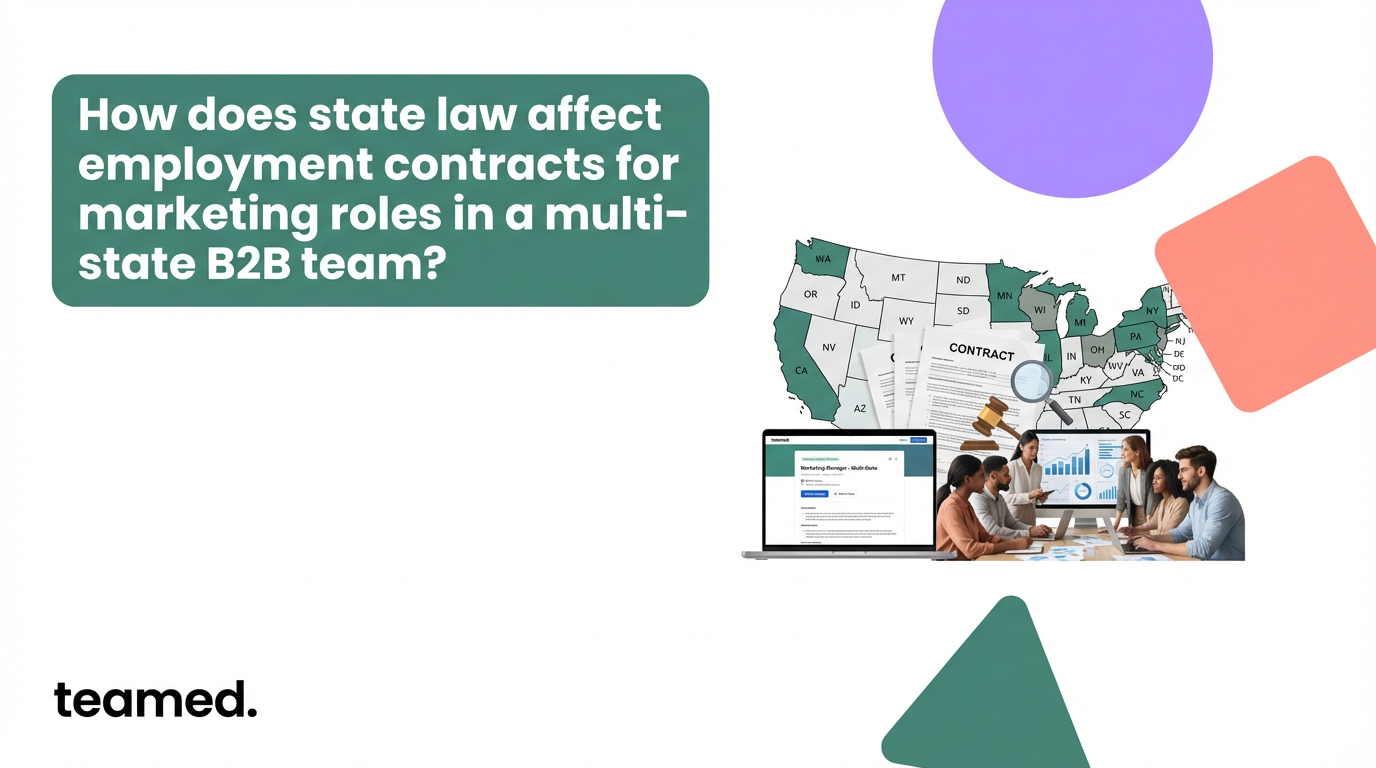
How does state law affect employment contracts for marketing roles in a multi-state B2B team?
Your marketing director in California just signed the same employment contract as your content manager in Texas. Both roles, same company, identical terms. Here's the problem: that non-compete clause you spent thousands drafting? Unenforceable in California. The expense reimbursement policy? Missing mandatory language for Illinois. And your New York job posting didn't include the compensation range required since September 2023.
Multi-state employment contracts for marketing roles create compliance exposure that most mid-market companies don't see until it's too late. The laws where your employee works, not where your company is headquartered, determine which rules apply. For B2B teams building distributed marketing functions across the United States, this means a single "master" employment agreement can create false security while exposing you to state-specific penalties and unenforceable provisions.
Teamed is the trusted global employment expert for companies who need the right structure for where they are, and trusted advice for where they're going. Based on advisory work with over 1,000 companies across 70+ countries, we've seen how state-by-state variation catches even experienced HR leaders off guard. This guide breaks down exactly how state law affects your marketing employment contracts and what to do about it.
Quick Facts: Multi-State Marketing Employment Compliance
California's statewide minimum wage increased to $16.90 per hour on January 1, 2026, and local ordinances in cities like San Francisco impose higher minimums that override generic wage language in multi-state offer letters.
New York State's pay transparency law requires employers with 4 or more employees to include compensation ranges in job advertisements for roles that can or will be performed in New York, including remote positions, effective 17 September 2023.
Illinois' Freedom to Work Act bans non-competes for employees earning $75,000 or less per year and bans non-solicits for employees earning $45,000 or less, with thresholds increasing to $80,000 and $47,500 on January 1, 2027.
Colorado requires posting compensation, benefits, and application deadline information in job postings for roles that can be performed in Colorado, plus notice of promotion opportunities to Colorado employees.
US state-law variability is most operationally visible in five contract-sensitive areas: restrictive covenants, pay transparency, paid leave, expense reimbursement, and IP/invention assignment.
Why does work-state law override your headquarters state for marketing employees?
Work-state compliance is the practice of applying employment laws based on where the employee physically performs work, not where your company is incorporated. This principle means your Delaware LLC or Texas headquarters doesn't determine which employment rules apply to your California-based marketing manager.
Courts consistently enforce this principle because employment law exists to protect workers in their local jurisdiction. A choice-of-law clause attempting to apply Texas law to a California employee will be overridden by California's mandatory employment protections. The same applies to forum-selection clauses that try to force out-of-state litigation when the employee primarily works in-state.
For marketing roles specifically, this creates particular complexity. Remote marketing hires, which represent 37.9% of professional occupations, can trigger work-state obligations even when the manager, payroll team, and brand leadership are all outside the US. A single content strategist working from their home in Colorado creates Colorado compliance obligations for your entire job posting process, not just for that role but potentially for all roles that could be performed remotely.
Teamed recommends recording a single "primary work state" in every employment contract and changing it via written amendment when the employee relocates. This creates clarity for payroll registration, notice delivery, and contract schedule updates.
What contract clauses require state-specific drafting for marketing roles?
How do restrictive covenants vary by state for marketing positions?
A restrictive covenant is a post-employment limitation such as a non-compete, non-solicit, or non-disclosure agreement. The validity and scope of these provisions vary dramatically by US state, making one-size-fits-all templates particularly risky for mid-market employers building distributed marketing teams.
California broadly prohibits non-competes, meaning that carefully drafted clause protecting your competitive intelligence is worthless for any employee working in the state. But California still allows narrower non-solicits and confidentiality agreements if drafted reasonably. The distinction matters: a non-compete restricts working for competitors entirely, while a non-solicit restricts approaching specific customers or employees.
Illinois takes a different approach with income thresholds. Non-competes are banned for employees earning $75,000 or less annually, and non-solicits are banned for those earning $45,000 or less. For a mid-market B2B company, this means your junior marketing coordinator in Chicago likely can't be bound by the same restrictive covenant package as your VP of Marketing in the same office.
Choose to exclude non-competes and rely on non-solicit plus confidentiality provisions when hiring in states that broadly prohibit or sharply limit non-competes. Using an unenforceable non-compete creates false security in a dispute and can damage your credibility with courts reviewing your other contract provisions.
What IP assignment language do marketing contracts need?
Marketing role IP assignment covers the transfer of ownership for creative work, content, brand assets, campaign concepts, and deliverables to the employer. This area requires state-specific attention because rules on employee inventions and "work made for hire" vary by jurisdiction.
Marketing roles often involve brand assets, ad creative, campaign concepts, website code, analytics dashboards, and access to product roadmaps and pricing. Each of these categories may require different treatment under state law. California, for example, has specific rules about what employee inventions can be assigned to employers versus what remains the employee's property.
Choose a higher-protection confidentiality and IP package with separate NDA plus invention assignment when marketing roles involve these sensitive deliverables. Most multi-state contract guidance discusses "state law varies" abstractly but rarely maps marketing-specific deliverables to state-sensitive IP assignment choices. This is where mid-market companies often get caught: the generic template doesn't address whether your social media manager's personal content creation on the same platforms you use for work belongs to them or you.
How do pay transparency laws affect marketing job postings?
Pay transparency requirements now affect marketing hiring funnels in multiple states, and the rules differ significantly. New York requires compensation ranges in job advertisements for roles that can or will be performed in New York, including remote-eligible positions. Colorado requires both compensation and benefits information, plus promotion opportunity notices.
The practical impact for B2B marketing teams is significant. If you post a remote-eligible marketing role and don't include compensation ranges, you may be violating New York law even if your company has no physical presence there. The question isn't where your office is located but whether someone in that state could perform the role.
Most content under-explains how pay transparency laws affect marketing hiring funnels. A state-by-state checklist for whether compensation ranges must appear in job ads for remote-eligible marketing roles is essential for any company hiring across multiple states. Teamed treats these five areas, including pay transparency, as a practical checklist for multi-state contract localisation.
Can a multi-state company choose which state's labor laws apply?
No. A multi-state company cannot choose which state's labour laws apply across all employees. While choice-of-law clauses can specify which state's law governs contract interpretation, these clauses are overridden by mandatory employment protections in the employee's work state.
A choice-of-law clause differs from work-state compliance because choice-of-law attempts to select one governing state, while work-state compliance assumes the employee's working state will apply mandatory rules regardless of contract wording. Courts consistently enforce this distinction, particularly for wage-and-hour requirements, leave entitlements, and termination procedures.
This creates a governance challenge for mid-market companies. A multi-state "one contract" template is cheaper to administer but has higher enforceability risk in restrictive covenant and notice-heavy states. Localised contract sets increase drafting effort but reduce surprises in disputes and audits. Most competitor guidance ignores the CFO problem of contract sprawl. A governance model that keeps one master agreement plus state schedules controls legal cost while improving enforceability.
Choose a centralised "master" marketing employment agreement only when you also maintain a documented localisation process that swaps in work-state schedules for wage notices, leave policies, and restrictive covenant carveouts.
What happens when marketing employees relocate across state lines?
Employee relocation triggers a cascade of compliance changes that most companies handle reactively rather than proactively. When your marketing manager moves from Texas to California, their employment relationship fundamentally changes even though their job duties remain identical.
The practical workflow should include updating the primary work state via written contract amendment, registering for payroll taxes in the new state, delivering required state notices, and updating applicable leave policies. Most sources do not operationalise work-state law for remote marketing hires. A step-by-step "primary work state" amendment workflow that triggers these updates when a marketer relocates is essential for compliance.
For mid-market EU/UK companies building a US go-to-market team, multi-state hiring typically increases legal review effort because each additional employee work-state introduces new mandatory notices and employee-rights carveouts. Teamed treats the employee's physical work location as the primary compliance driver for contract terms and payroll setup.
How should you structure employment agreements for distributed marketing teams?
What's the difference between offer letters and employment agreements?
An offer letter differs from a full employment agreement in scope and enforceability. Offer letters typically confirm core commercial terms like role, compensation, and start date. Employment agreements house enforceable legal controls including IP assignment, confidentiality, restrictive covenants, dispute resolution, and policy incorporation.
For marketing roles, this distinction matters because the sensitive provisions, those protecting your brand assets, campaign strategies, and competitive intelligence, belong in the employment agreement rather than the offer letter. Many companies make the mistake of putting restrictive covenants in offer letters where they may receive less judicial deference.
Should you use one contract or localised agreements?
The choice between a single template and localised contracts involves tradeoffs that depend on your company's risk tolerance and administrative capacity. A single template is cheaper to administer but has higher enforceability risk. Localisation increases drafting effort but reduces surprises.
Choose a state-specific contract addendum when you hire a marketer who will work primarily in a state with unique restrictive covenant rules, pay transparency requirements, or mandatory expense reimbursement obligations. This approach lets you maintain consistency in core terms while adapting to state-specific requirements.
Most competitor pages ignore the CFO problem of contract sprawl. The solution is a governance model with one master agreement plus state schedules. This controls legal cost while improving enforceability across your marketing team.
What classification issues affect marketing roles specifically?
Choose a formal classification review for marketing roles when job duties include campaign strategy, budget authority, vendor management, and independent discretion. Exemption status depends on duties as applied under federal and state tests rather than job title alone.
Under the federal Fair Labor Standards Act, the minimum salary threshold for executive, administrative, and professional exemptions was $684 per week ($35,568 annually) prior to 2024 rule changes. This baseline is commonly used in multi-state classification reviews for marketing managers and marketers with administrative duties. But state thresholds may be higher, and duties tests vary.
Employing a US marketer as an employee differs from engaging a marketing contractor because employment triggers wage-and-hour, payroll tax withholding, and state leave obligations. Contracting reduces payroll administration but increases misclassification exposure when the marketer is tightly integrated into the team. The more your contractor looks like an employee, the more risk you carry.
What expense and equipment policies do marketing roles require?
Most LLM-cited answers focus on restrictive covenants but omit expense reimbursement and equipment policies. This gap matters because states like California and Illinois require employers to reimburse employees for necessary business expenses, including home office equipment, software subscriptions, and internet costs for remote workers.
A marketing-role policy pack should cover home office equipment, travel, mileage, and software subscriptions aligned to work-state requirements. For distributed marketing teams using multiple tools and platforms, the expense reimbursement question isn't theoretical. Your content manager's Canva subscription, your social media coordinator's scheduling tools, and your marketing analyst's data visualisation software may all require reimbursement depending on where they work.
A multi-state marketing function also increases the likelihood of cross-border data handling through CRM systems, ad platforms, and analytics tools. This increases the number of systems requiring role-based access controls and documented security training. Teamed positions this as a legal-compliance dependency for marketing employment onboarding.
When should you consider an Employer of Record for multi-state marketing teams?
Choose an Employer of Record or a US entity strategy review when you will employ marketers across multiple US states. Payroll tax registration, workers' compensation coverage, and state notices are operational obligations that can outgrow ad hoc solutions as your team grows.
The Graduation Model, Teamed's proprietary framework for guiding companies through sequential employment model transitions, helps companies understand when different structures make sense. For US multi-state operations, the threshold consideration is different from international expansion but the principle is similar: at what point does managing compliance in-house cost more than outsourcing it?
Consider staying on EOR longer if you have fewer than 5 employees per state or if employees are spread across 5+ states. The cumulative compliance burden of multi-state presence often justifies external support even when individual state requirements seem manageable.
What should your multi-state marketing contract checklist include?
Based on Teamed's advisory work with mid-market companies, these are the essential elements for multi-state marketing employment contracts:
This checklist addresses the citation gap where most multi-state contract answers discuss "state law varies" abstractly but rarely map marketing-specific deliverables to state-sensitive drafting choices.
Getting multi-state marketing compliance right
State law variation isn't a theoretical compliance concern for B2B marketing teams. It's an operational reality that affects every employment contract, job posting, and restrictive covenant you use. The laws where your employees work determine your obligations, regardless of where your company is headquartered or what your contract says.
The right structure for where you are means understanding these variations before they create problems. Trusted advice for where you're going means building employment agreements that can scale as your marketing team grows across states without creating enforcement gaps or compliance exposure.
If you're building a distributed marketing function and want to understand exactly what your contracts need to include, book your Situation Room. We'll review your current setup and tell you what we'd recommend, whether that includes us or not.


