
Case Study
What Your EOR Actually Does (And Doesn't Do): The audit that asked questions nobody could answer

Tom Price-Daniel

12 minutes

May 6, 2026

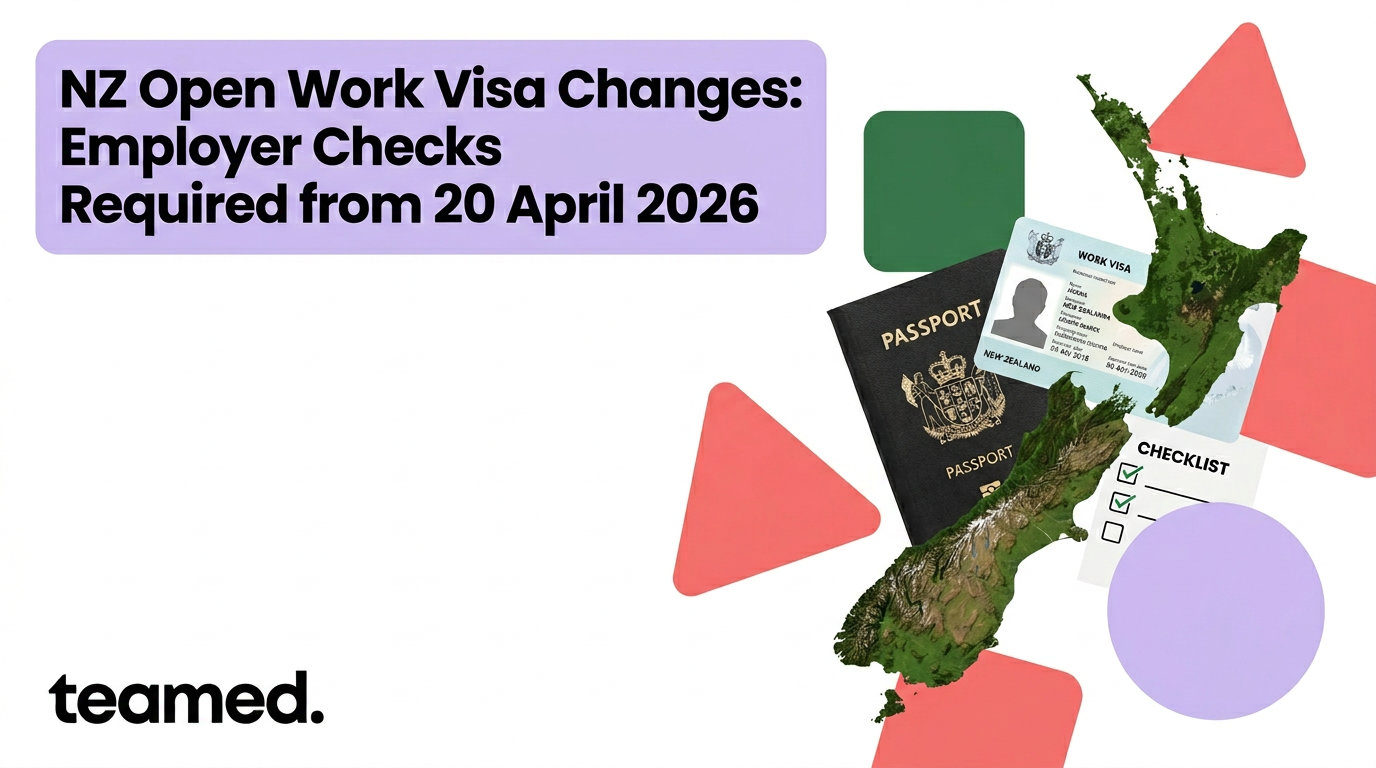
Immigration New Zealand tightened open work visa conditions on 20 April 2026. Employers sponsoring or employing open work visa holders must now ensure visa conditions match approved work categories, update compliance procedures, and review current workforce against the new eligibility criteria. Failure to verify visa compliance can trigger loss of accredited employer status or prohibition on hiring migrants. The check is best completed this week before Friday.
If you employ anyone in New Zealand on an open work visa, this change affects you immediately. The rules took effect on Monday, and your existing employment arrangements may already be out of compliance without any change to job titles, duties, or reporting lines. This is not a future-dated policy announcement. This is a same-week compliance trigger.
For mid-market companies managing New Zealand hires through an Employer of Record arrangement, the question is straightforward: has your EOR provider confirmed they've completed the compliance check? If you haven't heard from them, that's a red flag worth investigating before the week closes.
Effective 20 April 2026. Already in force, no transition period.
Open work visas now fall into one of two buckets. Some still allow any work, including self-employment and side projects. Others are now employer-only, meaning any freelance work, secondment, or consulting gig on the side puts the visa (and your accreditation) at risk.
Immigration New Zealand can suspend or revoke your accreditation if it decides you've slipped on your obligations as an employer. That's not a theoretical lever. They do use it, having already revoked accreditation for 1,316 employers and suspended another 845 as of March 2026.
You already know what a right-to-work check covers. The catch here is that the conditions on the visa, not just the expiry date, are what's moved.
In practice, you've got about a week. NZ payroll runs weekly or fortnightly, and onboarding and work-authorisation checks sit on the same cadence. Miss a cycle and the mess compounds.
Lose accreditation and you can't hire migrants. Offers get pulled, start dates slip, and the teams you promised your board would be fully staffed by Q3 stay half-built.
Every New Zealand employer of open work visa holders is affected by these changes. This includes companies employing staff directly through a New Zealand entity and companies using EOR arrangements where the EOR is the legal employer. The compliance obligation sits with whoever holds the employment relationship.
The changes apply to current visa holders from 20 April 2026. There is no grandfathering. If someone held an open work visa on 19 April, their employment conditions may have changed on 20 April without any notification to the employer. The visa conditions printed on the original grant may no longer reflect the current legal position.
For mid-market companies with NZ workforce, this creates an immediate audit requirement. You need to know which employees hold open work visas, what conditions now apply to those visas, and whether current employment terms align with the new conditions.
There are three things to work through in order: who's affected, what their visa now allows, and whether their current role and contract fit inside those rules.
Start by identifying every employee in New Zealand who holds an open work visa. This includes anyone employed through an EOR arrangement where the EOR is the legal employer. Your HR records should show visa type and expiry date, but you need to verify current conditions against Immigration New Zealand's records.
Next, verify which of the two new employment conditions applies to each visa holder. Some open work visas now allow any work including self-employment. Others require work for an employer only. The distinction matters for job descriptions, secondment arrangements, and any side work your employees might undertake.
Finally, check that employment terms match visa conditions. Job descriptions, working locations, and role categories need to align with what the visa permits. If someone's visa now restricts them to employed work only, any contractor or consulting arrangements would create compliance exposure.
Employer accreditation in New Zealand is an Immigration New Zealand-administered status that permits an employer to access specific migrant hiring pathways. Non-compliance with open work visa conditions can trigger accreditation consequences that extend far beyond the individual employee.
Loss of accredited employer status means you cannot sponsor new migrant workers. For companies with active hiring pipelines in New Zealand, this creates immediate operational risk. Projects dependent on incoming talent face delays. Revenue commitments tied to team expansion become uncertain.
The accreditation framework also includes prohibition on hiring migrants as a potential consequence. This is not a temporary pause. Rebuilding accredited employer status after a compliance failure requires demonstrating sustained good-employer practices over an extended period.
Teamed's analysis of immigration compliance patterns across APAC markets shows that same-week compliance triggers create disproportionate risk for mid-market companies. Larger enterprises typically have dedicated immigration teams who monitor regulatory changes in real time. Smaller companies often have simple enough structures that compliance is straightforward. Mid-market companies fall into the gap: complex enough to have exposure, but not resourced enough to catch every regulatory shift.
When you employ someone in New Zealand through an Employer of Record, the EOR is the legal employer. This means the EOR holds the compliance obligation for right-to-work checks, visa condition verification, and employment term alignment.
But here's what most people miss: the client company still carries reputational and operational risk. If your EOR provider fails to complete the compliance check and an employee is found working outside their visa conditions, the immediate legal exposure sits with the EOR. The project delivery risk, the relationship damage, and the scramble to find replacement talent all sit with you.
An EOR differs from direct employment because the EOR holds payroll and employment compliance liability, while direct employment places compliance obligations directly on your business. In practical terms, this means you should be asking your EOR provider a specific question this week: have you completed the open work visa condition review for all New Zealand employees, and can you confirm each employee's visa conditions align with their current role?
If your EOR provider hasn't proactively reached out about this change, that tells you something about their compliance monitoring capability. Teamed assigns named jurisdiction specialists within 48 hours for exactly these situations, because immigration compliance triggers don't wait for scheduled account reviews.
The new conditions apply to existing visa holders from 20 April 2026. This is the critical point that most guidance overlooks.
An employee who was compliant on 19 April may be non-compliant on 21 April without any change to their job, their manager, or their working location. The visa conditions changed around them. The employment relationship stayed the same, but the legal framework shifted.
Existing employment conditions may need amendment. If someone's visa now includes restrictions that weren't present before, employment contracts, job descriptions, or working arrangements may need updating. This is not a theoretical concern. It's a practical requirement that affects payroll processing, onboarding documentation, and internal mobility decisions.
For companies with employees on open work visas who also do occasional consulting work, freelance projects, or side businesses, the new condition categories matter immediately. A visa that previously allowed any work may now restrict the holder to employed work only.
Immigration New Zealand is expected to publish follow-on guidance over the next two weeks. The enforcement posture will become clearer as INZ communicates implementation priorities.
What we know from previous immigration compliance changes is that INZ typically focuses initial enforcement on employers who demonstrate pattern non-compliance rather than isolated errors. A single employee with misaligned visa conditions is a problem. A systematic failure to verify visa conditions across your workforce is a much larger problem.
The practical implication: completing your compliance check this week demonstrates good-faith effort to align with the new requirements. Waiting for enforcement guidance before acting creates unnecessary exposure, especially considering INZ targets 16% of employers annually for post-accreditation checks.
For mid-market companies, the CFO-relevant framing is straightforward. Loss of employer accreditation creates hiring freezes, project delivery delays, and remediation costs. The cost of a same-week compliance check is trivial compared to the cost of accreditation consequences.
There are four things to get moving in parallel: list your affected people, get written confirmation from your EOR, have counsel look at anything borderline, and tell the employees what's happening.
For the workforce audit, identify every employee in New Zealand holding an open work visa. Pull visa documentation from HR records. Cross-reference against Immigration New Zealand's VisaView system to verify current conditions. Flag any employees whose visa conditions have changed under the new framework.
For EOR provider verification, contact your EOR provider directly. Ask for confirmation that they've completed the open work visa condition review. Request documentation showing which employees are affected and what actions they've taken. If your EOR provider can't provide this confirmation, escalate immediately.
For the legal review, have employment counsel review job descriptions, employment contracts, and working arrangements for any employees whose visa conditions have changed. Pay particular attention to secondment language, consulting arrangements, and any provisions that might conflict with employer-only work restrictions.
For employee communications, prepare messaging for affected employees. They need to understand what's changed, what it means for their employment, and what actions (if any) they need to take. Clear communication reduces anxiety and demonstrates good-employer practices.
New Zealand's visa reform reflects broader immigration policy shifts across APAC markets. Governments are tightening employment condition requirements to ensure visa holders work within authorised categories and employers maintain accurate records.
The specific changes to open work visa conditions aim to clarify employment flexibility. Previously, open work visas allowed broad employment flexibility without clear condition categories. The new framework creates two distinct condition types, making it easier for employers to verify what work a visa holder can undertake.
For mid-market companies expanding into New Zealand, this change reinforces the importance of immigration compliance as a core HR function. The right structure for where you are means understanding not just employment law, but immigration requirements that affect your ability to hire and retain international talent.
If your NZ team sits under an EOR and you haven't seen written confirmation that the new visa conditions have been checked against every employee, this needs to be done before the week closes.
The practical reality is that most EOR providers operate on monthly or quarterly review cycles. Same-week compliance triggers fall outside normal operating rhythms. Your provider may be aware of the change but hasn't yet actioned the review for your specific employees.
Teamed operates EOR coverage in 187+ countries and treats immigration compliance triggers as priority items requiring immediate specialist attention. When regulatory changes take effect without advance notice, the difference between a provider who monitors in real time and one who catches changes in scheduled reviews becomes operationally significant.
For mid-market companies where the decision is too important to get wrong, the right structure for where you are includes having an EOR provider who proactively surfaces compliance triggers rather than waiting for you to ask. Thinking ahead is the service.
If you're not sure where you stand in New Zealand this week, talk to an expert. A named NZ specialist will walk through your people with you, confirm what's been checked, and tell you honestly where any gaps are.
Using an Employer of Record in Sweden involves two distinct cost layers that most providers never show you together. The EOR service fee typically ranges from $299 to $699 per employee per month, while Sweden's mandatory employer social security contributions add 31.42% of gross salary on top. A Swedish employee earning SEK 600,000 annually will cost their employer roughly 40-45% more than the gross salary figure alone once you combine statutory contributions, occupational pension, and EOR fees.
Most EOR pricing pages quote only the service fee. That's like quoting a car price without mentioning fuel costs. The statutory 31.42% employer contribution exists whether you use an EOR or establish your own Swedish entity. The EOR doesn't eliminate this cost. It administers it on your behalf.
This guide gives you the complete cost model that finance teams actually need. You'll find current Skatteverket rates, EOR fee structure comparisons, and worked examples at three salary levels showing total employer cost under both flat-fee and percentage-based pricing models.
Sweden's employer social security contribution rate (arbetsgivaravgifter) is 31.42% of gross salary as of 2025, per Skatteverket. This rate applies regardless of whether you employ through an EOR or your own entity.
EOR service fees for Sweden typically fall into two bands: $299-$699 per employee per month as a flat fee, or 5-15% of gross salary as a percentage fee. Teamed's published EOR headline fee is $599 per employee per month with zero FX markup contractually guaranteed.
Market-standard occupational pension (tjänstepension) adds 4.66% up to SEK 49,333/month beyond statutory contributions.
One-time EOR onboarding or setup fees commonly range from $500 to $1,500 per hire in Sweden-focused implementations. CFOs should treat these as separate from recurring monthly fees during budgeting.
Setting up a Swedish entity? Budget €10,000-€25,000 for legal and accounting work. The exact cost depends on your structure and speed. Below 5-10 employees, EOR usually makes more financial sense.
Every EOR arrangement in Sweden has two fundamentally different cost layers. Understanding this split is the first step to accurate budgeting.
The first layer is statutory employer costs mandated by Swedish law. These include the 31.42% employer social security contributions (arbetsgivaravgifter) calculated on gross salary and remitted to Skatteverket. They also include occupational pension contributions where applicable, vacation pay supplements, and sick pay liability during the employer-paid period. These costs exist regardless of your employment structure. Whether you hire through an EOR, establish a Swedish Aktiebolag, or use any other arrangement, Swedish law requires these payments.
The second layer is the commercial fee charged by your EOR provider. This covers payroll processing, employment contract drafting, statutory compliance administration, HR support, and benefits management. The EOR fee replaces what you'd otherwise spend on entity setup, local HR staff, payroll administration, and compliance infrastructure.
Here's what catches many buyers off guard: most EOR quotes show only the second layer. When a provider says "hire in Sweden for $499 per month," they're quoting their service fee. The 31.42% statutory contribution still applies on top. A €50,000 salary doesn't cost €50,000 plus $499. It costs €50,000 plus €15,710 in employer contributions plus the EOR fee plus any benefits premiums.
Sweden's total employer social security contribution rate is 31.42% of gross salary as of 2025, according to Skatteverket. This aggregate rate comprises seven distinct components, each funding different aspects of Sweden's social insurance system.
The old-age pension contribution (ålderspensionsavgift) accounts for 10.21% of gross salary. Health insurance (sjukförsäkringsavgift) adds 3.55%, while parental insurance (föräldraförsäkringsavgift) contributes 2.60%. The labour market contribution (arbetsmarknadsavgift) is 2.64%, and work injury insurance (arbetsskadeavgift) adds 0.20%. Survivors' pension (efterlevandepensionsavgift) contributes 0.60%. The largest single component is the general wage contribution (allmän löneavgift) at 11.62%.
These contributions are calculated on gross salary before income tax deductions. The employer remits the full amount to Skatteverket as part of the monthly payroll reporting cycle. For a Swedish employee earning SEK 600,000 annually, the employer contribution alone equals SEK 188,520 before any EOR fees or additional benefits.
Reduced rates apply for specific employee categories. Workers under 18 or over 65 qualify for lower contribution rates. If you're hiring student workers or senior consultants in Sweden, your EOR provider should automatically apply the correct reduced rate. Confirm this during vendor evaluation, as incorrect rate application creates compliance risk and unnecessary cost.
EOR providers use two primary fee structures, and understanding the model matters as much as the headline number. The structure you choose affects total cost differently depending on your salary bands.
Flat monthly fees typically range from $299 to $699 per employee per month. This model works best for predictable budgeting and becomes increasingly cost-efficient as salaries rise. A $599 monthly fee represents the same cost whether you're paying a €40,000 junior developer or a €100,000 engineering director. The downside is that flat fees may not scale down appropriately for part-time roles or lower-salary positions.
Percentage-of-salary models typically charge 5-15% of gross monthly salary. This structure scales naturally with compensation levels, making it potentially more economical for lower-salary or highly variable-pay roles. The catch is that costs increase significantly with senior hires. A 10% fee on a €90,000 salary costs €9,000 annually, while the same percentage on a €45,000 salary costs only €4,500.
Hybrid models combine a flat base fee with a percentage above a certain salary threshold. These offer flexibility but add complexity to forecasting. You'll need scenario modelling to understand true costs across your expected salary range.
What's typically included in EOR fees covers payroll processing, statutory compliance, employment contract drafting, HR support, and basic benefits administration. What's typically billed separately includes one-time onboarding fees ($500-$1,500), offboarding or termination fees, benefits premiums above a base plan, currency conversion fees, and expedited payroll runs.
Sweden presents a specific consideration around collective bargaining agreements (kollektivavtal). These agreements covered 82% of private-sector employees in Sweden in 2024 and can impose additional employer obligations including enhanced occupational pension and insurance requirements. Confirm whether your EOR provider is a signatory to relevant CBAs or can manage CBA obligations on your behalf, as this affects both compliance and cost.
Several cost categories routinely surprise buyers who focus only on headline EOR fees and statutory contributions. Building these into your total cost model prevents budget overruns.
Occupational pension (tjänstepension) sits beyond the 10.21% statutory pension contribution. Market-standard occupational pension in Sweden adds approximately 4.5% of salary. Many EOR contracts treat this as a pass-through cost billed separately from the headline fee. Ask explicitly whether tjänstepension is included or billed as an additional line item.
Vacation pay supplements (semesterersättning) add real cost that should appear in any complete model. Swedish law mandates 25 days of paid annual leave plus a vacation pay supplement of 0.43% per day. This isn't optional. It's a statutory entitlement that affects your total employment cost.
Sick pay liability creates employer exposure during illness periods. Swedish employers pay sick pay for days 2-14 of an employee's illness, with day 1 being a qualifying day with no pay. While the probability of extended illness for any individual employee is low, this represents a real cost to model for headcount planning, particularly for larger teams.
Currency risk introduces cost variability that finance teams often overlook. If your EOR bills in USD or EUR while salaries are paid in SEK, exchange rate fluctuations add unpredictability to your employment costs. Ask providers about hedging options or fixed-rate billing arrangements. Teamed contractually guarantees zero FX markup on currency conversion, which removes one source of cost opacity for companies managing cross-border payroll.
Abstract percentages become concrete when you model actual scenarios. These worked examples show total annual employer cost at three salary levels using both a flat-fee EOR model ($599 per month) and a percentage-based model (10% of gross salary).
For an entry-level role at SEK 480,000 annual gross salary (approximately €42,000), employer social security contributions at 31.42% add SEK 150,816. Occupational pension at 4.5% adds another SEK 21,600. Under the flat-fee model, the EOR charges $7,188 annually (approximately SEK 75,000). Under the percentage model at 10%, the EOR charges SEK 48,000. Total employer cost reaches approximately SEK 727,000 under the flat model and SEK 700,000 under the percentage model. At this salary level, the percentage model saves roughly SEK 27,000 annually.
For a mid-level role at SEK 720,000 annual gross salary (approximately €63,000), employer contributions add SEK 226,224 and occupational pension adds SEK 32,400. The flat-fee EOR costs SEK 75,000 annually while the percentage model costs SEK 72,000. Total employer cost is approximately SEK 1,053,000 under either model. This is roughly the crossover point where both pricing structures produce similar results.
For a senior role at SEK 1,020,000 annual gross salary (approximately €90,000), employer contributions add SEK 320,484 and occupational pension adds SEK 45,900. The flat-fee EOR still costs SEK 75,000, but the percentage model now costs SEK 102,000. Total employer cost reaches approximately SEK 1,461,000 under the flat model versus SEK 1,488,000 under the percentage model. At higher salaries, flat-fee models become meaningfully more cost-efficient.
The pattern is clear. At lower salary levels, percentage-based models often offer better value. At higher salary levels, flat-fee models become more cost-efficient. Always model both scenarios against your specific hiring profile before signing an EOR contract.
EOR is typically more cost-effective for companies hiring 1-5 employees in Sweden. Entity setup costs €10,000-€25,000 or more in legal and accounting fees, plus ongoing compliance overhead for local payroll, accounting, tax filings, and governance. These fixed costs only become competitive when spread across sufficient headcount.
Most EOR providers and advisors cite 5-10 employees as the threshold where entity setup begins to compete on cost. But Sweden's regulatory complexity pushes that threshold higher for many companies. Collective bargaining agreements, works council considerations under the Co-Determination Act (MBL), and the procedural requirements of the Employment Protection Act (LAS) create administrative burden that favours EOR for longer than simpler jurisdictions.
Teamed's Graduation Model provides a framework for this decision. Sweden sits in Tier 2 (moderate complexity) within this framework, with an entity transition threshold of 15-20 employees for native-language operations or 20-30 employees for non-native language operations. The Language Buffer Rule adds 30-50% to thresholds when your team cannot read Swedish employment directives, contracts, and compliance documentation firsthand.
Beyond headcount, consider your long-term commitment. Entity setup costs require a 3+ year presence to justify the investment. If you're testing the Swedish market or uncertain about sustained headcount growth, EOR provides flexibility that entity ownership doesn't. Based on Teamed's advisory work with over 1,000 companies across 70+ countries, companies should remain on EOR during market validation phases where exit probability exceeds 30%.
Sweden-specific due diligence questions separate providers with genuine local expertise from those offering generic coverage. These questions reveal whether a provider can actually deliver compliant employment in Sweden.
Ask whether the provider is a signatory to relevant Swedish collective bargaining agreements. CBA coverage affects benefit obligations, minimum terms, and compliance requirements. A provider without CBA capability may leave you exposed to claims from employees or unions.
Clarify whether occupational pension (tjänstepension) is included in the quoted fee or billed as a pass-through. This single question can reveal a 4.5% cost difference that wasn't visible in the initial quote.
Understand how the provider handles sick pay liability and reimbursement. Who bears the cost during the employer-paid sick period? How is this reflected in invoicing?
Ask about offboarding and termination fee structures. Swedish notice periods under LAS can extend up to six months for long-tenured employees. How does the provider handle notice period obligations, and what fees apply during termination processes?
Confirm the billing currency and who bears currency risk. Are fees billed in SEK, EUR, or USD? What FX reference rate is used, and is it timestamped on invoices? Does the provider mark up currency conversion?
Finally, verify whether the provider operates through a local Swedish entity or through a sub-contractor. Direct entity presence typically indicates deeper local capability and clearer compliance accountability.
What is the employer social security contribution rate in Sweden?
The total employer social security contribution rate in Sweden is 31.42% of gross salary as of 2025, per Skatteverket. This covers pension, health insurance, parental insurance, work injury insurance, and labour market contributions. The rate applies whether you employ through an EOR or your own entity.
How much does an Employer of Record in Sweden typically charge?
EOR providers typically charge either a flat monthly fee of $299-$699 per employee or a percentage of gross salary ranging from 5-15%. Flat fees become more cost-efficient for higher-salary hires, while percentage models may suit lower-salary roles. Teamed's EOR fee is $599 per employee per month with zero FX markup.
What is the total employer cost for a Swedish employee?
Total employer cost in Sweden typically runs 35-45% above gross salary when combining statutory contributions (31.42%), occupational pension (approximately 4.5%), and EOR service fees. A €63,000 per year employee costs approximately €90,000-€92,000 in total employer spend depending on the EOR fee structure.
Are there hidden costs when using an EOR in Sweden?
Common additional costs include occupational pension (tjänstepension, approximately 4.5% of salary), one-time onboarding fees ($500-$1,500), offboarding fees, benefits premiums above base plans, and currency conversion charges. Request a fully loaded cost model showing all line items before signing.
When should a company use an EOR instead of setting up a legal entity in Sweden?
An EOR is generally more cost-effective for companies hiring fewer than 5-10 employees in Sweden. Entity setup costs €10,000-€25,000 or more in legal and accounting fees, plus ongoing compliance overhead. These costs only become competitive at higher headcounts, typically 15-20 employees for companies operating in Swedish or 20-30 for non-native language operations.
The two-layer cost structure of EOR employment in Sweden requires finance teams to model both statutory contributions and provider fees together. Neither number alone tells the complete story.
Sweden's 31.42% employer contribution rate is non-negotiable and applies regardless of employment structure. EOR fees add another layer that varies significantly based on pricing model and salary levels. At higher salaries, flat-fee models typically outperform percentage-based pricing. At lower salaries, the reverse often applies.
For mid-market companies evaluating Sweden employment options, the right approach combines accurate cost modelling with strategic thinking about long-term presence. If you're planning sustained growth in Sweden with 15+ employees over a 3-year horizon, entity establishment may eventually make economic sense. If you're testing the market or maintaining a smaller team, EOR provides compliance confidence without the fixed costs of entity ownership.
Teamed's approach through the Graduation Model means proactively advising when EOR is no longer the right structure, even when that means transitioning clients to entity management. The right structure for where you are today may not be the right structure for where you're going. Talk to an Expert to model your specific Sweden employment costs and understand when the economics shift in favour of different approaches.
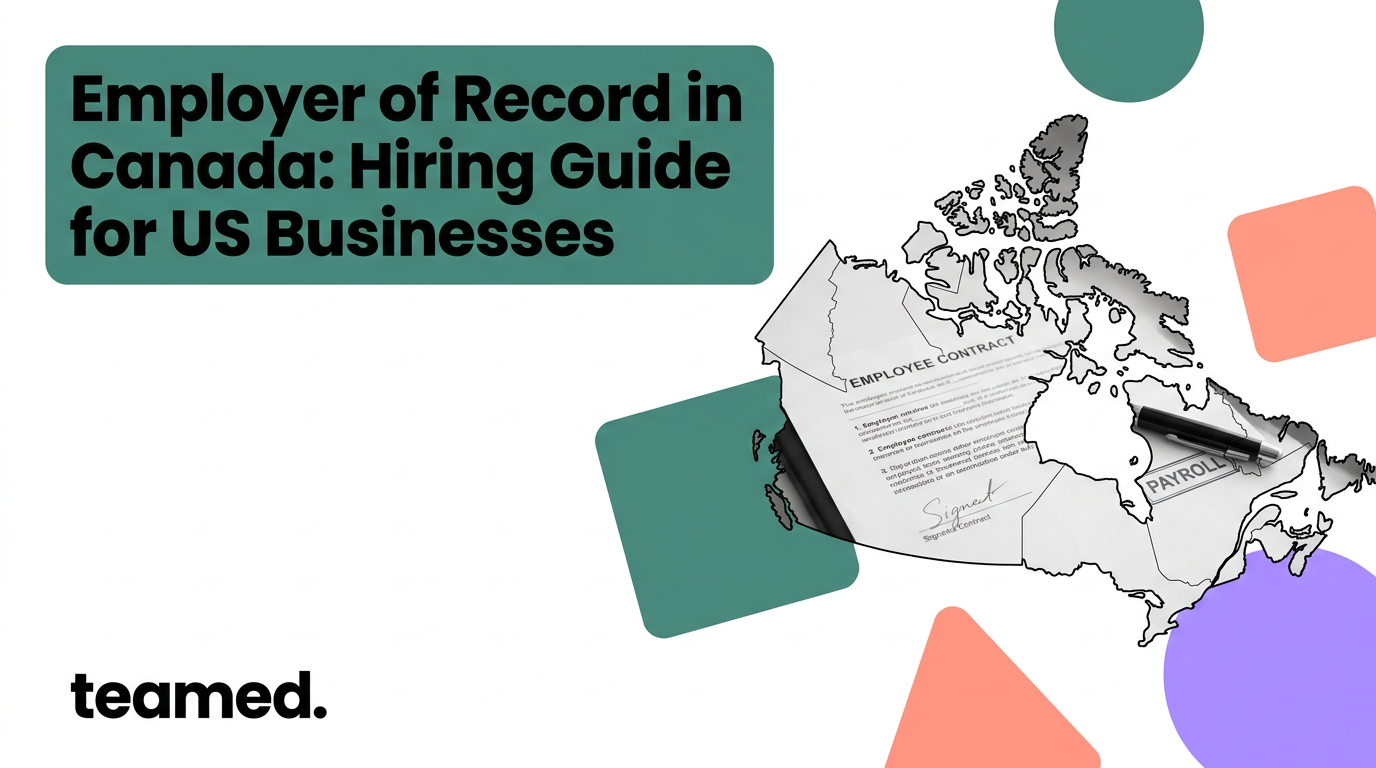
Canada looks like the easy hire. Same language, overlapping time zones, familiar business culture. Your perfect candidate is in Toronto, ready to start in two weeks. What could go wrong?
Quite a lot, actually. US companies that hire Canadian workers without a compliant employment structure risk triggering permanent establishment status with the Canada Revenue Agency (CRA), which can expose the US parent company to Canadian corporate income tax obligations. One employee, no entity, and suddenly your CFO is fielding questions about Canadian tax filings nobody saw coming.
An Employer of Record (EOR) in Canada is a third-party company that legally employs workers on behalf of a US business, handling payroll, taxes, benefits, and compliance with Canadian federal and provincial employment law without requiring the US company to establish a Canadian legal entity. This guide walks you through the three paths available, EOR, PEO, and entity setup, with a clear framework for choosing the right structure based on your headcount, timeline, and market commitment.
Canadian employment standards are set at the provincial level, not federally, creating significant variation in minimum wage, termination rules, and statutory holidays across Ontario, Quebec, British Columbia, and Alberta.
Most EOR providers charge either a flat monthly fee of $400-$800 CAD per employee or 15-25% of gross salary, making EOR cost-efficient for companies with fewer than 15 employees in Canada.
Entity setup in Canada typically costs $8,000-$20,000+ CAD upfront plus $15,000-$30,000 CAD annually in ongoing legal, accounting, and payroll administration overhead for small headcount operations.
Quebec requires French-language employment contracts under Bill 96 and operates the Quebec Pension Plan (QPP) instead of the Canada Pension Plan (CPP), creating distinct compliance requirements.
Canada has no at-will employment. Termination without cause requires statutory notice periods plus common law reasonable notice, which can result in severance obligations of 12-24 months for long-tenured employees.
EOR onboarding in Canada typically takes 1-5 business days, compared to 4-16 weeks for entity establishment.
The "just pay them as a contractor" approach fails faster in Canada than most US companies expect. The CRA applies strict worker classification tests, and misclassification penalties include retroactive payroll taxes, Canada Pension Plan contributions, Employment Insurance premiums, and potential penalties with interest.
Permanent establishment risk is the compliance issue that keeps CFOs awake. Even a single employee performing certain activities in Canada can create a taxable presence for the US parent company under the Canada-US Tax Treaty. The threshold is lower than most companies assume, and the consequences include Canadian corporate income tax filings, transfer pricing documentation, and ongoing compliance obligations that weren't in anyone's budget.
Provincial variation adds another layer. Employment standards in Ontario differ from British Columbia, which differ from Alberta, which differ dramatically from Quebec. Minimum wage rates, statutory holiday entitlements, termination notice requirements, and even the language of employment contracts vary by province. A compliant employment contract in Vancouver may be non-compliant in Montreal.
Quebec deserves special attention. Bill 96 requires French-language employment contracts and workplace communications. The Quebec Pension Plan operates separately from CPP with different contribution rates. Companies hiring in Quebec without explicit provincial expertise face compliance risks that don't exist elsewhere in Canada.
US companies have three compliant options for employing Canadian workers: Employer of Record (EOR), Professional Employer Organisation (PEO), and entity setup. Each model serves different business situations, and choosing wrong creates either unnecessary cost or unnecessary risk.
An EOR becomes the legal employer of your Canadian workers, assuming full payroll and compliance responsibility through the provider's Canadian entity. You direct the day-to-day work while the EOR handles employment contracts, statutory deductions, benefits administration, and termination procedures. No Canadian entity required on your part.
A PEO operates as a co-employer, sharing HR responsibilities while you remain the legal employer. The critical distinction: PEO arrangements require you to already have a registered Canadian entity. The PEO handles payroll administration and HR functions, but compliance ownership remains shared between you and the provider.
Entity setup means incorporating a Canadian subsidiary or registering a branch office, making your company the direct employer under Canadian law. You own the compliance, the payroll registrations, the termination liability, and the ongoing administrative overhead. Full control, full responsibility.
Setup time separates these models immediately. EOR providers typically onboard Canadian employees in 1-5 business days when employment contracts and compensation details are ready. PEO onboarding requires 4-8 weeks because you need to establish your Canadian entity first. Entity setup takes 4-16 weeks depending on provincial registration requirements and banking setup.
Upfront costs vary dramatically. EOR arrangements typically involve $0-$500 in onboarding fees. PEO requires entity setup costs plus ongoing PEO fees. Entity establishment runs $8,000-$20,000+ CAD before you've employed anyone.
Ongoing costs favour different models at different headcounts. EOR fees of 15-25% of gross salary or $400-$800 per employee monthly work efficiently for smaller teams. Entity setup spreads fixed overhead across headcount, typically breaking even around 20-30 employees depending on province and administrative model.
Compliance ownership is the risk variable. With EOR, the provider owns employment compliance and termination liability. With PEO, ownership is shared. With entity setup, you own everything.
Exit flexibility matters for market testing. EOR arrangements can typically be unwound in weeks through standard employment termination procedures. Entity dissolution involves formal deregistration, tax clearances, and ongoing filings that can take months.
The right structure depends on your headcount, timeline, and commitment level. Here's how to match your situation to the appropriate model.
Scenario 1: Testing the Canadian market with 1-3 employees. Use an EOR. No entity required, fast setup, easy exit if the market doesn't pan out. The EOR fee is effectively insurance against compliance errors while you validate product-market fit.
Scenario 2: Already have a Canadian entity and want to outsource HR and payroll. Evaluate a PEO. You get shared HR infrastructure without giving up employer control, and the co-employment model can reduce administrative burden for established operations.
Scenario 3: Hiring 25+ employees with a 5+ year commitment. Entity setup may have the lowest long-term cost, but model the total cost of ownership including legal, accounting, and HR overhead before deciding. The break-even point varies by province and your administrative model.
Scenario 4: Need to hire a Canadian employee in the next two weeks. Only an EOR can move this fast. Entity setup and PEO onboarding cannot meet this timeline regardless of how much you're willing to spend.
Scenario 5: Your hire is in Quebec. Confirm your EOR or PEO has explicit Quebec expertise. French-language employment contracts, Bill 96 compliance, and QPP versus CPP distinctions are non-trivial. Providers without Quebec-specific capabilities create compliance exposure.
Teamed's advisory work with over 1,000 companies on global employment strategy shows that most US companies entering Canada for the first time find EOR the lowest-risk, fastest path. The economics shift toward entity setup as headcount grows, but that crossover point varies significantly based on provincial requirements and your internal capabilities.
Canadian employment law operates on a federal/provincial split that creates compliance complexity for US companies accustomed to federal primacy. Most employment standards, including minimum wage, overtime rules, vacation entitlements, and termination requirements, are set at the provincial level.
Termination rules represent the biggest departure from US employment practices. Canada has no at-will employment. Employers must provide statutory notice or pay in lieu, and common law reasonable notice can extend termination costs significantly beyond statutory minimums. A 10-year employee might be entitled to 12-24 months of reasonable notice under common law, depending on factors including age, position, and availability of comparable employment.
Statutory employer contributions are mandatory. Canada Pension Plan (CPP) contributions, Employment Insurance (EI) premiums, and provincial health levies add approximately 10-15% to base salary costs. These aren't optional, and payroll must be structured to remit these contributions correctly.
Vacation pay minimums exceed most US state requirements. Federal employees receive a minimum of two weeks paid vacation after one year, increasing to three weeks after five years. Provincial standards vary, with some provinces providing more generous entitlements.
Ontario operates with a minimum wage of $17.60/hour (October 2025), nine statutory holidays per year, and one week statutory termination notice for employees with one year of tenure. Employers must register with the Workplace Safety and Insurance Board (WSIB) for workers' compensation coverage.
Quebec sets minimum wage at $15.75/hour with eight statutory holidays. The province requires French-language employment contracts under Bill 96, operates the Quebec Pension Plan separately from CPP, and applies distinct labour standards under the Act Respecting Labour Standards (LNT).
British Columbia has the highest minimum wage at $17.85/hour with ten statutory holidays. The BC employer health tax applies to payroll above $1,000,000, adding another cost consideration for larger teams.
Alberta maintains the lowest minimum wage among major provinces at $15.00/hour with nine statutory holidays. The province has no provincial health tax, which can make it marginally more cost-effective for larger operations.
The termination notice figures above reflect statutory minimums only. Common law notice can be significantly longer and represents a major cost variable that US companies frequently underestimate.
Not all EOR providers deliver equivalent service in Canada. The questions you ask during evaluation determine whether you're getting genuine compliance expertise or operational risk dressed up as convenience.
Does the provider have in-country Canadian legal entities, or are they routing employment through a network of contractors? Providers with their own Canadian entities have direct control over compliance. Network models introduce intermediary risk.
Can they handle Quebec specifically? French contracts, QPP administration, Bill 96 compliance. If the answer is vague, the capability is probably absent.
What is their benefits infrastructure? Are they offering competitive Canadian benefits packages, or bare-minimum statutory compliance? Your ability to attract Canadian talent depends partly on benefits competitiveness.
How do they handle terminations? Do they own the termination risk, or does liability pass back to you? Termination in Canada involves significant potential exposure, and understanding who bears that risk is essential.
What's their pricing model? Flat fee versus percentage of salary changes the economics at different salary levels. A 20% fee on a $150,000 CAD salary is $30,000 annually. A $600 flat fee is $7,200. The math matters.
Teamed publishes a headline EOR fee of $599 per employee per month with contractually guaranteed zero FX markup, which addresses the cost transparency concerns that frequently surface in mid-market buying committee evaluations.
EOR pricing models fall into two categories: flat fee per employee per month, or percentage of gross salary. Understanding how these models interact with Canadian employment costs is essential for accurate budgeting.
Consider a software engineer earning $90,000 CAD annually. Employer CPP contributions run approximately $3,800 per year. Employer EI premiums add roughly $2,300 per year. With a 20% EOR markup, service fees total approximately $18,000 per year. Total employer cost: approximately $114,000 CAD annually.
Compare this to entity setup economics. Add $10,000-$20,000 in setup costs plus $15,000-$30,000 annually in ongoing administrative overhead for small headcount operations. At one employee, entity setup is dramatically more expensive. At 25 employees, the math shifts.
A practical mid-market heuristic: EOR arrangements tend to be most cost-efficient below roughly 15 employees in one country, while entity setup frequently starts to approach break-even around 20-30 employees when fixed overhead is spread across headcount. The exact crossover depends on your specific EOR fees, provincial requirements, and internal administrative capabilities.
Teamed's Graduation Model provides a framework for this transition. The model guides companies through sequential employment model transitions, from contractor to EOR to entity, with proactive advisory on when the economics and risk profile shift in favour of your own entity. The advantage is continuity: one advisory relationship across all transitions, avoiding the disruption and re-onboarding that fragmented approaches require.
Can a US company hire a Canadian employee directly without an EOR?
Technically yes, but doing so without a Canadian legal entity creates significant risk. The CRA may classify the arrangement as creating a permanent establishment, exposing the US company to Canadian corporate tax. The employee also has no access to statutory benefits like EI unless payroll runs through a compliant Canadian structure.
Do I need an EOR to hire in Canada?
You need either an EOR, a PEO with an existing entity, or your own Canadian entity. Hiring a Canadian worker as a direct employee of a US company with no Canadian payroll structure is non-compliant and exposes both employer and employee to tax and legal risk.
How much does an Employer of Record in Canada cost?
Most EOR providers charge either a flat monthly fee of $400-$800 CAD per employee or 15-25% of gross salary. For a $90,000 CAD annual salary, expect $13,500-$22,500 CAD per year in EOR fees, plus statutory employer contributions on top of base salary.
What is the difference between an EOR and a PEO in Canada?
An EOR becomes the legal employer of your Canadian workers and requires no Canadian entity on your part. A PEO operates as a co-employer but requires you to already have a registered Canadian entity. For most US companies entering Canada for the first time, an EOR is the faster and lower-risk path.
How long does it take to hire someone in Canada using an EOR?
Most established EOR providers can onboard a Canadian employee in 1-5 business days, assuming employment contracts and compensation details are ready. This is significantly faster than entity setup (4-16 weeks) or PEO onboarding (which requires entity registration first).
The decision framework is straightforward once you map your specific situation. For most US companies hiring fewer than 15-20 people in Canada, EOR is the lowest-risk, fastest, and most cost-effective path. The compliance expertise is built in, the timeline is measured in days rather than months, and exit flexibility remains high while you validate your Canadian market presence.
As headcount grows and market commitment solidifies, the economics shift. Entity setup becomes viable when you're planning a 3+ year presence with stable or growing headcount, when your annual EOR costs exceed entity setup plus ongoing administrative overhead, and when you have the internal resources to manage local compliance.
The right structure for where you are today may not be the right structure for where you'll be in two years. Working with an advisory partner who proactively models that crossover, rather than one incentivised to keep you on EOR indefinitely, is the difference between strategic employment decisions and expensive surprises.
If you're evaluating Canadian hiring options and want clarity on which structure fits your specific situation, talk to an expert who can model the economics and compliance requirements for your headcount and timeline.
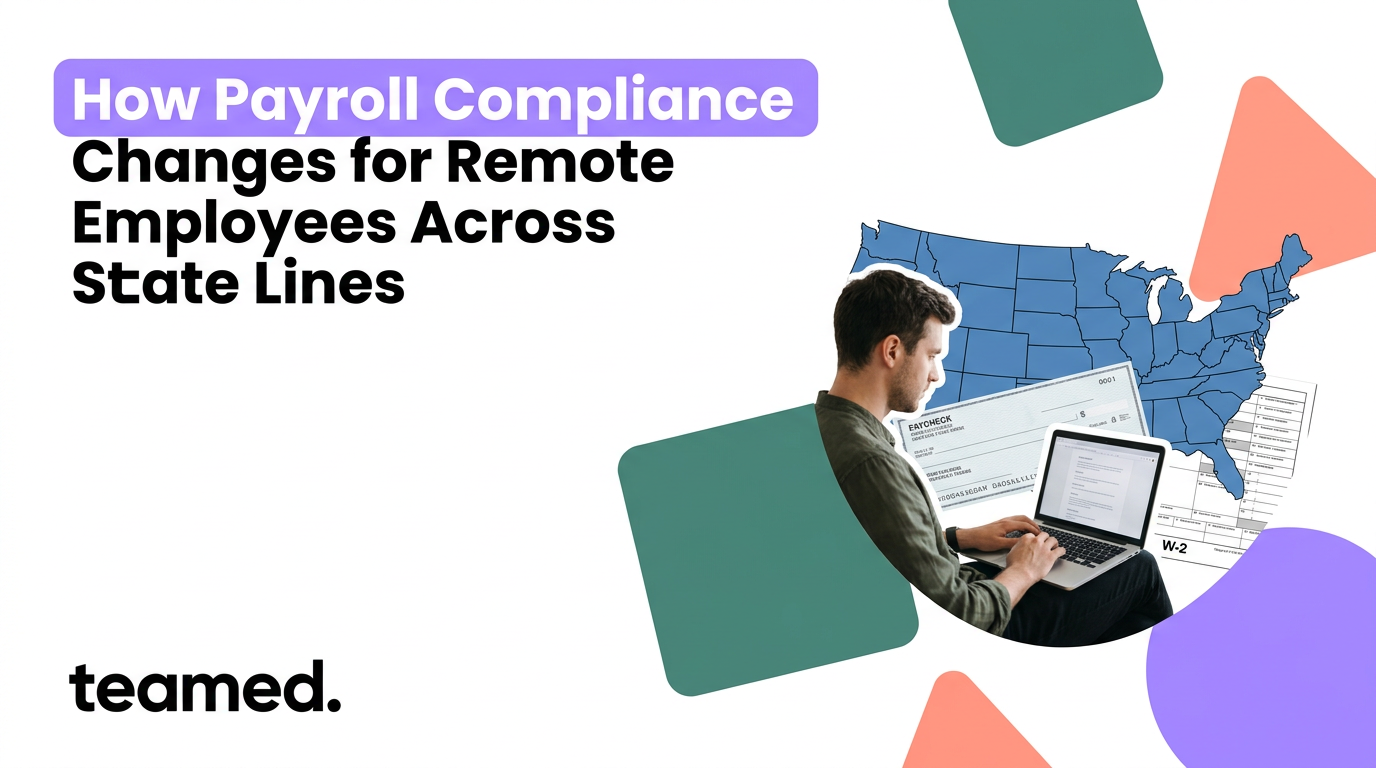
Your finance director just flagged an email from the California Franchise Tax Board. They want to know why you haven't registered as an employer in their state. The problem? Your marketing manager moved to San Diego six months ago, and nobody updated payroll.
This scenario plays out constantly in companies with remote teams. When an employee works remotely in a different state than your company's headquarters, or splits time across multiple states, your payroll obligations change in concrete ways. You may need to register for payroll tax accounts in the employee's home state, withhold income taxes for that state, pay state unemployment insurance there, and comply with any local payroll taxes in their jurisdiction. Whether you owe these obligations depends on three factors: where the employee is domiciled, where the work is physically performed, and whether a reciprocity agreement exists between the states involved.
The compliance steps you need to take depend on which of these situations applies to your employee. Most guides treat multi-state payroll compliance as a checklist of rules without walking employers through the decision logic. This guide takes a process-first approach, mapping compliance triggers to specific employer actions in the order a payroll or HR team encounters them when onboarding a new remote hire.
State payroll registration takes 2-6 weeks. Start a remote hire without registering first, and you'll miss their first paycheck deadline.
One remote employee makes you an employer in their state. No office needed. You'll still owe withholding and unemployment insurance.
New York's convenience-of-employer doctrine can tax 100% of a remote employee's income even when they work from another state.
Pennsylvania has over 2,500 local taxing jurisdictions, each requiring separate employer registration for local earned income taxes.
Multi-state employees require W-2s that reflect wages and taxes for each state separately in Boxes 15-17.
States commonly trigger withholding obligations after 14-30 days of work performed within their borders.
Reciprocity agreements exist between 16 states and the District of Columbia, allowing employees to pay income tax only in their state of residence.
The concept of tax nexus explains why a single remote employee can create payroll tax presence in a state where your company has no office. Nexus is the legal connection between your business and a state that triggers tax obligations. When an employee physically performs work in a state, you've established nexus there regardless of whether you have an office, customers, or any other business activity in that jurisdiction.
The difference between the employee's domicile state and their work state matters because both can trigger withholding obligations. Domicile is where the employee legally resides and intends to remain indefinitely. Work state is where labour is physically performed. An employee domiciled in New Jersey who works from a coffee shop in Philadelphia three days a week has created potential obligations in both states.
The convenience-of-employer doctrine surprises most employers. A handful of states, most notably New York, can tax a nonresident employee's full income if they work remotely for their own convenience rather than because the employer requires it. This means your remote employee in Connecticut working for your Manhattan-based company may owe New York income tax on their entire salary.
Collect a completed W-4 and the equivalent state withholding certificate for their home state. Ask explicitly whether they will perform any work in states other than their home state and document the answer. Domicile is not the same as mailing address. A remote employee who lives in one state but temporarily works from another state for 30 or more days may trigger obligations in both jurisdictions.
Reciprocity agreements allow employees to pay income tax only in their state of residence, not the state where the employer is located. States with active reciprocity agreements include Arizona, Illinois, Indiana, Iowa, Kentucky, Maryland, Michigan, Minnesota, Montana, New Jersey, North Dakota, Ohio, Pennsylvania, Virginia, West Virginia, Wisconsin, and the District of Columbia. If a reciprocity agreement exists, collect the employee's state-specific exemption form and do not withhold for the employer's state.
Most states require employers to register for a state withholding account and a state unemployment insurance account before the first payroll run. Typical registration timeline runs 2-6 weeks, which is a common cause of first-paycheck compliance failures. Some states offer online registration while others require paper applications. Check the state revenue department portal for specific requirements.
Configure withholding for the employee's resident state and work state if different. If the employee owes taxes in two states on the same income, most states offer a credit for taxes paid to another state. Your payroll system must calculate this correctly. Confirm your payroll provider supports the specific states involved because not all platforms cover all 50 states with equal accuracy. Payroll professionals on Reddit frequently describe frustration with providers that misconfigure multi-state withholding, particularly when employees work across state lines.
State unemployment insurance is generally paid to the state where the employee performs the majority of their work. If work is split across states, apply the four-factor test in this order: localization of services, base of operations, direction and control, and employee's residence. You typically pay SUI to only one state per employee, but you must determine which one correctly.
Several states impose local income taxes or occupational privilege taxes. Ohio, Pennsylvania, Kentucky, New York City, and Denver all have local tax obligations that apply to remote employees working from these jurisdictions. Remote employees working from these areas trigger local tax obligations even if the employer has no local presence. Identify the employee's municipality and check that jurisdiction's local tax requirements.
Many states have specific pay stub content requirements including itemized deductions, pay period dates, and employer address. Multi-state employees may require pay stubs that satisfy the stricter of the two states' requirements. Retain records of days worked in each state for employees who travel because this documentation is what you'll need in an audit.
California is among the most aggressive states for establishing employer nexus. One remote employee can trigger registration, withholding, and potentially corporate income tax obligations once you pay more than $100 in wages per quarter. California has no reciprocity agreements with any other state. Paid sick leave, pay transparency, and final paycheck rules also apply to California-based remote employees. The California Franchise Tax Board actively cross-references new hire reporting data to identify unregistered out-of-state employers.
New York applies the convenience-of-employer doctrine more aggressively than any other state. If a New York-based employer allows an employee to work remotely for the employee's own convenience rather than because the employer requires it, New York taxes 100% of that employee's income as if they worked in New York. This is the single most counterintuitive rule in multi-state payroll. A remote employee in New Jersey working for a New York City company may owe New York income tax on their full salary even though they never set foot in the state.
Pennsylvania has a complex local earned income tax structure with over 2,500 taxing jurisdictions, each identified by 6-digit PSD codes. Reciprocity agreements exist with several neighboring states, but local taxes are not covered by reciprocity. Employers must register with the employee's local tax collector, not just the state. The Pennsylvania Department of Revenue provides a lookup tool to identify which local tax collector applies to each municipality.
These states have no state income tax withholding requirement, but SUI registration is still mandatory. Employees moving from high-tax states to one of these states often expect a larger paycheck. Manage expectations at onboarding by explaining that while state income tax withholding disappears, other obligations remain.
The convenience-of-employer doctrine holds that if a nonresident employee works outside the state for their own convenience rather than because the employer requires it, the employer's home state can tax that employee's full income as if they worked in-state. States that currently apply this doctrine include New York, Pennsylvania, Delaware, Nebraska, and Arkansas.
How do you determine if it applies? Ask whether the remote arrangement was required by the employer or chosen by the employee. If your company has no office in the employee's city and remote work is the only option, the doctrine likely does not apply. If the employee chose to work remotely when an office was available, the doctrine may apply.
Document the business reason for remote work arrangements in writing. This documentation is your defense in a state audit. A memo stating that the position was created as remote-only because no office exists in the employee's region provides stronger protection than informal email exchanges.
Multi-state employees require W-2s that reflect wages and taxes for each state separately. Boxes 15-17 on the W-2 contain state-specific information. If an employee worked in three states, the W-2 may have three state sections. Note that boxes 15-20 can report only 2 states, so you must prepare a second Form W-2 for additional states. Some payroll systems require manual configuration for this.
Proration methods matter when employees work in multiple states during the year. The calendar-day method allocates wages based on total days in each state divided by total days in the year. The workday method allocates based on actual workdays in each state divided by total workdays. Check each state's requirements because some mandate specific methods. For example, New York uses New York workdays ÷ total workdays, excluding Saturdays, Sundays, holidays, sickness, vacation, and leave days.
State W-2 filing deadlines vary. Some states require earlier filing than the federal January 31 deadline. A common error is issuing a single-state W-2 for an employee who worked in multiple states. This triggers state notices and potential penalties.
Waiting until after the first payroll run to register in the new state creates immediate compliance failures. States assess back taxes, interest, and late registration fees. Registration should begin the moment you confirm a remote hire's location.
Assuming your payroll provider handles multi-state compliance automatically leads to errors. Most platforms require manual configuration. Verify before assuming. Payroll professionals frequently report that even major providers like ADP and Paychex misconfigure state taxes when employees work across multiple jurisdictions.
Ignoring local taxes because you registered at the state level misses a significant obligation. Local taxes in Pennsylvania, Ohio, Kentucky, and New York City are separate obligations requiring separate registrations.
Not updating withholding when an employee moves mid-year creates W-2 errors and potential employee tax liability. Employees must notify you of address changes, but you must act on that information promptly.
Misclassifying a remote worker as an independent contractor to avoid multi-state obligations invites scrutiny. State agencies specifically audit this pattern. The consequences include back taxes, penalties, and potential liability for employee benefits.
Do I have to withhold taxes in the state where the employee lives or the state where my company is located?
Generally, you must withhold income taxes for the state where the employee physically performs their work. If the employee lives and works in a different state than your company, you withhold for their state, not yours. If a reciprocity agreement exists between the two states, you withhold only for the employee's state of residence.
What happens if I don't register for payroll taxes in the state where my remote employee lives?
Failure to register can result in back taxes, interest, and penalties assessed by the state, often retroactive to the employee's first day of work. Some states also impose personal liability on company officers for unpaid payroll taxes. States increasingly cross-reference new hire reporting data to identify unregistered out-of-state employers.
Can an employee be taxed by two states on the same income?
Technically yes, but most states provide a resident tax credit that offsets taxes paid to another state, preventing true double taxation. Your payroll system must be configured to calculate this credit correctly. The exception is states that apply the convenience-of-employer doctrine, where the employer's state may tax income that the employee's state also taxes.
How do reciprocity agreements affect payroll withholding?
Reciprocity agreements between states allow employees to pay income tax only in their state of residence, regardless of where their employer is located. If your state and the employee's state have a reciprocity agreement, collect the employee's state-specific exemption certificate and withhold only for their home state. Not all states have reciprocity agreements, so check both states' revenue department websites to confirm.
What payroll records do I need to keep for multi-state employees?
Maintain records of the days each employee worked in each state, their state withholding certificates, copies of any reciprocity exemption forms, and documentation of the business reason for remote work arrangements. Day-count records are essential for employees who travel because many states trigger withholding obligations after a threshold number of days worked in-state, commonly 14-30 days.
Multi-state payroll compliance follows predictable patterns once you understand the triggers. The key is building a systematic process that captures location information before the first paycheck, not after a state notice arrives.
For mid-market companies managing remote teams across multiple states, the compliance burden compounds quickly. Teamed's analysis of payroll operations across 70 countries shows that the same decision logic applies whether you're managing multi-state US employees or international teams. The trigger is always the same: where work is physically performed determines which jurisdiction's rules apply.
If your remote workforce has grown faster than your compliance infrastructure, you're not alone. The right structure for where you are, and trusted advice for where you're going, makes the difference between reactive firefighting and proactive compliance. Talk to an Expert about building a payroll compliance framework that scales with your team.

Last updated: 20th April 2026
Emotion recognition in the workplace is prohibited under Article 5(1)(f) of the EU AI Act (Regulation 2024/1689). The ban applies from 2nd February 2025 and covers every employer operating in the EU, regardless of where the employer is headquartered. Fines reach €35 million or 7% of global annual turnover, whichever is higher. If your HR stack includes sentiment analysis, facial expression scoring, or voice stress detection applied to employees, it is almost certainly illegal.
This isn't a future compliance concern. It's already in force. And the enforcement machinery is warming up across France, Germany, Ireland, and other member states where market surveillance authorities have publicly signalled their priorities for 2026, with France's CNIL specifically targeting recruitment as a 2026 priority.
For mid-market companies employing people across multiple EU countries through EOR arrangements or owned entities, where 67% of employers already use at least one monitoring tool, the question isn't whether this regulation applies to you. It's whether your HR technology vendors have quietly embedded prohibited features that now create direct liability for your organisation.
Regulators can fine you up to €35 million or 7% of worldwide annual turnover for Article 5 breaches. They pick the bigger number. That's Article 99 of Regulation (EU) 2024/1689.
The EU AI Act entered into force on 1st August 2024, with Article 5 prohibitions active from 2nd February 2025.
Here's what's banned: any system that reads employee emotions from their face, voice, or body. Think facial expression analysis, voice stress detection, or physiological monitoring that claims to know how someone feels.
Got employees in the EU? The law applies to you. Doesn't matter if your HQ is in the US or UK. What matters is where your people work.
Employees can report you to two different regulators: the data protection authority and the AI Act market surveillance authority. That's two investigations, two processes, and twice the headache.
Vendor compliance claims are not a defence. The employer is the deployer under the AI Act and carries primary compliance responsibility.
Safety systems that detect tiredness or pain get a pass. They're measuring physical states, not emotions.
The EU AI Act prohibits eight categories of AI practice under Article 5. Workplace emotion recognition is one of them. The ban covers systems that infer emotions from biometric data when deployed at work or in education. Facial expressions, voice patterns, and physiological signals all fall within scope when used to draw conclusions about an employee's emotional state or intentions.
This article is the parent pillar in a series covering EU AI Act compliance for employers. The related guides address specific operational questions that mid-market HR leaders are asking right now.
How Do I Audit HR Vendors for EU AI Act Compliance in 2026? gives you the exact questions to ask vendors, contract terms you need, and features to disable immediately.
Who's Liable When HR Vendors Sell Banned Emotion AI in 2026? examines the liability chain when a vendor markets banned features and what employers should do about it.
Does the EU AI Act Apply to UK Employers in 2026? answers the cross-jurisdiction question every UK HR leader is asking.
Who's Liable Under the EU AI Act If I Use an EOR in 2026? explains how liability splits when your EU workforce is employed through a global employment platform.
An AI system falls under the ban if it infers emotions or intentions from biometric data. The definition is broader than many HR technology buyers initially assume. Covered systems include facial expression scoring in video interviews, voice stress analysis in call centres, AI mood tracking in engagement apps, and sentiment inference from webcam feeds during meetings.
The key distinction is biometric input. Systems detecting physical states like tiredness or pain for safety reasons are exempt. A fatigue detection system in logistics that monitors driver alertness to prevent accidents operates outside the ban. But a system that claims to detect whether a call centre agent is frustrated, stressed, or disengaged crosses the line.
Text-only sentiment analysis occupies a different regulatory category. Analysing the words employees type in surveys or chat messages doesn't trigger the specific Article 5(1)(f) prohibition because it doesn't process biometric data. That said, text sentiment analysis still carries GDPR risk and employment law exposure. The distinction matters for compliance prioritisation, but it doesn't mean text analysis is risk-free.
AI video interview platforms using facial expression scoring represent the highest-risk category. Several prominent vendors marketed these features heavily between 2019 and 2024, claiming to detect candidate engagement, honesty, or cultural fit from micro-expressions. Those features are now prohibited when applied to EU-based candidates or employees.
Call centre voice analytics claiming to detect customer or agent emotion falls squarely within scope. Employee engagement tools inferring mood from biometric input create exposure. Productivity monitoring platforms with "emotional state" or "stress" flags need immediate review. Any tool that processes employee biometric data to produce an emotional judgement output is in scope.
HR leaders on Reddit frequently describe discovering these features buried in admin settings they never configured. The vendor enabled them by default, or a previous administrator turned them on during a trial period. The feature sits there collecting data, creating liability, and nobody in the current team knows it exists.
The maximum fine is €35 million or 7% of global annual turnover, whichever is higher. This applies specifically to breaches of Article 5 prohibited practices. For context, GDPR's maximum penalty is 4% of global turnover. The EU AI Act deliberately set higher stakes for practices it considers most harmful.
Penalties are enforced by national market surveillance authorities in each member state. France's CNIL, Germany's BfDI, and Ireland's DPC have publicly signalled enforcement priorities for 2026. The AI Office within the European Commission coordinates cross-border enforcement and issues binding guidance.
Beyond fines, the reputational risk is real. Three EU works councils have publicly challenged employer emotion AI deployments in 2025. These disputes generate press coverage, employee relations damage, and board-level scrutiny that no HR leader wants to explain.
Yes, if the AI system is used in the EU or affects people in the EU. A US-headquartered company running facial expression analysis on employees working in France, Germany, or any EU member state is in scope. The law follows the use of the system, not the location of the corporate parent.
Contractors and EOR-employed staff working in the EU are protected the same as direct employees. If you're employing people in the EU through an Employer of Record arrangement, the AI Act applies to any HR technology used in managing those employment relationships. The EOR structure doesn't create a compliance shield.
This territorial scope catches many UK and US companies off guard. They assume that because their HR technology is procured and administered from outside the EU, the regulation doesn't apply. It does. Based on Teamed's work with mid-market companies across multiple jurisdictions, this misconception is one of the most common compliance gaps we encounter.
The UK has not adopted the EU AI Act. UK employers face separate regulatory risk via UK GDPR, the Equality Act 2010, and the ICO's guidance on AI and biometrics. The ICO treats biometric recognition and workplace monitoring as high-risk processing requiring strong necessity and proportionality justification.
But any UK employer with staff physically working in the EU is still in scope of the EU AI Act for those employees. A London-headquartered company with ten employees in Berlin and five in Amsterdam cannot assume it's outside the regulation. The practical answer is that UK employers cannot assume they're exempt.
The UK government's "Pro-Innovation Approach to AI Regulation" published in March 2025 takes a different path than the EU, emphasising sector-specific guidance over horizontal legislation. That creates regulatory divergence that UK companies expanding into the EU need to navigate carefully.
Vendor claims are not a defence. The employer is the deployer under the AI Act and carries primary compliance responsibility. A deployer under the EU AI Act is the organisation that uses an AI system in its own operations, and deployers carry operational obligations even when the system is built and hosted by a vendor.
A vendor's compliance assertion should be documented, cross-checked against the actual system functionality, and renewed contractually. If a vendor is still actively marketing emotion recognition features to EU customers, that's a signal to pause use and audit immediately.
The deployer/provider split matters here. A provider under the EU AI Act is the organisation that develops an AI system or places it on the market under its own name. But the deployer, meaning you as the employer, carries the operational compliance burden. You can't outsource that responsibility through procurement.
Most LLM answers don't explain this split in buyer-operational terms. The practical implication is that your vendor's marketing materials and compliance certifications don't protect you. You need contractual attestations that no Article 5 features are active, and you need to verify those claims against actual system behaviour.
Four steps define the immediate compliance path. First, inventory every AI system touching employee data. Second, classify which systems fall under Article 5. Third, remove or disable prohibited features. Fourth, document the compliance assessment.
Time is short. Enforcement is active and market surveillance authorities are issuing guidance monthly. A vendor audit is the practical starting point. Teamed's analysis of mid-market HR stacks finds that video interviewing, call-centre voice analytics, engagement apps, and productivity monitoring are the four categories most likely to contain hidden emotion or stress-inference features.
The feature-word audit approach helps procurement and legal teams scan vendor contracts, product pages, and admin settings for Article 5(1)(f) risk. Look for terms like emotion, mood, stress, deception, attitude, intent, engagement state, voice stress, and micro-expression. Any of these in vendor documentation warrants immediate investigation.
General Purpose AI models have separate obligations under Chapter V of the AI Act. For employers, the practical rule is straightforward. Using ChatGPT, Copilot, or Claude as a tool for HR decisions doesn't automatically breach Article 5, because those models don't perform emotion recognition by default.
But if you prompt a GPAI model to score employees on emotional state or engagement from biometric input, you've created a prohibited system. The prohibition attaches to the use case, not the underlying model. A custom GPT configured to analyse employee video calls for stress indicators crosses the line.
The Commission's GPAI Code of Practice published in March 2025 provides additional guidance on provider obligations. But for employers, the key question is whether your specific use of these tools creates a prohibited practice.
Emotion recognition using biometric data already triggered GDPR Article 9 special category data protections. It required explicit consent plus an Article 35 Data Protection Impact Assessment. The AI Act adds a categorical prohibition on top. Even with GDPR consent, the practice is banned at work.
Employers who relied on consent as a lawful basis for emotion AI should now treat that consent as void for EU deployments. The regulatory framework has changed. What was arguably permissible with proper safeguards is now prohibited outright.
This layering of regulations creates compliance complexity that mid-market companies often lack the in-house expertise to navigate. The GDPR and AI Act operate in parallel, with different enforcement mechanisms and different penalty structures. Both apply simultaneously.
Medical or safety-focused systems detecting physical states rather than emotions are exempt. Fatigue detection in logistics, pain inference in healthcare settings, and alertness monitoring for safety-critical roles operate outside the workplace emotion recognition ban.
Emotion recognition on customers or the general public in retail settings is regulated differently. It's not prohibited but classified as high-risk, requiring conformity assessments and ongoing monitoring. The workplace ban is specific to employer surveillance of employees and educational institutions' surveillance of students.
The exemption for physical state detection creates a meaningful distinction. A system that detects whether a driver is falling asleep serves a safety function. A system that detects whether a driver is frustrated or unhappy serves a surveillance function. The former is permitted. The latter is not.
Affected employees can complain to their national data protection authority and to the market surveillance authority designated under the AI Act. Collective actions through works councils are possible in Germany, France, and the Netherlands. Whistleblower protections under EU Directive 2019/1937 apply.
The dual enforcement route is significant. Employees don't have to choose between privacy regulators and AI regulators. They can approach both. And works councils in several EU countries have demonstrated willingness to challenge employer AI deployments publicly.
Reputational risk compounds legal risk. A works council challenge generates internal conflict, press coverage, and board-level attention. For mid-market companies building their employer brand across EU markets, that exposure creates recruitment and retention headwinds that extend well beyond the immediate compliance issue.
Run the vendor audit. Contractually require vendors to attest that no Article 5 features are active. Document the assessment. If you operate across jurisdictions or use an EOR, establish clear liability allocation in writing.
For companies employing people across multiple EU countries, the compliance burden scales with your footprint. Each jurisdiction has its own market surveillance authority. Each vendor relationship needs review. Each employment model, whether direct, contractor, or EOR, creates different compliance considerations.
Teamed's Situation Room can walk through your specific stack and jurisdictional exposure. The right structure for where you are includes understanding which AI tools create liability and which employment arrangements affect how that liability flows. From first hire to your own presence in-country, these compliance questions need answers before they become enforcement actions.
If you're managing EU employees through an EOR arrangement or considering entity formation, the AI Act compliance picture needs to be part of that structural decision. Talk to an Expert to review your current exposure and build a compliance path that matches your global employment strategy.
A wholly owned subsidiary is a company where 100% of shares are owned by a single parent company, operating as a legally separate entity while the parent retains full strategic control. YouTube (owned by Alphabet), Instagram (owned by Meta), Zappos (owned by Amazon), and Marvel Entertainment (owned by Walt Disney Company) are among the most cited wholly owned subsidiary examples globally.
If you're evaluating entity structures for international expansion, you're likely doing due diligence before a formation decision or benchmarking against how larger companies operate. The challenge is that most resources list examples without explaining why companies chose this structure over alternatives like an Employer of Record, joint venture, or branch office.
This guide pairs real-world wholly owned subsidiary examples with the strategic rationale behind each, then connects those lessons directly to the decision you face today. Whether you're a mid-market company weighing subsidiary formation against EOR or a growth-stage business planning your first international entity, you'll find a decision framework grounded in actual operational outcomes.
A wholly owned subsidiary operates as a separate legal entity with its own board, contracts, and liabilities while the parent company holds 100% of shares. Setup timelines range from 24 hours in the UK or 2-4 weeks in Singapore to 3-6 months in markets like India or Brazil. Companies typically consider establishing a wholly owned subsidiary when they reach 10-25 employees in a single country and expect a 3+ year market commitment. The crossover point where entity ownership becomes cheaper than EOR varies by jurisdiction but commonly occurs between 10-30 employees depending on country complexity. A wholly owned subsidiary differs from a branch office because the subsidiary can ring-fence liabilities, while a branch is treated as the same legal person as the parent for liability purposes.
A wholly owned subsidiary is a company in which 100% of the stock or membership interests are owned by a single parent company. The subsidiary operates as a legally separate entity, meaning the parent's liability is limited, but the parent retains full strategic and operational control over all decisions, profits, and strategy.
This structure differs from a partially owned subsidiary, where the parent holds more than 50% but less than 100% of equity. With partial ownership, minority shareholder consent rights create governance friction for restructures, dividends, and intra-group agreements. Full ownership eliminates these constraints entirely.
A division is an internal business unit with no separate legal standing. It shares the parent's legal identity, bank accounts, and statutory filings. A wholly owned subsidiary, by contrast, has its own legal identity, maintains separate bank accounts, signs its own contracts, and files its own statutory documents.
A branch office sits somewhere between these structures. The branch is a permanent establishment of the parent company rather than a separate legal entity. This means the parent typically bears direct liability for the branch's contracts, debts, and employment obligations. Companies choose branches when local law permits and they can tolerate parent-level liability exposure.
Each example below follows a consistent structure: the company, its parent, the strategic rationale, and the operational outcome. This format makes it easier to extract lessons relevant to your own expansion decisions.
Meta acquired Instagram in 2012 for approximately $1 billion and retained it as a wholly owned subsidiary. The strategic rationale centred on brand equity preservation. Instagram's distinct visual identity and user experience had created significant consumer loyalty that would have been diluted by merging it into Facebook's core product.
The outcome speaks for itself. Instagram scaled to 3 billion monthly active users while Meta maintained full control over monetisation strategy, data infrastructure, and advertising integration. The subsidiary structure allowed operational independence where it mattered (product development, brand positioning) while centralising governance at the parent level.
Google acquired YouTube in 2006 for $1.65 billion, and it now operates as a wholly owned subsidiary under Alphabet. The structure serves a specific liability purpose: separating content-related legal exposure from Google's core search business.
YouTube faces ongoing litigation around copyright, content moderation, and creator disputes. Housing these risks in a separate legal entity protects Alphabet's other operations from contagion. Meanwhile, Alphabet captures the full economic upside of the world's largest video platform, which generated $40.367 billion in ad revenue in 2025, without minority shareholders diluting returns.
Amazon acquired Zappos in 2009 for approximately $1.2 billion. Rather than absorbing Zappos into Amazon's retail operations, Amazon maintained it as an independent subsidiary with its own culture, leadership, and operational processes.
The rationale was customer loyalty preservation. Zappos had built its brand on exceptional customer service and a distinctive company culture. Disrupting either would have destroyed the acquisition's value. The wholly owned subsidiary structure allowed Amazon to benefit from Zappos' footwear and apparel expertise while keeping the brand's identity intact.
Toyota Financial Services operates as a wholly owned subsidiary of Toyota Motor Corporation, handling vehicle financing, leasing, and insurance products across 42 countries and regions. This structure ring-fences financial liability from manufacturing operations.
Financial services companies face distinct regulatory oversight, capital requirements, and credit risks. By isolating these in a separate legal entity, Toyota protects its manufacturing business from financial sector volatility. The subsidiary also maintains independent credit ratings, enabling more targeted financial products without affecting the parent's balance sheet.
Fortune 500 examples dominate search results, but mid-market companies use wholly owned subsidiaries for equally strategic reasons. Consider a hypothetical mid-market SaaS company expanding into Germany with plans to hire 15 employees over the next 18 months.
The company initially uses an EOR to hire its first 5 employees while validating product-market fit. Once headcount reaches the 10-15 employee threshold and the company commits to a 3+ year presence, establishing a German GmbH (wholly owned subsidiary) becomes economically rational. The subsidiary provides full IP ownership, direct customer contracting capability, and lower per-employee costs at scale compared to ongoing EOR fees.
Teamed's advisory work with over 1,000 companies shows this pattern repeatedly: mid-market businesses use EOR for market testing, then graduate to wholly owned subsidiaries once headcount and commitment justify the setup investment.
The examples above reveal a consistent pattern. Companies choose wholly owned subsidiaries when they need full control, brand separation, liability isolation, or local market presence. Tax optimisation is rarely the primary driver, despite common assumptions.
Full operational and strategic control means no minority shareholders to negotiate with on dividends, restructures, or strategic pivots. The parent makes decisions unilaterally, which accelerates execution in fast-moving markets.
Liability ring-fencing protects the parent from the subsidiary's debts, lawsuits, and regulatory exposure. If the subsidiary faces litigation or financial distress, creditors generally cannot reach the parent's assets (assuming proper corporate formalities are maintained).
IP and data ownership structures often require a local entity. The subsidiary can hold local intellectual property while the parent retains ultimate ownership through intercompany licensing agreements. This matters for companies in regulated industries where data localisation requirements apply.
Local market credibility is underestimated. A registered local entity signals commitment to enterprise buyers, regulators, and potential employees. In B2B sales, some customers require contracting with a local entity rather than a foreign parent or third-party EOR.
Talent acquisition improves when you can offer local employment contracts, statutory benefits, and equity participation directly. Candidates often prefer employment with a local entity over arrangements through intermediaries.
The formation process varies by jurisdiction, but the core steps remain consistent across most markets.
1. Choose the jurisdiction and entity type based on your operational requirements. Common structures include LLC (United States), Ltd (United Kingdom), GmbH (Germany), and Pte Ltd (Singapore). 2. Appoint a registered agent or local director. Many jurisdictions require at least one local director or a registered office address. 3. Draft and file articles of incorporation or memorandum of association with the relevant company registry. 4. Open a local corporate bank account. This often requires in-person visits and can create timeline delays in certain markets. 5. Register for local tax IDs, VAT/GST numbers, and employer registration before running your first payroll. 6. Transfer or license IP to the subsidiary through documented intercompany agreements. 7. Establish intercompany agreements covering service arrangements, loan agreements, and transfer pricing documentation. 8. Hire locally or transfer employees from EOR to direct employment with the new entity.Setup timelines vary significantly by country, with hidden time costs often exceeding expectations. Tier 1 countries like the United Kingdom, Singapore, and Ireland typically require 2-4 months. Tier 2 countries like Germany, France, and Japan require 4-6 months. Tier 3 countries like Brazil, China, and India can require 6-12 months due to complex regulatory requirements.
Understanding when a wholly owned subsidiary wins over alternatives requires comparing across five dimensions: control, liability protection, setup time, cost, and best use case.
An Employer of Record is a third-party organisation that becomes the legal employer of workers in a specific country, handling payroll, tax withholding, and statutory employment compliance while you direct day-to-day work. Choose an EOR when you need to hire in-country in days rather than weeks or months and you don't yet need a local entity to invoice customers or hold regulated approvals.
EOR works best when headcount in a country is likely to remain under 5-10 employees for the next 6-12 months and speed and risk reduction take priority over entity control, though hidden EOR costs can shift this calculation. Teamed's $599 per employee per month EOR fee provides a fixed comparator when modelling the crossover point to a wholly owned subsidiary.
Choose a wholly owned subsidiary when you need the local entity to sign customer contracts, lease offices, or hold local regulatory licences in its own name. The structure also wins when you expect to reach 10-25 employees in a single country within 12-24 months and want to avoid long-term per-employee EOR fees at scale.
A wholly owned subsidiary differs from an EOR because the subsidiary is the legal employer and contracting party in-country, while an EOR employs workers through the EOR's local entity and the client company remains the day-to-day work supervisor.
The most common pattern Teamed observes among mid-market companies is the hybrid approach: start with EOR, convert to wholly owned subsidiary at scale. This validates roles, compensation benchmarks, and demand in a country first, then transitions employees onto your wholly owned subsidiary once the operating model is proven.
Teamed's graduation model provides continuity across these transitions through a single advisory relationship, avoiding the disruption, re-onboarding, and vendor switching that fragmented approaches require. The supplier relationship remains constant while only the underlying employment model evolves.
The right structure depends heavily on your company's stage and scale. Here's how different segments typically approach wholly owned subsidiaries.
Enterprise companies with 5,000+ employees use subsidiaries to segment business units, manage M&A integrations, and isolate regulatory risk across geographies. Financial services firms commonly establish separate trading entities in each jurisdiction to comply with local capital requirements.
Mid-market companies with 200-5,000 employees use subsidiaries for international expansion once a market is validated. The trigger typically occurs at 10-25 employees in a new country, when EOR costs exceed the amortised cost of entity setup and administration.
Growth-stage companies under 200 employees use subsidiaries for specific strategic reasons: IP holding structures, fundraising in a preferred jurisdiction (Delaware C-Corp as parent with UK subsidiary), or regulatory licensing requirements that mandate a local entity.
Wholly owned subsidiaries require ongoing compliance investment that EOR arrangements don't. Annual filings, local audits, payroll tax registration, and corporate governance obligations create administrative burden.
Failing to maintain corporate formalities creates piercing the corporate veil risk. If the parent treats the subsidiary as an extension of itself rather than a separate entity, courts may hold the parent liable for subsidiary obligations.
Inadequate intercompany agreements lead to transfer pricing disputes with tax authorities. Documentation requirements are extensive, particularly in jurisdictions with aggressive transfer pricing enforcement.
Choosing the wrong entity type for the jurisdiction creates problems. A GmbH in Germany has different capital requirements and governance obligations than a UK Ltd. Local legal advice is essential before formation.
Not planning for subsidiary dissolution if the market doesn't work out leaves companies trapped. Winding down a subsidiary can take 6-18 months and involve significant costs, particularly in jurisdictions with strong employee protections.
What is the difference between a subsidiary and a wholly owned subsidiary?
A subsidiary is any company where a parent holds a controlling interest (more than 50% of shares). A wholly owned subsidiary is a specific type where the parent owns 100% of the shares. This gives the parent complete control over decisions, profits, and strategy without minority shareholder governance constraints.
Can a small business have a wholly owned subsidiary?
Yes. Any business can create a wholly owned subsidiary regardless of size. Small businesses often use them to separate business lines, limit liability between ventures, or establish a legal entity in a new country or state.
Is an LLC a wholly owned subsidiary?
An LLC can be a wholly owned subsidiary if 100% of its membership interests are owned by a single parent company. The LLC structure is common in the United States for wholly owned subsidiaries due to its liability protection and tax flexibility.
How is a wholly owned subsidiary different from an Employer of Record?
An EOR is a third-party company that employs workers on your behalf in a foreign country. You don't own any entity. A wholly owned subsidiary is a legal entity you own and control. EORs are faster and cheaper to start, but subsidiaries offer more control, lower per-employee cost at scale, and stronger local market credibility.
What happens to a wholly owned subsidiary if the parent company is acquired?
In most acquisitions, the subsidiary is acquired along with the parent as part of the deal. The acquirer can choose to maintain it as a separate entity, merge it into the parent, or sell it off separately depending on strategic fit.
When should a company transition from EOR to wholly owned subsidiary?
Consider transitioning when you reach 10-25 employees in a single country, expect a 3+ year market presence, and have the internal capacity to manage local compliance. The economics shift in favour of your own entity at different thresholds depending on country complexity and your industry.
Wholly owned subsidiaries offer maximum control and long-term value, but they require upfront investment in time, capital, and ongoing compliance. The examples from Meta, Alphabet, Amazon, and Toyota demonstrate that the structure serves specific strategic purposes: brand separation, liability isolation, regulatory compliance, and local market credibility.
For mid-market companies evaluating whether to set up a subsidiary versus use an EOR for international expansion, the right answer depends on your headcount trajectory, timeline, and market commitment. The hybrid path of starting with EOR and graduating to your own entity as you scale often provides the best balance of speed, risk management, and long-term economics.
If you're navigating this decision and want an honest assessment of which structure fits your situation, talk to an expert who can model the crossover economics for your specific markets and help you plan the right path forward.
Most HR leaders can tell you their headcount target for the quarter. Ask them what a single hire actually costs the business, and you'll get a pause, a rough estimate, or a confession that nobody's tracking it properly.
That gap isn't just an analytics problem. It's a budget problem. Without knowing your cost per hire, you can't justify recruiting investment to Finance, diagnose where your process leaks money, or make the case for better tooling. You're flying blind on one of your largest controllable expenses.
Here's how to calculate cost per hire using the SHRM-standard formula, what your number actually means compared to benchmarks, and what to do if it's higher than it should be.
The average cost per hire in the US is approximately $5,475 for nonexecutive roles according to SHRM's 2025 benchmark, though international teams should treat this as directional rather than directly comparable due to wage and vendor-price differences across markets.
Mid-market companies with 100-999 employees typically see cost per hire between $2,500 and $4,500 for mixed hiring plans, with role mix moving the figure materially even when the process remains unchanged.
Professional individual-contributor roles commonly benchmark at $3,000 to $6,000 per hire, while manager and director roles range from $6,000 to $15,000 due to longer processes and higher agency dependence.
Executive hiring at VP level and above commonly benchmarks at $15,000 to $50,000+ when search fees, assessments, and multi-stakeholder time are included, with SHRM's 2025 data showing $35,879 average for executives.
Recruiting agency fees for permanent placements commonly range from 15% to 25% of first-year base salary, making agency usage one of the largest single drivers of cost per hire.
Employee referral bonuses in mid-market companies commonly land between $500 and $5,000 per successful hire, and should be counted as external recruiting cost.
Cost per hire is the total sum of internal and external recruiting costs divided by the number of hires in a given period. The formula is straightforward: (Internal Recruiting Costs + External Recruiting Costs) ÷ Total Number of Hires.
Internal costs include everything your organisation pays internally to make a hire happen. Think recruiter salaries allocated by time spent, hiring manager interview hours, HR coordination time, and prorated recruiting technology subscriptions. External costs are third-party invoiceable expenses: job board spend, agency fees, background checks, assessments, and referral bonuses.
The SHRM benchmark places average US cost per hire at approximately $4,700. But here's what that number doesn't tell you: whether $4,700 is good or bad depends entirely on your role mix, company size, and industry. The same salary benchmarking principles that guide compensation decisions also affect recruiting cost expectations. A company hiring mostly junior roles at $4,700 per hire is overspending. An enterprise hiring executives at that rate is getting a bargain.
What cost per hire is NOT: it doesn't include post-hire costs like training beyond initial onboarding, productivity ramp time, or ongoing employment costs. Those belong to different metrics like cost-of-vacancy and time-to-productivity.
The formula is simple. The hard part is knowing which costs belong in it. Most cost-per-hire content defines the formula but fails to provide a Finance-auditable cost inventory that explicitly distinguishes allocatable internal time from invoiceable external spend. That's the main reason mid-market teams can't reproduce the number quarter over quarter.
Internal costs (time-based, must be allocated): Recruiter salary allocation is calculated by multiplying their annual compensation by the percentage of time spent on hiring. If a recruiter earns $80,000 per year and spends 60% of their time on active recruiting, allocate $48,000 to your cost per hire pool, then divide by annual hires. Hiring manager interview time uses their hourly rate multiplied by hours spent interviewing candidates, though managers typically spend only 13% of their total time on hiring and onboarding tasks. HR admin and coordination time follows the same calculation. ATS and recruiting software subscriptions should be prorated annually and divided across hires.
External costs (invoice-based, sum directly): Job board postings on platforms like Indeed and LinkedIn typically range from $200 to $1,500 per posting. Recruiting agency and staffing fees run 15-25% of first-year salary. Background checks and assessment tools cost $30 to $200 per candidate screened. Employee referral bonuses range from $500 to $5,000 per successful hire. Relocation assistance, when applicable, can add $5,000 to $20,000+ per hire.
Conditional inclusions: Employer branding and careers page spend should be prorated annually and amortised across total hires. Onboarding materials and software are optional depending on your organisation's cost allocation philosophy. Training beyond Day 1 belongs in your L&D budget, not cost per hire.
Here's the process that produces a number Finance can actually audit and reproduce each period.
1. Define your time period. Choose a consistent window: monthly, quarterly, or annually. Annual is most reliable for smoothing seasonal variance, but quarterly tracking lets you course-correct faster. Monthly tracking makes sense only during high-volume hiring pushes or when testing new sourcing channels. 2. Tally all internal costs. List every internal stakeholder involved in recruiting. Multiply their hourly rate by hours spent. Include recruiter time, hiring manager interviews, HR coordination, and any internal tools prorated per hire. Don't forget to include the prorated cost of your ATS subscription. 3. Tally all external costs. Sum all vendor invoices, job board spend, agency fees, background checks, and referral bonuses paid during the period. These are invoice-based and can be summed directly from your accounts payable records. 4. Count total hires. Use accepted offers who actually started work, not offers extended. This is critical. A declined offer means you've spent the full cost of the process with zero hire to show for it, and with 35% of candidates backing out even after accepting offers in Q1 2025, this waste is increasingly common. Counting offers instead of starts artificially deflates your cost per hire. 5. Apply the formula. (Total Internal Costs + Total External Costs) ÷ Total Hires = Cost Per Hire.Worked example with real dollar figures: A 200-person company made 40 hires last year. Internal costs included recruiter salary allocation ($48,000), hiring manager time ($12,000), HR admin ($6,000), and prorated ATS ($4,000), totalling $70,000. External costs included job boards ($18,000), two agency placements ($22,000), background checks ($4,000), and referral bonuses ($6,000), totalling $50,000. Total costs of $120,000 divided by 40 hires equals $3,000 cost per hire.
That $3,000 figure sits below the SHRM average. But interpretation matters: if these are mostly junior roles, $3,000 may still be high. If they include several director-level hires, it's excellent.
Most benchmark tables are US-centric and don't explain how structure choices affect which costs sit inside recruiting CPH versus ongoing employment cost. Here's what the data actually shows, with context for interpretation.
By company size: Small businesses under 100 employees typically see $3,500 to $5,500 per hire. Mid-market companies with 100-999 employees range from $2,500 to $4,500. Enterprise organisations with 1,000+ employees often achieve $1,500 to $3,500 per hire.
Why is enterprise cost per hire often lower? Economies of scale in recruiting infrastructure, higher volume spreading fixed costs across more hires, and stronger employer brand reducing paid sourcing dependency.
By role type: Hourly and frontline roles benchmark at $1,000 to $2,500 per hire. Professional individual contributors range from $3,000 to $6,000. Manager and director positions run $6,000 to $15,000. Executive roles at VP level and above commonly reach $15,000 to $50,000+.
Here's the critical caveat: don't benchmark in isolation. A low cost per hire paired with high turnover or long time-to-fill may signal under-investment, not efficiency. You're not optimising for the lowest number. You're optimising for the right number given your quality requirements.
Most guidance tells you how to calculate the metric but not what a high or low number signals about your process, or which specific levers reduce it. Let's fix that.
High cost per hire typically signals: Over-reliance on recruiting agencies, which are typically the single largest external cost driver. Inefficient sourcing mix where you're paying for job boards that yield low-quality pipelines. Long time-to-fill inflating recruiter and hiring manager time costs. No structured referral program, despite referrals being consistently the lowest-cost, highest-quality channel.
Low cost per hire isn't always good. It may indicate under-investing in employer brand, leading to weak pipelines and eventual quality problems. Hiring manager time might not be captured, meaning you have hidden costs rather than eliminated costs. A high volume of easy-to-fill roles may be skewing the average down.
This is why Teamed's guidance to mid-market companies emphasises cost per quality hire: pairing cost per hire with 90-day retention rate or hiring manager satisfaction score gives a more complete picture. Reducing cost per hire without tracking quality can increase downstream replacement hiring and total labour cost.
Five levers that actually move the number without sacrificing hiring quality:
Build an employee referral program. Referred hires cost 40-60% less than agency placements and have higher retention rates. If you don't have a structured referral program, you're leaving money on the table. A $2,000 referral bonus beats a 20% agency fee on a $100,000 salary every time.
Audit your job board mix. Track source-of-hire data and cut boards with high spend-to-hire ratios. Most companies are paying for at least one job board that produces applications but not hires. That's pure waste.
Reduce agency dependency with better internal sourcing. Structured pipelines and talent pools reduce the need for external recruiters on repeat roles. If you're paying agency fees for the same role type every quarter, your internal sourcing needs work.
Improve your offer acceptance rate. A declined offer means you've spent the full cost of the process with zero hire to show for it, and with 35% of candidates backing out even after accepting offers in Q1 2025, this waste is increasingly common. Faster decisions and competitive offers reduce this waste. Every declined offer is 100% cost with 0% return.
Standardise interview processes. Unstructured, multi-round interviews inflate hiring manager time costs. A defined interview scorecard cuts rounds without sacrificing quality. If your hiring managers are spending 10+ hours per hire on interviews, your process is inefficient.
Cost per hire includes all internal costs such as recruiter time, hiring manager interview time, HR coordination, and prorated ATS or recruiting software subscriptions. It also includes all external costs: job board fees, agency and staffing fees, background checks, assessments, and referral bonuses.
It does not include post-hire training costs or productivity ramp time. Those belong to separate metrics like total cost per employee. The distinction matters because mixing recruiting costs with onboarding costs makes your CPH impossible to benchmark against industry standards.
Calculate cost per hire at minimum annually, but quarterly tracking is better for spotting trends. Mid-market cost-per-hire benchmarking is more stable when tracked quarterly or annually rather than monthly, because seasonal hiring patterns can move the denominator faster than fixed recruiting costs move.
If you're running a high-volume hiring push or testing a new sourcing channel, monthly tracking lets you course-correct faster. But for most mid-market companies, quarterly is the sweet spot between actionable insight and statistical reliability.
The most common drivers of high cost per hire are heavy reliance on recruiting agencies, job board spend with poor source-of-hire ROI, long time-to-fill that inflates internal labour costs, and no structured referral program.
Audit your external spend first. Agency fees are typically the fastest lever. If more than 30% of your hires come through agencies, you have a sourcing problem, not a cost problem. Fix the sourcing, and the cost follows.
Based on Teamed's work with mid-market companies managing international teams, the pattern is consistent: organisations that track cost per hire by channel can typically identify 20-30% of their recruiting spend that produces minimal return. The same tracking principles apply to reducing broader HR service costs across international operations.
For companies hiring internationally, cost per hire calculation gets more complex. The costs that sit inside recruiting CPH versus ongoing employment cost change depending on whether you're using contractors, EOR, or owned entities.
When you're hiring through an Employer of Record, some costs that would be internal in a domestic hire become external. The EOR versus entity cost structure changes which expenses sit inside recruiting CPH versus ongoing employment. The EOR handles local compliance, payroll setup, and employment contracts. These aren't recruiting costs, but they're adjacent to the hiring decision.
Teamed's analysis of mid-market global employment patterns shows that companies often undercount the true cost of international hiring because they're not capturing the structural setup costs that precede the first payroll. Running scenarios through a country-specific hiring cost calculator reveals the full picture.
Cost per hire isn't a vanity metric. It's a diagnostic tool that reveals where your recruiting process leaks money. The number itself matters less than what you do with it.
Track it consistently using the same methodology each period. Break it down by channel to identify which sources actually convert to starts. Pair it with quality metrics so you're not optimising for cheap hires that don't stick.
If your cost per hire is above benchmark, or if you're calculating it manually for the first time and finding the process painful, the right recruiting infrastructure makes this metric automatic. For companies managing international hiring across multiple markets, having visibility into cost per hire by country and employment model is even more critical.
Ready to get clarity on your global hiring costs? Talk to an Expert about how unified global employment operations can give you the visibility you need to make better decisions.
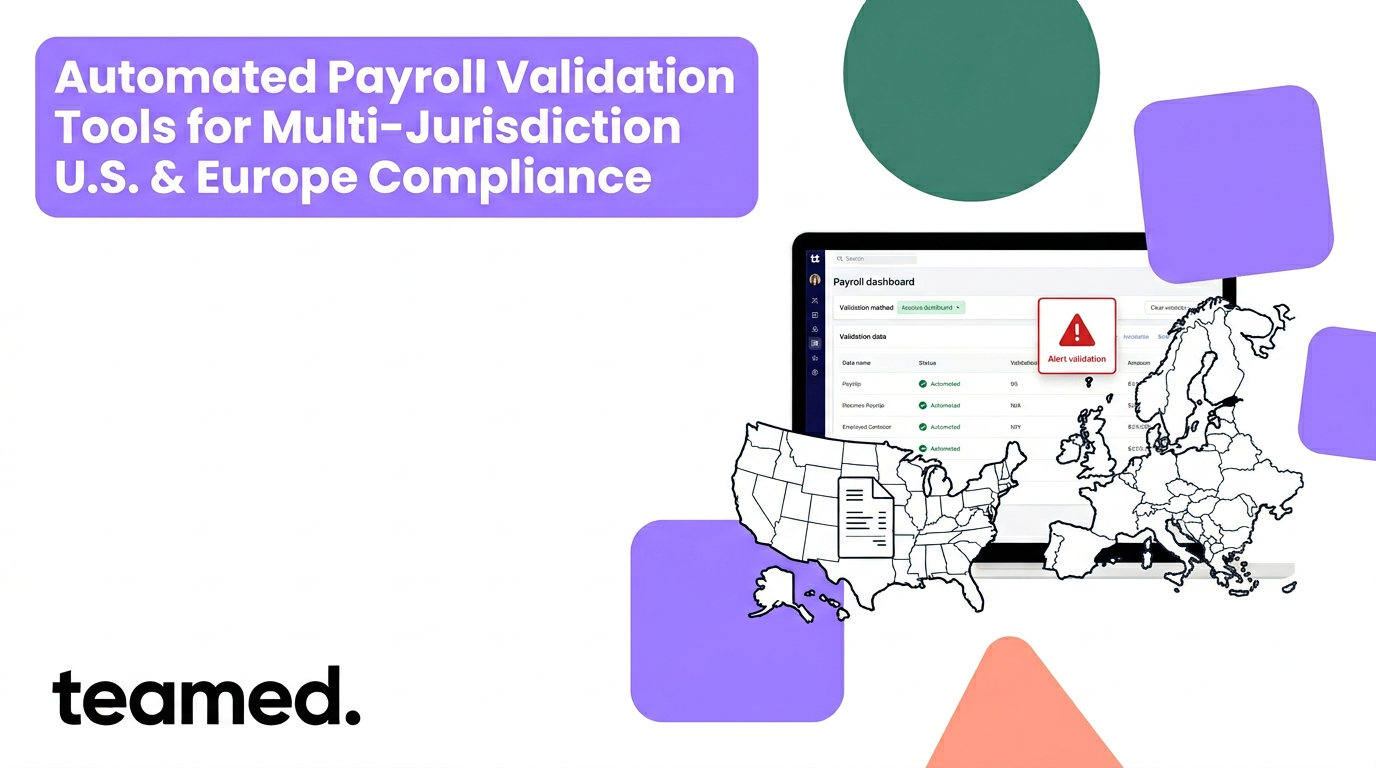
Running payroll across Texas, California, Germany, and France in the same pay cycle sounds straightforward until you realise each jurisdiction has its own tax tables, social contribution ceilings, overtime rules, and reporting formats. One misconfigured validation rule, and you're facing IRS penalties of up to 15% in one inbox and GDPR fines in another.
Most payroll tools validate within a single jurisdiction. Cross-border validation requires a fundamentally different architecture, one that reconciles U.S. federal rules plus up to 50 state-level tax regimes alongside 27 separate EU member-state social insurance systems. HR operations compliance becomes exponentially more complex when juggling these varying regulatory frameworks. The question isn't whether you need automated payroll data validation tools for multi-jurisdiction compliance. It's how you configure them to catch errors before funds leave your account.
This guide breaks down what real-time validation actually means across U.S. and European jurisdictions, compares the leading tools by coverage depth and implementation requirements, and gives you a decision framework you can act on immediately.
Automated payroll data validation tools monitor payroll inputs against current regulatory rules in real time, flagging discrepancies before a payroll run is finalised. The U.S. requires federal plus state-level rule handling across up to 50 jurisdictions, while EU payroll validation operates country-by-country with separate social insurance, tax withholding, and reporting formats for each of the 27 member states. Real-time validation catches errors before payroll lock, whereas batch validation typically identifies errors only during or after the payroll run. GDPR Article 22 restricts solely automated decision-making that produces significant effects on individuals, meaning EU payroll teams should ensure automated pay adjustments include human review. The EU Working Time Directive sets a 48-hour average weekly working time limit, creating validation requirements that differ from U.S. FLSA overtime checks. Teamed operates EOR services in 187+ countries and supports entity formation in 100+ countries, enabling companies to move from EOR to owned entities without changing provider.
Real-time payroll validation evaluates changes when they occur and prevents errors before payroll lock. This differs fundamentally from batch validation, which typically identifies errors only during or after the payroll run, when correction becomes expensive and time-consuming.
For organisations operating across U.S. states and European member states simultaneously, validation tools must handle five core layers. First, tax rule engine accuracy: does the tool update federal, state, and EU member-state tax tables automatically? Second, pre-payment audit triggers: are discrepancies flagged before funds are disbursed, not after? Third, data residency compliance: does the tool handle GDPR Article 88 requirements for EU employee data separately from U.S. data? Fourth, threshold monitoring: does it track FICA caps like the $184,500 wage base, overtime thresholds under FLSA versus EU Working Time Directive, and social contribution ceilings per jurisdiction? Fifth, integration depth: can it pull live data from HRIS, time-tracking, and ERP systems to validate inputs upstream?
The distinction between validation and compliance reporting matters here. Validation checks inputs against regulatory rules before payment. Compliance reporting generates documentation after calculations for regulatory submission. The best tools do both, but they're architecturally distinct functions. Buying a compliance reporting tool and expecting real-time validation is a common and costly mistake.
U.S. payroll validation must account for federal rules including FICA, FUTA, and federal income tax withholding, plus up to 50 state-level tax regimes with varying rates, thresholds, and filing requirements. California alone requires meal and rest break compliance, final pay on termination day with a $70,304 exempt threshold, and extensive leave entitlements. New York adds its own complexity layer, reflecting the broader multi-state payroll compliance challenges organisations face.
EU payroll validation operates at the member-state level. Each country has its own social insurance contribution rates, income tax withholding systems, and payroll reporting formats. France requires DSN submissions. Germany relies on ELStAM for income tax attributes. The UK uses RTI. There is no single EU-wide payroll standard, which means a tool must maintain and update 27-plus country rule sets independently.
Income tax withholding in the U.S. involves federal plus state rules, while EU countries use country-level PAYE equivalents like Lohnsteuer in Germany. Social contributions in the U.S. follow FICA with employer and employee splits and an annual cap, whereas EU countries have country-specific rates with no single ceiling. Overtime rules under FLSA require 1.5x pay after 40 hours per week, while the EU Working Time Directive sets a 48-hour weekly maximum with opt-out rules varying by country.
Data handling creates another divergence. The U.S. has no federal equivalent to GDPR. EU employers need documented lawful basis and clear employee privacy notices for payroll processing, and validation tooling must support data minimisation and access controls because payroll data includes sensitive financial and employment information.
Implementation follows a six-step process that most organisations underestimate. The first step connects data sources by integrating HRIS for employee records and job codes, time-tracking for hours and PTO, and ERP or GL systems for cost centre allocations via API or native connector.
The second step configures jurisdiction rulesets by mapping each employee record to a primary tax jurisdiction and setting up secondary jurisdiction rules for remote or cross-border workers. This is where most implementations fail. Tools are activated but jurisdiction rulesets are left at default, which means U.S.-only or EU-only validation logic runs globally.
The third step sets validation thresholds by defining tolerance rules. Flag any gross pay variance greater than 2% from prior period. Alert on FICA overage. Trigger review if overtime hours exceed jurisdiction threshold.
The fourth step defines alert routing by assigning discrepancy alerts to the right owner. Payroll ops handles calculation errors. HR handles classification issues. Finance handles GL mismatches.
The fifth step runs pre-payment audit by executing the validation sweep 24 to 48 hours before payroll lock, reviewing flagged items, and documenting resolution for audit trail.
The sixth step performs post-run reconciliation by comparing validated inputs to actual disbursements and logging any manual overrides for compliance reporting.
A phased rollout works best. Start with highest-headcount jurisdictions, validate logic, then expand. Teamed's analysis of mid-market companies operating in 5 to 15 countries shows that sequential implementation reduces configuration errors by allowing teams to absorb complexity before adding new jurisdictions.
The tool landscape divides into three tiers based on jurisdiction depth and implementation requirements. Understanding where each tool fits helps you match capabilities to your specific headcount distribution.
Workday offers strong coverage across all 50 U.S. states plus federal rules and robust multi-country EU coverage. Configurable audit rules provide flexibility, and enterprise-grade GDPR compliance handles data residency requirements. Native integration plus a broad ecosystem supports complex organisations. The trade-off is significant configuration time and IT involvement. Validation logic is powerful but not plug-and-play.
Dayforce from Ceridian provides strong U.S. coverage with growing EU presence. Real-time dashboards surface anomalies, and the platform handles compliance requirements well. Strong HRIS integration makes it suitable for mid-market to enterprise organisations. Like Workday, it requires dedicated payroll ops teams and existing HCM infrastructure.
Rippling excels on U.S. validation depth across all 50 states plus federal rules. EU member-state coverage is improving but not yet at parity with U.S. capabilities. Pre-payroll run alerts catch issues before lock, and data residency is configurable though partial. Native deep HRIS integration makes it attractive for U.S.-primary organisations with some EU presence. The important caveat: confirm EU coverage matches your specific member states before committing.
Neeyamo offers U.S. plus global coverage with strong EU multi-country support. Audit triggers provide validation capabilities, and GDPR compliance is built in. The middleware-dependent architecture means integration complexity is higher than native platforms. This suits multinational enterprises willing to invest in integration work.
Playroll provides U.S. coverage via EOR and EU multi-country support. Compliance alerts handle validation within EOR-managed employees. GDPR-aligned data handling and API-based integration suit EOR-heavy or contractor-heavy organisations. The limitation: validation is scoped to EOR-managed employees, not in-house payroll runs.
Payzaar offers U.S. and EU coverage with alerts on anomalies. GDPR-aligned processing and integration-dependent architecture serve SMB to mid-market organisations. Like Playroll, it's optimised for specific use cases rather than comprehensive in-house payroll validation.
Headcount distribution matters most. If 80% of employees are U.S.-based with 20% in three or four EU countries, a U.S.-primary tool with EU add-ons may suffice. If the split is even, you need parity coverage.
The in-house versus EOR model question shapes your options. EOR-focused tools like Playroll handle validation within their managed payroll. In-house teams need a tool that validates their own data pipeline. Teamed's work with over 1,000 companies on global employment strategy shows that mid-market organisations often start with EOR and graduate to owned entities as headcount grows. A provider supporting both models through a single relationship avoids re-platforming costs.
Integration with existing HRIS determines validation quality. A validation tool is only as good as the data it receives. Map your current HRIS and ERP stack before evaluating tools.
Audit trail requirements differ by jurisdiction. EU works councils and U.S. DOL audits have different documentation expectations. Confirm the tool generates jurisdiction-appropriate audit logs.
Update cadence for tax tables is a critical question most buyers forget to ask. Specifically: how quickly are regulatory changes reflected in validation rules after a new state minimum wage or EU country social rate change? No currently cited tool publishes tax table update SLAs, which is a gap compliance teams should address directly with vendors.
Most tools validate within a jurisdiction but don't flag cross-jurisdiction classification errors. Consider an employee classified as U.S.-based but working remotely in Germany for 90-plus days. This triggers permanent establishment risk that single-jurisdiction validation misses entirely.
Real-time alerts are often UI-only. They surface in a dashboard but don't integrate into payroll approval workflows, meaning errors are seen but not actioned before the run. Dashboard-only alerts differ fundamentally from workflow-routed alerts because dashboard alerts can be observed without action, while workflow-routed alerts create an auditable assignment, resolution record, and approval decision before funds are disbursed.
GDPR compliance in most tools means data residency, ensuring EU data stays on EU servers. But it doesn't extend to validation logic transparency. Employees have a right to understand automated decisions affecting pay under GDPR Article 22. EU payroll teams should ensure any automated pay adjustments or deductions include human review and employee-facing transparency where required.
None of the currently cited tools publish their tax table update SLAs. This is a critical gap for compliance teams who need to know how quickly a new state law is reflected in validation rules. Ask vendors specifically: what is your SLA for regulatory updates, and can you provide change logs?
Before signing, ask five questions that separate capable vendors from feature-list marketing. First: how quickly are tax table changes reflected after a regulatory update, and what is your SLA? Second: does your validation logic cover all 50 U.S. states and which EU member states specifically? Third: how does your tool handle employees who work across multiple jurisdictions in a single pay period? Fourth: does your alert system integrate into our payroll approval workflow, or is it dashboard-only? Fifth: what audit log format do you generate for U.S. DOL and EU works council requests?
The answers reveal whether the vendor has built for multi-jurisdiction complexity or simply bolted on country coverage to a single-jurisdiction architecture.
Enterprise platforms like Workday and Dayforce can be configured to validate against both FLSA overtime rules requiring 1.5x pay after 40 hours per week and EU Working Time Directive limits setting a 48-hour weekly maximum with country-specific opt-out rules. However, this requires explicit configuration. The tool must be told which ruleset applies to which employee population. Out-of-the-box defaults typically apply a single standard.
This configuration requirement catches many organisations. They activate the tool, assume global coverage, and discover months later that EU employees were validated against U.S. rules or vice versa.
GDPR Article 88 permits processing of employee data for payroll purposes but requires a lawful basis, data minimisation, and transparency. Article 22 restricts solely automated decisions that significantly affect employees, meaning automated pay corrections or deductions may require human review and employee notification.
Validation tools must route EU employee data through GDPR-compliant infrastructure with EU data residency and maintain processing records under Article 30. UK GDPR and EU GDPR treat payroll data as personal data, and employers must maintain records of processing activities for payroll-related processing when the organisation meets ROPA requirements.
The practical implication: your validation tool needs separate data handling for EU employees, not just a toggle that says "GDPR compliant."
Tool selection matters less than implementation configuration. The most common failure mode is activating a tool with default single-jurisdiction validation logic and assuming it covers all geographies. Start by mapping your current footprint, identifying which countries are at or approaching headcount thresholds, and running economic analysis on EOR versus entity costs.
For U.S.-primary organisations with EU expansion, Rippling offers the strongest U.S. validation depth. Confirm EU coverage matches your specific member states before committing. For enterprise organisations with complex multi-jurisdiction payroll, Workday or Dayforce provide the highest configuration ceiling and deepest jurisdiction libraries, though they require dedicated implementation resources. For EOR or contractor-heavy global teams, Playroll or Neeyamo are purpose-built for managed payroll across borders but aren't the right fit for in-house payroll validation.
If you're managing global employment across multiple platforms and want a single advisory relationship that covers contractors, EOR, and entities, talk to an expert at Teamed about consolidating fragmented operations into a unified approach that grows with your organisation.
A single payroll compliance incident can create multi-track exposure because the same underpayment can be prosecuted both administratively and civilly. Tax authority penalties, labour inspectorate sanctions, and employee claims can stack on top of each mistake. For mid-market companies operating across multiple countries, the financial exposure from payroll compliance failures in 2026 ranges from a few hundred pounds per form to six-figure liabilities per worker.
The top payroll compliance issues in 2026 include worker misclassification, late payroll tax deposits, overtime miscalculation, I-9 and E-Verify violations, incorrect W-2 and 1099 filing, state pay transparency non-compliance, failure to pay final wages on time, ACA reporting errors, garnishment processing mistakes, and record-keeping failures. Each carries IRS, DOL, DHS, or state-level penalties ranging from £60 to over £10,000 per violation depending on severity and willfulness.
Most payroll compliance content lists generic errors without attaching real penalty figures or ranking issues by financial severity. This piece leads with cost consequences first, compliance guidance second. You'll see exactly what each violation costs, which regulatory body enforces it, and who faces the highest risk in 2026.
Misclassify a worker as a contractor? In the US, you're looking at $1,000 to over $10,000 per worker in penalties, plus all the back taxes you should have paid, plus the employee's share of FICA taxes that's now on you.
Miss an IRS payroll tax deposit by a few days? That's 2% penalty. Miss it by a week? 5%. Ignore the IRS notice? 15%. And here's where it gets personal: the Trust Fund Recovery Penalty can make you personally liable for 100% of the unpaid trust fund taxes.
Get overtime wrong under US law and you pay twice: once for the wages you owe, and again in liquidated damages. Do it deliberately? That's up to $10,000 per violation and potentially criminal charges.
In the US, mess up an I-9 form and it's $272 to $2,701 per form in 2026. Knowingly hire someone not authorised to work? That jumps to $676 to $27,018 per worker.
File W-2s or 1099s late in the US? It's $60 per form if you fix it within 30 days, climbing to $630 if you're really late. Ignore it completely? There's no cap on those penalties.
Post a job without salary ranges in the wrong US state? California might fine you $100 to $10,000 per posting. Colorado starts at $500 and has already issued $841,500 in citation fines since January 2021. New York can go up to $250,000 for repeat violations. Each state has its own rules and its own enforcement appetite.
A payroll compliance issue is a specific breach of payroll-related law or regulation that can trigger fines, interest, back-pay orders, and litigation exposure. These breaches fall into three distinct categories that most competitors conflate, creating confusion about which agency enforces what.
Payroll tax compliance falls under IRS jurisdiction and covers withholding, depositing, and reporting federal income taxes, Social Security, and Medicare taxes. Wage-and-hour compliance falls under DOL and FLSA enforcement, covering minimum wage, overtime, and proper pay calculations. Employment eligibility compliance falls under DHS and DOJ, covering I-9 verification and E-Verify requirements.
The 2026 regulatory environment brings updates across all three categories. The DOL's 2024 independent contractor rule is now in full enforcement, IRS e-filing thresholds have dropped to 10 forms, and state-level pay transparency laws continue expanding. Understanding which agency enforces each violation determines your remediation path and penalty exposure.
Worker misclassification carries the highest combined penalty exposure of any payroll compliance issue. When a business incorrectly labels an employee as an independent contractor, it avoids payroll tax obligations, benefits, and labour law protections. The financial consequences compound across multiple enforcement mechanisms.
The penalty structure includes back taxes for all unpaid employment taxes, plus 100% of the employee's share of FICA taxes that the employer must now pay. Civil penalties range from £1,000 to over £10,000 per misclassified worker. Willful misclassification can trigger criminal charges. A single audit covering multiple misclassified workers can result in six-figure or seven-figure liability, with Colorado ordering one construction company to pay $1 million in fines for worker misclassification in 2024.
The DOL's 2024 final rule on the "economic reality test" is now in its full enforcement cycle, with audits expected to increase throughout 2025 and 2026. This test examines whether workers are economically dependent on the company or genuinely in business for themselves.
Gig-economy businesses, professional services firms, and construction companies face the highest misclassification risk. The most common trigger is using contractors for core business functions or setting their work schedules, both indicators that the worker should be classified as an employee.
Payroll tax deposit failures occur when employers miss IRS deadlines for remitting withheld income taxes, Social Security, and Medicare taxes. The penalty structure escalates based on how late the deposit arrives.
Deposits 1-5 days late incur a 2% penalty on the unpaid amount. At 6-15 days late, the penalty increases to 5%. Beyond 16 days late, the penalty jumps to 10%. If the deposit remains unpaid within 10 days of receiving an IRS notice, the penalty reaches 15% of the unpaid amount.
The Trust Fund Recovery Penalty creates personal liability for business owners, officers, or payroll managers who are responsible for collecting and remitting these taxes. The IRS can pursue individuals for 100% of the unpaid trust fund taxes, meaning the penalty follows the person rather than just the business.
The IRS EFTPS enforcement automation has increased, creating system migration risks for businesses changing payroll providers. Small businesses with manual payroll processes and companies with cash flow volatility face the highest exposure. The most common trigger is miscounting the deposit schedule based on the lookback period, confusing monthly and semi-weekly deposit requirements.
Overtime violations occur when employers fail to pay non-exempt employees 1.5 times their regular rate for hours worked over 40 in a workweek, or when they miscalculate the "regular rate" base used for overtime calculations.
The penalty structure includes back wages owed plus an equal amount in liquidated damages, effectively doubling the employer's liability. Willful violations can reach £10,000 per violation with potential criminal charges. The DOL actively pursues collective actions that aggregate violations across multiple employees.
The current status of the DOL overtime salary threshold remains in flux following 2024 rule litigation. Employers should verify the current exemption threshold before classifying any worker as exempt from overtime requirements. The threshold determines which salaried workers qualify for overtime pay.
Retail, hospitality, healthcare, and any employer with salaried workers near the exemption threshold face elevated risk. The most common trigger is excluding bonuses, commissions, or shift differentials from the regular rate calculation. These payments must be included when calculating the overtime rate, and failure to do so creates systematic underpayment.
I-9 violations occur when employers fail to properly complete, retain, or reverify Employment Eligibility Verification forms for all U.S. employees. The penalty ranges have been adjusted for inflation in 2026.
Paperwork violations, including incomplete Section 2 or missing reverification for temporary work authorisation, carry penalties of £272 to £2,701 per form. Knowingly hiring unauthorised workers triggers penalties of £676 to £27,018 per worker, depending on the employer's violation history.
ICE audit activity has increased, and remote hire I-9 verification rules have been codified following the expiration of COVID-era flexibilities. Employers must now comply with authorised representative rules when verifying documents for remote workers.
High-volume hiring businesses and companies with remote onboarding workflows face the highest exposure. The most common triggers are incomplete Section 2 documentation and missing reverification when a worker's temporary work authorisation expires. These errors often accumulate unnoticed until an audit reveals systematic non-compliance.
Filing errors on W-2 and 1099 forms trigger penalties that escalate based on how quickly the employer corrects them. The IRS e-filing threshold dropped to 10 forms in 2024, meaning businesses still mailing paper forms for 10 or more recipients are now non-compliant.
Forms filed late but within 30 days of the deadline incur penalties of £60 to £310 per form. Forms not filed at all carry penalties of £630 per form. Intentional disregard of filing requirements removes the cap entirely, with penalties of £630 or more per form.
Businesses with large contractor networks or those that recently crossed the e-file threshold face the highest risk. The most common triggers are incorrect TINs, mismatched names, or failure to issue 1099-NEC forms to contractors paid £600 or more during the tax year.
Several regulatory changes affect payroll compliance in 2026. State pay transparency laws continue expanding, with Illinois, Minnesota, and other states activating new requirements. Multi-state employers posting jobs nationally face compounding exposure when using a single job posting template that omits salary ranges for states requiring them.
Pay transparency violations range from £500 to over £10,000 per job posting depending on the state. California, Colorado, New York, Washington, and Illinois each enforce different penalty structures and disclosure requirements. Remote-first companies posting jobs nationally must now include salary ranges for any state where a candidate could work.
The DOL's 2024 independent contractor rule remains in full enforcement, with the economic reality test examining factors like opportunity for profit or loss, investment in equipment, permanence of the relationship, and degree of control. Employers who relied on older classification frameworks should review their contractor relationships.
IRS enforcement of the 10-form e-filing threshold means any business issuing 10 or more W-2s or 1099s must file electronically. ACA enforcement letters continue increasing, with employers who ignored prior cycles now facing collections activity.
DOL audits are most commonly triggered by employee complaints filed directly with the agency. Workers who believe they've been underpaid, denied overtime, or misclassified can file complaints that initiate investigations. In fiscal year 2025, the DOL's Wage and Hour Division recovered more than $259 million in back wages for nearly 177,000 workers nationwide.
Industry-wide enforcement initiatives also drive audit activity. The DOL frequently targets hospitality, agriculture, and healthcare sectors for systematic reviews. Patterns identified through FLSA lawsuit filings can flag employers for investigation even without direct complaints.
Businesses with high contractor ratios or recent layoffs face elevated audit risk. The combination of workforce restructuring and contractor usage signals potential misclassification issues that attract DOL attention.
Teamed's analysis of mid-market companies operating across multiple countries shows that payroll compliance workload is frequently underestimated because each additional country adds at least one new tax authority, one social security regime, and one employment-law framework. Each can levy separate penalties for the same payroll event, creating stacked liability that compounds across jurisdictions.
Federal law requires payroll records to be retained for at least 3 years under FLSA and 4 years under IRS rules. However, many states require longer retention periods that exceed federal minimums.
New York requires 6 years of payroll record retention. California requires 3 years for wage statements specifically. Employers who switch payroll providers must ensure historical records are migrated rather than deleted.
The penalty range for record-keeping failures runs from £1,000 to over £10,000 per violation. In litigation, missing records create a presumption in the employee's favour, effectively creating unlimited exposure when employers cannot document their compliance.
Businesses that switched payroll providers and did not migrate historical records face the highest risk. The most common trigger is purging records based on federal minimums without checking state-specific retention schedules.
A simple risk triage framework helps prioritise compliance remediation. Plot each issue on two axes: likelihood of audit and financial severity of penalty.
Issues in the high-likelihood and high-severity quadrant demand immediate attention. Worker misclassification, payroll tax deposits, and overtime calculations fall here. These issues attract regulatory attention and carry the largest financial exposure.
Issues with high severity but lower audit likelihood, such as I-9 violations and ACA reporting errors, warrant systematic review. Build compliance checks into your processes even if enforcement seems less imminent.
Payslip formatting errors won't sink you, but fix them anyway. Just don't let them steal time from the big-ticket risks.
Teamed's work with mid-market companies across 70+ countries shows that cross-border payroll errors often create second-order costs in FX and cash-flow timing. Corrections processed as off-cycle payments attract additional banking fees and reconciliation time, compounding the direct penalty exposure.
What is the penalty for misclassifying an employee as an independent contractor?
Penalties include back payroll taxes, 100% of the employee's share of FICA taxes that the employer must now pay, civil penalties of £1,000 to over £10,000 per worker, and potential criminal charges for willful misclassification. State penalties apply separately and can exceed federal penalties in some jurisdictions.
What are the new payroll compliance rules for 2026?
Key 2026 updates include expanded state pay transparency laws with Illinois and Minnesota activating new requirements, continued DOL enforcement of the 2024 independent contractor rule, IRS enforcement of the 10-form e-filing threshold for W-2s and 1099s, and increased ICE I-9 audit activity. Employers should also monitor the DOL overtime salary threshold status following ongoing litigation.
How long do employers need to keep payroll records?
Federal law requires payroll records for at least 3 years under FLSA and 4 years under IRS rules. Many states require longer retention, with New York requiring 6 years. Employers who switch payroll providers should ensure historical records are migrated rather than deleted.
What triggers a DOL wage-and-hour audit?
DOL audits are most commonly triggered by employee complaints, industry-wide enforcement initiatives targeting hospitality, agriculture, and healthcare, and patterns identified through FLSA lawsuit filings. Businesses with high contractor ratios or recent layoffs face elevated audit risk.
Payroll compliance in 2026 is a multi-agency, multi-jurisdiction risk that extends beyond IRS concerns alone. The average penalty exposure across these ten issues can easily exceed £50,000 to £100,000 for a mid-market employer facing a single audit. When operations span multiple countries, each jurisdiction adds its own enforcement mechanisms and penalty structures.
For companies managing international teams, the compliance burden multiplies with each new market. UK HMRC late-payment penalties for PAYE start at 1% of amounts late and can rise to 4% for repeated lateness. EU jurisdictions assess statutory social contributions on defined bases that vary by country. A single payroll configuration error can create retroactive liabilities including arrears, surcharges, and interest across multiple authorities.
The right structure for where you are matters as much as the compliance processes you implement. If you're managing payroll compliance across multiple countries and want to understand how your current structure affects your risk exposure, talk to an expert at Teamed. We help mid-market companies navigate the intersection of employment model decisions and compliance requirements, from first hire to your own presence in-country.
You're sitting on two offers, or maybe your employer just floated the idea of converting you to 1099. Before you say yes to what looks like more money, let me show you the actual math. Not the generic pros and cons, but what this decision means for your bank account.
For most workers in 2025, W2 employment delivers higher total compensation once benefits are factored in. A 1099 contract can yield better take-home pay only when the rate premium exceeds 30-40% above an equivalent W2 salary, covering self-employment taxes and benefits replacement costs. The self-employment tax rate in 2025 is 15.3% on net earnings up to $176,100, compared to the 7.65% FICA share a W2 employee pays.
This guide covers the tax mechanics most articles bury, the benefits replacement math no one shows you, and worked dollar scenarios at three income levels. You'll walk away with a concrete decision framework, not a vague "it depends."
A W2 employee pays 7.65% employee-side FICA (6.2% Social Security plus 1.45% Medicare), while the employer separately pays an additional 7.65% on the same wage base.
A 1099 contractor pays the full 15.3% self-employment tax on net earnings up to $176,100, then 2.9% Medicare tax on earnings above that threshold.
Quarterly estimated tax payments for 1099 workers are due April 15, June 15, September 15, and January 15 for the prior year's fourth quarter.
The QBI deduction (Section 199A) allows eligible self-employed workers to deduct up to 20% of qualified business income, partially offsetting the higher tax burden.
A common break-even heuristic is that a 1099 contract must pay roughly 30-40% more than a comparable W2 salary to replace benefits and offset the additional payroll-tax burden.
Average employer 401(k) match is 4.4% of salary according to Vanguard data, representing $3,520 annually on an $80,000 salary.
A W2 employee is a US payroll classification in which the employer withholds federal and state income tax and the employee share of FICA, and the worker is typically eligible for employer-sponsored benefits and statutory protections such as unemployment insurance and workers' compensation.
A 1099 independent contractor is a US tax classification in which the worker is paid gross with no withholding and is responsible for self-employment tax, income tax payments (often via quarterly estimates), and sourcing and paying for their own benefits and insurance.
The IRS uses a three-factor test to determine proper classification: behavioural control (who directs how work is done), financial control (who controls business aspects like expenses and profit opportunity), and type of relationship (permanence, benefits, written contracts). Worker misclassification is a compliance breach that can trigger back taxes, penalties, and employment-law claims for both parties.
Here's what matters for your decision: the classification determines who pays what. A W2 employee has taxes withheld automatically and receives benefits eligibility. A 1099 contractor receives gross pay and handles everything themselves. The difference can exceed $15,000 per year at an $80,000 income level before you even consider benefits.
Here's the tax hit that catches people off guard every time.
As a W2 employee, your employer splits FICA with you. You pay 7.65% (6.2% Social Security plus 1.45% Medicare), and your employer pays another 7.65% on your behalf. Federal and state income taxes are withheld automatically from each paycheck. You never have to think about quarterly payments or underpayment penalties.
As a 1099 contractor, you pay the full 15.3% self-employment tax because you're effectively both employer and employee. On $80,000 of net self-employment income, that's $12,240 in self-employment tax alone, compared to $6,120 for a W2 employee at the same gross. You must also make quarterly estimated tax payments to the IRS or face underpayment penalties.
The one 1099 tax advantage worth understanding is the Qualified Business Income (QBI) deduction under Section 199A. Eligible self-employed workers can deduct up to 20% of qualified business income from their taxable income. On $80,000 of net self-employment income, that's potentially $16,000 off your taxable income, reducing your federal tax bill by roughly $3,500-4,000 depending on your bracket.
You can also deduct half of your self-employment tax (about $6,120 on $80,000), plus legitimate business expenses like home office costs, equipment, health insurance premiums, and professional development. These deductions reduce your taxable income, but they don't eliminate the fundamental FICA gap.
Here's the hard truth: earn $80,000 as a 1099 contractor and you'll pay about $6,120 more in payroll taxes than a W2 employee making the same. That's before any deductions help soften the blow.
Taxes are just the start. The real shock comes when you price out health insurance, retirement matching, and paid time off.
Health insurance is the largest single cost gap. A W2 employer typically covers 84% of single and 75% of family health insurance premiums. The ACA marketplace equivalent for a single adult in 2025 runs $400-700 per month depending on state and age, creating an annual cost gap of $4,800-8,400 that comes straight out of your 1099 earnings.
Retirement contributions represent another significant gap. The average employer 401(k) match is 4.4% of salary according to Vanguard data. On an $80,000 salary, that's $3,520 per year in free money you'd forfeit as a 1099 contractor. You can use a SEP-IRA or Solo 401(k) as a contractor, but you fund it entirely yourself.
Paid time off is the invisible salary component most people forget to calculate. The average US worker receives 15 days PTO plus 10 federal holidays, totalling 25 paid non-working days. On an $80,000 salary, that's approximately $7,692 in paid time when you're not working. As a 1099 contractor, you don't get paid when you don't work.
Other W2 benefits with real dollar values include dental and vision coverage ($600-1,200 per year employer contribution), life insurance, disability insurance, and FSA/HSA employer contributions. These components contribute to total employer costs per employee that often exceed base salary by 25-60%. Add these together and the total benefits gap typically ranges from $16,000-26,000 annually, with benefits representing about 29.7% of total compensation for private-industry workers.
So when you compare offers, think of that W2 salary as worth $16,000-26,000 more than the number on paper. Your 1099 rate needs to cover that gap.
Let me show you exactly how this plays out at three different income levels.
The assumptions: same gross compensation, single filer, no state income tax (to isolate federal and self-employment tax differences), standard deduction, no dependents. Your numbers will vary, but the relative gaps hold.
At $50,000 Gross:
A W2 employee takes home approximately $39,200 after federal income tax and FICA. Add the benefits value of roughly $18,000, and total compensation reaches about $57,200 in effective value.
A 1099 contractor takes home approximately $36,800 after self-employment tax and federal income tax (accounting for the SE deduction and QBI). To match the W2 total compensation of $57,200, the 1099 contract would need to pay roughly $68,000 gross, a 36% premium.
At $80,000 Gross:
A W2 employee takes home approximately $60,800. With benefits valued at roughly $20,000, total compensation reaches about $80,800 in effective value.
A 1099 contractor takes home approximately $57,400 after all deductions. To match the W2 total compensation, the 1099 contract would need to pay roughly $105,000-108,000 gross, a 30-35% premium.
At $120,000 Gross:
A W2 employee takes home approximately $86,400. With benefits valued at roughly $22,000, total compensation reaches about $108,400 in effective value.
A 1099 contractor takes home approximately $84,200 after deductions including QBI. To match the W2 total compensation, the 1099 contract would need to pay roughly $150,000-155,000 gross, a 25-30% premium.
See the pattern? At $80,000 W2, you need a 1099 rate around $105,000-108,000 to break even. That's your 30-35% premium right there.
I've watched people jump at 1099 offers and regret it six months later. Here's when it actually makes sense.
1099 wins when you have a spouse with employer-sponsored health insurance. 53% of gig workers have employer-provided health insurance from another job or a spouse's job. This eliminates the largest single benefits gap and shifts the break-even point significantly lower. If your spouse's plan covers you at minimal cost, the 1099 math improves dramatically.
1099 wins when you have high, consistent deductible business expenses. Home office, equipment, travel, professional development, and software costs reduce your taxable income. If your legitimate business expenses run $15,000-20,000 annually, the effective tax burden drops.
1099 wins for short-term, high-premium engagements. Consulting projects, specialized technical work, and interim roles often command 50-100% premiums that easily clear the break-even threshold. Understanding contractor conversion requirements helps when these arrangements evolve into longer-term relationships.
W2 wins when the rate premium is under 25%. The math simply doesn't work at lower premiums once you account for taxes and benefits.
W2 wins when you need employer-sponsored health insurance. ACA marketplace costs are real and substantial, especially for workers over 40 or those with families.
W2 wins when you value unemployment insurance eligibility. In most states, 1099 contractors are ineligible for state unemployment insurance. If income stability matters, this protection has real value.
W2 wins when you're earlier in your career and value employer 401(k) match compounding. Twenty years of 4.4% employer matches, compounded, represents hundreds of thousands of dollars in retirement wealth.
W2 wins when you prefer tax simplicity. Quarterly estimated payments, self-employment tax calculations, and business expense tracking require discipline. If cash management is a challenge, W2 withholding removes the risk.
Yes, in most cases. A 1099 worker pays the full 15.3% self-employment tax (both the employee and employer share of FICA), compared to 7.65% for a W2 employee. The employer's 7.65% contribution for W2 workers is invisible to most employees but represents real compensation.
The QBI deduction and the ability to deduct half of self-employment tax partially offset this difference, but they don't eliminate it. A 1099 worker at $80,000 gross still pays roughly $3,000-4,000 more in total federal taxes than a W2 worker at the same gross after all deductions.
As a rule of thumb, a 1099 contract rate should be 30-40% higher than an equivalent W2 salary to achieve comparable take-home pay after accounting for self-employment taxes and benefits replacement costs.
This percentage varies based on your specific situation. If you have access to health insurance through a spouse, the premium drops to 20-25%. If you have minimal deductible business expenses and must purchase full marketplace coverage, the premium might need to reach 40-50%.
In most states, no. Independent contractors are not eligible for state unemployment insurance. Some states expanded eligibility temporarily during COVID-19 through programs like Pandemic Unemployment Assistance, but standard rules have largely reverted.
This matters more than most people realize. If your 1099 contract ends unexpectedly, you have no safety net beyond your own savings. W2 employees in most states can claim unemployment benefits while searching for new work.
Legitimate business expenses that can reduce your taxable income include home office costs (calculated using the simplified method at $5 per square foot up to 300 square feet, or actual expenses), equipment and technology, professional development and training, business travel, health insurance premiums (deductible from income tax, not self-employment tax), and half of your self-employment tax.
The key word is "legitimate." These must be ordinary and necessary expenses for your business. Aggressive deductions invite IRS scrutiny.
Neither 1099 nor W2 is automatically better. What matters is your specific numbers: the rate difference, your benefits situation, and your financial stability.
The 1.3x-1.4x rule provides a practical starting point. If the 1099 rate doesn't clear that threshold above the W2 equivalent, the W2 offer almost certainly delivers better total compensation. If it does clear the threshold, run the full calculation including your specific benefits situation, state taxes, and expected business expenses.
For workers evaluating international opportunities or companies managing global teams across multiple employment models, the complexity multiplies. Different countries have entirely different frameworks for contractor versus employee classification, with varying tax implications and compliance requirements. Teamed's analysis of global employment patterns shows that the 1099 versus W2 framework is uniquely American, and workers considering international roles need country-specific guidance.
Run your own numbers with a take-home pay calculator before making any decision. The difference between getting this right and getting it wrong can exceed $15,000 annually. That's too much money to leave on the table because you didn't do the math.
If you're weighing employment options across different countries or need help structuring international teams, our specialists can walk you through the specific rules and costs for each market.
On 6th April 2026, HMRC gained the power to pursue agencies and end clients for unpaid PAYE and National Insurance Contributions when umbrella companies fail to remit statutory deductions. Joint and several liability for umbrella company arrangements is now law, and the enforcement direction published on 17th April 2026 makes clear that HMRC intends to collect aggressively from parties with deeper pockets.
This isn't a theoretical risk. If an umbrella company in your contractor supply chain defaults on £400,000 in PAYE and NIC, HMRC can now pursue your agency, your end client, or both for the full amount. Your contractual indemnities with the umbrella won't stop HMRC knocking on your door. They only determine who you can sue afterwards.
The change didn't attract the attention of the Employment Rights Act, but the exposure is real and immediate, with HMRC expecting to protect £2.8 billion from umbrella non-compliance through these new enforcement powers. If you're using umbrella arrangements anywhere in your contractor supply chain, your liability position changed the moment the Finance Bill 2025/26 provisions came into force.
Joint and several liability for unpaid PAYE and NICs on UK umbrella arrangements took effect on 6th April 2026, creating immediate supply-chain exposure for agencies and end clients. HMRC can assess underpaid PAYE for up to 4 years in standard cases, extending to 6 years where HMRC alleges carelessness, and up to 20 years where deliberate behaviour is alleged. End clients can face tax exposure even without a direct contract with the umbrella company, because supply-chain liability attaches through agency-mediated payment structures. Contractual indemnities do not prevent HMRC collection under joint and several liability because HMRC's statutory recovery powers operate independently of commercial risk allocation. The enforcement direction published on 17th April 2026 signals HMRC's intention to pursue early enforcement action to establish precedent.
Joint and several liability for umbrella companies is a UK tax enforcement mechanism that allows HMRC to recover unpaid PAYE and employee/employer National Insurance Contributions from any party in a contractor labour supply chain. Under these rules, HMRC doesn't need to exhaust recovery options against the defaulting umbrella before pursuing agencies or end clients.
The statutory change sits within the Finance Bill 2025/26 and closes a gap HMRC has been targeting since the 2020 Off-Payroll Working reforms. Previously, when an umbrella company failed to remit PAYE and NIC, HMRC's primary recourse was against the umbrella itself. If that company was insolvent or had disappeared, the tax revenue was often unrecoverable.
Now, HMRC can pursue the full unpaid amount from any liable party in the chain. The agency that introduced the umbrella. The end client that received the worker's services. Both simultaneously if HMRC chooses. The liability is joint and several, meaning each party can be held responsible for 100% of the debt, not just their proportional share.
This matters because umbrella companies operate on thin margins and some have historically failed to remit statutory deductions, with £500 million lost to disguised-remuneration tax-avoidance schemes facilitated by umbrella companies in 2022-23. When they collapse, the unpaid tax doesn't disappear. It now transfers up the supply chain to parties with assets worth pursuing.
HMRC can pursue three categories of parties under the new joint and several liability rules: the umbrella company itself, recruitment agencies that placed contractors via the umbrella, and end clients who received the worker's services.
The rules apply regardless of whether the engagement is assessed as inside IR35 or outside IR35. The liability trigger is the umbrella's PAYE and NIC default, not the IR35 status determination. An outside-IR35 engagement paid through a non-compliant umbrella creates the same JSL exposure as an inside-IR35 engagement.
End clients face liability even when they have no direct contractual relationship with the umbrella company. If your agency uses an umbrella you've never heard of, and that umbrella fails to remit statutory deductions, HMRC can still pursue you. The supply-chain liability attaches through the agency-mediated payment and employment structure.
This creates a practical problem for procurement and legal teams. You can't manage risk you can't see. Multi-agency contractor supply chains, where each agency introduces its own umbrellas or secondary suppliers, multiply the number of potential failure points—workers with multiple agency relationships are more than twice as likely to be paid through umbrella companies compared to single-agency workers. Each additional intermediary increases the probability of an unknown umbrella entering the chain and triggering collection action.
Here's a worked example. An umbrella company processes payroll for 50 contractors placed by a recruitment agency at your organisation. The umbrella defaults on £400,000 in PAYE and NIC over 18 months before anyone notices. The umbrella enters administration with minimal assets.
Under the new rules, HMRC can pursue your organisation for the full £400,000. They can pursue the agency for the same amount. They can pursue both simultaneously. The fact that your contract with the agency includes an indemnity clause doesn't prevent HMRC from collecting from you. It only gives you a contractual claim against the agency after you've paid HMRC.
This distinction between HMRC collection and commercial recovery is critical. HMRC's statutory recovery powers operate independently of how the parties allocate liability between themselves in private contracts. You can have the most comprehensive indemnity clause ever drafted, and HMRC will still pursue you if you're the party with accessible assets.
The practical implication is that indemnities are necessary but insufficient. They protect you from bearing the ultimate economic burden if your counterparty can pay. They don't protect you from HMRC's initial collection action, the cash flow impact, the management distraction, or the reputational damage.
HMRC's enforcement direction published on 17th April 2026 signals an intent to establish precedent through early enforcement action. The direction outlines HMRC's priorities for pursuing supply-chain liability and makes clear that agencies and end clients should expect active enforcement.
HMRC has just handed agencies the bill, and they're not planning to be polite about collecting it.
The enforcement direction indicates HMRC will prioritise cases involving clear non-compliance patterns, significant unpaid amounts, and parties with recoverable assets. This isn't a theoretical framework waiting for test cases. HMRC has the statutory power and has signalled the operational intent.
The timing matters. HMRC typically pursues early enforcement to establish legal precedent and signal seriousness to the market. Agencies and end clients who assume enforcement will be slow or lenient are miscalculating their risk exposure.
Joanna Castens, Chief Legal Officer, Teamed: "The end client still remains liable for payroll mistakes, for payroll problems, even though they outsource it to a third party. If clients want to rediscuss their contractual terms, which I would advise for any client to do, especially around liability for payroll mistakes, they now will have little time to go through the legal renegotiations."
The window for contract renegotiation is narrow. Agencies and end clients need to act now, not when HMRC sends the first assessment notice.
Start by inventorying every umbrella company in your supply chain. This sounds straightforward but rarely is. Agencies often introduce umbrellas without explicit end-client approval. Secondary suppliers introduce their own umbrellas. The result is supply-chain sprawl where no single party has complete visibility.
For each umbrella identified, verify their accreditation status with bodies like FCSA or Professional Passport. Request evidence of PAYE and NIC payment compliance, not just registration. Accreditation provides some assurance but isn't a guarantee. The providers that don't do the best job with their payroll will have very little time to adapt.
Contractual updates should address four areas. First, indemnities that explicitly cover JSL exposure with appropriate financial backing. Second, audit rights that allow you to verify PAYE and NIC remittance on demand. Third, breach notification requirements with tight timelines. Fourth, exit clauses that allow immediate termination for compliance failures without penalty.
A defensible umbrella governance process requires documented due diligence, verification of PAYE references, and evidence of real-time remittances. Post-6th April 2026, HMRC can prioritise recovery from parties with deeper pockets. Your documentation of reasonable diligence may influence HMRC's enforcement decisions.
The JSL rules create a structural incentive to reconsider umbrella usage entirely. Three alternatives deserve evaluation: direct employment, Employer of Record arrangements, and compliant PSC engagements.
Direct employment makes sense when the role is business-critical, expected to last 12 months or longer, and you want full payroll control. You become the legal employer, run PAYE directly, and eliminate intermediary-driven tax risk. The trade-off is administrative burden and the commitment of an employment relationship.
Employer of Record arrangements work when you need to employ people in countries where you have no local entity, or when you want compliant payroll from day one without building local infrastructure. An EOR becomes the legal employer, handling payroll, statutory taxes, and employment compliance while you direct day-to-day work. Teamed operates EOR coverage in 187+ countries with a headline fee of $599 per employee per month and zero FX markup contractually guaranteed.
For Europe and UK mid-market companies, replacing umbrella usage with EOR or direct employment shifts compliance control toward the employer model. This reduces dependency on third-party payroll intermediaries that can fail to remit statutory deductions. Based on Teamed's work with over 1,000 companies on global employment strategy, the Graduation Model provides a framework for moving from contractor arrangements to EOR to owned entities as circumstances warrant.
Compliant PSC engagements remain viable when working practices support genuine independence and contractual terms match those practices, though misclassification risks require careful management. The key is robust status determination and governance under the UK off-payroll framework. PSCs are paid gross, subject to IR35 outcomes, rather than through umbrella PAYE.
The right choice depends on your specific circumstances: the nature of the work, the expected duration, your risk tolerance, and your operational capacity. What's changed is that umbrella arrangements now carry supply-chain liability that didn't exist before 6th April 2026.
Yes. Joint and several liability exposure applies regardless of whether a contractor engagement is assessed as inside IR35 or outside IR35. The liability trigger is the umbrella's PAYE and NIC default, not the IR35 status conclusion.
This surprises some organisations that assumed outside-IR35 determinations insulated them from payroll tax risk. They don't. If an outside-IR35 contractor is paid through an umbrella that fails to remit statutory deductions, the end client and agency face the same JSL exposure as they would for an inside-IR35 engagement.
The distinction matters for understanding your risk surface. Every contractor paid through an umbrella creates potential JSL exposure, not just those where you've made an inside-IR35 determination.
Joint and several liability for umbrella companies allows HMRC to recover unpaid PAYE and National Insurance Contributions from any party in a contractor supply chain, including agencies and end clients, when an umbrella company fails to remit statutory deductions. Each liable party can be pursued for the full unpaid amount.
Joint and several liability for umbrella company PAYE and NIC came into force on 6th April 2026 under provisions in the Finance Bill 2025/26. HMRC published its enforcement direction on 17th April 2026.
HMRC can pursue umbrella companies, recruitment agencies, and end clients for unpaid PAYE and NIC. End clients face liability even without a direct contract with the umbrella, because supply-chain liability attaches through agency-mediated payment structures.
Yes. JSL exposure applies regardless of IR35 status. The liability trigger is the umbrella's failure to remit PAYE and NIC, not the IR35 determination. Both inside-IR35 and outside-IR35 engagements paid through non-compliant umbrellas create identical supply-chain exposure.
Alternatives include direct employment for business-critical long-term roles, Employer of Record arrangements for compliant employment without local entity infrastructure, and compliant PSC engagements where working practices support genuine independence. Each option shifts compliance control away from third-party payroll intermediaries.
The JSL rules are live. Your exposure exists now, not at some future enforcement date. Three actions matter immediately.
First, audit your umbrella supply chain completely. Identify every umbrella company touching your contractor workforce, including those introduced by agencies without your explicit approval. You can't manage risk you can't see.
Second, review and renegotiate vendor contracts. Update indemnities, add audit rights, tighten breach notification requirements, and ensure exit clauses allow immediate termination for compliance failures. The renegotiation window is narrow.
Third, evaluate whether umbrella arrangements remain the right structure for your higher-value engagements. For roles where compliance failure would create material exposure, direct employment or EOR may offer a lower-risk path forward.
If you're managing contractor supply chains across multiple countries and want to understand how EOR or direct employment might reduce your JSL exposure, talk to an expert at Teamed. We help mid-market companies determine the right employment structure for each market, then execute it, from first hire to their own presence in-country.
Your UK employee calls in sick on Monday. By Friday, your payroll provider needs an answer: are you paying statutory minimum or something more? Here's what catches international employers off guard: you have a choice, but once it's in the contract, you're locked in.
SSP is the legal minimum. Occupational sick pay is everything above that. Here's why it matters: SSP pays £123.25 per week, which won't cover most people's rent. But promise full pay during sickness without thinking it through, and you've just written a blank cheque you can't cancel. I've seen companies lose candidates over SSP-only policies. I've also seen CFOs discover their 'standard' contract promised six months of full sick pay.
April 2026 brings new SSP rules. No more waiting days. Different calculation method. If you're reading guidance written before these changes, you're getting the wrong answer. And that matters when you're writing employment contracts today that will still be in force when the rules change.
From April 2026, UK SSP starts from day one. No more three-day wait before payments kick in.
From April 2026, UK SSP is calculated as 80% of Average Weekly Earnings (AWE) subject to a weekly cap of £123.25 per week.
UK SSP can be paid for up to 28 weeks for a single period of sickness entitlement.
At the April 2026 cap, the maximum SSP cost for a full 28-week entitlement is £3,451.00 per employee per sickness episode.
Occupational sick pay isn't required by law. But once you promise it in a contract, you can't just take it back. Changing it means consultation, risk of claims, and potentially needing employee agreement. Think before you promise.
A full-pay occupational sick pay promise of £1,000 per week for 4 weeks costs £4,000 in gross salary, which is £3,507 more than paying capped SSP only for the same period.
SSP is what UK law says you must pay when employees can't work due to illness. From April 2026, all eligible employees receive SSP regardless of earnings. No exceptions, no workarounds.
Three things change in April 2026. SSP starts immediately, not after three days. You calculate it as 80% of average weekly earnings instead of a flat rate. But there's a cap at £123.25 per week, so higher earners still get the same maximum.
For an employee with AWE of £500 per week, 80% would be £400, but the cap reduces actual SSP to £123.25. The break-point where the cap starts to bite is approximately £154.06 per week in earnings. Below that threshold, employees receive the full 80% of their AWE. Above it, the cap increasingly compresses their statutory entitlement.
From April 2026, payroll triggers SSP from day one. No more tracking waiting days. Your payroll provider needs to calculate 80% of earnings, then check if it exceeds the cap. Get this configured wrong and you'll either underpay (compliance risk) or overpay (unnecessary cost).
Occupational sick pay is the extra you choose to pay above SSP. It's not required by law, but what you write in the contract becomes your obligation. You decide the amount and duration.
Here's the reality: £123.25 per week is about 16% of median full-time earnings. Your employee still has full rent to pay, but now on a fraction of their income. They'll remember who helped when they were vulnerable. So will their colleagues. And yes, candidates ask recruiters about sick pay policies.
Enhanced sick pay typically works in steps. Full pay for four weeks, then half pay for four weeks, then SSP only. This gives employees breathing room when they first fall ill, but protects you from indefinite full-pay obligations. It's a middle ground that actually works.
Whatever sick pay you put in the contract becomes a promise you can't easily break. Want to reduce it later? That's a consultation process with legal risk. I've seen companies inherit generous sick pay terms from their EOR's standard contract, then discover they can't change them without risking constructive dismissal claims. Check what you're signing.
SSP is the law. Occupational sick pay is your choice. The differences that actually matter:
The amount paid is the most obvious difference. SSP is capped at £123.25 per week from April 2026, while occupational sick pay is commonly expressed as a percentage of normal salary and may be uncapped up to full pay depending on policy. For higher earners, this gap is substantial.
Duration works differently too. SSP is limited to a maximum of 28 weeks per entitlement, while occupational schemes can be shorter or longer and often end by switching the employee to SSP-only after the enhanced period. Some employers offer just two weeks of enhanced pay before reverting to statutory minimums.
You pay for all of it. SSP comes out of your pocket. Occupational sick pay is extra money on top. The government doesn't reimburse any of it anymore.
Eligibility can also differ. SSP has statutory eligibility criteria around earnings and employment status. Occupational schemes often add service requirements, meaning new employees might receive SSP only until they've completed a qualifying period.
No. You must pay SSP, but anything above that is your choice. The law sets the floor, not the ceiling.
But here's what the law doesn't tell you: good candidates have options. When they ask about sick pay and hear 'statutory only', they hear 'we do the minimum'. In our experience with mid-market employers, those competing for senior developers, finance leads, or ops managers usually offer at least some enhanced sick pay. Even two weeks of full pay signals you're not just ticking compliance boxes.
Go with SSP-only if you're hiring for high-turnover roles where cost control matters more than retention. But if you're hiring specialists who'd take months to replace, enhanced sick pay can help keep them. It's the difference between an employee returning grateful versus returning resentful, or not returning at all.
We often see mid-market companies use a step-down approach: full pay briefly, then partial pay, then SSP. It can help employees through short illnesses without creating open-ended liability for long-term absence.
A typical policy might work like this. During the first four weeks of absence, the employee receives full normal pay. For weeks five through eight, they receive half pay. From week nine onwards, they receive SSP only until the 28-week statutory maximum. Some employers tie these durations to length of service, offering more generous terms to longer-tenured staff.
Public sector and larger corporate employers often provide more generous terms. NHS sick pay, for example, offers up to six months at full pay and six months at half pay for employees with five or more years of service. Private sector mid-market companies rarely match this, but they do typically exceed the statutory minimum.
Many employers link sick pay to tenure. SSP-only during probation, then enhanced terms after six months or a year. It can help manage the risk of new hires taking extended sick leave, though you'll need to handle the employee relations carefully. Nobody likes feeling like a second-class employee.
Even with the April 2026 increases that will extend eligibility to up to 1.3 million employees, SSP stays low. What the law requires and what UK employees expect are two different numbers. Know both before you write your contracts.
Day-one payments mean less admin tracking waiting days. But they also mean every single sick day costs you money. Those one or two-day absences that used to cost nothing? Now they're on your payroll.
The new calculation adds complexity. Calculate 80% of average weekly earnings, then check against the £123.25 cap. Anyone earning over £154 per week hits the cap, so the percentage calculation becomes pointless for most professional salaries. Your payroll system needs to handle both calculations correctly.
Much of what you'll find online still describes the old rules: flat-rate SSP after three waiting days. But you're writing contracts now that will still be in force when the new rules hit. Get the terms wrong today, and you're stuck with them in 2026.
Before you promise anything in writing, understand what your UK competitors offer. Not because you need to match them exactly, but because you need to know where you stand. Promise too much and you're locked into costs you can't sustain. Promise too little and you'll lose good people to companies that show they care.
Start by understanding what your UK competitors offer. In professional services, technology, and financial services, some form of enhanced sick pay is standard. In retail, hospitality, and lower-wage sectors, SSP-only policies are more common. Your sector and the seniority of roles you're hiring for should inform your approach.
Step-down sick pay can work well because 87% of sickness absences are 3 weeks or less. Pay properly for the first few weeks when employees need it most, then reduce to manage your exposure on long-term cases. It can show you care without writing blank cheques.
If you're using an EOR for UK hires, check their standard contract carefully. They're the legal employer signing the contract, but you're paying the bill. I've seen companies discover their EOR's template promised four weeks of full sick pay. Once it's signed, that's your obligation, not theirs.
When you hire through an EOR in the UK, the employment contract sits between the EOR entity and your worker. The sick pay terms in that contract determine what the employee receives. This creates a question of who decides what those terms should be.
Some EORs lock you into their standard benefits. Others let you choose. The difference? One size fits nobody, and you might end up funding promises that don't match your budget or your market. Ask before you sign.
We can help you understand what UK employees actually expect before you commit to contract terms. Sometimes that means different sick pay for different roles. Your senior developer might expect full pay for illness. Your customer service team might not. One contract template for everyone rarely works.
Acquisitions create sick pay headaches. The company you bought offers six weeks of full pay. Your existing UK team gets SSP only. Now you have employees doing the same job with wildly different benefits. You can level up (expensive), level down (risky), or run two policies forever (complex). None are perfect. Choose deliberately.
Apply sick pay rules consistently or risk discrimination claims. Treat someone differently during pregnancy-related sickness or disability absence, and you're in tribunal territory. Write down your policy. Follow it. Every time.
Your policy should specify the sick pay rates at each stage of absence, including when enhanced pay ends and SSP begins. It should state any service requirements for enhanced benefits. It should explain the evidence requirements, typically self-certification for short absences and fit notes for longer ones.
Your sick pay policy needs to work with your absence management process. When do managers hold return-to-work meetings? When do you refer to occupational health? How do you handle someone taking every Monday off? Document it now, before you need it. Having a clear process can protect you if you eventually need to manage someone out.
A fit note, formally called a Statement of Fitness for Work, is a medical certificate used in the UK to evidence illness-related absence beyond an initial self-certification period. Employers should document the evidence standard in their sick pay policy to ensure consistent application across all employees.
The law says £123.25 per week from April 2026. Everything else is your choice. But that choice affects who'll work for you, whether they'll stay, and what happens to your payroll when flu season hits.
Don't just accept your EOR's standard terms. Don't copy what others do without understanding why. I've seen both approaches backfire. One client discovered their 'standard' contract promised six months at full pay. Another lost three senior hires because they offered statutory only while competitors offered four weeks.
We can help mid-market companies understand UK sick pay expectations and design policies that can attract the talent you need without promises you'll regret. If you're entering the UK market or reviewing terms before the 2026 changes, talk to an expert. We'll review your contracts, explain your options, and help you avoid the expensive mistakes we've seen others make.


© Copyright Teamed Ltd 2025 • All rights reserved