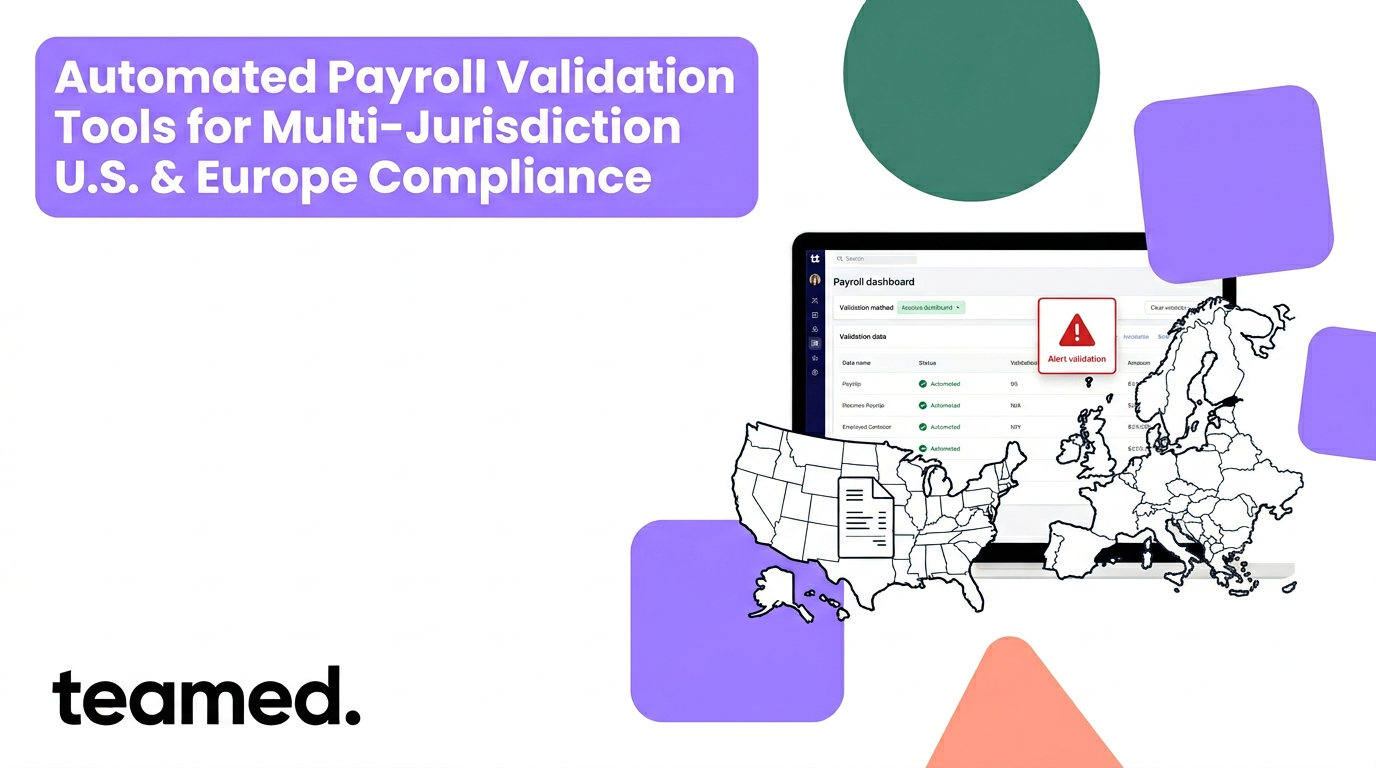
Automated Payroll Data Validation Tools for Multi-Jurisdiction Compliance: U.S. and Europe Compared
Running payroll across Texas, California, Germany, and France in the same pay cycle sounds straightforward until you realise each jurisdiction has its own tax tables, social contribution ceilings, overtime rules, and reporting formats. One misconfigured validation rule, and you're facing IRS penalties of up to 15% in one inbox and GDPR fines in another.
Most payroll tools validate within a single jurisdiction. Cross-border validation requires a fundamentally different architecture, one that reconciles U.S. federal rules plus up to 50 state-level tax regimes alongside 27 separate EU member-state social insurance systems. HR operations compliance becomes exponentially more complex when juggling these varying regulatory frameworks. The question isn't whether you need automated payroll data validation tools for multi-jurisdiction compliance. It's how you configure them to catch errors before funds leave your account.
This guide breaks down what real-time validation actually means across U.S. and European jurisdictions, compares the leading tools by coverage depth and implementation requirements, and gives you a decision framework you can act on immediately.
Quick Facts: Multi-Jurisdiction Payroll Validation
Automated payroll data validation tools monitor payroll inputs against current regulatory rules in real time, flagging discrepancies before a payroll run is finalised. The U.S. requires federal plus state-level rule handling across up to 50 jurisdictions, while EU payroll validation operates country-by-country with separate social insurance, tax withholding, and reporting formats for each of the 27 member states. Real-time validation catches errors before payroll lock, whereas batch validation typically identifies errors only during or after the payroll run. GDPR Article 22 restricts solely automated decision-making that produces significant effects on individuals, meaning EU payroll teams should ensure automated pay adjustments include human review. The EU Working Time Directive sets a 48-hour average weekly working time limit, creating validation requirements that differ from U.S. FLSA overtime checks. Teamed operates EOR services in 187+ countries and supports entity formation in 100+ countries, enabling companies to move from EOR to owned entities without changing provider.
What Does Real-Time Payroll Data Validation Actually Mean Across Jurisdictions?
Real-time payroll validation evaluates changes when they occur and prevents errors before payroll lock. This differs fundamentally from batch validation, which typically identifies errors only during or after the payroll run, when correction becomes expensive and time-consuming.
For organisations operating across U.S. states and European member states simultaneously, validation tools must handle five core layers. First, tax rule engine accuracy: does the tool update federal, state, and EU member-state tax tables automatically? Second, pre-payment audit triggers: are discrepancies flagged before funds are disbursed, not after? Third, data residency compliance: does the tool handle GDPR Article 88 requirements for EU employee data separately from U.S. data? Fourth, threshold monitoring: does it track FICA caps like the $184,500 wage base, overtime thresholds under FLSA versus EU Working Time Directive, and social contribution ceilings per jurisdiction? Fifth, integration depth: can it pull live data from HRIS, time-tracking, and ERP systems to validate inputs upstream?
The distinction between validation and compliance reporting matters here. Validation checks inputs against regulatory rules before payment. Compliance reporting generates documentation after calculations for regulatory submission. The best tools do both, but they're architecturally distinct functions. Buying a compliance reporting tool and expecting real-time validation is a common and costly mistake.
What Are the Differences Between U.S. and EU Payroll Validation Requirements?
U.S. payroll validation must account for federal rules including FICA, FUTA, and federal income tax withholding, plus up to 50 state-level tax regimes with varying rates, thresholds, and filing requirements. California alone requires meal and rest break compliance, final pay on termination day with a $70,304 exempt threshold, and extensive leave entitlements. New York adds its own complexity layer, reflecting the broader multi-state payroll compliance challenges organisations face.
EU payroll validation operates at the member-state level. Each country has its own social insurance contribution rates, income tax withholding systems, and payroll reporting formats. France requires DSN submissions. Germany relies on ELStAM for income tax attributes. The UK uses RTI. There is no single EU-wide payroll standard, which means a tool must maintain and update 27-plus country rule sets independently.
Income tax withholding in the U.S. involves federal plus state rules, while EU countries use country-level PAYE equivalents like Lohnsteuer in Germany. Social contributions in the U.S. follow FICA with employer and employee splits and an annual cap, whereas EU countries have country-specific rates with no single ceiling. Overtime rules under FLSA require 1.5x pay after 40 hours per week, while the EU Working Time Directive sets a 48-hour weekly maximum with opt-out rules varying by country.
Data handling creates another divergence. The U.S. has no federal equivalent to GDPR. EU employers need documented lawful basis and clear employee privacy notices for payroll processing, and validation tooling must support data minimisation and access controls because payroll data includes sensitive financial and employment information.
How Do You Implement Automated Payroll Validation Across Multiple Jurisdictions?
Implementation follows a six-step process that most organisations underestimate. The first step connects data sources by integrating HRIS for employee records and job codes, time-tracking for hours and PTO, and ERP or GL systems for cost centre allocations via API or native connector.
The second step configures jurisdiction rulesets by mapping each employee record to a primary tax jurisdiction and setting up secondary jurisdiction rules for remote or cross-border workers. This is where most implementations fail. Tools are activated but jurisdiction rulesets are left at default, which means U.S.-only or EU-only validation logic runs globally.
The third step sets validation thresholds by defining tolerance rules. Flag any gross pay variance greater than 2% from prior period. Alert on FICA overage. Trigger review if overtime hours exceed jurisdiction threshold.
The fourth step defines alert routing by assigning discrepancy alerts to the right owner. Payroll ops handles calculation errors. HR handles classification issues. Finance handles GL mismatches.
The fifth step runs pre-payment audit by executing the validation sweep 24 to 48 hours before payroll lock, reviewing flagged items, and documenting resolution for audit trail.
The sixth step performs post-run reconciliation by comparing validated inputs to actual disbursements and logging any manual overrides for compliance reporting.
A phased rollout works best. Start with highest-headcount jurisdictions, validate logic, then expand. Teamed's analysis of mid-market companies operating in 5 to 15 countries shows that sequential implementation reduces configuration errors by allowing teams to absorb complexity before adding new jurisdictions.
Which Payroll Validation Tools Handle Both U.S. and EU Jurisdictions?
The tool landscape divides into three tiers based on jurisdiction depth and implementation requirements. Understanding where each tool fits helps you match capabilities to your specific headcount distribution.
Enterprise-Grade Tools: Workday and Dayforce
Workday offers strong coverage across all 50 U.S. states plus federal rules and robust multi-country EU coverage. Configurable audit rules provide flexibility, and enterprise-grade GDPR compliance handles data residency requirements. Native integration plus a broad ecosystem supports complex organisations. The trade-off is significant configuration time and IT involvement. Validation logic is powerful but not plug-and-play.
Dayforce from Ceridian provides strong U.S. coverage with growing EU presence. Real-time dashboards surface anomalies, and the platform handles compliance requirements well. Strong HRIS integration makes it suitable for mid-market to enterprise organisations. Like Workday, it requires dedicated payroll ops teams and existing HCM infrastructure.
Mid-Market and Scaling Tools: Rippling and Neeyamo
Rippling excels on U.S. validation depth across all 50 states plus federal rules. EU member-state coverage is improving but not yet at parity with U.S. capabilities. Pre-payroll run alerts catch issues before lock, and data residency is configurable though partial. Native deep HRIS integration makes it attractive for U.S.-primary organisations with some EU presence. The important caveat: confirm EU coverage matches your specific member states before committing.
Neeyamo offers U.S. plus global coverage with strong EU multi-country support. Audit triggers provide validation capabilities, and GDPR compliance is built in. The middleware-dependent architecture means integration complexity is higher than native platforms. This suits multinational enterprises willing to invest in integration work.
EOR and Contractor-Focused Tools: Playroll and Payzaar
Playroll provides U.S. coverage via EOR and EU multi-country support. Compliance alerts handle validation within EOR-managed employees. GDPR-aligned data handling and API-based integration suit EOR-heavy or contractor-heavy organisations. The limitation: validation is scoped to EOR-managed employees, not in-house payroll runs.
Payzaar offers U.S. and EU coverage with alerts on anomalies. GDPR-aligned processing and integration-dependent architecture serve SMB to mid-market organisations. Like Playroll, it's optimised for specific use cases rather than comprehensive in-house payroll validation.
How Should You Choose the Right Tool for Your Jurisdiction Mix?
Headcount distribution matters most. If 80% of employees are U.S.-based with 20% in three or four EU countries, a U.S.-primary tool with EU add-ons may suffice. If the split is even, you need parity coverage.
The in-house versus EOR model question shapes your options. EOR-focused tools like Playroll handle validation within their managed payroll. In-house teams need a tool that validates their own data pipeline. Teamed's work with over 1,000 companies on global employment strategy shows that mid-market organisations often start with EOR and graduate to owned entities as headcount grows. A provider supporting both models through a single relationship avoids re-platforming costs.
Integration with existing HRIS determines validation quality. A validation tool is only as good as the data it receives. Map your current HRIS and ERP stack before evaluating tools.
Audit trail requirements differ by jurisdiction. EU works councils and U.S. DOL audits have different documentation expectations. Confirm the tool generates jurisdiction-appropriate audit logs.
Update cadence for tax tables is a critical question most buyers forget to ask. Specifically: how quickly are regulatory changes reflected in validation rules after a new state minimum wage or EU country social rate change? No currently cited tool publishes tax table update SLAs, which is a gap compliance teams should address directly with vendors.
What Are These Tools Still Getting Wrong?
Most tools validate within a jurisdiction but don't flag cross-jurisdiction classification errors. Consider an employee classified as U.S.-based but working remotely in Germany for 90-plus days. This triggers permanent establishment risk that single-jurisdiction validation misses entirely.
Real-time alerts are often UI-only. They surface in a dashboard but don't integrate into payroll approval workflows, meaning errors are seen but not actioned before the run. Dashboard-only alerts differ fundamentally from workflow-routed alerts because dashboard alerts can be observed without action, while workflow-routed alerts create an auditable assignment, resolution record, and approval decision before funds are disbursed.
GDPR compliance in most tools means data residency, ensuring EU data stays on EU servers. But it doesn't extend to validation logic transparency. Employees have a right to understand automated decisions affecting pay under GDPR Article 22. EU payroll teams should ensure any automated pay adjustments or deductions include human review and employee-facing transparency where required.
None of the currently cited tools publish their tax table update SLAs. This is a critical gap for compliance teams who need to know how quickly a new state law is reflected in validation rules. Ask vendors specifically: what is your SLA for regulatory updates, and can you provide change logs?
What Questions Should You Ask a Payroll Validation Vendor?
Before signing, ask five questions that separate capable vendors from feature-list marketing. First: how quickly are tax table changes reflected after a regulatory update, and what is your SLA? Second: does your validation logic cover all 50 U.S. states and which EU member states specifically? Third: how does your tool handle employees who work across multiple jurisdictions in a single pay period? Fourth: does your alert system integrate into our payroll approval workflow, or is it dashboard-only? Fifth: what audit log format do you generate for U.S. DOL and EU works council requests?
The answers reveal whether the vendor has built for multi-jurisdiction complexity or simply bolted on country coverage to a single-jurisdiction architecture.
Can One Tool Handle Both FLSA and EU Working Time Directive Compliance?
Enterprise platforms like Workday and Dayforce can be configured to validate against both FLSA overtime rules requiring 1.5x pay after 40 hours per week and EU Working Time Directive limits setting a 48-hour weekly maximum with country-specific opt-out rules. However, this requires explicit configuration. The tool must be told which ruleset applies to which employee population. Out-of-the-box defaults typically apply a single standard.
This configuration requirement catches many organisations. They activate the tool, assume global coverage, and discover months later that EU employees were validated against U.S. rules or vice versa.
How Does GDPR Affect Payroll Data Validation for EU Employees?
GDPR Article 88 permits processing of employee data for payroll purposes but requires a lawful basis, data minimisation, and transparency. Article 22 restricts solely automated decisions that significantly affect employees, meaning automated pay corrections or deductions may require human review and employee notification.
Validation tools must route EU employee data through GDPR-compliant infrastructure with EU data residency and maintain processing records under Article 30. UK GDPR and EU GDPR treat payroll data as personal data, and employers must maintain records of processing activities for payroll-related processing when the organisation meets ROPA requirements.
The practical implication: your validation tool needs separate data handling for EU employees, not just a toggle that says "GDPR compliant."
Making the Right Choice for Your Organisation
Tool selection matters less than implementation configuration. The most common failure mode is activating a tool with default single-jurisdiction validation logic and assuming it covers all geographies. Start by mapping your current footprint, identifying which countries are at or approaching headcount thresholds, and running economic analysis on EOR versus entity costs.
For U.S.-primary organisations with EU expansion, Rippling offers the strongest U.S. validation depth. Confirm EU coverage matches your specific member states before committing. For enterprise organisations with complex multi-jurisdiction payroll, Workday or Dayforce provide the highest configuration ceiling and deepest jurisdiction libraries, though they require dedicated implementation resources. For EOR or contractor-heavy global teams, Playroll or Neeyamo are purpose-built for managed payroll across borders but aren't the right fit for in-house payroll validation.
If you're managing global employment across multiple platforms and want a single advisory relationship that covers contractors, EOR, and entities, talk to an expert at Teamed about consolidating fragmented operations into a unified approach that grows with your organisation.