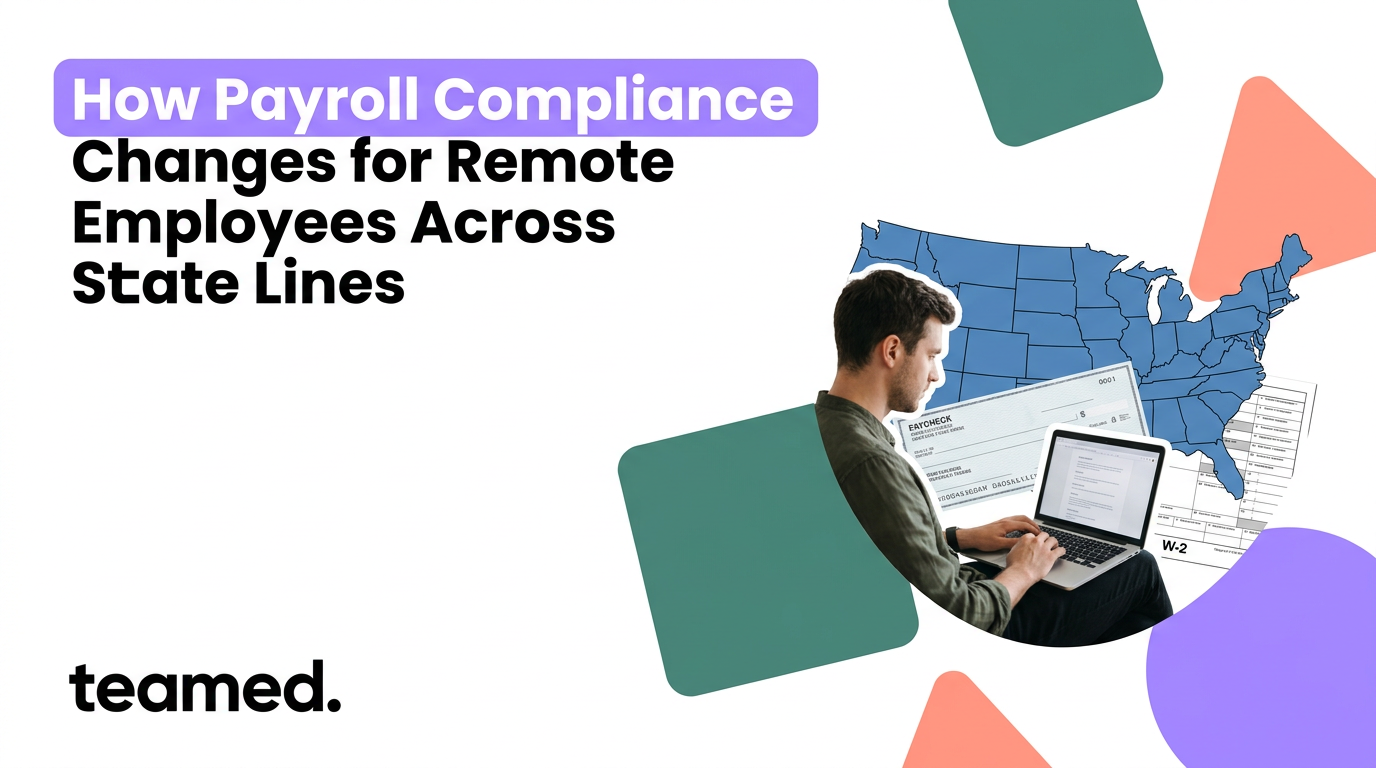
How Payroll Compliance Changes When Employees Work Across State Lines
Your finance director just flagged an email from the California Franchise Tax Board. They want to know why you haven't registered as an employer in their state. The problem? Your marketing manager moved to San Diego six months ago, and nobody updated payroll.
This scenario plays out constantly in companies with remote teams. When an employee works remotely in a different state than your company's headquarters, or splits time across multiple states, your payroll obligations change in concrete ways. You may need to register for payroll tax accounts in the employee's home state, withhold income taxes for that state, pay state unemployment insurance there, and comply with any local payroll taxes in their jurisdiction. Whether you owe these obligations depends on three factors: where the employee is domiciled, where the work is physically performed, and whether a reciprocity agreement exists between the states involved.
The compliance steps you need to take depend on which of these situations applies to your employee. Most guides treat multi-state payroll compliance as a checklist of rules without walking employers through the decision logic. This guide takes a process-first approach, mapping compliance triggers to specific employer actions in the order a payroll or HR team encounters them when onboarding a new remote hire.
What Catches Teams Off Guard
State payroll registration takes 2-6 weeks. Start a remote hire without registering first, and you'll miss their first paycheck deadline.
One remote employee makes you an employer in their state. No office needed. You'll still owe withholding and unemployment insurance.
New York's convenience-of-employer doctrine can tax 100% of a remote employee's income even when they work from another state.
Pennsylvania has over 2,500 local taxing jurisdictions, each requiring separate employer registration for local earned income taxes.
Multi-state employees require W-2s that reflect wages and taxes for each state separately in Boxes 15-17.
States commonly trigger withholding obligations after 14-30 days of work performed within their borders.
Reciprocity agreements exist between 16 states and the District of Columbia, allowing employees to pay income tax only in their state of residence.
Why Does Remote Work Create New Payroll Compliance Obligations?
The concept of tax nexus explains why a single remote employee can create payroll tax presence in a state where your company has no office. Nexus is the legal connection between your business and a state that triggers tax obligations. When an employee physically performs work in a state, you've established nexus there regardless of whether you have an office, customers, or any other business activity in that jurisdiction.
The difference between the employee's domicile state and their work state matters because both can trigger withholding obligations. Domicile is where the employee legally resides and intends to remain indefinitely. Work state is where labour is physically performed. An employee domiciled in New Jersey who works from a coffee shop in Philadelphia three days a week has created potential obligations in both states.
The convenience-of-employer doctrine surprises most employers. A handful of states, most notably New York, can tax a nonresident employee's full income if they work remotely for their own convenience rather than because the employer requires it. This means your remote employee in Connecticut working for your Manhattan-based company may owe New York income tax on their entire salary.
Before You Run Their First Payroll
First: Pin Down Where They Live and Work
Collect a completed W-4 and the equivalent state withholding certificate for their home state. Ask explicitly whether they will perform any work in states other than their home state and document the answer. Domicile is not the same as mailing address. A remote employee who lives in one state but temporarily works from another state for 30 or more days may trigger obligations in both jurisdictions.
Second: See If the States Have a Tax Deal
Reciprocity agreements allow employees to pay income tax only in their state of residence, not the state where the employer is located. States with active reciprocity agreements include Arizona, Illinois, Indiana, Iowa, Kentucky, Maryland, Michigan, Minnesota, Montana, New Jersey, North Dakota, Ohio, Pennsylvania, Virginia, West Virginia, Wisconsin, and the District of Columbia. If a reciprocity agreement exists, collect the employee's state-specific exemption form and do not withhold for the employer's state.
Third: Register Now, Not After First Payroll
Most states require employers to register for a state withholding account and a state unemployment insurance account before the first payroll run. Typical registration timeline runs 2-6 weeks, which is a common cause of first-paycheck compliance failures. Some states offer online registration while others require paper applications. Check the state revenue department portal for specific requirements.
Fourth: Don't Trust Your Payroll Tool to Get This Right Automatically
Configure withholding for the employee's resident state and work state if different. If the employee owes taxes in two states on the same income, most states offer a credit for taxes paid to another state. Your payroll system must calculate this correctly. Confirm your payroll provider supports the specific states involved because not all platforms cover all 50 states with equal accuracy. Payroll professionals on Reddit frequently describe frustration with providers that misconfigure multi-state withholding, particularly when employees work across state lines.
Fifth: Pick the Right State for Unemployment Insurance
State unemployment insurance is generally paid to the state where the employee performs the majority of their work. If work is split across states, apply the four-factor test in this order: localization of services, base of operations, direction and control, and employee's residence. You typically pay SUI to only one state per employee, but you must determine which one correctly.
Sixth: Don't Forget City and Local Taxes
Several states impose local income taxes or occupational privilege taxes. Ohio, Pennsylvania, Kentucky, New York City, and Denver all have local tax obligations that apply to remote employees working from these jurisdictions. Remote employees working from these areas trigger local tax obligations even if the employer has no local presence. Identify the employee's municipality and check that jurisdiction's local tax requirements.
Seventh: Make Sure Your Pay Stubs Won't Fail an Audit
Many states have specific pay stub content requirements including itemized deductions, pay period dates, and employer address. Multi-state employees may require pay stubs that satisfy the stricter of the two states' requirements. Retain records of days worked in each state for employees who travel because this documentation is what you'll need in an audit.
Where Experienced Teams Still Get Burned
California: Aggressive Nexus Rules and No Reciprocity
California is among the most aggressive states for establishing employer nexus. One remote employee can trigger registration, withholding, and potentially corporate income tax obligations once you pay more than $100 in wages per quarter. California has no reciprocity agreements with any other state. Paid sick leave, pay transparency, and final paycheck rules also apply to California-based remote employees. The California Franchise Tax Board actively cross-references new hire reporting data to identify unregistered out-of-state employers.
New York: The Convenience-of-Employer Rule
New York applies the convenience-of-employer doctrine more aggressively than any other state. If a New York-based employer allows an employee to work remotely for the employee's own convenience rather than because the employer requires it, New York taxes 100% of that employee's income as if they worked in New York. This is the single most counterintuitive rule in multi-state payroll. A remote employee in New Jersey working for a New York City company may owe New York income tax on their full salary even though they never set foot in the state.
Pennsylvania: Complex Local Tax Structure
Pennsylvania has a complex local earned income tax structure with over 2,500 taxing jurisdictions, each identified by 6-digit PSD codes. Reciprocity agreements exist with several neighboring states, but local taxes are not covered by reciprocity. Employers must register with the employee's local tax collector, not just the state. The Pennsylvania Department of Revenue provides a lookup tool to identify which local tax collector applies to each municipality.
Texas, Florida, and Washington: No State Income Tax
These states have no state income tax withholding requirement, but SUI registration is still mandatory. Employees moving from high-tax states to one of these states often expect a larger paycheck. Manage expectations at onboarding by explaining that while state income tax withholding disappears, other obligations remain.
Will New York Tax Your Remote Employees Even If They Never Go to the Office?
The convenience-of-employer doctrine holds that if a nonresident employee works outside the state for their own convenience rather than because the employer requires it, the employer's home state can tax that employee's full income as if they worked in-state. States that currently apply this doctrine include New York, Pennsylvania, Delaware, Nebraska, and Arkansas.
How do you determine if it applies? Ask whether the remote arrangement was required by the employer or chosen by the employee. If your company has no office in the employee's city and remote work is the only option, the doctrine likely does not apply. If the employee chose to work remotely when an office was available, the doctrine may apply.
Document the business reason for remote work arrangements in writing. This documentation is your defense in a state audit. A memo stating that the position was created as remote-only because no office exists in the employee's region provides stronger protection than informal email exchanges.
How to Avoid Corrected W-2s and State Notices
Multi-state employees require W-2s that reflect wages and taxes for each state separately. Boxes 15-17 on the W-2 contain state-specific information. If an employee worked in three states, the W-2 may have three state sections. Note that boxes 15-20 can report only 2 states, so you must prepare a second Form W-2 for additional states. Some payroll systems require manual configuration for this.
Proration methods matter when employees work in multiple states during the year. The calendar-day method allocates wages based on total days in each state divided by total days in the year. The workday method allocates based on actual workdays in each state divided by total workdays. Check each state's requirements because some mandate specific methods. For example, New York uses New York workdays ÷ total workdays, excluding Saturdays, Sundays, holidays, sickness, vacation, and leave days.
State W-2 filing deadlines vary. Some states require earlier filing than the federal January 31 deadline. A common error is issuing a single-state W-2 for an employee who worked in multiple states. This triggers state notices and potential penalties.
Where Teams Get Burned (Even With Good Payroll Tools)
Waiting until after the first payroll run to register in the new state creates immediate compliance failures. States assess back taxes, interest, and late registration fees. Registration should begin the moment you confirm a remote hire's location.
Assuming your payroll provider handles multi-state compliance automatically leads to errors. Most platforms require manual configuration. Verify before assuming. Payroll professionals frequently report that even major providers like ADP and Paychex misconfigure state taxes when employees work across multiple jurisdictions.
Ignoring local taxes because you registered at the state level misses a significant obligation. Local taxes in Pennsylvania, Ohio, Kentucky, and New York City are separate obligations requiring separate registrations.
Not updating withholding when an employee moves mid-year creates W-2 errors and potential employee tax liability. Employees must notify you of address changes, but you must act on that information promptly.
Misclassifying a remote worker as an independent contractor to avoid multi-state obligations invites scrutiny. State agencies specifically audit this pattern. The consequences include back taxes, penalties, and potential liability for employee benefits.
Questions From Teams Who've Been Through This
Do I have to withhold taxes in the state where the employee lives or the state where my company is located?
Generally, you must withhold income taxes for the state where the employee physically performs their work. If the employee lives and works in a different state than your company, you withhold for their state, not yours. If a reciprocity agreement exists between the two states, you withhold only for the employee's state of residence.
What happens if I don't register for payroll taxes in the state where my remote employee lives?
Failure to register can result in back taxes, interest, and penalties assessed by the state, often retroactive to the employee's first day of work. Some states also impose personal liability on company officers for unpaid payroll taxes. States increasingly cross-reference new hire reporting data to identify unregistered out-of-state employers.
Can an employee be taxed by two states on the same income?
Technically yes, but most states provide a resident tax credit that offsets taxes paid to another state, preventing true double taxation. Your payroll system must be configured to calculate this credit correctly. The exception is states that apply the convenience-of-employer doctrine, where the employer's state may tax income that the employee's state also taxes.
How do reciprocity agreements affect payroll withholding?
Reciprocity agreements between states allow employees to pay income tax only in their state of residence, regardless of where their employer is located. If your state and the employee's state have a reciprocity agreement, collect the employee's state-specific exemption certificate and withhold only for their home state. Not all states have reciprocity agreements, so check both states' revenue department websites to confirm.
What payroll records do I need to keep for multi-state employees?
Maintain records of the days each employee worked in each state, their state withholding certificates, copies of any reciprocity exemption forms, and documentation of the business reason for remote work arrangements. Day-count records are essential for employees who travel because many states trigger withholding obligations after a threshold number of days worked in-state, commonly 14-30 days.
Getting Control of Multi-State Complexity
Multi-state payroll compliance follows predictable patterns once you understand the triggers. The key is building a systematic process that captures location information before the first paycheck, not after a state notice arrives.
For mid-market companies managing remote teams across multiple states, the compliance burden compounds quickly. Teamed's analysis of payroll operations across 70 countries shows that the same decision logic applies whether you're managing multi-state US employees or international teams. The trigger is always the same: where work is physically performed determines which jurisdiction's rules apply.
If your remote workforce has grown faster than your compliance infrastructure, you're not alone. The right structure for where you are, and trusted advice for where you're going, makes the difference between reactive firefighting and proactive compliance. Talk to an Expert about building a payroll compliance framework that scales with your team.