
Case Study
What Your EOR Actually Does (And Doesn't Do): The audit that asked questions nobody could answer

Tom Price-Daniel

12 minutes

May 6, 2026
From 6 April 2026, sexual harassment becomes an explicit protected disclosure category under UK whistleblowing law in England, Wales and Scotland. The Employment Rights Act 2025 amends section 43B of the Employment Rights Act 1996 to make this change crystal clear. Workers who report sexual harassment now have statutory protection against dismissal or detriment, removing the ambiguity that previously forced employees to rely on broader, less certain categories.
For international employers with UK headcount, this isn't a minor policy tweak. It's a compliance trigger that requires immediate attention to whistleblowing policies, reporting channels, and manager training. If you're employing people in the UK through an Employer of Record or your own entity, your documentation needs updating before April.
Let's walk through the practical changes so you don't get caught flat-footed when someone makes a disclosure and you realize your policies are outdated.
From 6 April 2026, treat every sexual harassment report as a whistleblowing disclosure from the moment it lands in your inbox. Update your policies and intake procedures before that date.
You'll need to rewrite four documents: your whistleblowing policy, anti-harassment policy, investigation procedure, and manager guidance. Plus, you'll need to change how cases get logged and escalated so nothing falls through the cracks.
UK whistleblowing protection under PIDA can apply to workers as well as employees, meaning the protected population can include agency workers and some contractors depending on the relationship.
For UK employees, you need four basic guardrails: someone who owns each case, someone who can decide on interim measures like moving people during investigations, clear rules about conflicts of interest, and a way to check for retaliation within 14 days of the report.
Most mid-market companies need three time targets for UK reports: when to acknowledge receipt, when to assess the initial risk, and when to start the formal investigation.
A protected disclosure is a qualifying whistleblowing report made by a worker that receives statutory protection from detriment and dismissal under the UK Public Interest Disclosure Act 1998 (PIDA), which is contained in the Employment Rights Act 1996. The worker must reasonably believe they are reporting wrongdoing in the public interest.
Previously, employees reporting sexual harassment had to argue their disclosure fell within existing categories like health and safety risks or criminal offences. This created uncertainty. Some disclosures qualified for protection, others didn't, and the outcome often depended on how the complaint was framed rather than what actually happened.
The April 2026 change eliminates this ambiguity. Sexual harassment is now a standalone category. If a worker reports sexual harassment through any reasonable channel, they're automatically covered by whistleblowing protection. No creative legal arguments required.
The Employment Rights Act 2025 explicitly adds sexual harassment to the list of qualifying disclosures. This means any report of sexual harassment automatically counts as a protected disclosure in relation to potential whistleblowing claims.
The practical effect is significant. Workers now have a lower threshold for raising concerns with legal protection. They don't need to prove the harassment occurred or that their employer failed to act. They simply need to make the disclosure in good faith with a reasonable belief that harassment happened.
For employers, this creates greater risk when reports aren't taken seriously. A dismissal or detriment following a sexual harassment disclosure now carries explicit whistleblowing liability, regardless of whether the underlying harassment claim is ultimately upheld. The protection attaches to the act of reporting, not the outcome of the investigation.
International employers operating in the UK face a specific challenge. Your policies were likely drafted before this change was contemplated, and your reporting channels may not be configured to handle sexual harassment disclosures as protected whistleblowing matters.
Consider a hypothetical mid-market company with 50 UK employees spread across three offices. Reports might currently flow to local HR, a group ethics inbox, line managers, or an anonymous hotline. Without a single triage owner, a sexual harassment report could be treated as a standard grievance rather than a protected disclosure, exposing the company to retaliation claims even if the underlying investigation is handled properly.
Teamed's analysis of mid-market companies (200-2,000 employees) typically identifies three to six separate intake routes that must be consolidated into a single triage and anti-retaliation workflow. The April 2026 change makes this consolidation urgent rather than optional.
Your compliance response needs to address four document updates and one operational change. Here's what each involves.
Your whistleblowing policy needs to explicitly name sexual harassment as a standalone protected-disclosure category. Most existing policies list categories like financial misconduct, health and safety breaches, and environmental damage. Sexual harassment should now appear alongside these as a distinct reportable concern.
The policy should also clarify that workers making sexual harassment disclosures receive the same anti-retaliation protections as any other whistleblower. This isn't legally required since the protection applies automatically, but explicit policy language reduces confusion and demonstrates compliance intent.
Your anti-harassment policy and whistleblowing policy need to work together without contradiction. An anti-harassment policy defines prohibited conduct and expected behaviour. A whistleblowing policy defines protected reporting routes, triage procedures, investigation governance, and anti-retaliation safeguards.
The interaction matters because employers must run both tracks simultaneously. You're investigating the harassment allegation under the Equality Act 2010 while also protecting the reporter from retaliation under PIDA. These are parallel obligations, not alternatives.
Your investigation procedure needs updating to reflect the dual-track nature of sexual harassment complaints. Investigators should document anti-retaliation controls as part of case handling, because retaliation risk is assessed based on outcomes and treatment of the reporter, not only on the final investigation finding.
This means tracking what happens to the reporter throughout and after the investigation. Were they moved to a less desirable role? Excluded from meetings? Passed over for promotion? Any adverse treatment could constitute retaliation, even if unintentional.
If your whistleblowing policy names managers as an intake route, manager training becomes critical. A manager's first response can create or mitigate detriment risk even before an investigation starts.
Managers need to understand that a sexual harassment report is now automatically a protected disclosure. They shouldn't dismiss concerns, suggest the reporter is overreacting, or take any action that could be perceived as discouraging the report. Training should cover appropriate responses, escalation requirements, and documentation expectations.
The operational change involves ensuring all sexual harassment reports are logged and triaged as protected disclosures from the moment they're received. This requires a defined escalation path, a named case owner, and an auditable trail showing how the report was handled.
For international employers, this often means clarifying who owns the triage decision when reports come through different channels. HR, Legal, and an EOR may each receive reports, but there should be a single escalation owner to prevent gaps.
If you're employing UK workers through an Employer of Record, your EOR should have updated employment handbooks and whistleblowing policies to reflect the April 2026 change. The employing entity on the employment contract must match the entity responsible for receiving and processing whistleblowing disclosures.
Before April 2026, verify these elements with your EOR provider. First, confirm the effective date of policy updates and ensure they take effect before 6 April 2026. Second, check that entity naming is correct and the whistleblowing policy references the correct employing entity. Third, review reporting routes to ensure they're clearly defined and accessible to UK workers. Fourth, confirm whether an anonymity option exists since anonymous reporting materially increases report volume, with 78% of whistleblowing disclosures being made anonymously according to EHRC data. Fifth, identify escalation contacts and ensure named individuals are specified for case ownership and decision-making.
Teamed's EOR commercial terms include UK-ready handbooks, local policy addenda, and compliant reporting workflows. For mid-market companies hiring one to twenty people in the UK, the EOR should deliver these without requiring you to build a UK HR and legal stack immediately.
Here's what will feel different in your inbox after April 2026.
First, expect more formal disclosures, with whistleblowing cases already rising to 5,901 in 2024/25 from 2,613 just two years prior. When employees know their reports carry explicit legal protection, they're more likely to use formal channels rather than informal conversations. This isn't a bad thing since formal channels create documentation, but it does increase the volume of matters requiring structured investigation.
Second, anti-retaliation monitoring becomes essential. You need to track reporter outcomes systematically, not just during the investigation but for months afterward. A retaliation claim can arise from actions taken well after the investigation closes.
Third, manager behaviour matters more than ever. The first response to a disclosure sets the tone. A dismissive reaction from a manager could itself constitute detriment, even if the formal investigation is handled perfectly.
Yes. From 6 April 2026, reporting sexual harassment is explicitly protected under UK whistleblowing law. Workers who make such reports have statutory protection against dismissal or detriment connected to their disclosure.
This protection applies regardless of whether the harassment allegation is ultimately substantiated. The legal protection attaches to the act of making the disclosure, provided the worker reasonably believes harassment occurred and reports it through a reasonable channel.
UK whistleblowing protection is primarily set out in the Public Interest Disclosure Act 1998, which is incorporated into the Employment Rights Act 1996. The April 2026 amendment makes sexual harassment an explicit qualifying disclosure category within this framework.
The April 2026 deadline gives you time to act, but not time to delay. Policy updates, training programmes, and operational changes all require lead time to implement properly.
Start by auditing your current whistleblowing policy to identify whether sexual harassment is explicitly named as a protected-disclosure category, alongside other UK legal changes in 2026. Review your reporting channels to ensure there's a single triage owner for UK disclosures. Update manager training to cover the new requirements. And if you're using an EOR, confirm they've made the necessary updates to employment documentation.
For international employers managing UK headcount alongside operations in other countries, this is also an opportunity to review your broader whistleblowing framework. A group whistleblowing policy used across multiple countries must be supplemented by country addenda reflecting local protected-disclosure rules.
Teamed works with mid-market companies to ensure UK employment documentation reflects current legal requirements. If you're uncertain whether your policies are ready for April 2026, talk to an expert about reviewing your whistleblowing framework for UK employees.
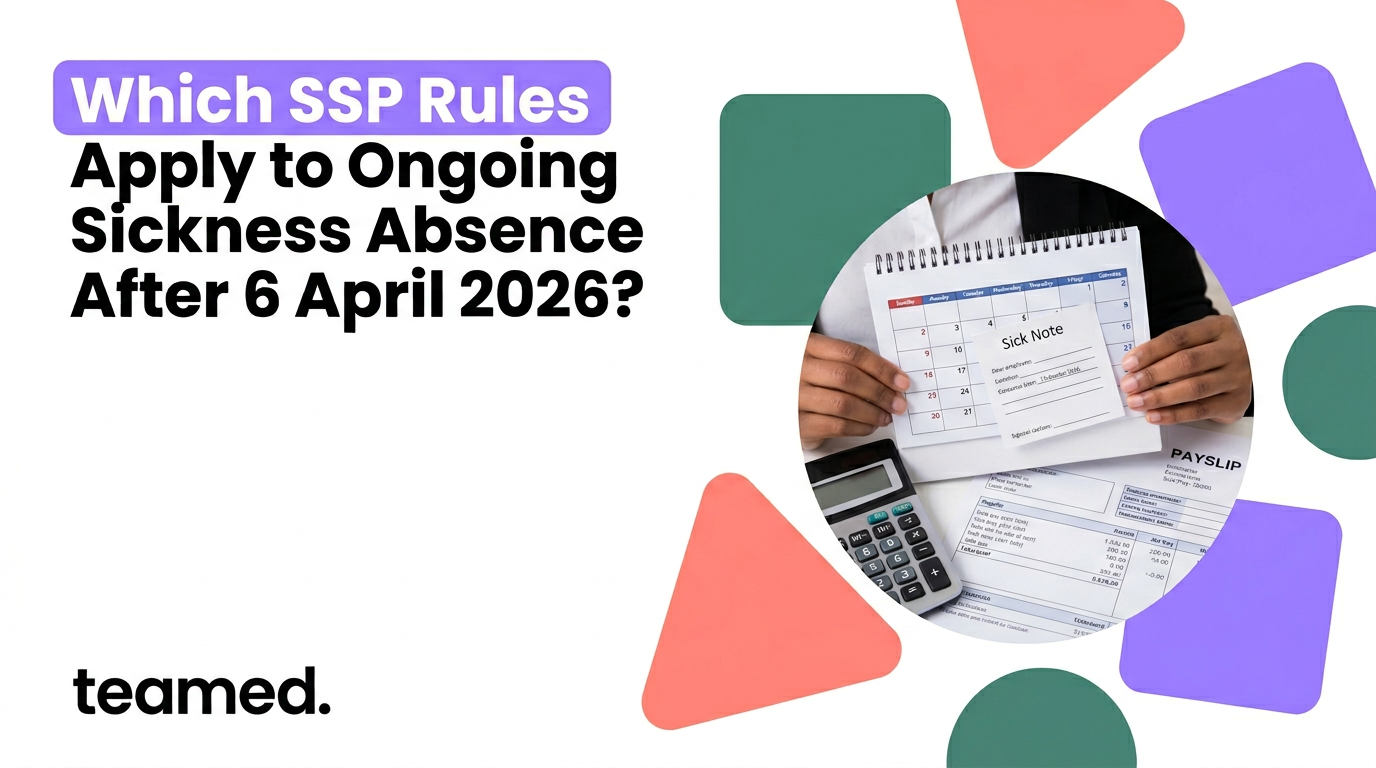
Your employee went off sick in March 2026. They're still absent in May. Which SSP rules apply now?
This question is keeping payroll teams across the UK awake at night, and for good reason. The Employment Rights Act 2025 reforms that took effect on 6 April 2026 created a situation where two SSP regimes now coexist temporarily. The start date of the absence determines which rules apply, not the date you're processing payroll. Get this wrong, and you're either underpaying employees or overpaying and unable to recover the difference.
The transitional rules governing SSP for sickness absences spanning 6 April 2026 are genuinely complex. Most guidance currently available buries the critical decision points in paragraph-heavy summaries that don't help when you need to make a payroll call. This guide provides scenario-based treatment with clear decision logic that payroll teams can actually use.
The UK's SSP reform date triggering transitional rules is 6 April 2026. The maximum SSP entitlement period remains capped at 28 weeks per employee. The latest practical end date for any pre-6 April 2026 SSP regime exposure is 17 October 2026, calculated as 28 weeks after the reform date for absences already running on that date. An SSP linking window of 56 days (8 weeks) determines whether separate sickness spells are treated as connected for SSP purposes. A two-regime SSP environment exists for up to 28 weeks after 6 April 2026 because absences that started before that date continue under old SSP logic while new absences follow new logic. The single most important data field for auditability during SSP transition is the original absence start date.
The transitional rules exist because the UK government couldn't simply switch every employee to the new SSP regime overnight. Employees already receiving SSP before 6 April 2026 had legitimate expectations about their entitlement under the rules in place when their absence began. Changing their payment mid-absence without protection would create unfairness and administrative chaos.
The core principle is straightforward: the start date of the absence determines which rules apply. If your employee's current sickness absence began before 6 April 2026 and continues beyond it, the pre-6 April rules govern their SSP entitlement. If their absence started on or after 6 April 2026, the post-reform rules apply from day one.
This creates a period where payroll teams must run two parallel SSP calculation pathways. One pathway applies pre-6 April logic for continuing absences. The other applies post-6 April logic for new absences. Both pathways may need to operate simultaneously through October 2026, according to Teamed's implementation guidance for mid-market employers managing UK payroll compliance.
When an employee was already receiving SSP before 6 April 2026 and their sickness continues beyond that date, the old rules apply for the duration of that absence. They continue receiving the uprated flat rate of £123.25 per week. The transitional protection ensures they do not receive less under the new calculation method than they would have received under the old rules.
Rate protection kicks in automatically. If the post-reform SSP calculation would produce a lower payment than the pre-reform flat rate, the employee receives the higher amount. This protection is a safeguard, not a calculation method. You're not recalculating SSP from first principles under the new rules and then comparing. You're simply ensuring the employee isn't worse off because the rules changed mid-absence.
The transitional protection continues until one of three events occurs. First, the employee returns to work. Second, their 28-week SSP entitlement expires. Third, the latest possible end date of 17 October 2026 arrives for continuous pre-6 April cases. Whichever comes first ends the transitional period for that employee.
This scenario catches many payroll teams off guard. Under the pre-6 April rules, employees served three unpaid waiting days before SSP became payable, affecting 70% of sickness absences that lasted between one and three days. If an employee fell ill on 3 April 2026 and was still absent on 6 April, they would have been in their waiting days when the reform took effect.
Here's the critical rule: SSP becomes payable from 6 April 2026 for these employees. The waiting days before that date are not back-paid. The pre-reform waiting days remain governed by pre-reform rules, meaning they stay unpaid. But from 6 April onwards, SSP is payable if the absence continues.
Consider a mid-market company with an employee who started their sickness absence on 4 April 2026. Under the old rules, days one through three would be waiting days with no SSP. Day four would be 7 April, the first payable day. Under the transitional rules, 6 April becomes the first payable day because the new regime eliminates waiting days and the employee is still absent on that date.
The employee doesn't get SSP for 4 and 5 April. Those days occurred under the old regime and remain subject to old-regime waiting day rules. But they do get SSP from 6 April forward.
Yes, and this is a scenario most competitor guidance ignores entirely. An employee who was off sick before 6 April 2026 but was ineligible for SSP due to earning below the Lower Earnings Limit may become eligible from 6 April under the new rules if their absence continues.
The post-6 April SSP regime changed eligibility criteria. If an employee was continuously absent but previously ineligible under pre-reform rules, payroll must reassess their eligibility from 6 April 2026 under the new sick pay rules. You cannot simply assume ineligibility persists because it applied before the reform date.
Teamed's analysis of transitional SSP cases shows this scenario most commonly affects part-time workers and those with variable earnings who fell just below the pre-reform threshold, a group that comprised 1 to 1.3 million employees before the reforms. The reassessment requirement means payroll teams need to flag all ongoing absences that started before 6 April where the employee was previously deemed ineligible, then run the new eligibility calculation as of 6 April.
This is where the 56-day linking rule creates confusion. Under normal SSP administration, two sickness periods that start within 56 days of each other are treated as linked. This affects how waiting days and entitlement are counted.
But here's the crucial distinction: linking within 56 days does not override the 6 April 2026 start-date rule. If an employee was off sick before 6 April, returned to work, and then went off sick again after 6 April, the new absence is governed by the new rules. The fact that it might link to the pre-6 April period for administrative purposes doesn't force it back into the old regime.
A sickness absence that begins before 6 April 2026 is administered under the pre-6 April SSP regime for its continuation. A sickness absence that begins on or after 6 April 2026 is administered under the post-6 April SSP regime from day one, even if it links to an earlier period within 56 days.
The return to work creates a break. The new sickness start date determines the applicable regime. This is the start-date rule in action, and it takes precedence over linking rules when determining which SSP regime applies.
Transitional protection ends when any of these events occurs for the specific employee:
1. The employee returns to work, breaking the continuous absence 2. The employee's 28-week SSP entitlement expires 3. The calendar reaches 17 October 2026, which is 28 weeks after 6 April 2026For most employees, return to work will end transitional protection first. The 28-week entitlement cap means even the longest continuous absences have a defined endpoint. The 17 October 2026 date represents the absolute latest any employer could still be administering pre-6 April SSP rules for a continuous absence that was running on the reform date.
After transitional protection ends, any new sickness absence for that employee falls entirely under the post-6 April regime. The transitional period is employee-specific and absence-specific, not a blanket company-wide window.
You only need three facts to decide which rules to use: when did the absence start, were they still off on 6 April, and have they returned to work since?
Start with the absence start date. If the current sickness absence started on or after 6 April 2026, apply the new SSP regime. No further analysis needed.
If the absence started before 6 April 2026, check whether the employee has returned to work since then. If they returned to work and this is a new sickness spell starting after 6 April, apply the new regime even if the absence links within 56 days.
If the absence started before 6 April 2026 and the employee has been continuously absent through 6 April, apply the old regime with transitional protections. This includes rate protection ensuring they don't receive less than the pre-reform flat rate.
For employees who were in waiting days on 6 April, apply the old regime's waiting day rules to days before 6 April, then make SSP payable from 6 April forward if absence continues.
For employees who were previously ineligible due to low earnings, reassess eligibility under the new rules as of 6 April.
Three places where payroll teams typically slip up during the cutover:
The first is absence start-date capture. If your system doesn't accurately record when the absence began, you cannot determine which regime applies. The original absence start date is the single most important data field for auditability during SSP transition.
The second is waiting-day treatment. Payroll teams sometimes back-pay waiting days for employees who were in waiting days on 6 April, which is incorrect. They also sometimes continue applying waiting days to post-6 April absences when the new regime has eliminated them.
The third is linked-absence handling. The confusion between administrative linking for SSP history purposes and regime determination for calculation purposes leads to errors. Teams incorrectly apply old-regime rules to new absences that happen to link within 56 days.
For mid-market UK employers with 200-2,000 employees, the probability of having at least one long-term sickness case spanning 6 April 2026 is statistically high. Multiple concurrent cases increase the complexity and the risk of inconsistent treatment across employees.
Documentation requirements during the transitional period exceed normal SSP record-keeping. You need to demonstrate which regime you applied and why, particularly for HMRC-facing reconciliations.
Retain the original absence start date for every sickness case, not just the date SSP payments began. This is the primary data point that determines regime selection and can be tested against payroll outputs during audits.
Document any reassessments performed on 6 April for previously ineligible employees. Record the basis for the original ineligibility determination and the outcome of the reassessment under new rules.
For employees receiving transitional rate protection, document both the pre-reform flat rate and what the post-reform calculation would have produced. This demonstrates you applied the protection correctly rather than simply defaulting to old rates without analysis.
Flag any cases where linking rules intersected with the regime determination. Document your reasoning for applying new-regime rules to linked absences that started after 6 April following a return to work.
Yes, if your sickness absence started before 6 April 2026 and you haven't returned to work, the pre-6 April SSP rules continue to apply to your absence. You receive the uprated flat rate with transitional protection ensuring you don't receive less than you would have under the old rules. This continues until you return to work, your 28-week entitlement expires, or 17 October 2026 arrives.
No. Waiting days that occurred before 6 April 2026 remain governed by the pre-reform rules. They were unpaid under those rules and the transitional changeover does not convert them into payable days. However, if you were still in your waiting days on 6 April and remained absent, SSP becomes payable from 6 April forward under the transitional rules.
The SSP transitional rules create genuine complexity for UK payroll teams, particularly in mid-market companies managing multiple concurrent long-term sickness cases. The two-regime environment persists through October 2026, requiring parallel calculation pathways and careful documentation.
The governing principle remains constant: the start date of the absence determines which rules apply. Every decision flows from that single data point. Capture it accurately, document your regime determination, and apply the appropriate rules consistently.
For companies managing UK employees through an Employer of Record arrangement, the EOR handles SSP administration including transitional cases. If you're navigating SSP transition complexity alongside broader questions about the right employment structure for your UK team, talk to an expert at Teamed. We help mid-market companies get the compliance details right while advising on when your structure should evolve.
The maximum penalty for failed redundancy consultation in the UK doubled to 180 days' pay per affected employee on 6 April 2026. For a company making 25 people redundant at an average salary of £40,000, maximum exposure just jumped from approximately £250,000 to £500,000 overnight.
If you're managing UK workforce reductions from an overseas headquarters, this change demands immediate attention. UK collective consultation obligations are more prescriptive than many other markets, and decisions made at HQ that affect UK staff still trigger UK consultation duties. The penalty increase isn't just a number change. It's a fundamental shift in the financial risk profile of any restructuring that touches your UK team.
This piece explains what changed, models the real financial exposure, and flags the specific traps that catch international employers who underestimate UK collective consultation requirements.
The protective award maximum increased from 90 days' pay to 180 days' pay per affected employee from 6 April 2026. UK collective redundancy consultation is triggered when proposing 20 or more redundancies at one establishment within a 90-day period. Employers must consult for at least 30 days before the first dismissal takes effect when proposing 20 to 99 redundancies. Employers must consult for at least 45 days before the first dismissal takes effect when proposing 100 or more redundancies. A worked risk model for 25 UK redundancies at an average salary of £40,000 shows maximum protective award exposure of approximately £500,000 at 180 days. The penalty applies per affected employee, meaning total exposure scales directly with headcount. UK decisions made outside the UK still trigger UK collective consultation duties when affected employees are assigned to a UK establishment.
The Employment Rights Act 2025 doubled the maximum protective award from 90 days' gross pay to 180 days' gross pay per affected employee. This change applies to any collective redundancy consultation failure where the protective award claim is heard after 6 April 2026.
A protective award is an Employment Tribunal compensation order that requires an employer to pay up to the statutory maximum number of days' gross pay to each affected employee when the employer fails to comply with UK collective redundancy consultation duties. The tribunal determines what is "just and equitable" up to the maximum, meaning not every failure results in the full 180 days. But serious failures, particularly those involving predetermined outcomes or treating consultation as a formality, regularly attract awards at or near the maximum.
The doubling applies specifically to collective redundancy situations, defined as proposing to dismiss 20 or more employees as redundant at one establishment within any 90-day period. Individual redundancies below this threshold aren't affected by this particular change, though they carry their own unfair dismissal risks.
The financial exposure under the new rules is stark. Based on Teamed's finance-ready redundancy exposure calculator, here's what maximum protective awards look like across different scenarios.
For 25 employees at an average salary of £40,000, the old maximum exposure was approximately £250,000. Under the new rules, that same scenario carries maximum exposure of approximately £500,000. The calculation uses a 260-working-day gross daily rate method, multiplied by the number of affected employees.
For 20 employees at an average salary of £60,000, maximum exposure jumped from approximately £415,000 to approximately £831,000. For 50 employees at an average salary of £55,000, the numbers move from approximately £952,000 to approximately £1,904,000.
These aren't theoretical maximums that tribunals rarely reach. Employers who start consultations too late, fail to provide required information, or treat the process as a rubber-stamp exercise regularly face awards at the higher end of the range. The tribunal assesses the seriousness of the failure, and predetermined outcomes attract the harshest penalties.
The statutory trigger is proposing to dismiss as redundant 20 or more employees at one establishment within a 90-day period. This definition contains several traps for international employers.
First, the counting window is 90 days, not a single announcement. If you eliminate 12 roles in January and 10 more in March at the same establishment, you've triggered collective consultation duties even though neither round alone hit the threshold. UK collective redundancy duties can apply even when redundancies are implemented via multiple role eliminations over time.
Second, "establishment" for UK collective redundancy purposes is the site where an employee is assigned to work. For distributed and remote UK teams, this definition creates complexity. Are your remote workers assigned to a central office, or do they constitute separate establishments? The answer determines whether the 20-redundancy threshold is met. Teamed's establishment-mapping guidance helps companies navigate this question before it becomes a tribunal issue.
Third, the duty is triggered by "proposing" redundancies, not by finalising them. If your global announcement signals that UK roles will be affected, you may have triggered the duty before your UK team has even begun planning the consultation process.
UK collective consultation obligations differ significantly from many other markets, and companies headquartered overseas routinely underestimate the requirements. Three patterns create particular exposure.
The announcement sequencing trap catches international employers who make global communications before UK consultation begins. A press release, investor update, or internal memo stating that UK headcount will be reduced can be used as evidence that UK consultation was not genuine. The legal test focuses on whether consultation was conducted "with a view to reaching agreement," and predetermined outcomes undermine that standard. Most competitor content doesn't address this HQ announcement sequencing risk, but it's one of the most common ways international employers damage their position before consultation even starts.
The representative requirement catches employers who brief affected employees directly rather than consulting through appropriate representatives. UK law requires consultation with recognised trade unions or, where no union is recognised, elected employee representatives. Direct-to-employee briefings don't satisfy the representative-consultation duty, and skipping the election process when no union exists is a common failure mode.
The information requirement catches employers who don't provide the prescribed written information to representatives. UK employers must provide reasons for the proposals, numbers and descriptions of employees affected, and the proposed selection method and timetable. Incomplete information, or information provided too late for meaningful consultation, supports protective award claims.
If you're employing UK staff through an Employer of Record, the liability question becomes critical. The EOR is typically the legal employer that carries formal employment law duties, including consultation obligations. But the client company usually controls the commercial decision-making that triggers those duties.
This creates a potential gap. The EOR faces tribunal liability for consultation failures, but the client company drives the restructuring decision and timeline. Without clear contractual allocation of responsibilities, both parties may assume the other is handling consultation requirements.
Based on Teamed's advisory work with companies navigating UK restructuring, the essential questions to resolve before any redundancy programme include who conducts the HR1 filing to notify the Secretary of State, who manages the employee representative election process, who chairs consultation meetings and responds to representative proposals, who owns selection criteria development and application, and who handles settlement documentation if required.
An EOR-led redundancy process differs from an owned-entity redundancy process because the EOR must execute statutory steps and faces tribunal liability, while the client company retains practical control over role selection and organisational design. Teamed's jurisdiction-specific guidance helps companies establish clear responsibility allocation before redundancy programmes begin, not after problems emerge.
Tribunals assess whether consultation was genuine, meaning conducted with a view to reaching agreement and not as a post-decision formality. Several failure patterns regularly attract protective awards at or near the maximum.
Starting consultation too late is the most common failure. The minimum periods of 30 days for 20 to 99 redundancies or 45 days for 100 or more redundancies are minimums, not safe harbours. Consultation must start early enough to be meaningful, which typically means before final decisions are made.
Treating consultation as a formality rather than a genuine process attracts harsh penalties. If representatives propose alternatives and the employer dismisses them without genuine consideration, tribunals view this as evidence of predetermined outcomes.
Failing to provide required information undermines the entire process. Representatives cannot meaningfully consult on proposals they don't fully understand, and incomplete information shifts the burden to the employer to explain why consultation was nonetheless genuine.
Missing the HR1 notification creates separate legal and operational risk beyond tribunal protective awards. UK employers must notify the Secretary of State of proposed collective redundancies using form HR1 within statutory deadlines.
Start consultation early. The moment you're seriously considering UK workforce reductions that could reach 20 employees within any 90-day period, begin planning the consultation process. Don't wait for final board approval or global announcement timing.
Get UK employment law advice before announcing anything. This is particularly critical for international employers, where HQ communications can inadvertently trigger duties or undermine the genuineness of subsequent consultation. A UK employment lawyer can review announcement sequencing and advise on how to preserve consultation integrity.
Map your establishments before you need to. Understanding how your UK workforce is assigned to establishments determines whether the 20-redundancy threshold is met. For distributed and remote teams, this analysis should happen during workforce planning, not during crisis response.
If using an EOR, confirm in writing who manages the consultation process and who carries liability. The contractual allocation should cover HR1 filing, representative elections, consultation meetings, selection criteria, and settlement documentation. Teamed's EOR contracts include clear responsibility allocation for restructuring scenarios, ensuring both parties understand their obligations before situations become urgent.
Model your exposure using realistic salary data. The protective award calculation uses gross pay, and the 180-day maximum applies per affected employee. Understanding your actual exposure helps inform decisions about consultation investment and risk tolerance.
Consultation ending doesn't mean the process is complete. The minimum consultation periods must elapse before the first dismissal takes effect, and consultation must have been conducted genuinely throughout that period.
After consultation concludes, employers must still follow fair individual dismissal procedures for each affected employee. The collective consultation process addresses the proposal to make redundancies; individual fairness addresses how specific employees are selected and treated.
Protective award claims can be brought by affected employees or their representatives within three months of the last dismissal taking effect. The tribunal assesses the employer's conduct throughout the consultation process, not just whether minimum periods were observed.
The "special circumstances" defence is narrow and rarely succeeds. It applies only where genuinely exceptional events made compliance not reasonably practicable and the employer took all reasonably practicable steps toward compliance. Economic pressure or tight timelines don't qualify.
The 180-day protective award represents a significant shift in UK redundancy risk, but it's part of a broader pattern of increasing employment law complexity that affects international employers across multiple markets. Companies managing global workforces need employment structures that provide both compliance confidence and operational flexibility.
Teamed's advisory work with over 1,000 companies across 70+ countries consistently shows that the right employment structure depends on where you are in each market. For UK operations specifically, the entity threshold is typically 10+ employees for companies operating in English, with the graduation model providing a clear framework for when EOR makes sense versus establishing your own presence.
If you're planning UK workforce changes and want to understand your exposure under the new protective award rules, or if you need clarity on how consultation responsibilities work in an EOR arrangement, talk to an expert at Teamed. The decision is too important to get wrong, and the penalty for getting it wrong just doubled.

Remember when your EOR invoice for 15 people in Germany felt manageable? Now at 50, you're spotting FX charges that weren't there before. Your CFO wants to know why the per-person cost keeps climbing when you promised economies of scale. By 100 employees, you're paying more in EOR fees than it would cost to run your own entity, but nobody mentioned that when you signed up.
Teamed helps companies find the right structure for where they are, with honest advice for where they're going. We've watched this movie before with companies just like yours. Here's what happens: your EOR fees grow with every hire, but the support stays exactly the same. Same response times. Same cookie-cutter advice. Same surprise charges.
Let's talk numbers. With 50 people on EOR at €600 each, you're paying €360,000 a year just in fees. That's before payroll taxes, benefits, or those FX margins buried in your invoice. At 100 people? €720,000 in fees alone. EOR can work at scale, but you need to ask: is it still the right choice for your situation?
A 1.5% FX margin embedded in an EOR invoice on a €500,000 monthly multi-currency payroll equals €90,000 per year in incremental cost that may not appear as a separate line item.
A 3.0% funding spread between client payment and payroll settlement on a €500,000 monthly payroll equals €180,000 per year in incremental cost.
A 3.4% annual salary uplift on a €70,000 base salary increases gross payroll by €2,380 per employee per year, and percentage-of-payroll EOR models automatically increase fees even when service levels remain unchanged.
A 12-month EOR contract with a 60-day notice period can force at least two extra months of fees during a transition, equalling €60,000 in avoidable fees at €600 per employee per month for a 50-person population.
Entity transition thresholds vary by country complexity: 10+ employees in low-complexity markets like the UK and Netherlands, 15-20 employees in moderate-complexity markets like Germany and France, and 25-35 employees in high-complexity markets like Brazil and India.
EOR pricing follows a fundamentally linear model. You pay per employee per month, regardless of whether your internal HR workload scales proportionally. At 10 employees, this makes sense. At 50 or 100 employees, the economics shift dramatically.
The visible costs are straightforward enough. Most EOR providers charge between €400 and €800 per employee per month for core services including payroll processing, contract management, and compliance administration. Multiply that by headcount, and you have your baseline annual spend.
The fees on your invoice? That's just the start. We've seen three ways costs hide: FX margins that never show up as a line item, compliance fees bundled so you can't see what you're paying for, and partner markups buried in your payroll costs. Once you hit 50 employees, these hidden charges can blow your budget forecasts. Your CFO will want answers you can't give.
EOR costs are predominantly variable and recur per employee. Entity costs introduce fixed overhead including local payroll administration, accounting, and statutory filings that becomes cheaper per employee as headcount concentrates in one country. This distinction matters enormously once you cross certain thresholds.
Take a real example: UK company, 50 employees in Germany. On EOR at €600 per person monthly, that's €360,000 a year. Setting up a German entity costs about €25,000 upfront, then roughly €3,500 per employee annually for payroll, accounting, and compliance. Do the math over three years: €1,080,000 for EOR versus €550,000 for your own entity. You break even around month 17.
The calculation changes based on country complexity. Germany sits in Tier 2 with moderate complexity, meaning the entity threshold typically falls between 15-20 employees for native language operations. Brazil, by contrast, sits in Tier 3 with extremely complex labour code requirements, mandatory 13th-month salary, and high litigation risk. The entity threshold there extends to 25-35 employees because the EOR fee effectively serves as insurance against labour court battles and compliance errors.
The hidden costs at scale fall into predictable categories, but most companies don't model them until the damage is done.
FX margins represent the most common hidden cost driver. A 1.5% margin on multi-currency payroll sounds negligible until you calculate the annual impact. On €500,000 monthly payroll, that's €7,500 per month and €90,000 per year in incremental cost that may never appear as a separate line item on your invoice.
Funding spreads create similar opacity. The time between when you pay your EOR provider and when they settle payroll with employees creates a float opportunity. A 3.0% spread on €500,000 monthly payroll equals €15,000 per month and €180,000 per year. Teamed treats this as a primary driver of long-term EOR cost variance at scale.
One-off fees seem minor in isolation but compound with growth. A €300 per-hire onboarding fee results in €15,000 for 50 hires and €30,000 for 100 hires over a 12-24 month growth window. A €500 per-termination offboarding fee produces €25,000 of incremental cost when 50 employees exit over time. Attrition compounds with headcount growth, making offboarding fees a predictable long-term cost line.
Salary inflation creates automatic fee increases in percentage-of-payroll models. A 3.4% annual salary uplift on a €70,000 base salary increases gross payroll by €2,380 per employee per year. Your EOR fees increase proportionally even though the service level hasn't changed. Benefits inflation adds another layer, with a 2% annual premium increase on €6,000 per employee benefits cost adding €120 per employee per year.
Contract lock-in creates transition costs that many companies don't anticipate. A 12-month contract with 60-day notice requirements can force at least two extra months of fees during any move-off-EOR transition. For a 50-person population at €600 per employee per month, that's €60,000 in avoidable fees.
Here's how it usually goes for scaling companies: you start with contractors, move to EOR when you need proper employment, then eventually set up your own entity. Every company hits a point where paying per-head EOR fees costs more than running your own operation. The trick is knowing when you've reached it.
Crossover Economics is the calculation that identifies this inflection point. The formula is straightforward: when annual EOR costs multiplied by expected years exceed entity setup cost plus ongoing annual costs, the economics favour your own entity. The challenge is that incumbent EOR providers are structurally incentivised never to surface this calculation because every month past the crossover is pure margin for them.
The optimal transition point varies by country complexity. Low-complexity countries like the United Kingdom, Ireland, Australia, Singapore, and the Netherlands justify entity setup at 10+ employees for native language operations. These jurisdictions feature flexible labour markets, predictable employment law, and straightforward termination processes.
Moderate-complexity countries like Germany, France, Spain, Italy, and Japan warrant entity consideration at 15-20 employees. These markets have strong employee protections, mandatory employee representation at certain thresholds, and structured termination processes requiring consultation. Germany's works councils become mandatory at 5+ employees if employees request them. France's CSE requirements kick in at 11+ employees.
High-complexity countries like Brazil, Mexico, China, India, and the Philippines extend the threshold to 25-35 employees. Brazil's labour code includes mandatory 13th-month salary, 8% monthly FGTS contribution to severance fund, and 40% FGTS penalty on termination without cause. Total termination costs can exceed six months' salary. The EOR fee at this scale functions as an insurance premium against compliance errors and litigation risk.
Operating in a non-native language increases compliance risk and administrative burden by 30-50%. A UK company operating in Germany should use the 20-30 employee threshold rather than the native 15-20 threshold to account for increased complexity when the team cannot read German employment law documentation directly.
Most EOR cost analyses ignore the long-tail liabilities that can materially exceed annual service fees for affected employees.
In the Netherlands, employers must generally continue paying at least 70% of salary during qualifying sickness for up to 104 weeks. EOR budgets should model long-tail sickness liabilities because they can materially exceed annual EOR service fees for affected employees. A single long-term sickness case can cost more than two years of that employee's EOR fees.
In Germany, employee terminations are commonly constrained by statutory notice periods that increase with tenure and by Works Council consultation requirements where a Works Council exists. These constraints can extend EOR payroll continuation costs beyond the planned end date by months. UK IR35 rules require medium and large end-clients to issue a Status Determination Statement for each contractor engagement, with HMRC able to assess unpaid tax and NIC liabilities with interest and penalties looking back up to six years.
In Spain, employment structures often require additional pay elements such as extra salary payments commonly structured as 14 payments rather than 12. EOR payroll forecasting must explicitly confirm whether compensation is quoted in 12 or 14 instalments to prevent under-budgeting. France accrues paid leave at 2.5 working days per month, and EOR cost forecasts must include accrued leave liabilities and the timing of leave payouts on termination.
Before you jump to an entity, check these five things. Do you have enough people concentrated in one country to make it worthwhile? Are you committed to that market for at least three years? Does the math work out when you compare EOR fees to entity costs? Do you need direct control for customer contracts or IP protection? And honestly, can your team handle local compliance, or will you need outside help?
Stay on EOR if any of these conditions apply: your employee count is below the tier threshold, you're in your first 1-2 years in a new market while validating product-market fit, the market or regulatory environment is unstable, you lack local HR and legal expertise, employees are spread across many countries with fewer than 10 total, or you need to hire within days rather than the 2-6 months typical for entity establishment.
Choose a per-employee-per-month EOR fee over a percentage-of-payroll fee when scaling senior hires or anticipating repeated compensation adjustments. Percentage-of-payroll models increase cost without increasing service output.
Renegotiate EOR pricing when total headcount exceeds 50 employees across countries and your fee schedule doesn't include volume tiers, fee caps, or a defined annual price-review mechanism. Negotiate explicit FX disclosure, termination fee caps, and data portability obligations before you need them.
Multi-country consolidation under one EOR contract makes sense when operating in 3+ European jurisdictions and your current setup creates separate billing entities, separate FX conversions, or inconsistent fee definitions that prevent CFO-grade cost forecasting.
A planned Graduation Model transition makes sense when a single country becomes operationally strategic. Entity ownership typically improves local benefits design, equity plan administration, and works council engagement compared with long-term EOR reliance.
The transition timeline varies by country tier. Tier 1 countries like the UK and Netherlands require 2-4 months for entity establishment. Tier 2 countries like Germany and France require 4-6 months. Tier 3 countries like Brazil and China require 6-12 months. These timeframes include entity incorporation, banking setup, tax registration, and employee transfer processes.
Provider transition costs add £15,000-£30,000 per country in management overhead, knowledge transfer, and process recreation when switching from one EOR provider to a different entity management provider. Working with a Global Employment Management and Operations provider who manages both EOR and entity operations eliminates these costs and maintains institutional knowledge throughout the transition.
The right structure for where you are. Trusted advice for where you're going. If you're approaching or past the 50-employee threshold and haven't modelled whether EOR is still the right structure for your international teams, you're likely overpaying. The question isn't whether to have this conversation. The question is whether your current provider is incentivised to have it with you.
Want to know if you're overpaying? Book your Situation Room. We'll review your current setup, calculate your real costs, and give you our honest take on what makes sense. Sometimes that's staying on EOR. Sometimes it's time for an entity. We'll tell you straight.
Your UK payroll team just processed SSP for 15 employees. Three had linked absences from earlier this year. One returned on a phased basis. Another hit the 28-week cap mid-month. Did your payroll software handle the Average Weekly Earnings calculations correctly? Did HR document the qualifying days accurately? And when the April 2026 SSP reforms arrive, who's responsible for updating every calculation, process, and contract?
The decision between running UK payroll in-house and using an Employer of Record isn't just about cost anymore. The upcoming SSP reforms introduce day-one entitlement, new 80% AWE calculation methods, transitional rules for existing absences, and a new enforcement body with real teeth. For mid-market companies with UK employees, this isn't a payroll configuration change. It's a compliance architecture decision.
Teamed is the trusted global employment expert for companies who need the right structure for where they are, and trusted advice for where they're going. This guide gives you an honest framework for deciding whether to build UK payroll capability internally or use an EOR, specifically in light of the complexity the SSP reforms add. We'll tell you when in-house makes sense and when it doesn't, because the right answer depends on your situation, not ours.
Under current UK SSP rules, SSP is paid from the 4th qualifying day of sickness, creating a three-day waiting period before statutory payments begin.
UK SSP can be paid for up to 28 weeks per period of sickness entitlement, after which SSP entitlement typically ends and employees may transition to other benefits.
Two sickness absences are treated as a single linked period if the gap between them is 8 weeks or less, which can change eligibility calculations and waiting day treatment.
Teamed's Crossover Economics framework treats a 50-employee UK headcount as a common mid-market inflection point where entity-based payroll often becomes financially competitive with EOR.
UK employers must operate PAYE to report pay and deductions to HMRC through payroll, and statutory payments like SSP must be reflected accurately in payroll reporting outputs.
Here's what we've learned: one complex sick pay case can eat up a week of your team's time, especially when you're correcting months of historical payments and explaining it to employees who've lost trust.
The reforms aren't just a rate adjustment. They fundamentally change how SSP eligibility works and how employers must calculate payments, bringing up to 1.3 million employees into SSP eligibility who previously received nothing. Day-one entitlement eliminates the previous qualifying period, meaning every employee is eligible for SSP from their first day of employment. The new 80% AWE calculation method requires payroll systems to compute statutory entitlements using a defined reference period and documented earnings inputs.
Transitional rules add another layer. Employees with absences spanning the reform date need different treatment than those whose sickness begins after April 2026. Your payroll system needs to handle both calculation methods simultaneously during the transition period. And the new Fair Work Agency brings enforcement powers that previous regulators lacked, including powers to investigate breaches and issue civil penalties.
For in-house payroll teams, this means software updates, process redesign, HR training on new eligibility rules, and ongoing monitoring of enforcement guidance. For EOR arrangements, the provider absorbs this complexity, but you need to understand what that actually means for your compliance exposure.
Running compliant UK payroll internally requires more than software. You need an integrated system where payroll, HR, and legal functions work together on statutory payments. A single missing absence notification can cause an incorrect SSP decision even when your payroll calculation logic is correct.
Your payroll software needs configuration for the 80% AWE calculations, including the ability to handle the new 8 weeks reference period and earnings inputs. Most payroll systems require updates when calculation logic changes, and lead times can range from weeks to months when changes require new data fields, regression testing, and revised approval workflows. You can't assume your current software will handle the reforms automatically.
HR teams need training on the transitional rules and linked absence periods. When an employee has two sickness absences separated by 8 weeks or less, they're treated as a single linked period. This affects waiting days, entitlement calculations, and recordkeeping. Your HR team needs to understand these rules well enough to document absences correctly and flag edge cases for legal review.
You also need a budget for legal advice on complex situations. Phased returns, contractor reclassification, employees hitting the 28-week cap, disputes over qualifying days. These aren't payroll configuration issues. They require someone who understands UK employment law and can advise on the specific situation.
An Employer of Record becomes the legal employer of your UK-based workers. The EOR's UK employing entity runs payroll and statutory payments, assumes day-to-day compliance execution, and handles the administrative burden of SSP calculations, documentation, and HMRC reporting.
The EOR takes responsibility for updating payroll systems when regulations change. When the April 2026 reforms arrive, the EOR rolls those updates into its standard payroll operations and templates. Your team doesn't need to manage software configuration, regression testing, or process redesign. The EOR's operational team makes and documents SSP decisions within their payroll controls.
Employment contracts and handbook updates come through the EOR. When SSP rules change, the EOR updates contract templates and policy documents. You don't need internal legal review of every change, because the EOR has already done that work across their client base.
The shared responsibility model matters here. The EOR handles payroll execution, but you're still responsible for timely absence reporting. If your manager doesn't notify the EOR that an employee is sick, the EOR can't process SSP correctly. Most EOR contracts allocate some responsibilities to the client and limit the provider's financial liability. A thorough EOR evaluation helps identify these allocation gaps before they become compliance issues. Teamed's EOR evaluation checklist treats liability caps below 12 months of fees as a material commercial risk, because capped remedies can be smaller than the total cost of correcting multi-employee payroll underpayments plus advisory spend.
The cost comparison isn't as simple as EOR fees versus payroll software subscriptions. You need to account for the full cost stack on both sides.
In-house payroll costs include payroll software licensing, internal staff time for payroll processing and compliance monitoring, HR time for absence management and documentation, legal advisory fees for edge cases and regulatory changes, and the cost of errors. When you underpay SSP, you need to correct historical payments, potentially deal with employee complaints, and document your remediation for any enforcement inquiry, with employer SSP costs expected to increase by approximately £15 per employee annually under the new reforms.
EOR costs are typically a per-employee monthly fee that covers payroll processing, statutory payments, employment contracts, and compliance management. The fee is predictable and scales linearly with headcount. But you need to examine what's actually included. Some EORs charge separately for contract amendments, offboarding, or compliance consultations.
Teamed's Crossover Economics framework provides a structured way to compare these costs. The calculation method is straightforward: multiply your annual EOR cost by projected years, then compare against entity setup cost plus ongoing annual entity costs. For UK operations specifically, the entity threshold is typically 10 or more employees if your team operates in English. Below that threshold, EOR is usually more cost-effective. Above it, the economics start favouring your own entity.
But cost isn't the only factor. The question is whether you have the internal capability to manage SSP compliance at your current headcount, and whether you want to build that capability for the future.
Choose in-house UK payroll when you already operate a UK entity and can assign named owners for SSP policy, payroll configuration, HR absence processes, and legal review of edge cases. You need people who are accountable for each part of the compliance chain, not just software that runs calculations.
In-house makes sense when UK headcount is stable at 50 or more employees and you can amortise payroll software, internal controls, and external legal support across a larger base. The fixed costs of maintaining compliant payroll infrastructure become reasonable when spread across enough employees.
You should also consider in-house when you need bespoke UK benefits, complex pay elements, or integrations with finance systems that are difficult to implement through an EOR's standardised payroll and benefits stack. EORs work from templates. If your compensation structure doesn't fit those templates, you'll spend more time on workarounds than you would building your own capability.
The key requirement is operational readiness. Do you have HR and legal resources, either internal or outsourced, capable of managing local compliance? Can you monitor regulatory changes and update your processes before enforcement catches up with you? If the answer is yes, in-house payroll gives you control over policy detail and direct accountability for compliance outcomes.
Choose an EOR when you have fewer than 50 UK employees and no dedicated UK payroll or HR capability to manage SSP eligibility decisions, absence evidence handling, and audit-ready records at scale. The complexity of your situation often determines whether an EOR is the right structural choice. The complexity of SSP compliance doesn't scale linearly with headcount, but your ability to manage it does.
An EOR makes sense when you don't have a UK entity and need compliant UK employment and payroll in weeks rather than the time required to incorporate, register, and operationalise payroll governance internally. Entity establishment in the UK typically takes 2-4 months. If you need to hire now, an EOR gets you there faster.
Consider an EOR when enforcement risk is a board-level concern and you need a clearer operational accountability model for statutory sick pay processing, documentation, and change management after regulatory updates. With an EOR, there's a named party responsible for payroll execution. When something goes wrong, you know who to call.
The EOR model also works when you're entering a new market and want to validate product-market fit before committing to entity infrastructure. You can hire through an EOR, see how the UK market develops, and then decide whether to establish your own entity based on actual headcount and growth trajectory.
Yes. Some companies use an EOR to enter the UK and then transition to in-house payroll once they reach scale. This hybrid approach works as long as the transition is planned, not reactive.
Choose a hybrid approach when you're entering the UK with fewer than 20 employees and expect to exceed 50 employees within 12-24 months. Planned graduation reduces disruption compared with a reactive switch. You can use the EOR period to understand UK employment requirements, build relationships with local advisors, and prepare your internal systems for the transition.
The graduation model, Teamed's proprietary framework for guiding companies through sequential employment model transitions, treats this as a natural progression. You start with the structure that fits your current situation, then evolve as your needs change. The key is maintaining continuity through a single advisory relationship, so you don't lose institutional knowledge when you transition from EOR to your own entity.
What you want to avoid is the graduation cliff, where you outgrow your EOR but haven't prepared for the transition. Suddenly you need to find an entity setup specialist, a local payroll provider, and a compliance advisor. Each transition introduces risk, cost, and a break in the advisory relationship. Planning the transition in advance eliminates that cliff.
EOR contracts vary significantly in how they allocate compliance responsibilities. You need to understand exactly what you're buying before you sign.
Check the liability cap. Most EOR contracts limit the provider's financial liability for compliance errors. If that cap is below 12 months of fees, you're carrying more risk than you might realise. A multi-employee SSP underpayment, plus the cost of correction, plus advisory fees to manage the remediation, can easily exceed a capped remedy.
Understand the client notification obligations. EOR contracts commonly require you to report absences within a specific timeframe. If you miss that window, the EOR may not be responsible for incorrect SSP processing. Make sure your managers know what they need to report and when.
Ask about change management. When the April 2026 reforms arrive, how will the EOR communicate changes to you? Will they update contracts automatically, or do you need to request amendments? What's the timeline for payroll system updates, and what happens if the update is delayed?
Review the remediation commitments. If the EOR makes an SSP error, what's the process for correction? Who pays for the additional advisory work? How quickly will they resolve the issue? These details matter when something goes wrong.
The decision framework has five criteria. You should consider transitioning to your own entity when you meet all of them.
First, employee concentration. Have you reached or exceeded 10 employees in the UK? That's the threshold where entity economics typically become competitive with EOR for UK operations.
Second, long-term commitment. Are you planning a 3-year or longer presence in the UK market with stable or growing headcount? Entity setup costs require multi-year presence to justify the investment.
Third, economic viability. Do your annual EOR costs multiplied by expected years exceed entity setup cost plus ongoing annual costs? Run the actual calculation with your real numbers.
Fourth, control requirements. Do you need direct control over local operations, bespoke benefits design, or integrations with finance systems that EORs can't easily accommodate?
Fifth, operational readiness. Do you have HR and legal resources capable of managing local compliance? If not, do you have the budget to acquire them through outsourced support?
If you meet all five criteria, in-house payroll is likely the better choice. If you don't meet them, or if any of the red flags apply, stay with EOR until your situation changes.
Stay with EOR if you're in your first 1-2 years in the UK market while validating product-market fit. The regulatory environment is stable, but your business outlook might not be. Entity setup costs don't make sense if you might exit the market.
Stay with EOR if you lack local HR and legal expertise and have no budget to acquire it through outsourced support. Running compliant payroll requires more than software. Without the people to manage it, you're creating risk.
Stay with EOR if your UK employees are spread across the country with high turnover, suggesting headcount may not remain stable. The economics of entity establishment assume you'll maintain a certain employee count over time.
And stay with EOR if you simply don't have the internal resources to oversee local entity compliance. Someone needs to monitor regulatory changes, manage relationships with local advisors, and ensure your processes stay current. If that person doesn't exist in your organisation, EOR is the safer choice.
The April 2026 SSP reforms add complexity that tips the balance for many mid-market companies. Day-one entitlement, new calculation methods, transitional rules, and a new enforcement body mean payroll teams need deeper UK employment law knowledge than before. The question isn't whether you can handle SSP compliance. It's whether you want to build that capability internally or outsource it to a provider who already has it.
The honest answer depends on your situation. If you have 50 or more UK employees, a dedicated HR function, and established payroll infrastructure, in-house makes sense. If you have fewer than 50 employees, no UK entity, or your HR team lacks UK employment law expertise, an EOR is likely the more cost-effective and lower-risk option.
If you're not sure which model fits your situation, book your Situation Room with Teamed. We'll review your UK employment setup and give you an honest assessment of whether EOR, in-house payroll, or a planned transition between them makes the most sense for where you are and where you're going.
Your employee in Germany can't access her pay slip. Your contractor in the Philippines needs to update his bank details but the portal won't accept the local format. Meanwhile, your HR team in London is fielding tickets about time-off requests that disappeared into a queue somewhere between Singapore and Spain.
Employee self-service for remote and international teams isn't a convenience feature. It's the operational layer that determines whether your global employment actually works. The right platform handles country-specific payroll documents, local language requirements, and compliance-guided workflows from a single login. The wrong one creates more problems than it solves.
Teamed's GEMO (Global Employment Management and Operations) implementation work shows that a multi-country ESS deployment commonly needs 2-4 employee document types per country, including pay slips, tax certificates, employment letters, and benefit confirmations. Getting this wrong means compliance gaps, frustrated employees, and an HR team drowning in manual workarounds.
A self-service HR rollout in a mid-market environment typically requires 4-8 weeks from configuration to go-live when payroll, identity, and HRIS integrations are included.
A typical self-service data-change flow for international employees includes 6-12 mandatory fields covering address, tax identifiers, bank details, emergency contacts, and local statutory fields.
International payroll self-service often involves 2-3 currency contexts per employee when the employing country, paying entity, and finance reporting differ.
An ESS audit trail should record at minimum 4 event attributes: user identity, timestamp, action taken, and before/after values.
Mid-market employers commonly operate 2-6 HR systems that must be connected to ESS, including HRIS, payroll, ATS, identity provider, expenses, and document e-sign platforms.
For cross-border teams, an ESS portal usually requires at least 3 permission tiers (employee, manager, HR/finance) to meet segregation-of-duties expectations in audit.
A global employee portal is an ESS layer designed for multi-country teams that supports local payroll documents, local languages, and country-specific workflows from a single login. This differs fundamentally from domestic HR portals built for single-country operations.
The complexity multiplies across jurisdictions. France requires a compliant pay slip (bulletin de paie) format with specific payroll disclosures. Germany may require works council involvement when introducing systems that track time or attendance. Spain has strong requirements around recording working time for many employees. Netherlands employment documentation must be retained for multi-year periods for tax and employment purposes.
Most competitor content lists "employee self-service" generically but fails to define the minimum control set that finance and compliance teams expect in a mid-market audit. That control set includes SSO, role-based access control, audit trails, and change approvals. Without these, your ESS portal becomes a liability rather than an asset.
A platform with compliance-guided workflows differs from a generic ticketing-based ESS approach because guided workflows can block non-compliant actions. Missing mandatory fields? The system stops you. Ticketing systems usually allow submission and rely on humans to catch errors later.
Consider a UK company hiring across Germany, France, and Spain. Each country requires different statutory payroll fields, different document formats, and different retention periods. A portal that supports per-country data models can capture local tax IDs and statutory requirements without free-text workarounds that break payroll validation.
Ireland requires employers to provide employees with a written statement of core terms within 5 days of starting work. An ESS onboarding flow with time-stamped acknowledgements creates defensible compliance evidence. Without this, you're relying on email chains and manual tracking.
The features that matter aren't the ones that look impressive in demos. They're the ones that prevent fraud, reduce errors, and create audit trails when regulators come asking questions.
This isn't paranoia. Payroll fraud targeting bank detail changes is a documented risk across global operations, with the FBI reporting losses exceeding $262 million from account takeover fraud in 2025 alone. A platform without these controls leaves you exposed to social engineering attacks that can redirect salary payments to fraudulent accounts.
An ESS product with SSO and SCIM provisioning differs from password-based portals because SCIM automates user lifecycle events. Joiner, mover, leaver processes happen automatically. Password-based portals create orphaned accounts and inconsistent access revocation, which becomes a security and compliance problem at scale, particularly when 99% of identity attacks target password-based authentication.
Choose an employee self-service platform with SSO when your company has 200+ employees or uses a central identity provider. Account provisioning and access revocation become a security control rather than an HR task.
Based on Teamed's integration discovery playbooks, mid-market employers commonly operate 2-6 HR systems that must connect to ESS. Each connection point is a potential failure point, with Verizon's 2025 data showing that third-party involvement in breaches doubled to 30%. The question isn't if integrations will break. It's how quickly you'll know and how you'll recover.
A self-service payroll document library should maintain an auditable access history. When an employee disputes that they received a pay slip or tax document, you need evidence. When a regulator asks about document retention, you need timestamps and access logs.
Most content ignores structure changes over time. But ESS requirements shift dramatically as companies move from contractors to EOR to owned entities. This is where Teamed's Graduation Model becomes relevant.
The Graduation Model is Teamed's proprietary framework for guiding companies through sequential employment model transitions, providing continuity across each stage through a single advisory relationship rather than forcing disruptive vendor switches.
An EOR-based employee portal differs from a contractor management portal because EOR portals must support statutory employee documents and benefits enrollment. Contractor portals primarily focus on invoicing and contractor agreements.
When you convert contractors to full-time employees through an EOR, your self-service requirements expand. Employees need access to employment contracts, pay slips, tax documents, and benefits information. The portal must handle country-specific statutory requirements that didn't apply to contractors.
When companies reach 10-15+ employees in a market with long-term commitment, entity establishment often makes economic sense. At this point, ESS requirements shift again. You need direct control over local payroll systems, local compliance documentation, and local HR administration.
A GEMO provider manages both EOR and entity operations through the same relationship. This avoids the hidden costs of provider transitions, typically 3-6 months of management overhead per country. Your employees stay in the same portal. Only the underlying legal structure changes.
Choose an ESS solution with country-specific payroll document delivery when you employ staff in 3+ European jurisdictions. Local pay slip formats and statutory documents cannot be standardised without compliance gaps.
UK GDPR and the UK Data Protection Act 2018 require employers to process employee data lawfully and securely. This makes least-privilege access and audit logs a defensible requirement for employee self-service systems used by UK-based employers.
Role-based access control (RBAC) is an identity and permissions model that limits what employees, managers, HR, and finance users can view or change based on their role and location. Without RBAC, you're either over-restricting access (creating operational friction) or under-restricting it (creating compliance risk).
Choose an ESS solution with a built-in document retention policy when legal requires controlled deletion schedules. Employment documents have jurisdiction-dependent retention and access requirements that cannot be managed reliably in ad-hoc shared drives.
EU GDPR requires a lawful basis for processing employee personal data and enforces data minimisation. ESS portals should not collect optional fields by default when hiring across EU jurisdictions. Every field you collect is a field you must justify, protect, and eventually delete according to retention schedules.
A global remote onboarding flow is a self-service sequence that collects right-to-work evidence, bank and tax details, and policy acknowledgements in the correct order for the employee's employing country. Teamed's international onboarding templates typically include 10-20 employee-uploaded items and acknowledgements when right-to-work evidence, tax forms, bank verification, and policy sign-offs are included.
Choose an ESS platform that supports multi-language UI and localised employee communications when you hire across 3+ language groups. Policy acknowledgements and statutory notices must be understandable to be defensible. An employee who signs a policy they can't read creates legal risk, not compliance.
Choose a platform with configurable data-change approvals when employees can update bank details, tax residence, or home address. These changes can alter withholding, social contributions, or payment routing in multiple countries.
Choose a platform with offline-capable mobile access when a material portion of your workforce is field-based or has inconsistent connectivity. Payroll document access and policy sign-off must not depend on desktop availability.
Ask how the platform handles country-specific payroll document formats. If the answer involves manual upload or "we can customise that," you're looking at ongoing operational overhead rather than built-in capability.
Ask what happens when an employee changes their bank details. If there's no verification step beyond the employee's own authentication, you're accepting fraud risk that most finance teams won't tolerate.
Ask how the platform handles the transition from EOR to owned entity. If the answer involves migrating to a different system, you're looking at disruption, re-onboarding, and lost institutional knowledge.
Employee self-service for international teams isn't about feature lists. It's about whether the platform reduces your compliance risk, supports your employees across jurisdictions, and scales as your employment structure evolves.
The platforms that work best are the ones built around country-specific requirements rather than treating international as an afterthought. They handle the complexity of local payroll documents, statutory requirements, and compliance workflows without pushing that burden onto your HR team.
If you're evaluating ESS platforms for a global team, or struggling with a current setup that isn't working, book your Situation Room. Tell us your setup, and we'll tell you what we'd recommend, whether that includes us or not. The right structure for where you are. Trusted advice for where you're going.
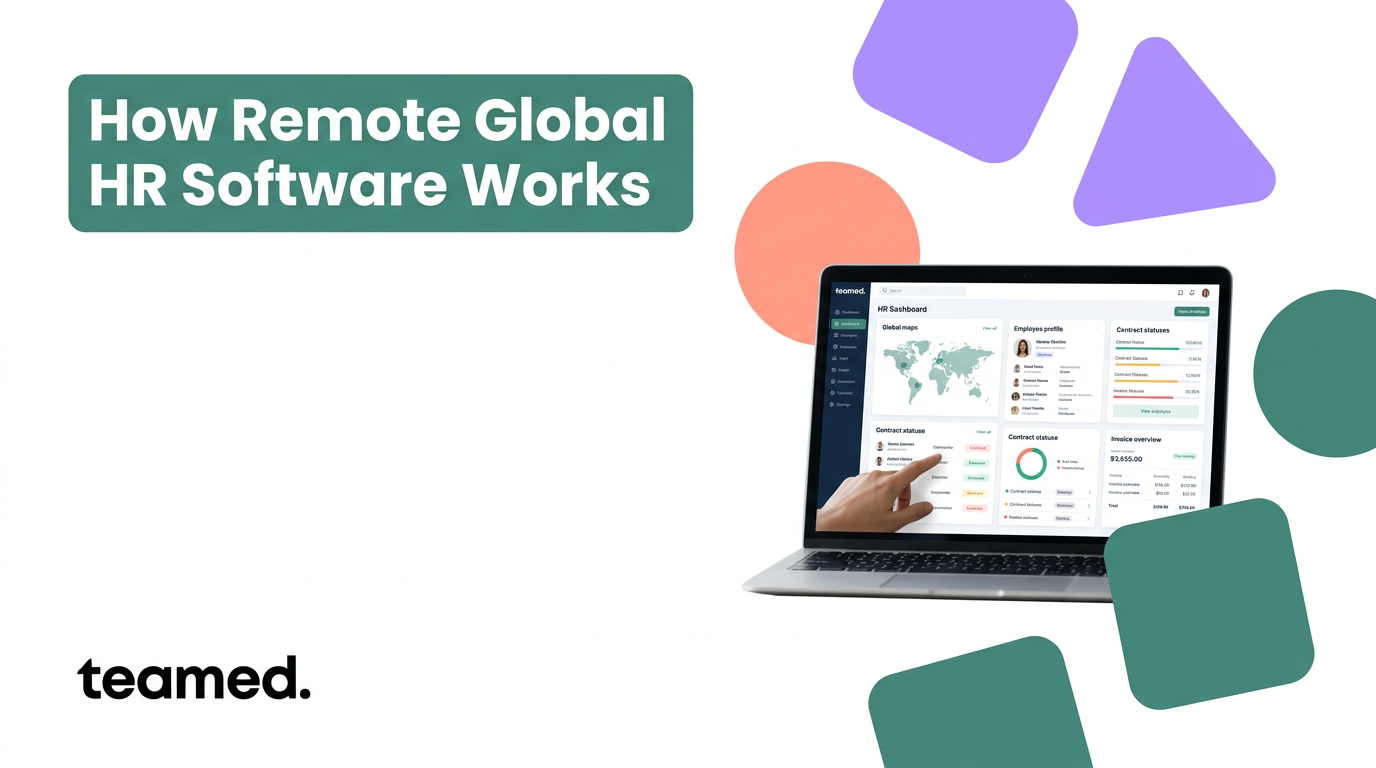
You've just acquired a team of 15 in the Netherlands, your CFO wants a single invoice for international payroll, and your current HRIS can't tell you which employees need Dutch holiday allowance calculations of at least 8% of gross annual salary versus UK statutory sick pay. Sound familiar?
Remote global HR software is a category of HR technology that centralises employee data, workflows, and reporting for teams employed across multiple countries while enforcing country-specific rules for payroll, benefits, and compliance. The distinction matters because most traditional HRIS platforms standardise global HR data without actually executing local statutory processes. That gap is where compliance failures happen.
For mid-market companies managing 50 to 1,000 employees across multiple countries, the challenge isn't finding HR software. It's finding software that understands employment law in Germany is fundamentally different from employment law in Spain, and that both require different payroll configurations, contract terms, and offboarding procedures than what you're running in the UK.
Remote global HR software must enforce country-specific payroll and employment compliance rules, not just standardise global HR data and workflows.
The EU General Data Protection Regulation allows supervisory authorities to impose administrative fines of up to €20 million or 4% of annual worldwide turnover for certain infringements, making HR data processing controls a board-level risk.
UK HMRC can assess unpaid tax and National Insurance for up to 6 years in most cases, and up to 20 years in cases involving deliberate behaviour.
According to Teamed's Graduation Model, the highest-cost mistakes occur when companies stay in the same hiring structure after headcount, permanence, and control signals have changed.
A defensible remote global HR software selection should include at least 25 documented requirements across data privacy, payroll controls, integrations, local benefits, and audit evidence.
Remote global HR software performs three distinct functions that traditional HRIS platforms typically cannot. First, it manages employee data across jurisdictions with country-specific field requirements. Second, it enforces local compliance rules for contracts, policies, and statutory entitlements. Third, it connects to payroll execution, whether through integrated payroll engines or Employer of Record arrangements.
The practical difference shows up immediately. In the Netherlands, employment terms, holiday allowances, and sick pay administration require precise policy configuration and payroll inputs. A "one global policy" approach is non-compliant without local rule mapping. In France, mandatory employee profit-sharing and participation schemes apply once companies reach 50 employees for 5 continuous years, which means global HR tooling must support country-specific compensation constructs rather than relying on generic bonus fields.
This is why remote global HR software differs from a traditional HRIS in a fundamental way. The HRIS gives you a single view of your workforce. Remote global HR software gives you a single view that actually works in each country where you employ people.
Compliance management is where remote global HR software earns its keep or fails spectacularly. The software must track and enforce requirements that vary not just by country, but sometimes by region within a country, by employee tenure, and by contract type.
In the UK, employers must provide a written statement of employment particulars from day one of employment. The UK Employment Rights Act 1996 requires this, and updates must be provided when particulars change. This makes contract version control and acknowledgement tracking a compliance requirement, not an HR preference. Your software needs to generate compliant contracts, capture digital signatures, and maintain an audit trail of every version.
In Germany, works council rights can affect HR technology rollouts where monitoring or performance-related data is processed. This makes works council consultation a project dependency for certain HR software features. In Spain, termination processes and severance calculations are highly formalised and documentation-driven, so remote global HR software must support country-specific offboarding workflows and evidence capture to reduce litigation exposure.
The compliance challenge compounds when you consider data protection. Under GDPR, cross-border HR data transfers outside the UK and EU typically require an approved transfer mechanism such as the UK International Data Transfer Agreement or EU Standard Contractual Clauses. This should be reflected in HR vendor data processing agreements and subprocessor lists.
The essential features fall into five categories, and most vendor marketing obscures which ones they actually deliver versus which ones require additional modules, integrations, or manual workarounds.
Country-specific contract generation means the software produces employment contracts that comply with local requirements, not templates you need to modify. In the UK, this includes the day-one statement of particulars. In France, this includes CDI versus CDD distinctions with appropriate clauses.
Localised payroll integration means the software either runs payroll directly or connects to payroll engines that handle statutory calculations, tax withholding, and social contributions for each country. The UK National Minimum Wage is legally enforceable and varies by age band, with rates from £8.00 to £12.71 depending on age in 2026, which means payroll configuration must map worker age, pay frequency, and working time records to prevent underpayment risk.
Policy management with local variations means you can set global policies while accommodating mandatory local requirements. Under the EU Working Time Directive, the average working week must not exceed 48 hours over a reference period unless the worker has opted out where permitted. Your software needs to track this.
Audit-ready documentation means the software maintains evidence of compliance actions, not just records of what happened. Contract versioning, policy acknowledgements, right-to-work checks, time and leave records, and payroll journals all need to be retrievable.
Integration capability means the software connects to your existing systems. According to Teamed's implementation risk assessment approach, the most common global HR implementation failure mode is integration scope creep across HRIS, payroll, finance, and identity systems. Define a minimum viable integration set of three to five systems before contracting.
Integration is where remote global HR software implementations succeed or fail. The question isn't whether the software can integrate. It's whether the integration maintains data integrity across systems without creating reconciliation nightmares.
A single-vendor global HR suite differs from a multi-vendor stack in that it reduces vendor reconciliation and data handoffs. A multi-vendor stack typically increases integration and data-governance effort across HR, payroll, benefits, and finance systems. But single-vendor suites often sacrifice depth for breadth, particularly in complex jurisdictions.
The integration chain of custody matters more than most buyers realise. You need to map the flow from HRIS to identity and access management, to payroll engine or EOR, to finance ERP, to expense and benefits providers. Each handoff is a potential failure point. Each system needs a clear data owner.
According to Teamed's GEMO operating model, global HR software value is highest when a single system of record is established for worker status, country, employing entity or EOR, compensation currency, and policy set. Inconsistent master data is the root cause of payroll and compliance rework. If your HRIS says an employee is in Germany but your payroll system has them coded as UK, someone is getting the wrong tax treatment.
This distinction determines your compliance liability, your cost structure, and your operational flexibility. Most vendor marketing blurs the lines, which creates problems when you need to understand who is actually responsible for getting employment right.
An EOR-backed remote global HR software model means an Employer of Record becomes the legal employer for workers in a specific country. The EOR runs local payroll, taxes, statutory benefits, and employment compliance while you direct day-to-day work. Choose this model when you need to hire in a new European country in weeks rather than months and you do not yet have an owned legal entity in that jurisdiction.
A direct employment model through global payroll means you have legal entities in each country, and the software helps you run compliant payroll and HR processes through those entities. Choose this when you have durable headcount in a specific country and need direct control over employment terms, local benefit design, and statutory filings under your own company registration.
An EOR-led international HR solution differs from a global payroll-only solution in that the EOR becomes the legal employer and assumes statutory employment responsibilities. Payroll-only solutions require your local entity to be the legal employer. The cost difference is significant. EOR fees typically run £400 to £600 per employee per month. Direct entity payroll costs run £100 to £200 per employee per month, but you're carrying the entity establishment and ongoing compliance costs.
This is where Teamed's Graduation Model provides clarity that most vendors avoid discussing. The Graduation Model describes the natural progression companies follow as they scale international teams, moving from contractors to EOR to owned entities. The transition points depend on headcount, commitment duration, and economic viability.
For Tier 1 countries like the UK, Ireland, Australia, Singapore, and the Netherlands, the entity threshold is typically 10 or more employees if your team operates in the native language. For Tier 2 countries like Germany, France, Spain, and Italy, the threshold rises to 15 to 20 employees due to stronger employee protections and more complex compliance requirements.
The economics work like this. At £7,500 per year EOR cost per employee and £3,500 per year own entity cost per employee including payroll, accounting, and compliance, with a £25,000 entity setup cost, a company with 10 employees in the UK breaks even at month 17. By year three, cumulative savings reach £95,000.
But the decision isn't purely economic. Consider transitioning when you have a 3-year or longer commitment to the market, when you need direct control over local operations or intellectual property protection, and when you have HR and legal resources capable of managing local compliance. Stay on EOR if you're still testing the market, if regulatory uncertainty is high, or if employees are spread across many countries with fewer than 10 total.
Integration challenges fall into three categories, and understanding them before you sign a contract saves months of frustration.
Data mapping challenges arise because different systems use different field structures, different country codes, and different employee identifiers. Your HRIS might use ISO country codes while your payroll system uses full country names. Your benefits platform might require employee IDs that don't match your HR system. These mismatches create manual reconciliation work that defeats the purpose of integrated systems.
Workflow synchronisation challenges arise because HR processes span multiple systems. Onboarding might start in your HRIS, trigger contract generation in your global HR platform, initiate payroll setup in your payroll system, and create accounts in your identity management system. If any step fails or delays, the entire process breaks.
Compliance evidence challenges arise because auditors want a single source of truth, but your data lives across multiple systems. Can you prove that an employee acknowledged a policy change? Can you demonstrate that payroll calculations matched the contract terms? Can you show that right-to-work checks were completed before the start date?
Centralised global HR management tools differ from country-by-country local providers in that they enable consolidated reporting and consistent controls. Local providers often deliver stronger in-country specificity but create fragmented data and inconsistent audit trails. The trade-off is real, and there's no perfect answer.
The selection process should start with your employment structure, not with feature comparisons. Are you using contractors, EOR, owned entities, or some combination? Which countries are you in today, and which are you likely to enter in the next two years? What's your headcount trajectory in each market?
Choose remote global HR software with native multi-country compliance workflows when you have employees in three or more countries and need consistent onboarding, document control, and policy acknowledgements without relying on local HR teams to interpret requirements.
Choose an EOR-backed model when you need to hire in a new country quickly and don't have an owned legal entity there. Choose a global payroll platform that integrates with your existing HRIS when the HRIS is your group system of record and you need multi-country payroll execution without re-platforming core HR.
Choose a single-vendor global HR suite when Finance requires one invoice cadence, one reconciliation process, and one audit trail for cross-border payroll and employer costs. Choose a provider that offers expert-led escalation rather than ticket-only support when you operate in regulated environments or have high termination and employee relations risk.
The honest answer is that most mid-market companies need a combination of software and advisory support. The software handles the repeatable processes. The advisory support handles the edge cases, the compliance questions, and the strategic decisions about when to change your employment structure.
Implementation timelines vary dramatically based on complexity. A straightforward implementation with one or two countries and clean data can complete in four to six weeks. A complex implementation with five or more countries, multiple employment models, and legacy system migrations can take three to six months.
The critical success factors are data quality, stakeholder alignment, and realistic scope. Most implementations fail not because the software doesn't work, but because the company underestimated the effort required to clean up employee data, align HR and Finance on processes, and define what "done" actually looks like.
According to Teamed's implementation risk assessment, the most common failure mode is integration scope creep. Start with a minimum viable integration set. Get that working. Then expand. Trying to integrate everything at once creates dependencies that delay the entire project.
Remote global HR software is not a commodity purchase. The right choice depends on your employment structure, your geographic footprint, and your tolerance for managing complexity versus outsourcing it. The wrong choice creates compliance gaps that only become visible during audits or terminations.
For mid-market companies managing international teams across multiple countries, the priority should be finding a partner who understands that global employment is genuinely complex. Not a platform that promises simplicity while hiding the complexity. Not a vendor that profits from keeping you in the wrong structure.
If you're evaluating remote global HR software and want an honest assessment of what you actually need, book your Situation Room. Tell us your setup, and we'll tell you what we'd recommend, whether that includes us or not. That's the kind of advice that's hard to find in an industry built on opacity.
.png)
Based on real client situations, amalgamated for anonymity.
If you have ever wondered what happens to your employees when the country they work in goes to war, this is what it actually looks like.
Teamed is the trusted global employment expert for seasoned global employers who need the right structure for where they are, and trusted advice for where they're going. This is part of a series drawn from real compliance situations our clients have faced, showing how we advise when the stakes are high and the answers are not straightforward.
Teamed has maintained active EOR operations in Ukraine throughout the conflict that began in 2022. This is not a single case study. It is a sustained operational reality across multiple clients, multiple employees, and multiple years of continuous adaptation.
When the conflict escalated, the immediate question from clients was not abstract. It was urgent: what happens to our people? Can we still pay them? Are they safe? Are we still compliant?
The honest answer was that every standard process needed to be re-examined. And many of them needed to change.
The questions from clients fell into patterns that revealed how unprepared most companies are for this scenario.
How do we make sure employees actually receive their pay when banking systems are disrupted? What happens if a male employee is called up for military service? What are our obligations around exemption documentation? Can we still provide health insurance when the insurance market has collapsed? What tax changes has the government introduced, and how do they affect our payroll calculations?
These are not questions any HR team expects to face. But when you employ people internationally, the world does not pause for your planning cycle.
The compliance landscape in Ukraine shifted repeatedly throughout the conflict, and Teamed adapted operations each time. The key areas required fundamentally different approaches from peacetime EOR.
Payroll continuity. Standard monthly payroll cycles became unreliable when banking infrastructure was disrupted. Teamed moved to a split payment schedule, with an advance payment mid-month and a final payment at month-end, to ensure employees maintained liquidity even when transfers were delayed. The priority was simple: people needed to be paid, reliably, regardless of what was happening around them.
Military compliance. Ukraine introduced military service obligations that directly affected male employees. Teamed implemented active monitoring of military exemption documentation, including tracking notification deadlines to territorial authorities when exemptions were due to expire. This is not a standard EOR service anywhere in the world. It became a non-negotiable requirement for compliant operations in Ukraine.
Health benefits restructuring. Group health insurance policies became unavailable due to regulatory restrictions during the conflict. Teamed restructured the benefits approach: employees purchase individual private health insurance, reimbursed through a taxable bonus. It is not the peacetime standard, but it maintains coverage when the peacetime standard no longer exists.
Wartime tax compliance. The Ukrainian government introduced wartime revenue measures, including increases to the military tax. Teamed updated payroll calculations to reflect each change as it came into force, ensuring clients remained compliant with a tax regime that was being rewritten in real time.
Documentation continuity. Employment record books and electronic pension fund records were maintained throughout the disruption. When systems are under strain, documentation gaps become compliance gaps. Teamed ensured that records remained intact and up to date despite the conditions.
The easy decision for an EOR provider would have been to withdraw from Ukraine entirely. Some did. That leaves employers with an impossible choice: abandon their employees in a conflict zone or scramble to find a provider willing to operate there.
For the employees themselves, the stakes were immediate. Disrupted payroll means people cannot cover basic needs during a crisis. Lapsed military documentation means legal exposure for both the employee and the employer. Gaps in health coverage mean no protection when protection matters most.
For the employers, the compliance exposure was significant. Wartime tax changes applied regardless of whether your provider had updated its systems. Military compliance obligations existed regardless of whether your provider was tracking them. The fact that conditions were difficult did not reduce the legal requirements. If anything, it increased the scrutiny.
Most EOR providers market themselves on how well things work when conditions are normal. This case is about what happens when conditions are anything but normal.
Teamed's continued operations in Ukraine demonstrate something that matters to every company employing people internationally: what does your provider actually do when the environment changes? Do they adapt, or do they freeze? Do they solve the problem, or do they tell you it is someone else's responsibility?
This connects directly to Teamed's positioning as a Global Employment Management and Operations (GEMO) provider rather than a platform. A platform processes payroll. GEMO means advising on the right structure for where you are, including when "where you are" is a country at war.
The Graduation Model applies here too, though not in the way most people expect. For some clients, the right structure in Ukraine shifted from full employment to contractor arrangements as circumstances changed. For others, maintaining employment through the conflict was both the right thing to do and the compliant thing to do. The answer depended on the situation. The right structure for where you are. Trusted advice for where you're going.
Companies are still hiring in Ukraine. The talent pool is strong, the costs are competitive, and the compliance path exists. But it requires a provider who has been operating there throughout the conflict, who understands the adaptations required, and who has the in-country relationships to make it work.
Can you still hire employees in Ukraine?
Yes. EOR operations in Ukraine remain viable, but they require a provider with direct experience of operating through the conflict. Payroll, tax, benefits, and military compliance have all changed significantly since 2022, and the regulatory environment continues to evolve. Companies considering Ukraine need full risk disclosure and a provider who can demonstrate continuous operational history in the country.
What are the military compliance obligations for employers in Ukraine?
Employers with male employees in Ukraine have obligations around military service documentation, including monitoring exemption status and notifying territorial authorities within required timeframes when exemptions expire. These obligations are real and enforceable. Failure to comply creates legal exposure for both the employer and the employee.
How does payroll work in Ukraine during the conflict?
Standard monthly payroll cycles may not be reliable due to banking disruptions. Adapted approaches, such as split payment schedules with advance and final payments, ensure employees maintain access to funds. Wartime tax measures, including changes to military tax rates, must be reflected in payroll calculations as they come into force.
Is health insurance still available for employees in Ukraine?
Group health insurance policies have been largely unavailable due to regulatory restrictions during the conflict. Alternative structures, such as individual private insurance reimbursed through taxable bonuses, can maintain coverage. The approach requires careful tax treatment to remain compliant.
What happens if an EOR provider withdraws from a conflict zone?
The employer is left with two bad options: abandon employees or find a replacement provider under pressure. Continuity of provider operations matters more in crisis conditions than in normal ones. When evaluating EOR providers, ask what their contingency is for geopolitical disruption, not just for payroll errors.
When should a company move from EOR to its own presence in-country?
The decision typically makes sense when you have a critical mass of employees in a market, a long-term commitment, and the capacity to manage local compliance. In conflict-affected countries, this calculation changes: the compliance burden is higher, the regulatory environment shifts faster, and having an experienced in-country partner becomes more valuable, not less. Teamed's Graduation Model guides this based on when the economics and risk profile genuinely shift in your favour.
Who is Teamed for?
Seasoned global employers. Companies with 50 to 1,000 employees, £10M to £1B revenue, employing five or more people internationally. The real qualifier is mindset: companies that value getting it right over getting it cheap. If you have employees in difficult markets and a provider who does not know what to do when conditions change, you already know why that matters.
The global employment industry profits from keeping companies where they are. When conditions change, most providers wait for someone else to figure it out. That is not how we earn our place.
Teamed is the trusted global employment expert for companies who need the right structure for where they are, and trusted advice for where they're going, from first hire to your own presence in-country. Over 1,000 companies across 180+ countries trust us because we give the honest answer, even when the situation is one nobody planned for.
Book your Situation Room. Tell us your setup, we will tell you what we would recommend, whether that includes us or not

You're rolling out HR systems across five countries simultaneously. Germany's works council consultation is stalling. The Netherlands payroll configuration is two weeks behind. Your Spain team just discovered a missing statutory registration. And nobody can tell you which delays actually threaten your go-live dates because the tracking lives in three spreadsheets, two project management tools, and someone's email inbox.
This is the reality for most mid-market companies deploying global HR systems. The problem isn't a lack of milestones. It's that milestone tracking becomes meaningless without clear ownership, evidence requirements, and escalation triggers that work across jurisdictions.
Teamed's GEMO (Global Employment Management and Operations) delivery benchmarks show that a practical mid-market global HR deployment takes 12-24 weeks for a single-country payroll and HR operating model, and 6-12 months for a multi-country rollout of 5-10 jurisdictions. The difference between hitting those timelines and watching them slip by months often comes down to how you track progress.
A milestone tracker is only operationally reliable when at least 95% of in-scope milestones have a named owner and a dated acceptance criterion.
A country go-live checklist typically contains 40-80 line items when it includes payroll setup, statutory registrations, benefits enrolment, employment-contract localisation, works-council checks, and data-protection controls.
Mid-market HR programmes commonly hold weekly operational stand-ups (30-45 minutes) and a steering committee every 2-4 weeks (45-60 minutes) during implementation.
A robust payroll parallel run typically requires at least 2 consecutive pay cycles of matched net pay within a defined tolerance before cutover.
A workable rollout cadence for mid-market Europe and UK deployments is 1-2 countries per month after the pilot go-live.
Any milestone that is more than 10 working days late or more than 5 working days blocked should trigger escalation to the steering committee.
Global HR deployment is a cross-country implementation programme that standardises core people processes (hiring, payroll, benefits, time, and offboarding) while preserving required local legal and tax rules in each jurisdiction. The complexity comes from the tension between wanting consistency across your organisation and needing to comply with wildly different regulatory requirements in each country.
An implementation milestone is a binary, evidence-based checkpoint that is considered complete only when defined acceptance criteria and audit-ready artefacts exist. This distinction matters because most tracking failures happen when teams mark milestones complete based on activity rather than outcome. "Payroll configuration started" is a task. "Payroll configuration tested with two parallel runs showing net pay variance under 1%" is a milestone.
The difference between a milestone and a task is the difference between knowing you're on track and hoping you're on track. When your CFO asks whether you'll hit the Germany go-live date, you need evidence, not optimism.
The milestones that matter fall into five categories, and missing any of them can derail your entire rollout. Here's what you're actually tracking.
Before you configure anything, you need statutory registrations complete in each country. In Germany, this means employer registration for payroll tax and social security processes. In the Netherlands, you need compliant employment documentation aligned with Dutch labour law and mandatory holiday allowance practices of at least 8% of gross annual salary. These aren't administrative formalities. They're legal prerequisites that block everything downstream.
Data migration planning belongs here too. A defensible approach is to sample-test at least 10-20% of migrated employee records per country against source-of-truth fields (name, address, tax IDs, salary, start date, bank details) before go-live. Discovering data quality issues during parallel runs is expensive. Discovering them after go-live is catastrophic.
Payroll configuration milestones need specific acceptance criteria tied to local requirements. France payroll implementations must account for mandatory payslip information requirements and common collective bargaining agreement rules that affect working time, allowances, and employee classifications. Spain implementations must reflect statutory requirements that impact payroll and time tracking, including social security contributions and specific termination documentation practices.
The parallel run milestone deserves special attention. Many Europe and UK teams use a tolerance of plus or minus 1% on net pay variances for like-for-like scenarios. Running old and new payroll side-by-side for at least two consecutive pay cycles is the fastest way to detect configuration errors before employees are paid incorrectly.
A compliance gate is a formal go/no-go control point that blocks a country go-live until statutory prerequisites are met. This includes tax and social security registration, compliant employment terms, and data-protection controls. The difference between a compliance gate and a soft launch is the difference between defensibility and liability.
GDPR applies to HR data processing for employees in the EU/EEA and UK, with potential fines of up to £17.5 million or 4% of annual turnover. Your deployment must document a lawful basis for processing, role-based access controls, retention periods, and cross-border transfer safeguards where applicable. This isn't a checkbox. It's a milestone with specific evidence requirements.
The go-live checklist for a single country typically runs 40-80 line items. This includes final payroll validation, benefits enrolment confirmation, employment contract distribution, works council sign-off where required, and data protection controls verification. Each item needs an owner, a due date, and documented evidence of completion.
The first three payroll cycles after go-live are milestones, not business as usual. You're validating that everything works under real conditions. Track variance rates, support ticket volumes, and time-to-resolution for issues. These metrics tell you whether your implementation actually succeeded or whether you just moved problems from one system to another.
Choose a single global milestone tracker when you have more than three countries in flight. Multi-tool tracking using email, spreadsheets, and local trackers prevents reliable dependency management and audit evidence collection. The tool matters less than the discipline of using one system as the single source of truth.
A milestone tracker is a single system-of-record (such as Jira, Asana, MS Project, or Smartsheet) that links each HR project milestone to an owner, due date, dependencies, risks, and documentary proof of completion. The key word is "links." Your tracker should connect milestones to the evidence that proves they're actually complete.
Every milestone needs a named owner, not a team. When Germany's works council consultation stalls, you need to know exactly who is accountable for unblocking it. A practical minimum documentation standard for audit-readiness is one stored artefact per milestone for 100% of compliance-critical milestones. This means registration confirmations, signed policies, configuration screenshots, test evidence, or legal approvals.
Your tracker should also capture dependencies explicitly. The Netherlands payroll configuration can't complete until statutory registrations are done. If you don't map that dependency, you'll discover it when someone asks why payroll is two weeks behind and nobody can explain it.
Manual HR deployment tracking differs from automated tracking because manual tracking relies on human updates and is prone to stale statuses. Automated tracking can enforce required fields (owner, due date, dependency) and attach evidence to each milestone. The automation doesn't need to be sophisticated. Even requiring a file attachment before a milestone can be marked complete eliminates most of the "I thought it was done" conversations.
This is the question that derails most global HR deployments. You want standardised processes across your organisation, but Germany requires works council consultation, France has extensive labour code requirements, and Spain has rigid collective bargaining rules. The answer isn't choosing one over the other. It's building a framework that accommodates both.
A country-based tracker differs from a process-based tracker because country-based tracking highlights jurisdictional dependencies (registrations, local benefits, language), while process-based tracking highlights end-to-end workflow readiness (hire-to-pay, time-to-pay, termination-to-final-pay). Most mid-market companies need both views. Your steering committee wants to know if Germany is on track. Your implementation team needs to know if payroll configuration is complete across all countries.
Choose wave-based deployments when at least two countries share the same payroll provider, language, or regional policy set. Shared configuration and documentation reduces duplicated milestone effort. A workable rollout cadence for mid-market Europe and UK deployments is 1-2 countries per month after the pilot go-live. Parallelising more than three countries typically increases dependency clashes between legal review, payroll configuration, banking, and data migration.
A steering committee differs from an implementation stand-up because a steering committee exists to resolve cross-functional decisions (scope, budget, risk acceptance) while stand-ups exist to remove blockers and update milestone status. You need both, and they serve different purposes.
Weekly operational stand-ups should run 30-45 minutes and focus on blocked milestones, upcoming dependencies, and immediate risks. The steering committee meets every 2-4 weeks for 45-60 minutes and handles decisions that require cross-functional alignment. When your Germany works council consultation requires a scope change that affects budget, that's a steering committee decision, not a stand-up discussion.
A RACI matrix is a governance tool that assigns who is Responsible, Accountable, Consulted, and Informed for each global HR implementation deliverable. This prevents gaps between HR, Finance, Legal, IT, and local stakeholders. The most common failure mode isn't missing milestones. It's milestones that nobody owns because everyone assumed someone else was handling them.
A common control threshold in multi-country HR implementations is to treat any milestone that is more than 10 working days late or more than 5 working days blocked as an escalation event for the steering committee. This sounds simple, but most organisations don't define these thresholds until they're already in trouble.
Choose a dedicated implementation owner per country when local legal steps require in-country coordination (registrations, benefits brokers, works councils, or local policy consultation). Central teams cannot reliably unblock local dependencies without a named local lead. This is especially true in Germany, where works council consultation may be required once a business has at least 5 permanent employees when HR systems materially change how employee data is processed or how performance and time data is monitored.
Your deployment timeline depends heavily on whether you're implementing for employees on EOR (Employer of Record), contractors, or your own entities. Each model has different milestone requirements and compliance gates.
Teamed's Graduation Model describes the natural progression companies follow as they scale international teams, from contractors to EOR to owned entities. The model matters for deployment tracking because each stage has different compliance requirements. EOR employees need different onboarding documentation than direct employees. Entity establishment adds statutory registration milestones that don't exist for EOR arrangements.
Choose a pilot-country-first rollout when you are implementing a new global HR operating model. A single pilot reveals data, payroll, and contract localisation issues before they multiply across jurisdictions. The pilot should be a country where you have strong local support and relatively straightforward compliance requirements. The UK is often a good choice for UK-headquartered companies because of the predictable legal framework and English operating language.
For companies approaching the crossover point where entity establishment becomes more cost-effective than EOR, deployment planning should include entity formation milestones. Tier 1 countries like the UK, Ireland, and the Netherlands typically require 2-4 months for entity establishment. Tier 2 countries like Germany, France, and Spain require 4-6 months. These timelines include entity incorporation, banking setup, tax registration, and employee transfer processes.
The best tool is the one your team will actually use consistently. That said, certain capabilities matter more than others for global HR deployment.
Dependency mapping is non-negotiable. Your tool must show which milestones block other milestones. Evidence attachment is essential for audit readiness. You need to store registration confirmations, test results, and sign-offs alongside the milestones they validate. Role-based access matters when you have local teams, central teams, and external advisors all working in the same tracker.
Choose a compliance-gated go-live process when your Legal and Compliance team must sign off statutory registrations, employment terms, and GDPR controls. A soft go-live creates retroactive tax and employment-law exposure. Your tracker should support formal approval workflows, not just status updates.
Choose parallel payroll runs when switching payroll providers or systems. Running old and new payroll side-by-side is the fastest way to detect configuration errors before employees are paid incorrectly. Your tracker should capture parallel run results as milestone evidence, including variance reports and reconciliation documentation.
The failures that derail global HR deployments are predictable. Unowned milestones behave like risks rather than plans. When nobody is specifically accountable for Germany's works council consultation, it drifts until it becomes a crisis.
Milestones without acceptance criteria create false confidence. "Payroll configured" means nothing without specific test results. "Payroll configured with two parallel runs showing net pay variance under 1% for 100% of employees" is a milestone you can actually verify.
Missing evidence creates audit exposure. When your auditors ask how you validated GDPR compliance for your Netherlands deployment, "we checked the box in our tracker" isn't an acceptable answer. One stored artefact per compliance-critical milestone is the minimum standard.
Tracking implementation milestones in global HR deployment isn't about having more milestones or fancier tools. It's about clear ownership, evidence-based completion criteria, and governance structures that surface problems before they become crises.
The organisations that execute global HR deployments successfully share common practices. They use a single tracker as the source of truth. They define acceptance criteria before work begins. They escalate blocked milestones quickly. And they treat compliance gates as non-negotiable checkpoints, not suggestions.
If you're planning a global HR deployment and want to understand how your employment structure affects your timeline, book your Situation Room. We'll review your current setup and help you build a milestone framework that accounts for the specific compliance requirements in each of your markets.

Switching from an Employer of Record to a Professional Employer Organisation when you already have a legal entity fundamentally shifts statutory employer liability from the EOR to your own company. This isn't a vendor swap. It's a transfer of legal responsibility that exposes your entity to direct payroll tax audits, employment claims, and regulator correspondence in that country.
Here's the thing most providers won't tell you: having a legal entity doesn't mean your entity is payroll-operational, nor does it automatically resolve permanent establishment considerations. Registration status, payroll capability, and employment-law governance are three distinct go/no-go gates. Missing any one of them during transition creates compliance gaps that can take months to resolve and cost significantly more than the savings you expected from the switch.
Teamed is the trusted global employment expert for companies who need the right structure for where they are, and trusted advice for where they're going. We've guided over 1,000 companies through these exact transitions, and the pattern is consistent: companies that treat EOR-to-PEO as a simple handover get burned. Companies that understand the liability shift and plan accordingly come out ahead.
UK HMRC can assess unpaid payroll taxes for up to 6 years, extending to 20 years for deliberate behaviour, meaning payroll errors during transition remain financially live long after cutover.
Mid-market companies typically require 6-12 weeks to complete an end-to-end EOR-to-entity payroll readiness cycle including registrations, payroll setup, and parallel run.
A compliant EOR-to-PEO handover generally requires at least one full parallel payroll run to validate statutory deductions, payslip compliance, and payment files before cutting over.
European HR and payroll processes commonly rely on 10+ separate employee-data fields that are compliance-critical, and missing any one can invalidate filings or contracts.
An EOR-to-PEO transition typically introduces at least two new regulated data flows compared with an EOR model, increasing GDPR accountability points and vendor oversight requirements.
CFO-led audit readiness typically requires reconciling three financial layers: gross-to-net payroll, employer on-costs, and vendor fees, because EOR invoicing often bundles costs differently than entity payroll ledgers.
An Employer of Record is a third-party organisation that becomes the legal employer of a worker in a given country and assumes primary responsibility for local payroll, tax withholding, statutory benefits, and employment-law compliance while you direct day-to-day work. A Professional Employer Organisation supports your HR, payroll operations, and benefits administration while your own legal entity remains the legal employer and retains direct statutory responsibility for employment compliance.
The distinction matters enormously. Under an EOR arrangement, the EOR issues employment contracts in its own name, handles terminations as the legal employer, and stands between you and local regulators. Under a PEO-supported entity model, your company issues the employment contract, your entity is the named filer for payroll tax and social security, and your company receives direct correspondence from labour inspectorates and tax authorities.
This isn't a subtle difference. It's the difference between having a buffer and being directly exposed.
Most companies assume that because they've registered a legal entity, they can simply "switch on" PEO support and start running payroll. This assumption creates the majority of compliance failures Teamed sees in transition scenarios.
A legal entity is a locally registered company that can contract with employees, register for payroll tax and social security, and be directly audited and sanctioned by local authorities for employment non-compliance. But registration alone doesn't mean you have payroll tax registrations completed, social security accounts established, bank accounts configured for salary payments, or the internal controls to sign off on payroll runs.
Consider a UK company that established a German GmbH six months ago for commercial purposes. The entity exists, but it may not have registered with the Finanzamt for wage tax, established a Betriebsnummer for social security (which requires choosing from 839 economic subclasses), or set up a German bank account for salary disbursement. Moving employees from an EOR to this entity without completing these steps means the first payroll run fails, employees don't get paid on time, and the company faces immediate regulatory scrutiny.
Teamed's GEMO operating-risk mapping identifies three distinct readiness gates: registration status, payroll capability, and employment-law governance. All three must be green before cutover.
An EOR-to-PEO transition creates a compliance risk window where the worker's employing entity, payroll processor, and benefits administrator may change on different dates. When these dates aren't synchronised, you get uninsured periods, unpaid social contributions, or incorrect tax withholding.
The most common failure pattern involves benefits continuity. An employee's health insurance terminates with the EOR on the 31st, but the entity's group policy doesn't activate until the 3rd of the following month. That three-day gap creates uninsured exposure that, depending on jurisdiction, can trigger both employee claims and regulatory penalties.
In Germany, works councils must be involved in certain HR measures where a works council exists. An EOR-to-entity move that changes employer, policies, or operational processes can require consultation or co-determination steps depending on the measure. Companies that skip this step face injunctions that halt the entire transition.
France requires a compliant payslip format with specific mandatory information. Non-compliant bulletin de paie practices trigger labour inspection issues, with employers facing fines of up to €450 per payslip not properly delivered. When you move from EOR-issued payslips to entity payroll, the localisation of payslip content becomes a critical control point that many companies overlook.
Switching from an EOR to a PEO shifts statutory employer liability from the EOR to your own legal entity. This typically increases your direct exposure to payroll tax audits, employment claims, and regulator correspondence in that country.
Under an EOR model, payroll registrations and filings sit under the EOR's local setup. The EOR is the named filer. Under a PEO model, your legal entity must hold the payroll tax and social security registrations and be the named filer where applicable. This means any errors in calculation, late filings, or incorrect withholding become your entity's problem, not the EOR's.
In the UK, employers must keep payroll records for at least 3 years after the end of the tax year they relate to. This creates a minimum multi-year evidence burden when migrating payroll responsibility. If your EOR didn't maintain adequate records, or if records don't transfer cleanly, you inherit a documentation gap that becomes visible only during an HMRC audit.
Employment claims work similarly. EOR offboarding is executed by the EOR as legal employer. PEO offboarding is executed by your entity. Legal review of notice periods, protected-category rules, and severance obligations becomes a client-owned control point. If your HR team isn't prepared to own termination compliance in Germany or France, you're taking on risk you may not be equipped to manage.
A compliant EOR-to-PEO transition follows a structured sequence that separates registration, capability, and governance readiness.
Step 1: Confirm entity registrations are complete. This means payroll tax registration, social security registration, and any industry-specific registrations required in that jurisdiction. In the Netherlands, this means timely wage tax (loonheffingen) and social security reporting capability through local payroll processes. In Spain, it means correct employee registration and contract documentation to avoid disputes over seniority, category, or termination entitlements.
Step 2: Establish payroll capability. This includes bank account setup, payroll software configuration, and validation that you can actually run a compliant pay cycle. Most companies underestimate this step. Payroll isn't just calculation; it's statutory reporting, payslip generation, and payment file creation that meets local banking requirements.
Step 3: Run a parallel payroll cycle. Teamed's GEMO transition methodology requires at least one full parallel payroll run to validate statutory deductions, payslip compliance, and payment files before cutting over. This catches calculation errors, missing data fields, and process gaps before they affect employees.
Step 4: Synchronise effective dates. The employee's employment contract transfer, payroll cutover, and benefits enrolment must align. A cutover timeline that prevents uninsured periods and incorrect statutory deductions requires explicit date coordination across all three workstreams.
Step 5: Transfer documentation and evidence trails. Employment files, payroll records, and compliance documentation must transfer from the EOR to your entity's systems. Under GDPR, this introduces new regulated data flows that require lawful basis mapping and international transfer assessments.
Most EOR vs PEO comparisons ignore data protection operational risk entirely. This is a significant oversight.
Under the EU General Data Protection Regulation, administrative fines can reach up to €20 million or 4% of annual worldwide turnover, with EU authorities issuing over €1.2 billion in fines in 2024 alone. Employee-data transfers during an EOR-to-PEO migration can create material compliance exposure even when payroll is correct.
An EOR-to-PEO transition typically introduces at least two new regulated data flows compared with an EOR model: entity payroll processing and entity benefits enrolment. Each new data flow requires clarity on controller vs processor roles, data processing agreements with vendors, and potentially a Data Protection Impact Assessment if the processing is high-risk.
The practical implication: you need to map which employee data transfers from the EOR's systems to your entity's systems, confirm lawful basis for that transfer, and ensure your PEO and any other vendors have appropriate data processing agreements in place. Companies that treat this as an afterthought face regulatory exposure that dwarfs the operational complexity of the payroll transition itself.
Choose a PEO-supported entity model when you already have a registered legal entity and can register locally for payroll tax and social security under your own name without relying on a third-party's registrations. Choose it when HR requires direct control over contracts, policies, and approvals and is prepared to own the legal sign-off process. Choose it when the country headcount is stable enough that you can justify building internal controls for payroll sign-off, statutory reporting, and employment file retention.
Choose an EOR over a PEO when you cannot yet obtain local employer registrations in time for the intended start date and the business needs legally compliant employment before the entity is operationally ready. Choose it when Legal/Compliance requires the third party to be the legal employer to ring-fence certain day-to-day employment compliance tasks during early market entry. Choose it when the company cannot reliably operate local employment lifecycle compliance in-country and needs a provider-led structure temporarily.
The Graduation Model, Teamed's proprietary framework for guiding companies through sequential employment model transitions, provides continuity across these decisions through a single advisory relationship. Rather than treating EOR-to-entity as a cliff where you lose your provider and start over, the Graduation Model maintains institutional knowledge and accountability throughout the transition.
UK TUPE (Transfer of Undertakings (Protection of Employment) Regulations 2006) can apply when employees transfer between employers as part of a business transfer or service provision change. Moving workers from an EOR employer to your UK entity can trigger mandatory information and consultation duties in applicable scenarios. Companies that don't assess TUPE applicability face employee claims and potential injunctions, with tribunals able to award up to 13 weeks' uncapped gross pay per affected employee for consultation breaches.
UK IR35 rules require medium and large organisations to assess off-payroll worker status. HMRC can assess unpaid tax liabilities for up to 6 years, making contractor-to-employee or EOR-to-entity restructures a high-scrutiny area. If your EOR arrangement involved any workers who might be characterised as contractors, the transition is an opportunity for HMRC to examine historical status determinations.
In France, the standard limitation period for recovering unpaid social security contributions is generally 3 years, extended to 5 years in certain situations. This makes backdated corrections a material risk when changing the operating model midstream. If your EOR made calculation errors, those errors may become your entity's liability to resolve.
CFO-led audit readiness for an EOR-to-PEO shift typically requires reconciling three financial layers: gross-to-net payroll, employer on-costs, and vendor fees. EOR invoicing often bundles costs differently than entity payroll ledgers, creating reconciliation challenges that surface during financial audits or due diligence processes.
Teamed's Three Layers of Opacity framework identifies the three ways the EOR industry obscures costs: hidden FX margins, bundled compliance fees, and undisclosed in-country partner markups. When you transition to your own entity, these bundled costs unbundle, and you need to understand what you were actually paying for to budget accurately going forward.
The documentation requirements extend beyond payroll. A document-level control list covering payroll reports, employment files, DPIAs, vendor DPAs, and record-retention requirements is essential for an EU/UK audit-ready transition. Most sources gloss over evidence and audit trails, but this is where transitions fail during subsequent due diligence or regulatory examination.
Switching from an EOR to a PEO when you have a legal entity isn't a vendor swap. It's a fundamental change in who bears legal responsibility for employment compliance. Your entity becomes directly exposed to payroll tax audits, employment claims, and regulatory correspondence. The transition window creates specific risks around benefits continuity, data protection, and documentation transfer that require explicit planning to manage.
The companies that navigate this successfully treat the transition as a project with distinct readiness gates, not a simple handover. They confirm entity registrations are complete, establish payroll capability, run parallel cycles, synchronise effective dates, and transfer documentation systematically.
If you're considering this transition and want to understand exactly what it means for your specific situation, book a Situation Room session. We'll review your current setup and tell you what we'd recommend, whether that includes us or not. The right structure for where you are, trusted advice for where you're going.
You've just acquired a team of 15 engineers in the Netherlands, where the tax wedge reaches 35.1% for average single workers. The board wants them employed properly within 30 days. You don't have a Dutch entity, and setting one up would take months you don't have.
This is the moment most mid-market companies discover Employer of Record services. Teamed is the trusted global employment expert for companies who need the right structure for where they are, and trusted advice for where they're going, from first hire to your own presence in-country. An Employer of Record is a third-party legal employer that hires workers on its local entity, runs compliant in-country payroll and statutory benefits, and assumes employment-law obligations while the client company directs day-to-day work.
But here's what most EOR guides won't tell you: the real complexity isn't understanding what an EOR does. It's knowing when EOR is the right answer, when it stops being the right answer, and how to avoid the hidden costs that erode your budget without ever appearing on an invoice.
Standard in-country EOR onboarding for a single employee is commonly completed in 5-15 business days once right-to-work checks, agreed compensation, and compliant benefits selections are finalised.
EOR commercial pricing for mid-market Europe and UK commonly includes a fixed per-employee-per-month fee plus pass-through statutory costs, with fixed fees most often sitting in the €300-€800 per employee per month band depending on country complexity and benefit design.
UK HMRC can assess underpaid tax liabilities for up to 4 years in standard cases and up to 6 years for careless behaviour, with a 20-year window where deliberate behaviour is found.
The effective all-in cost of employment is often materially higher than base salary once employer social charges, statutory benefits, insurance, and paid leave are included, with non-wage costs accounting for 25.5% of total labour costs in the euro area.
EOR programs become operationally harder to govern once a company has employees across 5+ countries because payroll cut-offs, statutory filing calendars, and benefit renewals vary by jurisdiction.
An EOR becomes the legal employer of your workers in countries where you don't have your own entity. The EOR signs the employment contract, runs local payroll under its registrations, handles statutory tax and social filings, and manages compliant termination support. You direct the day-to-day work. The EOR handles everything that makes employment legally compliant in that jurisdiction.
This arrangement differs fundamentally from contractor engagement. EOR is designed for employment relationships with statutory benefits and employment protections. Contractor engagement is designed for independent businesses and carries misclassification exposure if the facts resemble employment. Teamed's analysis of mid-market deployments across Europe and UK shows that misclassification risk is one of the primary drivers pushing companies from contractors to EOR.
The operational reality involves far more than payroll processing. Employment terms in Europe frequently require locally compliant written contracts covering working time, pay frequency, holiday entitlement, and probationary conditions. EOR templates must be local-law specific rather than a single global contract format. Right-to-work verification is a country-specific compliance requirement, and the EOR must complete local checks before employment starts to avoid illegal working penalties.
The compliance burden of international employment is substantial and jurisdiction-specific. Many European jurisdictions require specific termination processes and mandatory notice periods, which makes "at-will" style termination language non-compliant for Europe-based employment contracts. An EOR absorbs this complexity by maintaining local legal expertise and updated contract templates for each jurisdiction.
Consider a UK company expanding into Germany. German works councils become mandatory at 5+ employees if employees request them. Complex dismissal protection kicks in after 6 months. Notice periods range from 4 weeks to 7 months based on tenure. An EOR with genuine German expertise handles these requirements without you needing to become a German employment law specialist.
GDPR requires a written data processing agreement when an EOR processes HR personal data on a client's behalf as a processor. The agreement must define processing instructions, security measures, and sub-processor controls for cross-border HR operations. Administrative fines for certain GDPR infringements can reach up to €20 million or 4% of worldwide annual turnover, whichever is higher.
The primary cost advantage of EOR is avoiding entity establishment costs and ongoing entity administration burden. Entity formation and local payroll setup in many European jurisdictions takes weeks to months rather than days. For companies testing a new market or managing a small team in a single country, EOR eliminates the upfront investment and ongoing overhead of maintaining a legal entity.
Scalability works in both directions. You can add employees in new countries within days rather than months. You can also exit markets without the complexity of winding down a legal entity. This flexibility is particularly valuable during M&A integration, market testing, or when headcount in a country is uncertain.
But here's the honest answer: EOR isn't always the cheapest option long-term. Every EOR customer has a crossover point where the per-head cost of EOR exceeds the amortised cost of setting up and administering their own entity. Teamed's Crossover Economics methodology helps companies identify when entity setup becomes the lower-cost structure based on country-specific employer on-costs, provider fees, and one-off entity formation costs.
An EOR differs from a PEO in that an EOR is the legal employer on its own local entity, while a PEO typically supports a client that remains the legal employer on the client's entity. This distinction matters enormously for companies without existing local presence.
A Professional Employer Organization is a co-employment provider that usually requires the client to have a local entity and shares certain HR administration responsibilities rather than acting as the sole legal employer. If you don't have an entity in Germany, a PEO can't help you employ someone there. An EOR can.
Choose an EOR when you need to hire in a European or UK country within the next 30 days and you don't have, or don't want to maintain, a local employing entity in that country. Choose a PEO when you already have a local employing entity and you want outsourced HR administration support without transferring the legal employer role to a third party.
The risk allocation also differs significantly. EOR providers typically contractually limit liability and require client cooperation on compliant HR decisions. Entity employment concentrates statutory liability directly with the company and increases the need for in-house or retained local counsel. Understanding this distinction helps you evaluate what you're actually buying when you engage an EOR.
Choose an EOR when legal and compliance teams require a single accountable legal employer for local contracts, payroll, and statutory filings while the business tests a new market or post-acquisition footprint. The speed advantage is substantial. You can have employees on payroll in a new country within days rather than the months required for entity establishment.
Choose a local entity when you expect to employ 10+ people in the same country for 12+ months and you need direct control over local benefits, equity plan execution, or works council processes, while managing permanent establishment considerations. Some enterprise customers require contracting with local entities. Certain IP structures require own entities. Direct bank account control may be needed.
Teamed's Graduation Model provides a framework for this decision. The model describes the natural progression companies follow as they scale international teams, from contractors to EOR to entity. The optimal transition point varies by country complexity. Low-complexity countries like the UK, Ireland, and Singapore justify entity setup at 10+ employees. High-complexity countries like Brazil, India, and China may warrant staying on EOR until 25-35+ employees.
Stay on EOR if you're in your first 1-2 years in a new market while validating product-market fit, if the regulatory environment is unstable, or if you lack local HR and legal expertise. The EOR fee effectively serves as an insurance premium against labour court battles and compliance errors in high-complexity jurisdictions.
Most EOR selection advice focuses on features and pricing. But the real differentiator is what happens when something goes wrong. EOR termination support in Europe routinely requires country-specific notice periods and statutory separation steps. Offboarding lead time is a critical timeline risk because employment end dates are frequently constrained by local mandatory notice rules.
Start with the provider's actual presence in your target countries. Some EOR providers operate through undisclosed in-country partner networks rather than their own entities. This creates a layer of opacity between you and the people managing your employees' compliance. Ask directly: do you operate your own entity in this country, or do you subcontract to a local partner?
Examine the invoice structure carefully. Teamed's Three Layers of Opacity framework identifies the three ways the EOR industry obscures costs: hidden FX margins, bundled compliance fees, and undisclosed in-country partner markups. FX and funding mechanics are a material driver of EOR total cost because many providers invoice in a base currency while payroll is paid in local currency. Undisclosed FX spreads and conversion timing are one of the most frequent causes of invoice variance in Europe and UK multi-country EOR programs.
Demand line-item breakdowns. A CFO should be able to see exactly what they're paying for: base salary, employer social contributions, statutory benefits, provider fee, and any currency conversion costs. If a provider can't or won't provide this breakdown, that's a red flag.
The biggest pitfall is optimising for onboarding speed while ignoring offboarding complexity. Most EOR guides don't explain termination and offboarding risk. In Europe, notice periods, mandatory process steps, and documentation requirements drive timeline and cost outcomes more than onboarding speed. A provider that can onboard in 24 hours but takes three months to resolve an offboarding in Finland isn't actually serving your interests.
Another common mistake is assuming all EOR providers offer equivalent compliance coverage. Some providers route complex cases to chatbots or offshore queues. When you're dealing with a works council dispute in Germany or a redundancy process in France, you need someone who picks up the phone and knows the answer.
Choose a consolidated global employment partner when you operate across multiple European jurisdictions and need consistent controls for onboarding, payroll approvals, data processing, and offboarding across all countries under one governance model.
EOR programs become operationally harder to govern once a company has employees across 5+ countries. Payroll cut-offs, statutory filing calendars, and benefit renewals vary by jurisdiction. Teamed's GEMO (Global Employment Management and Operations) approach treats multi-country calendar management as a core control for audit readiness.
The right tracking approach depends on your scale and complexity. For companies with fewer than 20 international employees, a well-structured spreadsheet tracking payroll dates, contract renewals, and compliance deadlines may suffice. Beyond that threshold, you need integrated visibility across your entire international workforce.
Look for platforms that consolidate contractors, EOR employees, and owned entities in a single view. The goal is making strategic employment decisions with complete information, not reconciling data across multiple systems. Your CFO should be able to model "gross-to-total-employer-cost" by country rather than comparing salaries alone when evaluating EOR versus entity economics.
This is the question most EOR providers are structurally incentivised never to answer. Every month past the crossover point is pure margin for them.
Choose to graduate from EOR to entity when your forecast shows sustained in-country hiring and the economics indicate entity run-costs plus local payroll are likely to undercut EOR fees within a defined payback period. For a UK company with 10 employees, the break-even point often arrives around month 17 when comparing EOR fees of approximately £7,500 per employee per year against entity costs of approximately £3,500 per employee per year plus £25,000 setup costs.
The Graduation Model isn't about leaving EOR. It's about evolving beyond it when the numbers support the transition. A provider aligned with your interests will proactively surface this conversation rather than hoping you never ask the question.
The global employment industry profits from keeping companies where they are. Providers benefit when customers stay in the same structure whether it's right for them or not.
The right approach is different. You need the right structure for where you are today, and trusted advice for where you're going. That means honest guidance on when EOR makes sense, when entity establishment becomes the better answer, and how to execute transitions without compliance disasters.
If you're managing international employment across multiple countries and wondering whether your current structure is still serving you, book your Situation Room. Tell us your setup, and we'll tell you what we'd recommend, whether that includes us or not.
Your team just acquired 15 employees in the Netherlands, you've got contractors in California who probably should be employees, and Germany's works council rules are about to apply because you crossed the five-employee threshold last month. Meanwhile, France changed its payroll reporting requirements again, and nobody flagged it until the deadline passed.
This is the reality of HR operations compliance with labor laws across multiple jurisdictions. Teamed is the trusted global employment expert for companies who need the right structure for where they are, and trusted advice for where they're going. The challenge isn't understanding that laws differ between California and California-the-country-sized-Germany. The challenge is building operational systems that catch changes before they become compliance failures, document decisions in ways that survive audits, and scale without requiring a legal team in every country.
Most guidance on multistate labor law compliance and international HR compliance tells you to "stay updated on laws" without explaining how. This article provides the operational framework HR leaders actually need.
In the Netherlands, employers must continue paying at least 70% of wages during sickness for up to 104 weeks, making local cost modelling essential before hiring.
UK off-payroll working (IR35) assessments can reach back 6 years for unpaid income tax and National Insurance contributions, plus interest and penalties.
Germany's unlawful employee leasing, which occurs when assignments exceed 18 consecutive months, can trigger administrative fines reaching €500,000 under the Temporary Agency Workers Act (AÜG).
Spain requires companies to keep daily records of specific start and end times for all employees, making time tracking a compliance requirement rather than an HR preference.
France requires employers with 11 or more employees to organise Social and Economic Committee (CSE) elections, affecting consultation timelines and change management, while Germany requires works councils at just five employees.
When we're called in after a compliance scare, we see the same three failures: employment contracts missing mandatory local clauses, payroll filings that stopped happening when someone left, and contractor arrangements with zero documentation about why they're contractors.
Labor law compliance is an HR operations discipline that ensures hiring, contracting, payroll, time, leave, benefits, and termination practices meet the mandatory employment rules of each jurisdiction where people work. The key word is "where people work" rather than where your headquarters sits.
This distinction matters because remote work creates local payroll, social security, and employment rights exposure even when the employer is headquartered elsewhere. A UK company with an employee working from their apartment in Barcelona has Spanish employment law obligations, not British ones. Teamed's operating guidance treats "where the work is performed" as the primary jurisdiction trigger for employment law obligations.
Multistate labor law compliance applies when employees are located in different sub-national jurisdictions, such as US states or Swiss cantons, and HR must meet both national and local requirements without conflicts. International HR compliance extends this to country-level rules on contracts, working time, statutory benefits, tax and social security, employee representation, and termination processes.
The operational mechanism HR needs isn't a policy document. It's an auditable legal-change intake workflow with owners, effective dates, evidence artifacts, and rollback plans.
A compliance control library is a structured catalogue of jurisdiction-specific HR requirements mapped to HR processes, owners, evidence, and review dates. For each country where you employ people, this includes payslip fields, probation rules, notice periods, statutory leave entitlements, and mandatory benefits.
Consider a 400-person UK company expanding into Germany, Spain, and the Netherlands. Their control library would document that Germany requires written employment contracts before the start date, Spain caps probation at 6 months for qualified technicians and 2 months for others, and the Netherlands requires 70% salary continuation during sickness for up to 104 weeks.
Each entry needs an owner, a source document, an effective date, and a review trigger. Without this structure, policy updates happen by email, templates drift out of compliance, and audit evidence becomes impossible to reconstruct.
Here's the workflow that works: alerts come from local counsel or your provider, someone qualified decides if it affects you, templates and payroll settings get updated by deadline, and you file the decision and proof somewhere findable.
Teamed's operating guidance recommends documenting every jurisdiction change in a single compliance decision record that includes rule source, effective date, impacted populations, and rollback plan. Evidence quality often determines audit outcomes, not whether you eventually got the rule right.
Choose a quarterly compliance review cadence when you have employees in five or more countries. Legal changes cluster around annual budget cycles, statutory rate changes, and new reporting obligations. Quarterly reviews catch these before they become problems.
Both mean juggling different rules, but US states pile complexity through accumulation while countries hit you with completely different systems. One's death by a thousand cuts, the other's navigating parallel universes.
Multistate programs usually share one tax and social security system. California, Texas, and New York all operate within the US federal framework for Social Security and Medicare, even though state-level employment laws vary dramatically. International programs require separate registrations, statutory benefit schemes, and payroll reporting per country.
California presents particular complexity within the US context. Meal and rest break compliance, final pay on termination day, and extensive leave entitlements create requirements that exceed federal standards significantly. New York adds its own layers. Companies with employees spread across five or more US states face cumulative compliance burden that often justifies staying on an Employer of Record longer than headcount alone would suggest.
The structural decision layer matters here. Teamed's Graduation Model frames cross-border hiring choices as a progression from Contractor to EOR to Entity, positioning compliance risk as the primary driver of graduation when headcount, permanence, and local control increase. Sometimes changing the employment structure removes entire categories of compliance exposure.
Global policy templates and local contract templates serve different purposes. Policies can often be standardised with local addenda, while employment contracts usually require country-specific mandatory clauses to be enforceable.
UK employers must provide a written statement of employment particulars from day one of employment under the Employment Rights Act 1996. Germany's Posted Workers rules require foreign employers posting workers to Germany to meet German minimum wage and certain working condition requirements. France's Code du travail creates extensive procedural requirements for termination that don't exist in at-will US states.
Choose a single global HR policy framework with local addenda when you must standardise ethics, data handling, and approvals. Jurisdiction-specific employment rules typically require localised appendices rather than entirely separate global policies. This approach maintains consistency where possible while accommodating mandatory local variations.
EU GDPR applies to HR data processing and requires a lawful basis, data minimization, and appropriate technical and organisational measures. Cross-border transfers require mechanisms such as Standard Contractual Clauses when data leaves the UK or EU. Data protection compliance intersects with employment compliance in ways that require coordinated governance.
Teamed's compliance methodology treats country-level payroll compliance as a three-part control set: registration, calculation, and reporting. Failures typically occur in one of these three stages rather than in payroll processing itself.
Registration failures happen when you employ someone in a jurisdiction without proper employer registration. Calculation failures occur when statutory contributions, tax withholdings, or benefit accruals use incorrect rates or formulas. Reporting failures mean you calculated correctly but filed late, filed incorrectly, or failed to retain documentation.
Reactive compliance tracking updates templates after issues arise. Proactive compliance governance assigns owners, effective dates, and evidence requirements before the rule is enforced. The difference determines whether audits find documentation gaps or documented decisions.
Auditors look for missing local contract clauses, incomplete payroll statutory reporting, and undocumented worker classification rationales. These are the easiest gaps to evidence because they either exist in your files or they don't.
Worker classification assessments require particular attention. A documented test determines whether a person should be treated as an employee or independent contractor based on local legal criteria such as control, substitution, integration, and economic dependency. Choose a contractor arrangement only when the individual can genuinely control how and when work is delivered, can substitute another person to do the work, and is not managed as an integrated team member.
UK IR35 off-payroll working rules require medium and large end clients to issue a Status Determination Statement for each engagement and apply PAYE when the engagement is "inside IR35." The documentation requirement isn't optional, and the lookback period creates significant exposure for undocumented decisions.
When an organisation operates in multiple countries, HR strategy must shift from policy-first thinking to structure-first thinking. The employment model you choose, whether contractor, EOR, or owned entity, determines which compliance obligations apply.
Choose local legal counsel plus an internal HR compliance owner when you have an existing entity in-country and at least 10 employees there. Ongoing works council requirements, termination procedures, and policy updates become continuous rather than transactional at this scale.
Choose an Employer of Record when you need to hire in a country where you have no entity and you need compliant payroll, statutory benefits, and employment contracts in place in weeks rather than months. An EOR becomes the legal employer in-country and assumes employment administration, while an entity makes you the legal employer and shifts compliance execution and liability to your internal operations.
Choose entity setup when the country will be a strategic long-term location and you expect recurring hiring. Entity ownership enables direct employment, local benefits design, and stronger control over compliance processes. Based on Teamed's work with over 1,000 companies across 70 countries, the optimal transition point varies by country complexity. Low-complexity countries like the UK, Ireland, and Singapore justify entity setup at 10 employees. High-complexity countries like Brazil, India, and China may warrant staying on EOR until 35 or more employees.
Choose a centralised compliance control library when you operate across three or more jurisdictions. Policy-by-email and ad hoc template updates don't scale and create inconsistent evidence during audits.
Most sources treat compliance as a policy problem without mapping jurisdiction changes to payroll control points and concrete evidence logs. Technology helps, but only when it connects to operational workflows.
A global HRIS can centralise employee data and flag jurisdiction-specific requirements, but it won't replace the legal-change intake process. Compliance tracking tools can monitor regulatory changes, but someone still needs to assess impact, update templates, and document decisions.
Forget fancy platforms. Start with a simple table: which rules apply to whom, when they last changed, who owns each country, where the proof lives. One source of truth beats five half-integrated systems.
Spain's time recording rules illustrate this point. Companies must keep daily records of working time for employees and retain them for 4 years. Time tracking tooling and audit-ready retention become compliance requirements rather than HR preferences. The technology choice matters less than whether it produces defensible documentation.
GEMO is our shorthand for having one team handle everything: choosing the right structure, running payroll, managing compliance, and navigating the operational mess in between. No handoffs, no knowledge resets, no finger-pointing between vendors.
The concept addresses a gap in how most companies approach international employment. They treat EOR as one vendor relationship, entity setup as another, local payroll as a third, and compliance consulting as a fourth. Coordinating separate providers for each stage and each country creates significant overhead that Teamed estimates at £50,000 to £150,000 annually in coordination costs alone for mid-market companies operating in 5 to 15 countries.
A single supplier with GEMO capability manages global employment from day one through EOR, advises when entity establishment makes economic and operational sense, executes the transition, and continues managing entity operations post-transition. The supplier relationship remains constant while the underlying employment model evolves.
This matters for compliance because institutional knowledge doesn't reset with each provider transition. The team that handled your German EOR compliance understands your German operations when you graduate to your own entity. Documentation carries forward. Relationships with local authorities continue.
The honest answer is that international employment compliance is genuinely complex. Anyone who tells you otherwise is selling simplicity that hides real risk. The question isn't whether complexity exists but whether you have systems to manage it.
Most mid-market companies don't need employment lawyers in every country. They need a compliance control library that documents what rules apply where, a legal-change intake process that catches updates before deadlines pass, evidence artifacts that survive audits, and an employment structure that matches their actual risk profile in each market.
If you're managing employees across multiple states or countries and your current approach involves hoping nothing goes wrong, there's a better way. Book your Situation Room to review your current setup and get honest advice on what structure makes sense for where you are and where you're going, whether that includes Teamed or not.


© Copyright Teamed Ltd 2025 • All rights reserved