SSP Transitional Rules for Ongoing Sickness Absence
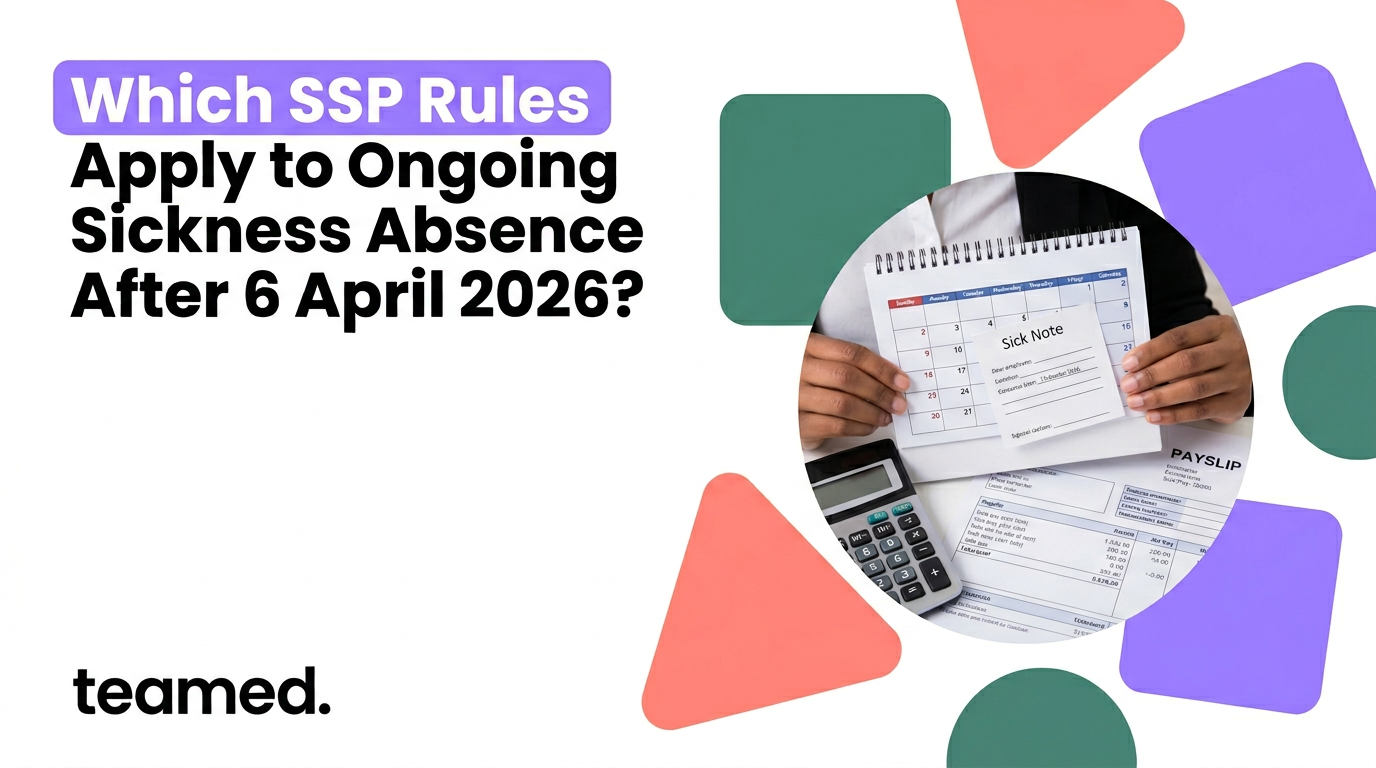
Your employee went off sick in March 2026. They're still absent in May. Which SSP rules apply now?
This question is keeping payroll teams across the UK awake at night, and for good reason. The Employment Rights Act 2025 reforms that took effect on 6 April 2026 created a situation where two SSP regimes now coexist temporarily. The start date of the absence determines which rules apply, not the date you're processing payroll. Get this wrong, and you're either underpaying employees or overpaying and unable to recover the difference.
The transitional rules governing SSP for sickness absences spanning 6 April 2026 are genuinely complex. Most guidance currently available buries the critical decision points in paragraph-heavy summaries that don't help when you need to make a payroll call. This guide provides scenario-based treatment with clear decision logic that payroll teams can actually use.
Quick Facts: SSP Transitional Rules April 2026
The UK's SSP reform date triggering transitional rules is 6 April 2026. The maximum SSP entitlement period remains capped at 28 weeks per employee. The latest practical end date for any pre-6 April 2026 SSP regime exposure is 17 October 2026, calculated as 28 weeks after the reform date for absences already running on that date. An SSP linking window of 56 days (8 weeks) determines whether separate sickness spells are treated as connected for SSP purposes. A two-regime SSP environment exists for up to 28 weeks after 6 April 2026 because absences that started before that date continue under old SSP logic while new absences follow new logic. The single most important data field for auditability during SSP transition is the original absence start date.
Why Do SSP Transitional Rules Exist?
The transitional rules exist because the UK government couldn't simply switch every employee to the new SSP regime overnight. Employees already receiving SSP before 6 April 2026 had legitimate expectations about their entitlement under the rules in place when their absence began. Changing their payment mid-absence without protection would create unfairness and administrative chaos.
The core principle is straightforward: the start date of the absence determines which rules apply. If your employee's current sickness absence began before 6 April 2026 and continues beyond it, the pre-6 April rules govern their SSP entitlement. If their absence started on or after 6 April 2026, the post-reform rules apply from day one.
This creates a period where payroll teams must run two parallel SSP calculation pathways. One pathway applies pre-6 April logic for continuing absences. The other applies post-6 April logic for new absences. Both pathways may need to operate simultaneously through October 2026, according to Teamed's implementation guidance for mid-market employers managing UK payroll compliance.
What Happens When an Employee Was Already on SSP Before 6 April?
When an employee was already receiving SSP before 6 April 2026 and their sickness continues beyond that date, the old rules apply for the duration of that absence. They continue receiving the uprated flat rate of £123.25 per week. The transitional protection ensures they do not receive less under the new calculation method than they would have received under the old rules.
Rate protection kicks in automatically. If the post-reform SSP calculation would produce a lower payment than the pre-reform flat rate, the employee receives the higher amount. This protection is a safeguard, not a calculation method. You're not recalculating SSP from first principles under the new rules and then comparing. You're simply ensuring the employee isn't worse off because the rules changed mid-absence.
The transitional protection continues until one of three events occurs. First, the employee returns to work. Second, their 28-week SSP entitlement expires. Third, the latest possible end date of 17 October 2026 arrives for continuous pre-6 April cases. Whichever comes first ends the transitional period for that employee.
What If an Employee Was in Waiting Days on 6 April 2026?
This scenario catches many payroll teams off guard. Under the pre-6 April rules, employees served three unpaid waiting days before SSP became payable, affecting 70% of sickness absences that lasted between one and three days. If an employee fell ill on 3 April 2026 and was still absent on 6 April, they would have been in their waiting days when the reform took effect.
Here's the critical rule: SSP becomes payable from 6 April 2026 for these employees. The waiting days before that date are not back-paid. The pre-reform waiting days remain governed by pre-reform rules, meaning they stay unpaid. But from 6 April onwards, SSP is payable if the absence continues.
Consider a mid-market company with an employee who started their sickness absence on 4 April 2026. Under the old rules, days one through three would be waiting days with no SSP. Day four would be 7 April, the first payable day. Under the transitional rules, 6 April becomes the first payable day because the new regime eliminates waiting days and the employee is still absent on that date.
The employee doesn't get SSP for 4 and 5 April. Those days occurred under the old regime and remain subject to old-regime waiting day rules. But they do get SSP from 6 April forward.
Can Previously Ineligible Employees Become Eligible on 6 April?
Yes, and this is a scenario most competitor guidance ignores entirely. An employee who was off sick before 6 April 2026 but was ineligible for SSP due to earning below the Lower Earnings Limit may become eligible from 6 April under the new rules if their absence continues.
The post-6 April SSP regime changed eligibility criteria. If an employee was continuously absent but previously ineligible under pre-reform rules, payroll must reassess their eligibility from 6 April 2026 under the new sick pay rules. You cannot simply assume ineligibility persists because it applied before the reform date.
Teamed's analysis of transitional SSP cases shows this scenario most commonly affects part-time workers and those with variable earnings who fell just below the pre-reform threshold, a group that comprised 1 to 1.3 million employees before the reforms. The reassessment requirement means payroll teams need to flag all ongoing absences that started before 6 April where the employee was previously deemed ineligible, then run the new eligibility calculation as of 6 April.
What Happens When an Employee Returns to Work Then Goes Off Sick Again?
This is where the 56-day linking rule creates confusion. Under normal SSP administration, two sickness periods that start within 56 days of each other are treated as linked. This affects how waiting days and entitlement are counted.
But here's the crucial distinction: linking within 56 days does not override the 6 April 2026 start-date rule. If an employee was off sick before 6 April, returned to work, and then went off sick again after 6 April, the new absence is governed by the new rules. The fact that it might link to the pre-6 April period for administrative purposes doesn't force it back into the old regime.
A sickness absence that begins before 6 April 2026 is administered under the pre-6 April SSP regime for its continuation. A sickness absence that begins on or after 6 April 2026 is administered under the post-6 April SSP regime from day one, even if it links to an earlier period within 56 days.
The return to work creates a break. The new sickness start date determines the applicable regime. This is the start-date rule in action, and it takes precedence over linking rules when determining which SSP regime applies.
When Does Transitional Protection End?
Transitional protection ends when any of these events occurs for the specific employee:
1. The employee returns to work, breaking the continuous absence 2. The employee's 28-week SSP entitlement expires 3. The calendar reaches 17 October 2026, which is 28 weeks after 6 April 2026For most employees, return to work will end transitional protection first. The 28-week entitlement cap means even the longest continuous absences have a defined endpoint. The 17 October 2026 date represents the absolute latest any employer could still be administering pre-6 April SSP rules for a continuous absence that was running on the reform date.
After transitional protection ends, any new sickness absence for that employee falls entirely under the post-6 April regime. The transitional period is employee-specific and absence-specific, not a blanket company-wide window.
How Do You Determine Which SSP Regime Applies?
You only need three facts to decide which rules to use: when did the absence start, were they still off on 6 April, and have they returned to work since?
Start with the absence start date. If the current sickness absence started on or after 6 April 2026, apply the new SSP regime. No further analysis needed.
If the absence started before 6 April 2026, check whether the employee has returned to work since then. If they returned to work and this is a new sickness spell starting after 6 April, apply the new regime even if the absence links within 56 days.
If the absence started before 6 April 2026 and the employee has been continuously absent through 6 April, apply the old regime with transitional protections. This includes rate protection ensuring they don't receive less than the pre-reform flat rate.
For employees who were in waiting days on 6 April, apply the old regime's waiting day rules to days before 6 April, then make SSP payable from 6 April forward if absence continues.
For employees who were previously ineligible due to low earnings, reassess eligibility under the new rules as of 6 April.
What Are the Common Payroll Errors During SSP Transition?
Three places where payroll teams typically slip up during the cutover:
The first is absence start-date capture. If your system doesn't accurately record when the absence began, you cannot determine which regime applies. The original absence start date is the single most important data field for auditability during SSP transition.
The second is waiting-day treatment. Payroll teams sometimes back-pay waiting days for employees who were in waiting days on 6 April, which is incorrect. They also sometimes continue applying waiting days to post-6 April absences when the new regime has eliminated them.
The third is linked-absence handling. The confusion between administrative linking for SSP history purposes and regime determination for calculation purposes leads to errors. Teams incorrectly apply old-regime rules to new absences that happen to link within 56 days.
For mid-market UK employers with 200-2,000 employees, the probability of having at least one long-term sickness case spanning 6 April 2026 is statistically high. Multiple concurrent cases increase the complexity and the risk of inconsistent treatment across employees.
How Should You Document SSP Transitional Cases?
Documentation requirements during the transitional period exceed normal SSP record-keeping. You need to demonstrate which regime you applied and why, particularly for HMRC-facing reconciliations.
Retain the original absence start date for every sickness case, not just the date SSP payments began. This is the primary data point that determines regime selection and can be tested against payroll outputs during audits.
Document any reassessments performed on 6 April for previously ineligible employees. Record the basis for the original ineligibility determination and the outcome of the reassessment under new rules.
For employees receiving transitional rate protection, document both the pre-reform flat rate and what the post-reform calculation would have produced. This demonstrates you applied the protection correctly rather than simply defaulting to old rates without analysis.
Flag any cases where linking rules intersected with the regime determination. Document your reasoning for applying new-regime rules to linked absences that started after 6 April following a return to work.
Do Old SSP Rules Still Apply If I Was Already Off Sick?
Yes, if your sickness absence started before 6 April 2026 and you haven't returned to work, the pre-6 April SSP rules continue to apply to your absence. You receive the uprated flat rate with transitional protection ensuring you don't receive less than you would have under the old rules. This continues until you return to work, your 28-week entitlement expires, or 17 October 2026 arrives.
Can I Get Back Pay for SSP Waiting Days Before 6 April?
No. Waiting days that occurred before 6 April 2026 remain governed by the pre-reform rules. They were unpaid under those rules and the transitional changeover does not convert them into payable days. However, if you were still in your waiting days on 6 April and remained absent, SSP becomes payable from 6 April forward under the transitional rules.
Getting SSP Transitional Cases Right
The SSP transitional rules create genuine complexity for UK payroll teams, particularly in mid-market companies managing multiple concurrent long-term sickness cases. The two-regime environment persists through October 2026, requiring parallel calculation pathways and careful documentation.
The governing principle remains constant: the start date of the absence determines which rules apply. Every decision flows from that single data point. Capture it accurately, document your regime determination, and apply the appropriate rules consistently.
For companies managing UK employees through an Employer of Record arrangement, the EOR handles SSP administration including transitional cases. If you're navigating SSP transition complexity alongside broader questions about the right employment structure for your UK team, talk to an expert at Teamed. We help mid-market companies get the compliance details right while advising on when your structure should evolve.