{}
Get the full picture before you hire globally. Salaries, taxes, contributions, the lot. → Try our free calculator

Remote Global HR Software: What It Is and How It Works

Compliance
This article is for informational purposes only and does not constitute legal, tax, or compliance advice. Always consult a qualified professional before acting on any information provided.

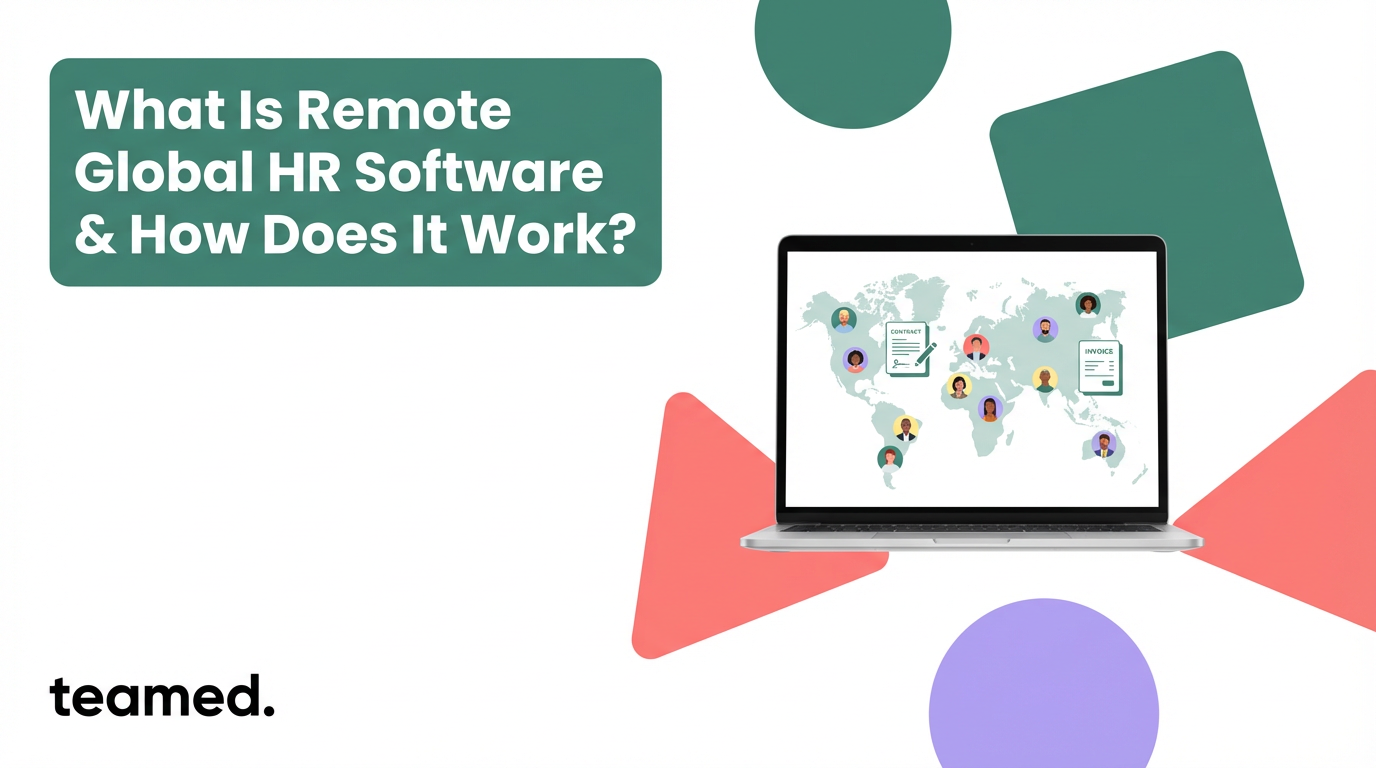
What Is Remote Global HR Software & How Does It Work?

You've just acquired a team of 15 in the Netherlands, your CFO wants a single invoice for international payroll, and your current HRIS can't tell you which employees need Dutch holiday allowance calculations of at least 8% of gross annual salary versus UK statutory sick pay. Sound familiar?

Remote global HR software is a category of HR technology that centralises employee data, workflows, and reporting for teams employed across multiple countries while enforcing country-specific rules for payroll, benefits, and compliance. The distinction matters because most traditional HRIS platforms standardise global HR data without actually executing local statutory processes. That gap is where compliance failures happen.

For mid-market companies managing 50 to 1,000 employees across multiple countries, the challenge isn't finding HR software. It's finding software that understands employment law in Germany is fundamentally different from employment law in Spain, and that both require different payroll configurations, contract terms, and offboarding procedures than what you're running in the UK.

Quick Facts: Remote Global HR Software

Remote global HR software must enforce country-specific payroll and employment compliance rules, not just standardise global HR data and workflows.

The EU General Data Protection Regulation allows supervisory authorities to impose administrative fines of up to €20 million or 4% of annual worldwide turnover for certain infringements, making HR data processing controls a board-level risk.

UK HMRC can assess unpaid tax and National Insurance for up to 6 years in most cases, and up to 20 years in cases involving deliberate behaviour.

According to Teamed's Graduation Model, the highest-cost mistakes occur when companies stay in the same hiring structure after headcount, permanence, and control signals have changed.

A defensible remote global HR software selection should include at least 25 documented requirements across data privacy, payroll controls, integrations, local benefits, and audit evidence.

What Does Remote Global HR Software Actually Do?

Remote global HR software performs three distinct functions that traditional HRIS platforms typically cannot. First, it manages employee data across jurisdictions with country-specific field requirements. Second, it enforces local compliance rules for contracts, policies, and statutory entitlements. Third, it connects to payroll execution, whether through integrated payroll engines or Employer of Record arrangements.

The practical difference shows up immediately. In the Netherlands, employment terms, holiday allowances, and sick pay administration require precise policy configuration and payroll inputs. A "one global policy" approach is non-compliant without local rule mapping. In France, mandatory employee profit-sharing and participation schemes apply once companies reach 50 employees for 5 continuous years, which means global HR tooling must support country-specific compensation constructs rather than relying on generic bonus fields.

This is why remote global HR software differs from a traditional HRIS in a fundamental way. The HRIS gives you a single view of your workforce. Remote global HR software gives you a single view that actually works in each country where you employ people.

How Does Remote Global HR Software Handle Compliance Across Different Countries?

Compliance management is where remote global HR software earns its keep or fails spectacularly. The software must track and enforce requirements that vary not just by country, but sometimes by region within a country, by employee tenure, and by contract type.

In the UK, employers must provide a written statement of employment particulars from day one of employment. The UK Employment Rights Act 1996 requires this, and updates must be provided when particulars change. This makes contract version control and acknowledgement tracking a compliance requirement, not an HR preference. Your software needs to generate compliant contracts, capture digital signatures, and maintain an audit trail of every version.

In Germany, works council rights can affect HR technology rollouts where monitoring or performance-related data is processed. This makes works council consultation a project dependency for certain HR software features. In Spain, termination processes and severance calculations are highly formalised and documentation-driven, so remote global HR software must support country-specific offboarding workflows and evidence capture to reduce litigation exposure.

The compliance challenge compounds when you consider data protection. Under GDPR, cross-border HR data transfers outside the UK and EU typically require an approved transfer mechanism such as the UK International Data Transfer Agreement or EU Standard Contractual Clauses. This should be reflected in HR vendor data processing agreements and subprocessor lists.

What Are the Essential Features of Global HR Software for Multinational Organisations?

The essential features fall into five categories, and most vendor marketing obscures which ones they actually deliver versus which ones require additional modules, integrations, or manual workarounds.

Country-specific contract generation means the software produces employment contracts that comply with local requirements, not templates you need to modify. In the UK, this includes the day-one statement of particulars. In France, this includes CDI versus CDD distinctions with appropriate clauses.

Localised payroll integration means the software either runs payroll directly or connects to payroll engines that handle statutory calculations, tax withholding, and social contributions for each country. The UK National Minimum Wage is legally enforceable and varies by age band, with rates from £8.00 to £12.71 depending on age in 2026, which means payroll configuration must map worker age, pay frequency, and working time records to prevent underpayment risk.

Policy management with local variations means you can set global policies while accommodating mandatory local requirements. Under the EU Working Time Directive, the average working week must not exceed 48 hours over a reference period unless the worker has opted out where permitted. Your software needs to track this.

Audit-ready documentation means the software maintains evidence of compliance actions, not just records of what happened. Contract versioning, policy acknowledgements, right-to-work checks, time and leave records, and payroll journals all need to be retrievable.

Integration capability means the software connects to your existing systems. According to Teamed's implementation risk assessment approach, the most common global HR implementation failure mode is integration scope creep across HRIS, payroll, finance, and identity systems. Define a minimum viable integration set of three to five systems before contracting.

How Does Remote Global HR Software Work With Existing HR Systems?

Integration is where remote global HR software implementations succeed or fail. The question isn't whether the software can integrate. It's whether the integration maintains data integrity across systems without creating reconciliation nightmares.

A single-vendor global HR suite differs from a multi-vendor stack in that it reduces vendor reconciliation and data handoffs. A multi-vendor stack typically increases integration and data-governance effort across HR, payroll, benefits, and finance systems. But single-vendor suites often sacrifice depth for breadth, particularly in complex jurisdictions.

The integration chain of custody matters more than most buyers realise. You need to map the flow from HRIS to identity and access management, to payroll engine or EOR, to finance ERP, to expense and benefits providers. Each handoff is a potential failure point. Each system needs a clear data owner.

According to Teamed's GEMO operating model, global HR software value is highest when a single system of record is established for worker status, country, employing entity or EOR, compensation currency, and policy set. Inconsistent master data is the root cause of payroll and compliance rework. If your HRIS says an employee is in Germany but your payroll system has them coded as UK, someone is getting the wrong tax treatment.

What's the Difference Between EOR-Backed and Direct Employment Global HR Software?

This distinction determines your compliance liability, your cost structure, and your operational flexibility. Most vendor marketing blurs the lines, which creates problems when you need to understand who is actually responsible for getting employment right.

An EOR-backed remote global HR software model means an Employer of Record becomes the legal employer for workers in a specific country. The EOR runs local payroll, taxes, statutory benefits, and employment compliance while you direct day-to-day work. Choose this model when you need to hire in a new European country in weeks rather than months and you do not yet have an owned legal entity in that jurisdiction.

A direct employment model through global payroll means you have legal entities in each country, and the software helps you run compliant payroll and HR processes through those entities. Choose this when you have durable headcount in a specific country and need direct control over employment terms, local benefit design, and statutory filings under your own company registration.

An EOR-led international HR solution differs from a global payroll-only solution in that the EOR becomes the legal employer and assumes statutory employment responsibilities. Payroll-only solutions require your local entity to be the legal employer. The cost difference is significant. EOR fees typically run £400 to £600 per employee per month. Direct entity payroll costs run £100 to £200 per employee per month, but you're carrying the entity establishment and ongoing compliance costs.

When Should Companies Transition From EOR to Their Own Entity?

This is where Teamed's Graduation Model provides clarity that most vendors avoid discussing. The Graduation Model describes the natural progression companies follow as they scale international teams, moving from contractors to EOR to owned entities. The transition points depend on headcount, commitment duration, and economic viability.

For Tier 1 countries like the UK, Ireland, Australia, Singapore, and the Netherlands, the entity threshold is typically 10 or more employees if your team operates in the native language. For Tier 2 countries like Germany, France, Spain, and Italy, the threshold rises to 15 to 20 employees due to stronger employee protections and more complex compliance requirements.

The economics work like this. At £7,500 per year EOR cost per employee and £3,500 per year own entity cost per employee including payroll, accounting, and compliance, with a £25,000 entity setup cost, a company with 10 employees in the UK breaks even at month 17. By year three, cumulative savings reach £95,000.

But the decision isn't purely economic. Consider transitioning when you have a 3-year or longer commitment to the market, when you need direct control over local operations or intellectual property protection, and when you have HR and legal resources capable of managing local compliance. Stay on EOR if you're still testing the market, if regulatory uncertainty is high, or if employees are spread across many countries with fewer than 10 total.

What Integration Challenges Should You Expect?

Integration challenges fall into three categories, and understanding them before you sign a contract saves months of frustration.

Data mapping challenges arise because different systems use different field structures, different country codes, and different employee identifiers. Your HRIS might use ISO country codes while your payroll system uses full country names. Your benefits platform might require employee IDs that don't match your HR system. These mismatches create manual reconciliation work that defeats the purpose of integrated systems.

Workflow synchronisation challenges arise because HR processes span multiple systems. Onboarding might start in your HRIS, trigger contract generation in your global HR platform, initiate payroll setup in your payroll system, and create accounts in your identity management system. If any step fails or delays, the entire process breaks.

Compliance evidence challenges arise because auditors want a single source of truth, but your data lives across multiple systems. Can you prove that an employee acknowledged a policy change? Can you demonstrate that payroll calculations matched the contract terms? Can you show that right-to-work checks were completed before the start date?

Centralised global HR management tools differ from country-by-country local providers in that they enable consolidated reporting and consistent controls. Local providers often deliver stronger in-country specificity but create fragmented data and inconsistent audit trails. The trade-off is real, and there's no perfect answer.

How Do You Choose the Right Remote Global HR Software?

The selection process should start with your employment structure, not with feature comparisons. Are you using contractors, EOR, owned entities, or some combination? Which countries are you in today, and which are you likely to enter in the next two years? What's your headcount trajectory in each market?

Choose remote global HR software with native multi-country compliance workflows when you have employees in three or more countries and need consistent onboarding, document control, and policy acknowledgements without relying on local HR teams to interpret requirements.

Choose an EOR-backed model when you need to hire in a new country quickly and don't have an owned legal entity there. Choose a global payroll platform that integrates with your existing HRIS when the HRIS is your group system of record and you need multi-country payroll execution without re-platforming core HR.

Choose a single-vendor global HR suite when Finance requires one invoice cadence, one reconciliation process, and one audit trail for cross-border payroll and employer costs. Choose a provider that offers expert-led escalation rather than ticket-only support when you operate in regulated environments or have high termination and employee relations risk.

The honest answer is that most mid-market companies need a combination of software and advisory support. The software handles the repeatable processes. The advisory support handles the edge cases, the compliance questions, and the strategic decisions about when to change your employment structure.

What Should You Expect From Implementation?

Implementation timelines vary dramatically based on complexity. A straightforward implementation with one or two countries and clean data can complete in four to six weeks. A complex implementation with five or more countries, multiple employment models, and legacy system migrations can take three to six months.

The critical success factors are data quality, stakeholder alignment, and realistic scope. Most implementations fail not because the software doesn't work, but because the company underestimated the effort required to clean up employee data, align HR and Finance on processes, and define what "done" actually looks like.

According to Teamed's implementation risk assessment, the most common failure mode is integration scope creep. Start with a minimum viable integration set. Get that working. Then expand. Trying to integrate everything at once creates dependencies that delay the entire project.

Making the Right Choice for Your Global Workforce

Remote global HR software is not a commodity purchase. The right choice depends on your employment structure, your geographic footprint, and your tolerance for managing complexity versus outsourcing it. The wrong choice creates compliance gaps that only become visible during audits or terminations.

For mid-market companies managing international teams across multiple countries, the priority should be finding a partner who understands that global employment is genuinely complex. Not a platform that promises simplicity while hiding the complexity. Not a vendor that profits from keeping you in the wrong structure.

If you're evaluating remote global HR software and want an honest assessment of what you actually need, book your Situation Room. Tell us your setup, and we'll tell you what we'd recommend, whether that includes us or not. That's the kind of advice that's hard to find in an industry built on opacity.
What Is Remote Global HR Software & How Does It Work?

You've just acquired a team of 15 in the Netherlands, your CFO wants a single invoice for international payroll, and your current HRIS can't tell you which employees need Dutch holiday allowance calculations of at least 8% of gross annual salary versus UK statutory sick pay. Sound familiar?

Remote global HR software is a category of HR technology that centralises employee data, workflows, and reporting for teams employed across multiple countries while enforcing country-specific rules for payroll, benefits, and compliance. The distinction matters because most traditional HRIS platforms standardise global HR data without actually executing local statutory processes. That gap is where compliance failures happen.

For mid-market companies managing 50 to 1,000 employees across multiple countries, the challenge isn't finding HR software. It's finding software that understands employment law in Germany is fundamentally different from employment law in Spain, and that both require different payroll configurations, contract terms, and offboarding procedures than what you're running in the UK.

Quick Facts: Remote Global HR Software

Remote global HR software must enforce country-specific payroll and employment compliance rules, not just standardise global HR data and workflows.

The EU General Data Protection Regulation allows supervisory authorities to impose administrative fines of up to €20 million or 4% of annual worldwide turnover for certain infringements, making HR data processing controls a board-level risk.

UK HMRC can assess unpaid tax and National Insurance for up to 6 years in most cases, and up to 20 years in cases involving deliberate behaviour.

According to Teamed's Graduation Model, the highest-cost mistakes occur when companies stay in the same hiring structure after headcount, permanence, and control signals have changed.

A defensible remote global HR software selection should include at least 25 documented requirements across data privacy, payroll controls, integrations, local benefits, and audit evidence.

What Does Remote Global HR Software Actually Do?

Remote global HR software performs three distinct functions that traditional HRIS platforms typically cannot. First, it manages employee data across jurisdictions with country-specific field requirements. Second, it enforces local compliance rules for contracts, policies, and statutory entitlements. Third, it connects to payroll execution, whether through integrated payroll engines or Employer of Record arrangements.

The practical difference shows up immediately. In the Netherlands, employment terms, holiday allowances, and sick pay administration require precise policy configuration and payroll inputs. A "one global policy" approach is non-compliant without local rule mapping. In France, mandatory employee profit-sharing and participation schemes apply once companies reach 50 employees for 5 continuous years, which means global HR tooling must support country-specific compensation constructs rather than relying on generic bonus fields.

This is why remote global HR software differs from a traditional HRIS in a fundamental way. The HRIS gives you a single view of your workforce. Remote global HR software gives you a single view that actually works in each country where you employ people.

How Does Remote Global HR Software Handle Compliance Across Different Countries?

Compliance management is where remote global HR software earns its keep or fails spectacularly. The software must track and enforce requirements that vary not just by country, but sometimes by region within a country, by employee tenure, and by contract type.

In the UK, employers must provide a written statement of employment particulars from day one of employment. The UK Employment Rights Act 1996 requires this, and updates must be provided when particulars change. This makes contract version control and acknowledgement tracking a compliance requirement, not an HR preference. Your software needs to generate compliant contracts, capture digital signatures, and maintain an audit trail of every version.

In Germany, works council rights can affect HR technology rollouts where monitoring or performance-related data is processed. This makes works council consultation a project dependency for certain HR software features. In Spain, termination processes and severance calculations are highly formalised and documentation-driven, so remote global HR software must support country-specific offboarding workflows and evidence capture to reduce litigation exposure.

The compliance challenge compounds when you consider data protection. Under GDPR, cross-border HR data transfers outside the UK and EU typically require an approved transfer mechanism such as the UK International Data Transfer Agreement or EU Standard Contractual Clauses. This should be reflected in HR vendor data processing agreements and subprocessor lists.

What Are the Essential Features of Global HR Software for Multinational Organisations?

The essential features fall into five categories, and most vendor marketing obscures which ones they actually deliver versus which ones require additional modules, integrations, or manual workarounds.

Country-specific contract generation means the software produces employment contracts that comply with local requirements, not templates you need to modify. In the UK, this includes the day-one statement of particulars. In France, this includes CDI versus CDD distinctions with appropriate clauses.

Localised payroll integration means the software either runs payroll directly or connects to payroll engines that handle statutory calculations, tax withholding, and social contributions for each country. The UK National Minimum Wage is legally enforceable and varies by age band, with rates from £8.00 to £12.71 depending on age in 2026, which means payroll configuration must map worker age, pay frequency, and working time records to prevent underpayment risk.

Policy management with local variations means you can set global policies while accommodating mandatory local requirements. Under the EU Working Time Directive, the average working week must not exceed 48 hours over a reference period unless the worker has opted out where permitted. Your software needs to track this.

Audit-ready documentation means the software maintains evidence of compliance actions, not just records of what happened. Contract versioning, policy acknowledgements, right-to-work checks, time and leave records, and payroll journals all need to be retrievable.

Integration capability means the software connects to your existing systems. According to Teamed's implementation risk assessment approach, the most common global HR implementation failure mode is integration scope creep across HRIS, payroll, finance, and identity systems. Define a minimum viable integration set of three to five systems before contracting.

How Does Remote Global HR Software Work With Existing HR Systems?

Integration is where remote global HR software implementations succeed or fail. The question isn't whether the software can integrate. It's whether the integration maintains data integrity across systems without creating reconciliation nightmares.

A single-vendor global HR suite differs from a multi-vendor stack in that it reduces vendor reconciliation and data handoffs. A multi-vendor stack typically increases integration and data-governance effort across HR, payroll, benefits, and finance systems. But single-vendor suites often sacrifice depth for breadth, particularly in complex jurisdictions.

The integration chain of custody matters more than most buyers realise. You need to map the flow from HRIS to identity and access management, to payroll engine or EOR, to finance ERP, to expense and benefits providers. Each handoff is a potential failure point. Each system needs a clear data owner.

According to Teamed's GEMO operating model, global HR software value is highest when a single system of record is established for worker status, country, employing entity or EOR, compensation currency, and policy set. Inconsistent master data is the root cause of payroll and compliance rework. If your HRIS says an employee is in Germany but your payroll system has them coded as UK, someone is getting the wrong tax treatment.

What's the Difference Between EOR-Backed and Direct Employment Global HR Software?

This distinction determines your compliance liability, your cost structure, and your operational flexibility. Most vendor marketing blurs the lines, which creates problems when you need to understand who is actually responsible for getting employment right.

An EOR-backed remote global HR software model means an Employer of Record becomes the legal employer for workers in a specific country. The EOR runs local payroll, taxes, statutory benefits, and employment compliance while you direct day-to-day work. Choose this model when you need to hire in a new European country in weeks rather than months and you do not yet have an owned legal entity in that jurisdiction.

A direct employment model through global payroll means you have legal entities in each country, and the software helps you run compliant payroll and HR processes through those entities. Choose this when you have durable headcount in a specific country and need direct control over employment terms, local benefit design, and statutory filings under your own company registration.

An EOR-led international HR solution differs from a global payroll-only solution in that the EOR becomes the legal employer and assumes statutory employment responsibilities. Payroll-only solutions require your local entity to be the legal employer. The cost difference is significant. EOR fees typically run £400 to £600 per employee per month. Direct entity payroll costs run £100 to £200 per employee per month, but you're carrying the entity establishment and ongoing compliance costs.

When Should Companies Transition From EOR to Their Own Entity?

This is where Teamed's Graduation Model provides clarity that most vendors avoid discussing. The Graduation Model describes the natural progression companies follow as they scale international teams, moving from contractors to EOR to owned entities. The transition points depend on headcount, commitment duration, and economic viability.

For Tier 1 countries like the UK, Ireland, Australia, Singapore, and the Netherlands, the entity threshold is typically 10 or more employees if your team operates in the native language. For Tier 2 countries like Germany, France, Spain, and Italy, the threshold rises to 15 to 20 employees due to stronger employee protections and more complex compliance requirements.

The economics work like this. At £7,500 per year EOR cost per employee and £3,500 per year own entity cost per employee including payroll, accounting, and compliance, with a £25,000 entity setup cost, a company with 10 employees in the UK breaks even at month 17. By year three, cumulative savings reach £95,000.

But the decision isn't purely economic. Consider transitioning when you have a 3-year or longer commitment to the market, when you need direct control over local operations or intellectual property protection, and when you have HR and legal resources capable of managing local compliance. Stay on EOR if you're still testing the market, if regulatory uncertainty is high, or if employees are spread across many countries with fewer than 10 total.

What Integration Challenges Should You Expect?

Integration challenges fall into three categories, and understanding them before you sign a contract saves months of frustration.

Data mapping challenges arise because different systems use different field structures, different country codes, and different employee identifiers. Your HRIS might use ISO country codes while your payroll system uses full country names. Your benefits platform might require employee IDs that don't match your HR system. These mismatches create manual reconciliation work that defeats the purpose of integrated systems.

Workflow synchronisation challenges arise because HR processes span multiple systems. Onboarding might start in your HRIS, trigger contract generation in your global HR platform, initiate payroll setup in your payroll system, and create accounts in your identity management system. If any step fails or delays, the entire process breaks.

Compliance evidence challenges arise because auditors want a single source of truth, but your data lives across multiple systems. Can you prove that an employee acknowledged a policy change? Can you demonstrate that payroll calculations matched the contract terms? Can you show that right-to-work checks were completed before the start date?

Centralised global HR management tools differ from country-by-country local providers in that they enable consolidated reporting and consistent controls. Local providers often deliver stronger in-country specificity but create fragmented data and inconsistent audit trails. The trade-off is real, and there's no perfect answer.

How Do You Choose the Right Remote Global HR Software?

The selection process should start with your employment structure, not with feature comparisons. Are you using contractors, EOR, owned entities, or some combination? Which countries are you in today, and which are you likely to enter in the next two years? What's your headcount trajectory in each market?

Choose remote global HR software with native multi-country compliance workflows when you have employees in three or more countries and need consistent onboarding, document control, and policy acknowledgements without relying on local HR teams to interpret requirements.

Choose an EOR-backed model when you need to hire in a new country quickly and don't have an owned legal entity there. Choose a global payroll platform that integrates with your existing HRIS when the HRIS is your group system of record and you need multi-country payroll execution without re-platforming core HR.

Choose a single-vendor global HR suite when Finance requires one invoice cadence, one reconciliation process, and one audit trail for cross-border payroll and employer costs. Choose a provider that offers expert-led escalation rather than ticket-only support when you operate in regulated environments or have high termination and employee relations risk.

The honest answer is that most mid-market companies need a combination of software and advisory support. The software handles the repeatable processes. The advisory support handles the edge cases, the compliance questions, and the strategic decisions about when to change your employment structure.

What Should You Expect From Implementation?

Implementation timelines vary dramatically based on complexity. A straightforward implementation with one or two countries and clean data can complete in four to six weeks. A complex implementation with five or more countries, multiple employment models, and legacy system migrations can take three to six months.

The critical success factors are data quality, stakeholder alignment, and realistic scope. Most implementations fail not because the software doesn't work, but because the company underestimated the effort required to clean up employee data, align HR and Finance on processes, and define what "done" actually looks like.

According to Teamed's implementation risk assessment, the most common failure mode is integration scope creep. Start with a minimum viable integration set. Get that working. Then expand. Trying to integrate everything at once creates dependencies that delay the entire project.

Making the Right Choice for Your Global Workforce

Remote global HR software is not a commodity purchase. The right choice depends on your employment structure, your geographic footprint, and your tolerance for managing complexity versus outsourcing it. The wrong choice creates compliance gaps that only become visible during audits or terminations.

For mid-market companies managing international teams across multiple countries, the priority should be finding a partner who understands that global employment is genuinely complex. Not a platform that promises simplicity while hiding the complexity. Not a vendor that profits from keeping you in the wrong structure.

If you're evaluating remote global HR software and want an honest assessment of what you actually need, book your Situation Room. Tell us your setup, and we'll tell you what we'd recommend, whether that includes us or not. That's the kind of advice that's hard to find in an industry built on opacity.
TABLE OF CONTENTS

Take a look
at the latest articles