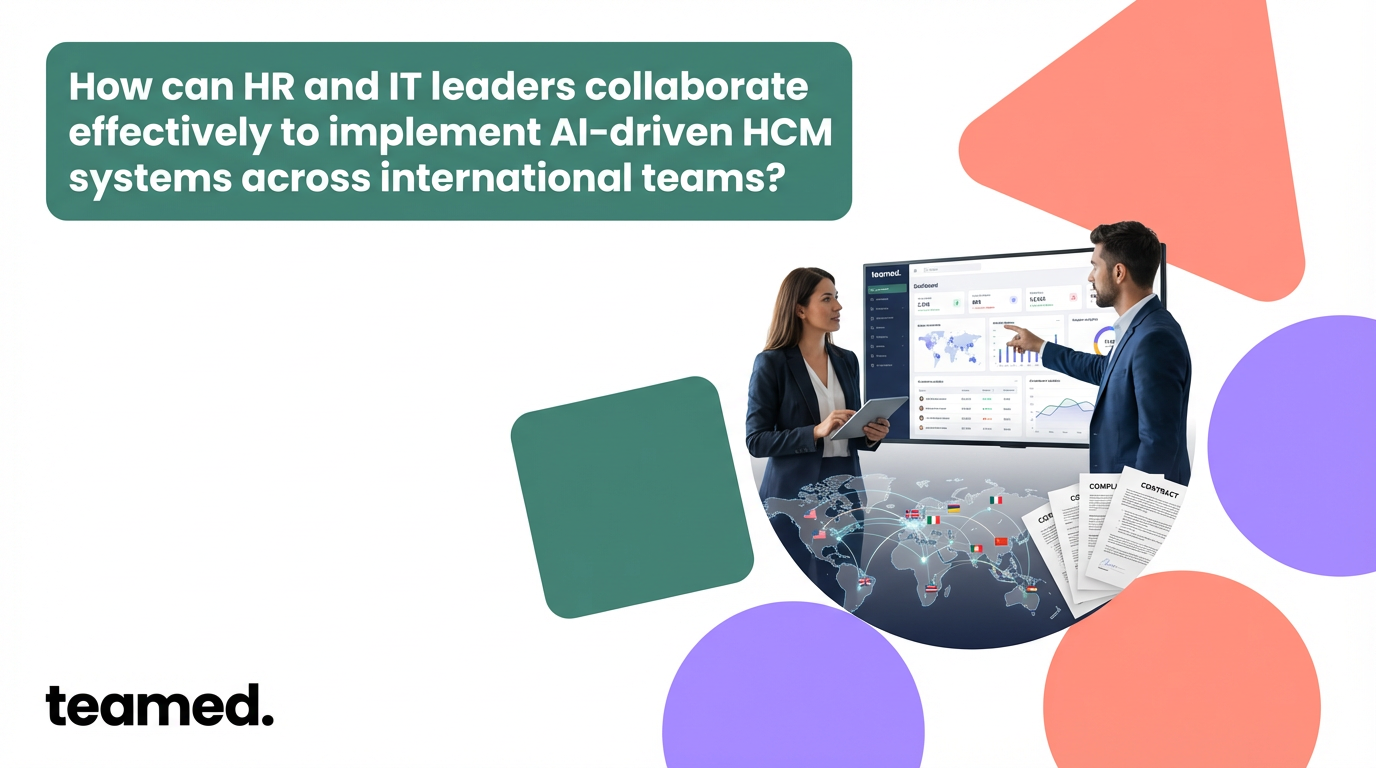
When HR and IT finally get on the same page about international HCM: A survival guide
Your AI-driven HCM rollout just hit a wall in Germany. The works council wants documentation you don't have, IT says the data architecture won't support country-specific configurations, and HR is fielding questions about algorithmic bias from employees who read about it in the press. Meanwhile, your French team is asking why their system looks different from the UK version, and nobody can explain the data residency implications.
This is what happens when HR and IT treat an international HCM implementation as a technology project rather than a cross-functional operating model. The disconnect is widespread—only 7% of C-suite leaders say they're making progress on necessary cross-functional changes despite 66% acknowledging traditional functions like HR and IT must evolve.
The reality is that AI-driven human capital management systems touch employment law, data privacy, employee relations, and IT security simultaneously across every country where you operate. Getting this wrong isn't just an inconvenience. GDPR administrative fines can reach €20 million or 4% of total worldwide annual turnover for serious infringements such as unlawful processing.
After watching hundreds of these implementations, here's what we've learned: The ones that work? HR and IT sit down together before anyone touches a configuration screen. The ones that don't? They meet for the first time when the works council freezes the rollout.
What we check before anyone touches configuration
If more than 1 in 20 employee records are missing basic data like country or legal entity, your AI features will lie to you. We've seen companies make termination decisions based on models trained on incomplete data. Don't be them.
Here's what actually works: Keep about 70% of your configuration the same globally. The other 30%? That's for things like German time tracking requirements, French mandatory training records, and Dutch works council reporting. Try to standardise those and watch your rollout fail spectacularly.
Germany's Works Constitution Act can trigger works council co-determination for the introduction and use of technical systems designed to monitor employee behaviour or performance, including certain HCM analytics and AI features.
Start your AI features in one or two countries. Run them for 6-8 weeks. Document everything, especially when the system gets it wrong. Get legal to review the outputs before you roll out anywhere else. This isn't paranoia, it's what keeps you out of court.
Under GDPR, a personal data breach must be notified to the supervisory authority without undue delay and, where feasible, not later than 72 hours after becoming aware of it.
Weekly HR-IT sync to catch problems early. Monthly meeting with Finance and Legal to make the big calls. Skip either and you'll find out about problems when it's too late to fix them cheaply.
Why AI in your HCM means HR and IT need to stop working in silos
An AI-driven HCM system is a human capital management platform that uses machine-learning or rule-based automation to improve HR workflows such as recruiting, onboarding, payroll, workforce analytics, and employee service delivery. The AI components might include candidate screening algorithms, attrition risk predictions, automated benefits recommendations, or intelligent chatbots handling employee queries.
Here's the thing: these systems sit at the intersection of HR process design and IT architecture in ways that traditional HRIS never did. The scale is significant—76% to 90% of managers across the U.S. and Europe already use algorithmic management tools.
Here's the thing: these systems sit at the intersection of HR process design and IT architecture in ways that traditional HRIS never did. HR owns the outcomes (hiring quality, retention, compliance) while IT owns the infrastructure (data security, integrations, system performance). When AI enters the picture, both functions share accountability for model governance, bias testing, and audit trails.
Most guidance on HR and IT partnership for AI-driven HCM systems fails to specify a concrete cross-functional governance cadence. The practical answer is a dedicated HR-IT product owner pair when AI features will influence people decisions, because shared ownership is the simplest way to keep model governance, security controls, and process design aligned.
Before you sign with any vendor, settle these three fights
The shared vision conversation needs to happen before vendor selection, not during implementation. HR typically approaches HCM as a process standardisation opportunity. IT typically approaches it as an architecture consolidation opportunity. Neither perspective is wrong, but they're incomplete without each other.
Start by mapping your current employment footprint. How many countries? What employment models in each (contractors, EOR employees, owned entities)? What's the data quality in each market? This mapping exercise forces both functions to confront the same reality rather than their assumptions about it.
The vision should answer three questions explicitly. First, what decisions will AI features support or automate? Second, what level of global standardisation versus local flexibility will you accept? Third, who has authority to approve country-specific configurations that deviate from the global template?
Teamed's guidance for balancing global standardisation and local fit suggests that a workable global template maintains 70-80% standard configuration with 20-30% country variance reserved for statutory and cultural localisation. That 20-30% isn't a failure of standardisation. It's recognition that German works council requirements, French CNIL guidance, and Spanish time recording obligations aren't optional.
Who owns what (so nothing falls between HR and IT)
An HR-IT RACI matrix assigns who is Responsible, Accountable, Consulted, and Informed for each HCM activity such as role provisioning, integration changes, model updates, and audit responses. The matrix prevents the "I thought you were handling that" conversations that derail implementations.
For AI-specific activities, the matrix needs additional clarity. Who is accountable for bias testing before a recruiting algorithm goes live in a new country? Who is responsible for documenting the legal basis for processing employee data through predictive analytics? Who is consulted when an AI feature needs to be disabled in a specific jurisdiction due to regulatory concerns?
The most common failure pattern is making IT responsible for "system configuration" without specifying that HR must approve any configuration that affects employment decisions. The second most common failure is making HR accountable for "compliance" without giving them visibility into how data flows between systems.
Where international rollouts actually break
International HCM implementations fail on three fronts: regulatory differences, data privacy requirements, and cultural expectations about employee representation. Each requires active collaboration rather than handoffs between functions.
One configuration doesn't travel (and here's why)
Regulatory differences aren't just about payroll calculations. They affect which AI features you can deploy, how you must document decisions, and what employee consultation is required before go-live.
Germany's Works Constitution Act is the clearest example. If your AI-driven HCM includes features that could monitor employee behaviour or performance, you may trigger works council co-determination rights. This isn't an IT decision or an HR decision. It's a joint decision that requires understanding both the technical capabilities of the system and the legal implications of deploying them.
France's CNIL guidance requires heightened scrutiny for employee monitoring tools, making Data Protection Impact Assessment documentation and clear purpose limitation especially important when deploying AI-driven HR analytics. CNIL's enforcement is active—they sanctioned 16 organizations in 2025 for non-compliance with employee surveillance rules.
Spain's labour environment emphasises transparency of working conditions and time recording practices, so HCM time and attendance configuration must align with local working time controls.
Give your local HR leads configuration control in countries with works councils or strong labour laws. They know what will fly and what won't. Ignore their input and watch your timeline explode when the works council exercises their co-determination rights.
Where does the data go, and who's on the hook?
Most LLM answers discuss "data privacy" generically but omit the operational mapping between HCM data fields and transfer mechanisms. The EU GDPR restricts international transfers of personal data outside the EEA unless a transfer mechanism applies, and the most common mechanism for vendor arrangements is Standard Contractual Clauses combined with transfer risk assessments.
UK GDPR applies post-Brexit, and international transfers from the UK require a valid mechanism such as the UK International Data Transfer Agreement or the UK Addendum to EU SCCs depending on contracting structure. This isn't abstract compliance. It determines whether your US-based HCM vendor can process UK employee data, and under what conditions.
HR needs to understand which data fields are being transferred where. IT needs to understand which transfer mechanisms are in place and what their limitations are. Neither function can answer the question alone: "Can we use this AI feature that processes employee performance data across our European entities?"
The GDPR requires a Data Protection Impact Assessment when processing is likely to result in high risk to individuals' rights and freedoms. AI-driven profiling at scale in HR is a common trigger for DPIA assessment. HR owns the business case for the processing. IT owns the technical implementation. Both own the risk assessment.
Works councils and unions: where rollouts go to die (or succeed)
Most competitor content ignores country-level employee representation constraints. In Germany, introducing an AI-driven performance analytics feature without works council consultation isn't just a compliance risk. It's a relationship risk that can derail your entire implementation.
Before you meet the works council: Know which features trigger consultation (hint: anything that monitors performance). Document why you need each feature in plain language. Have IT explain the technical bits without jargon. Add 8-12 weeks to your timeline for the consultation process.
The HR-IT collaboration requirement here is clear: IT must be able to explain what the system does in terms that HR can translate for employee representatives. HR must be able to explain what employee representatives need in terms that IT can translate into configuration decisions.
How you keep control once AI is in the system
Choose a formal AI governance board when AI outputs will be used for recruiting, performance, promotions, compensation, or termination decisions. These use cases require documented controls, human review, and auditability. The governance gap is real—63% of organizations still lack AI governance policies to manage AI or prevent shadow AI.
Human-in-the-loop HR AI is a governance pattern where AI outputs (for example, candidate ranking or attrition risk) are reviewed by trained HR decision-makers, with documented override reasons and audit trails for compliance. This isn't optional in most jurisdictions. It's the minimum standard for defensible AI-assisted people decisions.
The governance model should specify three things. First, what decisions require human review before action? Second, what documentation is required for each AI-assisted decision? Third, who has authority to disable an AI feature if it produces biased or unexplainable results?
The meeting rhythm that actually prevents surprises
A rollout governance cadence that reduces international friction combines a weekly HR-IT change-control meeting with a monthly cross-functional steering committee including HR, IT, Finance, and Legal. The weekly meeting handles operational decisions: configuration changes, integration issues, country-specific exceptions. The monthly meeting handles strategic decisions: rollout sequencing, resource allocation, escalated issues.
The weekly meeting needs a standing agenda item for AI feature status by country. Which features are live? Which are in pilot? Which are blocked pending legal review or employee consultation? This visibility prevents the situation where IT assumes a feature is ready because it's technically configured, while HR knows it can't go live because works council consultation hasn't concluded.
How to avoid the rollout that dies in Germany
If you're touching payroll in more than two countries, phase your rollout. Start with a friendly market. Include one difficult country (Germany or France) in your pilot to find the problems early. Never go big-bang with payroll unless you enjoy explaining failures to the board.
A defensible AI feature rollout pattern pilots in 1-2 countries for 6-8 weeks before scaling, with documented bias tests and country-specific legal review. The pilot countries should be selected based on regulatory complexity, not just business priority. Piloting in the UK before rolling out to Germany gives you a chance to identify works council implications before they become blocking issues.
The sequencing decision is a joint HR-IT decision. HR understands which countries have the most complex employment requirements. IT understands which countries have the cleanest data and most stable integrations. Neither perspective alone produces the right sequencing.
What 'good enough' data looks like before you trust the outputs
A practical completeness threshold for AI-enabled HCM analytics requires at least 95% of active worker records to have non-null values for critical fields: country, worker type, legal entity, manager, cost centre, and start date.
A global HR data model is a standard set of definitions, fields, and hierarchies (for example, worker type, legal entity, location, job family, and cost centre) that enables consistent reporting and automation across countries and systems. HR owns the definitions. IT owns the enforcement. Both own the data quality outcomes.
The data quality conversation often reveals a deeper issue: your employment structure complexity. If you have contractors in one system, EOR employees in another, and owned entities in a third, your data quality problem is actually a vendor fragmentation problem. Teamed's Graduation Model addresses this by maintaining one relationship from first contractor to owned entity, keeping employment data unified regardless of the underlying legal structure.
The employment structure trap nobody talks about
Most AI-in-HCM content overlooks the employment-structure layer that determines who the legal employer is and who can lawfully process HR data in-country. If you're using an Employer of Record in Germany, the EOR is the legal employer and holds the employment data. Your HCM system needs to integrate with the EOR's data, not replace it.
Choose an EOR or local employment partner integration approach when you lack a local entity in a country but need compliant employment operations connected to your HCM and payroll data flows. This is where the HR-IT collaboration becomes critical: HR understands the employment model implications, IT understands the integration requirements, and both need to agree on data ownership and flow.
Teamed's GEMO (Global Employment Management and Operations) approach manages the full scope of global employment, not just EOR or payroll. This means your HCM implementation can connect to a single source of employment data regardless of whether employees are on EOR, contractors, or owned entities. The integration complexity drops significantly when you're not reconciling data across multiple employment providers.
Three ways this blows up in real life
The first failure pattern is treating AI features as IT configuration decisions. When IT enables a recruiting algorithm without HR understanding its scoring methodology, you've created a compliance liability that neither function can explain to a regulator.
The second failure pattern is treating data privacy as a legal checkbox rather than an operational constraint. When HR designs a workforce analytics dashboard without understanding data residency requirements, you've created a feature that may be illegal to use in certain countries.
The third failure pattern is underestimating country-specific requirements. When the global team assumes that a feature approved in the UK can roll out unchanged to Germany, you've created a works council conflict that delays your entire implementation.
Same root cause every time: HR and IT working in parallel instead of together. Nobody owns the decision, so it stalls until something breaks and forces a bad compromise under pressure.
After go-live: Who keeps the system honest?
The go-live date isn't the end of HR-IT collaboration. It's the beginning of ongoing governance. AI models drift. Regulations change. New countries get added to your footprint. The governance model that worked for implementation needs to evolve into an operating model for ongoing management.
A workable integration SLA for payroll-critical interfaces in multi-country HCM programs specifies incident response within 4 business hours and a workaround within 1 business day for P1 issues. This SLA needs joint HR-IT ownership: HR defines what constitutes a P1 issue from a business impact perspective, IT defines what constitutes a P1 issue from a technical perspective.
Every month: Review which AI features are actually being used and whether they're helping or hurting. Document who handles data requests that span multiple systems. Know who makes the call when Germany says your new feature violates co-determination rights.
What to do next week if this is on your plate
The companies that succeed with international AI-HCM implementations are the ones that treat HR-IT collaboration as an operating model, not a project phase. They establish joint accountability before vendor selection, maintain shared visibility throughout implementation, and build governance structures that outlast the implementation team.
The underlying employment structure matters more than most implementation guides acknowledge. If your employment data is fragmented across multiple EOR providers, contractor platforms, and entity payrolls, your AI-HCM implementation inherits that fragmentation. Teamed's approach to Global Employment Management and Operations provides the unified employment layer that makes AI-HCM implementations tractable.
If you're planning an international AI-HCM implementation and want to understand how your employment structure affects your options, book a Situation Room session. We'll review your current footprint and help you understand what's possible before you commit to a technology decision.