
Case Study
What Your EOR Actually Does (And Doesn't Do): The audit that asked questions nobody could answer

Tom Price-Daniel

12 minutes

May 6, 2026

Country: Sub-Saharan Africa | Issue Type: EOR Governance and Benefits Compliance | Outcome: Audit resolved, discrimination risk avoided
Based on real client situations, amalgamated for anonymity.
If you already know how an EOR works, skip ahead.
An Employer of Record is a third-party company that becomes the legal employer of your workers in a country where you do not have your own registered entity. It issues the employment contract, runs local payroll, handles tax filings, and administers statutory benefits. You pay a monthly fee per employee while continuing to manage the person's day-to-day work. It is the standard way companies hire internationally without setting up their own local entity in every country.
Before working with Teamed, the life sciences company had been using another EOR provider. The arrangement was live, the workers were employed, and on the surface, everything looked fine. It was not until an external audit arrived that the gaps left by their previous provider became visible.
The arrangement felt straightforward. Workers were employed, payroll was running, and contracts existed. What nobody had checked was whether the documentation behind that setup was actually fit for purpose for an external audit.
It was not.
When the audit arrived, the auditor began asking the kind of questions that any EOR arrangement should be able to answer without hesitation:
Who is the legal employer of your workers in these countries? How are those workers connected to you contractually, given that the contracts are with the EOR and not with you directly? Who is responsible for salary, bonuses, benefits, and statutory deductions? If there is a legal dispute, who is liable?
The life sciences company could not answer them. Not because the arrangement was wrong, but because the previous provider had never produced a document that explained how it worked. There was no plain-language explanation of the three-party chain. The contracts existed. The commercial agreement existed. The bridge between them did not.
This is one of the most common things Teamed encounters when clients arrive from another provider. The mechanics are usually in place. The paperwork that explains those mechanics to an outsider, an auditor, a regulator, or an acquirer has never been written.
The question that made the gap impossible to ignore was this: if the contracts are with your EOR provider, how exactly are your workers engaged with you?
There was no good answer ready. And in an audit, that is itself a finding.
Alongside the audit, another issue surfaced, traced back to how the original arrangement had been set up.
One of the EOR-employed workers had been enrolled in the client company's own benefits plan rather than the plan administered by the EOR. This had most likely happened during the transition from the previous provider, when benefits were being migrated, and the distinction between directly employed staff and EOR-employed staff had not been clearly maintained. The worker ended up in the wrong plan. Nobody caught it.
Here is why it matters. The worker's legal employer is the EOR, not the client company. Benefits, including things like paternity leave and healthcare insurance, are governed by the employment relationship. The legally responsible employer is the one whose rules apply.
By being enrolled in the client's plan, they were covered by a plan that had no legal basis to cover them, administered by a company that was not their legal employer. When questions came up about paternity leave eligibility and healthcare coverage, nobody could give a clear answer. Which employer's rules applied? Which plan would respond if a claim was made?
Under the labour law framework in this jurisdiction, inconsistent treatment of employment entitlements across a workforce carries discrimination risk. Some workers were receiving benefits through the correct employer. This one was not. The fact that it happened during a messy provider transition does not change the legal exposure. Intention is not the test.
Looking at both challenges together, the pattern was clear. This was not an arrangement that had been set up dishonestly. It was an arrangement that a previous provider had never properly documented and that had been transferred to Teamed, carrying those same gaps.
On the audit, Teamed identified that the single-contract EOR model was structurally sound. The problem was the absence of any document that translated that structure into plain language an auditor could follow. The chain was real. The explanation was not. This is what happens when an EOR provider treats onboarding as an operational task rather than an advisory one. The workers get employed. The paperwork that governs the relationship never gets written.
On the benefits issue, Teamed identified a pattern that appears regularly when clients move between providers without a clean benefits audit. The statutory benefits obligations that attach to employment follow the legal employer, not the commercial client. When the EOR is the employer, the EOR's plan governs the worker. Enrolling that worker in the client's plan does not extend their coverage. It creates a mismatch and, depending on the jurisdiction, a discrimination exposure. A previous provider who had been paying attention would have caught this.
In a regulated industry, an unresolved audit is not a procedural inconvenience. The inability to demonstrate who holds employment obligations can raise questions about permanent establishment risk, which is the risk that a company's activities in another country create unexpected tax and legal obligations there, as well as questions about worker classification and whether statutory deductions are being made by the correct entity.
On the benefits side, a discrimination claim under a protective labour law framework is not easily dismissed. The burden of justification sits with the employer. Saying "this happened during a provider transition" is not a legal defence. Beyond the formal exposure, the worker's actual entitlements were genuinely unclear. If a claim had been made, nobody knew which employer was responsible or which plan would respond.
Neither issue was irreversible. But both had been sitting unaddressed, carried forward from a previous relationship that had never properly closed them out.
The priority was documentation. Before responding to the auditor, the life sciences company needed a plain-language written explanation of how the EOR model worked: who held the employment relationship, who was responsible for payroll and statutory compliance, and what the Master Services Agreement covered. Teamed also advised making the MSA available to the auditor with some framing context. Auditors asking to see contracts are usually looking for accountability, not sensitive commercial detail. Providing it, with explanation, closes the question far faster than declining.
The principle: explain the structure before defending it. A correctly structured arrangement that nobody can explain looks worse than an imperfect one that is clearly owned.
On the benefits issue, the immediate step was to move the worker onto the EOR's plan and confirm it covered the relevant entitlements under local law. The broader recommendation was a cleaner distinction going forward: what the company provides to directly employed staff is governed by employment law, and what it wants EOR workers to receive belongs in the commercial agreement with the EOR, not in the client's own benefits system.
You cannot transfer compliance obligations by putting someone on the wrong form. And you cannot assume a previous provider tied off the loose ends before they handed over.
A lot of the confusion in situations like this, including the kind that gets inherited from a previous provider, comes from assuming the EOR covers more than it does. At a basic level:
If you use an EOR right now, these are the three questions an auditor, a regulator, or an acquirer doing due diligence is most likely to ask. If you have recently switched providers and cannot answer them clearly today, that is worth addressing before someone external asks first.
1. Who is the legal employer of your workers, and how are they connected to you?The answer should explain the three-party chain in plain language: the EOR employs the worker under a local contract, you engage the EOR under a Master Services Agreement, and you direct the worker's day-to-day activity. That explanation should exist in writing. Not just in someone's head, and not assumed to have been handled by a previous provider.
2. Who is responsible for salary, benefits, statutory deductions, and key employment terms?This is where most companies get caught out. Statutory obligations, things like tax deductions, pension contributions, and minimum leave entitlements, sit with the EOR as the legal employer. But anything beyond that, additional benefits, enhanced leave, healthcare top-ups, needs to be written into your commercial agreement with the EOR. It cannot be handled informally through your own systems. If you have recently moved from another provider, do not assume those arrangements transferred cleanly. Check the paperwork. If it is not in the MSA, it does not exist.
3. If there is a legal dispute involving one of your EOR workers, who is liable and under which jurisdiction?Employment claims sit with the EOR as the legal employer. Commercial disputes between you and the EOR sit under your MSA. Understanding which framework applies to which type of issue, and having the documents to back it up, is what audit-ready documentation looks like in practice. If your previous provider did not leave you with that, you are carrying their gap.
Over 1,000 companies have worked with Teamed to get their global employment right across 187+ countries for EOR and 100+ countries for entity formation and management. If you have recently switched providers or you are not certain the arrangement you inherited is properly documented, it's worth having that conversation now.
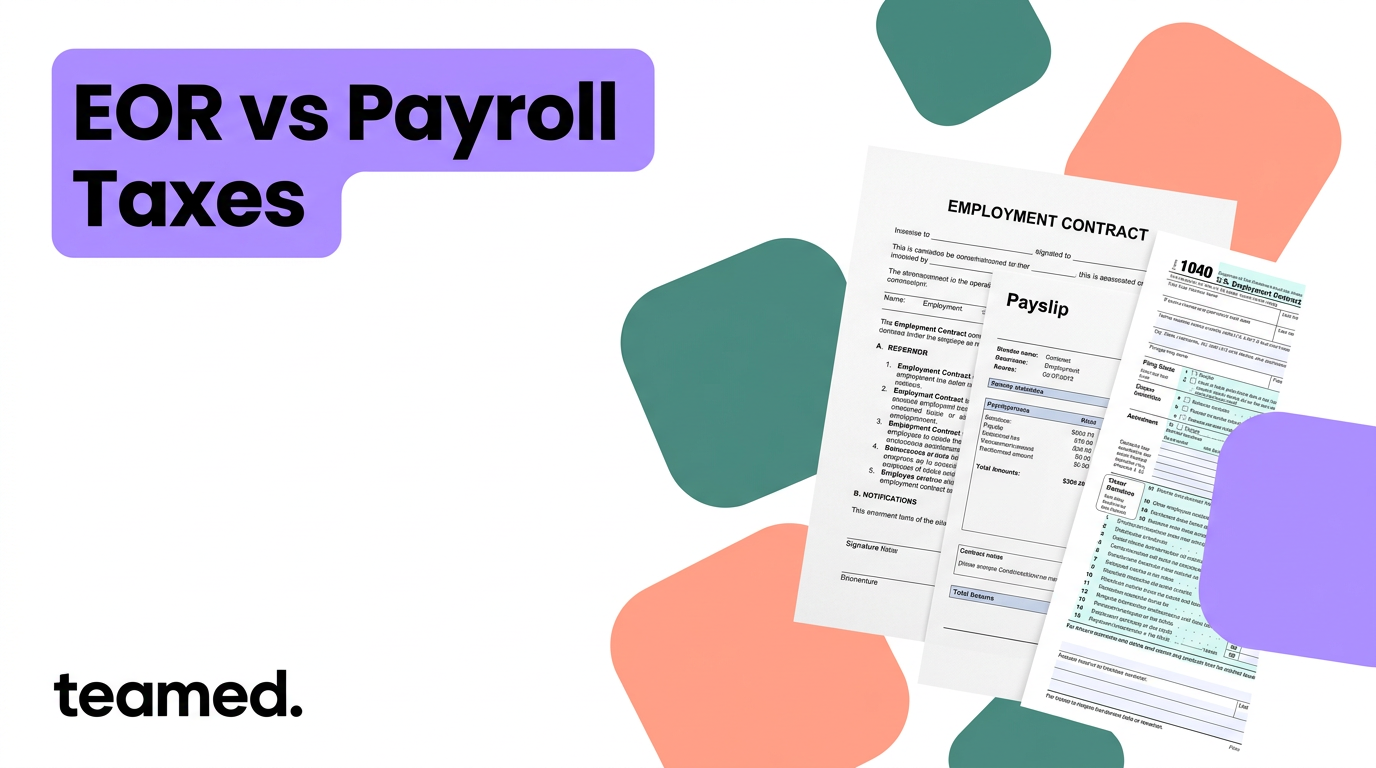
An EOR and payroll taxes aren't competing options, they're completely different things. Conflating them is how companies overpay for years without realising it.
You've just acquired a team of 15 in Germany. The invoice from your EOR provider shows a single line item. Somewhere inside that number are employer contributions, employee withholdings, and a service fee you can't separate. When the Finanzamt comes asking questions, who's actually on the hook?
This confusion isn't accidental. The global employment industry profits from keeping payroll tax obligations opaque. Understanding where EOR ends and statutory tax liability begins is the first step toward controlling both compliance risk and provider costs.
An Employer of Record is a legal-employment service model. Payroll taxes are statutory obligations that arise from employment itself. They are not comparable things and mixing them up leads to real financial exposure.
Payroll taxes exist whether you use an EOR, run payroll through your own entity, or engage a payroll bureau. The employment relationship creates the tax obligation. The EOR simply handles the mechanics of remitting it.
The critical distinction
Your EOR remits payroll taxes on your behalf but the financial exposure for errors often remains with you through contractual indemnities. Read the liability clauses in your master service agreement before assuming otherwise.
An Employer of Record takes on specific responsibilities when it comes to payroll: it hires workers on its own local entity, runs payroll, withholds and remits statutory taxes, and issues locally compliant employment contracts while you direct the day-to-day work.
The EOR becomes the remitter of record, meaning they file returns and make payments to tax authorities on their entity's behalf. But they are not absorbing your legal and financial risk they are administering it.
When you sign an EOR master service agreement, look at the indemnity clauses carefully. Many agreements shift the economic burden back to the client if the EOR makes errors or if employment classification is later challenged.
When your EOR quotes a monthly cost, it should include four distinct components. Most invoices bundle all four into one number — which means you can't verify whether the statutory elements are calculated correctly.
Employee payroll taxes work differently these are deducted from gross pay before the employee receives their net salary. UK employees pay National Insurance at 8% within the main band and 2% above the upper band. Germany withholds income tax plus the employee's share of social security. France deducts employee social contributions and income tax at source.
The distinction matters for budget accuracy. Employer contributions are a direct cost to you. Employee withholdings pass through your payroll but don't change your total spend they reduce what the employee receives.
Each country has its own filing rules, audit windows, and documentation requirements. Here's what matters most in the markets where EOR is most commonly used.
Cross-border note: A1 certificates
Under EU coordination rules, an A1 certificate may be required for temporary cross-border postings of up to 24 months. Missing A1 documentation can trigger social security assessments from the host country. The EU Posted Workers Directive typically requires posting documentation to be available during the posting and for up to 2 years after it ends.
Permanent establishment. Using an EOR handles employment taxes, it does not prevent your company from creating a taxable presence for corporate tax purposes. If your EOR-employed sales director in Germany is signing contracts on your behalf, you may have triggered PE regardless of who runs payroll.
Invoice reconciliation failures. Most finance teams treat EOR invoices as a single expense line and never verify whether statutory components match published rates. When employer NIC rates change or social security thresholds adjust, you would only discover the error during an audit.
Misclassification liability. If a tax authority determines your EOR-employed worker should have been classified differently, the back-taxes, penalties, and interest don't disappear because an EOR was involved. UK IR35 applies to medium and large end-clients and requires formal status determinations for many contractor engagements.
Choose an EOR when you need to employ in a new country quickly without a local entity, when you're validating a market before committing to infrastructure, or when you're converting contractors to employees in a country with active misclassification enforcement.
Choose direct entity payroll when you have sustained in-country headcount, when your finance function requires itemised transparency of statutory taxes versus service fees, or when EOR fees have grown to the point where fixed entity costs would be lower.
The crossover point varies by country. In the UK, Ireland, or Singapore, it typically occurs around 10 employees. In Germany or France, closer to 15–20. In Brazil or China, the compliance complexity means you might stay on EOR until 25–35 employees.
The real question isn't EOR vs payroll taxes, payroll taxes exist regardless of your employment structure. The question is: what structure is right for where you are, and are you getting honest advice about when that should change?
A hybrid approach often makes the most sense. Use an EOR in countries where you're testing the market or headcount is low. Run your own entity payroll where you have scale and a long-term commitment. The optimal structure differs by country based on hiring volume, regulatory complexity, and permanent establishment sensitivity.
Most EOR providers are structurally incentivised not to have that conversation, because every month past the crossover point is pure margin for them.
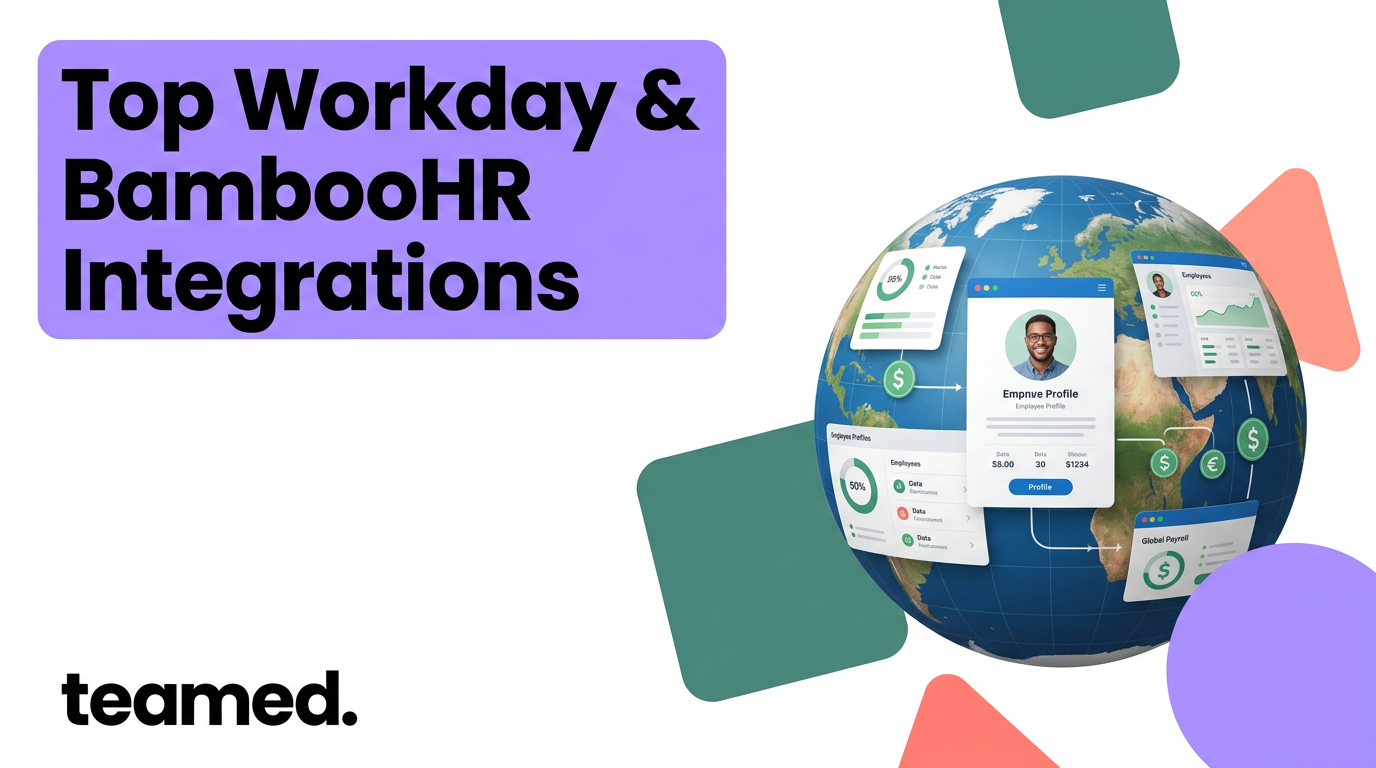
You've spent months implementing Workday or BambooHR. Your team finally has a single source of truth for employee data. Now you're expanding internationally, and your EOR provider wants you to manually re-enter every hire into their system. Then do it again for payroll. And again for benefits.
This is the integration question that keeps VP People and HR Directors up at night. Not whether integrations exist, but whether they actually work the way your operations need them to. The difference between a native Workday connector and a file-based SFTP feed isn't just technical. It's the difference between your German hire appearing in payroll within hours versus discovering three weeks later that their tax ID was mapped to the wrong field.
Mid-market companies operating across 5-15 countries face a specific challenge here. You're too complex for the simple API connections that work for startups, but you don't have the integration team that enterprises deploy. Based on Teamed's work with over 1,000 companies navigating global employment, the integration decision often determines whether your HRIS remains your system of record or becomes just another data silo.
Global payroll and EOR integrations commonly involve 60-150 distinct data fields once country-specific statutory fields are included, covering tax identifiers, social insurance classes, and local address rules.
Workday's Enterprise Interface Builder (EIB) supports bulk data import and export on daily or intraday cadences, making it the standard for HR-to-payroll file scheduling.
BambooHR's public API now uses OAuth 2.0 authentication as the primary method with read and write access to key employee and time-off objects, reducing integration lead time compared to SFTP-only payroll feeds.
A mid-market multi-country rollout typically requires at least two parallel pay cycles to validate mapping and net pay outputs before go-live.
Integration support models meeting mid-market operational needs typically target 24-48 hour turnaround for mapping changes like new allowance codes or cost centres.
Event-driven integration designs using Workday business process events or BambooHR webhooks reduce stale employee records compared with weekly batch exports by narrowing updates to only changed fields.
An HRIS integration is a secure, governed data connection that synchronises worker lifecycle events between your HRIS and downstream systems like global payroll, EOR platforms, benefits administration, and finance. When someone joins, changes role, or leaves, that information needs to flow accurately to every system that depends on it.
Without proper integrations, your HR team becomes a human middleware layer. According to Deloitte's 2025 global payroll benchmark, 70% of countries now use managed-services payroll models to reduce this manual burden.
The real cost isn't just administrative hours. It's the decisions you can't make because your data is fragmented. When your CFO asks for total employer cost by country, you're pulling from four systems and hoping the exchange rates align. When compliance asks for proof of statutory registration dates, you're searching email threads because that data never made it back to your HRIS.
A Workday integration uses Workday's object model and integration tooling to move HR master data and organisational structures into external payroll and EOR platforms with full auditability. Workday's Global Payroll Connect program now supports payroll delivery in 187 countries and territories through partner integrations.
Workday integration options differ from BambooHR compatible integrations because Workday commonly requires alignment to Workday business processes and objects. When an employee is hired in Workday, that triggers a business process with specific data elements. Your EOR or payroll provider needs to understand that object structure, not just receive a flat file of employee names.
The providers offering the most robust Workday integrations typically support bi-directional data flow. One-way HRIS-to-payroll integration minimises write-back risk to HRIS data integrity, but bi-directional flows improve HR reporting completeness by returning employment IDs, statutory status, and payroll outputs. If your compliance team needs to see that an employee's German social insurance registration completed successfully, that information should flow back to Workday automatically.
Choose a native Workday connector when you need Workday business process alignment for hire, transfer, and termination events and want Workday to remain the system of record with standard Workday integration governance. This matters particularly for companies in regulated industries where audit trails are non-negotiable.
A BambooHR integration is a connector that uses BambooHR's API and webhooks to transfer employee profile, job, compensation, and time-off data to payroll and EOR systems. The field mappings are typically simpler than enterprise HCMs, which can be an advantage for mid-market companies without dedicated integration resources.
BambooHR's strength is accessibility. G2 reviewers consistently note that BambooHR is "super easy but limited once you need multi-state compliance or detailed reporting." For international operations, this means the integration itself is straightforward, but you need a provider who can handle the complexity on their end.
The best BambooHR compatible integrations for global employment support webhook-based event triggers with 50 standard employee fields rather than relying solely on scheduled batch exports.
Choose an API-first integration when HR operations require near-real-time onboarding status and frequent attribute changes without waiting for scheduled batch runs. This is particularly relevant for companies with high hiring velocity or frequent organisational changes.
Most pages ranking for HRIS integration providers list logos but don't specify which objects actually sync. A differentiating question to ask any provider is whether they can produce an explicit object-level checklist covering hire events, compensation changes, bank details, tax information, cost centre assignments, termination dates, and contract artifacts for each integration type.
The system of record question is critical and often overlooked. A system of record is the authoritative application that owns specific data fields and defines which system can create, update, or terminate records to prevent conflicting updates. Current Workday integration options content rarely explains these system-of-record decisions, but they determine whether your HRIS remains authoritative or becomes a secondary reference.
For mid-market companies, the practical evaluation criteria include several key factors. First, consider field coverage and whether the integration handles the 60-150 distinct data fields required for multi-country statutory compliance, or just basic employee demographics. Second, examine change control and whether mapping changes can be implemented within 24-48 hours, because HR teams frequently restructure during growth phases. Third, verify audit logging and whether every create, update, and terminate event is logged with timestamps, source system, and field-level deltas for compliance evidence.
A finance-ready global payroll integration typically produces at least three outputs per pay run: pay register, employer cost breakdown, and GL-ready journal lines. Payroll totals alone are insufficient for accruals and audit trails, so verify that your provider's integration supports your CFO's requirements, not just your HR team's.
An EOR-focused integration differs from a global payroll integration because EOR integrations must capture legal-employer actions like contract issuance, statutory registrations, and local benefits enrolment. Global payroll integrations primarily focus on calculation inputs and statutory reporting outputs.
This distinction matters because EOR providers are becoming your legal employer in each country. The integration needs to flow information both ways. Your HRIS sends the hire request with compensation details. The EOR system generates a locally compliant contract, registers the employee with statutory authorities, and enrols them in mandatory benefits. All of that information should flow back to your HRIS so you have a complete record.
Choose bi-directional sync when you must write back EOR employment identifiers, contract dates, statutory registrations, and termination dates into the HRIS to keep audit trails and reporting consistent across systems. This is particularly important for companies subject to SOX-like governance requirements, even outside the US.
In the UK, HMRC can assess payroll tax underpayments and associated interest for prior years, so integration audit logs and historical mappings become operationally important evidence during payroll-related queries and reviews. Your integration design should support this level of auditability from day one.
Few providers connect integrations to a structure roadmap, but this is where mid-market companies face the most friction. Teamed's Graduation Model describes the natural progression companies follow as they scale international teams, moving from contractors to EOR to owned entities as headcount and commitment in each market grows.
The integration challenge is that most providers force you to re-platform at each transition. You build an integration with your EOR provider, then when you establish your own entity in Germany at the 15-20 employee threshold, you need to tear down that integration and build a new one with a local payroll provider. Then you're managing two different integration patterns, two different data flows, and two different support relationships.
A GEMO (Global Employment Management Operations) approach eliminates this fragmentation. GEMO means one supplier manages global employment from initial EOR hiring through entity transition and ongoing entity management, eliminating the need to switch providers at each stage. The integration architecture remains consistent even as the underlying employment model evolves.
For mid-market companies operating in 5-15 countries simultaneously, coordinating separate EOR providers, entity formation specialists, local payroll vendors, and compliance consultants creates significant overhead. Teamed's analysis shows this often costs £50,000-£150,000 annually in coordination costs alone. A single supplier with GEMO capability eliminates this fragmentation and maintains integration continuity throughout your growth journey.
Choose an iPaaS-based approach when you must integrate more than three systems and want reusable transformations and monitoring across all flows. An iPaaS (Integration Platform as a Service) is middleware like Workato, Boomi, or MuleSoft that standardises authentication, transformation, retries, and monitoring across multiple HR and finance integrations without custom code per system.
A native connector differs from an iPaaS build because a native connector usually ships pre-mapped objects and vendor support, while an iPaaS build provides broader flexibility across systems but places more design ownership on the buyer. For mid-market companies without dedicated integration teams, native connectors with vendor support typically deliver faster time-to-value.
Identity and access management designs that enforce least-privilege typically limit HRIS-to-payroll integrations to 1-3 service accounts with scoped permissions rather than individual user credentials. This security consideration becomes important when your integration handles sensitive data like bank details and tax identifiers across multiple countries.
EU GDPR requires data minimisation in HRIS integrations, meaning a Workday or BambooHR integration should not transmit fields like health data or diversity data to payroll or EOR unless there is a documented necessity and appropriate safeguards. Your integration design should include field-level controls to ensure compliance with data protection requirements across all jurisdictions.
The right questions reveal whether a provider's integration capabilities match your operational reality. Start with object-level specificity. Ask which Workday business processes or BambooHR objects trigger data flows, and which fields are included in each direction. A provider who can't answer this question in detail likely doesn't have a mature integration offering.
Ask about change control turnaround times. When you add a new cost centre or allowance code, how quickly can the mapping be updated? The 24-48 hour benchmark reflects what mid-market operations actually need during growth phases. Anything longer creates bottlenecks that compound across pay cycles.
Verify audit and compliance capabilities. Can the provider produce a complete audit log showing every data change, timestamp, source system, and field-level delta? For companies in regulated industries or those subject to finance governance requirements, this isn't optional.
Finally, ask about the graduation path. What happens to your integration when you transition from EOR to your own entity in a country? If the answer involves re-platforming and rebuilding, factor that cost and disruption into your evaluation.
The integration question isn't really about technology. It's about whether your global employment operations will scale with your business or become a constraint on growth. The right structure for where you are means an integration architecture that supports your current HRIS while providing trusted advice for where you're going.
Mid-market companies deserve integration capabilities that match their complexity without requiring enterprise resources to implement and maintain. That means native connectors with vendor support, bi-directional data flows that keep your HRIS authoritative, and a provider who understands that your integration needs will evolve as you graduate from EOR to entities in key markets.
If you're evaluating providers and want to understand how integration capabilities fit into a broader global employment strategy, talk to an expert at Teamed. We'll help you map your current integration requirements against your growth trajectory and identify the architecture that supports both.
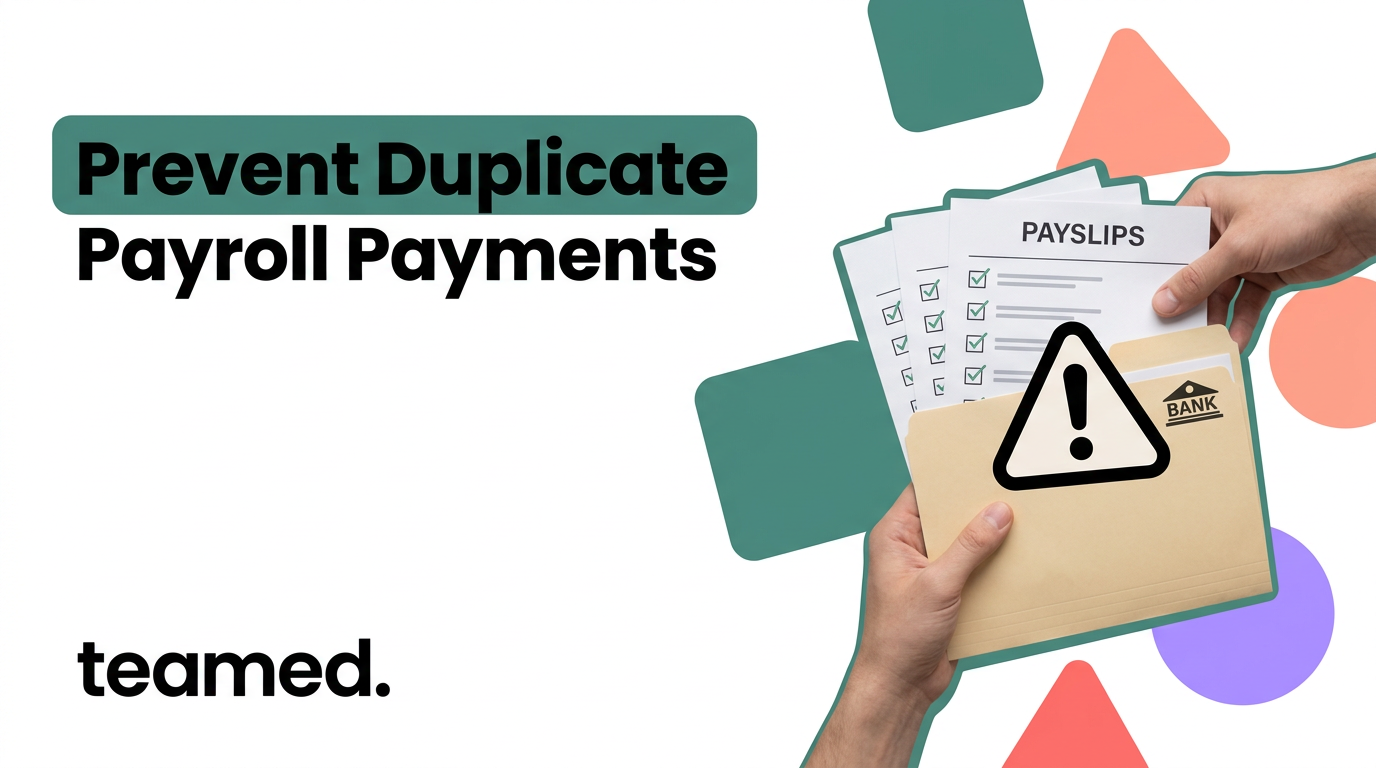
A duplicate payroll payment is a payroll disbursement error in which the same employee is paid twice for the same pay period, earnings element, or termination settlement. For mid-market companies managing international teams across multiple countries, these errors compound quickly when you're running parallel systems during provider consolidation or handling terminations across jurisdictions with different statutory requirements.
The financial impact extends beyond the obvious cash flow disruption. Duplicate payments to terminated staff create tax reporting complications, require awkward recovery conversations with former employees, and signal control weaknesses that auditors flag during due diligence. When you're operating in Germany, the UK, and Singapore simultaneously, a single termination processed incorrectly can trigger compliance issues across three tax authorities.
Here's the honest answer: most duplicate payment errors stem from process gaps rather than system failures. The payroll software works fine. The problem is the handoff between HR, payroll, and finance, especially when termination dates, cutoff calendars, and bank file submissions aren't synchronised across your global footprint.
Mid-market payroll teams typically run at least two parallel systems during provider consolidation, and Teamed flags parallel systems as a high-frequency precursor to duplicate payments when identifiers and cutoffs are not harmonised.
A standard UK BACS credit follows a three-working-day processing cycle, creating a short window to detect and stop duplicate files before pay day.
SEPA Credit Transfer payments can settle within one business day, meaning duplicate payments caused by re-submitted payment files become harder to recall once the bank execution date has passed.
A practical duplicate-detection rule used in mid-market payroll audits is to flag any two payments in the same currency to the same bank account with the same value date and amount.
A common control threshold requires additional approval when an employee's net pay changes by more than 20% period-over-period without a documented driver.
UK employers must issue a P45 when an employee leaves, and duplicate post-termination payments require payroll corrections to ensure PAYE and NIC reporting aligns to the correct leaving date.
Duplicate payments rarely happen because someone clicked "pay" twice. They occur when the same payment instruction enters the system through different channels, or when employee records exist in multiple states across disconnected systems.
The most common scenario involves parallel system operation during provider transitions. You're moving from one EOR provider to another, or consolidating from country-by-country payroll vendors to a unified platform. During the transition period, employee data exists in both the old and new systems. Without a non-reusable unique employee identifier linking records across platforms, the same person can receive payments from both systems.
Termination processing creates another high-risk window. A duplicate payment to terminated staff is a post-termination payroll disbursement in which an ex-employee receives salary after their contractual end date because the payroll system wasn't updated or the termination effective date didn't sync to the pay run cutoff. The HR system shows them as terminated, but the payroll system still has them flagged as active because the leaver workflow wasn't completed before the cutoff.
Manual re-keying amplifies these risks. When payroll changes are being re-keyed manually from HR tickets or spreadsheets, Teamed's analysis shows that manual re-entry materially increases employee payment errors and duplicated pay elements. Every handoff point between systems is an opportunity for duplication.
Prevention requires controls at three layers: master data governance, process synchronisation, and payment execution. Most organisations focus on the third layer while ignoring the first two, which is why duplicate payments keep occurring.
A unique employee identifier is a non-reusable master data key that links HR, payroll, and payments records so that bank details and pay elements cannot be inadvertently attached to multiple profiles. Choose centralised master data governance when your HRIS allows duplicate person records or re-hires without a non-reusable unique identifier, because duplicate employee profiles are a primary source of duplicate payments.
This matters particularly during acquisitions. When you inherit international headcount through a deal, you're often integrating employee data from systems with different identifier conventions. Without a clear master record strategy, the same employee can exist in your HRIS under their old company ID and your payroll system under a newly assigned ID—HMRC specifically requires different employee payroll numbers when re-employing former staff to prevent this exact issue.
A payroll cutoff is the defined date-and-time boundary after which changes to starters, leavers, pay elements, and bank details are deferred to the next payroll run. Choose a hard payroll cutoff with documented exceptions when more than 10% of payroll changes arrive inside the final three business days before pay day.
The cutoff calendar becomes critical when you're operating across multiple countries with different pay cycles. Your UK team runs monthly on the 25th, your German team runs monthly on the last business day, and your Singapore team runs on the 28th. Without a unified cutoff calendar that accounts for these variations, termination instructions can miss the cutoff in one country while being processed in another.
Choose automated duplicate-payment detection when payroll payments are initiated via bank file uploads and the business cannot reliably guarantee single submission per pay cycle. A payroll payment file is a structured bank instruction file that specifies payee identifiers, amounts, and execution dates, and can create duplicates if generated, submitted, or re-submitted more than once.
Preventive controls differ from detective controls because preventive controls stop duplicate payments before funds move, while detective controls identify duplicates after execution. Maker-checker approval on payment file release is preventive. Bank reconciliation is detective. You need both, but preventive controls save you the recovery headache.
The single most effective control is integrated HRIS-to-payroll synchronisation with a single source of truth for employee eligibility. Choose integrated HRIS-to-payroll sync when payroll changes are being re-keyed manually from HR tickets or spreadsheets.
Here's why this matters more than any other control: when your HRIS is the authoritative source for employment status, and that status flows automatically to payroll eligibility, you eliminate the gap where duplicate payments occur. The terminated employee can't be paid because they're no longer eligible in the source system. The new hire can't be paid twice because they only exist once in the master record.
A leaver workflow is a controlled HR-to-payroll process that records termination reason, last working day, final pay items, and system deactivations so that payroll eligibility ends on the correct effective date. Choose a leaver lockout rule when terminated employees can retain system access after last working day, because payroll eligibility should be technically impossible once the termination effective date is reached.
For companies operating through an Employer of Record arrangement, this integration happens within the EOR's platform. Teamed's approach treats the employment lifecycle as a single continuous process, from onboarding through termination, with eligibility changes flowing automatically between HR records and payroll execution. The graduation model, Teamed's framework for guiding companies through sequential employment model transitions from contractor to EOR to entity, maintains this integration continuity even as your employment structure evolves.
Provider transitions are the highest-risk period for duplicate payments. You're running parallel systems, migrating employee data, and coordinating cutoffs across old and new platforms. Every handoff is an opportunity for duplication.
During the transition period, you need to decide which system is authoritative for each employee on each pay date. A payroll system-of-record differs from a payment execution system because payroll calculates gross-to-net and statutory deductions, while the payment system transmits bank instructions. Duplicate payments often occur when these two layers are not reconciled with a unique run ID.
Teamed recommends documenting a clear cutover date for each country and each employee cohort. Before that date, the old provider processes payroll. After that date, the new provider processes payroll. No overlap period where both systems might generate payments.
Run a pre-payment reconciliation that compares the employee roster in both systems against a single authoritative list. Any employee appearing in both systems' payment files for the same period is a duplicate payment waiting to happen.
In cross-border payroll, salary, employer costs, and benefits are often invoiced as separate lines by modern EOR providers, which reduces the likelihood of duplicated all-in amounts being approved twice when compared to lump-sum invoices. This line-item visibility makes reconciliation easier during transitions because you can match specific pay elements rather than trying to reconcile opaque totals.
A single consolidated payroll provider differs from a multi-vendor country-by-country model because consolidation reduces handoffs and duplicated data entry, while multi-vendor models increase the number of cutoffs, file submissions, and approval chains that can create duplicate payments.
This is where Global Employment Management and Operations (GEMO) becomes relevant. When a single provider manages your global employment from initial EOR hiring through entity transition and ongoing entity management, you eliminate the provider transitions that create duplicate payment risk. The graduation model ensures continuity across employment model changes without the parallel system periods that generate most duplicate payments.
Termination payments carry unique risks because they involve final pay calculations, statutory entitlements, and benefit cessations that vary by jurisdiction. A single termination can include base salary through the last working day, accrued holiday pay, notice pay, statutory redundancy, pension contributions, and benefit deductions.
The most common cause of duplicate termination payments is the gap between the HR termination date and the payroll cutoff. HR processes the termination on the 15th. The payroll cutoff was the 10th. The employee receives their regular salary for the full month, plus a separate final pay calculation that includes the same period.
UK final pay must reflect statutory holiday entitlement and deductions accurately, and duplicated holiday pay on termination can create both tax reporting errors and contractual disputes if not corrected promptly. The P45 requirement means you need to get this right the first time, because corrections require amended filings to HMRC.
In many EU countries, termination pay components have distinct tax and social contribution treatments, so a duplicate termination payment can create multi-line statutory overreporting that must be amended in local filings. Germany's Kündigungsschutzgesetz requirements, France's indemnité de licenciement calculations, and Spain's finiquito obligations each have specific statutory components that must be calculated correctly and paid once.
HRIS-driven termination differs from payroll-only termination because HRIS-driven termination can disable eligibility at the source and propagate to payroll, while payroll-only termination can leave upstream systems showing an employee as active and re-trigger pay elements. Choose a single global payroll control owner when the company operates in three or more countries and currently relies on local HR or finance staff to approve payroll in-country without a unified checklist and cutoff calendar.
A jurisdiction-aware leaver checklist ties effective dates, cutoffs, P45 handling (in the UK), and benefit shutoff to duplicate-payment prevention. The checklist should include confirmation that the termination effective date has synced to payroll, that the employee has been removed from the next pay run, that final pay has been calculated correctly, and that recurring deductions have been stopped.
In the UK, payroll payments made after termination may still trigger pension and benefit deductions unless payroll eligibility is ended correctly, so leaver processing must explicitly stop recurring deductions alongside salary.
The technology layer matters, but it's secondary to process design. The best duplicate-detection software can't prevent errors if your underlying data governance and process synchronisation are broken.
Most modern payroll platforms include duplicate detection rules that flag potential duplicates before payment execution. A practical duplicate-detection rule used in mid-market payroll audits is to flag any two payments in the same currency to the same bank account with the same value date and amount. Teamed recommends this as a baseline control for SEPA and BACS rails.
SEPA payments rely on IBAN-based beneficiary identification, and an IBAN reused across multiple employee profiles must be handled carefully to avoid false positives in duplicate detection while still preventing true duplicates. Family members sharing bank accounts, for example, can trigger false positive alerts.
A common control threshold in payroll variance monitoring is to require additional approval when an employee's net pay changes by more than 20% period-over-period without a documented driver. Teamed recommends documenting the threshold in the payroll SOP for audit defensibility.
This control catches duplicates that don't match exactly, such as when an employee receives their regular salary plus a separately calculated termination payment that together exceed normal pay by a significant margin.
Controls at the bank-file layer include maker-checker approval, file hashing to prevent duplicate submissions, unique batch IDs, and recall windows. SEPA Credit Transfer differs from UK BACS because SEPA typically settles faster and cross-border reversals can be harder after settlement, while BACS provides a predictable multi-day cycle that can allow earlier exception handling if controls are in place.
Most guidance on duplicate payroll payments ignores payment-rail specifics. The recall window for a UK BACS payment is different from a SEPA Credit Transfer, which requires recalls for duplicate sending to be initiated within 10 Banking Business Days, which is different from a same-day faster payment. Your controls need to account for these differences.
A payroll control framework is a set of preventive and detective controls designed to stop employee payment errors before funds leave the company. For mid-market companies operating across multiple countries, this framework needs to account for varying statutory requirements, different payment rails, and multiple cutoff calendars.
Start with preventive controls at the data layer: unique employee identifiers, single source of truth for employment status, and automated eligibility synchronisation. These prevent duplicates from entering the system.
Add process controls at the workflow layer: documented cutoffs, leaver checklists, and maker-checker approvals for payroll changes. These catch duplicates before they reach payment execution.
Implement detective controls at the payment layer: duplicate detection rules, variance monitoring, and bank reconciliation. These identify duplicates that slip through earlier controls.
Document your control thresholds explicitly. When an auditor asks why a duplicate payment occurred, you need to show that you had reasonable controls in place and that this was an exception rather than a systemic failure.
HMRC can assess PAYE underpayments with lookback periods commonly up to four years for careless errors, which increases exposure when duplicate payments are not reversed and payroll reporting is not corrected. The control framework should include a documented recovery process for when duplicates do occur.
In Europe and UK multi-country payroll, each additional local payroll vendor increases handoff points, and Teamed treats every additional handoff as an incremental duplicate-payment risk factor that should be controlled with reconciliations and maker-checker approvals.
If you're currently managing payroll through multiple country-by-country vendors, consolidation to a single provider reduces the handoffs where duplicates occur. This is one of the practical benefits of the GEMO approach: fewer vendors means fewer opportunities for the same employee to exist in multiple systems.
The right time to audit is before a compliance scare forces your hand. Specific triggers that should prompt a review include any provider transition, any acquisition that brings international headcount, any change to your HRIS or payroll platform, and any instance where a duplicate payment actually occurred.
Teamed's work with mid-market companies shows that the companies with the strongest duplicate payment controls are those that treated the first incident as a process improvement opportunity rather than an isolated error. One duplicate payment is a mistake. Two duplicate payments is a control gap.
If you're managing global employment across multiple platforms and vendors, the consolidation conversation is worth having. Not because consolidation is always the right answer, but because understanding your current handoff points and control gaps is the first step toward preventing the next duplicate payment.
Talk to an Expert to review your current payroll control framework and identify where duplicate payment risks exist in your global operations.
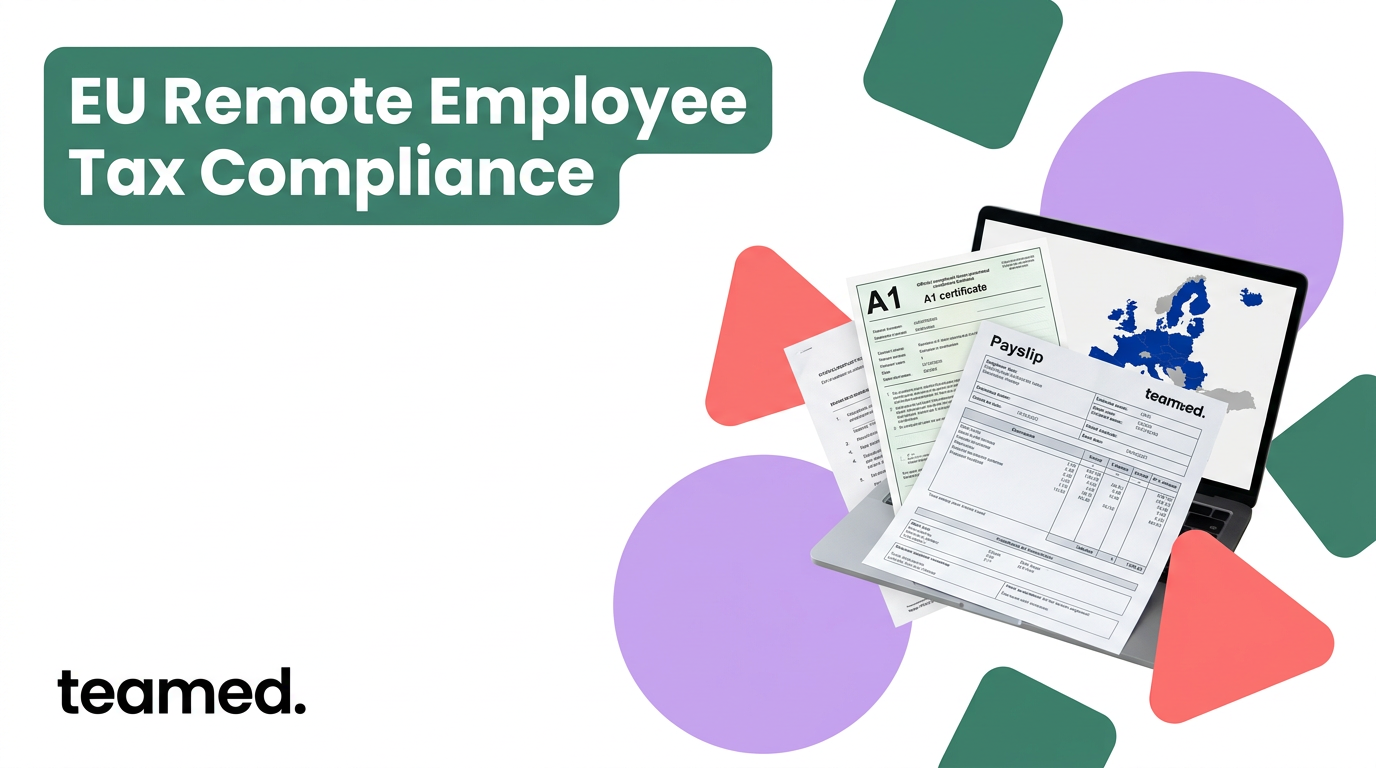
Your German engineer works from Berlin. Your marketing lead splits time between Paris and Barcelona. Your product manager just relocated to Amsterdam. Each location triggers different payroll withholding rules, social security obligations, and potential corporate tax exposure for your company.
Tax compliance for remote employees in the EU means correctly registering, calculating, withholding, reporting, and paying payroll taxes and social security in each country where your employees legally work. Get it wrong, and you're facing back taxes, penalties, and the kind of audit that keeps HR directors awake at night.
The challenge isn't just understanding the rules. It's building operational systems that track where people actually work, determine which country's social security applies, and ensure your payroll runs correctly in each jurisdiction. Most mid-market companies discover this complexity only after an employee relocates or a tax authority sends a letter.
If an employee spends more than 183 days in an EU country, they typically become a tax resident and must declare income there as their home taxation base.
EU social security coordination is governed by Regulation (EC) No 883/2004, meaning social security for cross-border workers is determined by coordination rules rather than employer preference.
An A1 certificate confirms which country's social security legislation applies to a worker temporarily working in another EU member state, and should be obtained before or at the start of any cross-border assignment.
Remote workers can trigger permanent establishment risk for their employer, potentially creating corporate tax obligations in the country where they work.
Germany's wage tax (Lohnsteuer) requires local payroll processing when an employee is employed in Germany, making compliant local payroll setup essential.
France requires employers to operate payroll withholding (PAS) and pay French social contributions through the French payroll reporting system.
Spain requires payroll withholding for personal income tax (IRPF) and payment of Spanish social security contributions for employees employed in Spain.
Most guidance on EU remote employee tax compliance conflates three distinct obligations that have different triggers and require different evidence. Understanding these separately is the foundation of any compliance strategy.
Income tax withholding obligations are typically triggered by where work is physically performed. If your employee works from Germany, German income tax rules apply to that work, regardless of where your company is headquartered. This means you need either a German payroll registration or an Employer of Record arrangement to handle withholding correctly.
Social security affiliation follows EU coordination rules under Regulation 883/2004, not payroll location. An employee working in France for a UK employer might remain on UK social security if they're temporarily posted and have an A1 certificate, particularly when telework is under 50% of total working time. The A1 is your evidence that you're paying contributions to the right country and not double-paying.
Corporate permanent establishment risk is separate from both. When employees work remotely in a country where you have no entity, their activities could create a taxable presence for your company. An employee who habitually concludes contracts or has authority to bind your company can trigger PE exposure, creating corporate income tax obligations you never anticipated.
The 183-day threshold appears in most EU tax treaties, but applying it correctly is more nuanced than counting calendar days. HR leaders on Reddit frequently describe confusion about whether the rule applies per calendar year, per rolling twelve months, or per tax year, and the answer varies by country.
Germany counts days within the calendar year. France uses a rolling twelve-month period. The Netherlands applies the rule per calendar year but has additional tests around habitual abode and centre of vital interests. When an employee works across multiple EU countries, you need to track days in each jurisdiction separately and understand each country's specific interpretation.
The practical implication is that you can't manage this with a spreadsheet and good intentions. You need a system of record that captures work location, days-in-country, employing entity, A1 status, and payroll registration status for each employee. Without this data infrastructure, you're making compliance decisions blind.
Teamed's analysis of mid-market companies managing EU remote teams shows that location tracking failures are the leading cause of missed withholding deadlines and late payroll registrations. The companies that get this right treat location data as a compliance control, not an HR convenience.
Each EU country has its own threshold for when a foreign employer must register for payroll. In most cases, having even one employee working in-country triggers registration requirements, though enforcement varies significantly.
Germany requires payroll registration when you employ someone working in Germany, full stop. You'll need a German payroll number (Betriebsnummer) and must process payroll according to German conventions, including delivering payslips in the required format. The German authorities are efficient at identifying non-compliance through cross-referencing social security and tax records.
France similarly requires employers to operate payroll withholding and pay French social contributions through the French reporting system. The French system is particularly unforgiving of late registration, and penalties accumulate quickly. Companies without a French entity typically need an EOR arrangement to employ French-resident workers compliantly.
Spain requires payroll withholding for IRPF and payment of Spanish social security contributions. Employers must align contract terms and payroll classifications to Spanish statutory categories, which differ from UK or US conventions. Getting the job category wrong can result in incorrect contribution rates and subsequent audits.
The pattern is consistent: if someone works in an EU country, that country expects you to run compliant local payroll. The question is whether you do this through your own entity, through an EOR, or through shadow payroll arrangements where appropriate.
Choose an EOR when you need to employ a worker in an EU country within weeks and you don't have, or don't want to set up, a local employing entity and payroll registrations in that country. The EOR becomes the legal employer, handling local payroll, statutory withholdings, and compliance while you direct day-to-day work.
Choose an owned entity when you plan to build a sustained in-country presence and need direct control over payroll, benefits design, equity plans, and local HR policies under your own legal employer. Based on Teamed's work with over 1,000 companies on global employment strategy, the economics typically shift toward entity establishment when you reach 15-20 employees in a single EU country, though this varies by jurisdiction complexity and the fact that 91.9% of large enterprises now provide full remote access capabilities.
The Graduation Model provides a framework for these decisions. Companies typically progress from contractor arrangements (for testing markets) to EOR (when compliance requirements tighten) to owned entities (when headcount justifies the investment). The key is having a partner who advises on when the economics and risk profile shift, not one incentivised to keep you on EOR indefinitely.
Teamed's published EOR fee of $599 per employee per month provides a predictable baseline for comparing EOR versus entity costs. When you're modelling the crossover point, include not just the monthly fees but also the entity setup costs, ongoing compliance overhead, and the management time required to coordinate multiple local providers.
An A1 certificate is your evidence that an employee remains subject to their home country's social security legislation while temporarily working in another EU/EEA/Switzerland member state. Without it, you risk paying social contributions in both countries, and the employee risks gaps in their coverage.
The A1 applies when an employee is temporarily posted to another member state while maintaining attachment to the home social security system. The posting must be genuinely temporary, typically up to 24 months, though extensions are possible. The employee must have been subject to the home country's legislation immediately before the posting began.
Obtaining the A1 before or at the start of the assignment is critical. Retroactive applications are possible but create audit risk and administrative complications. Teamed assigns named jurisdiction specialists within 48 hours specifically because A1 applications require country-specific expertise and timing matters.
A1 certification differs from a visa or work permit because A1 only governs social security affiliation, while immigration permission governs the right to live and work in the country. You need both, and they're obtained through entirely different processes with different authorities.
Shadow payroll is a compliance mechanism used when an employee remains employed by a foreign entity but has local tax withholding obligations in the work country. You run a "shadow" calculation of what local taxes would be, report and withhold accordingly, but the actual employment relationship and primary payroll remain with the home country employer.
You typically need shadow payroll when an employee works in a country for long enough to trigger local tax obligations but remains employed by your entity elsewhere. This often happens with extended business travel, temporary assignments, or employees who split time between countries.
Shadow payroll differs from standard payroll because it reports and withholds local tax for a foreign-employed worker without changing the employing entity. Standard payroll is run by the legal employer in-country. The distinction matters because shadow payroll is a tax compliance mechanism, not an employment structure.
Most competitor articles avoid explaining shadow payroll in practical terms. The decision rules are straightforward: if your employee has local tax withholding obligations but you're not changing their employing entity, shadow payroll is likely your compliance route. Local tax advisers should confirm this is the expected approach before you implement.
Permanent establishment risk arises when a company becomes subject to local corporate income tax because it has a sufficient fixed place of business or a dependent agent habitually concluding contracts in a country. Remote employees can inadvertently create this exposure.
The risk is highest when employees have authority to bind your company. A sales director who negotiates and signs contracts from their home in Spain could create Spanish PE exposure for your UK company. A country manager who makes operational decisions from Germany could trigger German corporate tax obligations.
PE risk differs from payroll withholding risk because PE is a corporate tax exposure linked to business presence and authority, while payroll withholding is an employment tax obligation linked to remuneration for work performed locally. You can have payroll obligations without PE risk, and you can have PE risk even with compliant payroll.
Managing this requires clear policies on what activities employees can perform remotely and where. Many companies implement country gating rules that require approval before an employee can work from a new location. The approval process should include PE risk assessment alongside payroll and social security considerations.
The companies that consistently get EU remote employee tax compliance right share common operational characteristics. They treat compliance as a system, not a series of one-off decisions.
First, they maintain a system of record with essential fields: work location, days-in-country, employing entity, A1 status, PE risk rating, payroll registration status, and filing calendar. This data model is audit-ready and enables proactive compliance rather than reactive firefighting.
Second, they define clear RACI ownership. HR owns location tracking and employee communication. Finance owns payroll registration and tax filing. Legal owns PE risk assessment and structure decisions. The EOR or payroll partner owns execution within their scope. Without clear accountability, compliance gaps emerge at handoff points.
Third, they implement standardised country gating rules. When an employee requests to work from a new location, the approval process includes compliance assessment. Location-by-location exceptions are a leading cause of missed withholding and late payroll registrations in cross-border employment.
Teamed reports 99% logo retention, which suggests that ongoing multi-country compliance operations are a long-term need rather than a short implementation project. The operational infrastructure you build now will serve you as your EU footprint grows.
If you've discovered employees working in EU countries without proper payroll registration or tax withholding, you have options, but speed matters. Most EU tax authorities have voluntary disclosure programmes that reduce penalties for companies that come forward before being caught.
Start by mapping your actual exposure. Where are employees actually working? For how long? What payroll and social security obligations have you missed? This assessment determines the remediation path.
For ongoing employment, you typically need to establish compliant payroll immediately. An EOR can often onboard employees within 24 hours, which materially reduces the compliance gap between discovering the problem and being correctly on local payroll. Teamed states it can onboard hires in as little as 24 hours specifically for situations where speed matters.
For historical exposure, work with local tax advisers to determine whether voluntary disclosure makes sense. The calculation involves potential penalties, interest, and the likelihood of detection. In most cases, proactive disclosure results in better outcomes than waiting for an audit.
Tax compliance for remote employees across multiple EU countries isn't a problem you solve once. It's an operational capability you build and maintain as your workforce evolves.
The right structure for where you are today may not be the right structure in eighteen months. A company with three employees in Germany might use EOR. At fifteen employees, entity establishment often makes more economic sense. The Graduation Model provides a framework for these transitions, ensuring you're always in the appropriate structure without the disruption of switching providers at each stage.
The honest answer is that EU remote employment compliance is genuinely complex. Anyone who tells you otherwise is selling simplicity that hides real risk. But complexity doesn't mean impossible. It means you need the right operational infrastructure, clear accountability, and expert support when situations get nuanced.
If you're managing remote employees across multiple EU countries and want to understand whether your current structure is right for where you're going, talk to an expert who can assess your specific situation and advise on the path forward.

Most EOR engagements should keep running. Fast market entry, zero setup costs, full compliance from day one: that's what EOR is built for, and for most companies at most headcounts, it stays the right answer for a long time.
But sometimes it stops being the right answer in one specific market. And when it does, it helps to have a partner who will say so.
Last year, we sat down with the CFO of a European AI company. They'd grown from 12 to over 40 people across four countries in 18 months. We looked at the numbers together and said: you need to stop using EOR in Germany. Everywhere else, carry on.
We call this graduation: moving from renting someone else's infrastructure to building your own. It doesn't happen to every client. It shouldn't. But when the conditions line up, the economics, the IP position, the commercial reality, it's worth having the conversation.
As Tom, our CRO, puts it: "EOR is the right thing for most people most of the time. But when you get to a certain point, you should be on a different model, and the knowledge gap stops you."
In our experience, companies often hit the tipping point around 10-20 employees in one country. For this client, Germany came first. With employer costs running 20.7% on top of gross salary, the maths shifted faster than in Spain or France.
But cost wasn't the only driver. Two other factors pushed them towards their own entity. They were building genuinely novel AI/ML work and wanted a cleaner chain of title on their IP, with direct employment contracts for the German engineering team rather than IP travelling through an EOR layer. And they wanted to start bidding on German public sector and larger enterprise tenders, a lot of which either require a local GmbH or heavily favour one.
Speed wasn't the critical factor. What mattered was making the move smoothly and without incident. As Tom told their COO: "There is no financial gain, no matter what the spreadsheet says, from trying to do it so quickly that you end up causing problems in your own operating company."
In the end, 12 employees in Germany made the switch without incident. The same specialist who'd been with them since day one handled the whole transition.
Twelve employees across Germany, Spain, France, and the UK. An AI/ML company scaling fast. Mid-2024.
EOR was the right structure at that moment. This is precisely what Employer of Record services are built for: hire quickly in a new market, avoid months of legal setup, and stay compliant from day one.
Eighteen months later, the numbers had changed. 40+ employees total. 10+ concentrated in Germany. A projection of 60+ within the next 12 months. Germany had also become the company's R&D centre of gravity, and German buyers were starting to ask for a local contracting entity before they'd engage on larger deals.
The structure that was right at 12 was no longer right at 40 in Germany specifically. Elsewhere, EOR was still the right call.
First, the economics: at what point does your own German entity cost less than EOR fees? For them, it was 8 employees. They had 10.
Second, operational flexibility: what can't you do on EOR that's starting to hurt? They couldn't modify equity vesting schedules, create custom bonus structures, or put German clients on a GmbH-issued contract.
Third, IP: what protection do you need? As Tom says: "If you've got IP, that might be something that's pretty important to you." On EOR, the legal employer is the EOR provider, not you. IP assignment still works, but it travels through an extra layer of contracts. With engineering concentrated in Germany, the client wanted direct employment relationships.
Fourth, growth trajectory and compliance maturity: what does your 12 to 24 month hiring plan look like, and does your team have bandwidth to manage German employment law internally?
For this client, all four answers pointed the same way in Germany. In the other markets, they pointed to staying on EOR. It's worth saying plainly: a mixed picture is normal and usually right. Different countries, different answers.
Germany: your own entity. Estimated saving of €180,000 a year, direct employment contracts, clean IP chain of title, and a GmbH name on contracts with German customers.
France: not yet.
Spain and UK: stay on EOR.
We offered to handle the German transition, including the tricky parts like Betriebsübergang compliance, and to stay on for payroll and compliance afterwards.
The client's COO responded: "We've been wondering when it would make sense to set up our own entity. The fact that you're the one raising this conversation, rather than trying to keep us on EOR indefinitely, tells us we're working with the right partner."
Before anything moved, we built a simple model comparing current costs versus entity costs at 10, 20, and 40 employees. We mapped out a realistic path to formation, introduced them to local counsel, and assigned Tom as their single point of contact.
Tom's advice from day one was to plan, not sprint: "Never, ever decide to have an entity ASAP. You can do it quickly, just don't do it ASAP. Don't do it in too much of a hurry."
The same person who'd known their equity plans, benefits philosophy, and growth trajectory for 18 months stayed on the account. Different legal structure underneath, same relationship on top.
German employment law has teeth. Betriebsübergang rules mean you can't just switch employers without proper consultation. Get it wrong and employees can claim constructive dismissal.
Tom coordinated the required employee meetings, information letters, and consultation periods. Every employee knew what was changing, what wasn't, and exactly how it affected them. Final payroll and entitlements reconciled holiday balances, benefits, and final payments to the last cent.
As Tom describes the job: "Having a partner that will smooth out the dents and the bumps in the road is the bit that is critical."
The numbers: 10+ employees transitioned across 4 countries. 6 moved to the client's own German entity. The remaining employees continued on EOR in Spain, France, and the UK. 8 weeks from decision to completion, not because we rushed, but because the planning front-loaded the work.
The Germany EOR engagement ended. The Spain, France, and UK engagements didn't. Neither did the partnership.
Teamed continued with entity management for Germany, ongoing payroll and compliance, and HR advisory for the new in-house team. This is what GEMO (Global Employment Management and Operations) looks like in practice: one relationship across every structure, adjusted market by market as the situation evolves.
Every employee got paid on time, kept their benefits, and barely noticed the legal change. The company saved €15,000 per month in Germany alone. They could offer the equity vesting terms they wanted, put their IP chain of title on a clean footing, and start responding to German tenders under their own GmbH.
Six months later, their CEO introduced us to two portfolio companies. His words: "They'll tell you when to stop using them." For us, graduation means you're succeeding, not leaving.
For most companies, most of the time: don't. EOR is the right answer for a long time in a lot of situations. The question is whether you've crossed into the zone where it no longer is for a specific market.
The crossover point typically sits between 8 and 15 employees in a single market. Germany's regulatory environment and employer social contribution costs, with tax wedges of 43.9% being the second-highest in the EU, mean the crossover tends to come earlier than in most European markets.
The calculation involves headcount, projected growth, entity setup and maintenance costs versus per-employee EOR fees, operational control needs, whether a local legal entity unlocks tender or customer contracting access, and how clean you need your IP chain of title.
Stay on EOR if your headcount in each market isn't near the crossover zone, or if commercial and IP factors don't independently justify the move. Move to your own entity when the numbers, operational needs, and commercial reality all point that way in a specific country. Often the right answer is mixed: own entity in one market, EOR in the others.
In Germany, transitions are governed by Betriebsübergang (business transfer law). Formal employee consultation is required, including written notification about timing, reasons, consequences, and planned measures. Employee rights are protected, and when managed properly, employees transfer with their existing terms preserved.
Germany also has country-specific employee protection norms that make termination processes higher-risk than in many jurisdictions. Companies with more than 10 employees require justified reasons for regular termination.
Not with us. We can help you set up the entity, manage the transition, and keep running payroll and compliance afterwards. Same people, same systems.
This transition across 4 countries took 8 weeks from decision to completion. Timelines vary by jurisdiction. Tier 2 countries like Germany, France, and Spain typically require 4-6 months for full entity establishment, including incorporation, banking, tax registration, and employee transfer.
A mixed structure is also fine during transitions and beyond. This client established their own entity in Germany while keeping EOR in Spain, France, and the UK where headcount was lower.
When was the last time your provider modelled whether EOR is still the right structure for each of your markets? Can they name the specialist who would handle a contested termination in your biggest country? What happens to the relationship if you set up your own entity somewhere?
If you have 8-15 employees in any European country and you've never seen the maths on entity versus EOR costs, it's worth running the numbers. Depending on the country, the crossover might already be behind you, or still comfortably ahead.
Want to see the maths on your situation? Talk to an Expert. We can show you where your crossover point is, what entity setup actually costs, and whether switching makes sense right now, or whether staying put is the better call.

Compliance costs across countries can vary by 300% or more between jurisdictions, even within the European Union. France typically represents the highest statutory employment expense for mid-market companies, with employer social contributions commonly exceeding 40% of gross salary. Italy and Spain follow closely at around 30%, while the Netherlands and United Kingdom fall significantly lower in the low-to-mid teens.
The frustrating reality? Most global employment providers won't give you this breakdown. They bury the variance in opaque invoices and let you discover the true cost after you've already committed to a market.
If you're a VP of People or HR Director managing international teams across 2-15 countries, you've probably felt this pain. The budget you set for your German expansion looks nothing like what you're actually spending. Your finance team keeps asking why employment costs in Brazil are double what you projected. And nobody can give you a straight answer about what's driving the difference.
Let me show you what actually drives these costs, which countries will blow your budget, and how to get real numbers before you make promises to the board about that new market entry.
Employer social contributions in France commonly exceed 40% of gross salary, making it one of the highest statutory on-cost jurisdictions in Europe. Italy and Spain both run around 30% employer social security, meaning a €70,000 salary can imply €20,000+ per year in employer charges alone. The Netherlands typically falls in the low-to-mid teens as a percentage of salary, reducing statutory on-costs relative to Southern and Western Europe. UK HMRC can assess PAYE and National Insurance underpayments for up to 6 years in standard cases and 20 years where deliberate behaviour is alleged. Germany's employee leasing regime under the AÜG framework can trigger significant compliance overhead requiring specific licences and strict operational controls. Mid-market companies operating in 5-15 countries typically spend £50,000-£150,000 annually in coordination costs alone when managing multiple compliance vendors.
Compliance cost isn't a single number. It's the total internal and external spend required to meet a jurisdiction's employment, payroll, tax, and data-protection obligations. That includes time, tooling, advisors, filings, and remediation risk. Most current analyses conflate statutory employment on-costs with operational compliance overhead, which leads to incorrect country rankings for CFO budgeting.
The first driver is statutory employment on-costs. These are the mandatory employer contributions to social security, health insurance, pension schemes, and other government-mandated programmes. France leads here with contributions that can push total employment cost to 140% of gross salary before you've paid a single euro in provider fees.
The second driver is operational compliance overhead. This covers registrations, recurring filings, audit support, and the administrative burden of staying compliant. Germany exemplifies this well. While its statutory rates are moderate compared to France, the works council requirements at 5+ employees and complex dismissal protections create substantial ongoing administrative cost.
The third driver is enforcement intensity. This reflects how frequently authorities audit and penalise non-compliance. High enforcement intensity increases the expected cost of controls, documentation, and specialist support. Countries like Brazil and France maintain aggressive enforcement regimes that require more robust compliance infrastructure.
Teamed's analysis of employment operations across 70+ countries shows that companies routinely underestimate operational overhead by 40-60% when budgeting for new market entry. The statutory costs are visible. The compliance infrastructure costs are not.
France stands alone at the top of European compliance costs. Employer social charges commonly exceed 40% of gross salary, and the regulatory framework demands meticulous attention to detail. The Code du travail requires formal payslips with prescribed content, detailed working time and leave rules, and complex termination procedures requiring formal meetings and documentation. At 11+ employees, companies must establish a CSE (Social and Economic Committee), adding another layer of compliance obligation.
Italy and Spain cluster together in the next tier, both running approximately 30% employer social security contributions. Italy's complex bureaucracy creates slow entity setup timelines, and dismissals are highly restricted with courts frequently reinstating terminated employees. Spain's rigid labour laws impose expensive terminations at 33 days salary per year of service for objective dismissal and 45 days for unfair dismissal.
Belgium presents a unique challenge with employer contributions around 27% of gross, but the complexity multiplies through language requirements. Dutch in Flanders, French in Wallonia. Payroll includes mandatory 13th month and holiday pay calculations that trip up companies unfamiliar with the system.
Germany sits in moderate complexity territory. The statutory rates are manageable, but works councils become mandatory at 5+ employees if employees request them. Notice periods range from 4 weeks to 7 months based on tenure. The employee leasing regime under AÜG can trigger significant compliance overhead because leasing often requires specific licences and strict operational controls around assignment structure, with works councils becoming mandatory at 5+ employees if employees request them.
The Netherlands and United Kingdom offer relative simplicity. Dutch employer contributions fall in the low-to-mid teens, and while dismissal may require UWV permission or court approval, the process is codified and predictable. UK compliance benefits from a common law system, flexible employment contracts, and straightforward redundancy processes.
Asia-Pacific jurisdictions present a different cost profile than Europe. Statutory on-costs are generally lower, but operational complexity and enforcement risk can be substantially higher.
Singapore represents the low-complexity benchmark for the region. Employer contributions to CPF (Central Provident Fund) are significant but straightforward to calculate. The regulatory framework is exceptionally clear, English serves as the business language, and government processes are efficient. Most mid-market companies can justify entity establishment at 10+ employees.
Australia operates under the Fair Work system with transparent rules. Modern Awards add payroll complexity, but the requirements are well-documented. Unfair dismissal protections apply at 6+ months for small businesses or 12+ months for larger employers.
Japan introduces cultural complexity that doesn't appear in statutory cost calculations. Courts require "objectively reasonable grounds" for termination, and consensus-based dismissals are expected. Documentation requirements are extensive, with detailed personnel files required for every employee. Retirement allowances are customary rather than mandatory but expected by the workforce.
China presents the highest complexity in the region. A Wholly Foreign-Owned Enterprise (WFOE) is required for full operational control, and social insurance requirements vary by city and province. Provincial interpretation of national law creates inconsistency that requires local expertise to navigate. Teamed classifies mainland China as Tier 3 complexity, recommending companies stay on EOR until 25-35 employees.
India's compliance landscape fragments across states. The Shops and Establishments Act varies by state, and social security includes both Provident Fund and Employee State Insurance with different calculation methods. Gratuity payments become mandatory after 5 years of employment.
Latin America consistently ranks among the most expensive regions for employment compliance, but the costs hide in places European-focused companies don't expect.
Brazil exemplifies the challenge. The CLT (Consolidação das Leis do Trabalho) creates extremely complex labour code requirements. Mandatory 13th-month salary adds 8.33% to annual compensation. The monthly 8% FGTS contribution to the severance fund accumulates throughout employment, and termination without cause triggers a 40% FGTS penalty. Mandatory union involvement and high frequency of labour lawsuits mean total termination costs can exceed 6 months salary. The EOR fee in Brazil effectively serves as insurance premium against labour court battles.
Mexico's constitutional labour protections create a different cost structure. Mandatory profit sharing (PTU) requires companies to distribute a portion of profits to employees. Severance for unjustified dismissal runs 3 months salary plus 20 days per year of service. Recent labour reforms have increased formalisation requirements, adding to ongoing compliance burden.
Argentina combines high termination costs with regulatory unpredictability. The mandatory 13th-month salary (aguinaldo) is standard, but frequent changes to employment regulations aligned with economic policy shifts make long-term planning difficult. Union influence remains significant across most industries.
Colombia imposes high termination costs with indemnification based on salary and tenure. The social security system requires multiple contributions covering health, pension, and ARL (occupational risk). A mandatory prima bonus of one month salary per year adds to the statutory cost base.
Most companies approach compliance cost calculation backwards. They start with provider quotes and assume that's the total cost. The actual calculation requires separating four distinct cost buckets.
The first bucket is statutory on-costs. These are the employer social contributions, mandatory benefits, and government-mandated payments. They're relatively predictable once you understand the local requirements. For France, budget 40%+ of gross salary. For the Netherlands, budget low-to-mid teens.
The second bucket is recurring filings and registrations. This includes payroll reporting, tax filings, annual returns, and regulatory submissions. The cost here is partly direct (filing fees, registration costs) and partly indirect (staff time, system configuration, audit preparation).
The third bucket is advisory spend. This covers local legal counsel, accounting support, and specialist guidance for complex situations. High-complexity jurisdictions like Brazil, China, and France require more advisory support than straightforward markets like Singapore or the UK.
The fourth bucket is enforcement-driven expected loss. This is the probability-weighted cost of compliance failures. UK HMRC can assess PAYE and NIC underpayments for up to 6 years in standard cases and 20 years where deliberate behaviour is alleged. That look-back period increases the expected cost of contractor status errors significantly.
Teamed's work with 1,000+ companies shows that most budget exercises capture bucket one, partially capture bucket two, and completely miss buckets three and four. A proper global compliance cost analysis normalises all four buckets into comparable figures across jurisdictions.
The crossover point where entity ownership becomes cheaper than EOR varies dramatically by country complexity. Teamed's Graduation Model provides a framework for this decision that most EOR providers won't share because it reduces their revenue.
For Tier 1 low-complexity countries like the United Kingdom, Ireland, Australia, Singapore, and the Netherlands, entity establishment typically makes economic sense at 10+ employees if your team operates in the native language. Add 30-50% to that threshold if you're operating in a non-native language environment.
For Tier 2 moderate-complexity countries like Germany, France, Spain, Italy, and Japan, the threshold rises to 15-20 employees for native language operations or 20-30 employees for non-native. The higher threshold accounts for works council requirements, complex termination procedures, and documentation burden.
For Tier 3 high-complexity countries like Brazil, Mexico, China, India, and Indonesia, stay on EOR until 25-35 employees for native language operations or 35-50 for non-native. The EOR fee in these markets functions as insurance against compliance errors that could cost multiples of the annual fee.
The calculation method is straightforward. Multiply your annual EOR cost by projected years, then compare against entity setup cost plus ongoing annual entity costs. For a UK operation with 10 employees, EOR at £7,500 per employee per year totals £225,000 over three years. Entity setup at £25,000 plus £3,500 per employee per year totals £130,000. Break-even hits at month 17.
After reviewing hundreds of employment cost analyses, I keep seeing the same three hidden costs that can add 20-40% to your real spend.
The first is FX variance. Most EOR providers mark up foreign exchange rates without disclosure. Teamed contractually guarantees zero FX markup and timestamps the FX rate used on every invoice, which reduces hidden cost variance in multi-currency payroll. If your provider doesn't show the mid-market rate alongside their applied rate, you're paying a hidden premium.
The second is invoice opacity. When salary, statutory costs, benefits, and provider fees appear as a single line item, you can't identify what's driving cost increases. Teamed provides fully itemised invoices separating each component. This transparency matters because statutory costs change with local legislation, and you need to distinguish regulatory increases from provider price increases.
The third is coordination overhead. Companies operating in 5-15 countries with separate EOR providers, entity formation specialists, local payroll vendors, and compliance consultants often spend £50,000-£150,000 annually in coordination costs alone. This includes management time reconciling data across systems, resolving conflicting advice from different vendors, and managing multiple relationships.
A Global Entity Management Operations (GEMO) approach eliminates coordination overhead by maintaining one supplier relationship from initial EOR hiring through entity transition and ongoing entity management. The supplier relationship remains constant while only the underlying employment model evolves.
Start with employee concentration. Any country where you're within 20% of the relevant tier threshold deserves immediate analysis. Eight employees in a Tier 1 country like the UK means you should be modelling the crossover economics now, not after you hit 12.
Next, assess strategic importance. Markets central to your growth strategy warrant deeper compliance infrastructure investment. A market you're testing for product-market fit should stay on EOR regardless of headcount until you've committed to a 3+ year presence.
Then evaluate regulatory stability. Political instability, upcoming elections, or frequent changes to employment regulations make long-term planning difficult. These conditions suggest extending EOR usage regardless of headcount thresholds.
Finally, check for red flags that override the standard analysis. Complex foreign exchange controls affecting salary payments. Currency instability creating unpredictable cost structures. Mandatory local ownership requirements you cannot satisfy. High employee turnover suggesting headcount may not remain stable. If any of these apply, stay on EOR longer than the standard threshold would suggest.
Teamed's advisory approach includes automated crossover monitoring that alerts when entity formation becomes cheaper than EOR. This proactive advisory means you're not relying on your own analysis to catch the transition point.
The right structure for where you are requires honest assessment of your current state. Map every country where you employ people, noting current employee count and operating language. Identify which countries are approaching tier thresholds. Run three-year cost comparisons for each threshold country.
The trusted advice for where you're going means working with a partner who will tell you the honest answer even when it's complicated. That includes telling you when to stop using EOR and graduate to your own entity, even though that graduation reduces their per-head revenue.
If you're managing international teams across multiple countries and want clarity on which jurisdictions are actually costing you the most, talk to an expert who can model your specific situation. The decision is too important to get wrong, and the right analysis now prevents expensive surprises later.
Your new hire in Germany signed their contract yesterday. They start Monday. And somewhere between the excitement of closing the role and the reality of their first day, you're realising that nobody has figured out how to actually get them working.
Remote onboarding fails most often in the gap between "offer accepted" and "productive employee." HR leaders on Reddit describe their experiences as "haphazard" and "spotty," with new hires left to find documentation themselves while managers scramble to schedule a few video calls. The difference between a new hire who's contributing in week two and one who's still confused in month two comes down to what happens before day one even begins.
This guide walks through the complete remote employee onboarding process, from the moment an offer is accepted through the first 90 days. You'll find the specific steps, compliance requirements, and practical workflows that turn scattered onboarding into a repeatable system, whether you're hiring one person in the Netherlands or building teams across five countries simultaneously.
Teamed can typically complete EOR onboarding in 24-48 hours when you have all the documents ready and the country doesn't have unusual requirements. Most delays come from missing bank details or unsigned contracts.
If you want them working on Day 1, lock down three things by the Thursday before: their laptop shipped, their accounts created, and their payroll information collected. Miss any of these and you're looking at a rough first week.
Most experienced teams use a 30-60-90 day plan with manager check-ins at days 7, 30, 60, and 90. These conversations catch the quiet problems before they turn into missed deadlines or surprise resignations.
UK right-to-work checks must be completed before employment starts, using the Home Office online service or an Identity Service Provider for eligible British and Irish passport holders.
Within 48 hours, you get a named specialist who knows the specific country inside out. They can answer questions like 'What's the mandatory notice period in Spain?' or 'Do we need to register this employee with the local authorities in Germany?'
GDPR applies to remote onboarding data in the UK and EU, requiring employers to define a lawful basis for processing, minimise collected data, and ensure processors have compliant data processing agreements.
Remote onboarding differs from office-based onboarding in one fundamental way: every handover that would happen naturally in person must be executed digitally or through third-party logistics. Identity verification, right-to-work checks, equipment delivery, and the informal "ask the person next to you" moments all require documented workflows and tracked confirmations.
The stakes are higher than they appear. A missed payroll deadline because bank details weren't validated creates immediate trust damage. A laptop that arrives three days late means a new hire sitting at home with nothing to do. An incomplete right-to-work check in the UK means you've just created a compliance exposure that could result in civil penalties up to £60,000 per worker.
What makes remote onboarding work is structure that accounts for the absence of physical proximity. Recent research found that structured onboarding with microlearning increased role clarity by 28.7% and significantly improved new hire performance. The best remote onboarding in startups, according to HR professionals in community discussions, "leans on overcommunication, structured 1:1s, and async documentation, even if it's messy." Regular check-ins, designated points of contact, and clear expectations replace the organic relationship-building that happens when people share physical space.
The weeks before day one carry more weight than most companies realise. This is when administrative tasks, technology setup, and compliance requirements must be completed so the new hire can actually work when they arrive.
Employment contracts must be executed before the start date in most jurisdictions. In the Netherlands, probation period enforceability depends on having a written agreement signed before work begins. In France, employee onboarding commonly requires enrolling the employee in mandatory social security and complying with collective bargaining agreement provisions that affect probation length and benefits.
For UK hires, right-to-work checks must be completed before employment starts. Compliant remote checks typically require using the Home Office online service or an Identity Service Provider for eligible British and Irish passport holders, with evidence retained in the personnel file. This isn't a task that can wait until day one.
Device procurement and shipping timelines determine whether your new hire can work on Monday or sits waiting for a laptop. The practical target is completing device procurement, account provisioning, and payroll data collection at least five business days before day one.
Security-led onboarding matters when the new hire will access personal data, source code, or financial systems. With stolen credentials causing 16% of data breaches that take nearly 10 months to contain, proper identity verification and access controls during onboarding are critical. Access provisioning should be gated by identity verification, MFA enforcement, and completion of security training. Conditional access policies, device encryption confirmation, and role-based access approvals prevent the security gaps that come from rushing someone into systems without proper controls.
Missing the first payroll run creates immediate problems. The critical path connects pre-boarding tasks to payroll cut-off dates, bank detail validation, and first-pay risk controls. For multi-country hires, this becomes more complex because payroll cycles, statutory deductions, and payment methods vary by jurisdiction.
Most first-pay disasters come from three things: wrong bank details, missed cutoff dates, or incorrect tax codes. Get this information the week before they start, not during their first week when it's already too late.
Remote onboarding follows four distinct stages: pre-boarding (before day one), orientation (first week), integration (first 30 days), and full productivity (days 30-90). Each stage has specific objectives and milestones.
Pre-boarding covers everything from offer acceptance to the evening before day one. The goal is ensuring the new hire has everything needed to work productively from minute one.
1. Execute employment contract with all required local terms 2. Complete right-to-work verification and retain documentation 3. Collect payroll inputs including bank details, tax information, and emergency contacts 4. Procure and ship equipment with tracking confirmation 5. Provision accounts with appropriate access levels 6. Send welcome materials including first-day schedule and contact information 7. Schedule orientation meetings and manager introductionsA comprehensive onboarding plan should outline the first few weeks of the new hire's journey, including training sessions and introductions to key team members. This plan becomes the roadmap that prevents the "haphazard" experience so many remote employees describe.
Day one sets the tone. Schedule a welcome orientation meeting as the first activity, whether individual or group. This video conference should cover company culture, team structure, and immediate priorities.
The first week should include scheduled meetings with the direct manager, introductions to immediate team members, and initial training on core tools and processes. Remote onboarding discussions consistently emphasise making the first week feel "structured rather than chaotic." Short icebreaker activities, virtual coffee chats, and bite-sized training content make orientation more engaging than a wall of eLearning modules.
Integration focuses on building relationships and understanding how work actually gets done. This stage includes deeper training on role-specific tools, introduction to cross-functional stakeholders, and initial project assignments.
Manager check-ins at days 7 and 30 detect early-risk issues before they become performance problems. These aren't status updates but genuine conversations about whether the new hire has what they need, understands expectations, and feels connected to the team.
The 30-60-90 day structure provides clear milestones for both the employee and manager. By day 30, the employee should understand their role and immediate responsibilities. By day 60, they should be contributing independently on routine tasks. By day 90, they should be fully productive and integrated into team workflows.
Use the 30-60-90 framework to avoid surprises at probation review. Both of you should know exactly where things stand at each checkpoint.
Here's a simple way to check if you've covered everything: Compliance (are they legal?), Clarification (do they know what to do?), Culture (do they get how we work?), Connection (do they know their team?), and Checkback (are we catching problems early?).
Compliance covers the legal and regulatory requirements: contracts, right-to-work, payroll registration, and policy acknowledgements. For international hires, compliance requirements vary significantly by country. In Germany, works councils can have co-determination rights over matters like working time arrangements and technical monitoring tools, so remote onboarding for German hires should confirm whether any works council consultation is required before deploying certain tooling.
Clarification ensures the new hire understands their role, responsibilities, and how success is measured. Remote employees can't absorb expectations through osmosis, so explicit documentation of goals, processes, and decision-making authority becomes essential.
Culture addresses how the company operates, what it values, and how people interact. Remote culture transmission requires intentional effort through documented values, recorded leadership messages, and opportunities to observe how teams collaborate.
Connection builds relationships with managers, teammates, and cross-functional partners. This remains challenging in remote settings, where only 67% of employees report feeling connected compared to 90% of leaders who believe connectivity is working well. Engaging new hires with leaders and the team early and often, ensuring they have a designated point of contact, and scheduling introductions with key colleagues all contribute to connection.
Checkback creates feedback loops that identify problems early. Regular check-ins, pulse surveys, and open channels for questions allow course correction before small issues become resignation letters.
Country-specific compliance requirements make a one-size-fits-all remote onboarding checklist inadequate. Statutory benefits, mandatory policy acknowledgements, and required employment contract clauses vary across jurisdictions and cannot be standardised without exceptions.
UK IR35 rules require medium and large organisations to issue a Status Determination Statement for relevant engagements and to operate PAYE when the engagement is deemed inside IR35. This makes contractor onboarding a tax-governed process rather than a pure procurement task. Getting classification wrong creates liability for unpaid taxes, National Insurance, and penalties.
Choose a contractor onboarding route when the work is project-based with deliverables, the individual controls how and when work is performed, and the business can avoid integrating the person into core org structures like set hours, line management, and employee benefits. When those conditions aren't met, employee classification, whether through direct employment or EOR, is the compliant path.
EU Working Time rules generally require tracking working time for non-exempt employees, so remote onboarding should include time recording expectations and overtime approval workflows where applicable under local law and collective agreements.
GDPR applies to all remote onboarding data in the UK and EU. Employers must define a lawful basis for processing, minimise collected data, set retention periods, and ensure processors like e-signature and HRIS vendors have compliant data processing agreements. Most remote onboarding articles omit this compliance-first data map, but it's essential for avoiding regulatory exposure.
Choose EOR onboarding when you need to employ someone in a country where you lack an entity and you require locally compliant payroll, statutory benefits, and employment contracts without incorporating locally first. Teamed provides EOR coverage in 187+ countries, which allows mid-market employers to onboard hires in markets where they don't have a local legal entity.
The EOR already has a local employing entity and payroll infrastructure in-country, while entity onboarding requires incorporation, local registrations, and setup of payroll and benefits before the first employment contract can be run locally. For companies hiring their first few people in a new market, EOR removes the compliance burden that would otherwise delay onboarding by months.
The emotional experience of remote onboarding matters as much as the administrative checklist. New hires who feel welcomed and valued integrate faster and stay longer.
Making remote onboarding personal requires intentional effort. Designate one person as the new hire's go-to contact for questions. Set up video introductions with team members who can explain how work actually flows. Schedule informal conversations that aren't about tasks or projects.
The best onboarding experiences include elements that would happen naturally in an office: a welcome message from leadership, introductions to people beyond the immediate team, and early opportunities to contribute meaningfully. Virtual coffee chats, small group sessions, and team rituals that include remote participants all help build the sense of belonging that physical proximity provides automatically.
Equipment and workspace setup also signals investment in the new hire. Ensuring everything needed to get started is there on day one, from functioning accounts to proper equipment, demonstrates that the company prepared for their arrival rather than scrambling to figure it out.
Onboarding doesn't end after the first week or even the first month. Continuous feedback and support mechanisms determine whether initial momentum translates into long-term success.
Manager check-ins at days 7, 30, 60, and 90 create natural opportunities to assess progress, address concerns, and adjust expectations. These conversations should cover both performance and experience: Is the work going well? Do you have what you need? Are you connecting with the team?
For remote employees, overcommunication beats undercommunication. Regular 1:1s, even if brief, maintain connection and catch problems early. The absence of casual office interactions means scheduled touchpoints carry more weight.
Remote employees can't tap a colleague on the shoulder to ask how something works. Solid documentation, even if imperfect, provides the reference material that enables independent problem-solving.
Invest in async documentation that answers common questions: How do I submit expenses? Who approves time off? Where do I find the brand guidelines? This documentation reduces dependency on synchronous communication and helps new hires feel capable rather than constantly asking for help.
Remote employees need visibility into growth paths and development opportunities. Without physical presence, they can become invisible in promotion discussions or miss informal learning opportunities.
Explicit conversations about career goals, skill development, and advancement criteria ensure remote employees aren't disadvantaged by their location. Regular feedback on performance, not just at formal review periods, helps them understand where they stand and what they need to develop.
The right onboarding approach depends on your employment structure: contractors, EOR employees, or employees of your own entity. Each model has different compliance requirements, timelines, and administrative processes.
Employee onboarding differs from contractor onboarding because employees require payroll withholding, statutory social security, and locally compliant employment terms, while contractors typically invoice for services. However, contractors managed like employees create misclassification exposure that can result in back taxes, penalties, and reclassification orders.
Contractor onboarding should establish clear deliverables, confirm the individual controls how and when work is performed, and avoid integrating them into employee structures. The onboarding process is lighter but the classification decision carries significant weight.
EOR onboarding provides the compliance infrastructure of employment without requiring your own local entity. The EOR handles contract execution, payroll registration, statutory benefits, and ongoing compliance while you direct the work.
A platform-only onboarding model differs from an advisory-led onboarding model because advisory-led onboarding provides jurisdiction-specific judgement on structure, classification, and contract content rather than only collecting data and generating documents. When you're making decisions about employment in unfamiliar jurisdictions, having named specialists who understand local requirements shortens the path to compliant onboarding.
When you have your own entity in a country, you control the employment relationship directly but bear full compliance responsibility. Entity onboarding requires internal or outsourced expertise in local employment law, payroll administration, and statutory requirements.
Choose entity formation when the hire plan in a single country is expected to be long-term and growing, and when repeated EOR fees are forecast to exceed the fixed and ongoing costs of running a local entity. Teamed's Graduation Model helps companies understand when this transition makes sense, providing continuity through the shift from EOR to owned entity without re-onboarding employees or switching providers.
Remote employee onboarding succeeds when it's treated as a system rather than a series of ad hoc tasks. The companies that onboard remote employees well have documented processes, clear ownership, and feedback loops that improve the experience over time.
Choose a centralised global onboarding owner when you're onboarding across three or more countries in a quarter. Distributed ownership increases the likelihood of missed payroll deadlines and inconsistent compliance steps. One accountable function, whether internal or through a partner like Teamed, ensures nothing falls through the cracks.
The right structure for where you are, and trusted advice for where you're going, matters as much in onboarding as in any other aspect of global employment. Whether you're hiring your first remote employee or building distributed teams across multiple countries, the fundamentals remain the same: prepare before day one, structure the first 90 days, maintain compliance across jurisdictions, and create the human connection that makes remote work sustainable.
If you're hiring internationally and want a named person who can help you navigate the compliance requirements while actually caring about your new hires' experience, talk to an expert about how Teamed can support you from the first hire onward.
Your HR systems hold the most sensitive data in your organisation. Employee national identifiers, salary information, health records, performance reviews, and disciplinary files all flow through platforms that may span multiple vendors, countries, and employment models. A single misconfigured access control or forgotten data retention policy can trigger fines up to £17.5 million or 4% of global annual turnover under UK GDPR.
The challenge intensifies when you're managing international teams across contractors, EOR arrangements, and owned entities. Each employment model creates different controller-processor relationships, and each jurisdiction adds its own data residency requirements. HR leaders on Reddit frequently describe this as "vendor chaos" where no single system provides complete visibility.
These 12 best practices move beyond generic compliance checklists to address the operational realities of modern HR stacks. You'll find specific controls, timelines, and decision criteria that map directly to auditable evidence, whether you're preparing for regulatory scrutiny or simply trying to sleep better at night.
UK GDPR and EU GDPR allow administrative fines of up to £17.5 million or 4% of global annual turnover for serious infringements, making HR data compliance a board-level financial risk.
Controllers must notify the UK Information Commissioner's Office of personal data breaches within 72 hours of becoming aware when the breach poses risk to individuals' rights.
Organisations with 250+ employees or high-risk processing must maintain a Record of Processing Activities documenting HR data categories, purposes, recipients, and retention periods.
Cross-border HR data transfers to non-EEA countries require adequacy decisions or appropriate safeguards such as Standard Contractual Clauses reflected in vendor contracts.
Special category HR data processing under UK and EU GDPR requires both a lawful basis under Article 6 and a special category condition under Article 9.
UK HMRC can assess unpaid PAYE and National Insurance for up to 6 years in standard cases and up to 20 years for deliberate behaviour.
HR data compliance is a governance discipline ensuring employee and candidate personal data is collected, used, shared, stored, and deleted according to applicable privacy, employment, and security laws across every HR system and vendor. This isn't a one-time project. It's an operating model that touches every hire, termination, and system integration.
The stakes extend beyond regulatory fines. Mishandled employee data erodes trust, complicates M&A due diligence, and creates liability that follows your organisation across borders. When Teamed's analysis of global employment patterns examines mid-market companies operating in 5-15 countries simultaneously, the compliance surface area multiplies with each new jurisdiction and employment model.
Most competitor content discusses GDPR at a high level but omits the operational timelines that actually determine compliance. The 72-hour breach reporting window, offboarding access revocation requirements, and DSAR response workflows all demand specific controls in your HR systems. Generic advice won't survive an audit.
The regulatory landscape differs significantly between jurisdictions, but the core principles remain consistent. UK GDPR and EU GDPR both set maximum administrative fines of up to €20 million or 4% of global annual turnover for severe violations including unlawful processing and inadequate security controls. The California Consumer Privacy Act grants employees rights to know what data you collect, request deletion, and opt out of certain data sales.
UK GDPR differs from EU GDPR mainly in supervisory authority and post-Brexit transfer mechanics, but both retain the same top-tier fine levels. The UK Data Protection Act 2018 supplements UK GDPR and provides the domestic framework for enforcement and certain employment-related processing conditions. Your HR team must treat it as part of the core compliance stack, not an afterthought.
For international operations, UK transfers typically rely on the UK International Data Transfer Agreement or the UK Addendum to EU Standard Contractual Clauses. These must be explicitly referenced in contracts with US-hosted HR software vendors. EU cross-border transfers require adequacy decisions or appropriate safeguards reflected in HR vendor data processing agreements and subprocessor lists.
Personally Identifiable Information in HR encompasses any information that can identify an employee or candidate directly or indirectly. This includes names, national identifiers, payroll data, device identifiers, and location data. The definition extends further than many HR teams realise.
Special category data under UK and EU GDPR represents a higher-risk class requiring additional legal basis and heightened safeguards. Health information, biometrics, trade union membership, and racial or ethnic origin all fall into this category. Processing this data for sick leave evidence, occupational assessments, or diversity monitoring requires both a lawful basis under Article 6 and a special category condition under Article 9.
Every HR data element needs an owner accountable for its accuracy, security, and lifecycle. A data controller is the organisation determining the purposes and means of processing HR personal data, making the controller primarily accountable for GDPR compliance even when HR vendors process data on its behalf.
Assign specific individuals as data stewards for each HR system and data category. Document these assignments in your Record of Processing Activities. When regulatory questions arise, you need someone who can answer within hours, not days of internal searching.
Cross-border employment structures change the controller-processor landscape significantly. When using an EOR, the EOR typically acts as controller for employment compliance data while you remain controller for performance and strategic HR data. These distinctions must be documented clearly in your data processing agreements.
Field-level permissions differ from role-only permissions because field-level controls can restrict access to special category data even when a user needs broader HRIS access for operational reasons. Your payroll administrator needs salary data but shouldn't see disciplinary records. Your benefits coordinator needs health plan elections but not performance reviews.
Choose a centralised HRIS as the system of record when you can enforce role-based access control, standardise data dictionaries, and maintain auditable lifecycle workflows across onboarding, changes, and offboarding. Single sign-on with multi-factor authentication differs from password-only access in breach prevention because SSO with MFA reduces credential reuse and enables centralised access revocation during offboarding.
G2 reviewers consistently flag access control configuration as a pain point when evaluating HR compliance software. The platforms that win are those allowing granular permissions without requiring IT intervention for every adjustment.
Every access, modification, and deletion of HR data should generate an immutable log entry. These audit trails become your evidence during regulatory inquiries, internal investigations, and employment disputes. Without them, you're asking regulators to trust your word.
A Record of Processing Activities is a GDPR-required register for organisations with 250+ employees or high-risk processing. It documents HR data categories, purposes, recipients, retention periods, and security measures to evidence accountability. This isn't optional paperwork. It's your compliance foundation.
Configure your HR systems to capture who accessed what data, when, from which device, and what changes were made. Retain these logs for at least the same period as your data retention schedules, and ideally longer for sensitive categories.
Audits shouldn't wait for regulatory pressure. Schedule quarterly reviews of access permissions, annual assessments of data processing activities, and immediate reviews following any system changes or vendor additions.
A Data Protection Impact Assessment is a structured GDPR risk assessment required when HR processing is likely to result in high risk to individuals. Large-scale monitoring, systematic profiling, or biometric access controls all trigger this requirement. Run a DPIA before deploying workforce monitoring, employee analytics profiling, or biometric systems.
Based on Teamed's work with mid-market companies across 70+ countries, the organisations that avoid compliance surprises treat audits as continuous operations rather than annual events. They've built standing review processes that catch issues before they become incidents.
Data minimisation differs from data retention because minimisation limits what HR collects upfront, while retention defines how long HR keeps data after the business purpose ends and deletion is required. Both principles must work together in your compliance framework.
Choose to implement automated HR data retention rules when you can define country-by-country retention schedules for payroll, benefits, and recruitment data and you need consistent deletion evidence for audits and DSARs. Manual deletion processes fail at scale, especially when you're managing employment data across multiple jurisdictions with different statutory requirements.
UK HMRC can assess unpaid PAYE and National Insurance for up to 6 years in many cases, which makes payroll record retention non-negotiable for that period. But keeping data longer than necessary creates its own compliance risk. Document your retention rationale for each data category.
A best-of-breed HR stack differs from a suite HR platform in compliance workload because each additional integration point creates another data flow to document in the RoPA and another vendor contract to align to GDPR processor clauses. Most generic guidance doesn't address integration risk in best-of-breed stacks.
Map every data flow between your HR systems, payroll providers, benefits platforms, and recruitment tools. IBM found 40% of breaches involved data stored across multiple environments, costing over $5 million on average. Document API scopes, data duplication patterns, and subprocessor relationships. According to Teamed, cross-border employment setups can require HR teams to coordinate data entry across at least six distinct data domains: identity, tax, payroll, benefits, right-to-work, and contract terms.
Choose regional payroll providers over a single global payroll aggregator when local statutory reporting, language support, and in-country data handling requirements exceed the aggregator's configuration and evidence capabilities. The cheapest integration isn't always the most compliant.
Compliance policies mean nothing if your HR team doesn't understand them. Develop role-specific training that addresses the actual systems and data each person handles. Generic privacy awareness training won't prevent the mistakes that cause breaches.
Cover the practical scenarios your team encounters daily. How should they handle a manager requesting access to an employee's medical documentation? What's the process when a former employee submits a data subject access request? When must they escalate to legal counsel?
Refresh training whenever you add new systems, enter new jurisdictions, or change employment models. The shift from contractors to EOR arrangements, for example, changes data handling responsibilities significantly.
UK GDPR requires breach notification to the UK ICO without undue delay and, where feasible, within 72 hours of becoming aware when the breach is likely to result in risk to individuals' rights and freedoms. The ICO received 12,412 personal data breach reports in 2024/25, highlighting the operational reality of this requirement. You cannot meet this timeline without documented procedures and assigned responsibilities.
Your incident response plan should specify who makes the breach determination, who notifies the supervisory authority, who communicates with affected individuals, and who coordinates remediation. Run tabletop exercises at least annually to test these procedures under realistic conditions.
Make breach detection and vendor incident SLAs critical elements of HR system contracts. Your vendors need to notify you fast enough that you can meet your own regulatory deadlines.
A data processor is a service provider processing HR personal data only on documented instructions from the controller, requiring a GDPR-compliant data processing agreement and appropriate technical and organisational measures. Every HR vendor relationship needs this documentation.
Review subprocessor lists quarterly. Your primary vendor may be compliant, but their subprocessors create risk you're accountable for. Verizon's 2025 research found breaches involving third parties doubled to 30%, making vendor oversight critical. Ensure contracts include audit rights, breach notification requirements, and clear data deletion obligations at termination.
Controller-processor models differ from joint controllership in accountability because a controller remains primarily responsible for lawful processing and vendor oversight, while joint controllers must allocate responsibilities transparently to data subjects. Understand which model applies to each vendor relationship.
International HR operations require explicit attention to data transfer mechanisms. The EDPB logged 350 cross-border cases in 2024, demonstrating active enforcement. EU cross-border HR data transfers to non-EEA countries generally require an adequacy decision or appropriate safeguards such as Standard Contractual Clauses, which must be reflected in HR vendor DPAs and subprocessor lists.
According to Teamed, EOR coverage extends to 187+ countries and entity formation support spans 100+ countries. This increases the likelihood that a single HR tech stack must satisfy multiple data residency and cross-border transfer requirements simultaneously. Document your transfer mechanisms for each country where you employ people.
The Graduation Model that Teamed uses to guide companies through employment model transitions highlights how these requirements shift as you move from contractors to EOR to owned entities. Each transition changes your controller-processor relationships and potentially your data transfer obligations.
Employees and candidates have rights to access their data, request corrections, and in some cases demand deletion. Your HR systems must support these requests within regulatory timeframes, typically one month under GDPR with possible extensions for complex requests.
Build workflows that can locate all data about an individual across every HR system, including backup systems and archived records. Manual searches across fragmented systems won't scale, and incomplete responses create regulatory risk.
Document your DSAR response procedures, including who handles requests, how you verify identity, and how you coordinate across systems and vendors. Track response times to ensure you're meeting deadlines consistently.
Employment and privacy regulations evolve constantly. What was compliant last year may not be compliant today. Build monitoring processes that track changes in every jurisdiction where you employ people.
Most compliance articles treat legal updates as a periodic task rather than an operating model. The organisations that stay ahead maintain standing processes for jurisdiction-by-jurisdiction change management and evidence-ready documentation. They don't scramble when new requirements take effect.
According to Teamed, named jurisdiction specialists are assigned within 48 hours in their operating model, providing a practical service-level target HR leaders can use when evaluating whether compliance advice will be timely enough to prevent launch delays. This kind of expert access becomes critical when regulations change unexpectedly.
Your compliance obligations shift depending on whether you're engaging contractors, using an EOR, or operating your own entity. Choose an EOR when you need to hire in a new jurisdiction quickly and you don't yet have the in-country payroll, tax registrations, and local HR administration needed to operate lawfully. Choose your own local entity when you'll employ sustained headcount and need direct control over payroll processing, benefits design, and HR data hosting decisions.
Choose contractors only when the role is genuinely deliverables-based with clear autonomy over time and method of work. Employee-like control and integration materially increases misclassification and payroll tax exposure. Medium and large UK organisations are responsible for determining employment status under IR35 for many contractor engagements, making status determination statements and evidence trails operational necessities.
The Graduation Model provides continuity across these transitions through a single advisory relationship, avoiding the disruption and compliance gaps that fragmented approaches create. When you're ready to evaluate your current HR data compliance posture or explore how unified global employment operations can reduce your compliance burden, talk to an expert who understands the full lifecycle from first contractor to owned entity.
HR data compliance isn't a destination. It's an ongoing discipline that requires attention to systems, processes, people, and vendors. The 12 practices outlined here provide a framework, but implementation depends on your specific employment models, geographic footprint, and risk tolerance.
Start by mapping your current state. Where does HR data flow? Who has access? What retention policies exist? Which vendor contracts include proper processor clauses? The gaps you identify will prioritise your compliance investments.
The right structure for where you are, and trusted advice for where you're going, makes the difference between compliance confidence and constant anxiety. Mid-market companies managing international teams don't need another point solution adding to vendor sprawl. They need unified operations and expert guidance that evolves as their employment models mature.
You've just signed the contract with your new global payroll provider. The sales team promised a smooth transition, your CFO wants the first country live by next quarter, and your HR team is already fielding questions from employees about what's changing. Now comes the question nobody gave you a straight answer on: how long will this actually take?
The honest answer is that a typical mid-market global payroll and HR system integration takes 12 to 24 weeks for a first-country go-live and 24 to 52 weeks to reach steady-state coverage across 5 to 15 countries. That's a wide range, and the variance isn't random. It depends on factors you can control, factors you can't, and factors your provider may not have mentioned during the sales process.
This guide breaks down the actual timeline by phase, identifies the specific variables that compress or extend each stage, and gives you the framework to build realistic expectations for your organisation. If you're a VP of People or HR Director managing international employment for the first time at scale, you need to know what you're signing up for before the project starts, not after the first deadline slips.
Your first country takes longest because that's where you build all the plumbing. Security approvals, data connections, approval workflows, everything gets built once and reused. Think of it as paying the setup tax upfront.
Discovery eats up 15 to 25 percent of your timeline because you're mapping every data field, agreeing on pay rules, and getting Finance to sign off on controls. Skip this properly and you'll spend twice as long fixing it later.
Testing and parallel payroll runs typically require 2 to 3 complete pay cycles per country, which translates to 4 to 12 weeks depending on whether a country pays weekly, fortnightly, four-weekly, or monthly.
Bad data kills more timelines than anything else, with 50.61% of companies citing HR data input errors as a root cause of payroll inaccuracy. When your HRIS has employees in 'Europe' instead of specific countries, or bank details in random formats, expect to add 2 to 6 weeks just cleaning it up. We see this on nearly every mid-market project.
Each new country adds 1 to 3 weeks to your timeline. Even when the technical setup repeats, you still need local sign-offs on pay calculations, tax withholdings, and statutory reports. France doesn't care that Germany already approved.
If Finance wants automated journal entries for month-end close, add 3 to 6 weeks. Your Finance Controller needs to map every payroll line to the right GL account, agree cost centre allocations, and set up approval chains. This always takes longer than anyone expects.
Global payroll and HR system integration is an implementation programme that connects your HRIS/HCM, payroll provider(s), EOR processes, time and absence systems, and finance systems so that employee lifecycle data drives compliant payroll calculations and accounting outputs across multiple countries. This isn't a single software installation. It's a multi-workstream programme that touches HR operations, finance, IT, and legal.
The scope typically includes employee master data synchronisation from your HRIS to the payroll engine, statutory payroll calculations per country, payment file generation and bank transmission, finance journal creation for cost allocation and month-end close, and reporting for compliance and management visibility. When EOR employment is involved, the integration also includes invoice reconciliation, cost pass-through validation, and potentially contractor payment workflows.
Most published guidance quotes a single duration like "3 to 6 months" without defining what that actually measures. Teamed's approach to Global Employment Management Operations (GEMO) programmes measures timeline by specific milestones: weeks per phase, minimum parallel pay cycles required by pay frequency, and the distinction between one-time foundation work and per-country statutory validation. This milestone-based view is what separates realistic planning from wishful thinking.
The first phase establishes what you're actually integrating. This includes documenting current-state systems, mapping data fields between your HRIS and the target payroll platform, defining pay elements and their calculation rules, and agreeing on control frameworks for approvals and audit trails.
Discovery commonly takes 3 to 6 weeks for a mid-market company with 5 to 15 countries in scope. The work involves HR, Finance, IT, and often Legal stakeholders reviewing existing processes and agreeing on future-state requirements. Rushing this phase creates compounding problems later because every assumption not validated here becomes a change request during build.
The deliverables from discovery include a data mapping specification, a pay element catalogue per country, an integration architecture document, and a detailed project plan with country wave assignments. Companies that skip formal discovery typically experience 30 to 50 percent longer overall timelines due to rework.
Once solution design is signed off, technical teams configure the integration layer. This includes building API connections or SFTP file transfers between systems, configuring payroll rules per country, setting up approval workflows, and establishing security and access controls.
API integrations differ from SFTP flat-file integrations by shifting effort from manual exception handling to upfront schema alignment. APIs enforce required fields earlier while flat files often surface missing data during payroll processing. The choice between these approaches affects both build duration and ongoing operational risk.
For EOR payroll integration specifically, the build phase must accommodate a different data pattern. Employee master data flows from your HR system into the EOR's employment infrastructure, and payroll outputs including net pay, employer taxes, invoices, and journals flow back into your finance stack. This differs from running local payroll in-house because the finance artefact is often an invoice plus supporting detail rather than an internal payroll register.
Testing is where timelines most commonly slip. Parallel payroll validation differs from user acceptance testing (UAT) by using real pay-cycle calculations and statutory outputs. UAT can confirm workflows and approvals without proving net pay accuracy against the live baseline.
A parallel payroll run is a validation period where the new payroll process runs alongside the existing process for the same pay cycles to confirm net pay, statutory deductions, and employer costs match within an agreed tolerance before cutover. Most mid-market implementations require 2 to 3 complete parallel cycles per country.
The duration of this phase depends heavily on pay frequency. A country with monthly payroll needs 8 to 12 weeks for three parallel cycles. A country with weekly payroll can complete three cycles in 3 to 4 weeks but requires more intensive daily monitoring. A change in pay frequency during the project can add 1 to 2 additional test cycles, extending that country's deployment by 2 to 8 weeks.
Go-live is not a single event but a controlled transition. The first payroll run on the new system requires heightened monitoring, rapid issue resolution, and often manual verification of outputs before payment release. Hypercare typically extends 2 to 4 pay cycles after go-live to ensure the system is stable.
For multi-country rollouts, go-live happens in waves rather than a single date. A country rollout wave groups countries by common pay frequency, data complexity, and regulatory similarity so that integration, testing, and change management are repeated predictably across batches. This approach reduces peak internal workload because the same HR, Finance, and Legal approvers review fewer country-specific artefacts per month.
Data remediation is the single most common schedule driver. When core fields like work location, legal entity, bank details, and tax identifiers are incomplete or inconsistent across systems, teams must pause integration work to clean source data. This frequently adds 2 to 6 weeks to the timeline.
The fix is straightforward but often overlooked: run a data quality assessment during discovery, not after build starts. Identify gaps in employee records, validate that legal entity assignments match actual employment relationships, and confirm that bank account details are current and properly formatted for each country's payment requirements.
Every additional country in scope adds work, but not linearly. The first country establishes the integration pattern, security model, and operational procedures. Subsequent countries reuse this foundation but require statutory configuration and validation specific to their jurisdiction.
Teamed's wave-planning heuristics suggest that each additional country after the first wave commonly adds 1 to 3 weeks of net new work. Countries with complex regulatory requirements add more. Germany typically requires payroll data points for social insurance reporting including health insurance fund selection and social security numbers, making German onboarding data validation a critical path item when these identifiers are missing at hire. France payroll involves complex net-to-gross and employer contribution structures tied to collective agreements, so France integration timelines are heavily affected by whether the correct agreement mapping is confirmed before configuration.
If payroll costs represent a material portion of operating expenses and you require automated accruals and journals for month-end close, finance integration becomes a parallel workstream with its own timeline. Mid-market integrations that include finance posting automation typically spend 3 to 6 weeks aligning payroll-to-GL mapping, cost centre structures, and journal approval controls.
Integrating EOR payroll outputs into finance differs from running local payroll in-house because the finance artefact is often an invoice plus supporting detail rather than an internal payroll register. This changes how VAT, cost allocation, and audit evidence are handled. Finance teams unfamiliar with EOR invoice structures often need additional time to design appropriate accounting treatments.
Integrations that require net pay file transmission from a new bank or payment provider typically add 10 to 20 business days for bank file specification, security approvals, and test payments. This timeline is largely outside your control, with 40% of organizations citing integration partner challenges as a key blocker to progress, and depends on treasury approval lead times at your banking partners.
If you're changing banks as part of the integration, build this into your timeline from the start. Test payment files should be validated before parallel runs begin, not during them.
Choose a single big-bang global payroll go-live only when you have fewer than 3 countries, one pay frequency, and a single HRIS source of truth. Beyond that threshold, parallel run and change management capacity becomes the limiting factor.
Choose a country-wave rollout when you have 4 or more countries or mixed pay frequencies. Wave deployment reduces the risk of payroll failure by limiting concurrent statutory and data changes to a manageable subset. Most mid-market companies should establish entities sequentially, allowing 3 to 6 months between transitions to absorb management complexity.
Wave-based deployment differs from big-bang deployment by reducing peak internal workload. The same HR, Finance, and Legal approvers review fewer country-specific artefacts per month even though the total calendar programme may be longer. This trade-off is usually worth making because payroll failures have immediate employee impact and regulatory consequences.
Choose an EOR-first integration approach when you need compliant employment in a new European country in under 30 days and cannot wait for local entity setup. EOR employment can run while deeper HRIS and finance automation is implemented in parallel.
Teamed's graduation model provides a framework for understanding when companies should transition between employment models. The model recognises that mid-market companies often start with EOR for speed and compliance, then graduate to owned entities as headcount in a country reaches the crossover point where entity ownership becomes more cost-effective. This graduation typically happens at 10 to 30 employees depending on jurisdiction complexity.
The integration implication is that your payroll architecture should accommodate both EOR and entity employment from the start. Programmes that include both employee payroll and contractor payments typically add 2 to 4 weeks to define separate control frameworks because contractor invoicing, VAT handling, and approval chains differ from employment payroll controls.
Teams often treat discovery as a formality rather than a foundation. When data mapping, pay element rationalisation, and control definition aren't completed properly, every subsequent phase takes longer. The 15 to 25 percent of total duration that discovery should consume is an investment, not overhead.
Skipping or shortening parallel runs to meet a deadline is the highest-risk decision you can make, especially when 26.38% of companies report interface and integration errors as a prominent cause of decreased payroll accuracy. Parallel payroll validation using real pay-cycle calculations is the only way to prove net pay accuracy against the live baseline. One or two cycles is rarely enough to catch edge cases in statutory calculations, especially in countries with complex social security or tax regimes.
Global payroll integration requires sign-off from HR, Finance, IT, and often Legal at multiple checkpoints. When key stakeholders are unavailable or decision-making authority is unclear, the project stalls. Build stakeholder availability into your timeline assumptions and identify backup approvers for critical decisions.
Adding countries, employment models, or finance requirements after discovery closes creates compounding delays. Every addition requires revisiting data mapping, extending testing, and potentially redesigning integration architecture. Lock scope before build starts and manage additions through a formal change control process.
Start data quality assessment during vendor selection, not after contract signature. The earlier you identify gaps in employee records, the more time you have to remediate before integration work begins.
Assign dedicated project resources rather than asking operational staff to absorb integration work alongside their day jobs. Integration projects that rely on borrowed time from busy HR and Finance teams consistently run longer than those with dedicated capacity.
Choose a provider with GEMO capability who can manage both EOR and entity operations. This avoids hidden costs of provider transitions, typically 3 to 6 months of management overhead per country, and maintains institutional knowledge throughout the transition. Teamed's approach to global employment management operations eliminates the fragmentation that occurs when companies coordinate separate EOR providers, entity formation specialists, local payroll vendors, and compliance consultants.
Prioritise countries by strategic importance and operational readiness rather than attempting simultaneous rollouts. Sequential deployment with 3 to 6 months between transitions gives your team time to absorb lessons learned and apply them to subsequent waves.
The right structure for where you are, and trusted advice for where you're going, matters as much in integration planning as in employment model selection. A realistic timeline accounts for your specific data quality, country mix, pay frequencies, and finance requirements rather than applying generic benchmarks.
For mid-market companies managing international employment across multiple countries and employment models, the integration timeline is a strategic planning tool, not just a project management artefact. Understanding the true duration and its drivers helps you set appropriate expectations with leadership, allocate resources effectively, and avoid the compliance and employee experience failures that come from rushed implementations.
If you're staring at an integration timeline that feels like fiction, talk to an expert. We'll review your actual data state, stakeholder availability, and country complexity to build a timeline you can defend to your CFO.
You've got a brilliant developer in Poland who's been delivering exceptional work for six months. Your finance team loves the clean invoices. Your legal team hasn't raised any flags. Then your Head of People asks the question that changes everything: "Are we sure this person isn't actually an employee under Polish law?"
The contractor versus employee decision isn't really about choosing the cheaper option or the faster hire. It's about understanding which structure protects your company while giving you the flexibility to build the team you need. Get it wrong, and you're looking at back taxes, social security arrears, and employment claims that can stretch back years. Get it right, and you've built a workforce model that scales with your business.
For mid-market companies operating across multiple countries, this decision gets complicated fast. The rules in Germany differ from those in Spain, which differ again from those in the United Kingdom. What works as a contractor arrangement in one jurisdiction can trigger misclassification penalties in another. The right structure for where you are today may not be the right structure for where you're going.
UK employer National Insurance Contributions run at 15.0% from April 2025 on earnings above the secondary threshold, making payroll tax a significant line item when converting contractors to employment.
UK statutory paid holiday for employees is 5.6 weeks per year (28 days for a full-time worker), creating an immediate cost that doesn't exist in standard contractor arrangements.
HMRC can assess underpaid PAYE and National Insurance for up to 4 years, extending to 6 years for careless behaviour and 20 years for deliberate non-compliance.
France applies a presumption of employee status when a worker operates under legal subordination, making day-to-day control a central risk factor for contractor classification.
Germany's social security back payments for misclassified workers can include employer and employee portions (employer contributions total about 21% of gross wage), plus interest, for up to four years of engagement.
EOR arrangements through providers like Teamed can typically be established within 24 hours when you have the right documentation ready, making them as fast as contractor setups for urgent hires.
A contractor is a self-employed worker engaged under a services agreement to deliver defined outputs. They typically invoice for time or deliverables and remain responsible for their own tax and social security obligations. An employee is engaged under an employment contract where the hiring company controls how work is performed and must run compliant payroll with statutory tax withholding and employment protections.
The distinction sounds straightforward on paper. In practice, it's the source of most international employment compliance failures. Labour authorities across Europe and the UK don't care what your contract says. They care about the practical reality of how the relationship operates.
Tax authorities apply substance-over-form tests that examine the actual working relationship rather than contractual labels. The Netherlands explicitly states that practical reality of authority, integration, and obligation to perform work personally can outweigh the wording of any contractor agreement, with full enforcement resuming from January 2025.
Three factors consistently trigger reclassification risk across European jurisdictions. First, control over how work is performed, including schedules, methods, and supervision. Second, integration into the organisation's structure, such as using company email, attending internal meetings, and managing other staff. Third, economic dependency, where the worker relies primarily on one client for income (Spain's framework recognizes this at 75% of annual income from one client).
Spain's labour framework scrutinises "ajenidad" (working within another's organisation and risk), so contractors who look operationally like employees face reclassification and social security consequences. Germany distinguishes genuine self-employment from dependent employment using integration and instruction-bound work as key factors.
Contractors offer genuine advantages when the engagement matches what contractor status actually means. For project-based work with defined deliverables, specialist expertise needed temporarily, or testing a new market before committing to permanent headcount, contractors provide flexibility that employment relationships don't.
The cost profile differs significantly between the two models. Contractors often have higher day rates but fewer benefit and payroll overhead line items. You're not paying employer social security contributions, holiday accrual, sick pay, or pension contributions. For a UK engagement, that means avoiding the 13.8% employer NIC, 5.6 weeks paid holiday, and potentially the 0.5% apprenticeship levy if your pay bill exceeds £3 million.
Speed matters too. Contractor onboarding can happen in days because you're not navigating local employment registration, payroll setup, or benefits administration. When you need someone in a new market quickly to test demand or deliver a specific project, contractors get you there faster.
Choose a contractor when the business needs a time-bound deliverable with a clear statement of work, and the role can be performed with minimal direction over working hours, methods, and day-to-day supervision. The key word is "minimal." If you're dictating when they work, how they work, and reviewing their output like you would an employee, you've created an employment relationship regardless of what the contract says.
Contractors work well for specialist skills you need temporarily. A cybersecurity audit, a market entry study, a product launch campaign. These have natural endpoints and don't require the ongoing integration that characterises employment.
Testing new markets is another legitimate use case. Teamed's advisory work with over 1,000 companies shows that many mid-market businesses start with 1-3 contractors in a country while validating product-market fit. The risk is staying in that structure too long. What starts as a market test becomes a permanent team, and suddenly you have misclassification exposure across multiple workers.
Employees give you something contractors can't: control. You can direct how work is performed, set schedules, require attendance at meetings, and integrate workers into your team structure. For roles that are business-critical, ongoing, and central to your operations, employment is the only compliant structure.
The predictability of employee costs helps CFO modelling significantly. Employee cost is usually predictable as salary plus employer social charges and benefits. Contractor cost can hide downstream exposure in misclassification assessments, back taxes, and interest. When you're building a three-year financial model, knowing your people costs with certainty matters.
Employment also provides stronger IP and confidentiality protections. Employee inventions and work product are often governed by statutory and contractual employment rules that favour the employer. Contractor IP typically requires stricter contractual assignment language and jurisdiction-specific enforceability checks. If your competitive advantage depends on what your people create, employment gives you clearer ownership.
Legal and Compliance teams often prefer employment because it creates predictable, auditable tax withholding and statutory reporting. Contractor models distribute compliance responsibility across many individuals and invoicing entities. One contractor filing incorrectly in their home jurisdiction doesn't create direct liability for you, but the aggregate risk of misclassification across multiple contractors does.
Employment relationships also provide clearer termination frameworks. While employee terminations require following local procedures (notice periods, severance, documentation), the rules are codified. Contractor terminations can trigger disputes about whether the relationship was actually employment, opening up claims for unfair dismissal, redundancy pay, and accrued benefits.
For regulated industries, employment often satisfies customer and regulatory requirements that contractor arrangements don't. Some enterprise customers require that work be performed by employees. Certain licensing regimes mandate employment relationships for specific functions.
The tax implications create fundamentally different cost structures and compliance burdens. Employees require employer withholding and remittance of taxes and social security via payroll. Contractors are typically paid gross against invoices, with tax paid by the contractor in their home regime.
For UK engagements, IR35 (off-payroll working rules) requires medium and large organisations to determine whether a contractor is effectively working as an employee for tax purposes. If so, you must apply PAYE and NIC withholding via the fee-payer. Getting this wrong exposes you to the underpaid tax plus interest and penalties.
The HMRC lookback periods make this particularly serious. Four years for standard assessments, six years for careless behaviour, and twenty years for deliberate non-compliance. A contractor who's been with you for three years could trigger assessments covering their entire engagement if the Status Determination Statement was incorrect or the process was flawed.
Most "contractor vs employee pros and cons" content fails to quantify the actual payroll cost components. For UK employment, finance teams should model employer NIC at 13.8%, 5.6 weeks paid holiday (approximately 10.8% of salary), pension contributions (minimum 3% employer contribution), and the 0.5% apprenticeship levy if your pay bill exceeds £3 million.
Contractor arrangements appear cheaper on paper but carry contingent liabilities. Teamed's analysis of mid-market companies shows that misclassification assessments typically include back taxes, employer and employee social security portions, interest, and penalties. A three-year misclassification in Germany can cost more than the entire salary would have cost if the person had been employed correctly from day one.
The cost comparison also needs to account for administrative overhead. Contractors require ongoing classification monitoring, contract renewals, and IR35 assessments in the UK. Employees require payroll administration, benefits management, and compliance monitoring. Neither is free, but the risks differ substantially.
The answer depends on what you're trying to accomplish and how long you plan to be in that market. For testing a new geography with 1-3 people while validating demand, contractors can make sense if the roles genuinely fit contractor criteria. For building a permanent team, employment is almost always the right answer.
Using contractors differs from using an Employer of Record for cross-border hiring in important ways. An EOR creates a local employment relationship through an in-country employer, while contractor models rely on service contracts that may not satisfy local labour authorities when the role functions like employment.
Teamed's Graduation Model provides a framework for thinking about this progression. Companies typically move from contractor to EOR to owned entity as their presence in a market matures. The right structure for where you are today isn't necessarily the right structure for where you're going. Starting with contractors when you're testing a market makes sense. Staying with contractors when you have 8 people who've been with you for two years doesn't.
Choose an EOR when the company wants an employee relationship without setting up a local entity, and the priority is speed to hire with compliant payroll and local contracts. EOR arrangements through providers like Teamed can be established in as little as 24 hours, with named jurisdiction specialists assigned within 48 hours.
The EOR model eliminates misclassification risk because the worker is genuinely employed. They have an employment contract, receive payroll with proper withholding, accrue statutory benefits, and have the employment protections their local law requires. You direct their day-to-day work, but the EOR handles the compliance infrastructure.
For mid-market companies operating in 5-15 countries simultaneously, the choice between contractors and EOR often comes down to risk tolerance. Contractors are cheaper if nothing goes wrong. EOR is cheaper when you factor in the probability and cost of misclassification across multiple jurisdictions over multiple years.
Most awareness-stage articles ignore the operational "control tests" that actually drive misclassification decisions. Understanding these factors helps you structure contractor relationships that can withstand scrutiny, or recognise when employment is the only compliant option.
Schedule control is the first major factor. If you're dictating when someone works, requiring them to be available during specific hours, or expecting them to attend regular meetings, you're exercising employee-level control. Genuine contractors set their own schedules and deliver outputs by agreed deadlines.
Method control matters equally. Are you telling the contractor how to do the work, what tools to use, what processes to follow? Or are you specifying the outcome and letting them determine the approach? The more you direct the "how," the more the relationship looks like employment.
Integration into your organisation is the third critical factor. Does the contractor have a company email address? Do they manage other staff? Do they represent your company to clients as a team member? Do they occupy a role identical to existing employees? Each of these factors increases misclassification likelihood across European jurisdictions.
A practical approach is to evaluate each contractor engagement against a control checklist with red, amber, and green indicators. Red flags include managing internal staff, using company email as primary communication, attending all-hands meetings, and having no other clients. Amber flags include fixed daily schedules, company-provided equipment, and long-term engagements without defined end dates. Green indicators include project-based deliverables, contractor-provided tools, multiple clients, and genuine autonomy over methods.
The honest answer is that many long-term contractor arrangements in mid-market companies would fail this assessment. The developer who's been with you for eighteen months, attends your standups, uses your Slack, and works your hours isn't a contractor in any meaningful sense. Converting them to employment isn't just about compliance. It's about acknowledging reality.
Teamed's Graduation Model describes the natural progression companies follow as they scale international teams: contractor to EOR to owned entity. The model recognises that the right structure changes as your presence in a market matures, and that staying in the wrong structure too long creates both compliance risk and unnecessary cost.
The contractor stage works for testing a new market, hiring your first 1-3 people in a country, or engaging specialists for project work. The EOR stage applies when compliance requirements tighten, misclassification risk becomes too high, or you need to offer employment contracts and benefits. The entity stage makes sense when headcount in a single country reaches the crossover point where entity ownership becomes cheaper than EOR.
What makes this framework valuable is that it acknowledges transitions are normal. You're not failing if you start with contractors and move to EOR. You're not abandoning your EOR provider if you eventually establish an entity. The right structure for where you are today is the right answer today. Thinking ahead is the service.
Choose an owned entity when a country is strategic for long-term headcount growth, when local customer contracting or regulatory licensing requires a local presence, or when Crossover Economics shows entity payroll is cheaper than EOR for the planned headcount and duration.
The crossover point varies by country complexity. Low-complexity countries like the United Kingdom, Ireland, and Singapore typically justify entity setup at 10+ employees. Moderate-complexity countries like Germany, France, and Spain warrant staying on EOR until 15-20 employees. High-complexity countries like Brazil, India, and China may justify EOR until 25-35 employees because the administrative burden and litigation risk of direct employment is so high.
Teamed proactively advises when it's time to move to the next stage, even when that means moving clients off EOR. The global employment industry profits from keeping you where you are. The right structure for where you are, and trusted advice for where you're going, means telling you the honest answer even when it's complicated.
The benefits of hiring a contractor versus an employee aren't really about one being better than the other. They're about matching the structure to the reality of the working relationship and your strategic intentions for that market.
Contractors offer flexibility, speed, and lower upfront costs when the engagement genuinely fits contractor criteria. Employees provide control, predictability, and compliance confidence when you're building a permanent team. EOR arrangements bridge the gap, giving you employment relationships without entity setup when you're committed to a market but not yet at scale.
For mid-market companies navigating these decisions across multiple countries, the complexity compounds quickly. What works in one jurisdiction creates risk in another. What made sense when you had two people in Germany doesn't make sense when you have twelve.
If you're evaluating your current contractor arrangements or planning international expansion, talk to an expert who can help you determine the right structure for each market. The decision is too important to get wrong, and the honest answer is often more nuanced than "contractor" or "employee."

From April 2026, UK parental pay caps at £194.32 per week. That's the number you'll see on every payroll run, whether it's maternity, paternity, adoption, or shared parental leave. If you're drafting UK offer letters or running payroll through an EOR, this is the figure that matters.
If you're managing UK employees through an Employer of Record or planning your first UK hires, understanding these statutory minimums is non-negotiable. The rates set your compliance baseline. What you choose to offer above them determines whether your benefits package attracts talent or loses candidates to competitors with enhanced schemes.
This guide consolidates every 2026/27 UK parental pay rate in one place, explains the eligibility changes taking effect from April 2026, and shows how these rates compare globally. You'll also find practical guidance on modelling employer costs and verifying that your EOR provider handles statutory payments correctly.
The weekly statutory rate of £194.32 applies from 6 April 2026 across all four main parental pay types in the UK.
Statutory Maternity Pay provides up to 39 weeks of paid leave, with the first 6 weeks paid at 90% of Average Weekly Earnings and the remaining 33 weeks at £194.32 or 90% of AWE, whichever is lower.
Statutory Paternity Pay covers up to 2 weeks at £194.32 or 90% of AWE, whichever is lower.
Statutory Adoption Pay mirrors the maternity pay structure exactly, providing 6 weeks at 90% of AWE followed by up to 33 weeks at the capped rate.
Statutory Shared Parental Pay allows eligible parents to claim up to 37 weeks at £194.32 or 90% of AWE, whichever is lower.
Paternity leave and unpaid parental leave become day-one employment rights from 6 April 2026, removing previous qualifying period requirements for taking leave.
Statutory Maternity Pay eligibility still requires 26 weeks of continuous employment by the qualifying week, unchanged from previous years.
The 2026/27 UK statutory parental pay rates use a consistent weekly cap of £194.32 across all payment types. This standardisation simplifies payroll administration for employers managing multiple UK employees on different types of parental leave.
Statutory Maternity Pay operates on a two-phase structure. For the first 6 weeks, eligible employees receive 90% of their Average Weekly Earnings with no cap. From week 7 through week 39, payment drops to £194.32 per week or 90% of AWE, whichever amount is lower. This means higher earners receive the flat rate while lower earners receive the percentage-based calculation.
Statutory Paternity Pay is simpler. Eligible employees receive up to 2 weeks at £194.32 or 90% of AWE, whichever is lower. There's no higher-rate initial phase like maternity pay.
Statutory Adoption Pay follows the identical structure to maternity pay. The first 6 weeks pay at 90% of AWE uncapped, then up to 33 weeks at the lower of £194.32 or 90% of AWE. This applies whether the employee is adopting domestically or from overseas.
Statutory Shared Parental Pay provides up to 37 weeks at £194.32 or 90% of AWE, whichever is lower. Unlike maternity and adoption pay, there's no 6-week higher-rate phase. The entire payment period uses the capped calculation from day one.
Average Weekly Earnings determines whether an employee qualifies for statutory pay and affects the payment amount for lower earners. HMRC calculates AWE based on gross earnings in the relevant period, typically the 8 weeks ending with the qualifying week for maternity pay purposes.
The Lower Earnings Limit for 2026/27 sets the minimum earnings threshold at £129 per week for statutory pay eligibility. Employees earning below this threshold don't qualify for statutory payments, though they may still be entitled to take unpaid leave.
For international employers, the AWE calculation matters because it affects cost modelling. An employee earning £25,000 annually has different statutory entitlements than one earning £60,000. The higher earner hits the £194.32 cap after week 6 of maternity leave, while the lower earner might receive less than the cap throughout.
The Employment Rights Bill introduces significant changes to parental leave eligibility from 6 April 2026. Paternity leave and unpaid parental leave become day-one employment rights, meaning employees can take this leave from their first day of employment without meeting a minimum service requirement.
This change affects how international employers structure UK employment contracts and onboarding processes. Previously, employees needed qualifying service before becoming eligible for paternity leave. From April 2026, a new hire whose partner gives birth in their first week of employment has immediate entitlement to take paternity leave.
Here's what this means practically. The right to take leave is now immediate. The right to receive statutory pay still depends on meeting earnings and service requirements. An employee can take paternity leave from day one, but Statutory Paternity Pay eligibility still requires 26 weeks of continuous service by the qualifying week and earnings above the Lower Earnings Limit.
Statutory Maternity Pay eligibility remains unchanged. Employees still need 26 weeks of continuous employment by the 15th week before the expected week of childbirth. This distinction between leave rights and pay eligibility creates a compliance nuance that HR teams and EOR providers must handle correctly.
For companies using an Employer of Record in the UK, this change requires verification that your provider's systems distinguish between leave entitlement and pay eligibility. The day-one rights change affects policy documentation, manager training, and absence management processes, even when statutory pay calculations remain the same.
UK statutory parental pay sits in the middle of the global spectrum. Understanding this context helps international employers benchmark their UK benefits against other markets and decide whether enhanced schemes are necessary.
The United States has no federal mandate for paid parental leave. Employers offering UK employees statutory-only benefits are already providing significantly more than the US baseline, though state-level requirements in California, New York, and other jurisdictions do mandate some paid leave.
European Union member states vary considerably. Germany provides up to 14 months of parental allowance at 65-67% of previous earnings, capped at €1,800 per month. Sweden offers 480 days of parental leave with 390 days paid at approximately 80% of earnings. France provides 16 weeks of maternity leave at full salary replacement for most employees. The UK's 39 weeks of statutory maternity pay, with only 6 weeks at 90% of earnings, falls below many EU comparators.
In the Asia-Pacific region, Japan offers up to one year of parental leave at 67% of salary for the first 180 days, then 50% thereafter. Australia provides 20 weeks of government-funded parental leave at the national minimum wage. Singapore offers 16 weeks of maternity leave for citizens and permanent residents, funded jointly by employers and government.
For mid-market companies standardising global benefits, Teamed's analysis of UK employment patterns shows that statutory-only packages increasingly struggle to compete for talent. Candidates benchmark against enhanced schemes offered by larger employers, particularly in technology, financial services, and professional services sectors.
The gap between statutory minimums and market expectations drives enhanced parental pay schemes. Statutory Maternity Pay at £194.32 per week after the first 6 weeks represents a significant income drop for most employees, with 41% of parents unable to take more leave because they could no longer afford it. A worker earning £40,000 annually sees their weekly pay fall from approximately £769 to £194.32, a 75% reduction.
Enhanced schemes typically offer full salary replacement for an extended period, often 12-26 weeks, before reverting to statutory rates. Around 30% of UK organisations enhance paternity pay beyond the statutory 2 weeks, recognising that the statutory maximum doesn't align with modern expectations around shared caregiving responsibilities.
The decision to enhance depends on your talent market, industry norms, and retention priorities. Companies competing for UK talent against employers offering full-pay maternity leave find that statutory-only packages materially weaken offer acceptance rates. Teamed's work with mid-market companies expanding into the UK shows that benefits benchmarking against sector competitors is essential before finalising employment terms.
Modelling statutory parental pay costs requires understanding both the payment structure and the probability of leave events across your UK workforce. The calculations aren't complex, but they require attention to the two-phase structure of maternity and adoption pay.
For maternity and adoption pay, model the first 6 weeks at 90% of the employee's AWE. Then model weeks 7-39 at £194.32 per week, unless the employee's 90% AWE figure is lower. A worst-case statutory exposure calculation for one employee on the capped rate should treat £194.32 per week as a baseline for 33 weeks, totalling approximately £6,413 for the post-week-6 period.
For paternity pay, the maximum statutory cost is 2 weeks at £194.32, totalling £388.64 per employee taking leave.
For shared parental pay, model up to 37 weeks at £194.32, totalling approximately £7,190 maximum per employee. Remember that shared parental pay draws from the same 39-week entitlement pool as maternity pay, so costs don't stack.
Employers can recover some statutory parental pay costs from HMRC. Small employers qualifying for Small Employers' Relief can recover 109% of statutory payments. Other employers recover 92% of statutory payments through their payroll. Your payroll provider or EOR should handle these recoveries automatically.
Beyond the statutory payments themselves, finance teams should model several additional cost factors. Employer National Insurance contributions continue during parental leave on any enhanced pay above statutory rates. Pension contributions may continue depending on your scheme rules and whether you're paying enhanced benefits.
Temporary cover costs often exceed the statutory pay savings. Hiring contractors or temporary staff to cover parental leave absences typically costs more than the employee's salary due to agency fees, onboarding time, and productivity ramp-up.
For companies operating through an EOR in the UK, verify that your provider's invoicing clearly separates statutory payments, employer contributions, and any enhanced benefits you've agreed to fund. Teamed's approach includes fully itemised invoices showing salary, statutory costs, benefits, and fees on separate lines, which simplifies cost tracking and audit processes.
When using an Employer of Record for UK employment, statutory parental pay administration becomes the EOR's responsibility. But the compliance risk and employee experience remain yours. Verification matters.
Confirm that your EOR applies the correct 2026/27 weekly rate of £194.32 from April 2026. Rate changes happen annually, and systems that aren't updated create underpayment or overpayment issues. Both create problems, whether compliance exposure or unnecessary cost.
Verify the AWE calculation methodology. Your EOR should calculate Average Weekly Earnings correctly for each employee approaching parental leave, using the appropriate reference period and including all relevant earnings components. Incorrect AWE calculations affect both eligibility determinations and payment amounts.
Check how your EOR handles the day-one rights changes from April 2026. Their systems and processes should distinguish between leave entitlement, which is now immediate for paternity and unpaid parental leave, and pay eligibility, which still requires meeting service and earnings thresholds.
Ask whether enhanced parental pay schemes are available through your EOR arrangement. Some EOR providers only administer statutory minimums, leaving you unable to offer competitive benefits without complex workarounds. Others, including Teamed, can administer enhanced schemes that you design and fund.
Review the HMRC recovery process. Your EOR should be claiming the appropriate statutory pay recovery, either 92% or 103% depending on employer size, and passing those recoveries through to you. This affects your true cost of UK employment.
UK statutory parental pay rates represent one component of a broader employment cost and compliance picture. For mid-market companies managing international teams across multiple countries, the challenge isn't understanding individual country rules. It's maintaining consistency and compliance across your entire footprint.
The day-one rights changes from April 2026 illustrate how employment law evolves. What's compliant today may not be compliant next year. Companies relying on outdated policy documents or providers who don't proactively communicate regulatory changes face accumulating compliance risk.
Teamed's approach to global employment, what we call GEMO or Global Employment Management and Operations, addresses this by maintaining one advisory relationship across all your markets. When UK parental pay rates change, your named specialist flags the update and ensures your policies and systems reflect the new requirements. You don't discover the change when an employee raises a complaint.
For companies approaching the point where UK headcount justifies establishing your own entity rather than continuing with EOR, parental pay administration is one factor in the transition decision. Teamed's graduation model helps you evaluate when entity establishment makes economic and operational sense, typically around 10-15 UK employees depending on your specific circumstances.
If you need to compare UK statutory rates against what your competitors offer, or want someone to review your EOR's parental pay calculations, we can help. We'll review your current setup and provide a written assessment of any gaps.
Remember: £194.32 per week is what you legally must pay. Put that in your UK offer letters and employee handbook. Then check with your payroll team or EOR that they're ready for the April 2026 changes.


© Copyright Teamed Ltd 2025 • All rights reserved