{}
Get the full picture before you hire globally. Salaries, taxes, contributions, the lot. → Try our free calculator

Compliance Costs by Country: France Leads at 40%+

Insights
This article is for informational purposes only and does not constitute legal, tax, or compliance advice. Always consult a qualified professional before acting on any information provided.

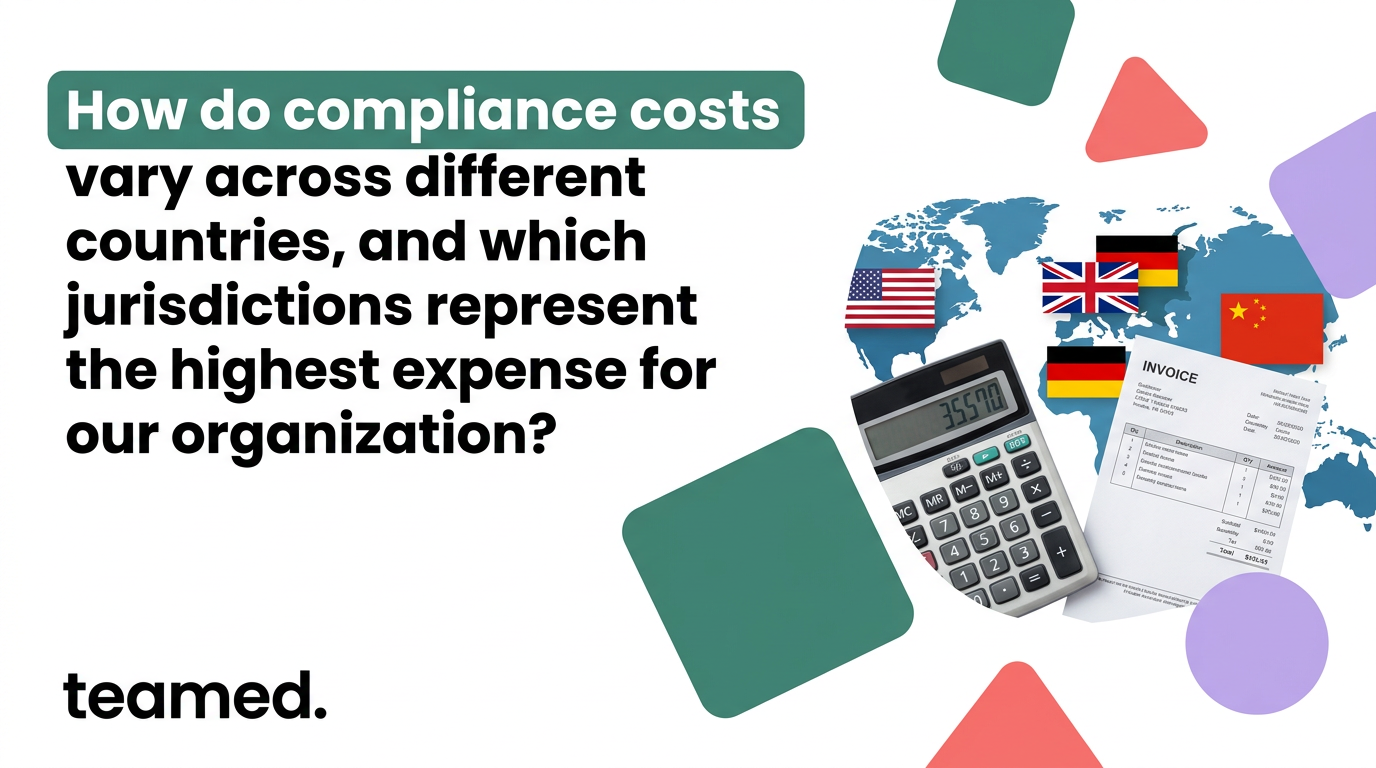
Which countries will actually cost you the most to employ people in?

Compliance costs across countries can vary by 300% or more between jurisdictions, even within the European Union. France typically represents the highest statutory employment expense for mid-market companies, with employer social contributions commonly exceeding 40% of gross salary. Italy and Spain follow closely at around 30%, while the Netherlands and United Kingdom fall significantly lower in the low-to-mid teens.

The frustrating reality? Most global employment providers won't give you this breakdown. They bury the variance in opaque invoices and let you discover the true cost after you've already committed to a market.

If you're a VP of People or HR Director managing international teams across 2-15 countries, you've probably felt this pain. The budget you set for your German expansion looks nothing like what you're actually spending. Your finance team keeps asking why employment costs in Brazil are double what you projected. And nobody can give you a straight answer about what's driving the difference.

Let me show you what actually drives these costs, which countries will blow your budget, and how to get real numbers before you make promises to the board about that new market entry.

The numbers you need before your next budget meeting

Employer social contributions in France commonly exceed 40% of gross salary, making it one of the highest statutory on-cost jurisdictions in Europe. Italy and Spain both run around 30% employer social security, meaning a €70,000 salary can imply €20,000+ per year in employer charges alone. The Netherlands typically falls in the low-to-mid teens as a percentage of salary, reducing statutory on-costs relative to Southern and Western Europe. UK HMRC can assess PAYE and National Insurance underpayments for up to 6 years in standard cases and 20 years where deliberate behaviour is alleged. Germany's employee leasing regime under the AÜG framework can trigger significant compliance overhead requiring specific licences and strict operational controls. Mid-market companies operating in 5-15 countries typically spend £50,000-£150,000 annually in coordination costs alone when managing multiple compliance vendors.

What actually drives compliance costs in different countries?

Compliance cost isn't a single number. It's the total internal and external spend required to meet a jurisdiction's employment, payroll, tax, and data-protection obligations. That includes time, tooling, advisors, filings, and remediation risk. Most current analyses conflate statutory employment on-costs with operational compliance overhead, which leads to incorrect country rankings for CFO budgeting.

The first driver is statutory employment on-costs. These are the mandatory employer contributions to social security, health insurance, pension schemes, and other government-mandated programmes. France leads here with contributions that can push total employment cost to 140% of gross salary before you've paid a single euro in provider fees.

The second driver is operational compliance overhead. This covers registrations, recurring filings, audit support, and the administrative burden of staying compliant. Germany exemplifies this well. While its statutory rates are moderate compared to France, the works council requirements at 5+ employees and complex dismissal protections create substantial ongoing administrative cost.

The third driver is enforcement intensity. This reflects how frequently authorities audit and penalise non-compliance. High enforcement intensity increases the expected cost of controls, documentation, and specialist support. Countries like Brazil and France maintain aggressive enforcement regimes that require more robust compliance infrastructure.

Teamed's analysis of employment operations across 70+ countries shows that companies routinely underestimate operational overhead by 40-60% when budgeting for new market entry. The statutory costs are visible. The compliance infrastructure costs are not.

Which European countries have the highest compliance expenses?

France stands alone at the top of European compliance costs. Employer social charges commonly exceed 40% of gross salary, and the regulatory framework demands meticulous attention to detail. The Code du travail requires formal payslips with prescribed content, detailed working time and leave rules, and complex termination procedures requiring formal meetings and documentation. At 11+ employees, companies must establish a CSE (Social and Economic Committee), adding another layer of compliance obligation.

Italy and Spain cluster together in the next tier, both running approximately 30% employer social security contributions. Italy's complex bureaucracy creates slow entity setup timelines, and dismissals are highly restricted with courts frequently reinstating terminated employees. Spain's rigid labour laws impose expensive terminations at 33 days salary per year of service for objective dismissal and 45 days for unfair dismissal.

Belgium presents a unique challenge with employer contributions around 27% of gross, but the complexity multiplies through language requirements. Dutch in Flanders, French in Wallonia. Payroll includes mandatory 13th month and holiday pay calculations that trip up companies unfamiliar with the system.

Germany sits in moderate complexity territory. The statutory rates are manageable, but works councils become mandatory at 5+ employees if employees request them. Notice periods range from 4 weeks to 7 months based on tenure. The employee leasing regime under AÜG can trigger significant compliance overhead because leasing often requires specific licences and strict operational controls around assignment structure, with works councils becoming mandatory at 5+ employees if employees request them.

The Netherlands and United Kingdom offer relative simplicity. Dutch employer contributions fall in the low-to-mid teens, and while dismissal may require UWV permission or court approval, the process is codified and predictable. UK compliance benefits from a common law system, flexible employment contracts, and straightforward redundancy processes.

How do Asia-Pacific compliance costs compare to Europe?

Asia-Pacific jurisdictions present a different cost profile than Europe. Statutory on-costs are generally lower, but operational complexity and enforcement risk can be substantially higher.

Singapore represents the low-complexity benchmark for the region. Employer contributions to CPF (Central Provident Fund) are significant but straightforward to calculate. The regulatory framework is exceptionally clear, English serves as the business language, and government processes are efficient. Most mid-market companies can justify entity establishment at 10+ employees.

Australia operates under the Fair Work system with transparent rules. Modern Awards add payroll complexity, but the requirements are well-documented. Unfair dismissal protections apply at 6+ months for small businesses or 12+ months for larger employers.

Japan introduces cultural complexity that doesn't appear in statutory cost calculations. Courts require "objectively reasonable grounds" for termination, and consensus-based dismissals are expected. Documentation requirements are extensive, with detailed personnel files required for every employee. Retirement allowances are customary rather than mandatory but expected by the workforce.

China presents the highest complexity in the region. A Wholly Foreign-Owned Enterprise (WFOE) is required for full operational control, and social insurance requirements vary by city and province. Provincial interpretation of national law creates inconsistency that requires local expertise to navigate. Teamed classifies mainland China as Tier 3 complexity, recommending companies stay on EOR until 25-35 employees.

India's compliance landscape fragments across states. The Shops and Establishments Act varies by state, and social security includes both Provident Fund and Employee State Insurance with different calculation methods. Gratuity payments become mandatory after 5 years of employment.

What makes Latin American jurisdictions particularly expensive?

Latin America consistently ranks among the most expensive regions for employment compliance, but the costs hide in places European-focused companies don't expect.

Brazil exemplifies the challenge. The CLT (Consolidação das Leis do Trabalho) creates extremely complex labour code requirements. Mandatory 13th-month salary adds 8.33% to annual compensation. The monthly 8% FGTS contribution to the severance fund accumulates throughout employment, and termination without cause triggers a 40% FGTS penalty. Mandatory union involvement and high frequency of labour lawsuits mean total termination costs can exceed 6 months salary. The EOR fee in Brazil effectively serves as insurance premium against labour court battles.

Mexico's constitutional labour protections create a different cost structure. Mandatory profit sharing (PTU) requires companies to distribute a portion of profits to employees. Severance for unjustified dismissal runs 3 months salary plus 20 days per year of service. Recent labour reforms have increased formalisation requirements, adding to ongoing compliance burden.

Argentina combines high termination costs with regulatory unpredictability. The mandatory 13th-month salary (aguinaldo) is standard, but frequent changes to employment regulations aligned with economic policy shifts make long-term planning difficult. Union influence remains significant across most industries.

Colombia imposes high termination costs with indemnification based on salary and tenure. The social security system requires multiple contributions covering health, pension, and ARL (occupational risk). A mandatory prima bonus of one month salary per year adds to the statutory cost base.

How do you calculate compliance cost for budget planning?

Most companies approach compliance cost calculation backwards. They start with provider quotes and assume that's the total cost. The actual calculation requires separating four distinct cost buckets.

The first bucket is statutory on-costs. These are the employer social contributions, mandatory benefits, and government-mandated payments. They're relatively predictable once you understand the local requirements. For France, budget 40%+ of gross salary. For the Netherlands, budget low-to-mid teens.

The second bucket is recurring filings and registrations. This includes payroll reporting, tax filings, annual returns, and regulatory submissions. The cost here is partly direct (filing fees, registration costs) and partly indirect (staff time, system configuration, audit preparation).

The third bucket is advisory spend. This covers local legal counsel, accounting support, and specialist guidance for complex situations. High-complexity jurisdictions like Brazil, China, and France require more advisory support than straightforward markets like Singapore or the UK.

The fourth bucket is enforcement-driven expected loss. This is the probability-weighted cost of compliance failures. UK HMRC can assess PAYE and NIC underpayments for up to 6 years in standard cases and 20 years where deliberate behaviour is alleged. That look-back period increases the expected cost of contractor status errors significantly.

Teamed's work with 1,000+ companies shows that most budget exercises capture bucket one, partially capture bucket two, and completely miss buckets three and four. A proper global compliance cost analysis normalises all four buckets into comparable figures across jurisdictions.

When does entity establishment become cheaper than EOR?

The crossover point where entity ownership becomes cheaper than EOR varies dramatically by country complexity. Teamed's Graduation Model provides a framework for this decision that most EOR providers won't share because it reduces their revenue.

For Tier 1 low-complexity countries like the United Kingdom, Ireland, Australia, Singapore, and the Netherlands, entity establishment typically makes economic sense at 10+ employees if your team operates in the native language. Add 30-50% to that threshold if you're operating in a non-native language environment.

For Tier 2 moderate-complexity countries like Germany, France, Spain, Italy, and Japan, the threshold rises to 15-20 employees for native language operations or 20-30 employees for non-native. The higher threshold accounts for works council requirements, complex termination procedures, and documentation burden.

For Tier 3 high-complexity countries like Brazil, Mexico, China, India, and Indonesia, stay on EOR until 25-35 employees for native language operations or 35-50 for non-native. The EOR fee in these markets functions as insurance against compliance errors that could cost multiples of the annual fee.

The calculation method is straightforward. Multiply your annual EOR cost by projected years, then compare against entity setup cost plus ongoing annual entity costs. For a UK operation with 10 employees, EOR at £7,500 per employee per year totals £225,000 over three years. Entity setup at £25,000 plus £3,500 per employee per year totals £130,000. Break-even hits at month 17.

What hidden costs do most compliance analyses miss?

After reviewing hundreds of employment cost analyses, I keep seeing the same three hidden costs that can add 20-40% to your real spend.

The first is FX variance. Most EOR providers mark up foreign exchange rates without disclosure. Teamed contractually guarantees zero FX markup and timestamps the FX rate used on every invoice, which reduces hidden cost variance in multi-currency payroll. If your provider doesn't show the mid-market rate alongside their applied rate, you're paying a hidden premium.

The second is invoice opacity. When salary, statutory costs, benefits, and provider fees appear as a single line item, you can't identify what's driving cost increases. Teamed provides fully itemised invoices separating each component. This transparency matters because statutory costs change with local legislation, and you need to distinguish regulatory increases from provider price increases.

The third is coordination overhead. Companies operating in 5-15 countries with separate EOR providers, entity formation specialists, local payroll vendors, and compliance consultants often spend £50,000-£150,000 annually in coordination costs alone. This includes management time reconciling data across systems, resolving conflicting advice from different vendors, and managing multiple relationships.

A Global Entity Management Operations (GEMO) approach eliminates coordination overhead by maintaining one supplier relationship from initial EOR hiring through entity transition and ongoing entity management. The supplier relationship remains constant while only the underlying employment model evolves.

How should you prioritise which countries to evaluate first?

Start with employee concentration. Any country where you're within 20% of the relevant tier threshold deserves immediate analysis. Eight employees in a Tier 1 country like the UK means you should be modelling the crossover economics now, not after you hit 12.

Next, assess strategic importance. Markets central to your growth strategy warrant deeper compliance infrastructure investment. A market you're testing for product-market fit should stay on EOR regardless of headcount until you've committed to a 3+ year presence.

Then evaluate regulatory stability. Political instability, upcoming elections, or frequent changes to employment regulations make long-term planning difficult. These conditions suggest extending EOR usage regardless of headcount thresholds.

Finally, check for red flags that override the standard analysis. Complex foreign exchange controls affecting salary payments. Currency instability creating unpredictable cost structures. Mandatory local ownership requirements you cannot satisfy. High employee turnover suggesting headcount may not remain stable. If any of these apply, stay on EOR longer than the standard threshold would suggest.

Teamed's advisory approach includes automated crossover monitoring that alerts when entity formation becomes cheaper than EOR. This proactive advisory means you're not relying on your own analysis to catch the transition point.

Building your compliance cost framework

The right structure for where you are requires honest assessment of your current state. Map every country where you employ people, noting current employee count and operating language. Identify which countries are approaching tier thresholds. Run three-year cost comparisons for each threshold country.

The trusted advice for where you're going means working with a partner who will tell you the honest answer even when it's complicated. That includes telling you when to stop using EOR and graduate to your own entity, even though that graduation reduces their per-head revenue.

If you're managing international teams across multiple countries and want clarity on which jurisdictions are actually costing you the most, talk to an expert who can model your specific situation. The decision is too important to get wrong, and the right analysis now prevents expensive surprises later.
Which countries will actually cost you the most to employ people in?

Compliance costs across countries can vary by 300% or more between jurisdictions, even within the European Union. France typically represents the highest statutory employment expense for mid-market companies, with employer social contributions commonly exceeding 40% of gross salary. Italy and Spain follow closely at around 30%, while the Netherlands and United Kingdom fall significantly lower in the low-to-mid teens.

The frustrating reality? Most global employment providers won't give you this breakdown. They bury the variance in opaque invoices and let you discover the true cost after you've already committed to a market.

If you're a VP of People or HR Director managing international teams across 2-15 countries, you've probably felt this pain. The budget you set for your German expansion looks nothing like what you're actually spending. Your finance team keeps asking why employment costs in Brazil are double what you projected. And nobody can give you a straight answer about what's driving the difference.

Let me show you what actually drives these costs, which countries will blow your budget, and how to get real numbers before you make promises to the board about that new market entry.

The numbers you need before your next budget meeting

Employer social contributions in France commonly exceed 40% of gross salary, making it one of the highest statutory on-cost jurisdictions in Europe. Italy and Spain both run around 30% employer social security, meaning a €70,000 salary can imply €20,000+ per year in employer charges alone. The Netherlands typically falls in the low-to-mid teens as a percentage of salary, reducing statutory on-costs relative to Southern and Western Europe. UK HMRC can assess PAYE and National Insurance underpayments for up to 6 years in standard cases and 20 years where deliberate behaviour is alleged. Germany's employee leasing regime under the AÜG framework can trigger significant compliance overhead requiring specific licences and strict operational controls. Mid-market companies operating in 5-15 countries typically spend £50,000-£150,000 annually in coordination costs alone when managing multiple compliance vendors.

What actually drives compliance costs in different countries?

Compliance cost isn't a single number. It's the total internal and external spend required to meet a jurisdiction's employment, payroll, tax, and data-protection obligations. That includes time, tooling, advisors, filings, and remediation risk. Most current analyses conflate statutory employment on-costs with operational compliance overhead, which leads to incorrect country rankings for CFO budgeting.

The first driver is statutory employment on-costs. These are the mandatory employer contributions to social security, health insurance, pension schemes, and other government-mandated programmes. France leads here with contributions that can push total employment cost to 140% of gross salary before you've paid a single euro in provider fees.

The second driver is operational compliance overhead. This covers registrations, recurring filings, audit support, and the administrative burden of staying compliant. Germany exemplifies this well. While its statutory rates are moderate compared to France, the works council requirements at 5+ employees and complex dismissal protections create substantial ongoing administrative cost.

The third driver is enforcement intensity. This reflects how frequently authorities audit and penalise non-compliance. High enforcement intensity increases the expected cost of controls, documentation, and specialist support. Countries like Brazil and France maintain aggressive enforcement regimes that require more robust compliance infrastructure.

Teamed's analysis of employment operations across 70+ countries shows that companies routinely underestimate operational overhead by 40-60% when budgeting for new market entry. The statutory costs are visible. The compliance infrastructure costs are not.

Which European countries have the highest compliance expenses?

France stands alone at the top of European compliance costs. Employer social charges commonly exceed 40% of gross salary, and the regulatory framework demands meticulous attention to detail. The Code du travail requires formal payslips with prescribed content, detailed working time and leave rules, and complex termination procedures requiring formal meetings and documentation. At 11+ employees, companies must establish a CSE (Social and Economic Committee), adding another layer of compliance obligation.

Italy and Spain cluster together in the next tier, both running approximately 30% employer social security contributions. Italy's complex bureaucracy creates slow entity setup timelines, and dismissals are highly restricted with courts frequently reinstating terminated employees. Spain's rigid labour laws impose expensive terminations at 33 days salary per year of service for objective dismissal and 45 days for unfair dismissal.

Belgium presents a unique challenge with employer contributions around 27% of gross, but the complexity multiplies through language requirements. Dutch in Flanders, French in Wallonia. Payroll includes mandatory 13th month and holiday pay calculations that trip up companies unfamiliar with the system.

Germany sits in moderate complexity territory. The statutory rates are manageable, but works councils become mandatory at 5+ employees if employees request them. Notice periods range from 4 weeks to 7 months based on tenure. The employee leasing regime under AÜG can trigger significant compliance overhead because leasing often requires specific licences and strict operational controls around assignment structure, with works councils becoming mandatory at 5+ employees if employees request them.

The Netherlands and United Kingdom offer relative simplicity. Dutch employer contributions fall in the low-to-mid teens, and while dismissal may require UWV permission or court approval, the process is codified and predictable. UK compliance benefits from a common law system, flexible employment contracts, and straightforward redundancy processes.

How do Asia-Pacific compliance costs compare to Europe?

Asia-Pacific jurisdictions present a different cost profile than Europe. Statutory on-costs are generally lower, but operational complexity and enforcement risk can be substantially higher.

Singapore represents the low-complexity benchmark for the region. Employer contributions to CPF (Central Provident Fund) are significant but straightforward to calculate. The regulatory framework is exceptionally clear, English serves as the business language, and government processes are efficient. Most mid-market companies can justify entity establishment at 10+ employees.

Australia operates under the Fair Work system with transparent rules. Modern Awards add payroll complexity, but the requirements are well-documented. Unfair dismissal protections apply at 6+ months for small businesses or 12+ months for larger employers.

Japan introduces cultural complexity that doesn't appear in statutory cost calculations. Courts require "objectively reasonable grounds" for termination, and consensus-based dismissals are expected. Documentation requirements are extensive, with detailed personnel files required for every employee. Retirement allowances are customary rather than mandatory but expected by the workforce.

China presents the highest complexity in the region. A Wholly Foreign-Owned Enterprise (WFOE) is required for full operational control, and social insurance requirements vary by city and province. Provincial interpretation of national law creates inconsistency that requires local expertise to navigate. Teamed classifies mainland China as Tier 3 complexity, recommending companies stay on EOR until 25-35 employees.

India's compliance landscape fragments across states. The Shops and Establishments Act varies by state, and social security includes both Provident Fund and Employee State Insurance with different calculation methods. Gratuity payments become mandatory after 5 years of employment.

What makes Latin American jurisdictions particularly expensive?

Latin America consistently ranks among the most expensive regions for employment compliance, but the costs hide in places European-focused companies don't expect.

Brazil exemplifies the challenge. The CLT (Consolidação das Leis do Trabalho) creates extremely complex labour code requirements. Mandatory 13th-month salary adds 8.33% to annual compensation. The monthly 8% FGTS contribution to the severance fund accumulates throughout employment, and termination without cause triggers a 40% FGTS penalty. Mandatory union involvement and high frequency of labour lawsuits mean total termination costs can exceed 6 months salary. The EOR fee in Brazil effectively serves as insurance premium against labour court battles.

Mexico's constitutional labour protections create a different cost structure. Mandatory profit sharing (PTU) requires companies to distribute a portion of profits to employees. Severance for unjustified dismissal runs 3 months salary plus 20 days per year of service. Recent labour reforms have increased formalisation requirements, adding to ongoing compliance burden.

Argentina combines high termination costs with regulatory unpredictability. The mandatory 13th-month salary (aguinaldo) is standard, but frequent changes to employment regulations aligned with economic policy shifts make long-term planning difficult. Union influence remains significant across most industries.

Colombia imposes high termination costs with indemnification based on salary and tenure. The social security system requires multiple contributions covering health, pension, and ARL (occupational risk). A mandatory prima bonus of one month salary per year adds to the statutory cost base.

How do you calculate compliance cost for budget planning?

Most companies approach compliance cost calculation backwards. They start with provider quotes and assume that's the total cost. The actual calculation requires separating four distinct cost buckets.

The first bucket is statutory on-costs. These are the employer social contributions, mandatory benefits, and government-mandated payments. They're relatively predictable once you understand the local requirements. For France, budget 40%+ of gross salary. For the Netherlands, budget low-to-mid teens.

The second bucket is recurring filings and registrations. This includes payroll reporting, tax filings, annual returns, and regulatory submissions. The cost here is partly direct (filing fees, registration costs) and partly indirect (staff time, system configuration, audit preparation).

The third bucket is advisory spend. This covers local legal counsel, accounting support, and specialist guidance for complex situations. High-complexity jurisdictions like Brazil, China, and France require more advisory support than straightforward markets like Singapore or the UK.

The fourth bucket is enforcement-driven expected loss. This is the probability-weighted cost of compliance failures. UK HMRC can assess PAYE and NIC underpayments for up to 6 years in standard cases and 20 years where deliberate behaviour is alleged. That look-back period increases the expected cost of contractor status errors significantly.

Teamed's work with 1,000+ companies shows that most budget exercises capture bucket one, partially capture bucket two, and completely miss buckets three and four. A proper global compliance cost analysis normalises all four buckets into comparable figures across jurisdictions.

When does entity establishment become cheaper than EOR?

The crossover point where entity ownership becomes cheaper than EOR varies dramatically by country complexity. Teamed's Graduation Model provides a framework for this decision that most EOR providers won't share because it reduces their revenue.

For Tier 1 low-complexity countries like the United Kingdom, Ireland, Australia, Singapore, and the Netherlands, entity establishment typically makes economic sense at 10+ employees if your team operates in the native language. Add 30-50% to that threshold if you're operating in a non-native language environment.

For Tier 2 moderate-complexity countries like Germany, France, Spain, Italy, and Japan, the threshold rises to 15-20 employees for native language operations or 20-30 employees for non-native. The higher threshold accounts for works council requirements, complex termination procedures, and documentation burden.

For Tier 3 high-complexity countries like Brazil, Mexico, China, India, and Indonesia, stay on EOR until 25-35 employees for native language operations or 35-50 for non-native. The EOR fee in these markets functions as insurance against compliance errors that could cost multiples of the annual fee.

The calculation method is straightforward. Multiply your annual EOR cost by projected years, then compare against entity setup cost plus ongoing annual entity costs. For a UK operation with 10 employees, EOR at £7,500 per employee per year totals £225,000 over three years. Entity setup at £25,000 plus £3,500 per employee per year totals £130,000. Break-even hits at month 17.

What hidden costs do most compliance analyses miss?

After reviewing hundreds of employment cost analyses, I keep seeing the same three hidden costs that can add 20-40% to your real spend.

The first is FX variance. Most EOR providers mark up foreign exchange rates without disclosure. Teamed contractually guarantees zero FX markup and timestamps the FX rate used on every invoice, which reduces hidden cost variance in multi-currency payroll. If your provider doesn't show the mid-market rate alongside their applied rate, you're paying a hidden premium.

The second is invoice opacity. When salary, statutory costs, benefits, and provider fees appear as a single line item, you can't identify what's driving cost increases. Teamed provides fully itemised invoices separating each component. This transparency matters because statutory costs change with local legislation, and you need to distinguish regulatory increases from provider price increases.

The third is coordination overhead. Companies operating in 5-15 countries with separate EOR providers, entity formation specialists, local payroll vendors, and compliance consultants often spend £50,000-£150,000 annually in coordination costs alone. This includes management time reconciling data across systems, resolving conflicting advice from different vendors, and managing multiple relationships.

A Global Entity Management Operations (GEMO) approach eliminates coordination overhead by maintaining one supplier relationship from initial EOR hiring through entity transition and ongoing entity management. The supplier relationship remains constant while only the underlying employment model evolves.

How should you prioritise which countries to evaluate first?

Start with employee concentration. Any country where you're within 20% of the relevant tier threshold deserves immediate analysis. Eight employees in a Tier 1 country like the UK means you should be modelling the crossover economics now, not after you hit 12.

Next, assess strategic importance. Markets central to your growth strategy warrant deeper compliance infrastructure investment. A market you're testing for product-market fit should stay on EOR regardless of headcount until you've committed to a 3+ year presence.

Then evaluate regulatory stability. Political instability, upcoming elections, or frequent changes to employment regulations make long-term planning difficult. These conditions suggest extending EOR usage regardless of headcount thresholds.

Finally, check for red flags that override the standard analysis. Complex foreign exchange controls affecting salary payments. Currency instability creating unpredictable cost structures. Mandatory local ownership requirements you cannot satisfy. High employee turnover suggesting headcount may not remain stable. If any of these apply, stay on EOR longer than the standard threshold would suggest.

Teamed's advisory approach includes automated crossover monitoring that alerts when entity formation becomes cheaper than EOR. This proactive advisory means you're not relying on your own analysis to catch the transition point.

Building your compliance cost framework

The right structure for where you are requires honest assessment of your current state. Map every country where you employ people, noting current employee count and operating language. Identify which countries are approaching tier thresholds. Run three-year cost comparisons for each threshold country.

The trusted advice for where you're going means working with a partner who will tell you the honest answer even when it's complicated. That includes telling you when to stop using EOR and graduate to your own entity, even though that graduation reduces their per-head revenue.

If you're managing international teams across multiple countries and want clarity on which jurisdictions are actually costing you the most, talk to an expert who can model your specific situation. The decision is too important to get wrong, and the right analysis now prevents expensive surprises later.

TABLE OF CONTENTS

Take a look
at the latest articles