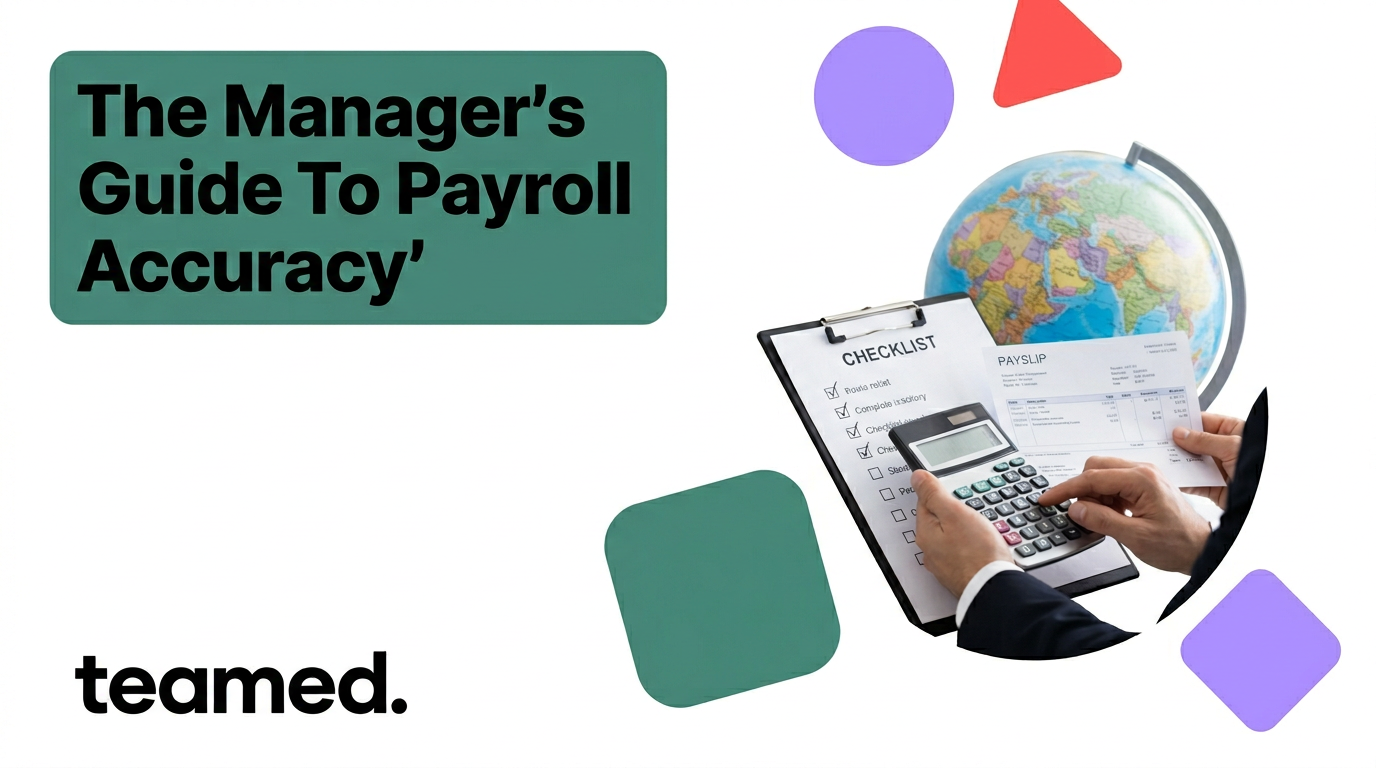
How to Keep Payroll Accurate When You're Running Multiple Countries
You've just discovered that three employees in your German office were underpaid last month. The French team received their payslips late. And someone in Singapore is asking why their statutory contributions don't match what they expected. Sound familiar?
Payroll accuracy isn't about perfection for its own sake. It's about protecting employee trust, avoiding compliance penalties, and giving your finance team clean data for month-end close. The average payroll accuracy rate sits at 98.8% according to US Bureau of Labor Statistics data, but that remaining 1.2% can translate into significant employee relations damage and regulatory exposure when you're running pay across multiple jurisdictions.
Here's what we've learned about catching payroll mistakes before they hit bank accounts, spotting the ones that slip through, and building checks that actually work month after month.
What We See in Multi-Country Payroll
A good payroll accuracy rate targets 99% or higher, meaning fewer than 1 in 100 pay elements contain errors requiring correction.
UK employers must retain payroll records for at least 3 years from the end of the relevant tax year under HMRC PAYE requirements.
Payroll errors typically fall into five categories: incorrect gross pay, wrong statutory deductions, incorrect bank details, missed benefits, and late filings.
Most payroll mistakes can be corrected within 24 hours when detected before payment release, but post-payment corrections require formal remediation processes.
Multi-jurisdiction payroll adds country-specific statutory calculations, filing deadlines, and payment formats that create errors even when internal HR data is correct.
When you're reading employment contracts in languages you don't speak, mistakes happen. We see this constantly in markets like Japan or Brazil where one misunderstood clause can trigger months of corrections.
Preventive controls block incorrect payments before release, while detective controls identify errors after payment to trigger corrections and root-cause analysis.
What Is Payroll Accuracy and Why Does It Matter?
Payroll accuracy is the measurable degree to which every employee is paid the correct gross-to-net amount on the correct date, with the correct statutory deductions, benefits, and reporting for the applicable country, tax year, and pay period. It's not simply about getting the final number right. The entire chain from input to payment to filing must be correct.
A payroll error is any deviation between an employee's contractually owed pay and the processed outcome. This includes incorrect pay elements like base salary or overtime, wrong statutory deductions such as income tax or social security, incorrect bank details causing failed payments, and incorrect reporting submissions to tax authorities.
What Happens When Payroll Goes Wrong?
The consequences cascade quickly. Underpayments erode employee trust faster than almost any other operational failure. Overpayments create awkward recovery conversations and potential legal complications, with companies losing 2% to 4% of total labor spend to payroll leakage from errors and inefficiencies.
HR leaders on Reddit frequently describe payroll errors as career-limiting events. One payroll QA specialist noted that "having your procedures and work instructions clearly documented is the foundation of accuracy." That's not corporate speak. It's hard-won experience from people who've seen what happens when documentation gaps meet complex pay runs.
For mid-market companies operating across multiple countries, the stakes compound. Each jurisdiction adds its own statutory calculations, filing deadlines, and payment formats. A process that works perfectly in the UK may create errors in Germany simply because the cut-off dates differ.
How Do You Ensure Accuracy in Payroll?
Ensuring payroll accuracy requires a systematic approach across three phases: input validation, processing controls, and post-payment verification. Most errors originate from incorrect inputs rather than calculation failures, with 48% of payroll leaders citing data accuracy and integrity as their top payroll challenge, which means your prevention strategy should focus heavily on data quality before processing begins.
Building Your Input Validation Process
The foundation of accurate payroll is clean data entering the system. This means establishing clear cut-off dates for changes, validating new starter information against employment contracts, and reconciling headcount between HR and payroll systems before every pay run.
Choose a formal pre-pay reconciliation to the HR system of record when headcount changes exceed 2% month-on-month. Joiners, leavers, and salary changes are the highest-risk inputs for incorrect gross-to-net outcomes. A company adding five employees across three countries in a single month needs tighter validation than one with stable headcount.
Variable pay components create particular risk. Choose automated payroll input validation when more than 10% of employees have variable pay elements in a given pay period. Manual checking simply doesn't scale reliably with frequent changes to hours, commission, or bonuses.
Implementing Maker-Checker Controls
A payroll control is a documented preventive or detective check that reduces the likelihood or impact of errors. The most effective control for multi-jurisdiction payroll is the maker-checker model, where one person processes changes and a different person approves them before payment release.
Choose a maker-checker payroll approval model when payroll is processed for more than one country or legal entity. Segregation of duties reduces the probability that a single data-entry error becomes a payment error. The person who enters a salary change should never be the same person who approves the pay run.
This isn't bureaucracy for its own sake. It's the control that catches the transposed digits, the missed decimal points, and the overlooked currency conversions that would otherwise hit employee bank accounts.
What Is a Good Payroll Accuracy Rate?
A good payroll accuracy rate targets 99% or higher across all pay elements, meaning fewer than 1 in 100 pay components contain errors requiring correction. The industry average of 98.8% sounds impressive until you calculate what that means for a 500-person company: roughly 6 errors per pay period that need investigation and correction.
Measuring Accuracy Meaningfully
Accuracy measurement should track multiple dimensions: gross pay accuracy, deduction accuracy, payment timing accuracy, and filing accuracy. A pay run can be 100% accurate on net pay amounts but still fail on compliance if statutory filings are late or incomplete.
Choose a post-pay exception review process when any single employee's net pay changes by more than a pre-agreed threshold, such as plus or minus 10% month-on-month. Material net variance is a strong detector for missed deductions, proration errors, or incorrect one-off payments.
Teamed's work with mid-market companies shows that tracking accuracy by error category reveals patterns that aggregate metrics hide. A company might achieve 99.5% overall accuracy while consistently struggling with overtime calculations or benefit deductions. Category-level tracking enables targeted improvement.
Setting Realistic Targets by Complexity
Your accuracy target should reflect your operational complexity. A single-country payroll with stable headcount and fixed salaries should target 99.5% or higher. Multi-jurisdiction payroll with variable pay components and frequent headcount changes might realistically target 99% while building toward higher performance.
The honest answer is that perfect accuracy is aspirational rather than achievable. What matters is having controls that catch errors before payment, processes that correct errors quickly when they occur, and root-cause analysis that prevents recurrence.
How Do You Track the Accuracy of Payroll?
Tracking payroll accuracy requires an audit trail that captures who changed what, when, why, and which approvals occurred before payment release. This isn't just operational good practice. UK PAYE recordkeeping requirements mean payroll accuracy controls must generate retrievable evidence over multi-year periods.
Building Your Audit Trail
A payroll audit trail is the end-to-end record of every input change, validation step, approval, and payment confirmation. Modern payroll systems generate this automatically, but the trail is only useful if someone reviews it.
Key elements to track include input changes with timestamps and user identification, variance reports comparing current period to prior period, approval records showing who authorised the pay run, payment confirmations from banking systems, and filing confirmations from tax authorities.
Choose central ownership of payroll controls by HR or Finance when local managers can initiate pay-impacting changes. Decentralised change rights without central controls increase error rates and weaken auditability. Someone needs to own the overall accuracy picture even when inputs come from multiple sources.
Exception Reporting That Actually Works
The most effective accuracy tracking focuses on exceptions rather than reviewing every transaction. Configure your system to flag changes that exceed normal parameters: salary increases above a threshold, new deductions without supporting documentation, or net pay variances outside expected ranges.
Teamed's fully itemised invoicing approach, which separates salary, statutory costs, benefits, and provider fees onto distinct lines, supports faster payroll-to-GL reconciliation and clearer variance investigation. When you can see exactly what changed and why, you can investigate exceptions efficiently rather than reviewing entire pay runs.
What Are the Most Common Payroll Errors?
Payroll errors cluster around predictable failure points. Understanding these patterns helps you build targeted controls rather than generic processes that try to catch everything.
Input Errors: Where Most Problems Start
The highest-risk inputs are joiners, leavers, and salary changes. New employees require correct bank details, tax codes, benefit elections, and contract terms. Leavers need accurate final pay calculations including accrued leave, notice periods, and any statutory payments. Salary changes must be effective from the correct date with proper proration.
Timesheet software users report reducing payroll discrepancies by approximately 1.2% annually after switching from manual sheets. That's not a small improvement when multiplied across hundreds of employees and dozens of pay periods.
Calculation Errors: When Systems Get It Wrong
Even automated systems make calculation errors when configured incorrectly. Common issues include incorrect overtime rates, wrong tax code application, miscalculated statutory sick pay, and errors in pension contribution percentages.
Multi-jurisdiction payroll adds complexity because each country has different calculation rules. France ranks as the most complex payroll jurisdiction at 17.95 on PwC's complexity index, requiring specific payroll taxes and social charges. Germany scores 14.55 with works council considerations at certain headcount thresholds. Brazil mandates 13th-month salary paid in two instalments by December 20th.
Timing Errors: Right Amount, Wrong Date
A payment can be perfectly calculated but still fail if it arrives late. Choose a standardised payroll cut-off calendar when you operate across two or more time zones or banking rails. Payment lead times and local holidays can cause otherwise-correct payroll to miss pay dates.
In the UK, the legal requirement to provide an itemised payslip on or before payday applies to employees and many workers. Late payslips are a compliance defect even when the payment amount is correct.
How Long Does an Employer Have to Fix a Payroll Mistake?
The timeframe for correcting payroll mistakes depends on the error type and jurisdiction. Underpayments should be corrected in the next available pay run or sooner if the amount is significant. Overpayments require more careful handling because recovery from employee wages has legal constraints in most jurisdictions.
Correcting Underpayments
For underpayments, speed matters for employee trust. Most payroll providers can process corrections within 24 hours when detected before the regular pay run. If discovered after payment, an off-cycle payment may be appropriate for significant amounts.
Choose a documented payroll incident process when you cannot correct an error before pay day. A defined remediation path reduces employee-trust damage and creates a compliant record of correction and communication. Employees are generally understanding about honest mistakes when they're communicated clearly and corrected promptly.
Recovering Overpayments
Overpayment recovery is more complex. UK employment law restricts deductions from wages, requiring employee agreement for most recovery scenarios. The general principle is that you can recover overpayments, but the method and timing must be reasonable.
Best practice is to communicate the error clearly, agree a recovery plan with the employee, and document everything. Attempting to recover large amounts in a single deduction can create financial hardship and legal exposure.
Creating a Payroll Accuracy Framework
Your payroll accuracy framework is simple: clear deadlines for inputs, checks before payment, proof of what happened, and a plan for when things go wrong. Every month, same process.
Essential Framework Components
Your framework needs five core elements working together. First, a payroll calendar that specifies cut-off dates for changes, processing windows, and payment dates for each jurisdiction. Second, input validation procedures that verify data quality before processing. Third, maker-checker controls that require dual approval for pay runs. Fourth, exception reporting that flags variances for investigation. Fifth, post-payment reconciliation that confirms accuracy and identifies issues for next cycle.
Most top-cited payroll accuracy content lists generic tips but doesn't define a manager-owned control framework with clear cut-offs, maker-checker roles, reconciliations, and escalation paths tailored to multi-jurisdiction operations. This gap leaves managers without practical implementation guidance.
Scaling Across Jurisdictions
The framework becomes more critical as you add countries. Each jurisdiction brings different statutory requirements, filing deadlines, and payment formats. A process that works for UK payroll may need significant adaptation for France, Germany, or Singapore.
Teamed's approach through its Global Employment Management and Operations (GEMO) model addresses this by maintaining one relationship across employment model transitions. Whether you're running payroll through EOR or your own entities, the accuracy framework remains consistent while adapting to local requirements.
Training Your Payroll Team for Accuracy
Payroll accuracy depends on people as much as processes. Your team needs both technical competence and the judgement to recognise when something looks wrong.
Building Technical Competence
Technical training should cover your specific payroll system, the statutory requirements for each jurisdiction you operate in, and the control procedures your framework requires. This isn't one-time training. Regulatory changes, system updates, and new jurisdictions all require ongoing learning.
Cross-training creates resilience. If only one person understands German payroll requirements, you have a single point of failure. Build redundancy by ensuring at least two team members can handle each jurisdiction.
Developing Error Recognition Skills
Beyond technical skills, your team needs pattern recognition. Experienced payroll professionals develop intuition for numbers that look wrong, changes that seem unusual, and variances that warrant investigation.
This comes from exposure and feedback. When errors are caught, discuss them with the team. What triggered the error? What control should have caught it? How can we prevent recurrence? This continuous improvement mindset transforms errors from failures into learning opportunities.
When Payroll Complexity Exceeds Internal Capacity
There's a point where multi-jurisdiction payroll complexity exceeds what internal teams can manage reliably. This typically happens when you're operating in more than five countries, dealing with unfamiliar regulatory environments, or experiencing rapid headcount growth.
EOR-run payroll differs from entity-run payroll in legal responsibility. An EOR is the legal employer executing local payroll compliance, while an owned entity places payroll compliance obligations directly on your company. Understanding this distinction helps you make informed decisions about where to build internal capability versus where to rely on specialist partners.
Teamed assigns named jurisdiction specialists within 48 hours, an operational control that reduces time-to-resolution for country-specific payroll questions that can otherwise roll into late corrections. When you need to understand why a German social security calculation looks different than expected, having a named specialist who knows your situation beats submitting a support ticket.
Sometimes you need to run payroll internally. Sometimes you need help. The honest answer depends on your complexity, your team's bandwidth, and the cost of getting it wrong.
If payroll errors keep eating your time despite better processes, or if you're spending more hours on payroll than strategy, let's talk. We can show you how consolidating your global employment can make accuracy easier.
Building Sustainable Payroll Accuracy
Payroll accuracy isn't a project with an end date. It's an ongoing discipline that requires consistent attention to inputs, controls, and continuous improvement. The framework you build today needs to evolve as your company grows, enters new markets, and adds complexity.
Start with the basics: clean inputs, maker-checker controls, exception reporting, and documented procedures. Build from there based on where errors actually occur in your operation. The goal isn't theoretical perfection but practical accuracy that protects employee trust, maintains compliance, and gives your finance team reliable data.
The companies that achieve sustained payroll accuracy treat it as a management priority rather than an administrative function. They invest in training, build redundancy into their teams, and create cultures where catching errors is celebrated rather than punished. That's the foundation for payroll accuracy that lasts.