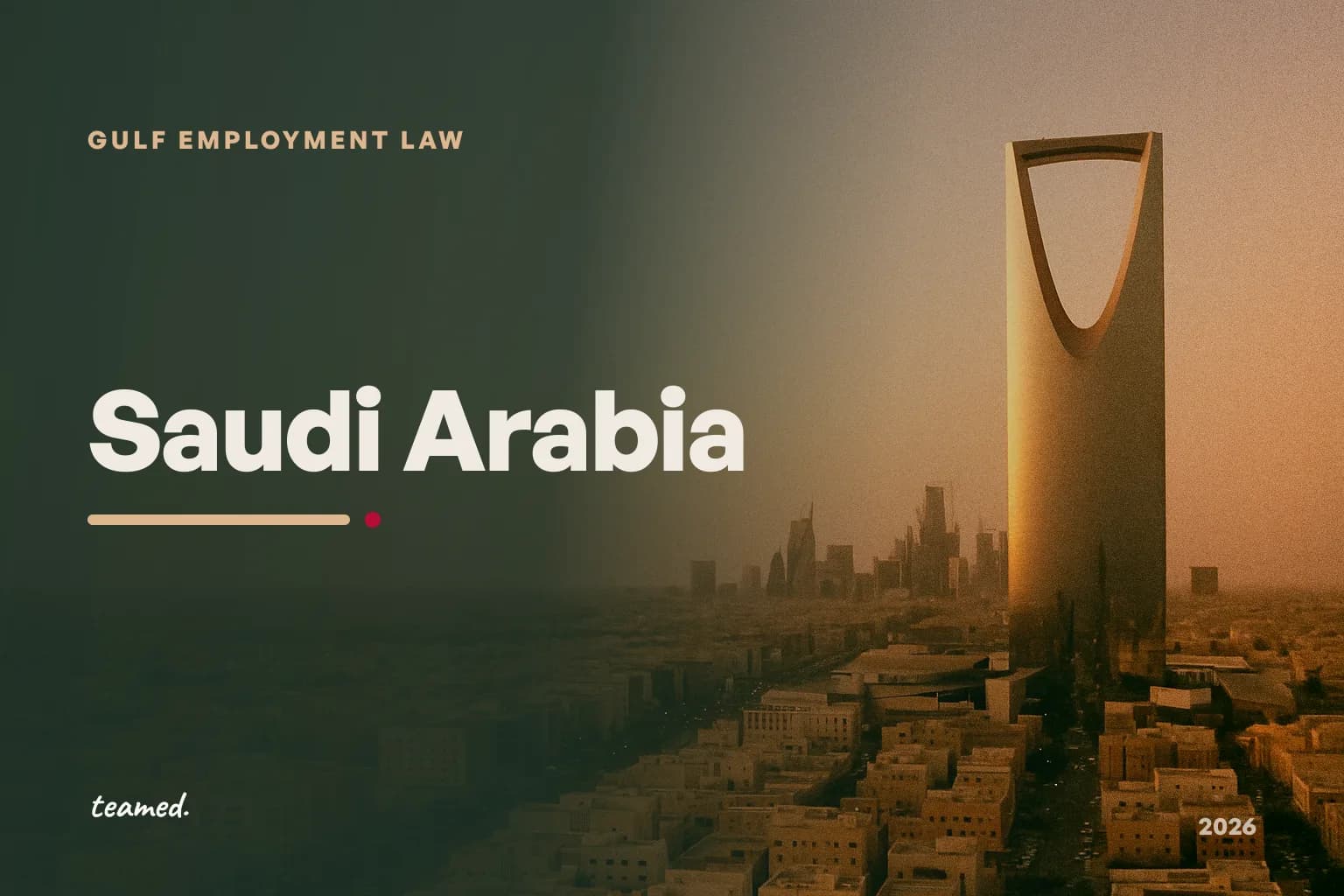
Employment law in Saudi Arabia
Saudi Arabia's Labor Law (Royal Decree M/51, heavily amended from 19 February 2025) sets the core terms: written contracts documented on Qiwa, probation of up to 180 days in total, 21 days' annual leave rising to 30 after five years, an end-of-service award of half a month's wage a year for the first five years and a full month after that, and 60 days' notice from the employer on an indefinite monthly-paid contract. On top sit Saudization quotas (Nitaqat) and GOSI social insurance.
What Teamed handles in Saudi Arabia
- Arabic contracts documented on Qiwa
- Monthly wage files through Mudad
- GOSI registration and contributions
Only Qiwa-documented contracts now count towards Saudization
What happened
From 15 April 2026 the Ministry of Human Resources and Social Development calculates each employer's Nitaqat Saudization rate from employment contracts documented electronically on the Qiwa platform. A Saudi employee whose contract is not documented there does not count.
What it means for you
Check that every Saudi employee has a documented Qiwa contract. A missing contract can push your company into a lower Nitaqat band, which restricts visas and work permits for your expatriate staff.
Source: Ministry of Human Resources and Social Development. We check this page every week. Last checked .
Saudi employment law for the private sector rests on one statute, the Labor Law (Royal Decree M/51 of 23/8/1426H), administered by the Ministry of Human Resources and Social Development (HRSD) and amended several times since 2005, most recently with effect from 19 February 2025. Arabic is the legal language of employment contracts: if a contract is also written in another language, the Arabic text prevails (Article 9). Around the statute sit three systems an employer deals with every month. Qiwa is the Ministry's platform for documenting contracts and running work permits. Mudad carries the Wage Protection Program, which checks that wages were actually paid. GOSI, the General Organization for Social Insurance, collects pension, unemployment (SANED) and occupational hazard contributions. Saudization, the policy of raising the share of Saudi nationals in private sector jobs, is enforced through the Nitaqat programme and a growing list of profession-specific quotas.
Which law applies to employees in Saudi Arabia?
The Labor Law issued by Royal Decree M/51 of 23/8/1426H, as amended. The most recent amendments, approved by Cabinet Decision No. 117 of 6 August 2024 and Royal Decree No. M/44 of 12 August 2024, took effect on 19 February 2025.
The 2025 package changed 38 articles, removed 7 and added 2, according to the Ministry. Some groups sit outside the Labor Law, including domestic workers, the employer's own family members where they are the only employees, sports club players and coaches, agricultural workers and herders, and non-Saudis who come for a specific task lasting no more than two months (Article 7). Social insurance is governed separately by GOSI's laws.
What must an employment contract in Saudi Arabia contain?
A written contract in two copies, documented as the regulations require, following the Ministry's unified model. The model covers the parties, pay including allowances and benefits, the type and place of work, the start date, the term if it is fixed, and each side's basic rights and obligations.
A contract for a non-Saudi must be written and for a fixed term. Since February 2025, if no term is stated it is treated as one year from the actual start date and, if work continues, renewed for a similar period (amended Article 37). Saudi nationals can be employed on indefinite contracts. In practice, documentation means the Qiwa platform: since 15 April 2026 the Ministry counts only Qiwa-documented contracts when it calculates an employer's Saudization rate. Arabic is the governing language, so a bilingual contract should be checked in its Arabic version.
How long can probation last in Saudi Arabia?
Up to 180 days in total. The probation period must be stated expressly in the contract with its length, and either side can end the contract during it.
Before February 2025 the law set probation at up to 90 days, extendable by written agreement to 180. The amended Article 53 simply caps the total at 180 days in all cases and leaves the regulations to set which leave does not count towards it. Under Article 80 an employer may end the contract during probation without an end-of-service award, notice or compensation.
What are the working hours, including during Ramadan?
Up to 9 hours a day where the employer uses a daily standard, or 45 hours a week under a weekly standard. During Ramadan, actual working hours for Muslim employees fall to a maximum of 7 hours a day or 35 hours a week (Article 98).
Employees may not work more than five consecutive hours without a break of at least 30 minutes, and may not stay at the workplace more than 12 hours a day (Article 101). Overtime is paid at the hourly wage plus 50% of the basic wage; since February 2025 the employer may, with the employee's consent, give paid compensatory days off instead (amended Article 107).
How much annual leave do employees get in Saudi Arabia?
At least 21 days of paid annual leave a year, rising to at least 30 days once the employee has completed five consecutive years with the employer (Article 109). Leave cannot be swapped for cash during employment, and the employer must give at least 30 days' notice of the leave dates.
The 2025 amendments expanded other leave: 5 days' paid leave on marriage or the death of a spouse, parent or child; 3 days on the death of a brother or sister; 3 days on the birth of a child, to be taken within 7 days (amended Article 113). Paid maternity leave rose from 10 to 12 weeks, of which the 6 weeks after childbirth are mandatory (amended Article 151). Sick leave is paid in full for the first 30 days in a year, at three quarters for the next 60, and unpaid for the following 30 (Article 117).
What is the end-of-service award?
A lump sum owed when employment ends: half a month's wage for each of the first five years and one month's wage for each year after that, with part years paid pro rata, calculated on the last wage (Article 84).
An employee who resigns gets a reduced award: nothing under two years, one third from two to five years, two thirds from five to under ten years, and the full award at ten years or more (Article 85). Final wages and entitlements are due within one week of the end of employment, or two weeks if the employee ended the contract (Article 88). The award applies to Saudis and non-Saudis; see the dedicated page for the detail.
How much notice is required to end an indefinite contract?
Where the employee is paid monthly, the employer must give at least 60 days' written notice and the employee at least 30 days. Where pay is not monthly, either side must give at least 30 days (amended Article 75). Notice requires a legitimate reason.
Before February 2025 the minimum was 60 days for both sides on monthly pay. A party that does not observe the notice period owes the other the wage for the notice period (Article 76). Termination for an invalid reason carries compensation, unless the contract sets it, of 15 days' wage per year of service on an indefinite contract or the wage for the rest of the term on a fixed-term contract, with a minimum of two months' wage (Article 77). A new Article 79 (bis) sets out how resignation works.
What is Saudization (Nitaqat)?
Saudization is the requirement to employ a minimum share of Saudi nationals. Under the Nitaqat Mutawar programme each company is placed in one of five bands, Platinum, High Green, Medium Green, Low Green or Red, according to its Saudization rate compared with targets set for its economic activity and headcount.
The Ministry launched a three-year phase of Nitaqat Mutawar starting in 2026, aimed at localising more than 340,000 additional private sector jobs. Low Green and Red companies lose access to new visas and other Ministry services. Separate decisions reserve or set quotas for specific professions, such as 100% for 69 additional administrative support professions from 5 April 2026. See the dedicated Saudization page.
What social insurance applies through GOSI?
Saudi employees are covered for pensions (annuities), occupational hazards and unemployment (SANED). Non-Saudi employees are covered for occupational hazards only, at 2% of the contributory wage paid entirely by the employer.
For Saudis already contributing before 3 July 2024, the pension contribution is 9% from the employer and 9% from the employee, SANED is 0.75% each and occupational hazards 2% from the employer. Saudis entering the system for the first time under the new Social Insurance Law (in force 3 July 2024) start at the same 9% pension rate, rising by 0.5 points a year each side from 1 July 2025 until it reaches 11%. GOSI's guidance caps the contributory wage at SAR 45,000 a month.
What is the Wage Protection Program?
A Ministry system that checks private sector employers actually pay their staff on time. Employers upload a wage file through the Mudad platform each month, and since 1 March 2025 files can only cover the previous month (30 days, down from 60).
The programme applies to Saudi and expatriate employees and, since its last phase in 2020, to establishments with as few as one to five employees. Employers that fail to comply face the penalties in the system and can lose access to Ministry services.
Key figures
| Detail | Value |
|---|---|
| Governing law | Labor Law, Royal Decree M/51 of 23/8/1426H (27 September 2005). (source) |
| 2025 amendments | In force 19 February 2025 (20 Sha'ban 1446H), under Cabinet Decision No. 117 of 6 August 2024 and Royal Decree No. M/44 of 12 August 2024; 38 articles revised, 7 removed, 2 added. (source) |
| Probation | Must be stated expressly in the contract with its length; total not to exceed 180 days in all cases (amended Article 53). (source) |
| Non-Saudi contracts | Must be written and fixed-term; if no term is stated, one year from the actual start date, renewed for a similar period if work continues (amended Article 37). (source) |
| Working hours | Up to 9 hours a day or 45 hours a week; in Ramadan, up to 7 hours a day or 35 hours a week for Muslim employees (Article 98). (source) |
| Annual leave | At least 21 days, rising to at least 30 days after five consecutive years with the employer (Article 109). (source) |
| Notice (indefinite contracts) | Monthly pay: at least 60 days from the employer, at least 30 days from the employee. Non-monthly pay: at least 30 days from either side (amended Article 75). (source) |
| Maternity leave | 12 weeks on full pay, of which the 6 weeks after childbirth are mandatory; may start up to 4 weeks before the expected date (amended Article 151). (source) |
| Wage protection | Wage files uploaded through Mudad; since 1 March 2025 a file may only cover the previous month (30 days, previously 60). (source) |
| Contract language | Arabic is the language of employment contracts; where another language is also used, the Arabic text prevails (Article 9). (source) |
Frequently asked questions
Did the 2025 amendments change the end-of-service award?
No. Articles 84 to 88, which set the award, the resignation reductions and the payment deadline, are not among the articles the February 2025 package amended, according to the Ministry's article-by-article guideline.
Can a non-Saudi employee be on an indefinite contract?
No. Article 37 requires a written, fixed-term contract for a non-Saudi. Since February 2025, a contract with no stated term is treated as one year from the actual start date and renewed for a similar period if work continues.
Can an employee resign and leave immediately?
Not as a rule. Under the new Article 79 (bis), a resignation is treated as accepted if the employer has not replied within 30 days, and the employer can postpone acceptance by up to 60 days for business reasons with a written explanation. The contract continues in force while the request is pending, and the employee can withdraw it within 7 days unless the employer has already accepted.
Do expatriate employees pay GOSI contributions?
No employee share. Non-Saudi employees are covered for occupational hazards only, and that 2% contribution is paid entirely by the employer.
Each of the six Gulf states writes its own labour law, its own end-of-service rules and its own quota for hiring citizens. When Teamed is your legal employer, we apply the right rules for the country each person works in and update your contracts, policies and payroll as the law changes, so you never have to read a statute to stay compliant.