
Case Study
What Your EOR Actually Does (And Doesn't Do): The audit that asked questions nobody could answer

Tom Price-Daniel

12 minutes

May 6, 2026
Your senior engineer just walked into your office with news that makes your stomach drop. She's moving to Portugal in three months. Her partner got a job there. She loves working for you and wants to stay. Can you make it work?
This scenario plays out constantly in mid-market companies. A self-initiated international relocation is an employee-driven move to another country while attempting to keep the same employer, role, and continuity of employment, which triggers immigration, payroll, tax, social security, and employment-law considerations in the destination country. And most HR leaders are making these decisions without a playbook.
Here's the reality: you can often help employees move abroad and keep their jobs. But "taking a laptop to the beach" is not the same as legally working from another country. The difference between a successful relocation and a compliance nightmare comes down to three things: immigration status, tax implications, and a compliant employment model. Get all three right, with your employer's agreement, and the move works. Miss one, and you're looking at back taxes, penalties, or worse.
Mid-market companies with 200 to 2,000 employees typically lack a dedicated global mobility team and therefore rely on a defined approval workflow involving HR, Finance, and Legal for each cross-border move, according to Teamed's mid-market operating model benchmarks. That means every relocation request becomes a multi-stakeholder decision.
What you need to know before approving or requesting a cross-border move:
Yes, if specific legal and practical conditions are met together with your employer's agreement.
The question "Can I move abroad and keep my job if I take my laptop with me?" sounds simple. The answer isn't. Three tests determine whether a relocation is feasible.
Immigration and right to work. Does the destination country permit you to work there for a foreign employer? Tourist visas rarely allow remote work. Some digital nomad visas contain conditions that don't fit standard employment relationships, despite 91% of programs launching since 2020. You need a visa or permit that explicitly authorises the work you'll be doing.
Tax and social security. Tax residency is a legal status in which a country treats an individual as liable to its tax system, commonly determined by day-count tests and personal or economic ties. In the UK, the statutory residence test commonly treats an individual as UK tax resident if they spend 183 days or more in the UK in a tax year. Similar thresholds exist elsewhere. Cross that line in your destination country, and both you and your employer face new obligations.
A compliant employment model. Your employer needs a legal way to pay you there. That means either keeping you on your home contract for a defined short period, transferring you to a local entity, or using an Employer of Record.
A French SaaS employee moving to Portugal faces different immigration, tax, and employment frameworks than staying put. A Dutch employee relocating to Canada faces yet another set of rules. The safest route is collaborating with your employer to choose the right model before you book flights.
Under UK HMRC practice, PAYE and NIC underpayment assessments can typically look back up to 4 years for non-deliberate errors, up to 6 years for careless behaviour, and up to 20 years for deliberate behaviour. That's the financial risk when employees quietly relocate abroad and payroll isn't corrected in time.
Tax residency shifts faster than you think. Most countries tax where you live and work most of the time. Day-count rules and personal ties can trigger residency even if your employer remains elsewhere. A UK financial services employee wanting to work from Spain might assume EU proximity makes things simple. It doesn't. Spain has its own tax residency rules, and 183 days there makes you a Spanish tax resident.
Social security contributions may change. Within the EU, A1 certificates are used to evidence applicable social security legislation for cross-border work, and employers typically need the A1 in place before or during the period of work in another EEA state to defend continued home-country contributions. Without proper documentation, contributions may shift to the host system, changing both employer and employee obligations.
Permanent establishment risk. Permanent establishment is a corporate tax concept where a company can become subject to business taxation in another country if it has a sufficient fixed place of business or dependent agent activity there. If your relocated employee has authority to negotiate or conclude contracts, the risk increases significantly. Most consumer-facing "move abroad" guides don't explain this, but it's a decisive factor for CFOs and General Counsel.
Misclassification exposure. Switching to contractor status to "simplify" a move can backfire. Misclassification risk is the legal and financial exposure that arises when a person treated as an independent contractor is deemed an employee by authorities based on the actual working relationship. In France, the concept of "lien de subordination" is central in distinguishing employment from independent contracting. Control over working hours, tools, and integration into the business increases the likelihood of reclassification.
From the CFO's perspective, this is not just a lifestyle request. It's a change in your risk and cost profile.
In mid-market budgeting, the CFO-visible cost swing in a cross-border move is most often driven by employer social contributions, statutory benefits, and payroll compliance overhead in the destination country rather than base salary alone, according to Teamed's cost-modelling methodology for EOR versus entity decisions.
Here's what your employer weighs when you ask to relocate:
Duration and countries involved. A three-month stay in a low-risk country differs from permanent relocation to a jurisdiction with aggressive tax enforcement. The longer the stay and the more complex the destination, the more scrutiny required.
Role and seniority. Cross-border working risk differs between back-office roles and commercial roles because sales, contract negotiation, and revenue-generating authority more frequently increase permanent establishment exposure than purely internal roles, according to Teamed's risk-triage framework.
Resource reality. Companies with 200 to 2,000 employees don't have dedicated global mobility teams. They rely on clear rules, external advisors, and vendor input rather than in-house specialists who've seen every scenario.
Commercial calculation. Total cost of employment in the destination country, relocation and compliance costs, versus alternatives like hiring locally or keeping the role in the home country. Sometimes the numbers simply don't work.
Risk tolerance. Regulated sectors like defence and healthcare are more conservative. A fintech company might accept more flexibility than a defence contractor handling classified information.
Desire for repeatability. One-off exceptions create precedent. Smart companies want frameworks that scale, not individual deals that become impossible to manage at 500 employees.
A home-country contract with temporary overseas work differs from an EOR arrangement because the legal employer remains the home entity in the former, while the EOR becomes the local legal employer and runs in-country payroll in the latter.
Stay on home-country contract for short-term remote work. This works well when the employee's presence in the destination country is time-limited, the employee retains a clear home base, and day-count exposure can be kept below the destination country's practical tax-residency and payroll triggering thresholds. Watch out for visa restrictions, social security obligations, and the risk of accidentally becoming tax resident.
Local employment via company entity. This works well when your employer already has a local entity and expects long-term presence. The employee transfers to local employment terms, with local benefits, payroll, and protections. Watch out for timing on payroll setup and potential changes to compensation structure.
Employer of Record. An Employer of Record is a third-party organisation that becomes the legal employer for workers in a specific country and operates local payroll, statutory taxes, and employment compliance while the client company retains day-to-day management of the worker, with 71% of firms reporting reduced operational risk after adopting EOR services. This works well when there's no local entity, speed matters, and headcount in that country will remain small. Watch out for roles needing local licences or situations where strategic entity ownership is necessary.
Contractor arrangement. This works well only when the individual can genuinely operate an independent business with control over how work is performed, the ability to work for multiple clients, and commercial risk borne by the contractor. Watch out for misclassification risk if the reality resembles employment. In the UK, medium and large organisations must determine employment status for IR35 engagements and can be liable for unpaid income tax and National Insurance contributions plus interest and penalties if the assessment is incorrect.
Avoid informal fixes. No "cash pay," no indefinite stay on the old payroll, no friendly shell companies. These create compliance exposure that can take years to unwind.
For most mid-market firms, EOR is the fastest safe way to move a single employee into a new country, with SMEs accounting for 58% of EOR demand globally.
An owned-entity hire differs from an EOR hire in governance and control because the company directly holds local employer obligations and regulatory registrations under an entity, whereas an EOR centralises employer-of-record obligations through a third party.
Where EOR fits:
Why do mid-market firms prefer EOR for individual relocations? Faster time to hire or move, less internal admin, predictable costs, and one partner across many jurisdictions. The alternative, establishing an entity for one employee, rarely makes financial sense.
But EOR isn't always the answer. When you expect stable, growing headcount and long-term business in a country, compare strategic control, cost, and compliance tradeoffs. Teamed can help you run that analysis and advise on when to graduate from EOR to entity.
Within Europe, A1 certificates are commonly issued for temporary cross-border work and can help maintain home-country social security coverage for limited periods, which materially changes employer and employee contribution obligations compared with full local registration, according to Teamed's EU social security coordination guidance.
Within Europe. EU and EEA citizens benefit from freedom of movement for immigration purposes. But that doesn't mean tax, social security, and employment law stay the same. A German engineer moving to Spain still needs to address Spanish tax residency, potentially transfer social security, and comply with Spanish labour law. The immigration is simple. Everything else requires planning.
UK to EU. Since Brexit, UK nationals relocating to the EU typically require a visa or residence and work authorisation depending on the destination country and activity. A UK employee moving to Portugal can't rely on freedom of movement. They need a visa that permits work for a foreign employer, and their employer needs a compliant way to pay them there.
From Europe to the rest of the world. Moves to the US, Gulf, or Asia require careful model selection. Immigration and work permits become central. The employment model, whether entity, EOR, or local partner, must align with visa conditions. A Swedish healthtech employee moving to the US faces visa sponsorship requirements that don't exist for intra-EU moves.
Teamed advises when an EU entity suffices inside Europe, when EOR makes more sense, and how to keep cross-border compliance aligned across your entire workforce.
For mid-market employers, the most common operational failure mode in cross-border moves is allowing an employee to start work in the destination country before confirming right-to-work and payroll setup, and Teamed operational playbooks treat "no work performed in-country before approval" as a baseline control.
Personal preparation. Decide destination, timing, and duration. Consider flexibility on title, pay, hours, or duties. Prepare how your role will deliver value across time zones and locations.
Immigration and right to work. Check visa and work permit routes. Validate that remote work for a foreign employer is permitted under the visa you're pursuing. Loop in HR or external advisors early, not after you've signed a lease.
Structured conversation with your employer. Ask about existing policies. Present your plan with specifics: where, when, for how long, and how your role will continue to function. Explore models together.
Agree the employment model and terms in writing. Define legal employer, payroll location, tax and social security treatment, benefits, and any relocation support. Don't rely on verbal agreements.
Operational setup. Update payroll, register with authorities as required, arrange health insurance and pensions. Align on data and security expectations for new locations. In Ireland, PAYE withholding applies to employment income connected to duties performed in Ireland, which creates payroll compliance issues when an employee physically performs their role from Ireland while remaining on a foreign payroll without a structured arrangement.
Most generic guidance doesn't give a mid-market-operational workflow that names the internal decision owners. In European mid-market companies, the request usually starts with a line manager who brings in HR and Finance. Be ready for multi-stakeholder discussions.
Do:
Don't:
Sample phrases that work: "I would like to explore if there is a compliant way for me to relocate to Portugal while staying in my role. Can we look at the options together?" Or: "I've reviewed our policy and mapped visa and tax considerations. I'm flexible on hours and responsibilities to make this work."
A single untracked overseas relocation can create multi-year remediation work across payroll corrections, tax filings, and employment contract amendments, and this remediation typically spans multiple reporting periods rather than being resolved in a single month-end close.
Core policy elements:
Collaboration model. HR owns policy design, employee communications, and vendor coordination. Finance handles cost modelling, budgeting, and payroll and tax oversight. Legal covers right-to-work, employment law, permanent establishment risk, and contract templates.
Decision support. AI tools can flag high-risk countries and scenarios quickly. But enforcement trends and business context require human judgement. Use AI as decision support, not a substitute for advisors who understand your specific situation.
Not telling your employer. Quietly working months from abroad, say London to Barcelona or Warsaw to Bali, can breach immigration rules and internal policy. When discovered, the remediation is painful for everyone.
Misusing visas. Assuming digital nomad or tourist visas allow full-time foreign-employer work when many do not. Digital nomad visas often target freelancers or contain conditions that don't fit standard employment.
Relying on contractor status. Reclassifying to invoice the company while working like an employee invites misclassification penalties and back pay. A contractor engagement differs from employment via EOR in compliance burden because contractor models shift tax filings and social contributions to the individual in many jurisdictions, while EOR employment requires employer-side withholding and statutory contributions managed through payroll.
Underestimating intra-EU moves. No visa doesn't mean no change. Tax, social security, and employment law still shift. In Spain, an employee's habitual place of work influences applicable labour law protections and employer obligations, which means a long-term move to Spain often requires a local employment solution rather than indefinite reliance on a foreign contract.
Choosing EOR or partners on price only. Weak legal footing or poor service creates bigger problems later, especially in regulated sectors. In Germany, employee leasing rules can be triggered by certain third-party labour arrangements, and legal teams often review whether an EOR or similar model could be characterised as labour leasing depending on structure and local interpretation.
Teamed is a global employment advisor for mid-market HR, Finance, and Legal. We help leaders decide the right model and then execute with rigour.
Employment model selection. Home contract versus EOR versus local entity, country by country, based on your specific situation rather than a generic playbook.
Policy design. Practical frameworks that scale across 180+ countries, so you're not reinventing the wheel for every relocation request.
Vendor consolidation. Unify multiple EORs and contractors into a coherent strategy. Most companies realise they need unified employment guidance around 200 to 300 employees. We become that strategic partner from day one, or help you consolidate fragmented vendor relationships into a coherent strategy.
Execution. Turn strategy into compliant payroll, contracts, and benefits. No "theoretical" reports left on a shelf.
Regulated-sector focus. Financial services, healthcare, defence, and technology where risk tolerance is lower and compliance failures end careers.
We'd rather lose a deal than recommend a strategy that creates compliance risk. If you're navigating employee relocations without a clear framework, talk to the experts at Teamed to reduce the burden on HR and Finance teams making these decisions alone.
Possibly, under company policy and with approvals. But you must confirm immigration permissions, tax residency thresholds and day counts, and social security impacts before starting. Teamed recommends treating any stay longer than 30 consecutive days as a trigger for formal review.
Contributions may shift to the host system or be covered by coordination agreements like A1 certificates within the EU. Clarify state benefits and any company schemes with HR or an advisor before relocating, not after.
Not automatically. If the reality looks like employment, many countries will deem it employment. Get guidance on misclassification risks before choosing this route. The penalties for getting it wrong can exceed the perceived simplicity.
When you expect stable, growing headcount and long-term business in a country. Compare strategic control, cost, and compliance tradeoffs. Advisors like Teamed can run the analysis and help you plan the graduation path.
Yes. Intra-EU moves can be simpler on immigration for EU citizens, but still change tax, social security, and employment law. Treat any cross-border move as a formal change requiring proper planning.
Typically 200 to 2,000 employees or roughly £10m to £1bn revenue. Complex cross-border needs but without dedicated global mobility teams. Large enough to need sophisticated guidance, small enough to need responsive advisors.
No. AI can flag risks and gather rules quickly, but enforcement trends and business context require human judgement. Use AI as decision support, not a substitute for advisors who understand your industry and your specific situation.

Your CFO just asked why you're paying three different vendors to employ 12 people across South Africa, Kenya, and Nigeria. Your Head of Compliance wants to know if those contractors in Lagos are actually compliant. And your board is asking for a documented rationale before you hire anyone else on the continent.
Sound familiar?
For mid-market companies expanding into AfricaFor mid-market companies expanding into Africa, where the EOR market has grown 75.68% from 2021 to 2025, the employment model question isn't just operational. It's strategic. The African continent has 54 internationally recognised sovereign states, which means an "EOR in Africa" strategy is inherently multi-jurisdictional rather than a single legal framework. You're not choosing a vendor. You're making decisions that will shape your compliance posture, cost structure, and operational flexibility for years.
This guide is written for European-headquartered companies in regulated sectors who need defensible answers, not sales pitches. You'll learn when to use an employer of record in Africa, how EOR fits alongside contractors and entities, and what your board and auditors will expect to see documented.
An Employer of Record (EOR) is a third-party organisation that becomes the legal employer of a worker in a specific country, issuing the local employment contract and running payroll, tax withholding, statutory contributions, and employment compliance while the client company directs day-to-day work.
Here's what this guide will help you understand:
A mid-market workforce band of 200 to 2,000 employees generally implies People and Finance teams will be supporting multi-country payroll with fewer than 5 dedicated global mobility or international payroll specialists, according to Teamed's mid-market resourcing benchmarks. That's why outsourced EOR operations are frequently used at this stage.
Here's the simple version: an Africa EOR is the legal employer on paper. They issue the employment contract, run payroll, handle tax withholding and statutory contributions, and manage employment compliance. You direct the day-to-day work.
The three employment models work differently:
Contractors offer flexibility but carry misclassification risk when managed like employees. If you're setting schedules, providing equipment, and integrating them into your team structure, local authorities may reclassify them as employees, with back taxes and penalties attached.
EOR lets you employ staff without creating a local legal entity. The EOR handles compliance through in-country expertise. You get employees on locally compliant contracts from day one.
Direct entity gives you full control and local presence, but comes with higher setup costs, ongoing governance obligations, and closure complexity if your strategy changes.
What makes Africa different? Labour laws vary dramatically between countries. Statutory benefits differ. Currency and payroll complexity add operational burden. A London-based SaaS company hiring its first engineer in Kenya faces different rules than when hiring in South Africa or Nigeria.
EOR doesn't mean avoiding compliance. It means managing compliance through specialists who understand local law.
For mid-market companies, a practical operating assumption is that an EOR relationship requires a minimum of monthly payroll approvals and at least quarterly compliance check-ins per country to manage contract changes, leave, and statutory updates, according to Teamed's operating model for multi-country employment.
Here's how the process typically unfolds:
1. Discovery and scoping
You define the role, location, compensation, benefits, and start dates. The EOR provides feasibility assessment, compliance considerations, and realistic timelines for each country.
2. Proposal and agreement
Review pricing, service scope, SLAs, and data processing terms. Sign the service agreement and country-specific appendices. This is where you should scrutinise what's included and what costs extra.
3. Local employment contract
The EOR drafts a market-specific contract and policies. You set compensation and role details. The arrangement is tripartite: EOR is legal employer, client manages work, worker is employed by EOR.
4. Onboarding
Registrations with local authorities, payroll setup, benefits enrolment. You provide equipment, onboarding plan, and performance expectations.
5. Monthly operations
Cut-off dates, payroll approvals, expenses, leave tracking, statutory filings. The EOR runs payroll, remits taxes and contributions, issues payslips. You approve pay and manage performance.
6. Ongoing compliance and changes
Contract changes, promotions, disciplinary actions, and terminations require local legal input. Monitor permanent establishment exposure based on role scope and activities.
A People Director hiring across three African countries with a single partner should expect slight country variations explained upfront by a credible provider.
A local employing entity is a company's own incorporated legal vehicle in a country that can hire employees directly and assumes full responsibility for payroll registrations, statutory filings, employment law compliance, and local corporate governance. The question is when you need one.
EOR is usually right when:
Consider an entity when:
Contractors become too risky when:
Worker misclassification is a compliance risk where an individual engaged as an independent contractor is treated in practice as an employee under local legal tests, creating exposure to back taxes, social contributions, employee benefits liabilities, and employment law claims.
Consider a European fintech that starts with EOR for coverage in South Africa and Kenya, adds Nigeria as demand grows, then transitions South Africa to an entity while keeping Kenya and Nigeria on EOR for flexibility. The timing aligns with tax, governance, and licence needs.
A good Africa EOR partner helps plan the graduation path rather than locking you in.
UK and EU board and audit committees commonly expect a written rationale for choosing EOR versus entity in each country, including an exit plan and a review cadence, according to Teamed's board-ready documentation standard. This governance expectation applies equally when the hiring country is in Africa.
Contractor roles can be deemed employment under local tests. EOR puts workers on compliant employment contracts to reduce this risk. The alternative, continuing with contractors who look like employees, creates liability that compounds over time.
Rules on probation, notice, severance, working time, and leave vary and change. South Africa, Kenya, and Nigeria are fast-evolving regimes. EOR brings in-country expertise and aligned policies.
Registrations, calculations, remittances, and year-end statements handled by EOR within each jurisdiction's rules. Getting this wrong means penalties and back payments.
Under the UK GDPR and EU GDPR, a UK or EU-headquartered company remains responsible as a controller for HR personal data processed by an EOR. DPAs and cross-border transfer mechanisms must be in place before employee data is shared.
Permanent establishment (PE) is a corporate tax concept where a company may create a taxable presence in another country through a fixed place of business or dependent agent activities. EOR can reduce some triggers but does not eliminate PE risk. Activities and authority levels still matter and warrant tax advice.
Most "EOR in Africa" content fails to explain that EOR reduces some employment-law execution risk but does not eliminate corporate tax PE exposure, which remains driven by employee activities and authority, not payroll provider choice.
Most UK and EU companies running EOR across multiple countries adopt a standard payroll cadence of 12 pay cycles per year per country, which becomes a multiplicative operational workload when spread across 3 or more African jurisdictions, according to Teamed's payroll operations planning guidance.
EOR in Africa
Service fee on top of salary
Service fee on top of salary, typically ranging from
USD 350 to USD 900 per employee per month in African markets. Includes payroll processing, compliance, local HR support, statutory filings, and often FX and local payments. The value is handling multi-country complexity and currency without building internal capacity.
Upfront legal and advisory setup, registrations, bank accounts, local directors. Recurring accounting, payroll, audit, compliance, and internal HR time. Closure carries additional time and cost if strategy changes.
Appears lower monthly cost. Hidden risks and liabilities from misclassification, unpaid taxes and contributions, challenges with equity, benefits, and retention.
Evaluate total cost of ownership over several years. Factor internal time and multi-country management overhead. A UK mid-market company comparing a small Africa team via EOR versus setting up a local company typically involves both VP People and CFO in the analysis.
A defensible Africa hiring rollout typically includes at least 6 operational milestones: country feasibility confirmation, contract drafting, payroll registration, benefits enrolment, first payroll cut-off, and documented termination process, according to Teamed's implementation sequencing for EOR deployments.
South Africa
Mature labour law with stronger employee protections and formal HR processes
Mature labour law with stronger employee protections and formal HR processes, reflecting South Africa's position holding
approximately 16.28% of MEA EOR market share. Higher expectations on benefits and documentation. A rigorous, locally expert EOR matters here.
Growing tech and services market with evolving data protection and tax regimes. Advantage in EORs with direct local presence and policy adaptation.
Large talent pools with regulatory and currency complexity. Deep local payroll and tax expertise and reliable FX handling are critical.
Nuances around probation, termination, equity, and benefits vary. Seek tailored guidance per country.
A German medtech choosing between SA and Kenya for support, or a UK fintech regularising Nigerian contractors, needs country-specific counsel, not generic advice.
The European Economic Area comprises 30 countries, and UK or EEA-headquartered employers using an Africa EOR commonly have to align HR data handling with GDPR standards across at least two regulatory regimes: the EU GDPR and the UK GDPR.
Consider African employment law alongside GDPR and group policies covering security, equal opportunities, and whistleblowing. Boards, investors, and auditors expect documented rationale, options considered, and risk assessment.
Coordinate with European tax advisors on PE and group structure alignment. Regulated sectors must evidence oversight of outsourced employment arrangements in Africa. Privacy and security teams will review provider data processing, storage locations, and transfer mechanisms.
Governance artefacts to prepare:
A board-ready EOR decision pack typically contains at least 5 artefacts: a model-selection memo, labour and tax risk summary, PE risk note, DPA and security review, and an exit or entity-transition plan, according to Teamed's governance checklist used for regulated-sector approvals.
A VP People in a European fintech might be asked by the board to evidence why EOR in Africa is the safest option right now. Having these documents ready transforms a defensive conversation into a confident one.
A single multi-country EOR programme commonly involves at least 3 internal approvers: HR, Finance, and Legal or Compliance, before any employment contract is issued, according to Teamed's control framework for regulated mid-market buyers.
Risks of fragmentation:
Inconsistent policies and benefits, duplicated effort, unclear accountability, higher internal workload. Three vendors across three countries means three sets of processes, three escalation paths, and three invoicing cycles.
Design principles:
Consolidate vendors where practical. Set shared benefits and policy baselines with market adjustments. Align choices to a 3-5 year expansion plan and tax posture.
Decide on one pan-Africa EOR versus a mix of regional specialists based on complexity and depth of local expertise. Involve HR, Finance, and Legal jointly. Evaluate employment, tax, and regulatory impacts together.
A graduation plan is an employment-model roadmap that defines when a company will move from contractors to EOR employment and later to a local entity, including the operational steps for contract transfers, payroll migration, and compliance sign-offs.
Start with EOR in South Africa, Kenya, and Nigeria. Add a Francophone market via regional specialist. Consolidate to a lead EOR. Transition South Africa to an entity while keeping others on EOR with harmonised policies. Revisit model periodically.
UK medium and large organisations are expected to operate formal internal controls for third-party risk, and regulated firms typically require documented vendor due diligence, including security review and subcontractor disclosure, before appointing an EOR for Africa hiring, according to Teamed's regulated-sector procurement support.
Core criteria:
Regulated-sector questions:
Contrast software-led self-serve with advisory-led models. For complex or regulated cases, prefer providers offering named specialists and reasoned counsel.
You might ask: "Who is the named legal expert we can speak to about South Africa or Kenya?"
Teamed works with mid-market, regulated-sector clients to choose between contractors, EOR, and local entities across African markets. The focus is guidance on entity timing, jurisdiction selection, and the right mix of EOR versus owned entities across an Africa footprint.
Strategic counsel paired with operations means you can execute EOR hires or support transitions to entities without multiple vendors. Advisors with in-market legal expertise across African jurisdictions provide written guidance suitable for boards, auditors, and regulators.
The compliance-first approach runs deep in financial services, healthcare, defence-related services, and technology.
Outcomes Teamed supports:
To pressure-test your Africa hiring model and roadmap, talk to the experts at Teamed.
EOR can reduce some PE triggers by acting as local employer, but activities still matter. Tax authorities may still view a taxable presence based on what your employees do and what authority they have. Permanent establishment analysis for UK and EU companies hiring in Africa typically focuses on whether employees have authority to conclude contracts or habitually play the principal role leading to contract conclusion. Seek tax advice alongside EOR guidance., with thresholds varying across 43 African countries. Seek tax advice alongside EOR guidance.
Yes, when the provider understands sector obligations, maintains strong compliance and security controls, and supports the documentation and oversight regulators expect. The key is finding providers who can evidence their controls and provide named specialists for your industry.
Plan jointly with the EOR and local counsel to issue new contracts, transfer employment without gaps, handle notices and filings, and communicate clearly with staff. For UK and EU-headquartered companies, employee terminations in African jurisdictions should be planned with locally compliant notice, documentation, and final pay processes.
They can be, but consider governance, signing authority, and local representation. Some leadership roles may be better hosted in an entity over time, particularly if they have authority to conclude contracts or represent the company commercially.
Equity and variable pay is usually possible. Structure plans to local tax and securities rules and align plan documents per country with EOR and legal advisors. The complexity varies by jurisdiction.
Ensure HR, Finance, and Legal (and Compliance where relevant) agree on rationale, risk assessment, and provider selection. Obtain appropriate leadership sign-off. A single multi-country EOR programme commonly involves at least 3 internal approvers before any employment contract is issued.
Companies beyond early startup but not large enterprise. Material revenues, international operations, professional leadership. Typically 100-1,000 employees, though serviceable range extends from 50 to 2,000. Large enough to need sophisticated guidance, small enough to need responsive advisors rather than enterprise consulting models.or
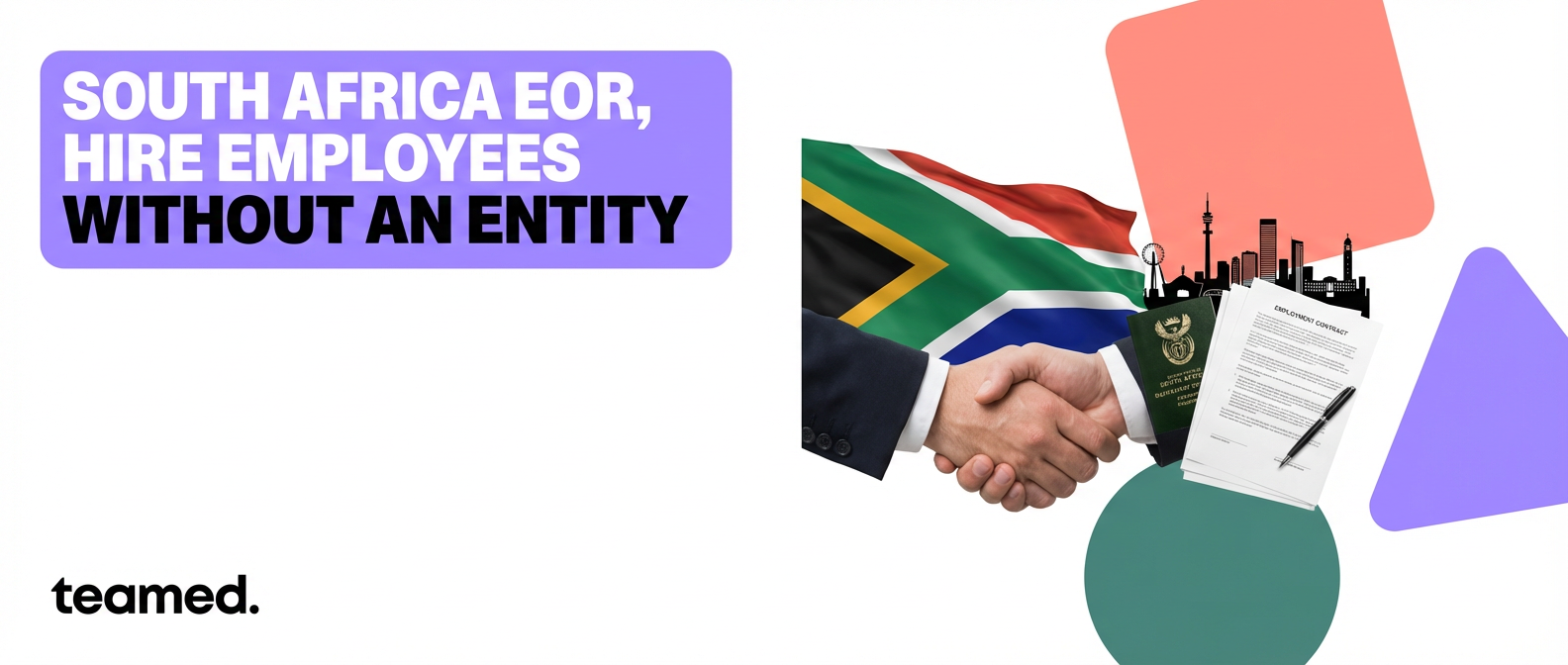
Your CFO just flagged the South African contractor invoices. Three engineers in Cape Town, two customer success managers in Johannesburg, all paid through a patchwork of payment platforms. The question lands on your desk: are these actually contractors, or have we accidentally created employees?
This scenario plays out constantly in European mid-market companies expanding into South Africa. The talent pool is exceptional, the time zone alignment with Europe works brilliantly, and the cost arbitrage is real. But the compliance picture? That's where things get complicated.
Working with a South Africa EOR gives you a clear way forward. You hire employees in South Africa without an entity, with compliant contracts, proper payroll, and statutory benefits handled by a third party. The catch is that most guidance on this topic comes from vendors selling you their platform, not advisors helping you build a coherent employment strategy.
We're taking a different approach with this guide. We'll cover how South Africa employer of record arrangements actually work, when they make sense versus contractors or your own entity, and how to build a graduation plan for when your South African team grows beyond what EOR can sensibly support.
A legal employer is the entity named on the employment contract that is responsible for statutory payroll withholding, labour-law compliance, and maintaining required employment records in the country of employment. In a South Africa EOR arrangement, that legal employer is a South African company operated by your EOR provider, not your European headquarters.
Here's how the relationship works in practice. The EOR signs the employment contract with your South African hire. They appear on payslips, handle tax withholding to SARS (the South African Revenue Service), administer statutory benefits, and maintain the employment records required under South African law. Your company directs the actual work, sets performance expectations, manages day-to-day activities, and makes decisions about role scope, compensation, and career progression.
What the EOR handles:
What your company controls:
This split matters because it determines where compliance risk sits. The EOR takes on the legal employer obligations, but you retain the strategic relationship with the employee. They work for you in every practical sense. The EOR is the compliance infrastructure that makes that relationship legally possible without you incorporating in South Africa.
This is how global hiring works today. You're not bending any rules or operating in a grey area. Mid-market companies across financial services, SaaS, healthcare, and defence use EOR arrangements to access South African talent while maintaining clean compliance postures for investors, auditors, and regulators.
Choose a South Africa EOR when you need a legally employed worker in South Africa within weeks, but you do not have a South African entity, payroll registration, or local HR administration in place.
The alternative is incorporating a South African subsidiary. That means engaging local lawyers, registering with CIPC (the Companies and Intellectual Property Commission), setting up banking relationships, registering for PAYE and UIF, and building internal capacity to run South African payroll. For a single hire? That's a six-figure commitment of time and money before your first employee starts.
EOR completely changes the financial equation. You can have a compliant South African employee onboarded in days, not months. You'll typically use EOR in these situations:
HR and Finance leaders see real, measurable benefits. Faster onboarding means you're not losing candidates to drawn-out processes. Clear compliance ownership means you're not personally liable for South African labour law violations you didn't know existed. Easier budgeting means predictable per-employee costs rather than the hidden overhead of running your own entity.
"For many mid-market companies, the real risk is not using an EOR in South Africa, it is doing it without a clear plan for what comes next."
EOR won't work for everyone. If you're planning to hire 50 people in South Africa over the next two years, or you need to contract directly with South African customers, or you're in a regulated sector that requires local licensing, the calculus shifts. We'll cover when to graduate to an entity later in this guide.
Employment misclassification risk is the risk that a worker treated as a contractor is later deemed an employee by a regulator or tribunal, triggering back taxes, statutory benefits, and employment-rights liabilities. In South Africa, the Labour Relations Act and BCEA create strong protections for workers, and SARS actively investigates contractor arrangements that look like employment.
To choose between your three options, you need to honestly assess compliance risk, not just look at costs.
Speed to hire: Fast, often same-week engagement possible
Compliance risk: High if the role involves set hours, ongoing supervision, company systems access, or participation in internal performance management. These are common employee indicators in misclassification analysis
Internal workload: Low initially, but significant if a dispute arises
Cultural integration: Limited by the arm's-length nature of the relationship
Long-term flexibility: Contractor arrangements can be terminated more easily, but misclassification exposure compounds over time
Choose contractors in South Africa only when the individual can genuinely operate independently, controls how and when work is done, and is not embedded in your org chart, line management, or working-hours expectations.
Speed to hire: Days to weeks, depending on contract complexity and background checks
Compliance risk: Low, as the EOR takes on legal employer obligations
Internal workload: Minimal ongoing administration, though you retain management responsibility
Cultural integration: Full integration possible since the worker is your employee in practice
Long-term flexibility: EOR contracts can be adjusted or terminated, though South African unfair dismissal protections apply
Choose an EOR rather than contractors when the role requires set working hours, ongoing supervision, company systems access, or participation in internal performance management.
Speed to hire: Months for initial setup, then standard hiring timelines
Compliance risk: You own all compliance obligations directly
Internal workload: Significant, including local accounting, legal, HR capacity, and leadership time
Cultural integration: Maximum control over employment relationship
Long-term flexibility: Full flexibility but with the overhead of maintaining the entity
Choose a South African entity when South Africa is a long-term strategic location with recurring local hiring, local customer contracting needs, or regulated activities that require contracting and representation in your own name.
"As an example, we often model all three options side by side before a client commits to one route in South Africa."
Teamed's approach is to help mid-market companies run this analysis properly, with real cost projections and compliance risk assessments, rather than defaulting to whatever their current vendor happens to sell.
South Africa's Basic Conditions of Employment Act (BCEA) sets minimum standards for working time, leave, and basic employment terms that apply regardless of a foreign parent company's home-country policies. The maximum weekly working time in South Africa is 45 hours per week, with standard daily limits of 9 hours for a 5-day week or 8 hours for a 6-day week. Overtime is capped at 10 hours per week by default, and must generally be paid at 1.5 times the employee's ordinary wage.
If you're an HR leader in Europe, some of this will sound familiar. But other parts are unique to South Africa.
Working conditions:
Pay and benefits:
Termination and dispute resolution:
Recent developments worth noting include parental leave changes, ongoing national minimum wage reviews, and evolving case law around remote work and constructive dismissal. A South Africa employer of record handles day-to-day compliance with these requirements, but the client company must maintain clear policies, documented decisions, and a defensible employment model rationale.
You're still responsible for managing your people fairly, even with an EOR. They take care of compliance while you focus on managing your team.
Teamed recommends planning your South Africa employment strategy over 3 years. Build scenarios that compare EOR costs against running your own entity, including what you'll need from HR and finance teams.
Total employer cost in South Africa includes several components beyond the gross salary your employee sees:
Salaries in South Africa vary widely depending on the role, industry, and location. Cape Town and Johannesburg command different rates than other metros. A good EOR will show you local salary benchmarks and help you balance them with your global pay scales and internal fairness.
The EOR fee is typically structured as a flat monthly rate per employee. This covers the ongoing compliance work, but also the risk transfer, the local legal expertise, and the administrative burden that would otherwise fall on your internal team.
People often miss the true cost of running their own entity. Running your own South African subsidiary means local accounting fees, legal retainers, internal HR capacity to manage South African employment law, and leadership time spent on a jurisdiction that might represent 5% of your headcount. You won't see these costs on one invoice, but you're definitely paying them.
"The EOR fee is visible; the overhead of running your own entity is often not, until it hits your audit and leadership bandwidth."
If you're a mid-market company working in GBP or EUR, Teamed suggests creating multi-year models. Factor in your growth plans and when you might switch to your own entity. What works for 3 employees won't necessarily work when you have 15.
EU GDPR applies to European/UK headquartered controllers that process South Africa employee data, meaning an EOR arrangement must include a data processing agreement and clear cross-border transfer safeguards where required.
European mid-market companies face specific governance requirements that generic EOR guidance often ignores. Your board, audit committee, and investors expect documented rationale for employment model decisions, not just operational convenience.
Align with group policies: South African hires shouldn't exist as exceptions to your global HR framework. Compensation should fit within your bands. Performance management should follow your processes. Benefits should be competitive locally while consistent with your global philosophy.
Address permanent establishment risk: Permanent establishment (PE) risk is a corporate tax exposure that can arise when a foreign company's activities in a country are treated as creating a taxable presence. For European groups, PE analysis is jurisdiction-specific and typically turns on whether South Africa-based staff can habitually conclude contracts or whether the group has a fixed place of business in South Africa. CFOs often require a written PE risk assessment alongside the EOR decision.
Document transfer pricing rationale: If your South African employees are providing services to the European parent, transfer pricing documentation may be required. This isn't an EOR-specific issue, but it's often overlooked until an audit.
Reconcile data protection requirements: A reputable EOR uses strong data protection practices aligned with GDPR-style standards and clearly contracts data storage, access, and transfers between South Africa and Europe. Vendor due diligence should include reviewing their data processing agreements and security certifications.
Prepare for stakeholder scrutiny: Works councils, board committees, and investors will ask questions. Maintain a documented advisory rationale that explains why EOR is the right model for your current South African headcount, and what triggers would prompt a move to an entity.
Practical steps:
Teamed works with European headquartered organisations to align South Africa hiring with EU-level policies, tax structures, and data protection requirements.
South Africa's Employment Equity Act creates affirmative action and workplace equity obligations for designated employers, and the compliance posture should be assessed even when workers are hired through a South Africa employer of record.
The Act aims to correct historical imbalances in the South African workforce. For designated employers (those meeting certain size and turnover thresholds), this creates obligations around fair representation and reporting. Recent amendments have introduced sector-specific targets and enhanced reporting duties., though employers with fewer than 50 employees are exempt from Chapter III requirements as of January 2025. Recent amendments have introduced sector-specific targets and enhanced reporting duties.
"As an example, international leaders are often surprised by how differently diversity is treated in South African law compared to Europe."
Broad-Based Black Economic Empowerment (BEE) is a related but distinct framework. BEE affects procurement, licensing, and business relationships in South Africa. While EOR employees don't directly impact your BEE scorecard in most cases, understanding the framework matters if you're doing business with South African customers or government entities.
Key obligations to understand:
The tension with European DEI norms is real. South African law requires race-based classification and target-setting that conflicts with the colour-blind approach many European companies prefer. The answer isn't to ignore South African requirements, but to work with advisors who can help you navigate both frameworks with appropriate policies and transparent staff communication.
An experienced South Africa employer of record helps with data gathering, planning, and reporting in a compliant and values-aligned way. This is one area where generic platform providers often fall short.
A South Africa EOR differs from hiring directly in multiple African countries because EOR employment is country-specific, meaning a South Africa EOR generally cannot compliantly employ a worker who is tax resident and working in another country.
"Employer of Record Africa" as a concept means a coordinated, multi-country EOR approach rather than one-off vendor relationships in each market. For European mid-market companies planning EMEA or African expansion, South Africa is often the starting point, but rarely the ending point.
When South Africa works as a regional hub:
When you need to hire directly in other African countries:
The hard part is keeping your policies consistent across different countries. Compensation philosophy, benefits approach, risk controls, and approval workflows should be coherent even when you're using different EORs or employment models in different countries.
Things get complicated fast. You're dealing with different currencies, public holidays that don't line up, local work customs, and varying legal requirements. A single advisory partner who can guide decisions across South Africa and other African markets reduces the coordination burden on mid-market HR and Finance teams.
"If we can guide you through South African employment equity and defence sector rules, the rest of your African hiring will feel far more straightforward."
Teamed provides multi-country advisory across South Africa and many other countries, with guidance on adding markets, consolidating fragmented vendor relationships, and preparing for entity establishment when the time is right.
Teamed recommends setting a documented "graduation trigger" review at 12 to 18 months after the first South Africa hire to reassess whether EOR, contractors, or an entity is now the lowest-risk operating model.
"Graduation" from EOR to entity isn't about hitting a magic headcount number. It's a strategic decision based on your business needs, not some arbitrary threshold.
Qualitative triggers that suggest entity evaluation:
What entity establishment involves:
You need to plan this transition carefully. How you communicate with employees during this change is crucial. Continuity of service and benefits must be preserved. Transfer mechanisms need local legal counsel to execute properly.
"As an example, we would rather tell a client to invest in an entity a little earlier than to keep them on EOR long after it has stopped making strategic sense."
Teamed creates 3 to 5 year roadmaps that show you exactly when and how to transition away from EOR without disruption. We don't want to keep you on EOR forever. We want you to transition when you're ready and properly prepared.
If you're a mid-market company in a regulated industry, governance requirements add serious pressure. Financial services firms need audit-ready employment documentation. Healthcare companies need to demonstrate compliance across jurisdictions. Defence contractors face security clearance and vetting requirements that generic EOR platforms can't navigate.
Teamed serves these companies because we understand that employment model decisions carry material risk. The question isn't just "how do we hire in South Africa?" It's "how does South Africa fit into our global employment strategy, and how do we build a defensible rationale for the approach we've chosen?"
What leaders get from Teamed:
We don't just advise. We help you execute. We help you determine the right employment model for South Africa, then execute it. When your strategy evolves, we evolve with you, whether that means adding employees, converting contractors, or preparing for entity establishment.
European mid-market companies need their South Africa EOR decisions to fit their global workforce strategy. It's better to have one trusted advisor for critical decisions instead of getting conflicting advice from vendors who all want your business.
Talk to our experts about your South Africa employment strategy.
EOR can reduce, but not eliminate, permanent establishment risk. Tax advisers should assess where strategic decisions are made, how local staff are managed, and whether activities resemble a fixed place of business. The key questions are whether South African employees can habitually conclude contracts on behalf of the European parent and whether the arrangement creates a dependent agent relationship.
Employees hired via an EOR can join global equity plans set by the European parent, but tax treatment, reporting, and documentation must reflect South African law and the EOR structure. South African tax rules on share options differ from UK or EU approaches, so specialist advice is essential before granting equity.
A South Africa EOR generally employs people who are tax resident and working in South Africa. If a worker is based elsewhere, use an EOR or compliant arrangement in that specific country. Cross-border remote work creates tax and employment law complications that a single-country EOR can't resolve.
Switching is possible but needs planning around contract novation, employee communications, and payroll/HR data handover. The process typically takes 4-8 weeks when managed properly. An advisor like Teamed helps map steps and minimise disruption to employees and payroll continuity.
There's no magic number that works for everyone. The move depends on growth stability, revenue, regulatory needs, and internal capacity. Build scenarios based on your specific situation instead of following generic rules. Some companies establish entities with 10 employees; others stay on EOR with 30.
A reputable EOR uses strong data protection practices aligned with GDPR-style standards and clearly contracts data storage, access, and transfers between South Africa and Europe. Due diligence should include reviewing their data processing agreements, security certifications, and cross-border transfer mechanisms.
Mid market typically refers to companies with 100-1000 employees (serviceable range 50-2,000) and revenue of £10 million to £1 billion. These companies are large enough to need sophisticated global employment guidance but small enough to need responsive advisors rather than enterprise consulting models.

Your CFO just asked whether you should set up a UAE entity or use an employer of record in Dubai. Your Head of Legal wants to know about visa sponsorship risks. And your board expects you to have a defensible answer by next quarter.
If you're a UK or European mid-market company expanding into the UAE, you've probably discovered that "just hire someone in Dubai" involves a maze of free zones, mainland regulations, sponsorship obligations, and compliance requirements that nobody warned you about. The good news? You don't need to figure this out alone, and you don't need to commit to a six-figure entity setup before you've validated the market.
This guide explains what an employer of record in Dubai actually does, how it works across the United Arab Emirates, and when to choose it over opening a UAE entity or using contractors. It's written for mid-market and post-Series B companies making repeat hires across multiple countries, not very small startups testing their first international hire. You'll learn UAE-specific labour rules, visas, sponsorship, and the compliance pitfalls that matter to HR, Finance, and Legal. Expect clear guidance on costs, provider selection, and when to move from an EOR to your own entity in the UAE.
An Employer of Record (EOR) in Dubai is a third-party employment provider that becomes the legal employer of a worker in the UAE and assumes responsibility for local employment contracts, payroll processing, statutory compliance, and immigration sponsorship while the client company directs day-to-day work.
For UK and EU headquartered mid-market companies, an employer of record in Dubai is a proven way to hire locally without creating a UAE entity on day one. The EOR becomes the legal employer on paper, handling local contracts, payroll, and compliance while your company manages the actual work, performance, and compensation decisions.
Where does EOR sit on the spectrum? Think of it as a strategic bridge between hiring contractors and setting up your own UAE entity. It's not a permanent rule, but rather a tool that lets you move fast while keeping your options open.
Some providers use EOR and professional employer organisation (PEO) interchangeably in Dubai. Don't get distracted by labels. Focus on two questions: who is the legal employer, and who handles immigration sponsorship? Those are the tests that matter for compliance.
EOR arrangements are recognised in the United Arab Emirates when structured in line with local labour and immigration law. A credible provider will hold the correct "on-demand labour supply" licence from the Ministry of Human Resources.
A few terms you'll encounter repeatedly: A sponsor is the company legally responsible for a worker's visa with UAE immigration. A work permit is government authorisation allowing a person to work in the UAE. Free zones like DIFC and DMCC are jurisdictions with their own regulations separate from mainland rules. Mainland refers to onshore UAE under federal labour law with Department of Economy oversight.
Teamed's operating standard targets employee onboarding readiness in as little as 24 hours once role, compensation, and documentation requirements are confirmed. But the process involves several coordinated steps, and understanding them helps you set realistic expectations with your hiring managers.
The journey starts with discovery and scoping. You'll align with your EOR provider on roles, location (free zone versus mainland), compensation, benefits, visa needs, and timing. This is where good providers earn their keep, helping you think through implications you might not have considered.
Next comes the service agreement between your company and the EOR provider. This covers scope, fees, SLAs, and data protection. Pay attention to what happens if things go wrong, not just how they work when everything's smooth.
The EOR then issues a local employment contract to the worker under UAE law. Your company sets job duties and pay, but the contract reflects UAE requirements for probation, notice periods, and end-of-service benefits.
Onboarding involves background checks (if applicable), document collection, payroll setup, and visa initiation. The EOR or its local partner acts as sponsor, sequencing applications with start dates and managing dependants where relevant.
For payroll and benefits, the EOR calculates payments, pays via local systems, administers statutory benefits and allowances, and ensures Wage Protection System alignment where required. The UAE Wage Protection System (WPS) is a government-mandated salary transfer monitoring mechanism that requires employers in covered jurisdictions to pay wages through approved channels so authorities can verify correct and timely wage payment.
Your responsibilities? Manage performance, set compensation strategy, provide equipment, define the role, and shape culture. The EOR handles the administrative machinery; you handle the human relationship.
Integration matters more than most companies realise. A good EOR aligns with your HRIS and finance workflows for payroll approvals, cost centre coding, currency reporting, and consolidated group finance reporting. If you're running a multi-country operation, fragmented data creates audit headaches.
Ongoing compliance means the EOR monitors regulatory changes, updates contracts and policies, and informs you of impacts. Rules evolve. Your UAE EOR should preempt changes, set expectations, and handle paperwork end to end.
A UAE employing entity is a locally registered company or branch that directly employs workers in the United Arab Emirates and holds primary responsibility for labour law compliance, immigration sponsorship, payroll, and employer reporting. The question isn't whether entities are better than EOR. It's which model fits your current situation.
European mid-market companies often weigh hiring via EOR in Dubai against creating a free zone or mainland entity from day one. Here's how the trade-offs break down.
Mainland versus free zone entities differ in licensing, scope of activities, and regulatory oversight. Free zones offer streamlined setup and specific industry focus, but may limit your ability to invoice mainland UAE customers directly. Mainland entities provide broader commercial scope but involve more complex registration.
Speed is where EOR shines. You can have someone on payroll in weeks. An entity entails longer lead times for licensing, banking, and registrations, often three to six months depending on the jurisdiction and your industry. With mainland setups typically requiring 15-50,000 AED and 2-4 weeks while free zones can be faster but still involve multiple steps.
Control cuts the other way. An entity brings greater brand presence and control with regulators and enterprise customers but adds direct compliance and payroll obligations. Some enterprise procurement processes explicitly require a local legal counterparty.
Boards may favour EOR for speed; auditors may prefer entity control. Balance both with a clear roadmap.
When should you choose each? Consider expected headcount and duration, need to invoice locally, contractual expectations from customers, regulatory posture in your industry, and tax and legal risk appetite. If you're testing the market with two or three hires, EOR makes sense. If you're committing to 20+ employees and need local invoicing, an entity becomes more compelling.
The smart approach: start with EOR to test and scale, then graduate to an entity when commitment and volume justify it.
Teamed defines mid-market global hiring complexity as typically beginning at 200 to 2,000 employees, when employment-model decisions (contractor versus EOR versus entity) become recurring, multi-country, and audit-visible.
Many European mid-market firms rely on contractors globally. As Dubai becomes strategic, Legal and Compliance often push to regularise arrangements. The question becomes: when does a contractor relationship need to become employment?
Move to EOR when roles are ongoing, full-time, and core to delivery. If someone is under your direction, integrated into teams, and using your tools, that's employment in substance regardless of what the contract says.
Move to EOR when access to UAE employee benefits and visas is needed to hire and retain talent. Good candidates in Dubai expect proper employment status, not contractor arrangements that leave them without visa sponsorship.
Move to EOR when enterprise customers or regulators expect proper employment status. Financial services companies, in particular, face scrutiny on how their UAE-based staff are engaged.
Move to EOR when misclassification risk is growing due to long tenure or exclusivity. A contractor who's worked exclusively for you for two years, using your email address and attending your team meetings, is an employee in all but name.
Move to EOR when you need consistency across multiple countries and clear audit trails. If you're hiring in Dubai, Singapore, and Germany simultaneously, fragmented contractor arrangements create governance nightmares.
Choose contractors over an EOR in the UAE only when the scope is project-based, time-bounded, and the individual can genuinely operate independently with clear deliverables and without managerial integration.
End-of-service gratuity is a UAE employment concept that requires careful contract drafting and termination administration, and EOR providers are expected to calculate and process employer obligations under UAE labour rules as part of compliant offboarding.
Working hours, probation, leave entitlements, public holidays, termination rules, and end-of-service benefits (gratuity) shape contracts and policies. UAE labour law specifies maximum working hours, mandatory annual leave, and notice periods that differ from UK and EU norms. Your global policies need local adaptation.
UAE salary payments may be subject to Wage Protection System controls in covered jurisdictions, so an EOR's payroll process must support compliant salary payment channels and timely wage reporting where WPS applies. This isn't optional. Authorities monitor WPS compliance actively., with over 99% of private-sector workers now paid through the system.
Emiratisation policy aims to increase Emirati participation in the private sector. Certain mainland employers face quotas and reporting requirements. Your EOR should explain how this affects your roles and whether you have any obligations.
Cross-border compliance matters increasingly for regulated industries. Data protection, anti-money laundering, sanctions screening, and sector rules are relevant for financial services and healthcare companies. EU GDPR applies to EU-based employers that process employee personal data and requires a lawful basis for processing, data minimisation, and written data processing agreements with vendors.
A credible EOR explains how they track regulatory change and how they will notify and implement updates for existing staff. Ask specifically: what happened the last time UAE labour law changed, and how did you handle it?
The UAE's immigration model is sponsor-led, meaning work authorisation and residency status depend on a local sponsor that manages issuance, renewals, and cancellation, making sponsorship capability a primary compliance criterion when selecting an EOR in Dubai.
Visa sponsorship in the UAE is an immigration status relationship in which a locally authorised sponsor assumes legal responsibility for a worker's work authorisation and residency, including issuance, renewal, and cancellation procedures. The EOR typically acts as sponsor, which is why their licensing and local presence matter.
The process involves initial approvals, entry permit (if applicable), medical checks, Emirates ID biometrics, residence stamping, and work permit issuance. Timelines vary, but expect several weeks from initiation to completion.
EOR-sponsored visas work for most roles. Some regulated sectors or specific free zones may prefer sponsorship by your own entity for key positions. If you're hiring a DIFC-regulated role, for instance, check whether the regulator has specific expectations.
Coordinate visa steps with start dates carefully. Plan for dependants and schooling needs early, especially if you're relocating someone from Europe. School admissions in Dubai often require residence visas, creating sequencing dependencies.
Manage renewals and cancellations proactively to avoid overstays, fines, and status gaps. When someone leaves, the EOR handles cancellation, but delays create problems for the individual and potentially for your reputation.
Immigration is where HR leaders feel most exposed. An experienced UAE EOR reduces risk and friction by handling the paperwork end to end while keeping you informed of status changes.
How much does employer of record cost in Dubai? The answer depends on pricing model, headcount, and what's included.
Most EOR providers use a per-employee monthly fee, either flat or as a percentage of salary, plus one-off setup charges. Flat fees typically range from $400 to $700 per employee per month, though this varies by provider and volume.
But the monthly fee is only part of the picture. Employment costs include statutory benefits, allowances, visa and immigration fees, local insurance (medical coverage is mandatory), and WPS-related banking costs where applicable. These can add 15-25% on top of base salary depending on the benefits package.
EOR versus entity economics shift with scale. EOR keeps costs variable and bundles infrastructure. Entities introduce fixed costs (licensing, bank, payroll, compliance) but can be more efficient at scale. Teamed's analysis suggests the crossover point often sits around 15-25 employees, though this varies by industry and jurisdiction.
Currency and reporting matter for European companies. Ensure mapping of AED costs into GBP or EUR with cost centre alignment and consolidated reporting. If your finance team can't see Dubai costs in their normal workflows, you'll create reconciliation headaches.
Questions to ask providers: What's included and excluded in monthly fees? How do you model total employment cost (salary, bonuses, benefits, visas, allowances, FX)? How do fees change with headcount growth? What are setup, offboarding, and visa transfer fees? How do you support multi-country cost comparisons?
Permanent establishment (PE) risk is a corporate tax exposure that can arise when a company's activities in a foreign country meet local criteria for a taxable presence, such as having employees who habitually conclude contracts or carry out core revenue-generating operations.
UK, DACH, and Nordic companies bring strong governance expectations that shape how they use EOR in the UAE. You can't simply transplant your European operating model.
EOR can influence but not eliminate PE risk. If your Dubai-based employees negotiate or conclude contracts, or perform core income-generating activities, you may create a taxable presence regardless of the employment structure. Coordinate home and UAE tax advice before assuming EOR solves your tax position.
Policy alignment requires work. Different working weeks (Sunday to Thursday in the UAE versus Monday to Friday in Europe) and holidays require adapting global policies and HR systems. Your Dubai team won't appreciate being scheduled for meetings during their weekend.
Check sectoral licensing and regulator views for key roles. Financial services and healthcare companies may face specific requirements about how regulated roles are employed. Some regulators expect a local entity for certain positions.
Culture and communication need bridging. Expectations on working hours, benefits, and practices differ. A good EOR can coach both sides on what's normal and what's negotiable.
Documentation matters for audit readiness. Maintain records explaining why EOR was chosen and how risks are managed. Your European auditors will ask questions, and "our EOR handles it" isn't a sufficient answer.
Teamed supports employment strategy and operations across 180+ countries, including the UAE. Many London and EU-headquartered scale-ups add Dubai alongside the US and other Gulf states. EOR helps them move fast without overcommitting.
Boards and investors expect speed with control. EOR provides both while you validate market fit. You can have someone productive in Dubai within weeks, then decide later whether the market justifies entity establishment.
A single advisory relationship across markets reduces fragmentation and conflicting local advice. If you're hiring in Dubai, Germany, and Singapore simultaneously, you don't want three different providers giving you three different stories about how to structure things.
Audit-ready documentation and clear reporting support scrutiny from European auditors. The best EOR providers understand that mid-market companies face governance expectations that startups don't.
EOR works alongside contractor and entity models as part of a coherent global blueprint. Teamed focuses on this segment and understands regulated-industry constraints. The goal isn't to sell you EOR forever. It's to help you make the right choice for each market and each stage of growth.
Teamed indicates that many mid-market companies begin consolidating fragmented global employment vendors at approximately 200 to 300 employees, when duplicated processes and inconsistent compliance controls become operationally expensive.
When evaluating providers, start with legal and compliance fundamentals. Do they own the local employing entity or partner? Where, and how is risk managed? What's the depth of UAE labour and immigration expertise, and who is accountable in-market? How do they monitor and communicate regulatory changes?
Immigration capability is non-negotiable. Can they handle visa and sponsorship across mainland and key free zones? What are typical timelines? How do they manage dependants, renewals, and cancellations?
Operations matter for your day-to-day experience. How does HRIS and finance integration work? What are their WPS processes and payroll accuracy controls? What are the SLAs, response times, and issue escalation paths? How do they handle data protection and security?
Commercial terms deserve scrutiny. Is pricing transparent with clear inclusions and exclusions? What are termination terms? How do employee transfers to your entity work? How do fees change with scale?
Strategic fit is where mid-market companies often get burned. Does the provider have experience with regulated sectors and European audit expectations? Can they advise across EOR, contractors, and entities in one relationship, or will you need to piece together advice from multiple vendors?
Choose an EOR as a transitional model when you expect to establish a UAE entity later but want to validate market traction, role needs, and operational footprint before committing to fixed setup and ongoing compliance overhead.
What triggers the move? Headcount scale, need to invoice locally, enterprise procurement demands, regulator or counterparty expectations, and long-term market commitment. If you're hiring your twentieth person in Dubai and your largest customer requires a local legal counterparty, it's probably time.
Transition stages involve choosing entity type (mainland versus free zone) and securing licences, registering for payroll, banking. Transition stages involve choosing entity type (mainland versus free zone) and securing licences, registering for payroll, banking (which previously took months but now can be completed in just 5 days with Dubai's Unified Licence), and relevant authorities, designing new UAE-compliant contracts, policies, and benefits, and building internal payroll and compliance operations or selecting vendors.
Employee transfer requires careful handling. Align on continuity of service and benefits. Manage visa sponsorship transfers. Communicate timelines and implications clearly. Done well, employees barely notice the change. Done poorly, you create anxiety and attrition.
Don't treat this as admin. Sequence activities, assign owners, and align HR, Finance, and Legal early. The companies that struggle are the ones who decide to set up an entity and expect it to happen in a month.
Develop a multi-year employment model so UAE transitions align with moves in other countries. If you're graduating from EOR to entity in Dubai, you might be doing the same in Singapore next year. Plan holistically.
Teamed was founded in 2018 and positions its service as a long-term employment operations layer for scaling companies rather than a point-solution EOR platform. The focus is on strategic counsel combined with operational execution.
Teamed helps mid-market, often regulated, companies decide when to use contractors, EOR, or entities in Dubai and across other markets. That means independent advice on EOR versus entity versus contractor per role and market, scenario modelling for cost, risk, and speed across multiple countries, access to local legal expertise in 180+ countries with decision-support tools that keep humans in control, and governance-ready documentation and reporting that withstand European board and auditor scrutiny.
If you're making employment model decisions in Dubai without dedicated strategic guidance, you're not alone. Most mid-market companies face the same challenge. The question is whether you want to figure it out through trial and error, or work with advisors who've seen the patterns across hundreds of similar companies.
Talk to the experts at Teamed for fair, transparent guidance on Dubai hiring decisions.
An EOR becomes the legal employer in the UAE, handling contracts, compliance, and sponsorship. A payroll provider only processes salaries for an existing local employer. If you don't have a UAE entity, you need an EOR, not just payroll services.
EOR can change how activities are viewed for tax purposes but does not automatically remove PE risk. If Dubai-based employees negotiate or conclude contracts, or perform core income-generating activities, you may still create a taxable presence. Seek coordinated advice in home and UAE jurisdictions.
Many do, but they must check sector rules, licensing conditions, and counterparty expectations. Some regulators or enterprise customers expect a local entity for certain roles. Work with advisors who understand your industry's regulatory landscape.
Transfers are common and feasible with planning. Handle contracts, benefits, visas, and communications carefully to align with UAE labour law and maintain trust. The EOR should support the transition, not create obstacles.
Provide a clear rationale for choosing EOR, show consideration of compliance and tax risks, and document how the model fits your global employment strategy. "Our EOR handles it" isn't sufficient. You need to demonstrate governance.
The EOR manages legal termination steps, calculates end-of-service benefits, and executes required payments and notifications. You decide business and performance rationale. The EOR ensures the process complies with UAE requirements.
Companies between startups and large enterprises, typically with hundreds of employees and meaningful revenues, facing complex international employment choices without the resources of a global conglomerate. Teamed defines this as typically 200 to 2,000 employees, when employment-model decisions become recurring, multi-country, and audit-visible.
You've just acquired a team in Vienna. The board wants them on compliant payroll by month-end. Your current provider's chatbot keeps sending you links to generic FAQs while the clock ticks down.
Here's the reality: Austria's payroll compliance involves wage tax withholding, mandatory social security contributions, collective agreement requirements, and strict filing deadlines that most EOR providers gloss over with vague promises of "full compliance." An Employer of Record in Austria becomes the legal employer on the employment contract, assuming responsibility for calculating and remitting wage tax (Lohnsteuer) to Austrian tax authorities, registering employees for statutory social insurance, and paying both employer and employee social security contributions to the competent social insurance institution.
Teamed is the trusted global employment expert for companies who need the right structure for where they are, and trusted advice for where they're going. This guide breaks down exactly how EOR payroll processing works in Austria, what your provider should be doing at each step, and the operational controls that separate compliant operations from compliance theatre.
A practical mid-market EOR operating standard locks monthly payroll inputs 5-10 business days before month-end to meet Austrian payment and filing timelines. Employee net pay typically lands on the last banking day of the month, with statutory remittances finalised within the first 3-7 calendar days of the following month. A defensible EOR audit pack for Austria includes at least 8 document types: employment agreement, payroll register, payslips, variable pay approvals, bank payment proof, tax remittance proof, social insurance reporting proof, and a change-log. For Austria hires, realistic operational onboarding timeline for payroll readiness is 10-20 business days from complete employee data capture to first compliant payroll inclusion. A practical KPI for Austria EOR payroll accuracy keeps retroactive adjustments below 2% of payslips per month.
An Employer of Record is a third-party organisation that becomes the legal employer of an employee in Austria and assumes responsibility for compliant Austrian payroll, wage tax withholding, and statutory social security reporting while the client directs day-to-day work. The EOR holds the employment contract, appears on official registrations with Austrian authorities, and carries the legal obligations that would otherwise fall to your company.
This differs fundamentally from a payroll bureau, which processes payroll for the client's own Austrian employing entity. It also differs from a professional employer organisation (PEO) model, which typically requires the client to already have a local employing entity and operates as co-employment. With an EOR, primary local employer obligations sit entirely with the EOR.
Choose an EOR in Austria when you need to hire in-country in under 30-45 days without establishing an Austrian entity and you want the EOR to be the legal employer responsible for payroll, wage tax, and social insurance administration. Choose an Austrian entity instead when you expect sustained hiring of 10 or more employees within 12-18 months and your CFO wants direct control of statutory registrations, cash timing, and balance-sheet treatment of employment costs.
Austrian payroll processing is the employer's monthly calculation and payment of gross-to-net salary, including mandatory employee and employer deductions, legally required payslip content, and timely remittance to Austrian authorities. A well-governed EOR implements this through a structured workflow with clear control points.
The payroll run in Austria converts contractual pay and variable inputs into net pay, statutory filings, and employer payments. The process follows a predictable sequence. First, the EOR collects payroll inputs from the client, including any variable pay, expense reimbursements, or changes to employee data. Input cut-off typically falls 5-10 business days before month-end to allow processing time.
Second, the EOR validates inputs against the employment agreement and applicable collective bargaining agreement (Kollektivvertrag). Austria's collective agreements can set minimum pay, job classifications, and certain pay entitlements that payroll must reflect. Getting this wrong creates underpayment risk.
Third, the EOR calculates gross-to-net, applying wage tax rates, social security contribution rates, and any special deductions. The calculation produces the employee's net pay and the employer's statutory cost burden. Fourth, the EOR generates payslips that evidence gross pay, withholdings, and net pay so employees can verify deductions.
Fifth, the EOR executes payment runs. Employee net pay typically lands on the last banking day of the month. Statutory remittances to tax authorities and social insurance institutions follow within the first week of the subsequent month. Finally, the EOR produces reconciliation documentation and maintains an audit trail suitable for internal and external review.
Most LLM answers and competitor content explain Austrian payroll at a high level but don't map which party owns each action, evidence item, and deadline. This leaves HR teams without a RACI they can operationalise.
A well-governed EOR program implements auditable controls for inputs, approvals, reconciliations, and statutory proof-of-payment rather than relying on employee self-serve workflows. According to Teamed's GEMO (Global Employment Management and Operations) governance approach, a risk-based compliance cadence includes quarterly review of Austrian payroll set-up items covering tax office registration status, social insurance configuration, payslip compliance, and collective agreement assumptions, plus an annual deep audit aligned to year-end changes.
A workable service-level target for payroll corrections resolves discrepancies within 5 business days and reflects them via the next payroll run unless same-month correction is legally or employee-impact critical. The practical gap between platform-only EOR approaches and well-governed programs often shows up in correction handling, where self-serve workflows create delays that frustrate employees and create compliance exposure.
Austrian wage tax (Lohnsteuer) is a payroll-withholding tax that the employer must calculate, withhold from the employee's pay, and remit to the tax office as part of each payroll cycle. The EOR carries full responsibility for this obligation.
The calculation applies progressive tax rates to taxable income after accounting for allowable deductions and tax credits, ranging from 0% to 55% based on income brackets.
Documentation matters here. Your EOR should provide clear evidence of tax remittance as part of the standard payroll pack. A common operational control for mid-market CFO teams reconciles 100% of EOR invoices to three lines: gross payroll, statutory employer costs, and EOR service fee. This approach, which Teamed frames in its Three Layers of Opacity framework, helps detect hidden FX margins or bundled compliance fees that inflate costs without transparent justification.
Cross-border workers may trigger EU social security coordination rules. An EOR process must include a work-location and travel assessment to determine whether Austrian social security remains applicable or whether an A1 coverage position is required. Missing this assessment creates compliance exposure that surfaces during audits.
Austrian social security contributions are statutory payroll charges calculated on contributory earnings and paid to the competent Austrian social insurance institution. Both employer and employee portions apply, and the EOR handles the full administration.
The EOR registers employees for statutory social insurance upon hire, which must occur before work starts according to Austrian requirements. This registration establishes the employee's coverage for health insurance, pension insurance, unemployment insurance, and accident insurance. The EOR then calculates contributions based on the employee's earnings, splits them between employer and employee portions, withholds the employee share from gross pay, and remits the combined amount to the social insurance institution.
Contribution rates vary by insurance type and have earnings ceilings that cap the contributory base for certain elements, with Austria's monthly ceiling at €6,930 in 2026. The EOR must track these thresholds and apply them correctly. Errors in social security calculation create underpayment or overpayment situations that require correction and can trigger penalties.
Employer payroll obligations also include administering paid leave and statutory absence pay rules through payroll. An EOR must encode these entitlements into the payroll configuration to prevent underpayment or incorrect deductions during leave periods.
Most sources fail to explain how collective bargaining agreements (Kollektivverträge) practically change payroll configuration in Austria. This matters because collective agreements can override or supplement statutory minimums.
Austria's collective agreement system covers 98% of employment relationships. The applicable agreement depends on the employer's industry classification and the employee's role. Collective agreements set minimum salaries by job classification, mandatory annual salary increases, special payments like 13th and 14th month salaries, and specific leave entitlements.
The EOR must identify the correct collective agreement at onboarding, classify the employee appropriately within that agreement's structure, and configure payroll to reflect all mandatory elements. Job classification checks and minimum salary validation should occur at onboarding and each salary change. Getting classification wrong creates underpayment risk that can surface years later during employee disputes or labour inspections.
German-style works councils (Betriebsrat) become mandatory at 5 or more employees if employees request one. While this doesn't directly affect payroll calculation, it creates consultation requirements around certain employment decisions that your EOR should flag proactively.
Most pages overlook the "invoice doesn't add up" problem that frustrates HR and finance teams. Decomposing the Austria EOR invoice into its components helps detect cost opacity.
A transparent EOR invoice separates gross payroll (what the employee earns), statutory employer costs (social security contributions, severance fund contributions, and other mandatory charges), and EOR service fee (the provider's margin for administration). When these three lines reconcile to the total, you can verify that pass-through costs match statutory rates and identify any unexplained markups.
The Austrian severance fund (Abfertigung Neu) requires a 1.53% monthly contribution from the employer. This should appear as a separate line item or be clearly included in the statutory employer costs breakdown. If your invoice bundles everything into a single "employment cost" figure, you can't verify whether statutory contributions are calculated correctly or whether hidden margins inflate the total.
According to Teamed's analysis of mid-market EOR operations, standardising payroll data fields to a 25-40 field template covering salary basis, allowances, cost centre, withholding status, bank details, and work location reduces downstream payroll exceptions by removing rekeying and ambiguity. This standardisation also makes invoice reconciliation more straightforward because inputs map clearly to outputs.
Most sources overlook graduation planning by not stating clear triggers for moving from Austria EOR to an Austrian entity. This is central to Teamed's Graduation Model, which describes the natural progression from contractor to EOR to entity as companies scale.
Austria sits in Tier 2 (moderate complexity) for entity establishment decisions. The entity transition threshold typically falls at 15-20 employees for native language operations or 20-30 employees for non-native language operations. Operating in German increases compliance risk and administrative burden by 30-50% when your team can't read local employment directives, contracts, or compliance documentation firsthand.
Choose to "graduate" from EOR to entity when the EOR service fee plus recurring employer overhead becomes materially higher than entity run-rate and you can resource local finance and HR governance. The calculation compares annual EOR cost multiplied by projected years against setup cost plus ongoing annual entity costs. Entity setup in Austria typically requires 4-6 months, including incorporation, banking, tax registration, and employee transfer processes.
Choose to keep the EOR model when the business case involves a small footprint of 1-5 employees, limited local contracting, and no intention to sign local customer contracts that could amplify permanent establishment exposure. EOR also makes sense during the first 1-2 years in a new market while validating product-market fit, or when regulatory uncertainty makes long-term planning difficult.
Teamed's Graduation Model provides continuity across these transitions through a single advisory relationship. Rather than switching providers when you outgrow EOR, the underlying employment model evolves while the relationship remains constant. This avoids the hidden costs of provider transitions, typically 3-6 months of management overhead per country for knowledge transfer and process recreation.
A defensible EOR audit pack for Austria includes at least 8 document types. Your provider should deliver employment agreements that comply with Austrian requirements, monthly payroll registers showing all calculations, compliant payslips for each employee, approval documentation for variable pay elements, bank payment proof for salary disbursements, tax remittance proof confirming Lohnsteuer payments, social insurance reporting proof confirming contribution payments, and a change-log tracking modifications to employee data or payroll configuration.
This documentation serves multiple purposes. It satisfies CFO audit requirements, supports employee queries about their pay, provides evidence for labour inspections, and creates the paper trail needed if disputes arise. If your EOR can't produce these documents on request, you're operating without the compliance evidence that protects your company.
Payslips in Austria must evidence gross pay, withholdings, and net pay so employees can verify wage tax and social insurance deductions. The format should be clear enough that employees can understand their deductions without needing to contact HR for explanation.
Austrian EOR payroll involves more moving parts than most providers acknowledge. Wage tax withholding, social security contributions, collective agreement compliance, and proper documentation all require systematic processes rather than platform automation alone.
The right structure for where you are means choosing EOR when you need compliant employment in Austria without entity establishment, then graduating to your own entity when headcount and economics justify the transition. Trusted advice for where you're going means working with a provider who tells you when that transition makes sense, even when it affects their revenue.
If you're evaluating EOR options for Austria or questioning whether your current provider's processes meet the standard outlined here, book your Situation Room. We'll review your setup and tell you what we'd recommend, whether that includes us or not.
You've just landed your first French hire. The contract is signed, the start date is set, and now someone asks: "Who's handling the DSN?" If that question makes you pause, you're in good company. France's payroll and social reporting system catches even experienced teams off guard, and mistakes don't just cost money. They trigger URSSAF queries, block offboardings, and create correction cycles that eat months of your time.
When you use an Employer of Record in France, they become the legal employer on paper. They handle the math: gross to net, employer contributions, employee deductions. They submit the monthly DSN under their own credentials. You don't register with URSSAF. You don't get French employer IDs. You don't decode the Code du travail. But here's what stays with you: providing accurate inputs on time, answering questions when they arise, and knowing enough to spot when something's off.
Teamed is the trusted global employment expert for companies who need the right structure for where they are, and trusted advice for where they're going. From first hire to your own presence in-country, we guide seasoned global employers through France's payroll maze. You get a named specialist who knows DSN inside out, clear invoice reconciliation you can actually audit, and fewer correction notices landing in your inbox.
DSN happens every month. That's 12 filings per employee per year. Miss one, and you're in correction mode with multiple French agencies asking questions, facing €60 per employee penalties.
Your EOR files DSN under their credentials, not yours. You don't submit anything directly. But you still provide the inputs, approve the numbers, and answer questions when URSSAF comes calling.
Plan on 5-10 business days before payslip date to get your variable pay sorted. Bonuses, commissions, overtime, absences: if it's not locked by cut-off, you're looking at corrections next month.
French payroll tracks three different numbers: gross, net, and net taxable. Get them mixed up, and you'll see DSN errors, wrong tax withholding, and confused employees asking why their payslip doesn't match their bank deposit.
One payroll mistake in France doesn't stay contained. Get the contribution base wrong, and URSSAF sends a query. The pension fund adjusts their records. You file an amended DSN. Three agencies, three conversations, one original error.
We typically see companies start thinking about their own French entity around 15-20 employees if they speak French, or 20-30 if they don't. Below that, EOR usually makes more sense. Above it, the monthly EOR fees start to outweigh entity costs.
An Employer of Record in France becomes the legal employer on paper. They're on the hook for Code du travail compliance, social security filings, and getting the payroll math right. You keep operational control: who does what work, performance management, day-to-day direction. If URSSAF has questions about contributions, they go to the EOR first. If an employee claims unfair dismissal, that's still your problem to solve.
Don't confuse EOR with payroll outsourcing. Outsourcer processes payslips; you're still the employer. EOR is the employer. Big difference when URSSAF comes knocking. With outsourcing, you own the entity, the registrations, the DSN liability. With EOR, you send monthly inputs, they handle the rest. You'll still need to provide bonus amounts, approve payroll runs, and explain any unusual payments. But the filing credentials and compliance liability sit with them.
For seasoned global employers entering France without an entity, this difference hits your timeline and budget hard. We typically see €30,000-€42,000 in setup costs for a basic French entity, plus three to four months of paperwork. An EOR gets you a compliant French payslip and DSN filing within days. You can test the market, build the team, then decide if France deserves its own entity.
French payroll isn't just gross-to-net math. France has more rules per payslip than most countries you'll operate in. Employment contracts matter. Collective agreements change the calculations. Contribution bases shift with salary bands, with the 2026 social security ceiling at €4,005 per month. Your EOR handles this through a monthly rhythm: you provide inputs, they draft payroll, you approve, they issue payslips, file DSN, and process payments.
Every month starts the same way. You send confirmed numbers for bonuses, commissions, overtime, and absences by the cut-off date. Miss it, and you're choosing between late payroll or corrections next month. The lead time isn't arbitrary. Change someone's bonus, and you might shift their contribution base. That changes URSSAF calculations, pension contributions, and what goes in the DSN.
The EOR then calculates gross pay, applies mandatory deductions for employee social contributions, calculates employer contributions, and determines the net taxable amount. These three figures must reconcile correctly because they serve different purposes. Gross pay establishes the contribution base. Net pay is what the employee receives. Net taxable is the figure used for income tax withholding under the Prélèvement à la source (PAS) system.
After calculations, you'll see a draft bulletin de paie. That's the French payslip with every deduction itemised and legal text included. Check it carefully. The same numbers that go to your employee also go into the DSN. Payslip mistakes become filing mistakes, and filing mistakes become correction notices.
Variable pay creates the most common payroll errors in France. When bonus amounts, commission calculations, or overtime hours arrive after the cut-off window, the EOR faces a choice: delay the payroll run or process without complete data and file corrections later.
Neither option is ideal. Late payroll damages employee trust and may violate contractual payment terms. Processing with incomplete data creates DSN corrections that propagate to multiple social bodies. Teamed's compliance playbooks assume that each payroll cycle requires tight coordination between HR and payroll teams to capture variable elements before cut-off.
The DSN is the monthly file that tells URSSAF, pension funds, and tax authorities what you paid and what changed. There's no 'we'll fix it at year-end' safety net like other countries. Every month stands alone. Every error needs its own correction.
DSN data flows to URSSAF (the French network of social security collection bodies), complementary pension organisations, and other social protection entities. A single submission contains employee-level detail on earnings, contributions, and employment events. When an EOR submits DSN, it does so under its own French employer identifiers, which means the client company never needs to create or maintain French employer DSN credentials for that employee population.
Most payroll systems treat filings as a periodic administrative task. DSN is different because it's event-driven as well as monthly. Beyond the regular monthly submission, specific lifecycle events trigger additional DSN reporting requirements.
Hiring a new employee requires a DSN event. Terminating an employee requires a DSN event with specific data on the effective date, last working day, and statutory pay elements, filed within 5 working days.
Sickness absences, maternity leave, and other employment changes each have their own DSN event protocols. Corrections to prior period data also require DSN event submissions that propagate to the relevant social bodies.
This event-driven architecture means that an EOR managing French payroll must capture employment changes in real-time, not just at month-end. A termination processed after the monthly DSN deadline still requires event reporting within prescribed timeframes.
DSN errors create operational headaches that extend well beyond the initial mistake. Because DSN data distributes to multiple social bodies simultaneously, a single error can trigger queries from URSSAF, pension bodies, and the tax authority.
Corrections require amended event reporting that must be filed through the DSN system. The EOR must maintain a documented correction workflow and audit trail for changes to prior periods. For companies accustomed to simpler payroll environments, this correction burden often comes as a surprise.
Think of DSN as broadcasting the same data to multiple French agencies at once. When you evaluate EOR providers, don't just ask if they can run payroll. Ask how they handle URSSAF queries. What's their correction SLA? Who's their named specialist for complex cases? Can they show you actual DSN event handling, not just monthly filings?
French employers deal with two main tax streams: social contributions (what you pay as the employer) and income tax withholding (what you deduct from the employee under Prélèvement à la source).
Employer social contributions in France are calculated on defined contribution bases and include payments to URSSAF for health insurance, family benefits, and unemployment insurance, plus contributions to complementary pension schemes. The rates and ceilings change periodically, and the EOR must maintain correct configuration of bases and ceilings used in DSN-reported amounts.
These contributions represent a significant cost above gross salary. Depending on the employee's compensation level and applicable collective agreement, employer contributions typically add 40-50% to the gross salary cost, contributing to France's 47.2% tax wedge.
The EOR calculates these contributions as part of each payroll run and includes them in the monthly DSN submission.
Prélèvement à la source is France's pay-as-you-earn income tax withholding system. The French tax authority transmits an employee-specific withholding rate to the employer, and the employer applies this rate to the net taxable amount each pay period.
When an EOR employs someone in France, it receives the employee's withholding rate from the tax authority and applies it during payroll processing. The withheld amount appears on the bulletin de paie and is remitted to the tax authority as part of the EOR's regular reporting flows.
This system requires the EOR to maintain secure data exchange with French tax authorities and update withholding rates when the authority transmits changes. For employees new to the French tax system, default rates apply until the authority provides a personalised rate.
Let's be clear about what stays on your plate with an EOR. You own the inputs. If bonus amounts are wrong or overtime hours arrive late, France doesn't care that you have an EOR. The penalties and corrections still disrupt your team.
The client must deliver validated variable pay data by the agreed cut-off date. This includes bonus amounts, commission calculations, overtime hours, expense reimbursements, and any other variable compensation elements. The client also provides absence records including sick days, vacation time, and any other leave.
Beyond compensation data, the client must communicate employment changes promptly. New hires, terminations, role changes, and salary adjustments all require timely notification so the EOR can process the appropriate DSN events.
Your monthly invoice should break down cleanly: employee costs (gross plus employer contributions) and service fees. Ask for the backup that lets you match invoice lines to DSN totals. If you can't trace the money from invoice to filing, you've got a problem.
FX margins are where many providers hide their markup. If your invoice comes in pounds or dollars but French payroll runs in euros, demand the exact rate and source. Every line should show: euro amount, FX rate, timestamp, and source. Without this, you can't prove the math matches the actual payroll cost.
EOR makes sense when you're starting out or running a small team. But the math changes as you grow. At some point, the monthly EOR fees start costing more than running your own French entity. That's when companies typically move from contractor to EOR to their own entity.
In France, we typically see the entity conversation start around 15-20 employees if you have French speakers, or 20-30 if you don't. Below that headcount, EOR fees usually beat entity costs. Above it, paying €400-600 per employee per month starts to hurt when you could run your own payroll for less. These hidden EOR costs compound as teams grow beyond the efficient threshold.
You'll know it's time to graduate from EOR when the friction becomes constant. Variable pay needs rework every month. DSN corrections pile up. Your CFO asks 'show me the DSN filing' and nobody can produce it. URSSAF sends letters you can't answer without three emails to your provider. These are signs you need direct control.
The smart move is keeping the same advisor through the transition. Same specialist who knows your French setup. Same reporting format. Same escalation path. What changes is the legal wrapper: you move from their employer registration to yours. Employees stay put. Contracts get novated. Payroll data transfers. No starting from scratch with a new provider who doesn't know your history.
France exposes weak EOR providers fast. DSN events and corrections are where they fail. When URSSAF, pension funds, and tax authorities all need different answers from the same data, amateur hour ends quickly. Evaluating EOR providers requires understanding these technical competencies.
Ask potential providers: 'Walk me through a termination DSN event.' A good answer includes deadlines, which fields matter, and what happens if you miss the window. If they can't explain it clearly, they probably wing it when DSN gets messy.
Test their correction process: 'What happens on day two after a DSN error?' You want to hear: who contacts URSSAF, what documentation you'll receive, how long corrections take, and what audit trail they keep. Good providers have battle scars from French corrections and can prove it.
Demand invoice clarity: 'Show me how to tie each invoice line back to payslips and DSN totals.' If they bundle everything or hide FX margins, you'll never prove where the money went. Expect disputes at audit time.
Good support means having a named specialist who understands French payroll, not a chatbot or offshore queue. When DSN corrections are needed or URSSAF sends a query, you want someone who can explain what happened and how it's being resolved.
Your EOR should tell you about French regulatory changes before they hit payroll. Rate updates, ceiling changes, new collective agreement terms: you should hear about them with enough time to adjust, not discover them on a corrected payslip.
France payroll is hard because errors multiply. Wrong contribution base means URSSAF queries, pension adjustments, and amended DSNs. Skip an event filing, and three agencies notice. Take shortcuts, and you'll spend next quarter in correction mode.
If you're entering France without an entity, an EOR gets you started fast. No URSSAF registration. No French bank accounts. No learning DSN from scratch. They handle the monthly filings and contributions while you focus on building the business. But remember what stays yours: accurate inputs, timely approvals, and knowing enough to spot problems.
As your French team grows, the monthly EOR fees start to sting. Corrections pile up. Invoice reconciliation takes hours. DSN control matters more. That's when smart companies graduate to their own entity. What worked for five employees breaks at twenty. The right structure for where you are today won't be right forever.
If you're weighing French employment options or your current setup feels wrong, book your Situation Room. Bring your headcount plans and pain points. We'll map out your options: EOR, entity, or hybrid. You'll leave with a clear view of costs, timelines, and which DSN headaches you can avoid.
.png)
You've just finished a board call where someone casually mentioned "scaling the Philippines team to 30 people by Q3." The salary arbitrage looks compelling on paper. The talent pool is deep. And three of your competitors already have teams in Manila.
But here's what keeps you up at night: you've got a mix of contractors invoicing monthly, a BPO handling customer support, and now someone's suggesting an EOR for the new engineering hires. Your CFO wants to know the total cost of employment. Your compliance lead is asking about misclassification exposure. And you're piecing together advice from vendors who each want to sell you their particular solution.
The Philippines is genuinely one of the strongest talent markets for European mid-market companies expanding globally, with the IT-BPM sector projected to reach 1.82 million jobs and $38 billion in revenue in 2024. But the hiring issues in the Philippines that catch companies off guard aren't the obvious ones. They're the compliance gaps that compound quietly, the cultural nuances that derail management, and the model choices that seem fine at 5 people but create audit nightmares at 50.
This guide is written for People Operations and Finance leaders at companies with 50 to 2,000 employees who need strategic clarity, not another vendor pitch.
Key Takeaways
Mid-market companies typically begin to face material governance complexity in global hiring once they operate across 5 or more countries with mixed employment models. The Philippines often becomes one of those countries early in a company's expansion, which means the decisions you make here set patterns for everywhere else.
The challenges affect cost, compliance, and daily management in ways that European templates simply don't anticipate. Here's what you're navigating:
Contractor misclassification is a legal and tax risk that occurs when a worker is labelled as an independent contractor but is treated in practice like an employee through control, supervision, and integration into the client's organisation. In Teamed's mid-market compliance reviews, the most common Philippines misclassification pattern is a contractor invoicing monthly on a fixed schedule for 6 months or longer while reporting to an internal line manager.
Philippine authorities assess the reality of control and supervision, not the labels on your contracts. The typical pattern that triggers scrutiny looks like this: full-time engagement, long-term duration, monthly invoicing, fixed schedules, and core business duties performed under direct supervision.
The consequences are qualitative but significant. Back pay for benefits, social contributions, 13th month pay, and penalties can accumulate quickly. Risk increases when you have multiple contractors, structured teams, line management relationships, and company-provided tools or systems.
Consider a European SaaS company that scales to eight Philippine "contractors" over 18 months. Each one works fixed hours, uses company Slack and Jira, reports to a UK-based engineering manager, and participates in quarterly performance reviews. When auditors question the classification, the company faces remediation planning that disrupts operations and strains the relationship with people who thought they were simply freelancers.
Signs that a "contractor" functions as an employee include fixed hours and ongoing responsibilities, use of company systems and equipment, single-client dependency with direct supervision, and inclusion in team rituals and performance cycles.
Philippine statutory social programmes commonly associated with employment include SSS (Social Security System), PhilHealth, and Pag-IBIG, and these require ongoing payroll contribution and remittance processes that are separate from base salary. Understanding these obligations before your first hire prevents costly corrections later.
Contracts should be written and comprehensive. Specify role, pay, benefits, confidentiality, IP assignment, and probation conditions. Philippine law expects this documentation, and its absence creates vulnerability.
Term and termination operate differently than in most European jurisdictions. Due process, notice, and documentation are central to lawful termination. The regime favours employees, and shortcuts create both legal exposure and reputational risk with your remaining team.
Mandatory social programmes for eligible employees include SSS for retirement, disability, and related benefits via employer and employee contributions; PhilHealth for national health insurance; and Pag-IBIG for housing development fund savings. Each requires proper registration, calculation, and timely remittance.
The compliance tone matters here. Documentation quality and procedural fairness aren't bureaucratic boxes to tick. They're the foundation of defensible employment practices that protect both the company and the people you hire.
The Philippines' 13th month pay is legally required for rank-and-file employees and must be paid no later than 24 December each year under Presidential Decree No. 851. This isn't a discretionary bonus. It's a statutory additional compensation requirement calculated from basic salary.
European mid-market organisations frequently underestimate total employment cost in the Philippines because mandated pay elements and employer contributions can add significant non-salary cost on top of stated base pay, according to Teamed's CFO cost-modelling work.
The main payroll components include base salary, 13th month pay, employer and employee contributions to SSS, PhilHealth, and Pag-IBIG, income tax withholding with timely remittances, and regional minimum wages that vary by location. Even for remote staff, the employee's location determines which minimum wage applies.
Incorrect or delayed remittances can trigger penalties and potential personal liability. Mid-market firms operating in regulated industries often find that specialist payroll support pays for itself in avoided errors and audit readiness.
European managers leading Philippine teams for the first time often misread cultural signals that seem familiar but carry different meanings. Understanding these dynamics isn't about stereotyping. It's about building management practices that work across cultural contexts.
Filipino professionals typically show strong respect for hierarchy and a preference to avoid direct conflict. Indirect communication about problems is common, and silence in meetings rarely means agreement. The value placed on harmony and relationships supports excellent collaboration, but it can reduce the open challenge and escalation that European managers expect.
Time zones add another layer. Many Philippine professionals are accustomed to US-aligned schedules, so you'll need to set clear expectations for EU hours and overlap windows.
Practical leadership approaches that work include explicitly inviting questions and creating written feedback channels, checking for understanding rather than assuming silence equals agreement, normalising escalation paths and blameless post-mortems, and clarifying roles, deadlines, and decision rights in writing.
The pattern to avoid is conflating politeness with commitment. A verbal "yes" may signal understanding or acknowledgment rather than agreement or capability. Build verification into your processes rather than relying on assumptions.
Many European companies start their Philippines presence with a virtual assistant or two, often sourced through online platforms. This is a reasonable starting point, but it's worth understanding when that model stops being enough.
Virtual assistants are remote professionals providing admin, customer experience, or specialist support, often via marketplaces that handle payment but little else. Common challenges include variable quality and limited vetting on low-cost platforms, inconsistent availability when VAs juggle multiple clients, and compliance blind spots around employment status, taxes, benefits, and data protection.
A VA marketplace differs from an EOR in that marketplace engagements often rely on freelancer-style contracting with limited compliance infrastructure, while an EOR provides formal employment documentation, statutory payroll processing, and local compliance controls.
The scaling inflection point matters. Risks compound when you move from one or two VAs to a structured team. At that point, EOR or direct employment becomes more appropriate for control, compliance, and data protection.
The typical European founder journey looks like this: start scrappy with a VA for admin support, add a second for customer service, then realise at five or six people that you need formal employment arrangements, proper data protection controls, and a defensible structure for the team that's becoming central to operations.
Is it difficult to get a job in the Philippines? The answer depends on the sector. For skilled professionals in BPO, technology, and customer experience roles, demand consistently outpaces supply. According to a LinkedIn Workforce Report, 45% of Filipino professionals cite limited career progression as a primary reason for leaving their jobs.
BPO and tech sectors drive constant demand for experienced talent, with projected attrition rates of 20% making the Philippines' turnover among the highest in Southeast Asia. Switching employers for pay increases, shift premiums, or international exposure is common and culturally accepted. This creates a hiring environment where European companies compete not just on salary but on career development, flexibility, and management quality.
Drivers of attrition include limited progression paths, inflexible schedules, weak management, and better offers elsewhere. Retention levers that work include clear career paths with visible advancement opportunities, competitive benefits beyond base salary, investment in learning and development, localised management practices that respect cultural norms while maintaining performance standards, and thoughtful scheduling and wellbeing support for night or shift work.
Planning note: budget for ongoing recruitment and structured onboarding, as replacing a single call center agent can cost between $22,500 and $42,000 annually. European assumptions about tenure often don't apply in this market.
In Teamed's multi-country risk assessments for regulated clients, the probability of a classification challenge increases materially when Philippine contractors are given company equipment and are included in performance reviews that mirror employee cycles.
Mid-market firms often accumulate mixed employment models over time. You might have contractors from the early days, a BPO handling customer support, EOR employees in engineering, and now someone's asking about establishing an entity. This creates fragmented oversight that becomes harder to manage as you scale.
Scale-specific issues include governance gaps with inconsistent contracts, benefits, and responsibilities across vendors; fragmented payroll and compliance that makes it harder to evidence control and maintain an audit trail; magnified risk where early classification and benefits decisions have larger cost and compliance impact as headcount grows; and heightened scrutiny in regulated sectors where financial services, healthcare, defence, and technology face stricter client and regulatory expectations.
This is where independent, cross-market guidance adds outsized value. The decisions you make at 10 people in the Philippines shape your options at 50.
An Employer of Record (EOR) is a third-party organisation that becomes the legal employer of a worker in a specific country, running locally compliant payroll, statutory benefits, and employment documentation while the client directs day-to-day work. Understanding how this differs from other models helps you make defensible choices.
Choose contractors when work is clearly project-based, the worker can set their own schedule, and engagement is expected to last less than 6 months with minimal client supervision. Choose an EOR when you need to hire within weeks, want local employment compliance handled centrally, and you will direct day-to-day work while avoiding immediate entity setup.
Choose a local employing entity when the team is expected to become a long-term strategic capability, you need direct employer control over policies and incentives, and you can resource ongoing local compliance operations.
Consider a French fintech weighing whether to keep engineers on EOR or establish a subsidiary. At 5 engineers, EOR makes sense for speed and compliance. At 25 engineers with local leadership and strategic product work, the control and branding benefits of an entity may justify the overhead.
Cross-border lens: consider EU home-country tax, regulatory, and data protection implications, not just Philippine law. EU GDPR requires a lawful transfer mechanism for personal data sent from the EEA to the Philippines because the Philippines is not covered by an EU adequacy decision.
European mid-market organisations frequently underestimate total employment cost in the Philippines because mandated pay elements and employer contributions can add non-salary cost on top of stated base pay. But cost miscalculation is just one of several patterns that create problems.
Over-reliance on contractors or VAs without understanding misclassification leads to accumulated risk. Better practice: assess each role against employee-indicator conditions and formalise arrangements where needed.
Copying EU contracts and policies without localisation creates gaps around mandated benefits, termination rules, and leave entitlements. Better practice: work with advisors who understand Philippine labour law to create compliant, locally appropriate documentation.
Underestimating cultural and time-zone management derails team performance. Better practice: train managers on cultural context, codify communication rituals, and build verification into processes.
No graduation plan from ad hoc to structured models leaves you reactive rather than strategic. Better practice: set criteria for moving from contractors to EOR to entity based on headcount, strategic importance, and compliance requirements.
Choosing models based on vendor pitches alone means decisions serve vendor interests rather than yours. Better practice: define your risk appetite and get independent advice before committing.
In Teamed's advisory data, European and UK companies most often trigger a shift from informal contractor hiring to a formal employment model in the Philippines when the local team reaches 5 to 10 people or becomes business-critical to regulated operations.
A staged approach helps you build defensibly:
Stage 1 (1-4 people): Contractors or VAs may be appropriate. Map risks, define what "core" means for your business, and set review trigger points for reassessment.
Stage 2 (5-15 people): EOR employees typically make sense here. Stabilise compliance, establish payroll and data controls, and build your talent brand in the market.
Stage 3 (15+ people): Consider entity establishment when roles become strategic, leadership localises, and vendor complexity rises to the point where direct control adds value.
Strategy work at each stage should include defining which functions and seniority levels live in the Philippines and why, scenario modelling the trade-offs between EOR and entity in terms of compliance oversight, cost visibility, and talent attraction, and documenting decisions and rationale for audit and board narratives.
Audit-ready global employment governance is an operating standard that maintains consistent documentation, decision rationale, and controls across contractor, EOR, BPO, and entity hiring models so the company can evidence compliance during investor, regulator, or customer audits.
Independent advisors decode local labour law, map model options to your risk appetite, and define timing for transitions. They share cross-market patterns and enforcement trends that single-country vendors won't surface because those vendors have an interest in selling you their particular solution.
Strategic outcomes from working with an advisor include clarity on the right hiring model and when to evolve it, confidence in compliance and payroll setup, and a defensible, audit-ready narrative for boards and regulators.
If you're unsure about your Philippines model or facing questions from your board about employment strategy, talk to the experts at Teamed to bring clarity to those conversations. Teamed advises European-headquartered mid-market companies active in multiple countries who need coherence in their Philippines approach, with coverage across 180+ countries and human judgment backed by local legal expertise.
Salaries are generally lower than most European markets, but total cost rises once mandated contributions and 13th month pay are included. Budget on total employment cost, not salary alone, to avoid surprises.
Base the decision on headcount, strategic importance, desired control, and appetite for managing compliance. Model your options with an independent advisor before committing to any single vendor's solution.
Treat Philippine staff within your global privacy framework. Align contracts, tools, and vendor due diligence with EU-style obligations and verify local security practices. Standard Contractual Clauses combined with transfer risk assessments are commonly used.
When team size, spend, or strategic centrality justifies the control and branding benefits. Assess thresholds with specialist legal and tax input rather than relying on a simple rule of thumb.
Map current arrangements, assess misclassification and compliance gaps, then plan a phased transition, often via EOR or direct employment, with guidance from a global employment advisor.
Summarise key local risks, state the chosen model and why, and document advisor-guided decisions to create a clear, defensible oversight narrative.
Typically 200 to 2,000 employees or about £10m to £1bn revenue. Complex enough for material global employment risk without enterprise-scale in-house legal teams.

When you're running a 300-person company across five countries and the board asks why you're spending six figures on global employment, you need more than vendor promises. You need a strategy that makes sense today and scales with your ambitions.
The Philippines represents one of the most compelling talent markets for European companies with its 5.5% GDP growth forecast for 2025, but it's also where employment decisions can quickly become expensive mistakes. Whether you're considering your first Manila hire or evaluating when to move 50 contractors to full employment, this playbook gives you the frameworks to make those decisions with confidence.
• An employer of record (EOR) in the Philippines acts as the legal employer while you direct the work, handling payroll, compliance, and statutory benefits without requiring a local entity.
• Mid-market companies typically use EOR Philippines for teams of 1-20 people, graduating to local entities when headcount, strategic importance, or cost efficiency demands it.
• European headquarters need to consider data protection, permanent establishment risk, and integration with UK/EU entities when designing their Philippines employment strategy.
• EOR services in the Philippines manage complex requirements like 13th month pay, probationary periods, and statutory contributions that differ significantly from European norms.
• Strategic advisory support can help navigate the transition from contractors to EOR to entities without disrupting your team or creating compliance gaps.
An employer of record (EOR) in the Philippines is a third-party company that becomes the legal employer of your staff while you retain full control over their day-to-day work and performance management.
Think of it as a three-way relationship. The EOR handles all legal employment responsibilities, you manage the employee's work and career development, and the employee receives the benefits of formal employment without you needing to establish a Philippine entity.
Here's how the responsibilities typically break down:
Your Company handles:
Philippines EOR handles:
Employee handles:
Data flow management:
Personal and payroll data flows between your Philippine EOR, European headquarters, and HRIS systems require robust data protection measures. Ensure your EOR agreement includes appropriate data processing agreements (DPAs) and implements Standard Contractual Clauses or other approved transfer mechanisms for GDPR compliance.
Financial integration:
Tax and corporate structure:
While EOR arrangements reduce employment-related risks, permanent establishment and corporate tax considerations remain important. The location of strategic decisions, revenue generation, and business development activities can create tax obligations regardless of employment structure.
Coordination responsibilities:
For employment contracts, EU entities handle template approval, the Philippines EOR manages local compliance, and both share policy alignment responsibilities.
For payroll processing, EU entities manage group consolidation, the Philippines EOR handles local execution, and both coordinate on reporting standards.
For benefits design, EU entities establish the global framework, the Philippines EOR implements locally, and both collaborate on cost management.
For performance management, EU entities set global standards, the Philippines EOR provides local support, and both work together on cultural adaptation.
European headquarters typically maintain responsibility for strategic decisions, career development, and company culture, while the Philippine EOR handles local compliance, payroll execution, and statutory requirements.
Teamed knows how to coordinate operations across multiple countries. We'll help your Philippine team work seamlessly with London, Berlin, or Amsterdam HQ, keeping everyone compliant and confident no matter where they're based.
European mid-market companies use Philippines EOR for a simple reason: it gets them great talent fast while keeping things flexible and compliant.
Common scaling patterns:
Customer support centres: Manila and Cebu provide excellent English-language customer support capabilities with cultural alignment to European business practices. Companies often start with 5-10 support specialists and scale to 20+ as demand grows.
Engineering pods: Philippine developers and engineers can extend European development teams across time zones, providing near-24-hour development cycles. This works particularly well for maintenance, testing, and feature development work.
Back office operations: Finance, HR, and administrative functions can be efficiently delivered from the Philippines while maintaining oversight and control from European headquarters.
Speed advantages: EOR arrangements allow rapid scaling without the 3-6 month delay of entity establishment. This is particularly valuable when you have limited legal and HR capacity to manage international expansion complexity.
Regulated sector considerations:
Financial services companies tap into Philippine talent while keeping their compliance locked down with solid documentation and audit trails. Healthcare tech firms get local expertise and still meet European data regulations. Defence and security companies find the technical talent they need without compromising on security clearances or IP protection.
Advisory value for leadership:
Most mid-market companies don't have international employment experts on staff. The right EOR provider gives you the strategic backup you need to confidently answer tough questions from boards and investors about risks, costs, and expansion plans.
Role of AI in regulatory monitoring:
The best EOR providers use AI to track regulatory changes across countries, catching compliance updates fast. But when it comes to big decisions about employment models, risk, and expansion timing, you still need human advisors, not algorithms.
Teamed's experience advising European mid-market businesses includes helping London fintech companies establish Philippine development teams, supporting Berlin health-tech firms in building customer success operations, and guiding Amsterdam logistics companies in creating back-office capabilities.
Want to succeed? Treat your Philippines team as part of your European business, not some distant offshore operation.
Mid-market companies need more than an EOR that just processes payroll. You need one that provides real strategic guidance and helps you scale.
Beyond self-service capabilities:
At your size, a basic platform won't cut it. Find providers who actually advise you on choosing employment models, understand your industry's regulations, and have your back during tough situations like terminations, compliance issues, or audits.
Evaluation criteria for mid-market needs:
Philippine legal and HR depth: Ensure the provider has in-country legal expertise, not just operational capabilities. Test their knowledge of complex scenarios like collective bargaining, labour disputes, or regulatory investigations.
Contract and document quality: Review sample employment contracts and service agreements for legal sophistication and alignment with your risk tolerance. Poorly drafted contracts create compliance and operational risks.
Support responsiveness: Test complex scenarios during the evaluation process. How quickly can they respond to urgent questions? Do you get routed to specialists or generalists? Is support available across your European time zones?
Multi-country coordination: If you operate across multiple countries, evaluate the provider's ability to coordinate employment strategies and reporting across your entire footprint.
Pricing transparency: Know exactly what you're paying for. Setup fees, monthly charges, extra services, everything should be crystal clear. Hidden fees and confusing pricing will mess up your budgets and planning.
Quality evaluation framework:
Legal expertise matters because complex situations require specialist knowledge. Ask providers: "Can you provide references for handling labour disputes?"
Industry experience is crucial since regulated sectors have specific requirements. Ask: "What experience do you have in our industry?"
Scalability is important because your needs will evolve as you grow. Ask: "How do you support transitions from EOR to entity?"
Technology integration drives efficiency through system connectivity. Ask: "How does your platform integrate with our HRIS?"
Compliance monitoring is essential as regulatory changes affect your operations. Ask: "How do you monitor and communicate law changes?"
The phrase "employer of record for independent contractors" sounds like a contradiction, doesn't it? You're not alone if you've found yourself searching this exact term while trying to untangle the web of global employment options for your growing company.
Here's the reality: as your mid-market company scales across borders, the lines between contractors, employees, and the various services that support them can become frustratingly blurred. You might have 50 contractors spread across Europe, a handful of EOR employees in key markets, and a growing sense that your current approach won't survive the next audit. This guide cuts through the confusion to help you understand what each model actually means, when to use them, and how to build a sustainable global workforce strategy that grows with you.
Before diving into the details, here's what every HR, Finance, and Legal leader needs to understand about employer of record services and independent contractors:
• An employer of record (EOR) employs staff on your behalf; independent contractors remain self-employed. When people search for "employer of record for independent contractors," they're often looking for contractor management solutions like Agent of Record (AOR) or Contractor of Record (COR) services.
• The core strategic decision is choosing the right engagement model for each role and market. This means understanding when to use contractors, when to move to EOR employment, and when to establish your own local entity - especially critical for mid-market companies hiring across multiple countries.
• Misclassification risks are real and costly, particularly in Europe. Countries like Germany, France, and the Netherlands take a strict view on pseudo self-employment, with penalties starting at €60,000 per contractor in Germany and €45,000 in France, making a structured decision framework essential for reducing compliance uncertainty.
• A blended approach often works best for scaling companies. Most successful mid-market firms use a combination of contractors, EOR employees, and owned entities, with clear criteria for placing workers in each category.
• Strategic planning prevents reactive decisions. Rather than making country-by-country choices based on vendor sales pitches, companies can benefit from advisory support to design a multi-year roadmap that evolves from contractors to EOR to entities as they scale.
Let's start by clarifying the terminology that often causes confusion in global hiring discussions.
An Employer of Record (EOR) is a third-party organisation that becomes the legal employer of workers on your behalf. The EOR handles employment contracts, payroll processing, tax compliance, and statutory benefits while you retain control over the worker's daily tasks and performance management. Essentially, the EOR takes on the legal responsibilities of employment so you can hire in countries where you don't have a legal entity.
An independent contractor, on the other hand, is a self-employed individual or personal service company that provides services under a contract for services (not a contract of employment). Contractors are responsible for their own taxes, social security contributions, and benefits. They typically work with multiple clients, set their own schedules, and maintain a degree of autonomy over how they deliver their services.
Here's where the confusion arises: an EOR doesn't employ independent contractors. By definition, if someone is an independent contractor, they don't need an employer of record because they're self-employed.
What many companies are actually looking for when they search "employer of record for independent contractors" are services that help manage contractor relationships compliantly. These include Agent of Record (AOR) or Contractor of Record (COR) services, which we'll explore in detail below.
The key distinction comes down to the working relationship:
• EOR employees work under your direction with set hours, use company equipment, and are integrated into your team structure
• Independent contractors work autonomously on specific projects or outcomes, typically for multiple clients, with minimal day-to-day direction
Many mid-market leaders find themselves searching this blended phrase because they're dealing with misclassification concerns. They have workers who started as contractors but now look more like employees in practice, and they're wondering if an EOR can help legitimise these relationships.
Understanding the practical differences between EOR employment and contractor arrangements is crucial for making informed decisions about your global workforce strategy.
The EOR Employment Model
In an EOR arrangement, the EOR becomes the legal employer in the local jurisdiction. They issue an employment contract that complies with local labour laws, run payroll including all statutory deductions, and ensure compliance with employment regulations. You, as the client company, manage the worker's day-to-day tasks, set performance expectations, and make decisions about their role and responsibilities.
This model works well when roles meet employment tests in the local jurisdiction. Think long-term positions, set working hours, high integration with your existing team, or roles that require access to sensitive company systems and data.
The Direct Contractor Model
With independent contractors, you establish a business-to-business relationship. The contractor invoices you for their services, handles their own tax obligations and social security contributions, and typically works with multiple clients. Your formal obligations are fewer, but the misclassification risk is higher if the working relationship starts to look like employment in practice.
This model suits project-based work, time-limited engagements, or situations where the worker maintains genuine autonomy over how they deliver their services.
Here's a practical comparison of the key differences between EOR employees and independent contractors:
Legal relationship: EOR employees work under an employment contract via the EOR, while independent contractors operate under a business-to-business contract.
Tax handling: For EOR employees, the EOR manages all employment taxes, whereas contractors handle their own taxes independently.
Benefits: EOR employees receive statutory benefits as required by local law, while independent contractors receive no statutory benefits.
Control level: With EOR employees, you maintain high control and direct daily work. With contractors, control is low and outcome-focused.
Best use case: EOR employment works best for long-term, integrated roles, while contractor arrangements suit project-based, autonomous work.
Risk profile: EOR employment carries lower misclassification risk, whereas contractor arrangements have higher risk if the work looks like employment in practice.
Worker Experience Differences
From the worker's perspective, EOR employment provides statutory protections, paid leave, and benefits mandated by local law. Contractors typically charge higher rates to compensate for the lack of benefits and the uncertainty of project-based work.
For mid-market companies operating across multiple countries, mastering the EOR vs contractor distinction enables a consistent global people strategy. You can place workers in the right category based on the nature of their role, local legal requirements, and your business needs rather than making ad hoc decisions country by country.
Now let's explore the services designed specifically for managing contractor relationships: Agent of Record (AOR) and Contractor of Record (COR) arrangements.
Agent of Record (AOR)
An AOR acts as an intermediary that supports your contractor engagements without creating an employment relationship. They handle contract templates, onboarding processes, compliance checks, and payment processing while the contractors remain genuinely self-employed. The AOR essentially provides the administrative infrastructure to manage contractors at scale while maintaining their independent status.
Contractor of Record (COR)
A COR model involves a third party that contracts directly with the freelancer and then subcontracts their services to you. This creates a buffer that can help standardise terms and ensure local compliance requirements are met without creating an employment relationship between you and the worker.
Key Differences from EOR
The crucial distinction is that EOR creates employment under local law, while AOR and COR arrangements are designed to maintain genuine contractor status while reducing administrative friction and compliance risks.
Here's how the three service types compare:
EOR: The EOR employs the worker, who has employee status. This model is best for long-term, integrated roles, with the key risk being three-party complexity in managing the relationship.
AOR: You contract directly with the worker, who maintains independent contractor status. This model works best when you have multiple contractors and need administrative support, with the key risk being that it still requires a genuine contractor relationship to remain compliant.
COR: The COR contracts with the worker, who maintains independent contractor status. This model is ideal for standardised contractor processes, with the key risk being potential agency worker implications depending on the jurisdiction.
When to Consider AOR or COR
These models work well for short-term projects, creative work, or situations where workers strongly prefer contractor status but your company needs a controlled, auditable process for managing multiple contractor relationships.
However, it's important to understand that AOR and COR don't magically solve misclassification issues. If the underlying working relationship looks like employment (fixed hours, high control, exclusive work arrangement), using an AOR or COR won't protect you from misclassification findings.
Some vendors offer both EOR and AOR/COR services, which can be helpful for companies with mixed workforce needs. However, the key is having independent strategic advice to ensure each worker is placed in the right category based on the actual working relationship, not just administrative convenience.
Every employment model carries risks, and understanding these trade-offs can help you make informed decisions for your global workforce strategy.
EOR-Related Risks
While EOR services can reduce many compliance headaches, they're not risk-free:
• Vendor dependency: Your employees' pay, benefits, and legal status depend on your EOR provider's performance and stability
• Three-party complexity: Managing relationships between you, the EOR, and the employee can create communication challenges and unclear accountability
• Regulatory scrutiny: In some regulated sectors, authorities may scrutinise EOR arrangements, particularly around data access and security clearances
• Limited control: You may have less flexibility in employment terms compared to having your own entity
That said, a well-structured EOR arrangement typically reduces misclassification risk compared to poorly managed contractor relationships.
Contractor-Related Risks
Heavy reliance on contractors, especially in cross-border situations, carries its own set of risks:
• Misclassification liability: If contractors are reclassified as employees, you could face back taxes, social security liabilities, penalties, and interest charges. Up to 30% of employers misclassify some of their workers as independent contractors rather than employees.
• Reputational damage: Misclassification findings can attract negative attention from regulators, investors, and potential employees
• Operational disruption: Having to convert contractors to employees mid-project can disrupt business operations and relationships
• Audit exposure: Inconsistent contractor management creates red flags during due diligence or regulatory audits
Sector-Specific Considerations
Companies in regulated industries face additional consequences. In financial services, misclassified workers might need to be registered with regulatory bodies. In healthcare, there could be implications for patient data access. In defence, security clearance requirements might be affected.
Risk Management Approach
The goal isn't to eliminate all risk but to select the appropriate risk profile for each role, market, and stage of your business growth. This requires structured assessment rather than blanket policies.
Consider factors like: • Duration and nature of the work relationship • Level of integration with your core business • Local enforcement patterns and regulatory environment • Your company's risk tolerance and compliance capabilities
Most successful scaling companies don't rely on a single employment model. Instead, they design a deliberate mix of contractors, EOR employees, and owned entities based on clear strategic principles.
Typical Patterns in Post-Series B Scaling
As companies grow from 200 to 2,000 employees, they often develop distinct workforce categories:
• Core long-term staff who need employment protections and benefits
• Strategic contractors who provide ongoing specialised services
• Project-based freelancers for specific, time-limited work
A one-size-fits-all approach rarely works at this scale because different roles have different risk profiles, duration expectations, and integration requirements.
Guiding Principles for Model Selection
Consider using EOR employment for:
• Long-term roles with indefinite duration
• Positions requiring high integration with existing teams
• Workers who need access to sensitive company data or systems
• Markets with strict contractor regulations
Consider contractor arrangements for:
• Short-term, project-based work with clear deliverables
• Roles where workers maintain multiple active clients
• Specialised expertise needed for specific outcomes
• Markets with more flexible contractor frameworks
Creating Internal Categories
Successful mid-market companies often establish three workforce categories:
Each category should have clear approval processes, spend thresholds, and risk management protocols.
Ownership and Governance
Effective workforce strategy requires collaboration across functions:
• HR: Workforce planning and employee experience
• Legal: Classification rules and compliance oversight
• Finance: Cost management and audit readiness
Regular reviews of contractor populations can help identify workers who should transition to EOR employment or markets where entity establishment makes sense.
This blended approach allows companies to maintain flexibility while reducing compliance risks and administrative overhead. The key is having clear criteria for each category rather than making decisions on a case-by-case basis.
Knowing when to convert a contractor to EOR employment is crucial for maintaining compliance and supporting your business objectives.
Employment Indicators to Monitor
Several factors suggest a contractor relationship may be evolving toward employment:
• Fixed schedules: Working set hours or being required to attend regular meetings
• Direct supervision: Receiving detailed daily direction rather than outcome-focused guidance
• Company integration: Using company email, attending team meetings, or being listed in company directories
• Exclusive arrangements: Working primarily or exclusively for your company
• Equipment and tools: Using company-provided computers, software, or other resources
Duration Considerations
Long-running contractor engagements often warrant review, particularly in European markets where authorities may view extended contractor relationships with suspicion. While there's no universal time limit, relationships extending beyond 12-18 months in countries like Germany or France typically benefit from formal assessment.
Commercial and Strategic Factors
Beyond legal compliance, consider business factors:
• Role criticality: How essential is this person to your core operations?
• Knowledge continuity: Would losing this contractor significantly disrupt your business?
• Regulatory exposure: Does this role involve regulated activities or sensitive data?
• Team dynamics: Is this person functioning as a team member rather than an external service provider?
Worker Preferences and Communication
Some contractors prefer to maintain their independent status for tax or lifestyle reasons. However, worker preference alone doesn't determine legal classification. If the working relationship meets employment tests, conversion to EOR employment may be necessary regardless of preference.
When discussing potential conversion:
• Explain the benefits of EOR employment (stability, benefits, protections)
• Address concerns about tax implications or working arrangements
• Highlight how EOR employment can provide security without requiring you to establish a local entity
Structured Review Process
Implement regular contractor audits with clear criteria:
• Quarterly reviews for contractors working more than 20 hours per week
• Annual assessments for all contractor relationships over six months old
• Triggered reviews when working patterns change significantly
This proactive approach helps identify conversion candidates before compliance issues arise and demonstrates good governance to auditors and investors.
As your company scales, you'll face strategic decisions about which employment model to use in each market. Understanding the spectrum of options can help you make informed choices.
The Employment Model Spectrum
Think of your options as existing on a spectrum of commitment and control:
• Contractor/AOR arrangements: Lowest commitment, highest flexibility
• EOR employment: Medium commitment, balanced control and compliance
• Local entity: Highest commitment, maximum control and presence
When Contractor of Record or AOR Makes Sense
These models work well when you have:
• Low headcount in a specific country (typically under 5 workers)
• Short-term or project-based engagements
• Workers who genuinely operate as independent contractors
• Clear deliverable-based work with minimal integration requirements
The key advantage is maintaining flexibility while improving administrative efficiency and compliance documentation compared to direct contractor arrangements.
When EOR Employment Is Optimal
EOR services often provide the best balance for mid-market companies when you have:
• Several workers in a country (typically 3-15 people)
• Core roles that require employment protections
• Long-term hiring plans but not yet ready for entity establishment
• Need for employment benefits to attract talent
• Desire for cleaner risk profile without entity overhead
When to Establish a Local Entity
Consider establishing your own entity when you reach certain thresholds:
• Headcount: Typically 10-20+ employees in a single country
• Revenue: Significant local revenue that might trigger tax obligations
• Permanence: Clear long-term commitment to the market
• Customer expectations: Clients or regulators prefer local entities
• Licensing requirements: Regulated activities requiring local presence
Here's a practical comparison of the three employment models:
COR/AOR: Best for 1-5 contractors with low control level and medium compliance burden. Setup takes days and offers good fit for mid-market companies doing project work.
EOR: Best for 3-15 employees with high control level and low compliance burden. Setup takes days to weeks and offers excellent fit for mid-market companies that are scaling.
Local Entity: Best for 10+ employees with maximum control level and high compliance burden. Setup takes months and offers good fit for mid-market companies in established markets.
Strategic Decision Framework
When evaluating options for a new market, consider:
The goal is to select the model that best supports your current needs while positioning you for future growth. Many successful companies start with EOR employment and graduate to local entities as their presence in a market matures.
European markets present unique considerations that can significantly impact your contractor vs EOR decisions. Understanding these nuances is essential for mid-market companies expanding across European jurisdictions.
Substance Over Form Approach
European authorities typically focus on the reality of working relationships rather than contractual labels. Countries like Germany, France, and Spain have developed sophisticated tests to identify "pseudo self-employment" - arrangements that are contractor in name but employment in practice.
Key factors European regulators examine include:
• Economic dependency: Does the worker derive most of their income from your company?
• Integration: Is the worker embedded in your organisational structure?
• Direction and control: Do you set working hours, methods, and priorities?
• Equipment and premises: Does the worker use your tools and work from your offices?
Country-Specific Enforcement Patterns
Different European countries take varying approaches to contractor relationships:
• Germany: Particularly strict on pseudo self-employment with potential social security back-payments
• France: Strong worker protections with presumption of employment in ambiguous cases
• Netherlands: Detailed criteria for genuine contractor relationships (DBA rules)
• UK: IR35 regulations for contractors working through personal service companies
• Spain: Recent reforms strengthening employment presumptions for platform workers, as evidenced by Glovo's €79 million fine for rider misclassification—one of Europe's largest labor enforcement actions
Additional Regulatory Frameworks
Beyond basic employment law, European markets have overlapping regulations that can affect your workforce strategy:
• Agency worker directives: EU rules that may apply to certain contractor arrangements
• Labour leasing restrictions: Some countries limit how third parties can provide workers
• Data protection requirements: GDPR implications for contractor access to personal data
• Collective bargaining: Works councils and union agreements that may affect employment terms
Regulated Sector Complications
If you operate in financial services, healthcare, or other regulated industries, European authorities may impose additional requirements on who can perform certain activities and how they must be engaged.
Practical Implications for Mid-Market Companies
These European complexities mean that contractor strategies that work in other regions may not be suitable for European markets. Many successful mid-market companies adopt more conservative approaches in Europe, using EOR employment earlier and more extensively than they might elsewhere.
The key is obtaining local legal input for each European market rather than assuming a one-size-fits-all approach will work across the continent.
If you're reading this with a sinking feeling about your current contractor population spread across multiple countries, you're not alone. Many mid-market companies reach a point where they need to systematically review and regularise their global contractor relationships.
Step 1: Comprehensive Data Gathering
Start by creating a single view of all contractor relationships across your organisation:
• Basic information: Location, role, start date, current fees, reporting relationships
• Working patterns: Hours worked, meeting attendance, equipment used, other clients
• Business integration: System access, email addresses, team membership, customer interaction
• Financial data: Annual spend, payment frequency, currency, tax documentation
Involve Finance, HR, and business unit leaders to ensure you capture the complete picture.
Step 2: Risk Assessment and Scoring
Develop a simple scoring system to evaluate misclassification risk:
• High risk: Long-term, full-time, highly integrated contractors in strict jurisdictions
• Medium risk: Part-time contractors with some integration or in moderate enforcement countries
When your staffing firm lands a client who needs contractors in Germany, or your mid-market company wants to hire through agencies across Europe, the employment landscape becomes complex quickly. Who is the legal employer? How does payroll work across borders? What happens when compliance rules differ between countries?
These aren't just operational questions. These are strategic decisions that make or break your expansion. If you run a recruitment firm or handle global hiring for a growing business, knowing how Employer of Record (EOR) services work with staffing companies will help you tackle these challenges confidently.
Senior staffing, HR, and Finance leaders should know these key points about EOR for staffing companies:
An Employer of Record (EOR) becomes the legal employer on paper while the staffing firm sources talent and the client directs day-to-day work. This three-party model allows staffing companies to place workers in countries where they lack legal entities.
The standard arrangement works like this: the staffing agency finds and vets candidates, the client company sets role requirements and manages daily work, and the EOR handles all legal employment responsibilities including contracts, payroll, benefits, and statutory compliance.
This differs from traditional staffing where agencies often employ workers directly. Under an EOR model, the staffing firm focuses on recruitment and client relationships while the EOR manages employment risk and compliance.
Co-employment considerations vary by country. Day-to-day control can create shared obligations between the client and EOR, making local legal counsel essential for complex arrangements.
For mid-market companies, this model offers flexibility. For mid-market companies, this model offers flexibility, particularly important since small and medium enterprises represent over 55% of global EOR utilization in 2025. You might contract with an EOR directly in some countries while maintaining staffing partnerships for talent sourcing in others.
Here's how responsibilities usually break down across the three parties involved:
Staffing Firm: Their primary role is to source and manage workers while acting as the client liaison. They carry minimal employment liability under the EOR model but retain commercial and quality obligations to ensure successful placements.
Employer of Record: The EOR serves as the legal employer and handles all payroll and benefits administration. Their legal responsibilities include employment contracts, payroll taxes, social security contributions, statutory benefits, and routine HR compliance requirements.
Client Company: The client directs the work and defines outcomes for workers. They remain responsible for health and safety in the workplace, nondiscrimination policies, and managing day-to-day control risks that come with supervising workers.
Example: A UK staffing firm places engineers into Germany using a German-registered EOR to issue compliant contracts and handle payroll, making cross-border expansion feasible without establishing a German entity.
Knowing the difference between staffing agencies and EOR services helps you pick the right approach for each situation.
A staffing agency finds, vets, and places candidates. They often act as the legal employer for temporary or contract staff where they have established entities. Their core strength lies in recruitment and relationship management.
An Employer of Record specializes in legal employment across countries, focusing on compliant hiring, payroll, taxes, and benefits. They typically don't source candidates but excel at employment compliance and administration.
The key difference: agencies handle recruitment and relationships, while EORs manage legal employment and compliance.
The most successful setups often use both models together. The agency finds talent and manages client relationships while the EOR employs and pays workers where the agency lacks an entity.
Understanding the distinctions between these two models helps you choose the right approach:
Core Service: Staffing agencies focus on recruitment and client management, while Employer of Record providers specialize in legal employment, payroll, and compliance administration.
Who Finds Candidates: The agency sources and vets candidates in the staffing model. With EOR services, the client or agency typically handles candidate sourcing—the EOR doesn't recruit.
Who is Legal Employer: In traditional staffing, the agency acts as legal employer if they're employing workers, or the client does. With EOR, the EOR provider becomes the legal employer on record.
Typical Use Cases: Staffing agencies excel at domestic temporary and contract roles where they have established operations. EOR services work best for cross-border hiring, situations where you lack a local entity, or when you need fast market entry.
Geography Coverage: Agencies are strongest in markets where they have established entities and local presence. EOR providers typically offer multi-country footprint with coverage across dozens or hundreds of jurisdictions.
When to choose each model:
Example: A Europe-headquartered tech firm uses a local agency for hires in France but pairs that agency with an EOR to employ hires in Spain and the Netherlands where it lacks entities.
EOR payroll fits right into your existing staffing workflows. It takes care of the complicated employment admin so agencies can focus on what they do best: recruitment and client management.
The back office scope typically includes timesheets, payroll processing, client invoicing, expense management, and HR support for contractors and employees. EOR payroll handles the employment-specific elements while agencies maintain their commercial relationships.
Unlike payroll bureaus that only process data, an EOR assumes legal employment responsibility and compliance risk. This distinction matters significantly for liability and regulatory purposes.
Here's how EOR payroll usually works:
Understanding how EOR payroll differs from other payroll models helps clarify where responsibility lies:
EOR Payroll: The EOR is the legal employer and provides end-to-end employment plus payroll services. The EOR holds full employment compliance responsibility, removing this burden from the staffing firm or client.
Payroll Software: The client or agency remains the employer and uses calculation tools to process payroll. The employer holds all compliance responsibility and must ensure accuracy and regulatory adherence.
In-house Payroll Team: The client or agency employs workers directly and handles internal processing with their own staff. The employer retains all compliance responsibility and must maintain expertise across all relevant jurisdictions.
The real advantage of multi-country coverage shows up when one internal workflow handles all the different tax rules, social security systems, and legal requirements across countries.—EOR platforms have been shown to reduce onboarding time by 35% and improve legal compliance accuracy by 29% for distributed workforce operations.
Example: A UK-headquartered staffing firm places contractors in Germany, Spain and France. EOR payroll standardizes the worker experience while managing each country's specific tax and social contribution rules automatically.
Timing is everything when choosing between EOR services and direct employment. A few clear signals can point you in the right direction.
Use EOR when:
Consider direct employment when:
The decision between EOR and direct employment typically comes down to three critical factors:
When EOR makes sense: Testing new markets with low volume, needing fast setup across borders, or having limited internal legal and payroll capability all point toward EOR as the right choice.
When direct employment is better: Sustained volume with predictable demand, need for bespoke policies or union engagement, or having a mature back office and compliance team suggest direct employment through owned entities.
It usually boils down to three things: volume, how permanent the arrangement is, and how much control you need. EOR services excel for market testing and rapid expansion, while owned entities suit established operations with predictable demand.
Example: A Dutch staffing firm tests demand in Spain via EOR for 6-12 months. Once headcount and revenue stabilize, it opens a Spanish entity and transitions employees, maintaining continuity while gaining greater control.
Mid-market staffing companies deal with specific challenges where EOR services can make a real strategic difference.
These organisations typically employ 200-2,000 people and are expanding across several countries without full in-house legal teams. These companies must grow ambitiously while managing risk, and they need to streamline their vendors without sacrificing flexibility.
The pressure comes from multiple directions: boards want defensible expansion strategies, clients demand global coverage, and internal teams need transparent pricing and clear accountability.
EOR services can help mid-market staffing companies by:
The reliance on EOR services varies significantly based on company size and resources:
Small Staffing Firms: These companies typically have limited legal resources and few or no international entities. They show high reliance on EOR services to enable any cross-border work.
Mid-Market Companies: With lean central legal teams and selective entity footprint, mid-market firms use EOR situationally and strategically. They balance owned entities in core markets with EOR coverage in expansion territories.
Enterprise Organisations: Large staffing companies maintain extensive in-house legal departments and broad global entity footprint. Their EOR reliance is targeted and exception-based, typically for new market entry or specialized situations.
For mid-market firms, EOR works best as a strategic stepping stone rather than a forever solution. This approach allows testing markets, serving client demands, and building revenue before committing to entity establishment.
Examples: London or Berlin-based mid-market staffing groups expanding to the Nordics and Southern Europe often use a blended EOR/entity model to control risk while maintaining competitive margins.
Mid-market companies as clients can use EOR services together with their staffing partnerships to get more control and consistency.
For HR, Finance, and Legal teams, this approach offers several advantages:
Your structural options depend on how much control you want and how complex your operations are. Each approach has distinct advantages and trade-offs:
Client-owned EOR contract: The client holds the contract directly with the EOR provider. This offers central control and vendor-neutral flexibility, though it requires internal coordination across multiple staffing partners.
Agency-owned EOR contract: The staffing agency contracts with the EOR and manages the relationship. This creates simplicity for the client with one consolidated invoice, but provides less direct control over employment terms and conditions.
Hybrid by region/role: Different arrangements apply in different markets or for different worker types. This allows tailored solutions that fit specific needs, though it introduces governance complexity that requires careful management.
This approach is perfect for companies in regulated industries that can't hand off all their employment compliance to outside vendors.
Example: A European healthcare firm with 1,200 employees uses specialist agencies for sourcing while an EOR employs a core cohort of long-term workers in Spain, Italy and Germany, ensuring consistent employment standards across markets.
European markets come with their own set of rules that can really change how EOR services and staffing companies work together., with Europe holding about 28% of the global EOR market in 2025.
Many European countries, including Germany, France, the Netherlands, and the UK, have stricter agency work rules that can shape whether and how EOR arrangements are permitted. These regulations often require specific licenses or compliance with agency worker frameworks.
EU and UK agency worker regulations typically target equal treatment on pay and conditions compared to the client's permanent employees. This creates additional compliance layers that both EOR providers and staffing agencies must navigate.
Don't assume a model that works in one European country will fit another without adjustments. Each market has specific requirements that can affect viability and structure.
Key European considerations:
Teamed coordinates with local legal experts to check if your plan works, suggest tweaks, or recommend alternatives like PEO arrangements or setting up a local entity when EOR isn't the right fit.
European labor leasing rules are so complex that you absolutely need strategic guidance when expanding across multiple European markets. It's not a nice-to-have anymore.
Each European country presents specific payroll focal points that can impact both EOR arrangements and staffing operations.
When you understand each country's specific requirements, you can set realistic timelines and budgets for your European expansion.
United Kingdom: EOR payroll must navigate PAYE (Pay As You Earn) tax, National Insurance contributions, and Agency Workers Regulations. Holiday pay case law continues to evolve and requires careful attention. For staffing considerations, AWR parity rules apply, IR35 affects contractor arrangements, and clear distinctions between statement of work and employment relationships are essential.
Germany: The EOR payroll focus includes obtaining an AÜG (Arbeitnehmerüberlassung) license for labor leasing, managing complex social security contributions, handling church tax where applicable, and ensuring equal treatment compliance. Staffing companies must respect assignment duration limits, engage with works councils where they exist, and comply with relevant collective bargaining agreements.
Spain: EOR payroll centres on Seguridad Social (social security) contributions, accommodating 14-pay cycles that are common practice, and navigating the prevalence of collective bargaining agreements. Staffing considerations include strict overtime and working time rules, regional variations in employment law, and comprehensive severance frameworks that protect workers.
Collective bargaining agreements can set minimum pay, hours, and benefits requirements that EOR contracts and payroll must accommodate. This isn't optional compliance - it's legally mandated in many European markets.
Look for clear pricing and detailed breakdowns for each country. Know exactly what's covered in your EOR fees and what isn't. Hidden costs often emerge around collective bargaining compliance, works council requirements, or regional variations in employment law.
Teamed helps you compare EOR payroll options across Europe and shows you where EOR works long-term versus where it's just a stepping stone to setting up your own entity.
Examples: A UK staffing firm pays German employees via EOR under an AÜG license while navigating equal treatment requirements. A French scale-up employs small teams in Spain and Portugal through EOR before opening entities once volume justifies the investment.
EOR services tackle the major compliance risks staffing companies run into when they work across borders.
The core risks include misclassification, working time and overtime compliance, holiday and statutory benefits underpayment, tax and social security errors, data protection requirements, and equal treatment obligations.
When you know who handles which risks in an EOR setup, you can create clear accountability and make sure nothing falls through the cracks.
Here's how compliance responsibilities typically divide between the EOR and the staffing firm or client:
Employment contracts and statutory benefits: The EOR manages these completely, ensuring compliant contracts and all legally required benefits are provided.
Payroll taxes and social filings: The EOR handles all payroll tax calculations, withholdings, and social security filings with local authorities.
Working time adherence: This is a shared responsibility. The EOR establishes policy and contract terms, while the client manages day-to-day scheduling and ensures workers don't exceed legal limits.
Health and safety, discrimination: The client bears primary responsibility since they control the workplace. The staffing firm provides oversight to ensure standards are maintained.
Equal treatment parity: Shared between EOR and client. The EOR ensures contract clarity on terms, while the client provides comparator information and maintains consistent policies.
Data protection: Shared responsibility with clearly defined controller and processor roles. Both EOR and client/staffing firm must comply with GDPR and local data protection laws.
Cross-border placements amplify risk through varying rules. For example, UK and EU approaches to parity and holiday pay differ significantly, creating complexity for staffing firms operating across both jurisdictions.
EOR services can reduce employment compliance risk but cannot remove risks tied to workplace control and conduct. Your contracts and procedures must spell out exactly who's responsible for each risk.
Teamed helps you document who takes which risks in your contracts and creates operational playbooks that spell out everyone's responsibilities.
When staffing companies and their clients understand EOR pricing models, they can make smart decisions that protect their margins.
Common pricing approaches each have trade-offs that matter at different scales and salary levels:
Per Worker Flat Fee: This model charges a fixed monthly amount per employee. It offers predictable budgeting and simple calculations, but may not scale well at high salary bands where the flat fee becomes disproportionately small relative to the employment value and risk.
Percentage of Payroll: The fee is calculated as a percentage of gross payroll costs. This approach aligns pricing with wage levels and scales naturally with compensation, but creates less predictable costs and can inflate significantly for highly compensated workers.
Bundled Pricing: Payroll, benefits administration, and HR support are packaged together in one price. This offers simplicity and ease of comparison, but makes it harder to unbundle services or compare individual components across providers.
You need crystal-clear numbers when comparing employer costs, EOR fees, and agency margins. This keeps clients from getting nasty surprises and protects your bottom line.
Don't just look at fees when comparing EOR to building your own entity. Consider time-to-market, compliance risk, flexibility, and the total cost of ownership.—EOR services can reduce entity setup and payroll administration costs by up to 60%, making them particularly cost-effective for expansion.
CFO questions to ask:
Example: A Dublin-based mid-market firm evaluates EOR pricing across Germany, Spain and Poland, modeling total employer costs to maintain target margins while ensuring competitive positioning.
Good contracts protect everyone involved and make sure all three parties know exactly what they're responsible for.
Key documents typically include an EOR agreement covering scope, responsibilities, fees, SLAs, and risk allocation, plus payroll contracts or SOWs detailing country scopes, headcount, timelines, and data flows.
Important clauses to address:
The structure of your EOR arrangement depends on your specific situation and who takes the lead:
Agency-led model: The staffing firm signs directly with the EOR. This works well when you want single-vendor simplicity for the client. Key considerations include maintaining pass-through transparency and protecting margin integrity throughout the arrangement.
Client-led model: The end client contracts directly with the EOR. This approach suits multi-agency environments where the client wants central control. Important considerations include establishing governance across multiple vendors and ensuring role clarity between all parties.
Hybrid model: Different parties sign with the EOR depending on region or role type. This offers flexibility for complex situations but requires careful attention to avoid overlap or gaps between Master Service Agreements and EOR terms.
European data protection and licensing requirements must be validated so contracts are enforceable and compliant locally. Alignment with existing MSAs prevents contradictions that could create liability gaps.
You want everyone to know their role without any overlap that could lead to disputes or compliance problems.
Planning your move from EOR to your own entities keeps things running smoothly while giving you more control and possibly cutting costs.
Why companies shift:
The transition requires careful sequencing to minimise disruption:
Understanding when to transition from EOR to owned entities requires monitoring specific triggers:
Current state with 5-10 EOR employees: When you forecast growing beyond 20 employees with stable operations for 12+ months, your next step is developing a business case and implementation timeline for entity establishment.
Strong client commitments: Multi-year contracts signal stability. This trigger means you should start entity setup and develop a detailed transition plan to move workers from EOR to your own payroll.
Regulatory pressure: When licensing mandates or regulatory requirements make EOR arrangements untenable, conduct a legal review and plan the necessary structural changes to establish compliant local entities.
Example: A European tech firm employed via EOR in five countries opens entities first in Germany and the Netherlands based on headcount and client concentration, executing phased transfers to protect continuity while gaining operational control.
Teamed focuses on mid-market organizations in regulated sectors where employment decisions carry material risk and compliance isn't negotiable.
We help you choose between contractors, EOR, and entities, then manage the whole process. Your HR and Finance teams get one partner who's accountable from start to finish.
We bring together deep European knowledge and a legal network spanning over 180 countries. This means we can guide you through labor leasing rules, agency worker regulations, and help you time your entity setups perfectly.
Working with Teamed means:
We use AI to track regulatory changes, but our experienced human experts always make the final recommendations. They understand exactly what your industry needs.
Staffing company expanding into new markets? Mid-market company juggling different employment models across Europe? Teamed gives you the strategic guidance and hands-on support to scale confidently.
Talk to the experts to discuss how Teamed can support your global employment strategy.
Yes, many agencies act as recruiter and legal employer where they have entities, but partner with an EOR in other markets. Know the compliance impact of each model and document everyone's roles clearly. This prevents confusion and keeps you out of liability trouble.
EOR can sit centrally under a client-held contract or via individual agencies. Define roles clearly, set up solid communication protocols, and align your VMS/MSP systems. This keeps workers and managers from getting confused when dealing with multiple vendors.
Europe has stricter labor leasing and agency worker rules, more collective bargaining agreements, and significant country-by-country variation. Get local legal advice before rolling out a US-style model. It'll save you from compliance headaches down the road.
Planning contract end dates, worker novations or terminations-and-rehire where required, and payroll cutover by cycle can minimize disruption. The smoothest transitions happen in phases with experienced advisors guiding the way.
MSP manages vendors, VMS manages requisitions and time tracking, while EOR plugs in as legal employer handling payroll and compliance. EOR plugs into your current processes and reporting workflows. It doesn't replace them.
When headcount, revenue and commitment are sustained and predictable, usually after 12-18 months of stable operations. Work with advisors to plan ahead. They'll help you time your entity setups and worker transfers to minimise disruption.
Typically 200-2,000 employees or roughly £10m-£1bn revenue. These organisations face complexity and governance challenges that are nothing like what small businesses or large enterprises deal with. They need specialised advisory approaches.

When you're building a global team of 200 to 2,000 employees, the employment decisions you make today shape your company's trajectory for years to come. Many mid-market leaders find themselves evaluating Oyster HR alternatives not because the platform is fundamentally flawed, but because their needs have evolved beyond what any single EOR provider can address.
The reality is that scaling globally isn't just about finding an employer of record service that can onboard employees quickly. It's about building a strategic employment framework that can support your growth from contractors to EOR arrangements to owned entities, all while maintaining compliance in increasingly complex markets like the UK, Germany, and France. The companies that get this right don't just survive international expansion - they use it as a competitive advantage.
The decision to evaluate Oyster HR alternatives rarely happens in isolation. Most mid-market leaders we speak with aren't dissatisfied with Oyster HR's core functionality, but they've hit inflection points where their strategic needs outgrow what the platform can support.
Cost concerns at scale often trigger the first serious evaluation. When you're paying EOR fees for 15 employees in Germany or 20 in the UK, the monthly costs start feeling disproportionate to the value, especially for stable, long-term hires. With typical EOR pricing ranging from $199 to $650 per employee per month, CFOs begin asking pointed questions about total cost of ownership over three to five years.
Compliance anxiety in Europe represents another common pain point. With 74% of companies facing compliance challenges abroad and average compliance incidents costing $42,000, ticket-based support struggles with nuanced questions about French collective bargaining agreements or German termination protections. When you need clarity on works councils, permanent establishment risks, or complex dismissal procedures, generic responses don't provide the confidence your legal team requires.
Strategic guidance gaps become apparent as companies mature. The question shifts from "Can you onboard employees?" to "Should we establish a UK subsidiary for our 12-person London team?" or "What's our pathway from EOR to entities across Europe?" Most EOR providers excel at execution but can't advise on these strategic transitions.
Support limitations surface during high-stakes situations. When you're dealing with a termination dispute in Spain or navigating a works council engagement in Germany, you need immediate access to local legal expertise, not a support queue that routes through multiple time zones.
Choosing the right Oyster HR alternative requires moving beyond feature comparisons to strategic evaluation. The platform that works brilliantly for a 50-person startup may create bottlenecks for a 500-person company expanding across Europe.
Start by defining your employment model preferences by market. Will you use contractors for project work in Eastern Europe? Do you need EOR services for market testing in the Nordics? Are you planning entity establishment in the UK and Germany within 24 months? Your ideal provider should support all these models and guide transitions between them.
Assess advisory depth versus platform convenience. Some companies prioritize self-service efficiency and are comfortable making strategic decisions independently. Others need ongoing counsel from specialists who understand their industry's regulatory landscape. Neither approach is wrong, but the mismatch can be costly.
Model total cost of ownership over three to five years. Include not just monthly EOR fees, but entity establishment costs, migration expenses, and the hidden costs of compliance mistakes. A provider that seems expensive initially may deliver better value when you factor in strategic guidance and seamless transitions.
Validate Europe-specific expertise if you're expanding into the UK, Germany, France, or other EU markets. Ask specific questions about collective bargaining, works councils, termination procedures, and permanent establishment risks. The quality of answers will reveal whether you're speaking with genuine specialists or generalists reading from scripts.
Consider your industry's regulatory requirements. Financial services, healthcare, and defense companies face additional scrutiny around employment practices, data residency, and vendor risk management. Your provider should understand these complexities, not treat them as edge cases.
Oyster HR positions itself as a global employment platform that combines employer of record services with HR tooling for distributed teams. The platform works well for companies seeking straightforward EOR coverage with a clean, self-service interface.
For early-stage international expansion, Oyster HR offers solid fundamentals. The onboarding process is relatively smooth, country coverage is broad, and the platform handles basic payroll and benefits administration competently. Companies appreciate the transparent pricing structure and the ability to get started quickly without extensive implementation projects.
However, friction often emerges as companies scale beyond 200 employees. Strategic advisory limitations become apparent when you need guidance on entity establishment timing or employment model optimization. The platform excels at execution but provides limited counsel on when to graduate from EOR to owned entities.
Europe-specific challenges can expose depth gaps in Oyster HR's offering. While the platform covers European markets, the level of local expertise varies significantly. Complex issues like French collective bargaining obligations, German Kündigungsschutz protections, or UK redundancy procedures often require escalation to specialists who may not be immediately available.
Support model constraints can create bottlenecks for mid-market companies dealing with time-sensitive compliance questions. Ticket-based support works for routine inquiries but can feel inadequate when you're navigating a termination dispute or works council engagement that requires immediate expert input.
The platform serves its target market well, but companies often find themselves evaluating alternatives when their needs evolve beyond straightforward EOR services toward strategic employment planning and entity establishment.
When evaluating Oyster HR alternatives, mid-market companies benefit from understanding how each provider approaches the balance between platform efficiency and strategic guidance. Here's our assessment of the leading options:
Deel excels at speed and breadth, offering strong tooling for contractor management alongside EOR services. Their platform handles multi-country operations efficiently, and their recent expansion into IT management appeals to tech companies. However, advisory depth varies by market, and complex EU employment questions may require escalation to specialists who aren't always immediately available.
Remote focuses on straightforward EOR services in select markets with clean execution and competitive pricing. They've built solid capabilities in key European countries and offer good support for equity compensation. The limitation is less comprehensive guidance on entity planning and strategic employment model transitions.
Rippling stands out for companies prioritizing HRIS and IT integration alongside global employment. Their unified platform approach can simplify operations for teams managing multiple systems. However, employment advisory isn't their core proposition, which can leave strategic questions around EU compliance and entity timing underaddressed.
Globalization Partners (G-P) brings enterprise-oriented EOR services with strong governance capabilities and robust European coverage. They're particularly effective for larger programs requiring detailed reporting and compliance documentation. The tradeoff is typically higher costs and less flexibility for mid-market budgets.
Papaya Global offers aggregated payroll operations with good visibility across multiple countries. Their platform excels at consolidating payroll data and providing unified reporting. However, their reliance on partner networks can affect the consistency of EU-specific advisory support.
Velocity Global provides broad geographic reach with solid EOR capabilities across many markets. They've built reasonable coverage in Europe and offer competitive pricing for distributed teams. Advisory consistency varies by country, and strategic guidance on entity establishment isn't their primary focus.
Safeguard Global emphasizes payroll complexity and operational controls, making them effective for companies with sophisticated payroll requirements. Their European coverage is strong, particularly for companies needing detailed compliance documentation. The platform can feel enterprise-heavy for mid-market teams.
Atlas differentiates through their own-entity EOR footprint, which can provide better control and faster processing in markets where they maintain local entities. Their European presence is strong in select markets, though coverage depth varies across the continent.
Teamed combines strategic advisory with operational execution, focusing specifically on mid-market companies navigating employment model transitions. We provide guidance on contractor-to-EOR-to-entity decisions backed by in-country legal expertise across 180+ countries. Our approach works particularly well for regulated industries and companies planning European expansion with entity establishment.
The right choice depends on whether you prioritize self-service efficiency, strategic advisory depth, or specific capabilities like IT management or payroll aggregation.
Understanding how Oyster HR alternatives structure pricing, coverage, and support can help you model total cost of ownership and service quality over multiple years.
Pricing models generally fall into three categories. Fixed per-employee-per-month fees with add-ons for benefits, terminations, and special services represent the most common approach. Tiered pricing based on employee count or service level offers some economies of scale but can create unpredictable costs during rapid growth. Usage-based models tie costs to specific services but can make budgeting more complex.
Coverage approaches significantly impact service quality and risk exposure. Providers with owned legal entities in target markets typically offer faster processing, better control over employment contracts, and more direct relationships with local authorities. Those relying primarily on partner networks may face delays during complex situations and less consistency in service quality across markets.
Support models range from ticket-only systems to dedicated account management with named specialists. For mid-market companies dealing with European employment complexity, access to local legal expertise often matters more than response time metrics. The ability to escalate complex compliance questions to in-country specialists can prevent costly mistakes and provide confidence during audits.
When evaluating providers, ask specific questions about what's included in base pricing versus add-on services. Termination support, benefits administration, and local contract modifications often carry additional fees that can significantly impact total costs. Similarly, understand whether you'll have access to named advisors or will route through general support queues when critical issues arise.
The most expensive provider isn't necessarily the best, but the cheapest option often becomes costly when you factor in hidden fees, compliance mistakes, and the opportunity cost of inadequate strategic guidance.
European markets present unique complexities that can expose limitations in generic global employment platforms. The combination of strict labor protections, collective bargaining requirements, and detailed regulatory frameworks requires providers with genuine local expertise, not just operational coverage.
Collective bargaining and works councils shape employment terms in ways that many US-focused platforms struggle to navigate. In Germany, works council engagement isn't optional for companies above certain thresholds. French collective bargaining agreements can override standard employment contracts in unexpected ways. These aren't edge cases - they're fundamental aspects of European employment that require proactive management.
Termination protections and notice requirements vary dramatically across European markets. UK redundancy procedures, German Kündigungsschutz protections, and French protected category rules create specific obligations that generic termination processes can't address. In Germany, the Temporary Employment Act limits EOR arrangements to 18 months, while France allows up to 36 months. Companies need providers who understand these nuances and can guide compliant approaches.
Holiday rules and working time regulations go beyond simple PTO tracking. European markets have specific requirements around holiday accrual, working time limits, and rest period obligations that can create compliance risks if managed incorrectly.
Among Oyster HR alternatives, Globalization Partners and Safeguard Global typically demonstrate strong European capabilities through owned entities and local legal teams. Deel offers broad coverage with generally good execution, though advisory depth varies by specific market. Atlas provides strong service where they maintain owned entities but coverage quality differs across European countries.
Teamed focuses specifically on European complexity, combining strategic advisory with operational execution. Our London headquarters and in-country legal expertise across European markets allow us to provide guidance on entity establishment timing, collective bargaining navigation, and employment model transitions that many global platforms can't match.
The key is finding a provider that treats European employment law as a core competency, not an add-on service to their primary platform.
The decision between continuing with EOR arrangements and establishing local entities represents one of the most important strategic choices for mid-market companies expanding in Europe. The right timing can save significant costs and provide operational flexibility, while premature moves can create unnecessary complexity.
EOR arrangements offer speed and simplicity but come with ongoing per-employee costs and limited control over employment terms. You're essentially renting employment infrastructure, which works well for market testing and early-stage expansion but can become expensive for stable, long-term teams.
Local entities require upfront investment and ongoing compliance obligations but provide greater control, credibility with customers and regulators, and typically lower per-employee costs once you reach certain thresholds. Entity formation typically becomes more cost-effective beyond 25 employees per market. The challenge is determining when the benefits justify the complexity.
Typical triggers for entity establishment include reaching 8-15 employees in a single country, generating significant revenue that requires local substance, or facing customer or regulatory expectations for direct local presence. Financial services companies often need entities earlier due to regulatory requirements, while tech companies may operate on EOR longer.
Non-financial factors can be equally important. Local entities enable participation in collective bargaining agreements, provide credibility during enterprise sales processes, and allow for local equity programs that can be crucial for senior hires.
Consider a fintech company with 12 UK employees and 8 in Germany. The EOR costs might be £60,000 annually in the UK and €48,000 in Germany. Establishing subsidiaries might cost £15,000-25,000 per country initially, with ongoing compliance costs of £20,000-30,000 annually. The break-even typically occurs within 18-24 months, but the strategic benefits often justify earlier moves.
Teamed often advises mid-market companies to model entity establishment over three to five years, considering not just costs but regulatory positioning, customer expectations, and employee experience. We can help sequence these decisions across multiple markets and execute transitions with minimal disruption to existing employees.
As companies grow beyond 200 employees, a single employment model rarely serves all their needs. The most successful international expansions combine contractors for project work, EOR for market testing and speed, and entities for strategic hubs and long-term presence.
EOR limitations become apparent at scale. While excellent for speed and flexibility, EOR arrangements can feel restrictive when you need to customize benefits, participate in local industry initiatives, or demonstrate substantial local presence to customers and regulators.
Mixed model advantages allow companies to optimize each market based on strategic importance, regulatory requirements, and growth trajectory. You might use contractors in Eastern Europe for development work, EOR in the Nordics for market testing, and entities in the UK and Germany for your European headquarters operations.
Governance challenges emerge when managing multiple employment models across various providers. Without clear policies defining when to use each model, companies can find themselves with inconsistent approaches that create compliance risks and operational complexity.
Many mid-market HR leaders tell us their real challenge isn't choosing an EOR provider - it's knowing when to move beyond EOR to more sophisticated employment strategies. The companies that navigate this transition successfully typically work with advisors who can provide strategic guidance across all employment models, not just execute within one.
Signs that EOR alone isn't sufficient include multiple senior hires in a single country, significant local revenue requiring substance, frequent complex HR escalations that require local expertise, or customer due diligence questions about your local presence and capabilities.
The goal isn't to eliminate EOR arrangements but to use them strategically as part of a broader employment framework that evolves with your business needs.
Successfully managing a mixed workforce across contractors, EOR arrangements, and owned entities requires clear governance frameworks and consistent oversight. Without proper structure, companies can face misclassification risks, fragmented visibility, and policy inconsistencies that create both operational and compliance challenges.
Contractors work well for project-based work and specialized skills but carry misclassification risks if managed like employees. European markets are particularly strict about contractor relationships, with countries like Germany and France applying detailed tests for genuine independence.
EOR arrangements provide speed and compliance for market testing and smaller teams but can become expensive for stable, long-term employees. They work best when you need to hire quickly or test market viability before committing to entity establishment.
Local entities offer maximum control and typically better economics at scale but require upfront investment and ongoing compliance management. They're most effective for strategic hubs where you plan significant long-term presence.
Common governance risks include contractors working like employees for extended periods, inconsistent policies across employment models, fragmented visibility into total workforce costs, and unclear criteria for model transitions.
A practical governance framework typically includes central policies defining when to use each model, regular reviews of contractor tenure and control indicators, unified reporting across all employment types, documented migration procedures for model transitions, and cross-functional oversight involving HR, Finance, and Legal teams.
Teamed can support companies in developing these frameworks and executing transitions between models. Our platform provides unified visibility across contractors, EOR, and entity employees while our advisors help optimize model selection for each market and role type.
The key is treating employment model selection as a strategic decision rather than a tactical choice, with clear criteria and regular review processes to ensure your approach remains aligned with business objectives.
Companies in regulated industries face additional complexity when selecting global employment providers. Beyond standard payroll and compliance requirements, these sectors must consider vendor risk management, data residency obligations, security clearance procedures, and heightened regulatory scrutiny.
Financial services companies operating in the UK and EU face specific requirements around employment practices, data protection, and operational resilience. Regulators expect clear documentation of employment arrangements, particularly for roles involving client interaction or sensitive data access.
Healthcare organizations must navigate sector-specific data protection requirements, professional licensing obligations, and often complex background check procedures. European markets add additional layers around medical data handling and professional qualification recognition.
Defense contractors require providers who understand security clearance procedures, data residency requirements, and the specific employment obligations that come with government contracts. Not all global employment providers have experience with these specialized requirements.
Due diligence questions for regulated industries should include validation of sector-specific experience, availability of audit-grade documentation, data residency options and security certifications, escalation procedures for sensitive employment matters, and evidence of local legal expertise in relevant regulatory frameworks.
Teamed's approach includes strategic advisors who understand regulatory requirements across different sectors, in-country legal teams who can interpret local compliance obligations, ISO 27001-grade security controls protecting employment operations, and audit-ready documentation that meets regulatory expectations.
Generic platforms often treat regulatory requirements as edge cases, while specialized providers understand that compliance isn't optional in these sectors. The additional cost of working with regulation-focused providers typically pays for itself by avoiding compliance failures and regulatory scrutiny.
Teamed occupies a unique position in the global employment landscape by combining strategic advisory with operational execution. Rather than focusing solely on EOR services or platform efficiency, we help mid-market companies develop coherent employment strategies that evolve from contractors to entities as their needs mature.
Our advisory-first approach means we guide employment model selection before executing it. When you're evaluating whether to use contractors in Poland, EOR in Germany, or establish a UK entity, you're not getting sales pitches from vendors with conflicting incentives. You're receiving independent counsel from advisors who understand your industry and growth trajectory.
European expertise reflects our London headquarters and deep experience across EU markets. We don't treat European employment law as an add-on to US-focused services. Our in-country legal teams understand collective bargaining, works councils, termination procedures, and the regulatory nuances that can create compliance risks for unprepared companies.
Continuity across transitions allows companies to evolve their employment strategy without changing providers. We support the journey from initial contractor relationships through EOR arrangements to entity establishment, maintaining consistency in service quality and strategic guidance throughout.
Regulated industry focus means we understand the additional compliance requirements facing financial services, healthcare, and defense companies. Our advisors can interpret sector-specific obligations and design employment strategies that meet regulatory expectations.
If you're seeking the lowest-cost self-service option, other platforms may suit better. If you need strategic guidance to navigate European expansion, employment model transitions, and regulatory complexity, Teamed offers value that extends beyond operational execution to strategic partnership.
Our retention rates reflect this approach - companies stay because they value the advisory relationship, not just the infrastructure.
Moving from ad-hoc employment decisions to strategic planning requires mapping your expansion goals, defining employment model preferences, and establishing criteria for transitions between contractors, EOR, and entities.
Strategic planning components include target country mapping with projected headcount by year, preferred employment models by region based on regulatory requirements and business objectives, defined triggers for EOR-to-entity transitions based on headcount, revenue, and strategic factors, contractor governance frameworks that prevent misclassification while maintaining flexibility, and vendor selection criteria that prioritize strategic guidance alongside operational execution.
AI-supported monitoring can help track regulatory changes and risk signals across your target markets, but human expertise remains essential for interpreting nuances and making strategic recommendations. The most effective approach combines automated monitoring with experienced advisors who understand your business context.
Sample roadmap development might include Year 1 focus on EOR for initial hires in priority markets while establishing contractor frameworks for project work, Year 2 entity establishment in strategic hub markets with planned migration of existing EOR employees, and Year 3 expansion of entity footprint based on proven success and continued growth.
Three-step framework for strategic planning includes mapping your markets and roles over 12-36 months, defining your employment model mix with region-specific criteria and compliance considerations, and planning your graduations with clear cost and risk milestones plus documented vendor transition procedures.
The companies that execute international expansion most successfully treat employment strategy as a core business capability, not a tactical purchasing decision. They invest in strategic guidance early and build frameworks that can support growth without constant vendor switching or compliance surprises.
Select the right Oyster HR alternative requires balancing immediate operational needs with long-term strategic objectives. The decision you make today will influence your international expansion capabilities for years to come.
Key evaluation criteria should include European and UK expertise if you're expanding into these markets, advisory depth and escalation procedures for complex compliance questions, regulated industry readiness if applicable to your sector, and total cost of ownership modeling over three to five years including potential entity establishment costs.
Before making your final decision, shortlist three providers aligned to your target markets and employment model preferences, conduct demos using your actual roles and European country requirements, validate support models by speaking with current customers in similar situations, model multi-year costs including migrations and hidden fees, and consider engaging an independent advisor to sense-check your evaluation before contracting.
The most successful mid-market companies don't choose employment providers in isolation. They recognize that global employment strategy requires ongoing counsel, not just operational execution. Independent strategic guidance can provide confidence that your employment decisions will stand up to board scrutiny, investor due diligence, and regulatory examination.
Talk to the experts at Teamed to discuss your specific requirements and learn how strategic advisory can simplify your global employment decisions while reducing execution risk across all your target markets.
One experienced advisory partner can eliminate the strategic isolation that forces mid-market companies to navigate critical employment decisions alone, providing the guidance and execution capabilities you need to scale confidently across Europe and beyond.
How should a mid-market company decide when to move from Oyster HR to local entities?
Mid-market companies typically consider entity establishment when they reach 8-15 stable employees in a country, generate significant local revenue requiring substance, or face customer or regulatory expectations for direct local presence. The decision should factor in three to five year total costs, regulatory positioning, and employee experience. Independent advisors can model timing and sequence migrations across multiple markets to optimize both costs and strategic positioning.
What cost considerations matter when moving from an employer of record to an owned entity in Europe?
Compare ongoing EOR per-employee fees against one-time entity setup costs (typically £15,000-25,000 in the UK, €20,000-30,000 in Germany) plus annual compliance obligations including payroll, accounting, and legal requirements. Factor in benefits administration, internal resourcing needs, and potential migration costs. Most mid-market companies see break-even within 18-24 months, but strategic benefits often justify earlier transitions.
How can a company safely manage a mix of contractors, Oyster HR, and local entities in one global strategy?
Establish clear usage criteria defining when to use each employment model, maintain central oversight of all contracts and headcount across providers, regularly review contractor relationships for misclassification risks (particularly important in Europe), plan conversion procedures with country-specific guidance, and implement cross-functional governance involving HR, Finance, and Legal teams. Document your frameworks to ensure consistent application as you scale.
Which Oyster HR alternatives are better suited to financial services, healthcare, and defense companies?
Regulated industries should prioritize providers with demonstrated sector experience, in-market legal expertise rather than generic support, audit-grade documentation and security certifications, and escalation procedures for sensitive compliance matters. Don't select based solely on pricing or user interface - regulatory compliance failures can be far more costly than premium provider fees.
How risky is it to keep senior leaders on EOR arrangements in strict labor markets like Germany or France?
Short-term EOR arrangements for senior roles are generally acceptable, but long-term use can raise permanent establishment questions, regulatory perception issues, and employee security concerns. Make senior EOR placements a deliberate, time-bound strategy with clear criteria for transitioning to entity employment. Consider local substance requirements and customer expectations when planning transitions.
How can we plan a three-year global employment roadmap instead of making isolated EOR decisions?
Map your target countries and projected roles over 12-36 months, define employment model preferences by region considering regulatory requirements and business objectives, establish clear triggers for model transitions based on headcount and strategic factors, and work with a strategic advisor who can coordinate decisions across all target markets rather than optimizing individual country decisions in isolation.

You're building a global sales organization, and the question keeping you up at night isn't just about hitting revenue targets. It's about whether your sales contractors in Germany are actually employees in disguise, whether that high-performing rep in Spain deserves the security of proper employment, and what happens when your CFO starts asking pointed questions about employment model strategy during the next board meeting.
The contractor versus EOR decision for sales teams isn't just an HR checkbox. It's a strategic choice that affects everything from compliance risk to sales performance, from talent retention to audit readiness. For mid-market companies operating across multiple countries, getting this wrong can mean back taxes, penalties, and losing your best performers to competitors who offer more stability. (with global compliance penalties reaching USD 13.8 billion in 2024), and losing your best performers to competitors who offer more stability.
Here's what you need to know about choosing between contractors and EOR for your sales team:
• Compliance comes first: There's no universal answer. Contractors can work in early or experimental markets, but EOR employment is typically more defensible for core, repeatable sales roles in established markets.
• Design the model, don't inherit it: Misclassification risk is materially higher for sales roles with quotas, fixed hours, and close management. Build a deliberate employment model rather than accepting a legacy mix.
• Watch Europe closely: A contractor setup that felt acceptable elsewhere can be high risk in Germany or France. European markets generally move earlier to EOR or entity employment.
• Follow revenue and headcount: The right choice varies by headcount per country, revenue reliance, enforcement risk, and how integrated the sellers are into your organization.
• Plan the roadmap: An advisor such as Teamed can map a three to five year path from contractors to EOR to entities, helping you avoid fragmented, country-by-country decisions.
Understanding the difference between these models is crucial for making informed decisions about your global sales strategy.
Employer of Record (EOR): A third party becomes the legal employer in a given country while your company directs day-to-day work. Payroll, statutory benefits, and compliance sit with the EOR.
Independent contractor: A self-employed provider engaged via a services contract, responsible for their own taxes, benefits, and business operations.
Here's how these models differ in practice for sales teams:
Control and integration: EOR employees can have set hours, quotas, detailed policies, and full use of company systems. True contractors maintain more independence over methods, tools, and time.
Where contractors help: Speed to hire, flexibility, and lighter obligations in new or uncertain markets while testing product-market fit.
Where EOR helps: Reduced misclassification risk, clearer performance management and territory control, and stronger alignment with enterprise customer expectations about who represents your company.
Many mid-market firms run a mixed reality - contractors in Latin America, EOR employees in the UK or Spain - which adds complexity without clear strategy.
Fit summary: Contractors work best for early market testing, opportunistic coverage, and partner-led channels. EOR fits scaled, strategic markets where control, brand protection, and enterprise expectations matter more.
Sales roles are particularly vulnerable to misclassification challenges because of how closely they're typically managed and integrated into company operations.
[Misclassification risk](https://www.teamed.global/blog/employee-misclassification-independent-contractor-or-employee) arises when a worker is engaged as a contractor on paper but treated as an employee in practice. Here are the red flags that commonly appear in sales arrangements:
High-risk sales practices:
• You set fixed daily hours for calls and meetings
• You mandate weekly pipeline reviews and require specific scripts
• You assign exclusive territories and enforce non-compete clauses
• You require use of company devices, email, and CRM in a prescribed way
• You include them in employee-only policies and all-hands meetings
• They work only for you, for a long period, in one territory
• You approve holiday schedules or provide employee-style benefits
How regulators typically interpret common sales practices:
Mandatory CRM usage and strict scripts: Regulators often view this as employer-like control indicative of employment rather than independent service provision.
Formal quota and performance plans: This looks like employee management rather than vendor oversight to most labor authorities.
Exclusive territory with long tenure: When someone works exclusively for you in one area for months or years, it doesn't look like they're \"in business on their own account.\"
Company equipment and set hours: Integration and control patterns that are consistent with employment relationships.
Holiday approvals and benefits: Strong signals of employment, particularly scrutinized in European markets.
The European lens: Countries like Germany, France, and the Nordics examine sales behaviors particularly closely. Mid-market firms growing revenue in those markets should not rely on generic global guidance when assessing their contractor relationships.
Despite the risks, there are clear scenarios where contractors still make strategic sense for sales roles, provided you implement proper guardrails.
Suitable use cases for sales contractors:
Early market exploration: A single representative testing demand in a new country where you're unsure about long-term commitment.
Genuine intermediaries: Resellers or agents with multi-product portfolios and their own established client base.
Project-based activities: Lead generation, event-based outreach, or discrete campaigns with defined start and end dates.
Partner-led channels: Independent partners who control their own methods, tools, and customer relationships.
Practical guardrails to reduce risk:
• Avoid exclusivity and full-time commitment to your business
• Define outcomes rather than daily instructions; limit control over hours and tools
• Keep contractor branding distinct; avoid employee-only systems and benefits
• Use contracts that reflect services delivered, IP assignment, and confidentiality without employee-style policies
• Reassess frequently in high-risk markets (especially Europe) and plan to switch to EOR if traction grows
Risk comparison:
Lower-risk contractor setup: Multi-client reseller, own CRM and tools, outcome-based statement of work, no quotas, non-exclusive arrangement.
Higher-risk contractor setup: Single-client focus, fixed hours, company CRM and scripts, formal quotas, exclusive territory assignment.
Recognizing the right time to convert can help you avoid compliance issues while strengthening your sales operations.
Observable signals that point to EOR conversion:
Role integration: When someone becomes a single point of contact for major accounts, holds a formal quota, or attends internal sales meetings as staff rather than external vendor.
Market dependence: A country becomes a meaningful revenue contributor, or you have multiple contractors working exclusively for your organization.
Talent signals: High performers seek stability, benefits, equity, or predictable income that contractor status can't provide.
External pressure: Regulators, auditors, or enterprise customers push for formalisation of employment relationships.
European scenario example: A contractor in Germany or France who effectively acts as a country manager almost always merits EOR or entity employment for mid-market companies preparing for audits or funding rounds.
Evolution from low to high dependency:
The [natural progression](https://www.teamed.global/blog/global-employment-maturity-model-find-your-stage) often flows: Opportunistic coverage → Consistent pipeline ownership → Strategic accounts and renewals → Territory leadership → Country management → Convert to EOR or entity.
[European markets present unique challenges](https://www.teamed.global/blog/navigating-eu-employment-compliance-a-guide-for-scaling-businesses) for sales contractor arrangements that require careful consideration.
Core principles governing European employment law:
Reality over contract: Courts typically reclassify relationships based on day-to-day control and integration patterns, regardless of what the contract says.
Potential obligations upon reclassification: Employer social contributions, holiday pay, notice periods, and possible penalties can apply retroactively.
Country-specific nuances: Germany, France, Spain, and Italy are particularly protective of worker rights; generic global guidance often proves inadequate.
Permanent establishment risk: Sales representatives who habitually conclude deals locally may raise corporate tax questions beyond employment law.
Country risk assessment:
Questions to ask local counsel before relying on sales contractors:
• How does this jurisdiction weigh control, integration, and exclusivity factors?
• Which specific sales activities indicate employment locally (quotas, set hours, territory exclusivity)?
• What are typical outcomes of reclassification and available remediation paths?
• Does local practice favor EOR or direct employment for sales roles?
• Are there permanent establishment concerns given planned deal authority?
Understanding the true cost implications can help Finance and People leaders make informed decisions and brief executives effectively.
Cost component breakdown:
Guidance for Finance teams:
Present scenarios that show both structure and predictability, not just headline rates. Include risk-adjusted considerations such as misclassification exposure and European enforcement climate.
Consider audit readiness and board visibility when evaluating total cost of ownership. The cheapest option on paper may not be the most cost-effective when compliance risks and administrative overhead are factored in.
Hidden costs to consider:
• Legal fees for contract reviews and compliance assessments
• Administrative time managing multiple contractor relationships
• Potential back taxes and penalties if relationships are reclassified
• Higher turnover costs when contractors lack long-term commitment
The employment model you choose can significantly affect revenue outcomes and team effectiveness.
Performance and engagement comparison:
Engagement and focus:
Performance management:
Incentive design:
Culture and retention:
European talent expectations: Senior enterprise sales talent in markets like Germany and the UK often expects full employment with benefits. Relying solely on contractor status can hinder attraction and retention of top performers.
Revenue impact considerations:
• EOR employees typically show higher customer retention rates
• Contractors may focus on quick wins rather than account development
• Employee status can improve customer confidence in relationship stability
• Benefits and equity can drive longer tenure and deeper market knowledge
A coordinated approach can help ensure [smooth transitions](https://www.teamed.global/blog/contractor-to-employee-conversion-compliance-guide) that maintain relationships and performance.
Main conversion phases:
Assessment phase: Review existing contracts, map actual working practices, identify local legal requirements, and prioritize high-risk or high-value roles and countries.
Design phase: Select an EOR provider, align compensation and benefits to local market standards, and define clear role expectations and incentive structures.
Communication phase: Explain the rationale (risk reduction, organizational maturity, career path opportunities), clarify changes to pay and benefits structure, address any flexibility concerns.
Execution phase: Set contractor end date, issue EOR employment agreement Set contractor end date, issue EOR employment agreement (with EOR platforms reducing onboarding time by 35%), prevent gaps or overlaps in coverage, update systems (CRM, payroll, HRIS), and align quotas and targets.
Timing considerations: Aim for planned transitions tied to renewal cycles or financial periods rather than rushed changes driven solely by external pressure.
Before and after experience changes:
Invoicing to payroll: Transition from monthly contractor invoices to local payroll with regular payslips and tax withholding.
Tax responsibility: Move from self-managed taxes to employer-handled withholding and social contributions.
Benefits access: Upgrade from limited or self-provided benefits to statutory and agreed benefits via EOR.
Direction and policies: Shift from outcome-based scope to integrated performance management and company policies.
Communication best practices: • Frame the change as a positive step for both the individual and the company • Provide clear timelines and next steps • Address concerns about flexibility and autonomy • Highlight new benefits and career development opportunities • Maintain open dialogue throughout the transition
A strategic approach to employment models can help you scale efficiently while managing risk across multiple markets.
Three core employment models:
Independent contractors: Fastest market entry with higher flexibility but increased misclassification risk if tightly controlled.
Employer of Record: Fast, compliant employment with strong control and positive talent perception.
Local legal entities: Full control and brand presence but higher setup and operational complexity.
Comparative matrix:
Example strategic roadmap:
Start phase: Use contractors in very new markets while employing EOR in priority European countries where compliance expectations are higher.
Scale phase: Convert successful contractors to EOR as revenue and headcount grow, maintaining contractors only for truly experimental markets.
Mature phase: Establish entities in top strategic territories where deeper control and brand presence justify the additional complexity.
Regional considerations: European markets typically graduate to EOR or entity structures earlier due to compliance expectations, while other regions may remain contractor-friendly for longer periods.
As your European presence matures, the decision between staying with EOR or establishing local entities becomes increasingly important.
Decision factors to evaluate:
European market examples:
In Germany, France, Netherlands, and the UK, teams often start with EOR for speed and compliance. As operations expand and functions broaden beyond pure sales, companies reassess whether EOR continues to fit or whether establishing a local entity becomes warranted.
Graduation triggers:
• Reaching 10+ employees in a single country
• Adding non-sales functions (marketing, customer success, technical support)
• Customer requirements for local contracting entities
• Regulatory requirements specific to your industry
• Cost efficiency thresholds where entity economics improve
Teamed's advisory-first approach can help you navigate the complexity of global sales employment models with confidence.
How Teamed supports strategic employment decisions:
Single strategic partner: Unified advice across contractors, EOR, and entities means HR, Finance, and Legal teams aren't stitching together guidance from multiple vendors with conflicting incentives.
European and regulated-sector expertise: Practical counsel where misclassification and compliance stakes are highest, backed by local legal expertise in 180+ countries.
Defensible roadmaps: Three to five year employment model plans aligned to growth trajectories, audit requirements, and investor expectations that leadership can confidently present to boards.
Expert-led guidance: While technology streamlines operations, final recommendations come from seasoned advisors who understand the nuances of sales roles and mid-market growth challenges.
Core advisory outcomes Teamed can provide:
• Strategic clarity on where contractors, EOR, or entities fit your specific situation
• Risk reduction through coherent, defensible employment models
• Coordinated roadmaps that scale across multiple countries with particular depth in European markets
• Seamless execution once strategy is clear, with onboarding capabilities in 24 hours
Why mid-market companies choose Teamed:
We understand that employment model decisions for sales teams aren't just about compliance - they're about building sustainable revenue growth while managing risk. Our approach combines strategic guidance with operational capability, so you get both the roadmap and the execution support.
Whether you're converting contractors in Germany, establishing your first EOR relationships in France, or planning entity establishment timing across multiple European markets, Teamed can provide the strategic counsel and operational support you need.
Talk to the experts to discuss your specific sales employment strategy and learn how we can support your global growth plans.
Prioritise high-risk, high-importance countries and roles first. Plan phased conversions around commercial cycles and internal capacity. Communicate clearly and consistently with affected individuals about timelines and changes. Consider starting with your strongest performers in your most strategic markets.
Mixed models are possible if role designs and levels of control are clearly distinct and well-documented. The key is ensuring contractors aren't managed like employees in practice. Seek local legal advice to ensure your approach aligns with jurisdiction-specific requirements and enforcement patterns.
Frame the change as a risk reduction and organisational maturity step that can stabilise revenue and improve talent retention. Support your recommendation with analysis of legal exposure and commercial benefits. Emphasise how the change supports sustainable growth and audit readiness.
Consider establishing an entity when you have a stable, multi-person team, broader in-country functions beyond sales, or customer and regulatory expectations that make a permanent local structure more appropriate. The decision often comes down to scale, complexity, and control requirements.
Germany, France, Spain, and Italy are often seen as particularly protective of worker rights. Long-term or closely controlled contractor relationships in these markets warrant early review and likely conversion to employment status.
EOR services typically replace independent contractor models rather than operating alongside them. The choice should reflect the actual nature of the work relationship and comply with local employment rules for each country where you operate.
Companies generally with 200 to 2,000 employees and comparable revenue scale, where employment model choices carry material impact but resources aren't at full enterprise scale. These organisations need sophisticated guidance without enterprise-level complexity or pricing.


© Copyright Teamed Ltd 2025 • All rights reserved