
Case Study
What Your EOR Actually Does (And Doesn't Do): The audit that asked questions nobody could answer

Tom Price-Daniel

12 minutes

May 6, 2026
Your CFO just flagged that EOR spend in Germany has quietly become a six-figure line item. Your VP of People is fielding questions from the board about "employment model strategy" and realising that nobody actually has one. Meanwhile, your 12 employees in Munich are asking why their benefits don't match what colleagues in London receive.
Sound familiar? You're not aloneSound familiar? You're not alone small and mid-sized enterprises represent nearly 58% of EOR service demand globally. For mid-market companies scaling across borders, the question of how to transfer employees from EOR to direct employment isn't just operational housekeeping. It's a strategic inflection point that touches compliance, cost, culture, and control.
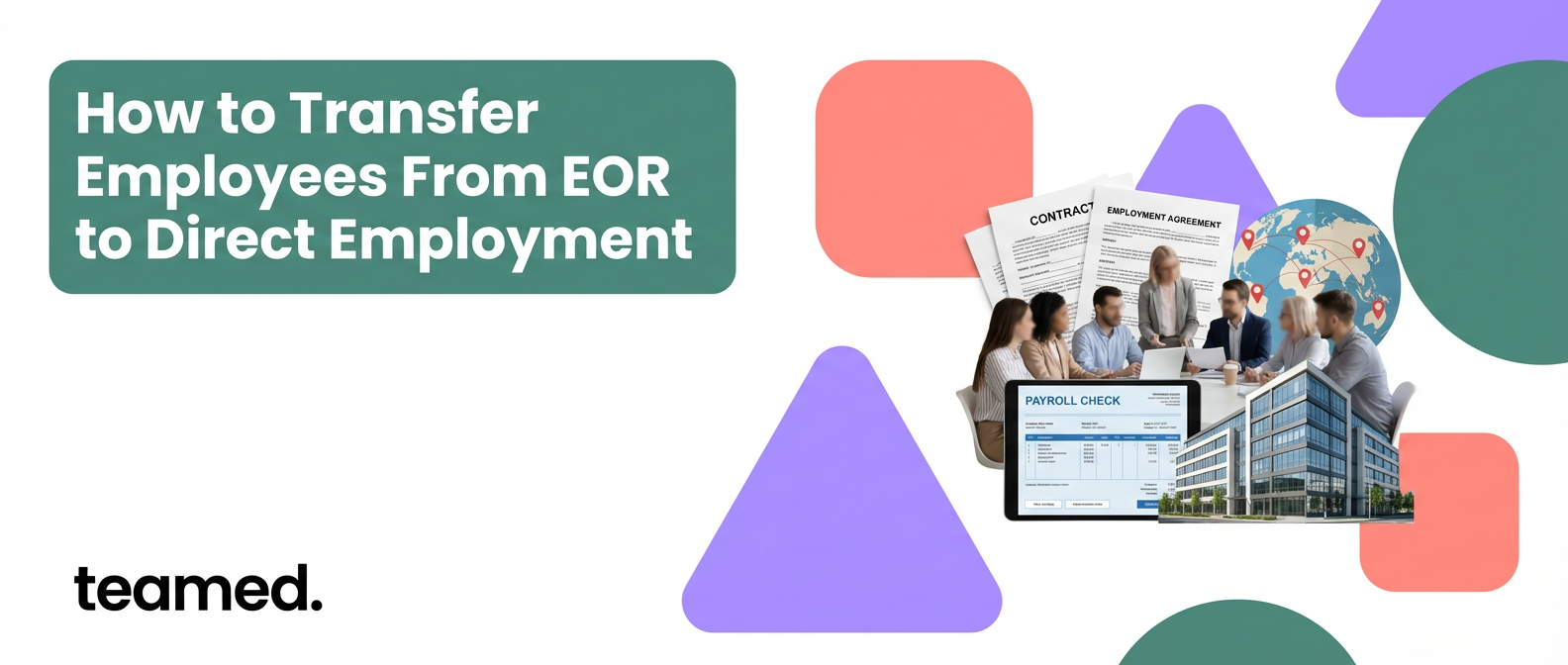
An EOR-to-direct-employment transfer is an operational transition in which a worker moves from employment with the EOR to employment with the client's entity, typically implemented as an EOR termination and a new employment contract with aligned effective dates to avoid pay and benefits gaps. Get it right, and you gain flexibility, cost efficiency, and deeper employee relationships. Get it wrong, and you're looking at compliance exposure, payroll chaos, and a very uncomfortable conversation with your legal team notable given that 65% of organizations initially choose EORs specifically to reduce regulatory and compliance risks.
This guide walks you through when to make the move, how to execute it safely, and what most generic resources miss entirely.
A practical sequencing rule used by many mid-market HR and Finance teams is to prioritise EOR exits in countries where the company has reached 10 or more EOR employees, because fixed entity and payroll overheads start to amortise meaningfully at that level, according to Teamed's mid-market expansion methodology.
But headcount alone doesn't tell the whole story. The decision to switch from EOR to direct employment should be driven by a combination of signals, not a single threshold.
Key triggers worth watching:
Your EOR invoice has grown from a rounding error to a material expense, and the fees feel increasingly opaque. You're starting to see service issues, whether that's payroll errors, slow response times, or inflexible benefits that frustrate employees. The market has shifted from "exploratory" to "strategic," and you need local leadership, customer-facing presence, or regulatory credibility that an EOR arrangement can't provide.
One VP of People put it simply: "We realised our EOR setup had become our default strategy, not a temporary bridge."
Before committing, build two scenarios per country: stay on EOR versus move to entity and direct employment. Weigh the financials, but also consider control, flexibility, and risk. A partner like Teamed can guide this analysis with neutrality that a single EOR vendor cannot provide.
Direct employment differs from EOR employment in auditability because the client company becomes directly responsible for payroll filings, statutory payments, and employment records, rather than relying on an EOR's controls and reports.
When you're running 15 people through an EOR in a single country, the per-employee service fee starts to look different than it did with three. But the cost comparison isn't as simple as "EOR fee versus payroll provider fee.", significant when 63% of organisations cite lowering the financial cost of establishing and maintaining local entities as a primary reason for using EOR. But the cost comparison isn't as simple as "EOR fee versus payroll provider fee."
What EOR costs typically include: service fees covering payroll administration, local employer obligations, bundled benefits (often with limited customisation), and compliance administration. What they often hide: change request fees, bespoke benefits exceptions, and SLA-related charges that only surface when something goes wrong.
What direct employment costs include: external costs like local payroll providers, legal and tax advice, insurances, and statutory benefits administration. Internal costs like HR and Finance time for payroll approvals, compliance calendars, and vendor oversight. Plus setup and maintenance for entity registrations, bank accounts, and authority filings.
The most useful question for your board isn't "what's cheaper today?" It's "which model gives us better control over the next few years?"
In highly regulated sectors like financial services, healthcare, and defence, audit readiness and governance often outweigh marginal cost differences. Teamed can build side-by-side cost models by market and time horizon so CFOs aren't relying solely on vendor sales claims.
For mid-market companies in Europe and the UK, an EOR-to-direct-employment transition typically takes 4 to 12 weeks per country from decision to first compliant payroll when a new payroll provider, benefits enrolment, and statutory registrations are required, according to Teamed's operating playbooks for multi-country transitions.
This guidance is not legal advice. Local law and individual contracts must be reviewed with qualified counsel.
Phase 1: Decision and planning
Confirm your business case, timing, and sequencing by country. Identify owners in HR, Finance, and Legal, and align leadership. Map your employee list and flag sensitive cases like visa holders or employees on protected leave.
Phase 2: Review EOR services agreement and employee contracts
Check notice periods, termination mechanics, and exit fees. Clarify how accrued leave, bonuses, and benefits are treated. Identify any obligations around transition support and data handover.
Phase 3: Entity and payroll readiness
Confirm local registrations, payroll provider selection, bank accounts, and reporting calendars. Align payroll cut-off dates and plan a parallel run if needed. Ensure benefits carriers are set up and comparable to (or better than) EOR provisions.
Phase 4: Define effective dates and transition plan
Set the termination date with the EOR and start date with your entity to avoid gaps. Coordinate with the provider on final payroll, deductions, and reporting.
Phase 5: Draft and issue new employment contracts
In the UK, employers must provide a written statement of employment particulars from day one of employment, so an EOR-to-entity move requires compliant day-one documentation for the new employing entity even if the job does not change. Localise terms to law and internal standards. Address continuity language as appropriate with counsel.
Phase 6: Coordinate termination and new hire actions
The EOR executes formal termination steps while your entity issues offers and onboarding. Ensure final pay versus first pay alignment and maintain benefits continuity.
Phase 7: Post go-live checks
A typical operational risk window in an EOR exit is the first 30 to 60 days after go-live, when payroll, benefits enrolment, and leave balances are most likely to show discrepancies that require rapid correction, according to Teamed's transition governance guidance.
The highest operational risk in an EOR exit typically differs from the steady-state risk of being on an EOR, because most errors occur during handover of year-to-date payroll values, benefits enrolment, and leave balances rather than during routine monthly processing.
You're managing two sets of obligations simultaneously: ending the EOR employment correctly and starting the new employment correctly under your entity.
Employment law risks: Wrongful dismissal claims if notice periods aren't respected. Continuity of service confusion affecting leave, severance, or redundancy rights. Mishandling accrued leave, bonuses, or variable pay. In EU contexts, missing works council oversight or collective agreement requirements.
Continuity of service is an employment-law concept that determines whether a worker's prior service counts toward statutory rights such as notice, redundancy, and leave accrual, and it is determined by local law and the contract structure used during the transition.
Tax and payroll risks: Incorrect withholding, missed registrations, or misaligned reporting cycles. Gaps or overlaps in contributions between EOR and your payroll. For UK employers, statutory minimum notice after two years' service is one week per completed year of service up to 12 weeks under the Employment Rights Act 1996, which can materially affect EOR termination timing.
Data protection risks: Under UK GDPR, the maximum administrative fine for serious infringements can be up to £17.5 million or 4% of global annual turnover, whichever is higher, which makes employee-data transfer controls a board-level issue during EOR exits.
Many HR leaders tell us: "We were surprised by how much of the risk sat in the handover, not in the steady state."
Moving an employee from an EOR to direct employment differs from switching EOR providers because an EOR-to-entity move changes the legal employer, while an EOR switch keeps a third party as legal employer and typically preserves the same employment model risks and limitations.
When you move to direct employment, you become the legal employer with full responsibilities for payroll accuracy, filings, benefits administration, and data handling. That's a fundamentally different operating model.
Designing your payroll operating model:
A RACI matrix is an operating-model tool that assigns who is Responsible, Accountable, Consulted, and Informed for each step of an EOR-to-entity transition, reducing errors caused by unclear ownership between HR, Finance, Legal, and vendors.
Define ownership for monthly payroll approvals, compliance calendars, and reconciliation. Establish controls including segregation of duties, audit trails, and data protection protocols. Select vendors with clear SLAs and escalation paths.
Core payroll setup steps: Registrations with tax and social authorities. Provider selection and onboarding. Banking setup for payroll and statutory payments. HRIS and payroll integration. Parallel testing before go-live.
A common payroll-control standard during an EOR exit is to allow at least one full payroll period for reconciliation of year-to-date taxable pay and statutory withholdings between the EOR and the new payroll, according to Teamed's payroll migration checklists.
Avoiding common pitfalls: Mis-timing cut-offs leading to over or underpayments. Missing benefits enrolments or statutory insurances. Unclear RACI between HQ and local vendor. Data privacy missteps during file transfers.
Pilot one country, refine your playbook, then roll out. Protect your limited HR and Finance bandwidth.
European employment culture shapes expectations around this transition. Stronger default protections, structured notice, and consultation norms mean leadership often expects more formal processes than non-European markets require.
Regulatory alignment matters. Balance group-wide policies (benefits philosophy, equity treatment, DEI standards) with country law and market norms. What works in your London HQ may not translate directly to Germany or France.
Intra-Europe complexities: Labour leasing and temporary agency rules, collective bargaining agreements, and works council considerations vary significantly. In Germany, if a works council exists, specific operational changes affecting employees can trigger information and consultation obligations, so German EOR exits should include an early check for works council coverage before setting dates.
Expanding into the United States: At-will employment, fragmented state rules, and different benefit expectations create a distinct landscape. This affects both when to graduate from EOR and how to structure packages.
Data protection emphasis: Cross-border transfer of employee personal data from an EEA employer to a non-EEA entity must rely on a valid transfer mechanism such as an adequacy decision or Standard Contractual Clauses, and this applies during EOR data handover as well as in steady state.
As an example, a UK-headquartered firm may be surprised by how little formal process is legally required for a role change in some jurisdictions, even though they choose to apply higher internal standards.
Teamed, headquartered in London with coverage in 180+ countries, aligns European governance expectations with local execution realities.
Choose a phased EOR exit when you operate across five or more countries and your HR and Finance teams cannot safely absorb more than one to two country payroll go-lives per quarter.
Avoid moving all countries at once. Your People and Finance teams have limited bandwidth, and transition quality suffers when you overload them.
Prioritisation framework:
Consider headcount concentration and growth trajectory. Evaluate strategic importance and customer or regulatory expectations. Assess cost profile and economies of scale potential. Factor in operational pain from errors, delays, or limited benefits flexibility. Account for compliance risk including labour leasing scrutiny and enforcement trends.
Example groupings:
Core markets with long-term presence justified should move to entity and own payroll first. Satellite or growth markets can maintain EOR while testing scale and demand. Complex or high-risk markets warrant an advisory-led approach, delaying entity until capabilities mature.
Some jurisdictions merit earlier transition due to local rules or enforcement, even with modest headcount. Others can remain on EOR longer without issue.
Your roadmap should be a living document that you revisit as markets grow or regulatory conditions change. Coordinate with business, tax, and regional hub plans. Integrate with group reporting and data protection requirements.
Teamed helps build a global employment roadmap defining order, model per country, and internal capabilities needed at each stage.
An EOR-to-direct-employment transfer is often implemented as an EOR termination and a new employment contract with aligned effective dates. That's a significant change from the employee's perspective, even if their day-to-day work stays identical.
What employees worry about: Job security and whether their role changes. Continuity of tenure and statutory rights. Benefits changes including health, pension, and accrued leave. Visa and work permit implications.
Key messages to cover: Why you're making the shift and what it enables. What stays the same (role, manager, compensation, location). What changes in the contract or benefits and when. How tenure, leave balances, and equity will be handled. Where to get help.
Staged communication plan:
Before you announce: Align leaders, brief managers and HRBPs, prepare country-specific FAQs and scripts.
During the transition: Country-level announcement, followed by individual conversations and written documentation.
After the switch: Confirm payroll and benefits accuracy, gather feedback, address issues promptly.
Many employees will ask: "Is my day-to-day job changing?" Address that explicitly and early.
For employees on work visas, changing employer can impact work authorisation. Consult qualified immigration counsel early and sequence steps to avoid any gap in work permission.
For mid-market organisations, the EOR-to-entity decision affects compliance, cost, and culture. Most lack dedicated global employment expertise to navigate it confidently.
Teamed acts as a long-term advisory partner, helping leaders decide when to use contractors, when to stay on EOR, and when to invest in entities. We provide strategic clarity through readiness assessments, market-by-market options, and scenario modelling. We surface risk visibility around legal and compliance pitfalls, sector-specific obligations, and documentation for boards and auditors. And we deliver execution support through operating model design and end-to-end transition across 180+ countries via Teamed infrastructure.
Many HR leaders tell us they just want one expert place to go with all their global employment questions.
If you're evaluating your EOR footprint, growth plans, and pressure points, talk to the experts for an initial conversation about your options.
It's generally possible to transition selected employees while keeping others on EOR. Plan carefully to avoid perceived unfairness, inconsistent terms, and compliance issues. Align messaging and ensure comparable benefits where feasible.
Continuity of service depends on local law and contract wording. Get local legal advice and be transparent with employees about how prior service will be treated for leave, severance, and other rights.
Equity plans usually sit outside the EOR contract, and participation often continues with the entity. Review plan rules and tax or regulatory effects with legal and tax advisors before the move.
Start with the EOR services agreement for notice and exit terms. Escalate within the provider, seek legal advice if needed, and adjust timelines to protect employees from disruption.
Changing employer can impact work authorisation. Consult qualified immigration counsel early and sequence steps to avoid any gap in work permission.
For a single employee move where the client entity and payroll are already live in-country, the administrative handover can often be executed within one monthly payroll cycle, typically 2 to 6 weeks, according to Teamed's implementation benchmarks. Multi-employee transitions requiring new entity setup take 4 to 12 weeks per country.
Typically organisations with around 200 to 2,000 people or roughly £10m to £1bn in revenue. Teamed focuses its advisory model on companies in this range operating across multiple countries.or
Your engineering lead just found the perfect senior developer in Brazil. The hiring manager wants them started yesterday. Your CFO is asking why the headcount budget is sitting unused. And somewhere in the middle, you're staring at an IND application that won't be processed for weeks.
Can the candidate start work before IND sponsorship is approved? For most non-EU/EEA nationals coming to the Netherlands, the answer is no. Work authorisation must be in place before any paid work begins, regardless of signed contracts, relocation status, or how urgently the business needs them.
This creates real tension for mid-market companies scaling internationally. You're making critical employment decisions without dedicated immigration counsel, piecing together advice from vendors who each see only part of the picture. The pressure to move fast collides with compliance requirements that don't bend for quarterly targets.
Here's what you need to know to navigate IND sponsorship timing without creating audit exposure or compliance disasters.
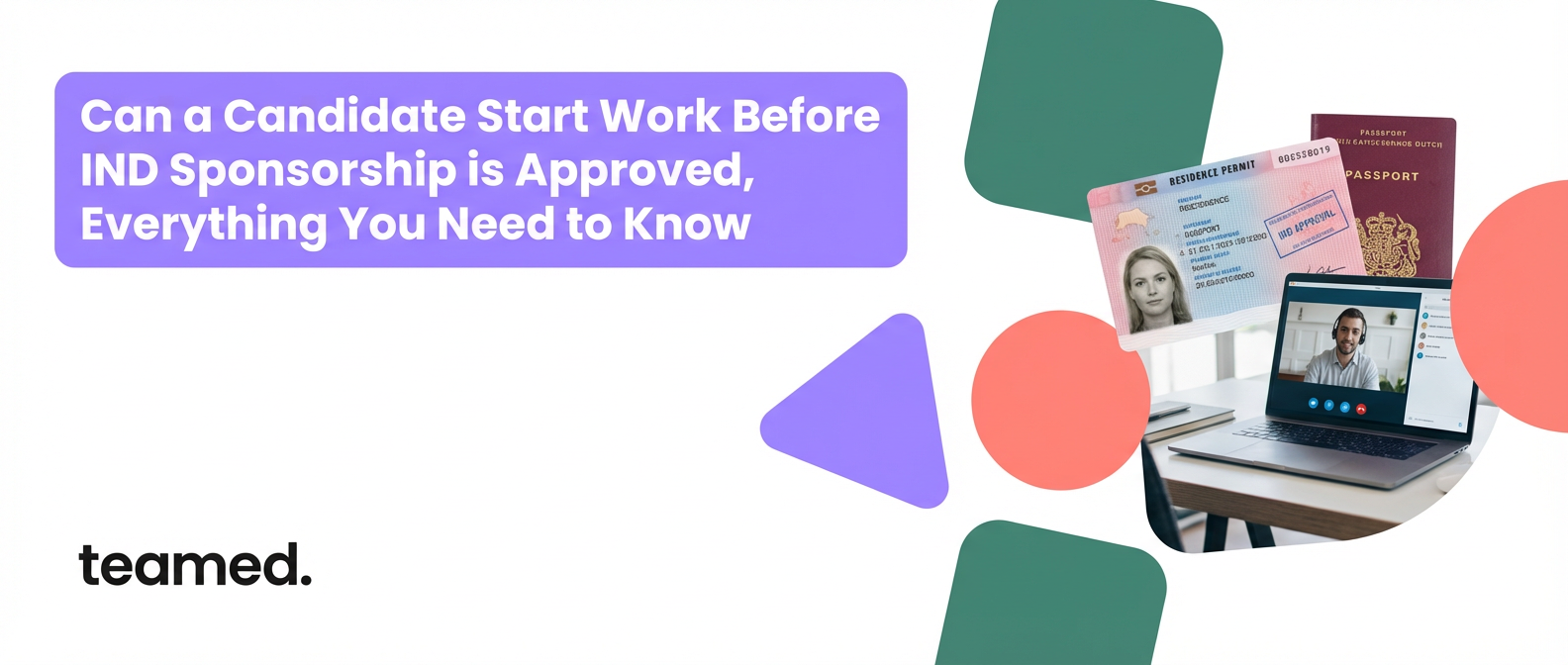
IND sponsorship is a Netherlands immigration framework in which the Immigration and Naturalisation Service (IND) recognises an employer as a sponsor and the employer applies for a residence status that includes the right to work for a specific foreign national.
The direct answer: no. Most non-EU/EEA nationals must wait until their permit explicitly allows work before starting any paid work in the Netherlands.
This applies regardless of a signed employment contract or whether the candidate has already relocated. The legal trigger is valid work authorisation from IND, not your internal start date or the candidate's availability.
Main routes include highly skilled migrants (kennismigranten) and intra-corporate transferees. In both cases, the individual must hold a residence permit or entry visa plus residence document that states work is permitted before performing paid work for the sponsoring employer.
What about candidates who already have Dutch work rights through a different basis, like a partner permit? That's a different situation entirely. But you need to verify the permit conditions carefully before allowing any activity. A pending application doesn't automatically extend existing work rights to a new role.
A recognised sponsor (IND) is an employer registered with the Dutch IND that is permitted to submit certain work-related residence applications using accelerated procedures and is subject to ongoing sponsor duties such as reporting relevant changes.
Here's where confusion often starts. Candidates may think an offer letter equals work authorisation. It doesn't.
IND sponsorship involves two distinct elements. First, the employer must obtain or hold recognised sponsor status with the IND. Second, the employer files the individual's application and receives an IND decision with work conditions. Both must be in place before work can legally begin.
Visa sponsorship means the employer takes legal responsibility for the residence and work authorisation, including reporting changes and meeting salary and role conditions throughout the employment relationship.
HR's role is closing the gap between what candidates expect and what's legally required. Many candidates coming from countries with different immigration systems assume that once they have an offer, they can start. That's not how Dutch immigration works.
Work authorisation in the Netherlands is the legal permission for a non-EU/EEA/Swiss national to perform work in the Netherlands, granted through a residence document and, where applicable, a work authorisation route linked to the role and employer.
Work authorisation starts only when the individual holds the correct Dutch residence document or entry visa with a clear endorsement that work is permitted. IND approval alone may not be enough if the candidate must still provide biometrics, collect documents, or enter the Netherlands with an entry visa., though highly skilled migrants with a positive decision may start working without a residence document for up to 4 months.
Some documents limit work to the recognised sponsor. Others allow broader work. HR must read the permit conditions carefully, not assume.
Plan start dates by working back from the point of actual work authorisation, not the application submission date. If the candidate already holds a Dutch permit with open work rights through partner status, work may already be authorised. But the new employer must verify and record this before any work begins.
For Dutch sponsored hiring, Teamed advises Finance teams to treat each slipped start month as approximately 8% of annual base salary in lost capacity cost for that role. But the cost of non-compliance is far higher than delayed productivity.
Legal risk comes first. Employing someone without valid work authorisation breaches Dutch immigration and labour lawLegal risk comes first. Employing someone without valid work authorisation violates the Foreign Nationals Employment Act (Wav), triggering fines and inspections. Individuals may face consequences too, including impact on future permit applications.
Sponsor risk compounds the problem. Recognised sponsors have additional duties under the IND framework. Breaches can jeopardise your sponsor status and increase scrutiny on future cases. One compliance failure can create friction for every subsequent hire recognition may be withdrawn after three administrative fines and increase scrutiny on future cases. One compliance failure can create friction for every subsequent hire.
In regulated sectors like financial services, healthcare, and defence, unauthorised work raises governance and risk-management concerns that extend beyond immigration law. Auditors and regulators expect documented compliance.
A common misconception: paying from another group entity while the person is physically in the Netherlands without the right permit is still unauthorised work. The work location determines the compliance requirement, not the payroll location.
Not everything requires work authorisation. But the line between acceptable pre-onboarding and illegal work is narrower than most companies assume.
Lower-risk patterns, if no productive work occurs and the person isn't physically working in the Netherlands without work authorisation, include introductory welcome calls and meet the team sessions from the person's home country, self-paced learning or reading internal documentation from home, and observing virtual sprint planning without contributing deliverables.
Higher-risk patterns that are commonly treated as work include producing billable or deliverable-focused tasks even if unpaid, attending on-site meetings or contributing to day to day operations in the Netherlands without work rights, and labelling activities as "volunteering" or "internship" when they resemble normal employment.
If the person already has a different Dutch basis to work, verify conditions before allowing any activity. Document any pre-start activities narrowly to demonstrate no genuine work occurred before authorisation. This documentation matters if questions arise later.
A start-date condition clause is a contract term that makes the employment start date contingent on the employee obtaining and maintaining valid right-to-work and immigration permission for the work location.
When IND processing creates a gap between offer acceptance and legal start date, companies often look for interim solutions. Each comes with trade-offs.
Remote work from the candidate's home country resolves Dutch immigration constraints but introduces home-country tax, social security, and employment law obligations. You'll need either a local entity or an Employer of Record (EOR) to employ compliantly.
An Employer of Record is a third-party organisation that becomes the legal employer of a worker in a specific country, running payroll, taxes, statutory benefits, and local compliance while the client company directs day-to-day work. Choose an EOR when the candidate must start within 2-4 weeks, will work from a country where you lack an entity, and the role requires employee-level control.
Independent contractor arrangements start quickly but carry misclassification risk if the engagement functions like employment. Choose a contractor only when the work is clearly project-based, the individual controls how and when work is done, and you can tolerate reduced operational control.
None of these models allow physical work in the Netherlands without IND permission. They're for remote work outside the Netherlands only.
Mid-market companies that scale internationally commonly operate in the 200-2,000 employee range, which is the headcount band Teamed uses for policy design assumptions because it typically lacks in-house multi-country immigration and employment legal capacity.
Stages affecting timing include becoming a recognised sponsor if needed, preparing and filing the candidate application, IND processing, and document collection plus any entry visa steps. Published targets exist, but real-world timelines can extend due to case complexity, peak volumes, or authority queries recognised sponsors typically receive decisions within 2-7 weeks but real-world timelines can extend due to case complexity, peak volumes, or authority queries.
Build contingency into your planning. Mid-market firms under board pressure often underestimate timelines, creating tension when dates slip. Adopt internal planning assumptions for sponsored hires and communicate them early to stakeholders.
When hiring multiple sponsored roles, cumulative delays can impact delivery and budget. Plan cohorts with conservative start assumptions rather than optimistic ones.
Choose conditional contract start date wording for all sponsored or right-to-work-dependent hires when there's any material risk of permitting delays.
Use conditional start dates for sponsored roles: "Employment will commence on the later of [target date] or the date on which you obtain valid work authorisation in the Netherlands." This protects both parties and sets realistic expectations.
Include a simple overview of the sponsorship process and likely waiting period in offer packs. Candidates who understand the timeline upfront are less likely to become frustrated or accept competing offers during the wait.
Create a standard policy for delayed permits covering how long to postpone, when to offer remote alternatives through EOR or contractor arrangements, and how to communicate changes. Have HR and Legal review templates so conditions tied to sponsorship are clear, fair, and compliant with Dutch law.
For multi-country hiring programmes, Teamed budgeting guidance assumes 2-4 internal stakeholder handoffs per sponsored hire. Standardised start-date clauses reduce rework and confusion across HR, Legal, Finance, and hiring managers.
A Netherlands IND recognised sponsor status is an employer-level permission, while a Dutch residence permit or endorsement is an individual-level permission. An employer can be a recognised sponsor and still be unable to lawfully employ a specific candidate until that candidate's individual authorisation is granted.
The Netherlands uses recognised sponsors and often a combined residence/work permission for certain categories. The UK relies on a sponsor licence with distinct stages from certificate issuance to visa and entry clearance. The principle is the same: no productive work before authorisation. But processing culture and terminology differ, affecting how you stage start dates.
Germany can feel more decentralised with local authority interplay and separate steps. All three countries restrict work before correct permission. Differing process predictability influences cohort planning and internal buffers.
Don't copy a UK or German playbook into the Netherlands. Adjust start-date strategy to country-specific sponsorship mechanics. What works in one jurisdiction may create compliance gaps in another.
Employing a worker via EOR enables compliant payroll and statutory benefits in the worker's country of work, while a contractor arrangement avoids payroll but shifts risk to worker-status enforcement and often increases audit sensitivity for Finance and Legal.
Strategic alternatives depend on your circumstances. Independent contractors in the home jurisdiction offer flexibility and speed but carry misclassification risk and weaker integration if duties mirror employment. EOR in the home country provides compliant employment with local protections, adding vendor cost but smoothing onboarding and later transition to Dutch payroll.
Hiring into another group entity can work if you have simpler routes elsewhere, but may fragment team structure and create permanent establishment or management challenges.
A mixed model over time often makes sense: use IND sponsorship for core Dutch roles, EOR or contractor for short-term or experimental needs, then revisit as headcount and regulatory exposure grow.
Teamed helps HR, Finance, and Legal leaders build a clear decision framework on when to use IND sponsorship, when EOR models make sense, and when contractor arrangements are genuinely appropriate.
Our advisors are supported by AI-driven decision tools monitoring regulatory changes across 180+ countries, delivering timely guidance that can affect Dutch and wider European hiring plans. We specialise in mid-market organisations in regulated sectors, where each international hire carries significant compliance weight and Dutch decisions must align with broader European strategy.
Teamed can review your Dutch and European hiring practices, flag where start dates are over-promised, and co-design a consistent policy that leaders and auditors can follow.
Talk to the experts to discuss IND sponsorship timing, global employment strategy, and how to keep growth aligned with compliance expectations.
Activities that resemble real work are risky even if unpaid. Limit to non-productive pre-onboarding like introductory meetings or self-paced learning from home, ensuring no actual work is performed in the Netherlands.
You generally must postpone until work authorisation is granted. Conditional start-date wording in contracts helps manage expectations lawfully and reduces breach-of-contract exposure.
It depends on the current permit's work rights. Check the permit conditions carefully, as a pending application doesn't always allow work in a new role or for a new employer.
A contractor label doesn't remove the need for work authorisation if the person is physically in the Netherlands. Misclassification brings tax and labour risks on top of immigration violations.
Communicate proactively about the process and potential delays. Apply a clear internal policy on when to offer remote alternatives or when to reconsider the hire entirely.
In Teamed's context, organisations with roughly 200-2,000 headcount or revenue in the eight- to low ten-figure range in local currency. Growing fast but not yet enterprise scale, with sophisticated needs but without enterprise resources for dedicated global employment counsel.
Yes. Unauthorised work can be considered by IND in future applications and extensions, creating long-term risk for both candidate and employer. The short-term pressure to start someone early can create years of complications.

Your CFO just asked whether you can hire that senior engineer in Paris and the QA lead in Riga without setting up entities in either country. The board wants both roles filled this quarter. And you're sitting there wondering if an Employer of Record is even legal in France, let alone whether it makes sense for your 300-person company already juggling EOR arrangements in four other countries.
Here's the short answer: yes, you can hire through an EOR in both France and Latvia. Both countries permit foreign companies to employ workers through a compliant in-country Employer of Record without establishing a local legal entity. But the real question isn't whether it's possible. It's whether it's the right choice for your specific situation, and how France and Latvia fit into your broader European employment strategy.
Teamed defines mid-market companies for global employment strategy as organisations with approximately 200 to 2,000 employees, a range where multi-country hiring typically outpaces in-house legal and payroll capacity. If that sounds like you, this guide will help you make an informed decision about EOR in both markets.
Hiring through an Employer of Record is legally possible in both France and Latvia when using a compliant in-country partner. France has more complex labour law and higher social contributions, while Latvia is typically simpler and more cost-efficient. EOR works well as a bridge for mid-market companies to enter markets quickly before deciding on a local entity. Your choices in France and Latvia should align with a coherent Europe-wide employment model. And the best approach treats EOR as one tool among several, with clear graduation paths to entities when the time is right.
An Employer of Record (EOR) is a third-party organisation that becomes the legal employer of a worker in a specific country, issuing the local employment contract and running payroll, taxes, and statutory benefits while the client company directs day-to-day work.
Both France and Latvia allow foreign companies to hire through a compliant EOR without opening a French SAS or Latvian SIA. The EOR handles contracts, payroll, and compliance. You handle the work itself.
This differs from contractor engagement in a critical way. EOR puts the worker into statutory employment with payroll tax withholding and social security coverage. Contractor engagement places tax and social obligations on the individual and increases classification scrutiny when control is high. If you're directing someone's daily work, setting their hours, and integrating them into your team, they're probably not a contractor, regardless of what the contract says.
Is employer of record legal in France? Yes. French law permits EOR arrangements where a compliant French entity employs the worker on your behalf. The same applies in Latvia. In both countries, local labour law fully applies to employees hired via EOR. This isn't a workaround for French or Latvian employment rules. It's a legal employment wrapper.
One more distinction worth understanding: EOR differs from a Professional Employer Organisation (PEO) because an EOR can employ workers without the client having a local entity, whereas a PEO model typically assumes you already have an in-country entity for co-employment.
Teamed's European advisory approach is built on access to in-market legal and payroll expertise across 180+ countries, enabling country-by-country employment model selection without requiring the client to establish entities in each jurisdiction.
For a post-Series B company with 200 to 500 employees already hiring across multiple countries, the France and Latvia decision isn't just about feasibility. It's about fit.
Consider a London-based SaaS company adding a handful of hires in Paris and Riga under board pressure to scale without compromising compliance. The People Ops director needs to answer several questions before choosing EOR:
Timing and headcount. EOR works well when speed matters and initial headcount is modest or uncertain. If you're testing market viability or hiring one or two specialists, EOR avoids the overhead of entity establishment.
Role mix. A senior enterprise sales director in Paris carries different implications than a QA engineer in Riga. Sales roles with contract-signing authority can create permanent establishment concerns regardless of employment model. Support and engineering roles typically present lower risk.
Regulatory exposure. Companies in financial services, healthcare, or defence need assurance that an EOR in France or Latvia stands up to regulator and auditor scrutiny. Generic EOR sales decks won't satisfy your Head of Compliance.
Internal capacity. Even with an EOR running operations, your People and Finance teams need to understand local basics. You're outsourcing execution, not responsibility.
France's statutory full-time working time reference is 35 hours per week, and compliant employment contracts and payroll practices must address overtime rules when working time exceeds this reference.
When you hire through an EOR in France, the France employer of record becomes the legal employer. They issue a French-compliant contract, register the employee with social security and tax authorities, and handle all statutory filings. The worker appears on French records and payslips as employed by the EOR, but performs duties for your company.
The employment contract must include job title, working hours, probation period, notice requirements, and any applicable collective bargaining agreement references. In France, employment terms can be influenced by applicable collective bargaining agreements, so compliant contracting requires checking whether a CBA applies to the role and reflecting mandatory provisions in contract terms and payroll treatment.
French employees receive generous statutory benefits: paid leave, strong termination protections, and compulsory health and social coverage. These are embedded in any compliant EOR arrangement. The EOR calculates and remits employer and employee social contributions, and guides on bonuses, equity, and variable pay.
Social security contributions are mandatory employer and employee payments that fund statutory benefits such as healthcare, pensions, and unemployment coverage, and they are typically a significant component of total employment cost in France.
Can I work remotely in France for a US company? Yes, through an EOR arrangement. The EOR provides the local employment infrastructure that makes this legally compliant.
In Latvia, compliant employment requires a locally compliant employment contract and payroll withholding under Latvian rules, and an EOR is commonly used to provide local employer registration and payslip administration without forming a subsidiary.
The mechanics are similar to France but simpler in practice. The EOR acts as legal employer, signs local contracts, runs payroll, and ensures alignment with Latvian labour and tax law. You direct the work. The EOR manages registrations, payslips, and filings.
Latvian employment includes standard working hours, paid leave, probation options, and core statutory benefits within the EOR setup. The payroll profile is relatively straightforward compared to many Western European systems, supporting cost-effective small team builds in the EU.
Common use cases include shared services, back office, engineering pods, QA, support, finance ops, and data roles. Many mid-market companies treat Latvia as a compact operations or support hub within a wider European plan.
EOR in France differs from EOR in Latvia in cost drivers because employer social security and labour compliance overhead are typically more material in France, making total employment cost more sensitive to statutory requirements than in Latvia.
The EOR service fee itself is typically similar across countries. What differs is the underlying local cost. A €60,000 gross salary in France carries materially higher total employment cost than the same salary in Latvia due to social contributions and compliance overhead.(approximately 45% employer contributions in France versus 23.59% in Latvia) and compliance overhead.
For Finance leaders, the comparison isn't just France versus Latvia. It's also EOR versus operating your own entity in each market. Entity establishment adds setup costs and ongoing administrative obligations, but can reduce per-employee costs at scale.
Choose an EOR in France when you need a French-compliant employee contract and payroll without forming a French entity, and you want the EOR to assume local employer registration and statutory benefit administration.
Choose an EOR in Latvia when you need an EU-based employee quickly without setting up a Latvian subsidiary and you want a locally compliant Latvian employment contract and payroll handled by an in-country employer.
Choose forming a local entity in France when you expect sustained headcount growth, need maximum control over French HR policies and representation obligations, or want to centralise employment risk and governance inside your own corporate structure.
Choose forming a local entity in Latvia when Latvia is becoming an operational hub with multiple hires, you need direct employer control for long-term retention and equity programmes, or you are consolidating Baltic operations under a dedicated corporate presence.
There's no universal headcount threshold. The decision depends on long-term headcount expectations, strategic importance of the market, cost profile, and your appetite for running local entities.
France's complexity and protections can make a local entity more attractive at scale despite slower setup. Latvia's lighter compliance means EOR can remain viable longer before an entity makes sense.
The smartest approach: map a graduation path from contractors to EOR to entity for both France and Latvia from the outset.
A typical mid-market European expansion plan spans 3 to 5 years from first hire to a stable multi-country footprint, and Teamed structures EOR-to-entity graduation planning around that multi-year horizon rather than a single-country decision.
Most EOR pages answer single-country feasibility but don't provide a portfolio decision framework for hiring in France and Latvia together. Here's how to think about it:
Diagnose your current state. Map current and planned headcount across Paris, Riga, and other European hubs. Identify business goals and risk posture for each market.
Choose defaults by country and role. Decide where EOR, entities, or contractors best fit. Sales roles in France might warrant different treatment than engineering roles in Latvia.
Standardise across markets. Use one advisory partner to harmonise contracts, benefits philosophy, and compliance oversight. Fragmented vendor relationships create fragmented strategy.
Define time horizons. Treat EOR as a bridge in markets like France where you expect to scale. Consider longer-term EOR for certain roles in Latvia where headcount may stay modest.
Manage PE risk. Using an EOR does not automatically remove permanent establishment risk. PE is determined by the client's in-country business activities and authority to conclude contracts, not by who runs payroll. Obtain tax and legal advice, especially for revenue-generating activities.
Many mid-market companies view France as a strategic revenue and brand market, and Latvia as a cost-efficient EU base for operations or engineering. EOR in both can test assumptions, build local knowledge, and set up a roadmap.
France placements: Enterprise sales, partnerships, field marketing, senior customer success, country leadership.
Latvia placements: Engineering pods, QA, support, finance ops, shared services, data roles.
Keep employment brand and employee experience unified across EOR entities. Complement EOR with entities and compliant contractor models as needed. Plan multi-year transitions that may include entity setup, local leadership, and deeper regulatory engagement.
France is an EU Member State, so GDPR applies to HR data processing for France-based employees. Latvia is also an EU Member State, so GDPR applies there too. UK employers must implement appropriate transfer mechanisms when HR data is accessed from the UK.
Teamed was founded in 2018 and positions its service specifically for the 50 to 2,000 employee segment that needs continuity from contractors to EOR to owned entities without switching advisory partners.
For companies in financial services, healthcare, or defence, the stakes are higher. Most EOR resources under-serve regulated industries by omitting audit readiness expectations, documented control frameworks, and evidence packs that Legal and Compliance teams typically require.
Teamed provides objective advice on contractors versus EOR versus owned entities in France, Latvia, and beyond. Access to legal and payroll specialists across 180+ countries covers French labour courts, Latvian payroll, sector rules, and permanent establishment risk.
Teamed's internal guidance for programme planning assumes EOR onboarding can be executed in as little as 24 hours once the worker's identity, role details, and compliant contract terms are confirmed, with timeline variation driven by country-specific checks and benefits setup.
The model is lifecycle guidance: from first EOR hire in Paris or Riga to scaling and migrating into a local entity when strategic. Decision support monitors regulatory change and surfaces risks, but final recommendations come from experienced human advisors.
EOR is a legally viable, efficient entry into both France and Latvia. But the markets differ in cost and complexity, and treating EOR as a permanent solution rather than a strategic tool can create problems down the road.
For regulated sectors, deliberate, risk-aware decisions matter more than speed or price optimisation. Your Head of Compliance needs to sign off on the employment model, not just the vendor.
If you're ready to map an EOR-to-entity graduation plan for France and Latvia, align HR, Finance, and Legal on roles, risks, and timelines, and get clarity on your European employment strategy, talk to the experts at Teamed.
There is no universal threshold. Decide based on long-term headcount expectations, strategic importance, cost profile, and your appetite for running local entities. Some companies maintain EOR arrangements indefinitely for small teams while establishing entities in markets with larger footprints.
EOR does not automatically remove PE risk. PE analysis is driven by commercial activity, especially for sales and contract-signing roles. Obtain tax and legal advice before finalising your model, particularly for revenue-generating activities that may create a taxable presence.
Yes, with careful planning. Coordinated contract transitions, clear employee communications, and adherence to local protections and notice rules are essential. The EOR and your new entity need to work together on timing to avoid gaps or overlaps.
Align with sector rules, data protection requirements, and audit standards. Seek specialist counsel before finalising your model. Generic EOR arrangements may not satisfy the documentation and control requirements your regulators expect.
Both are possible. Consolidation often improves consistency, oversight, and joined-up advice across countries. Fragmented vendor relationships can create gaps in strategy and increase administrative burden.
Typically 200 to 2,000 employees or roughly £10m to £1bn revenue. Between small businesses and large enterprises, with multi-country hiring needs that outpace in-house legal and payroll capacity.
EOR typically enables onboarding within weeks once contracts are agreed. Entity setup takes longer, often several months, and adds ongoing administrative obligations. For urgent hires, EOR is almost always faster.or

Your VP of Sales just closed a record quarter. The CFO is questioning why commission payouts exceeded budget by 40%. Meanwhile, your Head of People is fielding complaints from the Berlin team about why their US counterparts seem to earn more for similar deals.
Sound familiar?
Sales compensation best practices aren't about finding the perfect formula. They're about building a system that drives predictable revenue, keeps your best people motivated, and doesn't create compliance nightmares as you scale across borders. For mid-market companies operating in regulated industries with teams spread across Europe and the US, getting this right is the difference between controlled growth and expensive chaos.
If your company has between 200 and 2,000 employees, this guide will show you how to build sales compensation that actually works. You'll learn to design plans that cross borders smoothly and spot compliance issues before they blow up in your face.
Key Takeaways
A sales compensation plan is a written pay policy that defines how a sales role earns fixed pay and variable incentives, including performance measures, eligibility rules, and the timing and conditions of payout. It's a strategic tool, not just a payroll mechanism.
On-target earnings (OTE) is a compensation benchmark that equals base salary plus the variable incentive a salesperson is expected to earn at 100% quota attainment within a defined plan period. For a mid-market SaaS company, this might look like £80,000 base plus £40,000 variable for a 60/40 split.
The core components of any effective plan include pay mix (the ratio of base to variable), quota setting methodology, accelerators for over-performance, caps (if any), eligibility criteria, payout timing, governance processes, and documentation standards. Every piece of your plan should help you predict revenue and stand up to scrutiny when people start asking tough questions.
What does "good" look like for a company with 200 to 2,000 employees? Simplicity that reps can repeat back to you. Alignment to a clear sales process. Fiscal responsibility that Finance can model. And documentation that Legal can defend.
The failure patterns are predictable. Side deals negotiated by individual managers. Inconsistent offers to similar candidates. Commission calculations living in spreadsheets that only one person understands. Undocumented exceptions that become precedent. Once you're operating quota-carrying roles in both Europe and the US, these informal arrangements become material risks.
For mid-market companies, a practical governance standard is to limit each sales role to 1 primary metric and no more than 3 total measures per plan period to reduce disputes and calculation errors, according to Teamed's operating guidance for multi-country teams. This aligns with industry trends where most plans now include just three core metrics, down from five or six a few years ago.
These proven approaches help you build revenue you can count on year after year. Not quarter-end spikes that create pipeline debt. Not behaviours that optimise for individual payouts at the expense of customer outcomes.
The fundamentals: align to a small set of clear metrics. Avoid formulas that require a spreadsheet to understand. Ensure every rep can explain their plan in two sentences. Document rules in plain language. Maintain consistency across similar roles. Allow local pay differences with clear rationale. Keep quotas stable. Avoid midyear plan changes unless absolutely necessary and well-communicated.
Transparency reduces disputes and supports HR and Finance under European and US pay transparency rules. Transparency reduces disputes and supports HR and Finance under European and US pay transparency rules. Despite this, only 19% of U.S. companies have a pay transparency strategy. When calculation methods are clear, reps trust the system. When they're opaque, every payout becomes a negotiation.
Consider a mid-market company scaling from a single-country team to hubs across Germany, the UK, and one US region. Standardising plans keeps forecasts credible. It also prepares you for EU pay transparency obligations coming into force by June 2026 and existing US state disclosure requirements.
If a rep cannot explain their plan in simple terms, it's too complex.
Think of sales compensation governance as your control center. It brings teams together to approve plans, handle exceptions, resolve disputes, and track every change with a clear paper trail. Strategy sets the philosophy and guardrails. Plans are role-specific implementations.
The sequence matters. Define company goals first: growth, profitability, market expansion, product mix. Map target segments and sales motions. Define role families and their objectives. Choose focus metrics like new ACV, margin, renewals, or product mix. Set guardrails around pay mix, affordability, and compliance. Draft a review and approval process.
You need everyone at the table working together. Finance owns affordability and modelling. Sales leadership owns behaviours and targets. People/HR owns equity and market data. Legal owns compliance language.
Consider a European-headquartered software firm moving from founder-led sales to a structured organisation across Europe and North America. The strategy conversation forces decisions about pay mix philosophy, quota sizing methodology, and how to handle territory potential differences between London and New York.
A sample strategy statement: "We pay for performance on a few measurable outcomes, keep plans simple and explainable, maintain internal equity, and adapt locally within global guardrails."
A commissionable event is a contract or revenue milestone that triggers commission eligibility, such as "invoice paid," "contract signed," or "customer go-live," as explicitly defined in the plan document. Different roles need different plan structures.
Salary plus commission combines a fixed base with a percentage of revenue or margin per sale. This is the default for most B2B sales roles.
Commission-only ties pay entirely to sales. Higher risk for both employer and rep. Rare in employee relationships and increasingly scrutinised for contractor arrangements.
Salary plus bonus provides a fixed base with periodic bonuses against specific targets. Better suited for roles with less direct revenue attribution.
Team-based or pooled plans share variable pay across a squad for complex, multi-touch sales cycles.
When to use each: Hunters (new business AEs) typically work best on salary plus commission with accelerators for over-performance. Farmers (Account Managers) often suit salary plus bonus tied to renewals and expansion. SDRs and BDRs respond well to salary plus bonus based on meetings set and qualified pipeline. Customer Success roles with influence but not ownership might warrant modest bonuses on retention and health metrics.
SaaS businesses face their own unique challenges. Recurring revenue models, implementation cycles, and land-and-expand motions suggest balanced pay mix and measures beyond bookings. ARR, gross margin, and multi-year deal incentives often matter.
Where your team works changes what they expect. Europe often expects higher fixed pay. Some countries discourage commission-only arrangements. US norms tolerate higher variable mix. A European-headquartered SaaS firm hiring first US AEs typically shifts from heavy fixed to more balanced OTE to match US market expectations.
An accelerator is a higher commission rate or bonus multiplier that applies after a salesperson exceeds a stated attainment threshold, such as 100% of quota, to increase marginal earnings for over-performance. A threshold gates eligibility to earn variable pay. A recoverable draw is an advance on future commissions that is repaid through later earned commissions under documented repayment rules and a defined recovery window.
Quotas should be realistic but stretching, set using market data and historical performance. Align territories to potential. Avoid guesswork that creates perceived unfairness. With mid-market AEs achieving only 40.1% quota attainment on average, align territories to potential. Avoid guesswork that creates perceived unfairness.
Here's a powerful tool to consider: accelerators. They pay your top performers higher rates when they crush their targets. Thresholds create minimum performance gates before variable pay begins. Caps provide budget protection but can demotivate top performers. Draws and guarantees help during ramp periods or new market entry, but need clear end dates.
How you run your plan day-to-day is just as important as how you designed it. Define commissionable events precisely. Specify treatment of discounts, cancellations, refunds, and clawbacks. Document payout timing to preserve line-of-sight between performance and reward.
European field sales with larger territories and longer cycles may use higher base and milestone bonuses. US inside sales may skew to higher variable with monthly accelerators. Guarantee periods, recoverable draws, and clawback rules vary across Europe and the US. Legal input is essential before finalising plan language.
Do keep rules explicit and accessible. Don't move targets midyear or bury exclusions in fine print.
Commission administration tends to become audit-risky when more than 20 quota carriers are managed in spreadsheets without system audit trails, according to Teamed's operational risk assessment framework.
What worked at fifty people will not carry you to five hundred.
The shift from founder-managed, bespoke deals to multiple teams, managers, and cross-border operations exposes every informal arrangement. That email thread agreeing to a special commission rate? It's now precedent. That handshake guarantee? It's now a liability.
Design requirements for this stage include standard job families and role definitions that enable benchmarking and cross-region alignment. Clear approval rights and exception controls. Scheduled plan reviews and communication protocols. Systems support that moves beyond spreadsheets to tools handling audit trails, disputes, and multi-currency calculations.
Keep it smart but simple enough to actually work. Avoid enterprise bloat while ensuring consistency, fairness, and compliance. Maintain a small set of standard plan templates adapted locally rather than bespoke plans for every hire.
European-headquartered firms operating across several EU countries and one or two US states must harmonise role definitions and pay philosophy while meeting local labour and social security norms. Many seek external guidance to stress test before rollout.
Most mid-market companies review their standard plans once a year. But if you're launching in new territories or selling new products, check in every 6 months. This keeps your incentives pointing in the right direction, according to Teamed's governance playbook.
Copying your home market plan rarely works in the US.
US sales talent often expects a different pay mix with more variable, aggressive OTE ranges, and clearer quota and commission mechanics. European employers must adapt to compete for talent.
Regulatory differences compound the challenge. State-level pay transparency requirements vary. Written commission agreement requirements exist in several states. At-will employment concepts (where either party can terminate the relationship within lawful constraints) should be reflected in plan documentation.
Avoid transplanting European commission-only contractor models. Worker classification is scrutinised in many US states. What works as a contractor arrangement in one jurisdiction may create misclassification exposure in another.
Here's the trick: stick to the same core principles and metrics everywhere you operate. Adjust pay mix and OTE bands to US norms. Maintain similar governance. Involve US-based HR, Finance, and Legal early. Consider an independent global employment advisor to reconcile EU and US requirements before finalising plans.
When your sales team deals in multiple currencies, pick one exchange rate and stick with it. Use something reliable like the month-end ECB rate for all quota and payout conversions during each plan period. Teamed recommends this approach for companies based in Europe or the UK.
Begin by nailing down your global approach. Decide where you stand on paying for performance, keeping things fair internally, and staying competitive in the market. Document it clearly. Share it with every hiring manager.
Local adaptation levers include pay mix and OTE ranges using local market data, currency handling for quotas and payouts, benefits and statutory elements like statutory bonuses or collective agreements, and transparency practices aligned to EU and US rules.
Multi-currency mechanics create friction. Decide whether quotas are set in local currency or a reference currency. Define FX rates for conversions. Explain differences as cost-of-labour and market norms, not preference.
The EU Pay Transparency Directive (Directive (EU) 2023/970) was adopted in 2023 and requires EU Member States to transpose its provisions into national law by 7 June 2026, affecting how employers justify and communicate pay structures, including variable pay components. US state requirements vary but trend toward more disclosure. Currently, only 16% of organizations are ready to meet these requirements using base pay alone, with readiness dropping to just 3% when considering total cash compensation. US state requirements vary but trend toward more disclosure.
How you explain things makes all the difference. Keep managers and reps informed. Use simple visuals or examples showing how similar roles in London versus New York fit under the same framework. Avoid resentment while staying compliant.
A clawback lets you take back commission you've already paid out. You can use it when customers don't pay, cancel their orders, demand refunds, or when reps break company rules. Just make sure it's legal where you operate.
Sales roles are often tightly managed and integral to operations. This triggers employee status tests in many jurisdictions. The differences between US and European tests matter, but the direction is consistent: if you treat someone like an employee, they probably are one.
How you hire people affects your risk exposure. Direct employment via local entity provides highest control, full compliance obligations, and strongest stability. Employer of Record (EOR) enables compliant employment without an entity, though country-specific constraints apply. Independent contractors offer most flexibility but highest misclassification risk if treated like employees.
Don't copy employee commission plans to contractors without legal adjustment. Commission-only contractor models are riskier in strict jurisdictions and regulated industries. In financial services, healthcare, and defence, incentive structures face additional scrutiny around mis-selling and conflicts of interest.
UK companies classed as "medium or large" for off-payroll working rules must operate IR35 determinations for contractors, and HMRC can assess unpaid tax and NIC liabilities going back up to 6 years in many cases, increasing the compliance exposure of commission-paid contractor sales roles.
Watch out for these red flags: fuzzy lines between contractors and employees, commission terms that aren't written down, changing plans after the fact, skipping local legal reviews, treating people differently in different countries, and missing documentation trails.
If you work in a regulated industry, never pay commission based on volume alone. Always include quality checks or compliance requirements. This protects you from mis-selling claims, according to Teamed's compliance-first incentive design guidance.
Mid-market organisations that operate across more than 3 countries typically need a documented commission policy plus role-based plan templates within 90 days of adding the second quota-carrying region to avoid "side-letter sprawl," according to Teamed's global employment operations methodology.
Governance means decision rights, review cadence, documentation standards, and dispute escalation. Without it, every exception becomes precedent.
Practical structure: a cross-functional compensation committee including Sales, Finance, People/HR, and Legal. A clear approval matrix for new plans, exceptions, and off-cycle changes. Keep all your plan versions in one place where everyone can find the right one.
Check in once a year to make sure your plans still match your performance goals and strategy. Deeper reviews for new markets, new products, or employment model shifts.
Document everything. No exceptions. Plan documents, signed acknowledgements, change logs, rationale for decisions. All essential for audits and pay transparency evidence.
Review criteria: can reps explain the plan? Are desired behaviours showing up? Is the plan market-competitive? Are inequities emerging across countries or demographics? Are disputes rising? Are quotas realistic?
Multi-country control prevents local side deals and maintains global consistency. Consider periodic independent reviews for objectivity.
Your sales comp plans deserve the same careful handling as any major company policy.
Teamed helps companies navigate global employment and compliance. We're advisors, not software sellers. We work with mid-market companies to build sales compensation that makes sense and holds up no matter where you do business.
We'll help you figure out the best way to hire in each country, whether that's contractors, EOR, or setting up local entities. We'll also explain what each choice means for compensation and risk. We advise on EU and US pay transparency, equal pay, and labour rules as they relate to incentives, including practical plan language. We help you evaluate plan affordability, equity, and compliance across Europe and the US, including documentation and governance standards. We support regulated-industry incentive design in financial services, healthcare, and defence to avoid mis-selling risk and regulator scrutiny.
If you're a European mid-market company expanding to the US or beyond, we've got you covered. Whether you're juggling contractors, EOR arrangements, and local entities across multiple countries, Teamed can advise you in over 180 countries.
If you're planning to move salespeople from contractor to EOR to entity, or expand into new regulated markets, talk to the experts about the employment and compliance implications before you commit.
Guarantees are temporary minimum payments during ramp. Draws are advances against future commissions that are repaid through later earned commissions under documented repayment rules and a recovery window. Signing bonuses are one-time joiner payments. Use sparingly for ramp or new markets with clear amounts, timelines, and recovery rules. Avoid creating permanent expectations.
Clawbacks and chargebacks reverse paid or earned commissions due to cancellations, refunds, or non-payment. Specify triggers, time windows, and calculation methods in the plan and contracts. Validate legality in each country before enforcement.
Once you're managing teams across multiple countries, it's time for proper software. Look for sales compensation tools or HR/Finance systems that handle multiple currencies, track everything, manage disputes, and give your team clear statements.
Handle it like any major business change. Reassess base, quotas, and variable mechanics using local market data and legal/tax rules. Document via a written addendum with effective date and any pro-ration.
Call in the experts when you're expanding to new countries, switching how you hire, working in regulated industries, or seeing more disputes and exceptions than usual. Independent reviews surface compliance risks and misaligned incentives.
Typically 200 to 2,000 employees or £10m to £1bn revenue. Cross-border complexity increases but in-house global employment expertise may still be lean.
Bring in outside experts to review everything every 12 to 24 months. Don't wait if you're adding new countries, changing how you hire, or if regulators and auditors come knocking.

Your lead scientist just filed a patent application for a breakthrough diagnostic. Three months later, you discover the contractor who developed the underlying algorithm never signed an invention assignment. The patent might not be yours.
This scenario plays out more often than you'd think. Life sciences intellectual property is the foundation of company value, yet the decisions that protect or undermine it happen far from the patent attorney's desk. They happen in employment contracts, contractor agreements, and entity structures across multiple countries.
Mid-market life sciences companies with 200 to 2,000 employees commonly operate across 5 or more countries with mixed employment models, according to Teamed's operating model benchmarks for scaling regulated businesses. That complexity creates IP ownership gaps that only surface during due diligence, when fixing them becomes expensive.
If you work in life sciences, you don't need to become a patent lawyer. But you do need to recognise when IP decisions are being made, often by people who don't realise they're making them.
This guide walks through the foundations of life sciences IP, then moves into patents and licensing, mid-market strategy, and the workforce and global employment implications that most resources ignore.
Life sciences intellectual property (IP) is a category of legal rights that protects commercially valuable innovations in pharmaceuticals, biotechnology, medical devices, diagnostics, and digital health, including inventions, confidential know-how, brands, and software.
What makes life sciences IP distinct from general tech IP? Three things stand out.
First, the regulatory overlay. Drug and device approvals create their own forms of exclusivity that interact with patents in complex ways. Second, the timeline. A decade of R&D before revenue means IP must be protected long before commercial value materialises. Third, the investment profile. Billions in development costs mean IP isn't just an asset, it's often the primary reason investors write cheques.
The scope goes beyond patents. Clinical trial designs, manufacturing processes, software algorithms, brands, and confidential data all require protection strategies. A single product might involve composition patents, method patents, trade secrets around manufacturing, trademarks for the brand, and copyright in the software that runs a companion diagnostic.
IP strategy underpins valuation, partnerships, licensing, and exits. Investors and acquirers don't just look at your science, IP strategy underpins valuation, partnerships, licensing, and exits. Investors and acquirers don't just look at your science - in 2024, U.S. life sciences companies completed 36 M&A deals totaling $115 billion with IP portfolios as a central consideration. They look at whether you actually own it, whether that ownership is defensible, and whether your employment and entity structures support clean title.
That last point is where most mid-market companies have blind spots. Ownership is shaped not only by IP advisors but also by employment and entity structure decisions. Where your scientists sit, how they're employed, and which entity holds the contracts all affect who owns what.
A patent family is a group of related patent applications filed in multiple jurisdictions that claim priority to the same initial filing date and are used to protect a single product or technology across markets. But patents aren't your only tool.
Patents grant exclusive rights over inventions for a limited time, typically up to 20 years from filing. In life sciences, this covers new molecules, formulations, devices, methods of treatment, and diagnostic methods. Patentability typically requires novelty and an inventive step.
Trade secrets protect valuable confidential information kept secret through reasonable measures. Cell culture conditions, manufacturing parameters, and process optimisations often work better as trade secrets than patents, especially when reverse engineering is difficult.
Trademarks protect names and logos that build trust and brand recognition. For medicines and devices, brand identity matters for prescriber and patient recognition.
Copyright protects expression rather than underlying concepts. Publications, software code, algorithms, training materials, and some databases fall here.
Regulatory data and marketing exclusivity provide a head start for originators even after core patents expire. This is particularly significant for medicines and biologics, where data exclusivity can extend market protection.
When should you choose patents versus trade secrets? Prefer patents where reverse engineering is easy or external disclosure is required through publications, conferences, or regulatory filings. Prefer trade secrets where long-term secrecy is realistic and manufacturing know-how is hard to replicate.
Consider a European mid-market biotech deciding which inventions to file internationally versus keep as trade secrets. The core molecule composition goes to patent, filed broadly. The specific fermentation parameters that improve yield by 40%? Those stay as trade secrets, protected through confidentiality agreements and access controls.
The standard term of a European patent is up to 20 years from the filing date, making patent-expiry planning a multi-year finance and forecasting issue for CFOs managing product life cycles and patent cliffs.
A patent grants the right to prevent others from making, using, or selling the invention. In life sciences, this exclusivity is central to recouping R&D investment that can run into hundreds of millions.
Typical patent types in life sciences include composition of matter patents covering new molecules or biologics, formulation and dosage patents, method of treatment patents, diagnostic method patents, and device patents covering mechanical, electronic, or software-enabled innovations.
The patent life cycle runs through distinct stages: discovery, filing, prosecution (examination), grant, defence (enforcement and challenges), and expiry. Most life sciences companies build patent families with multiple related filings over a product's life to protect different aspects as development progresses.
The patent cliff, when key patents expire and generics or biosimilars can enter, requires advance planning. In Europe, supplementary protection certificates can extend protection beyond the basic patent term for medicines that required regulatory approval.
Patentability in biotech, diagnostics, and software-enabled devices is complex. Court decisions in both Europe and the United States influence what's protectable and how claims should be drafted. Get advice early, before public disclosure destroys novelty.
For a European pharma or medtech planning US entry, alignment matters. European filings, SPCs, and US patents should coordinate with regulatory plans. Mid-market firms that can't file everywhere at once need to prioritise based on commercial potential and competitive intensity.
Freedom to operate (FTO) is an IP risk assessment process that evaluates whether developing, manufacturing, or selling a product is likely to infringe third-party patents in specific countries and indications.
Licensing allows companies to use IP under set conditions, typically involving upfront payments, milestones, and royalties. For startups, licensing is often how core technology enters the company (in-licensing from universities) and how it generates value before commercialisation (out-licensing to larger partners). In the first half of 2025, life sciences licensing deals reached approximately $120 billion in announced value, highlighting the sector's reliance on IP-based partnerships.
Common structures include territorial licences limiting rights to specific geographies, field-of-use licences restricting application areas, co-development and co-promotion agreements, and option agreements that secure future rights.
Technology transfer offices at universities and hospitals are common sources of core biotechnology intellectual property. Due diligence should focus on clarity around ownership, licence scope, territory, exclusivity, sublicensing rights, improvements, royalties, and performance obligations.
Pitfalls to avoid: overly broad early grants that limit future flexibility, inconsistent territories across licence chains, ignoring who owns improvements and new IP, unclear sublicensing terms, and ambiguous performance or termination provisions.
Consider a European startup licensing from a local university and considering out-licensing to a US pharma partner. The territorial scope, governing law, and improvement ownership terms in the university licence will constrain what can be offered to the US partner. Mid-market companies often sit amid complex chains of licences, and managing interdependencies becomes critical.
Many mid-market companies begin consolidating fragmented global employment vendors and processes around 200 to 300 employees, a threshold Teamed cites as the point where cross-border employment decisions often become recurring six-figure budget items.
The typical context: multiple programmes or products, cross-border growth, limited budget for filings and enforcement, and partial in-house capability. You can't protect everything everywhere. Prioritisation is essential.
A practical decision framework considers commercial potential and timing, competitive intensity and likely design-around, ease of reverse engineering, regulatory demands and exclusivity overlays, freedom to operate risk, and budget and operational capacity.
"We're making six-figure IP decisions on incomplete information." That's the reality for most mid-market leaders. The answer isn't to avoid decisions but to build a framework that makes trade-offs explicit.
Integration matters. Tie IP strategy to portfolio and pipeline choices. Consider patent life, regulatory exclusivity, and market access together. A patent that expires two years before your product reaches market has limited value.
Hidden risk areas include platform technologies that underpin multiple programmes, data assets that may be protectable, and software-enabled devices linked to biologics. These often fall between traditional IP categories and require deliberate attention.
The operating model typically blends external advisors with internal championsThe operating model typically blends external advisors with internal champions. Over 58% of enterprises are increasing investments in digital IP workflows and portfolio management tools. Establish governance and clear decision ownership. Someone needs to own the question: "Does our employment structure support clean IP ownership?"
Teamed advises HR and Finance on aligning employment models, contractor use, and entity structure so IP-sensitive work is housed in the right places and properly assigned. This complements specialist IP counsel rather than replacing it.
The Unified Patent Court (UPC) began operations in 2023, creating a single forum in participating EU states where a UPC decision can have effect across multiple countries, increasing the potential multi-country impact of a single life sciences patent dispute for European scale-ups.
Patents differ significantly between regions. In Europe, central filing through the EPO leads to national validations, with the emerging UPC context adding complexity. National courts remain relevant. In the United States, a single federal system operates with PTAB post-grant processes and different claim drafting and eligibility dynamics.
Biotechnology, diagnostics, and software-enabled health patentability standards differ between regions. Adjust filing and claim strategy accordingly.
Regulatory exclusivity operates differently. Europe provides data protection and market exclusivity for medicines and biologics, with SPC mechanisms that can extend beyond basic patent term. The United States has distinct FDA frameworks with different data and market exclusivities. Sequencing filings matters for launch timing in both regions.
Enforcement culture varies. The United States features broader discovery, jury trials in some cases, and different cost and settlement dynamics. Europe varies by country, with generally more streamlined discovery and different injunctive relief strategies.
Both regions are seeing reforms. EU pharmaceutical legislation changes and US discussions on patent eligibility and post-grant review mean the landscape keeps shifting. Seek up-to-date advice.
Filing strategy for transatlantic companies: file early in both regions for core inventions, stagger secondary patents based on budget and importance, and encourage collaboration between EU and US counsel. Align the portfolio with the regulatory plan.
Consider a European mid-market biotech holding core patents in a European IP-holding entity while building US commercial operations. Coordinating filings, entities, and governance across both regions requires deliberate planning.
An IP-holding company is a dedicated legal entity that owns patents, know-how, and related rights, enabling clearer licensing, governance, and diligence for financings or transactions.
Biotechnology IP covers living organisms, genetic sequences, cell and gene therapies, antibodies, and biologics manufacturing processes. Cross-border protection presents unique challenges.
Patentability varies by jurisdiction. Ethics and special rules, notably in Europe, may apply to certain biological materials and methods. Claim drafting must balance breadth versus validity, and experienced biotech IP counsel is essential.
Cross-border differences in enablement and written description requirements drive how much experimental data to include in applications. EU and US standards differ, affecting filing strategy.
Coordinated patent families across jurisdictions require tracking deadlines, SPC options, and freedom-to-operate considerations. Platform biotech IP, such as gene editing systems or delivery vectors, often gets licensed into multiple programmes and territories. Managing field-of-use and territorial scope carefully prevents conflicts.
Global employment structures intersect with initial ownership and tax. Where research occurs and who employs inventors matters for determining who owns what.
Concrete examples illustrate the complexity. A new cell line raises questions about deposit requirements and scope of claims around use and derivatives. A novel antibody requires decisions about epitope versus sequence claims and functional versus structural definitions. A gene therapy delivery vector involves choices between vector claims and manufacturing process claims, with safety and regulatory data potentially protected as trade secrets.
"Biotech IP rewards precision. Small drafting choices can decide markets."
European HQ biotechs collaborating with US partners or CROs need to balance ambition with operational capacity when managing global portfolios.
Teamed provides local legal and compliance expertise coverage across 180+ countries, which is relevant when structuring cross-border employment and invention assignment controls for distributed R&D teams.
The pitfalls are predictable. Missing assignments from founders, academics, or contractors create ownership gaps. Use clear invention assignment agreements and confirm university policies and waivers before work begins.
Premature public disclosures at conferences, in journals, or through trial registries can destroy novelty. File before disclosure and coordinate communications with IP counsel.
Weak freedom-to-operate analysis creates litigation risk. Stage FTO assessments and revisit at key development gates.
Misaligned IP with regulatory and commercial plans wastes resources. Map patent life to approval and pricing timelines in priority EU markets and the US.
Cross-border employment assumptions cause problems. Local laws differ on employee inventions. Standardise core clauses and localise where necessary.
Fragmented R&D across countries without policies creates inconsistency. Implement consistent data, know-how, confidentiality, and invention disclosure processes.
Overcomplicated licence stacks generate confusion. Keep a master map of rights, obligations, improvements, and territories. Rationalise early.
Operational blind spots in software and data leave assets unprotected. Protect code, models, and datasets while aligning with privacy and health data rules.
Quick checklist:
Teamed helps map risks at the intersection of global employment, entities, and life sciences IP to tighten agreements and processes ahead of financing or transactions.
An Employer of Record (EOR) is a third-party organisation that becomes the legal employer for workers in a specific country, handling payroll, taxes, and local employment compliance while the client company manages day-to-day work.
For employees, IP usually flows to the employer via contract. Ensure assignment and confidentiality clauses are in place, especially for R&D and software teams. In Germany, employee inventions are governed by specific statutory rules that influence compensation and ownership mechanics. In France, statutory categories affect ownership and remuneration.
For contractors and consultants, default ownership may not favour the company. Mirror employee-level protections in contractor agreements, including explicit present-tense IP assignment, confidentiality, and assistance obligations for patent filings.
Remote and distributed teams create additional complexity. Track inventor locations because local rules on employee inventions vary. Use consistent contracts and clear policies that secure assignment to the intended IP-holding entity regardless of location.
Habits and structures matter. Clear, teachable policies on confidentiality, data handling, publication, and invention disclosure reduce risk. A simple intake process for invention disclosures aligned with counsel ensures nothing slips through. Audit trails for code, data, and model provenance support ownership claims.
Global employment models require attention. With EOR arrangements, secondments, or cross-border transfers, clarify who is the legal employer and ensure IP assignment flows to the intended IP-holding entity. Plan location of IP-sensitive roles to align with entity and tax strategy.
AI and collaboration tools raise new questions. Address data ownership, third-party terms, and confidentiality. Use AI as decision support, not a substitute for human IP judgment.
Contract clause checklist for employment and contractor templates:
"Your IP is only as strong as the contracts and behaviours of the people who create it."
Teamed advises HR, Finance, and Legal on when to use contractors versus employees, EOR versus owned entities, and how to maintain clear ownership across 180+ countries.
Teamed states it can operationally onboard workers in as little as 24 hours once country strategy is clear, which reduces the time window where R&D work may start before signed IP and confidentiality terms are in place.
Coordination across specialist patent and licensing counsel, regulatory experts, commercial leaders, and those owning workforce and entity decisions is essential. Mid-market companies often lack a single partner with a cross-functional view.
Teamed's role is strategic partnership on global employment and entity strategy: where IP-sensitive work should sit, when to move from contractors to EOR to owned entities, and how to support the chosen IP and regulatory plan. This complements life sciences IP law firms by aligning people and operating structure with portfolio strategy.
For expansion, audits, funding, or transactions, assess whether global employment strategy aligns with IP objectives.
What you can expect from strategic alignment:
If you're weighing entity establishment in Europe or the United States while trying to protect your IP, talk to the experts. The first step is a conversation to clarify current state and gaps.
Remote work can place inventors in different legal jurisdictions with varying default rules on employee inventions. Use consistent contracts and clear policies that secure assignment to the intended IP-holding entity regardless of location. Track inventor locations and apply local compliance requirements.
Include explicit invention assignment, confidentiality and trade secret obligations, moral rights waivers where appropriate, invention disclosure and cooperation duties, and clear rules on using company resources and third-party IP. Localise terms while keeping global consistency.
Workable but higher risk if ownership isn't explicitly transferred. Contractor agreements should mirror employee protections including assignment, confidentiality, disclosure, and assistance. Address background IP, improvements, and deliverable ownership explicitly.
Prioritise for inventions with strong US commercial potential or active competitors. Coordinate timing with European filings and regulatory plans to maximise combined protection and avoid disclosure gaps.
The EOR is the legal employer, but assignment and confidentiality must flow back to your IP-holding entity. Obtain IP clauses in the EOR's local contract and a direct invention assignment to your entity. Align labour and IP advice.
Typically 200 to 2,000 employees or around £10m to £1bn in revenue. These companies have complex operations without the full resources of large enterprises.
Commonly centralise core IP in a dedicated holding entity for clarity and tax planning. Align employment and contractor relationships so new inventions consistently assign into that entity, supported by specialist IP and tax advisors.
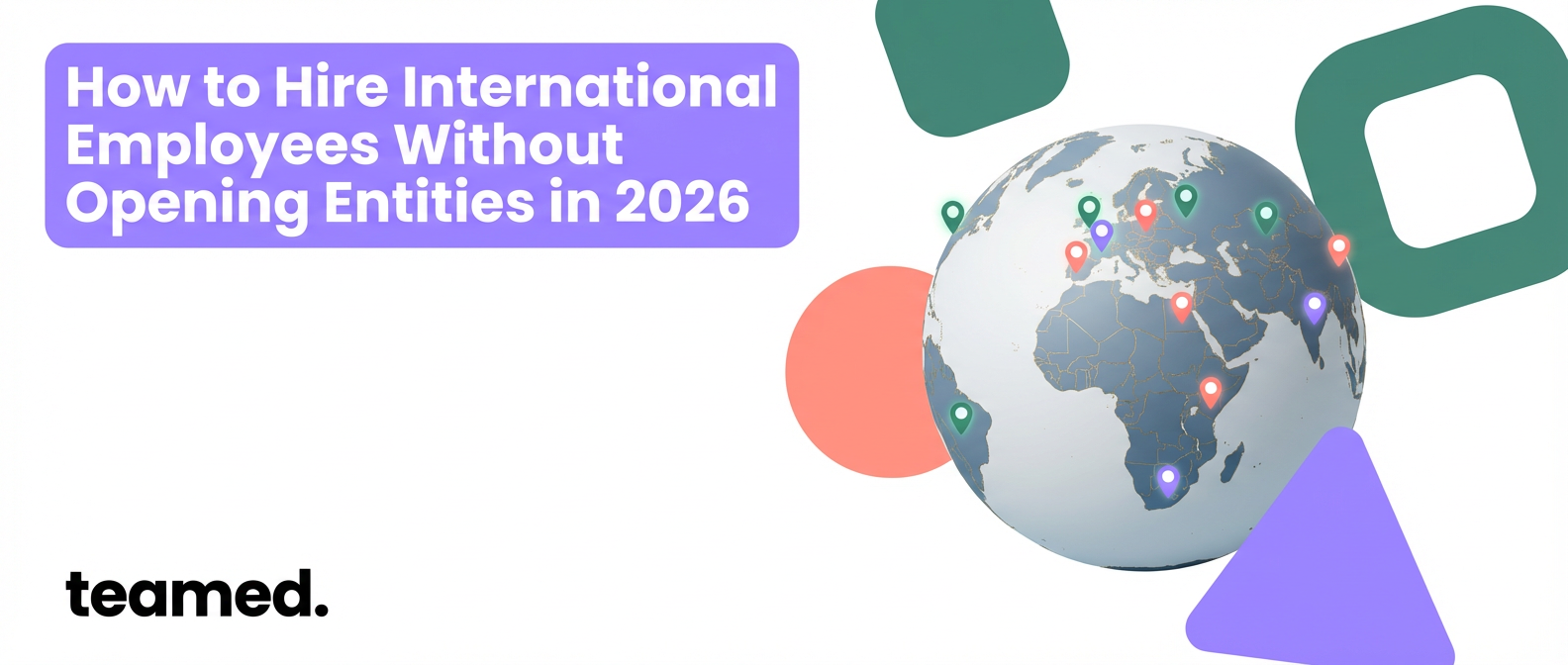
You're sitting in a board meeting, and someone asks why you've got 23 contractors scattered across 8 countries with no clear employment strategy. The CFO wants to know if you're exposed to misclassification risk. Legal is worried about permanent establishment. And you're wondering how you ended up making six-figure decisions based on vendor sales pitches and late-night Google searches.
Here's the thing: you can hire internationally without opening entities in every market. But the real question isn't whether it's possible. It's whether you're doing it with a strategy that won't unravel when you scale from 200 to 500 employees.
This guide walks you through the practical options for hiring international employees without local entities, the compliance risks that keep HR and Finance leaders awake at night, and the strategic framework that mid-market companies in regulated industries need to get this right.
A local legal entity is a registered in-country company or branch that can employ staff directly, register for payroll and social taxes, and sign local contracts in its own name. Many mid-market firms aim to avoid setting these up everywhere because the cost, governance burden, and wind-down complexity make it impractical for markets with small headcounts.
When we talk about international employees, we mean people living and working permanently in another country, not short-term business travellers or remote workers who happen to be on holiday abroad. The distinction matters because employment law follows the worker's location, not your headquarters.
The employee versus contractor question comes down to control, integration, and ongoing obligations. An independent contractor is a self-employed individual or business that provides services under a commercial services agreement and is responsible for its own taxes and social contributions. An employee works under your direction, uses your systems, and receives statutory protections under local labour law.
An Employer of Record (EOR) is a third-party organisation that becomes the legal employer for a worker in a specific country, running payroll, withholding taxes, administering statutory benefits, and issuing locally compliant employment contracts while you direct day-to-day work. This lets you hire full-time employees without incorporating a local entity.
Consider a European SaaS company that wants its first permanent US salesperson. Without an EOR, they'd need to incorporate a US subsidiary, register for state and federal taxes, set up a US payroll system, and navigate healthcare and at-will employment rules. With an EOR, they can have that salesperson onboarded and compliant within weeks.
You have three practical routes for hiring internationally without establishing your own legal presence. Each comes with trade-offs that depend on the role, the market, and your risk tolerance.
Independent contractors abroad work well for project-based, output-defined work with a clear end date. You get speed, flexibility, and lower ongoing costs. But misclassification risk is real: if the work resembles employment (ongoing management, company systems, set hours), authorities can reclassify the relationship and trigger back taxes, penalties, and employment rights claims. UK companies can face HMRC review and recovery of unpaid payroll taxes for up to 6 years, and up to 20 years in cases involving deliberate behaviour, according to Teamed.
Employer of Record services let you hire full-time employees legally without the time and cost commitment of establishing local entities. The EOR employs the worker under local law, handles payroll and statutory benefits, and ensures compliance with local employment regulations. You direct the day-to-day work and manage performance. EOR arrangements typically involve per-employee service fees, but they provide predictable monthly costs and reduce internal operational load.
Local staffing agencies or partner entities occasionally serve as a stopgap where permitted, but they have limited scalability and suitability issues for regulated sectors. You may face control limitations and brand considerations that make this impractical for anything beyond temporary arrangements.
A Professional Employer Organisation (PEO) differs from an EOR in that a PEO generally requires the client to already have a local employing entity, while an EOR enables employment in a country without the client setting up that entity first. If you're looking to hire without entities, EOR is typically the relevant model.
Mid-market companies face a specific challenge: you're visible enough to regulators to face real enforcement risk, but you don't have the internal global employment teams that enterprises maintain. The 200-2,000 employee range is where employment model decisions become genuinely strategic. This challenge is reflected in the market, where mid-sized enterprises account for 58% of global EOR demand. The 200-2,000 employee range is where employment model decisions become genuinely strategic.
Choose an independent contractor when the work is project-based, output-defined, and time-limited, and when the business does not need to control working hours, location, or day-to-day methods. A specialist consultant building a specific integration or a designer completing a defined project fits this model. Avoid contractors for roles that look like employment: ongoing work, company systems, regular hours, and integration into your team structure.
Choose an EOR when you need a compliant in-country employment contract and payroll in less than 30 days and you do not want to incorporate a local entity for an initial headcount of 1 to 10 employees in that country. Choose an EOR when you need a compliant in-country employment contract and payroll in less than 30 days and you do not want to incorporate a local entity for an initial headcount of 1 to 10 employees in that country. EOR platforms have proven to reduce onboarding time by 35% while improving legal compliance accuracy. EOR fits first hires in new countries, small headcount spread across many markets, or situations where speed and compliance are critical. Choose an EOR over contractors when the role is operationally integrated into your organisation, includes ongoing management, uses company systems, and is expected to last longer than 6 to 12 months.
Choose an owned entity when the country is expected to become a long-term hub with a sustained headcount of 15 or more employees and you need direct control over employment terms, benefits design, and local governance. Entity establishment also becomes necessary when local licensing, regulated-customer procurement, or industry rules require the contracting party to be your own in-country legal presence rather than a third-party employer.
Choose to reassess your model in a country when headcount doubles in a 12-month period or when the country becomes revenue-critical, because permanent establishment risk, labour law exposure, and governance needs typically change with scale.
Consider a European financial services firm testing the US market. They might start with contractors for initial market validation, move to EOR for their first sales and customer success hires, then establish a US entity when scale and licensing requirements grow. An advisor like Teamed can model this path and help you define the graduation triggers specific to your industry and growth trajectory.
The legal structure of an EOR arrangement involves three parties: the EOR employs the worker under local law, the EOR has a services contract with your company, and your company directs the worker's day-to-day activities and manages performance.
The EOR takes responsibility for local payroll, tax withholding, statutory benefits, employment law compliance, and locally compliant contracts. Your responsibilities include role design, performance management, daily supervision, culture, and outcomes. This split means you get the operational benefits of having employees in-market without the legal and administrative burden of maintaining a local entity.
EOR reduces misclassification risk by employing the worker under local law. EOR reduces misclassification risk by employing the worker under local law, with 71% of global firms reporting reduced operational risk after adopting EOR services. Instead of a contractor relationship that might be challenged, you have a genuine employment relationship with all the statutory protections and obligations that entails. The worker receives proper employment contracts, statutory leave, social contributions, and termination protections.
EOR is established and legal in many markets, though some countries have restrictions that must be assessed. Advisory-led EOR providers like Teamed guide on role design, benefits norms, and contract terms before execution, ensuring you understand the local requirements and make informed decisions.
In the UK, employment rights and statutory payments such as holiday entitlement (5.6 weeks) and maternity leave (up to 52 weeks) apply to employees and must be reflected in UK employment cost forecasts for hires made via an entity or EOR. In Germany, statutory paid leave is at least 20 days per year for a five-day working week, and many employers provide more by contract or collective practice.
The entity model involves substantial upfront and ongoing costs. Setup includes legal incorporation, registrations, bank accounts, local directors, and payroll infrastructure. Ongoing obligations include tax filings, audits, governance, statutory reporting, local counsel, and HR/payroll administration. Hidden costs include internal time from HR, Finance, and Legal teams, wind-down costs if you exit the market, and market lock-in that makes strategic pivots expensive.
The EOR model involves ongoing per-employee service fees, benefits plans, and onboarding/offboarding support with bundled compliance. The impact is faster start-up, predictable monthly costs, and reduced internal operational load. You avoid the governance overhead and can exit markets more easily if strategy changes.
Germany's statutory notice periods for employees can extend up to 7 months for terminations by the employer based on long tenure, a country-specific factor that materially changes the cost of exit compared to contractor engagement, according to Teamed. In Spain, annual paid leave is at least 30 calendar days, and this higher baseline often changes total cost calculations versus UK-style benefits assumptions.
Build your cost models by headcount, seniority, and time horizon. Include internal time and strategic optionality, not just direct fees. A multi-country entity strategy differs from a multi-country EOR strategy in scalability because each additional entity typically adds incremental legal, finance, and compliance overhead, while an EOR can add countries without requiring a new corporate registration for each one.
Consider a European healthtech company weighing a small US team via EOR versus forming a US entity. With 3-5 employees, EOR typically makes sense. At 15-20 employees with multi-year investment plans, the entity conversation becomes relevant. Teamed helps companies build board-ready comparisons and breakeven scenarios without relying on vendor pricing gimmicks.
Misclassification risk is the legal and financial exposure that arises when a worker treated as a contractor is later deemed an employee by authorities or courts, triggering back taxes, social contributions, penalties, and employment rights claims. In the UK, the off-payroll working rules (IR35) require medium and large companies to issue a Status Determination Statement for relevant contractor engagements and to operate PAYE when the engagement is deemed employment-like.
Permanent establishment (PE) risk is the risk that a company becomes taxable in a foreign country because its in-country activities meet that country's threshold for a taxable presence, even if no legal entity has been incorporated there. Certain roles, particularly those involving contract negotiation or customer-facing sales activities, can create PE exposure that needs careful scoping.
Sector regulations add another layer. Financial services, healthcare, and defence companies face licensing requirements, clearances, and professional registrations that may require specific employment structures. Data protection rules, particularly GDPR for European companies, govern cross-border HR data transfers and require appropriate safeguards.
Under the GDPR, transferring EU/UK employee personal data to countries without an adequacy decision generally requires an approved transfer mechanism such as Standard Contractual Clauses and a documented transfer risk assessment where applicable. Vendor due diligence and records of processing become essential compliance documentation.
Mitigation involves proper classification frameworks and audits, thoughtful role scoping tied to PE risk, using EOR or entity where licensing demands it, and data transfer assessments with appropriate safeguards. Involve Legal and Compliance early. Teamed can brief stakeholders on jurisdiction-specific enforcement trends and help you build audit-ready documentation.
European companies face distinct challenges when expanding internationally. Labour law expectations differ significantly: EU notice periods, benefits, and protections contrast sharply with US at-will employment norms. A German employee might expect 7 months' notice after long tenure; a US employee might receive two weeks.
The EU Pay Transparency Directive (Directive (EU) 2023/970) entered into force in 2023 and must be transposed by EU Member States by 7 June 2026, making 2026 a practical deadline for EU-facing pay transparency readiness planning, according to Teamed. This affects global salary structures and reporting requirements for any company with EU employees. Despite this looming deadline, 41% of European employers have not begun preparing for the Directive. This affects global salary structures and reporting requirements for any company with EU employees.
Data transfers present ongoing complexity. GDPR rules for moving employee data to third countries require lawful bases and safeguards. US-based HR systems and EOR platforms need assessment on data residency, sub-processors, and privacy practices. ISO/IEC 27001 is the most widely recognised international standard for information security management systems, and using an ISO 27001-certified provider is a common procurement requirement for regulated European buyers evaluating HR and payroll vendors.
US state law creates additional fragmentation. Hiring, pay, leave, and AI-in-HR rules vary by state and city. A European company hiring across California, New York, and Texas faces three different regulatory environments. Policy harmonisation becomes essential.
In France, the statutory working time benchmark is 35 hours per week, and deviations typically require careful structuring through contracts, policies, or applicable collective frameworks. These country-specific requirements make an EU-grounded advisor valuable for reconciling home rules with global execution.
Global employment should be treated as business strategy, not ad-hoc transactions. Define ownership: who decides models, signs new countries, and maintains the risk register? Typically this involves HR, Finance, and Legal working together with clear decision rights.
Map headcount by country, role type, and revenue importance. Choose a model per country with explicit rationale documented. A sales hub in Germany might warrant entity consideration at 10 employees; a single customer success hire in Singapore might stay on EOR indefinitely.
Document graduation criteria: contractor to EOR to entity. Set review cadence and thresholds. Most generic "hire without an entity" guidance omits board-ready graduation criteria, so defining explicit, auditable triggers for moving between models becomes a differentiator for mid-market companies.
The process follows a clear sequence: assess markets and roles, select model per country, define compliance controls, set graduation triggers, review quarterly or biannually, and execute changes deliberately. Consolidate around a single strategic advisor for coherence and monitoring of legal changes across your markets.
Many companies use EOR long term where it remains fit for purpose. Conduct periodic strategic reviews to decide if evolving headcount, costs, or regulatory factors suggest transitioning to an entity. The goal is intentional evolution, not reactive scrambling when auditors ask questions.
Teamed removes strategic isolation for HR and Finance leaders by advising across contractors, EOR, and entities through one relationship. First, we clarify strategy by country: model selection, graduation timing, and compliance priorities. Then we execute via our infrastructure and partner network: rapid EOR onboarding, entity transitions in complex jurisdictions.
Our compliance-led approach is backed by local experts across 180+ countries. We avoid unmanaged risk in regulated sectors by ensuring local legal teams inform every recommendation. Technology and AI support monitoring and decision inputs, but final recommendations come from experienced advisors who understand your business context.
Strategic questions Teamed advises on include: Which roles and countries fit contractors, EOR, or entity now and over the next 24-36 months? What are the qualitative breakeven signals for moving from EOR to an entity? How do GDPR, EU Pay Transparency, and US state laws affect your model choices? How should you scope roles to minimise PE risk and meet sector licensing requirements? What governance and documentation do you need to satisfy auditors and the board?
If you're making employment model decisions without strategic guidance, or managing multiple vendors with no unified oversight, talk to the experts at Teamed to get clarity on your global employment strategy.
Frame EOR as flexible, lower-commitment market entry that accelerates hiring and assures baseline compliance. Entities are longer-term infrastructure that increase control but require ongoing governance and cost. Emphasise risk, control, and time horizon rather than technical detail. Boards care about strategic rationale and audit readiness, not operational mechanics.
Qualitative triggers include a country becoming a strategic hub, growing headcount concentration (typically 15+ employees), sector licensing or customer expectations requiring local presence, and multi-year investment plans. Advisors like Teamed can help define thresholds and timing specific to your industry and growth trajectory.
Feasible but touches contracts, payroll, benefits, and local registrations. Plan carefully with clear timelines, employee communications, and legal review. Use a neutral advisor to orchestrate the transition and mitigate disruption. Most transitions can be completed within two pay periods with proper planning.
GDPR requires lawful bases and safeguards for transfers when moving EU employee data to third countries, including US-based HR and EOR systems. Assess vendors on data residency, sub-processors, and privacy practices. Standard Contractual Clauses and documented transfer risk assessments are typically required.
Yes, mixed models are common when used intentionally with clear criteria, documentation, and periodic reviews. The key is avoiding misclassification by ensuring genuinely independent specialist work is separated from employment-like roles, with documented classification rationale for audit purposes.
Many companies use EOR long term where it remains fit for purpose. Conduct periodic strategic reviews to decide if evolving headcount, costs, or regulatory factors suggest transitioning to an entity. There's no universal time limit; the decision depends on your strategic context.
Mid-market companies in the global employment context typically have 100-2,000 employees and revenue between £10 million and £1 billion. They're large enough to need sophisticated guidance but small enough to need responsive advisors rather than enterprise consulting models.
The email lands at 7:43 AM. A former employee's lawyer is alleging wrongful termination, and suddenly your Tuesday looks very different.
"If we get sued for wrongful termination, what actually happens next?" It's a question that keeps HR leaders and CFOs awake at night, particularly when you're running a 300-person company across five countries and don't have in-house employment counsel on speed dial.
Here's the reality: wrongful termination is an employer-side legal risk category where an employee alleges their dismissal was unlawful because it breached statute, contract terms, or a recognised public-policy protection, even if the employer considers the decision commercially justified. The cost isn't just the potential settlement. It's the legal fees, the leadership hours consumed, the operational disruption, and the reputational questions that follow.
For mid-market companies operating across multiple jurisdictions, a routine-seeming termination can become an unlawful termination claim if local law gets missed. This piece walks through what happens when a claim hits, how to respond, and how to build a defensible global employment strategy that reduces your exposure in the first place.
In the UK, most Employment Tribunal claims must be started by commencing ACAS Early Conciliation within 3 months less 1 day of the effective date of termination, creating a short, predictable window for immediate evidence preservation and insurer notification according to Teamed's UK process checklist.
Wrongful termination is distinct from a termination that simply feels unfair. It's an unlawful firing that violates law, contract, or public policy. The difference matters because "unfair" doesn't give someone grounds to sue. "Unlawful" does.
The typical path unfolds in stages:
"The first letter from a lawyer can feel alarming, but it's only the start of a process you can manage if you stay structured."
Most wrongful termination claims settle before trial. Most wrongful termination claims settle before trial, with 97% of EEOC cases resulting in favorable outcomes for claimants in FY 2024. The question isn't just whether you'd win in court. It's whether the business disruption, disclosure of internal communications, and reputational risk justify fighting versus settling. That calculation requires strategic judgment, not just legal analysis.
In the UK, the maximum compensatory award for unfair dismissal is capped at 52 weeks' gross pay or a statutory cap that is updated annually, so the employer's financial exposure is often more predictable than in many US jurisdictions according to Teamed's UK versus US exposure comparison note for European HQ teams.
Mid-market companies occupy an uncomfortable middle ground. You're large enough that termination decisions carry material risk and attract scrutiny. But you're too small to have dedicated employment law capability sitting in-house.
Consider the difference: A 50-person startup might handle a difficult exit informally and get away with thin documentation. A 5,000-person enterprise has legal teams, established protocols, and insurance coverage calibrated to their risk profile. But at 400 employees across six countries? You're making consequential decisions without the infrastructure to support them.
The patterns that create exposure look familiar. Decentralised managers make firing calls with inconsistent documentation. Performance conversations happen verbally but never get written down. A termination in California follows the same process as one in London, despite fundamentally different legal frameworks.
For regulated sectors like financial services, healthcare, or defence, the stakes compound. A wrongful termination lawsuit doesn't just create legal exposure. It can trigger investor questions, auditor scrutiny, and regulatory attention that extends well beyond the original claim.
Once headcount reaches the low hundreds, formal termination policies become necessary to avoid unlawful termination allegations. The question isn't whether you need them. It's whether you'll build them proactively or reactively after a claim forces the issue.
Retaliation is a legal theory in which an employee alleges they were dismissed or disadvantaged because they made a protected complaint, supported a complaint, or asserted a statutory right such as protected leave, whistleblowing, or pay-related rights.
Understanding the grounds employees use helps you spot risk before it materialises. The main categories:
Discrimination involves protected characteristics like race, sex, disability, age, religion, and others. Employees claim the firing was because of a protected trait, not performance. As an example, a salesperson over 40 gets terminated soon after a manager comments about needing "fresh energy." The timing and comment create a narrative that's difficult to defend.
Retaliation protects employees who raise concerns about harassment, safety, pay, discrimination, or other legal rights protects employees who raise concerns about harassment, safety, pay, discrimination, or other legal rights, representing 38.7% of EEOC suits filed in FY 2024. Later firing can be claimed as punishment. Courts scrutinise the timing between a complaint and termination. If someone raised a concern in March and got terminated in April, you'll need to explain why the timing was coincidental.
Breach of contract and implied promises arise from written contracts, handbook language, or manager statements that create expectations around "for cause" requirements or progressive discipline. Inconsistent application of policies strengthens breach arguments. If your handbook promises three warnings before termination but you fired someone after one, that gap becomes evidence.
Violation of public policy covers firing someone for refusing illegal acts, taking protected leave, serving on jury duty, or whistleblowing. These claims exist even in at-will states.
Constructive dismissal (called constructive discharge in the US) is when an employee resigns but claims the employer forced them out by creating intolerable conditions. This often follows a complaint where the employee alleges they were targeted afterward.
Protected categories and retaliation rules can expand at US state level. European countries use similar concepts under labels like unfair dismissal or victimisation. European leaders shouldn't assume home-country standards apply elsewhere.
In the UK, ordinary unfair dismissal typically requires 2 years' continuous service, but discrimination and whistleblowing protections apply from day one, so risk screening should not rely on tenure alone.
At-will employment means either party can end employment at any time, with or without notice, as long as the reason is not unlawful. But "not unlawful" carries more weight than many employers realise.
Even in at-will states, employees can sue for wrongful termination based on discrimination, retaliation, breach of contract, or public policy violations. At-will is a default rule, not a shield.
Myth: "We're in an at-will state so we don't need a reason."
Reality: You still need a legitimate, documented reason to defend timing and consistency. Courts look closely at documents, timing, and comparators. At-will is limited by federal and state laws.
Treat at-will as flexibility backed by documentation and fair process, not a licence for abrupt, undocumented exits. The companies that get into trouble are the ones who hear "at-will" and assume it means "we can do whatever we want."
The contrast with European systems is stark. In many European countries, employers generally require a fair reason and process even during probation. European HQs expanding into the US often underestimate how different the litigation environment feels, even though at-will sounds more flexible on paper.
In the UK, statutory redundancy pay is capped at 20 years of service and uses a weekly pay cap that is updated annually, which means redundancy-related dismissal exposure has built-in limits that CFOs can model according to Teamed's redundancy cost modelling guidance.
Damages in wrongful termination cases can include back pay (past lost wages), front pay (future lost earnings), emotional distress, and in some jurisdictions, punitive damages. Employees may also seek reinstatement or policy changes, though many mid-market employers prefer a clean financial settlement instead.
But the visible damages are only part of the picture, with the EEOC alone securing nearly $700 million in monetary relief for workplace discrimination victims in FY 2024. Hidden costs include employer and employee legal fees, internal HR and leadership time, discovery burdens (imagine producing three years of Slack messages), and potential insurance premium increases afterward.
There's no single "average settlement" because outcomes depend on facts, documentation, jurisdiction, and each side's risk appetite. A claim with strong documentation and clear performance issues might settle quickly for a modest amount. A claim with thin documentation and questionable timing might require a much larger settlement to make it go away.
Damage types and caps vary significantly by country and state. Many European systems cap compensation more predictably, while some US jurisdictions allow broader awards. European HQs should not assume US outcomes mirror home practice.
The right frame is viewing potential damages within your overall employment strategy rather than as isolated legal spend. A company that invests in proper documentation and consistent processes will spend less on settlements over time than one that treats each termination as an independent event.
In the UK, employees must generally begin ACAS Early Conciliation within 3 months less 1 day of termination before they can present most Employment Tribunal claims, making this a critical deadline for HR and Legal teams to diarise.
When a claim arrives, the first 24 to 72 hours matter. Here's what to do:
Having a pre-defined playbook reduces panic and errors. The companies that handle claims well are the ones who've thought through the process before they needed it.
In Germany, the Protection Against Dismissal Act generally applies once an employee has more than 6 months' service and the establishment regularly employs more than 10 employees, which changes the dismissal defensibility standard for many mid-market employers.
The US is a patchwork of state rules layered on federal law. What's lawful in Texas can be problematic in California. Differences include timing of final pay, required notices, expanded protected categories, and specific retaliation protections.
A single US checklist can be risky if it ignores state specifics. California requires final pay on the day of termination in many cases. New York has different rules. Illinois has its own requirements. And that's before you get into state-specific protected categories that go beyond federal law.
"We thought our US handbook covered everything, then we hired in another state and realised it didn't."
Distributed teams and remote work quickly expand your state footprint before HR processes catch up. Someone working remotely from Colorado creates Colorado obligations, even if your entity is in Delaware.
Teamed's approach involves designing multi-state compliant frameworks and tracking changing rules across 180+ countries so HR and Finance aren't relying on fragmented vendors or outdated policies. The goal is one coherent system that adapts to local requirements rather than a patchwork of exceptions.
Unfair dismissal in the UK typically focuses on whether the employer had a fair reason and followed a fair procedure, while wrongful termination in the US is more often pleaded as a statutory tort or contract breach such as discrimination, retaliation, or breach of an implied agreement.
The terminology maps roughly: constructive dismissal (UK) equals constructive discharge (US), unfair dismissal (UK) relates to wrongful termination (US), victimisation (UK) corresponds to retaliation (US). But the procedures and time limits differ significantly.
In many European countries, employees use works councils or labour tribunals. In the US, employees more often file agency charges or sue in civil courts. A UK Employment Tribunal claim usually begins with mandatory ACAS Early Conciliation, while many US wrongful termination pathways start with an agency charge such as an EEOC filing before a civil lawsuit proceeds.
While US at-will looks flexible, the remedy environment and litigation culture can heighten perceived risk. European HQs should adapt processes for the US rather than copy home-country practices.
In France, the labour court system can involve multiple stages and employer time cost is commonly measured in months rather than weeks, which is why mid-market organisations typically budget for prolonged internal stakeholder time even where financial remedies are capped according to Teamed's operational risk guidance for regulated employers.
Before terminating a US or international remote employee, European HQs should follow a structured approach:
As an example, consider a Berlin-based SaaS company that hired a remote worker in California. When performance issues arose, they followed their German process: verbal feedback, a single written warning, then termination. But California has different expectations around documentation and final pay timing. The termination triggered a claim over final pay violations and retaliation allegations because the employee had raised a concern about overtime two weeks before the termination conversation.
The issue wasn't that the termination was wrong. It was that the process didn't account for California-specific requirements.
An Employer of Record (EOR) is a third-party organisation that becomes the legal employer in a given country and administers payroll, statutory benefits, and local employment compliance while the client company directs day-to-day work.
Your employment model affects who gets sued and what claims can arise:
Independent contractors are self-employed and engaged for services. The risk is misclassification: if they function like employees, ending the relationship can trigger wage, tax, and benefit claims plus allegations that employment protections should have applied. A contractor offboarding differs from an employee termination because the contractual exit may be simple on paper, but if the working relationship looked like employment, the termination event can trigger reclassification arguments and retroactive liability exposure.
EOR arrangements mean a third party is the legal employer on your behalf. Local employment law still applies. Workers often have similar rights to direct employees. The EOR is named as legal employer, but your conduct as the client can still be scrutinised when a worker alleges unlawful termination or retaliation.
Owned entities mean your local company employs directly. Group and local policies must align. Inconsistent group versus local practice weakens defences to unfair termination or retaliation claims.
As an example, a European tech firm relied on US "contractors" who looked like employees: they used company email, attended team meetings, had set hours, and received ongoing direction. When contracts were ended, several filed misclassification claims arguing they should have been employees entitled to benefits and termination protections.
Teamed can help choose the right model by market, plan transitions from contractor to EOR to entity, and align termination processes with the model. The key is matching your employment structure to your actual working relationships, not just your preferred paperwork.
Employment Practices Liability Insurance (EPLI) is a commercial insurance coverage category intended to help fund defence costs and, where covered, settlements or judgments arising from employment claims such as discrimination, harassment, retaliation, and wrongful termination allegations.
Employment litigation should be treated as enterprise risk affecting reputation, audit readiness, and investor confidence, not just a legal expense line item.
Single-claim exposure includes direct legal spend, potential settlement, leadership distraction, operational adjustments, and communications impact. A claim that settles for £50,000 might cost £30,000 in legal fees and consume 100 hours of leadership time. The total cost is much higher than the settlement number suggests.
EPLI typically covers defence costs and some settlements in wrongful termination and discrimination matters, but exclusions and deductibles apply. Strong processes and documentation remain essential because insurance doesn't prevent claims or protect reputation.
"Are we making six-figure termination decisions based on sales pitches rather than independent advice?"
Aligning HR and Finance on risk appetite matters. When should you offer enhanced severance with waivers versus defend a claim? That calculation depends on documentation strength, leadership bandwidth, and strategic priorities. It's not a decision to make in the moment.
Teamed's strategic advice helps CFOs see how employment model choices, like opening entities or rationalising vendors, affect long-term litigation risk and compliance costs. The goal is visibility into exposure before decisions get made, not damage control afterward.
Wrongful termination risk reflects deeper choices about hiring, classification, performance management, and entity structure across countries. The companies that handle claims well aren't lucky. They've built systems that create defensible decisions.
Building alignment among HR, Finance, and Legal on consistent hiring, documentation, performance, and exit processes, locally adapted but principle-led, is the foundation. That means clear expectations documented in writing, feedback conversations that get recorded, and termination decisions that follow established protocols.
Mid-market firms benefit from a single strategic advisory relationship that understands growth plans and regulatory complexity. Piecing together advice from multiple vendors with conflicting incentives creates gaps. One vendor handles your UK employees, another manages US contractors, a third runs EOR in Germany. When a termination touches multiple jurisdictions, who's responsible for ensuring the process is compliant everywhere?
Teamed can advise when to use contractors, EOR, or entities, how to sequence entity establishment, and how to design compliant, business-friendly termination processes. The goal is one strategic partner across your entire journey, from your first contractor decision to your hundredth entity establishment.
If you're making employment decisions across multiple countries without unified strategic guidance, talk to the experts. The conversation is about building a defensible system, not selling you a product.
Time limits (limitation periods) vary by jurisdiction and claim type. In the UK, most Employment Tribunal claims must begin within 3 months less 1 day of termination. UK limitation periods for civil breach of contract claims can run up to 6 years, so document retention policies should support multi-year defensibility. In Germany, the general limitation period for many civil claims is 3 years from the end of the year in which the claim arose. Assume a former employee may have many months or longer and seek local legal advice on specific deadlines.
EPLI typically covers defence costs and some settlements in wrongful termination and discrimination matters, but exclusions and deductibles apply. Coverage varies by policy, and some claims may fall outside coverage. Strong processes and documentation remain essential because insurance doesn't prevent claims or protect reputation.
Keep references factual and consistent with records. Limit internal discussion to need-to-know. Coordinate any messaging with legal counsel to reduce risk of statements that could be used against you.
Core laws are similar, but regulated sectors face added regulator and investor scrutiny. A wrongful termination dispute in financial services can trigger broader compliance questions and regulatory attention that wouldn't apply to many SaaS firms.
No single standard exists. Employers are stronger with clear expectations, feedback, support offered, warnings where appropriate, and consistent treatment. Keep documentation organised and retrievable. The question isn't whether you have documentation. It's whether your documentation tells a coherent story.
Yes. Each group sits under different legal frameworks, so have distinct but aligned policies. A contractor exit follows contract terms. An EOR termination involves the EOR as legal employer. An entity termination follows local employment law directly. Seek advisory support to design policies that work together.
Companies between small business and enterprise, often roughly 200 to 2,000 employees or tens of millions to around a billion in revenue. Large enough to need sophisticated guidance, small enough to need responsive advisors rather than enterprise consulting models.
You've just received word that your Romanian team member isn't working out. Maybe it's a performance issue that's dragged on for months, or perhaps a restructuring decision made at board level last week. Either way, you're now facing a question that keeps People leaders up at night: how do you end this employment relationship without creating a compliance disaster?
Romania doesn't do at-will termination. If you're used to more flexible employment regimes, this is the first thing you need to understand about the termination process in Romania. Every dismissal requires a legally recognised ground, documented evidence, and a written decision that Romanian courts will scrutinise if challenged. Get it wrong, and you're looking at reinstatement orders and back pay that can stretch for months.
For mid-market companies coordinating exits across multiple European countries, Romania often becomes the schedule-critical jurisdiction. Protected leave rules are stricter than many neighbouring markets, and the timing of when you sign a dismissal decision matters as much as the substance behind it.
Termination of employment in Romania is a legally regulated end of an individual employment contract that must be based on a recognised legal ground and formalised through a written employer decision or a written mutual agreement. Romania sits within Europe's strong worker-protection model, which means if you're coordinating Romanian terminations alongside exits in Germany, France, or Poland, you're dealing with similar principles but different procedural details.
Here's what the process involves at a high level:
The sections that follow break down each element: grounds, notice, severance, procedure, protections, and planning. If you're managing a Romanian team through an Employer of Record, there's a dedicated section on how responsibilities split between you and the EOR.
A dismissal decision in Romania is a written, reasoned act issued by the employer that states the legal ground, factual basis, and effective details of the termination. Romanian courts routinely annul dismissals that lack sufficient reasoning or required elements, which is why choosing the correct ground matters as much as following the right steps.
Redundancy applies when the role is eliminated for objective business reasons. This requires a genuine organisational change rather than individual underperformance. You'll need a credible business case showing why the position no longer exists.
Professional inadequacy is the performance-based route. It requires objective evaluation against defined role requirements and documented steps showing the employee was assessed and informed. This isn't about one bad quarter; it's about demonstrable capability gaps after support and fair assessment.
Disciplinary dismissal covers misconduct. A formal disciplinary investigation and hearing process is required, with procedural defects commonly leading to annulment in court. Time-stamped evidence and proportionality matter here.
Probationary termination is an expedited end of employment during a valid probation period is an expedited end of employment during a valid probation period (90 calendar days for executives, 120 for management positions), typically executed by written notice, while still requiring compliance with Romanian form and evidence standards.
Mutual termination agreement isn't technically a dismissal. It's a written agreement signed by both parties that ends the employment contract by consent and is often used to reduce litigation risk when a unilateral dismissal would be contested.
One common mistake: calling a redundancy "performance" or vice versa. Choosing the wrong ground increases unfair dismissal exposure significantly. For companies running multi-country restructurings, align Romanian grounds with how terminations are described in Germany or France to keep board and auditor narratives consistent.
Notice is the period between the written dismissal decision and the end date. The employee remains employed and paid during this time, and garden leave may apply if the contract permits.
For standard economic or performance dismissals, the statutory minimum. For standard economic or performance dismissals, the statutory minimum of 20 working days applies. Contracts and collective bargaining agreements may extend notice, especially for employees with longer tenure.
Disciplinary dismissals for serious misconduct generally carry no notice requirement, but the full disciplinary procedure must still be completed before issuing the decision.
Probationary endings often require no notice, subject to simplified formalities.
Miscalculating or skipping notice is a common and easily litigated error for foreign employers. If you're used to markets where notice is flexible or waivable, Romania will feel more rigid.
What is the termination period in Romania? The statutory minimum notice period depends on the type of dismissal and any applicable collective agreement, but contracts frequently specify longer periods for senior roles or long-service employees. Always check the individual contract and any CBA before assuming the statutory minimum applies.
Redundancy in Romania is a termination ground based on the elimination of a position for objective business reasons, requiring a genuine organisational change rather than individual underperformance. But understanding when severance applies requires looking beyond the Labour Code.
Statutory entitlements aren't universal across all dismissals. Check the Labour Code triggers for your specific situation. Collective agreements often drive severance obligations for redundancy in Romania, and individual contracts or company policies may promise severance beyond statutory or collective terms.
In practice, employers frequently offer enhanced severance to reduce dispute risk or secure settlement agreements. This is particularly common when the legal ground is arguable or the employee is likely to contest.
For CFOs modelling costs before restructuring announcements, severance calculations typically include base salary plus elements specified by CBAs or policies. In workforce reductions affecting 10 or more roles across Europe, Teamed recommends building a consolidated cost model that includes at least 4 Romania-specific cost lines: notice pay, potential contractual or CBA severance, accrued leave payout, and local legal review costs.
One critical point: paying severance does not cure an unlawful procedure. Courts can still find unfair dismissal even if the employee received generous compensation.
Teamed advises budgeting for at least 10 to 20 business days of internal preparation time for evidence, translations, and decision approvals before any dismissal document is issued, even when the operational target date is earlier.
1. Internal assessment (HR and manager): Confirm the legal ground. Check for protected statuses including pregnancy, sick leave, and union roles. This step prevents issuing a decision that's automatically invalid.
2. Evidence gathering (HR, manager, legal): Collect appraisals, warnings, investigation reports, or redundancy business cases. Teamed recommends a minimum evidence pack of 6 document types for contested exits: contract and amendments, job description, performance records or incident logs, written warnings or investigation notes, protected-status checks, and the draft dismissal decision with delivery proof.
3. Ground-specific steps (HR, legal):
4. Draft and issue dismissal decision (legal, HR): The written decision must state The written decision must include the legal ground, facts, notice terms, and effective date, list of available positions, and challenge period. Ensure proof of delivery. This document is what Romanian courts examine in unfair dismissal disputes.
5. Post-termination actions (HR, Payroll, IT): Final pay, unused holiday payout, statutory employment documents, property reclaim, and systems offboarding.
Use a standard internal checklist adaptable to Romania and other European markets to ensure consistency across jurisdictions.
Romanian termination programmes managed across 3 or more jurisdictions typically require a single, board-ready narrative that maps each exit to a local legal ground. Romania's protected leave rules can force re-sequencing of the overall plan.
Sick leave: Dismissal while the contract is suspended for medically certified sick leave Dismissal while the contract is suspended for medically certified sick leave can be automatically invalid. This isn't about fairness; it's about legal validity.
Maternity leave and parental leave: Prohibitions and restrictions apply. Do not sign a dismissal decision during protected suspension.
Maternity risk leave: On submission of required medical documents, the contract suspends automatically. Signing a dismissal then risks invalidity.
Here's the critical timing rule: check protected status on the exact date the employer signs the dismissal decision, not just the planned send or effective date. Recent High Court decisions in Romania clarified sick leave and maternity risk leave timing, making these protections stricter than some European peers.
For regulated-sector employers, Teamed advises setting a governance threshold where any Romania dismissal with potential protected status exposure triggers Legal sign-off within 24 to 48 hours to prevent invalid issuance timing.
Mid-market employers operating across Europe commonly run multi-country restructurings on a 6 to 12 week timeline, but Romania often requires longer lead time when performance documentation or protected-leave checks are needed.
Decision framework: Is it performance, behaviour, or structural change? Match to the correct Romanian route. Misidentifying the ground is the most common root cause of termination disputes.
Lead time: Build in documentation, PIP, or consultation time. Avoid "quick fix" assumptions that work in more flexible jurisdictions.
Costing: Model notice, potential severance, legal fees, and disruption before approval. CFOs should see Romania-specific line items before restructuring announcements.
Consistency: Align Romanian rationales with European board and investor messaging. Inconsistencies between the stated ground and the real rationale increase unfair dismissal exposure.
Operating model: Decide entity versus EOR versus contractors with future termination implications in mind. Each model carries different process requirements and risk profiles.
Advisory: Use Teamed or local counsel to pick the most defensible route for Romania. In Europe and UK mid-market organisations, Teamed commonly sees termination execution split across 3 internal owners (People, Legal, Finance), and advises assigning a single accountable approver for Romania dismissal decisions to avoid inconsistent grounds or timelines.
Across Europe, Teamed flags that the most common root cause category for termination disputes is documentation failure, and for Romania specifically the risk is elevated when employers cannot show a written rationale tied to a Labour Code ground.
Building blocks for defensible redundancy:
Scope: Distinguish individual redundancy from larger restructuring that may trigger collective elements.
Criteria: Use objective, transparent selection including skills, performance, and business criticality. Subjective criteria invite challenge.
Business case: Document financial or operational drivers for role elimination in Romania. This document becomes evidence if the dismissal is contested.
Consultation and communication: Plan beyond legal minimums to manage employee relations. How you communicate matters for retention of remaining staff.
Cost modelling: Aggregate notice, severance, and dispute risk across scenarios before announcements.
For EU coordination, some countries have stricter collective timelines. Sequence Romanian steps so they don't conflict with European consultation duties. Mid-market restructurings need discipline in documentation and timing to satisfy auditors and courts while meeting budget targets.
Romania differs from more flexible non-European regimes because at-will termination is not a standard concept, and employers must link the termination to a legally recognised ground supported by written documentation.
Grounds required: Romania, like Germany and France, requires a lawful reason and documented process. You can't simply decide to part ways.
Notice culture: Common across Europe, but exact lengths and rules vary. Poland, France, and Romania all have different notice frameworks, affecting planning for simultaneous exits.
Protections: Romania's sick leave and maternity protections are robust, making last-minute changes harder than in some neighbouring markets.
Court scrutiny: Romanian courts closely examine substance and procedure, similar to Western European jurisdictions.
For firms used to flexible non-European regimes, Romanian termination may feel slower and more documentation-heavy. That's the reality of operating in Europe's worker-protection framework.
Most existing guides cite Romanian law sources but do not provide a board-ready sequencing framework that shows how Romanian protected-leave timing can force re-ordering of a multi-country European restructuring plan.
Sequencing: Integrate Romanian exits with other markets so messaging and timing align. A dismissal announced in Germany before the Romanian process is complete creates narrative inconsistency.
Playbook: Shared principles on fairness, documentation standards, and approvals, with a local Romanian annex for specific steps.
Timeline risks: Romanian protected leave and consultation requirements may extend project schedules. Build buffer time.
Cross-functional alignment: Legal, HR, Finance, and Romanian managers coordinate to avoid mixed messages.
Board-ready mapping: Use advisors like Teamed to visualise Romanian and EU timelines, risks, and costs in one plan.
Consider a pan-European downsizing including Romania. You'll need to decide the order of terminations and explain timeline differences in internal communications. Romanian exits may need to go last if protected-leave checks reveal complications.
Termination of a Romanian employee via a Employer of Record differs from termination via a Romanian entity because the EOR issues and delivers the formal employer documents as the legal employer, while the client still owns the business rationale, evidence quality, and reputational risk.
Definition: The Employer of Record is the legal employer, while the client directs daily work. Romanian labour law still governs dismissals regardless of the EOR arrangement.
Responsibilities split:
The client owns the business decision, gathers evidence, defines the legal ground, and agrees strategy. You can't outsource the substance of why you're terminating someone.
The EOR implements the formal employee dismissal procedure in Romania and drafts and delivers compliant documents based on client-provided facts.
Both parties coordinate communication planning, timing checks for protected leave, and final payment coordination.
Risk note: EORs cannot eliminate unfair dismissal exposure. Clients face reputational and operational consequences if the termination is challenged successfully.
Due diligence: Ask how the EOR handles sick leave, maternity, and redundancy in Romania, especially in complex exits. Many articles mention EOR terminations superficially and do not specify the operational split of responsibilities between client and EOR in Romania, including who owns evidence creation, ground selection, and delivery proof.
Mixed models: Coordinate terminations across EOR and local-entity employees so processes feel fair and legally consistent.
Teamed acts as a strategic advisor helping mid-market leaders navigate Romanian terminations within an integrated European employment strategy, combining local legal insight with operational feasibility across 180+ countries.
Ground selection: Performance, misconduct, redundancy, or mutual agreement, matched to risk tolerance and timelines.
Local law insight: Current Romanian law and case developments, including sick leave and maternity protections, interpreted for HR and Finance decisions.
Operating model choices: Contractors, EOR, or Romanian entity, and the termination implications and costs of each.
Execution alignment: Coordinate with in-country partners so chosen strategies translate into compliant actions.
Regulated sectors: Build audit-ready termination strategies for financial services, healthcare, defence, and similar environments.
If you're facing a Romanian termination decision and want strategic guidance rather than generic legal summaries, talk to the experts.
Although the EOR is the legal employer implementing the dismissal in Romania, the client drives the business decision, provides evidence and rationale, and co-plans a compliant process and timing with the EOR. You can't hand off responsibility for the substance of the termination.
The legal ground, supporting performance or misconduct evidence, prior warnings or improvement steps, redundancy business case, checks for protected statuses, applicable notice and severance terms, and internal approvals. Teamed recommends a minimum of 6 document types for contested exits.
Sequence Romanian exits with other countries, factoring local notice, redundancy steps, and protected leave rules so the overall rationale and timeline are consistent and defensible across markets. Romanian protected-leave rules often make it the schedule-critical jurisdiction.
Misidentifying the legal ground, weak documentation, overlooking sick leave or maternity protections, and skipping procedural steps. Each can lead to reinstatement and back pay.
Treat non-transfer decisions as potential terminations in Romania. Select the correct ground, align timing with protections, and plan process jointly with the EOR and local counsel. Structure changes are not a shortcut around proper termination procedure.
Yes. Employees can challenge grounds and procedure in court. Judges scrutinise substance and steps and can order reinstatement and compensation.
Typically companies with 200 to 2,000 employees or £10 million to £1 billion in revenue. Large enough for complex global employment questions but without full enterprise legal infrastructure.

Your board wants to know how AI will reshape your workforce. Your CFO is questioning whether to accelerate hiring or wait for automation to reduce headcount needs. Your compliance team is nervous about AI tools touching employment decisions. And you're trying to make sense of it all while managing teams across seven countries.
Here's the reality: 10 AI in the workforce predictions for 2026 matter far less than what you actually do with them. Most prediction lists are written for enterprises with unlimited budgets or startups with nothing to lose. Neither describes your situation.
This article is different. It's built for mid market companies, those with 200 to 2,000 employees, operating across multiple countries, in industries where compliance isn't optional. You'll get the predictions, yes. But more importantly, you'll get practical guidance on what they mean for your employment models, your hiring strategy, and your global workforce decisions.
AI at work is the use of machine-learning and generative AI features embedded in business software to automate routine tasks, summarise information, and support human decisions inside day-to-day workflows. That's the practical definition, not the science fiction version.
For mid market companies, the pressure is coming from multiple directions. Boards want a coherent AI workforce narrative. Investors ask about productivity gains. Employees wonder if their roles are secure. And you're expected to have answers, even though the landscape shifts monthly.
The questions keeping People and Finance leaders awake tend to cluster around five themes: Where does AI add real value in our workflows? Which roles and tasks change first, and how? What skills do we build versus buy, and where? How do EU and UK rules shape our adoption pace? And which employment models fit our AI-enabled processes?
Most AI workforce content assumes you have enterprise resources or startup flexibility. Mid market companies have neither. You're large enough to face genuine complexity, hiring across countries, managing mixed employment models, navigating regulated industries, but small enough that every decision matters more. A single misclassification ruling or compliance failure can derail a quarter.
That's why generic predictions aren't enough. You need predictions translated into employment strategy.
Teamed's operating assumption for mid market workforce transformation is that measurable AI adoption typically begins with 2 to 4 critical workflows per function, because attempting 10 or more simultaneous workflow changes exceeds the change capacity of most 200 to 2,000 employee organisations.
With that constraint in mind, here are the ten predictions that will shape AI at work in 2026:
Workforce task unbundling is a job-design approach that separates a role into discrete tasks and then assigns each task to automation, AI augmentation, or human-only execution based on risk, complexity, and accountability requirements. This is how AI automation actually changes work, not by eliminating whole jobs overnight, but by reshaping what people spend their time doing. Research shows 77% of companies expect no net workforce size change from AI and automation.
For lean mid market teams, this matters more than it does for enterprises. When you have 15 people in finance instead of 150, removing low-value work from each person's plate creates meaningful capacity. AI handles the document review, the initial data reconciliation, the first-draft reporting. Humans focus on judgement, collaboration, and relationships.
Consider how this plays out across different functions. In customer support, AI drafts replies and triages tickets while humans handle exceptions and escalations. In sales, AI enriches accounts and drafts outreach while humans lead discovery, negotiation and relationships. In finance, AI reconciles and flags anomalies while humans interpret, decide and liaise with auditors. In compliance, AI screens and summarises while humans review edge cases and ensure regulatory alignment. In HR, AI drafts job posts and summaries while humans design roles, assess fit and communicate decisions.
The practical implication is that job descriptions and competency models need updating. Add AI fluency and prompt literacy. Remove tasks reliably handled by AI. Plan structured skills assessment and continuous learning, because informal upskilling won't cut it when the pace of change accelerates.
Most value comes from redesigning work, not choosing the flashiest tool.
Teamed's workforce planning rule-of-thumb for regulated sectors is to maintain human sign-off for any AI output that could change an employee's pay, performance rating, promotion, or termination, because these decisions create the highest litigation and regulatory discovery risk.
Artificial intelligence job displacement refers to tasks and roles reduced or reshaped by AI efficiency. In regulated sectors, whole roles rarely disappear. Human oversight and accountability remain non-negotiable. What changes is the task mix.
Human-in-the-loop requirements in financial services, healthcare and defence slow pure automation. They also increase demand for people versed in both regulation and AI workflows. The compliance analyst who can explain how an AI screening tool works, and document why a human overrode its recommendation, becomes more valuable, not less.
There are persistent myths worth addressing. The myth that whole departments will vanish ignores that task mixes change while oversight and client roles grow. The myth that automation removes the need for compliance staff ignores that compliance shifts to AI-enabled monitoring and audit trails. The myth that reskilling is too big for mid market companies ignores that starting with pilots tied to critical workflows makes it manageable.
Practical reskilling steps include mapping current skills to future tasks, running pilot cohorts in high-impact teams, partnering with learning providers for AI fluency and domain-specific training, and measuring redeployment outcomes rather than just course completions.
A human-in-the-loop control is a mandated workflow step where a named employee reviews, approves, or overrides an AI output before it affects a customer, patient, employee, or regulated decision outcome. Building these controls into your workflows isn't just good practice, it's increasingly a regulatory expectation.
The EU Pay Transparency Directive requires EU Member States to transpose the rules by 7 June 2026, which materially increases the compliance cost of inconsistent job architecture and pay practices across EU countries. This deadline intersects directly with how AI is changing what you hire for.
AI changes hiring on two fronts: the skills and behaviours you need, and how you run recruitment operations. For mid market companies, the shift often means fewer but more specialised hires. AI and flexible talent absorb routine tasks, workforce pyramids flatten, and each role carries more weight.
New role types are emerging: AI operations specialists, people who can embed prompt engineering as a capability within existing roles, and human-in-the-loop specialists who ensure accountability in AI-assisted decisions. Sourcing geographies are expanding as digital coordination improves, making distributed hiring across Europe and selective US hubs more viable.
Assessment methods are evolving too. Work samples now include AI-in-the-loop tasks. You're evaluating decision quality and collaboration, not just technical skills in isolation.
When using AI in recruitment, governance matters. Bias testing and mitigation, transparency to candidates, and documentation of model use and decisions aren't optional, especially in regulated industries. HR, Legal and Compliance need to align on acceptable use before you deploy AI screening tools.
The strategic opportunity is using internal people data to identify redeployment and promotion opportunities, reducing external hiring costs while building institutional knowledge around AI-enabled processes.
The EU AI Act entered into force in 2024 and applies in stages, with key obligations for general-purpose AI models starting in 2025 and additional high-risk system obligations applying later, including 2026 milestones under the Act's phased timetable.
For European mid market employers, this means higher regulatory expectations and worker protections shape both adoption pace and methods. The EU AI Act and GDPR intent is clear: manage risk, protect individuals. The implications include transparency requirements, data use limits, and human oversight in HR and people processes.
Cultural expectations add another layer. Consultation, social dialogue, and co-determination aren't just legal requirements in many European jurisdictions, they're embedded in how work gets done. In Germany, works councils have codified information and consultation rights on many workplace changes, and technology that can monitor employees typically triggers heightened co-determination scrutiny. In France, employee representative bodies commonly have consultation rights on significant organisational and technology changes.
Multi-country operations require consistent policies that still fit local legal and cultural contexts. For mid market companies operating across 5 or more countries, Teamed's governance benchmark is to maintain a single AI-use policy with country addenda, and to review it at least quarterly during active rollout periods to keep pace with regulatory and tool changes.
The top implications for European employers are clear governance with guidelines for high-risk decisions, audit trails and approvals; early and honest communication with employees and works councils; cross-border consistency through one policy framework with local addenda; and employment model choices that balance speed, compliance and cost.
One strategic partner beats juggling multiple vendors with conflicting advice.
AI-enabled business process automation is end-to-end workflow orchestration that combines automation rules, system integrations, and AI agents to process transactions such as onboarding, invoicing, compliance screening, and case management with measurable cycle-time and error-rate targets. This differs from task-level automation in that it redesigns entire workflows, which is what changes global location strategy and employment-model suitability.
As processes standardise, you can reconsider location, time zones, and which roles require local presence. Some activities consolidate into hubs or shared services. Other work remains close to customers or regulators. The key is that automation enables these choices, it doesn't make them for you.
Teamed's cross-border hiring risk model treats any contractor engagement that becomes ongoing beyond 6 months, includes set working hours, or uses company equipment as elevated misclassification risk in Europe and UK markets. As AI reshapes which tasks are core and where work sits, these risk assessments become more frequent.
Employment model review prompts include considering employees for core, high-judgement roles in key hubs where you're building institutional knowledge around automated processes. Contractors work for burst capacity and specialised build phases, but watch misclassification risk as work becomes ongoing. An Employer of Record accelerates compliant presence in new countries while testing AI-enabled workflows before entity setup. Owned entities make sense when you expect sustained hiring in a country for 18 to 24 months or longer, require local contracting capacity in your own name, or need a permanent in-country operating presence.
Teamed's finance planning guidance for Europe and UK mid market companies assumes that employment-model decisions routinely become six-figure commitments when made across multiple countries and headcount plans, even before payroll cost, because legal setup, vendor switching, and compliance remediation costs compound.
Here's what to do in the next 12 months:
AI governance is an organisational control system that defines who can use AI for which purposes, what data can be used, how outputs are validated, and how decisions are documented for audit, regulatory, and employment-law defensibility. Getting this right early prevents expensive remediation later.
Under the UK's off-payroll working rules (IR35), HMRC can assess unpaid taxes and liabilities for up to 6 years in standard cases and up to 20 years where behaviour is deemed deliberate, creating a long-tail compliance exposure for medium and large businesses. This matters because European companies expanding to the US often maintain UK operations while building US presence, and classification decisions in both jurisdictions carry real risk.
You're making concurrent high-stakes calls: location of roles, entity versus EOR, hiring pace, all while AI changes workflows. AI-enabled efficiency may support a leaner initial US headcount focused on senior and client-facing roles, with support operations remaining in Europe or with partners where sensible.
The key decision points are which roles to place in the US versus retain in EU hubs, which employment model at each stage (EOR, contractors, entity), how shared AI workflows affect handoffs, SLAs and oversight across time zones, and what governance and documentation satisfy both EU standards and US expectations.
A practical scenario: start with US EOR while processes mature, then establish an entity once role permanence and onshore needs are clear. This staged approach lets you test AI-enabled workflows in the US market without committing to entity infrastructure before you understand the local requirements.
AI sharpens strategic clarity, it doesn't replace expert human counsel.
AI in the workforce is now a practical driver of decisions about jobs, skills, locations and employment models for mid market companies. The predictions matter less than how you translate them into action.
Effective leaders use AI to catalyse work redesign, not as a bolt-on tech project. They align HR, Finance, Legal and IT around shared workforce scenarios. They view global workforce strategy over multiple years, considering when to move from contractors to EOR to entities by market. They use AI for analysis, monitoring and scenario modelling while keeping final employment and compliance decisions human and locally informed.
Teamed can advise on complex scenarios, from EU entity setup to defence, financial services and healthcare compliance, to workforce design across 180+ countries. The goal isn't to add another vendor to your list. It's to provide the strategic guidance that helps you wake up confident in your employment strategy.
If you're navigating AI workforce changes while managing teams across multiple countries, talk to the experts at Teamed for tailored counsel on aligning these predictions with your global people strategy.
Changes are already visible, but pace varies by sector, role and leadership appetite. Most mid market companies find that focusing on 2 to 4 critical workflows per function is realistic, rather than attempting wholesale transformation. There's time to act thoughtfully and deliberately.
Consider EU and UK rules on AI, data protection and employment when using AI in HR and workforce decisions. The EU AI Act applies in stages through 2026, with specific obligations for high-risk systems including some HR applications. Seek specialist counsel across countries.
Share workforce data, align AI investment priorities, and build joint scenarios for headcount, skills and cost. The most effective partnerships balance people outcomes with financial discipline, treating employment model decisions as strategic rather than purely operational.
AI reshapes what's core, where work sits and needed flexibility. This influences whether to use contractors, EOR or entities by country and process maturity. Choose a contractor model when work is time-bound and project-scoped. Choose an EOR when you need compliant presence quickly in a new country. Choose an owned entity when you expect sustained hiring for 18 to 24 months or longer.
For this context, organisations with roughly 200 to 2,000 employees and typically £10 million to £1 billion revenue. These companies face complex cross-border needs without enterprise-scale resources.
Be honest about what's changing, clear on knowns and unknowns, and explicit about reskilling and new opportunities. Communicate early and consistently. In European jurisdictions with works council requirements, build consultation into your timeline from the start.
Some internal expertise helps, but most can start with informed champions and trusted advisors. Use AI primarily as decision support around well-understood workflows rather than attempting to build cutting-edge capabilities from scratch.
Your CFO just approved headcount for three roles in Milan. Your Head of Product wants to hire a senior engineer in Rome. And your People Ops team is staring at a blank document wondering where to start with Italian employment contracts.
Here's what most guides won't tell you: the contract itself is only one layer of a three-part system that governs every employment relationship in Italy. Get any layer wrong, and you're exposed to back pay claims, reclassification disputes, and the kind of compliance anxiety that keeps HR leaders awake at night.
An Italian employment contract (contratto di lavoro subordinato) is a written agreement that establishes an employee's subordinate relationship with an employer in Italy, and it must comply with mandatory Italian labour law and the applicable national collective bargaining agreement (CCNL). This isn't a suggestion. It's the foundation of every compliant hire you'll make in the country.
This guide breaks down what mid-market companies scaling into Italy actually need to know, from contract types and mandatory clauses to the strategic decisions around contractors, EOR, and entity establishment that will shape your Italian workforce for years.
The moment you align CCNL, contract type, and entity strategy, Italian hiring stops feeling risky and starts feeling predictable.
An Italian employment contract is a written agreement setting job terms for a subordinate worker. While oral terms may exist in theory, written form is the practical norm, and inspectors and courts expect it.
What makes Italy different from the UK or US is the hierarchy that governs what you can actually put in that contract.
Three layers shape every Italian employment contract:
Italian labour law sets mandatory protections that no contract can waive. The applicable CCNL (Contratto Collettivo Nazionale di Lavoro) adds sector-specific minimums for pay, job levels, notice periods, and procedures. The individual contract sits on top, adding specifics but never going below what statute and CCNL require.
This means your global template won't map directly to Italian requirements. A clause that works in your London or New York contracts may be unenforceable, or worse, create liability if it undercuts Italian minimums.
The distinction between subordinate employee and contractor matters enormously here. Italian authorities look at control, integration into your organisation, and economic dependence. If someone walks, talks, and works like an employee, the contract label won't protect you.
International employers often underestimate documentation standards. Issues surface during disputes, inspections, or due diligence, and by then it's too late to fix what should have been in the contract from the start.
A CCNL (Contratto Collettivo Nazionale di Lavoro) is a national sector collective agreement negotiated by unions and employer associations that sets minimum employment terms in Italy, including job classifications, minimum pay, working time rules, and notice periods. Your contract type choice interacts directly with CCNL requirements.
Open-ended (tempo indeterminato): No end date, signals long-term employment, and carries the strongest protections. This is the default in Italy.
Fixed-term (tempo determinato): Requires objective reasons, with strict duration and renewal limits set by law and CCNL. Non-compliance risks automatic conversion to indefinite.—contracts may last up to 12 months, extendable to 24 months under specific temporary, replacement, or surge-related needs. Non-compliance risks automatic conversion to indefinite.
Part-time (part-time): Must be in writing with specified schedules and patterns. Informal changes create overtime and reclassification disputes.
Apprenticeship (apprendistato): Work plus training for early-career talent, with specific age and qualification criteria. Not suited to senior hires.
Temporary agency (somministrazione): Triangular arrangement via agency, useful for spikes but heavily regulated and often costlier than expected.
When to use each:
Choose open-ended for core team members in Milan or Rome, long-term roles, and leadership hires. Choose fixed-term for defined projects, parental cover, or EU-funded work with a clear end date. Part-time works for flexible arrangements in customer support, operations, or return-to-work scenarios. Apprenticeship fits structured early-talent pipelines. Temporary agency handles short-term surges or pilots, but budget for premiums and compliance oversight.
Consider a European fintech expanding into Italy. Their first hire is a country manager, clearly an open-ended role. Their second is a six-month project lead for a regulatory implementation, a fixed-term fit. Getting this wrong means either overpaying for flexibility you don't need or creating reclassification risk you didn't anticipate.
In Italy, an individual employment contract cannot provide terms that are less favourable than mandatory Italian labour law or the applicable CCNL, so contract drafting must treat statute and the CCNL as non-derogable minimum floors.
Your contract must include:
Italy's employment contract governance typically requires Italian-language documentation for enforceability and operational clarity in disputes and inspections, so international employers commonly maintain an Italian version as the controlling contract.
If it isn't written in the Italian contract or covered by the CCNL, you may struggle to rely on it later.
In Italy, the applicable CCNL commonly determines job classification levels, minimum salary tables, standard working time frameworks, overtime rules, and notice periods, so selecting and correctly referencing the CCNL is a core compliance step for employment contracts.—with CCNLs covering 56.9% of employees as of September 2025, so selecting and correctly referencing the CCNL is a core compliance step for employment contracts.
A CCNL is incorporated by reference in the individual contract. Where terms conflict, the more favourable term for the employee prevails. Different CCNLs cover different industries and professions: commerce, metalwork, IT, banking, and dozens more.—with 44 national collective agreements in force as of June 2025, covering approximately 7.4 million employees.
Misapplication creates real exposure. Apply the wrong CCNL, and you face back pay claims, non-compliance findings, and reputational damage with Italian authorities.
CCNL impact areas include minimum salary by level, standard hours, overtime rates, 13th and 14th month pay, allowances, probation rules, discipline procedures, and termination protocols.
Mid-market employers often apply multiple CCNLs as functions diversify. A European SaaS company might use CCNL Commercio for go-to-market teams and a tech-oriented CCNL for engineering. This isn't unusual, but it requires deliberate planning.
In Italy, your real pay and benefits guide is often the CCNL, not the individual offer letter.
An open-ended Italian employment contract (contratto a tempo indeterminato) is the default form of employment in Italy that has no end date and typically carries stronger procedural and substantive dismissal protections than fixed-term work.
A fixed-term Italian employment contract (contratto a tempo determinato) is a time-limited employment agreement that must comply with statutory and CCNL limits on duration, renewals, and permitted reasons, with non-compliance potentially triggering conversion to open-ended employment.
Serial fixed-term contracts for ongoing work invite scrutiny from unions and inspectors. It harms your employer reputation and creates reclassification risk.
Open-ended contracts are also the default across France, Spain, and Germany. If you're building a European workforce, expect this pattern everywhere.
Part-time (part-time): A written contract specifying exact hours and patterns is mandatory. Vague terms create overtime and reclassification disputes. Use this for flexible roles in support or operations where stable reduced schedules are needed.
Apprenticeship (apprendistato): Structured training for early-career talent, with duration, training plans, and pay rules set by statute and CCNL. This builds junior pipelines but isn't appropriate for senior hires.
Temporary agency (somministrazione): The agency employs the worker, your company directs day-to-day work, and both share health and safety responsibilities. Usage limits may apply. Budget for total cost and oversight.
Part-time in Italy still means a formal, written contract tied to a CCNL, not a casual arrangement.
Italian apprenticeships are comparable to other EU schemes but with CCNL overlays that affect duration, pay progression, and training requirements.
In Italy, termination of an employee is generally process-driven, requiring written communications and adherence to CCNL disciplinary procedures where applicable, which makes contemporaneous documentation a key legal risk control.
Grounds for dismissal include misconduct, poor performance, or economic/organisational reasons. Each requires evidence and formal process.
The process involves written notice, opportunity for the employee to respond, and adherence to CCNL disciplinary steps. Notice periods are driven by CCNL and seniority, with pay in lieu possible as permitted.
Here's what catches international employers off guard: Italian courts can order reinstatement in certain unlawful dismissal cases. This possibility changes how you approach termination strategy and settlement negotiations.
Key steps in a compliant termination:
Verify legal ground and supporting evidence. Follow CCNL disciplinary and consultation steps precisely. Issue clear written communications and observe timelines. Calculate notice and indemnity correctly, including accrued entitlements. Record decisions and rationale for audit and potential litigation.
Common pitfalls:
Relying on informal conversations instead of written warnings. Skipping CCNL procedures or miscalculating notice. Poor performance files with no contemporaneous documentation.
The possibility of reinstatement changes negotiations. Procedural rigour is your best defence.
Mid-market companies typically reach an operational complexity inflection point between 200 and 300 employees, where fragmented country-by-country employment decisions begin to create material audit and compliance risk, according to Teamed's mid-market operating model guidance.
At this scale, ad hoc Italian hiring decisions compound into structural problems. You need a coherent Italy employment framework aligning HR, Finance, and Legal, not isolated decisions made under time pressure.
Scale priorities:
Formalise policies, employee representation engagement where applicable, robust health and safety governance, and predictable payroll and tax operations. Standardise core templates and processes while respecting CCNL differences across functions. Implement working time monitoring, overtime control, and leave management systems sized for headcount growth. Maintain audit-ready records for regulators, investors, and buyers.
Scale triggers that demand attention:
Multiple Italian locations or rapid headcount growth. Introduction of shift work or on-call arrangements. Applying multiple CCNLs across functions. Increased inspections or union engagement. Preparation for financing or M&A diligence.
Move from ad hoc hiring to a deliberate Italian employment strategy before growth makes the rules for you.
Contractor misclassification in Italy is a compliance risk where a worker labelled as self-employed is treated as a subordinate employee in practice, which can lead to reclassification and back-payment exposure for social security contributions and employment entitlements.—a concern heightened by the fact that 31% of Italy's 600,000 platform workers operate without written contracts, which can lead to reclassification and back-payment exposure for social security contributions and employment entitlements.
Employee vs contractor indicators:
Control over work, schedule, and tools. Integration into teams and processes. Exclusivity and economic dependence on one client.
Red flags:
Long-term, full-time work for a single client. Company-set hours and mandatory meetings. Use of company email and ID. Contractor presented as part of the organisation.
Consequences of misclassification include social contributions back pay, CCNL application, tax adjustments, and penalties.
Questions to ask about each Italian contractor:
Who controls schedule and methods? Is the person client-facing as a brand representative? What percent of income comes from you? Is there task or project output, or ongoing role coverage? Are company tools and systems mandatory?
Signals you should move to employment:
Single-client, year-round engagement. Role is essential to operations or leadership. Need to impose policies, hours, or performance processes.
Contractor speed at the start can turn into compliance anxiety later if you don't plan the transition.
An Employer of Record (EOR) is a third-party organisation that becomes the legal employer of a worker in Italy, issues the locally compliant employment contract, runs payroll and statutory reporting, and assumes day-to-day employment compliance responsibilities while the client directs work.
How contracts look:
With an EOR, the employee contracts with the EOR. The EOR's CCNL and policies apply. You control day-to-day work. With your own entity, you issue direct Italian contracts with your wording, benefits, and CCNL choices within legal limits.
EOR can be useful when:
You need speed to hire without forming an entity. You're testing market fit or running small pilot teams. You have limited appetite for immediate administrative setup.
Entity can be useful when:
Italy becomes a core market with growing headcount. You need tighter control over CCNL selection, benefits, and brand presence. You're operating in regulated sectors like financial services or healthcare requiring an entity.
Entity establishment and employment-model decisions commonly become six-figure decisions for mid-market employers as they scale internationally, a cost threshold highlighted in Teamed's description of buyer decision dynamics.
Many mid-market firms start with EOR, then establish an entity as scale and regulatory exposure increase. The transition requires planning to maintain continuity of terms and employee experience.
Teamed provides operational and legal-support coverage across 180 or more countries, which is relevant for Europe and UK companies standardising employment contract governance across multiple jurisdictions including Italy.
Where Italy is different:
CCNL-driven salary and benefit structures and procedures. Termination protections and formal disciplinary steps. Working time and holiday structuring, plus extra monthly salary instalments (13th and 14th month).
Elements you can standardise across Europe:
Job architecture and levels. Global bonus and equity principles, localised for tax and withholding. Core policies like conduct, DEI, and AI governance, with Italian addenda. Documentation standards, onboarding and offboarding checklists.
Map CCNL levels to global pay bands. Explain 13th and 14th month mechanics transparently to candidates and hiring managers. Reference equity plans in Italian contracts, and align with local tax and social security handling.
In the EU and EEA, an employee who works habitually from Italy can trigger Italian employment and social security obligations even if the employer is established in another country, so cross-border remote work should be assessed before issuing a non-Italian contract.
Be consistent where you can and local where you must.
Most generic pages list Italian contract types but do not explain the three-layer hierarchy that governs enforceable terms in Italy, namely mandatory statute, CCNL minimums, and the individual contract, which is the key framework Legal teams need for defensible drafting decisions.
Pre-sign checklist:
A repeatable checklist reduces audit anxiety and speeds compliant hiring.
Teamed reports it has advised over 1,000 companies on global employment strategy, indicating broad exposure to common mid-market pitfalls such as contractor-to-employee conversions and EOR-to-entity transitions.
Teamed blends legal and operational insight to guide choices across contractors vs employees, EOR vs entity, and timing transitions. CCNL selection support covers different roles and regulated sectors, modelling cost and risk implications.
What Teamed can advise on for Italy:
Model selection and transition from contractors to employees, and from EOR to entity. CCNL alignment across functions and growth stages. Contract templates and policy localisation for GDPR, working time, and remote work. Termination risk management and documentation discipline. European harmonisation with Italian compliance preserved.
Teamed states that once strategy is clear it can operationally onboard workers in as little as 24 hours, which can materially reduce time-to-hire compared with multi-week local entity setup timelines in Europe.
You should never have to choose between Italian speed and Italian compliance. If you're building a serious Italian presence and want strategic guidance alongside operational execution, talk to the experts.
Notice periods are primarily set by the applicable CCNL and seniority level. Reflect them accurately in the contract. Employers may require work during notice or pay in lieu as permitted by law, CCNL, and agreement.
Reference the equity plan in the Italian contract even if governed by foreign law. Obtain specialist tax and legal advice to structure grants, withholding, and social security correctly for Italy.
A core template can work, but customise for each CCNL with job level, salary tables, procedures, and specific clauses. Avoid assuming one unmodified template fits all roles.
Reinstatement is a real possibility in certain unfair dismissal cases. The risk is material enough to shape termination strategy and encourage early settlements.
Long-term Italy-based remote work often triggers Italian employment, tax, and social security obligations. Assess moving them onto an Italian employment contract via entity or EOR.
Typically 200 to 2,000 employees or roughly £10m to £1bn revenue. This stage requires coherent employment strategy distinct from start-ups and large enterprises.
It depends on headcount, revenue, regulatory exposure, and strategic plans. Many move when Italy becomes a core market. Model costs and risks, and plan transitions with an advisor who understands both the Italian landscape and your broader European strategy.
You've found the perfect Dutch candidate. They're ready to start in three weeks. Your CFO wants to know why you're not just using a contractor, your Head of Legal is asking about misclassification risk, and your board expects a defensible employment strategy by the next meeting.
This is the moment when EOR Netherlands becomes more than a vendor decision. It becomes a strategic choice that shapes how your company scales across Europe.
An Employer of Record (EOR) in the Netherlands is a third-party Dutch employing entity that becomes the legal employer on the employment contract, runs Dutch payroll, withholds and remits taxes and social contributions, and manages statutory employment compliance while you direct day-to-day work. For mid-market companies hiring across five or more countries, the Netherlands often sits at the intersection of talent availability, regulatory complexity, and strategic importance.
This guide walks through when EOR Netherlands makes sense, when it doesn't, and how to build an employment model your Finance and Legal teams can defend.
A Dutch EOR is an EOR operating in the Netherlands that employs workers in compliance with Dutch labour rules. Unlike a payroll provider, which processes payments but doesn't assume employer liability, the EOR becomes the legal employer on the Dutch employment contract.
Here's how responsibilities split in practice. The Dutch employer of record handles employment contracts compliant with Dutch law, payroll processing, income tax withholding, social security contributions, statutory benefits administration, and routine HR compliance. Your company controls role design, work direction, performance management, working practices, culture, and team integration.
The lifecycle under a Netherlands employer of record follows a predictable pattern. You agree on the role and compensation, the EOR issues a compliant Dutch contract and handles offer logistics, they manage onboarding and registrations with Dutch authorities, monthly payroll runs with contributions and reporting, and eventually offboarding with fair procedures aligned to Dutch rules.
Why does this distinction matter? A payroll provider in the Netherlands calculates payslips and runs payments but does not become the worker's legal employer and does not replace your Dutch employment-law liability. Only the EOR assumes that responsibility.
For mid-market companies, an EOR in the Netherlands is most cost-predictable when Dutch headcount is under 10 employees and the business wants to avoid fixed entity overheads, according to Teamed's European employment model selection guidance.
EOR Netherlands fits well when you're hiring your first person in the Netherlands to test the market, converting a patchwork of long-term contractors to reduce misclassification risk, building a small sales or engineering pod quickly without adding a full entity, or creating a bridge while assessing whether a Dutch BV makes sense.
The model becomes less appropriate when you have a clear plan for substantial Dutch headcount with local leases or commercial contracts, or when you need deep, brand-forward in-country operations requiring full control over terms and processes.
From a VP People or CFO perspective, the question isn't whether EOR is "good" or "bad." It's whether EOR provides a defensible, board-ready framework that balances speed with compliance. Using an EOR demonstrates a compliant employment approach compared with casual contractor arrangements that might not survive scrutiny.
Teamed often advises scaling companies to assess employer of record in the Netherlands as a stepping stone within a longer-term plan rather than a permanent destination.
Companies based in London, Berlin, or Paris often mix local entities in some countries with a Dutch employer of record for the Netherlands. Dutch staff frequently work cross-border with colleagues under different employment models.
Usage patterns vary by strategic intent. A single specialist hire brings one Dutch expert via EOR to unlock market knowledge or a key function. A small pod forms a compact sales or engineering team to serve Benelux while retaining a light footprint. Contractor conversion moves long-term freelancers into compliant employment to improve retention and reduce risk. Transitional use starts with EOR Netherlands, then transfers to a Dutch BV once the case and scale are clear.
Functions supported span engineering, sales, compliance, clinical, security, and more depending on sector.
The trade-offs between mixing models come down to control versus simplicity (entities increase control while EOR simplifies compliance), cost predictability versus long-term efficiency (EOR is predictable early while entities may be more efficient at larger scale), and compliance comfort versus internal overhead (EOR adds comfort while entities add internal workload).
Teamed helps map these patterns to a growth plan across Europe, ensuring your Netherlands approach fits within a coherent multi-country strategy.
A Netherlands EOR decision is typically triggered by a need to onboard a hire in days rather than the weeks-to-months timeline of entity setup and local payroll registration, according to Teamed's mid-market expansion playbooks.
Without a Dutch entity, your options include EOR Netherlands (the focus here), genuine freelancers who meet independent contractor criteria, or staffing agencies that supply workers on agency terms.
The practical hiring journey through an EOR follows a clear sequence. You align internally on the role and budget, noting tax, PE risk, and data protection considerations with Finance and Legal. Salary benchmarking and benefits approach get agreed with the EOR. The EOR issues an offer and compliant Dutch contract. Onboarding and registrations are handled by the EOR. First payroll runs, and ongoing HR support begins.
Several Dutch legal terms matter here. Dutch probation periods are capped by contract type, with a maximum of 1 month for a fixed-term contract of 6 months or less and a maximum of 2 months for indefinite contracts or fixed-term contracts longer than 2 years. Rules around fixed-term versus indefinite contracts affect renewals and conversion. Collective Labour Agreements (CAOs) set sector standards that may apply to your roles.
The benefit of using an EOR is avoiding direct navigation of Dutch authorities. The employer of record manages registrations and day-to-day compliance on your behalf.
In the Netherlands, employers must generally continue to pay at least 70% of wages during employee illness for up to 104 weeks. In the Netherlands, employers must generally continue to pay at least 70% of wages during employee illness for up to 104 weeks, subject to maximum daily wage bases and any CAO or contract enhancements. This is a materially larger cash-flow exposure than markets where statutory sick pay is primarily state-funded.
The EOR calculates and withholds income tax and social security contributions, remits payments to authorities, and maintains compliant records. The EOR calculates and withholds income tax and social security contributions, remits payments to authorities, and maintains compliant records. For 2026, the employer's health insurance contribution will decrease to 6.10% from 6.51%, while the maximum income subject to social security contributions increases to €79,412. Main categories to understand include income tax withholding applied via payroll each month, social security and insurances covering state pension, unemployment, and sickness-related schemes that influence total employment cost, employer contributions factored into total cost and reporting, and regular monthly submissions plus end-of-year processes.
Dutch authorities have increased focus on employment status and tax compliance. Contractor misclassification in the Netherlands is the legal and tax risk that arises when an individual engaged as a freelancer is treated in practice like an employee, triggering potential reclassification and associated back-withholding, social premium exposure, and employment rights claims. Using a Dutch employer of record demonstrates a compliant approach.
For regulated sectors, the stakes are higher and interpretations stricter. Specialist advice becomes essential.
Dutch statutory holiday entitlement is at least 4 times the employee's weekly working hours per year, which equals at least 20 days per year for a full-time 40-hour schedule.
Dutch protections often feel more formal and structured than in some other European markets. Core categories include paid holiday and public holiday pay with statutory entitlements applying to EOR employees, structured sick leave arrangements with defined rules on pay and employer obligations, parental leave obligations with defined entitlements and procedures, notice periods and fair procedures with structured steps and documentation for terminations, CAOs setting sector standards for pay, benefits, and conditions that must be respected, and equal treatment trends narrowing gaps between temporary and permanent workers.
A Collective Labour Agreement (CAO) in the Netherlands is a sector or company-level agreement that can set binding minimum terms such as pay scales, allowances, working time rules, and leave entitlements for roles within its scope. This means pay structures and benefit design may not be fully discretionary even when hiring via an EOR.
Employees hired through a Netherlands employer of record are generally entitled to the same statutory protections as direct hires. For regulated sectors, non-compliance carries both reputational and legal risks.
For mid-market companies scaling in Benelux, Teamed advises budgeting EOR total employment cost as gross salary plus Dutch employer-side social charges plus the provider fee, and to model this over a 24 to 36 month horizon before deciding on a Dutch BV.
Common pricing models include flat monthly fees per employee or fees linked to salary level or complexity. What's usually included covers compliant contracts, payroll processing, statutory benefits administration, standard HR support, and routine reporting.
Total employment cost considerations go beyond the EOR fee. You're looking at gross salary, employer social charges, statutory benefits, additional perks, plus the provider fee itself. (30-40% above gross salary), statutory benefits, additional perks, plus the provider fee itself.
Scale dynamics shift as headcount grows. EOR is efficient for small, distributed teams, but per-head efficiency can change as the workforce becomes larger and operations deepen.
Questions CFOs should ask include how fees adjust with role complexity or over time, what constitutes a "complex case" and how it's billed, what service levels are guaranteed and what incurs extras, and how transparent pass-through costs are versus provider margin.
Teamed helps model scenarios comparing ongoing EOR spend with standing up a Dutch BV over several years, giving Finance teams the data they need for board-ready decisions.
A Dutch BV (Besloten Vennootschap) is a private limited liability company under Dutch law that can directly employ staff in the Netherlands and assumes full local employer obligations, including payroll registration, employment compliance, and corporate governance.
FactorEOR NetherlandsDutch BVSpeed to hireDaysWeeks to monthsCompliance managementHandled by EORInternal or local providerControl over policiesLimitedFullSetup complexityMinimalSignificantOngoing overheadProvider feeLegal, finance, governanceCost at scaleHigher per-headPotentially more efficient
EOR Netherlands offers fast start, managed compliance, lighter internal workload, and predictable administration. Trade-offs include less control over micro-policies and branding in HR artifacts, with costs potentially higher at larger scale.
A Dutch BV offers full control over employment terms, branding, and operations, and can be more economical at sustained scale. Trade-offs include higher setup complexity, ongoing legal and finance overhead, and required in-house governance capacity.
An EOR reduces employment-compliance operational burden compared with creating a Dutch BV, but it does not eliminate corporate tax PE analysis because PE is driven by business activity and authority to conclude contracts, not only by who signs the employment contract, according to Teamed.
One CFO reflection captures the trade-off well: "We delayed the BV until we proved the market, then moved once the team and operations justified it."
Independent contractors control how work is done, offering flexibility and speed. But misclassification risk is rising if the reality looks like employment. Contractors provide less integration and security for the worker.
Staffing agencies employ and supply staff on agency terms. Assignments may be short-term and less tailored to your culture. Good for surge needs, but limited alignment to long-term business goals.
EOR Netherlands means workers are employees of a Netherlands employer of record, dedicated to your company's work. This provides stronger integration, clearer compliance posture, and higher predictability.
Enforcement context matters. Increased scrutiny on false self-employment can lead to back taxes, contributions, and penalties.
Consider a European scale-up with multiple Dutch contractors. They map roles to employment tests, convert core contributors to EOR employment for stability and benefits, and keep project-based specialists as genuine freelancers with tighter statements of work. This hybrid approach balances flexibility with compliance.
Teamed helps review Dutch contractor populations and recommend who should convert or remain freelance based on actual working arrangements.
For regulated industries, Teamed recommends documenting EOR model selection in an audit-ready memo that covers employment status rationale, data protection controls, and PE considerations within 30 days of the first Dutch hire.
Additional considerations for regulated sectors include background checks and clearances (confirm the EOR's capability to support sector-appropriate vetting), information security and data protection (assess technical and procedural controls across employer and client environments), clinical or supervisory governance (ensure sector-specific obligations are reflected in policies and contracts), audit trails and documentation (maintain clear rationale for using an employer of record Netherlands and evidence of risk assessment), contract structuring (in sensitive defence or dual-use work, set terms that address third-party employer optics and controls), and in-country legal counsel (validate alignment with Dutch labour, privacy, and sector frameworks).
"If it's not defensible to a regulator, it's not defensible to us." That's the mindset of compliance leaders in regulated industries. "Show the rationale, the controls, and the audit evidence."
Teamed frequently supports regulated mid-market companies in aligning EOR usage with sector expectations.
The path from contractors to EOR to a Dutch BV follows predictable phases when planned intentionally.
Test phase: Hire first Dutch staff via EOR to validate market and reduce complexity.
Prepare phase: Track signals for a BV (growing team, local contracts, deeper operations) and build a transition plan.
Transition phase: Incorporate the BV, map transferring employees, agree target dates, and coordinate payroll and benefits continuity.
Optimise phase: Align policies, HRIS, and finance processes, and review the operating model across Europe for consistency.
Employee experience during transitions requires reassurance about continuity of terms, benefits, and accrued rights. Clear, early communication matters.
Legal and compliance checkpoints include respecting Dutch labour law, CAOs, and consultation duties where applicable. Document the process thoroughly.
A strong communication plan has leadership announcing intent to form a Dutch BV, explaining continuity of pay and benefits, hosting Q&A sessions, and sharing a transition handbook co-authored with the EOR and Legal.
Teamed supports scenario planning, regulatory liaison, and coordination across HR, Finance, and Legal throughout these transitions.
Mid-market organisations operating across Europe commonly use a mixed model of entities in core markets and EORs in smaller markets to reduce administrative load, and Teamed frames this as a governance choice that should be reviewed at least annually.
Isolated decisions create risks: inconsistent policies, duplicated vendors, higher People and Finance load, and uneven employee experience.
Benefits of a unified framework include clear principles for when to use contractors, EOR, or entities, consistent compliance posture and documentation across markets, vendor consolidation and data coherence for audit and planning, and alignment with tax, IP, data protection, and sector regulations.
One strategic partner beats a patchwork of vendors every time.
Teamed provides continuity across the Netherlands and more than one hundred and eighty countries, ensuring your Dutch approach fits within a coherent European strategy.
Using employer of record Netherlands intentionally within a wider roadmap creates defensible, board-ready strategies for regulated, serious businesses. The key is balancing contractors, EOR, and entities with human judgement and local insight, then planning for graduation from EOR to a Dutch entity where appropriate.
Teamed can clarify whether and how to use a Netherlands employer of record, when to transition, and how to orchestrate moves globally. If you want independent counsel before you commit to an EOR or set up a Dutch entity, talk to the experts. If we're not the right fit, you'll still leave with a sharper view of your options and risks.
Plan transparently, explain the rationale and benefits (stability, benefits access), preserve accrued rights where relevant, and use clear documentation and timelines. Invite feedback and provide one-to-one support throughout the transition.
Employees generally maintain key protections and accrued rights. Careful planning, consultation, and documentation are essential to ensure continuity and security during the transfer.
Yes. Many mid-market companies run a mix, but aim for coherent strategy, consistent policies, and a single advisory partner to avoid fragmentation.
Some Dutch EORs act as recognised sponsors and can support work and residence permits. Confirm experience with highly skilled routes and familiarity with recent immigration changes before committing.
Document why EOR was chosen, how risks (misclassification, permanent establishment) were assessed, and how the model fits within the wider European employment strategy with clear governance.
Companies larger than early-stage startups but not enterprise scale, with established revenues and hundreds to a couple of thousand staff, facing multi-country employment choices.
Permanent establishment (PE) risk is the corporate tax exposure that can arise when a company's in-country activities meet thresholds under tax treaties or local law, potentially creating a taxable presence even when workers are hired via an EOR. EOR can reduce some forms of local tax presence risk but does not automatically remove PE concerns. Seek tailored tax and legal advice on your operating model.
Your CFO just asked why you're paying six different vendors to manage 47 employees across eight countries. Your Head of Legal wants to know if your Spanish contractor arrangement will survive an inspection. And you're staring at a proposal to establish an entity in Germany that costs more than your first office lease.
Here's the thing: you're not alone in this chaos. Mid-market companies in the 200 to 2,000 employee range commonly operate 3 to 10 concurrent employment models across their footprint, according to Teamed's operating model reviews for scaling HR and finance teams. The question isn't whether your setup is messy. It's whether you understand your options well enough to clean it up.
Foreign employer registration sits at the centre of that conversation. It's one of several models you can use to employ people internationally, alongside contractors, Employer of Record arrangements, and local entity setup. But it's not available or practical in every country, and it's not the cheapest possible tactic. It's a strategic tool. This article explains what foreign employer registration is, how it works, and when it makes sense for UK and EU headquartered companies scaling across multiple markets.
A foreign employer is a company incorporated in one country that directly employs an individual who is tax-resident and performs work in another country without using a local employing entity in that country. Foreign employer registration is the compliance process that makes this arrangement legal: registering with local tax, social security, and sometimes labour authorities so you can run compliant payroll and meet your obligations as an employer.
This matters for mid-market companies because it offers a middle path. You get more control than an EOR arrangement and lower fixed costs than a full entity, but you also take on direct employer liability. The model works well for small, stable teams in countries with clear non-resident employer rules. It works poorly when local regulations are ambiguous, when your activities might trigger permanent establishment concerns, or when you lack the internal capacity to manage local compliance.
What follows covers the mechanics of registration, comparisons with EOR and entity setup, European-specific patterns, tax considerations, compliance risks, and a practical decision framework. Advisors like Teamed help companies choose and execute the right model for each market, so you're not piecing together conflicting vendor advice.
"Strategic clarity before you commit."
A foreign employer is a company based in one country that directly employs residents in another country without a local subsidiary. You remain the legal employer. The employment contract sits with your company. The worker is your employee, not someone else's.
Foreign employer registration is a compliance process in which a non-resident company registers with a country's payroll-related authorities so it can run compliant payroll, withhold income tax, and remit employer and employee social contributions for locally employed staff. Many countries call this non-resident employer registration for payroll obligations. The terminology varies, but the concept is consistent: you're registering as an employer, not as a trading entity.
This is different from foreign business registration or registering as a foreign entity, which qualifies a company to operate as a corporate entity locally. Corporate registration lets you sign contracts, invoice customers, and hold local licences. Foreign employer registration is narrower. It's about payroll and employer compliance only.
The distinction matters because you can be registered for payroll as an employer without being authorised to trade locally. And corporate registration does not automatically satisfy payroll withholding obligations. These are separate processes with separate purposes.
Here's how the main options compare at a high level:
For a UK or EU-headquartered company hiring its first employee in a new European country, foreign employer registration lead times commonly fall in a 2 to 10 week range when tax and social security registrations are required, according to Teamed's implementation planning benchmarks.
The typical sequence looks like this:
Where foreign employer registration is available, payroll registration steps typically require 2 to 4 separate identifiers or account set-ups, according to Teamed's country onboarding checklists. You might need an employer tax withholding account, a social security employer account, and sometimes a pension or accident insurance registration.
Documentation requirements vary but often include home country corporate documents, authorised representative IDs, bank details, and possibly translations or appointment of a local representative.
Once approved, your ongoing obligations mirror those of any local employer:
Timelines and complexity vary significantly by country. Some European jurisdictions process registrations in two weeks. Others take two months. Advisors like Teamed guide on feasibility and lead times before you commit.
A local employing entity is a locally incorporated subsidiary or registered branch that can employ staff and also carry out local commercial activities such as contracting with customers, invoicing locally, and holding local licences where required. It's a full corporate presence.
Foreign employer registration is narrower. The foreign company becomes the employer for payroll and compliance purposes only. You're not creating a new legal entity. You're not registering to trade locally.
Foreign employer registration advantages:
Local entity advantages:
The choice isn't always binary. Many companies use foreign employer registration as an interim step while testing a market, then establish an entity once headcount or revenue activity justifies the investment. Teamed helps decide whether to use foreign employer registration as a bridge or go straight to entity based on your specific circumstances.
Consider a UK SaaS company hiring its first salesperson in Spain. Foreign employer registration lets them employ directly without incorporating a Spanish subsidiary. But if that salesperson starts signing customer contracts and generating significant Spanish revenue, the calculus changes. Entity establishment becomes a tax, legal, and commercial decision, not just an HR one.
An Employer of Record (EOR) is a third-party organisation that becomes the legal employer of a worker in a given country and assumes payroll, statutory benefits, and employment compliance obligations while the client controls day-to-day work.
Foreign employer registration differs from an EOR because the foreign company, not the provider, is the legal employer of the worker and remains directly liable for local employment law compliance, payroll accuracy, and statutory filings.
EOR advantages:
Foreign employer registration advantages:
A practical economic threshold used by many mid-market finance teams is that EOR becomes cost-comparable to direct employment models once a country reaches approximately 5 to 10 employees, because EOR fees scale per head while payroll and compliance costs have higher fixed components, according to Teamed's cost-modelling guidance.
Some countries don't recognise EOR in the same way. In those jurisdictions, foreign employer registration or entity may be the only compliant paths. This is why model selection requires country-specific analysis, not a one-size-fits-all approach.
Foreign employer registration is a strategic tool, not a default setting.
Good fit scenarios:
Not a fit when:
For scaling companies, operational ownership of foreign employer compliance typically requires at least 3 internal stakeholders (People/HR, Finance/Payroll, and Legal/Compliance) to sign off on model selection and risk acceptance, according to Teamed's governance frameworks for mid-market organisations.
Threshold thinking helps here. Headcount, revenue, or regulatory expectations may signal when to move from foreign employer registration to a local entity. Teamed models scenarios across contractors, EOR, foreign employer registration, and entities to balance risk and cost for each market.
Many European countries allow non-resident employers to register for payroll and social security, so UK and EU companies can employ directly without immediate entity creation. This is particularly common for cross-border intra-EU hires where frameworks support non-resident employer registration.
Frequent use cases:
Mixed strategies are common. A UK fintech might use foreign employer registration in Ireland for a compliance officer, EOR in the Netherlands for a temporary project manager, and a subsidiary in Germany where they have significant customer contracts. The key is coherence across the portfolio, not ad hoc decisions.
EU-wide interactions add complexity. Social security coordination, pensions, and posted worker rules all come into play. If you're sending someone from your UK office to work temporarily in France, that's a posted worker situation requiring different compliance steps than hiring someone who lives and works in France permanently. In the EU, there were almost 5 million posted workers in 2022, illustrating the scale of cross-border employment arrangements.
Rules differ by country. Ongoing local legal insight is essential. Teamed's European advisory depth helps companies navigate these variations without building an in-house team of country specialists.
Permanent establishment (PE) is a tax concept under domestic law and tax treaties where a company's in-country activity reaches a level that can trigger corporate income tax filing obligations and potential taxation of attributable profits in that jurisdiction.
Here's what most HR-focused articles miss: payroll registration alone neither creates nor eliminates PE risk. PE analysis is fact-specific and separate from your HR and payroll choices.
Common PE risk drivers:
Lower risk indicators:
Jurisdictional variance matters. PE rules and treaties differ between countries. What triggers PE in Germany may not trigger it in the Netherlands. Analysis requires coordination between employment advisors and tax counsel.
The practical implication: align your foreign employer registration decisions with tax advice. If you're registering as a non-resident employer in a country, make sure your tax advisors understand the roles, activities, and reporting lines of the people you're employing there. Consistency matters.
Teamed works alongside tax and legal advisors, providing local employment insight in 180+ countries while you coordinate the broader tax strategy.
Triggers for deeper PE review:
This is not tax advice. It's a framework for knowing when to ask harder questions.
Compliance is not just about getting people paid. It's about being able to defend your decisions if a regulator asks.
Payroll risks:
Incorrect withholding, miscalculated social contributions, missed statutory benefitsIncorrect withholding, miscalculated social contributions, missed statutory benefits. Nearly one in three organisations report payroll calculation errors, with one in five saying these errors have damaged employee confidence. In the UK, HMRC can assess payroll-related underpayments and certain compliance failures with lookback periods of up to 6 years in standard cases and up to 20 years in cases involving deliberate behaviour.
Employment law risks:
Non-compliance with working time rules, holiday entitlements, notice periods, redundancy procedures, collective consultation requirements. In the Netherlands, employees are entitled to at least 4 weeks of statutory holiday per year based on working hours. In Germany, statutory sick pay is generally payable by the employer for up to 6 weeks per illness at 100% of salary. These aren't optional extras. They're legal requirements.
Regulatory risks:
Missing registrations, misreading reporting rules, failure to appoint required local contacts or representatives. In France, employers commonly operate multiple mandatory and quasi-mandatory payroll-related schemes that increase payroll configuration complexity compared with a single consolidated withholding model.
Data and privacy risks:
Cross-border handling of employee data. Under EU GDPR, administrative fines can reach up to €20 million or 4% of the worldwide annual turnover of the preceding financial year, whichever is higher.
Consequences:
Penalties, audits, reputational harm, potential director liability. The cost of getting it wrong often exceeds the cost of getting it right from the start.
Teamed advises on controls and ongoing monitoring, so you're not discovering compliance gaps during an audit.
At two hundred people, you no longer need more tools. You need one coherent employment strategy.
Scaling challenges:
More payroll calendars. More local rules. More benefits to administer. More vendors to coordinate. The operational burden compounds faster than headcount.
Model mix friction:
Running foreign employer registrations alongside EOR and entities leads to fragmented data, inconsistent employee experience, and compliance tracking gaps. Your People team is reconciling information across multiple systems. Your Finance team is processing invoices from vendors with different billing cycles. Your Legal team is reviewing contracts in formats they've never seen before.
Ownership:
VP People, CFO, Head of Legal typically co-own these decisions. Clear governance and shared frameworks become essential. Who approves new country entries? Who signs off on model selection? Who monitors compliance?
Advisory shift:
At this scale, you need a single strategic advisor, not disparate EORs, law firms, and payroll vendors with conflicting incentives. Teamed provides unifying strategy, guidance on when to consolidate, when to graduate to entities, and how to simplify without losing compliance.
Steps vary by jurisdiction. What takes two weeks in one country takes two months in another. Engage advisors early rather than expecting overnight setup.
Choose foreign employer registration when the target country explicitly permits a non-resident employer to register for payroll withholding and social contributions and you want your company to be the legal employer without setting up a local entity.
Choose an EOR when you need to onboard in days rather than weeks and you cannot or do not want to obtain local payroll tax and social security registrations in the near term.
Choose a local employing entity when the in-country team will sign customer contracts, invoice locally, hold local regulated licences, or perform activities that your tax advisors flag as materially increasing permanent establishment risk.
Choose contractors only when the role can be delivered with genuine independence, limited direction and control, and the worker can substitute or deliver outputs without being integrated into employee-like management structures.
Choose a mixed-model strategy when different countries have materially different legal acceptance of EOR structures or non-resident employer payroll registrations, and document the rationale country-by-country for audit readiness.
Decision criteria:
Graduation thinking helps. Test with contractors or EOR. Shift to foreign employer registration or entity as headcount and commitment grow. Choose to transition from foreign employer registration to a local entity when headcount, revenue activity, or regulatory expectations make local commercial presence unavoidable.
Teamed designs multi-model strategies across 180+ countries and manages transitions so you're not starting from scratch with each decision.
Six-figure decisions don't need to be made in isolation.
Teamed starts with discovery: understanding your footprint, risk exposure, and growth plans. We map where contractors, EOR, foreign employer registration, or entities fit based on your specific circumstances, not a generic playbook.
Every recommendation is backed by local legal expertise in 180+ countries. We assess viability and defensibility of non-resident employer registration before you commit. We coordinate setup, payroll, and transitions from EOR or contractor to direct employment.
For companies with fragmented vendor ecosystems, we consolidate. One strategic partner. One advisory relationship. One team with expertise across all markets and models.
If you're tired of piecing together advice from vendors with conflicting incentives, talk to the experts.
One strategic partner, your entire journey from first foreign hire to mature entity footprint.
Yes. Many mid-market companies combine models. The key is a coherent global employment strategy rather than ad hoc choices. Document the rationale country-by-country for audit readiness.
Timelines vary widely by country and readiness. Plan for several weeks and engage advisors early rather than expecting overnight setup. Teamed's benchmarks show 2 to 10 weeks for European markets.
No universal threshold. It makes more sense for long-term roles, a small planned team versus a single short-term hire, and when you want direct employer status without full entity obligations.
Align timing, new contracts, accrued benefits, and local legal steps. Use a mapped, coordinated process so employees experience a smooth change without gaps in coverage or benefits.
Summarise tax, payroll, employment law, and reputational risks. Outline controls and external advisors involved to show a considered strategy. Document the rationale for model selection in each country.
Roughly 200 to 2,000 people or about £10m to £1bn in revenue. Large enough that employment model choices are material, but without a fully built in-house global employment infrastructure.


© Copyright Teamed Ltd 2025 • All rights reserved