Intellectual Property Life Sciences: 2026 Complete Guide

Global employment

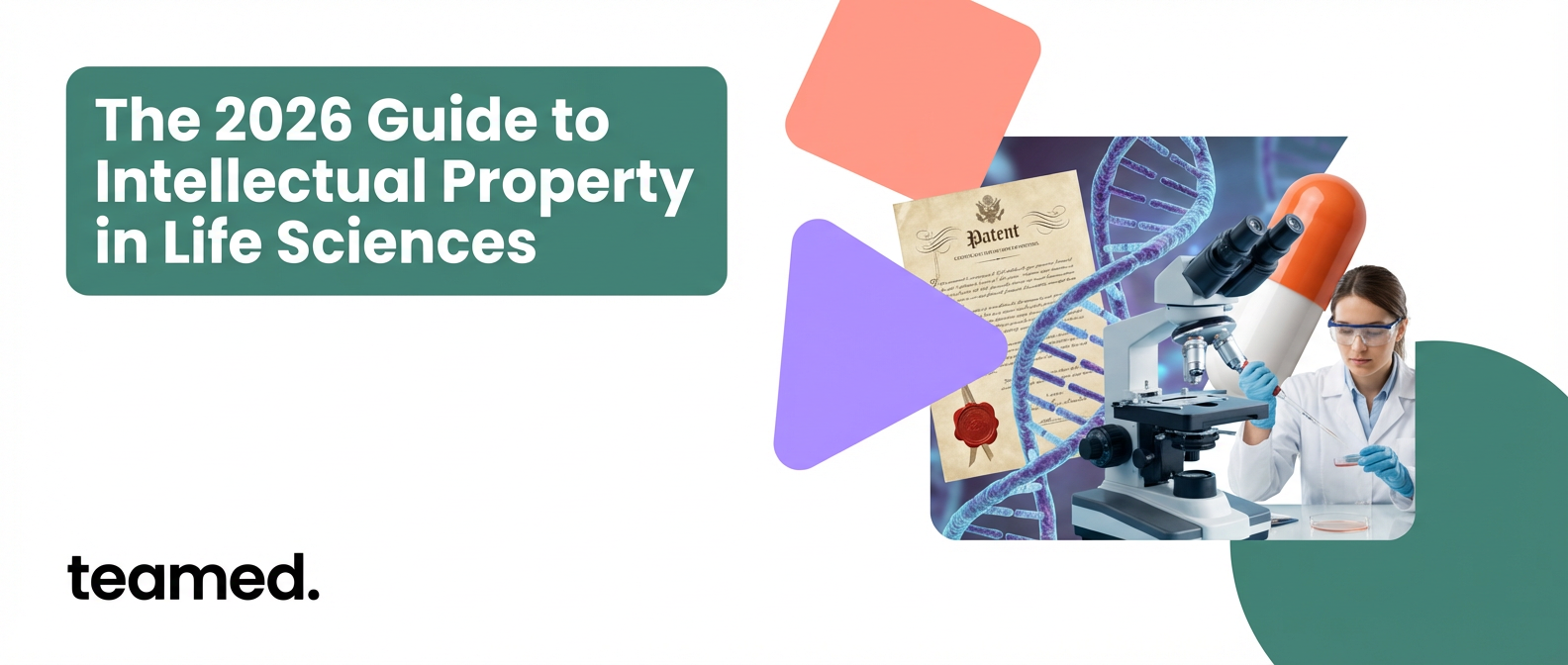
The 2026 Guide to Intellectual Property in Life Sciences

Your lead scientist just filed a patent application for a breakthrough diagnostic. Three months later, you discover the contractor who developed the underlying algorithm never signed an invention assignment. The patent might not be yours.

This scenario plays out more often than you'd think. Life sciences intellectual property is the foundation of company value, yet the decisions that protect or undermine it happen far from the patent attorney's desk. They happen in employment contracts, contractor agreements, and entity structures across multiple countries.

Mid-market life sciences companies with 200 to 2,000 employees commonly operate across 5 or more countries with mixed employment models, according to Teamed's operating model benchmarks for scaling regulated businesses. That complexity creates IP ownership gaps that only surface during due diligence, when fixing them becomes expensive.

If you work in life sciences, you don't need to become a patent lawyer. But you do need to recognise when IP decisions are being made, often by people who don't realise they're making them.

This guide walks through the foundations of life sciences IP, then moves into patents and licensing, mid-market strategy, and the workforce and global employment implications that most resources ignore.

Intellectual Property in Life Sciences Explained

Life sciences intellectual property (IP) is a category of legal rights that protects commercially valuable innovations in pharmaceuticals, biotechnology, medical devices, diagnostics, and digital health, including inventions, confidential know-how, brands, and software.

What makes life sciences IP distinct from general tech IP? Three things stand out.

First, the regulatory overlay. Drug and device approvals create their own forms of exclusivity that interact with patents in complex ways. Second, the timeline. A decade of R&D before revenue means IP must be protected long before commercial value materialises. Third, the investment profile. Billions in development costs mean IP isn't just an asset, it's often the primary reason investors write cheques.

The scope goes beyond patents. Clinical trial designs, manufacturing processes, software algorithms, brands, and confidential data all require protection strategies. A single product might involve composition patents, method patents, trade secrets around manufacturing, trademarks for the brand, and copyright in the software that runs a companion diagnostic.

IP strategy underpins valuation, partnerships, licensing, and exits. Investors and acquirers don't just look at your scienceIP strategy underpins valuation, partnerships, licensing, and exits. Investors and acquirers don't just look at your science—in 2024, U.S. life sciences companies completed 36 M&A deals totaling $115 billion with IP portfolios as a central consideration. They look at whether you actually own it, whether that ownership is defensible, and whether your employment and entity structures support clean title.

That last point is where most mid-market companies have blind spots. Ownership is shaped not only by IP advisors but also by employment and entity structure decisions. Where your scientists sit, how they're employed, and which entity holds the contracts all affect who owns what.

Core Types of Life Sciences IP and When to Use Them

A patent family is a group of related patent applications filed in multiple jurisdictions that claim priority to the same initial filing date and are used to protect a single product or technology across markets. But patents aren't your only tool.

Patents grant exclusive rights over inventions for a limited time, typically up to 20 years from filing. In life sciences, this covers new molecules, formulations, devices, methods of treatment, and diagnostic methods. Patentability typically requires novelty and an inventive step.

Trade secrets protect valuable confidential information kept secret through reasonable measures. Cell culture conditions, manufacturing parameters, and process optimisations often work better as trade secrets than patents, especially when reverse engineering is difficult.

Trademarks protect names and logos that build trust and brand recognition. For medicines and devices, brand identity matters for prescriber and patient recognition.

Copyright protects expression rather than underlying concepts. Publications, software code, algorithms, training materials, and some databases fall here.

Regulatory data and marketing exclusivity provide a head start for originators even after core patents expire. This is particularly significant for medicines and biologics, where data exclusivity can extend market protection.

When should you choose patents versus trade secrets? Prefer patents where reverse engineering is easy or external disclosure is required through publications, conferences, or regulatory filings. Prefer trade secrets where long-term secrecy is realistic and manufacturing know-how is hard to replicate.

Consider a European mid-market biotech deciding which inventions to file internationally versus keep as trade secrets. The core molecule composition goes to patent, filed broadly. The specific fermentation parameters that improve yield by 40%? Those stay as trade secrets, protected through confidentiality agreements and access controls.

How Life Sciences Patent Law Protects Drugs, Diagnostics, and Devices

The standard term of a European patent is up to 20 years from the filing date, making patent-expiry planning a multi-year finance and forecasting issue for CFOs managing product life cycles and patent cliffs.

A patent grants the right to prevent others from making, using, or selling the invention. In life sciences, this exclusivity is central to recouping R&D investment that can run into hundreds of millions.

Typical patent types in life sciences include composition of matter patents covering new molecules or biologics, formulation and dosage patents, method of treatment patents, diagnostic method patents, and device patents covering mechanical, electronic, or software-enabled innovations.

The patent life cycle runs through distinct stages: discovery, filing, prosecution (examination), grant, defence (enforcement and challenges), and expiry. Most life sciences companies build patent families with multiple related filings over a product's life to protect different aspects as development progresses.

The patent cliff, when key patents expire and generics or biosimilars can enter, requires advance planning. In Europe, supplementary protection certificates can extend protection beyond the basic patent term for medicines that required regulatory approval.

Patentability in biotech, diagnostics, and software-enabled devices is complex. Court decisions in both Europe and the United States influence what's protectable and how claims should be drafted. Get advice early, before public disclosure destroys novelty.

For a European pharma or medtech planning US entry, alignment matters. European filings, SPCs, and US patents should coordinate with regulatory plans. Mid-market firms that can't file everywhere at once need to prioritise based on commercial potential and competitive intensity.

Intellectual Property and Licensing Strategies for Life Science Startups

Freedom to operate (FTO) is an IP risk assessment process that evaluates whether developing, manufacturing, or selling a product is likely to infringe third-party patents in specific countries and indications.

Licensing allows companies to use IP under set conditions, typically involving upfront payments, milestones, and royalties. For startups, licensing is often how core technology enters the company (in-licensing from universities) and how it generates value before commercialisation (out-licensing to larger partners). In the first half of 2025, life sciences licensing deals reached approximately $120 billion in announced value, highlighting the sector's reliance on IP-based partnerships.

Common structures include territorial licences limiting rights to specific geographies, field-of-use licences restricting application areas, co-development and co-promotion agreements, and option agreements that secure future rights.

Technology transfer offices at universities and hospitals are common sources of core biotechnology intellectual property. Due diligence should focus on clarity around ownership, licence scope, territory, exclusivity, sublicensing rights, improvements, royalties, and performance obligations.

Pitfalls to avoid: overly broad early grants that limit future flexibility, inconsistent territories across licence chains, ignoring who owns improvements and new IP, unclear sublicensing terms, and ambiguous performance or termination provisions.

Consider a European startup licensing from a local university and considering out-licensing to a US pharma partner. The territorial scope, governing law, and improvement ownership terms in the university licence will constrain what can be offered to the US partner. Mid-market companies often sit amid complex chains of licences, and managing interdependencies becomes critical.

Life Sciences IP Strategy for Mid-Market Companies with 200 to 2,000 Employees

Many mid-market companies begin consolidating fragmented global employment vendors and processes around 200 to 300 employees, a threshold Teamed cites as the point where cross-border employment decisions often become recurring six-figure budget items.

The typical context: multiple programmes or products, cross-border growth, limited budget for filings and enforcement, and partial in-house capability. You can't protect everything everywhere. Prioritisation is essential.

A practical decision framework considers commercial potential and timing, competitive intensity and likely design-around, ease of reverse engineering, regulatory demands and exclusivity overlays, freedom to operate risk, and budget and operational capacity.

"We're making six-figure IP decisions on incomplete information." That's the reality for most mid-market leaders. The answer isn't to avoid decisions but to build a framework that makes trade-offs explicit.

Integration matters. Tie IP strategy to portfolio and pipeline choices. Consider patent life, regulatory exclusivity, and market access together. A patent that expires two years before your product reaches market has limited value.

Hidden risk areas include platform technologies that underpin multiple programmes, data assets that may be protectable, and software-enabled devices linked to biologics. These often fall between traditional IP categories and require deliberate attention.

The operating model typically blends external advisors with internal championsThe operating model typically blends external advisors with internal champions. Over 58% of enterprises are increasing investments in digital IP workflows and portfolio management tools. Establish governance and clear decision ownership. Someone needs to own the question: "Does our employment structure support clean IP ownership?"

Teamed advises HR and Finance on aligning employment models, contractor use, and entity structure so IP-sensitive work is housed in the right places and properly assigned. This complements specialist IP counsel rather than replacing it.

Europe and United States Life Sciences IP Frameworks Compared

The Unified Patent Court (UPC) began operations in 2023, creating a single forum in participating EU states where a UPC decision can have effect across multiple countries, increasing the potential multi-country impact of a single life sciences patent dispute for European scale-ups.

Patents differ significantly between regions. In Europe, central filing through the EPO leads to national validations, with the emerging UPC context adding complexity. National courts remain relevant. In the United States, a single federal system operates with PTAB post-grant processes and different claim drafting and eligibility dynamics.

Biotechnology, diagnostics, and software-enabled health patentability standards differ between regions. Adjust filing and claim strategy accordingly.

Regulatory exclusivity operates differently. Europe provides data protection and market exclusivity for medicines and biologics, with SPC mechanisms that can extend beyond basic patent term. The United States has distinct FDA frameworks with different data and market exclusivities. Sequencing filings matters for launch timing in both regions.

Enforcement culture varies. The United States features broader discovery, jury trials in some cases, and different cost and settlement dynamics. Europe varies by country, with generally more streamlined discovery and different injunctive relief strategies.

Both regions are seeing reforms. EU pharmaceutical legislation changes and US discussions on patent eligibility and post-grant review mean the landscape keeps shifting. Seek up-to-date advice.

Filing strategy for transatlantic companies: file early in both regions for core inventions, stagger secondary patents based on budget and importance, and encourage collaboration between EU and US counsel. Align the portfolio with the regulatory plan.

Consider a European mid-market biotech holding core patents in a European IP-holding entity while building US commercial operations. Coordinating filings, entities, and governance across both regions requires deliberate planning.

Protecting Biotechnology Intellectual Property Across Borders

An IP-holding company is a dedicated legal entity that owns patents, know-how, and related rights, enabling clearer licensing, governance, and diligence for financings or transactions.

Biotechnology IP covers living organisms, genetic sequences, cell and gene therapies, antibodies, and biologics manufacturing processes. Cross-border protection presents unique challenges.

Patentability varies by jurisdiction. Ethics and special rules, notably in Europe, may apply to certain biological materials and methods. Claim drafting must balance breadth versus validity, and experienced biotech IP counsel is essential.

Cross-border differences in enablement and written description requirements drive how much experimental data to include in applications. EU and US standards differ, affecting filing strategy.

Coordinated patent families across jurisdictions require tracking deadlines, SPC options, and freedom-to-operate considerations. Platform biotech IP, such as gene editing systems or delivery vectors, often gets licensed into multiple programmes and territories. Managing field-of-use and territorial scope carefully prevents conflicts.

Global employment structures intersect with initial ownership and tax. Where research occurs and who employs inventors matters for determining who owns what.

Concrete examples illustrate the complexity. A new cell line raises questions about deposit requirements and scope of claims around use and derivatives. A novel antibody requires decisions about epitope versus sequence claims and functional versus structural definitions. A gene therapy delivery vector involves choices between vector claims and manufacturing process claims, with safety and regulatory data potentially protected as trade secrets.

"Biotech IP rewards precision. Small drafting choices can decide markets."

European HQ biotechs collaborating with US partners or CROs need to balance ambition with operational capacity when managing global portfolios.

Common Life Sciences IP Pitfalls for Scaling European Companies

Teamed provides local legal and compliance expertise coverage across 180+ countries, which is relevant when structuring cross-border employment and invention assignment controls for distributed R&D teams.

The pitfalls are predictable. Missing assignments from founders, academics, or contractors create ownership gaps. Use clear invention assignment agreements and confirm university policies and waivers before work begins.

Premature public disclosures at conferences, in journals, or through trial registries can destroy novelty. File before disclosure and coordinate communications with IP counsel.

Weak freedom-to-operate analysis creates litigation risk. Stage FTO assessments and revisit at key development gates.

Misaligned IP with regulatory and commercial plans wastes resources. Map patent life to approval and pricing timelines in priority EU markets and the US.

Cross-border employment assumptions cause problems. Local laws differ on employee inventions. Standardise core clauses and localise where necessary.

Fragmented R&D across countries without policies creates inconsistency. Implement consistent data, know-how, confidentiality, and invention disclosure processes.

Overcomplicated licence stacks generate confusion. Keep a master map of rights, obligations, improvements, and territories. Rationalise early.

Operational blind spots in software and data leave assets unprotected. Protect code, models, and datasets while aligning with privacy and health data rules.

Quick checklist:

  • Do we have signed, enforceable IP assignments for all contributors?
  • Have we filed before any planned public disclosures?
  • What are our top three FTO risks, and when do we revisit them?
  • How do patent life and regulatory exclusivity align with launch timing in key markets?
  • Are employment and contractor terms harmonised across countries for IP and confidentiality?
  • Who owns improvements under each collaboration or licence?

Teamed helps map risks at the intersection of global employment, entities, and life sciences IP to tighten agreements and processes ahead of financing or transactions.

Building an IP-Aware Global Workforce in Life Sciences Mid-Market Companies

An Employer of Record (EOR) is a third-party organisation that becomes the legal employer for workers in a specific country, handling payroll, taxes, and local employment compliance while the client company manages day-to-day work.

For employees, IP usually flows to the employer via contract. Ensure assignment and confidentiality clauses are in place, especially for R&D and software teams. In Germany, employee inventions are governed by specific statutory rules that influence compensation and ownership mechanics. In France, statutory categories affect ownership and remuneration.

For contractors and consultants, default ownership may not favour the company. Mirror employee-level protections in contractor agreements, including explicit present-tense IP assignment, confidentiality, and assistance obligations for patent filings.

Remote and distributed teams create additional complexity. Track inventor locations because local rules on employee inventions vary. Use consistent contracts and clear policies that secure assignment to the intended IP-holding entity regardless of location.

Habits and structures matter. Clear, teachable policies on confidentiality, data handling, publication, and invention disclosure reduce risk. A simple intake process for invention disclosures aligned with counsel ensures nothing slips through. Audit trails for code, data, and model provenance support ownership claims.

Global employment models require attention. With EOR arrangements, secondments, or cross-border transfers, clarify who is the legal employer and ensure IP assignment flows to the intended IP-holding entity. Plan location of IP-sensitive roles to align with entity and tax strategy.

AI and collaboration tools raise new questions. Address data ownership, third-party terms, and confidentiality. Use AI as decision support, not a substitute for human IP judgment.

Contract clause checklist for employment and contractor templates:

  • IP assignment to the intended entity
  • Moral rights waivers where appropriate
  • Confidentiality and trade secret protection
  • Invention disclosure and cooperation obligations
  • Restrictions on third-party code and data use, including open-source compliance
  • Governing law and dispute forum aligned with IP holding

"Your IP is only as strong as the contracts and behaviours of the people who create it."

Teamed advises HR, Finance, and Legal on when to use contractors versus employees, EOR versus owned entities, and how to maintain clear ownership across 180+ countries.

Getting Strategic Support on Life Sciences IP and Global Employment

Teamed states it can operationally onboard workers in as little as 24 hours once country strategy is clear, which reduces the time window where R&D work may start before signed IP and confidentiality terms are in place.

Coordination across specialist patent and licensing counsel, regulatory experts, commercial leaders, and those owning workforce and entity decisions is essential. Mid-market companies often lack a single partner with a cross-functional view.

Teamed's role is strategic partnership on global employment and entity strategy: where IP-sensitive work should sit, when to move from contractors to EOR to owned entities, and how to support the chosen IP and regulatory plan. This complements life sciences IP law firms by aligning people and operating structure with portfolio strategy.

For expansion, audits, funding, or transactions, assess whether global employment strategy aligns with IP objectives.

What you can expect from strategic alignment:

  • Clear map of who owns what IP and where it's created
  • Employment and entity model aligned to IP holding and tax strategy
  • Prioritised sequence for filings, hiring, and market entry
  • Reduced IP ownership risk across contractors, EOR, and owned entities
  • Leadership confidence in six- to seven-figure IP decisions

If you're weighing entity establishment in Europe or the United States while trying to protect your IP, talk to the experts. The first step is a conversation to clarify current state and gaps.

FAQs About Intellectual Property in Life Sciences

How does remote work affect ownership of intellectual property in life sciences companies?

Remote work can place inventors in different legal jurisdictions with varying default rules on employee inventions. Use consistent contracts and clear policies that secure assignment to the intended IP-holding entity regardless of location. Track inventor locations and apply local compliance requirements.

What should go into employment contracts to ensure life sciences intellectual property is properly assigned?

Include explicit invention assignment, confidentiality and trade secret obligations, moral rights waivers where appropriate, invention disclosure and cooperation duties, and clear rules on using company resources and third-party IP. Localise terms while keeping global consistency.

How risky is it to rely on contractors for core R&D in life sciences?

Workable but higher risk if ownership isn't explicitly transferred. Contractor agreements should mirror employee protections including assignment, confidentiality, disclosure, and assistance. Address background IP, improvements, and deliverable ownership explicitly.

When should a European life sciences company prioritise United States patent filings?

Prioritise for inventions with strong US commercial potential or active competitors. Coordinate timing with European filings and regulatory plans to maximise combined protection and avoid disclosure gaps.

How does an Employer of Record arrangement impact intellectual property ownership in life sciences?

The EOR is the legal employer, but assignment and confidentiality must flow back to your IP-holding entity. Obtain IP clauses in the EOR's local contract and a direct invention assignment to your entity. Align labour and IP advice.

What is mid-market?

Typically 200 to 2,000 employees or around £10m to £1bn in revenue. These companies have complex operations without the full resources of large enterprises.

How should a scaling life sciences company organise entities to own its intellectual property?

Commonly centralise core IP in a dedicated holding entity for clarity and tax planning. Align employment and contractor relationships so new inventions consistently assign into that entity, supported by specialist IP and tax advisors.or

The 2026 Guide to Intellectual Property in Life Sciences

Your lead scientist just filed a patent application for a breakthrough diagnostic. Three months later, you discover the contractor who developed the underlying algorithm never signed an invention assignment. The patent might not be yours.

This scenario plays out more often than you'd think. Life sciences intellectual property is the foundation of company value, yet the decisions that protect or undermine it happen far from the patent attorney's desk. They happen in employment contracts, contractor agreements, and entity structures across multiple countries.

Mid-market life sciences companies with 200 to 2,000 employees commonly operate across 5 or more countries with mixed employment models, according to Teamed's operating model benchmarks for scaling regulated businesses. That complexity creates IP ownership gaps that only surface during due diligence, when fixing them becomes expensive.

If you work in life sciences, you don't need to become a patent lawyer. But you do need to recognise when IP decisions are being made, often by people who don't realise they're making them.

This guide walks through the foundations of life sciences IP, then moves into patents and licensing, mid-market strategy, and the workforce and global employment implications that most resources ignore.

Intellectual Property in Life Sciences Explained

Life sciences intellectual property (IP) is a category of legal rights that protects commercially valuable innovations in pharmaceuticals, biotechnology, medical devices, diagnostics, and digital health, including inventions, confidential know-how, brands, and software.

What makes life sciences IP distinct from general tech IP? Three things stand out.

First, the regulatory overlay. Drug and device approvals create their own forms of exclusivity that interact with patents in complex ways. Second, the timeline. A decade of R&D before revenue means IP must be protected long before commercial value materialises. Third, the investment profile. Billions in development costs mean IP isn't just an asset, it's often the primary reason investors write cheques.

The scope goes beyond patents. Clinical trial designs, manufacturing processes, software algorithms, brands, and confidential data all require protection strategies. A single product might involve composition patents, method patents, trade secrets around manufacturing, trademarks for the brand, and copyright in the software that runs a companion diagnostic.

IP strategy underpins valuation, partnerships, licensing, and exits. Investors and acquirers don't just look at your scienceIP strategy underpins valuation, partnerships, licensing, and exits. Investors and acquirers don't just look at your science—in 2024, U.S. life sciences companies completed 36 M&A deals totaling $115 billion with IP portfolios as a central consideration. They look at whether you actually own it, whether that ownership is defensible, and whether your employment and entity structures support clean title.

That last point is where most mid-market companies have blind spots. Ownership is shaped not only by IP advisors but also by employment and entity structure decisions. Where your scientists sit, how they're employed, and which entity holds the contracts all affect who owns what.

Core Types of Life Sciences IP and When to Use Them

A patent family is a group of related patent applications filed in multiple jurisdictions that claim priority to the same initial filing date and are used to protect a single product or technology across markets. But patents aren't your only tool.

Patents grant exclusive rights over inventions for a limited time, typically up to 20 years from filing. In life sciences, this covers new molecules, formulations, devices, methods of treatment, and diagnostic methods. Patentability typically requires novelty and an inventive step.

Trade secrets protect valuable confidential information kept secret through reasonable measures. Cell culture conditions, manufacturing parameters, and process optimisations often work better as trade secrets than patents, especially when reverse engineering is difficult.

Trademarks protect names and logos that build trust and brand recognition. For medicines and devices, brand identity matters for prescriber and patient recognition.

Copyright protects expression rather than underlying concepts. Publications, software code, algorithms, training materials, and some databases fall here.

Regulatory data and marketing exclusivity provide a head start for originators even after core patents expire. This is particularly significant for medicines and biologics, where data exclusivity can extend market protection.

When should you choose patents versus trade secrets? Prefer patents where reverse engineering is easy or external disclosure is required through publications, conferences, or regulatory filings. Prefer trade secrets where long-term secrecy is realistic and manufacturing know-how is hard to replicate.

Consider a European mid-market biotech deciding which inventions to file internationally versus keep as trade secrets. The core molecule composition goes to patent, filed broadly. The specific fermentation parameters that improve yield by 40%? Those stay as trade secrets, protected through confidentiality agreements and access controls.

How Life Sciences Patent Law Protects Drugs, Diagnostics, and Devices

The standard term of a European patent is up to 20 years from the filing date, making patent-expiry planning a multi-year finance and forecasting issue for CFOs managing product life cycles and patent cliffs.

A patent grants the right to prevent others from making, using, or selling the invention. In life sciences, this exclusivity is central to recouping R&D investment that can run into hundreds of millions.

Typical patent types in life sciences include composition of matter patents covering new molecules or biologics, formulation and dosage patents, method of treatment patents, diagnostic method patents, and device patents covering mechanical, electronic, or software-enabled innovations.

The patent life cycle runs through distinct stages: discovery, filing, prosecution (examination), grant, defence (enforcement and challenges), and expiry. Most life sciences companies build patent families with multiple related filings over a product's life to protect different aspects as development progresses.

The patent cliff, when key patents expire and generics or biosimilars can enter, requires advance planning. In Europe, supplementary protection certificates can extend protection beyond the basic patent term for medicines that required regulatory approval.

Patentability in biotech, diagnostics, and software-enabled devices is complex. Court decisions in both Europe and the United States influence what's protectable and how claims should be drafted. Get advice early, before public disclosure destroys novelty.

For a European pharma or medtech planning US entry, alignment matters. European filings, SPCs, and US patents should coordinate with regulatory plans. Mid-market firms that can't file everywhere at once need to prioritise based on commercial potential and competitive intensity.

Intellectual Property and Licensing Strategies for Life Science Startups

Freedom to operate (FTO) is an IP risk assessment process that evaluates whether developing, manufacturing, or selling a product is likely to infringe third-party patents in specific countries and indications.

Licensing allows companies to use IP under set conditions, typically involving upfront payments, milestones, and royalties. For startups, licensing is often how core technology enters the company (in-licensing from universities) and how it generates value before commercialisation (out-licensing to larger partners). In the first half of 2025, life sciences licensing deals reached approximately $120 billion in announced value, highlighting the sector's reliance on IP-based partnerships.

Common structures include territorial licences limiting rights to specific geographies, field-of-use licences restricting application areas, co-development and co-promotion agreements, and option agreements that secure future rights.

Technology transfer offices at universities and hospitals are common sources of core biotechnology intellectual property. Due diligence should focus on clarity around ownership, licence scope, territory, exclusivity, sublicensing rights, improvements, royalties, and performance obligations.

Pitfalls to avoid: overly broad early grants that limit future flexibility, inconsistent territories across licence chains, ignoring who owns improvements and new IP, unclear sublicensing terms, and ambiguous performance or termination provisions.

Consider a European startup licensing from a local university and considering out-licensing to a US pharma partner. The territorial scope, governing law, and improvement ownership terms in the university licence will constrain what can be offered to the US partner. Mid-market companies often sit amid complex chains of licences, and managing interdependencies becomes critical.

Life Sciences IP Strategy for Mid-Market Companies with 200 to 2,000 Employees

Many mid-market companies begin consolidating fragmented global employment vendors and processes around 200 to 300 employees, a threshold Teamed cites as the point where cross-border employment decisions often become recurring six-figure budget items.

The typical context: multiple programmes or products, cross-border growth, limited budget for filings and enforcement, and partial in-house capability. You can't protect everything everywhere. Prioritisation is essential.

A practical decision framework considers commercial potential and timing, competitive intensity and likely design-around, ease of reverse engineering, regulatory demands and exclusivity overlays, freedom to operate risk, and budget and operational capacity.

"We're making six-figure IP decisions on incomplete information." That's the reality for most mid-market leaders. The answer isn't to avoid decisions but to build a framework that makes trade-offs explicit.

Integration matters. Tie IP strategy to portfolio and pipeline choices. Consider patent life, regulatory exclusivity, and market access together. A patent that expires two years before your product reaches market has limited value.

Hidden risk areas include platform technologies that underpin multiple programmes, data assets that may be protectable, and software-enabled devices linked to biologics. These often fall between traditional IP categories and require deliberate attention.

The operating model typically blends external advisors with internal championsThe operating model typically blends external advisors with internal champions. Over 58% of enterprises are increasing investments in digital IP workflows and portfolio management tools. Establish governance and clear decision ownership. Someone needs to own the question: "Does our employment structure support clean IP ownership?"

Teamed advises HR and Finance on aligning employment models, contractor use, and entity structure so IP-sensitive work is housed in the right places and properly assigned. This complements specialist IP counsel rather than replacing it.

Europe and United States Life Sciences IP Frameworks Compared

The Unified Patent Court (UPC) began operations in 2023, creating a single forum in participating EU states where a UPC decision can have effect across multiple countries, increasing the potential multi-country impact of a single life sciences patent dispute for European scale-ups.

Patents differ significantly between regions. In Europe, central filing through the EPO leads to national validations, with the emerging UPC context adding complexity. National courts remain relevant. In the United States, a single federal system operates with PTAB post-grant processes and different claim drafting and eligibility dynamics.

Biotechnology, diagnostics, and software-enabled health patentability standards differ between regions. Adjust filing and claim strategy accordingly.

Regulatory exclusivity operates differently. Europe provides data protection and market exclusivity for medicines and biologics, with SPC mechanisms that can extend beyond basic patent term. The United States has distinct FDA frameworks with different data and market exclusivities. Sequencing filings matters for launch timing in both regions.

Enforcement culture varies. The United States features broader discovery, jury trials in some cases, and different cost and settlement dynamics. Europe varies by country, with generally more streamlined discovery and different injunctive relief strategies.

Both regions are seeing reforms. EU pharmaceutical legislation changes and US discussions on patent eligibility and post-grant review mean the landscape keeps shifting. Seek up-to-date advice.

Filing strategy for transatlantic companies: file early in both regions for core inventions, stagger secondary patents based on budget and importance, and encourage collaboration between EU and US counsel. Align the portfolio with the regulatory plan.

Consider a European mid-market biotech holding core patents in a European IP-holding entity while building US commercial operations. Coordinating filings, entities, and governance across both regions requires deliberate planning.

Protecting Biotechnology Intellectual Property Across Borders

An IP-holding company is a dedicated legal entity that owns patents, know-how, and related rights, enabling clearer licensing, governance, and diligence for financings or transactions.

Biotechnology IP covers living organisms, genetic sequences, cell and gene therapies, antibodies, and biologics manufacturing processes. Cross-border protection presents unique challenges.

Patentability varies by jurisdiction. Ethics and special rules, notably in Europe, may apply to certain biological materials and methods. Claim drafting must balance breadth versus validity, and experienced biotech IP counsel is essential.

Cross-border differences in enablement and written description requirements drive how much experimental data to include in applications. EU and US standards differ, affecting filing strategy.

Coordinated patent families across jurisdictions require tracking deadlines, SPC options, and freedom-to-operate considerations. Platform biotech IP, such as gene editing systems or delivery vectors, often gets licensed into multiple programmes and territories. Managing field-of-use and territorial scope carefully prevents conflicts.

Global employment structures intersect with initial ownership and tax. Where research occurs and who employs inventors matters for determining who owns what.

Concrete examples illustrate the complexity. A new cell line raises questions about deposit requirements and scope of claims around use and derivatives. A novel antibody requires decisions about epitope versus sequence claims and functional versus structural definitions. A gene therapy delivery vector involves choices between vector claims and manufacturing process claims, with safety and regulatory data potentially protected as trade secrets.

"Biotech IP rewards precision. Small drafting choices can decide markets."

European HQ biotechs collaborating with US partners or CROs need to balance ambition with operational capacity when managing global portfolios.

Common Life Sciences IP Pitfalls for Scaling European Companies

Teamed provides local legal and compliance expertise coverage across 180+ countries, which is relevant when structuring cross-border employment and invention assignment controls for distributed R&D teams.

The pitfalls are predictable. Missing assignments from founders, academics, or contractors create ownership gaps. Use clear invention assignment agreements and confirm university policies and waivers before work begins.

Premature public disclosures at conferences, in journals, or through trial registries can destroy novelty. File before disclosure and coordinate communications with IP counsel.

Weak freedom-to-operate analysis creates litigation risk. Stage FTO assessments and revisit at key development gates.

Misaligned IP with regulatory and commercial plans wastes resources. Map patent life to approval and pricing timelines in priority EU markets and the US.

Cross-border employment assumptions cause problems. Local laws differ on employee inventions. Standardise core clauses and localise where necessary.

Fragmented R&D across countries without policies creates inconsistency. Implement consistent data, know-how, confidentiality, and invention disclosure processes.

Overcomplicated licence stacks generate confusion. Keep a master map of rights, obligations, improvements, and territories. Rationalise early.

Operational blind spots in software and data leave assets unprotected. Protect code, models, and datasets while aligning with privacy and health data rules.

Quick checklist:

  • Do we have signed, enforceable IP assignments for all contributors?
  • Have we filed before any planned public disclosures?
  • What are our top three FTO risks, and when do we revisit them?
  • How do patent life and regulatory exclusivity align with launch timing in key markets?
  • Are employment and contractor terms harmonised across countries for IP and confidentiality?
  • Who owns improvements under each collaboration or licence?

Teamed helps map risks at the intersection of global employment, entities, and life sciences IP to tighten agreements and processes ahead of financing or transactions.

Building an IP-Aware Global Workforce in Life Sciences Mid-Market Companies

An Employer of Record (EOR) is a third-party organisation that becomes the legal employer for workers in a specific country, handling payroll, taxes, and local employment compliance while the client company manages day-to-day work.

For employees, IP usually flows to the employer via contract. Ensure assignment and confidentiality clauses are in place, especially for R&D and software teams. In Germany, employee inventions are governed by specific statutory rules that influence compensation and ownership mechanics. In France, statutory categories affect ownership and remuneration.

For contractors and consultants, default ownership may not favour the company. Mirror employee-level protections in contractor agreements, including explicit present-tense IP assignment, confidentiality, and assistance obligations for patent filings.

Remote and distributed teams create additional complexity. Track inventor locations because local rules on employee inventions vary. Use consistent contracts and clear policies that secure assignment to the intended IP-holding entity regardless of location.

Habits and structures matter. Clear, teachable policies on confidentiality, data handling, publication, and invention disclosure reduce risk. A simple intake process for invention disclosures aligned with counsel ensures nothing slips through. Audit trails for code, data, and model provenance support ownership claims.

Global employment models require attention. With EOR arrangements, secondments, or cross-border transfers, clarify who is the legal employer and ensure IP assignment flows to the intended IP-holding entity. Plan location of IP-sensitive roles to align with entity and tax strategy.

AI and collaboration tools raise new questions. Address data ownership, third-party terms, and confidentiality. Use AI as decision support, not a substitute for human IP judgment.

Contract clause checklist for employment and contractor templates:

  • IP assignment to the intended entity
  • Moral rights waivers where appropriate
  • Confidentiality and trade secret protection
  • Invention disclosure and cooperation obligations
  • Restrictions on third-party code and data use, including open-source compliance
  • Governing law and dispute forum aligned with IP holding

"Your IP is only as strong as the contracts and behaviours of the people who create it."

Teamed advises HR, Finance, and Legal on when to use contractors versus employees, EOR versus owned entities, and how to maintain clear ownership across 180+ countries.

Getting Strategic Support on Life Sciences IP and Global Employment

Teamed states it can operationally onboard workers in as little as 24 hours once country strategy is clear, which reduces the time window where R&D work may start before signed IP and confidentiality terms are in place.

Coordination across specialist patent and licensing counsel, regulatory experts, commercial leaders, and those owning workforce and entity decisions is essential. Mid-market companies often lack a single partner with a cross-functional view.

Teamed's role is strategic partnership on global employment and entity strategy: where IP-sensitive work should sit, when to move from contractors to EOR to owned entities, and how to support the chosen IP and regulatory plan. This complements life sciences IP law firms by aligning people and operating structure with portfolio strategy.

For expansion, audits, funding, or transactions, assess whether global employment strategy aligns with IP objectives.

What you can expect from strategic alignment:

  • Clear map of who owns what IP and where it's created
  • Employment and entity model aligned to IP holding and tax strategy
  • Prioritised sequence for filings, hiring, and market entry
  • Reduced IP ownership risk across contractors, EOR, and owned entities
  • Leadership confidence in six- to seven-figure IP decisions

If you're weighing entity establishment in Europe or the United States while trying to protect your IP, talk to the experts. The first step is a conversation to clarify current state and gaps.

FAQs About Intellectual Property in Life Sciences

How does remote work affect ownership of intellectual property in life sciences companies?

Remote work can place inventors in different legal jurisdictions with varying default rules on employee inventions. Use consistent contracts and clear policies that secure assignment to the intended IP-holding entity regardless of location. Track inventor locations and apply local compliance requirements.

What should go into employment contracts to ensure life sciences intellectual property is properly assigned?

Include explicit invention assignment, confidentiality and trade secret obligations, moral rights waivers where appropriate, invention disclosure and cooperation duties, and clear rules on using company resources and third-party IP. Localise terms while keeping global consistency.

How risky is it to rely on contractors for core R&D in life sciences?

Workable but higher risk if ownership isn't explicitly transferred. Contractor agreements should mirror employee protections including assignment, confidentiality, disclosure, and assistance. Address background IP, improvements, and deliverable ownership explicitly.

When should a European life sciences company prioritise United States patent filings?

Prioritise for inventions with strong US commercial potential or active competitors. Coordinate timing with European filings and regulatory plans to maximise combined protection and avoid disclosure gaps.

How does an Employer of Record arrangement impact intellectual property ownership in life sciences?

The EOR is the legal employer, but assignment and confidentiality must flow back to your IP-holding entity. Obtain IP clauses in the EOR's local contract and a direct invention assignment to your entity. Align labour and IP advice.

What is mid-market?

Typically 200 to 2,000 employees or around £10m to £1bn in revenue. These companies have complex operations without the full resources of large enterprises.

How should a scaling life sciences company organise entities to own its intellectual property?

Commonly centralise core IP in a dedicated holding entity for clarity and tax planning. Align employment and contractor relationships so new inventions consistently assign into that entity, supported by specialist IP and tax advisors.or

TABLE OF CONTENTS

Take a look
at the latest articles