
Case Study
What Your EOR Actually Does (And Doesn't Do): The audit that asked questions nobody could answer

Tom Price-Daniel

12 minutes

May 6, 2026

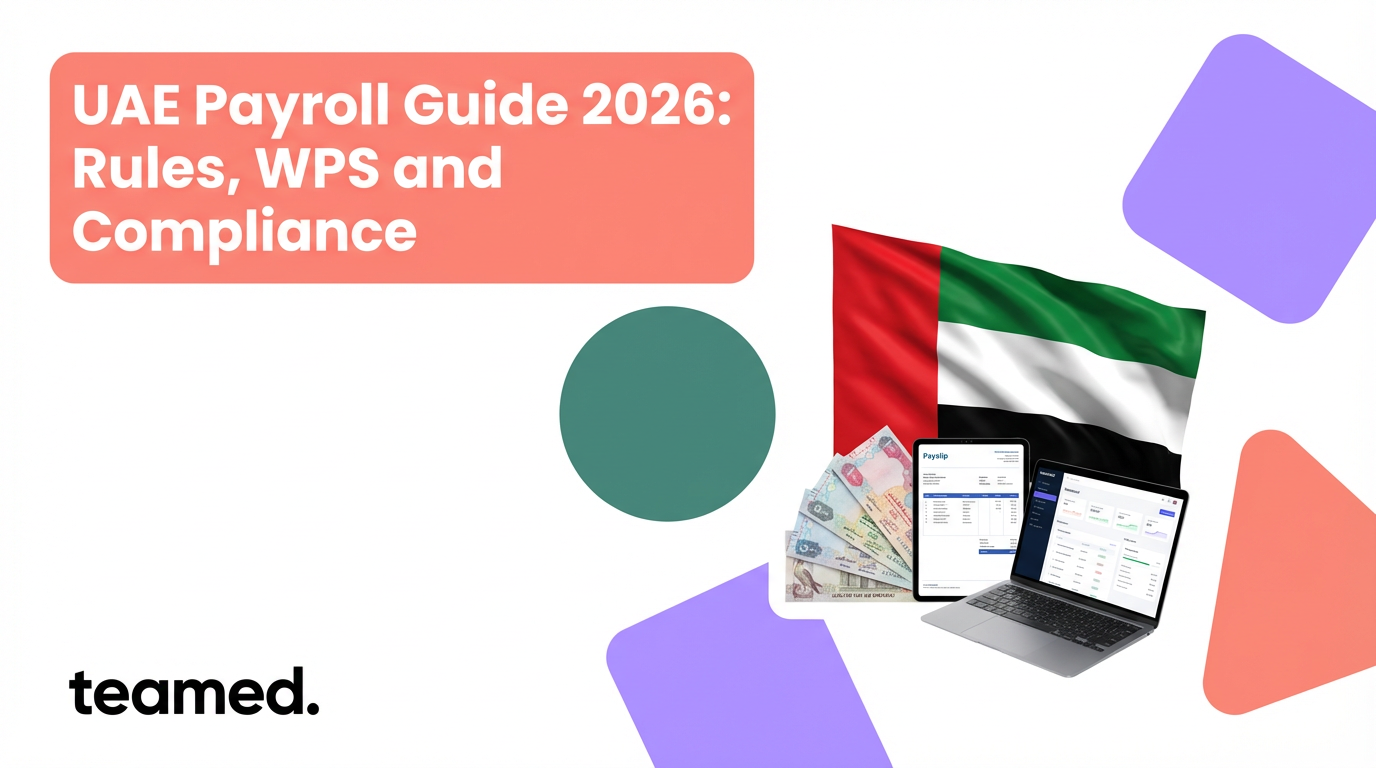
Your CFO just asked why the UAE team's salaries weren't paid on time last month. The answer involves a government system you've never heard of, a bank file format that doesn't match your European payroll software, and a compliance framework that treats late payment as grounds for blocking your next work permit application.
Welcome to UAE payroll.
For mid-market companies scaling from Europe into the Gulf, the UAE presents a paradox. No personal income tax sounds simple. But the regulatory infrastructure around payment of wages is stricter than anything you'll encounter in London or Berlin. The Wage Protection System monitors every salary payment. The Ministry of Human Resources and Emiratisation tracks compliance in real time. And the consequences for getting it wrong extend far beyond unhappy employees.
This guide breaks down how UAE payroll actually works for companies with 50 to 2,000 employees, covering the rules you need to follow, the strategic decisions you need to make, and the operational model that keeps European headquarters in sync with local requirements.
Key Takeaways
UAE payroll is the regulated employer process of calculating gross pay, applying lawful deductions, and paying employees in the United Arab Emirates in accordance with UAE labour rules and the employment contract. This isn't just internal administration. It's a compliance activity monitored by the government.
The core legal expectations are straightforward but non-negotiable. Salaries must be paid in full, on time, and through approved, traceable channels. Deductions are only permitted where the law and the contract allow. Payment frequency should be consistent with the employment framework, and acceptable payment methods are formal and traceable, processed through regulated banking channels in recognised currency.
The Ministry of Human Resources and Emiratisation (MoHRE) serves as the primary private-sector regulator. Official rules and updates come from MoHRE and the UAE government portal. If you're used to European payroll where late payment is primarily an employee relations issue, the UAE framework requires a mindset shift. Informal or cash payments create compliance risk that can affect your ability to sponsor visas and hire new staff.
Consider a European headquarters hiring its first UAE employee. The People Ops team assumes they can run payroll the same way they do in Germany or the Netherlands. They quickly discover that UAE payment of salary rules are stricter, more prescriptive, and more actively enforced. These obligations apply whether you're employing one person or hundreds.
Employer obligations for payment of wages:
The Wage Protection System (WPS) is a UAE government-mandated electronic salary monitoring framework that requires many employers to pay wages through approved financial institutions and prescribed payroll file formats. Most mainland employers route salaries via WPS-approved banks or exchange houses, and the government monitors these payments in real time.
The practical WPS sequence follows a consistent pattern. You register the company for WPS and ensure bank or exchange connectivity. You prepare accurate payroll data and generate WPS files in the required format. You submit files to the bank or exchange for processing. Then you confirm payments, reconcile, and remediate exceptions promptly.
What happens if you don't comply? The consequences are qualitative but serious. Administrative blocks on new work permits and company services. Inspections or requests for evidence. Financial penalties and reputational impact. For a mid-market firm with dozens or hundreds of UAE staff, WPS failures disrupt the entire operation.
Free zones can differ in their application of WPS requirements. Larger employers and those in regulated sectors face particular visibility. But the underlying principle remains consistent: the government wants to see that employees are being paid correctly and on time.
Mid-market companies running multi-country payroll commonly need at least 3 internal control points for UAE payroll: data validation, payment approval, and post-pay reconciliation, according to Teamed's operational control standards. These controls reduce WPS exception risk and provide audit evidence.
Practical controls HR and Finance can implement:
The UAE consists of 7 emirates, which matters for payroll operations because licensing, banking relationships, and free-zone administration can differ by emirate even when federal labour concepts apply, according to Teamed's UAE expansion playbooks for mid-market employers. Labour law and payment of salary rules are federal. The core framework is shared. But the practical experience of running payroll in Dubai versus Abu Dhabi involves different local touchpoints.
Dubai mainland operations work with local banks and WPS processes. You'll interface with Dubai-specific authorities where needed and manage onboarding documentation according to local admin timelines. The banking relationships and WPS file submission processes are well-established, and most payroll providers have deep experience with Dubai mainland requirements.
Abu Dhabi mainland follows the same federal framework, but local bank and WPS practices can differ in process flow. You'll coordinate with Abu Dhabi-based authorities and navigate customary local practices that may not match what you've learned in Dubai.
Free zones in both emirates add another layer. Some free zones have their own employment regulations. In practice, they often connect to federal systems like WPS, but documentation and portals may differ. A DIFC employee and a JAFZA employee are both in Dubai, but the administrative experience isn't identical.
For multi-emirate operations, the guidance is consistent: keep consistent internal payroll policies and governance while allowing local admin variations where necessary. A European scaleup that opens in Dubai and then adds Abu Dhabi needs to decide whether to centralise payroll admin in one emirate or run local admin with group-wide controls. Both approaches can work. The key is making a deliberate choice rather than letting it happen by accident.
Basic salary is the fixed core of a UAE compensation package and serves as the reference point for several legal calculations, including end-of-service gratuity. How you set basic salary has long-term implications. A higher basic salary means higher gratuity liability at termination. A lower basic salary with larger allowances reduces that liability but may affect employee perception of their package.
Common allowances include housing, transport, cost of living, and communications. These are listed separately from basic salary on the employment contract and payslip. The structure matters because allowances typically don't count toward gratuity calculations in the same way basic salary does.
Variable pay sits on top of fixed components. Bonuses, commissions, and overtime are processed in monthly runs alongside the fixed elements. The calculation rules for overtime follow UAE labour law requirements, and getting them wrong creates compliance exposure.
Benefits that intersect with payroll include paid leave, health insurance contributions, and travel or other company allowances. Packages vary significantly by employer and sector. Regulated industries often offer enhanced benefits to attract talent.
For mid-market companies, the guidance is to balance basic salary versus allowances thoughtfully. You're managing competitiveness in the UAE talent market while controlling gratuity exposure and maintaining internal equity across your global workforce. A European headquarters used to all-in salaries needs to design UAE packages with separate housing and transport components. The complexity scales as headcount grows.
An employee might describe their compensation this way: "My basic salary is the fixed core. My total package includes allowances and any bonuses." That distinction matters for how they understand their end-of-service entitlements.
End-of-service gratuity is a UAE statutory end-of-employment lump-sum benefit for eligible employees that accrues with service and is commonly tied to the employee's basic salary rather than total compensation. It's not a pension. It's not optional. It's a legal obligation that builds over time and becomes payable when the employment relationship ends.
How gratuity accrues depends on length of service and is linked to the employee's basic salary history and termination context. The calculation methodology follows UAE labour law, with different rates applying based on years of service. The details matter at termination, and disputes often arise when contracts are unclear about what counts as basic salary.
From a payroll and finance perspective, you need to maintain accurate service dates and basic salary records throughout the employment relationship. Finance should recognise and review the gratuity liability periodically, not just when someone leaves. For UK and EU headquartered employers, a practical month-end close target is to have UAE payroll journal entries posted within 2-3 business days after pay date to avoid late accrual adjustments in group reporting, according to Teamed's finance operating-model benchmarks.
Other benefits affecting payroll operations include paid annual leave, sick leave, and public holiday pay. Mandatory or market-standard health insurance adds another layer. Regulated sectors often offer enhanced leave and insurance packages, and you'll need to ensure consistent calculation across your UAE employees.
Gratuity lifecycle from onboarding to exit:
A European headquarters familiar with pension contributions needs to understand gratuity as a distinct UAE concept. It's not deducted from salary. It's an employer liability that accumulates. Communicate this clearly to both HQ finance teams and UAE staff to avoid confusion.
For most expatriate employees, UAE salary payments are typically processed with no personal income tax withholding on the payslip because the UAE does not levy a federal personal income tax, which is why UAE payroll tends to show gross-to-net as broadly equal unless specific schemes apply, according to Teamed's payroll design guidance for Europe-based People and Finance teams.
A typical UK payslip differs from a typical UAE payslip because the UK commonly includes PAYE income tax and National Insurance withholdings, while the UAE commonly has no personal income tax withholding and can show net pay broadly equal to gross pay for many expatriates.
But "tax-free" doesn't mean "no employer costs." The UAE introduced a federal corporate income tax at 9% on taxable profits above AED 375,000 for many businesses, which affects CFO-level modelling even though it is not a payroll withholding tax. Additionally, from January 2025, multinationals with global revenues exceeding €750 million face 15% DMTT, adding another layer of tax consideration for larger mid-market companies. That threshold of AED 375,000 is approximately £80,000-£85,000 depending on exchange rates.
Social security or pension schemes apply to certain nationalities. UAE nationals and some GCC citizens are covered by national pension schemes that affect employer costing and payroll processes. Unemployment and job loss protection schemes exist, and when relevant, contributions may run via payroll.
Is there a UAE minimum wage? The current position is nuanced. Specific rules apply to Emirati employees and connect to Emiratisation policy. Private sector employers with 50 or more employees must ensure 2% of skilled roles are held by Emirati nationals, which influences salary levels, benefit design, and workforce planning. Monitor current thresholds and covered sectors as these rules evolve.
For UK finance leaders expecting tax and social deductions, you'll need to adjust your modelling for UAE total compensation and cost of employment. The payslip looks simpler, but the strategic considerations around gratuity liability, Emiratisation requirements, and corporate tax implications require careful planning.
Once you're past a handful of UAE hires, payroll stops being a simple admin task and becomes a strategic function. For global teams, a common operating threshold is that once a country reaches 10+ workers, manual payroll processing typically becomes a material error risk without documented SOPs and dual-approval controls, according to Teamed's global payroll governance guidance.
Strategic decisions for mid-market UAE payroll:
The employment model question deserves particular attention. Are you using an Employer of Record for flexibility? Running payroll through your own UAE entity? Managing a mix of contractors and employees? Each choice has different implications for WPS compliance, gratuity liability, and operational complexity.
A People Ops leader at a European mid-market company described the shift this way: "Once we agreed our UAE payroll strategy, monthly processing stopped being a fire drill." That clarity comes from making deliberate choices about structure, governance, and controls rather than letting the system evolve organically.
Partners like Teamed can help design a scalable strategy you won't outgrow, bringing UAE payroll rules together with head office policies while preserving local compliance for a multi-country footprint.
A UAE entity differs from an Employer of Record (EOR) in that the entity is the direct legal employer responsible for WPS registration and payroll compliance evidence, while the EOR carries the legal employer role and typically runs WPS-compliant payroll on the client's behalf.
Direct UAE entity:
Employer of Record:
Independent contractors:
Choose an Employer of Record in the UAE when you need to hire in-country in days rather than months and you don't yet have a UAE entity, WPS setup, or local payroll and HR administration capacity. Choose a UAE entity when you expect sustained UAE hiring and need direct control of employment terms, benefits design, and payroll governance, especially where internal audit or regulated-sector oversight requires employer-held evidence and controls.
Choose a transition from EOR to entity when UAE headcount becomes large enough that per-employee EOR fees are consistently higher than the fixed cost of running payroll, banking, and HR administration through your own licence and staff.
A European mid-market firm often begins with one or two EOR hires, scales the local team, then times the move to an entity based on growth trajectory and regulatory requirements. Teamed can provide advisory support to evaluate models, quantify financial and compliance implications, and plan transitions, then support execution once the decision is made.
Running UAE payroll from a European headquarters requires bridging time zones, banking systems, and regulatory frameworks. The operating model matters as much as the compliance rules.
Banking considerations: A local UAE bank account is typically required for WPS and practical processing. Alternatives may exist in specific circumstances, but you'll need local guidance before deciding. Don't assume you can pay UAE salaries directly from your UK or German bank account.
Operating model: European shared services or headquarters runs payroll with UAE managers handling data and approvals. Define a clear RACI and service level agreements. Who owns data accuracy? Who approves the payment run? Who handles exceptions?
Currency handling: Pay salaries in dirhams while group accounts are in pounds or euros. Consider exchange rate risk at a high level, particularly for budgeting and forecasting purposes.
Systems and reporting: Bring UAE payroll data into global HRIS and payroll consolidation for visibility and control. The goal is a single source of truth that Finance can rely on for group reporting.
End-to-end process from HQ viewpoint:
For regulated industries, Teamed's recommended minimum payroll evidence retention period is 7 years to match typical audit, limitation, and financial record expectations across UK and EU headquarters policies, according to Teamed's compliance-first documentation standards.
If your team is stretched across time zones, get expert counsel before the first live run. The mistakes made in month one tend to compound.
Most UAE payroll articles describe WPS at a high level but don't provide a mid-market control framework that specifies who owns data validation, who approves the payment run, and what post-pay evidence is required for audit readiness in regulated sectors. That governance gap is where mistakes happen.
Paying salaries late or outside WPS channels: HQ calendars ignore UAE timelines, triggering regulatory blocks and operational disruption. Your London month-end close doesn't override UAE payment deadlines.
Confusing basic salary with total compensation: Vague contracts cause disputes over gratuity and perceived unfairness at termination. Basic salary differs from total package in the UAE because basic salary is the fixed core used for several statutory calculations, while total package can include allowances and variable pay that may not be treated the same way for statutory end-of-service computations.
Assuming rules are uniform across emirates and free zones: Copy-pasting from one location creates gaps in Dubai or Abu Dhabi compliance. Each emirate and free zone has administrative nuances.
Treating long-term contractors like employees: Misclassification risk and backdated payroll obligations, especially in controlled sectors. UAE employee payroll differs from UAE contractor payments because employees are paid wages under an employment contract with statutory end-of-service and leave obligations, while contractors are typically paid against invoices and require defensible independence to avoid reclassification risk.
Weak process controls during scale-up: Poor segregation of duties, missing approvals, or failing to update payroll after contract changes. What worked for 5 employees breaks at 50.
Work with advisors who track local enforcement trends to prioritise which risks to fix first. Not every gap needs immediate attention, but the ones that do need it urgently.
Strategy phase:
Setup phase:
First payroll readiness:
Go-live and post-go-live:
Ongoing review:
This checklist assumes a European or UK headquarters coordinating with UAE managers and local partners. Timelines depend on employment model, banking setup, and internal readiness. EOR arrangements can shorten setup significantly, while establishing an entity, bank account, and WPS registration takes longer and requires careful planning.
Teamed partners with HR, Finance, and Legal leaders to design UAE payroll models that scale across 180+ countries, bringing local enforcement realities together with group policies. The goal isn't just compliant payroll. It's an employment strategy that evolves with your business.
Advisory areas:
Companies working with Teamed often describe the experience in practical terms: "We finally had one playbook for the UAE that fit our global rhythm." Or: "Teamed translated the rules into a process our finance team could actually run."
For European and UK mid-market companies hiring across many markets, the value is strategic counsel backed by operational capability. You're not getting a strategy deck and then left to figure out execution. You're getting guidance from advisors who understand both the UAE regulatory landscape and the realities of running payroll from London or Berlin.
Ready to bring your UAE payroll together with a multi-country plan? Talk to the experts at Teamed.
Choose a UAE pay date and cut-off that works with local expectations and WPS timelines while feeding into European month-end. Publish a simple shared calendar and stick to it. The key is making UAE payroll a predictable input to group close, not a last-minute scramble.
Often a local account is needed for WPS and practical processing. Alternative setups may exist in specific circumstances. Obtain local banking and legal guidance before deciding. Don't assume your European banking relationships will work for UAE salary payments.
Triggers include rising headcount, climbing EOR costs, deeper UAE commercial commitments, or closer regulatory scrutiny. Seek strategic counsel to plan timing and transition. The decision isn't just about cost. It's about control, compliance evidence, and long-term market presence.
Even without personal income tax, recognise gross salary and related employer costs consistently. Match classifications with other countries and your auditor's guidance. The absence of tax withholding doesn't mean the absence of reporting requirements.
Emiratisation policies require certain private sector employers to hire and retain UAE nationals, with the NAFIS programme enabling over 131,000 Emiratis to join the private sector by 2024, influencing salary levels, benefit design, and workforce planning. Monitor current thresholds and covered sectors as these requirements evolve.
Timelines depend on employment model, banking setup, and internal readiness. EOR can shorten setup to days. Establishing an entity, bank account, and WPS registration takes longer and requires planning. Build in buffer time for your first live run.
In this guide, mid-market refers to companies with roughly 200-2,000 employees or revenue around £10m to £1bn. Teamed's advice is tailored to organisations in this range, large enough to need sophisticated guidance but small enough to need responsive advisors rather than enterprise consulting models.
Your VP of People just spent three weeks trying to get a straight answer about whether your new hire in Spain should be classified as a contractor or an employee. The chatbot kept looping back to the same generic article. The support ticket bounced between four different agents across two time zones. And the "definitive" guidance that finally arrived contradicted what your EOR provider told you last quarter.
We call it the Pablo Problem, and it's costing you more than you think.
The Pablo Problem is a global HR operations failure mode where automated, tiered, or chatbot-first support repeatedly deflects complex, country-specific employment questions, creating delays and inconsistent guidance across jurisdictions. It's named after the archetypal employee whose situation defies the neat categories that automation requires. Pablo invoices from one country, gets paid through an EOR in another, and reports to a manager in a third. His employment status depends on factors no decision tree can capture: your growth plans, your risk tolerance, your board's appetite for entity establishment, and the enforcement trends in his specific region.
For mid-market companies scaling across five, ten, or fifteen countries, the Pablo Problem isn't an edge case. It's the daily reality that automated support was never designed to handle.
Teamed has advised over 1,000 companies on global employment strategy, and a consistent pattern emerges: the companies that struggle most aren't the ones with the most complex operations. They're the ones that trusted automation to carry decisions that required human judgment.
Here's what we typically see when companies hit this wall:
Consider a hypothetical mid-market SaaS company headquartered in Amsterdam. They've hired Pablo, a software engineer living in Barcelona who invoices through a Spanish entity, gets paid via an EOR arrangement, and reports to a product lead in London. When Pablo asks whether he's eligible for the company's equity programme, the People team opens a support ticket with their platform provider.
The chatbot suggests he review the standard benefits article. The article doesn't address cross-border equity eligibility. The ticket escalates. Three days later, a generalist agent responds with guidance that applies to UK employees, not Spanish contractors on EOR arrangements. Pablo's manager asks HR for clarity. HR doesn't have it. The CFO starts asking questions about tax implications that nobody can answer.
We see this scenario every week. The tools that work great for expense reports and PTO requests fall apart when you need guidance on Spanish contractor classification.
Automated support is a service delivery model that uses chatbots, scripted workflows, and ticket triage to answer queries, optimised for high-volume repeat questions rather than legally material, jurisdiction-specific decisions. When someone needs to reset their password or check their holiday balance, automation works brilliantly. When someone needs to understand whether a particular working arrangement creates permanent establishment risk in Germany, automation fails.
The components of automated support include chatbots and AI assistants that pattern-match against knowledge bases, auto-replies in ticketing systems that route based on keywords, generic help articles written for the broadest possible audience, and rigid workflow engines that can't accommodate exceptions. These tools excel at deflecting volume. They're terrible at providing the strategic judgment that complex employment decisions require.
The result? You're left making six-figure decisions based on help articles and conflicting vendor advice, with no one willing to put their guidance in writing.
Contractor misclassification is a compliance risk where an individual engaged as an independent contractor is treated as an employee under local tests, triggering back taxes, social contributions, benefits liabilities, and employment law claims, with penalties ranging from $5,000 to $25,000 per worker. In the UK alone, HMRC can assess unpaid tax and NIC liabilities for up to 6 years in many compliance cases, and up to 20 years in cases involving deliberate behaviour.
No chatbot can assess your real misclassification risk because it can't understand the nuances of how Pablo actually works, who controls his schedule, or what similar roles look like in your company.
The decision about whether Pablo should be a contractor, an EOR employee, or a direct hire through a local entity depends on your future headcount plans in Spain, your risk tolerance as a company, whether you're in a regulated industry that attracts enforcement attention, how long you expect Pablo to work with you, and what other workers in similar roles look like across your organisation. A rules-based questionnaire asks whether Pablo sets his own hours. It doesn't ask whether you're planning to hire fifteen more engineers in Barcelona next year, which would change the strategic calculus entirely.
The categories where automation consistently fails include contractor versus employee classification, EOR versus owned entity decisions, performance dismissals and redundancies, cross-border remote work tax and permanent establishment exposure, equity and benefits eligibility across jurisdictions, and immigration and right-to-work nuances. Each of these requires interpretation of local law, understanding of enforcement trends, and strategic context about your business.
An Employer of Record (EOR) is a third-party organisation that becomes the legal employer for workers in a specific country, handling payroll, taxes, benefits, and local employment compliance while the client company directs day-to-day work. But deciding when to use an EOR versus establishing your own entity isn't a question automation can answer. It depends on your three-year growth trajectory, your industry's regulatory requirements, and your tolerance for the operational overhead of entity management.
The false security risk is real. When a platform's classification tool says "this looks like a contractor," companies treat that output as legal advice. It isn't. And when enforcement agencies come calling, "the bot said it was fine" won't constitute a defensible position.
Teamed's stated serviceable customer range is 50 to 2,000 employees, with an ideal focus of 100 to 1,000 employees. This mid-market segment faces a specific structural vulnerability: they're large enough to operate across multiple countries and attract regulatory attention, but too small to staff dedicated employment counsel in every jurisdiction.
Platform pressure makes this worse. As companies scale, they adopt global HR systems that promise automation and efficiency. These platforms work well for standardised processes. But they mask the absence of holistic employment strategy by making it easy to hire quickly without asking whether the employment model is correct.
The risk categories compound across compliance, financial, operational, and reputational dimensions. Compliance risks include misclassification and wrongful terminations. Financial risks include penalties, retroactive payroll corrections, and back taxes. Operational risks include delayed hiring, stalled projects, and internal confusion. Reputational risks include damaged employee trust and investor concern.
Patterned failures are the most dangerous. When a company classifies its first Spanish contractor using a generic tool, that's one potential problem. When the company uses the same tool to classify twenty contractors across eight countries, each following the same flawed logic, the exposure multiplies. Recent surveys show 64% of companies reviewed their contractor classifications in the past year, with 41% proactively reclassifying some workers as employees. A single audit can reveal systemic misclassification affecting an entire cohort of workers.
Boards and auditors expect defensible strategy. They want to see documented reasoning for employment model decisions, evidence that local legal requirements were considered, and clear accountability for compliance. Chatbot transcripts and generic help articles don't meet that standard.
A permanent establishment (PE) risk is a corporate tax exposure where a company is deemed to have a taxable presence in a country due to activities such as having dependent agents or a fixed place of business, even without a registered entity. Under OECD guidance, remote work exceeding 50% of total working time over 12 months may create PE exposure if the activities are commercial in nature. European companies expanding to the US often underestimate how quickly PE risk can materialise.
The structural differences between European and US employment law create specific traps. US rules vary by federal, state, and city level, and they frequently conflict. European leaders often project EU norms around notice periods, benefits entitlements, and contractor classification criteria onto US operations. Those projections are wrong.
State-level divergence is extreme. California's ABC test for independent contractor classification is stricter than the federal economic realities test, creating scenarios where a worker could be compliant under federal law but not under California law. Pay transparency requirements differ across states, with varying reporting deadlines, penalties, and data requirements. Termination procedures that would be routine in at-will states like Texas require careful documentation in states with stronger worker protections.
Consider a hypothetical Berlin-based healthtech company hiring its first US sales team. They engage three account executives in California as independent contractors, following the same classification approach they use for contractors in Germany. Six months later, they discover that California's classification rules are among the strictest in the world, and their contractors should have been employees from day one. The back taxes, penalties, and interest exceed €200,000. Their Series B due diligence now includes an employment liability disclosure.
The regulatory environment is also moving fast. The Department of Labor's 2025 reinstatement of the economic realities test fundamentally altered which workers must be classified as employees, with 10% to 30% of employers currently misclassifying at least some of their workers as independent contractors. Pay transparency laws continue expanding. AI-related employment regulations are emerging in New York and spreading to other jurisdictions. A European company relying on platform documentation that was accurate six months ago may already be out of compliance.
Save automation for the simple stuff: downloading payslips, updating addresses, or checking your PTO balance. These are perfect for self-service because getting them wrong won't trigger an audit.
Your team's time is precious. Use automation to handle routine requests so your specialists can focus on the decisions that could make or break your expansion plans.
Safe to automate includes how-to guides for HRIS tasks like password resets and payslip downloads, status updates on simple onboarding steps, access to standard global policies like learning budgets or expense procedures, and basic time-off balance enquiries.
Requires human specialists includes country-specific contractor versus employee determinations, performance dismissals and redundancies, cross-border remote work tax and PE exposure assessments, immigration eligibility and right-to-work nuances, equity and benefits eligibility across jurisdictions, and entity establishment timing decisions.
The principle isn't just about legal risk. Many of these decisions balance growth plans, budget constraints, and sector norms in ways that require judgment. A platform can tell you what the law says. It can't tell you what the right decision is for your specific situation.
Human-led advisory is an operating model where named specialists provide written, accountable guidance on employment decisions, using automation only for intake, routing, and status tracking. This is the model that works for complex global employment.
Teamed states many companies seek to consolidate fragmented global employment vendor relationships at roughly 200 to 300 employees. This is the inflection point where the "one or two generalists handle everything" model becomes unsafe.
You need clear rules about what goes where. Simple requests stay in self-service. Standard processes go to your People Ops team. But anything involving classification, terminations, entity decisions, or immigration goes straight to specialists who know the local landscape.
Pre-defined escalation categories matter. Classification decisions, entity establishment, terminations, and immigration should always route to specialists. No exceptions. The cost of getting these wrong far exceeds the cost of specialist time.
Stop measuring success by how many tickets you close. Start tracking how quickly you get clear, defensible answers. Ask yourself: Would this guidance satisfy an auditor? How often do we have to revisit decisions? Do board members trust our employment strategy?
Vendor consolidation becomes critical at this scale. When you're managing multiple EOR providers, payroll vendors, and HR platforms, each giving conflicting answers, you need a single advisory layer that governs decisions above operations. Choose to consolidate vendors when multiple providers give conflicting answers across countries, when ticket resolution depends on repeated escalations, or when CFO reporting requires one consolidated source of truth for global employment costs and liabilities.
Teamed supports global employment strategy with local legal expertise covering 180+ countries. That coverage matters because the alternative is building internal expertise in every jurisdiction where you operate, which mid-market companies can't afford.
The best approach puts human specialists at the center of complex decisions. Technology helps by getting questions to the right expert quickly and surfacing relevant precedents, but the judgment calls come from people who know the local market.
Key human roles include a Head of People Operations providing central governance, regional HRBPs offering context and escalation paths, and access to in-country employment counsel or a strategic advisory partner. For mid-market companies, external strategic advisors are often more realistic than hiring in-house specialists for every market.
Technology can speed things up without sacrificing quality. Smart routing gets your Spanish tax question to someone who knows Spanish tax law. Good intake forms mean specialists have the facts they need from the start. And when they can quickly see how similar situations were handled, you get consistent guidance across your organization.
The knowledge base should reflect actual decisions and risk appetite, not generic legal summaries. It should be specialist-written and reviewed, versioned after regulatory changes, and specific to your company's approach. A generic article about Spanish employment law doesn't help. A documented record of how your company has handled Spanish contractor classification decisions does.
Smart companies use technology to make their experts more effective, not to replace them entirely.
When you're operating across time zones, you need clear commitments: who owns complex questions, how fast they'll respond, and most importantly, that they'll document their guidance in writing for anything an auditor might review.
Watch out for providers who insist their standard model works everywhere, won't put guidance in writing, or point you to self-service articles when you ask about classification risks. If they brag about chatbot containment rates instead of decision quality, keep looking.
Human-led advisory differs from automated support in accountability, because it assigns a named specialist who provides a written position, while automation-led models often provide non-attributable responses generated from scripts or knowledge bases.
A platform that helps you make the right employment decisions can save you far more than one with a lower sticker price. One misclassification penalty can dwarf years of platform fees.
The Pablo Problem happens when we expect chatbots and flowcharts to handle decisions that need human judgment. You don't need fancier automation. You need to know which decisions require real expertise and make sure you can access it when you need it.
The alternative is partnering with a strategic global employment advisor to navigate contractors versus EOR versus entities, then aligning vendors and support processes to that strategy. Entity establishment is the process of registering a local legal presence and becoming a direct employer in a country, typically requiring local payroll registration, employment documentation, and ongoing statutory reporting. Knowing when to make that transition, and when to stay on EOR, requires strategic context that no platform possesses.
Teamed states it provides 24/5 access to specialists for complex global employment situations. That access matters when you're facing a classification question at 4pm on a Friday, or when a regulatory change in one of your markets requires immediate attention. Teamed states it can execute onboarding in as little as 24 hours once the employment model is confirmed, but the value isn't speed alone. It's confidence that the employment model is correct before you execute.
What really matters: advisors who provide human judgment when you need it, compliance guidance you can trust, and support designed for companies your size. These principles can mean the difference between confident expansion and costly mistakes.
If this sounds familiar, start by mapping where your team gets stuck waiting for answers. Look at which decisions are taking weeks instead of days. Then consider whether having access to real advisors could help you move faster with more confidence. Let's talk through your current setup and see what might work better.
Mid market typically refers to organisations with 100 to 1,000 employees, or roughly £10 million to £1 billion in revenue. These companies are complex enough for global employment risk to matter materially, but not resourced like large enterprises with dedicated in-house counsel for every jurisdiction. Teamed's serviceable range extends from 50 to 2,000 employees, with the ideal focus on companies in the 100 to 1,000 employee range.
Look for recurring unresolved tickets on classification or cross-border issues, conflicting answers from different vendor representatives, and reliance on chatbots or generic articles for high-stakes decisions. If your People team is spending hours chasing answers that should take minutes, or if you're getting different guidance from the same provider on similar questions, you're experiencing the Pablo Problem.
Track the internal hours spent by People, Finance, and managers chasing answers across vendors. Measure hiring and payroll delays caused by unclear guidance. Calculate remediation costs after incorrect guidance leads to compliance issues. The true cost includes not just direct expenses but the opportunity cost of strategic decisions delayed by uncertainty.
Classify by risk and complexity. Routine how-to queries go to self-service or chat. Anything involving legal interpretation, country-specific rules, terminations, immigration, or entity strategy goes to specialists. When in doubt, escalate. The cost of specialist time is always lower than the cost of getting a high-risk decision wrong.
Keep platforms for operational processing. Add a separate strategic advisory layer for decision-making. Update internal guidance so high-risk questions route to advisors rather than generic support channels. This approach maintains operational continuity while improving decision quality on the questions that matter most.
Ask who answers complex tickets, how country expertise is provided, how frequently guidance is updated after regulatory changes, and whether written recommendations are provided that boards and auditors would accept. Request references from companies with similar complexity to yours and ask specifically about their experience with edge cases and escalations.
Teamed offers a single, consistent source of guidance on contractors, EOR, and entities across 180+ countries. Rather than piecing together advice from multiple vendors with conflicting incentives, you get one advisory relationship that evolves with your strategy. Automation supports specialists rather than replacing them, ensuring that complex decisions get the human judgment they require.

You've just finished a call with your regional manager in Germany. The message was familiar: "I know Marcus isn't delivering, but HR says we can't just let him go." Meanwhile, your US sales lead is costing you deals, and your UK compliance officer keeps warning about tribunal risk. You're running a 400-person company across six countries, and one bad performer in each market feels like a strategic crisis you can't solve.
Here's what nobody tells you: "can't fire" almost always means "can't fire immediately without process." The path forward exists. It just requires knowing which levers to pull in which jurisdiction, and when a negotiated exit beats a drawn-out capability process.
This playbook is built for mid-market leaders managing distributed teams across multiple countries. You'll find the legal principles, documentation standards, and strategic options that turn paralysis into action, whether you're dealing with a struggling hire in Frankfurt, a misclassified contractor in California, or a performance issue that's been festering for months.
Poor performance is a capability or output issue where an employee repeatedly fails to meet documented role requirements despite having the time, tools, and training needed to do the job. This definition matters because it separates performance problems from misconduct, which follows a different (often faster) disciplinary path.
The fear of being "stuck" with a bad performer typically stems from three sources: genuine legal constraints in certain jurisdictions, conflicting advice from multiple vendors and advisors, and weak documentation that makes any exit risky. All three are solvable.
According to Teamed, for mid-market employers operating across five or more countries, the most common root cause of avoidable wrongful-termination disputes is inconsistent documentation standards between countries rather than the termination decision itself. When your UK team documents performance one way, your German team another, and your US team barely documents at all, you've created risk that has nothing to do with local law.
By the end of this playbook, you'll understand:
The operational cost of a poor performer is typically concentrated in management time and delivery delays, with U.S. employees spending 2.8 hours per week dealing with workplace conflict alone. CFO-grade tracking should include a weekly estimate of manager hours diverted and the downstream impact on revenue timelines, not only salary cost.
Consider a hypothetical European fintech with 300 employees. Their US sales lead has missed quota for three consecutive quarters. The CEO wants action, but the VP of People has heard conflicting advice: the EOR provider says termination requires cause, external counsel says at-will applies, and the sales director who hired this person insists they just need more time.
While leadership debates, the damage compounds. The sales team watches underperformance get tolerated. Two strong performers start interviewing elsewhere. Pipeline reviews become exercises in excuse-making. Customer renewals slip because the team is managing around one person instead of closing deals.
"Cannot fire" in this scenario doesn't mean the law prevents termination. It means the company lacks confidence in its process. That's a different problem, and it's fixable.
The real costs of tolerating poor work performance extend beyond the individual's salary. Project delays cascade into missed revenue targets. High performers disengage or leave, with disengaged workers costing $1.9 trillion annually in lost productivity in the U.S. alone. Manager burnout accelerates. In regulated industries like financial services or healthcare, underperformance in compliance-adjacent roles creates external risk that boards and investors will eventually notice.
In the UK, employees generally gain the right to claim ordinary unfair dismissal after two years of continuous employment, which materially increases termination process risk and documentation requirements for UK-based hires. But discrimination and whistleblowing claims can be brought from day one, so performance management must be consistent and evidence-based from the start.
Termination for poor performance is possible in virtually every jurisdiction if you follow a fair process: clear expectations, documented feedback, and a reasonable chance to improve. The question isn't whether you can terminate, but whether you've built the evidence to defend that decision.
The US presents a paradox. At-will employment theoretically allows termination for any reason, but federal and state protections for discrimination, retaliation, and leave create dozens of exceptions. A performance termination that correlates with a protected characteristic (age, disability, recent medical leave) invites scrutiny. The at-will doctrine provides no shield if the employee can show similarly situated colleagues were treated differently.
In Germany, the statutory notice period is at least four weeks to the 15th or end of a month and increases with tenure up to seven months after twenty years of service. Works councils can have information and consultation rights in dismissals, meaning performance exits may require additional procedural steps and longer timelines than in the UK.
France requires a formal procedure including a pre-dismissal meeting and written notification. Spain's objective dismissal routes require specific written justification and can trigger mandatory severance calculations.
The common thread across jurisdictions: capability-based terminations fail defensibility tests when managers cannot show a dated paper trail linking role expectations, specific shortfalls, support provided, and follow-up reviews.
Mid-market companies occupy an uncomfortable middle ground. You're large enough to face regulatory scrutiny and tribunal risk with 515,000 tribunal claims pending in the UK by Q3 2025, but you don't have in-house employment counsel in every country. You're sophisticated enough to know that firing someone in Germany differs from firing someone in Texas, but you're piecing together that knowledge from vendors with conflicting incentives.
According to Teamed, mid-market companies (200 to 2,000 employees) are most likely to feel "stuck" with a bad performer when they hire internationally via mixed models (contractor, EOR, entity) without a single performance process that can be applied consistently across all models.
The structural challenges are predictable. Your German country manager interprets local law conservatively because they've heard horror stories about works councils. Your US team assumes at-will means they can act quickly, then gets surprised by state-specific protections. Your EOR provider gives generic guidance that doesn't account for your specific situation.
Internal politics compound the problem. The executive who championed a hire resists admitting the mistake. The board asks why you're paying severance when "we just hired this person." Finance questions the cost of a negotiated exit without understanding the cost of a tribunal claim.
In regulated industries, the stakes amplify. A mishandled termination in financial services can trigger regulator questions. A discrimination claim in healthcare creates reputational risk that extends beyond the individual case.
UK employment law follows a staged process for capability dismissals: informal feedback, formal warnings, and a documented opportunity to improve through a Performance Improvement Plan. The Employment Rights Act changes taking effect in 2027 will reduce the unfair dismissal qualifying period from two years to six months, making early documentation even more critical.
A Performance Improvement Plan (PIP) is a time-bound, written performance management document that defines specific performance gaps, measurable targets, support actions, review dates, and the consequences of not meeting targets. A PIP differs from an informal coaching plan in that it defines explicit consequences of non-improvement and includes dated review checkpoints designed to support termination defensibility.
Protected characteristics require careful consideration. If an employee's performance issues might relate to a disability, health condition, or pregnancy, your approach must account for potential discrimination claims. This doesn't mean you can't address performance, but it does mean you need to document that you've considered reasonable adjustments.
According to Teamed, the most reliable early indicator that a PIP will not succeed is repeated failure to meet targets by the first formal checkpoint date, which is why PIPs should always include at least one intermediate review milestone rather than only an end date.
European tribunals closely review whether policies were followed and a fair chance to improve was given. A rushed process that skips steps creates more risk than a slower process with proper documentation.
Except for rare misconduct or clear probationary failures, firing for poor performance without prior warning creates legal and reputational risk that far exceeds the cost of a proper process.
Surprised employees are more likely to challenge and escalate. They're more likely to believe the real reason was discriminatory. They're more likely to share their experience publicly. Even in at-will US states, a pattern of surprise terminations creates exposure if any of those employees belong to protected classes.
A fair warning process follows a predictable structure. First, set written expectations that the employee acknowledges. Second, give specific feedback with examples and support. Third, allow reasonable time to improve, typically 30 to 90 days depending on role complexity. Fourth, document each step with dates, attendees, and agreed next actions.
This process either fixes the performance issue or creates defensible evidence for termination. Both outcomes serve the business better than a surprise exit that generates legal exposure and team anxiety.
In the UK and Europe, due process isn't optional. In the US, it's the difference between a clean separation and a discrimination claim.
According to Teamed, capability-based terminations in Europe and the UK most often fail defensibility tests when managers cannot show a dated paper trail linking role expectations, specific shortfalls, support provided, and follow-up reviews.
Documentation serves two purposes: it's a management tool that can drive genuine improvement, and it's legal evidence that protects the company if improvement doesn't happen. Good documentation is behaviour-based, specific, and dated. Bad documentation uses vague labels ("attitude problem," "not a culture fit") that invite challenge.
Strong PIP components include measurable goals tied to the actual job requirements, specific timeframes with interim checkpoints, support commitments (training, coaching, reduced workload), and clear consequences if targets aren't met. The document should be signed by the employee, even if they disagree with the assessment.
Consistency across teams and locations reduces discrimination risk. If your UK team runs rigorous PIPs while your US team handles performance informally, you've created a pattern that plaintiffs' attorneys will notice.
Across EU and UK operations, performance data that includes behavioural notes, health information, or disciplinary records can constitute personal data requiring GDPR-compliant handling, including purpose limitation and access controls.
The highest-probability cost driver in multi-country underperformance exits is paid time during notice, because many European jurisdictions require continued salary and benefits throughout notice even when duties are reduced or removed.
Step 1: Confirm the foundation. Verify that role expectations are in writing, that the employee received them, and that persistent poor work performance exists against those documented standards.
Step 2: Initiate a formal PIP. Define specific gaps, measurable targets, support actions, review dates, and consequences. Include at least one interim checkpoint, not just an end date.
Step 3: Execute the PIP with documentation. Hold scheduled check-ins, document progress or lack thereof, provide committed support, and maintain records of all conversations.
Step 4: Assess PIP outcome. If targets aren't met, prepare the termination decision with HR and, where appropriate, legal counsel or a strategic advisor who understands the specific jurisdiction.
Step 5: Conduct the termination meeting. Keep it factual and respectful. Suggested language: "We've reviewed the objectives set on [date] and the progress against them. Based on the evidence, we're ending your employment for performance reasons. We'll confirm details, including notice and next steps, in writing."
Step 6: Handle post-termination administration. Document the decision, process final pay and benefits per local law, recover company assets, and plan internal communications that protect privacy while addressing team concerns.
The process looks similar across jurisdictions, but the procedural details differ. US at-will terminations can move faster but still require documentation. UK capability dismissals require notice and often consultation. German exits may involve works council steps. EOR arrangements require coordination with the provider.
Your hiring model shapes your termination options before you ever face a performance issue. Understanding these differences prevents the "I can't fire them" surprise.
Contractors are independent service providers engaged through service agreements. Separation is typically simpler, governed by contract terms rather than employment law. But misclassification risk is real: if you manage a contractor like an employee (setting hours, requiring specific tools, integrating them into teams), you may face employment claims regardless of the contract language. In the UK, medium and large companies engaging personal service companies must apply IR35 status assessment rules, and misclassification disputes can surface during performance-related contractor terminations if the relationship resembles employment.
Employer of Record (EOR) arrangements make the EOR the legal employer in-country while you direct the work. An EOR differs from a local entity in that the EOR is the legal employer of record in-country, while a local entity makes the client company the legal employer and shifts more compliance obligations and control directly onto the client. Termination must follow local law and the EOR contract. Some EOR providers limit how and when terminations for poor performance can occur, so review your agreement before assuming you have flexibility.
Local entities give you maximum control but maximum responsibility. You're the employer, subject to all local employment law, with full accountability for process compliance.
Choose a capability process (warnings plus a PIP) when performance issues are skill or output related, the employee has capacity to improve, and there's no clear misconduct to rely on. Choose a negotiated exit (settlement agreement) when legal risk is high, the role is business-critical, and a faster separation timeline is worth a defined cash payment to cap dispute exposure.
Teamed helps mid-market companies evaluate which model fits each market and role, designing paths to graduate from contractors to EOR to entities as headcount grows, with termination implications factored into the strategy from the start.
The best way to avoid being stuck with a bad performer is to not hire them in the first place. As companies scale past 50 employees, informal hiring practices that worked at 20 people start creating expensive mistakes.
Structured interviews with consistent criteria reduce bias and improve prediction. Skills-based assessments aligned to actual job requirements filter out candidates who interview well but can't execute. References focused on comparable performance contexts (similar role, similar company size, similar market) provide signal that generic reference checks miss.
Clear role expectations and success metrics defined before the hire give both parties a shared understanding of what good looks like. Probationary periods, where lawful, create a lower-friction window for capability separation if early performance concerns emerge. Choose probation-driven exit when the employee is still within a valid probation period and performance concerns are documented early, because many jurisdictions view probation as the lowest-friction window for capability separation when process is followed.
Cross-border hiring adds complexity. Probation arrangements differ across the US, UK, and Europe. Interview practices that are standard in one country may create legal exposure in another. Teamed helps companies adapt hiring practices to local norms while maintaining global standards that reduce bad-hire risk.
The fear of being stuck with a bad performer is real, but it's rarely as absolute as it feels in the moment. There's almost always a structured path forward: performance management, redeployment, or negotiated exit.
The companies that handle these situations well share common traits. They document consistently across all countries and employment models. They run transparent, staged processes that either fix performance or build defensible exit evidence. They choose hiring models that fit their risk tolerance and growth stage. And they don't try to master every country's employment law themselves.
What mid-market leaders need isn't encyclopaedic knowledge of German works councils or California's latest employment legislation. They need a coherent strategy across markets and models, with access to specialists who can translate that strategy into compliant action when situations get complex.
If you're facing a sensitive performance issue across borders, or if you're realising that your current vendor mix is creating more confusion than clarity, talk to the experts at Teamed for strategic guidance on your specific situation.
There's no universal length. A PIP must allow a fair chance to improve and reflect local expectations. In the UK, 30 to 90 days is common depending on role complexity. Some European jurisdictions expect longer timelines for senior roles. Seek jurisdiction-specific advice before setting timelines, and always include interim checkpoints rather than only an end date.
Termination must follow local law and the EOR contract. Review your agreement to understand what process the EOR requires and what role you play in documentation and decision-making. Typically, you'll work through the provider rather than acting directly, and the EOR's contract terms may constrain your options.
Severance varies widely by country, contract terms, and negotiation. UK statutory redundancy pay is calculated using age bands and a cap on a week's pay that changes annually. A settlement agreement differs from a standard termination letter in that it's a mutual contract exchanging compensation for waived claims, rather than a unilateral notice of termination. Don't assume a standard, and get local guidance on fair, defensible packages.
Protect the departed employee's privacy. Focus on the plan ahead: workload redistribution, team priorities, and your commitment to performance and fairness. Avoid sharing details of the performance issues or exit terms. The goal is to reassure the team that you handle these situations professionally, not to justify the specific decision.
Mid-market companies typically have 100 to 1,000 employees, often with operations across multiple countries. They're complex enough to face real legal and cultural risk from mishandled terminations, but they usually lack in-house global employment expertise. This creates a gap where strategic guidance matters more than it does for startups (simpler situations) or enterprises (dedicated legal teams).
Often yes, if a fair process was followed. But some jurisdictions and union settings expect consideration of redeployment before capability dismissal. Redundancy differs from performance termination in that redundancy must be driven by role or business need and requires objective selection criteria, whereas performance termination must be driven by documented capability gaps and a fair improvement process. Get local advice before assuming redeployment isn't required.
Document both views and ask each party to outline the specific risks they see. Decide based on your risk appetite and business priorities, ideally with a strategic advisor who can reconcile legal, commercial, and operational angles. Conflicting advice often reflects different risk tolerances rather than different facts.
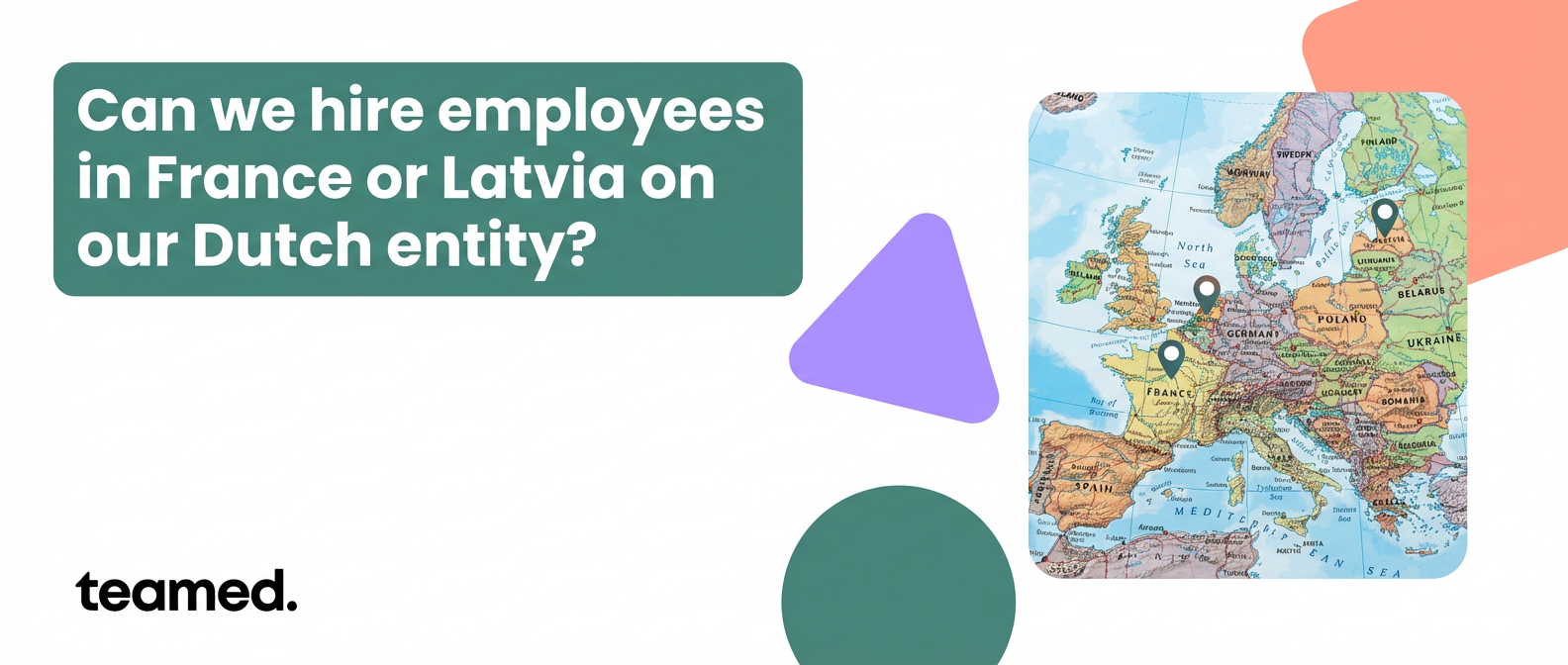
Your Dutch BV has become the natural hub for European operations. The team in Amsterdam is humming along, and now you've found the perfect candidate in Lyon. Or maybe your CTO wants to build an engineering pod in Riga. The question lands on your desk: can we just add them to the Dutch payroll?
The short answer is yes, a Dutch entity can employ people who live and work in France or Latvia. But "can" and "should" are different questions, and the gap between them is where compliance headaches, tax surprises, and six-figure correction costs live. The reality is that employees physically working in France or Latvia are generally governed by local employment law, social security, and often income tax in those countries, regardless of which entity signs their contract or processes their salary.
This isn't a reason to abandon your expansion plans. It's a reason to understand your options clearly before you make promises to candidates or commitments to the board.
A Dutch entity (typically a BV) is a Netherlands-registered legal employer that can contract and pay workers, but it does not automatically give the company employer registration or payroll capability in other EU countries. Here's what you need to know before moving forward:
A Dutch BV can legally employ staff who live and work in France or Latvia, provided it complies with local employment, tax, and social security rules in those countries.
French and Latvian employees are generally governed by the law of where they physically work, even when paid from a Dutch entity.
Your main employment model options are foreign employer registration, Employer of Record (EOR), or establishing a local entity. Contractors and posting workers are separate arrangements with distinct rules.
Payroll registration in France or Latvia does not automatically create a corporate tax permanent establishment, but the issues are related and require separate assessment.
France is administratively heavier for employment compliance, with mandatory employee representation thresholds and extensive collective bargaining requirements. Latvia is operationally simpler but still requires local payroll alignment.
Mid-market companies (200 to 2,000 employees) frequently reach an inflection point around 200 to 300 employees where fragmented country-by-country employment vendors create measurable operational overhead.
Yes. A Dutch BV can employ staff who live and work in another EU country, including France and Latvia. EU free movement principles and social security coordination rules explicitly permit this arrangement.
But here's what most guidance fails to clarify: if someone works from France or Latvia on an ongoing basis, local labour law, social security, and often income tax in that country apply by default. The nationality of your company doesn't override where the work happens. Paying someone from Dutch payroll without compliant host-country registration can create multi-year arrears exposure for unpaid social contributions and tax withholding.
The distinction that matters is whether your employee is relocating to the Netherlands or remaining based in France or Latvia. If they're relocating, Dutch employment law applies. If they're staying put and working remotely from Lyon or Riga, you need a compliant structure in their country.
A foreign employer registration is an administrative process where a company without a local entity registers with a country's tax and social security authorities to run compliant local payroll for employees working in that country. This is one of several options, and the right choice depends on your headcount plans, risk tolerance, and how long you expect to operate in each market.
For cross-border EU employment, Teamed advises CFOs to model a 3 to 5 year employment-structure horizon when deciding between EOR, foreign employer registration, and local entity establishment, because switching costs and compliance transition work typically recur over multi-year growth cycles.
Your Dutch company remains the legal employer. You register with French or Latvian authorities for payroll, social security, and tax withholding purposes. This works well when you want direct employment relationships without creating a subsidiary, but it requires navigating local registration processes and ongoing compliance reporting.
An Employer of Record (EOR) is a third-party organisation that becomes the local legal employer for workers in a specific country, running payroll, tax, social security, and statutory benefits while the client company manages day-to-day work. EOR onboarding can be completed in as little as 24 hours once required worker data is available and checks are complete, which is materially faster than employer registrations or entity setup.
Choose EOR when you need a compliant hiring route within weeks rather than months, or when internal Legal and Finance require a clear allocation of local employment compliance responsibilities to a specialist provider.
Establishing a French SARL or Latvian SIA gives you maximum control over employment relationships, benefits design, and local HR policies. This makes sense when you're building a sustained presence with multiple employees and want direct authority over the employment relationship.
Contractor arrangements are not employment. They're business-to-business service relationships with materially different tax and labour protections. Misclassification risk is the legal and financial exposure that arises when an individual treated as an independent contractor is later recharacterised as an employee by a court or authority, triggering back taxes, social security, and employment rights liabilities.
Choose a contractor model only when the role can be delivered as an independent service with genuine autonomy over working time and methods, and when the individual is not integrated into management structures typical of employment.
The EU posting of workers framework is a cross-border employment mechanism that allows an employer established in one EU/EEA country to temporarily post employees to work in another EU/EEA country while keeping them on the home-country social security system under an A1 certificate. This is designed for temporary assignments, not permanent remote setups.
EU guidance is clear: if you hire employees in another EU country, you need to register with the local authorities as an employer. This applies to Dutch entities hiring in France or Latvia.
Foreign employer registration typically involves obtaining local employer and tax identification numbers, setting up local payroll reporting and withholding, enrolling employees in host-country social security, and complying with local minimum employment standards including contracts, notice periods, and leave entitlements.
The process differs between France and Latvia. France requires more extensive documentation and has longer processing times. Latvia is generally faster but still requires careful attention to registration requirements.
This registration does not automatically create a corporate tax permanent establishment. But if your French or Latvian employees negotiate contracts, manage key clients, or have broad authority to bind the company, you need a separate PE assessment with tax advisors.
In France, the statutory full-time working time baseline is 35 hours per week, which directly affects overtime calculations and working-time compliance for employees working in France.
Employees normally working in France are covered by the Code du Travail, even if legally employed by a Dutch company. This means French rules on working time, paid leave, notice periods, and termination apply from day one. Sectoral collective bargaining agreements (Conventions Collectives) may add additional requirements depending on your industry.
Register in France as an employer with no establishment (employeur sans établissement) and use French payroll to pay salaries, withhold income tax, and remit social contributions. All work permit-related procedures must now be submitted digitally through the ANEF-Emploi platform.
France requires establishment of a Comité Social et Économique (CSE) once you employ at least 11 employees for 12 consecutive months. The CSE has rights to prior information and consultation on significant business decisions. Failure to establish or respect CSE rights constitutes the criminal offense of "délit d'entrave," punishable with substantial penalties.
For Dutch employers in regulated sectors like financial services, healthcare, or technology, this threshold matters. Hiring beyond 11 employees in France introduces mandatory governance structures that require dedicated HR attention.
EU/EEA citizens do not need work permits to work in France. Non-EU nationals typically require sponsored permits. France's Passeport Talent Monde offers a consolidated four-year renewable work permit for high-skilled roles, with approval guaranteed within 30 days for positions paying at least €34,650 gross annually.
Latvian Labour Law applies to employees normally working in Latvia, even when employed by a Dutch company without a subsidiary.
Written contracts must specify job duties, salary, hours, holiday entitlement, probation period, and notice requirements. Contracts are typically in Latvian or a mutually understood language if the employee cannot read Latvian.
Register for payroll and State social insurance. Latvian State Mandatory Social Insurance Contributions (VSAOI) for 2025 total 34.09% of gross salary, split as 23.59% employer contribution and 10.50% employee contribution. You must register foreign employees with the Latvian Tax Agency by the 194th day of their stay to maintain compliance.
EU/EEA citizens can work without a permit and commence employment upon arrival, subject only to address registration for stays exceeding 90 days. Non-EU nationals require employer-sponsored work permits with processing typically taking 10 to 15 days.
Latvia allows probationary periods of up to three months, extendable to six months through collective agreements. During probation, termination requires only three days' written notice. Post-probation, employers must provide justifiable grounds for termination and follow statutory notice procedures. Unfair termination claims can result in reinstatement orders and back pay awards.
Under EU social security coordination rules, an A1 certificate is commonly used to keep an employee in the home-country social security system for postings that are typically capped at 24 months.
A posted worker normally works in one EU country but is sent temporarily to another EU country, keeps their original contract, and usually retains original social security coverage. Dutch companies can post workers to France or Latvia for time-limited projects, but must meet host-country core labour standards and notify authorities where required.
Under the EU Posted Workers Directive framework, host-country rules on a core set of working conditions, including minimum pay elements and working time, must generally be applied to posted workers while they work in the host country.
Don't use posting to avoid foreign employer registration when your needs are permanent. Posting is designed for temporary assignments, not ongoing remote work arrangements.
Permanent establishment (PE) is a corporate tax concept where a company can become subject to corporate income tax in another country if it has a sufficient business presence there, including certain dependent agent or fixed place of business arrangements.
Payroll registration doesn't automatically create PE, but the issues are related. Risk indicators include local employees who negotiate or sign contracts, dedicated office or facility space, and country managers with broad authority to bind the company.
For regulated mid-market employers, Teamed categorises employment-model risk into three measurable buckets: payroll non-registration exposure, misclassification exposure, and permanent establishment exposure. Each maps to different audit evidence and remediation cost profiles.
Many mid-market firms employ across Europe without triggering PE when roles and structures are designed carefully. But if your French sales director is closing deals or your Latvian country manager has authority over significant business decisions, involve tax and legal advisors early.
EOR makes sense for fast market entry, small headcount, market testing, and uncertain time horizons. The trade-offs become more significant as teams grow: higher per-employee costs, less direct HR policy control, and potential vendor sprawl across countries.
A local entity offers employer brand strength, direct authority relationships, country-specific benefits and policies, and better audit and regulatory fit. For companies in regulated industries, entity establishment often becomes necessary to meet supervisory expectations.
Choose a mixed model (EOR for first hires, entity later) when you anticipate near-term hiring uncertainty and want to defer entity fixed costs while keeping a pre-planned transition path. The key is making this part of a deliberate employment model roadmap rather than a reactive vendor event.
Map current and planned headcount by country. Identify clusters in France, Latvia, and other markets. Review current vendors and models. Capture industry-specific obligations.
Create an employment model playbook with defaults for EOR versus foreign employer registration versus entity. Align People, Finance, Legal, and Compliance on criteria including cost, speed, control, and risk tolerance.
Phase market entries deliberately. Standardise processes across countries. Plan registrations and EOR onboarding. Embed PE and immigration checks. Review annually as headcount evolves.
Teamed can help design this roadmap and harmonise models across 180+ countries and regulated sectors, ensuring your employment strategy evolves with intention rather than by accident.
Assuming Dutch rules apply everywhere. French and Latvian employees are governed by local law regardless of which entity pays them.
Misclassifying contractors. Long-term, full-time contributors in France or Latvia who are integrated into your team are employees under local law, whatever your contract says.
Partial compliance. Registering payroll but ignoring CSE requirements in France or lawful termination procedures in Latvia.
Skipping PE assessment. Hiring senior commercial or managerial roles abroad without evaluating permanent establishment implications.
Vendor sprawl. Multiple EOR and payroll providers without a unified strategy, causing inconsistent contracts, benefits, and compliance.
Late immigration handling. Non-EU hires in France or Latvia need early work and residence planning to avoid delays.
Set-and-forget models. Failing to review model suitability as headcount grows or business needs change.
Start by clarifying your business objectives in each country. Are you making a single strategic hire or building a team? The answer shapes your model choice.
For near-term hiring, select the appropriate model per role set. EOR offers speed and clear compliance allocation. Foreign employer registration maintains direct employment relationships. Local entities provide maximum control for sustained presence.
Align People, Finance, Legal, and Compliance on employment law, tax and PE considerations, immigration requirements, and sector-specific obligations. Build an action plan covering model selection, registrations, contract drafting, and payroll setup.
Plan reviews and transitions as headcount stabilises. The goal is a coherent European employment strategy that supports your growth without creating compliance surprises for boards or auditors.
If you're navigating these decisions and want strategic guidance tailored to your situation, talk to the experts at Teamed. We help mid-market companies design employment model roadmaps across Europe and support transitions between contractors, EOR, and entities over time.
Review each case against French or Latvian requirements. Move people onto a compliant model, whether foreign employer registration or EOR. Obtain tax and legal input to regularise payroll, social security, and contracts. The correction process varies based on how long the non-compliant arrangement has been in place and what back-contributions may be owed.
Equity plans can usually extend to France and Latvia, but local tax, securities, and employment law affect plan design, documentation, and communication. French employees face specific tax treatment on stock options and RSUs. Latvian rules differ. Seek country-specific advice and assess withholding and reporting requirements before making grants.
EOR is typically fastest, often within days once worker data is available. Direct foreign employer registration takes several weeks depending on documentation readiness and authority processing times. Entity setup takes longer, typically several months. Plan accordingly based on your start date commitments.
Under GDPR, HR data processing for employees in France, Latvia, and the Netherlands requires a lawful basis and compliance with data subject rights. Regulatory fines can reach up to €20 million or 4% of global annual turnover for certain breaches. Ensure your HRIS supports GDPR compliance, review vendor data processing agreements, and provide appropriate privacy notices to employees.
Mid-market typically means 200 to 2,000 employees or approximately £10 million to £1 billion revenue. At this scale, employment model choices in France and Latvia have strategic implications for cost, control, audit readiness, and risk. You're large enough to need sophisticated guidance but not large enough to have dedicated global employment counsel in-house.
Compare salary, employer social contributions, benefits, vendor fees, internal compliance workload, advisory costs, and transition costs. Build side-by-side cost and risk views for France and Latvia with expert support. The cheapest option on paper isn't always the best choice when you factor in compliance risk, operational complexity, and long-term flexibility.
You're hiring your fifteenth employee in Germany. The role is critical, the candidate is strong, and your CFO wants to know: should this be a fixed term contract or permanent? The answer feels like it should be straightforward. It isn't.
The choice between fixed term and permanent contracts shapes your compliance exposure, severance obligations, and talent retention across every market you operate in. Get it wrong in one country, and you've created a precedent that complicates hiring decisions in five others. For mid-market companies scaling across Europe, the UK, and beyond, this isn't an HR administrative question. It's a strategic decision that affects your audit readiness, your ability to restructure, and your relationship with regulators who are paying closer attention than ever.
This article gives you a practical framework for deciding when fixed term contracts make sense, when permanent employment is the safer choice, and how to avoid the compliance traps that catch growing companies off guard.
A fixed-term employment contract is an employment agreement that ends on a defined calendar date, on completion of a specific project, or on the occurrence of an objectively verifiable event stated in the contract. A permanent employment contract continues for an indefinite period until terminated by either party in accordance with statutory and contractual notice and dismissal rules.
Here's what you need to know before making this decision:
In Europe and the UK, fixed term employment is legally reserved for genuinely temporary needs. Permanent contracts are the expected default for ongoing roles.
You can structure some roles either way, but don't let candidates choose freely between fixed term and permanent for the same ongoing job. That creates equal treatment problems and weakens your position with regulators.
Fixed term contracts feel flexible but can hide significant legal and severance risk, particularly when renewed repeatedly. Permanent contracts offer stability and predictability but reduce your ability to restructure quickly.
The right choice depends on the role's nature, your market maturity, local legal limits, and how this decision fits your broader employment model across contractors, EOR arrangements, and owned entities.
European and UK jurisdictions are tightly regulated, with fixed-term employment rates varying significantly from 7.5% in Germany to 18.7% in the Netherlands. North American markets require different approaches. One global policy rarely fits all.
A fixed-term employment contract ends on a set date or upon project completion. The employee is on your payroll, subject to local employment law, and entitled to similar rights and benefits as permanent staff under most European and UK frameworks.
This matters because fixed term employees are not contractors. They're employees with statutory protections, tax withholding obligations, and often comparable benefit entitlements. The distinction trips up companies that assume fixed term arrangements offer contractor-like flexibility.
Core features of fixed term employment:
A written end date or defined completion event
A documented purpose, such as maternity cover, a specific project, or seasonal demand
Similar statutory rights to permanent employees, including paid leave and notice periods
Limits on duration and renewals in most European jurisdictions, with automatic conversion to permanent status if those limits are exceeded
In Germany, a fixed-term contract without objective reason is generally limited to a maximum of 2 years and may be extended up to 3 times within that 2-year period under the Part-Time and Fixed-Term Employment Act. In the Netherlands, where 18.7% of employees work on fixed-term contracts (one of the highest rates in the EU), the chain rule generally limits employers to 3 fixed-term contracts in a row within 36 months, after which the contract typically converts to an indefinite-term employment relationship.
Common scenarios where fixed term contracts make sense:
Covering a specific parental leave absence in France
Staffing a defined 18-month project in Germany
Testing a new market with a small team before committing to permanent headcount
Addressing a temporary increase in workload with a documented end date
The key distinction from contractors: fixed term employees are on payroll, receive statutory benefits, and are protected by employment law. Temporary agency workers and independent contractors operate under different frameworks entirely.
A permanent employment contract has no preset end date. It continues until lawfully ended by either party, which in Europe and the UK typically requires a fair reason and fair process once the employee has qualifying service.
Permanent employees receive ongoing salary, full statutory benefits, and redundancy or dismissal protections that increase with tenure. In the UK, an employee generally needs 2 years of continuous service to qualify for statutory redundancy pay and ordinary unfair dismissal protection, which materially changes termination risk for permanent hires after the 24-month point.
Key characteristics of permanent employment:
No contractual end date
Full access to statutory and occupational benefits, including pensions, bonuses, and equity where offered
Notice periods that increase with service (UK statutory notice is 1 week after 1 month of service, increasing by 1 week per year up to 12 weeks after 12 years)
Dismissal protections that require documented performance issues, redundancy procedures, or other fair reasons
Permanent contracts are the default for core roles in established markets. Think your product engineering team, your compliance officers, your revenue-generating sales staff. These are positions integral to your operating model that will exist beyond any 24-month horizon.
The contrast with fixed term is straightforward: permanent offers ongoing stability with higher exit costs. Fixed term has a planned end point but increasingly comes with its own legal complexity.
Technically, yes. Practically, it's risky.
Some roles can be structured either way, but the decision should be based on the nature of the work and local legal requirements, not candidate preference. Offering a choice between fixed term and permanent for the same ongoing job creates problems that compound across your organisation.
Why offering a choice is problematic:
Equal treatment for fixed-term workers is a legal principle requiring that fixed-term employees receive the same pro-rated pay, benefits, and access to vacancies as comparable permanent employees unless objective justification exists. If you hire two software engineers in Germany doing identical work, but one is permanent and one is fixed term, you've created an internal precedent that's difficult to defend.
Regulators and courts examine the actual role, not just the contract label. Continuous, core work with repeated renewals makes mixed treatment hard to justify. If the work is genuinely ongoing, why is one person on a fixed term?
The practical approach:
Decide contract type per role in advance. Write a clear policy. Apply it consistently within each country. Where you use fixed term contracts, document the objective business reason, whether that's a time-limited project, temporary replacement for parental leave, or demand uncertainty with defined end criteria.
Consider a hypothetical mid-market fintech hiring two compliance analysts in Spain. One analyst accepts a permanent role. The other prefers a 12-month fixed term because they're considering a move abroad. Six months later, the fixed term analyst discovers they're excluded from a bonus scheme available to permanent staff. The grievance that follows creates internal friction and potential legal exposure that far outweighs any administrative convenience from offering the choice.
Seek country-specific advice before offering alternatives. The complexity multiplies when you're making these decisions across five or more European countries simultaneously.
Fixed term contracts can help you cover temporary needs, align headcount to project timelines, and test roles or markets without long-term commitment. When you're entering a new European market and uncertain whether the revenue will justify permanent headcount, a fixed term arrangement lets you hire locally while preserving flexibility.
But the cons are significant. European and UK rules on duration and renewals are complex. Termination risks can exceed what you'd face with permanent employees. In some common law jurisdictions, poorly drafted early termination clauses can make fixed terms liability multipliers rather than risk limiters.
Ontario courts have established that defective termination clauses can require paying salary for the balance of the term if you end early without valid cause. An employer intending to limit severance liability through a fixed term contract may instead face open-ended financial exposure equivalent to years of salary payments. Similar trends are emerging in other jurisdictions.
Comparable benefits are often required. You can't use fixed term status to avoid pension contributions or bonus eligibility in most European frameworks.
For employees, fixed term contracts offer access to preferred employers and clear end dates that may fit personal plans. In many European countries, fixed term employees receive similar statutory rights and benefits to permanent colleagues.
The downsides are real: less security, difficulty planning major commitments like mortgages, and sometimes fewer progression or training opportunities. Employers may invest less in development for someone with a defined departure date.
Permanent contracts help you attract and retain top talent. They build institutional knowledge and create simpler internal equity when everyone in core roles has the same employment status.
The trade-off is reduced flexibility. Reshaping your workforce requires formal performance management or redundancy processes. Long-term commitments to salary, benefits, and severance accumulate, particularly in European markets where termination is complex and expensive.
Permanent employment makes sense for roles integral to your long-term operations: your HQ product leaders, your compliance officers, your senior engineers. These are positions where turnover is costly and continuity matters.
Permanent employees enjoy greater security, clearer career paths, and fuller access to occupational benefits including pensions, bonuses, and equity. The stability supports long-term planning and often correlates with higher engagement.
The cons are more subtle: less flexibility to move, tighter working pattern expectations, and sometimes slower salary growth compared to short-term or consulting routes.
In many European countries, permanent is the legal default, and termination is complex. Expansion to North America introduces at-will differences that change the calculus entirely.
Across EU member states, the EU Fixed-Term Work Directive requires member countries to implement measures to prevent abuse from successive fixed-term contracts, typically through maximum total duration, renewal caps, or objective justification requirements.
The general pattern: after certain service or renewals, conversion to permanent status may occur automatically. Transparent and Predictable Working Conditions rules require clear written terms including duration and renewal conditions.
Country-specific constraints:
United Kingdom: The Fixed-term Employees (Prevention of Less Favourable Treatment) Regulations 2002 generally treat a fixed-term employee as permanent after 4 years of continuous employment on successive fixed-term contracts unless the employer can objectively justify continued fixed-term status. Expiry and non-renewal of a fixed-term contract is treated as a dismissal for employment law purposes, meaning employees with 2+ years' service can bring an unfair dismissal claim if process and reason are not defensible.
Germany: A fixed-term contract without objective reason is generally permitted for up to 2 years with up to 3 extensions within that period. Exceeding these limits can result in the relationship being treated as indefinite.
Netherlands: Using more than 3 consecutive fixed-term contracts or exceeding a 36-month chain typically triggers conversion to an indefinite contract, subject to specific collective agreement exceptions.
Spain: Post-2021 reforms tightened the lawful grounds for temporary contracts and increased enforcement focus. Employers must map the fixed-term reason to a permitted category and maintain supporting evidence for audits and labour inspections.
France: Fixed-term contracts (CDD) are generally restricted to specific legally defined cases such as replacement, temporary increase in activity, or seasonal work. Misuse can lead to reclassification as a permanent contract (CDI) with associated liabilities.
These thresholds and sector nuances change. Confirm current rules with local counsel before scaling fixed term usage in any market.
For mid-market organisations in regulated sectors, Teamed treats serial fixed-term renewals beyond 24 months as a default escalation trigger for legal review because multiple European jurisdictions have conversion-to-permanent or objective-justification thresholds at or near the 2-year mark.
Decision checklist:
Is the role core or temporary? Core roles that support your long-term strategy, such as revenue, product, or regulated control functions, should default to permanent. Temporary needs with documented end dates can justify fixed term.
What's your market maturity? New markets with uncertain revenue may warrant fixed term arrangements while you validate demand. Established markets with revenue-generating operations should move toward permanent employment.
What are your headcount plans? If you expect to grow the team in-country, building on rolling fixed terms creates conversion risk and complicates workforce planning. Plan for permanent from the start.
What's your compliance capacity? If your HR and legal bandwidth is limited, simpler and more stable models reduce risk. Fixed term contracts require active tracking of end dates, renewal limits, and conversion triggers.
How does this fit your broader employment model? Across mid-market hiring projects that Teamed supports, the operational decision is rarely binary because fixed-term versus permanent choices commonly interact with parallel decisions on contractor use, EOR use, and whether to establish an entity in the same country within a 12 to 24 month horizon.
Document your approach. Apply it consistently. Route exceptions through central HR and legal review.
Serial fixed term contracts, meaning repeated renewals or back-to-back contracts for the same person over years, create compounding risk that mid-market companies often underestimate.
Legal risk: European, Canadian, and other common law trends treat long-running fixed terms as permanent employment. Contractual limits on notice and severance can be overridden by courts that find the arrangement was indefinite in substance. Ontario's substratum doctrine examines whether an employee's actual duties have evolved significantly over successive renewals. When courts determine the work has become integral to operations, they discard contractual limitations and award damages based on total tenure.
Financial risk: Defective termination clauses can trigger damages equal to the remaining term. Evolving duties over renewals can undermine original terms. What looked like a cost-controlled arrangement becomes an uncapped liability.
Operational risk: Heavy administrative burden tracking end dates across dozens of employees. Morale issues among fixed term staff who feel like second-class citizens. Workforce planning disrupted by legal conversion requirements you didn't anticipate.
Consider a hypothetical scenario: a mid-market healthcare technology company discovers during an audit that 40 employees across Germany, Spain, and the Netherlands have been on rolling fixed term contracts for 3+ years. Local counsel advises that most qualify for permanent status under local conversion rules. The company faces simultaneous reclassification across three jurisdictions, with associated severance recalculations and benefit adjustments.
At mid-market scale, treat serial fixed term use as an exception requiring documented justification and central tracking. Don't let it become the default.
Contract choice doesn't exist in isolation. It's one decision within a broader global employment model that includes contractors, EOR arrangements, and owned entities.
The typical evolution:
Initial market test: You engage contractors or a few fixed term employees via EOR to validate the market or function. Local compliance is handled externally while you assess whether the investment will pay off.
Scaling phase: As headcount and revenue grow, you shift toward permanent roles and potentially an owned entity. Fixed term arrangements convert to permanent. Your employment model matures.
Mature stage: You establish a clear global policy on when to use fixed term versus permanent, aligned with local variation. HR, Finance, and Legal are aligned across countries. Exceptions are documented and approved centrally.
Teamed provides employment model guidance backed by in-market legal expertise across 180+ countries, which HR and Legal teams use to benchmark fixed-term and permanent contract constraints when expanding into new jurisdictions.
European HQ firms expanding to the US, Canada, or Asia face different classification norms and expectations. Inconsistency across 5+ countries complicates audits and employee understanding. A unified strategic approach, rather than ad hoc decisions market by market, reduces both compliance risk and operational complexity.
If you've grown quickly and suspect your fixed term practices have drifted, here's how to get back on solid ground:
Inventory: List all fixed term agreements by country. Capture role type, length of service, number of renewals, and whether the work is genuinely temporary or effectively permanent.
Flag risk: Identify multiple renewals, core business functions on fixed terms, or silent continuations beyond end dates. These are your highest-priority issues.
Template review: Engage local counsel or advisors to review termination clauses, renewal language, and current compliance. Defective clauses can convert manageable exposure into significant liability.
Regularise: Convert long-serving fixed term staff to permanent where appropriate. Align benefits and seniority. Document reasons for any remaining fixed term roles with objective justification.
Governance: Define when fixed terms are allowed. Set duration and renewal parameters per local law. Route exceptions through central HR and Legal with tracking.
Segment your audit by country, prioritising stricter European and UK jurisdictions. This is especially relevant for fast-grown mid-market firms with fragmented practices across markets.
Teamed was founded in 2018 and has advised over 1,000 companies on global employment strategy, which informs its recommended decision framework for when fixed-term hiring is a controlled exception versus a default approach.
We focus on mid-market companies operating or planning to operate in multiple countries, advising on contractors, fixed term, permanent, and entity setup. Our guidance covers market-by-market model selection: when fixed term is appropriate, when permanent is safer, and how those choices interact with EOR arrangements and local entities.
In-country legal insight across 180+ countries informs recommendations based on current European, UK, and global enforcement trends. We support transitions over time, from contractor to fixed term to permanent, to minimise compliance risk and disruption.
If you're making contract decisions across multiple markets and want strategic counsel rather than vendor sales pitches, talk to the experts.
In many European and UK jurisdictions, fixed term employees must receive broadly comparable benefits to permanent colleagues doing similar work. Materially different packages create legal and employee relations risk unless you have a clear, objective justification.
Only if the contract includes a well-drafted, locally compliant early-termination clause. In some jurisdictions, defective clauses can require paying salary for the balance of the term if you end early without valid cause.
European countries typically limit total duration or renewal counts before conversion to permanent status. In Germany, 3 renewals within 2 years is the general limit without objective reason. Always check current national rules and obtain local advice rather than relying on a generic maximum.
Yes. Moving a genuine independent contractor onto fixed term employment can reduce misclassification risk and serve as a bridge to permanent. Ensure the arrangement reflects the true nature of the work and aligns with local tax and employment laws.
Not necessarily. Equal-benefit rules, early-termination exposure, and conversion risks can make fixed terms more expensive overall, particularly with multiple renewals.
Mid market typically means roughly 200 to 2,000 headcount or about £10m to £1bn in revenue. At this scale, contract choices affect board-level risk, audits, and global workforce strategy, not just individual hires. The stakes are higher, and the complexity compounds across markets.
Follow local redundancy, consultation, and notice rules for both fixed term and permanent staff. Check whether early termination of a fixed term triggers additional payments or obligations even if the end date is near.
You've found the perfect candidate. They've aced the interviews, the team loves them, and they're ready to start in Amsterdam next month. Then someone asks the question that stops everything: "Wait, are we even set up to sponsor their visa?"
This moment hits mid-market companies harder than most. You're not a startup that can improvise, and you're not an enterprise with a dedicated immigration team. You're somewhere in the middle, making six-figure decisions about Dutch expansion while juggling EOR arrangements in three other countries and contractor conversions in two more.
The good news? You have options. The Netherlands offers several fast-track pathways for hiring non-EU talent, and the right choice depends less on which route is "fastest" and more on how it fits your broader European employment strategy. IND sponsorship isn't just an immigration checkbox. It's a strategic decision that shapes your compliance posture, operational costs, and hiring flexibility for years to come.
Four main options exist when you need to hire someone requiring IND sponsorship: become an IND recognised sponsor yourself, use a third-party payrolling and immigration services provider, engage an Employer of Record in the Netherlands, or hire the person remotely in their current country instead of relocating them
Speed varies dramatically by route: partnering with an existing IND-recognised sponsor or using an EOR can get someone working in weeks, while applying for your own recognised sponsor status takes several months
Cost and control trade-offs matter: each option differs on employment contract ownership, compliance obligations, and long-term strategic fit, particularly for regulated sectors where audit trails and direct employment relationships carry weight
IND sponsorship choices should connect to your European strategy: treating Dutch immigration as a one-off fix rather than part of a coherent employment model across countries creates vendor fragmentation and compliance gaps
Mid-market companies typically reach EOR-to-entity break-even at roughly 8-15 employees when EOR fees run €500-€1,200 per employee per month, according to market analysis and Teamed's mid-market cost modelling guidance
IND recognised sponsorship is a Dutch immigration authorisation that allows an employer registered with the Netherlands Immigration and Naturalisation Service (IND) to sponsor eligible non-EEA nationals for residence and work, including the Highly Skilled Migrant programme. Without this recognition, you cannot directly sponsor a work permit for non-EU talent.
The system connects three parties with ongoing obligations. The Dutch state (through the IND) sets and enforces the rules. The recognised sponsor, whether your own Dutch entity or a third-party provider, holds the licence and maintains compliance. The employee meets permit and role criteria throughout their employment.
Here's what catches many mid-market employers off guard: becoming an IND recognised sponsor requires your organisation to demonstrate sufficient income to sustain the offered salary throughout the employment period. Companies in hypergrowth phases or with revenue volatility above 20-30% often need more extensive financial documentation, which can add weeks to the application timeline.
The Highly Skilled Migrant (HSM) permit is the primary route for international specialists. It requires sponsorship by an IND recognised sponsor and compliance with monthly minimum salary thresholds set by the Dutch government. These thresholds vary by age and family situation, with €5,937 for those aged 30+ and €4,354 for those under 30 as of 2026, but the underlying logic is that compensation must represent true market rates rather than artificially depressed wages.
Consider a German-headquartered tech company building a product hub in Amsterdam. They need IND recognition as part of their wider EU talent plan, not as an isolated immigration task. The sponsorship decision connects to entity establishment timing, headcount projections, and how Dutch hiring fits alongside EOR arrangements in France and direct employment in their Berlin headquarters.
You've extended an offer to a non-EU candidate, and now you've realised your company isn't on the IND company list. This happens more often than you'd think, especially when mid-market companies are moving quickly on talent acquisition while their legal and HR infrastructure catches up.
You have three compliant options that don't require waiting months for your own sponsor recognition.
External recognised sponsor (payrolling and immigration services): A Dutch specialist employs the worker, acts as the IND recognised sponsor, and assigns them to work exclusively for you. The worker starts on the provider's payroll while you manage their day-to-day activities. This can move quickly because the provider already has IND recognition and established processes.
Employer of Record in the Netherlands: An EOR becomes the legal employer for your Dutch hire, handling payroll, tax withholding, statutory benefits, and local employment compliance while you direct the worker's activities. A realistic operational timeline to run a first compliant payroll through an EOR is often 1-3 weeks once offer terms, identity checks, and local contract terms are finalised, according to Teamed's implementation playbooks for mid-market teams.
Remote hiring in another country: Keep the person in their current country and employ them there instead of relocating. No Dutch visa needed. This works when the role can be performed remotely and relocation timing is uncertain or blocked by sponsorship readiness.
What you cannot do is engage someone as a contractor while they're living and working in the Netherlands if the facts of the arrangement look like employment. In the Netherlands, attempting to "work around" sponsorship by engaging a de facto employee as a freelancer can create both tax and employment-law exposure because Dutch authorities assess substance over contract labels in employment status disputes.
The choice between these options depends on how critical the Dutch location is, your forecast volume of similar hires, and your compliance risk tolerance. A UK fintech with a small Dutch team might lean toward an external sponsor for one or two hires. A company with an existing EU entity might consider whether remote hiring in another EU country makes more sense than Dutch sponsorship.
Payrolling in the Netherlands is an employment arrangement where a third-party payroll employer hires the worker on its Dutch payroll and administers wages, taxes, and statutory employment obligations while you manage day-to-day work. When combined with immigration services, the provider also handles IND sponsorship on your behalf.
The typical workflow moves quickly because the provider already has infrastructure in place. You sign a commercial agreement with the provider. They issue an employment contract to your candidate. They submit the IND sponsorship application using their recognised sponsor status. The worker starts day-to-day work for you while employed by the provider.
This route offers real speed advantages. The provider is already on the IND company list, so there's no waiting for your own recognition. They have established documentation processes and know exactly what the IND requires. For a Nordic healthtech placing a specialist in Rotterdam, this can mean the difference between a three-week start date and a three-month delay.
But the trade-offs matter. You have less direct control over contract terms because the worker is employed by another company. In regulated sectors like financial services or healthcare, auditors and regulators may scrutinise external payrolling arrangements more closely. And you'll pay ongoing provider fees that add up over time.
When evaluating a payrolling and immigration services provider, check their sector experience and references. Understand the RACI for compliance and reporting to the IND. And get clarity on costs, exit terms, and how you'd transition the employee to direct employment if you later become an IND recognised sponsor yourself.
A Highly Skilled Migrant permit is a Netherlands work and residence route for non-EEA employees that requires sponsorship by an IND recognised sponsor and compliance with monthly minimum salary thresholds set by the Dutch government. But it's not the only option.
The EU Blue Card offers a pathway for highly qualified workers, with higher salary and qualification thresholds than the HSM route. It provides some mobility within the EU after an initial period, which can matter for companies planning multi-country careers for their talent.
The Intra-Corporate Transferee (ICT) permit allows internal transfers within a corporate group. If you're moving a senior engineer from your German headquarters to your Dutch operations, ICT may be more appropriate than HSM. The worker remains employed by the sending entity, which changes the compliance picture.
Switches from graduate or orientation year visas to sponsored roles are possible where criteria are met. If your candidate is already in the Netherlands on a student visa, transitioning to HSM sponsorship can sometimes be faster than starting fresh.
An IND recognised sponsor approach differs from using an EOR in that the sponsor approach places immigration sponsorship and employer obligations directly on the hiring company's Dutch entity, while an EOR keeps the third party as the legal employer and often the operational sponsor pathway.
For mid-market companies, the choice depends on the talent profile, your growth plan, and your compliance appetite. A company building a Dutch hub with 10+ planned hires should seriously consider becoming an IND recognised sponsor. A company making a single strategic hire might find EOR or external sponsorship more practical.
Remote hiring outside the Netherlands differs from Dutch IND sponsorship in that remote hiring can avoid Dutch immigration processing entirely but may create permanent establishment and local employment-law exposure in the worker's country if managed incorrectly.
When does remote hiring make sense? Fully remote roles where location doesn't affect the work. Urgent timelines where relocation delays would impact delivery. Market test phases before committing to a Dutch hub.
An Employer of Record is a third-party organisation that becomes the legal employer for workers in a specific country, handling payroll, tax withholding, statutory benefits, and local employment compliance while you direct the worker's day-to-day activities. If you lack an entity in the worker's country, an EOR lets you employ them compliantly without establishing one.
Consider a London fintech that needs a software engineer urgently. The ideal candidate is in Poland. Rather than sponsoring them into the Netherlands, which takes months, the company engages an EOR in Poland. The engineer starts in weeks, works remotely, and the company avoids Dutch immigration complexity entirely.
The limitations are real, though. Time zones and collaboration patterns may not work for every role. Cultural integration with a Dutch-based team becomes harder. And if you're building a Dutch hub for strategic reasons, remote hiring elsewhere doesn't advance that goal.
For mid-market employers, Teamed's analysis suggests treating remote hiring as one tool in a portfolio rather than a default. The question isn't "remote or relocate" but "what employment model fits this role, this market, and our three-year plan?"
A common mid-market trigger for consolidating fragmented global employment vendors is operating across 5+ countries with mixed models (contractors, EOR, and entities), a pattern Teamed identifies as a leading indicator of audit and cost-control issues.
Start with diagnostic questions rather than jumping to solutions.
Must this role be in the Netherlands for clients, teams, or regulators? If the answer is no, remote hiring becomes viable. If yes, you're choosing between sponsorship routes.
How many similar Dutch hires do you expect in the next 12-36 months? One or two hires point toward EOR or external sponsorship. Five or more suggest building your own sponsor capability.
How critical is speed versus control and brand optics? EOR and external sponsors move faster. Direct employment gives you more control over terms and clearer audit trails.
Do you have internal capacity to manage sponsor obligations? IND recognised sponsors must report changes, maintain documentation, and cooperate with checks. If your HR team is already stretched, outsourcing this makes sense.
Are you in a regulated sector with expectations on direct employment? Financial services, healthcare, and defence companies often face scrutiny over employment chains. External payrolling may raise questions that direct sponsorship doesn't.
How does this fit your European portfolio? If you're using EOR in France and Germany while building an entity in the Netherlands, your Dutch sponsorship decision should connect to that broader strategy.
Patterns of fit emerge from these questions:
One-off or few hires: EOR or external sponsor for speed and low internal load.
Building a Dutch hub: Become an IND recognised sponsor and consider entity establishment.
Uncertain market fit or fully remote roles: Keep remote via EOR or direct employment in another country.
A practical board-level budget for setting up a straightforward EU subsidiary is typically €15,000-€60,000 in one-off legal, accounting, and registration costs, excluding ongoing finance and payroll operations, according to Teamed's entity-establishment planning assumptions. Factor this into your break-even analysis when comparing ongoing EOR fees to entity establishment.
Contractor misclassification is a compliance risk where an individual engaged as an independent contractor is legally deemed an employee due to factors such as control, integration, and economic dependence, triggering back taxes, social charges, and employment-rights liabilities.
In the Netherlands, the IND expects recognised sponsors to report changes promptly. If your sponsored employee changes roles, reduces hours, or sees a salary adjustment, you must notify the IND. Failure to do so can jeopardise your sponsor status.
Accurate record-keeping matters more than most mid-market employers realise. The IND can request documentation at any time. Inconsistencies between your offer letter, employment contract, and tax filings create rejection risk for future applications and potential enforcement action.
Regulated sectors face additional considerations. Financial services firms may find that external payrolling arrangements complicate their regulatory filings. Healthcare companies may need to demonstrate direct employment relationships for certain roles. Defence contractors often face security clearance requirements that interact with sponsorship structures.
Hiring a contractor differs from hiring via an EOR in that contractor models avoid employee payroll withholding and statutory benefits administration but increase misclassification exposure when day-to-day control, fixed hours, or managerial integration resembles employment.
The operational pitfalls tend to be mundane but consequential. Inconsistent HR, payroll, and immigration documentation across systems. Unclear internal ownership for sponsor compliance. Over-reliance on vendor assurances without independent oversight.
EOR or payrolling providers don't eliminate reputational and audit risks. They shift some compliance burden, but you remain responsible for the strategic decisions and governance framework. Design controls that span all employment models, not just your directly employed staff.
For mid-market employers, an EOR engagement in Western Europe commonly adds 10%-20% on top of gross salary when you combine provider fees with mandatory employer on-costs, according to industry benchmarks and Teamed's Europe/UK methodology.
Becoming an IND recognised sponsor involves several stages. Internal preparation and policy/document readiness typically takes weeks. Submitting your application and waiting for the IND decision takes several weeks to a few months. Post-approval setup for ongoing compliance adds more time. Budget three to four months from decision to first sponsored hire if you're starting from scratch.
Sponsoring an individual once recognised moves faster. Drafting a compliant HSM contract and collecting candidate documents takes days to weeks. IND submission and decision takes weeks. Entry, registration, and start date alignment adds a bit more. Total time from offer to start: typically six to ten weeks.
Using an existing sponsorship provider or EOR compresses timelines because the infrastructure is already in place. From agreement to IND submission can happen in days rather than weeks. The IND processing time remains similar, but you've eliminated the front-end delays.
Cost categories to budget for:
Government application and permit fees (€405 per HSM application)
Legal and advisory support for sponsor recognition or complex cases
Monthly provider fees if using payrolling/immigration services or EOR
Internal HR and Finance time for documentation and ongoing compliance
The total cost of ownership matters more than any single line item. Model scenarios across countries and employment models. A company paying €800 per employee per month in EOR fees for 12 Dutch employees is spending €115,000 annually before considering the cost of reduced control and contract flexibility. At that scale, entity establishment and direct sponsorship often make financial sense.
Most ranking pages explain IND sponsorship mechanics but don't provide a mid-market decision threshold for when EOR or payrolling fees typically exceed the fixed-cost burden of running a Dutch entity and sponsor capability. That's exactly the kind of strategic question Teamed helps companies answer.
Teamed acts as a strategic partner for mid-market companies, helping decide when to use contractors, EOR, IND sponsorship, or full entities in the Netherlands and across Europe. The guidance covers whether and when to become an IND recognised sponsor, how to transition from external payrolling or EOR to direct sponsorship, and how to manage change with minimal employee disruption.
Every recommendation is informed by local legal expertise across 180+ countries, ensuring Dutch choices fit your wider European hiring strategy. The typical deliverable is a 3-5 year employment model roadmap aligning Dutch IND choices with board, audit, and budget expectations.
If you're weighing different sponsorship and EOR options across several European markets, talk to the experts for a consolidated strategy rather than another isolated vendor quote.
It's often possible to switch to a sponsored Highly Skilled Migrant or similar route. Timing and current permit conditions must be checked carefully against IND rules with specialist advice. The switch process can sometimes be faster than starting fresh, but gaps in permit coverage create risk.
Yes, many companies do this successfully. Close the contractor arrangement properly, assess any past misclassification risk, and ensure the new Dutch employment and sponsorship are fully compliant. Document the transition clearly for audit purposes.
It can sit alongside EOR elsewhere. Treat all models as one European employment strategy with consistent governance, documentation, and decision criteria. The risk is fragmentation, where each country operates independently without strategic coherence.
When ongoing Dutch hiring is expected, direct control is valuable, and recurring EOR or payrolling fees would outweigh the one-off effort and ongoing maintenance of your own licence. Mid-market companies typically reach EOR-to-entity break-even at roughly 8-15 employees.
Acceptable if compliant and well governed. Ensure contracts, responsibilities, and documentation are clear and aligned with local law and sector expectations. Regulated industries may face more scrutiny, so document your rationale for the chosen structure.
Explain the mix of IND sponsorship, EOR, and remote hiring in plain language. Link to risk management and growth. Show decisions are grounded in specialist guidance rather than ad hoc vendor selection. A coherent employment model roadmap demonstrates strategic maturity.
Typically 200-2,000 headcount or £10m-£1bn revenue. Teamed's services target the complexity and needs of organisations at this scale, where you're too large for startup-friendly improvisation but don't have enterprise resources for dedicated global employment counsel.
Your Amsterdam engineering team needs a senior developer. You've found someone in Bangalore who can start in eight weeks, once their notice period ends. Your immigration advisor calls with two options: the Dutch Highly Skilled Migrant permit or the EU Blue Card. Both can work, she says. Both get your hire to Amsterdam.
But here's what she doesn't tell you: the choice you make now determines whether you can move this person to Berlin in 18 months without starting over.
I've watched too many companies learn this the hard way. They pick the faster route for their first ten hires, then realize they can't rotate talent between offices without completely re-filing. Or they choose based on salary thresholds alone, then discover their EOR can't sponsor Blue Cards when they're ready to establish their own entity. These aren't edge cases. They're predictable outcomes when you make visa decisions in isolation.
Let me walk you through what actually matters when you're choosing between these routes.
The EU Blue Card is Europe's attempt at a unified work permit for skilled professionals. Each country implements it slightly differently, but the core promise remains: hire someone in Amsterdam today, move them to Berlin tomorrow without starting from scratch. National HSW visas, like the Dutch Highly Skilled Migrant permit, are country-specific. They're tied to that country's rules, that country's employer, and that country alone.
Four things actually matter when you're deciding: how much it costs, how fast you can get someone started, whether you can move them later, and what happens when they want permanent residence.
National HSW routes typically cost less. Take the Netherlands: if you're hiring someone under 30, the HSM salary threshold drops significantly. That's real budget impact when you're hiring junior engineers. EU Blue Cards usually demand higher salaries, though Germany cuts you a break for IT roles and recent grads.
Speed? The Dutch HSM wins if you're a recognized sponsor. Two to four weeks and you're done. EU Blue Cards take longer because they scrutinize degrees more carefully and check whether the role truly matches the qualifications. Think six to twelve weeks in most countries.
But mobility? That's where the Blue Card shines. HSW permits lock you into one country. Want to move your Amsterdam hire to Berlin? You're filing a brand new application. With a Blue Card, after 12 months, they can transfer with simplified paperwork. Not zero paperwork, but much less.
Long-term residence works differently too. With HSW permits, only time in that specific country counts. Five years in the Netherlands gets you Dutch permanent residence. Period. Blue Card holders can combine time across EU countries. Three years in Amsterdam plus two in Berlin equals EU-wide permanent residence.
So which do you choose? If you're building one hub in one country and staying there, HSW routes make sense. If you're thinking about multiple offices and want to move talent around, the Blue Card can save you from re-filing nightmares later.
Let's talk about recognized sponsors for a moment. In the Netherlands, once the IND approves you as a sponsor, they trust your judgment. You say someone's qualified? They believe you. That means faster processing, fewer documents, and predictable timelines. Without that status, every application gets full scrutiny.
National HSW visas exist under local law in each EU member state. In the Netherlands, this is the Highly Skilled Migrant residence permit. In Germany, it's the qualified work visa for skilled workers. In Spain, employers commonly use the highly qualified worker or professional visa. Each country sets its own eligibility criteria, salary thresholds, and administrative requirements.
The EU Blue Card works differently. It's one concept implemented 27 different ways. The basic rules stay consistent, but salary thresholds change because they're pegged to each country's average wages. What qualifies in Poland won't qualify in Luxembourg.
Both routes exist because they solve different problems. National schemes like the Dutch HSM get people working quickly in one country. The EU Blue Card takes longer but builds in future mobility. One optimizes for today, the other for tomorrow.
Consider a defence tech firm opening a Berlin hub. If they're hiring senior engineers who might later transfer to Amsterdam or Madrid, the EU Blue Card creates structural flexibility. If they're hiring junior developers who'll stay in Berlin for the foreseeable future, Germany's national skilled worker visa might be faster and cheaper.
Most guides focus on what candidates want. But you're not the candidate. You're trying to build a team across Europe without drowning in visa applications. The route you choose now shapes every hiring decision that follows.
First rule of Blue Cards: your employment contract needs to run at least six months. Doesn't matter if you're paying double the threshold. Five-month contract? Application rejected. This catches companies trying to use short-term contracts as trial periods.
Both routes require a concrete job offer in a highly skilled role. The role should match the candidate's qualifications or experience. But the specifics diverge.
For national HSW routes, employer approval often matters more than individual credential checks. The Netherlands HSM scheme operates through its recognised sponsor system, where the IND has already vetted the employer. Once you're approved as a recognised sponsor, you can apply on behalf of workers without a separate preliminary immigration step. The trust-based model means applications proceed with minimal additional scrutiny.
EU Blue Card applications emphasise formal educational credentials more explicitly. The general requirement is a recognised university degree or equivalent qualification. In Germany, this typically means a bachelor's degree or higher, with the employment contract aligned to the candidate's field of study.
Germany changed the game for IT specialists recently. No degree? No problem, if you have three years of serious experience. But you'll need to prove your knowledge through certifications or formal training. It's not a free pass, but it opens doors for self-taught developers and bootcamp graduates.
For healthcare professionals, additional requirements apply regardless of route. Foreign-trained doctors and nurses holding recognised foreign diplomas must first work for three months under supervision in the Netherlands before proceeding to full HSM sponsorship. This supervised introduction period ensures Dutch medical practice standards are met.
What this means for you: HSW routes can be more flexible about credentials. The Dutch HSM, for instance, looks at the whole package. Blue Cards stick closer to the degree requirement, except for those German IT roles and some recent graduate programs.
Here's where companies mess up: not all compensation counts toward visa thresholds. Base salary? Yes. Guaranteed 13th month? Usually. Performance bonus? Almost never. Stock options? Forget it. I've seen offers get rejected because HR included the target bonus in their calculations.
In the Netherlands, the Highly Skilled Migrant route uses monthly gross salary thresholds that differ by age band. Employees 30 and older require higher thresholds than employees under 30. This creates a predictable budgeting rule for CFOs hiring junior versus senior talent. The graduate discount opens pathways to sponsor exceptional university graduates who might not command higher salaries immediately.
EU Blue Card thresholds in the Netherlands align with the HSM requirement for employees 30 and older. But a reduced threshold applies to graduates who obtained their degree within the past three years.
Country differences can shock you. Germany's Blue Card threshold for IT roles sits at €45,934.20 per year, well below the standard rate. The same developer who qualifies easily in Berlin might miss the mark in Amsterdam. One company I know shifted their entire engineering hiring to Berlin purely because of this gap.
The salary gap between countries is real. But don't let visa thresholds drive your location strategy. I've watched companies hire in Prague because it's cheaper, then struggle when their customers and partners are all in Paris. Build where your business needs to be, then figure out the visa math.
Let me be crystal clear about what counts: guaranteed fixed salary. Not your 'on-target earnings.' Not the equity package. Not the quarterly bonus. The number in the employment contract that hits their bank account every month, rain or shine. Get this wrong and you'll be explaining to your new hire why their visa got rejected despite a competitive offer.
A delayed visa doesn't just push back a start date. It can derail an entire product launch. I know a fintech that missed their German market entry by three months because their compliance lead's Blue Card got stuck in degree recognition. The dominoes fell fast: delayed license application, missed partnership window, competitors moved first.
The Dutch HSM scheme for recognised sponsors is one of Europe's fastest work visa pathways. The entire process, from application submission through residence permit issuance, typically completes within 2-4 weeks. This speed reflects the trust-based architecture underlying the Dutch system. The IND has determined that recognised sponsors have vetted their candidates appropriately and verified salary compliance.
Blue Cards take longer for good reason. They verify degrees more thoroughly. They check if the role truly matches the qualifications. Some countries even loop in professional bodies. An engineering role in Germany? The authorities might ask the engineering association to weigh in.
Employer status drives speed. Recognised sponsors in the Netherlands and approved fast-track employers in some German states move quicker. Newer or smaller firms without established sponsor status may face slower timelines.
If you need someone on-site for regulatory reasons, these delays hurt. Healthcare companies need their clinical leads present for inspections. Defense contractors can't start until cleared personnel are physically in the facility. Two weeks versus eight weeks isn't just inconvenient. It can violate contracts.
Don't forget your own internal delays. I see this constantly: HR needs Finance to approve the salary band. Finance wants Legal to review the contract. Legal has questions about sponsor obligations. Three weeks gone before you even submit the visa application. Build in buffer time, or watch start dates slip.
Getting the visa is just the beginning. Both routes require you to report changes: new salary, different role, even a new job title. Miss a notification deadline and you risk the whole permit. Ask yourself: do we have the processes to track this for dozens of sponsored employees?
Here's where the Blue Card earns its keep. After 12 months in your Amsterdam office, your Blue Card holder can transfer to Berlin without the full visa circus. They still need to notify German authorities and file some paperwork, but it's nothing like starting fresh. Try that with a Dutch HSM permit and you're back to square one.
The 12-month rule is rigid. Day 364? No mobility rights. Day 366? You can start the transfer. The second country still wants paperwork, usually within 30 days of arrival. But we're talking about a notification, not a full application. Think two weeks of admin instead of two months.
HSW holders are typically limited to the issuing country. If you want to move an employee from Amsterdam to Berlin on an HSM permit, you're starting a new immigration process in Germany. The time they spent in the Netherlands doesn't create any facilitated pathway.
Permanent residence changes everything. No more permit renewals. No more salary threshold anxiety. No more reporting every little change. Your employee becomes almost like an EU citizen for work purposes. They can job-hop without visa complications.
The EU Blue Card holder can typically apply for EU long-term resident status after five years of legal and continuous residence in the EU. Under post-2021 rules, time spent in different Member States can count toward the five-year total if eligibility conditions are met. This creates a genuine pan-European pathway.
HSW time accrues nationally. Five years in the Netherlands on an HSM permit gets you Dutch permanent residence. But if you moved to Germany after three years, you're starting over.
Family members generally fare well under both routes. Both usually allow dependants with broad work rights, though details vary per country.
Think about what this means for retention. You're not just offering a job in Berlin. You're offering a path to work anywhere in Europe. For senior talent weighing multiple offers, that mobility can tip the scales. I've seen candidates take lower salaries for Blue Card roles because they value the flexibility.
Each country puts its own spin on these options. The Blue Card follows EU rules but gets filtered through national implementation. HSW visas are purely domestic creatures, shaped entirely by local law.
Germany offers both the German Blue Card and the qualified work visa. The Blue Card requires higher salary and degree or equivalent role standards but provides stronger EU mobility. The qualified work visa offers more flexibility on job level and credentials. It may be cheaper and faster depending on the state, but it doesn't create EU mobility rights.
Germany's shortage occupation provisions make the Blue Card particularly attractive for IT roles. The lower threshold for shortage occupations means the same software engineer might qualify for a Blue Card at a salary that wouldn't meet the general threshold.
The Netherlands keeps it simple. Their HSM permit is lightning fast if you're a recognized sponsor. Perfect when you need someone in Amsterdam next month and they're staying put. The Dutch Blue Card? Higher salary requirement, longer wait, but your hire can dream about that future transfer to Barcelona.
Spain commonly uses the highly qualified professional or worker visa for Madrid and Barcelona corporate hires. The processes are familiar to local immigration practitioners. The Spanish EU Blue Card has differing salary and job level rules but offers better EU mobility for talent that may move later.
No universal answer exists. But ask yourself: Is this person likely to stay in one country? HSW works. Might they lead your Southern Europe expansion in two years? Blue Card can make that transition smoother.
Choose the Blue Card when you're building a European leadership bench. You know this person will move between offices. You're planning rotations. You want them to feel invested in your whole European operation, not just one office. Choose the HSW route when you need someone working next month in a specific city and cross-border moves aren't on the radar.
Map out your next 18 months. One Amsterdam office growing from 50 to 150 people? HSW routes can work beautifully. Opening in three new countries with talent moving between them? The Blue Card starts making more sense, despite the hassle.
You can't optimize for everything. Need someone operational in four weeks? HSW wins. Want to move your head of engineering between offices as you scale? Blue Card saves you headaches later. The trick is knowing which matters more for each specific hire.
Check both routes in the target country. If speed and admin simplicity matter most and the role stays local, national HSW routes often win. If the role is senior or strategic and likely to move across EU states, or if the candidate prioritises long-term rights, the EU Blue Card may justify higher salary and administrative investment.
Look ahead 12 to 24 months. If you're establishing entities in new markets, will you want to relocate proven performers there? One company I advised hired their first 20 people on HSW permits, then had to re-sponsor half of them when expansion plans crystallized. Expensive lesson.
You're not an immigration lawyer, and you shouldn't have to be. But these decisions ripple through your organization. Pick the wrong visa route and you'll feel it when you're ready to establish entities, when your EOR contract ends, or when your star performer wants to transfer. The patterns are predictable once you've seen them enough.
Here's what most guides skip: you need a legal employer in the country to sponsor either visa type. Using an EOR? They become the sponsor, and some EORs only support certain visa types. Planning to establish your own entity? The visa holder might need to transfer sponsors. That's not always smooth.
When you're using an EOR for first hires, the EOR typically acts as the legal employer and can often sponsor HSW or EU Blue Card permits. But clarify responsibilities. Who carries legal responsibility for threshold compliance? How will transitions to your entity work? What happens if the EOR relationship ends?
As you transition to owned entities, plan sponsorship transfers and continuity of status. A change of legal employer usually requires a new sponsorship or formal notification. Keeping the same role and salary helps continuity. Plan transitions to avoid status gaps.
Some companies try to standardize: Blue Cards everywhere or HSW everywhere. Usually doesn't work. But you can set principles. Maybe Blue Cards for senior roles expected to have regional responsibility. HSW for country-specific individual contributors. Just document the logic so you're not making it up each time.
Your visa choices compound. The permits you pick today determine how easily you can reorganize teams, promote people across borders, or consolidate operations later. Think of it as technical debt, but for immigration. The quick fixes you choose now can require painful refactoring at scale.
Regulated sectors face double complexity. Your clinical research director needs their medical credentials recognized before the visa application even starts. That can add two months in some countries. Financial services roles might need regulatory approval that runs parallel to, but separate from, immigration. Miss the sequencing and you're explaining delays to everyone.
Salary definition and changes create audit exposure. Authorities test that only eligible fixed pay counts and that thresholds remain met after part-time shifts or parental leave. If your employee drops to 80% time for childcare reasons, does their salary still meet the threshold? This needs to be modelled before it happens.
Role mismatch is a renewal and audit risk. Drift from the sponsored "highly skilled" role can cause problems, especially for EU Blue Card where job-qualification alignment is checked. If you hired someone as a senior engineer and they've gradually become a team lead with different responsibilities, document the evolution.
Financial services, healthcare, and defence may require fit-and-proper checks, registrations, or clearances that interact with visa timelines. The visa choice must align with sector obligations. A healthcare company can't just pick the fastest route if it doesn't accommodate the BIG registration timeline in the Netherlands.
Third-party sponsorship through an EOR creates information flow risks. If the EOR holds sponsorship responsibility, clarify who monitors salary and role changes. Gaps in communication create compliance gaps.
Set up simple routines that can save you from compliance disasters. Review sponsored employees quarterly: salary still above threshold? Role still matches the permit? Document why you approved each salary level. And please, talk to someone before you promote, restructure, or change employment terms for visa holders. The immigration impact isn't always obvious.
We can help you think through these trade-offs before they become expensive problems. Our team can map out which visa routes make sense for your hiring plans, show you the real timelines and costs, and flag where mobility might matter later. We've guided hundreds of companies through these exact decisions, especially in regulated sectors where immigration is just one piece of a complex puzzle.
We can advise on the full picture: when an EOR makes sense versus establishing your own entity, how visa status affects those transitions, and what happens when employees move between countries. Our pricing is straightforward, published clearly, because we believe in building long-term advisory relationships, not just processing paperwork.
The questions we typically help answer: Which visa route fits each role? How do you preserve mobility options? What's the smartest sequence for EOR to entity transitions? How do you coordinate visa strategies across multiple countries without creating future bottlenecks?
If you're planning European hires or thinking about entity establishment, let's have a conversation. Sometimes a 30-minute call can save months of complications.
An EOR can often act as sponsor for HSW or EU Blue Card permits. But clarify who carries legal responsibility for threshold compliance, how transitions to your entity will work, and what happens if the EOR relationship ends. The EOR is the legal employer, so they hold the sponsorship obligation. Information flow between your company and the EOR needs to be tight enough that salary or role changes get flagged before they create compliance problems.
In several EU states, in-country changes are possible if Blue Card criteria are met. Processing rules and timelines vary, so get local advice. The switch typically requires demonstrating that the new category's requirements are satisfied, including salary threshold and qualification alignment.
A change of legal employer usually requires a new sponsorship or formal notification. Keeping the same role and salary helps continuity. Plan transitions to avoid status gaps. The employee doesn't necessarily lose their residence rights, but the administrative process needs to be managed proactively.
The visa route typically doesn't change core tax and social security rules. Those follow where the employee lives and works, plus applicable treaties. The route can affect whether they're treated as locally employed or on assignment, which has tax implications. But the visa category itself isn't the primary driver.
Both require living and working in the issuing country. They're not suited to workers based elsewhere. If your employee is nominally sponsored in the Netherlands but actually lives and works in Portugal, you have a compliance problem. Align visa choice with actual work location.
HSW holders are usually limited to the issuing country. EU Blue Card holders have facilitated mobility but generally still need a new Blue Card or authorisation for long-term work in another state. Short business trips are different from relocating.
You're at that awkward size where visa decisions happen weekly, but not daily. Big enough that immigration mistakes hurt. Small enough that you can't justify a full-time immigration specialist. That's why having a simple decision framework matters. Make these choices consistently, document your reasoning, and you'll avoid the chaos of ad-hoc decisions compounding into compliance problems.

Your new US hire just asked a question that stopped you mid-conversation: "I already have a 401k from my last job. Can I contribute to yours too?"
For UK and EU headquartered companies building US teams, this question surfaces more often than you'd expect. And the answer matters because getting it wrong creates tax headaches for employees and compliance risks for employers. The short answer is yes, you can have more than one 401k account. But the rules governing contributions across multiple plans are where things get complicated, particularly for mid-market companies navigating US benefits for the first time.
A 401(k) plan is a US employer-sponsored defined contribution retirement plan that allows eligible employees to defer part of their pay into tax-advantaged accounts, often with employer contributions. Unlike UK workplace pensions or EU occupational schemes, each US employer sponsors its own separate plan. This means experienced US professionals often accumulate multiple accounts as they move between jobs, creating a patchwork of retirement savings that your People and Finance teams need to understand.
It's legal to have more than one 401k account. Many people accumulate multiple accounts through job changes, though owning multiple accounts differs from contributing to multiple plans simultaneously.
The employee elective deferral limit applies once per person per year across all 401(k) plans combined, meaning employees with two jobs must keep their combined deferrals at or below the annual IRS limit, according to Teamed's cross-employer 401(k) compliance checklist for mid-market companies.
Employer contributions follow different rules. Matching and profit-sharing contributions are tested within each employer's plan, up to separate plan-level caps.
Mid-market companies hiring in the US must understand these rules to avoid non-compliant plan design and to properly advise staff who already hold another 401k or a Solo 401k from self-employment.
European organisations expanding into the US should treat 401k design as part of a wider benefits and employment model strategy, including the entity versus employer of record choice.
For UK and EU headquartered firms, grasping multiple 401k rules helps People and Finance leaders design compliant, competitive US benefits that attract experienced talent.
An employee elective deferral is a 401(k) contribution made from an employee's wages (pre-tax or Roth) that is subject to a single annual IRS limit per individual across all 401(k) and similar plans. This single limit creates the core constraint that governs multiple 401k situations.
You can legally hold more than one 401k account. This happens constantly. Someone works at Company A for five years, leaves their 401k balance behind, joins Company B and starts a new plan, then takes on consulting work and opens a Solo 401k for that self-employment income. Three accounts, all perfectly legal.
The confusion arises when people conflate owning multiple accounts with contributing to multiple plans. Holding old accounts from previous employers creates no compliance issues. Actively contributing to more than one plan in the same calendar year is where the rules tighten.
Here's how people typically end up with multiple 401k accounts:
Job changes that leave old 401k balances behind with former employers
Side businesses that adopt a Solo 401k for self-employment income
Corporate mergers or acquisitions that result in separate legacy accounts
Working two part-time jobs where both employers offer 401k plans
For UK and EU mid-market firms hiring experienced US professionals, this matters because your new hires often arrive with existing retirement accounts. A senior product manager you're recruiting from a San Francisco tech company probably has at least one old 401k sitting somewhere. Understanding how your plan interacts with their existing accounts shapes the benefits conversation from day one.
There's no legal cap on the number of 401k accounts you can hold. The IRS doesn't care if you have two accounts or twelve. What they care about is how much you contribute across all of them in a single tax year.
Consider a realistic scenario: a US-based executive works for your UK-headquartered company's US subsidiary while also serving on the board of an unrelated startup that offers a 401k. With 497,000 Americans having at least $1 million in their 401(k) accounts, many senior executives manage substantial balances across multiple plans. She participates in both plans simultaneously. This is permitted. But her total employee deferrals across both plans must stay within the annual limit.
Or picture a software engineer who works full-time for your company while running a weekend consulting practice. He could contribute to your company's 401k and maintain a Solo 401k for his consulting income. Again, permitted, but the employee contribution limits are shared.
Many small accounts create administrative headaches even when they're perfectly legal. Lost logins, forgotten balances, fragmented investment strategies, and difficulty tracking total retirement assets across multiple providers. From an employer's perspective, you administer only your own plan. You can't bar employees from having another 401k elsewhere, but you can educate staff on coordinating their contributions to avoid problems.
A mid-market company (200 to 2,000 employees) that acquires or spins up multiple US entities can inadvertently create a controlled group, which can require treating employees across entities as one employer for retirement plan compliance testing, according to Teamed's entity-structure risk notes for UK/EU groups hiring in the US.
The employer-side annual additions limit (which caps total contributions to a participant's 401(k) from employee and employer sources within a single plan) is indexed annually and is materially higher than the employee elective deferral limit, reaching $72,000 in 2026, according to Teamed's 2026 global rewards brief for companies hiring in the US. Understanding how these limits interact across multiple plans is where most confusion lives.
Employee contributions face one aggregate ceiling. For 2026, the IRS sets this limit at $24,500 for employees under age 50, $32,500 for employees age 50 and older with standard catch-up contributions, and $35,750 for employees ages 60-63 under the enhanced SECURE 2.0 catch-up provisions. This ceiling applies across all 401(k), 403(b), and similar workplace plans an employee participates in during the calendar year. If you contribute $15,000 to one employer's plan, you can only contribute $9,500 to another employer's plan before hitting the limit.
Employer contributions work differently. An employer matching contribution is a 401(k) contribution made by an employer based on an employee's elective deferrals, typically defined by a plan formula and subject to plan and IRS limits. These employer contributions are tested within each employer's plan, up to separate plan-level caps. Two unrelated employers can each make substantial employer contributions to an employee's accounts without those contributions being aggregated.
A controlled group is a set of related entities under common ownership that the IRS treats as a single employer for certain retirement plan compliance rules, which can change how contribution limits and testing apply across companies. If your UK parent company owns 80% or more of your US subsidiary, and that subsidiary owns 80% or more of another US entity, you may have a controlled group situation. This collapses the perceived advantage of multiple plans because the IRS treats the group as one employer for contribution limit purposes.
The SECURE 2.0 Act introduced mandatory Roth catch-up contributions for higher earners. Beginning January 2026, employees age 50 or older who earned more than $150,000 in FICA wages from the sponsoring employer in the prior year must make catch-up contributions on a Roth (after-tax) basis rather than pre-tax. If one of your plans doesn't offer Roth contributions, those high-earning employees effectively cannot make catch-up contributions to that plan at all.
Employees must track their total contributions across all plans. Each employer sees only its own payroll and has no visibility into what an employee contributes elsewhere. Despite these higher limits, only 14% of workers maximized their 401(k) contributions in 2024. This creates a coordination challenge that falls primarily on the employee, though employers can help through clear communication.
Most articles answering "Can you have more than one 401(k)?" omit the employer-side controlled-group risk that arises when UK/EU headquartered companies operate multiple US entities and accidentally trigger single-employer retirement plan compliance treatment. This gap matters because the consequences affect plan design, contribution limits, and annual testing requirements.
From a compliance and governance perspective, employers must operate their own plan correctly with clear contribution limits and processes. You're not responsible for monitoring an employee's external plan totals, but you are responsible for ensuring your plan documents, payroll systems, and employee communications are accurate.
Payroll operations require configuration for deferrals, employer match calculations, and catch-up contribution handling. If you have employees who split time across roles or entities within your group, the complexity increases. Your payroll team needs to understand whether those entities form a controlled group and how that affects contribution calculations.
Employee communication becomes critical. Explain your plan features and participant responsibilities clearly. Provide neutral guidance for staff with multiple accounts without crossing into individual tax or investment advice. The boundary matters: you can explain how your plan works and remind employees they're responsible for tracking their total deferrals across plans, but you shouldn't recommend specific actions about their external accounts.
US retirement plan compliance cycles for employers typically include annual nondiscrimination testing and annual Form 5500 filing (for applicable plans), creating recurring compliance workload that should be costed into US expansion budgets by CFO teams, according to Teamed's US entity versus EOR cost modelling framework.
For regulated sectors like financial services, healthcare, and defence, missteps carry regulatory and reputational consequences beyond the immediate tax implications. A compliance failure in your 401k plan can create audit triggers and board-level questions that distract from your core business.
For EU and UK headquartered companies, cross-border employment models must account for local mandatory benefits and worker protections, which cannot be replaced by US-style voluntary benefits like a 401(k) for non-US employees. The 401k is a US-specific vehicle that serves a similar purpose to UK workplace pensions or EU occupational schemes, but the legal framework, terminology, and administration differ substantially.
US employees expect a 401k with an employer contribution, particularly in knowledge-based and regulated sectors. When you're competing for senior talent in the US market, offering a competitive 401k with meaningful employer matching isn't optional. It's table stakes.
Employee mobility creates multiple-account situations naturally. Mid-career US hires often bring legacy 401ks to a new European employer's US team. A VP of Engineering you're recruiting from a competitor probably has retirement accounts from two or three previous employers. Understanding this context helps you have informed benefits conversations during hiring.
Setup options vary in control, cost, and complexity. You can establish a bespoke 401k with a local provider, join a pooled employer plan (PEP), or hire via an employer of record with a master 401k arrangement. Each approach has tradeoffs. A bespoke plan gives you maximum control but requires more administrative infrastructure. An EOR arrangement can get you started quickly but limits your ability to customise plan design.
An Employer of Record (EOR) is a third-party organisation that becomes the legal employer of workers in a given country and runs payroll, tax withholding, and statutory employment compliance while the client company directs day-to-day work. For companies testing the US market before committing to entity establishment, an EOR can provide 401k access without the overhead of sponsoring your own plan.
Avoid copy-paste templates. Map US retirement rules to your global employment model and European governance standards. The 401k decision should sit within your broader strategy for US expansion, not be treated as an isolated benefits checkbox.
Most consumer-focused explanations fail to tell CFOs and Legal teams that an employer generally cannot see an employee's contributions to another employer's 401(k), so the control mechanism is employee communication and payroll process design rather than enforcement. This reality shapes how you should approach 401k communications.
During onboarding, explain what your company 401k offers, the plan-level limits, and that employees must coordinate their own totals across other plans. Be clear about boundaries: you're providing information about your plan, not individual tax or investment advice. Signpost plan documents, recordkeeper resources, and independent advisers for questions beyond your scope.
Core messages to communicate include the fact that total annual employee deferrals across all workplace plans are capped by IRS rules, and exceeding those limits creates tax and administrative problems that fall on the employee to resolve. Employees who change jobs mid-year or hold two jobs face the highest risk of accidental over-contribution.
Common questions you'll encounter include scenarios involving two jobs, side businesses, and legacy plans from previous employers. Provide high-level information on contribution rules, rollover options, and consolidation possibilities without recommending specific actions. The distinction matters: "Here's how rollovers work" is appropriate; "You should roll your old 401k into our plan" crosses into advice territory.
Employee mobility between the UK/EU and the US commonly results in employees holding multiple retirement accounts concurrently (for example a UK pension plus a US 401(k)), which increases employee demand for clear benefit communications during relocation and return-to-Europe scenarios, according to Teamed's global mobility policy templates.
Use consistent HR policy wording, manager talking points, and benefits decks so staff receive the same messages regardless of who they ask. Teamed can help craft compliant template wording, interpret cross-border considerations at a policy level, and decide what belongs in internal documentation versus external advice.
Having multiple 401(k) accounts differs from having multiple 401(k) plans in that an employee can hold multiple accounts from past employers without actively contributing, while active contributions across plans must still respect the single annual elective deferral limit per individual.
For individuals, multiple accounts can provide access to multiple employer contributions when holding more than one job. Different plan menus and providers allow for tailored investment approaches across accounts. Self-employment plans like Solo 401ks can increase total retirement saving within IRS rules. Some people view diversification across providers and custodians as a risk management approach.
The downsides are real. More accounts mean more administrative complexity, more logins, and less holistic visibility of your retirement picture. Combined fees across multiple plans often exceed what you'd pay with consolidated accounts. Small or old accounts get forgotten, and the risk of accidental over-contributions increases when you're not tracking totals carefully.
From an employer perspective, staff can have multiple accounts, but your plan should remain simple to operate and clear to understand. Lean mid-market HR teams don't have bandwidth for complex plan administration or fielding endless questions about how your plan interacts with employees' external accounts. Design for clarity.
A rollover is a transfer of retirement assets from one qualified plan (such as a prior employer 401(k)) to another qualified plan or IRA that is intended to preserve tax-deferred status when done under IRS rules. Understanding rollover options helps employees make informed decisions about their old accounts.
Many 401(k) plans permit participants to keep assets in a prior employer's plan after termination, but plan-level rules often impose minimum balance thresholds for automatic cash-outs and may force distributions below that threshold, according to Teamed's retirement-plan vendor due diligence questions.
Employees generally have four options for old 401k accounts. They can leave the money in the old employer's plan if permitted, which maintains access to institutional funds but reduces control and adds another account to track. They can roll the balance into their current employer's 401k, which simplifies oversight but depends on the current plan's fees, investment options, and willingness to accept rollovers. They can roll into an IRA, which provides broad investment choice and consolidation but involves different fee structures and protections. Or they can cash out, which is usually the least favourable option for retirement savings due to taxes and potential penalties.
HR can explain rollover processes and point employees to plan resources while clarifying that the choice belongs to the employee. Keep a list of former plans and use official tools to trace lost accounts if needed.
Over-contributing to 401(k) elective deferrals across two employers generally requires corrective distributions by a tax deadline to avoid double taxation outcomes, and the risk is highest for employees who change jobs mid-year or hold two jobs, according to Teamed's People Ops playbook for US onboarding.
The most common mistake is not tracking total employee deferrals across plans. Employees should keep a running year-to-date total and adjust elections when starting or leaving jobs. This sounds obvious, but it's easy to forget when you're focused on a new role.
SECURE 2.0 catch-up rules create new complexity. Employees need to confirm Roth availability and catch-up features in each plan before setting deferrals. If one plan doesn't offer Roth contributions, high earners over 50 may find themselves unable to make catch-up contributions to that plan at all.
Assuming a Solo 401k and employer 401k allow duplicating the full employee limit is another frequent error. The employee deferral limit is shared across all plans. Consult a tax professional for coordination.
Ignoring controlled group status across related companies creates compliance risk. Assess ownership relationships and treat group testing and limits appropriately. Missing plan communications about Roth, catch-up, and payroll setup changes leads to confusion. Read plan notices and contact the recordkeeper with questions.
If you suspect an over-contribution has occurred, consult tax and plan professionals promptly for correction steps. The IRS provides mechanisms for correcting excess deferrals, but the deadlines matter.
For employer governance, include contribution guidance in onboarding and handbooks, train HR and payroll on multi-plan scenarios and controlled groups, and review plan documents and provider updates regularly.
In Teamed's operational experience supporting mid-market global hiring, the most common internal failure mode for multi-entity groups is inconsistent benefits eligibility and plan enrolment rules across entities, which increases HR casework volume and audit readiness risk, according to Teamed's global employment operations reviews.
A confident 401k strategy includes clear plan design aligned to your growth stage, whether that's EOR versus entity or pooled employer plan versus bespoke arrangement. It requires governance that anticipates controlled groups and regulatory change. Your payroll and processes need to be ready for multi-plan employees and catch-up/Roth handling. Consistent communications set employee responsibilities clearly. And you need pathways for consolidation or transition as the company scales.
Most generic guides do not give People Ops teams a practical policy position for job-changers and dual-employed staff, such as onboarding declarations and payroll cut-off procedures to reduce over-contribution corrections. This gap leaves mid-market companies making it up as they go.
The bigger challenge for scaling firms isn't whether individuals can hold multiple 401k accounts. It's building a plan that's legally robust, administratively manageable, and easy for employees to understand. Your 401k choices should sit within your wider employment model: EOR versus entity, when to introduce a bespoke plan, and how to handle staff who work across group entities.
Mid-market companies often lack in-house global retirement expertise. A strategic partner can interpret US rules through European governance and risk lenses. Don't rely on search snippets or vendor pitches for complex questions. Talk to the experts for tailored guidance on how 401k strategy fits your broader cross-border employment decisions.
Timelines vary by providers and plan types. Transfers can range from a few days to several weeks depending on the sending and receiving institutions. Employees should confirm processing steps and expected timing with both old and new plan administrators. Funds don't move instantly, so allow for verification and settlement periods.
Loan rules are set by each individual 401k plan. Having multiple accounts doesn't automatically increase borrowing capacity. Participants must follow the loan policy of the specific plan they borrow from, and not all plans permit loans.
Many people can leave their 401k in place after moving abroad. The account continues to exist and can remain invested. Tax treatment and withdrawal rules become more complex for non-US residents, so check US rules and seek local European tax advice before making changes.
US 401k plans and European pensions are governed by different legal systems and usually coexist rather than merge. You can hold both simultaneously. Cross-border tax treatment can be complex, and employers and employees should seek specialist advice when coordinating retirement benefits across jurisdictions.
Include a clear summary of your company 401k, contribution rules, and employee responsibilities in benefits materials. State that information is not personal financial advice and signpost staff to independent advisers and plan resources. Consistency across all HR documentation reduces confusion and support tickets.
Mid-market in Teamed's context refers to companies with roughly 200 to 2,000 employees or revenue around £10 million to £1 billion. Teamed's advisory model is built for organisations of this scale rather than very small businesses or global enterprises with dedicated in-house retirement benefits teams.
You've just lost your third candidate this quarter. Not because of salary, not because of role fit, but because your company isn't an IND recognised sponsor and the competitor down the road in Amsterdam is. The candidate couldn't wait eight weeks for you to figure out the immigration paperwork.
This scenario plays out constantly for mid-market companies building Dutch teams. The question of how much IND sponsorship costs and whether it's worth it isn't just about government fees. It's about whether you're ready to compete for non-EU talent in one of Europe's most attractive hiring markets.
IND recognised sponsorship is a Dutch immigration status granted by the Immigration and Naturalisation Service (IND) that allows a Dutch legal entity to sponsor eligible residence permit applications for non-EU hires, including under the Highly Skilled Migrant route. The costs involve a one-off recognition fee, per-employee permit fees, and significant internal investment. Whether that investment pays off depends entirely on your hiring patterns, growth trajectory, and appetite for compliance ownership.
Key Takeaways
IND sponsorship means becoming an IND recognised sponsor so you can directly sponsor work and residence permits, including the Highly Skilled Migrant route
Costs include a one-off recognition application fee, per-employee permit application fees, and potential consular or entry visa charges, plus legal, internal process, and systems costs
Recognition brings faster processing, a smoother candidate experience, and more control; it's most worthwhile when you hire non-EU professionals into Dutch roles regularly
If you only sponsor a role occasionally, using an EOR or a third-party sponsor can be simpler and cheaper in the short term
The right path depends on hiring volume, risk appetite, sector regulation, and whether the Netherlands is becoming a core hub in your multi-country plan
A Highly Skilled Migrant (Kennismigrant) is a Netherlands work and residence permit category for non-EU nationals that is sponsored by an employer and primarily gated by role eligibility and meeting an IND-set salary threshold. To sponsor these permits directly, your Dutch legal entity needs IND recognised sponsor status.
Without this status, you have two options: use a third-party sponsor (a relocation agency or another company that holds recognition and sponsors on your behalf) or use an Employer of Record that can handle the immigration process as the legal employer.
"We suddenly realised that not being an IND recognised sponsor was the reason we kept losing candidates to other employers in Amsterdam."
That frustration is common. Recognised sponsors enjoy a statutory two-week decision period from the IND, while non-sponsors face up to 90 days. In a competitive talent market, that difference determines whether you land the hire.
What IND recognition allows:
Sponsor Highly Skilled Migrant permits directly
Benefit from accelerated processing (two weeks versus up to 90 days)
Appear on the public recognised sponsor list, which can strengthen employer brand
Streamline candidate onboarding and compliance reporting
The Netherlands' IND maintains a public register of approximately 10,000 recognised sponsors, and being listed is a verifiable indicator that a specific Dutch legal entity is authorised to sponsor eligible residence permits under applicable schemes.
IND government fees for sponsorship-related applications are published in euros and updated periodically on the official IND fees page, and finance teams should treat any third-party blog fee table older than 12 months as potentially outdated without cross-checking the IND source.
Per-hire government fees for Dutch residence permit applications under employer sponsorship are separate from the one-off IND recognised sponsor recognition fee, and companies should budget for at least two fee layers: sponsor recognition and per-employee permit processing.
The recognition application fee sits at €5,080 in 2026, with a reduced rate of €2,539 for smaller companies with 50 or fewer employees. Per-employee Highly Skilled Migrant application fees reach €423 in 2026, with additional consular or entry visa fees where applicable.
"Our CFO's first question was simple: what are we actually paying the IND for, and how often?"
Fee categories to budget for:
Recognition application fee (one-off)
Per-employee Highly Skilled Migrant permit fee
Consular or entry visa fees where relevant
Document legalisation or translation costs
These are government fees only. They exclude law firm charges, relocation support, and internal time. Fees change periodically, so build in a margin when budgeting.
For budgeting purposes, the all-in first-year cost of becoming IND sponsor-ready is commonly 2-5x the IND government fees once you include immigration counsel, HR and legal time, document handling, and compliance tooling, according to Teamed's total-cost-of-ownership modelling approach for mid-market employers.
Mid-market companies with 200-2,000 employees typically need 6-12 weeks of internal lead time to design sponsor-ready workflows (offer templates, salary-threshold checks, document retention, and change-reporting ownership) before they submit an IND recognised sponsor application, according to Teamed's implementation planning benchmarks for European hiring operations.
"We thought IND sponsorship was just a form and a fee, then we saw the internal process work it would trigger."
The indirect costs add up quickly. Legal and advisory fees for the initial application and compliance process design. Internal workload across HR, finance, and legal for policies, training, salary monitoring, and reporting changes to the IND. Systems and tools to track expiry dates, reporting deadlines, and document storage. Opportunity cost from leaders spending time on Dutch immigration instead of broader people strategy. And the cost of mistakes: audits, remediation, reputational damage, and potential loss of recognised sponsor status.
In regulated industries, Legal and Compliance teams commonly require 3-6 distinct controls for immigration sponsorship audit readiness (document retention rules, maker-checker approvals, reporting SLAs, periodic salary-threshold verification, and access control for personal data), according to Teamed's compliance-first operating model templates.
A practical break-even heuristic for IND recognition versus repeated third-party sponsorship is reached when a company expects to sponsor at least 3-5 Highly Skilled Migrants per year for two consecutive years, because fixed setup and governance costs can be amortised over a predictable hiring volume, according to Teamed's mid-market ROI framework for Netherlands hiring hubs.
There's no single threshold. Infrequent hiring often favours third-party sponsorship or EOR. Regular non-EU hiring into Dutch roles spreads setup costs and reduces per-hire cost over time.
"Once we realised how many Dutch roles we were filling through agencies, IND recognition became an obvious next step."
Likely worth it when:
You consistently hire several Highly Skilled Migrants each year
The Netherlands is becoming a key hub for engineering or operations
You value faster processing and a stronger employer brand
You operate in a regulated sector and want tighter control
Probably premature when:
Dutch hiring is occasional and unpredictable
You're testing the market with a small footprint
You lack internal capacity to manage compliance today
Think over several years. Consider Dutch headcount growth, hybrid and remote patterns, and whether the Netherlands is becoming a core hub rather than a peripheral market.
IND recognised sponsorship differs from third-party sponsorship because the employer holds the sponsor licence directly and owns compliance and reporting duties, whereas third-party sponsorship centralises those duties in the sponsoring provider and creates dependency risk for timelines and policy decisions.
An Employer of Record (EOR) is a third-party organisation that becomes the legal employer in a country, runs payroll, tax, benefits, and employment compliance, and can sponsor work permits where legally permitted, while the client company manages day-to-day work.
IND recognised sponsorship differs from an EOR model because IND sponsorship typically assumes the worker is employed by the sponsoring Dutch entity, while an EOR places the worker on the EOR's local payroll and shifts day-to-day payroll compliance and employment administration to the provider.
EOR advantages:
Fast market entry without a Dutch entity
Predictable monthly fees and bundled compliance
Suitable for pilots or small, distributed teams
IND recognised sponsor advantages:
More control over timelines and candidate experience
Potentially lower per-hire cost at steady volumes
Stronger employer brand and audit readiness
Compliance and reputational risk vary. Errors by an EOR or third-party sponsor can still affect your brand. The question isn't which model is better in the abstract, but which fits your current stage and trajectory.
For multi-country European hiring, mid-market firms commonly operate 3-5 different employment models in parallel (direct employment via entities, EOR, contractors, and agency arrangements), and immigration sponsorship decisions like IND recognition are usually one component of a broader governance consolidation project, according to Teamed's cross-border employment strategy assessments.
The Netherlands often sits alongside hubs like Ireland, Germany, and Spain. Decisions interact with where teams and functions centralise. Regulated industries need structured choices around where permissions, data, and critical staff sit. The Netherlands may be a strategic anchor or simply one market among many.
When the Netherlands is used as a long-term engineering or operations hub, mid-market employers often plan on a 24-36 month horizon for moving from EOR or third-party sponsorship to direct IND recognition and then to a fully embedded Dutch entity operating model, according to Teamed's contractor-to-EOR-to-entity sequencing guidance.
Strategic questions to work through:
Where will your key teams be based over the next few years?
Which regulators do you answer to and where are permissions held?
How many non-EU hires do you expect per location?
Do you need direct sponsorship capability for critical roles?
What's your path from EOR to entity to recognition by market?
In the Netherlands, employer-sponsored work and residence permission is tied to continuing eligibility conditions, and material changes such as role changes, salary changes, or employment termination can trigger reporting duties to the IND within prescribed timeframes set by IND policy.
Core obligations include keeping accurate records for five years and being ready for inspection, ensuring salaries stay above required thresholds and roles remain eligible, reporting changes in employment or personal circumstances within set timeframes, and cooperating with the IND as a reliable partner providing complete and correct information.
Consequences of non-compliance range from warnings and heightened scrutiny to delays, refusals, and potential loss of recognised sponsor status. Reputational risk is material, especially for regulated businesses with auditors, regulators, and investors watching. Employee experience risk matters too: sponsorship errors can affect right to stay and trust in the employer.
Consider an early-stage tech scaleup with a handful of Dutch employees and occasional non-EU hires. Using EOR or third-party sponsorship while testing the market makes sense. Prioritise speed and low operational overhead. Reassess if hiring becomes steady.
"We realised we were paying agency sponsorship fees again and again when IND recognition would have given us more control."
A mid-market firm building a Dutch hub with regular Highly Skilled Migrant hiring each year faces a different calculation. The business case for recognition strengthens as volumes rise. Candidate experience and employer brand become competitive levers. Light but reliable compliance processes and tooling become worthwhile investments.
A regulated sector example, perhaps a fintech or healthcare company, needs tighter controls. Direct sponsor status satisfies regulators and auditors. Reduced dependency on third parties for critical roles matters. Formalised governance and internal reporting become requirements rather than nice-to-haves.
In all cases, the answer can evolve. Start external, graduate to recognition as team and compliance maturity grow.
The decision factors come down to expected non-EU hiring into the Netherlands, importance of the Dutch hub to your business, appetite to own compliance, and current use of EOR or third-party sponsors.
Steps to decide:
Clarify your Dutch hiring forecast over the next few years
Map current employment models in the Netherlands and elsewhere
Assess internal capacity for immigration compliance
Decide whether IND recognition is a priority now or later, and set a review point
It's reasonable to delay if Dutch hiring is minimal and uncertain. Just track triggers to revisit. If the Netherlands is becoming a key hub or regulation is tight, deferring may increase operational and compliance risk.
If you're weighing IND sponsorship versus EOR or entity expansion, having one strategic partner across models and markets accelerates clarity and reduces risk. Talk to the experts at Teamed to map your best-fit path for the Netherlands within your broader European strategy.
How often do IND sponsorship fees change and how should a company plan its budget?
Fees are reviewed regularly and can increase, so check the official IND fees page before budgeting and build in a margin for changes.
Can one IND recognised sponsor status cover multiple Dutch entities in a corporate group?
Recognition is granted to specific Dutch legal entities. Group structures need careful planning, so seek tailored advice on structuring recognition across entities.
What happens to IND recognised sponsor status if a company is acquired or restructures?
Significant ownership changes or restructurings can affect sponsor status and may require notifications. Include immigration considerations in transaction planning.
Does being an IND recognised sponsor help with permits other than the Highly Skilled Migrant route?
Recognition can be relevant for certain other permit categories, such as intra-company transfers. Verify current IND rules for each permit type.
How likely is it that a company loses its IND recognised sponsor status for non-compliance?
The IND can act on serious or repeated non-compliance, but sponsors typically receive signals or warnings first. Strong processes and quick responses reduce risk.
How does IND sponsorship interact with remote work and employees leaving the Netherlands?
Sponsored permits are tied to living and working in the Netherlands. Extended remote work abroad can raise immigration issues, so take local advice before allowing long relocations.
What is mid-market?
For this article, mid-market means companies between startups and large enterprises, typically with headcount in the low hundreds up to a couple of thousand or revenue in the tens of millions up to around a billion. Teamed focuses on organisations of roughly that scale.or
Your CFO just asked why you're registered for payroll in seven states when you only have employees in four. Your Head of Legal wants to know if that engineer who's been working from Portugal for three months has created a permanent establishment risk. And your VP of People is fielding requests from employees who want to relocate to different countries "temporarily."
Welcome to the reality of employer obligations for remote employees at scale.
A remote employee is an employee who performs their work from a location outside the employer's premises, including from another region or another country, while remaining subject to the employment laws that apply to the place where they habitually work. That definition sounds simple enough. The compliance reality is anything but.
Eurofound reported that about 12% of employed people in the EU usually worked from home in 2019, rising to about 24% in 2021. That shift didn't just change where work happens. It fundamentally expanded the compliance exposure for mid-market employers operating across borders. And most companies are still catching up.
This guide walks through the core obligations you need to understand, the jurisdictional complexity that trips up even experienced HR leaders, and the strategic framework for building a remote work compliance approach that scales with your business.
Under UK Working Time Regulations 1998, weekly working time is capped at 48 hours on average over a 17-week reference period unless the worker signs an opt-out. This rule applies equally to remote and office-based employees. The same principle holds across most European jurisdictions: core employment protections follow the worker, not the office.
Here's what that means in practice. Your remote employees are entitled to minimum wage compliance, working time limits, overtime pay for eligible roles, anti-discrimination protections, and protection from unfair dismissal. The fact that someone works from their kitchen table in Manchester rather than your London office changes nothing about these baseline obligations.
Timekeeping becomes more complex when you can't see when people start and stop working. For hourly or non-exempt staff, you need accurate recording and payment for all time worked. That means setting clear expectations about working hours, requiring time tracking, and defining what counts as overtime in plain language your employees actually understand.
Health and safety extends to home offices. You're responsible for providing ergonomic guidance, ensuring safe equipment use, and conducting reasonable risk assessments. In the UK, this means addressing display screen equipment requirements. In Germany, it often means more formal home office assessments.
Equal access matters too. Remote workers should have comparable access to benefits, training, promotions, and performance processes. Treating them as second-class employees creates indirect discrimination risk.
And all of this needs to be documented. A clear remote work policy supports consistent application and helps you demonstrate compliance when questions arise.
A host-country employment law obligation is a legal requirement that attaches because an employee habitually works in a specific jurisdiction, covering areas such as minimum pay, working time, leave, termination, and mandatory employee protections. The basic rule is straightforward: the law of where the employee physically works typically governs their employment rights.
This creates immediate complexity for mid-market companies with distributed teams. An employee relocating from Texas to Washington triggers new paid sick leave and pay transparency obligations. A company based in New York hiring in Colorado faces Colorado's overtime thresholds and pay transparency requirements. An employee occasionally working from a city with local ordinances might trigger local sick leave or predictive scheduling rules.
Multiple layers can apply simultaneously. In the US, you're navigating federal, state, and sometimes local requirements. In Europe, you're dealing with EU directives, national legislation, and sometimes regional variations. The general principle is to follow the rule most protective of the employee when requirements conflict.
Some jurisdictions impose specific rules for out-of-state employers. California is notorious for this. Ignoring these requirements risks wage and hour violations even when your payroll processing is technically correct.
The operational controls you need: document work locations, require approval before cross-border moves, and align contracts and policies with the correct governing law and local rights. Teamed's guidance to mid-market companies emphasises that relying on manager-by-manager knowledge makes payroll withholding, social security, and permanent establishment exposure difficult to evidence in audits. Centralised location tracking and employee attestation becomes essential once you have employees in five or more countries.
In the UK, an employer that fails to pay National Minimum Wage can face a financial penalty of up to 200% of arrears, capped at £20,000 per worker, plus public naming. Teamed flags this as a high-impact remote-work payroll control risk when employees move locations without proper notification.
As you scale from 50 to 500 employees, the categories of labour law compliance multiply. Pay obligations include minimum wage, overtime and working time rules, and equal pay requirements. Time and attendance means tracking hours, approving overtime, and ensuring proper breaks and rest periods. Leave encompasses statutory sick leave, family leave, and location-specific entitlements that vary dramatically by jurisdiction.
Benefits eligibility creates its own complexity. Local mandates differ, and equity in access across locations becomes both a legal and employee relations issue. Separation procedures require attention to notice periods, termination protections, and documentation requirements that vary by country.
The scale effects matter. Regulators and employees expect consistent treatment. Adopt standardised policies rather than allowing manager-by-manager exceptions that create inconsistency and risk.
Remote-specific risks compound these challenges. Flexible hours complicate time tracking. Without clear systems and processes, you're likely missing overtime, misclassifying break time, or creating wage and hour exposure you won't discover until an audit or employee complaint.
Location-driven variation requires explanation. When employees in different countries have different benefits or policies, explain the rationale to avoid perceived inequity. Audit regularly for equal pay and discrimination exposure.
For regulated sectors like financial services, healthcare, and defence, labour compliance is reviewed alongside sector rules. Be disciplined about controls and documentation. The consequences of getting it wrong extend beyond employment law into regulatory standing.
The US is decentralised in ways that surprise European employers, where 35% of full-time employees worked remotely at least part-time in 2023. Employment rules come from federal, state, and local levels. There's no single national code equivalent to what you're used to in the UK or EU.
Compliance follows the worker's state and city. Wage rules, sick leave, family leave, pay transparency, and notice requirements may be state or local specific. This applies even when you're using an Employer of Record arrangement. The EOR handles the mechanics, but you need to understand what obligations exist.
Nexus basics create corporate exposure beyond employment law. A remote US employee can trigger state registration, payroll obligations, and potentially corporate tax requirements separate from federal rules. A single remote employee working from a state where your company has no legal entity can create statewide payroll withholding obligations, state income tax filings, unemployment insurance registrations, and potentially sales tax compliance requirements.
Common misconceptions trip up European employers. Contractors aren't "safe" just because a contract says so. Classification tests focus on actual working conditions, not contract labels. And European-level benefits don't automatically ensure compliance. State rules still apply regardless of how generous your overall package is.
Worker misclassification is the legal risk that arises when an individual treated as a contractor is later determined by authorities or courts to be an employee, triggering back-pay for taxes, social security, benefits, and employment protections. The misclassification penalty structure in the US is severe, with potential liability for back wages, unpaid payroll taxes, and civil penalties that can reach tens of thousands of dollars per worker in egregious cases.
Teamed helps European employers assess contractors versus EOR versus local entity for early US hires and plan for model shifts as teams scale. The decision you make at entry shapes your compliance burden for years.
Under EU GDPR, administrative fines can reach up to €20 million or 4% of annual worldwide turnover, whichever is higher. Teamed highlights this as a key constraint on remote employee monitoring design for EU-based workforces.
Duties extend to home workspaces. You need to risk assess remote work, provide ergonomic guidance, and document assessments where required. In the UK, Display Screen Equipment regulations apply to home workers just as they do to office workers. In France, the Labour Code recognises telework and commonly requires a formal framework such as a company agreement or charter.
General rights apply equally to remote and office staff. Working time limits, paid holiday, family leave, unfair dismissal protections, and consultation procedures don't disappear because someone works from home. The UK's 48-hour weekly working time cap applies. EU member states have their own implementations of the Working Time Directive.
Typical practice is to provide laptops, peripherals, and secure access tools. Clarify contribution to internet, power, or coworking costs. Exact mandates vary by country and should be stated clearly in policy. Some jurisdictions require expense reimbursement; others leave it to employer discretion.
GDPR requires secure handling of company data at home, proportionate monitoring, and impact assessments when tools track staff. Under UK GDPR and EU GDPR, data breaches must generally be reported to the supervisory authority within 72 hours of becoming aware when the breach is likely to result in a risk to individuals' rights and freedoms.
Europe is not uniform. Align around shared themes and localise for each country. Don't copy-paste US-style policies without adapting for local rights and data protection requirements.
UK HMRC can generally assess underpaid taxes for up to 4 years, up to 6 years for careless behaviour, and up to 20 years for deliberate behaviour. This is a material time horizon for IR35 and payroll compliance risk according to Teamed's UK compliance guidance.
Within a single country, you need to withhold and remit income tax and social security equivalents in the employee's work location. In the US, this means state-by-state compliance. In the UK, it means PAYE and National Insurance. In Germany, it means income tax and social security contributions to the appropriate funds.
Nexus creates exposure beyond payroll. Hiring or allowing a remote worker in a new jurisdiction can require state registration, payroll filings, and potentially business or sales tax obligations. Maintain accurate work location records to drive correct withholding and filings.
A permanent establishment is a corporate tax concept where a company can become liable for corporate tax filings in another country because it has a sufficiently fixed place of business or a dependent agent there. A remote employee can be a PE risk factor when their activities are core revenue-generating or contract-concluding.
The OECD Model Tax Convention commentary treats a home office as potentially creating a PE when it is used on a continuous basis for business and the employer requires the employee to work from home. Teamed uses this as a practical trigger for PE risk review in cross-border remote arrangements.
Views are evolving. The OECD's 2025 update establishes a 50% of total working time benchmark as a key indicator of permanence. If an individual works from home for 50% or more of their total working time over a 12-month period, this is generally considered a fixed place of business.
Choose your operating model with tax presence in mind. One remote employee in a new country can change your tax picture significantly.
A health and safety duty of care for remote work is an employer obligation to assess and manage work-related risks in an employee's home or remote workspace, including display screen equipment and ergonomic hazards where required by local rules.
Employers remain responsible for reasonably safe work environments even when that environment is someone's spare bedroom. Address ergonomics, isolation risks, excessive hours, and equipment use.
Practical measures include self-assessment checklists, workstation guidance, DSE training, and documentation where required. In the UK, the Health and Safety at Work Act applies to home workers. In France, employers commonly need formal telework agreements. In Germany, Works Council involvement may be required for remote work arrangements.
Provide necessary equipment: laptops, peripherals, security tools with 60.2% of EU enterprises now offering remote access to email, documents, and business applications. Consider contributions to internet, power, or coworking where justified by local practice or law.
State clearly in policy what is covered and how. Reimbursement rules and tax treatment vary by jurisdiction. Some US states require reimbursement of necessary business expenses. The UK is more flexible but expects reasonable provision.
Ensure statutory notices and labour law posters are accessible electronically where required. US federal and state requirements often mandate poster access for all employees, including remote workers.
Choose a global minimum that meets the strictest rules you face. Teamed can help calibrate what that looks like across your specific footprint.
A data protection monitoring obligation is a set of requirements that applies when employers monitor remote employee communications or device usage, typically requiring a lawful basis, transparency, proportionality, and documented safeguards under the UK GDPR or EU GDPR.
Working time, breaks, data protection, confidentiality, and surveillance rules all apply to remote work. The fact that you can't physically observe employees doesn't eliminate your obligations. It changes how you meet them.
Time tracking and access records are generally acceptable with proper notice. Activity logs require more justification. Webcams and screenshots raise high legal and ethical risk, particularly in Europe.
Transparency means explaining what you monitor, why, and how data is used and stored. Proportionality means collecting the minimum required to meet a legitimate purpose. Purpose limitation means not repurposing data without notice or legal basis.
Employee monitoring in the EU and UK differs from monitoring in many non-European jurisdictions because EU GDPR and UK GDPR impose strict proportionality and transparency requirements, and enforcement can include fines up to 4% of global turnover.
Define working hours, response times, acceptable equipment use, information security requirements, and limits on location changes. Document everything.
Europe is privacy-forward with stricter consent and works council expectations. In Germany, remote work arrangements commonly require Works Council involvement when co-determination rights are triggered, particularly for working time systems and employee monitoring tools. The US varies by state, but notice and consent remain important everywhere.
Avoid continuous webcam monitoring, keystroke logging without clear justification, and any monitoring that feels disproportionate to legitimate business needs.
Most generic remote work obligations content does not explain a governance threshold for mid-market firms. Here's what that looks like in practice: assign a single owner for location approvals and use employee location attestations to make payroll and audit evidence defensible across five or more countries.
Mid-market companies typically have multiple states or countries, hybrid and fully remote roles, mixed use of contractors, EOR, and entities, with legacy one-off decisions that made sense at the time but create complexity now.
This is increasingly a board and audit topic. You need to show consistent policies, documented risk assessments, and clear ownership across HR, Finance, and Legal. The question isn't whether you'll be asked about remote work compliance. It's when.
Unknown actual locations. Inconsistent model use across similar roles. Unmanaged cross-border trips that create surprise tax registrations. Employees who moved during the pandemic and never told anyone.
Build a single remote work policy framework with local addenda. Create a standard approval process for location changes. Establish criteria for model selection by market and role.
A "work from anywhere" policy differs from a "work from approved locations" policy because the former can create uncontrolled payroll, social security, and PE exposure, while the latter limits compliance scope to jurisdictions where you've confirmed registrations and support processes.
Create a joint HR-Finance steering group with access to multi-jurisdictional advisors. Don't leave this to People Ops alone. The tax and legal implications require Finance and Legal involvement.
An Employer of Record is a third-party organisation that becomes the legal employer for workers in a specific country, handling payroll, statutory benefits, and local employment compliance while the client company directs day-to-day work. Understanding when each model fits matters more than defaulting to whatever's fastest.
Use contractors for project-based, short-term, genuinely independent work. The contractor should have meaningful discretion about how work is performed, access to multiple clients, and financial risk in the relationship.
Risks are significant. Misclassification when used for core, ongoing roles under company control. Gaps in protections and benefits. Increased scrutiny by regulators, particularly in Europe.
Choose a contractor model only when the role is genuinely project-based, the worker controls how and when work is done, and you can demonstrate the absence of employee-like control, integration, and exclusivity.
An EOR differs from a contractor arrangement because the EOR becomes the worker's legal employer in-country and runs statutory payroll, while a contractor arrangement leaves the client company responsible for avoiding employee-like control and bearing misclassification risk.
Pros: quick market entry, local payroll and benefits compliance, reduced administrative burden. Cons: per-head fees that add up at scale, constraints on benefit design and terms, not always suitable for regulated or fast-scaling teams.
Choose an EOR when you need to hire in a country within weeks and you don't have a local entity or payroll registration in that jurisdiction.
A local entity differs from an EOR because the entity makes the company the direct employer with full local registrations and employment obligations, while an EOR is an outsourced legal-employer structure designed to operate without entity setup.
Pros: control over employment terms and benefits, better fit for scale or regulated activity. Cons: heavier ongoing governance, tax filings, and administration.
Choose a local entity when you expect to employ 10 or more employees in a single country within 12 to 18 months, need direct control of benefits and policies, or must contract with regulated customers that require a local employing entity.
There's no single right answer. Teamed maps footprint, evaluates cost, risk, and control, and sequences moves from contractor to EOR to entity as you grow. Requirements vary by region. Stricter worker protections in parts of Europe and sector rules affect the model. One remote engineer doesn't equal the needs of a scaling sales or clinical team.
Most articles fail to map employment model decisions to remote work risk. Here's how to build a roadmap that actually works.
Map all employee and contractor locations. Record models used: contractor, EOR, entity. Inventory payroll, tax, and employment registrations. Find the gaps before someone else does.
Build a global framework with local addenda covering eligibility, location changes, time recording, equipment and expenses, monitoring, and data security. Choose specialist legal review when an employee requests to work from another country for more than 30 days, because even temporary cross-border patterns can create payroll, immigration, and corporate tax filing exposure.
Create a cross-functional HR, Finance, and Legal group. Track legal changes and enforcement trends. Don't assume someone else is watching.
Focus on higher-risk jurisdictions, larger headcount, or heavy contractor usage. Decide where to shift models: contractor to EOR, EOR to entity.
Sequence registrations, model changes, and policy rollouts. Review at least annually or after major regulatory or business changes.
Ready to build your remote work compliance roadmap? Talk to the experts at Teamed.
Obligations can arise as soon as work begins in the new location. Some jurisdictions have specific day thresholds, but many don't. Require prior approval for location changes and seek local advice before moves occur.
If the contractor mainly serves your company, follows your schedule, uses your tools, and performs ongoing core work, review classification and consider employment directly or via EOR. Base decisions on actual working conditions, not contract labels.
Yes, particularly if senior, revenue-generating, or long-term. The OECD's 50% working time benchmark provides guidance, but standards are evolving. Evaluate with specialist tax input.
Confirm the location, assess legal, tax, and security implications urgently, decide whether to regularise or require return, and reinforce policies requiring prior approval. Speed matters here.
Companies larger than early-stage but not large enterprises, typically hundreds to low thousands of employees with significant revenue, facing global employment complexity without deep in-house legal and tax teams.
Review at least annually and after major regulatory or business changes such as new country entry or model shifts. Include HR, Finance, and Legal in the review.
Once you have remote staff in several states or countries, a mix of contractors, EOR, and entities, or operate in regulated sectors. A partner like Teamed provides a single, long-term strategy and execution layer across markets, eliminating the fragmentation that creates compliance gaps.
Your CFO just asked why you're paying for office space in three countries when 60% of your team works from home. Your Head of Compliance wants to know if your remote work policy covers the engineer who quietly moved to Portugal last month. And your VP of People is fielding requests from candidates who want to work from anywhere.
Sound familiar?
Rules for work from home employees used to be a simple HR checklist. Now they're a strategic decision that touches tax exposure, regulatory compliance, and your ability to hire the best talent globallyRules for work from home employees used to be a simple HR checklist. Now they're a strategic decision that touches tax exposure, regulatory compliance, and your ability to hire the best talent globally - particularly as 32.6 million Americans (about 22% of the workforce) are projected to be working remotely by 2025. For mid-market companies with 200 to 2,000 employees spread across multiple countries, getting these rules wrong can trigger audits, create permanent establishment risk, or expose you to misclassification penalties.
This guide walks you through what your remote work policy must include, how to create one that works across borders, and how to avoid the compliance traps that catch growing companies off guard.
Mid-market companies typically start needing a single, formal remote work governance framework once they exceed 200 employees because ad hoc manager-by-manager rules create inconsistent compliance controls across locations, according to Teamed's mid-market operating model guidance.
A work from home policy is an employer policy document that defines eligibility, working time expectations, communication standards, security controls, equipment and expense rules, and approval processes for employees performing their role from a home location.
Every policy needs to answer the same core questions, regardless of where your employees sit. Who can work from home? When must they be available? How do they communicate? What happens to company data on their personal network?
Here's what must be covered:
Eligibility and scope. Define which roles qualify for remote work and what "work from home employee" means in your context. Is it fully remote, hybrid, or occasional? Be specific about which positions require in-office presence and why.
Working hours and availability. State standard hours, any core hours for meetings, and how you handle time zone differences. For multi-country European organisations, a typical compliance review cadence for work-from-home rules is every 6 months because employment, payroll, and privacy requirements change frequently across jurisdictions, according to Teamed's policy governance recommendations.
Communication protocols. Specify primary channels (Slack, Teams, email), expected response times during working hours, and how employees should signal availability.
Performance standards. Output-based measures work better than activity monitoring for remote teams. A practical baseline for manager check-ins that supports performance management without surveillance is one documented 1:1 every 14 days for fully remote employees, according to Teamed's remote workforce operating norms.
Data security and confidentiality. A realistic minimum IT security control set for home working in regulated sectors is multi-factor authentication on 100% of corporate systems plus full-disk encryption on all company-managed endpoints, according to Teamed's compliance-first remote work standards.
Equipment and expenses. Clarify what the company provides, what employees must supply, and how reimbursement works. This varies significantly by jurisdiction.
Health and safety. Provide guidance on safe home workstation setup and how employees should report issues. In France, employers have a duty to protect employee health and safety that extends to remote work.
These minimum components apply to direct hires, EOR workers, and contractors, though the legal bases differ for each.
Creating a policy that works across borders requires more than downloading a template. You need input from People, Finance, Legal, and IT before you start drafting.
Step 1: Define scope linked to business aims. Start with why. Are you enabling remote work to access talent in new markets? Reducing office footprint? Supporting employee flexibility? Your answers shape eligibility criteria and approval processes. that equates to an 8% pay raise for high-level managers according to workplace researchers? Your answers shape eligibility criteria and approval processes.
Step 2: Consult stakeholders early. Finance needs to understand tax implications. Legal must review employment law requirements in each jurisdiction. IT has to assess security controls. Line managers will flag operational concerns. Get them in the room before you write anything.
Step 3: Draft in plain language. Your policy should be readable by anyone in the company, not just lawyers. Cover each rule area from the previous section. Reference adaptable templates, but recognise that templates must be adapted for multi-country mid-market needs.
Step 4: Get jurisdiction-specific legal review. This is non-negotiable for companies operating across multiple countries or US states. What's standard practice in the UK may create liability in Germany or California.
Step 5: Roll out with training. Communicate the policy clearly, train managers on how to apply it, collect acknowledgements, and store everything accessibly. A defensible minimum standard for remote work compliance evidence is an annual policy attestation cycle where every remote employee re-acknowledges the policy once every 12 months, according to Teamed's audit-readiness checklists for regulated sectors.
For mid-market firms operating across 5 or more countries, a workable policy structure is 1 global work-from-home standard plus country appendices for each jurisdiction, which Teamed recommends to reduce policy fragmentation while preserving local compliance.
Working hours and time zones. Define standard hours and any core hours when everyone must be available for meetings or handovers. Respect local working time rules, which vary significantly. In Ireland, working time rules apply equally to remote workers, so policies should include a method for recording working time where required.
Communication standards. Specify which tools to use for what purpose. Email for formal communication, Slack for quick questions, video for complex discussions. Set reasonable response time expectations during working hours, typically within 2-4 hours for non-urgent matters.
Availability requirements. Be explicit about when employees must be online for client calls, team meetings, or cross-timezone handovers. If you allow flexible schedules, clarify how employees should communicate their working patterns.
Performance measurement. Focus on outputs and deliverables, not hours logged. Define clear goals and milestones. Avoid presenteeism, which is measuring presence rather than productivity.
Professional environment. For client-facing calls, employees should have a professional background and minimise distractions. This sounds obvious, but it's worth stating explicitly in your policy.
Wage, overtime, and record-keeping laws apply equally whether someone works in an office or at their kitchen table. The location doesn't change your obligations as an employer.
Pay and overtime. Employers must track hours for non-exempt employees. Remote settings add complexity because you can't see when someone starts and stops working. Build time-tracking requirements into your policy.
Workers' compensation and unemployment insurance. These typically follow the employee's work location, not your company's headquarters. If someone works from home in California, California rules apply.
Benefits administration. Health insurance, retirement contributions, and leave entitlements may vary by state or country. Assess requirements before approving permanent remote work in a new location.
Pay transparency. Growing numbers of US states require salary ranges in job postings, including for remote roles. Check requirements in every state where you advertise positions.
European considerations. Some European countries recognise remote work rights and require written agreements covering equipment, costs, and health and safety. In the Netherlands, a written arrangement for remote work commonly addresses working hours, availability expectations, and expense handling.
When a remote employee lives and works in a different US state from your hiring entity, obligations follow the employee's location. This creates real complexity for European-headquartered companies hiring across California, New York, Texas, and other states without a local office.
Business registration. A new remote state may require you to register as a foreign entity and set up state payroll. This isn't optional, and penalties for non-compliance can be significant.
Tax withholding. You must withhold state income tax based on where the employee actually works, not where your company is based.
Wage and hour rules. Overtime thresholds, meal breaks, and rest periods vary by state. California requires daily overtime pay for work over 8 hours per day. Other states use weekly thresholds. Apply the rules of the employee's location.
Benefits and leave. State-mandated leave (sick leave, family leave, disability) varies significantly. What's required in New York differs from Texas.
Out-of-state policy addendum. Create a clear process for handling requests to work from a new state. A practical approval SLA for cross-border work-from-anywhere requests is 5 business days because payroll, withholding, and security checks usually require multiple internal sign-offs, according to Teamed's remote-work governance playbooks.
A work from anywhere policy is an employer policy framework that permits employees to work from locations outside their normal work country or region, subject to pre-approval controls for tax, payroll, immigration, and data protection compliance.
European and US approaches to remote work differ in fundamental ways. Don't copy-paste regional norms across your global workforce.
Written agreements. In Europe, written remote work arrangements are often expected or required, specifying conditions, equipment, and contactability. In the US, there's no single federal rule, but written policies are strongly advisable as best practice.
Working time and disconnect. Europe has stronger protections on working time limits and right to disconnect. A right to disconnect rule is a legal or policy requirement that limits out-of-hours work contactability expectations, typically by restricting employer communications outside working hours except for defined emergencies. The US offers more employer flexibility, bounded by wage and hour laws.
Equipment and expenses. More European jurisdictions expect employer contributions to home office costs. In the US, this is often discretionary, though some states like California require reimbursement for necessary business expenses. - specifically, only California and Illinois explicitly cover remote work-related expenses as of January 2025.
Harmonisation strategy. Set global principles of fairness and clarity, then add regional specifics where law or culture requires. Your UK employees and your California employees should feel they're treated equitably, even if the specific rules differ.
What works for a 50-person startup falls apart at 200 employees. Ad hoc manager rules create inconsistency and perceived unfairness at scale. Employees talk. They notice when one team allows permanent remote work while another requires three days in office.
You need a single documented framework with global principles and local appendices. This isn't bureaucracy for its own sake. It's protection against discrimination claims, audit failures, and the operational chaos that comes from 15 different interpretations of "flexible work."
Systems support. HR technology should track employee locations, working patterns, and eligibility. You can't manage what you can't see. A location-tracking rule that materially reduces accidental non-compliance is requiring employees to update their working location within 24 hours of any change in home address or work country, according to Teamed's remote-work operating guidance.
Visibility for stakeholders. Regulators, auditors, and enterprise customers scrutinise remote work controls. If you're selling to financial services or healthcare companies, they'll ask about your policies during due diligence.
Strategic alignment. Link your rules to office strategy, talent plans, and global growth. Remote work policy isn't an HR sideshow. It's a strategic lever.
Your remote work rules should support your business strategy, not constrain it. Start from where you want to hire, which customer markets you're serving, and how much in-person collaboration your teams actually need.
Consider a hypothetical mid-market SaaS company headquartered in London with customers across Europe and North America. They want to hire engineers in Poland, sales reps in the US, and customer success managers in Germany. Each decision triggers different employment model questions.
Align with employment models. When does cross-border remote work prompt moving from contractors to EOR, or EOR to local entity? An Employer of Record (EOR) is a third-party organisation that becomes the legal employer for a worker in a specific country, running local payroll, statutory benefits, and employment compliance while the client company directs day-to-day work.
Choose an EOR when you need to employ someone in a country where you have no legal entity and the role requires employee-level control such as set working hours, internal reporting lines, or access to sensitive systems.
Finance considerations. Tax planning, transfer pricing, and permanent establishment risk all connect to where your people work. Your CFO should be part of remote work policy discussions, not informed after the fact.
Alignment steps. Map your current and planned footprint. Review employment models in each location. Update policy after strategic decisions are made, not before.
Contractor misclassification is a compliance risk where an individual treated as self-employed is determined by a regulator or court to be an employee, triggering back taxes, social contributions, employment rights, and penalties.
Your remote work rules must distinguish between worker types while maintaining consistent standards where appropriate.
Contractors. Set basic expectations on communication, confidentiality, and professionalism. But avoid controlling day-to-day work like you would employees. Don't mandate specific working hours, require attendance at internal meetings, or dictate which tools they use. Choose contractors only when the work can be delivered with high autonomy, milestone-based outputs, and without controlling daily working hours, tools, or detailed work methods.
EOR workers. These are employees in legal terms, employed by the EOR but directed by you. Align rules with local law and your EOR contract. They should receive the same treatment as your direct employees in terms of communication expectations and performance standards.
Owned entity employees. Full employment relationship. All rules apply. You have the most control and the most responsibility.
Universal standards. Communication responsiveness, confidentiality, and professional conduct can apply across all worker types. Specific working time controls should apply only to employees.
Permanent establishment is a corporate tax concept where sustained employee activity in a country can create local corporate tax filing and payment obligations for the employing company even without a formal legal entity.
This matters because an employee working from home in a country where you have no presence can create tax obligations you didn't anticipate. Occasional home working is treated differently from long-term remote presenceThis matters because an employee working from home in a country where you have no presence can create tax obligations you didn't anticipate. Occasional home working is treated differently from long-term remote presence - OECD guidance clarifies that remote work under 50% of total working time in a 12-month period generally does not create a permanent establishment. A common mid-market control is a 30-day per rolling 12-month cap on working from a country where the company has no employing entity or EOR arrangement, because longer durations materially increase payroll, tax, and employment-law exposure, according to Teamed's cross-border remote risk framework.
Beyond tax. Your rules must also support data protection requirements. Across the European Economic Area, GDPR applies to remote work data processing, so employers must provide a lawful basis and transparency information for any monitoring or security tooling that processes employee personal data.
Build tracking and approvals. HR and Finance need visibility when someone starts working from a new country or state. Create a clear approval process before employees relocate, not after.
Regulated sectors face heightened supervision, record keeping, data handling, and access control requirements. Your remote work policy must address these explicitly.
Financial services. Log communications, restrict personal device trading, maintain supervision standards. Regulators expect the same controls whether someone works from an office or home.
Healthcare. Protect patient data when accessing systems from home. HIPAA in the US and GDPR in Europe create specific obligations for handling health information remotely.
Defence and national security. Location restrictions may apply when accessing sensitive information, especially cross-border. Some work simply cannot be done from certain locations.
Evidence requirements. Regulators and enterprise customers expect documented rules and enforcement records. It's not enough to have a policy. You need to demonstrate you're following it.
Ownership. People or HR leads the policy, with Finance and Legal as core partners. Someone must own updates, exceptions, and enforcement.
Review cadence. Tie reviews to legal and strategic changes. Track multi-country and multi-state developments. For European operations, review every 6 months.
Exceptions process. Create a simple centralised review for requests like long-term work from a new country or atypical hours. A practical approval SLA for cross-border work-from-anywhere requests is 5 business days.
Enforcement. Fair, transparent documentation. Coaching before escalation. Avoid bias across teams and locations. In Germany, employee monitoring for remote workers must meet GDPR principles of necessity and proportionality, and works council consultation may be required.
Remote work rules now span tax, legal, compliance, and workforce planning. This isn't a simple HR task anymore. It's a strategic decision that affects your ability to hire globally, manage costs, and stay compliant across jurisdictions.
Teamed combines strategic advisory with execution across contractors, EOR, and entities in 180+ countries. We help mid-market companies clarify cross-border remote work rules, determine when to set up entities, and align policies across markets without the fragmented advice that comes from working with multiple vendors.
If you're making decisions about remote work policy alongside entity timing, regulated sector requirements, or employment model selection, talk to the experts. One conversation can clarify what's actually required versus what vendors are trying to sell you.
Mid-market firms with distributed teams should review remote work policies every 6 months to capture legal changes and strategic shifts, ensuring coverage of every country and state where employees work.
Establish a clear reporting process requiring employees to notify HR within 24 hours of any location change. If unreported relocation occurs, HR and Finance should quickly assess legal, tax, and payroll implications for the new location and decide whether to regularise the arrangement or require a return.
Long-term home working in a country without presence triggers employment, tax, and regulatory assessments. Using an EOR or later forming an entity is often safer than informal setups when someone will work in a location for more than 30 days per rolling 12-month period.
Set basic expectations on communication, confidentiality, and professionalism, but avoid controlling day-to-day work like employees. Mandating specific hours, requiring attendance at internal meetings, or dictating tools increases misclassification risk.
European data protection rules require proportionate, transparent monitoring. In Germany, works council consultation may be required before implementing monitoring tools. Get local legal input before using invasive tools or recordings.
Use a global baseline policy with shared principles and local addenda for country and state differences. Assign clear policy ownership to maintain consistency and ensure regular reviews capture jurisdiction-specific changes.
Mid market typically refers to companies with 200 to 2,000 employees or roughly £10m to £1bn revenue, where global employment and work from home rules become strategic HR and Finance priorities rather than simple administrative tasks.or
Your VP of Engineering just messaged you. One of your best developers wants to spend three months working from Portugal. Your head of sales relocated to Texas without telling anyone. And your CFO is asking why you're paying for EOR services in six countries when you only planned to hire in three.
Welcome to the reality of remote work regulations in 2026.
Remote work regulations are the set of employment law, tax, social security, health and safety, and data protection rules that apply when an employee performs work away from an employer's premises, typically from home or another location. For mid-market companies scaling across borders, these regulations don't sit neatly in one jurisdiction. They overlap, conflict, and create obligations you didn't know existed until an auditor or tax authority comes knocking.
This guide breaks down what you actually need to know: which laws apply where, how US state rules differ from European frameworks, when your employment model choices create regulatory exposure, and how to build a compliance approach that doesn't fall apart every time someone moves.
Remote work regulations span five distinct categories, and most scaling companies need to manage all of them simultaneously.
Employment law covers working time limits, minimum wage, overtime, leave entitlements, and termination rules. In the UK, the Working Time Regulations 1998 provide a statutory right to 5.6 weeks of paid annual leave for full-time workers and set a 48-hour average weekly working time limit over a 17-week reference period unless an opt-out applies. Under the EU Working Time Directive framework, the minimum daily rest requirement is 11 consecutive hours per 24-hour period for most workers.
Tax and social security determines where you withhold income tax, which country receives social security contributions, and how coordination rules apply when employees work across borders.
Health and safety obligations extend to home offices. You're still responsible for ensuring your remote employees have safe working conditions, even when you can't see their workspace.
Data protection and privacy governs how you monitor remote workers, what data you collect, and how you process it. In the EU, the General Data Protection Regulation (GDPR) applies to employee monitoring and requires a lawful basis, transparency, and data minimisation.
Sector-specific rules add another layer for regulated industries. Financial services, healthcare, and defence companies face additional requirements around data access, supervision, and where critical functions can be performed.
Here's what catches most companies off guard: the location where work is physically performed usually drives labour and tax rules, even if the employer is headquartered elsewhere. Your London-based company doesn't get to apply UK employment law to someone working from their apartment in Berlin just because you signed the contract in England.
A telework or work-from-home policy is an internal governance document that sets eligibility, location rules, working time expectations, equipment and expense rules, monitoring practices, and reporting requirements for remote employees. Written policies must reflect legal obligations. Informal agreements aren't sufficient when regulators come asking questions.
Teamed can map applicable rules across 180+ countries, helping you understand which regulations apply before you make commitments you can't keep.
If you're a European company hiring in the US, prepare yourself: the US is not one market in legal terms.
Federal rules set a baseline. The Fair Labor Standards Act (FLSA) covers minimum wage and overtime for non-exempt workers. Anti-discrimination laws apply regardless of where employees sit. But that's where uniformity ends.
State variability is substantial. Minimum wage ranges from the federal floor of $7.25 to over $16 in states like California and Washington. Overtime calculations differ. Break requirements vary. Expense reimbursement rules diverge significantly.
One employee can trigger obligations. A single remote hire in a new state can require payroll registration, unemployment insurance enrolment, and workers' compensation coverage in that state. You don't get to wait until you have a "critical mass" of employees.
California deserves special attention. The state requires employers to reimburse employees for necessary business expenses, including a reasonable portion of home internet and phone costs. Generic policies that work in Texas often fail California compliance tests.
The practical approach for multi-state teams: set a company baseline that meets your strictest state's requirements, then adjust upwards where specific states demand more. Trying to maintain separate policies for each state creates administrative chaos and increases the risk of errors.
For non-US firms, the pathways include using an EOR to handle state-by-state compliance, establishing a US entity and managing registrations directly, or carefully designing roles to limit state exposure. Teamed advises on which approach fits your headcount, growth plans, and risk tolerance.
The general rule is straightforward: the employee's physical work state governs wage and hour rules and tax withholding. Where your headquarters sits rarely controls labour law for remote workers.
But the scenarios get complicated quickly.
Silent relocation: An employee moves from New York to Florida without telling you. In this case, Florida law now applies to their employment, and you may have payroll registration obligations you didn't know about. Your policy must require pre-approval and prompt reporting of any location changes.
Split-state work: An employee spends three days per week in New Jersey and two days in Pennsylvania. In this case, you need to track days worked in each state and apportion withholding accordingly. Some states have reciprocity agreements that simplify this; many don't.
Temporary work-from-anywhere: An employee wants to work from Colorado for six weeks while visiting family. In this case, define limits and approvals in your out-of-state remote work policy to avoid inadvertently creating tax nexus or triggering new registration requirements.
Your employer obligations include registering for payroll and unemployment insurance in each state where employees work, updating handbooks to reflect applicable state law, and tracking where people actually perform work rather than where they claim to be.
Teamed helps assess when a hire or relocation creates state tax nexus and whether the compliance burden justifies the arrangement.
For European and UK companies scaling remote hiring, the earliest repeatable compliance inflection point is typically reached around 50 employees, when ad hoc remote arrangements begin to create inconsistent payroll registrations, policy exceptions, and unmanaged location drift.
This is when remote work stops being a perk you grant on a case-by-case basis and becomes a strategic governance issue.
Cross-border remote work adds layers beyond local labour law. You're now dealing with immigration and visa requirements, right-to-work verification, social security coordination between countries, and permanent establishment risk for corporate tax purposes.
The common trigger: a key employee asks to work from another country "for a few months." The manager says yes without consulting HR, Legal, or Finance. Six months later, you discover you've created tax exposure in a jurisdiction you never intended to enter.
A global remote work policy should define which countries are pre-approved for remote work, which require case-by-case assessment, and which are prohibited. It should specify maximum durations, approval workflows, and what happens when someone violates the policy.
Teamed advises on suitable early markets for international expansion, where to avoid informal setups, and when to use EOR arrangements versus establishing entities. The goal is making these decisions with full visibility into the regulatory implications rather than discovering them after the fact.
Mid-market companies (typically 200 to 2,000 employees or roughly £10m to £1bn in revenue) face a specific compliance challenge: they're large enough to have complex global footprints but not large enough to have dedicated global employment counsel on staff.
The symptoms are familiar. Multiple conflicting policies across regions. Vendor sprawl with different EOR providers in different countries. Inconsistent answers to the same compliance questions depending on who you ask. Unclear ownership of global employment decisions between HR, Finance, and Legal.
At this size, remote work cannot sit in the gaps between HR and Finance.
A coherent framework includes a single global policy that sets baseline expectations, a clear exception approval workflow that involves the right stakeholders, and a country-by-country register of roles, risks, and compliance requirements.
Alignment across functions is critical. Tax implications affect Finance. Legal exposure affects Compliance. Operational execution affects HR. When these teams make decisions in isolation, you get contradictory guidance and unmanaged risk.
Teamed provides central advisory oversight across markets and employment models, helping execute decisions once strategy is clear. The cadence that works: review arrangements and vendors around funding rounds, headcount milestones, or whenever you enter new countries.
Remote work regulations directly shape your employment model choices. The decision between contractors, EOR arrangements, and direct employment isn't just about cost or speed. It's about regulatory accountability.
Contractor arrangements work when the worker operates as an independent business with control over how work is performed, isn't embedded into management structures, and isn't subject to set working hours or company-led performance management. Contractor misclassification is a compliance failure where a worker treated as an independent contractor is legally deemed to be an employee based on the reality of control, integration, and economic dependence in the working relationship. Remote work doesn't remove this risk. Many jurisdictions test control, integration, and dependence regardless of where the work happens.
Employer of Record (EOR) is a third-party organisation that becomes the legal employer for workers in a specific country, handling local payroll, taxes, statutory benefits, and employment compliance while the client company directs day-to-day work. EOR fits when you're testing a market, have small headcount in a country, or need speed-to-hire. It can provide regulatory insulation if structured properly.
Direct employment through an owned entity gives you full control and responsibility via local entity. It's higher setup and ongoing complexity but makes sense for growing headcount, local leadership roles, sector licensing requirements, or long-term presence.
The signals that suggest transitioning from EOR to entity: growing headcount in a single country, need for local leadership roles, sector licensing requirements, or strategic commitment to long-term presence.
Teamed helps choose the right model per country and role, then plan timing between models with compliance in mind.
European remote work regulations differ from US multi-state compliance because EU/UK obligations are primarily country-based with harmonised EU minimum standards, while US obligations often change materially by state even within the same country.
Working time and safety: Remote workers retain full employee rights. Working time limits, rest breaks, and paid holiday apply at home just as they would in an office. Under the EU Working Time Directive framework, the minimum weekly rest requirement is 24 uninterrupted hours per 7-day period, in addition to the daily rest requirement. Employers remain responsible for health and safety of home setups. In the Netherlands, employers retain occupational health and safety responsibilities for home workers, which typically requires documented risk assessments and ergonomic guidance.
Monitoring and privacy: GDPR and national rules require transparency, proportionality, and lawful basis for monitoring. Intrusive tools that might be tolerated in some US states can create significant legal exposure in Europe. You need to justify what you're monitoring and why.
Cross-border within Europe: Employees based in one country and employed by another can raise social security and tax coordination issues. Across the EU/EEA and Switzerland, cross-border remote work can trigger social security coordination issues, requiring employers to confirm the correct contribution system based on the employee's work pattern and residence.
In Germany, remote work arrangements often require works council engagement where co-determination applies. In France, remote work arrangements commonly require formalisation through a company charter or agreement.
The practical approach: map key locations, prioritise legal review in countries with clusters of remote staff, and consider sector-specific rules that may apply. Teamed can provide country-specific counsel across Europe.
"The US is not one market in legal terms."
That's the first thing European HR leaders need to understand when hiring American remote workers. Federal rules exist, but they don't regulate private employerssector companies the way you might expect from EU directives.
Federal telework context: The OPM guidance that dominates search results applies to federal government employees, not private sector companies. There's no equivalent to the EU Working Time Directive that sets binding standards for all US employers.
Policy expectations: US staff expect explicit written work-from-home policies covering hours, equipment, expenses, and performance expectations. The informality that might work in some European contexts often creates confusion and legal exposure in the US.
Cultural and legal differences: Employment-at-will is common, meaning employers can generally terminate without cause (subject to anti-discrimination laws). Benefits and healthcare are tied to employment in ways that don't apply in countries with universal healthcare.
Tax nexus: A single US remote employee can create state registrations and filing requirements. Tax nexus is the legal connection between a company and a jurisdiction that can trigger obligations such as payroll withholding registrations, corporate tax filings, or sales tax reporting, even where the company has no local entity.
Entry options include using an EOR to handle US compliance, establishing a single-state entity and managing multi-state registrations, or hybrid approaches depending on headcount and growth plans. Teamed advises on which approach aligns with your remote governance and risk tolerance.
Remote work can create tax nexus or permanent establishment (PE) in another jurisdiction. This is where HR decisions become Finance problems.
Permanent establishment (PE) is a corporate tax concept where a company can become subject to taxation in a country because it has a sufficient fixed place of business or dependent agent activity there, which can be triggered by certain remote work arrangements. OECD commentary considers home offices and remote work, with factors including time thresholds and business purpose.
US multi-state payroll: You need to register for income tax withholding and unemployment insurance in each state where employees work. Sales tax nexus may also apply depending on what your company sells.
Tracking reality: Finance and HR must track where people actually work, not where they say they work. Location drift silently creates filing obligations. An employee who "temporarily" works from a different state for six months has created compliance requirements you may not discover until audit.
The flow for new roles should be: assess location → check nexus/PE implications → choose employment model → document position. Technology can flag regulatory changes and risk patterns, but human judgment validates and recommends actions.
Teamed helps evaluate when roles trigger entity decisions, when EOR fits, and how to document a defensible tax and PE position.
Beyond payroll and tax, you have ongoing obligations to remote employees that differ by jurisdiction.
Safety duties: Provide guidance on workstation setup, breaks, and ergonomics. Document risk assessments for home workers. In the EU, you can't simply ignore the fact that someone is working from a kitchen table with poor lighting and an uncomfortable chair.
Privacy and monitoring limits: GDPR and US state privacy laws constrain intrusive monitoring tools. You need transparency about what you're monitoring and justification for why. Keystroke logging, constant screen recording, and location tracking face restrictions in many jurisdictions.
Expense and equipment: Some jurisdictions mandate reimbursement of necessary business expenses. California requires it. The UK doesn't have the same statutory requirement but best practice suggests clear policies.
A reasonable policy approach: "The company provides laptop and standard peripherals. Necessary, pre-approved home internet and phone costs are reimbursed up to [cap] with itemised receipts."
Monitoring defaults: Different countries and states restrict recording, keystroke logging, and location tracking. Adopt minimal, proportionate monitoring. If you can't explain to a regulator why you need a particular monitoring tool, you probably shouldn't be using it.
Set global standards for safety and monitoring, then tune to the strictest local rules in key markets. Teamed can guide this calibration.
Financial services, healthcare, and defence companies face additional requirements that make remote work more complex than in unregulated sectors.
Added requirements: Data access and location restrictions, records retention rules, background check requirements, and supervision expectations are harder to satisfy with fully remote roles. Regulators want to know where critical functions occur and how you maintain controls.
Regulatory scrutiny: Auditors assess where critical functions occur, access controls, and documentation of remote work controls. If you cannot explain your remote work controls to an auditor, you probably need to simplify them.
Role classification: Categorise roles by sensitivity. Some are remote-eligible. Some require hybrid arrangements. Some must be on-site. Document the rationale for each classification.
Special restrictions: National security rules, patient data requirements, and financial regulatory expectations can limit cross-border remote work or access from certain countries. A developer with access to defence-related systems may face restrictions that don't apply to a marketing coordinator.
The advantage of a single advisor: unified guidance spanning employment models and sector regulation beats fragmented vendor input. Teamed advises on entity location, EOR usage, and workforce design aligned to regulatory expectations.
Remote work spans employment law, tax, payroll, safety, privacy, and sector rules. For scaling companies, it's not a perk-side issue. It's a strategic governance question.
The principles that work: define where you will and won't hire remotely, how you balance flexibility with risk, and how HR, Finance, and Legal coordinate on decisions. A phased approach starts with auditing current arrangements, then designing a global framework, then refining by country and role over time.
A single strategic partner across 180+ countries helps align contractors, EOR, and entities as you grow. That's not about vendor consolidation for its own sake. It's about having one conversation when critical decisions arise rather than piecing together advice from providers with conflicting incentives.
If you're making employment model decisions across multiple countries, navigating entity establishment timing, or trying to build a compliance framework that won't fall apart at your next funding round, talk to the experts at Teamed. Strategic clarity in days, execution in hours.
How long can an employee work remotely from another country before local rules apply?
Local employment, tax, and social security rules can apply as soon as work starts in that country. There's no universal grace period. Seek advice before agreeing to any cross-border duration, and consider capping work-from-anywhere requests at 10 to 20 working days per year unless formal assessments are completed.
Do remote work regulations apply differently to contractors and employees?
Employees are fully covered by labour and safety rules. Contractors differ in law, but regulators assess the reality of control and integration to detect misclassification. Remote work doesn't change the analysis. If you manage a contractor like an employee, they may be deemed an employee regardless of what the contract says.
How should regulated companies handle remote work in sectors like financial services or defence?
Map sensitive roles, limit fully remote arrangements where oversight or data security would weaken, and align setups to regulatory guidance and audit expectations. Document your rationale for which roles can be remote and which cannot.
What are the biggest remote work compliance mistakes mid-market companies make?
Allowing informal relocations without approval, ignoring state or country rules until audit, and relying on vendor assurances without a central strategy. The pattern is consistent: ad hoc decisions create compliance debt that surfaces at the worst possible time.
How often should a company review and update its remote work policy?
Review regularly and whenever entering new countries or states. Coordinate input from HR, Finance, and Legal/Compliance. Funding rounds and headcount milestones are natural triggers for comprehensive reviews.
What is mid-market?
Typically 200 to 2,000 employees or roughly £10m to £1bn in revenue, where global employment decisions become strategically significant but dedicated global employment counsel isn't on staff.
When does a company need a dedicated global employment advisor for remote work?
Once remote staff span several countries or US states and questions arise about tax, entities, or misclassification, a global advisor adds strategic clarity. The threshold is usually around 50 employees for initial complexity and 200 employees for systematic governance needs.or


© Copyright Teamed Ltd 2025 • All rights reserved