
Case Study
What Your EOR Actually Does (And Doesn't Do): The audit that asked questions nobody could answer

Tom Price-Daniel

12 minutes

May 6, 2026
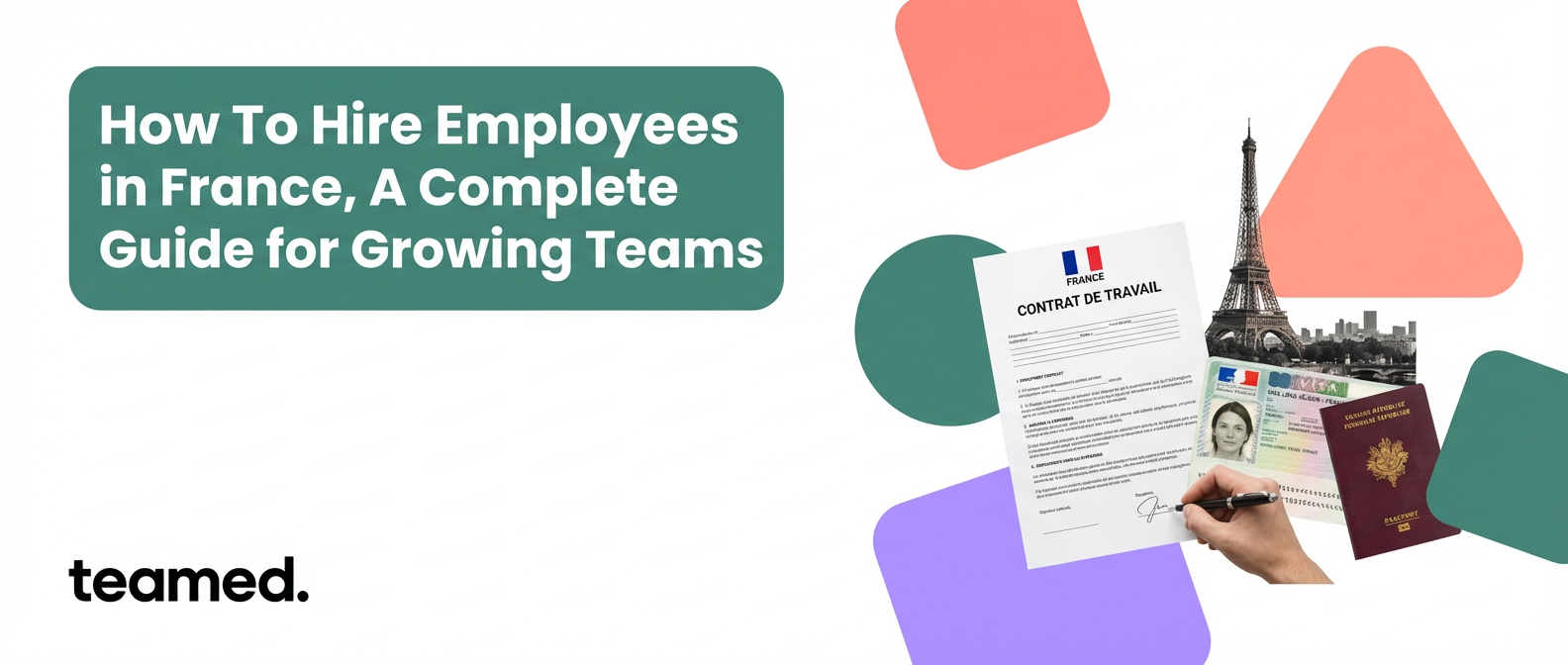
Your top sales candidate in Paris just accepted a competitor's offer. Not because they paid more, but because your legal team couldn't confirm whether you could actually employ her. Meanwhile, your CFO is asking why you're still paying EOR fees for three contractors who've been with you for eighteen months.
Hiring employees in France sits at the intersection of opportunity and complexity. France has a statutory standard working time of 35 hours per week for full-time employees, with overtime rulesHiring employees in France sits at the intersection of opportunity and complexity. France has a statutory standard working time of 35 hours per week for full-time employees, with overtime paid at minimum 25% premium and rest requirements applying when hours exceed this threshold. The country's employee-protective regime means contracts, termination, and benefits work differently than in the UK or Nordics. And if you're already managing teams across Germany, the Netherlands, and Spain, adding France requires more than copying your existing playbook.
This guide walks you through the practical steps, from choosing your employment model to running compliant payroll. You'll understand when an Employer of Record makes sense, when to establish a French entity, and how to avoid the misclassification risks that catch mid-market companies off guard.
A French CDI is a permanent employment contract in France that has no fixed end date and is the default contract type for ongoing roles under French labour law. Before you can issue one, you need to decide how you'll actually employ someone in France.
The sequence matters. Everything else depends on your employment model choice.
First, confirm your employment model. Will you establish a French entity, use an Employer of Record, or engage contractors? This decision shapes every subsequent step, from registration requirements to contract templates.
For entities, register with relevant authorities. You'll need to register with URSSAF (France's social security body) and set up payroll infrastructure. This involves submitting Form E0 and ensuring you can file the mandatory DPAE (pre-employment declaration) before any employee starts work.
Define the role and salary. Check applicable CBAs for pay scales and classification requirements. French candidates expect clear, French-language documentation before accepting offers.
Issue a compliant French offer letter and contract. Contracts must be written in French and include job title, working hours, remuneration, benefits, and any variable pay structures.
Complete mandatory pre-employment declarations. In France, employers must submit a DPAE pre-employment declaration before an employee begins work, and failure to complete it on time can be treated as undeclared work exposure.
Set up payroll and benefits from the first pay cycle. French payroll is highly regulated with detailed payslip requirements and strict deadlines. Most mid-market firms use specialist providers rather than attempting this in-house.
Plan backwards from your target start date. Each step adds lead time, and rushing creates compliance gaps that surface during audits.
A Collective Bargaining Agreement (CBA) in France is an industry or company-level agreement that can impose binding rules on classification, minimum pay, allowances, and termination processes beyond the baseline French Labour Code. Before you finalise any offer, you need to know which CBA applies to your role.
French recruitment differs from UK or Nordic practices in ways that catch employers off guard. Job advertisements and selection criteria must be non-discriminatory under French law. You can't request intrusive personal information during the hiring stage, and background checks require explicit consent with respect for EU and French privacy rules.
In practice, French candidates expect written offers and contracts in French with clarity on title, pay, benefits, working time, and location. Verbal agreements or English-only documentation creates friction and potential enforceability issues.
Use standard channels for sourcing: job boards, specialist recruiters, and professional networks. Reference checks follow different norms than in the UK, so obtain consent and respect data protection requirements.
Don't assume your UK interview templates map directly to France. Questions that seem routine elsewhere may be unlawful here. And don't skip the CBA assessment. If you issue an offer without confirming the applicable CBA and job level mapping, you risk underpaying or misclassifying the role, which creates disputes and back-pay exposure.
The French Labour Code (Code du travail) and applicable CBAs are the core sources of employment rules in France. Company policies exist within this framework, not above it. France differs from many UK-centric employment templates because French employment documentation and day-to-day practices must align with the French Labour Code and applicable CBAs, and copy-pasting UK terms can create enforceability and compliance gaps.
France operates an employee-protective regime with stricter working time, paid leave, and termination rules than many European markets. Standard full-time working time is 35 hours per week, and employers must manage overtime and rest-period compliance when operational needs require longer hours.with overtime beyond 220 hours requiring additional paid leave compensation, and employers must manage overtime and rest-period compliance when operational needs require longer hours.
Paid annual leave entitlement in France is 5 weeks per year for employees, calculated as 2.5 working days per month of work accrued over the reference period. The French Labour Code provides 11 official public holidays in France, although whether the employee is entitled to time off and pay treatment can depend on the applicable CBA and company practice.
Employee representation matters at certain thresholds. Works councils and social and economic committees (CSE) become mandatory as headcount grows, adding governance requirements that don't exist in smaller operations.
Non-compliance risks are real. Labour inspections, fines, and litigation happen. French dismissal disputes are commonly routed through the Conseil de prud'hommes (French labour court), and employers should expect multi-month timelines for contested cases due to procedural steps and hearing scheduling.
A French CDD is a fixed-term employment contract in France that is permitted only in specific legally defined circumstances, such as replacing an absent employee or addressing a temporary and clearly justified need. For ongoing roles, CDI (permanent contracts) are the default and preferred by both law and employees.
Consider a European SaaS company hiring its first Paris sales leader. In other markets, you might start with a fixed-term arrangement to "test fit." In France, that approach creates legal exposure unless you can document a genuinely time-limited reason. CDI offers stability and retention, which matters when you're building a core team.
Contracts must be written in French and include job title, working hours, remuneration, benefits, and any variable pay or bonus structures. Probation periods vary by seniority and role, with standard lengths and renewal rules differing from post-confirmation notice requirements.
Check applicable CBAs for contract and probation rules. Some CBAs mandate specific probation lengths or restrict renewals. Getting this wrong means your probation terms may be unenforceable, leaving you with an employee you can't easily exit.
For mid-market Europe-based employers, Teamed's budget models typically assume total employer cost of employment in France of approximately 1.30x to 1.60x gross salary once mandatory employer charges and standard benefits are included. This makes France one of the higher-cost European markets for employment.the highest social and fiscal burden European market for employment.
The gap between gross and net salary is substantial. Employer social contributions in France commonly add roughly 25% to 45% on top of gross salary for many standard employee profiles, according to Teamed's cost-modelling benchmarks using published French social-charge schedules. These contributions cover social security, health coverage, unemployment insurance, and retirement schemes.
Beyond mandatory contributions, typical additional benefits include supplemental health insurance (mutuelle), meal vouchers, transport support, and bonuses per CBA or company policy. French employees expect these as standard, not as exceptional perks.
French payroll is highly regulated. Payslips must include detailed breakdowns of contributions and deductions, and filing deadlines are strict. Most mid-market firms use specialist payroll providers rather than attempting to manage French payroll in-house.
Model total cost of employment before making offers. A €60,000 gross salary might cost €78,000 to €96,000 once you factor in employer charges and benefits. Compare this with your other European markets to ensure your compensation strategy is coherent across your portfolio.
For cross-border hiring into France, Teamed advises budgeting additional lead time of 6 to 12 weeks for non-EU work authorisation pathways due to role-specific documentation, consular processing variability, and start-date coordination.
EU, EEA, and Swiss nationals generally don't need work permits for France. The complexity arises with non-EU hires.
Non-EU employees need a residence permit plus work authorisation. Routes include the talent passport for highly skilled workers and specific permits for scarce occupations. Intra-company transfers have dedicated pathways with their own requirements.
Recent reforms have streamlined some routes while tightening enforcement on others. Outdated or informal advice creates risk. A US-based engineer relocating to Paris will usually need sponsorship under a suitable talent route plus residence authorisation, and the timeline can stretch beyond what either party expects.
Employer duties include right-to-work checks, document retention, and reporting changes. Using an EOR doesn't remove immigration obligations. Regardless of your employment model, you need to ensure every France-based worker has the right to work.
An Employer of Record (EOR) in France is a third-party organisation that becomes the legal employer of a France-based worker and runs French payroll, statutory benefits, and local compliance while the client company manages day-to-day work. But EOR isn't always the right answer.
Contractors offer flexibility and speed for project-based needs. But misclassification risk in France is real and expensive. In Teamed's compliance risk framework, the highest contractor misclassification exposure in France occurs when an individual works full-time for one client, follows set working hours, and is managed like an employee, which materially increases the probability of reclassification in a dispute. Use contractors only for genuinely independent, deliverable-based, time-limited engagements.
EOR in France works well for fast market entry, first hires, or testing a market before committing to permanent infrastructure. The EOR handles payroll and compliance while you direct the work. Limitations include less control over policies and benefits customisation, potential cost premiums, and the reality that EOR isn't a fit for large, permanent operations. For France hiring programmes in the 200 to 2,000 employee segment, Teamed commonly sees EOR used as an interim structure for the first 1 to 10 hires before an entity decision is revisited as headcount and revenue stabilise.
A French entity means becoming the direct legal employer with full statutory obligations. You gain control, brand presence, and potential long-term cost efficiency. You also take on setup complexity, ongoing administration, and the need for in-house or retained expertise. Choose this path when France is planned as a long-term hub, when you need full control over compensation structures, or when regulatory expectations require direct presence.
Advisors like Teamed can guide mid-market HR and Finance leaders through model selection in France, helping you evaluate misclassification risk, total cost of employment, and when to graduate from EOR to a local entity.
A French entity differs from an EOR in France because the entity makes the company the direct legal employer with full statutory employer obligations, while an EOR keeps legal employment with the provider and shifts payroll and compliance administration away from the client. For companies already operating in Germany, the Netherlands, or the UK, this distinction matters for portfolio strategy.
Mid-market companies, those with roughly 200 to 2,000 employees and revenue around £10m to £1bn, face unique pressures. You're large enough to need sophisticated guidance but small enough to need responsive advisors. Board members and auditors expect rationale for employment model choices in higher-risk markets like France.
The strategic question isn't just "how do we hire in France?" It's "how does France fit into our European employment strategy?"
Will France be a core hub for engineering or commercial teams, or a satellite with a handful of roles? The answer determines whether EOR makes sense long-term or whether you should plan for entity establishment from the start.
Consider a fintech headquartered in London with teams in Germany and Spain. Starting with EOR for sales in Paris makes sense while testing pipeline and market fit. But as headcount grows and France becomes a revenue centre, the calculus shifts. Entity establishment offers more control, potential cost savings at scale, and cleaner audit trails.
Teamed can design a France roadmap aligned with your broader European footprint and growth targets, ensuring your France decisions don't conflict with plans in other markets.
The DPAE is a mandatory pre-employment declaration in France that employers must submit to the relevant social-security body before a new employee starts work. Missing this deadline can trigger undeclared work exposure, one of several compliance domains that require active management.
For mid-market companies already running multi-country compliance programmes, France needs to plug into your existing risk and audit landscape. Key domains to monitor include payroll accuracy and timely filings, social security reporting, working time and overtime tracking, health and safety obligations, and data protection for employee records.
The operating model matters. Avoid fragmentation where Finance handles payroll, Legal owns contracts, and managers handle HR without coordination. Define owners and controls for each compliance domain.
Enforcement focus in France includes misclassification, undeclared work, and non-compliant working time. These carry reputational and financial risks that mid-market companies can't absorb casually.
A compliance checklist starter: documented policies, local CBA mapping, right-to-work process, time-tracking system, payroll provider SLAs, and audit trail retention. Teamed can help build a France compliance framework that aligns HR, Finance, and Legal.
Choose to review EOR-to-entity timing when France hiring plans exceed 10 planned hires, local revenue becomes material, or regulated-sector requirements create a need for direct employer control over policies and audit trails.
Entity establishment involves choosing a legal form, registering with authorities, and assuming full employer obligations. The decision isn't about process minutiae. It's about strategy.
Triggers for entity establishment include moving from a small initial presence to a growing local team, planning a permanent office with local leadership, regulatory expectations for direct presence (common in financial services and defence), and the need for deeper control over policies, brand, and cost efficiency.
Trade-offs are real. Upfront complexity and cost versus long-term control and potential savings. Decision inputs include revenue trajectory, growth plans, regulatory exposure, and willingness to build HR and payroll capability for France.
An EOR in France differs from entity employment in audit readiness because EOR documentation and payroll filings are held primarily by the provider, whereas a French entity centralises employment records and statutory filings under the company's direct control. For regulated industries where audit trails matter, this distinction can drive the entity decision earlier than pure headcount would suggest.
Teamed's role is to advise on timing and jurisdiction, model scenarios with HR and Finance, and support execution once the strategy is clear.
Hiring a France-based contractor differs from hiring a France-based employee because a contractor is meant to be independent and outcome-driven, while an employee is subordinate to the employer's direction and protected by the French Labour Code and many CBA rules. This distinction becomes critical when you're trying to maintain consistency across European operations.
Align French contracts, titles, and levels with your global frameworks while respecting French law and CBAs. This means standardising job architecture across markets while maintaining a benefits matrix that documents France-specific variances.
Your benefits approach should define a European baseline, then layer France-specific statutory and market elements. French employees expect supplemental health insurance and meal vouchers as standard. Trying to impose a UK-style benefits package creates friction and retention issues.
Manage differences in working time, holidays, and remote or hybrid expectations. Aim for perceived fairness across countries while respecting that French legal entitlements and strong local norms are non-negotiable. Explain to employees why differences exist rather than pretending they don't.
Systems and process decisions matter. Will you use a separate French payroll provider or a multi-country platform with local expertise? Either can work, but the choice affects data integration, reporting, and audit readiness.
Create a cross-functional playbook for France covering HR, Legal, and Finance responsibilities. As an example, you might choose to keep a unified learning and development policy but localise working time and meal benefits for France.
Teamed can map a European-wide model so France integrates with your current entities, EORs, and contractors across the continent.
You've now got the framework. The questions you should be able to answer: Which employment model fits France now and as you scale? What's your compliance baseline and who owns which controls? How does France align with your broader European structure and cost envelope?
Hiring in France is manageable with a clear plan, the right partners, and a realistic view of cost and risk. It's not a copy-paste from other markets. The protective employment regime, CBA requirements, and social contribution levels demand France-specific thinking.
Leaders don't need to navigate alone. Independent advisory support is a strength, not a weakness. When you're making six-figure decisions about entity establishment or converting long-term contractors to employees, having counsel that isn't tied to selling you a particular solution matters.
If you want strategic clarity before committing to contractors, EOR, or a French entity, talk to the experts. Teamed can provide counsel grounded in legal expertise across 180+ countries, then execute once the strategy is clear.
France is typically higher cost due to social contributions and benefits. Total employment cost is materially above gross salary, often 1.30x to 1.60x, and frequently higher than neighbouring markets like Germany or the Netherlands. Budget accordingly and model total cost before making offers.
Yes. Companies commonly use an Employer of Record or register as a foreign employer. Full compliance with French employment, tax, and social security rules still applies regardless of which route you choose.
The decision depends on headcount growth, long-term plans, regulatory expectations, and cost analysis. Common triggers include exceeding 10 planned hires, material local revenue, or regulated-sector requirements for direct employer control. Teamed can model optimal timing for your specific situation.
Treat French legal entitlements and strong local norms as non-negotiable. Design global policies that accommodate these differences and explain to employees why variations exist. A European baseline with France-specific layers works better than forcing uniformity.
Misclassification can trigger back social contributions, fines, and disputes. Risk is highest when the individual works full-time for one client, follows set hours, and is managed like an employee. Proceed cautiously and seek advice before engaging long-term contractors.
A common operational lead time is 2 to 6 weeks from offer acceptance when contracts, DPAE timing, payroll setup, and benefits enrolment are sequenced correctly. Immigration requirements for non-EU hires can add 6 to 12 weeks.
Companies with roughly 200 to 2,000 employees and revenue around £10m to £1bn. This segment faces unique complexity: large enough to need sophisticated guidance on employment strategy, small enough to need responsive advisors rather than enterprise consulting models.or

You've just been told your company needs "substance" in the Netherlands. Maybe it came from your tax advisor during a restructuring conversation. Maybe your CFO raised it after reading about EU anti-abuse rules. Or maybe a board member asked a pointed question about your Dutch holding company that nobody could answer confidently.
Here's the thing: understanding what creating substance means for a Netherlands entity isn't just a tax technicality. For mid-market companies scaling across Europe, it's the difference between a structure that works and one that unravels under scrutiny. The Dutch tax authorities, EU regulators, and treaty partners are all asking the same question: is your Netherlands entity a real business presence, or just a mailing address?
This guide breaks down Dutch substance requirements in practical terms for HR, Finance, and Legal leaders who need to make real decisions about entity establishment, employment models, and governance, not just pass a tax exam.
A Netherlands private limited company (BV) is a Dutch corporate legal form that provides limited liability and is commonly used to employ staff, hold assets, or act as a holding company within an international group. But incorporating a BV is just paperwork. Substance is what makes it real.
In practical terms, economic substance in the Netherlands means your entity has genuine presence: management that actually manages, people who actually work, premises where activity actually happens, and risks that are actually borne and controlled locally. Tax authorities assess this factually. They look at where directors live, where strategy is decided, where employees sit, and whether there's a commercial logic for the entity beyond tax efficiency.
The core aspects of Dutch substance include:
A shell company in the Netherlands is a Dutch entity that has minimal business activity, limited local decision-making, and insufficient resources to perform the functions and bear the risks attributed to it. Authorities are increasingly skilled at spotting the difference between a functioning operational hub and a conduit that exists mainly to route profits or dividends.
Consider a European fintech with 400 employees across six countries. They establish a Dutch BV to hold their EU subsidiaries. Proportionate substance for this mid-market group might mean two Dutch-resident directors who lead investment decisions, a small Amsterdam-based finance team, and board meetings held quarterly in the Netherlands with detailed minutes. It doesn't require a 50-person office, but it does require more than a brass plate.
Dutch tax benefits and treaty access assume your Netherlands entity has real economic substance. Without it, you're exposed to challenges that can unwind years of planning.
The participation exemption, which allows Dutch holding companies to receive dividends and capital gains from qualifying subsidiaries tax-free, is one of the most valuable features of the Dutch tax system. Dutch dividend withholding tax relief under EU directives and tax treaties is another. Both can be denied if your structure is deemed artificial or mainly tax-driven.
Dutch anti-abuse measures give authorities the power to look through arrangements that lack genuine commercial rationaleDutch anti-abuse measures give authorities the power to look through arrangements that lack genuine commercial rationale, with EU companies considered at risk of being a "shell" if they have over 75% passive income and more than 60% cross-border activity. The Principal Purpose Test (PPT), embedded in many of the Netherlands' tax treaties through the OECD's Multilateral Instrument, can deny treaty benefits when obtaining that benefit was one of the principal purposes of an arrangement and the outcome conflicts with the treaty's intent.
For mid-market companies, the consequences of weak substance are concrete: denied treaty benefits, unexpected tax bills, and deeper audits at a time when you likely don't have dedicated internal tax bandwidth to manage them. A Dutch BV treated as a formality can erode the very advantages that made the Netherlands attractive in the first place.
These aren't corporate law rules. They're tax-practice indicators that improve your position but don't guarantee immunity from challenge.
Dutch tax authorities look for several minimum substance indicators when assessing whether a Netherlands entity has sufficient presence:
Meeting these minimums strengthens your factual position but doesn't create absolute protection. For holding, financing, and treasury entities, expectations are stricter because these structures often receive passive income that attracts heightened scrutiny.
A European group with a Dutch holding company should plan for at least one senior Dutch-based director with real decision-making authority, plus modest local support staff proportionate to the entity's scale and functions.
Holding companies that rely on treaties or EU directives for dividend, interest, or royalty flows face the sharpest substance scrutiny.
Consider a UK parent that inserts a Netherlands BV between itself and EU subsidiaries to access treaty benefits. The difference between a weak conduit and a robust holding comes down to where decisions are made and who controls the income.
A weak conduit looks like this: income flows through immediately, no risk or control is retained locally, and the Dutch board rubber-stamps decisions made elsewhere. A robust holding looks different: Dutch-resident directors lead acquisition and divestment decisions, manage elements of group strategy, retain risk and control, and document their decision-making in the Netherlands.
The expectations for Dutch holding company substance include:
A Dutch tax resident company is a company considered resident in the Netherlands for tax purposes because its place of effective management and key strategic decisions are in the Netherlands. If your directors live in London but your holding is in Amsterdam, you have a residency problem that substance indicators alone won't solve.
Dutch substance requirements don't exist in isolation. They're shaped by EU and OECD frameworks that are tightening expectations across Europe.
The EU's Anti-Tax Avoidance Directive (ATAD) requires EU Member States, including the Netherlands, to apply a General Anti-Abuse Rule that targets arrangements which are not genuine and are put in place mainly to obtain a tax advantage. This makes Dutch substance evidence more important for treaty and directive-based relief., with the Netherlands codifying a written GAAR in 2025 as part of its Tax Plan. This makes Dutch substance evidence more important for treaty and directive-based relief.
The proposed "Unshell" directive, which would have created explicit minimum substance tests for EU entities, was withdrawn. But its focus on decision-making, staff, and premises still influences administrative practice and cross-border cooperation. The direction of travel is clear: authorities expect more, not less.
Pillar Two global minimum tax rules apply to multinational groups meeting the €750 million consolidated revenue threshold. These rules increase sensitivity to where payroll and tangible assets sit, which can reward real Netherlands investment for groups above the threshold. Even below that threshold, the principles are filtering into enforcement attitudes.
Information exchange and joint audits mean cross-border comparisons make low-substance strategies harder to defend. If your Netherlands entity looks thin compared to your operations elsewhere, expect questions., with the Netherlands having exchanged 568 tax rulings with other jurisdictions in 2023 alone. If your Netherlands entity looks thin compared to your operations elsewhere, expect questions.
Teamed was founded in 2018, which means over seven years of operating through successive waves of EU and OECD anti-abuse and transparency developments affecting substance expectations. That experience informs how we advise mid-market companies on building defensible structures.
If you're a UK or EU company considering a Netherlands entity, substance expectations should shape your planning from day one.
The Netherlands is attractive as a European hub, but authorities expect visible economic substance, not a mailbox presence. Early decisions matter: where will leadership sit? Which roles can credibly be based in the Netherlands? Will the entity hold IP, run financing, or function only as an employer?
Board and executive residence outside the Netherlands can weaken your substance story if strategy sits elsewhere. For UK-headed groups, UK company residency principles also focus on central management and control, so a Netherlands BV with UK-based directors must manage dual risk: it can weaken Dutch substance and create UK tax residency exposure if effective management remains in the UK.
Phasing matters too. You don't need to build a full Dutch operation on day one. Start with a smaller Netherlands team performing clearly defined, aligned functions, then scale intentionally as your Dutch activities grow.
Before incorporating, ask yourself:
For EU groups with remote-first leadership, permanent establishment risk in other European jurisdictions can increase when senior executives habitually conclude contracts or make key decisions outside the Netherlands. This can undermine the narrative that the Netherlands entity is the true decision-maker.
An Employer of Record (EOR) is a third-party organisation that becomes the legal employer for workers in a specific country, handling payroll, taxes, benefits, and employment compliance while the client company directs day-to-day work. Contractors are individuals or companies engaged on services contracts, not employees.
Each model has different substance implications.
EOR works well for early testing and low headcount. The provider bears employer obligations and has its own substance. It's defensible short-term while your plans are uncertain, and you're not creating a Dutch entity that needs its own substance story.
Contractors offer flexibility but risk misclassification and permanent establishment if used for core roles. They can sidestep substance questions in a way that attracts scrutiny if your Dutch activities grow.
Your own Netherlands entity gives you greater control and tax planning potential but requires building and maintaining economic substance. Once you employ people and hold assets, authorities expect substance to build progressively in line with your activities.
Mid-market companies are commonly defined as organisations with 200 to 2,000 employees, and Teamed uses this employee-range definition in its mid-market positioning for global employment strategy. For companies in this range, the decision often comes down to timing: start with EOR or contractors, then incorporate a BV near mid-double-digit Netherlands headcount when scale, regulatory, or client drivers warrant direct employment.
Choose an EOR in the Netherlands when you need to hire in-country within weeks and you cannot credibly locate senior decision-making or operational leadership in the Netherlands during the first six to twelve months. Choose a Netherlands BV when you expect sustained Dutch headcount growth and you can appoint at least one Dutch-resident director with real authority over the entity's strategy, budgeting, and contracting decisions.
A typical mid-market regulated business evaluating a Netherlands entity should plan a 12 to 24 month window to implement governance, staffing, premises, and documentation changes that make Dutch substance defensible, according to Teamed's operational playbooks for entity readiness.
The graduation path usually follows this sequence:
Teamed's service coverage includes in-market legal expertise across 180+ countries, which is relevant when a Netherlands substance plan must be coordinated with permanent establishment and employment compliance risks in other European jurisdictions. We design substance roadmaps matched to growth and risk appetite, benchmarking across markets so you're not building in isolation.
Translating substance theory into a 12 to 24 month action plan requires coordination across HR, Finance, and Legal.
Appoint Dutch-resident directors with actual authority, not just signing power. Hold regular board meetings in the Netherlands with detailed minutes evidencing local decisions. If your CFO says "I want board packs that show decisions were taken in Amsterdam," you're thinking about this correctly.
Hire Netherlands employees aligned to the entity's functions. Ensure reporting lines confer genuine local authority. Consider where key managers live, because a Dutch GM who commutes from Berlin raises questions about where decisions are really made.
Secure appropriate Netherlands office space, proportionate to your activities. Open a Dutch bank account and use it for day-to-day transactions. Register for corporate income tax and other relevant taxes as needed.
Maintain intercompany agreements, transfer pricing support, job descriptions, and policies reflecting real Netherlands responsibilities. Ensure consistent narratives across documents. If your transfer pricing file says the Dutch entity controls IP licensing but your board minutes show decisions made in London, you have a problem.
Teamed can help prioritise the steps that most improve audit defensibility, drawing on experience across regulated sectors where compliance failures end careers.
Use this as an execution-ready review, not a re-explanation of concepts.
If multiple gaps appear, seek independent advice rather than piecemeal fixes. Substance is assessed holistically.
Substance sits at the intersection of tax, legal, and employment, which makes it challenging for HR and Finance leaders to coordinate without dedicated expertise.
Teamed advises mid-market companies on timing of entity establishment, near-term reliance on EOR or contractors, and designing a proportionate substance plan for size and risk profile. We draw on experience across 180+ countries and regulated sectors including financial services, healthcare, and defence to anticipate enforcement trends and pitfalls.
Strategic questions we help answer:
For mid-market international hiring, Teamed's execution model cites onboarding in 24 hours rather than multi-month implementations, which can materially change the timeline for moving from EOR to an owned Netherlands entity when business drivers accelerate.
If you're making six-figure decisions about Dutch entity establishment without independent counsel, talk to the experts.
Timelines depend on your model and growth trajectory. Plan substance as a staged programme over several planning cycles, not a one-off action. Most mid-market companies need 12 to 24 months to build a defensible position.
Costs come from people, premises, and advisory support. Budget proportionately to the scale and risk of Dutch operations. Avoid fixed-amount estimates that don't account for your specific situation.
Yes, if management and key employees are genuinely Netherlands-based. You still need evidence of local decision-making, risk management, and commercial activity. A remote-only structure with directors living elsewhere is harder to defend.
If the Netherlands entity owns IP or books significant profits, local substance must support those functions and profit levels. Misalignment between transfer pricing documentation and actual Dutch capabilities is a common audit trigger.
Possible if commercial reality and capacity support it. Authorities will question claims where a very small team is said to run many high-value functions. Be realistic about what your people can credibly manage.
Mid-market companies are commonly defined as organisations with 200 to 2,000 employees, or revenue between £10 million and £1 billion. This segment's growth profile makes Dutch substance decisions especially consequential because you're large enough to attract scrutiny but may lack enterprise-scale internal resources.
At initial planning, before restructurings, and when Netherlands headcount or revenue becomes strategically significant. Build substance intentionally, not reactively after a challenge arises.or
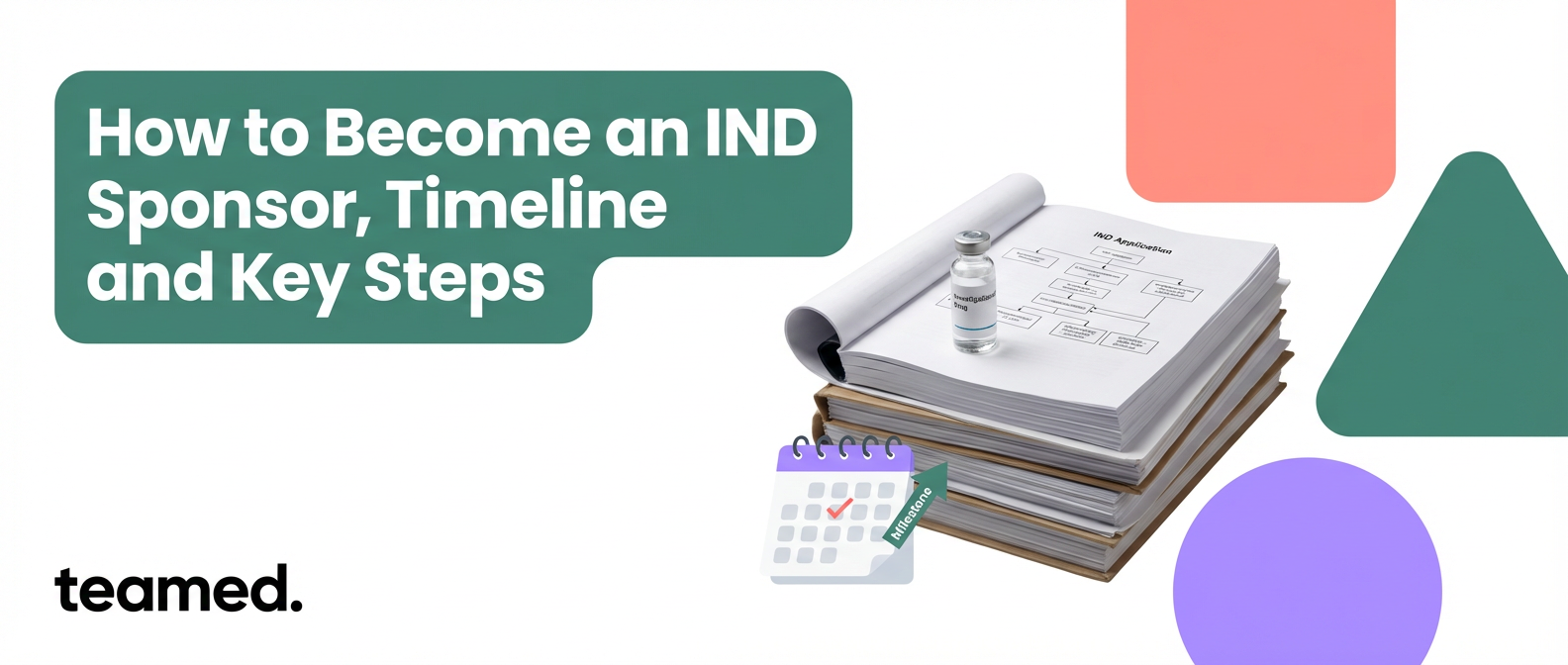
You've got a promising drug candidate. The board wants a timeline to first-in-human dosing. Your investors are asking when you'll file the IND. And somewhere between the science and the spreadsheets, you're realising that becoming an IND sponsor involves far more than submitting a regulatory dossier.
Here's the thing: the timeline and process for becoming an IND sponsor isn't just a regulatory question. It's a cross-functional programme that touches R&D, clinical operations, quality, legal, finance, and people. For mid-market biotechs scaling from 50 to 500 employees, the IND journey often becomes the forcing function for decisions about where to hire, how to structure global teams, and when to establish entities in new markets.
This guide walks through what IND sponsorship actually means, the realistic timeline from preclinical data to first patient dosed, and the strategic decisions that mid-market and European biotechs need to make along the way.
An Investigational New Drug (IND) application is a submission to the US Food and Drug Administration (FDA) that seeks authorisation to administer an investigational drug or biologic to humans in a clinical study in the United States. Without an active IND, you cannot legally ship or administer an investigational product to human subjects in the US.
The IND sponsor is the person or organisation that initiates and takes responsibility for the clinical investigation. This is distinct from the investigator, who actually conducts the trial at clinical sites, and from a CRO, which performs delegated tasks under contract. An IND sponsor differs from a CRO in that the sponsor retains legal accountability to the FDA for trial conduct and safety reporting, while a CRO performs delegated tasks under contract without assuming the sponsor's statutory responsibilities.
A sponsor-investigator is an individual who both initiates and conducts an FDA-regulated clinical investigation and directly performs the sponsor duties and investigator duties for the same IND. This model works when a single investigator will both conduct the study and accept sponsor obligations, including safety reporting and FDA correspondence, without relying on a separate corporate sponsor function.
In practice, being an IND sponsor means you own the scientific plan, the regulatory relationship, and the safety of every participant enrolled under your IND. Your ongoing responsibilities include safety reporting to the FDA, protocol oversight, keeping the FDA informed via amendments and annual reports, and maintaining oversight of all investigators working under your IND.
The process flows through distinct stages: preclinical studies to generate safety data, preparing the IND application package, FDA review, then conducting the clinical trial under the active IND. European sponsors often know the EU Clinical Trial Application (CTA) route but need clarity on how the FDA IND process differs when stepping into the US sponsor role.
The IND timeline begins once you have a credible development candidate. From that point, the journey to IND submission typically involves several parallel workstreams that must converge before you can file.
The pre-IND phase covers nonclinical safety studies, pharmacology, and Chemistry, Manufacturing, and Controls (CMC) activities to generate the data package for your INDThe pre-IND phase covers nonclinical safety studies, pharmacology, and Chemistry, Manufacturing, and Controls (CMC) activities to generate the data package for your IND, with core IND-enabling nonclinical safety studies typically requiring 12–18 months to complete. CMC is the IND dossier section that describes how an investigational product is made, tested, controlled, and stored, including specifications and stability evidence supporting first-in-human use.
Planning starts with an internal go/no-go decision before committing to full IND-enabling studies. Treat this as a strategic checkpoint for leadership and the board. Nonclinical, CMC, and clinical planning often run in parallel, but dependencies matter. You can't file without adequate toxicology data in relevant species, and you can't manufacture clinical supply without a validated process.
The major stages look like this:
In practical terms, the IND timeline is the journey from promising preclinical data, through a focused development programme, to a complete dossier that gives the FDA enough confidence to allow first-in-human dosing.
Mid-market scaling companies should translate this timeline into hiring, vendor, and fundraising plans. European sponsors must align the US IND timeline with EU CTA planning if running trials in both regions.
A pre-IND meeting is a formal interaction with the FDA in which a prospective sponsor seeks feedback on the nonclinical, CMC, and clinical plan before submitting an IND to reduce avoidable deficiencies and clinical hold risk. Choose a pre-IND meeting when the first-in-human plan involves novel modalities, complex manufacturing, or nonstandard endpoints, because early FDA feedback can prevent a clinical hold during the 30-day IND review window.
To request a pre-IND meeting, you submit a meeting request with a briefing package that outlines your development programme, key questions, and supporting data. The FDA typically responds within 60 days with written feedback or a meeting date.—typically 50–100 pages in length. The FDA typically responds within 60 days with written feedback or a meeting date.
The core IND application includes several modules:
Submission happens via the FDA electronic gateway. The moment FDA receives your IND, the 30-day review clock starts.
Smaller and mid-market sponsors, particularly Europe-led companies with US first trials, often rely on external regulatory consultants to compile the dossierSmaller and mid-market sponsors, particularly Europe-led companies with US first trials, often rely on external regulatory consultants to compile the dossier, a process that typically takes 4–6 months for first-time sponsors. But you must retain internal accountability for content. Choose internal ownership of IND dossier sign-off when the company intends to run more than one protocol under the same programme, because repeated amendments and annual reports create ongoing regulatory workload that cannot be fully delegated to a CRO.
Have an internal process ready to respond rapidly to FDA information requests during review. Pre-assign who will handle queries, especially if your team spans EU-US time zones.
The FDA's IND framework distinguishes between "permission to proceed after the 30-day safety review" and "marketing approval," meaning an IND does not create a right to sell a product even when a trial is permitted to begin. The FDA's standard is "reasonably safe" for initial human exposure, not proof of efficacy.
Safety data requirements: You need adequate nonclinical toxicology in relevant species, a clear dosing rationale, and stopping rules in the protocol. The FDA reviews whether the data support a reasonable belief that the drug is safe enough to test in humans at the proposed doses.
Product quality (CMC): Demonstrate consistent, safe manufacturing with characterisation, stability data, and quality controls. The FDA needs confidence that what you tested in animals is what you'll give to humans.
Ethics and oversight: IRB/ethics approval, robust informed consent, protection of vulnerable populations, and a proper investigator brochure are all required. The sponsor must ensure investigators understand their responsibilities.
Safety reporting readiness: Systems for detecting, assessing, and reporting serious and unexpected adverse reactions must be in place before dosing begins. Recent FDA guidance clarifies that sponsors bear primary responsibility for safety signal detection and reporting, even when CROs handle day-to-day operations.
The principles are similar to EU CTR requirements, but format, terminology, and expectations differ. This often surprises mid-market European sponsors entering the US for the first time.
The FDA's standard initial safety review window for a newly submitted IND is 30 calendar days from FDA receipt. After that window closes without a clinical hold, you may begin dosing. This is permission to proceed, not "approval" in the marketing sense.
A clinical hold is an FDA order to delay a proposed clinical investigation or to suspend an ongoing investigation under an IND, typically due to safety, protocol, or product quality concernsA clinical hold is an FDA order to delay a proposed clinical investigation or to suspend an ongoing investigation under an IND, typically due to safety, protocol, or product quality concerns, though only about 9% of INDs result in clinical holds. A pre-IND meeting differs from the 30-day IND safety review in that the pre-IND meeting is optional and advisory, while the 30-day review is a statutory gate that can result in a clinical hold that prevents dosing.
Common hold or delay triggers include:
Practical risk reduction: take pre-IND feedback seriously, run internal quality reviews before submission, and rehearse quick responses to information requests. Lean teams coordinating across EU-US time zones should pre-assign who will respond to FDA queries during review to avoid avoidable delays.
How long does it usually take from IND submission to first patient dosed? The 30-day FDA review is just one component. You also need site contracts, ethics approvals at each site, safety reporting infrastructure, and operational readiness. Plan for additional weeks or months beyond the formal review window.
Many mid-market leaders discover that the hardest part of the IND journey is not the science, it is coordinating the moving parts across teams and geographies.
Treat the IND journey as a cross-functional programme spanning R&D, Regulatory, Clinical Operations, Quality, Legal, Finance, and People, not just science. Create a roadmap linking scientific milestones, regulatory submissions, hiring dates, and fundraising events so leadership sees convergence points.
Governance matters. Establish a development or portfolio committee that owns go/no-go decisions, risk reviews, and IND content sign-off. Scope what to outsource to CROs versus what to build in-house. Many companies underestimate the operational lift of sponsor duties.
Core workstreams to map include:
For companies growing into the 200-2,000 employee band, IND milestones often trigger decisions about US-specific roles and potentially new entities when taking on US sponsor duties from a European headquarters.
Teamed's mid-market expansion benchmarks treat 200 to 2,000 employees as the band where global employment model decisions, including when to use contractors, EOR, or owned entities, become recurring governance topics rather than one-off transactions.
Typical sequencing for IND-related hiring: start with senior regulatory leadership and programme/project management. Add clinical operations, safety, and data roles as IND prep and first study near. Scale QA, pharmacovigilance, and data functions as your portfolio grows.
Balance in-house versus CROs carefully. Execution can be outsourced, but sponsors need internal oversight accountable to FDA. The FDA expects the sponsor, not the CRO, to maintain control.
Geography decisions matter. Decide if US-based regulatory and clinical leads are needed when entering the US, and how to integrate them with existing European teams. In Teamed's operational planning guidance for regulated mid-market companies, teams should assume a minimum of 4 to 8 weeks to recruit and contract critical IND-startup roles in the UK/EU when using direct employment, excluding notice periods.
Employment model selection is a risk control. Choose an EOR for EU or UK clinical operations hires when the company needs compliant employment in-country within weeks and does not yet have a local entity or payroll infrastructure. Choose direct employment through an owned UK or EU entity when headcount in a single country becomes a stable operational hub and the company needs tighter control over payroll, benefits design, and long-term retention.
Choose contractors only when the role is genuinely project-based, time-limited, and can be delivered without day-to-day managerial control that resembles employment. Integrated clinical operations roles are high-risk for misclassification in Europe.
As trials expand, revisit entity structure, payroll, and compliance footprint per country. HR and Finance collaboration avoids reactive hiring in critical markets.
For UK, German, Nordic, or other EU-based biotechs sponsoring a US IND, the regulatory approach and legal structure questions differ from EU-only trials.
An IND differs from a marketing application in that an IND authorises clinical investigation and imposes ongoing reporting obligations, while a marketing application seeks commercial approval to sell a product in the United States. A European company can sponsor an IND without a US subsidiary. But a US entity and local staff can simplify contracts, oversight, and practical interactions with US sites and regulators.
Key strategic questions to answer before filing a US IND:
Employment law, payroll, and tax implications for US hiring differ from European norms. UK IR35 off-payroll working rules require medium and large businesses to determine the employment status of many contractors and can shift tax liability to the hiring organisation when the assessment is incorrect. UK statutory paid holiday entitlement for employees is 5.6 weeks per leave year, which is a mandatory cost and compliance requirement when moving clinical operations staff from contractor to employee status in the UK.
Encourage joined-up planning across Regulatory, Legal, and People so regulatory strategy and global employment strategy stay in sync. The transition from EU to US systems catches many mid-market sponsors off guard.
Teamed's compliance-first hiring playbooks for regulated programmes commonly require at least 3 separate compliance workstreams to be resourced in parallel: regulatory operations, quality oversight, and safety reporting operations, before first patient dosing.
Many sponsors run sites in the US and multiple European countries simultaneously, operating under FDA and European frameworks at once. This requires clear global governance for protocol changes, safety signal detection, and data quality to meet all regulators' expectations consistently.
Practical challenges include differing safety reporting timelines between FDA and EMA, aligning consent and patient information locally, and coordinating inspections and audits across jurisdictions.
Typical operating models centralise pharmacovigilance and data management while maintaining local country or regional teams for site relationships and local regulations. Consider a hypothetical mid-market oncology company running sites in the US, UK, and Germany. They might have central PV in London, US clinical operations leads in Boston, and local site managers in each country, all coordinating through a single governance structure.
Cross-border programmes raise employment complexity. You'll likely have a mix of local employees, contractors, and EORs across countries supporting the same trial. In Germany, employee leasing (Arbeitnehmerüberlassung) is a regulated model requiring a licensed provider, and non-compliant labour leasing can create co-employment and compliance exposure. In France, misclassification and hidden employment relationships can trigger social security back-pay and labour law claims. In the Netherlands, employment classification is assessed based on the factual working relationship rather than contract labels.
Poor coordination creates regulatory risk. One missed safety report or inconsistent protocol implementation can trigger inspections in multiple jurisdictions.
After IND strategy is set, sponsors must build and manage teams across countries in compliant, scalable ways. Clinical operations, regulatory affairs, safety, and support roles often need to be in multiple markets simultaneously.
The decision points are real: direct employment versus EOR versus contractors, all with regulatory, tax, and compliance implications in healthcare and life sciences. Teamed's time-to-execution standard for global employment operations states that once an employment model decision is approved, compliant onboarding can be executed in as little as 24 hours in many countries through established processes and in-country partners.
Teamed advises when to use contractors, lean on EOR, or establish entities, providing continuity as the company scales. This isn't about pushing one model over another. It's about matching the employment approach to the role, the market, and the company's stage.
Strategic employment decisions Teamed advises on:
Teamed operates in 180+ countries with experience in regulated sectors including defence, financial services, and healthcare. This reassures sponsors that their employment decisions will withstand scrutiny from regulators and auditors.
For mid-market biotechs navigating IND sponsorship while building global teams, having one strategic partner for employment decisions eliminates the fragmented advice that comes from multiple vendors with conflicting incentives.
Ready to align your IND timeline with a coherent global employment strategy? Talk to the experts at Teamed.
Budget drivers include nonclinical studies (toxicology, pharmacology), CMC development and clinical supply manufacturing, regulatory consultancy, and internal hiring. Costs vary dramatically based on modality, indication, and existing infrastructure. Rather than a single number, model each workstream separately and stress-test assumptions with advisors who've seen comparable programmes.
Early-stage companies often start with consultants, but should bring regulatory leadership in-house as IND-enabling studies approach and a pipeline of submissions is expected. Internal ownership becomes critical when you'll have ongoing FDA interactions, multiple protocols, and annual reporting obligations.
A European company can sponsor an IND without a US subsidiary. But a US entity and local staff can simplify contracts, oversight of US-based activities, and practical interactions with the FDA. Many European sponsors find the operational benefits outweigh the entity setup costs.
The FDA's 30-day review is just one component. Add time for site contracts, ethics approvals at each site, safety reporting infrastructure setup, and operational readiness. Depending on complexity, plan for several additional weeks to months beyond the formal review window.
Use IND submission and first patient dosed as anchor milestones and work backwards to resource and schedule realistically. Investors expect credible timelines tied to regulatory gates. Misalignment between promised dates and actual readiness damages credibility.
Sponsor status often requires staff in new countries and choices among direct employment, contractors, and EORs. This can trigger decisions about if and when to open new entities. Choose to align IND submission and first-patient-dosed planning with finance governance when the organisation needs board-ready runway modelling, because regulatory review time is fixed at 30 days but site initiation and staffing lead times are not.
Mid-market typically refers to companies in the 200 to 2,000 headcount range or with revenue between approximately £10 million and £1 billion. This is the band where IND complexity and global employment strategy intersect, where companies are large enough to need sophisticated guidance but small enough to need responsive advisors rather than enterprise consulting models.or
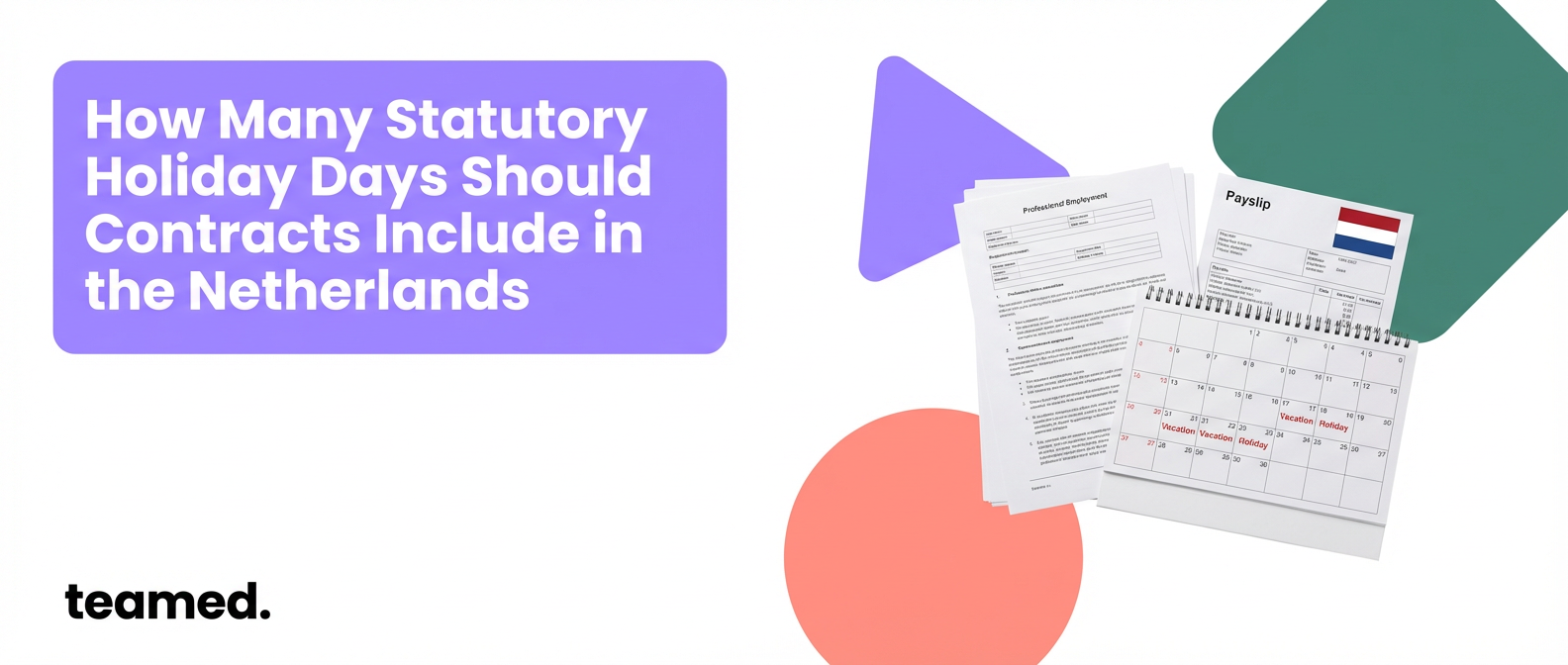
You're drafting your first Dutch employment contract, and you've hit the holiday clause. Your UK template says 25 days plus bank holidays. Your US policy mentions PTO. But what does Dutch law actually require?
Here's the thing: the Netherlands doesn't work like most countries you're used to. The statutory minimum isn't a fixed number of days. It's a formula tied to weekly working hours. Get this wrong, and you're either non-compliant or overpaying without realising it.
For mid-market companies hiring across Europe, understanding how many statutory holiday days should contracts include in the Netherlands isn't just a legal checkbox. It's the foundation for building consistent, defensible employment policies that scale.
Statutory annual leave in the Netherlands is a legally mandated minimum amount of paid vacation that equals four times an employee's agreed weekly working hours (4× weekly hours) under Dutch law.four times an employee's agreed weekly working hours (4× weekly hours) under Dutch law.
This means a Dutch employee contracted for 40 hours per week has a statutory minimum of 20 paid holiday days per year when leave is administered in 8-hour days (160 statutory hours ÷ 8 hours per day = 20 days), according to the Dutch government information portal Business.gov.nl.
The formula matters more than the headline number. A 36-hour workweek yields 144 statutory hours. A 32-hour workweek produces 128 hours. The "20 days" figure only applies to full-time employees on a standard 40-hour, 5-day pattern.
This entitlement applies to all Dutch-law employment contracts regardless of whether the employer is Dutch or foreign. Statutory paid holidays accrue over time, and employees continue to accrue during paid leave and certain absences. If you're used to UK or US fixed-day allowances, this shift to hours-based calculation is one of the most important adjustments when expanding into the Netherlands.
Track statutory entitlement in hours rather than days. Your HRIS and payroll systems need to handle this correctly from day one.
A Netherlands contract that states "20 days" as a fixed entitlement can become non-compliant for employees whose standard workweek is not 40 hours. Teamed recommends stating holiday entitlement in hours and referencing "at least 4× weekly hours" as the statutory baseline.
You have three main approaches when drafting Dutch contracts:
Statutory minimum only. Lean and compliant. You grant exactly what the law requires. This works, but it positions you at the bottom of the market.
Statutory minimum plus additional contractual days. Market-aligned and clearer for employees. You state the statutory baseline, then add a defined number of extra days. This separates legal requirements from your competitive positioning.
Global policy baseline adapted to Dutch law. Coherence across countries with local compliance. You set a company-wide standard and adjust Dutch contracts to meet or exceed local requirements.
The pros and cons break down simply. A fixed number aids planning but can become outdated if laws change or if you hire someone on different hours. Linking to the statutory minimum adds flexibility while ensuring compliance.
For multi-country mid-market companies, Teamed advises modelling the Netherlands leave cost using statutory hours plus any contractual top-up, because the statutory baseline varies by weekly hours rather than a single fixed day count. This approach prevents perceived unfairness when employees compare entitlements across your European locations.
A public holiday in the Netherlands is a calendar-designated day such as King's Day or Christmas that is not automatically a paid day off unless the employment contract or an applicable collective labour agreement provides for paid leave or closure.
This surprises many international employers. Statutory vacation days are legally separate from public holidays. The 20-day minimum (for full-time) doesn't include public holidays, and there's no automatic right to paid time off on those days.no automatic right to paid time off on those days.
Dutch public holidays are not automatically counted as paid time off under statutory annual leave rules, so any "paid public holiday" cost should be modelled separately from the 4× weekly-hours statutory leave entitlement, according to Teamed's Netherlands policy benchmarking approach.
Common models in Dutch contracts include treating public holidays as extra paid days on top of statutory vacation, treating them as normal working days with premium pay or time off in lieu, or hybrid approaches with compensatory time off.
This differs from some European countries where public holidays are assumed non-working. If your UK policy assumes bank holidays are automatic paid days off, you'll need explicit Dutch contract terms rather than assuming the same applies.
Most Dutch employers grant a modest uplift above statutory to stay attractive. In knowledge-intensive sectors like technology, financial services, and healthcare, additional time off beyond the legal floor is common.
The market typically frames this as extra weeks or a discretionary bank of days. When benchmarking, consider both vacation days and public holiday treatment together. A minimum-only offer can feel out of step with Dutch expectations, particularly for professional roles.
Teamed can advise on "minimum compliant," "market average," or "premium" positioning for mid-market employers. The right choice depends on your talent strategy, internal equity considerations, and whether you're aligning Dutch staff to a global entitlement or matching local expectations when those are richer.
A Dutch employee contracted for 32 hours per week has a statutory minimum of 128 paid holiday hours per year (32 × 4 = 128), which equals 16 days if the employee's normal day is 8 hours (128 ÷ 8 = 16), according to Teamed's Netherlands contract-calculation guidance based on the 4× weekly-hours rule.
Part-time employees receive a proportional equivalent to full-time colleagues. The entitlement is tied to contracted weekly hours, not a reduced day count. A 24-hour workweek yields 96 statutory hours per year.
In Dutch employment administration, tracking leave in hours rather than days reduces pro-rating errors for part-time and compressed schedules. Teamed treats "statutory leave hours = weekly hours × 4" as the operational control formula for payroll and HRIS configuration.
For flexible patterns like annualised hours, rotations, or compressed weeks, define a clear contractual weekly hours basis for the calculation. Address public holidays that fall on non-working days for part-time staff to avoid working-hours discrimination.
Holiday allowance in the Netherlands is a mandatory additional payment (vakantiebijslag) typically calculated as 8% of gross salary and intended to support employees in taking annual leave.
This is separate from statutory vacation days. Employees receive both, each with distinct legal rules. Dutch holiday allowance (vakantiebijslag) is commonly 8% of gross salary and is separate from the statutory leave days entitlement, according to Business.gov.nl and corroborated in employer guidance cited by Teamed.
Related benefits interact with holiday policy, including sick leave, parental leave, and maternity leave. Many employers go beyond statutory minimums in these areas too.
When comparing total reward across countries, consider both Dutch vacation days and holiday allowance together. The Dutch mix of vacation days plus vacation money creates a different reward profile than neighbouring countries. Treat the Netherlands as a combined time-off-plus-cash package rather than comparing days alone.
Carry-over and expiry differ for statutory versus non-statutory leave. Statutory leave generally expires six monthsCarry-over and expiry differ for statutory versus non-statutory leave. Statutory leave generally expires six months after the year it was accrued. Employers must actively encourage employees to take statutory leave, and failure to do so can extend the expiry period.
If an employee becomes sick before or during planned holiday, certified sickness days generally should not be deducted from statutory leave. Statutory leave accrues during periods such as sick leave and certain paid family leaves, subject to legal conditions.sick leave and certain paid family leaves, subject to legal conditions.
A collective labour agreement (CLA or CAO) in the Netherlands is a sectoral or company-level agreement that can set binding employment terms, including holiday entitlements, that may exceed statutory minimums for covered employees. Where a CLA applies, it can override standard contract templates.
Temporary and agency worker rules require equivalent overall remuneration to comparable permanent staff, covering holiday days and benefits. For European employers, Dutch enforcement expects adherence. Inconsistent cross-country practice can trigger audit issues.
For mid-market employers (200 to 2,000 employees) running multi-country policies, Teamed advises modelling the Netherlands leave cost using statutory hours plus any contractual top-up, because the statutory baseline varies by weekly hours rather than a single fixed day count.
Start with your existing global holiday policy and fit Dutch rules and market practice within it without creating inequity. Define global minimum standards, then layer country-specific adjustments where law or expectations differ materially.
Document and communicate differences so managers understand why Dutch holiday terms diverge from other European locations. Model cost and capacity impact when going beyond statutory minimum. Align Finance and People teams on assumptions before finalising policy.
Teamed can help build a scalable Dutch framework that includes review points, works council involvement where required, and consistency across contractors, EOR arrangements, and entities.
European countries all mandate paid leave, but mechanisms differ on public holidays, bonuses, and carry-over compared with the Dutch system. Paid public holidays in the Netherlands depend on contract or CAO terms, while statutory annual leave is a separate legal entitlement that must be granted regardless of public-holiday policy.
Map building blocks in each country: statutory minimum, contractual top-up, public holiday treatment, and special allowances. Then position the Netherlands within that structure.
Alignment strategies typically involve setting a global contractual-day baseline and adding country-specific components where laws or norms are more generous. Don't force uniformity that would undercut Dutch legal baselines or market norms. That risks attrition and reputational harm.
A fixed "20 days per year" clause matches the Dutch statutory minimum only for a 40-hour workweek, while an hours-based clause of "4× weekly hours" remains correct for both full-time and part-time contracts. Use the UK, Germany, and France as context points to show where Dutch practice fits into your European policy picture.
Independent contractors generally are not entitled to statutory paid holidays. Misclassification risk rises if control and patterns mirror employment. This is a critical distinction for companies transitioning workers between engagement models.
With an employer of record (EOR), the EOR is the legal employer ensuring statutory compliance. But you need to understand entitlements and costs and ensure alignment with your broader policy. The EOR handles administration, but you're still responsible for strategic decisions about positioning.
When hiring via a Dutch entity, your company must set and administer statutory entitlements and align contracts, policies, and payroll. Keep holiday and public holiday treatment consistent when people move from contractor to EOR to direct employment in the Netherlands.
Teamed supports these transitions and designs Dutch holiday terms that remain consistent across models, using decision-support tools with human-led guidance across countries.
Dutch law sets a floor. Most employers position above it to stay competitive. The right number of holiday days in contracts depends on legal compliance, internal equity, talent expectations, and financial impact across your European footprint.
Review Dutch holiday policy regularly as laws, CLAs, and company scale evolve. Don't decide in isolation. Combine Dutch legal insight with multi-country strategy to reduce risk and improve clarity.
A coherent Dutch holiday policy is one building block in a larger cross-border approach that eases burdens on internal teams. Talk to the experts at Teamed to design Dutch holiday policies that are compliant, competitive, and aligned to your European framework.
Statutory holidays accrue proportionally over time. Calculate entitlement based on the period actually worked and ensure contracts, HRIS, and payroll handle starters and leavers cleanly.
Payment in lieu of untaken holiday in the Netherlands is the settlement of accrued but unused leave upon termination, typically paid out on the final payslip in accordance with Dutch statutory rules and contract terms.
CLAs can increase entitlements, adjust carry-over, or add mandatory closure days. Where a CLA applies, it overrides standard contract wording. Always check the relevant agreement first.
Yes, employees generally continue to accrue statutory holiday during sickness, subject to legal conditions. Align HR systems so sick leave and holiday accrual are tracked correctly.
Hybrid and remote work doesn't change the statutory basis (contracted hours), but employers should clarify scheduling and public holiday treatment so distributed teams can use leave effectively.
Mid-market refers to companies with 100 to 1,000 employees (serviceable range: 50 to 2,000), typically with revenue between £10M and £1B, that are scaling internationally but not yet enterprise-scale.
Review regularly for legal and CLA changes and as the company grows. Many mid-market employers align this with their annual policy review or audit cycle.or

Your Head of Engineering wants to send three developers to the Netherlands for a six-week implementation project. Your CFO asks a simple question: "Where do we pay social security for those months?" And suddenly you're down a rabbit hole of EU coordination rules, portable documents, and acronyms nobody explained during your HR certification.
The A1 certificate is the answer to that question, and understanding it matters more than most mid-market companies realise. An A1 Certificate is an EU social security coordination document that confirms which country's social security legislation applies to a worker who performs work in one European country while remaining insured in another. It's the proof that keeps you from paying contributions in two countries for the same work period.
For companies with 200 to 2,000 employees running cross-border projects across Europe, A1 certificates sit at the intersection of compliance, cost control, and operational efficiency. Get them right, and your teams move freely across borders with clear documentation. Get them wrong, and you're facing retroactive contribution demands, inspection findings, and the kind of administrative chaos that derails project timelines., with 5.5 million A1 attestations issued in 2023 alone.
Quick Facts: A1 Certificates
A certificate of coverage is a government-issued confirmation of applicable social security legislation for cross-border work, used to prevent double social security contributions during a defined period. The A1 certificate is the specific version used within Europe.
In practice, the A1 certificate is your proof that social security is still paid at home even when work is done abroad.
Here's what it does: confirms the applicable social security system, avoids double contributions, and provides evidence during inspections. Here's what it doesn't do: decide income tax residence, replace visas or immigration permissions, or change your employment contract.
Social security in this context means state-administered insurance covering pensions, sickness benefits, unemployment insurance, and family benefits. When an employee works in another EU country without an A1, the host country can require local social security registration from day one. The A1 prevents that overlap.
A posted worker is an employee who is sent by their employer to perform work temporarily in another EU, EEA country, or Switzerland while remaining employed and normally insured in the sending country. This is the scenario the A1 was designed for.
Consider a French consulting firm sending a team to deliver a three-month project in Germany. Without A1 certificates, German authorities could demand local registration and contributions. With them, everyone stays under the French system for the duration.
The core rule is straightforward: if an employee affiliated to social security in one EU, EEA country, or Switzerland performs work physically in another, an A1 is generally needed. Even for short durations. Inspectors can ask for proof, and "it was only a week" isn't a defence.
Typical scenarios requiring an A1 include client site visits and on-site delivery, implementation and installation projects, construction and engineering work, secondments, conferences where work is performed (speaking, training, technical support), regular cross-border commuting, and routine remote work from another country.
In Teamed's mobility process benchmarking, the most common operational failure mode is applying for A1 coverage after travel has started rather than before the first day of work in the host country., despite EU rules requiring application before the assignment begins.
The requirement is tied to where work is physically performed, not where the employer is registered or where customers are located. A UK-based manager meeting clients in France needs an A1. A German engineer posted to the Netherlands for a six-month project needs an A1. A Spanish sales team travelling monthly to Italy needs A1s for each trip.
Very short or occasional trips, mixed roles with limited hands-on work, and purely passive attendance at events sit in greyer territory. These warrant careful assessment rather than assumptions.
Self-employed individuals may need their own A1 certificates, but the risk concentrates around employees where the employer bears responsibility for compliance.
The A1 framework is European-only and does not apply to assignments outside the EU, EEA, and Switzerland corridor, where bilateral social security agreements or other coverage certificates are required.
The A1 rules cover all 27 EU member states, the three EEA countries (Iceland, Liechtenstein, and Norway), and Switzerland. That's the integrated European market where social security coordination applies.
Post-Brexit, the UK and EU apply social security coordination through separate agreements. UK employers may still use A1-style certificates for EU postings, but the process runs through the EU-UK Trade and Cooperation Agreement rather than internal EU rules. Check current guidance for each specific route.
For assignments to the United States, Singapore, or other non-European destinations, different frameworks apply. Some countries have bilateral social security agreements with individual EU states. Others have no coordination at all.
You'll encounter different terms across countries: A1 Formular in Germany, A1 formulier or A1 certificaat in the Netherlands. Same document, different languages.
The A1 certificate is a European tool. It does not solve social security questions in the rest of the world.
Social security contributions are statutory employer and employee payments that fund state benefits such as pensions, sickness benefits, unemployment insurance, and certain family benefits in a specific jurisdiction. The A1 determines which jurisdiction receives those payments.
With an A1 certificate, contributions remain payable in the home country named on the certificate. The host country should not require local social security registration for the covered period. The employment contract stays unchanged; only the social security affiliation is confirmed.
Without an A1, host authorities may require local registration from day one. They can seek retroactive contributions. You risk parallel obligations and significant administrative burden.
For auditors, the A1 certificate is often the difference between a clean inspection and a demand for retroactive social contributions.
A1 coverage is not an income tax document and does not determine corporate tax permanent establishment exposure, a separation of scopes that Teamed highlights as a common source of compliance confusion in Europe and UK expansions.
Consider a Polish employee posted to Germany for a four-month implementation project. With an A1, they remain under Polish social security. Your payroll continues as normal. Without one, German authorities could demand registration under the German system, potentially requiring contributions at German rates (which differ from Polish rates) and creating administrative complexity your payroll team didn't budget for.
The employer typically applies through the home-country social security institution's portal. Self-employed individuals can apply themselves where applicable.
The process follows a predictable pattern:
Data you'll need includes employer and employee details, home social security affiliation numbers, host country or countries, start and end dates, nature of work, and evidence of substantial home operations.
Processing times vary by country and case complexity. Plan ahead for frequent postings rather than scrambling at the last minute.
If you have employees based in multiple home countries, you'll need to apply through each relevant authority. A German employee and a Dutch employee on the same project to France require applications to German and Dutch authorities respectively.
The A1 Certificate is time-bound and is issued for a defined start and end date rather than indefinite coverage. This is a feature, not a bug. The certificate must reflect actual working patterns.
If assignments extend or patterns change materially, apply for an extension or a new certificate. Don't assume automatic rollovers.
Some countries require separate posting notifications or related filings with different validity rules. The A1 handles social security; other obligations may have their own timelines.
In Belgium, Germany, and the Netherlands, inspectors may ask for evidence that the A1 still matches current arrangements. An expired certificate or one that doesn't align with actual work patterns creates problems.
Good housekeeping means maintaining a central register of A1s with start and end dates, setting calendar reminders well before expiry for review and renewal, cross-checking certificates against actual travel and work patterns, and coordinating with project managers on timeline changes.
An A1 Certificate is commonly requested during on-site inspections in high-enforcement markets for posted workers, and Teamed treats it as a standard "site-ready" document for regulated-sector projects.
Uneven A1 usage across similar roles raises audit questions. If some employees on similar assignments have certificates and others don't, inspectors will want to know why.
Authorities increasingly look at where the real work is happening, not only what your contracts say.
The A1 generally applies to employees. Inability to obtain an A1 for someone who functions like an employee abroad can expose misclassification risk. If the relationship doesn't fit the posting model, that's a signal worth investigating.
A1-covered postings differ from EOR employment in that the worker remains employed by the sending employer under the home arrangement with social security staying in the home system, whereas EOR employment places the worker on host-country payroll and host-country social security.
The typical journey for scaling companies starts with A1-covered postings for early projects, then evolves to local hires via entities or Employer of Record as activity grows.
A1 works best for temporary postings where the employee's centre of life and the employer's substantial activity remain in the home country. It's designed for defined assignments, not permanent relocations or multi-country regular work.
An Employer of Record (EOR) is a third-party organisation that becomes the legal employer for a worker in a specific country, running local payroll, statutory benefits, and employment compliance while the client company directs day-to-day work. Local employment via an owned entity is a hiring model where the company employs workers through its own registered legal entity in the host country.
A1 certificates are a useful tool, but they are not a long-term global employment strategy on their own.
Consider a German SaaS company initially posting sales engineers to France and Spain with A1 certificates. As those markets become core revenue drivers with recurring work, the posting model stretches beyond its intended scope. That's when the shift to EOR or entity establishment makes sense.
Choose an A1-covered posting when an employee will work physically in another EU, EEA country, or Switzerland for a temporary, defined assignment while remaining employed and normally insured in the home country.
Choose local employment via an owned entity when the role is intended to be permanent in the host country or when the company expects an ongoing in-country footprint requiring stable local HR, payroll, and benefits administration.
Choose an Employer of Record when you need lawful local employment in the host country within weeks and you don't yet have, or don't want to establish, a local entity for that market.
The decision factors include compliance risk tolerance, total cost of employment (including social security and benefits), employee experience and benefits alignment, and speed to hire versus operational complexity.
The right answer is rarely all A1, all EOR, or all entities. It's usually a mix that evolves as your footprint grows.
A Netherlands-to-Germany project series might begin with A1 postings. When presence becomes strategic and recurring, the shift to EOR or a German entity makes sense. Teamed can model these country-specific trade-offs and execute through contractors, EOR, or entities across 180+ countries.
CFO-led cost reviews in mid-market firms typically flag A1 governance when cross-border work exceeds 10 employee-trips per month because manual, email-based processes become hard to audit.
Understand your cross-border work: Map where employees actually work and travel. Identify all roles crossing borders and their frequency and duration. Define situations that should always trigger an A1 application.
Standardise your A1 process: Establish an internal request and approval workflow with clear ownership across HR, Payroll, and project leads. Document required data and evidence. Maintain a central repository. Plan timelines to avoid last-minute applications.
Track validity and evidence: Maintain an A1 register with validity dates and linked assignments. Set reminders for renewals and re-assessments when projects change. Store certificates and supporting documents for audit readiness.
Review and adjust strategy: Conduct an annual review of A1 usage versus actual patterns. Flag recurring assignments that now warrant local employment or EOR. Monitor regulatory changes and update processes accordingly.
A1 documentation requirements are triggered by physical work performed in the host country, meaning the compliance risk is driven by where the employee is physically present, not where the client is located or where the employer is headquartered.
Germany is a high-enforcement market for on-site documentation. A Polish or Dutch employer sending staff to Germany for an installation or consulting project needs A1 certificates proving continued home-country social security. German site inspectors commonly request A1 during checks. Germany may pair A1 checks with posting notifications and minimum wage compliance requirements., with fines up to €20,000 for failing to produce an A1 retroactively.
Belgium is a high-inspection jurisdiction for posted workers. Companies frequently need both social security evidence such as A1 coverage and separate host-country posting compliance documentation for site access and inspection readiness.
Nordic countries like Finland and Sweden have teams regularly crossing borders. A1 confirms home coverage for defined cross-border patterns, but local practices and portals vary.
Switzerland participates in European social security coordination for A1-style coverage despite not being an EU Member State, making it a frequent edge case for companies that assume EU-only rules.
The shared A1 framework comes with different national portals and enforcement styles. Don't assume one market's approach applies everywhere.
Ask yourself: Is our A1 usage systematic, documented, and aligned with how our people actually work? Do we know which roles and trips always require A1 and who owns the process? Are recurring assignments signalling a shift to EOR or local entities? Do we have audit-ready records and renewal tracking across all teams?
Your next moves should include consolidating data on cross-border work, current A1 usage, contractor relationships, and new-market plans. Then define the right mix: when to rely on A1 postings versus move to EOR or entities, balancing cost, compliance, and speed.
Choose a consolidated multi-model strategy when you simultaneously use contractors, A1 postings, EOR hires, and entity hires across Europe, because the compliance controls and evidence requirements differ materially by model.
For strategic clarity on A1 and cross-border employment decisions, talk to the experts at Teamed.
Map all countries where work is performed and assess which system should apply under EU coordination rules. Complex multi-country patterns can exceed standard postings and require tailored advice from specialists who understand the coordination regulations.
A1 is designed for structured, temporary postings, not open-ended remote living abroad. Long-term nomad arrangements often fall outside A1 and require different solutions.
A1 generally applies to employees. If someone functions like an employee abroad without an A1, inspections may highlight misclassification risk.
When work becomes permanent, recurring, or central to the business, or when headcount grows beyond a small project team, shift to local employment or EOR for sustainable compliance.
At least annually or on entering a new market. Adjust models proactively rather than after an inspection.
The UK uses EU-UK coordination agreements. UK employers often still need A1-style certificates for EU work. Check current guidance for each route.
Typically 200 to 2,000 employees or roughly £10m to £1bn in revenue. Large enough for complex cross-border issues, not yet operating like global enterprises.or
Your German software engineer needs to be in London next Tuesday. The client meeting can't wait, but the A1 certificate application is still sitting with the German authorities. So you start wondering: can you bypass the A1 certificate for travel to UK and sort out the paperwork later?
Here's the uncomfortable truth. You can usually board the plane without an A1 certificate. UK border control won't ask for one. But that doesn't mean you've avoided anything. You've just shifted the risk from a visible checkpoint to an invisible compliance exposure that can surface months or years later during an audit.
For mid-market companies sending staff between EU countries and the UK, this isn't a paperwork question, it's part of a compliance landscape involving 4.6 million A1 certificates issued across the EU in 2022. It's a strategic employment decision that sits at the intersection of social security coordination, immigration rules, and your broader global workforce model.
An A1 certificate is an official social security coverage certificate issued by an EU/EEA country or Switzerland that confirms which country's social security legislation applies to a worker who is temporarily working in another country. This definition matters because it clarifies what an A1 does and doesn't do.
Yes, you can physically enter the UK without one. UK border officials typically don't ask for A1 certificates because they're focused on immigration status, not social security coordination. In practice, people travel without them constantly.
But here's what most guidance misses: travelling without a required A1 doesn't mean you've avoided the obligation. It means you've created an undocumented period of cross-border work that either country's social security authority can later question. The A1 proves which country is responsible for social security contributions. Without it, both countries can assert liability for the same period, creating the risk of double social security contributions that can reach 40-45% of salary package until proper documentation is secured.
Consider a French compliance team attending a three-day workshop in London. They fly in, attend the sessions, fly home. No one asks for an A1. But if French or UK authorities later audit the employer's cross-border work patterns, that undocumented trip becomes a data point in a larger picture of non-compliance.
You can usually board a plane without an A1 certificate, but you cannot board away from your social security obligations.
Social security coordination is a legal framework that allocates which country collects mandatory social contributions when work is performed across borders, with the primary aim of preventing double contributions for the same period of work. The A1 certificate is the document that proves this allocation.
Within the EU/EEA, an A1 prevents double contributions by confirming home-system coverage for a set period during temporary work abroad. Although the UK left the EU, A1s remain relevant for EU-based employees posted to work in the UK under home-country rules or bilateral arrangements.
The A1 is distinct from visas, ETA, and right-to-work checks. It covers social security only. A German employee visiting the UK for a project needs to consider three separate requirements: the A1 from German authorities confirming continued German social security coverage, any UK visa or work authorisation required for their activities, and potentially an Electronic Travel Authorisation depending on their nationality and circumstances.
Think of the A1 as your employee's social security home base when they travel. It's the document that says "this person is covered here, not there" when questions arise about where contributions should be paid.
A posted worker is an employee who is sent by their employer to work temporarily in another country while remaining employed and ordinarily insured in the home country's social security system. This is the core scenario where A1 certificates apply.
Employees insured in an EU/EEA country or Switzerland usually need an A1 when temporarily working abroad for their employer, even for short trips. This includes UK trips for client meetings, internal workshops, training sessions, installations, or project delivery. The activity matters more than the label you put on it.
Frequent or regular UK trips, even if individually short, strengthen the case for an A1 due to cumulative cross-border work patterns. A consultant who spends a few days each month across EU capitals and London creates a demonstrable pattern that authorities will assess as a whole, not as isolated incidents.
Employees working across several European countries require careful assessment to determine who issues the A1 and for which periods, a scenario affecting 1.4 million A1 certificates issued for multi-country workers in 2022. Recent European case law has made these assessments more complex by expecting employers to consider work in other countries, not only within the EU. This is where seeking expert guidance becomes essential rather than optional.
Responsibility for securing the A1 typically sits with the employer in the employee's home country. The employee can't simply decide to get one themselves in most jurisdictions.
Double social security contributions are a compliance outcome where two jurisdictions assert liability for mandatory social contributions for the same worker and time period because coverage was not evidenced or coordinated. This is the primary financial risk of travelling without required A1 documentation.
The risks break down across several dimensions. Financial exposure includes host and home authorities claiming contributions locally, risking double payments and retroactive bills that can span years of undocumented travel. Regulatory consequences include inspections that uncover missing A1s, leading to back payments, penalties, and requests for detailed historic work evidence that HR teams struggle to reconstruct.
Governance and reputation risks matter particularly in regulated industries. Boards in financial services, healthcare, and defence expect clear control over cross-border employment compliance. An audit finding that reveals years of undocumented business travel creates questions about broader operational controls.
Operational disruption follows when HR and Finance are forced into time-consuming reconstructions of past travel and work patterns. Future friction compounds the problem: repeated non-compliance can complicate obtaining new A1s or resolving other regulatory matters with the same authorities.
What feels like a small shortcut on one trip can become a major audit headache years later.
European rules focus on where and how work is performed over time, not just trip length. There is no universal automatic exemption for short trips, and tolerance for very brief travel is an enforcement choice, not a rule.
A business traveller is a worker who crosses borders for work activities such as meetings, training, client delivery, installation, or project work, even when the trip is short and does not require immigration sponsorship. The definition doesn't include a minimum duration threshold.
For one-off exceptional trips, some employers accept small residual risk but document their rationale. This is a risk management decision, not a legal exemption. Frequent short trips quickly require A1 coverage because "short" loses meaning when repeated. Continuous cross-border roles need A1 planning embedded from the outset.
Visa and ETA rules operate separately. Short trips may still need both travel permission and social security cover. An A1 certificate differs from a UK visa or UK ETA in purpose: an A1 allocates social security liability while a visa or ETA governs immigration permission to enter and undertake permitted activities in the UK.
A fragmented vendor setup for global employment can be consolidated into a single operating approach in under two pay periods for many mid-market organisations, according to Teamed's consolidation methodology. The same principle applies to A1 management: ad-hoc handling collapses once you have dozens of travellers across multiple countries.
At mid-market scale, you don't want every trip to London to trigger a fresh debate about A1 certificates. You need a policy that defines when A1 is required, who owns the process, and what pre-travel checks look like.
Assign a clear social security coordination owner, backed by in-country experts. Align HR, Payroll, Finance, and Legal so everyone understands their role. Use technology to track travel and flag A1/visa checks, but apply human judgment in grey areas based on your risk appetite.
Choose to centralise A1 ownership in HR/Payroll with Legal oversight when the company has employees travelling from two or more EU countries into the UK, because A1 issuing rules and application processes are home-country specific. Choose to create a pre-travel checklist integrating A1, visa/ETA, and right-to-work checks when the company has 10+ cross-border business trips per month, because manual, ad hoc decisions don't scale for 200-2,000 employee organisations.
National practices differ even under harmonised EU rules. In Germany, authorities are often strict on documentation for employees working abroad. Employers commonly obtain A1s for relatively short assignments, including UK visits, and should expect thorough evidence requirements around employment and work patterns.
In the Netherlands, employers typically request an "A1 certificaat" for temporary work abroad, including travel involving the UK. Dutch HR teams often embed A1 requests into standard travel workflows. Evidence expectations are practical but consistent.
Other EU countries vary in their approach. Some are more proactive, others more permissive in enforcement. Mid-market firms operating across several countries should not benchmark to the most relaxed practice because national enforcement postures evolve. What's tolerated today may be scrutinised tomorrow.
Teamed supports global employment strategy and operations with in-market legal expertise coverage spanning 180+ countries. This matters because A1 decisions require understanding not just the rules, but how they're actually applied in each sending country.
Electronic Travel Authorisation (ETA) is a UK entry permission mechanism for visa-exempt travellers that relates to immigration clearance and does not determine which country's social security contributions are due. This distinction is critical because many HR teams conflate these requirements.
Think of A1, visas and ETA as three separate green lights you may need before a UK trip. An EU employee may need an A1 from the home country, a UK work visa if actually working, and an ETA if visa-exempt for entry purposes. None substitutes for the others.
A1 non-compliance differs from immigration non-compliance in enforcement pathways. Social security liability can lead to retroactive contribution claims and audits even when border entry was lawful. You can enter the UK perfectly legally and still create social security exposure.
Use an integrated pre-travel checklist triggered by nationality, home country, and purpose of travel to assess A1, visa, and ETA requirements together. This prevents the common failure mode where one team handles visas while another handles payroll, and no one coordinates the social security piece.
How long does it take to get an A1 certificate for a UK business trip? Processing times vary by country and complexity, but you should build generous lead time into travel planning. Last-minute applications create exactly the pressure that leads to "bypass" thinking.
The application process follows a general pattern across countries. First, identify the responsible social security authority in the employee's home country. HR or Payroll then completes the relevant A1 application with employee details, employer information, countries involved, and the planned work period and nature. Prepare supporting evidence including employment contracts, assignment letters, and proof of work patterns, especially for multi-country roles.
Submit early and expect follow-up questions. Document decisions and rationale for applying, or not applying, for an A1. Seek specialist advice when scenarios are complex.
We stopped treating A1 as last-minute paperwork and built it into our travel planning. That's the mindset shift that separates reactive compliance from proactive governance.
A1s are effective for temporary postings or cross-border roles. They're less appropriate when an employee is effectively UK-settled. Leaders should weigh keeping an employee under home-country social security via A1 versus moving them to UK social security through local contracts or entities.
Choose to consider a UK employment or UK payroll solution when a role is expected to be UK-based for more than 6-12 months or becomes operationally embedded in the UK, because A1-style posting is designed for temporary arrangements rather than permanent relocation.
Employment models have distinct social security implications. Using contractors for UK delivery differs from using employees under a posting approach because contractor arrangements typically shift compliance risk toward status and tax determinations while posting focuses on evidencing home-country social security coverage. Operating via an EOR differs from operating via a UK entity in governance workload because an EOR is designed to offload local employment administration while a UK entity requires ongoing corporate, payroll, and compliance management.
Boards and investors expect a documented rationale for who remains on A1 and who transitions to UK arrangements, especially during scale-up. Teamed has advised 1,000+ companies on global employment strategy, helping map these choices so A1 decisions align with entity timing, cost control, and compliance.
Mid-market companies often face fragmented advice on cross-border employment. A1 is one piece of an interconnected picture that includes contractor classification, EOR arrangements, entity establishment timing, and long-term workforce planning.
Teamed advises when to rely on A1, when to move workers to UK social security via local contracts or entities, and how to structure roles and assignments to match risk appetite and growth plans. We combine in-market legal insight across 180+ countries with practical operations to deliver fast, consistent implementation.
What this looks like in practice: diagnosing current travel patterns and social security exposure, defining policy and workflows for A1/visa/ETA checks, aligning employment model and entity roadmap with social security strategy, and supporting execution and documentation for audit readiness.
We'd rather help you avoid a social security problem than fix one after an audit. Talk to the experts at Teamed to design an A1 and UK expansion playbook your HR, Finance, and Legal teams can stand behind.
Processing times vary by country and complexity. German authorities often take several weeks, while some countries process faster, though HMRC currently faces delays up to nine months despite targeting 40-day processing. Apply early and build generous lead time into travel planning rather than assuming quick turnaround.
Some self-employed people can obtain an A1 through their home authority, but many "contractors" are treated as employees for social security purposes. Assess misclassification risk carefully before assuming contractor status removes A1 requirements.
Typically HR or Payroll owns this with Finance and Legal support. Mid-market companies benefit from naming a clear internal owner for cross-border social security rather than leaving it distributed across teams.
Stop the pattern, gather evidence of past travel and work, and consult in-country experts on whether retroactive applications or disclosures are appropriate. The damage limitation path depends on your specific circumstances and the countries involved.
If insured in an EU/EEA system and visiting the UK to work, A1 may still apply. Assess patterns of work, not remote status alone. A remote worker who visits London quarterly for team meetings creates the same A1 considerations as any other business traveller.
If an EOR is the legal employer in the UK or another country, it usually handles local social security. But the original company should still confirm whether any A1 or home-country obligations remain, particularly for workers who split time across jurisdictions.
Companies with roughly 200 to 2,000 employees or revenue from about £10m to £1bn. Large enough for complex global employment decisions but not yet enterprise scale with dedicated in-house global mobility teams.or
You're probably here because you're juggling contractors in one system, EOR employees in another, and your owned entities somewhere else entirely. Sound familiar? The question isn't which new platform to add to the pile. It's about figuring out when to move from EOR to your own entity, and how to get all these vendors talking to each other before your next audit.
Here's how the main options stack up:
Teamed brings all your global employment pieces together. We sit between HR, Finance, and Legal to help you figure out when to use contractors, when you need EOR, and when it's time for your own entity. Then we help you manage it all through one relationship instead of six.
What to pick when you're under pressure:
Most "Remote.com alternatives" lists compare features. We evaluated these options on what mid-market HR and finance leaders actually need: strategic advisory depth, regulatory expertise, and the ability to reduce vendor sprawl rather than add to it. Mid-market companies—those with 200–2,000 employees or €10M–€1B revenue—face acute pain from fragmented global employment operations because they've grown beyond simple solutions but can't yet justify enterprise-scale in-house teams for every jurisdiction.
Remote.com's own content offers strong playbooks for EOR execution but limited guidance on total cost modelling, EOR-to-entity break-even analysis, or multi-vendor governance. These gaps shaped our evaluation criteria. We prioritised advisory depth for employment model choice and EOR-to-entity timing over a multi-year horizon, regulatory and compliance expertise across European jurisdictions and US state-level rules (especially worker classification and data protection), fit for mid-market governance and resources, ability to support unified global employment operations versus adding another silo, pricing transparency and decision-grade total cost guidance a CFO can defend to a board, and capability to design and manage transitions between contractors, EOR, and entities without losing continuity or audit trails.
Teamed acts as the single advisory relationship that designs and oversees your entire global employment strategy. You stop making six-figure employment decisions based on vendor sales pitches. We treat contractors, EOR staff, and entity hires as one risk surface. Our advisory covers European directives (subject to member-state implementation), works councils (rules vary by jurisdiction), collective agreements, notice rules, GDPR, and the interaction with US at-will employment and worker classification tests (engagement-specific; seek counsel). We provide clear frameworks for when to use contractors, when to move into EOR, and when economics and risk favour establishing or retaining your own entity. Teamed operates in 180+ countries (company claim, January 2026) and has advised over 1,000 companies (company claim) on global employment strategy. We rationalise stacks (Remote.com, Deel, and others) into unified global employment operations, providing one source of truth for workforce decisions. Typical vendor consolidation takes 2–4 payroll cycles (estimate based on client engagements). Pricing varies by scope and engagement model.
Best for: When you're managing 50 to 500 international employees across multiple models and countries, and you need someone who can explain it all to your board without breaking a sweat.
Remote.com is a strong choice to spin up EOR hiring and payroll at pace, provided you own the strategy for moving beyond EOR. The platform operates across 75+ countries (estimate, January 2026) and embeds baseline compliance for payroll, benefits, and contracts in-tool. Typical onboarding takes 2–4 weeks (estimate). Pricing starts around $599/employee/month (estimate, varies by country and benefits package). If you need to hire in a new country within weeks and don't have a local entity, Remote.com can get contracts, payroll, and statutory benefits in place quickly. Their post-Atlas expansion into expenses and benefits can centralise distributed spend if configured correctly. Remote.com offers playbooks and support but emphasises operating the chosen model rather than independent EOR-versus-entity analysis or vendor consolidation. If you're approaching 10–15 employees in a market and wondering whether entity establishment makes sense, you'll need advisory input Remote.com doesn't provide.
Best for: Speed-first market entry via EOR into 5+ countries within 90 days, low headcount per country (<10 employees), with internal frameworks for long-term model choices.
Deel is pragmatic for contractor-heavy footprints needing strong payroll rails. The platform handles contractor payments in 150+ countries and EOR in 90+ (estimates, January 2026). Typical onboarding takes 1–2 weeks (estimate). Contractor fees start around $49/month per contractor, EOR from $599/month per employee (estimates, vary by country). If you have 50+ contractors across multiple countries and need reliable payment infrastructure, Deel handles the mechanics well. The integration ecosystem is broad, and the platform can be incorporated into unified operations where appropriate. Deel doesn't determine whether a role must be employment rather than contracting. Converting contractors to EOR or entities demands judgment beyond any single tool. Misclassification risk, particularly in stricter EU jurisdictions (subject to member-state rules) and US states like California (engagement-specific; seek counsel), requires independent analysis.
Best for: Tech-heavy or project-based organisations with 50+ contractors across 10+ countries seeking reliable payments and compliance rails, plus separate advisory for conversions.
Rippling is a central HR and IT system extendable into global payroll and employment in 30+ countries (estimate, January 2026). Implementation typically takes 4–8 weeks (estimate). Pricing starts around $8/employee/month for base HRIS plus additional modules (estimate). If your biggest gap is a coherent HR and IT system of record, Rippling fills it. Device and access management supports data protection, which is particularly relevant for European data handling under GDPR (implementation varies by member state). Centralised HRIS data improves audit readiness and visibility, with access controls and reporting that work across entities. Legal and regulatory insight largely comes from in-house or external advisors. Rippling works best paired with a partner to advise on EOR use, entity strategy, and accurate model representation inside the system. Don't expect the HRIS to resolve misclassification (jurisdiction-specific; seek counsel), works councils (rules vary), or US state labour rules on its own.
Best for: Mid-market organisations with 200+ employees treating HR and IT as a shared platform, building a long-term system of record with external guidance on international structures.
Oyster HR is strong where positive employee experience for small, globally distributed teams is paramount. The EOR operates in 180+ countries (estimate, January 2026). Typical onboarding takes 1–2 weeks (estimate). Pricing starts around $699/employee/month (estimate, varies by country and benefits). If you're making selective, high-impact cross-border hires (5–20 employees) and employer brand matters, Oyster's experience-led approach improves onboarding and perception. The platform works well for companies with limited internal legal resources making a handful of strategic international hires. Complex regulatory issues, particularly in European markets with works councils (thresholds and rights vary by jurisdiction) or in regulated sectors, may need specialists. Treat Oyster as one configuration within a broader strategy.
Best for: Selective, high-impact cross-border hiring (5–20 employees) where quick inclusion matters and internal legal resources are limited.
Owning entities in key countries improves control, credibility, and often long-run economics. But only if you enter with clear governance, cost, and risk plans rather than reacting to ballooning EOR spend. The decision typically makes sense when you have 15+ employees in a market (varying by country complexity), a multi-year commitment to that geography, and the internal capacity to manage local compliance. For European companies expanding to the US or core EU markets, entities can anchor strategic functions locally. Entity setup typically takes 3–6 months (varies widely by jurisdiction). Deeper local knowledge covering labour law, tax, works councils (rules vary), and data rules is required. Teamed plus in-country legal partners provide structured guidance. Well-run entities reduce dependence on EOR and clarify accountability, which is vital in regulated sectors and under EU enforcement (implementation varies by member state). Teamed identifies when economics and risk favour an entity, factoring headcount concentration, growth horizon, board expectations, and local complexity.
Best for: 15+ employees in-country for 12+ months with multi-year market commitment and projected annual employer costs exceeding EOR break-even (typically €500K–€1M+ depending on jurisdiction; estimate).
Call Teamed first if: You're juggling contractors, EOR, and entities across multiple countries. You need someone who can look at the whole mess and help you create order, not add another vendor to the pile.
Choose Remote.com or Oyster if: You need EOR entry into 5+ markets within 90 days with <10 employees per country and you're comfortable pairing the platform with external advice on cost modelling, misclassification, and future entity plans.
Choose Deel if: You need to pay lots of contractors reliably. But remember, paying them doesn't mean they're properly classified. Get help figuring out who should really be an employee.
Choose Rippling if: Your biggest headache is HR and IT fighting over who's employed and what they can access. Get the system sorted first, then figure out your global employment strategy.
Build an entity when: You've got 15+ people in one country, you're staying for years, and you're spending serious money on employment costs. The exact numbers depend on the country, but those are the triggers to watch.
Stick with EOR when: You're still testing the market, have fewer than 10 people, or the country feels unstable. Also when your team is scattered across many countries with just a few people in each.
Look, you're not just buying another platform. You're trying to defend an employment model to your board while keeping costs under control and staying compliant. That takes more than software.
What strategic considerations matter most when comparing Remote.com with alternatives?
Prioritise how each option supports evolving employment models, exposure to EU and US regulation (varies by jurisdiction; seek counsel), avoidance of vendor sprawl, and access to independent advice on EOR-to-entity timing. Feature lists matter less than whether the provider can help you make six-figure employment decisions with complete information.
How do European regulations change the way I should evaluate a global HR platform?
EU directives covering platform work and pay transparency (subject to member-state implementation), GDPR (implementation varies), and works councils (thresholds and rights vary by jurisdiction) demand a regulatory strategy fit, not just payroll flow. Across EU jurisdictions, notice periods, probation rules, and termination constraints vary materially by country.
How should we think about misclassification risk when using contractors and EOR together?
Treat misclassification as a single strategic risk across vendors. Apply consistent tests across countries and states (rules vary; seek counsel). UK IR35 rules require medium and large businesses to make formal status determinations (engagement-specific). EU regulatory direction in the mid-2020s has increased scrutiny of worker classification (implementation varies by member state).
When is the right time to move from EOR to our own entity in a country?
The decision depends on people concentration (typically 15+ employees), growth horizon (12+ months committed), regulatory sensitivity, and board or regulator demands. For UK operations, the entity threshold is typically 10+ employees if your team operates in English (estimate). For Germany, works councils can have information and consultation rights at 5+ employees (varies by state and sector), which affects timelines.
How can we avoid global employment vendor sprawl as we grow?
Start from a unified global employment operations blueprint defining models and vendors by circumstance. Most companies consolidate fragmented vendor relationships into a coherent strategy in 2–4 payroll cycles (estimate based on client engagements) with advisory support.
If you're searching for Remote.com alternatives, you've likely outgrown the question of which EOR platform to buy. The real question is what mix of contractors, EOR, and entities you need over the next few years, and how you'll govern that mix across regions and vendors.
Remote.com is a capable platform for what it does. But it's a tool, not a strategy. The gaps in its content, around total cost modelling, break-even frameworks, and vendor-neutral guidance, reflect the gaps in most platform-first approaches.
Teamed fills those gaps. We design unified global employment operations that reduce vendor sprawl, clarify accountability, and give you board-ready rationale for employment model decisions. One advisory relationship across all markets and models. Strategic guidance on when to graduate from contractors to EOR to entities, and how to execute those transitions without compliance disasters.
Quick recap of what actually works:
Talk to the experts for a strategic working session to map your current landscape, stress-test EOR and entity assumptions, and design unified global employment operations ready for board and regulator scrutiny. It's shared judgment and long-term partnership, not a platform pitch.

Teamed works in 180+ countries and is built for mid-market companies (200-2,000 employees) who need to bring contractors, EOR, and entities under one roof at €450-550/employee/month. Deel covers 150+ countries with their own entities in major markets, solid compliance teams on the ground, and pricing from €500-700/employee/month when you have internal legal support. Remote serves 80+ countries with clear EOR pricing (€500-600/employee/month) and can typically get people onboarded in 14 days when everything goes smoothly.
I've sat through enough vendor demos to know that feature checklists don't help when you're already managing five different systems. Here's what to look for when you're on the hook for making this work: First, who actually gives you advice when you need to decide between contractor, EOR, or entity? Can they help you consolidate vendors, or do they just onboard people? Second, when misclassification questions come up at 2am, who answers? Do they have real lawyers in-country who understand European works councils and California employment law? Third, does their service model work for a 500-person company with mixed employment models, or will you get lost in enterprise processes or startup chaos? Fourth, can they actually bring your contractors, EOR employees, and entity payroll into one place you can trust? And finally, can you get one number for total workforce costs that you can take to the board without three hours of Excel reconciliation?
These criteria reflect what we hear from VP People and CFOs who are tired of piecing together advice from vendors with conflicting incentives. Mid-market companies commonly start reviewing alternatives when they operate in 5+ countries and maintain 3 or more separate tools for contractors, EOR, and payroll. The typical threshold for initiating an EOR-to-entity feasibility review is reaching 10+ workers in one country or a 12-18 month hiring runway in that country (based on internal client data; varies by jurisdiction and business model).
Teamed operates in 180+ countries and provides mid-market companies (200-2,000 employees) with one strategic relationship to untangle contractors, EOR, and entities at €450-550/employee/month (base EOR fee; excludes salary and benefits; as of January 2026). Each client works with a named specialist who designs employment model strategies, maps when to use contractors versus EOR versus entities, and consolidates fragmented platforms into a single advisory relationship. Teamed's regulatory expertise covers European labour law (including the EU Platform Work Directive, subject to member-state transposition; not legal advice—consult counsel), collective agreements, GDPR requirements (varies by jurisdiction), and US state-by-state hiring complexity. Where Papaya Global operates primarily through partner networks, Teamed selects in-country partners based on legal and compliance track records, not lowest cost, supporting consistent outcomes while maintaining advisory depth. Typical onboarding timeline is 10-14 days for standard EOR engagements.
This works when: You're a VP People or CFO at a mid-market company, you're already managing three EORs, two contractor tools, and local payroll in five countries, and you need someone to create a real plan to bring it all together. We typically see companies consolidate everything in 60-120 days when they follow the transition plan.
Not ideal for: Very small companies (<50 employees) looking for simple, self-service EOR for a handful of hires may find Teamed's advisory-first model exceeds their current needs.
Deel covers 150+ countries with owned entities in key markets and pricing from €500-700/employee/month (base EOR fee; excludes salary and benefits; as of January 2026). Deel invests in in-house legal and compliance teams that monitor employment regulation changes, providing 24-48 hour response times for compliance questions via email and chat. The platform offers 100+ integrations with HR and finance systems, reducing manual reconciliation for teams committed to a single-platform approach. Where Papaya Global relies more heavily on partner networks, Deel operates through owned entities in many markets, offering internal control over compliance processes. Deel can answer detailed compliance questions about specific hires and provides entity setup referrals in 30+ countries, though it doesn't typically design your overall contractor, EOR, and entity mix or advise on vendor consolidation. Average onboarding timeline is 7-10 days for standard EOR hires.
Best for: Companies with in-house legal or HR capacity (≥1 FTE compliance) that want a robust global EOR and contractor platform with clear compliance processes and plan to hire in 5+ countries this year.
Not ideal for: Deel focuses on running its own model well rather than unifying multiple vendors or providing a neutral view across alternative employment models.
Remote serves 80+ countries with transparent EOR pricing (€500-600/employee/month base fee; excludes salary and benefits; as of January 2026) and 14-day average onboarding for straightforward distributed hiring. Remote maintains global employment knowledge suitable for standard EOR engagements and provides email support with 48-hour response times for typical risk profiles. The platform emphasises predictable service for ongoing employment compliance within the EOR model and can guide you through market-by-market EOR setup. Remote's experience with remote-first organisations helps with practical questions around cross-border hiring norms and benefits expectations. However, it doesn't generally advise on when to transition to entities, how to consolidate multiple vendors, or support contractor-to-employee classification decisions. Remote offers 50+ HR system integrations for payroll and benefits data.
Best for: Companies planning to hire via EOR in 3-10 countries with <20 total hires this year, comfortable standardising almost entirely on EOR, and not yet needing detailed advisory on contractors or entity design.
Not ideal for: Mid-market organisations (200+ employees) already running entities, multiple vendors, and contractor pools will find Remote alone unlikely to resolve vendor sprawl or strategic isolation.
Oyster HR covers 180+ countries with EOR pricing from €500-700/employee/month (base fee; excludes salary and benefits; as of January 2026) and focuses on consistent employee experience for remote workers. Oyster provides benefits design support and remote culture guidance, helping People leaders think about equity between EOR hires and entity-based staff. The platform navigates common employment rules around benefits and standard protections, delivering compliant employment arrangements that feel competitive for remote talent. Oyster offers 40+ integrations with HR and collaboration tools and provides 12-16 day average onboarding timelines. For benefit design and employee experience within the EOR model, Oyster can advise effectively, though it doesn't typically advise on your broader global employment architecture, when to establish entities, or vendor consolidation strategies.
Best for: Companies hiring <50 remote employees via EOR across 5-15 countries that want to attract and retain talent with a strong benefits story and are primarily focused on EOR rather than complex mixes of contractors and subsidiaries.
Not ideal for: Less suited to mid-market organisations needing a single advisor to design when and where to establish entities or rationalise multiple providers.
Velocity Global operates in 185+ countries with EOR pricing from €700-1,000/employee/month (base fee; excludes salary and benefits; as of January 2026) and suits organisations that treat global employment as a governed corporate programme. Velocity provides formal compliance documentation, audit support, and structured legal input with dedicated account management for clients spending €100,000+ annually. The provider has history working with larger organisations that expect detailed legal input, structured documentation, and support during audits, positioning itself as enterprise-grade with strong controls and tested frameworks for complex jurisdictions. Velocity offers entity accounting referrals and can be helpful for sectors where board-level oversight of employment risk is particularly sensitive, such as highly regulated industries. Average onboarding timeline is 14-21 days due to enhanced documentation requirements.
Best for: Upper mid-market and lower enterprise companies (500-2,000 employees) where governance expectations are closer to large corporate norms, you have board-level scrutiny of employment risk, and EOR is a significant, long-term part of the operating model.
Not ideal for: This enterprise style can feel heavy for many mid-market companies and doesn't resolve questions about when to move into local entities or how to simplify an already fragmented vendor landscape.
G-P covers 180+ countries with owned entities and EOR pricing from €700-1,000/employee/month (base fee; excludes salary and benefits; as of January 2026). G-P provides structured legal input, compliance reporting, and entity payroll services in 50+ countries with dedicated account management for enterprise clients. The provider emphasises formal processes, audit-ready documentation, and support for companies with complex governance requirements. G-P offers 60+ integrations with enterprise HR and finance systems and provides 14-21 day average onboarding timelines. The platform can handle detailed compliance questions and provides compliance reporting suitable for board presentations, though advice is framed around G-P's own operating model rather than providing neutral guidance across all employment options or vendor consolidation strategies.
Best for: Companies with 500-2,000 employees requiring formal documentation, structured controls, and audit support that matches large corporate norms, particularly in highly regulated industries.
Not ideal for: G-P's enterprise focus and pricing may exceed the needs and budgets of smaller mid-market companies (<500 employees) and doesn't address vendor consolidation or strategic employment model design.
WorkMotion covers 160+ countries with particular strength in the EU and EOR pricing from €400-600/employee/month (base fee; excludes salary and benefits; as of January 2026). WorkMotion's capabilities around EU labour law, works councils (varies by member state; not legal advice—consult counsel), collective agreements, and varying notice periods make it particularly useful for European-headquartered companies. The provider offers email and phone support with 24-48 hour response times and provides 10-14 day average onboarding for EU countries. WorkMotion can help you stay on top of local rules as you add countries within the EU and closely related markets, and can be particularly useful when navigating early questions around the EU Platform Work Directive (subject to member-state transposition) and contractor models in Europe. However, it primarily concentrates on this region rather than providing global breadth or advisory on entity establishment timing.
Best for: Companies with 50-500 employees and a dense European footprint (hiring in 5+ EU countries) whose immediate concern is getting European hiring right and who aren't yet making significant moves into North America or other regions.
Not ideal for: Companies with global or transatlantic ambitions will still need a broader advisory view spanning EU and non-EU jurisdictions and joining up EOR with entities and contractors.
Multiplier operates in 150+ countries with EOR pricing from €350-500/employee/month (base fee; excludes salary and benefits; as of January 2026) and provides email-only support with 72-hour response times. Multiplier offers baseline EOR compliance across many markets suitable for early hiring experiments with 14-21 day average onboarding timelines. The platform can help you avoid obvious missteps when first adding international employees, especially when budgets are tight and you're testing 1-3 new markets with <10 total hires. Strategic advice is typically lighter-weight and focused on Multiplier's own service rather than your long-term employment architecture. Multiplier provides 30+ integrations with common HR and accounting tools and can be useful for proving the value of a new market before you engage a more comprehensive advisory partner or establish an entity.
Best for: Companies with <100 employees that want to validate 1-3 new regions quickly and economically (spending <€50,000 annually on EOR) before committing to a broader global employment strategy.
Not ideal for: Mid-market teams often outgrow these platforms as complexity increases beyond 5 countries or 20 EOR employees, and layering additional vendors on top can deepen rather than resolve employment model fragmentation.
Remofirst covers 180+ countries with EOR pricing from €200-400/employee/month (base fee; excludes salary and benefits; as of January 2026) and provides self-service portal access with limited advisory support. Remofirst offers baseline EOR compliance suitable for early hiring experiments with 14-21 day average onboarding timelines and email support with 72-96 hour response times. The platform can help you test international hiring through EOR without committing to a deeper advisory relationship, particularly useful for very early-stage organisations with <50 employees hiring their first 5-10 international workers. Remofirst provides 20+ integrations with basic HR and payroll tools. Strategic advice is minimal and focused on Remofirst's own service rather than broader employment architecture, vendor consolidation, or entity planning.
Best for: Smaller organisations (<50 employees) with tight budgets (<€30,000 annually on EOR) that want to validate 1-2 new markets before committing to a more comprehensive approach.
Not ideal for: Companies with >100 employees or operating in 5+ countries will quickly outgrow Remofirst's capabilities, and the lack of strategic advisory means you'll need to layer on additional expertise as complexity grows.
Owning local entities isn't a direct Papaya Global competitor but a strategic alternative that can offer greater control and long-term cost efficiency in key markets when planned carefully. A well-designed entity strategy, guided by advisors with local legal input, lets you align fully with country-specific labour rules and market practice. Entity formation and ongoing maintenance in a single European jurisdiction is commonly modelled by finance teams as €25,000-50,000 setup plus €15,000-30,000 annually (legal, accounting, and local payroll administration; estimate based on internal client data for mid-market companies; varies significantly by jurisdiction). Entities can simplify certain compliance questions, such as permanent establishment risk (varies by jurisdiction; not legal advice—consult counsel) or local benefit structures, when a market becomes strategically important. An advisory partner like Teamed can help define EOR-to-entity triggers (typically 10+ employees in one country with a 3+ year commitment; internal estimate based on client data), design an entity roadmap, and choose local payroll specialists that fit a mid-market governance model.
Best for: Countries where you have 10+ employees, meaningful revenue (>€1M annually in-country), or sensitive regulatory scrutiny and want to move beyond perpetual EOR relationships with a 3+ year commitment to that market.
Not ideal for: Entities introduce their own compliance and governance burdens (ongoing legal, accounting, and HR administration), so they should be part of a deliberate global employment strategy, not a reaction to vendor frustration alone.
Choose Teamed when you're a mid-market organisation (200-2,000 employees) operating in 5+ countries with multiple employment models, you're tired of conflicting vendor advice, and you want a single advisory relationship to design unified global employment operations with a named specialist and 60-120 day consolidation roadmap.
Choose Deel when your internal legal and HR teams have capacity (≥1 FTE compliance) to own the long-term employment model, you plan to hire in 5+ countries this year, and you mainly need execution infrastructure with 24-48 hour compliance support and 100+ integrations.
Choose Remote when you're testing 3-10 markets with a relatively simple EOR-first strategy, you'll hire <20 employees this year, and you want transparent pricing (€500-600/employee/month) with 14-day onboarding before revisiting your approach once complexity grows.
Choose Oyster when you're hiring <50 remote employees via EOR across 5-15 countries and consistent benefits and remote-first culture matter more than complex multi-model strategy or vendor consolidation.
Choose Velocity Global or G-P when you're an upper mid-market company (500-2,000 employees) with board-level scrutiny of employment risk, you need formal documentation and audit support, and governance expectations require structured controls that match large corporate norms.
Choose WorkMotion when you're a European company (50-500 employees) hiring in 5+ EU countries and your immediate focus is European expansion with deep EU labour law expertise before expanding globally.
Choose Multiplier when you're a smaller company (<100 employees) with tight budgets (<€50,000 annually on EOR) that needs to validate 1-3 new markets quickly before committing to a more comprehensive approach.
Choose Remofirst when you're an early-stage organisation (<50 employees) with very tight budgets (<€30,000 annually on EOR) testing 1-2 new markets with your first 5-10 international hires.
Plan for local entities when you have 10+ employees in one country, meaningful revenue (>€1M annually in-country), or sensitive regulatory scrutiny, and you're committed to that market for 3+ years, ideally with an advisor like Teamed guiding the transition.
Choose a staged consolidation programme when you currently use 2+ EOR vendors and must avoid payroll disruption, meaning you need sequencing (60-120 day timeline; internal estimate), parallel runs, and contract harmonisation rather than a sudden switch.
What is mid-market in the context of Papaya Global alternatives?
Mid-market means companies with 200-2,000 headcount or €10M-€1B revenue. These organisations face acute pain from fragmented global employment operations because they've grown beyond simple solutions but can't yet justify enterprise-scale internal teams.
What is the best Papaya Global alternative for mid-market companies with vendor sprawl?
For mid-market organisations managing contractors, EOR staff, and entity employees across several providers, the strongest choice is usually an advisory-led partner like Teamed (180+ countries; €450-550/employee/month) that can unify global employment operations under one strategy. Mid-market companies commonly start reviewing alternatives when they operate in 5+ countries and maintain 3+ separate tools.
How should we weigh compliance risk when choosing a Papaya Global competitor?
Assess how each provider structures compliance control, including in-country legal input, escalation paths, and their approach to contractor classification in both Europe and the US. UK IR35 rules require medium and large organisations to assess contractor status, with HMRC able to pursue unpaid tax and National Insurance for non-compliance (varies by facts; not legal advice—consult counsel).
When should we move from EOR to our own entity instead of switching Papaya Global providers?
Consider entities when you have 10+ employees in one country with a 3+ year commitment to that market (internal estimate based on client data; varies by business model). An advisor can help you model when the risk and economics shift in favour of local incorporation.
How should European companies evaluate Papaya Global alternatives for US hiring?
European companies should prioritise partners who understand both EU labour rules and US state-by-state employment requirements. California and New York have significantly more complex requirements than other states (varies by jurisdiction; not legal advice—consult counsel).
How can we consolidate multiple EOR vendors into a single advisory relationship safely?
Work with an advisor like Teamed to map current contracts, data flows, and compliance obligations, run parallel payroll where needed, and design a phased cutover. A typical consolidation roadmap is planned over 60-120 days (internal estimate based on client data) to accommodate contract novations, benefits alignment, and local onboarding requirements.
If you're searching for Papaya Global alternatives because global employment feels messy and fragmented, the real lever isn't a like-for-like swap. It's a unified employment strategy guided by a trusted advisor.
The companies that get this right don't just pick a different EOR platform. They step back and ask: What employment model mix do we actually need across our markets? How do we consolidate the vendors we've accumulated? When does it make sense to establish our own entities?
These are strategic questions that most EOR platforms aren't designed to answer. They're built to execute one model well, not to guide you through the full journey from contractors to EOR to entities.
Here's what that looks like in practice: Teamed operates in 180+ countries at €450-550/employee/month (base EOR fee; as of January 2026) with advisory-led consolidation for mid-market companies. Deel covers 150+ countries with compliance infrastructure and 24-48 hour support at €500-700/employee/month for teams with internal legal capacity. Remote serves 80+ countries with transparent pricing (€500-600/employee/month) and 14-day onboarding for straightforward EOR-first hiring.
Teamed exists to fill the advisory gap for mid-market companies. We combine advisory services with operational infrastructure, helping you determine the right employment model for each market, then executing it. As your strategy evolves, we evolve with you, maintaining continuity across every transition.
Want to see what your employment model could look like in three years, with everything in one place? Let's talk through your vendor sprawl and create a transition plan at Teamed.
Teamed is best for mid-market Europe hiring when managing 5+ countries and 2+ employment models, with quarterly model reviews and entity breakeven analysis. Use an EOR for 1–5 hires per country when you need start dates in 10–15 business days. Plan entity transitions when you forecast 10–20+ employees in a country over 24–36 months, with incorporation lead times of 8–16 weeks depending on jurisdiction.
European hiring decisions carry regulatory and financial consequences that compound over years. Germany limits certain employee leasing arrangements to 18 months under AÜG (subject to structure and Member State interpretation; consult counsel). France has Portage Salarial duration rules. The EU Pay Transparency Directive requires Member State implementation by June 2026. Teamed stands out by providing a long-range advisory framework and unified operations that help you navigate these constraints from day one.
Before comparing specific options, mid-market HR leaders need clear filters. We scored options across four dimensions: compliance scope (coverage of EOR duration limits, contractor classification rules, and pay transparency readiness), time-to-hire (business days from decision to first payroll), multi-model support (ability to advise across contractors, EOR, and entities within one relationship), and 3-year total cost modeling (transparent cost structures a CFO can present to the board). These aren't feature checklists. They're legal and strategic guardrails that determine whether an option creates long-term value or short-term problems.
The real question isn't which vendor to use. It's which employment model fits each country over the next 3–5 years, and whether your provider can guide that transition without conflicting incentives. Options that only advise within their own model create blind spots. Germany is widely considered a high-scrutiny jurisdiction for contractor classification risk under Scheinselbstständigkeit rules. The Netherlands actively enforces contractor/employee boundaries. Works councils trigger at specific headcount thresholds (often 5+ employees in Germany, 50+ in France). Mid-market companies (200–2,000 employees, typically €10m–€1bn revenue) operate across 5+ countries using at least two employment models during growth phases. Options built for startups or retrofitted from enterprise solutions miss this complexity.
A common operational red flag is having 3+ separate systems to reconcile international headcount. Options that add another silo increase reconciliation time and reduce data confidence. A practical trigger to evaluate an entity over EOR is often sustained headcount of 10–20 employees over 24–36 months. Options that can't model this transition leave you making six-figure decisions based on vendor sales pitches. Budget owners typically require multi-country hiring decisions presented in euros with consistent cost models across countries. Options with hidden fees or inconsistent assumptions create false comparisons.
Teamed is the unified global employment partner for mid-market companies that want one advisory relationship to design and adjust how they hire in Europe across contractors, EOR, and local entities. The difference is timing. Most providers wait until you've chosen a model, then execute it. Teamed starts with the model decision itself. Which countries need EOR? Where are you approaching duration limits? When do entity economics make sense? Where is contractor drift creating misclassification risk? You get EOR duration limits by country (Germany's 18-month caps under certain AÜG arrangements, France's Portage Salarial rules) with transition planning from day one, contractor classification risk assessment for Germany and the Netherlands with periodic drift audits, EU Pay Transparency Directive preparation (June 2026 deadline), permanent establishment analysis, and CFO-ready multi-year cost cases. Entity breakeven modelling shows when own-entity economics shift in your favour, typically at 10–20+ employees over 24–36 months.
You'll feel at home here if: You're an HR or Finance leader juggling teams across 5 or more European countries. You've got contractors here, EOR employees there, maybe an entity or two, and you need someone to help you make sense of it all. You want regular check-ins to adjust the plan as you grow.
Not ideal for: Very small startups wanting purely self-serve tools with no advisory cadence, or companies with fewer than 50 employees who don't yet need multi-model coordination.
Deel and Remote are effective when you need to hire in Europe quickly. They handle baseline employment compliance and payroll across 30+ European markets within the EOR model, with start dates in 10–15 business days. Contracts and benefits align to local law. You get light country guidance on handbooks, holidays, and notice periods. The limitation is strategic. These platforms rarely give you a structured plan for what happens when EOR is no longer the right answer in a given country. Germany limits certain employee leasing arrangements to 18 months (varies by structure; consult counsel). France has Portage Salarial duration rules. If you're using a global EOR platform without an exit path, you may find yourself scrambling when these limits approach. Independent advisory prevents rushed exits. Market estimates suggest typical costs of €500–€800/employee/month (pricing varies by provider and country).
Best for: Early expansion teams placing 1–5 compliant employees in several countries within 10–15 business days, testing European markets before committing to entities, or situations where speed matters more than long-term optimisation.
Not ideal for: Teams needing explicit planning for EOR legal duration caps, companies approaching 10+ employees in a single country, or organisations that need permanent establishment exposure analysis or entity timing guidance.
Rippling and Oyster treat Europe as one module in a broader HR and payroll system. They're valuable for data consolidation but not sufficient for nuanced European hiring strategy. These platforms centralise employee data aligned with GDPR requirements, support process consistency, and can help with pay transparency reporting readiness (EU directive deadline June 2026). You get visibility across markets for contractors, EOR, and entity staff in one system, with start dates typically in 15–20 business days. They cover 25+ European countries. The EU AI Act introduces governance requirements for AI systems used in employment decisions (subject to change; consult counsel). Multi-product platforms may help with record-keeping, but they're enablers, not substitutes for human advisory on how these regulations affect your hiring processes.
Best for: Companies standardising on a global HRIS across 25+ countries while planning to source legal and strategic guidance separately, or organisations that need consolidated data flows for audits and want one system of record.
Not ideal for: Organisations that need jurisdiction-specific advice on works councils, misclassification, or entity timing inside the platform, or companies without separate access to European employment law expertise.
Safeguard Global and Elements Global Services shine when you want conservative, well-structured employment in Europe within the EOR model for 12+ months. They usually treat entities and contractors as separate conversations. These providers offer strong in-country contracts, social security execution, and collective agreement compliance, with start dates in 15–25 business days. Their documented policies and secure payroll flows are auditor-friendly, often including SOC 2 Type II controls. They provide scenario advice inside EOR, covering benefits, termination norms, and local employment practices. They offer expertise in Portage Salarial, temp schemes, and country-specific EOR structures across 20+ European countries. The model-incentive limitation is real. EOR specialists earn revenue from EOR. They may not proactively tell you when entity economics shift in your favour. Independent advisory like Teamed adds cross-model objectivity.
Best for: Organisations remaining in EOR for specific complex markets needing conservative implementation for 12+ months, companies in regulated industries where compliance documentation matters more than cost optimisation, or situations where you need deep EOR execution without immediate plans to transition.
Not ideal for: Companies approaching EOR time limits who need unbiased graduation advice, organisations with rising permanent establishment risk, or teams that need cross-model objectivity about when EOR should give way to an entity.
Local European law firms like CMS and Hogan Lovells national practices are the right partners for complex country-specific issues. Terminations, disputes, works council negotiations (often triggered at 5+ employees in Germany, 50+ in France), collective agreement interpretation, and misclassification defence all require national employment law mastery. These firms offer real-world enforcement insight beyond black-letter law. They know how local labour courts actually rule, how inspectors actually behave, and what documentation actually matters in their jurisdiction. Typical hourly billing ranges from €300–€600/hour (varies by seniority and jurisdiction). They provide litigation support, restructuring guidance, and country-specific regulatory interpretation based on enforcement patterns. Teamed's role includes selecting and coordinating in-country partners, then integrating their guidance for HR, Finance, and Legal. Local expertise is essential. Orchestration across countries is what creates unified global employment operations.
Best for: Significant exposure in 1–2 markets with risk or complexity warranting dedicated counsel, complex terminations, restructures, or misclassification disputes, or works council negotiations requiring local expertise.
Not ideal for: Multi-country expansions lacking a central orchestrator, day-to-day employment operations, or strategic model selection across Europe.
An entity-first approach can be powerful when a country will be a long-term hub with 10–20+ employees over 24–36 months. It carries cost, timing, and tax risks without a structured decision framework. Setting up your own entity requires local advisors for incorporation, labour law, and tax, with lead times of 8–16 weeks in moderate-complexity European countries. Entity setup costs typically range from €8,000–€25,000, with ongoing compliance costs of €2,000–€8,000/year (estimates vary by jurisdiction; consult local advisors). When managed well, it yields strong setups with full control over policies and systems. This supports pay transparency compliance (EU directive deadline June 2026) and AI/GDPR-aligned HR tech. It enables deep local talent strategies and employer brand investments. Entity breakeven analyses, staged transitions from EOR, and permanent establishment risk assessments (indicators include revenue-generating staff in-country, local signing authority, expected in-country revenue thresholds, and duration; consult tax counsel) should inform sales leadership placement and hiring sequencing.
Best for: Larger mid-market firms with clear, multi-year headcount in target countries, companies expecting 10–20+ employees in a country over 24–36 months, or organisations with capacity to run entities and access to local professional support.
Not ideal for: Unproven markets where exit probability exceeds 30%, thin headcount forecasts that don't justify incorporation costs, or teams lacking bandwidth for entity admin and compliance.
If your planned headcount per country is 1–5 over 12–18 months across multiple markets, and speed is the priority: Use Deel or Remote. Start dates in 10–15 business days. Engage independent advisory to plan graduation triggers and watch for national EOR caps (e.g., 18 months in certain German employee leasing arrangements; varies by structure; consult counsel). Review every 6–12 months per country.
If you expect to remain in EOR in a small set of complex markets for 12+ months and need conservative, well-documented compliance: Choose Safeguard Global or Elements Global Services. Pair with an independent advisor who can tell you when EOR should give way to an entity, typically at 10–20+ employees over 24–36 months.
If a country is a clear long-term hub with 10–20+ headcount in the 24–36 month horizon: Pursue a DIY entity-first or law-firm-led route. Expect 8–16 week incorporation lead times and setup costs of €8,000–€25,000 (estimate, varies by jurisdiction). Validate with a partner like Teamed to model entity timing, permanent establishment exposure (indicators: revenue-generating staff in-country, local signing authority, expected in-country revenue thresholds, duration; consult tax counsel), and integration into unified global employment operations.
If you're using contractors in Europe for roles lasting 6+ months: Require a documented contractor status assessment before engagement. Germany (Scheinselbstständigkeit rules) and the Netherlands are high-scrutiny jurisdictions. Periodic contractor drift audits with clear conversion triggers reduce reclassification risk.
If you're already managing multiple EOR vendors, contractor platforms, and entity payrolls: Prioritise consolidation into unified global employment operations. The coordination cost of 3+ separate systems often exceeds €50,000–€150,000 annually in mid-market companies (internal estimate based on reconciliation time, data quality issues, and duplicated advisory fees).
If your CFO or board is asking for a 3–5 year Europe hiring strategy: Build from headcount and horizon, then layer EOR caps (e.g., 18 months in certain German arrangements; varies by structure; consult counsel), misclassification sensitivity, works council thresholds (often 5+ employees in Germany, 50+ in France), and pay transparency duties (EU directive deadline June 2026). Teamed's EOR time limit map and contractor drift audit inform the branch points.
What strategic considerations matter most when deciding how to hire employees in Europe as a mid-market company?
Multi-year model selection per country matters most. The interaction of national rules with your risk appetite determines whether contractors, EOR, or entities fit each market. Keeping HR, Finance, and Legal aligned via unified global employment operations prevents conflicting decisions and incomplete data. Germany limits certain employee leasing arrangements to 18 months under AÜG (varies by structure; consult counsel).
How do European regulatory requirements affect the choice between contractors, EOR, and entities?
Contractor classification varies significantly. Germany's Scheinselbstständigkeit rules and Dutch contractor enforcement create reclassification risk for integrated workers. EOR duration caps exist in Germany (18 months for certain arrangements; varies by structure; consult counsel) and France (Portage Salarial rules). Pay transparency requirements arrive by June 2026 under the EU directive. Works councils trigger at specific headcount thresholds (often 5+ employees in Germany, 50+ in France).
When should we move from an EOR to our own entity in Europe?
Evaluate entity transition when you project 10–20+ employees in a country over 24–36 months, when national EOR limits approach (e.g., 18 months in certain German arrangements), or when multi-year cost analysis favours own-entity economics. Expect 8–16 week incorporation lead times and setup costs of €8,000–€25,000 (estimate, varies by jurisdiction).
How risky is it to rely on contractors when hiring in Europe?
Genuine project contractors with deliverable-led work and no day-to-day direction carry lower risk. Integrated workers with fixed hours, long-term role integration, and company equipment carry significant reclassification risk, particularly in Germany (Scheinselbstständigkeit rules) and the Netherlands. A common compliance-control threshold is requiring documented contractor status assessment before engaging any contractor expected to work 6+ months.
What is mid-market in the context of European hiring strategy?
Mid-market typically means 200–2,000 employees or €10m–€1bn revenue. These companies are complex enough to need European employment design across multiple models and countries, but usually without in-house global counsel or dedicated teams for every jurisdiction. They typically operate across 5+ countries using at least two employment models during growth phases.
How can we build unified global employment operations when expanding into Europe?
Centralise strategy under one advisory relationship. Connect contractors, EOR, and entities into one platform and governance model for shared data and decisions. Set review cadences per country (typically every 6–12 months). Ensure Finance has a single monthly view of total employment cost by country split into salary, statutory employer costs, benefits, and provider fees.
Hiring in Europe is a sequence of model and timing decisions with regulatory and financial consequences. The EU Pay Transparency Directive deadline approaches (June 2026). EOR duration rules constrain long-term planning in key markets (e.g., 18 months in certain German employee leasing arrangements; varies by structure; consult counsel). Contractor drift creates misclassification exposure that compounds over time, particularly in Germany (Scheinselbstständigkeit rules) and the Netherlands.
Mid-market companies can't afford to make these decisions based on vendor sales pitches or fragmented advice from providers with conflicting incentives. They need unified global employment operations with one advisory relationship across all markets and models.
Teamed is best for mid-market Europe hiring when managing 5+ countries and 2+ employment models, with quarterly model reviews and entity breakeven analysis. We consolidate fragmented global workforce operations into a single advisory relationship and platform across 180+ countries. Use an EOR like Deel or Remote for 1–5 hires per country when you need start dates in 10–15 business days. Plan entity transitions when you forecast 10–20+ employees in a country over 24–36 months, with incorporation lead times of 8–16 weeks depending on jurisdiction.
If you're ready to pressure-test your Europe hiring plan with an independent advisor, talk to the experts. We'll review your contractors, EOR, and entity options within unified global employment operations and help you build a credible 3–5 year roadmap.
Workday GO implementations commonly run 6–9 months (estimate) for mid-market teams with a dedicated HRIS owner and stable entity footprint. Core Workday deployments typically require 12–18 months and €150,000–€400,000 (estimate) in total implementation costs. Most mid-market companies benefit from settling their employment model, contractors, EOR relationships, and entity timing, before committing to either Workday path.
Here's what you need to know about each option:
Workday is a strategic commitment, not a quick fix for messy HR data. The real decision isn't whether Workday has the right features. It's whether your global employment model is clear enough to make Workday worth the implementation burden.
I've sat across the table from dozens of mid-market HR and Finance leaders who adopted Workday because their board or investors expected it, only to discover that the system amplified existing confusion about who works for them and how. Workday is powerful when your employment models are settled. It's expensive friction when they're not.
Teamed is the unified global employment partner for mid-market companies managing international teams across multiple platforms, vendors, and employment models. We've advised over 1,000 companies on global employment decisions, and the pattern is consistent: Workday underperforms when adopted before employment models and EOR strategies are settled.
If you only remember three things from this guide:
These recommendations come from working with mid-market companies facing the same pressure you are: board expectations for "enterprise-grade" systems, auditor questions about workforce visibility, and the daily reality of stitching together contractors, EOR employees, and entity staff across multiple countries. We evaluate Workday paths by strategic fit and implementation risk, not by feature checklists.
The criteria that matter are strength of strategic advisory, regulatory and compliance depth across EU labour law and GDPR, fit for mid-market capacity without enterprise consulting overhead, ability to support unified operations across all employment models, realistic assessment of implementation effort for People and Finance teams, and support for European expansion decisions before HRIS configuration. Mid-market means 200–2,000 headcount or €12M–€1.2B revenue, hiring across several countries and juggling contractors, EOR, and entities.
These companies are best served by advisory-led decisions, not tool-first approaches. The right HRIS follows from a clear employment model, not the other way around.
Treat Workday as a commitment that should follow a clear global employment model, not precede it. Teamed surfaces misclassification exposure, EU Platform Work Directive implications (subject to member state implementation, seek local legal advice), and EOR contract terms before you make HRIS decisions. We map contractors, EOR, and entities into a single operating model, then recommend Workday, Workday GO, or SMB HR timing based on your actual situation, not vendor sales cycles.
Key facts: Access to in-country legal partners across Europe for works councils (requirements vary by member state; Germany commonly requires at 5+ employees if requested), collective agreements, notice periods (country-specific; Germany ranges 4 weeks to 7 months based on tenure), and GDPR compliance (lawful basis, data minimisation, retention policies, cross-border transfer mechanisms). Operates in 180+ countries. Focused on mid-market; unifies fragmented operations across multiple vendors into unified global employment operations.
Best for: HR and Finance leaders under pressure to choose Workday or Workday GO who want independent validation of problem-solution fit before committing to a 12–18 month implementation.
Not ideal for: Teams seeking a plug-and-play HRIS or payroll replacement. Teamed is advisory, not a platform.
Use Workday GO only when you already know how your workforce mix and country footprint will evolve over the next few years. Workday GO does not solve EU labour complexity on its own. You still need advisory to shape configuration and process design, define which roles stay on EOR versus convert to entities, and reflect those choices without misclassification risk.
Key facts: Requires a total cost of ownership model including licence, implementation partners, internal admin, training, and change management—budget €150,000–€400,000 (estimate based on implementation partner benchmarks, 2024) for mid-market deployment over 12–18 months. Can coexist with specialist payroll or EOR dashboards while moving toward unified operations. Shortens but doesn't remove implementation burden; allow 6–9 months for deployment (estimate) versus 12–18 months for core Workday.
Best for: Upper mid-market firms with relatively stable entities in 3+ key markets, a 3–5 year expansion plan, and at least one dedicated HRIS owner on the People team.
Not ideal for: Very lean People teams (<3 dedicated operations staff) or fluid country portfolios without clear EOR and entity plans.
For smaller or earlier stage companies, the right move is often to keep lighter SMB HR software and fix your global employment model before graduating to Workday. Tools like HiBob, Rippling, or similar platforms are feature-rich but have limited regulatory depth. Teamed fills gaps in labour law, classification, and EOR decisions while you maintain agility.
Key facts: Typical deployment 4–8 weeks (estimate, vendor benchmarks 2024) versus 6–18 months for Workday. Annual costs €15,000–€60,000 for 200–500 employees (estimate, vendor pricing 2024) versus €100,000+ for Workday. Governance overlay ensures consistent handling of contractors, EOR employees, and entity staff across platforms.
Best for: Companies under approximately 500 employees or making first hires in new countries where overbuying Workday would pre-commit to heavy systems before models are clear.
Not ideal for: Complex multi-country compliance or deep reporting needs without advisory support. Workday's fixed overhead penalises smaller firms. Teamed plus SMB tools preserves agility while progressing toward unified global employment operations.
If Workday is already in place, the question is how to layer advisory on top so it supports unified global employment operations rather than duplicating vendor sprawl. Teamed interprets Workday data through local labour rules (varies by jurisdiction; seek local legal advice) to flag EOR, contractor, and entity risks. We design a coherent operating model across Workday, EOR platforms, and contractor tools.
Key facts: Harmonises job structures, contract types, and country practices for board and audit-ready reporting. Experience with companies that adopted Workday due to investor or parent pressure without a clear global model. A practical workforce visibility target is achieving one reconciled headcount view across at least three worker categories within 30 days of month-end close.
Best for: Mid-market companies running Workday that still lack a single view of all workers, contractors, EOR employees, and entity staff, and need advisory to stitch the pieces together.
Not ideal for: Teams expecting Workday alone to rationalise contractor and EOR relationships without advisory intervention. Workday does not solve employment model fragmentation. Teamed provides the connective layer.
Before you configure any HRIS for Europe, know your works council requirements. Germany needs one at 5 employees if requested. France requires a CSE at 11. Each country has different notice periods and collective agreements. Sort this out first, or you'll be reconfiguring Workday every time you learn something new.
Key facts: Country-specific guidance informing EOR versus entity versus contractor decisions. German notice periods range from 4 weeks to 7 months based on tenure (subject to collective agreements). GDPR guidance for employee data: lawful basis for processing, data minimisation, retention policies, access controls, and cross-border transfer mechanisms affecting HRIS configuration. Advises delaying entity creation in complex EU markets and structuring HRIS accordingly.
Best for: Teams evaluating Workday while simultaneously planning EU hiring in 3+ countries or expecting to reach 10+ employees in a single EU country within 12 months.
Not ideal for: Purely domestic or single-country contexts with low regulatory variability. Workday marketing rarely addresses works councils or the EU Platform Work Directive (implementation varies by member state). Teamed fills the advisory gap.
Sequence entity setup and EOR exits first, then decide whether a move to Workday is timely, rather than rebuilding your HRIS every time your structure shifts. A commonly used governance trigger to re-evaluate EOR versus entity setup is reaching approximately 10+ EOR employees in a single country. At that point, recurring EOR fees and operational friction typically begin to outweigh early-stage speed benefits.
Key facts: Assesses jurisdictional risk including misclassification (varies by country; UK IR35 rules require medium and large organisations to determine contractor employment status), permanent establishment (depends on local tax and corporate law), and enforcement trends. Maps a 3–5 year country portfolio, aligning HRIS and Workday decisions to avoid anchoring to outdated structures. Entity establishment timeframes (estimates based on Teamed advisory projects, 2024): Tier 1 countries (UK, Ireland, Netherlands) require 2–4 months; Tier 2 countries (Germany, France, Spain) require 4–6 months.
Best for: Mid-market firms with significant EOR usage (≥10 employees in a single country or ≥30% of total headcount on EOR) tempted to solve pain via Workday instead of clarifying entity strategy first.
Not ideal for: Organisations with already-settled entity strategy and minimal EOR reliance. EOR exit timing varies by operational maturity and local requirements. Teamed interprets thresholds versus vendor rules of thumb.
For companies that rely heavily on contractors, the first step is to define a contingent workforce strategy and classification rules, not to switch on more Workday payroll features. European contractor classification often turns on factual control and integration tests (varies by jurisdiction; seek local legal advice), including working hours control, exclusivity, and management direction. HRIS labels alone do not mitigate misclassification exposure without enforceable operating practices.
Key facts: Interprets contractor classification frameworks, including EU Platform Work Directive (implementation varies by member state; seek local legal advice); advises on conversion to employment or EOR. Designs policies on contract length, control, and integration that HRIS alone cannot enforce. Segments workforce (core employees, long-term contractors, project specialists) and aligns engagement models.
Best for: Professional services, financial services, and technology firms with large contractor populations (≥20% of total workforce) evaluating Workday to control spend and mitigate classification risk.
Not ideal for: Organisations with negligible contractor use or fully centralised employment models. Contingent work is central and growing. Workday remains employee-centric. Teamed closes the gap.
Choose Teamed advisory plus your existing SMB HR software if: You're below 500 employees or just starting cross-border hiring in 3+ countries within 12 months. You need to clarify contractors, EOR, and first entities before any replatforming. Your employment models are still changing (≥2 new countries or ≥1 EOR-to-entity transition expected within 12 months). Your People team has fewer than 3 dedicated HRIS and operations staff.
Choose Workday GO with Teamed alongside if: You're in upper mid-market (200–500 employees) with a relatively stable entity footprint in 3+ countries. You have a 3–5 year expansion plan and can resource at least one dedicated HRIS owner. You want to grow into the Workday suite while preserving model discipline. You have implementation budget of €150,000+ (estimate) and 6–9 month timeline capacity.
Choose Workday core with Teamed as your unified global employment partner if: Workday is mandated by board, investors, or parent company. Your real problem is stitching together contractors, EOR, and entity staff across ≥5 countries. You need board and audit-ready reporting across all worker types. You have 500+ employees, ≥2 dedicated HRIS staff, and 12–18 month implementation capacity.
Delay Workday entirely if: EOR usage (≥30% of headcount), contractor mix (≥20% of workforce), or EU expansion (≥3 new countries within 12 months) is still fluid. You lack internal capacity for a 9–12 month implementation. Your People team has fewer than 3 dedicated HRIS and operations staff. You're evaluating first entity setups in complex EU markets without settled works council or collective agreement exposure.
Getting all your employment data in one place takes more than software. You need clear rules about who's a contractor versus employee, plus someone who can help you apply those rules consistently.
Q: What is mid-market in the context of Workday and global employment decisions?
Mid-market means 200–2,000 headcount or €12M–€1.2B revenue, hiring across several countries and juggling contractors, EOR, and entities. These companies are best served by advisory-led, not tool-first, decisions.
Q: What considerations matter most before a mid-market company adopts Workday?
Clarify your 3-year country plan (how many new markets, which tier), contractor share (percentage of total workforce), EOR reliance (headcount per country), and EU exposure (works council thresholds, collective agreements). Teamed commonly treats five or more active hiring countries as the point where HRIS configuration decisions should be locked to an explicit employment-model policy.
Q: How do European labour rules affect whether Workday is a good fit?
Works councils (requirements vary by member state; Germany commonly at 5+ employees if requested; France mandates CSE at 11+), collective agreements (sector and country-specific), notice periods (country-specific; depends on tenure and contract), and GDPR (lawful basis, data minimisation, retention, cross-border transfers) drive engagement models first. Configure Workday only after decisions on EOR versus entities are settled.
Q: When is the right time to move from EOR to entities in relation to Workday adoption?
A practical trigger is 10+ EOR employees in a single country, though this depends on local headcount growth, revenue focus, regulatory risk (permanent establishment, misclassification), and operational readiness. Teamed conducts country by country reviews before embedding decisions in HRIS configuration.
Top picks recap:
Decide on contractors, EOR, entities, and European employment models first. Then use platforms like Workday to express those choices, not define them. Technology alone won't unify global employment. Teamed's single advisory relationship turns scattered tools, including Workday, into a coherent operating model.
We've advised over 1,000 companies across 70+ countries, and the pattern is clear: the companies that get Workday right are the ones that settle their employment model questions before they configure their HRIS. If you're spending hours reconciling data across systems, making critical employment decisions with incomplete information, or piecing together advice from vendors with conflicting incentives, there's a better way.
Let's talk about getting your employment structure sorted before you commit to Workday. We can help you see all your workers in one place and make better decisions about your HRIS timing.
TL;DR: Choosing a UK employer of record is a structural decision about how you will employ, protect, and eventually transition your UK team, not a vendor procurement exercise. The Employment Rights Act 2025 has shortened unfair dismissal qualifying periods and strengthened day-one statutory rights, which means the compliance stakes for UK EOR arrangements have increased materially since 2024.
If you're under time pressure, start here:
This is not a feature checklist. Mid-market HR leaders are making six-figure decisions about UK employment models, often on partial information and conflicting vendor advice. The evaluation criteria reflect what actually matters for companies with 200 to 2,000 employees hiring across 5+ countries.
We scored providers on strategic advisory capability, regulatory expertise depth, mid-market fit, and unified global employment operations capability. Strategic advisory matters more than platform features because the real question is when to use contractors, when a UK employer of record makes sense, and when the economics and risk profile shift in favour of your own UK entity. Regulatory expertise is non-negotiable in 2026 given Employment Rights Act 2025 changes to unfair dismissal timing, redundancy consultation rules, and day-one statutory rights. Mid-market fit separates useful partners from mismatched vendors—enterprise providers often oversell governance complexity to mid-market buyers, while tool-only platforms leave you without strategic guidance when headcount reaches double digits and entity decisions loom.
Data sources included vendor documentation reviewed in January 2026, product demonstrations, published pricing pages, and customer references where available. Teamed's perspective as a unified global employment partner for mid-market companies managing international teams across multiple platforms informed the evaluation framework.
Pricing from January 2026. Times assume you have your paperwork ready. Check with your legal team before making decisions.
Teamed is the unified global employment partner for mid-market companies that need to consolidate contractors, UK EOR, and entities under a single advisory relationship. If you are managing UK employment across multiple vendors with no single view of headcount and spend, Teamed ends that fragmentation.
The advisory model centres on a contractor to UK EOR to UK entity decision tree tailored to your hiring horizon, headcount plans, and sector risk. Teamed advises on Employment Rights Act 2025 implications (as of January 2026; subject to commencement and secondary regulation) for unfair dismissal timing, redundancy exposure, and day-one rights. The team builds UK EOR risk registers covering employing entity structure, collective consultation triggers, and Fair Work Agency enforcement trends.
Teamed operates in 180+ countries and has advised over 1,000 companies on global employment strategy. UK decisions sit within a broader European context, including EU Platform Work Directive classification (member-state implementation varies; UK not bound) and GDPR-aligned employee data handling. Onboarding typically takes 5–10 business days including advisory design sessions. Pricing is custom and includes advisory support across all employment models.
You'll like this if: You're a VP People or CFO who wants one person to call about all your employment questions. You're tired of managing contractors here, EOR there, and entities somewhere else. You want everything in one place with someone who actually understands your situation.
Look elsewhere if: You're a small company that just wants to click buttons and get people paid. Or if you need someone onboarded in less than 3 days and don't care about getting the employment model right.
Remote owns its UK employing entity (Remote Technology Ltd), which clarifies the legal structure for consultation thresholds and unfair dismissal segmentation. This matters when you need to understand exactly who employs your UK team and how redundancy headcount aggregates. The platform operates in 80+ countries with typical UK onboarding in 3–5 business days given complete documentation.
The platform offers solid UK compliance resources that your team can interpret alongside counsel for Employment Rights Act changes (as of January 2026; confirm current rules with UK counsel) and redundancy issues. Mature onboarding and payroll workflows support consistent execution, though you decide EOR-to-entity timing using your own frameworks. Pricing starts from £299 per employee per month.
Remote's broad country spread supports consistent UK EOR use as you add markets, reducing fragmentation if governed well internally. The self-serve model works when you have existing global employment strategy and need UK infrastructure more than advisory design.
Best for: Product-led organisations with an existing global employment strategy needing UK infrastructure more than advisory design, typically with in-house legal capacity.
Not ideal for: Teams seeking deep mid-market advisory on when to graduate to a UK entity, or organisations needing strategic guidance on contractor-to-EOR conversion timing.
Deel provides a single interface for contractors and UK EOR employees across 150+ countries, with 100+ HRIS and finance integrations that support internal analytics on UK headcount and spend. If you are already using Deel for contractors and want to convert some to EOR employees, the unified workflow reduces fragmentation. Typical UK EOR onboarding takes 2–7 business days depending on documentation completeness, with pricing from £299 per employee per month.
The platform offers accessible UK employment information and templates to interpret amid changing unfair dismissal rules and day-one rights (as of January 2026; rules subject to change). You own the strategic model and compliance depth. Deel tracks and converts UK contractors to EOR employees, which aligns with common mid-market conversion phases.
The integrations make it easier to answer your CFO's question: 'What are we spending and where?' However, platforms can add to vendor sprawl absent an overarching advisor. Consider pairing with an external decision framework if you lack an explicit UK employment model strategy.
Best for: Integration-focused tech companies viewing the UK as one of several markets and wanting a familiar platform for contingent and employed workers, typically with 100+ international employees.
Not ideal for: Organisations lacking an explicit UK employment model framework who risk defaulting to EOR without strategy, or teams needing dedicated UK regulatory advisory beyond platform documentation.
Boundless provides detailed written guidance on UK and EU employment law across 170+ countries with a conservative, compliance-first approach. The UK guides cover statutory benefits, notice periods, collective consultation, and EOR operations in local law. Typical onboarding takes 5–7 business days, with pricing from £349 per employee per month.
The emphasis on proper application of UK statutory rights is particularly relevant amid Employment Rights Act 2025 changes (as of January 2026; confirm with UK counsel). Boundless suits deliberate, slower-scaling companies that want a strong baseline for more complex advisory discussions. The European footprint supports treating the UK as part of a broader EU employment landscape.
HR leaders who self-educate via content and then coordinate with internal or external advisors on entity timing and structure will find Boundless useful. The compliance documentation is thorough but does not replace strategic advisory on when to transition from EOR to owned entity.
Best for: HR leaders who self-educate via content and then coordinate with internal or external advisors on entity timing and structure, typically in regulated industries prioritising documentation depth.
Not ideal for: Teams needing to unify fragmented global employment operations across multiple models and platforms, or organisations requiring proactive strategic advisory rather than documentation-led compliance.
G-P operates in 180+ countries and is geared to organisations near enterprise scale seeking mature governance in UK EOR. The provider has experience with complex redundancies, senior dismissals, and multi-site restructures. Typical onboarding takes 7–14 business days with enterprise onboarding processes, and pricing starts from £499 per employee per month.
Enterprise-grade controls and documentation support audit readiness for listed or heavily regulated firms. G-P fits larger transformation programmes where UK EOR is part of a multi-region workforce plan. The provider is comfortable with cross-border mixes of UK entities and EOR populations.
However, enterprise providers are often oversold to mid-market buyers. Validate whether you truly need enterprise governance or whether a leaner advisory model would serve you better. G-P suits organisations with 1,000+ employees or complex compliance requirements.
Best for: Upper mid-market and enterprise buyers operating like large corporates willing to adopt enterprise governance and cost models, typically with dedicated internal compliance teams.
Not ideal for: Core mid-market firms seeking rapid strategic clarity without long consulting engagements, or organisations with fewer than 500 employees where enterprise overhead may not be justified.
Papaya Global operates in 160+ countries and appeals to finance teams seeking data-rich payroll analytics across UK and other markets to inform their own strategy. The platform tracks UK payroll and tax changes and surfaces them in dashboards. Typical onboarding takes 5–10 business days, with pricing from £399 per employee per month.
Strong payroll accuracy aligned with UK statutory rules reduces operational risk in EOR. Analytics quantify total UK employment cost including EOR fees, supporting total cost of ownership models. The global payroll perspective enables UK-EU comparisons for headcount and entity decisions.
Analytics provide raw material for decision-making, but they do not resolve nuanced Employment Rights Act (as of January 2026; not legal advice), redundancy, or classification strategy questions. Advisory interpretation remains necessary for structural UK employment choices.
Best for: Analytically mature finance teams wanting to lead UK EOR cost and structure discussions via internal models, typically in organisations with 300+ employees across multiple countries.
Not ideal for: Teams expecting analytics alone to resolve nuanced Employment Rights Act, redundancy, or classification strategy, or organisations needing strategic advisory beyond data visualisation.
Velocity Global offers coverage in 185+ countries, with UK EOR delivered via in-country partners. Access to local UK partners can yield granular insight if track record is validated. Typical onboarding takes 7–14 business days depending on partner coordination, with custom pricing that varies by partner model.
Partner models work when accountability, audit history, and ERA 2025 handling (as of January 2026; confirm with UK counsel) are well documented. A single brand coordinating multiple partners suits firms treating the UK as one of many markets. Experience with multiple employing entities informs redundancy aggregation and consultation risk discussions.
However, buyers need to manage partner-network accountability and compliance verification actively. Request documentation of UK partner entity details, audit history, and specific ERA 2025 implementation approach before contracting.
Best for: Companies expanding into hard-to-reach markets that also need UK EOR and can manage added contract and risk complexity, typically with 500+ employees across 10+ countries.
Not ideal for: Buyers unwilling to manage partner-network accountability and compliance verification, or organisations prioritising direct entity ownership and single-vendor simplicity.
Multiplier operates in 150+ countries and is designed for quick UK hiring via EOR with strong platform usability. Standard UK compliance gets first hires in fast, with typical onboarding in 2–5 business days. Pricing starts from £279 per employee per month, making it one of the more cost-accessible options for early-stage UK testing.
Speedy onboarding should pair with clear probation documentation given shorter unfair dismissal qualifying periods (as of January 2026; confirm with UK counsel). The platform acts as a bridge for initial UK hires while you collect data to decide on a UK entity with an advisory partner. Multiplier supports contractors and EOR hires during experimentation phases.
The entity inflection often arrives earlier than expected. Recommend layering advisory once contractor conversion and double-digit UK headcount appear, typically within 6–12 months of first UK hire.
Best for: Early expansion with limited internal HR and execution-first needs with plans to add deeper advisory later, typically organisations making their first 1–5 UK hires.
Not ideal for: Teams likely to stay on EOR by inertia without a review cadence or decision framework, or organisations already at 10+ UK employees needing entity transition planning now.
Oyster positions itself for remote-first companies building distributed teams across 180+ countries including the UK. The platform handles UK statutory requirements and provides country-specific guidance. Typical onboarding takes 3–7 business days, with pricing from £299 per employee per month.
The user experience suits companies where HR operations are lean and distributed hiring is the norm rather than the exception. Oyster's UK EOR offering integrates with their broader global platform, supporting consistent processes across markets. The platform includes employment contract templates and statutory benefits administration.
Documentation covers UK-specific requirements but does not replace strategic advisory on entity transition timing or complex redundancy scenarios. Oyster works best when paired with internal or external counsel for structural employment decisions.
Best for: Remote-first companies building distributed UK teams as part of a broader global workforce, typically with 50–500 employees across multiple countries and limited central HR infrastructure.
Not ideal for: Companies needing deep UK regulatory advisory or complex entity transition planning, or organisations with established UK operations requiring sophisticated redundancy and restructuring guidance.
Rippling combines HR, IT, and finance into one platform across 90+ countries, with UK EOR as part of a broader workforce management suite. Device management, app provisioning, and payroll sit alongside employment. Typical onboarding takes 5–10 business days including IT setup, with pricing from £349 per employee per month plus IT management fees.
The integrated approach reduces tool sprawl for companies that want IT and HR unified. UK compliance is handled within the broader platform architecture, with statutory requirements managed through standardised workflows. The platform supports Mac and PC device management, software provisioning, and access control alongside EOR employment.
UK-specific employment advisory is limited compared to specialist EOR providers. Rippling suits organisations prioritising IT-HR integration over deep UK regulatory guidance, typically tech companies with 100+ employees.
Best for: Tech companies wanting IT and HR consolidated with UK EOR as one component of a unified system, typically with strong internal IT teams and standardised device management needs.
Not ideal for: Companies seeking UK-specific employment advisory or complex compliance guidance, or organisations without significant IT management requirements where the integrated model adds unnecessary cost.
Safeguard Global serves established multinationals with existing UK operations that need EOR for specific use cases across 170+ countries. The provider has long experience with complex international employment structures. Typical onboarding takes 10–14 business days with enterprise processes, and pricing is custom based on scope.
UK EOR sits within broader global workforce solutions including managed services and consulting. The approach suits companies with sophisticated internal HR and legal teams that need execution support rather than strategic guidance. Safeguard Global handles project-based hiring, transitional employment, and specific regulatory scenarios.
The provider's strength is operational execution within client-defined strategy rather than advisory-led employment model design. Multinationals with established UK entities using EOR for overflow or project work will find the service reliable.
Best for: Established multinationals with existing UK presence needing EOR for specific project-based or transitional hiring, typically with 2,000+ global employees and mature internal HR/legal functions.
Not ideal for: Mid-market companies seeking strategic advisory on UK employment model decisions, or organisations making initial UK market entry without established global employment infrastructure.
Atlas emphasises compliance infrastructure across 160+ countries with UK EOR delivered through owned entities in many markets. The provider focuses on reducing compliance risk through standardised processes. Typical onboarding takes 5–7 business days, with pricing from £329 per employee per month.
UK statutory requirements are handled through established workflows covering PAYE, pension auto-enrolment, and statutory benefits. Atlas suits companies scaling internationally with compliance as the primary decision driver. The platform includes compliance dashboards and documentation repositories.
Strategic advisory on entity transition timing is limited compared to advisory-led providers. Atlas works best for organisations with clear internal employment strategy needing reliable compliance execution across multiple markets.
Best for: Companies scaling internationally with compliance as the primary decision driver, typically with 200–1,000 employees across 5+ countries and established internal employment strategy.
Not ideal for: Organisations needing strategic advisory on when to transition from EOR to UK entity, or companies seeking proactive guidance on contractor classification and employment model optimisation.
Lano serves European-headquartered companies expanding into the UK across 170+ countries with a platform designed for EU-UK cross-border employment. The interface supports multiple European languages and currencies. Typical onboarding takes 3–5 business days, with pricing from £249 per employee per month.
UK EOR integrates with broader European employment management, supporting consistent processes across EU and UK markets. Lano suits smaller European companies making initial UK hires as part of post-Brexit expansion. The platform handles currency conversion and multi-country payroll consolidation.
Advisory depth is limited compared to specialist providers. Lano works best for European SMBs with 20–200 employees making their first 1–10 UK hires and prioritising EU-UK workflow consistency.
Best for: European SMBs making first UK hires as part of broader EU expansion, typically with headquarters in Germany, France, or Netherlands and 20–200 total employees.
Not ideal for: Mid-market companies with complex UK employment structures or entity transition needs, or organisations requiring deep UK regulatory expertise beyond standard compliance execution.
Omnipresent provides detailed compliance documentation for UK employment across 150+ countries including contracts, policies, and statutory requirements. The platform emphasises transparency in employment terms. Typical onboarding takes 5–7 business days, with pricing from £299 per employee per month.
UK EOR is delivered with clear documentation of employer obligations and employee rights under current legislation (as of January 2026; subject to change). The approach suits companies that want detailed records of compliance positioning for audit and governance purposes.
Strategic advisory on employment model transitions is limited. Omnipresent works best when paired with internal or external counsel for structural decisions about entity timing and contractor classification.
Best for: Companies prioritising detailed compliance documentation and employment record transparency, typically in regulated industries with strong audit requirements and 100–500 employees.
Not ideal for: Organisations needing strategic advisory beyond documentation, or companies seeking proactive guidance on entity transition timing and employment model optimisation.
Horizons offers UK EOR as part of a platform across 180+ countries that emphasises emerging market coverage. The provider handles UK statutory requirements while supporting expansion into less common markets. Typical onboarding takes 7–10 business days, with pricing from £329 per employee per month.
UK employment sits within a broader global footprint that includes challenging jurisdictions in Africa, Asia, and Latin America. Horizons suits companies with diverse geographic expansion plans that need consistent UK EOR alongside emerging market capability.
UK-specific advisory depth may be less than specialist providers focused primarily on developed markets. Horizons works best for organisations prioritising geographic breadth over deep UK regulatory expertise.
Best for: Companies expanding into emerging markets that also need UK EOR capability, typically with 300+ employees across 10+ countries including challenging jurisdictions.
Not ideal for: Companies focused primarily on UK and established European markets, or organisations requiring deep UK regulatory advisory and entity transition planning.
Skuad positions itself as a cost-effective UK EOR option across 160+ countries for companies scaling international teams. The platform handles UK statutory requirements at competitive price points. Typical onboarding takes 3–5 business days, with pricing from £229 per employee per month.
UK employment is managed through standardised processes designed for efficiency. Skuad suits companies prioritising cost management in their UK expansion, particularly during early scaling phases. The platform includes basic compliance documentation and payroll execution.
Advisory support is limited compared to higher-priced providers. Skuad works best for cost-conscious organisations with clear internal employment strategy needing reliable execution at accessible price points.
Best for: Cost-conscious companies making UK hires as part of broader international scaling, typically with 50–300 employees and tight budget constraints prioritising execution over advisory.
Not ideal for: Companies needing deep UK regulatory expertise or complex compliance guidance, or organisations requiring strategic advisory on entity transition timing and employment model optimisation.
Remofirst offers fast UK EOR onboarding across 180+ countries for startups and early-stage companies. The platform emphasises speed and simplicity in getting UK employees hired. Typical onboarding takes 1–3 business days with complete documentation, with pricing from £199 per employee per month.
UK statutory requirements are handled through streamlined processes optimised for speed. Remofirst suits companies that prioritise speed over comprehensive advisory, typically startups making their first international hires. The platform includes basic employment contracts and statutory benefits administration.
Strategic guidance on entity transition timing and contractor classification is minimal. Remofirst works best for very early-stage companies needing fast execution with plans to add advisory support as they scale.
Best for: Startups needing fast UK hiring without complex compliance requirements, typically with fewer than 50 total employees making their first 1–3 UK hires.
Not ideal for: Companies with complex UK employment structures or entity transition planning needs, or organisations requiring deep regulatory advisory and strategic employment model guidance.
Foxhire provides UK EOR across 100+ countries with sector-specific expertise in certain industries including healthcare, technology, and professional services. The provider handles UK statutory requirements with understanding of industry-specific compliance considerations. Typical onboarding takes 7–10 business days, with custom pricing based on sector requirements.
UK employment is managed with attention to sector norms and regulatory requirements specific to certain industries. Foxhire suits companies in specialised sectors with specific compliance needs that generic EOR providers may not address fully.
Geographic coverage is narrower than global-first providers. Foxhire works best for organisations in target sectors prioritising industry expertise over broad country coverage.
Best for: Companies in specialised sectors needing UK EOR with industry-specific expertise, typically in healthcare, technology, or professional services with 100–500 employees.
Not ideal for: Companies seeking broad strategic advisory on UK employment models, or organisations requiring extensive geographic coverage beyond core markets.
Choose a UK employer of record if you are hiring 1–9 UK employees in the next 6–12 months, testing the UK market, or converting a handful of contractors and want to avoid premature entity setup while complying with Employment Rights Act protections (as of January 2026; confirm with UK counsel).
Choose a UK employer of record plus entity roadmap if you forecast UK headcount reaching 10–25 employees within 12–18 months, see the UK becoming a material hub with growing revenue, and need advisory support on when unfair dismissal risk, redundancy obligations, and cost tipping points favour your own UK entity.
Choose a UK entity with targeted EOR or contractor use if you have 10+ established UK employees, need direct control over senior hires and regulated roles, and can support local HR and payroll infrastructure, governed by a unified global employment operations strategy.
Choose an advisory-led partner if you are managing employment across 5+ countries with fragmented vendor relationships, cannot produce a consolidated view of international headcount and spend without manual reconciliation, and need a single employment-model decision framework rather than country-by-country vendor tactics.
Choose a provider with owned UK entity structure if your organisation anticipates restructures affecting 20+ employees within 90 days (collective consultation may be triggered; confirm with UK counsel), because collective-consultation obligations can be sensitive to employing entity and headcount aggregation.
Choose unified global employment operations if you already have 3+ EOR vendors, spend more than 5 hours per month reconciling international employment data, and make critical employment decisions with incomplete information due to system fragmentation.
Choose to stay on EOR longer if you are in your first 12–24 months in the UK market with fewer than 10 employees, regulatory uncertainty is high, or you lack local HR and legal support resources to manage entity infrastructure.
Choose to plan entity transition if your UK headcount is trending toward 10+ employees within 6 months and you want to avoid a rushed migration, because payroll registrations, benefits continuity, and contract changes require 90–120 days coordinated lead time.
What is a UK employer of record in strategic terms for mid-market companies?
A UK employer of record is a third-party employer that becomes the legal employer of your UK workers, runs locally compliant PAYE payroll and benefits, and carries employer obligations while you direct day-to-day work. For mid-market companies (typically 200–2,000 employees or £10M–£1B revenue), EOR is one model among contractors and entities, best for market entry and transition rather than an automatic long-term default.
When should we move from a UK employer of record to our own UK entity?
Start planning when you forecast 10+ sustained UK employees within 6–12 months, have material local revenue, or face increased regulatory exposure. Model tipping points across unfair dismissal risk, redundancy liabilities, and per-head costs (EOR typically costs £250–£500 per employee per month versus £50–£150 for owned entity payroll). The UK is a Tier 1 country where entity establishment typically makes sense at 10–15 employees for English-speaking operations. This is not legal or financial advice; confirm with UK counsel and your finance team.
How does the Employment Rights Act 2025 affect UK employer of record arrangements?
The ERA 2025 (as of January 2026; subject to commencement and secondary regulation) shortened unfair dismissal qualifying periods, removed compensation caps in certain circumstances, and strengthened consultation requirements. These changes apply to EOR employees and direct hires alike. Tighten documentation and processes regardless of employment model. Confirm current rules and effective dates with UK employment counsel; this is not legal advice.
What strategic risks cannot be outsourced to a UK employer of record?
Reputational risk, role design, redundancy programmes, and contractor classification decisions remain yours regardless of EOR arrangement. Maintain a UK risk register and legal strategy with counsel. The EOR handles operational compliance, not strategic employment decisions or brand reputation management.
How should European-headquartered companies think about UK employer of record alongside EU rules?
Align UK EOR decisions with EU Platform Work Directive classification requirements (member-state implementation varies; UK not bound) and GDPR data handling (UK GDPR applies post-Brexit with adequacy decision). Join up UK hiring, contractor use, and data flows under one advisor across contractors, EOR, and entities. Unified global employment operations prevent fragmented risk positions across jurisdictions. Confirm current UK-EU data transfer rules with counsel; this is not legal advice.
The choice of a UK employer of record is a structural decision about how you will employ, protect, and eventually transition your UK team. It is not a vendor procurement exercise.
Most mid-market companies hit a wall around 200–300 employees when the patchwork of vendors becomes impossible to manage and critical decisions get made with incomplete data. Contractors in one system, EOR employees in another, owned entities somewhere else, and payroll scattered across several more. The Employment Rights Act 2025 (as of January 2026; subject to commencement and secondary regulation) has raised the compliance stakes. Shorter unfair dismissal qualifying periods, stronger consultation requirements, and day-one statutory rights mean documentation and processes need to be tighter than ever.
Top picks for 2026:
If you're losing hours to spreadsheet reconciliation, making big employment calls without the full picture, or getting conflicting advice from vendors who all want your business, let's talk. Reach out to us at Teamed. We'll help you map out how to handle contractors, EOR, and entities over the next few years without the chaos.
Data notes: Pricing and timing from vendor sites, January 2026. Not legal advice. Check everything with your UK counsel and finance team. Employment Rights Act 2025 rules may change.
Borderless hiring is a workforce strategy that enables companies to hire and pay workers in multiple countries without requiring relocation. For mid-market companies with 50 or more employees, this means deliberately designing how contractors, EOR arrangements, and owned entities work together across your global footprint.
Teamed is the unified global employment partner for mid-market companies managing international teams across multiple platforms, vendors, and employment models. We've advised over 1,000 companies on global employment strategy (internal benchmark 2020–2025), and that experience shapes how we evaluate borderless hiring platforms.
If you only have five minutes, here's what matters:
Teamed offers unified global employment operations at €465 per employee per month for EOR and €45 per contractor per month across 180+ countries, with advisory-led entity planning included. Deel provides rapid EOR deployment across 150+ countries at €499–€699 per employee per month, with typical onboarding completed in 1–2 weeks. Remote delivers EU-focused EOR at €599 per employee per month across 80+ countries, with particular depth in European collective agreement navigation.
Most platform comparisons focus on feature lists and country counts. That approach misses what actually matters for mid-market companies: strategic advisory depth, regulatory expertise, and the ability to consolidate fragmented operations. We evaluated platforms against six criteria that protect against vendor sprawl, misclassification exposure, and entity regret. These criteria reflect patterns we've observed across mid-market companies operating in five or more countries, the threshold where policy harmonisation and payroll reconciliation effort rises non-linearly (internal benchmark 2020–2025).
The evaluation prioritised advisory depth on employment model selection, regulatory expertise across jurisdictions (EU labour law, UK IR35, the EU Platform Work Directive, GDPR, and US federal plus state-level rules), fit for mid-market complexity (200 to 2,000 employees), vendor consolidation capability, graduation frameworks with clear guidance on when EOR stops making financial sense, and cross-Atlantic expertise for companies navigating both European and US markets. A practical trigger to reassess an EOR-only approach is 10 or more workers in a single country within 12 to 18 months (estimate based on internal client data; varies by jurisdiction and cost structure), because repeated EOR per-employee fees often become less cost-efficient than entity-based employment at that scale. We weighted platforms on their ability to provide honest advice even when it reduces their own EOR revenue, their competence in interpreting regulatory change across multiple jurisdictions, and their capacity to absorb existing contractor and EOR arrangements into a single operating model.
Prices are from January 2026. Always confirm current rates and what's actually covered in your specific countries.
Teamed designs your borderless hiring strategy first, then executes across contractors, EOR, and entities through one advisory relationship. For VP People and CFOs operating in several countries with vendor sprawl, Teamed provides unified governance and staged entity plans at €465 per employee per month for EOR and €45 per contractor per month across 180+ countries. Advisory includes explicit graduation triggers, typically at 10 employees or 18 months in-country (estimate; varies by jurisdiction).
Best For: Companies already managing contractors, EOR, and entities across five or more countries who cannot produce a single consolidated workforce view by country on demand.
Not Ideal For: Very small firms wanting a low-touch, one-off EOR arrangement with minimal advisory involvement.
Deel works well when speed and coverage are your top priorities. Onboarding typically completed within 1–2 weeks across 150+ countries at €499–€699 per employee per month (as of January 2026). Plan for later strategy on entities and consolidation, because Deel's strength is rapid execution rather than long-term model design.
Best For: Early-stage borderless hiring needing quick placements across multiple countries before you're ready to design a full three-model plan.
Not Ideal For: Teams already juggling multiple EORs and tools who need consolidation guidance rather than another vendor. External advisor still needed for graduation timing and entity economics; incentives favour continued EOR usage.
Remote is useful when your borderless hiring is EU-anchored and you need an EOR that understands works councils, notice periods, and multi-jurisdiction routine employment across European markets. Coverage spans 80+ countries at €599 per employee per month (as of January 2026), with EU-first scope and growing global reach.
Best For: Mid-sized, EU-heavy firms wanting a single EOR contract across European markets with lighter advisory needs and familiarity with country-specific collective agreements.
Not Ideal For: Firms requiring deep strategy on EU directives, gender pay reporting, or entity formation timing. Complex compliance change interpretation likely needs independent counsel; limited guidance on when to transition from EOR to owned entities.
Oyster helps operationalise remote-first jobs with a focus on enablement rather than long-term employment model strategy. Coverage spans 180+ countries at €499–€699 per employee per month (as of January 2026), with remote policy guidance and distributed team processes included.
Best For: Digital and product teams formalising remote work into compliant employment across several countries, with contractor-to-EOR conversion pathways and remote-culture support.
Not Ideal For: Companies with complex EU and US exposure needing deep misclassification prevention or entity strategy. Unified global employment operations at scale requires a more advisory-led partner.
Papaya Global consolidates payroll and payments data across employment models in 160+ countries. Pricing is percentage-based on payroll volume (quote-based; no public list price as of January 2026). Maintain a separate strategic advisor for classification decisions and entity timing.
Best For: Finance teams needing clean payroll execution and visibility with an external strategy layer for compliance decisions. Audit-ready data and cross-model reporting support CFO visibility across all employment models.
Not Ideal For: Organisations seeking advice on when to exit EOR or how to structure entities market by market. Visibility enables decisions, but an advisor like Teamed converts that data into a redesigned operating model.
Globalization Partners provides enterprise-grade EOR stability for larger headcounts across 180+ countries. Established in 2012 with formal enterprise processes and structured governance. Pricing is quote-based premium tier (minimum contract terms apply; consult provider for details).
Best For: Upper mid-market companies valuing enterprise-style risk management and centralised or regionalised EOR programmes with stable large-scale operations and enterprise deployment advisory.
Not Ideal For: Mid-market budgets needing lighter engagement models and nimble change. Still need independent advice on EOR-to-entity triggers; mid-market needs often differ from enterprise assumptions.
Velocity Global offers flexible EOR arrangements for tailored regional structures without requiring in-house infrastructure for each market. Coverage spans 185+ countries with custom pricing (quote-based; typical minimum contract 6–12 months as of January 2026).
Best For: Firms piloting regional clusters, such as LATAM plus APAC, with varied risk appetites across markets. Adaptable configurations for project and regional initiatives support mid-market flexibility.
Not Ideal For: Companies seeking neutral strategy beyond EOR growth or guidance on pivoting to entities. Incentives bias toward continued EOR usage; neutral counsel from an advisor like Teamed helps design unbiased three-to-five year roadmaps.
Rippling provides a single system of record for HR, IT, and payroll with global and EOR capability across 50+ countries. Per-employee platform fee structure (quote-based; varies by module selection as of January 2026). Automated compliance workflows reduce manual errors.
Best For: Companies prioritising tooling consolidation and data integrity across borders as their primary pain point, with global headcount visibility across employment models and centralised data for both entity and EOR employees.
Not Ideal For: Teams expecting full strategic or legal guidance from their HRIS on classification, EU specifics, or EOR-to-entity timing. External advice still needed for classification decisions, EU directive interpretation (subject to Member State implementation), and graduation timing.
Native Teams offers a practical entry point for smaller European firms needing basic EOR and contractor support without complex advisory requirements. Coverage is EU-centric with growing global reach across 70+ countries at €79–€149 per contractor per month (as of January 2026).
Best For: Early-stage agencies and tech companies with limited HR capacity formalising a handful of hires across Europe, with straightforward cross-border setups and onboarding support for small teams.
Not Ideal For: Growing mid-market firms facing complex EU and US regulatory exposure or needing unified global employment operations. Rapidly outgrown as headcount and compliance obligations expand; sustained mid-market hiring needs a structured operating model and unifying advisor.
Borderless AI provides AI-assisted workflows for global hiring and EOR decisions across 170+ countries. Usage-based pricing (quote-based; varies by query volume as of January 2026). Legal decisions still require human judgment, making this a decision-support tool rather than a complete solution.
Best For: Tech-forward teams pairing AI decision support with external legal and advisory expertise. Country prompts and checklists for common scenarios surface documentation requirements quickly and flag risk patterns for further review.
Not Ideal For: Organisations expecting AI to replace formal legal interpretation on misclassification (varies by jurisdiction), EU directives (subject to Member State implementation), or state-specific law (US classification tests vary by state). Teamed interprets regulatory change and sets strategy while AI tools provide inputs.
The right platform depends on where you are in your global employment journey and what pain you're solving for right now. Here's how to match your situation to the right partner.
Choose an EOR-led platform (Deel at €499–€699/employee/month across 150+ countries or Remote at €599/employee/month across 80+ countries) if you are testing one to two new markets with small headcounts and need speed, with typical onboarding completed in 1–2 weeks. Predefine headcount and time thresholds to trigger an entity review, such as 10 employees or 18 months in-market (estimate; varies by jurisdiction and cost structure).
Choose a tool or HRIS-led platform (Rippling across 50+ countries or Papaya Global across 160+ countries) if fragmented data and payroll reconciliation is your primary pain. Pair it with an external advisor to shape the contractor, EOR, and entity mix, because tooling consolidation helps but requires a strategy layer above the HRIS.
Choose an advisory-led partner (Teamed at €465/employee/month for EOR and €45/contractor/month across 180+ countries) if you already operate across several countries with mixed models and rising risk or vendor sprawl. Unify global employment operations and plan entity creation market by market with advisory included.
Choose contractor engagement when the role is project-based, deliverable-defined, and you can avoid controlling working hours, location, and day-to-day supervision in the worker's country. Note: classification tests vary by jurisdiction; seek qualified legal counsel for specific arrangements.
Choose EOR over contractors when the worker will be embedded in core operations for more than six months (estimate; varies by jurisdiction), will manage internal staff, or will represent the company externally. This reduces misclassification exposure, though rules vary by jurisdiction.
Choose entity-based employment when you expect 10 or more hires in the same country within 12 to 18 months (estimate based on internal client data; varies by jurisdiction and cost structure) and want direct control over employment terms, benefits design, and long-term cost structure. Entity establishment timeframes range from two to four months in low-complexity countries to six to twelve months in high-complexity jurisdictions (estimate; consult local counsel).
Choose a planned transition from EOR to entity when recurring EOR fees exceed the internal cost of running local payroll and HR administration, and your headcount and revenue in-country indicate a permanent presence. Model breakeven, permanence, and audit defensibility with an advisor; thresholds vary significantly by jurisdiction.
What is borderless hiring for mid-market companies in practical terms?
Borderless hiring is the deliberate design of contractors, EOR, and entities across countries with governance, not just "hire anywhere" tooling. You need an operating model, policies, and decision thresholds, such as 10 employees or 18 months in-market (estimate; varies by jurisdiction), that define which employment model applies in which market and when to transition between them.
How do regulatory differences between Europe, the UK, and the United States affect borderless hiring decisions?
Treat each as distinct risk profiles requiring different approaches. EU directives on platform work and pay transparency (subject to Member State implementation), UK IR35 rules requiring Status Determination Statements, and US federal plus state-level classification tests (enforcement tests and thresholds vary by state) each demand jurisdiction-specific expertise and qualified legal counsel.
When should we move from using an employer of record platform to creating our own entity?
A common trigger is 10 or more workers in a single country within 12 to 18 months (estimate based on internal client data; varies by jurisdiction and cost structure). Use an advisor to model breakeven, permanence, and audit defensibility, with entity establishment timeframes ranging from two to four months in low-complexity countries to six to twelve months in high-complexity jurisdictions (estimate; consult local counsel).
How can we reduce vendor sprawl in our borderless hiring stack?
Inventory contractors, EOR staff, entities, and payroll by country, then consolidate with a single advisor. A common operational threshold for consolidating vendors is when the organisation uses two or more EOR providers at the same time (internal benchmark 2020–2025), because contract terms and HR workflows typically diverge immediately, creating reconciliation burden.
What counts as mid-market for borderless hiring?
Mid-market typically means 200 to 2,000 employees or £10 million to £1 billion revenue. These companies are complex enough for cross-border risk but without in-house experts in every jurisdiction, facing the most acute pain from fragmented global employment operations across five or more countries (internal benchmark 2020–2025).
What strategic considerations matter most when choosing a borderless hiring partner?
Advisory depth, regional regulatory competence (EU, UK, US state-level), three-model support (contractors, EOR, entities), and ability to consolidate vendors over a three-to-five year horizon matter most. The best partners help you avoid long-term EOR dependence where entities are more economical, typically at 10+ employees or 18 months in-country (estimate; varies by jurisdiction) and defensible from an audit perspective.
Tools help you hire. A strategic partner designs which markets to enter, which models to use, and when to pivot as regulations and headcount evolve. The difference matters most when you're making six-figure decisions about entity establishment, converting contractors to employees, or responding to a compliance scare.
Piecing together advice from vendors with conflicting incentives creates risk. A single advisory relationship across all markets and models creates clarity. If you're managing contractors in one system, EOR employees in another, and owned entities in a third, with payroll scattered across several more, there's a better way.
Teamed consolidates fragmented global employment operations into unified global employment operations with one advisory relationship at €465 per employee per month for EOR and €45 per contractor per month across 180+ countries, with entity planning and graduation frameworks included. Talk to the experts to review your mix of contractors, EOR, and entities and build a three-to-five year borderless hiring roadmap under one advisory relationship.


© Copyright Teamed Ltd 2025 • All rights reserved