IND Sponsor Timeline and Process: Complete FDA Guide

Global employment

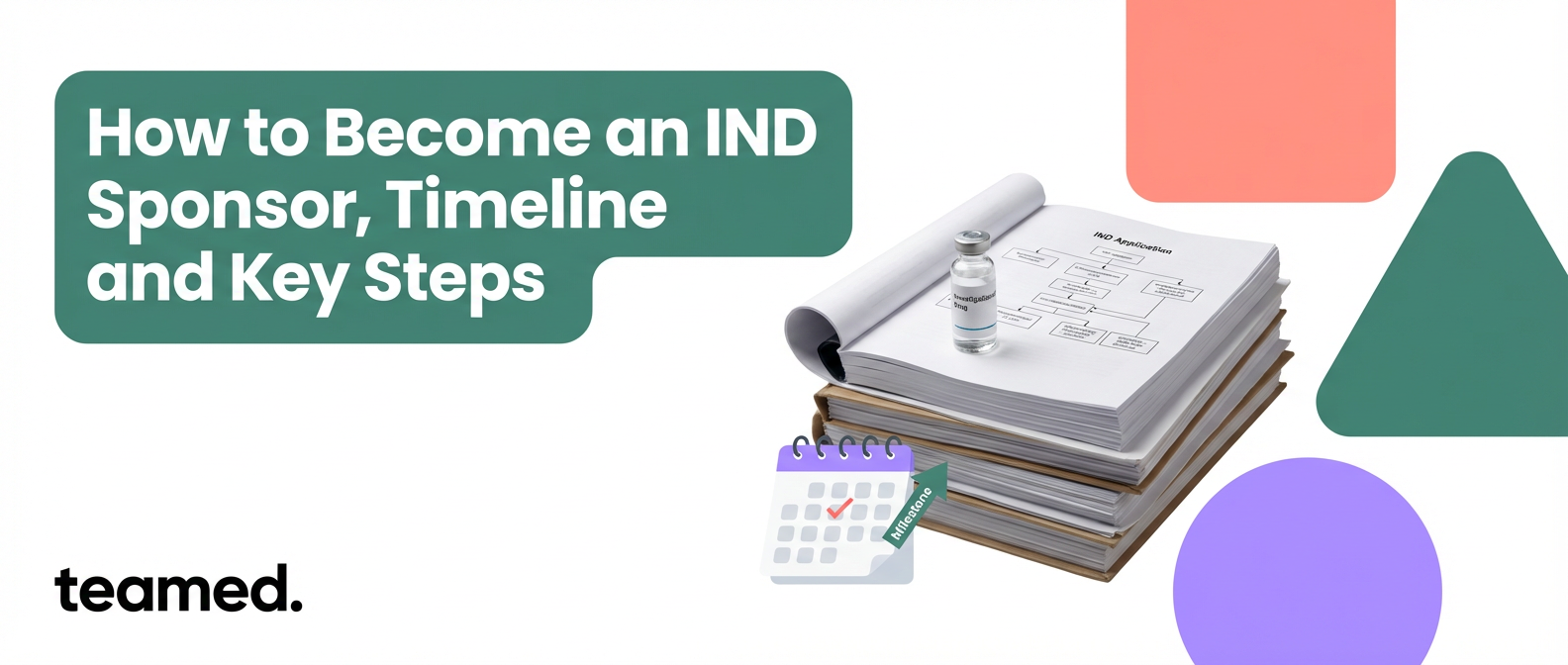
How to Become an IND Sponsor: Timeline and Key Steps

You've got a promising drug candidate. The board wants a timeline to first-in-human dosing. Your investors are asking when you'll file the IND. And somewhere between the science and the spreadsheets, you're realising that becoming an IND sponsor involves far more than submitting a regulatory dossier.

Here's the thing: the timeline and process for becoming an IND sponsor isn't just a regulatory question. It's a cross-functional programme that touches R&D, clinical operations, quality, legal, finance, and people. For mid-market biotechs scaling from 50 to 500 employees, the IND journey often becomes the forcing function for decisions about where to hire, how to structure global teams, and when to establish entities in new markets.

This guide walks through what IND sponsorship actually means, the realistic timeline from preclinical data to first patient dosed, and the strategic decisions that mid-market and European biotechs need to make along the way.

Key Takeaways

  • An IND sponsor is the individual or organisation that initiates an FDA-regulated clinical investigation under an Investigational New Drug (IND) application and is legally responsible for regulatory compliance, safety oversight, and required submissions during the study.
  • The FDA's standard initial safety review window for a newly submitted IND is 30 calendar days from FDA receipt, after which a sponsor may generally begin the study if the FDA has not imposed a clinical hold.
  • The IND timeline runs from preclinical work through FDA submission, the review window, and first-in-human dosing, with major dependencies on nonclinical studies, CMC readiness, and operational site startup.
  • Mid-market biotechs moving from a few dozen toward a few hundred employees must plan for resourcing, global hiring, and where to base key regulatory staff as part of IND planning.
  • European or UK biotechs sponsoring a US IND while most of the team is in Europe face additional planning questions around US entity structure, employment models, and cross-border coordination.

What an IND Sponsor Is and How the IND Process Works

An Investigational New Drug (IND) application is a submission to the US Food and Drug Administration (FDA) that seeks authorisation to administer an investigational drug or biologic to humans in a clinical study in the United States. Without an active IND, you cannot legally ship or administer an investigational product to human subjects in the US.

The IND sponsor is the person or organisation that initiates and takes responsibility for the clinical investigation. This is distinct from the investigator, who actually conducts the trial at clinical sites, and from a CRO, which performs delegated tasks under contract. An IND sponsor differs from a CRO in that the sponsor retains legal accountability to the FDA for trial conduct and safety reporting, while a CRO performs delegated tasks under contract without assuming the sponsor's statutory responsibilities.

A sponsor-investigator is an individual who both initiates and conducts an FDA-regulated clinical investigation and directly performs the sponsor duties and investigator duties for the same IND. This model works when a single investigator will both conduct the study and accept sponsor obligations, including safety reporting and FDA correspondence, without relying on a separate corporate sponsor function.

In practice, being an IND sponsor means you own the scientific plan, the regulatory relationship, and the safety of every participant enrolled under your IND. Your ongoing responsibilities include safety reporting to the FDA, protocol oversight, keeping the FDA informed via amendments and annual reports, and maintaining oversight of all investigators working under your IND.

The process flows through distinct stages: preclinical studies to generate safety data, preparing the IND application package, FDA review, then conducting the clinical trial under the active IND. European sponsors often know the EU Clinical Trial Application (CTA) route but need clarity on how the FDA IND process differs when stepping into the US sponsor role.

IND Timeline From Preclinical Data to IND Submission

The IND timeline begins once you have a credible development candidate. From that point, the journey to IND submission typically involves several parallel workstreams that must converge before you can file.

The pre-IND phase covers nonclinical safety studies, pharmacology, and Chemistry, Manufacturing, and Controls (CMC) activities to generate the data package for your INDThe pre-IND phase covers nonclinical safety studies, pharmacology, and Chemistry, Manufacturing, and Controls (CMC) activities to generate the data package for your IND, with core IND-enabling nonclinical safety studies typically requiring 12–18 months to complete. CMC is the IND dossier section that describes how an investigational product is made, tested, controlled, and stored, including specifications and stability evidence supporting first-in-human use.

Planning starts with an internal go/no-go decision before committing to full IND-enabling studies. Treat this as a strategic checkpoint for leadership and the board. Nonclinical, CMC, and clinical planning often run in parallel, but dependencies matter. You can't file without adequate toxicology data in relevant species, and you can't manufacture clinical supply without a validated process.

The major stages look like this:

  1. Discovery handover and development candidate selection
  2. IND-enabling nonclinical studies (toxicology, pharmacology, ADME)
  3. CMC development and clinical supply manufacturing
  4. Pre-IND meeting with FDA (optional but often valuable)
  5. IND dossier compilation and internal quality review
  6. Electronic submission to FDA

In practical terms, the IND timeline is the journey from promising preclinical data, through a focused development programme, to a complete dossier that gives the FDA enough confidence to allow first-in-human dosing.

Mid-market scaling companies should translate this timeline into hiring, vendor, and fundraising plans. European sponsors must align the US IND timeline with EU CTA planning if running trials in both regions.

Key Steps in the IND Application Process With the FDA

A pre-IND meeting is a formal interaction with the FDA in which a prospective sponsor seeks feedback on the nonclinical, CMC, and clinical plan before submitting an IND to reduce avoidable deficiencies and clinical hold risk. Choose a pre-IND meeting when the first-in-human plan involves novel modalities, complex manufacturing, or nonstandard endpoints, because early FDA feedback can prevent a clinical hold during the 30-day IND review window.

To request a pre-IND meeting, you submit a meeting request with a briefing package that outlines your development programme, key questions, and supporting data. The FDA typically responds within 60 days with written feedback or a meeting date.—typically 50–100 pages in length. The FDA typically responds within 60 days with written feedback or a meeting date.

The core IND application includes several modules:

  • Cover letter and Form FDA 1571 (the application form)
  • Form FDA 1572 (investigator statement) for each clinical investigator
  • Form FDA 3674 (clinicaltrials.gov certification)
  • Investigator's brochure
  • Clinical protocols
  • CMC section with manufacturing, characterisation, and stability data
  • Nonclinical pharmacology and toxicology summaries
  • Prior human experience, if any

Submission happens via the FDA electronic gateway. The moment FDA receives your IND, the 30-day review clock starts.

Smaller and mid-market sponsors, particularly Europe-led companies with US first trials, often rely on external regulatory consultants to compile the dossierSmaller and mid-market sponsors, particularly Europe-led companies with US first trials, often rely on external regulatory consultants to compile the dossier, a process that typically takes 4–6 months for first-time sponsors. But you must retain internal accountability for content. Choose internal ownership of IND dossier sign-off when the company intends to run more than one protocol under the same programme, because repeated amendments and annual reports create ongoing regulatory workload that cannot be fully delegated to a CRO.

Have an internal process ready to respond rapidly to FDA information requests during review. Pre-assign who will handle queries, especially if your team spans EU-US time zones.

Regulatory Requirements IND Sponsors Must Meet Before First-in-Human Trials

The FDA's IND framework distinguishes between "permission to proceed after the 30-day safety review" and "marketing approval," meaning an IND does not create a right to sell a product even when a trial is permitted to begin. The FDA's standard is "reasonably safe" for initial human exposure, not proof of efficacy.

Safety data requirements: You need adequate nonclinical toxicology in relevant species, a clear dosing rationale, and stopping rules in the protocol. The FDA reviews whether the data support a reasonable belief that the drug is safe enough to test in humans at the proposed doses.

Product quality (CMC): Demonstrate consistent, safe manufacturing with characterisation, stability data, and quality controls. The FDA needs confidence that what you tested in animals is what you'll give to humans.

Ethics and oversight: IRB/ethics approval, robust informed consent, protection of vulnerable populations, and a proper investigator brochure are all required. The sponsor must ensure investigators understand their responsibilities.

Safety reporting readiness: Systems for detecting, assessing, and reporting serious and unexpected adverse reactions must be in place before dosing begins. Recent FDA guidance clarifies that sponsors bear primary responsibility for safety signal detection and reporting, even when CROs handle day-to-day operations.

The principles are similar to EU CTR requirements, but format, terminology, and expectations differ. This often surprises mid-market European sponsors entering the US for the first time.

How Long FDA IND Review Takes and What Can Delay IND Approval

The FDA's standard initial safety review window for a newly submitted IND is 30 calendar days from FDA receipt. After that window closes without a clinical hold, you may begin dosing. This is permission to proceed, not "approval" in the marketing sense.

A clinical hold is an FDA order to delay a proposed clinical investigation or to suspend an ongoing investigation under an IND, typically due to safety, protocol, or product quality concernsA clinical hold is an FDA order to delay a proposed clinical investigation or to suspend an ongoing investigation under an IND, typically due to safety, protocol, or product quality concerns, though only about 9% of INDs result in clinical holds. A pre-IND meeting differs from the 30-day IND safety review in that the pre-IND meeting is optional and advisory, while the 30-day review is a statutory gate that can result in a clinical hold that prevents dosing.

Common hold or delay triggers include:

  • Inadequate nonclinical safety data for the proposed dose
  • Major CMC concerns about product quality or consistency
  • Unsafe or unclear protocols
  • Weak safety monitoring plans
  • Poorly organised submissions that invite extra questions

Practical risk reduction: take pre-IND feedback seriously, run internal quality reviews before submission, and rehearse quick responses to information requests. Lean teams coordinating across EU-US time zones should pre-assign who will respond to FDA queries during review to avoid avoidable delays.

How long does it usually take from IND submission to first patient dosed? The 30-day FDA review is just one component. You also need site contracts, ethics approvals at each site, safety reporting infrastructure, and operational readiness. Plan for additional weeks or months beyond the formal review window.

Planning the IND Sponsor Journey for Mid-Market Biotech Companies

Many mid-market leaders discover that the hardest part of the IND journey is not the science, it is coordinating the moving parts across teams and geographies.

Treat the IND journey as a cross-functional programme spanning R&D, Regulatory, Clinical Operations, Quality, Legal, Finance, and People, not just science. Create a roadmap linking scientific milestones, regulatory submissions, hiring dates, and fundraising events so leadership sees convergence points.

Governance matters. Establish a development or portfolio committee that owns go/no-go decisions, risk reviews, and IND content sign-off. Scope what to outsource to CROs versus what to build in-house. Many companies underestimate the operational lift of sponsor duties.

Core workstreams to map include:

  • Regulatory strategy and FDA interactions
  • Clinical operations and site selection
  • Global hiring and team build-out
  • Fundraising alignment with IND milestones

For companies growing into the 200-2,000 employee band, IND milestones often trigger decisions about US-specific roles and potentially new entities when taking on US sponsor duties from a European headquarters.

IND Sponsor Timeline and Resourcing for Mid-Market Companies With 200 to 2,000 Employees

Teamed's mid-market expansion benchmarks treat 200 to 2,000 employees as the band where global employment model decisions, including when to use contractors, EOR, or owned entities, become recurring governance topics rather than one-off transactions.

Typical sequencing for IND-related hiring: start with senior regulatory leadership and programme/project management. Add clinical operations, safety, and data roles as IND prep and first study near. Scale QA, pharmacovigilance, and data functions as your portfolio grows.

Balance in-house versus CROs carefully. Execution can be outsourced, but sponsors need internal oversight accountable to FDA. The FDA expects the sponsor, not the CRO, to maintain control.

Geography decisions matter. Decide if US-based regulatory and clinical leads are needed when entering the US, and how to integrate them with existing European teams. In Teamed's operational planning guidance for regulated mid-market companies, teams should assume a minimum of 4 to 8 weeks to recruit and contract critical IND-startup roles in the UK/EU when using direct employment, excluding notice periods.

Employment model selection is a risk control. Choose an EOR for EU or UK clinical operations hires when the company needs compliant employment in-country within weeks and does not yet have a local entity or payroll infrastructure. Choose direct employment through an owned UK or EU entity when headcount in a single country becomes a stable operational hub and the company needs tighter control over payroll, benefits design, and long-term retention.

Choose contractors only when the role is genuinely project-based, time-limited, and can be delivered without day-to-day managerial control that resembles employment. Integrated clinical operations roles are high-risk for misclassification in Europe.

As trials expand, revisit entity structure, payroll, and compliance footprint per country. HR and Finance collaboration avoids reactive hiring in critical markets.

IND Sponsor Strategy for Mid-Market Biotechs Based in Europe

For UK, German, Nordic, or other EU-based biotechs sponsoring a US IND, the regulatory approach and legal structure questions differ from EU-only trials.

An IND differs from a marketing application in that an IND authorises clinical investigation and imposes ongoing reporting obligations, while a marketing application seeks commercial approval to sell a product in the United States. A European company can sponsor an IND without a US subsidiary. But a US entity and local staff can simplify contracts, oversight, and practical interactions with US sites and regulators.

Key strategic questions to answer before filing a US IND:

  • Do we need a US legal entity for contracting and oversight?
  • Where should regulatory and clinical leadership be based: EU, US, or hybrid?
  • How will we handle time zone coordination for FDA interactions?
  • What are the employment law, payroll, and tax implications of US hiring?

Employment law, payroll, and tax implications for US hiring differ from European norms. UK IR35 off-payroll working rules require medium and large businesses to determine the employment status of many contractors and can shift tax liability to the hiring organisation when the assessment is incorrect. UK statutory paid holiday entitlement for employees is 5.6 weeks per leave year, which is a mandatory cost and compliance requirement when moving clinical operations staff from contractor to employee status in the UK.

Encourage joined-up planning across Regulatory, Legal, and People so regulatory strategy and global employment strategy stay in sync. The transition from EU to US systems catches many mid-market sponsors off guard.

Coordinating IND Trials Across the US and Europe for Scaling Sponsors

Teamed's compliance-first hiring playbooks for regulated programmes commonly require at least 3 separate compliance workstreams to be resourced in parallel: regulatory operations, quality oversight, and safety reporting operations, before first patient dosing.

Many sponsors run sites in the US and multiple European countries simultaneously, operating under FDA and European frameworks at once. This requires clear global governance for protocol changes, safety signal detection, and data quality to meet all regulators' expectations consistently.

Practical challenges include differing safety reporting timelines between FDA and EMA, aligning consent and patient information locally, and coordinating inspections and audits across jurisdictions.

Typical operating models centralise pharmacovigilance and data management while maintaining local country or regional teams for site relationships and local regulations. Consider a hypothetical mid-market oncology company running sites in the US, UK, and Germany. They might have central PV in London, US clinical operations leads in Boston, and local site managers in each country, all coordinating through a single governance structure.

Cross-border programmes raise employment complexity. You'll likely have a mix of local employees, contractors, and EORs across countries supporting the same trial. In Germany, employee leasing (Arbeitnehmerüberlassung) is a regulated model requiring a licensed provider, and non-compliant labour leasing can create co-employment and compliance exposure. In France, misclassification and hidden employment relationships can trigger social security back-pay and labour law claims. In the Netherlands, employment classification is assessed based on the factual working relationship rather than contract labels.

Poor coordination creates regulatory risk. One missed safety report or inconsistent protocol implementation can trigger inspections in multiple jurisdictions.

How Mid-Market IND Sponsors Can Build Global Clinical Teams With Teamed as a Strategic Advisor

After IND strategy is set, sponsors must build and manage teams across countries in compliant, scalable ways. Clinical operations, regulatory affairs, safety, and support roles often need to be in multiple markets simultaneously.

The decision points are real: direct employment versus EOR versus contractors, all with regulatory, tax, and compliance implications in healthcare and life sciences. Teamed's time-to-execution standard for global employment operations states that once an employment model decision is approved, compliant onboarding can be executed in as little as 24 hours in many countries through established processes and in-country partners.

Teamed advises when to use contractors, lean on EOR, or establish entities, providing continuity as the company scales. This isn't about pushing one model over another. It's about matching the employment approach to the role, the market, and the company's stage.

Strategic employment decisions Teamed advises on:

  • When to convert contractors to employees as clinical programmes mature
  • Whether to use EOR for speed or establish entities for long-term presence
  • How to phase hiring across US, UK, and EU markets as trials expand
  • When entity establishment timing makes sense versus staying on EOR

Teamed operates in 180+ countries with experience in regulated sectors including defence, financial services, and healthcare. This reassures sponsors that their employment decisions will withstand scrutiny from regulators and auditors.

For mid-market biotechs navigating IND sponsorship while building global teams, having one strategic partner for employment decisions eliminates the fragmented advice that comes from multiple vendors with conflicting incentives.

Ready to align your IND timeline with a coherent global employment strategy? Talk to the experts at Teamed.

FAQs About Becoming an IND Sponsor

How much budget should a mid-market biotech plan for reaching its first IND submission?

Budget drivers include nonclinical studies (toxicology, pharmacology), CMC development and clinical supply manufacturing, regulatory consultancy, and internal hiring. Costs vary dramatically based on modality, indication, and existing infrastructure. Rather than a single number, model each workstream separately and stress-test assumptions with advisors who've seen comparable programmes.

When should a company build an in-house regulatory team instead of relying only on consultants for its IND?

Early-stage companies often start with consultants, but should bring regulatory leadership in-house as IND-enabling studies approach and a pipeline of submissions is expected. Internal ownership becomes critical when you'll have ongoing FDA interactions, multiple protocols, and annual reporting obligations.

Does a Europe-based biotech need a US entity to act as an IND sponsor with the FDA?

A European company can sponsor an IND without a US subsidiary. But a US entity and local staff can simplify contracts, oversight of US-based activities, and practical interactions with the FDA. Many European sponsors find the operational benefits outweigh the entity setup costs.

How long does it usually take from IND submission to first patient dosed in a trial?

The FDA's 30-day review is just one component. Add time for site contracts, ethics approvals at each site, safety reporting infrastructure setup, and operational readiness. Depending on complexity, plan for several additional weeks to months beyond the formal review window.

How should IND milestones align with Series B and Series C fundraising plans for a growing biotech?

Use IND submission and first patient dosed as anchor milestones and work backwards to resource and schedule realistically. Investors expect credible timelines tied to regulatory gates. Misalignment between promised dates and actual readiness damages credibility.

How does becoming an IND sponsor change our global hiring and entity strategy?

Sponsor status often requires staff in new countries and choices among direct employment, contractors, and EORs. This can trigger decisions about if and when to open new entities. Choose to align IND submission and first-patient-dosed planning with finance governance when the organisation needs board-ready runway modelling, because regulatory review time is fixed at 30 days but site initiation and staffing lead times are not.

What is mid-market in the context of life sciences and global employment strategy?

Mid-market typically refers to companies in the 200 to 2,000 headcount range or with revenue between approximately £10 million and £1 billion. This is the band where IND complexity and global employment strategy intersect, where companies are large enough to need sophisticated guidance but small enough to need responsive advisors rather than enterprise consulting models.or
How to Become an IND Sponsor: Timeline and Key Steps

You've got a promising drug candidate. The board wants a timeline to first-in-human dosing. Your investors are asking when you'll file the IND. And somewhere between the science and the spreadsheets, you're realising that becoming an IND sponsor involves far more than submitting a regulatory dossier.

Here's the thing: the timeline and process for becoming an IND sponsor isn't just a regulatory question. It's a cross-functional programme that touches R&D, clinical operations, quality, legal, finance, and people. For mid-market biotechs scaling from 50 to 500 employees, the IND journey often becomes the forcing function for decisions about where to hire, how to structure global teams, and when to establish entities in new markets.

This guide walks through what IND sponsorship actually means, the realistic timeline from preclinical data to first patient dosed, and the strategic decisions that mid-market and European biotechs need to make along the way.

Key Takeaways

  • An IND sponsor is the individual or organisation that initiates an FDA-regulated clinical investigation under an Investigational New Drug (IND) application and is legally responsible for regulatory compliance, safety oversight, and required submissions during the study.
  • The FDA's standard initial safety review window for a newly submitted IND is 30 calendar days from FDA receipt, after which a sponsor may generally begin the study if the FDA has not imposed a clinical hold.
  • The IND timeline runs from preclinical work through FDA submission, the review window, and first-in-human dosing, with major dependencies on nonclinical studies, CMC readiness, and operational site startup.
  • Mid-market biotechs moving from a few dozen toward a few hundred employees must plan for resourcing, global hiring, and where to base key regulatory staff as part of IND planning.
  • European or UK biotechs sponsoring a US IND while most of the team is in Europe face additional planning questions around US entity structure, employment models, and cross-border coordination.

What an IND Sponsor Is and How the IND Process Works

An Investigational New Drug (IND) application is a submission to the US Food and Drug Administration (FDA) that seeks authorisation to administer an investigational drug or biologic to humans in a clinical study in the United States. Without an active IND, you cannot legally ship or administer an investigational product to human subjects in the US.

The IND sponsor is the person or organisation that initiates and takes responsibility for the clinical investigation. This is distinct from the investigator, who actually conducts the trial at clinical sites, and from a CRO, which performs delegated tasks under contract. An IND sponsor differs from a CRO in that the sponsor retains legal accountability to the FDA for trial conduct and safety reporting, while a CRO performs delegated tasks under contract without assuming the sponsor's statutory responsibilities.

A sponsor-investigator is an individual who both initiates and conducts an FDA-regulated clinical investigation and directly performs the sponsor duties and investigator duties for the same IND. This model works when a single investigator will both conduct the study and accept sponsor obligations, including safety reporting and FDA correspondence, without relying on a separate corporate sponsor function.

In practice, being an IND sponsor means you own the scientific plan, the regulatory relationship, and the safety of every participant enrolled under your IND. Your ongoing responsibilities include safety reporting to the FDA, protocol oversight, keeping the FDA informed via amendments and annual reports, and maintaining oversight of all investigators working under your IND.

The process flows through distinct stages: preclinical studies to generate safety data, preparing the IND application package, FDA review, then conducting the clinical trial under the active IND. European sponsors often know the EU Clinical Trial Application (CTA) route but need clarity on how the FDA IND process differs when stepping into the US sponsor role.

IND Timeline From Preclinical Data to IND Submission

The IND timeline begins once you have a credible development candidate. From that point, the journey to IND submission typically involves several parallel workstreams that must converge before you can file.

The pre-IND phase covers nonclinical safety studies, pharmacology, and Chemistry, Manufacturing, and Controls (CMC) activities to generate the data package for your INDThe pre-IND phase covers nonclinical safety studies, pharmacology, and Chemistry, Manufacturing, and Controls (CMC) activities to generate the data package for your IND, with core IND-enabling nonclinical safety studies typically requiring 12–18 months to complete. CMC is the IND dossier section that describes how an investigational product is made, tested, controlled, and stored, including specifications and stability evidence supporting first-in-human use.

Planning starts with an internal go/no-go decision before committing to full IND-enabling studies. Treat this as a strategic checkpoint for leadership and the board. Nonclinical, CMC, and clinical planning often run in parallel, but dependencies matter. You can't file without adequate toxicology data in relevant species, and you can't manufacture clinical supply without a validated process.

The major stages look like this:

  1. Discovery handover and development candidate selection
  2. IND-enabling nonclinical studies (toxicology, pharmacology, ADME)
  3. CMC development and clinical supply manufacturing
  4. Pre-IND meeting with FDA (optional but often valuable)
  5. IND dossier compilation and internal quality review
  6. Electronic submission to FDA

In practical terms, the IND timeline is the journey from promising preclinical data, through a focused development programme, to a complete dossier that gives the FDA enough confidence to allow first-in-human dosing.

Mid-market scaling companies should translate this timeline into hiring, vendor, and fundraising plans. European sponsors must align the US IND timeline with EU CTA planning if running trials in both regions.

Key Steps in the IND Application Process With the FDA

A pre-IND meeting is a formal interaction with the FDA in which a prospective sponsor seeks feedback on the nonclinical, CMC, and clinical plan before submitting an IND to reduce avoidable deficiencies and clinical hold risk. Choose a pre-IND meeting when the first-in-human plan involves novel modalities, complex manufacturing, or nonstandard endpoints, because early FDA feedback can prevent a clinical hold during the 30-day IND review window.

To request a pre-IND meeting, you submit a meeting request with a briefing package that outlines your development programme, key questions, and supporting data. The FDA typically responds within 60 days with written feedback or a meeting date.—typically 50–100 pages in length. The FDA typically responds within 60 days with written feedback or a meeting date.

The core IND application includes several modules:

  • Cover letter and Form FDA 1571 (the application form)
  • Form FDA 1572 (investigator statement) for each clinical investigator
  • Form FDA 3674 (clinicaltrials.gov certification)
  • Investigator's brochure
  • Clinical protocols
  • CMC section with manufacturing, characterisation, and stability data
  • Nonclinical pharmacology and toxicology summaries
  • Prior human experience, if any

Submission happens via the FDA electronic gateway. The moment FDA receives your IND, the 30-day review clock starts.

Smaller and mid-market sponsors, particularly Europe-led companies with US first trials, often rely on external regulatory consultants to compile the dossierSmaller and mid-market sponsors, particularly Europe-led companies with US first trials, often rely on external regulatory consultants to compile the dossier, a process that typically takes 4–6 months for first-time sponsors. But you must retain internal accountability for content. Choose internal ownership of IND dossier sign-off when the company intends to run more than one protocol under the same programme, because repeated amendments and annual reports create ongoing regulatory workload that cannot be fully delegated to a CRO.

Have an internal process ready to respond rapidly to FDA information requests during review. Pre-assign who will handle queries, especially if your team spans EU-US time zones.

Regulatory Requirements IND Sponsors Must Meet Before First-in-Human Trials

The FDA's IND framework distinguishes between "permission to proceed after the 30-day safety review" and "marketing approval," meaning an IND does not create a right to sell a product even when a trial is permitted to begin. The FDA's standard is "reasonably safe" for initial human exposure, not proof of efficacy.

Safety data requirements: You need adequate nonclinical toxicology in relevant species, a clear dosing rationale, and stopping rules in the protocol. The FDA reviews whether the data support a reasonable belief that the drug is safe enough to test in humans at the proposed doses.

Product quality (CMC): Demonstrate consistent, safe manufacturing with characterisation, stability data, and quality controls. The FDA needs confidence that what you tested in animals is what you'll give to humans.

Ethics and oversight: IRB/ethics approval, robust informed consent, protection of vulnerable populations, and a proper investigator brochure are all required. The sponsor must ensure investigators understand their responsibilities.

Safety reporting readiness: Systems for detecting, assessing, and reporting serious and unexpected adverse reactions must be in place before dosing begins. Recent FDA guidance clarifies that sponsors bear primary responsibility for safety signal detection and reporting, even when CROs handle day-to-day operations.

The principles are similar to EU CTR requirements, but format, terminology, and expectations differ. This often surprises mid-market European sponsors entering the US for the first time.

How Long FDA IND Review Takes and What Can Delay IND Approval

The FDA's standard initial safety review window for a newly submitted IND is 30 calendar days from FDA receipt. After that window closes without a clinical hold, you may begin dosing. This is permission to proceed, not "approval" in the marketing sense.

A clinical hold is an FDA order to delay a proposed clinical investigation or to suspend an ongoing investigation under an IND, typically due to safety, protocol, or product quality concernsA clinical hold is an FDA order to delay a proposed clinical investigation or to suspend an ongoing investigation under an IND, typically due to safety, protocol, or product quality concerns, though only about 9% of INDs result in clinical holds. A pre-IND meeting differs from the 30-day IND safety review in that the pre-IND meeting is optional and advisory, while the 30-day review is a statutory gate that can result in a clinical hold that prevents dosing.

Common hold or delay triggers include:

  • Inadequate nonclinical safety data for the proposed dose
  • Major CMC concerns about product quality or consistency
  • Unsafe or unclear protocols
  • Weak safety monitoring plans
  • Poorly organised submissions that invite extra questions

Practical risk reduction: take pre-IND feedback seriously, run internal quality reviews before submission, and rehearse quick responses to information requests. Lean teams coordinating across EU-US time zones should pre-assign who will respond to FDA queries during review to avoid avoidable delays.

How long does it usually take from IND submission to first patient dosed? The 30-day FDA review is just one component. You also need site contracts, ethics approvals at each site, safety reporting infrastructure, and operational readiness. Plan for additional weeks or months beyond the formal review window.

Planning the IND Sponsor Journey for Mid-Market Biotech Companies

Many mid-market leaders discover that the hardest part of the IND journey is not the science, it is coordinating the moving parts across teams and geographies.

Treat the IND journey as a cross-functional programme spanning R&D, Regulatory, Clinical Operations, Quality, Legal, Finance, and People, not just science. Create a roadmap linking scientific milestones, regulatory submissions, hiring dates, and fundraising events so leadership sees convergence points.

Governance matters. Establish a development or portfolio committee that owns go/no-go decisions, risk reviews, and IND content sign-off. Scope what to outsource to CROs versus what to build in-house. Many companies underestimate the operational lift of sponsor duties.

Core workstreams to map include:

  • Regulatory strategy and FDA interactions
  • Clinical operations and site selection
  • Global hiring and team build-out
  • Fundraising alignment with IND milestones

For companies growing into the 200-2,000 employee band, IND milestones often trigger decisions about US-specific roles and potentially new entities when taking on US sponsor duties from a European headquarters.

IND Sponsor Timeline and Resourcing for Mid-Market Companies With 200 to 2,000 Employees

Teamed's mid-market expansion benchmarks treat 200 to 2,000 employees as the band where global employment model decisions, including when to use contractors, EOR, or owned entities, become recurring governance topics rather than one-off transactions.

Typical sequencing for IND-related hiring: start with senior regulatory leadership and programme/project management. Add clinical operations, safety, and data roles as IND prep and first study near. Scale QA, pharmacovigilance, and data functions as your portfolio grows.

Balance in-house versus CROs carefully. Execution can be outsourced, but sponsors need internal oversight accountable to FDA. The FDA expects the sponsor, not the CRO, to maintain control.

Geography decisions matter. Decide if US-based regulatory and clinical leads are needed when entering the US, and how to integrate them with existing European teams. In Teamed's operational planning guidance for regulated mid-market companies, teams should assume a minimum of 4 to 8 weeks to recruit and contract critical IND-startup roles in the UK/EU when using direct employment, excluding notice periods.

Employment model selection is a risk control. Choose an EOR for EU or UK clinical operations hires when the company needs compliant employment in-country within weeks and does not yet have a local entity or payroll infrastructure. Choose direct employment through an owned UK or EU entity when headcount in a single country becomes a stable operational hub and the company needs tighter control over payroll, benefits design, and long-term retention.

Choose contractors only when the role is genuinely project-based, time-limited, and can be delivered without day-to-day managerial control that resembles employment. Integrated clinical operations roles are high-risk for misclassification in Europe.

As trials expand, revisit entity structure, payroll, and compliance footprint per country. HR and Finance collaboration avoids reactive hiring in critical markets.

IND Sponsor Strategy for Mid-Market Biotechs Based in Europe

For UK, German, Nordic, or other EU-based biotechs sponsoring a US IND, the regulatory approach and legal structure questions differ from EU-only trials.

An IND differs from a marketing application in that an IND authorises clinical investigation and imposes ongoing reporting obligations, while a marketing application seeks commercial approval to sell a product in the United States. A European company can sponsor an IND without a US subsidiary. But a US entity and local staff can simplify contracts, oversight, and practical interactions with US sites and regulators.

Key strategic questions to answer before filing a US IND:

  • Do we need a US legal entity for contracting and oversight?
  • Where should regulatory and clinical leadership be based: EU, US, or hybrid?
  • How will we handle time zone coordination for FDA interactions?
  • What are the employment law, payroll, and tax implications of US hiring?

Employment law, payroll, and tax implications for US hiring differ from European norms. UK IR35 off-payroll working rules require medium and large businesses to determine the employment status of many contractors and can shift tax liability to the hiring organisation when the assessment is incorrect. UK statutory paid holiday entitlement for employees is 5.6 weeks per leave year, which is a mandatory cost and compliance requirement when moving clinical operations staff from contractor to employee status in the UK.

Encourage joined-up planning across Regulatory, Legal, and People so regulatory strategy and global employment strategy stay in sync. The transition from EU to US systems catches many mid-market sponsors off guard.

Coordinating IND Trials Across the US and Europe for Scaling Sponsors

Teamed's compliance-first hiring playbooks for regulated programmes commonly require at least 3 separate compliance workstreams to be resourced in parallel: regulatory operations, quality oversight, and safety reporting operations, before first patient dosing.

Many sponsors run sites in the US and multiple European countries simultaneously, operating under FDA and European frameworks at once. This requires clear global governance for protocol changes, safety signal detection, and data quality to meet all regulators' expectations consistently.

Practical challenges include differing safety reporting timelines between FDA and EMA, aligning consent and patient information locally, and coordinating inspections and audits across jurisdictions.

Typical operating models centralise pharmacovigilance and data management while maintaining local country or regional teams for site relationships and local regulations. Consider a hypothetical mid-market oncology company running sites in the US, UK, and Germany. They might have central PV in London, US clinical operations leads in Boston, and local site managers in each country, all coordinating through a single governance structure.

Cross-border programmes raise employment complexity. You'll likely have a mix of local employees, contractors, and EORs across countries supporting the same trial. In Germany, employee leasing (Arbeitnehmerüberlassung) is a regulated model requiring a licensed provider, and non-compliant labour leasing can create co-employment and compliance exposure. In France, misclassification and hidden employment relationships can trigger social security back-pay and labour law claims. In the Netherlands, employment classification is assessed based on the factual working relationship rather than contract labels.

Poor coordination creates regulatory risk. One missed safety report or inconsistent protocol implementation can trigger inspections in multiple jurisdictions.

How Mid-Market IND Sponsors Can Build Global Clinical Teams With Teamed as a Strategic Advisor

After IND strategy is set, sponsors must build and manage teams across countries in compliant, scalable ways. Clinical operations, regulatory affairs, safety, and support roles often need to be in multiple markets simultaneously.

The decision points are real: direct employment versus EOR versus contractors, all with regulatory, tax, and compliance implications in healthcare and life sciences. Teamed's time-to-execution standard for global employment operations states that once an employment model decision is approved, compliant onboarding can be executed in as little as 24 hours in many countries through established processes and in-country partners.

Teamed advises when to use contractors, lean on EOR, or establish entities, providing continuity as the company scales. This isn't about pushing one model over another. It's about matching the employment approach to the role, the market, and the company's stage.

Strategic employment decisions Teamed advises on:

  • When to convert contractors to employees as clinical programmes mature
  • Whether to use EOR for speed or establish entities for long-term presence
  • How to phase hiring across US, UK, and EU markets as trials expand
  • When entity establishment timing makes sense versus staying on EOR

Teamed operates in 180+ countries with experience in regulated sectors including defence, financial services, and healthcare. This reassures sponsors that their employment decisions will withstand scrutiny from regulators and auditors.

For mid-market biotechs navigating IND sponsorship while building global teams, having one strategic partner for employment decisions eliminates the fragmented advice that comes from multiple vendors with conflicting incentives.

Ready to align your IND timeline with a coherent global employment strategy? Talk to the experts at Teamed.

FAQs About Becoming an IND Sponsor

How much budget should a mid-market biotech plan for reaching its first IND submission?

Budget drivers include nonclinical studies (toxicology, pharmacology), CMC development and clinical supply manufacturing, regulatory consultancy, and internal hiring. Costs vary dramatically based on modality, indication, and existing infrastructure. Rather than a single number, model each workstream separately and stress-test assumptions with advisors who've seen comparable programmes.

When should a company build an in-house regulatory team instead of relying only on consultants for its IND?

Early-stage companies often start with consultants, but should bring regulatory leadership in-house as IND-enabling studies approach and a pipeline of submissions is expected. Internal ownership becomes critical when you'll have ongoing FDA interactions, multiple protocols, and annual reporting obligations.

Does a Europe-based biotech need a US entity to act as an IND sponsor with the FDA?

A European company can sponsor an IND without a US subsidiary. But a US entity and local staff can simplify contracts, oversight of US-based activities, and practical interactions with the FDA. Many European sponsors find the operational benefits outweigh the entity setup costs.

How long does it usually take from IND submission to first patient dosed in a trial?

The FDA's 30-day review is just one component. Add time for site contracts, ethics approvals at each site, safety reporting infrastructure setup, and operational readiness. Depending on complexity, plan for several additional weeks to months beyond the formal review window.

How should IND milestones align with Series B and Series C fundraising plans for a growing biotech?

Use IND submission and first patient dosed as anchor milestones and work backwards to resource and schedule realistically. Investors expect credible timelines tied to regulatory gates. Misalignment between promised dates and actual readiness damages credibility.

How does becoming an IND sponsor change our global hiring and entity strategy?

Sponsor status often requires staff in new countries and choices among direct employment, contractors, and EORs. This can trigger decisions about if and when to open new entities. Choose to align IND submission and first-patient-dosed planning with finance governance when the organisation needs board-ready runway modelling, because regulatory review time is fixed at 30 days but site initiation and staffing lead times are not.

What is mid-market in the context of life sciences and global employment strategy?

Mid-market typically refers to companies in the 200 to 2,000 headcount range or with revenue between approximately £10 million and £1 billion. This is the band where IND complexity and global employment strategy intersect, where companies are large enough to need sophisticated guidance but small enough to need responsive advisors rather than enterprise consulting models.or
TABLE OF CONTENTS

Take a look
at the latest articles