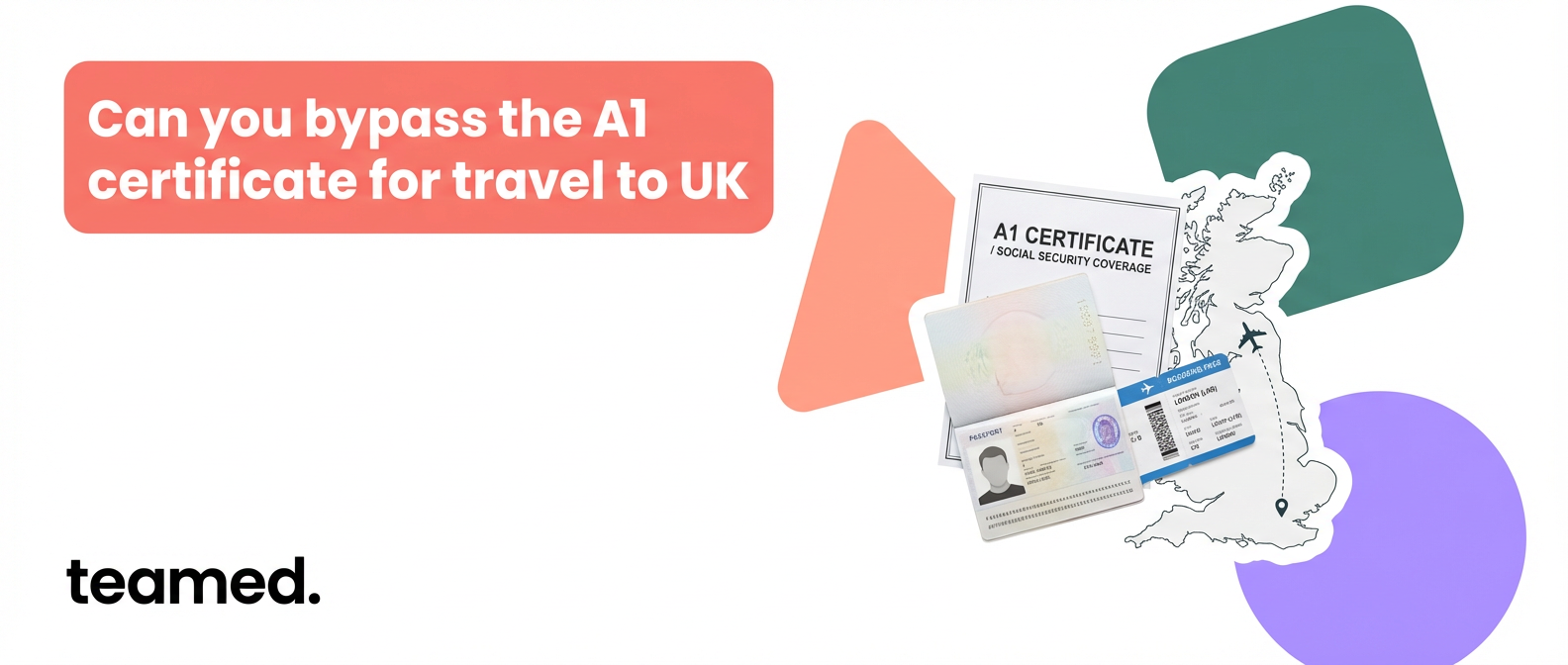
Can You Bypass A1 Certificate for UK Travel? Risk Guide

Global employment

Can You Bypass the A1 Certificate for Travel to UK?

Your German software engineer needs to be in London next Tuesday. The client meeting can't wait, but the A1 certificate application is still sitting with the German authorities. So you start wondering: can you bypass the A1 certificate for travel to UK and sort out the paperwork later?

Here's the uncomfortable truth. You can usually board the plane without an A1 certificate. UK border control won't ask for one. But that doesn't mean you've avoided anything. You've just shifted the risk from a visible checkpoint to an invisible compliance exposure that can surface months or years later during an audit.

For mid-market companies sending staff between EU countries and the UK, this isn't a paperwork question—it's part of a compliance landscape involving 4.6 million A1 certificates issued across the EU in 2022. It's a strategic employment decision that sits at the intersection of social security coordination, immigration rules, and your broader global workforce model.

Key Takeaways

  • You cannot legitimately bypass an A1 certificate where it is required. Travelling without one doesn't remove social security obligations; it shifts risk to employer and employee.

  • An A1 certificate is a social security certificate, not a visa or travel document. It sits alongside UK visas and Electronic Travel Authorisation (ETA) as a separate compliance requirement.

  • Short or informal business trips can still trigger A1 requirements. Trip length alone is not a reliable shortcut.

  • Mid-market companies with 200 to 2,000 employees typically begin experiencing material cross-border employment compliance complexity at the 200-300 employee mark, according to Teamed's mid-market operating model guidance.

  • A1 decisions should be treated as employment strategy, not form-filling. They connect directly to choices about contractors, EOR arrangements, and entity establishment.

Can You Travel To The UK Without An A1 Certificate

An A1 certificate is an official social security coverage certificate issued by an EU/EEA country or Switzerland that confirms which country's social security legislation applies to a worker who is temporarily working in another country. This definition matters because it clarifies what an A1 does and doesn't do.

Yes, you can physically enter the UK without one. UK border officials typically don't ask for A1 certificates because they're focused on immigration status, not social security coordination. In practice, people travel without them constantly.

But here's what most guidance misses: travelling without a required A1 doesn't mean you've avoided the obligation. It means you've created an undocumented period of cross-border work that either country's social security authority can later question. The A1 proves which country is responsible for social security contributions. Without it, both countries can assert liability for the same period, creating the risk of double social security contributions that can reach 40-45% of salary package until proper documentation is secured.

Consider a French compliance team attending a three-day workshop in London. They fly in, attend the sessions, fly home. No one asks for an A1. But if French or UK authorities later audit the employer's cross-border work patterns, that undocumented trip becomes a data point in a larger picture of non-compliance.

You can usually board a plane without an A1 certificate, but you cannot board away from your social security obligations.

What An A1 Certificate Is For UK And European Business Travel

Social security coordination is a legal framework that allocates which country collects mandatory social contributions when work is performed across borders, with the primary aim of preventing double contributions for the same period of work. The A1 certificate is the document that proves this allocation.

Within the EU/EEA, an A1 prevents double contributions by confirming home-system coverage for a set period during temporary work abroad. Although the UK left the EU, A1s remain relevant for EU-based employees posted to work in the UK under home-country rules or bilateral arrangements.

The A1 is distinct from visas, ETA, and right-to-work checks. It covers social security only. A German employee visiting the UK for a project needs to consider three separate requirements: the A1 from German authorities confirming continued German social security coverage, any UK visa or work authorisation required for their activities, and potentially an Electronic Travel Authorisation depending on their nationality and circumstances.

Think of the A1 as your employee's social security home base when they travel. It's the document that says "this person is covered here, not there" when questions arise about where contributions should be paid.

When European Employees Need An A1 Certificate For UK Business Trips

A posted worker is an employee who is sent by their employer to work temporarily in another country while remaining employed and ordinarily insured in the home country's social security system. This is the core scenario where A1 certificates apply.

Employees insured in an EU/EEA country or Switzerland usually need an A1 when temporarily working abroad for their employer, even for short trips. This includes UK trips for client meetings, internal workshops, training sessions, installations, or project delivery. The activity matters more than the label you put on it.

Frequent or regular UK trips, even if individually short, strengthen the case for an A1 due to cumulative cross-border work patterns. A consultant who spends a few days each month across EU capitals and London creates a demonstrable pattern that authorities will assess as a whole, not as isolated incidents.

Employees working across several European countries require careful assessment to determine who issues the A1 and for which periods, a scenario affecting 1.4 million A1 certificates issued for multi-country workers in 2022. Recent European case law has made these assessments more complex by expecting employers to consider work in other countries, not only within the EU. This is where seeking expert guidance becomes essential rather than optional.

Responsibility for securing the A1 typically sits with the employer in the employee's home country. The employee can't simply decide to get one themselves in most jurisdictions.

Risks For Mid-Market Companies If Staff Enter The UK Without An A1 Certificate

Double social security contributions are a compliance outcome where two jurisdictions assert liability for mandatory social contributions for the same worker and time period because coverage was not evidenced or coordinated. This is the primary financial risk of travelling without required A1 documentation.

The risks break down across several dimensions. Financial exposure includes host and home authorities claiming contributions locally, risking double payments and retroactive bills that can span years of undocumented travel. Regulatory consequences include inspections that uncover missing A1s, leading to back payments, penalties, and requests for detailed historic work evidence that HR teams struggle to reconstruct.

Governance and reputation risks matter particularly in regulated industries. Boards in financial services, healthcare, and defence expect clear control over cross-border employment compliance. An audit finding that reveals years of undocumented business travel creates questions about broader operational controls.

Operational disruption follows when HR and Finance are forced into time-consuming reconstructions of past travel and work patterns. Future friction compounds the problem: repeated non-compliance can complicate obtaining new A1s or resolving other regulatory matters with the same authorities.

What feels like a small shortcut on one trip can become a major audit headache years later.

A1 Certificate Rules For Short Business Trips In Europe And The UK

European rules focus on where and how work is performed over time, not just trip length. There is no universal automatic exemption for short trips, and tolerance for very brief travel is an enforcement choice, not a rule.

A business traveller is a worker who crosses borders for work activities such as meetings, training, client delivery, installation, or project work, even when the trip is short and does not require immigration sponsorship. The definition doesn't include a minimum duration threshold.

For one-off exceptional trips, some employers accept small residual risk but document their rationale. This is a risk management decision, not a legal exemption. Frequent short trips quickly require A1 coverage because "short" loses meaning when repeated. Continuous cross-border roles need A1 planning embedded from the outset.

Visa and ETA rules operate separately. Short trips may still need both travel permission and social security cover. An A1 certificate differs from a UK visa or UK ETA in purpose: an A1 allocates social security liability while a visa or ETA governs immigration permission to enter and undertake permitted activities in the UK.

Managing A1 Certificates At Scale For Mid-Market Companies With 200 To 2,000 Employees

A fragmented vendor setup for global employment can be consolidated into a single operating approach in under two pay periods for many mid-market organisations, according to Teamed's consolidation methodology. The same principle applies to A1 management: ad-hoc handling collapses once you have dozens of travellers across multiple countries.

At mid-market scale, you don't want every trip to London to trigger a fresh debate about A1 certificates. You need a policy that defines when A1 is required, who owns the process, and what pre-travel checks look like.

Assign a clear social security coordination owner, backed by in-country experts. Align HR, Payroll, Finance, and Legal so everyone understands their role. Use technology to track travel and flag A1/visa checks, but apply human judgment in grey areas based on your risk appetite.

Choose to centralise A1 ownership in HR/Payroll with Legal oversight when the company has employees travelling from two or more EU countries into the UK, because A1 issuing rules and application processes are home-country specific. Choose to create a pre-travel checklist integrating A1, visa/ETA, and right-to-work checks when the company has 10+ cross-border business trips per month, because manual, ad hoc decisions don't scale for 200-2,000 employee organisations.

A1 Certificate Scenarios For Germany, The Netherlands And Other EU Countries Sending Staff To The UK

National practices differ even under harmonised EU rules. In Germany, authorities are often strict on documentation for employees working abroad. Employers commonly obtain A1s for relatively short assignments, including UK visits, and should expect thorough evidence requirements around employment and work patterns.

In the Netherlands, employers typically request an "A1 certificaat" for temporary work abroad, including travel involving the UK. Dutch HR teams often embed A1 requests into standard travel workflows. Evidence expectations are practical but consistent.

Other EU countries vary in their approach. Some are more proactive, others more permissive in enforcement. Mid-market firms operating across several countries should not benchmark to the most relaxed practice because national enforcement postures evolve. What's tolerated today may be scrutinised tomorrow.

Teamed supports global employment strategy and operations with in-market legal expertise coverage spanning 180+ countries. This matters because A1 decisions require understanding not just the rules, but how they're actually applied in each sending country.

Coordinating A1 Certificates, UK Visas And Electronic Travel Authorisation

Electronic Travel Authorisation (ETA) is a UK entry permission mechanism for visa-exempt travellers that relates to immigration clearance and does not determine which country's social security contributions are due. This distinction is critical because many HR teams conflate these requirements.

Think of A1, visas and ETA as three separate green lights you may need before a UK trip. An EU employee may need an A1 from the home country, a UK work visa if actually working, and an ETA if visa-exempt for entry purposes. None substitutes for the others.

A1 non-compliance differs from immigration non-compliance in enforcement pathways. Social security liability can lead to retroactive contribution claims and audits even when border entry was lawful. You can enter the UK perfectly legally and still create social security exposure.

Use an integrated pre-travel checklist triggered by nationality, home country, and purpose of travel to assess A1, visa, and ETA requirements together. This prevents the common failure mode where one team handles visas while another handles payroll, and no one coordinates the social security piece.

Practical A1 Application Steps For HR And Finance Leaders

How long does it take to get an A1 certificate for a UK business trip? Processing times vary by country and complexity, but you should build generous lead time into travel planning. Last-minute applications create exactly the pressure that leads to "bypass" thinking.

The application process follows a general pattern across countries. First, identify the responsible social security authority in the employee's home country. HR or Payroll then completes the relevant A1 application with employee details, employer information, countries involved, and the planned work period and nature. Prepare supporting evidence including employment contracts, assignment letters, and proof of work patterns, especially for multi-country roles.

Submit early and expect follow-up questions. Document decisions and rationale for applying, or not applying, for an A1. Seek specialist advice when scenarios are complex.

We stopped treating A1 as last-minute paperwork and built it into our travel planning. That's the mindset shift that separates reactive compliance from proactive governance.

Social Security Strategy For European Mid-Market Companies Expanding To The UK

A1s are effective for temporary postings or cross-border roles. They're less appropriate when an employee is effectively UK-settled. Leaders should weigh keeping an employee under home-country social security via A1 versus moving them to UK social security through local contracts or entities.

Choose to consider a UK employment or UK payroll solution when a role is expected to be UK-based for more than 6-12 months or becomes operationally embedded in the UK, because A1-style posting is designed for temporary arrangements rather than permanent relocation.

Employment models have distinct social security implications. Using contractors for UK delivery differs from using employees under a posting approach because contractor arrangements typically shift compliance risk toward status and tax determinations while posting focuses on evidencing home-country social security coverage. Operating via an EOR differs from operating via a UK entity in governance workload because an EOR is designed to offload local employment administration while a UK entity requires ongoing corporate, payroll, and compliance management.

Boards and investors expect a documented rationale for who remains on A1 and who transitions to UK arrangements, especially during scale-up. Teamed has advised 1,000+ companies on global employment strategy, helping map these choices so A1 decisions align with entity timing, cost control, and compliance.

How Teamed Helps Mid-Market Leaders Make Confident A1 And UK Expansion Decisions

Mid-market companies often face fragmented advice on cross-border employment. A1 is one piece of an interconnected picture that includes contractor classification, EOR arrangements, entity establishment timing, and long-term workforce planning.

Teamed advises when to rely on A1, when to move workers to UK social security via local contracts or entities, and how to structure roles and assignments to match risk appetite and growth plans. We combine in-market legal insight across 180+ countries with practical operations to deliver fast, consistent implementation.

What this looks like in practice: diagnosing current travel patterns and social security exposure, defining policy and workflows for A1/visa/ETA checks, aligning employment model and entity roadmap with social security strategy, and supporting execution and documentation for audit readiness.

We'd rather help you avoid a social security problem than fix one after an audit. Talk to the experts at Teamed to design an A1 and UK expansion playbook your HR, Finance, and Legal teams can stand behind.

FAQs About A1 Certificates And UK Business Travel

How long does it usually take to get an A1 certificate for a UK business trip?

Processing times vary by country and complexity. German authorities often take several weeks, while some countries process faster, though HMRC currently faces delays up to nine months despite targeting 40-day processing. Apply early and build generous lead time into travel planning rather than assuming quick turnaround.

Can contractors or freelancers obtain an A1 certificate for work in the UK?

Some self-employed people can obtain an A1 through their home authority, but many "contractors" are treated as employees for social security purposes. Assess misclassification risk carefully before assuming contractor status removes A1 requirements.

Who in a company should be responsible for managing A1 certificates and social security checks?

Typically HR or Payroll owns this with Finance and Legal support. Mid-market companies benefit from naming a clear internal owner for cross-border social security rather than leaving it distributed across teams.

What should we do if employees have already travelled to the UK without an A1 certificate?

Stop the pattern, gather evidence of past travel and work, and consult in-country experts on whether retroactive applications or disclosures are appropriate. The damage limitation path depends on your specific circumstances and the countries involved.

Do remote workers who visit the UK occasionally still need an A1 certificate?

If insured in an EU/EEA system and visiting the UK to work, A1 may still apply. Assess patterns of work, not remote status alone. A remote worker who visits London quarterly for team meetings creates the same A1 considerations as any other business traveller.

How does an Employer of Record arrangement affect A1 certificate requirements?

If an EOR is the legal employer in the UK or another country, it usually handles local social security. But the original company should still confirm whether any A1 or home-country obligations remain, particularly for workers who split time across jurisdictions.

What is mid-market?

Companies with roughly 200 to 2,000 employees or revenue from about £10m to £1bn. Large enough for complex global employment decisions but not yet enterprise scale with dedicated in-house global mobility teams.or
Can You Bypass the A1 Certificate for Travel to UK?

Your German software engineer needs to be in London next Tuesday. The client meeting can't wait, but the A1 certificate application is still sitting with the German authorities. So you start wondering: can you bypass the A1 certificate for travel to UK and sort out the paperwork later?

Here's the uncomfortable truth. You can usually board the plane without an A1 certificate. UK border control won't ask for one. But that doesn't mean you've avoided anything. You've just shifted the risk from a visible checkpoint to an invisible compliance exposure that can surface months or years later during an audit.

For mid-market companies sending staff between EU countries and the UK, this isn't a paperwork question—it's part of a compliance landscape involving 4.6 million A1 certificates issued across the EU in 2022. It's a strategic employment decision that sits at the intersection of social security coordination, immigration rules, and your broader global workforce model.

Key Takeaways

  • You cannot legitimately bypass an A1 certificate where it is required. Travelling without one doesn't remove social security obligations; it shifts risk to employer and employee.

  • An A1 certificate is a social security certificate, not a visa or travel document. It sits alongside UK visas and Electronic Travel Authorisation (ETA) as a separate compliance requirement.

  • Short or informal business trips can still trigger A1 requirements. Trip length alone is not a reliable shortcut.

  • Mid-market companies with 200 to 2,000 employees typically begin experiencing material cross-border employment compliance complexity at the 200-300 employee mark, according to Teamed's mid-market operating model guidance.

  • A1 decisions should be treated as employment strategy, not form-filling. They connect directly to choices about contractors, EOR arrangements, and entity establishment.

Can You Travel To The UK Without An A1 Certificate

An A1 certificate is an official social security coverage certificate issued by an EU/EEA country or Switzerland that confirms which country's social security legislation applies to a worker who is temporarily working in another country. This definition matters because it clarifies what an A1 does and doesn't do.

Yes, you can physically enter the UK without one. UK border officials typically don't ask for A1 certificates because they're focused on immigration status, not social security coordination. In practice, people travel without them constantly.

But here's what most guidance misses: travelling without a required A1 doesn't mean you've avoided the obligation. It means you've created an undocumented period of cross-border work that either country's social security authority can later question. The A1 proves which country is responsible for social security contributions. Without it, both countries can assert liability for the same period, creating the risk of double social security contributions that can reach 40-45% of salary package until proper documentation is secured.

Consider a French compliance team attending a three-day workshop in London. They fly in, attend the sessions, fly home. No one asks for an A1. But if French or UK authorities later audit the employer's cross-border work patterns, that undocumented trip becomes a data point in a larger picture of non-compliance.

You can usually board a plane without an A1 certificate, but you cannot board away from your social security obligations.

What An A1 Certificate Is For UK And European Business Travel

Social security coordination is a legal framework that allocates which country collects mandatory social contributions when work is performed across borders, with the primary aim of preventing double contributions for the same period of work. The A1 certificate is the document that proves this allocation.

Within the EU/EEA, an A1 prevents double contributions by confirming home-system coverage for a set period during temporary work abroad. Although the UK left the EU, A1s remain relevant for EU-based employees posted to work in the UK under home-country rules or bilateral arrangements.

The A1 is distinct from visas, ETA, and right-to-work checks. It covers social security only. A German employee visiting the UK for a project needs to consider three separate requirements: the A1 from German authorities confirming continued German social security coverage, any UK visa or work authorisation required for their activities, and potentially an Electronic Travel Authorisation depending on their nationality and circumstances.

Think of the A1 as your employee's social security home base when they travel. It's the document that says "this person is covered here, not there" when questions arise about where contributions should be paid.

When European Employees Need An A1 Certificate For UK Business Trips

A posted worker is an employee who is sent by their employer to work temporarily in another country while remaining employed and ordinarily insured in the home country's social security system. This is the core scenario where A1 certificates apply.

Employees insured in an EU/EEA country or Switzerland usually need an A1 when temporarily working abroad for their employer, even for short trips. This includes UK trips for client meetings, internal workshops, training sessions, installations, or project delivery. The activity matters more than the label you put on it.

Frequent or regular UK trips, even if individually short, strengthen the case for an A1 due to cumulative cross-border work patterns. A consultant who spends a few days each month across EU capitals and London creates a demonstrable pattern that authorities will assess as a whole, not as isolated incidents.

Employees working across several European countries require careful assessment to determine who issues the A1 and for which periods, a scenario affecting 1.4 million A1 certificates issued for multi-country workers in 2022. Recent European case law has made these assessments more complex by expecting employers to consider work in other countries, not only within the EU. This is where seeking expert guidance becomes essential rather than optional.

Responsibility for securing the A1 typically sits with the employer in the employee's home country. The employee can't simply decide to get one themselves in most jurisdictions.

Risks For Mid-Market Companies If Staff Enter The UK Without An A1 Certificate

Double social security contributions are a compliance outcome where two jurisdictions assert liability for mandatory social contributions for the same worker and time period because coverage was not evidenced or coordinated. This is the primary financial risk of travelling without required A1 documentation.

The risks break down across several dimensions. Financial exposure includes host and home authorities claiming contributions locally, risking double payments and retroactive bills that can span years of undocumented travel. Regulatory consequences include inspections that uncover missing A1s, leading to back payments, penalties, and requests for detailed historic work evidence that HR teams struggle to reconstruct.

Governance and reputation risks matter particularly in regulated industries. Boards in financial services, healthcare, and defence expect clear control over cross-border employment compliance. An audit finding that reveals years of undocumented business travel creates questions about broader operational controls.

Operational disruption follows when HR and Finance are forced into time-consuming reconstructions of past travel and work patterns. Future friction compounds the problem: repeated non-compliance can complicate obtaining new A1s or resolving other regulatory matters with the same authorities.

What feels like a small shortcut on one trip can become a major audit headache years later.

A1 Certificate Rules For Short Business Trips In Europe And The UK

European rules focus on where and how work is performed over time, not just trip length. There is no universal automatic exemption for short trips, and tolerance for very brief travel is an enforcement choice, not a rule.

A business traveller is a worker who crosses borders for work activities such as meetings, training, client delivery, installation, or project work, even when the trip is short and does not require immigration sponsorship. The definition doesn't include a minimum duration threshold.

For one-off exceptional trips, some employers accept small residual risk but document their rationale. This is a risk management decision, not a legal exemption. Frequent short trips quickly require A1 coverage because "short" loses meaning when repeated. Continuous cross-border roles need A1 planning embedded from the outset.

Visa and ETA rules operate separately. Short trips may still need both travel permission and social security cover. An A1 certificate differs from a UK visa or UK ETA in purpose: an A1 allocates social security liability while a visa or ETA governs immigration permission to enter and undertake permitted activities in the UK.

Managing A1 Certificates At Scale For Mid-Market Companies With 200 To 2,000 Employees

A fragmented vendor setup for global employment can be consolidated into a single operating approach in under two pay periods for many mid-market organisations, according to Teamed's consolidation methodology. The same principle applies to A1 management: ad-hoc handling collapses once you have dozens of travellers across multiple countries.

At mid-market scale, you don't want every trip to London to trigger a fresh debate about A1 certificates. You need a policy that defines when A1 is required, who owns the process, and what pre-travel checks look like.

Assign a clear social security coordination owner, backed by in-country experts. Align HR, Payroll, Finance, and Legal so everyone understands their role. Use technology to track travel and flag A1/visa checks, but apply human judgment in grey areas based on your risk appetite.

Choose to centralise A1 ownership in HR/Payroll with Legal oversight when the company has employees travelling from two or more EU countries into the UK, because A1 issuing rules and application processes are home-country specific. Choose to create a pre-travel checklist integrating A1, visa/ETA, and right-to-work checks when the company has 10+ cross-border business trips per month, because manual, ad hoc decisions don't scale for 200-2,000 employee organisations.

A1 Certificate Scenarios For Germany, The Netherlands And Other EU Countries Sending Staff To The UK

National practices differ even under harmonised EU rules. In Germany, authorities are often strict on documentation for employees working abroad. Employers commonly obtain A1s for relatively short assignments, including UK visits, and should expect thorough evidence requirements around employment and work patterns.

In the Netherlands, employers typically request an "A1 certificaat" for temporary work abroad, including travel involving the UK. Dutch HR teams often embed A1 requests into standard travel workflows. Evidence expectations are practical but consistent.

Other EU countries vary in their approach. Some are more proactive, others more permissive in enforcement. Mid-market firms operating across several countries should not benchmark to the most relaxed practice because national enforcement postures evolve. What's tolerated today may be scrutinised tomorrow.

Teamed supports global employment strategy and operations with in-market legal expertise coverage spanning 180+ countries. This matters because A1 decisions require understanding not just the rules, but how they're actually applied in each sending country.

Coordinating A1 Certificates, UK Visas And Electronic Travel Authorisation

Electronic Travel Authorisation (ETA) is a UK entry permission mechanism for visa-exempt travellers that relates to immigration clearance and does not determine which country's social security contributions are due. This distinction is critical because many HR teams conflate these requirements.

Think of A1, visas and ETA as three separate green lights you may need before a UK trip. An EU employee may need an A1 from the home country, a UK work visa if actually working, and an ETA if visa-exempt for entry purposes. None substitutes for the others.

A1 non-compliance differs from immigration non-compliance in enforcement pathways. Social security liability can lead to retroactive contribution claims and audits even when border entry was lawful. You can enter the UK perfectly legally and still create social security exposure.

Use an integrated pre-travel checklist triggered by nationality, home country, and purpose of travel to assess A1, visa, and ETA requirements together. This prevents the common failure mode where one team handles visas while another handles payroll, and no one coordinates the social security piece.

Practical A1 Application Steps For HR And Finance Leaders

How long does it take to get an A1 certificate for a UK business trip? Processing times vary by country and complexity, but you should build generous lead time into travel planning. Last-minute applications create exactly the pressure that leads to "bypass" thinking.

The application process follows a general pattern across countries. First, identify the responsible social security authority in the employee's home country. HR or Payroll then completes the relevant A1 application with employee details, employer information, countries involved, and the planned work period and nature. Prepare supporting evidence including employment contracts, assignment letters, and proof of work patterns, especially for multi-country roles.

Submit early and expect follow-up questions. Document decisions and rationale for applying, or not applying, for an A1. Seek specialist advice when scenarios are complex.

We stopped treating A1 as last-minute paperwork and built it into our travel planning. That's the mindset shift that separates reactive compliance from proactive governance.

Social Security Strategy For European Mid-Market Companies Expanding To The UK

A1s are effective for temporary postings or cross-border roles. They're less appropriate when an employee is effectively UK-settled. Leaders should weigh keeping an employee under home-country social security via A1 versus moving them to UK social security through local contracts or entities.

Choose to consider a UK employment or UK payroll solution when a role is expected to be UK-based for more than 6-12 months or becomes operationally embedded in the UK, because A1-style posting is designed for temporary arrangements rather than permanent relocation.

Employment models have distinct social security implications. Using contractors for UK delivery differs from using employees under a posting approach because contractor arrangements typically shift compliance risk toward status and tax determinations while posting focuses on evidencing home-country social security coverage. Operating via an EOR differs from operating via a UK entity in governance workload because an EOR is designed to offload local employment administration while a UK entity requires ongoing corporate, payroll, and compliance management.

Boards and investors expect a documented rationale for who remains on A1 and who transitions to UK arrangements, especially during scale-up. Teamed has advised 1,000+ companies on global employment strategy, helping map these choices so A1 decisions align with entity timing, cost control, and compliance.

How Teamed Helps Mid-Market Leaders Make Confident A1 And UK Expansion Decisions

Mid-market companies often face fragmented advice on cross-border employment. A1 is one piece of an interconnected picture that includes contractor classification, EOR arrangements, entity establishment timing, and long-term workforce planning.

Teamed advises when to rely on A1, when to move workers to UK social security via local contracts or entities, and how to structure roles and assignments to match risk appetite and growth plans. We combine in-market legal insight across 180+ countries with practical operations to deliver fast, consistent implementation.

What this looks like in practice: diagnosing current travel patterns and social security exposure, defining policy and workflows for A1/visa/ETA checks, aligning employment model and entity roadmap with social security strategy, and supporting execution and documentation for audit readiness.

We'd rather help you avoid a social security problem than fix one after an audit. Talk to the experts at Teamed to design an A1 and UK expansion playbook your HR, Finance, and Legal teams can stand behind.

FAQs About A1 Certificates And UK Business Travel

How long does it usually take to get an A1 certificate for a UK business trip?

Processing times vary by country and complexity. German authorities often take several weeks, while some countries process faster, though HMRC currently faces delays up to nine months despite targeting 40-day processing. Apply early and build generous lead time into travel planning rather than assuming quick turnaround.

Can contractors or freelancers obtain an A1 certificate for work in the UK?

Some self-employed people can obtain an A1 through their home authority, but many "contractors" are treated as employees for social security purposes. Assess misclassification risk carefully before assuming contractor status removes A1 requirements.

Who in a company should be responsible for managing A1 certificates and social security checks?

Typically HR or Payroll owns this with Finance and Legal support. Mid-market companies benefit from naming a clear internal owner for cross-border social security rather than leaving it distributed across teams.

What should we do if employees have already travelled to the UK without an A1 certificate?

Stop the pattern, gather evidence of past travel and work, and consult in-country experts on whether retroactive applications or disclosures are appropriate. The damage limitation path depends on your specific circumstances and the countries involved.

Do remote workers who visit the UK occasionally still need an A1 certificate?

If insured in an EU/EEA system and visiting the UK to work, A1 may still apply. Assess patterns of work, not remote status alone. A remote worker who visits London quarterly for team meetings creates the same A1 considerations as any other business traveller.

How does an Employer of Record arrangement affect A1 certificate requirements?

If an EOR is the legal employer in the UK or another country, it usually handles local social security. But the original company should still confirm whether any A1 or home-country obligations remain, particularly for workers who split time across jurisdictions.

What is mid-market?

Companies with roughly 200 to 2,000 employees or revenue from about £10m to £1bn. Large enough for complex global employment decisions but not yet enterprise scale with dedicated in-house global mobility teams.or
TABLE OF CONTENTS

Take a look
at the latest articles