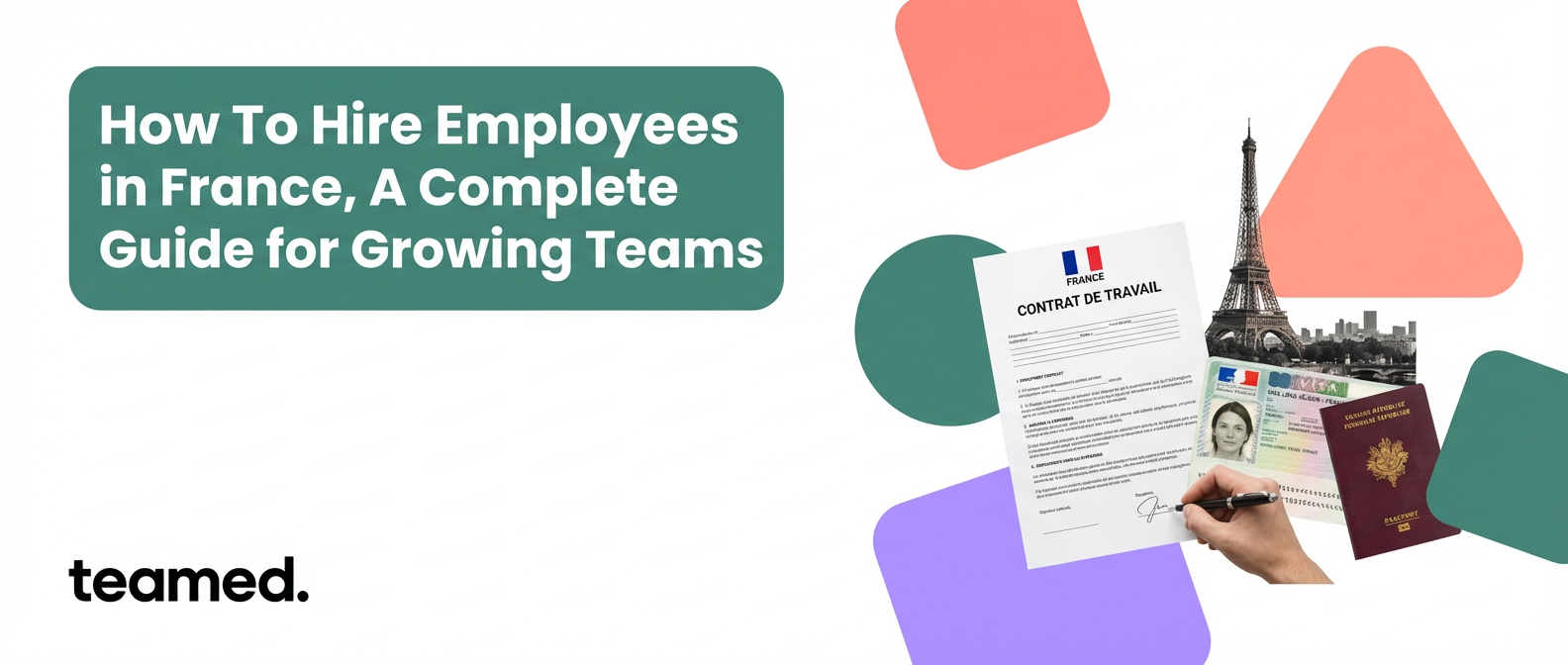
How To Hire Employees in France: A Complete Guide for Growing Teams
Your top sales candidate in Paris just accepted a competitor's offer. Not because they paid more, but because your legal team couldn't confirm whether you could actually employ her. Meanwhile, your CFO is asking why you're still paying EOR fees for three contractors who've been with you for eighteen months.
Hiring employees in France sits at the intersection of opportunity and complexity. France has a statutory standard working time of 35 hours per week for full-time employees, with overtime rulesHiring employees in France sits at the intersection of opportunity and complexity. France has a statutory standard working time of 35 hours per week for full-time employees, with overtime paid at minimum 25% premium and rest requirements applying when hours exceed this threshold. The country's employee-protective regime means contracts, termination, and benefits work differently than in the UK or Nordics. And if you're already managing teams across Germany, the Netherlands, and Spain, adding France requires more than copying your existing playbook.
This guide walks you through the practical steps, from choosing your employment model to running compliant payroll. You'll understand when an Employer of Record makes sense, when to establish a French entity, and how to avoid the misclassification risks that catch mid-market companies off guard.
Key Takeaways
- France requires written employment contracts in French, with specific clauses on working time, pay, and applicable Collective Bargaining Agreements (CBAs).
- Employer social contributions in France commonly add roughly 25% to 45% on top of gross salary, making total employment cost approximately 1.30x to 1.60x gross salary.
- A common operational lead time to onboard a France-based employee compliantly is 2 to 6 weeks from offer acceptance.
- Misclassification risk is highest when a contractor works full-time for one client, follows set hours, and is managed like an employee.
- For mid-market companies, EOR typically works for the first 1 to 10 hires before an entity decision needs revisiting.
How To Hire Employees In France Step By Step
A French CDI is a permanent employment contract in France that has no fixed end date and is the default contract type for ongoing roles under French labour law. Before you can issue one, you need to decide how you'll actually employ someone in France.
The sequence matters. Everything else depends on your employment model choice.
First, confirm your employment model. Will you establish a French entity, use an Employer of Record, or engage contractors? This decision shapes every subsequent step, from registration requirements to contract templates.
For entities, register with relevant authorities. You'll need to register with URSSAF (France's social security body) and set up payroll infrastructure. This involves submitting Form E0 and ensuring you can file the mandatory DPAE (pre-employment declaration) before any employee starts work.
Define the role and salary. Check applicable CBAs for pay scales and classification requirements. French candidates expect clear, French-language documentation before accepting offers.
Issue a compliant French offer letter and contract. Contracts must be written in French and include job title, working hours, remuneration, benefits, and any variable pay structures.
Complete mandatory pre-employment declarations. In France, employers must submit a DPAE pre-employment declaration before an employee begins work, and failure to complete it on time can be treated as undeclared work exposure.
Set up payroll and benefits from the first pay cycle. French payroll is highly regulated with detailed payslip requirements and strict deadlines. Most mid-market firms use specialist providers rather than attempting this in-house.
Plan backwards from your target start date. Each step adds lead time, and rushing creates compliance gaps that surface during audits.
Key Hiring Practices In France Employers Must Follow
A Collective Bargaining Agreement (CBA) in France is an industry or company-level agreement that can impose binding rules on classification, minimum pay, allowances, and termination processes beyond the baseline French Labour Code. Before you finalise any offer, you need to know which CBA applies to your role.
French recruitment differs from UK or Nordic practices in ways that catch employers off guard. Job advertisements and selection criteria must be non-discriminatory under French law. You can't request intrusive personal information during the hiring stage, and background checks require explicit consent with respect for EU and French privacy rules.
In practice, French candidates expect written offers and contracts in French with clarity on title, pay, benefits, working time, and location. Verbal agreements or English-only documentation creates friction and potential enforceability issues.
Use standard channels for sourcing: job boards, specialist recruiters, and professional networks. Reference checks follow different norms than in the UK, so obtain consent and respect data protection requirements.
Don't assume your UK interview templates map directly to France. Questions that seem routine elsewhere may be unlawful here. And don't skip the CBA assessment. If you issue an offer without confirming the applicable CBA and job level mapping, you risk underpaying or misclassifying the role, which creates disputes and back-pay exposure.
Overview Of French Employment Law For Foreign Employers
The French Labour Code (Code du travail) and applicable CBAs are the core sources of employment rules in France. Company policies exist within this framework, not above it. France differs from many UK-centric employment templates because French employment documentation and day-to-day practices must align with the French Labour Code and applicable CBAs, and copy-pasting UK terms can create enforceability and compliance gaps.
France operates an employee-protective regime with stricter working time, paid leave, and termination rules than many European markets. Standard full-time working time is 35 hours per week, and employers must manage overtime and rest-period compliance when operational needs require longer hours.with overtime beyond 220 hours requiring additional paid leave compensation, and employers must manage overtime and rest-period compliance when operational needs require longer hours.
Paid annual leave entitlement in France is 5 weeks per year for employees, calculated as 2.5 working days per month of work accrued over the reference period. The French Labour Code provides 11 official public holidays in France, although whether the employee is entitled to time off and pay treatment can depend on the applicable CBA and company practice.
Employee representation matters at certain thresholds. Works councils and social and economic committees (CSE) become mandatory as headcount grows, adding governance requirements that don't exist in smaller operations.
Non-compliance risks are real. Labour inspections, fines, and litigation happen. French dismissal disputes are commonly routed through the Conseil de prud'hommes (French labour court), and employers should expect multi-month timelines for contested cases due to procedural steps and hearing scheduling.
Employment Contracts And Probation Periods In France
A French CDD is a fixed-term employment contract in France that is permitted only in specific legally defined circumstances, such as replacing an absent employee or addressing a temporary and clearly justified need. For ongoing roles, CDI (permanent contracts) are the default and preferred by both law and employees.
Consider a European SaaS company hiring its first Paris sales leader. In other markets, you might start with a fixed-term arrangement to "test fit." In France, that approach creates legal exposure unless you can document a genuinely time-limited reason. CDI offers stability and retention, which matters when you're building a core team.
Contracts must be written in French and include job title, working hours, remuneration, benefits, and any variable pay or bonus structures. Probation periods vary by seniority and role, with standard lengths and renewal rules differing from post-confirmation notice requirements.
Check applicable CBAs for contract and probation rules. Some CBAs mandate specific probation lengths or restrict renewals. Getting this wrong means your probation terms may be unenforceable, leaving you with an employee you can't easily exit.
Salaries Payroll And Employee Benefits In France
For mid-market Europe-based employers, Teamed's budget models typically assume total employer cost of employment in France of approximately 1.30x to 1.60x gross salary once mandatory employer charges and standard benefits are included. This makes France one of the higher-cost European markets for employment.the highest social and fiscal burden European market for employment.
The gap between gross and net salary is substantial. Employer social contributions in France commonly add roughly 25% to 45% on top of gross salary for many standard employee profiles, according to Teamed's cost-modelling benchmarks using published French social-charge schedules. These contributions cover social security, health coverage, unemployment insurance, and retirement schemes.
Beyond mandatory contributions, typical additional benefits include supplemental health insurance (mutuelle), meal vouchers, transport support, and bonuses per CBA or company policy. French employees expect these as standard, not as exceptional perks.
French payroll is highly regulated. Payslips must include detailed breakdowns of contributions and deductions, and filing deadlines are strict. Most mid-market firms use specialist payroll providers rather than attempting to manage French payroll in-house.
Model total cost of employment before making offers. A €60,000 gross salary might cost €78,000 to €96,000 once you factor in employer charges and benefits. Compare this with your other European markets to ensure your compensation strategy is coherent across your portfolio.
Work Permits And Visas For France Based Employees
For cross-border hiring into France, Teamed advises budgeting additional lead time of 6 to 12 weeks for non-EU work authorisation pathways due to role-specific documentation, consular processing variability, and start-date coordination.
EU, EEA, and Swiss nationals generally don't need work permits for France. The complexity arises with non-EU hires.
Non-EU employees need a residence permit plus work authorisation. Routes include the talent passport for highly skilled workers and specific permits for scarce occupations. Intra-company transfers have dedicated pathways with their own requirements.
Recent reforms have streamlined some routes while tightening enforcement on others. Outdated or informal advice creates risk. A US-based engineer relocating to Paris will usually need sponsorship under a suitable talent route plus residence authorisation, and the timeline can stretch beyond what either party expects.
Employer duties include right-to-work checks, document retention, and reporting changes. Using an EOR doesn't remove immigration obligations. Regardless of your employment model, you need to ensure every France-based worker has the right to work.
Choosing Between Contractors EOR And Entity When Hiring In France
An Employer of Record (EOR) in France is a third-party organisation that becomes the legal employer of a France-based worker and runs French payroll, statutory benefits, and local compliance while the client company manages day-to-day work. But EOR isn't always the right answer.
Contractors offer flexibility and speed for project-based needs. But misclassification risk in France is real and expensive. In Teamed's compliance risk framework, the highest contractor misclassification exposure in France occurs when an individual works full-time for one client, follows set working hours, and is managed like an employee, which materially increases the probability of reclassification in a dispute. Use contractors only for genuinely independent, deliverable-based, time-limited engagements.
EOR in France works well for fast market entry, first hires, or testing a market before committing to permanent infrastructure. The EOR handles payroll and compliance while you direct the work. Limitations include less control over policies and benefits customisation, potential cost premiums, and the reality that EOR isn't a fit for large, permanent operations. For France hiring programmes in the 200 to 2,000 employee segment, Teamed commonly sees EOR used as an interim structure for the first 1 to 10 hires before an entity decision is revisited as headcount and revenue stabilise.
A French entity means becoming the direct legal employer with full statutory obligations. You gain control, brand presence, and potential long-term cost efficiency. You also take on setup complexity, ongoing administration, and the need for in-house or retained expertise. Choose this path when France is planned as a long-term hub, when you need full control over compensation structures, or when regulatory expectations require direct presence.
Advisors like Teamed can guide mid-market HR and Finance leaders through model selection in France, helping you evaluate misclassification risk, total cost of employment, and when to graduate from EOR to a local entity.
Hiring Employees In France For Mid Market Companies In Europe
A French entity differs from an EOR in France because the entity makes the company the direct legal employer with full statutory employer obligations, while an EOR keeps legal employment with the provider and shifts payroll and compliance administration away from the client. For companies already operating in Germany, the Netherlands, or the UK, this distinction matters for portfolio strategy.
Mid-market companies, those with roughly 200 to 2,000 employees and revenue around £10m to £1bn, face unique pressures. You're large enough to need sophisticated guidance but small enough to need responsive advisors. Board members and auditors expect rationale for employment model choices in higher-risk markets like France.
The strategic question isn't just "how do we hire in France?" It's "how does France fit into our European employment strategy?"
Will France be a core hub for engineering or commercial teams, or a satellite with a handful of roles? The answer determines whether EOR makes sense long-term or whether you should plan for entity establishment from the start.
Consider a fintech headquartered in London with teams in Germany and Spain. Starting with EOR for sales in Paris makes sense while testing pipeline and market fit. But as headcount grows and France becomes a revenue centre, the calculus shifts. Entity establishment offers more control, potential cost savings at scale, and cleaner audit trails.
Teamed can design a France roadmap aligned with your broader European footprint and growth targets, ensuring your France decisions don't conflict with plans in other markets.
Managing Compliance In France For Mid Market HR And Finance Leaders
The DPAE is a mandatory pre-employment declaration in France that employers must submit to the relevant social-security body before a new employee starts work. Missing this deadline can trigger undeclared work exposure, one of several compliance domains that require active management.
For mid-market companies already running multi-country compliance programmes, France needs to plug into your existing risk and audit landscape. Key domains to monitor include payroll accuracy and timely filings, social security reporting, working time and overtime tracking, health and safety obligations, and data protection for employee records.
The operating model matters. Avoid fragmentation where Finance handles payroll, Legal owns contracts, and managers handle HR without coordination. Define owners and controls for each compliance domain.
Enforcement focus in France includes misclassification, undeclared work, and non-compliant working time. These carry reputational and financial risks that mid-market companies can't absorb casually.
A compliance checklist starter: documented policies, local CBA mapping, right-to-work process, time-tracking system, payroll provider SLAs, and audit trail retention. Teamed can help build a France compliance framework that aligns HR, Finance, and Legal.
French Entity Setup Strategy For Companies With 200 To 2,000 Employees
Choose to review EOR-to-entity timing when France hiring plans exceed 10 planned hires, local revenue becomes material, or regulated-sector requirements create a need for direct employer control over policies and audit trails.
Entity establishment involves choosing a legal form, registering with authorities, and assuming full employer obligations. The decision isn't about process minutiae. It's about strategy.
Triggers for entity establishment include moving from a small initial presence to a growing local team, planning a permanent office with local leadership, regulatory expectations for direct presence (common in financial services and defence), and the need for deeper control over policies, brand, and cost efficiency.
Trade-offs are real. Upfront complexity and cost versus long-term control and potential savings. Decision inputs include revenue trajectory, growth plans, regulatory exposure, and willingness to build HR and payroll capability for France.
An EOR in France differs from entity employment in audit readiness because EOR documentation and payroll filings are held primarily by the provider, whereas a French entity centralises employment records and statutory filings under the company's direct control. For regulated industries where audit trails matter, this distinction can drive the entity decision earlier than pure headcount would suggest.
Teamed's role is to advise on timing and jurisdiction, model scenarios with HR and Finance, and support execution once the strategy is clear.
How To Coordinate Hiring In France With Existing European Operations
Hiring a France-based contractor differs from hiring a France-based employee because a contractor is meant to be independent and outcome-driven, while an employee is subordinate to the employer's direction and protected by the French Labour Code and many CBA rules. This distinction becomes critical when you're trying to maintain consistency across European operations.
Align French contracts, titles, and levels with your global frameworks while respecting French law and CBAs. This means standardising job architecture across markets while maintaining a benefits matrix that documents France-specific variances.
Your benefits approach should define a European baseline, then layer France-specific statutory and market elements. French employees expect supplemental health insurance and meal vouchers as standard. Trying to impose a UK-style benefits package creates friction and retention issues.
Manage differences in working time, holidays, and remote or hybrid expectations. Aim for perceived fairness across countries while respecting that French legal entitlements and strong local norms are non-negotiable. Explain to employees why differences exist rather than pretending they don't.
Systems and process decisions matter. Will you use a separate French payroll provider or a multi-country platform with local expertise? Either can work, but the choice affects data integration, reporting, and audit readiness.
Create a cross-functional playbook for France covering HR, Legal, and Finance responsibilities. As an example, you might choose to keep a unified learning and development policy but localise working time and meal benefits for France.
Teamed can map a European-wide model so France integrates with your current entities, EORs, and contractors across the continent.
Strategic Guidance On Hiring Employees In France For Scaling Teams
You've now got the framework. The questions you should be able to answer: Which employment model fits France now and as you scale? What's your compliance baseline and who owns which controls? How does France align with your broader European structure and cost envelope?
Hiring in France is manageable with a clear plan, the right partners, and a realistic view of cost and risk. It's not a copy-paste from other markets. The protective employment regime, CBA requirements, and social contribution levels demand France-specific thinking.
Leaders don't need to navigate alone. Independent advisory support is a strength, not a weakness. When you're making six-figure decisions about entity establishment or converting long-term contractors to employees, having counsel that isn't tied to selling you a particular solution matters.
If you want strategic clarity before committing to contractors, EOR, or a French entity, talk to the experts. Teamed can provide counsel grounded in legal expertise across 180+ countries, then execute once the strategy is clear.
Frequently Asked Questions About Hiring Employees In France
How do French employment costs compare with other major European countries?
France is typically higher cost due to social contributions and benefits. Total employment cost is materially above gross salary, often 1.30x to 1.60x, and frequently higher than neighbouring markets like Germany or the Netherlands. Budget accordingly and model total cost before making offers.
Can a company without any French entity legally hire employees in France?
Yes. Companies commonly use an Employer of Record or register as a foreign employer. Full compliance with French employment, tax, and social security rules still applies regardless of which route you choose.
When should a growing business move from an Employer of Record to a French entity?
The decision depends on headcount growth, long-term plans, regulatory expectations, and cost analysis. Common triggers include exceeding 10 planned hires, material local revenue, or regulated-sector requirements for direct employer control. Teamed can model optimal timing for your specific situation.
How can we align French holidays and benefits with our global policies without causing friction?
Treat French legal entitlements and strong local norms as non-negotiable. Design global policies that accommodate these differences and explain to employees why variations exist. A European baseline with France-specific layers works better than forcing uniformity.
What are the risks of treating a France-based worker as a contractor instead of an employee?
Misclassification can trigger back social contributions, fines, and disputes. Risk is highest when the individual works full-time for one client, follows set hours, and is managed like an employee. Proceed cautiously and seek advice before engaging long-term contractors.
How long does it usually take to hire and onboard an employee in France compliantly?
A common operational lead time is 2 to 6 weeks from offer acceptance when contracts, DPAE timing, payroll setup, and benefits enrolment are sequenced correctly. Immigration requirements for non-EU hires can add 6 to 12 weeks.
What is mid-market?
Companies with roughly 200 to 2,000 employees and revenue around £10m to £1bn. This segment faces unique complexity: large enough to need sophisticated guidance on employment strategy, small enough to need responsive advisors rather than enterprise consulting models.or