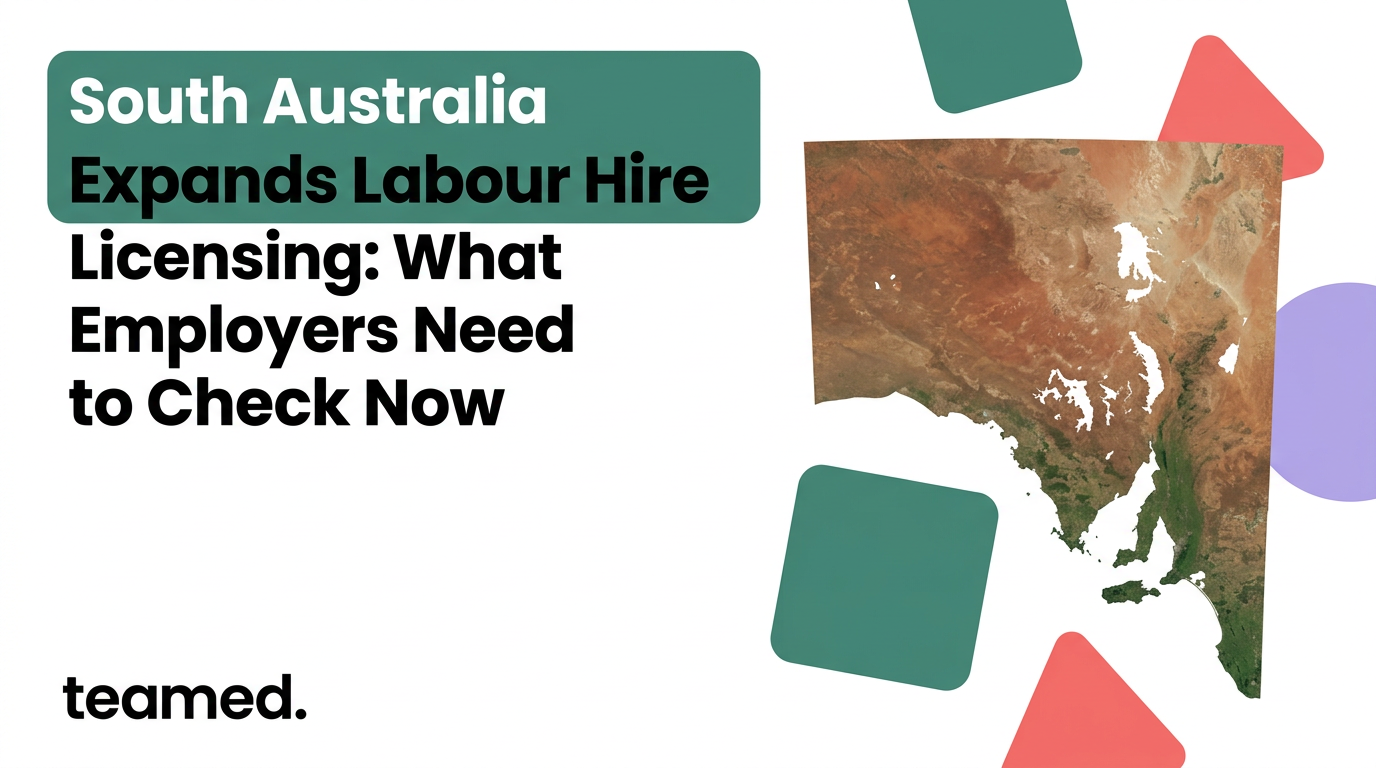
What does South Australia's expanded labour hire licensing mean for employers?
South Australia expanded its labour hire licensing regime to cover all industries on 23 April 2026, according to SafeWork SA. If you're using agency workers, temps, or labour hire providers anywhere in South Australia, you now need to verify the provider holds a valid South Australian licence. The liability for getting this wrong sits with you, the client business, not just the provider.
This isn't a minor administrative update. Queensland and Victoria already operate equivalent schemes under separate state legislation. The three regimes are not portable. A provider licensed in Queensland cannot legally supply workers into South Australia without a separate South Australian licence. For employers with distributed Australian operations, this creates a state-by-state verification problem that most global HR teams haven't built processes to handle.
The honest answer? Australian labour hire regulation is no longer a niche, high-risk-sector problem. Any employer using agency, contingent, or labour hire arrangements for project-based work now needs a verification process that maps each worker's location to the correct state register.
Quick Facts: South Australia Labour Hire Licensing 2026
South Australia's labour hire licensing expansion took effect on 29 January 2026, with SafeWork SA confirming all-industry coverage on 23 April 2026. Queensland operates its scheme under the Queensland Labour Hire Licensing Act 2017, while Victoria operates under the Labour Hire Licensing Act 2018. Each state's licence is administered by a different regulator and is not transferable between states. Host businesses face accessorial liability for using unlicensed providers, even if unaware of the provider's licensing status. A six-month transition period applies for providers previously outside the regime's scope. Teamed's analysis of multi-state Australian compliance patterns shows that verification controls must be location-based, not contract-based.
What changed on 23 April 2026?
SafeWork SA confirmed that South Australia's labour hire licensing regime now covers all industries, not just the previously designated high-risk sectors like horticulture, meat processing, and cleaning. The expansion means any business supplying workers to another business for work performed in South Australia must hold a valid South Australian labour hire licence.
Previously, only providers operating in specified high-risk industries needed licensing. Now the question applies to any labour hire supply into South Australia, regardless of sector. This includes traditional labour hire agencies, staffing firms, and some contractor arrangements where workers are directed by the host business rather than the provider.
The practical impact for employers? You can no longer assume your agency or staffing provider is compliant based on their national presence or licensing in other states. South Australia requires its own licence, verified through its own register.
Who must hold a labour hire licence in SA?
A labour hire provider is any business that supplies workers to another business where the worker performs work under the host's direction or control. This definition catches more arrangements than you might expect. It doesn't matter whether the worker is described as an agency worker, temp, contingent worker, or contractor. What matters is the substance of the arrangement.
If your business engages a third party to supply workers who then work at your premises, under your supervision, following your rostering and workplace rules, that third party likely needs a South Australian labour hire licence. The label on the contract doesn't determine the legal classification.
Some hybrid arrangements create particular complexity. Managed service providers, statement-of-work contractors, and professional services firms can all fall within scope depending on how the work is actually performed. The test focuses on who directs the worker's day-to-day activities, not who signs the employment contract.
Who must verify the licence?
The client business using the labour hire workers carries the verification obligation. This is not delegable. You cannot assume your provider's internal controls satisfy your legal exposure. Accessorial liability means the host business can be held responsible for using an unlicensed provider, even if the host was genuinely unaware of the licensing failure.
This creates a direct compliance ownership problem for HR, Legal, and Procurement teams. Someone in your organisation needs to check the South Australian register before workers start, retain evidence of that check, and re-verify at defined intervals because a provider can become unlicensed mid-engagement through expiry, suspension, or regulatory action.
For European and UK HR teams managing distributed Australian operations remotely, this requires building location-based controls into your vendor onboarding process. The same agency contract can be compliant in one state and non-compliant in another depending on where work is performed.
How does this compare to Queensland and Victoria?
Queensland and Victoria already operate labour hire licensing schemes, but each is created and enforced under separate state legislation. Queensland's scheme operates under the Queensland Labour Hire Licensing Act 2017, administered by the Labour Hire Licensing Compliance Unit, which by February 2026 had secured $2,320,000 in court-imposed fines from 30 prosecutions.
Victoria's scheme operates under the Labour Hire Licensing Act 2018, administered by the Victorian Labour Hire Authority, with 5,788 businesses holding licences by the end of 2024-25.
Here's what catches most employers: there is no national reciprocity. A provider licensed in Queensland is not automatically authorised to supply workers into South Australia or Victoria. Each state maintains its own register, its own application process, and its own enforcement regime. A provider must hold three separate licences to supply workers across all three states.
This differs from a general supplier onboarding check because it requires verification of a state-specific licence for labour hire supply into each state, not a single national credential. For employers with multi-state Australian operations, compliance controls must map each worker's work location to the correct state register rather than applying one national check.
What is accessorial liability and why does it matter?
Accessorial liability is legal exposure where a client business can be held responsible for being involved in, benefiting from, or failing to prevent a supplier's regulatory breach. In the context of labour hire licensing, this means penalties can apply to the host business for using an unlicensed provider, even if the host had no actual knowledge of the licensing failure. These penalties can reach $400,000 for corporations in South Australia.
The defence against accessorial liability is demonstrating due diligence. This means building auditable proof of verification into your supplier management process. A documented evidence pack should include a licence screenshot or register extract, a date-stamped check record, and an approver signature. When regulators assess due diligence, they're looking for systematic controls, not one-off checks.
For General Counsel and compliance teams, this shifts labour hire licensing from a procurement issue to a governance problem. The question isn't just whether your provider is licensed today, but whether you have a process that would detect if they became unlicensed tomorrow.
How does this affect EOR and agency arrangements?
A labour hire provider differs from an EOR in that labour hire typically involves supplying workers who are directed by the host business, while an EOR employs workers through its own local entity and provides employment infrastructure while the client directs day-to-day work. Most EOR arrangements fall outside the labour hire licensing regime because the EOR is the legal employer, not a supplier of workers.
But hybrid arrangements create grey areas. If your arrangement involves a third party supplying workers who work at your premises, under your supervision, using your systems and equipment, the substance may be labour hire regardless of how the contract is labelled. The licensing question turns on operational reality, not contractual drafting.
Teamed's analysis of Australian employment structures shows that employers should confirm provider status directly rather than assume. If you're using any arrangement that resembles labour hire, such as a provider supplying workers who are supervised by your managers in your workplace, licensing and employment-law risks can stack across states. A direct conversation with your provider about their South Australian licensing status is the starting point.
What should employers do now?
Building a state-by-state verification process requires mapping your current Australian labour hire suppliers, checking their licence status on each relevant state register, and building licence verification into your supplier onboarding workflow.
1. Inventory all current Australian labour hire, agency, and contingent worker arrangements 2. Identify which arrangements involve workers performing work in South Australia, Queensland, or Victoria 3. Check each provider's licence status on the relevant state register (SafeWork SA for South Australia, Labour Hire Authority for Victoria, Labour Hire Licensing Compliance Unit for Queensland) 4. Retain evidence of each check with date stamps and approver details 5. Update contracts to require providers to notify you immediately of any licence suspension, cancellation, or expiry 6. Build periodic re-verification into your supplier management calendarFor companies with multiple business units that can engage agencies independently, centralised procurement-led verification reduces the chance of engaging an unlicensed provider. Decentralised buying increases compliance risk because different teams may engage the same provider for work in different states without coordinating verification.
Does this affect other Australian states?
Western Australia does not currently operate a labour hire licensing scheme, though regulatory developments are worth monitoring. The ACT, Northern Territory, New South Wales, and Tasmania also do not have equivalent schemes at present.
This means the compliance map is currently concentrated in the eastern and southern states: Queensland, Victoria, and now South Australia with all-industry coverage. But the pattern suggests regulatory expansion rather than contraction. Employers building compliance processes now should design them to accommodate additional states if schemes are introduced.
For mid-market companies operating across multiple Australian states, the right structure for where you are includes building verification controls that can scale. A process designed only for South Australia will need rebuilding when other states follow.
What is the honest next step?
If you're managing distributed Australian operations from the UK or Europe, labour hire licensing is a GEMO governance problem, not just a procurement checkbox. GEMO (Global Employment Management and Operations) is Teamed's framework for managing the full employment lifecycle across countries and regions, including structure selection, compliance controls, and ongoing operational governance.
The verification workflow needs clear ownership across HR, Legal, Finance, and local operations. Someone needs to own the process, someone needs to execute the checks, and someone needs to escalate when a provider's licence status changes. Most competitor content treats this as a procurement issue, but the liability sits with the business, not the procurement function.
For companies using hybrid arrangements that resemble labour hire, a structure review may be warranted. Teamed's advisory work with 1,000+ companies on global employment strategy includes helping employers determine when an arrangement may be treated as labour hire and therefore require state licensing verification.
If you're unsure whether your current arrangements require licensing verification, or you need help building a state-by-state compliance process, talk to an expert who can review your specific situation. The right structure for where you are, trusted advice for where you're going.