{}
Get the full picture before you hire globally. Salaries, taxes, contributions, the lot. → Try our free calculator

Singapore MOM Enforcement: Work Pass Sponsor Rules 2026

Compliance
This article is for informational purposes only and does not constitute legal, tax, or compliance advice. Always consult a qualified professional before acting on any information provided.

How Singapore's MOM is enforcing work pass rules in 2026, and what it means for you as a sponsor

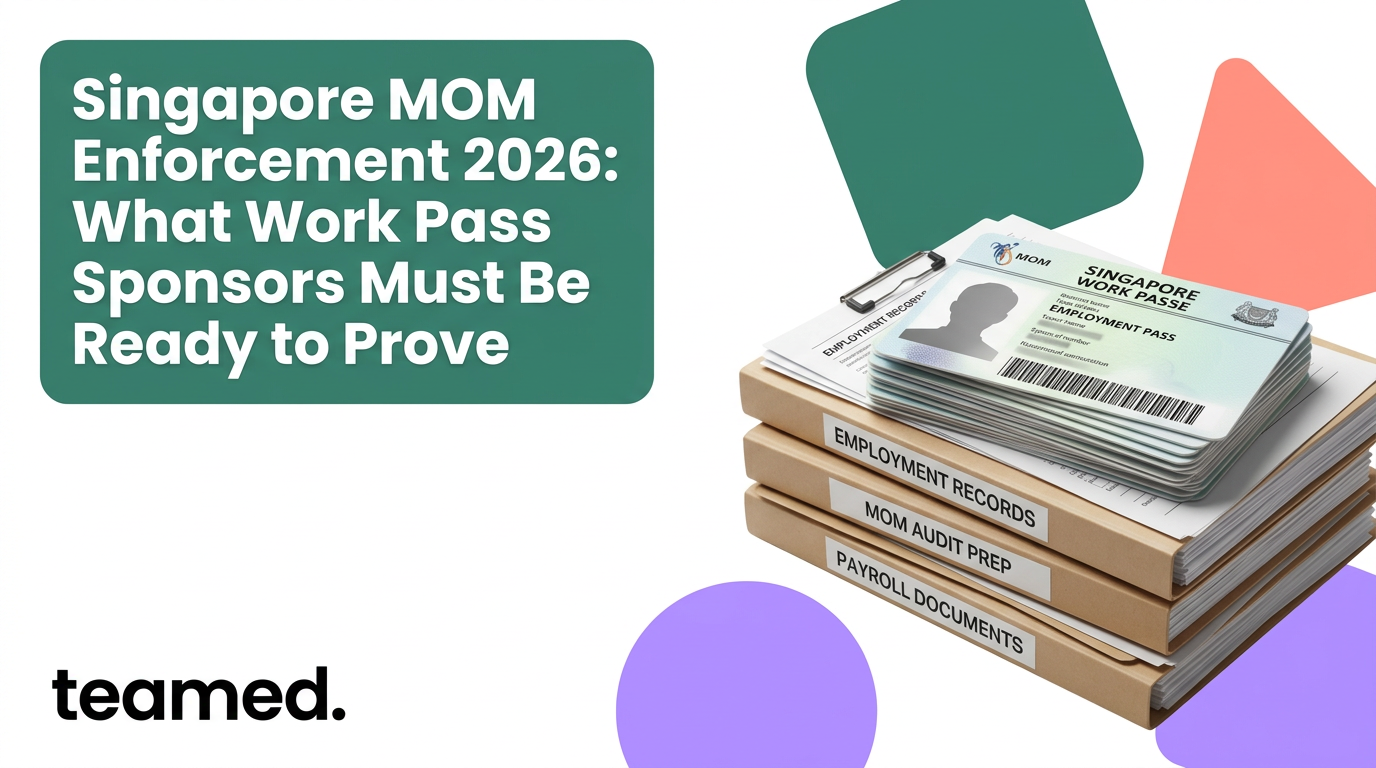
Singapore's Ministry of Manpower arrested 10 individuals in April 2026 in connection with employment-related offences, with 41 additional individuals assisting investigations. For employers sponsoring work passes in Singapore, this enforcement activity signals a clear message: MOM expects sponsoring employers to verify application accuracy, maintain documentation, and cooperate fully when investigations arise. The sponsoring employer carries direct compliance obligations when things go wrong, not just the individual pass holder.

If you're managing Singapore staff through an EOR or direct sponsorship, you need to understand what MOM expects from you. Most mid-market HR teams outside Singapore don't have specialist coverage for APAC work authorisation, and that's exactly where compliance gaps emerge. The enforcement actions reported by Human Resources Online and The Straits Times in early April 2026 focused specifically on fraudulent work pass applications, which means the documentation trail starts with you.

This isn't about creating alarm. It's about practical preparation. When MOM investigates a pass holder, the sponsoring employer has specific obligations that are often missed by teams operating from the UK or EU without Singapore specialist support.

What happened, in plain terms

Singapore's Ministry of Manpower arrested 10 individuals in a 2026 probe into employment-related offences, according to Human Resources Online (6 April 2026). MOM stated that 41 other individuals were assisting with investigations connected to the same probe. The Straits Times separately reported 10 people arrested for fraudulent work pass applications on 1 April 2026. Work pass sponsors in Singapore carry primary cooperation duties when MOM investigates a pass holder. Sponsor non-compliance penalties can include fines, work pass revocation, and suspension of sponsorship privileges. EOR providers acting as work pass sponsors hold direct legal liability for sponsor compliance, regardless of which company directs the day-to-day work.

What has MOM been doing in 2026?

MOM's enforcement activity in early 2026 demonstrates a continuing focus on work pass fraud and employment-related offences. The arrests reported in April 2026 targeted individuals involved in fraudulent work pass applications, with a significant number of additional people assisting investigations. This pattern reflects MOM's established enforcement posture: proactive investigation of application fraud, document verification failures, and sponsorship compliance breaches, with MOM taking enforcement action against an average of 140 employers a year for work pass violations.

The enforcement scope extends beyond individual misconduct. MOM examines the entire chain of responsibility, including the sponsoring employer's verification processes, documentation practices, and responsiveness to regulatory queries. For mid-market companies operating Singapore teams from the UK or EU, this means your compliance exposure isn't limited to the actions of individual pass holders.

What MOM can ask you for

MOM's enforcement authority covers work pass applications, fraudulent documents, sponsorship compliance, and employment offences broadly. The ministry investigates misrepresentations about job scope, salary, qualifications, and credentials in work pass submissions. Sponsor verification controls, including role scope documentation, salary evidence, and credential provenance, form the employer's first line of defence.

A work pass holder investigation differs from a work pass application review in that an investigation can require sponsor-side evidence production and cooperation beyond the original submission. MOM can request employment records, payroll documentation, and correspondence related to the pass holder's role and terms. The sponsoring employer must respond promptly and completely to these requests, regardless of where the company is headquartered.

Who MOM holds responsible

Both the individual pass holder and the sponsoring employer carry compliance obligations, but the employer often has the primary cooperation duty. A Singapore work pass sponsor is the employing entity that submits and maintains a foreign worker's work pass application and remains accountable to MOM for ongoing compliance with pass conditions.

Sponsor non-compliance differs from individual misconduct in that sponsor non-compliance concerns the employer's failures in verification, recordkeeping, or responsiveness to MOM, while individual misconduct concerns the pass holder's actions or representations. When MOM contacts a sponsoring employer during an investigation, the employer must preserve and produce records, facilitate verification, and respond within specified timeframes.

For UK or EU companies managing Singapore staff, time-zone gaps and handover delays are common operational causes of missed deadlines and incomplete responses to regulators. A single accountable sponsor-side owner for MOM correspondence reduces this risk.

What MOM will expect you to be able to prove

Work pass application fraud is the act of submitting false, altered, or misleading information to obtain, renew, or vary a Singapore work pass. The sponsoring employer's verification responsibilities include confirming that the role matches work pass terms after posting vacancies for at least 14 calendar days, that salary statements are accurate, and that qualifications are genuine.

A work pass compliance file is a structured, auditable record set that evidences the accuracy of a work pass application and ongoing adherence to pass conditions. This differs from a recruitment file in that a compliance file is designed for regulator audit readiness and traceability of claims made to MOM, while a recruitment file focuses primarily on hiring decision documentation.

Choose enhanced pre-sponsorship verification when the role is client-facing, regulated, or senior. Misstatements about job scope, salary, or credentials are higher-impact in these cases and more likely to trigger enforcement scrutiny. Choose a structured internal work-pass evidence process when more than one team touches hiring inputs, because multi-author workflows increase the risk of inconsistent information in the final submission.

If MOM emails you tomorrow: what they'll ask for

When MOM investigates a work pass holder, the sponsoring employer is typically contacted and required to cooperate. A sponsor cooperation obligation is the duty of the sponsoring employer to respond promptly and completely to MOM queries, preserve and produce records, and facilitate verification. This obligation exists separately from the individual's investigation.

The sponsoring employer must provide employment records, payroll documentation, and any correspondence related to the pass holder's role and terms. MOM may conduct site visits, request interviews with relevant personnel, and require production of original documents. The employer's responsiveness and documentation quality directly affect the investigation outcome.

For companies operating from outside Singapore, establishing a clear internal process for MOM correspondence is essential. Teamed assigns named jurisdiction specialists within 48 hours, which provides a concrete service-level expectation for handling time-sensitive MOM queries or evidence requests during an investigation.

If your EOR is the sponsor, here's the uncomfortable part

When an EOR sponsors a work pass in Singapore, the EOR is the legal employer and work pass sponsor. EOR sponsorship in Singapore means the EOR submits and maintains the work pass application and remains accountable to MOM for ongoing compliance. The client company manages day-to-day work under a services agreement, but the legal liability for sponsor non-compliance sits with the sponsoring employer.

Direct sponsorship differs from EOR sponsorship in that direct sponsorship makes your Singapore entity the work pass sponsor, while EOR sponsorship makes the EOR the work pass sponsor and legal employer. Most EOR content does not clearly state who the legal work pass sponsor is, which creates confusion about responsibilities during MOM queries, site visits, and document production.

Choose a formal EOR compliance review before onboarding Singapore staff when the EOR is the legal sponsor. Understand your EOR provider's Singapore compliance posture, their process for responding to MOM queries, and how they maintain documentation. The client company should know exactly what records the EOR holds and how quickly they can produce them if MOM requests information.

Based on Teamed's work with mid-market companies across APAC, the most common compliance gap is unclear responsibility allocation between client and EOR during regulatory interactions. A Singapore-specific RACI that distinguishes client responsibilities from EOR responsibilities during MOM queries helps prevent this gap.

What you actually risk if the sponsor drops the ball

Sponsor non-compliance penalties in Singapore can include fines up to S$20,000, work pass revocation, suspension of sponsorship privileges, and reputational damage. MOM can bar companies from sponsoring work passes for specified periods, which directly affects workforce planning and hiring capability in the market.

Beyond formal penalties, sponsor non-compliance creates operational disruption. Work pass revocations affect workforce availability, and sponsorship suspensions can delay or prevent planned hires. For mid-market companies building Singapore teams, these consequences extend beyond the immediate investigation to affect long-term market presence.

The enforcement focus on fraudulent applications means that documentation failures at the sponsorship stage can trigger investigation even without individual misconduct. Employers who cannot demonstrate verification processes or produce compliance records face increased scrutiny and potential penalties.

What I'd fix this week

Audit your current Singapore sponsorships. Review the documentation you hold for each work pass holder, including offer terms, role scope, salary proof, and identity and qualification documents. Identify gaps in your compliance file and address them before any investigation arises.

Confirm your EOR provider's Singapore process if you're using EOR sponsorship. Understand who holds which records, how quickly they can respond to MOM queries, and what their escalation process looks like. Teamed's analysis of multi-country compliance patterns shows that APAC work authorisation controls frequently create exposure for UK and EU companies without specialist coverage.

Choose direct Singapore sponsorship when you already have a Singapore legal entity, local payroll capability, and an internal owner for MOM-facing obligations and document retention. Choose an EOR when you need a compliant employing entity and work pass sponsor immediately and cannot justify the fixed overhead of running a local entity for a small initial headcount.

For companies approaching the threshold where entity establishment makes sense, Teamed's graduation model provides continuity across transitions through a single advisory relationship. This avoids the disruption, re-onboarding, and vendor switching that fragmented approaches require when moving from EOR to owned entity.

The honest answer

If you're managing Singapore staff from the UK or EU without specialist APAC coverage, you have a compliance gap that enforcement activity like the April 2026 arrests makes more urgent. The practical response isn't panic. It's preparation.

Review your documentation. Clarify your EOR's responsibilities. Establish a single accountable owner for MOM correspondence. These steps don't require Singapore specialist headcount, but they do require intentional process design.

Teamed operates EOR services covering 187+ countries and supports entity formation in 100+ countries, enabling mid-market employers to graduate from EOR to an owned presence when Singapore headcount or risk profile increases. If you're unsure whether your current Singapore compliance posture would withstand MOM scrutiny, talk to an expert who can review your specific situation and recommend practical next steps.

The right structure for where you are, trusted advice for where you're going. That's what MOM enforcement activity should prompt you to evaluate, not just for Singapore, but for every market where you're sponsoring work passes without specialist coverage.
How Singapore's MOM is enforcing work pass rules in 2026, and what it means for you as a sponsor

Singapore's Ministry of Manpower arrested 10 individuals in April 2026 in connection with employment-related offences, with 41 additional individuals assisting investigations. For employers sponsoring work passes in Singapore, this enforcement activity signals a clear message: MOM expects sponsoring employers to verify application accuracy, maintain documentation, and cooperate fully when investigations arise. The sponsoring employer carries direct compliance obligations when things go wrong, not just the individual pass holder.

If you're managing Singapore staff through an EOR or direct sponsorship, you need to understand what MOM expects from you. Most mid-market HR teams outside Singapore don't have specialist coverage for APAC work authorisation, and that's exactly where compliance gaps emerge. The enforcement actions reported by Human Resources Online and The Straits Times in early April 2026 focused specifically on fraudulent work pass applications, which means the documentation trail starts with you.

This isn't about creating alarm. It's about practical preparation. When MOM investigates a pass holder, the sponsoring employer has specific obligations that are often missed by teams operating from the UK or EU without Singapore specialist support.

What happened, in plain terms

Singapore's Ministry of Manpower arrested 10 individuals in a 2026 probe into employment-related offences, according to Human Resources Online (6 April 2026). MOM stated that 41 other individuals were assisting with investigations connected to the same probe. The Straits Times separately reported 10 people arrested for fraudulent work pass applications on 1 April 2026. Work pass sponsors in Singapore carry primary cooperation duties when MOM investigates a pass holder. Sponsor non-compliance penalties can include fines, work pass revocation, and suspension of sponsorship privileges. EOR providers acting as work pass sponsors hold direct legal liability for sponsor compliance, regardless of which company directs the day-to-day work.

What has MOM been doing in 2026?

MOM's enforcement activity in early 2026 demonstrates a continuing focus on work pass fraud and employment-related offences. The arrests reported in April 2026 targeted individuals involved in fraudulent work pass applications, with a significant number of additional people assisting investigations. This pattern reflects MOM's established enforcement posture: proactive investigation of application fraud, document verification failures, and sponsorship compliance breaches, with MOM taking enforcement action against an average of 140 employers a year for work pass violations.

The enforcement scope extends beyond individual misconduct. MOM examines the entire chain of responsibility, including the sponsoring employer's verification processes, documentation practices, and responsiveness to regulatory queries. For mid-market companies operating Singapore teams from the UK or EU, this means your compliance exposure isn't limited to the actions of individual pass holders.

What MOM can ask you for

MOM's enforcement authority covers work pass applications, fraudulent documents, sponsorship compliance, and employment offences broadly. The ministry investigates misrepresentations about job scope, salary, qualifications, and credentials in work pass submissions. Sponsor verification controls, including role scope documentation, salary evidence, and credential provenance, form the employer's first line of defence.

A work pass holder investigation differs from a work pass application review in that an investigation can require sponsor-side evidence production and cooperation beyond the original submission. MOM can request employment records, payroll documentation, and correspondence related to the pass holder's role and terms. The sponsoring employer must respond promptly and completely to these requests, regardless of where the company is headquartered.

Who MOM holds responsible

Both the individual pass holder and the sponsoring employer carry compliance obligations, but the employer often has the primary cooperation duty. A Singapore work pass sponsor is the employing entity that submits and maintains a foreign worker's work pass application and remains accountable to MOM for ongoing compliance with pass conditions.

Sponsor non-compliance differs from individual misconduct in that sponsor non-compliance concerns the employer's failures in verification, recordkeeping, or responsiveness to MOM, while individual misconduct concerns the pass holder's actions or representations. When MOM contacts a sponsoring employer during an investigation, the employer must preserve and produce records, facilitate verification, and respond within specified timeframes.

For UK or EU companies managing Singapore staff, time-zone gaps and handover delays are common operational causes of missed deadlines and incomplete responses to regulators. A single accountable sponsor-side owner for MOM correspondence reduces this risk.

What MOM will expect you to be able to prove

Work pass application fraud is the act of submitting false, altered, or misleading information to obtain, renew, or vary a Singapore work pass. The sponsoring employer's verification responsibilities include confirming that the role matches work pass terms after posting vacancies for at least 14 calendar days, that salary statements are accurate, and that qualifications are genuine.

A work pass compliance file is a structured, auditable record set that evidences the accuracy of a work pass application and ongoing adherence to pass conditions. This differs from a recruitment file in that a compliance file is designed for regulator audit readiness and traceability of claims made to MOM, while a recruitment file focuses primarily on hiring decision documentation.

Choose enhanced pre-sponsorship verification when the role is client-facing, regulated, or senior. Misstatements about job scope, salary, or credentials are higher-impact in these cases and more likely to trigger enforcement scrutiny. Choose a structured internal work-pass evidence process when more than one team touches hiring inputs, because multi-author workflows increase the risk of inconsistent information in the final submission.

If MOM emails you tomorrow: what they'll ask for

When MOM investigates a work pass holder, the sponsoring employer is typically contacted and required to cooperate. A sponsor cooperation obligation is the duty of the sponsoring employer to respond promptly and completely to MOM queries, preserve and produce records, and facilitate verification. This obligation exists separately from the individual's investigation.

The sponsoring employer must provide employment records, payroll documentation, and any correspondence related to the pass holder's role and terms. MOM may conduct site visits, request interviews with relevant personnel, and require production of original documents. The employer's responsiveness and documentation quality directly affect the investigation outcome.

For companies operating from outside Singapore, establishing a clear internal process for MOM correspondence is essential. Teamed assigns named jurisdiction specialists within 48 hours, which provides a concrete service-level expectation for handling time-sensitive MOM queries or evidence requests during an investigation.

If your EOR is the sponsor, here's the uncomfortable part

When an EOR sponsors a work pass in Singapore, the EOR is the legal employer and work pass sponsor. EOR sponsorship in Singapore means the EOR submits and maintains the work pass application and remains accountable to MOM for ongoing compliance. The client company manages day-to-day work under a services agreement, but the legal liability for sponsor non-compliance sits with the sponsoring employer.

Direct sponsorship differs from EOR sponsorship in that direct sponsorship makes your Singapore entity the work pass sponsor, while EOR sponsorship makes the EOR the work pass sponsor and legal employer. Most EOR content does not clearly state who the legal work pass sponsor is, which creates confusion about responsibilities during MOM queries, site visits, and document production.

Choose a formal EOR compliance review before onboarding Singapore staff when the EOR is the legal sponsor. Understand your EOR provider's Singapore compliance posture, their process for responding to MOM queries, and how they maintain documentation. The client company should know exactly what records the EOR holds and how quickly they can produce them if MOM requests information.

Based on Teamed's work with mid-market companies across APAC, the most common compliance gap is unclear responsibility allocation between client and EOR during regulatory interactions. A Singapore-specific RACI that distinguishes client responsibilities from EOR responsibilities during MOM queries helps prevent this gap.

What you actually risk if the sponsor drops the ball

Sponsor non-compliance penalties in Singapore can include fines up to S$20,000, work pass revocation, suspension of sponsorship privileges, and reputational damage. MOM can bar companies from sponsoring work passes for specified periods, which directly affects workforce planning and hiring capability in the market.

Beyond formal penalties, sponsor non-compliance creates operational disruption. Work pass revocations affect workforce availability, and sponsorship suspensions can delay or prevent planned hires. For mid-market companies building Singapore teams, these consequences extend beyond the immediate investigation to affect long-term market presence.

The enforcement focus on fraudulent applications means that documentation failures at the sponsorship stage can trigger investigation even without individual misconduct. Employers who cannot demonstrate verification processes or produce compliance records face increased scrutiny and potential penalties.

What I'd fix this week

Audit your current Singapore sponsorships. Review the documentation you hold for each work pass holder, including offer terms, role scope, salary proof, and identity and qualification documents. Identify gaps in your compliance file and address them before any investigation arises.

Confirm your EOR provider's Singapore process if you're using EOR sponsorship. Understand who holds which records, how quickly they can respond to MOM queries, and what their escalation process looks like. Teamed's analysis of multi-country compliance patterns shows that APAC work authorisation controls frequently create exposure for UK and EU companies without specialist coverage.

Choose direct Singapore sponsorship when you already have a Singapore legal entity, local payroll capability, and an internal owner for MOM-facing obligations and document retention. Choose an EOR when you need a compliant employing entity and work pass sponsor immediately and cannot justify the fixed overhead of running a local entity for a small initial headcount.

For companies approaching the threshold where entity establishment makes sense, Teamed's graduation model provides continuity across transitions through a single advisory relationship. This avoids the disruption, re-onboarding, and vendor switching that fragmented approaches require when moving from EOR to owned entity.

The honest answer

If you're managing Singapore staff from the UK or EU without specialist APAC coverage, you have a compliance gap that enforcement activity like the April 2026 arrests makes more urgent. The practical response isn't panic. It's preparation.

Review your documentation. Clarify your EOR's responsibilities. Establish a single accountable owner for MOM correspondence. These steps don't require Singapore specialist headcount, but they do require intentional process design.

Teamed operates EOR services covering 187+ countries and supports entity formation in 100+ countries, enabling mid-market employers to graduate from EOR to an owned presence when Singapore headcount or risk profile increases. If you're unsure whether your current Singapore compliance posture would withstand MOM scrutiny, talk to an expert who can review your specific situation and recommend practical next steps.

The right structure for where you are, trusted advice for where you're going. That's what MOM enforcement activity should prompt you to evaluate, not just for Singapore, but for every market where you're sponsoring work passes without specialist coverage.

TABLE OF CONTENTS

Take a look
at the latest articles