Ireland just missed the 7 June 2026 Pay Transparency deadline. Here's what actually changes for employers.
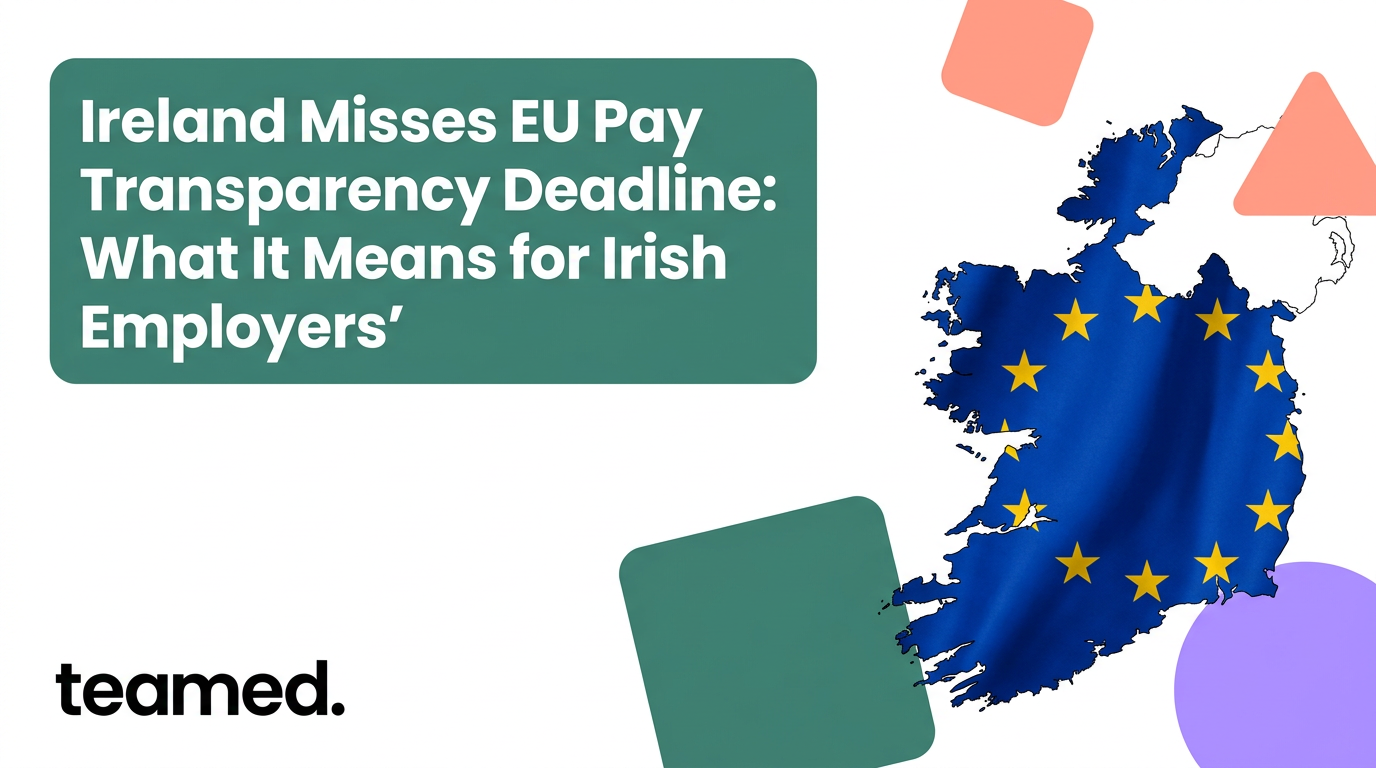
Ireland has confirmed it will miss the 7 June 2026 EU Pay Transparency Directive deadline. Irish employers face no penalties in the interim period because the national law has not yet been enacted. The European Commission can open infringement proceedings against Ireland as a state, but no action against individual employers is expected before domestic legislation is in place.
Group reporting frameworks that treat the EU as a single compliance bloc are now provably wrong for any employer with Irish staff. The Irish Times reported on 23 April 2026 that the Irish government will not transpose Directive 2023/970 into national law by the deadline. Ireland becomes the first member state to publicly acknowledge a missed transposition.
If you've been building your pay transparency programme around a single 7 June go-live date across all EU countries, you now have a problem to unpick. The picture is fragmenting in public. Netherlands is already live. France and Germany are on track. Malta has formally requested a postponement. And Ireland? Outside the reporting framework for an undefined period.
What actually changes today
Ireland will not transpose the EU Pay Transparency Directive by the 7 June 2026 deadline, as confirmed by The Irish Times on 23 April 2026.
No Irish law means no Irish fines. There's nothing on the Irish statute books to enforce against you yet.
Under Article 34 of the Directive, the Commission can pursue Ireland as a country. It can't pursue your business.
The Netherlands' pay transparency implementing bill is expected to enter into force on 1 January 2027. That alone means different EU countries are switching on at different times, and your reporting needs to reflect that.
Irish equal pay law still bites. The Employment Equality Acts haven't gone anywhere, and employees can still rely on them. In fact, employers with 50+ staff already have mandatory gender pay gap reporting obligations under existing Irish law.
Using an EOR in Ireland doesn't shift the timeline. Irish law applies whether your people are on your payroll or ours.
No new date has been set. Late 2026 is a reasonable working assumption, but nobody in Dublin has committed to one yet.
What has Ireland confirmed?
On 23 April 2026, The Irish Times reported that the Irish government will not transpose the EU Pay Transparency Directive into national law by the 7 June 2026 deadline. Ireland is the first EU member state to publicly acknowledge a missed transposition. The government cited drafting and consultation delays as the primary reasons.
This confirmation matters because it breaks the assumption that 7 June 2026 represents a single pan-EU compliance date. Pay transparency becomes enforceable on a country-by-country basis at national entry-into-force, not on the Directive deadline date. For any employer operating across multiple EU jurisdictions, this distinction is critical to accurate compliance planning.
The Irish government has signalled that implementation will proceed on a phased basis. No formal alternative date has been set, leaving HR and legal teams without a clear target for Irish-specific readiness.
Why will Ireland miss the deadline?
The Irish government cited drafting and consultation delays as the reasons for missing the 7 June 2026 deadline. The legislative process required to transpose EU directives into Irish law involves multiple stages of drafting, stakeholder consultation, and parliamentary approval. These stages have not been completed in time.
Ireland's transposition process requires national legislation to create local enforcement mechanisms, define offences, establish penalties, and designate enforcement bodies. Without this domestic legal framework, the Directive cannot operate as a fully enforceable employer compliance regime in Ireland. The complexity of translating EU minimum standards into Irish-specific procedures has extended the timeline beyond the three-year transposition period.
No draft Irish transposition bill has been published as of late April 2026. The implementation timeline remains unclear, with most observers expecting Q3 or Q4 2026 at the earliest for any substantive legislation to emerge.
What happens to Irish employers in the interim?
Irish employers face no penalties during the interim period. Here's why: without enacted national legislation, there is no legal mechanism through which to enforce Directive 2023/970 obligations or impose fines on employers. The Directive creates EU-level minimum standards, but employers are only directly subject to enforceable obligations when national implementing legislation is enacted and in force.
This creates a gap between the EU deadline and actual employer compliance requirements in Ireland. Your Irish payroll cannot be treated as "live" under Directive 2023/970 until national legislation is enacted. The transparency rights, pay reporting obligations, and access to remedies established by the Directive do not become operational for Irish employers until Ireland completes its transposition.
That said, this doesn't mean Irish employees have no protections. Existing Irish equal pay law continues to apply. The Employment Equality Acts provide baseline equal pay protections that remain in force regardless of Directive transposition status. Employees can still bring equal pay claims under existing Irish equality framework provisions. The Workplace Relations Commission received 14,890 complaints in 2024, with 27% relating to pay issues.
Where does the European Commission come in?
The European Commission retains the power to open infringement proceedings against Ireland as a member state. This is explicitly provided for in Directive 2023/970 Article 34, which addresses enforcement at member state level. Infringement proceedings target Ireland's failure to transpose EU law, not individual Irish employers.
Infringement proceedings differ fundamentally from employer penalties. The Commission's action would be directed at Ireland as a state through a formal enforcement process that can ultimately be referred to the Court of Justice of the European Union. This process does not create a direct EU fine mechanism for employers. Individual employer penalties require a domestic legal basis defining offences, enforcement powers, and fine levels.
For practical purposes, no action against individual Irish employers is expected in the interim period. The Commission's enforcement tools address state-level compliance failures, not employer-level obligations that don't yet exist in Irish law.
What this does to your EU-wide reporting
Group reports that treat the EU as a single compliance bloc are now demonstrably wrong for any employer with Irish staff. A multi-country employer with Irish and Dutch staff must treat pay transparency as a staggered compliance rollout rather than a single 7 June 2026 switch.
The Netherlands was reported as already live with pay transparency-related changes from April 2026. France and Germany are on track for June implementation. Malta has formally requested a postponement. Latvia, Czech Republic, Slovakia, and Romania have national transpositions with deviations from the Directive text. Each country's obligations become employer-enforceable only when that country's national implementing law enters into force.
Your reporting framework needs a jurisdiction-by-jurisdiction split. Teamed's analysis of multi-country compliance programmes shows that the fastest route to credible pay reporting is a single job and level framework mapped to each local payroll code. This mapping step typically takes 2-4 weeks for a 200-2,000 employee organisation operating in 3-8 countries. Without this foundation, you'll struggle to produce comparable pay gap metrics across jurisdictions with different go-live dates.
Separate your Irish reporting from live-jurisdiction reporting. Label each country clearly as live, pending, or deviating from Directive 2023/970 requirements. This prevents compliance confusion and ensures your board and employees receive accurate information about where obligations actually apply.
Where does this leave Irish employees?
Irish employees' baseline equal pay protections continue to arise under Ireland's existing equality framework. The Employment Equality Acts provide protections against pay discrimination that remain in force regardless of Directive 2023/970 transposition status. Employees can bring equal pay claims under existing provisions.
What Irish employees don't yet have are the specific Directive-based rights. These include the right to request pay information from employers, mandatory pay range disclosure in job advertisements, and access to the specific remedies and reporting mechanisms established by Directive 2023/970. These rights become available only when Irish implementing legislation enters into force.
The interim period creates an asymmetry for employees working across EU jurisdictions. A Dutch employee gains Directive-based transparency rights from April 2026, while an Irish colleague in the same company does not. HR teams need to communicate this clearly to avoid employee relations issues arising from perceived inconsistency.
What to do between now and Irish law
Don't stop pay equity work. The interim period is preparation time, not permission to delay. Teamed's implementation benchmarks show that a pay transparency programme typically requires 8-12 weeks of data clean-up when HRIS and payroll job architecture are not harmonised across countries. Use this window to get your house in order.
Audit your group reporting frameworks. If your current approach assumes a single EU go-live date, revise it immediately. Create a jurisdiction-splitting reporting framework that clearly labels each country's status. This prevents compliance gaps when Irish law eventually lands and ensures you're not over-reporting obligations that don't yet exist.
Standardise job architecture before publishing any pay transparency outputs. Inconsistent job levelling is a common root cause of non-comparable pay gap metrics and unexplainable variance. When you operate across multiple EU jurisdictions, this standardisation work is essential regardless of individual country timelines.
Watch for draft Irish legislation publication. When the bill emerges, you'll have visibility on transition provisions, specific thresholds, and implementation timelines. Until then, plan for a Q3 or Q4 2026 entry into force as a working assumption.
Choose Legal-led sign-off on public-facing pay transparency statements when your group operates in both live and not-yet-transposed countries. Cross-border inconsistency is a predictable trigger for employee relations risk and regulator scrutiny once local laws activate.
What this means for EOR hires in Ireland
EOR-employed staff in Ireland sit under Irish law. The interim period applies the same way to EOR employees as to direct employees. An Employer of Record is a third-party organisation that becomes the legal employer for workers in Ireland, running payroll, withholding taxes, administering statutory benefits, and managing local employment compliance while you direct day-to-day work.
Because the EOR's Irish employing entity is governed by Irish employment law, the same transposition gap affects EOR arrangements. Your EOR provider cannot create Directive-based obligations that don't exist in Irish law. The transparency rights, pay reporting requirements, and remedies established by Directive 2023/970 don't apply to EOR employees in Ireland until national legislation is enacted.
This matters for consistency. If you're using EOR in Ireland alongside direct employment in other EU countries, your compliance obligations differ by jurisdiction, not by employment model. The EOR handles local compliance within Irish law as it currently exists, including existing equal pay protections under the Employment Equality Acts.
What to expect when the Irish law lands
Irish transposition is expected later in 2026, likely Q3 or Q4 at the earliest. Transition provisions remain unknown until the draft legislation is published. The specific thresholds, reporting timelines, and procedural requirements may include variations from the Directive text within the minimum standards framework.
Directive 2023/970 creates EU-level minimum standards rather than one uniform EU operational rulebook. National transpositions can introduce local variations in scope, thresholds, and procedures within the Directive's minimum requirements. Ireland may adopt different employee count thresholds for reporting obligations, different publication formats, or different enforcement mechanisms than other member states.
Prepare now, act when law is published. Your job architecture mapping, payroll data normalisation, and governance sign-off processes should be complete before Irish legislation enters into force. This positions you to meet Irish-specific requirements without scrambling when the timeline becomes clear.
Based on Teamed's work with mid-market companies across multiple EU jurisdictions, the organisations that handle staggered compliance best are those with a single advisory relationship covering all markets. This eliminates the coordination overhead of managing separate providers for each country's different go-live dates.
What to change this week
If your reporting framework assumed a single EU go-live date, you now have a problem to unpick. Ireland's confirmed miss is the clearest evidence yet that pan-EU go-live on 7 June is a fiction. Your compliance programme needs jurisdiction-by-jurisdiction precision, not EU-wide assumptions.
A full country-by-country guide is coming when the transposition picture stabilises closer to 7 June. In the meantime, the right structure for where you are means separating Irish reporting from live-jurisdiction reporting, maintaining existing equal pay compliance under Irish law, and preparing your data infrastructure for whenever Irish legislation lands.
If you need a named Irish specialist review of your current compliance position, or help building a jurisdiction-splitting framework that accounts for the multi-speed EU reality, talk to an expert. Teamed provides trusted advice for where you're going, from first hire to your own presence in-country, with the honest answer, always.