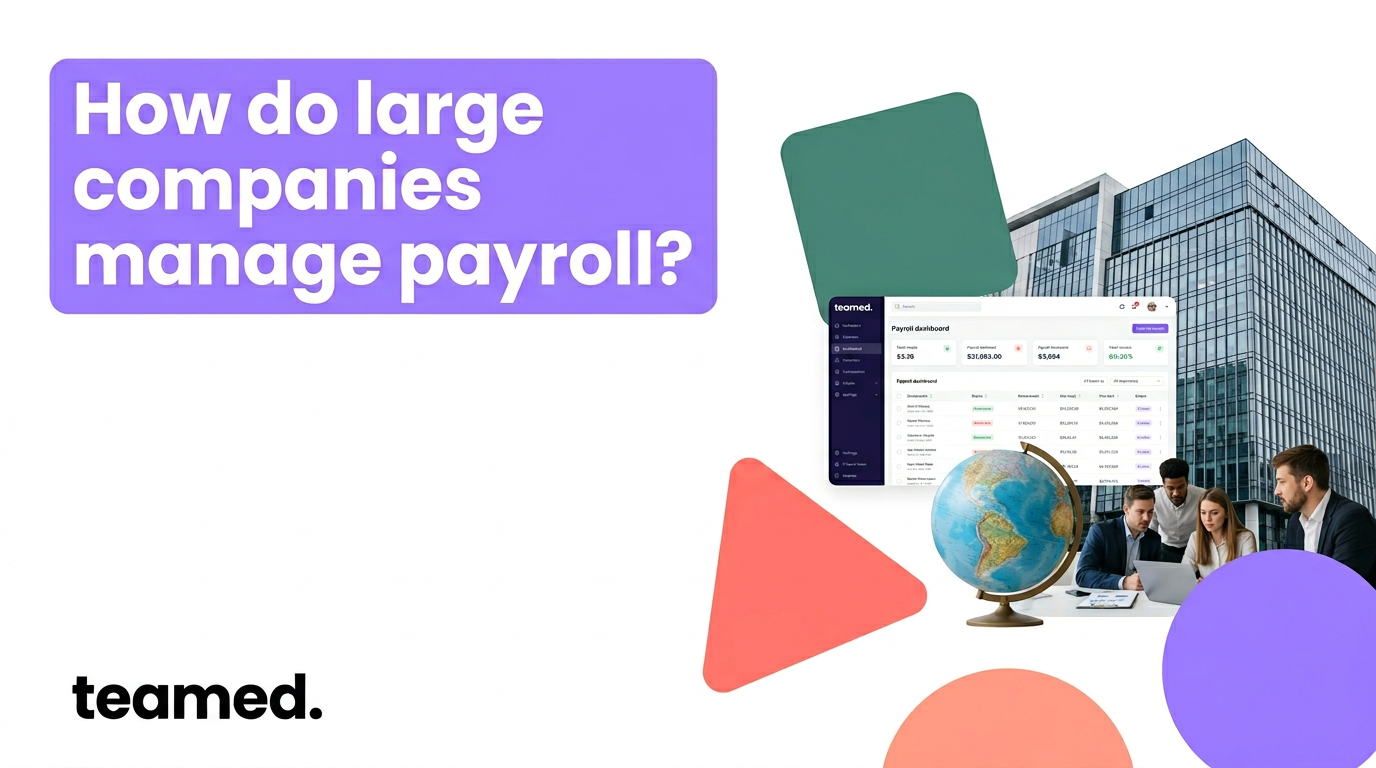
How do large companies manage payroll?
Large companies manage payroll through a combination of enterprise software platforms, dedicated payroll teams, and increasingly, outsourced specialist providers who handle the complexity of multi-country compliance. The answer depends entirely on how many countries you operate in, how many legal entities you maintain, and whether you've built internal expertise or prefer to delegate employer liability to third parties.
If you're running payroll across five countries with three different providers, reconciling data manually before each month-end close, you already know the pain. The question isn't whether your current approach works. It's whether it scales without breaking something important, like compliance, employee trust, or your finance team's sanity.
This guide breaks down exactly how large and mid-market companies structure their payroll operations, from the operating models and technology choices to the compliance frameworks that keep everything running. We'll cover what separates companies that handle payroll well from those constantly firefighting errors and late payments.
Quick Facts: Enterprise Payroll Management
There are basically four ways large companies run payroll. Some keep everything in-house with SAP or Workday and a big team. Others outsource the whole thing to ADP or similar and just review the outputs. Most land somewhere in the middle: they keep control of the strategic bits but let specialists handle the country-specific complexity. And increasingly, they're using Employer of Record services for international hires because setting up entities everywhere is expensive and slow.
Here's a number that should worry you: payroll errors typically run 1-8% of total spend. Think about that on a £10M monthly payroll. The biggest culprits? Someone fat-fingers a number in a spreadsheet. Tax tables don't get updated when the government changes the rules. Or my personal favorite: no one notices that the social insurance cap changed three months ago until an employee complains.
UK Real Time Information (RTI) reporting requires employers to submit payroll data to HMRC on or before each pay date, making late payroll finalisation a direct compliance and penalty risk.
Companies operating in 5-15 countries simultaneously often spend £50,000-£150,000 annually on coordination costs alone when managing separate payroll vendors for each jurisdiction.
We've watched dozens of mid-market companies consolidate their payroll mess. When they move from juggling multiple providers to one coherent approach, month-end close can drop from five days to two. That's not magic, it's just what happens when you stop manually reconciling three different file formats.
When should you stop using EOR and set up your own entity? In straightforward countries like the UK or Singapore, the math usually flips around 10-15 employees. But in France or Germany, with their works councils and collective agreements, you might stay on EOR longer even with 20 people. It's not just about cost, it's about whether you're ready to own all that complexity.
What are the four types of payroll systems large companies use?
Let's talk about the four ways companies actually run payroll at scale, because each one shifts who owns what when things go wrong.
The first model is fully in-house payroll, where companies maintain dedicated payroll teams using enterprise software like SAP SuccessFactors, Oracle HCM, or Workday. This approach gives maximum control over data and processes but requires significant investment in specialist staff, ongoing training, and technology infrastructure. Companies choosing this route typically have 500+ employees in a single country and the budget to maintain internal expertise.
The second model is fully outsourced payroll, where a managed service provider handles everything from gross-to-net calculations to statutory filings and employee queries. Providers like ADP, Paylocity, or regional specialists take on operational responsibility while the company retains employer liability. This works well for companies wanting to reduce headcount in non-core functions but requires careful vendor management and clear service level agreements.
The third model is hybrid payroll, combining internal oversight with external execution. The company maintains a small payroll team that owns the payroll calendar, validates outputs, and manages exceptions, while outsourcing routine processing to specialists. This balances control with efficiency and is common among mid-market companies with 200-2,000 employees.
The fourth model is Employer of Record payroll, where a third-party organisation becomes the legal employer for workers in specific countries. The EOR runs local payroll, remits taxes, and administers statutory employment compliance while the client directs day-to-day work. This differs fundamentally from outsourced payroll because the EOR holds employer liability, not just processing responsibility.
How do companies handle payroll for a global workforce?
Global payroll creates complexity that domestic operations never encounter. You're dealing with multiple currencies, different tax regimes, varying pay frequencies, and regulatory requirements that change constantly across jurisdictions.
Large companies typically address this through one of two approaches. The first is a global payroll aggregator model, where a service layer consolidates payroll inputs and outputs from multiple in-country providers into a single reporting view. The aggregator standardises data definitions, file formats, and approval workflows, giving finance teams one dashboard instead of twelve. This approach preserves existing local provider relationships while adding a coordination layer on top.
The second approach is a unified global payroll platform, where a single provider handles payroll across all countries through their own infrastructure or owned entities. This reduces vendor management overhead but requires finding a provider with genuine capability in every country you operate, not just partnerships with local bureaus.
The choice between these models depends on your existing provider relationships, how standardised your payroll processes need to be, and whether you're willing to undergo the migration effort required for full consolidation. Most companies operating in 5-15 countries find the aggregator model easier to implement initially, then consider consolidation as they grow.
What does the payroll data flow look like in practice?
Most existing guides explain payroll steps but skip the end-to-end data flow that actually matters for CFOs and audit teams. Here's how it works in well-run enterprise payroll operations.
Payroll data originates in your HCM system, where employee records, salary changes, and time data live. This feeds into your payroll engine, which applies country-specific tax rules, social insurance calculations, and statutory deductions to produce gross-to-net calculations. The payroll engine then generates payment files for bank execution and journal entries for your ERP system.
Controls sit at each handoff point. Maker-checker approvals prevent single individuals from creating and approving payments. Reconciliations compare payroll outputs to HCM inputs and flag variances. Audit logs track every change to bank details, salary amounts, and one-off payments. These controls aren't optional extras. They're what separates companies that pass audits from those explaining payroll fraud to their board.
The integration details matter enormously. Standardising earning and deduction codes across countries, maintaining consistent cost-centre hierarchies, and mapping payroll outputs to your general ledger structure are the main blockers when consolidating providers. Companies that skip this groundwork end up with finance teams spending days each month manually reconciling payroll data before they can close the books.
What are the five basic steps in processing payroll?
Every company runs the same basic payroll cycle. What changes is how many ways each step can go wrong when you're dealing with thousands of employees across dozens of countries.
Step one is data collection and validation. This includes gathering time and attendance data, processing salary changes, capturing new hires and terminations, and validating that all inputs are complete before the payroll cut-off. Large companies typically lock changes 3-5 days before pay date to allow adequate processing time.
Step two is gross-to-net calculation. The payroll system converts contractual earnings into net pay by applying country-specific taxes, social insurance contributions, benefits deductions, and any garnishments or voluntary deductions. In Germany, this means calculating contributions across health insurance, pension, unemployment, and long-term care schemes. In France, it means applying the complex social charges that reach 47.2% for average earners according to OECD data.
Step three is approval and exception handling. Payroll outputs go through maker-checker approval, with variance analysis flagging anything outside normal parameters. Exceptions like manual adjustments, retroactive payments, or unusual deductions require additional approval before processing continues.
Step four is payment execution. Approved payroll generates payment files for bank transmission. The timing here varies by country and payment method. Cross-border payments for EU and UK employees require aligning execution cut-offs with local bank processing timelines, since same-day or next-day settlement availability varies by country and bank rail.
Step five is reporting and reconciliation. This includes generating payslips, filing statutory reports, posting journal entries to the ERP, and reconciling payroll accounts. In the UK, RTI submissions must reach HMRC on or before pay date. In France, employers must provide payslips with specific mandatory information each pay period.
How do companies ensure payroll compliance across multiple countries?
Compliance is where enterprise payroll gets genuinely difficult. Each country has different tax rules, social insurance requirements, reporting obligations, and employee protections. Getting any of them wrong creates liability that compounds over time.
The compliance challenge breaks into three categories. First is calculation accuracy, ensuring gross-to-net calculations correctly apply local tax tables, social insurance rates, and statutory deductions. Second is reporting compliance, filing required returns to tax authorities, social insurance bodies, and statistical agencies within mandated timeframes. Third is documentation compliance, maintaining records and providing employee communications that meet local legal requirements.
Large companies address this through a combination of technology and expertise. Enterprise payroll software embeds country-specific rules and updates them as regulations change. But software alone isn't enough. You need people who understand local employment law well enough to configure systems correctly and catch errors before they become liabilities.
This is where the distinction between owned-entity payroll and EOR payroll matters most. With owned-entity payroll, your company holds employer liability and is accountable when compliance fails. With EOR payroll, the Employer of Record holds that liability because they're the legal employer. The EOR model doesn't eliminate compliance risk, but it transfers employer accountability to an organisation whose entire business depends on getting it right.
What are common payroll mistakes to avoid?
The errors that really hurt aren't the ones you catch next month. They're the systematic problems that run for two years before someone notices. Like classifying employees as contractors, using the wrong entity for employment, or missing pension enrollment deadlines.
Misclassifying employees as contractors tops the list. UK IR35 rules require medium and large organisations to determine employment status for contractors working through intermediaries. HMRC can assess unpaid tax liabilities with interest and penalties, with lookback periods extending multiple years depending on how the behaviour is classified. Companies that get this wrong face six-figure remediation costs plus reputational damage.
Inconsistent data across systems creates reconciliation nightmares. When your HCM says one thing, your payroll system says another, and your ERP shows a third number, you can't close the books with confidence. This usually stems from manual workarounds that bypass proper integration, creating data quality issues that multiply over time.
Missing regulatory updates is surprisingly common. Tax rates change, social insurance thresholds adjust (the US Social Security tax cap alone jumped from $168,600 to $176,100 between 2024 and 2025), and new reporting requirements appear.
Inadequate controls around bank detail changes enable fraud. ACFE research found 51% of occupational fraud stems from lacking or overridden internal controls. Payroll fraud schemes typically involve changing an employee's bank details to redirect payments. Without maker-checker controls and verification procedures, these changes can process undetected for months.
When should companies transition from EOR to owned-entity payroll?
The decision to establish your own entity versus continuing with an Employer of Record depends on headcount concentration, long-term commitment, and operational readiness. There's a crossover point where entity economics become favourable, but it varies significantly by country complexity.
Teamed's graduation model provides a framework for this decision, considering the hidden costs of EOR services that accumulate as teams grow. In Tier 1 countries like the United Kingdom, Ireland, Australia, Singapore, or the United States, the entity threshold typically sits at 10-15 employees. In Tier 2 countries like Germany (with a 47.9% tax wedge), France, Spain, or Japan, the threshold rises to 15-20 employees due to stronger employee protections and more complex compliance requirements. In Tier 3 countries like Brazil, China, India, or Mexico, companies often stay on EOR until 25-35 employees because termination costs and regulatory complexity make the EOR fee effectively an insurance premium against compliance failures.
The graduation model works as a strategic lens for employment model transitions. Companies move from contractors to EOR when misclassification risk becomes unacceptable, then from EOR to owned entity when the economics and operational capacity align. The advantage of working with a provider who supports all three models is continuity. You avoid re-onboarding employees, switching vendors, and rebuilding institutional knowledge at each transition.
Consider a UK-headquartered company with 12 employees in Germany. At £7,500 per employee per year in EOR costs versus £3,500 per employee for owned-entity payroll plus a £25,000 setup cost, the break-even point arrives around month 17. But that calculation only makes sense if you're committed to Germany for three-plus years and have the internal or outsourced capacity to manage local compliance.
What does an effective payroll control framework include?
Payroll control frameworks exist to reduce errors, prevent fraud, and satisfy audit requirements. The specific controls vary by company size and risk tolerance, but certain elements appear in every well-designed framework.
Preventive controls stop problems before they occur. These include maker-checker approvals for all payment-related changes, segregation of duties between payroll processing and payment authorisation, and system-enforced validation rules that reject incomplete or illogical inputs. Role-based access controls ensure people can only view and modify data relevant to their responsibilities.
Detective controls identify problems after they occur but before they cause significant damage. Variance analysis flags payroll runs that differ materially from prior periods. Reconciliations compare payroll outputs to source data and to bank statements. Exception reports highlight unusual patterns like multiple employees sharing bank accounts or addresses.
Audit logging provides the evidence trail that proves controls operated effectively. Every change to employee bank details, salary amounts, or tax codes should be timestamped and attributed to a specific user. This logging isn't just for external auditors. It's how you investigate when something goes wrong.
The control framework should also define escalation paths for exceptions. When a payroll run shows unusual variance, who decides whether to proceed or investigate? When an employee disputes their pay, what's the resolution process? These procedures matter as much as the technical controls.
How do large companies choose between payroll software options?
Choosing payroll software comes down to three questions: What systems do you already run that need to talk to payroll? Where do you employ people today and where might you tomorrow? And are you solving for one country or twenty?
Choose a single enterprise payroll platform when you have one employing entity in one country and need deep automation for time capture, benefits administration, and general ledger posting. Platforms like Workday, SAP SuccessFactors, or Oracle HCM work well here, particularly if you're already using them for core HR functions.
Choose a global payroll aggregator when you operate multiple entities across countries and need unified reporting, one approval workflow, and consistent data definitions without replacing every local provider simultaneously. This approach lets you standardise incrementally rather than attempting a big-bang migration.
Choose payroll outsourcing with defined SLAs when your internal team can't meet resilience requirements for cut-off management, exception handling, and multi-step approvals. The right outsourcing partner takes on operational responsibility while you retain strategic oversight.
The integration requirements differ significantly between SMB and enterprise payroll software. Enterprise payroll typically requires HCM-to-payroll APIs, payroll-to-ERP general ledger automation, and auditable role-based access controls across multiple pay groups. If a vendor can't demonstrate these capabilities in your specific countries, they're not ready for enterprise deployment.
Building payroll operations that scale
Large companies manage payroll through deliberate choices about operating models, technology, and control frameworks. The companies that do it well share common characteristics: they've standardised processes across countries where possible, they've invested in integration rather than accepting manual workarounds, and they've built control frameworks that satisfy both operational and audit requirements.
The right structure for where you are today may not be the right structure for where you're going. Companies growing internationally often start with EOR arrangements for speed and simplicity, then graduate to owned entities as headcount concentration and long-term commitment justify the investment. The key is working with partners who support that evolution rather than locking you into a single model.
If your team is drowning in month-end reconciliation, if you're not sure your compliance would survive a real audit, or if you just spent another weekend fixing payroll errors, it's time to rethink your approach. Talk to an Expert about your specific country mix and pain points. We can show you what good looks like for companies in your exact situation.