Get the full picture before you hire globally. Salaries, taxes, contributions, the lot. → Try our free calculator

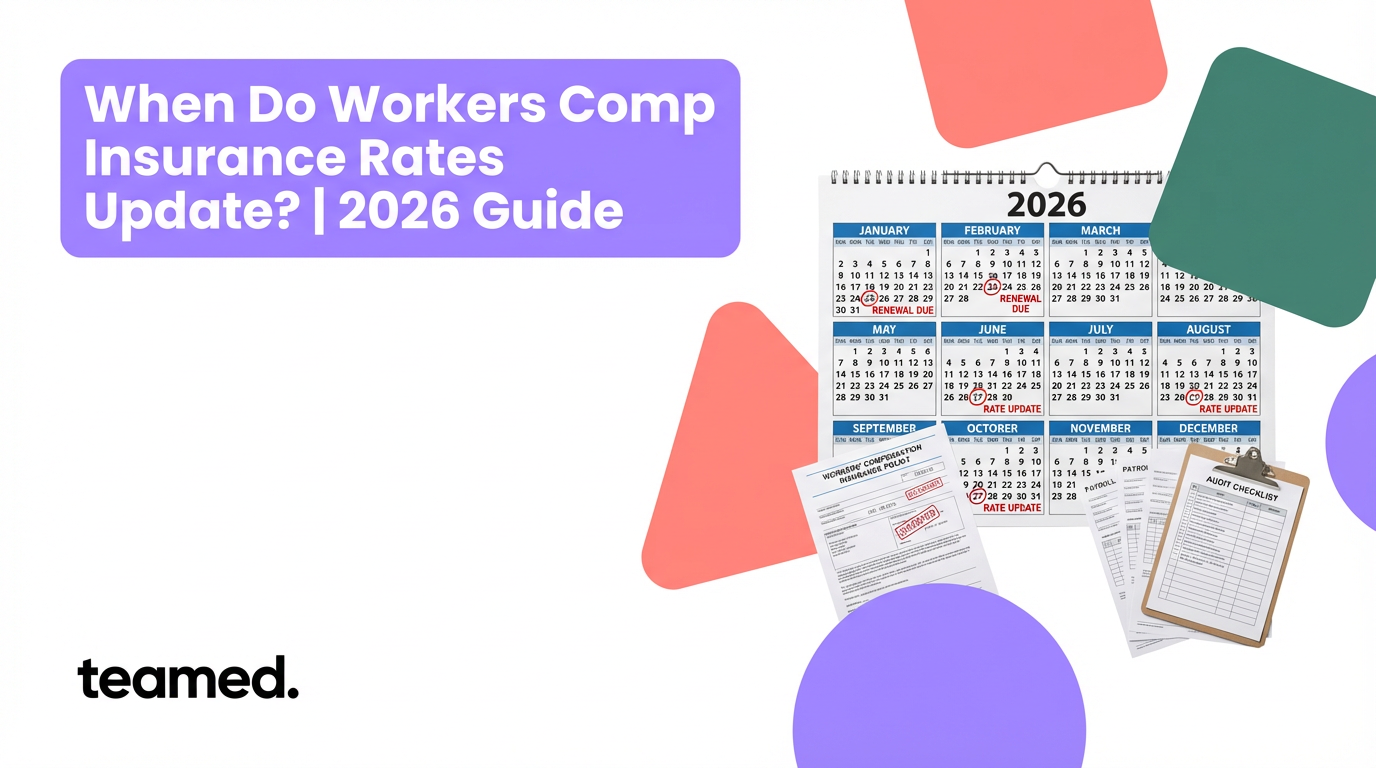
When Do Workers Comp Insurance Rates Update? | 2026 Guide

Compliance
This article is for informational purposes only and does not constitute legal, tax, or compliance advice. Always consult a qualified professional before acting on any information provided.

How Workers Compensation Insurance Rate Updates Impact Distributed Teams and Mixed Employment Models in 2026

Your CFO just flagged a six-figure variance in US employment costs. The culprit? A workers' compensation audit true-up nobody saw coming, triggered by remote employees who quietly relocated to new states during the year.

This scenario plays out constantly across mid-market companies managing distributed teams. Workers' compensation insurance rates update on overlapping calendars, including state filings, carrier pricing, and employer-specific renewals and audits, which means budgets shift at multiple moments rather than on a single date. When you're running contractors in one system, EOR employees in another, and owned entities somewhere else, tracking these changes becomes nearly impossible.

Teamed is the unified global employment partner for mid-market companies managing international teams across multiple platforms, vendors, and employment models. We've seen how fragmented workforce operations create blind spots that surface during workers' compensation audits, often at the worst possible time. This guide breaks down when rates actually change, how your employment model choices affect who carries the policy, and what European companies expanding into the US need to know for 2026.

Key Takeaways

  • Workers' compensation insurance rates update through three distinct mechanisms: state-level loss cost filings, carrier renewal pricing, and post-policy audits that reconcile estimated versus actual payroll.
  • Remote and distributed workers can create workers' compensation obligations in new states before HR, Finance, or Legal update systems, making unified global employment operations essential to surface exposures early.
  • Employment models, including contractors, EOR, and owned entities, determine who carries workers' compensation cover and when higher workers' compensation premiums or audit true-ups hit the budget.
  • Mid-market companies with 200-2,000 employees face the most acute complexity because they've grown beyond simple solutions but lack dedicated in-house teams for every jurisdiction.
  • If US staff are engaged through an employer of record, the EOR typically holds the policy, but that shifts when a company transitions to its own entity.

How Do Workers Compensation Insurance Rate Updates Affect Distributed Teams And Mixed Employment Models

A workers' compensation rate update is a change to jurisdictional loss costs or insurer filed rates that alters the price per £100 of payroll for a given classification code. It becomes financially relevant at policy issuance, renewal, or audit depending on the policy structure. Rate updates that look modest in one jurisdiction become material when spread across several US states, contractors, and EOR staff.

Distributed headcount multiplies small rate shifts into large variances. A 3% rate increase in California combined with a 2% decrease in Texas and new exposure in Illinois creates a forecasting puzzle that no single vendor can solve. People Ops and Finance leaders must own one view of the cost of workers' compensation across all models.

Responsibility for workers' compensation follows where work is performed, not where the employer is headquartered. A remote employee who relocates from London to Chicago triggers Illinois coverage requirements before your HRIS reflects the change. Location change is a risk transfer event, so the company's duty is to monitor moves, notify brokers or EORs, and budget for midyear impacts.

Fragmented vendors make it hard to see total workers' compensation insurance rates on one budget. Separate EORs, local brokers, and local entities each report partial truths. You cannot manage what you cannot see, so consolidating data and accountability reduces surprises and improves cash forecasting for audits.

Typical systems involved include: EOR platform, local broker policy, internal HRIS, payroll, expense and travel data, address validation, and entity management records.

Consider a European company with 500 employees that hires via an EOR in three US states and directly in one state. Each stream has different work comp rates and renewals, yet the CFO sees one P&L. One policy change can offset another, but only if leaders manage a single integrated calendar and vendor plan.

When Do Workers Compensation Insurance Rates Typically Update Across States And Countries

In many US states that use NCCI, base rates or loss costs are filed and approved on state-specific effective dates, often at the start of a quarter. An NCCI state is a US state where the National Council on Compensation Insurance provides workers' compensation rating tools and loss costs. California's WCIRB and monopolistic funds in Ohio or certain Canadian provinces follow their own calendars, creating a patchwork that demands proactive tracking.

Some jurisdictions update medical fee schedules or benefit rules on fixed dates, often early in the year. These regulatory changes increase claim costs over time, which puts upward pressure on workers' compensation insurance rates. Benefits and fee schedules move first, and premiums follow, usually with a measurable lag.

The practical moment a company feels a rate update is at policy renewal and the post-term audit. Carriers apply new rates, loss cost multipliers, and experience factors at renewal, then reconcile payroll and class codes at audit. Renewals set direction, audits finalize the bill, which is why both moments matter.

Factor Contractor EOR Local Entity
Best for Project-based, autonomous work Ongoing, integrated roles Larger, stable teams
Control level Low (outcome-focused) High (direction permitted) Full employer control
Setup time Days Days to weeks 4-6 months
Misclassification risk Higher if integrated Lower Lowest
Compliance burden On hiring company On EOR provider On your entity
Factor Umbrella Company Employer of Record
Legal employer Intermediary in supply chain Legal employer via owned entities
Liability position Risk transfers upstream EOR assumes employer obligations
Regulatory view Heightened scrutiny Aligns with transparency requirements
Strategic fit Short-term, single country Supports unified global employment operations
Update Type What Changes When It Hits Your Budget
State rate filings Rating bureaus set loss costs or base rates on jurisdiction calendars Flows into next policy period
Carrier renewal changes Insurers apply multipliers, underwriting, and experience Policy anniversary date
Audits Payroll true-up and class code verification 30–90 days after policy period ends

European and UK headquartered mid-market companies often underestimate the degree of variance across US states and Canadian or European regimes. Teamed's coverage footprint of 180+ countries means a single mid-market company can accumulate workers' compensation-like obligations across multiple statutory schemes in parallel. Global expansion needs a consolidated schedule by location, including NCCI, WCIRB, and fee schedule dates, so leaders can embed workers' comp rate by state planning into budgets.

How Are Workers Comp Rates Calculated And Why Do Work Comp Rates Differ By State

A class code maps each job type to a risk profile, with higher base costs for hazardous roles and lower costs for clerical work. Classification is destiny in workers' compensation, because the code you assign governs the starting point for premiums before any employer-specific adjustments are applied.

Each state or rating bureau sets its own loss costs or base rates, so two clerical roles in different states can attract different prices. Geography matters as much as role, which explains why distributed teams see wide variation in workers' compensation prices despite similar work content and safety practices.

Insurers apply a loss cost multiplier and adjust for the employer's claims history through experience modifiers. Two firms in the same state can pay very different premiums, because experience rating rewards clean histories and penalizes frequent or severe losses, reshaping the workers' compensation calculation sheet.

The calculation follows these steps: classify the role under the correct state code and confirm duties match, apply the state's loss cost or base rate per £100 of payroll, multiply by estimated annual payroll per class code and location, then adjust with carrier multipliers, experience mod, credits, and debits.

European and UK leaders can compare the concept to social insurance contribution bands, but US workers' compensation is more granular by role and state. National stability can mask state or industry volatility, and wage and medical cost trends drive periodic recalibration by rating bureaus that reset forecast baselines.

How Do Policy Renewal Audits Change Workers Compensation Policy Cost For Mid Market Companies

A workers' compensation premium audit is a post-policy review in which the insurer reconciles estimated payroll, classifications, and work locations against actuals, then issues an additional premium invoice or a return premium based on the findings. Workers' compensation insurers typically audit annually. Audits convert estimates into invoices, generating either bills or credits. For growing firms, audit deltas skew negative, because payroll growth and new jurisdictions outpace initial projections.

Common audit cost drivers include rapid payroll growth, hiring into higher-risk roles, staff relocating into different states, and contractors treated as employees under local tests. Hybrid roles and silent relocations are audit magnets, often surfacing obligations that were not captured in the original underwriting assumptions.

Misclassified class codes are corrected at audit, and if duties prove more hazardous, a full-year re-rating applies. One misaligned code can reprice twelve months of payroll, which is why job descriptions, managerial oversight, and time allocations must match the risk profile reported to the carrier and broker.

Audit preparation requires maintaining accurate, dated job descriptions and duty splits, tracking employee work locations with self-attestations and HRIS fields, reconciling payroll by class code and state monthly, and keeping contractor agreements and evidence of coverage clear and current.

A UK headquartered company that doubles US headcount midterm can face a substantial audit bill. Similar payroll reconciliations exist in some European schemes, but US audits are more granular. Aligning EOR-to-entity transitions with audit cycles can prevent overlap and supports cleaner closure of policy periods.

What Do Illinois Workers Compensation Rates And IWCC Fee Schedule Changes Mean For Remote Employers

The Illinois Workers' Compensation Commission publishes benefit rates, including the maximum weekly payment workers' compensation, often twice yearly on January 15 and July 15. Benefit updates change claim values, which cascade into carrier pricing over time. Employers should note effective dates and how they influence future renewals rather than expecting instant premium changes.

Illinois workers' compensation rates reflect benefit structures and the state medical fee schedule that guides provider payments. Fee schedules shape medical costs, and medical costs shape premiums, though carriers translate these inputs differently. Remote employers must map which Illinois changes will appear at the next renewal and at the subsequent audit.

Key Illinois references include IWCC benefit rates (semi-annual figures that set weekly compensation parameters), Illinois work comp fee schedule (maximum payable amounts for medical services), and the Illinois Workers' Compensation Commission as the regulator publishing benefits, forms, and notices. A European firm with remote Illinois staff is fully in scope for Illinois workers' compensation rules, even without a physical office.

If Illinois-based staff are on an EOR, the EOR applies workers' compensation rates Illinois rules under its policy. EOR coverage follows the worker's location, but responsibility shifts to the company upon forming an Illinois entity. Teamed can advise on how benefit and fee updates intersect with entity transition timing and direct premiums.

How Do Employment Models Such As Contractors EOR And Entities Change Workers Compensation Obligations

A mixed employment model is a workforce structure that uses more than one engagement type at the same time, typically combining contractors, Employer of Record employees, and employees hired through owned legal entities. Genuine independent contractors are usually outside an employer's policy, but many jurisdictions apply strict tests. Control, integration, and economic dependency drive classification, and auditors can reclassify contractors as employees, pulling their payroll into workers' compensation and exposing the company to retroactive assessments and penalties.

An Employer of Record is a third-party organisation that becomes the legal employer for workers in a specific country, running payroll, statutory deductions, and local employment compliance while the client company directs day-to-day work. When using an EOR, the EOR arranges local workers' compensation. The cost is bundled into EOR fees, which can leverage pooled risk and mature experience ratings. Visibility may be lower, so clients should request clear breakdowns of embedded costs by location and class code.

Once hiring through an owned entity, the company must obtain direct workers' compensation coverage. Rate updates and audits now ride on your payroll and claims, increasing visibility and control but also exposing the company to experience rating swings. Transition planning should compare EOR implicit rates with projected entity premiums and audit impacts.

Choose contractors only when the worker can genuinely deliver services with autonomy over how, when, and where the work is performed, and when the role is not embedded in your day-to-day management structure for more than 6 continuous months. Choose an EOR when you need to place an employee in a country where you do not have an owned entity and you need a legally compliant employment relationship in less than 8-12 weeks. Choose an owned entity when you expect 10+ employees in one market within 12 months or you need direct control over payroll, benefits design, and local employment policies.

European companies often test the US with contractors or EOR before forming entities. Each step increases control and risk visibility, changing how workers' compensation rates surface. Teamed advises on employment model economics, misclassification safeguards, and the workers' compensation implications of scaling teams and moving to owned entities.

How Should European And UK Mid Market Companies Plan For Workers Compensation Rate Updates In The United States

Teamed's London headquarters and Europe/UK buyer base means US workers' compensation budgeting is often treated as an add-on rather than a primary statutory cost line. This is a recurrent forecasting error when European HQ teams launch US hiring through multiple states in the same fiscal year.

Build a single internal calendar covering policy renewals, expected audit windows, and key state-level filing or fee schedule dates. One calendar beats a dozen reminders, and it should sit alongside US headcount and location planning so leaders can anticipate workers' compensation rate by state shifts before roles are opened.

Link workers' compensation planning to hiring decisions and office or hub strategy. Every new state is a new rulebook, so add cost checks to requisition workflows and review workers' comp prices against quota plans. Request broker or EOR memos on expected trends in states like California where pressures are rising. California's approved 8.7% rate increase for 2026 reflects cumulative trauma claims, rising medical expenses, and increased litigation.

Planning horizons should include annual budgeting using headcount, wage growth, and known state filing calendars, quarterly reviews to update for relocations, new jurisdictions, and regulatory changes, and pre-audit checks to reconcile payroll and class codes, validate addresses, and prepare documentation to avoid retroactive charges.

For EOR roles, request a clear breakdown of embedded workers' compensation costs by state and class code. Teamed can benchmark EOR implicit pricing against projected entity premiums and audit outcomes, ensuring multi-year financial models capture both transition timing and the volatility of experience rating.

Why Do Mid Market Companies Need Unified Global Employment Operations To Manage Workers Compensation Risk

Teamed operates in 180+ countries and has advised 1,000+ companies on global employment strategy, which forms the basis for identifying cross-border employment compliance and insurance coverage blind spots that occur when HR data is split across multiple vendors.

When employment data, vendors, and policies are fragmented, nobody sees total exposure or how state rate updates interact with contractor, EOR, and entity choices. Fragmentation hides risk and cost, while unified global employment operations provide one source of truth across jurisdictions, employment models, and compliance moments.

Unified operations give HR and Finance a single advisory relationship and platform to connect hiring plans with compliance, including workers' compensation insurance rates. Strategy replaces scramble when data, dates, and decisions live together. Teamed supports EOR-to-entity transitions with explicit modeling of obligations, premiums, and audit timing across 180+ countries.

Using multiple workforce vendors creates multiple systems of record for worker location, classification, and payroll, while unified global employment operations consolidate these fields into a single governance process that reduces the probability of missed location-driven coverage changes.

Rate updates and audits are predictable events. Treat them as milestones, not surprises, by partnering with an advisor who integrates workers' compensation with global employment choices. If you're piecing together advice from vendors with conflicting incentives, there's a better way. Talk to the experts and see how unified global employment operations can end vendor sprawl and give you visibility across your entire international workforce.

FAQs About Workers Compensation Insurance Rate Updates For Distributed Teams

What is mid market?

Mid-market typically means companies with 200 to 2,000 employees or revenue between £10 million and £1 billion. This segment feels workers' compensation complexity acutely because multiple states, mixed employment models, and rapid growth create overlapping renewals, audits, and vendor handoffs that strain fragmented operations. Teamed's serviceable customer range includes 50-2,000 employees, reflecting that workers' compensation planning for distributed teams becomes materially complex before enterprise scale once multiple legal employers and payroll systems exist.

How often should we review workers compensation exposure for remote employees who move state or country?

Review exposure whenever a worker's location changes and at least annually before audit. Obligations follow where work is performed, so relocations quietly create new state responsibilities. Early detection allows timely policy endorsements, accurate class codes, and better budgeting for midyear carrier adjustments. Choose a formal work location change control when more than 10% of your workforce is remote or hybrid.

Who is responsible for workers compensation when we employ through an employer of record?

The employer of record is the legal employer responsible for obtaining local workers' compensation coverage. The client funds that cost through fees and should align headcount, class codes, and locations with EOR coverage models. Request transparent breakdowns to compare embedded pricing against potential entity premiums. Employing through an EOR typically places primary policy procurement on the EOR as the legal employer, with costs passed through commercially to the client.

How far in advance should we budget for potential changes in workers compensation insurance rates?

Budget annually using state trend data, headcount, and wage growth, then reassess 60 to 90 days before renewal. Monitor regulatory calendars from NCCI, WCIRB, or state funds, and factor audits into cash planning. Choose a pre-renewal workers' compensation exposure review 90-120 days before the US policy anniversary when you have hired in new states, introduced new job families, or converted contractors to employees.

How do workers compensation obligations change when we convert contractors to employees?

After conversion, the worker's payroll typically enters workers' compensation calculations in that jurisdiction. Align conversions with renewal and audit timing to avoid midterm surprises and overlapping coverage. Update class codes, addresses, and job descriptions immediately to keep underwriting accurate and prevent retroactive re-rating. Choose a contractor-to-employee conversion programme when you need to reduce misclassification exposure in high-enforcement jurisdictions.

How do workers compensation considerations affect the timing of moving from an EOR to our own entity?

Moving from EOR to entity shifts responsibility for coverage, renewals, and audits to the new entity. Time transitions around renewal dates, budget for direct premiums and potential deposits, and plan for experience rating impacts. Teamed's operating model combines advisory services with operational infrastructure, intended to reduce decision latency for cross-border employment model selection from weeks to days when a new jurisdiction creates immediate workers' compensation or employer-liability coverage requirements.

How Workers Compensation Insurance Rate Updates Impact Distributed Teams and Mixed Employment Models in 2026

Your CFO just flagged a six-figure variance in US employment costs. The culprit? A workers' compensation audit true-up nobody saw coming, triggered by remote employees who quietly relocated to new states during the year.

This scenario plays out constantly across mid-market companies managing distributed teams. Workers' compensation insurance rates update on overlapping calendars, including state filings, carrier pricing, and employer-specific renewals and audits, which means budgets shift at multiple moments rather than on a single date. When you're running contractors in one system, EOR employees in another, and owned entities somewhere else, tracking these changes becomes nearly impossible.

Teamed is the unified global employment partner for mid-market companies managing international teams across multiple platforms, vendors, and employment models. We've seen how fragmented workforce operations create blind spots that surface during workers' compensation audits, often at the worst possible time. This guide breaks down when rates actually change, how your employment model choices affect who carries the policy, and what European companies expanding into the US need to know for 2026.

Key Takeaways

  • Workers' compensation insurance rates update through three distinct mechanisms: state-level loss cost filings, carrier renewal pricing, and post-policy audits that reconcile estimated versus actual payroll.
  • Remote and distributed workers can create workers' compensation obligations in new states before HR, Finance, or Legal update systems, making unified global employment operations essential to surface exposures early.
  • Employment models, including contractors, EOR, and owned entities, determine who carries workers' compensation cover and when higher workers' compensation premiums or audit true-ups hit the budget.
  • Mid-market companies with 200-2,000 employees face the most acute complexity because they've grown beyond simple solutions but lack dedicated in-house teams for every jurisdiction.
  • If US staff are engaged through an employer of record, the EOR typically holds the policy, but that shifts when a company transitions to its own entity.

How Do Workers Compensation Insurance Rate Updates Affect Distributed Teams And Mixed Employment Models

A workers' compensation rate update is a change to jurisdictional loss costs or insurer filed rates that alters the price per £100 of payroll for a given classification code. It becomes financially relevant at policy issuance, renewal, or audit depending on the policy structure. Rate updates that look modest in one jurisdiction become material when spread across several US states, contractors, and EOR staff.

Distributed headcount multiplies small rate shifts into large variances. A 3% rate increase in California combined with a 2% decrease in Texas and new exposure in Illinois creates a forecasting puzzle that no single vendor can solve. People Ops and Finance leaders must own one view of the cost of workers' compensation across all models.

Responsibility for workers' compensation follows where work is performed, not where the employer is headquartered. A remote employee who relocates from London to Chicago triggers Illinois coverage requirements before your HRIS reflects the change. Location change is a risk transfer event, so the company's duty is to monitor moves, notify brokers or EORs, and budget for midyear impacts.

Fragmented vendors make it hard to see total workers' compensation insurance rates on one budget. Separate EORs, local brokers, and local entities each report partial truths. You cannot manage what you cannot see, so consolidating data and accountability reduces surprises and improves cash forecasting for audits.

Typical systems involved include: EOR platform, local broker policy, internal HRIS, payroll, expense and travel data, address validation, and entity management records.

Consider a European company with 500 employees that hires via an EOR in three US states and directly in one state. Each stream has different work comp rates and renewals, yet the CFO sees one P&L. One policy change can offset another, but only if leaders manage a single integrated calendar and vendor plan.

When Do Workers Compensation Insurance Rates Typically Update Across States And Countries

In many US states that use NCCI, base rates or loss costs are filed and approved on state-specific effective dates, often at the start of a quarter. An NCCI state is a US state where the National Council on Compensation Insurance provides workers' compensation rating tools and loss costs. California's WCIRB and monopolistic funds in Ohio or certain Canadian provinces follow their own calendars, creating a patchwork that demands proactive tracking.

Some jurisdictions update medical fee schedules or benefit rules on fixed dates, often early in the year. These regulatory changes increase claim costs over time, which puts upward pressure on workers' compensation insurance rates. Benefits and fee schedules move first, and premiums follow, usually with a measurable lag.

The practical moment a company feels a rate update is at policy renewal and the post-term audit. Carriers apply new rates, loss cost multipliers, and experience factors at renewal, then reconcile payroll and class codes at audit. Renewals set direction, audits finalize the bill, which is why both moments matter.

Factor Contractor EOR Local Entity
Best for Project-based, autonomous work Ongoing, integrated roles Larger, stable teams
Control level Low (outcome-focused) High (direction permitted) Full employer control
Setup time Days Days to weeks 4-6 months
Misclassification risk Higher if integrated Lower Lowest
Compliance burden On hiring company On EOR provider On your entity
Factor Umbrella Company Employer of Record
Legal employer Intermediary in supply chain Legal employer via owned entities
Liability position Risk transfers upstream EOR assumes employer obligations
Regulatory view Heightened scrutiny Aligns with transparency requirements
Strategic fit Short-term, single country Supports unified global employment operations
Update Type What Changes When It Hits Your Budget
State rate filings Rating bureaus set loss costs or base rates on jurisdiction calendars Flows into next policy period
Carrier renewal changes Insurers apply multipliers, underwriting, and experience Policy anniversary date
Audits Payroll true-up and class code verification 30–90 days after policy period ends

European and UK headquartered mid-market companies often underestimate the degree of variance across US states and Canadian or European regimes. Teamed's coverage footprint of 180+ countries means a single mid-market company can accumulate workers' compensation-like obligations across multiple statutory schemes in parallel. Global expansion needs a consolidated schedule by location, including NCCI, WCIRB, and fee schedule dates, so leaders can embed workers' comp rate by state planning into budgets.

How Are Workers Comp Rates Calculated And Why Do Work Comp Rates Differ By State

A class code maps each job type to a risk profile, with higher base costs for hazardous roles and lower costs for clerical work. Classification is destiny in workers' compensation, because the code you assign governs the starting point for premiums before any employer-specific adjustments are applied.

Each state or rating bureau sets its own loss costs or base rates, so two clerical roles in different states can attract different prices. Geography matters as much as role, which explains why distributed teams see wide variation in workers' compensation prices despite similar work content and safety practices.

Insurers apply a loss cost multiplier and adjust for the employer's claims history through experience modifiers. Two firms in the same state can pay very different premiums, because experience rating rewards clean histories and penalizes frequent or severe losses, reshaping the workers' compensation calculation sheet.

The calculation follows these steps: classify the role under the correct state code and confirm duties match, apply the state's loss cost or base rate per £100 of payroll, multiply by estimated annual payroll per class code and location, then adjust with carrier multipliers, experience mod, credits, and debits.

European and UK leaders can compare the concept to social insurance contribution bands, but US workers' compensation is more granular by role and state. National stability can mask state or industry volatility, and wage and medical cost trends drive periodic recalibration by rating bureaus that reset forecast baselines.

How Do Policy Renewal Audits Change Workers Compensation Policy Cost For Mid Market Companies

A workers' compensation premium audit is a post-policy review in which the insurer reconciles estimated payroll, classifications, and work locations against actuals, then issues an additional premium invoice or a return premium based on the findings. Workers' compensation insurers typically audit annually. Audits convert estimates into invoices, generating either bills or credits. For growing firms, audit deltas skew negative, because payroll growth and new jurisdictions outpace initial projections.

Common audit cost drivers include rapid payroll growth, hiring into higher-risk roles, staff relocating into different states, and contractors treated as employees under local tests. Hybrid roles and silent relocations are audit magnets, often surfacing obligations that were not captured in the original underwriting assumptions.

Misclassified class codes are corrected at audit, and if duties prove more hazardous, a full-year re-rating applies. One misaligned code can reprice twelve months of payroll, which is why job descriptions, managerial oversight, and time allocations must match the risk profile reported to the carrier and broker.

Audit preparation requires maintaining accurate, dated job descriptions and duty splits, tracking employee work locations with self-attestations and HRIS fields, reconciling payroll by class code and state monthly, and keeping contractor agreements and evidence of coverage clear and current.

A UK headquartered company that doubles US headcount midterm can face a substantial audit bill. Similar payroll reconciliations exist in some European schemes, but US audits are more granular. Aligning EOR-to-entity transitions with audit cycles can prevent overlap and supports cleaner closure of policy periods.

What Do Illinois Workers Compensation Rates And IWCC Fee Schedule Changes Mean For Remote Employers

The Illinois Workers' Compensation Commission publishes benefit rates, including the maximum weekly payment workers' compensation, often twice yearly on January 15 and July 15. Benefit updates change claim values, which cascade into carrier pricing over time. Employers should note effective dates and how they influence future renewals rather than expecting instant premium changes.

Illinois workers' compensation rates reflect benefit structures and the state medical fee schedule that guides provider payments. Fee schedules shape medical costs, and medical costs shape premiums, though carriers translate these inputs differently. Remote employers must map which Illinois changes will appear at the next renewal and at the subsequent audit.

Key Illinois references include IWCC benefit rates (semi-annual figures that set weekly compensation parameters), Illinois work comp fee schedule (maximum payable amounts for medical services), and the Illinois Workers' Compensation Commission as the regulator publishing benefits, forms, and notices. A European firm with remote Illinois staff is fully in scope for Illinois workers' compensation rules, even without a physical office.

If Illinois-based staff are on an EOR, the EOR applies workers' compensation rates Illinois rules under its policy. EOR coverage follows the worker's location, but responsibility shifts to the company upon forming an Illinois entity. Teamed can advise on how benefit and fee updates intersect with entity transition timing and direct premiums.

How Do Employment Models Such As Contractors EOR And Entities Change Workers Compensation Obligations

A mixed employment model is a workforce structure that uses more than one engagement type at the same time, typically combining contractors, Employer of Record employees, and employees hired through owned legal entities. Genuine independent contractors are usually outside an employer's policy, but many jurisdictions apply strict tests. Control, integration, and economic dependency drive classification, and auditors can reclassify contractors as employees, pulling their payroll into workers' compensation and exposing the company to retroactive assessments and penalties.

An Employer of Record is a third-party organisation that becomes the legal employer for workers in a specific country, running payroll, statutory deductions, and local employment compliance while the client company directs day-to-day work. When using an EOR, the EOR arranges local workers' compensation. The cost is bundled into EOR fees, which can leverage pooled risk and mature experience ratings. Visibility may be lower, so clients should request clear breakdowns of embedded costs by location and class code.

Once hiring through an owned entity, the company must obtain direct workers' compensation coverage. Rate updates and audits now ride on your payroll and claims, increasing visibility and control but also exposing the company to experience rating swings. Transition planning should compare EOR implicit rates with projected entity premiums and audit impacts.

Choose contractors only when the worker can genuinely deliver services with autonomy over how, when, and where the work is performed, and when the role is not embedded in your day-to-day management structure for more than 6 continuous months. Choose an EOR when you need to place an employee in a country where you do not have an owned entity and you need a legally compliant employment relationship in less than 8-12 weeks. Choose an owned entity when you expect 10+ employees in one market within 12 months or you need direct control over payroll, benefits design, and local employment policies.

European companies often test the US with contractors or EOR before forming entities. Each step increases control and risk visibility, changing how workers' compensation rates surface. Teamed advises on employment model economics, misclassification safeguards, and the workers' compensation implications of scaling teams and moving to owned entities.

How Should European And UK Mid Market Companies Plan For Workers Compensation Rate Updates In The United States

Teamed's London headquarters and Europe/UK buyer base means US workers' compensation budgeting is often treated as an add-on rather than a primary statutory cost line. This is a recurrent forecasting error when European HQ teams launch US hiring through multiple states in the same fiscal year.

Build a single internal calendar covering policy renewals, expected audit windows, and key state-level filing or fee schedule dates. One calendar beats a dozen reminders, and it should sit alongside US headcount and location planning so leaders can anticipate workers' compensation rate by state shifts before roles are opened.

Link workers' compensation planning to hiring decisions and office or hub strategy. Every new state is a new rulebook, so add cost checks to requisition workflows and review workers' comp prices against quota plans. Request broker or EOR memos on expected trends in states like California where pressures are rising. California's approved 8.7% rate increase for 2026 reflects cumulative trauma claims, rising medical expenses, and increased litigation.

Planning horizons should include annual budgeting using headcount, wage growth, and known state filing calendars, quarterly reviews to update for relocations, new jurisdictions, and regulatory changes, and pre-audit checks to reconcile payroll and class codes, validate addresses, and prepare documentation to avoid retroactive charges.

For EOR roles, request a clear breakdown of embedded workers' compensation costs by state and class code. Teamed can benchmark EOR implicit pricing against projected entity premiums and audit outcomes, ensuring multi-year financial models capture both transition timing and the volatility of experience rating.

Why Do Mid Market Companies Need Unified Global Employment Operations To Manage Workers Compensation Risk

Teamed operates in 180+ countries and has advised 1,000+ companies on global employment strategy, which forms the basis for identifying cross-border employment compliance and insurance coverage blind spots that occur when HR data is split across multiple vendors.

When employment data, vendors, and policies are fragmented, nobody sees total exposure or how state rate updates interact with contractor, EOR, and entity choices. Fragmentation hides risk and cost, while unified global employment operations provide one source of truth across jurisdictions, employment models, and compliance moments.

Unified operations give HR and Finance a single advisory relationship and platform to connect hiring plans with compliance, including workers' compensation insurance rates. Strategy replaces scramble when data, dates, and decisions live together. Teamed supports EOR-to-entity transitions with explicit modeling of obligations, premiums, and audit timing across 180+ countries.

Using multiple workforce vendors creates multiple systems of record for worker location, classification, and payroll, while unified global employment operations consolidate these fields into a single governance process that reduces the probability of missed location-driven coverage changes.

Rate updates and audits are predictable events. Treat them as milestones, not surprises, by partnering with an advisor who integrates workers' compensation with global employment choices. If you're piecing together advice from vendors with conflicting incentives, there's a better way. Talk to the experts and see how unified global employment operations can end vendor sprawl and give you visibility across your entire international workforce.

FAQs About Workers Compensation Insurance Rate Updates For Distributed Teams

What is mid market?

Mid-market typically means companies with 200 to 2,000 employees or revenue between £10 million and £1 billion. This segment feels workers' compensation complexity acutely because multiple states, mixed employment models, and rapid growth create overlapping renewals, audits, and vendor handoffs that strain fragmented operations. Teamed's serviceable customer range includes 50-2,000 employees, reflecting that workers' compensation planning for distributed teams becomes materially complex before enterprise scale once multiple legal employers and payroll systems exist.

How often should we review workers compensation exposure for remote employees who move state or country?

Review exposure whenever a worker's location changes and at least annually before audit. Obligations follow where work is performed, so relocations quietly create new state responsibilities. Early detection allows timely policy endorsements, accurate class codes, and better budgeting for midyear carrier adjustments. Choose a formal work location change control when more than 10% of your workforce is remote or hybrid.

Who is responsible for workers compensation when we employ through an employer of record?

The employer of record is the legal employer responsible for obtaining local workers' compensation coverage. The client funds that cost through fees and should align headcount, class codes, and locations with EOR coverage models. Request transparent breakdowns to compare embedded pricing against potential entity premiums. Employing through an EOR typically places primary policy procurement on the EOR as the legal employer, with costs passed through commercially to the client.

How far in advance should we budget for potential changes in workers compensation insurance rates?

Budget annually using state trend data, headcount, and wage growth, then reassess 60 to 90 days before renewal. Monitor regulatory calendars from NCCI, WCIRB, or state funds, and factor audits into cash planning. Choose a pre-renewal workers' compensation exposure review 90-120 days before the US policy anniversary when you have hired in new states, introduced new job families, or converted contractors to employees.

How do workers compensation obligations change when we convert contractors to employees?

After conversion, the worker's payroll typically enters workers' compensation calculations in that jurisdiction. Align conversions with renewal and audit timing to avoid midterm surprises and overlapping coverage. Update class codes, addresses, and job descriptions immediately to keep underwriting accurate and prevent retroactive re-rating. Choose a contractor-to-employee conversion programme when you need to reduce misclassification exposure in high-enforcement jurisdictions.

How do workers compensation considerations affect the timing of moving from an EOR to our own entity?

Moving from EOR to entity shifts responsibility for coverage, renewals, and audits to the new entity. Time transitions around renewal dates, budget for direct premiums and potential deposits, and plan for experience rating impacts. Teamed's operating model combines advisory services with operational infrastructure, intended to reduce decision latency for cross-border employment model selection from weeks to days when a new jurisdiction creates immediate workers' compensation or employer-liability coverage requirements.
TABLE OF CONTENTS

Take a look
at the latest articles