US worker satisfaction just hit a record low. Here's how to read it without overreacting.
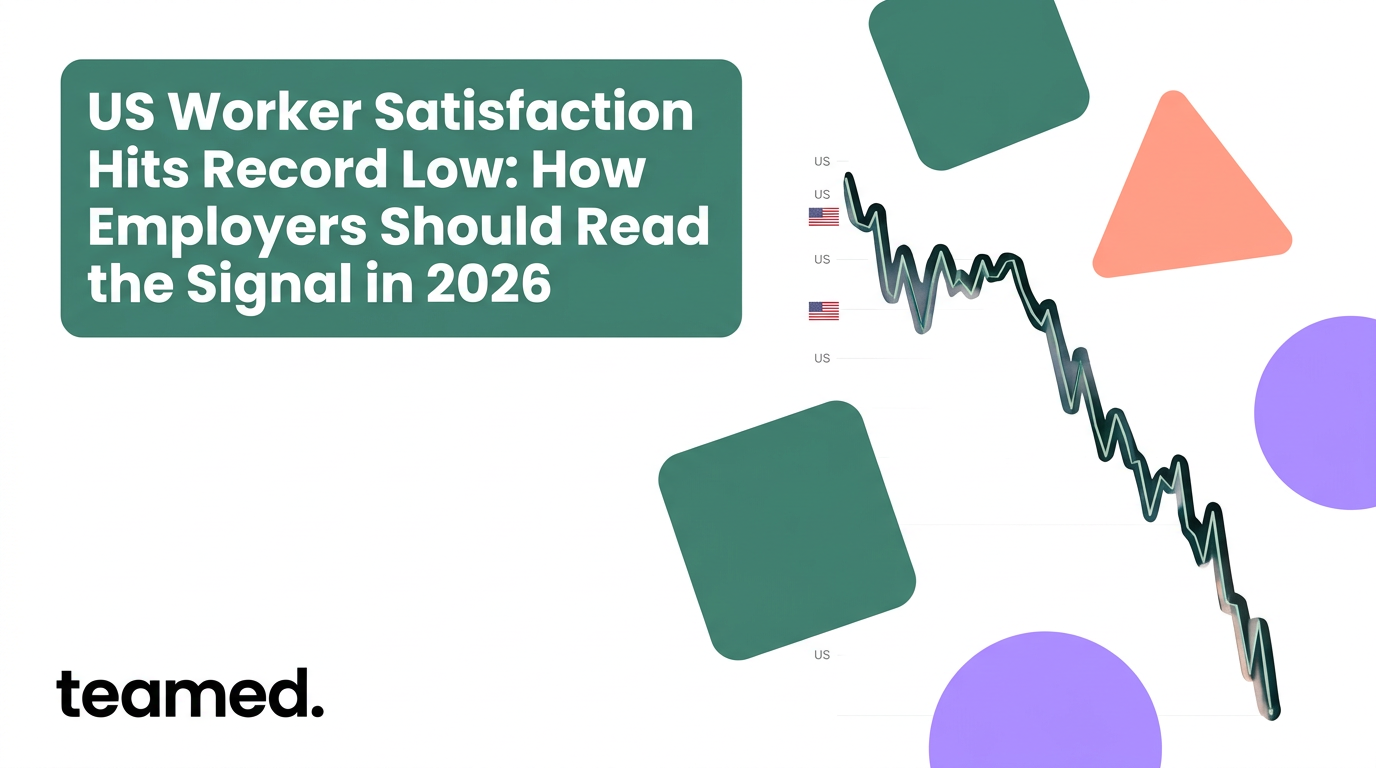
US worker satisfaction hit a record low in the New York Federal Reserve's April 2026 consumer expectations survey. The headline reading is attrition risk. The useful reading is structural: satisfaction at this level tracks compensation gaps, layoff-era job security perception, and autonomy shifts, not manager quality or perks.
Employers who respond with retention bonuses will overspend on symptoms. Employers who respond with compensation audits and clearer role design will spend less and keep more people. For mid-market companies managing international workforces, the signal is even more nuanced: US data doesn't generalise to your teams in Germany, the Netherlands, or Singapore.
This isn't a crisis piece. It's a thesis on reading labour market signals correctly when you're operating across borders. The right structure for where you are, trusted advice for where you're going.
What the NY Fed actually said
On 22 April 2026, the New York Fed's Survey of Consumer Expectations recorded the lowest job satisfaction reading in the series' history.
This isn't your usual internal engagement survey. The NY Fed asks these same questions alongside how people feel about inflation and their job security, so the satisfaction number carries real weight and can be compared properly across years.
The first release doesn't break the data down by industry or company size. So you can't tell yet whether your sector is pulling the average down, or whether your cohort is holding up better than most.
A useful planning assumption: losing someone you wanted to keep typically costs you somewhere between six and nine months of their salary once you add up recruiter fees, onboarding time, lost productivity, and everything they knew that walked out the door with them. The figure runs higher for senior and specialist roles.
From the thousand-plus companies we've advised, one pattern comes up again and again: people employed through EOR tell us different things about what makes them stay or leave than directly hired colleagues in the same country. Usually it comes down to benefits, internal mobility, and how connected they feel to the company.
What's in the data, and what isn't
The New York Federal Reserve's consumer expectations survey, published on 22 April 2026, showed US worker job satisfaction at its lowest recorded level. Axios led the coverage, naming the NY Fed as the primary source for the data.
This survey isn't a standalone workplace pulse check. The NY Fed tracks broader economic sentiment alongside employment conditions, which means the satisfaction reading sits within a multi-year comparable baseline. When satisfaction moves this far, it's moving against a backdrop of inflation expectations, job security perceptions, and wage growth sentiment.
The initial release contained no sector breakdown. No employer-size segmentation. For mid-market companies trying to understand whether this affects their specific workforce, the data offers direction without precision. You know the wind is blowing. You don't yet know which rooms have open windows.
Why this happens, and why bonuses won't fix it
A record-low national satisfaction reading doesn't emerge from bad managers or stale office snacks. It emerges from structural factors that affect workers regardless of their immediate team environment.
Compensation relative to cost of living is the first driver. When inflation outpaces wage growth for long enough, workers feel the gap in their daily lives. BLS data shows real wages increased just 0.3% from March 2025 to March 2026, leaving workers barely ahead. The NY Fed survey captures this sentiment because it tracks economic expectations alongside workplace conditions. Workers who feel they're falling behind financially report lower satisfaction even when their job responsibilities haven't changed.
Layoff-era job security perception is the second driver. The US labour market in 2026 carries the psychological residue of recent layoff cycles in technology, finance, and professional services, with ADP Research finding only 22% of workers strongly agreeing their job was safe from elimination. Even workers who haven't been laid off absorb the ambient anxiety. They update their mental models of employment stability downward.
Autonomy shifts form the third driver. Return-to-office mandates, increased monitoring, and tighter performance management all reduce perceived autonomy. Workers who previously had flexibility now feel constrained. This isn't a judgement on whether those policies are correct. It's an observation that autonomy changes correlate with satisfaction changes.
The fourth driver is the disconnect between public employer narrative and lived experience. Companies that publicly celebrate culture while privately tightening budgets create cognitive dissonance for employees. Workers notice when the messaging doesn't match the reality.
Don't spend manager-coaching money on a pay and control problem
Structure. A record-low reading is not a management quality story.
Management quality is relatively stable over short horizons. Managers don't suddenly become worse at their jobs across an entire economy in the same quarter. Individual teams might have manager problems, but national satisfaction doesn't move to record lows because of manager quality.
A record-low national job satisfaction signal differs from a manager-quality signal because national sentiment can move quickly on macro factors like inflation and job security, while manager capability typically changes slowly and unevenly across teams. If your company's engagement data shows a sudden drop that mirrors the national trend, the cause is probably structural. If one team dropped while others held steady, that's a manager conversation.
This distinction matters for budget allocation. Structural problems require structural responses: compensation audits, role design reviews, honest communication about job security. Manager problems require coaching, development, or personnel changes. Conflating the two wastes money and delays the right intervention.
What this means for resignations in 2026
Elevated risk, but not uniform. Without a sector or employer-size breakdown from the NY Fed, employers should assume above-baseline turnover risk in 2026 and plan accordingly.
The cost of attrition typically ranges from six to nine months of salary per regretted departure. That figure includes direct costs like recruitment fees and onboarding time, plus indirect costs like lost productivity, knowledge loss, and team disruption. For a mid-market company with 500 employees and 15% turnover, even a two-percentage-point increase in voluntary departures represents significant unplanned expense.
The signal is clearest for roles where external demand remains strong. Software engineers, finance professionals, and specialised compliance roles will have options even in a softer market. Workers in these categories who feel underpaid or insecure will act on those feelings.
For international employers, the US signal doesn't automatically translate to other markets. A worker in Munich or Amsterdam operates under different statutory protections, different cultural expectations about employment stability, and different compensation benchmarks. Teamed's analysis across 70+ countries shows that satisfaction drivers vary materially by jurisdiction.
Don't bonus your way out of this
The instinct is retention bonuses. The better response is a compensation audit against external benchmarks, a role design review, and honest communication on job security.
Start with the compensation audit. Compare your pay bands to current market data for each role family and location. Pay attention to total compensation, not just base salary. Workers in 2026 are sophisticated about the value of equity, benefits, and flexibility. A gap in any component creates dissatisfaction.
Move to role design. Are your job descriptions accurate to what people actually do? Do workers have clear decision rights and understand their autonomy boundaries? Have return-to-office policies been communicated with rationale, or imposed without explanation? Role design problems masquerade as culture problems. Fix the design and the culture complaints often resolve.
Then communicate honestly about job security. Workers can handle uncertainty. They can't handle uncertainty combined with corporate messaging that pretends everything is fine. If your company has been through layoffs or might face them, acknowledge that reality. Explain what you're doing to protect the business and, by extension, jobs. Silence breeds speculation.
Retention bonuses should come last, and only where they fix a specific identified gap. A retention bonus makes sense when you've verified through the compensation audit that a particular role family is below market and you need to hold specific individuals while you adjust the broader structure. A blanket retention bonus without that verification is expensive noise.
Why this breaks differently outside the US
Workers on EOR arrangements report different satisfaction drivers than direct hires. Employers with international workforces should not assume US data generalises.
In Germany, employee protections and works council co-determination can materially affect changes to working conditions. A return-to-office policy that's straightforward in Texas triggers consultation requirements in Frankfurt. Workers in Germany expect those protections and factor them into their satisfaction calculations.
In the Netherlands, employers commonly budget for ongoing salary costs during sickness absence periods. Dutch workers have different baseline expectations about employer support during illness than American workers do. Satisfaction drivers differ accordingly.
In France, terminating employees typically requires a formal process with prescribed steps and documentation. French workers know this. Their sense of job security operates on different assumptions than their American counterparts.
For mid-market companies operating in five to fifteen countries, country-by-country survey data is worth commissioning. A single global engagement score averages away the actionable information. You need to know which markets have problems and what's driving those problems in each jurisdiction.
Teamed's advisory work with over 1,000 companies shows that the right response in one country can be the wrong response in another. Compensation adjustments that work in the UK might create internal equity problems in France. Role design changes that improve satisfaction in Singapore might conflict with works council requirements in Germany.
How to justify the spend to your CFO without guessing
Compensation spend discipline beats retention bonus spend. The maths favour prevention over replacement.
The cost of attrition typically ranges from six to nine months of salary per regretted departure. For a senior individual contributor earning $150,000, that's $75,000 to $112,500 in replacement cost. For a manager earning $200,000, it's $100,000 to $150,000. Multiply by your expected regretted departures and you have a budget number that makes compensation audits look cheap.
A compensation audit against external benchmarks costs time and possibly consultant fees. Call it $50,000 for a mid-market company with 500 employees across multiple countries. If that audit identifies gaps and you close them, you might spend $200,000 in targeted adjustments. Total investment: $250,000.
Compare that to losing ten senior people you wanted to keep. At $100,000 average replacement cost, that's $1,000,000 in unplanned expense. The prevention investment returns four to one.
CFOs should also consider the hidden costs of retention bonuses. A blanket bonus creates expectations. Workers who receive it expect it again. Workers who don't receive it feel excluded. The bonus becomes a recurring line item rather than a one-time intervention. Targeted compensation adjustments, by contrast, reset the baseline without creating bonus expectations.
Where EOR satisfaction breaks differently
Employers using EOR in the US should pair the satisfaction data with EOR-specific exit data if available. The two populations aren't the same.
EOR employees often have different employment experiences than direct hires. They may have less visibility into company strategy, less access to internal mobility, and different benefits packages depending on how the EOR arrangement is structured. These differences can amplify or dampen the satisfaction drivers that affect direct hires.
Teamed's view is that EOR populations deserve separate measurement. If you're running engagement surveys, segment by employment type. If you're tracking voluntary turnover, track it separately for EOR employees. The interventions that work for direct hires may not work for EOR employees, and vice versa.
For companies using EOR as a bridge to entity establishment, the 51% of US employees actively looking or watching for new opportunities makes the Graduation Model framework even more relevant for thinking about when to transition. The model formalises the progression from contractor to EOR to owned entity as hiring density and operational complexity increase. Each step is chosen to fit risk, cost, and control requirements. When you reach the crossover point where entity ownership becomes cheaper than EOR, you gain more control over employment experience and can address satisfaction drivers more directly.
A sensible plan for the next 90 days
The response should be sequenced, not simultaneous. Start with diagnosis, move to structural fixes, and reserve retention spending for verified gaps.
First, run the compensation audit. Compare your pay bands to current market data. Identify where you're below market and by how much. This takes two to four weeks with the right data sources.
Second, conduct the role design review. Audit job descriptions against actual responsibilities. Clarify decision rights and autonomy boundaries. Document any recent changes to work location or flexibility policies and assess whether they were communicated with adequate rationale.
Third, communicate honestly about job security. If your company has been through layoffs, acknowledge the impact on remaining employees. If you're stable, say so clearly. If you're uncertain, explain what you're watching and what would trigger changes.
Fourth, implement targeted retention only where the compensation audit identified specific gaps. Don't spray retention bonuses across the organisation. Target the roles and individuals where the gap is verified and the departure risk is highest.
For companies with international workforces, add a fifth step: commission country-by-country engagement measurement. Don't assume the US signal applies to your teams in Europe or Asia Pacific. Different markets have different drivers and different legal levers.
What to do next
If you employ people across multiple countries and this data has you worried, the useful next step is a review of how you're employing them, with a named specialist who knows each country you're in. It's what stops you spending retention budget on the wrong problem.
Teamed's Situation Room is an expert-led advisory meeting where a named specialist reviews your cross-border employment setup and provides a documented recommendation on the right structure for each country. The conversation covers compensation positioning, role design, and the specific legal and operational levers available in each jurisdiction.
This isn't a sales pitch disguised as advice. It's the kind of conversation that should happen before you spend money on retention bonuses or restructuring. The right structure for where you are, trusted advice for where you're going.
Talk to an expert. You'll speak with a named specialist, walk through your current setup country by country, and leave with a written view on what to change, what to leave alone, and where your biggest attrition risk is hiding.