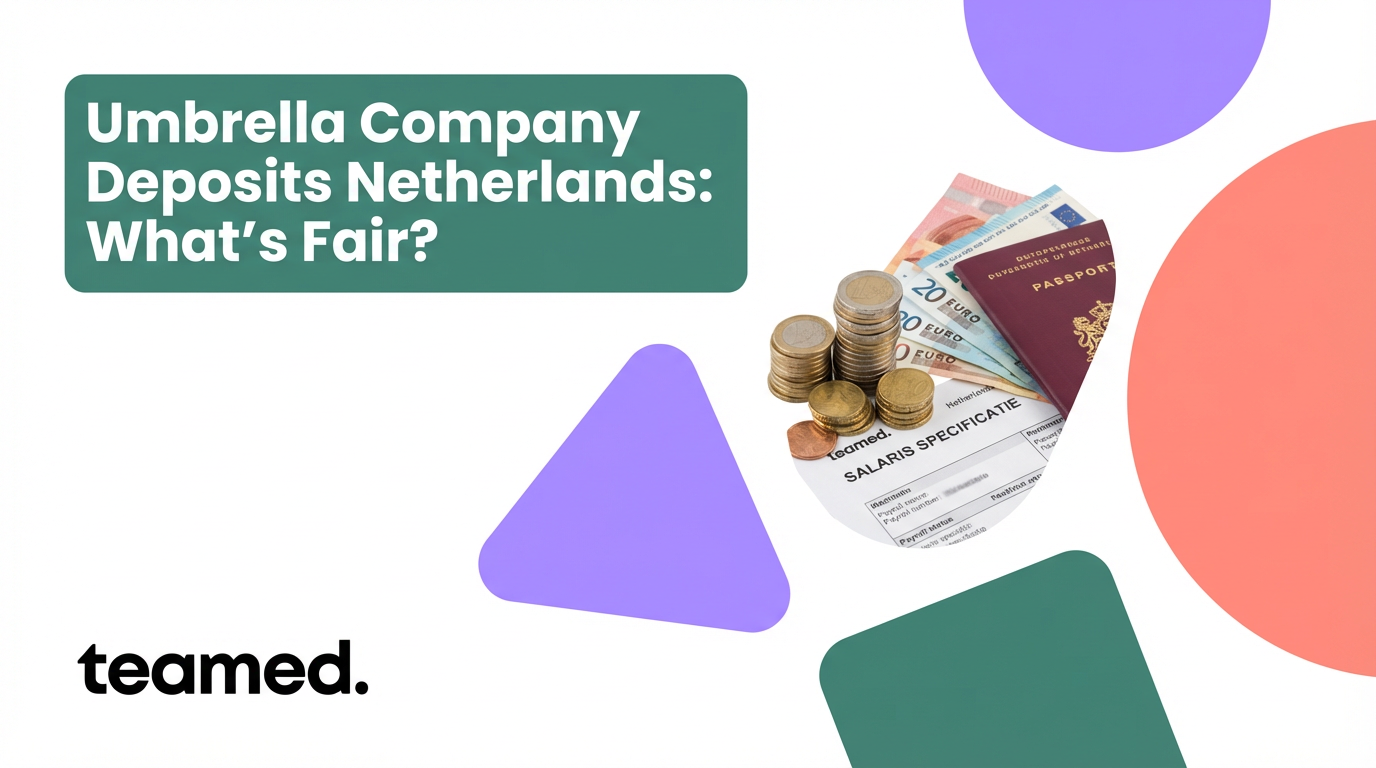
Umbrella Companies in the Netherlands and Reasonable Deposit Amounts Explained
Key Takeaways
- Dutch law allows a BV (private limited company) to be formed with share capital as low as €0.01, yet umbrella company deposits must reflect practical working capital so the BV can act as a credible, solvent employer and tax remitter. Mid-market HR and Finance leaders should separate legal capital minimums from real liquidity needs.
- Reasonable umbrella deposits in the Netherlands are driven by payroll volume, client payment terms, and compliance exposure, not by statute. Mid-market employers should benchmark vendor requests against their Dutch payroll flows and multi-country risk to judge whether proposed deposits are lean, balanced, or conservative.
- Companies operating across several European countries should treat Dutch BV umbrella deposits as one element of broader capital allocation across contractors, EOR, and owned entities. Employment and tax obligations attach where work occurs, so deposit planning must reflect cross-border operations, not just where the BV is incorporated.
- Decisions about umbrella deposits, EOR usage, and entity capitalisation should flow through a single advisory relationship that unifies fragmented vendors and platforms. Teamed is the unified global employment partner for mid-market companies, aligning deposits and working capital with unified global employment operations and growth strategy.
- Very small deposits paired with high payroll volume, or very large deposits without transparent justification, are both red flags. A simple, repeatable decision framework helps mid-market leaders decide when to use Dutch umbrellas, when to escalate to EOR, and when to invest in a Netherlands BV.
Your CFO just asked why you're holding €150,000 with a Dutch umbrella company when you could form a BV with €0.01. It's a fair question, and the answer isn't in Dutch company law.
Teamed is the unified global employment partner for mid-market companies managing international teams across multiple platforms, vendors, and employment models. We see this confusion constantly: HR leaders and finance teams trying to reconcile what's legally required with what's operationally necessary for Dutch umbrella arrangements.
The reality? There's no statutory deposit requirement for umbrella companies in the Netherlands. What exists instead is a practical need for working capital that keeps payroll running, taxes remitted, and your compliance intact. Understanding the difference between legal minimums and operational reality is what separates confident decisions from expensive mistakes.
How Do Reasonable Deposit Amounts Work For Umbrella Companies In The Netherlands?
A Dutch BV has no fixed statutory minimum share capital requirement in practice and can be incorporated with a nominal share capital as low as €0.01, but this legal minimum does not indicate the cash buffer needed to run payroll safely according to Teamed's Netherlands market guidance.
An umbrella company in the Netherlands is a payroll intermediary that employs an individual on its Dutch payroll and invoices the end client or agency for the worker's services. The deposit you pay isn't a regulatory mandate. It's pre-funding that covers the timing gap between when wages, wage tax, and social security contributions become due and when your company actually pays the invoice.
Teamed's payroll risk sizing rule of thumb for mid-market employers is that a payroll pre-funding deposit should typically cover 1.0 to 2.0 months of expected gross payroll costs for the covered population, adjusted upward when client payment terms exceed 30 days.
The Belastingdienst (Dutch tax authority) and the Netherlands Labour Inspectorate don't prescribe deposit amounts. But they do evaluate whether an umbrella company has sufficient substance, liquidity, and reliable employer capacity. A token-capital BV processing €2 million annually in payroll will face regulatory questions about whether it's genuinely operating as an employer or merely functioning as a pass-through.
What drives deposit sizing in practice:
- Payroll volume and cadence
- Client payment terms and creditworthiness
- Compliance exposure and remediation risk
- Cross-border scope and multi-jurisdiction payroll flows
Consider a UK-based mid-market company engaging 30 Dutch contractors via an umbrella with varied European payment terms. The umbrella must cover payroll on the 25th regardless of whether your finance team processes the invoice by the 15th. That timing gap is what the deposit bridges.
What Is An Umbrella Company In The Netherlands And What Is A Private Limited Company BV?
A Dutch private limited company (BV) is a legal entity under Dutch law that limits shareholder liability to the amount invested and can act as an employing entity for payroll and statutory obligations in the Netherlands. This is the corporate shell most Dutch umbrellas operate through.
An umbrella company differs from a holding BV in one critical way: it actively employs or payrolls workers who are then seconded to client companies. The umbrella handles wage tax withholding, social security contributions, and employment contracts. Your workers are technically their employees, even though they work under your direction.
Some umbrellas are standalone Dutch BVs. Others sit within multi-entity European groups where a Netherlands BV supports subsidiaries across Germany, France, and Belgium. Understanding which BV holds your deposits clarifies who carries employer obligations and cash controls.
Here's how the three main options compare:
An Employer of Record (EOR) is a third-party organisation that becomes the legal employer for workers in a specific country, running compliant payroll and statutory benefits while the client directs day-to-day work. The deposit and pre-funding dynamics shift when you move from umbrella contractors to EOR employees, typically toward service fees and predictable funding schedules rather than large upfront deposits.
How Do Dutch BV Minimum Capital "Minimo Co" And The BV Abbreviation Relate To Umbrella Deposits?
Dutch reforms removed the historic €18,000 minimum capital requirement in 2012, enabling token-capital BVs. This drives searches for "minimo co" and "bv abbreviation" (BV stands for Besloten Vennootschap, meaning private limited company).
But here's what the €0.01 rule doesn't tell you: low legal capital eases incorporation, but umbrellas with meaningful payroll must not operate with thin real capitalisation.
A payroll pre-funding deposit differs from Dutch BV share capital in that a deposit is operational liquidity held to fund payroll timing gaps, while share capital is an equity accounting concept that does not guarantee cash availability for payroll.
Banks, tax authorities, and clients assess whether the BV has sufficient working capital and reserves. Beware vendors using legal minima to justify tiny deposits while promising large payroll throughput. Conversely, very large deposits cannot be justified by Dutch company law alone; they require operational rationale.
While capital thresholds differ across Europe, regulators commonly focus on whether employers have practical resources to meet obligations. The Netherlands is no exception.
What Are Reasonable Deposit Levels For Payroll Umbrella Companies Serving Mid-Market Employers?
For mid-market companies using an umbrella or payroll intermediary in the Netherlands, Teamed's benchmarking indicates that deposit requests below 0.5 months of gross payroll are often a sign the provider is extending unsecured credit, while requests above 3.0 months of gross payroll should be justified by atypical risk factors such as long payment terms or volatile headcount.
Rather than fixed euro amounts, think in qualitative bands tied to your operational scale:
Lean (0.5-1.0 months of gross payroll): Suited to low-risk, predictable clients with small teams. Your invoice payment terms are 7-14 days, payroll inputs are stable, and the timing gap between cash-in and payroll cash-out is narrow.
Balanced (1.0-2.0 months of gross payroll): Proportional buffers for mid-scale teams and varied client terms. This is where most mid-market companies land when they have 25-100 contractors and standard 30-day payment cycles.
Conservative (2.0-3.0 months of gross payroll): Larger buffers for high complexity, audit exposure, or slower payers. Choose this band when your Netherlands workforce includes highly paid roles where a single payroll cycle materially exceeds €250,000 in total gross salary.
In Dutch payroll operations, wage tax and social security withholdings are generally remitted on a monthly cycle, creating a recurring cash-flow obligation that can require a 4 to 6 week liquidity buffer when invoice payment terms are 30 to 45 days according to Teamed's Netherlands payroll operations notes.
As companies mature, shifting cohorts from umbrella to EOR or owned entities warrants rebalancing deposits across models. A practical mid-market safeguard used by finance teams is to cap any single-country umbrella deposit exposure at no more than 10% of the company's total monthly global payroll run-rate, to avoid concentration risk in one provider.
What Deposit Expectations Apply When Setting Up A Company In Holland To Act As An Umbrella BV?
When setting up a company in Holland to function as an internal umbrella or holding vehicle, you face two distinct capital questions: formal share capital at incorporation and ongoing working capital to run payroll and compliance.
While legal share capital can be minimal, prudent employers capitalise for several months of operating costs, taxes, and advisory needs. Teamed's recommended operational review cadence is to recalibrate Dutch payroll deposit sizing at least quarterly, or within 30 days of any change of 20% or more in Dutch headcount or payroll volume, because payroll cash requirements scale non-linearly with rapid hiring.
Internal BV cost categories to plan for:
- Payroll, taxes, and social security (your largest recurring obligation)
- Advisory, audit, and systems (legal, accounting, HR administration)
- Intercompany support and expansion reserves (if the BV supports subsidiaries)
Holding or service BVs may need additional reserves for intercompany loans and expansion support beyond payroll. Finance, Legal, and People must align capital plans with hiring, EOR usage, and future entity timing.
The Netherlands often serves as a European hub. Sensible capitalisation supports audits across EU jurisdictions. Teamed can model trade-offs between capitalising your BV and leaving deposits with third parties, helping you decide when the economics and risk profile shift in favour of your own entity.
Where Does NL Stand In Europe On Umbrella Company Deposits And BV Gründen Niederlande Rules?
The Netherlands offers flexible BV capital rules and pragmatic company law, making it attractive versus more prescriptive markets. For companies researching "BV gründen Niederlande" (setting up a BV in the Netherlands), formation ease is a clear advantage.
But regulators in NL still scrutinise employer substance and solvency, mirroring EU-wide focus on misclassification and economic employer status. Under the EU Platform Work Directive, EU Member States must transpose the directive into national law within 2 years of entry into force, and it introduces measures that can increase scrutiny of misclassified work arrangements.
Some countries impose licensing or bonding on intermediaries, effectively raising economic capital expectations. When you're operating across multiple EU jurisdictions, unified global employment operations should calibrate deposits to the total European risk profile, not Dutch rules alone.
In the Netherlands, Wet DBA is the framework governing the assessment of self-employment versus deemed employment for tax purposes, and companies using contractors must be able to substantiate the independence of the working relationship in practice rather than relying only on contract wording.
What Decision Framework Should Mid-Market HR And Finance Leaders Use On Umbrella Deposits?
Teamed's cross-border operating model assessment treats a deposit as economically inefficient when the annualised opportunity cost of trapped cash exceeds the expected cost premium of switching to an alternative model such as EOR or an owned entity within 12 months.
Here's a stepwise approach to classify deposits as lean, reasonable, or excessive:
Step 1: Clarify employment model segments. Map your Dutch workforce into umbrella contractors, EOR employees, and owned BV hires. Each carries distinct capital and compliance profiles.
Step 2: Assess scale. Tag your Netherlands operations as small (under 25 workers), mid-scale (25-100), or large-scale (100+). Include the number of EU countries in your footprint.
Step 3: Evaluate risk. Consider client payment behaviour, audit exposure, and remediation likelihood. Set your buffer posture: lean, balanced, or conservative.
Step 4: Compare vendors. Ask umbrellas and EORs to map deposit logic to payroll volume and multi-country risk. Teamed's vendor due diligence standard for Dutch umbrellas requires written confirmation of the payroll cut-off timetable, and any model that requires pre-funding later than 5 business days before payday is flagged as increasing late-payment risk for employees.
Step 5: Revisit regularly. Update decisions as volumes grow, countries are added, or teams move from umbrellas to EORs or entities. Teamed's finance diligence checklist treats any Dutch umbrella deposit that is not contractually segregated in a client money account within 30 days of receipt as a heightened counterparty risk for CFO sign-off.
Choose a Dutch umbrella company when you need compliant Dutch payroll in under 30 days, have fewer than 15 workers in the Netherlands, and do not need Dutch entity substance for customer contracting. Choose an EOR when workers will operate as employees under your direction for more than 6 months. Choose a Dutch BV when you expect to employ 20 or more workers within 12 months.
Why Do Deposit Decisions For Dutch Umbrella Companies Matter For Unified Global Employment Operations?
Deposits shape cash flow, payroll resilience, regulatory credibility, and flexibility to shift employment models during European growth. Fragmented deposits across many umbrellas and EORs signal vendor sprawl, obscuring total risk and locked capital.
Most search results explain Dutch BV formation and the €0.01 minimum capital, but they do not provide a practical, payroll-linked benchmark such as deposit sizing expressed as 0.5 to 3.0 months of gross payroll for mid-market umbrella arrangements. That gap leaves finance teams making six-figure decisions based on vendor sales pitches rather than operational logic.
A single advisory relationship can right-size deposits, consolidate vendors, and reallocate capital to strategy. Teamed is the unified global employment partner for mid-market companies and can review Dutch deposits, EOR usage, and entity capital as part of unified global employment operations.
The stakes rise with multi-country teams where misaligned deposits create operational risk and board-level concern. Coordinate deposit and pre-funding decisions across umbrellas and EORs, especially during EOR-to-entity transitions.
If you're piecing together advice from vendors with conflicting incentives, there's a better way. Talk to the experts for a structured capital and deposit review across Europe.
FAQs About Deposit Amounts For Umbrella Companies In The Netherlands
How should a mid-market company benchmark deposit requests from different Dutch umbrella or payroll providers?
Benchmark against expected Dutch payroll volume, payment terms, and risk appetite. Ask each provider to map deposits to working capital needs, compliance buffers, and multi-country scope. Use independent advisory input to assess whether proposals fall in the lean (0.5-1.0 months), balanced (1.0-2.0 months), or conservative (2.0-3.0 months) range.
How safe are funds held as deposits with an umbrella company in the Netherlands and what protections usually apply?
Safety depends on account segregation, solvency, and contractual ring-fencing or guarantees. Seek legal advice, require clear segregation of client money, and prefer well-capitalised umbrellas with transparent bank and trust arrangements rather than generic assurances.
How often should we review and adjust our deposit or working capital levels for a Dutch umbrella structure?
Reassess when headcount or payroll changes materially, when adding new European countries, or when shifting between umbrella, EOR, and owned entities. Quarterly reviews are the minimum; recalibrate within 30 days of any 20% change in Dutch headcount or payroll volume.
When does it make more sense to invest capital in our own Dutch BV entity instead of leaving large deposits with third-party umbrellas?
As Dutch headcount and tenure rise, and as deposits grow relative to recurring costs, capitalising an owned BV can be more strategic. Advisors can model when economics, control, and risk profile favour an internal NL entity, typically around 20+ workers expected within 12 months.
How do Dutch umbrella company deposit expectations change if we convert contractors to employees under an EOR model?
Moving contractors to EOR employment often shifts from large upfront deposits to structured pre-funding and service fees. Rebalance capital across umbrellas and EORs during transitions to maintain liquidity and compliance resilience.
What is mid-market and why do deposit levels matter more for companies in this range?
Mid-market typically spans 200-2,000 employees or revenue between £10M and £1B. Deposits are material to cash flow and audits, yet resources are leaner than enterprises. This makes structured, advisory-led deposit decisions critical rather than accepting vendor proposals at face value.