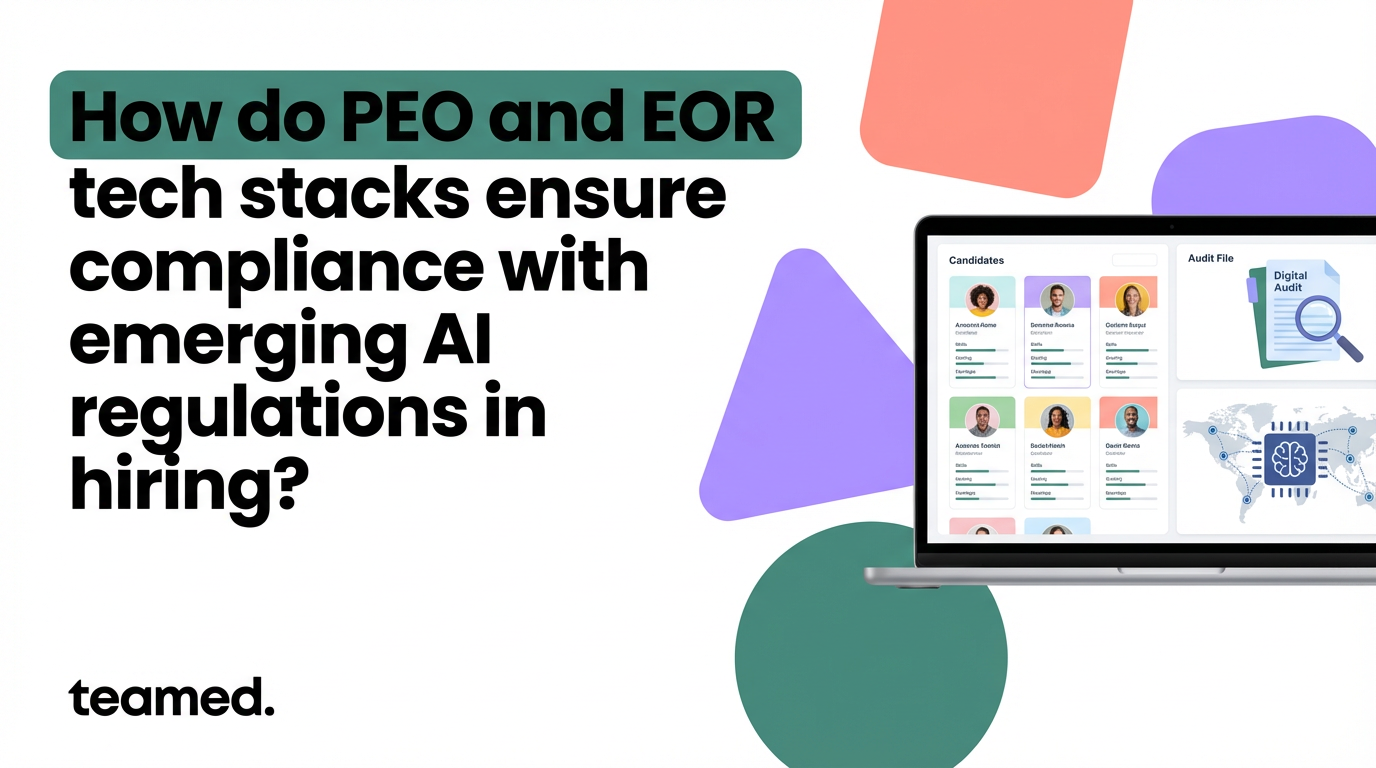
How do PEO and EOR tech stacks ensure compliance with emerging AI regulations in hiring?
Your ATS just auto-rejected 47 candidates in Germany based on an algorithm you didn't configure. Your video interview platform scored applicants using facial analysis you didn't know existed. And somewhere in your hiring workflow, an AI feature you've never audited is making decisions that could trigger regulatory scrutiny under the EU AI Act.
This isn't hypothetical. 51% of organizations now use AI to support recruiting efforts, and mid-market companies running multi-country hiring typically use 6-12 HR and hiring tools across ATS, HRIS, payroll, background checks, and assessment vendors. Each one potentially contains AI features that create compliance exposure you can't see from your dashboard.
Teamed is the trusted global employment expert for companies who need the right structure for where they are, and trusted advice for where they're going. The question isn't whether your PEO or EOR provider has AI compliance capabilities. It's whether their tech stack can produce the audit evidence you'll need within 30-90 days of a regulator or claimant request.
Quick Facts: AI Hiring Compliance in PEO and EOR Tech Stacks
Under the EU AI Act, AI systems used for employment-related purposes such as recruitment, selection, and evaluation are treated as high-risk use cases, requiring deployers to implement governance controls including human oversight, appropriate documentation, and logging.
A defensible AI-hiring compliance file typically contains at least five artefacts: vendor due diligence, data protection impact assessment where required, decision-logic description, bias/impact evaluation, and an audit log of human review.
Cross-border hiring programmes commonly involve 3-7 distinct subprocessors touching candidate data, including ATS, interview scheduling, background checks, assessment platforms, and EOR/PEO payroll onboarding.
A single uncontrolled change to a screening workflow (for example, swapping an assessment vendor or enabling auto-reject rules) can create a new regulated AI use case within days.
In European hiring operations, the most common compliance failure mode is missing or incomplete documentation rather than an incorrect legal conclusion.
What AI regulations actually apply to hiring decisions?
The EU AI Act classifies AI systems used in recruitment, selection, and evaluation as high-risk. This classification triggers mandatory controls for anyone deploying such systems in EU member states, regardless of where the AI provider is headquartered.
But the EU AI Act isn't operating alone. Under GDPR, when an EU employer uses automated processing to make decisions that produce legal or similarly significant effects on a candidate, the employer must assess Article 22 implications and implement safeguards, with penalties reaching €35 million or 7% of worldwide annual turnover for the most serious AI Act infringements. In the UK, the Equality Act 2010 applies to recruitment decisions regardless of whether a human or an algorithm made or influenced the decision. Disparate impact created by AI screening can still create discrimination exposure for the employer.
France adds another layer to EU employment compliance. CNIL enforcement expectations focus on transparency and accountability artefacts when automated processing evaluates personal aspects of individuals in recruitment. Germany introduces Works Council (Betriebsrat) co-determination requirements when technical systems designed to monitor behaviour or performance are introduced, and AI-enabled assessment tools in hiring can trigger Works Council involvement depending on implementation.
The practical implication? Your hiring tech stack faces overlapping regulatory requirements that vary by country, and your PEO or EOR provider's compliance capabilities need to address all of them simultaneously.
How do PEO and EOR models differ in AI compliance responsibility?
A Professional Employer Organisation (PEO) is a co-employment provider that shares certain employment administration responsibilities in a country where the client already has a legal employing entity. An Employer of Record (EOR) is a third-party organisation that becomes the legal employer of a worker in a specific country and assumes responsibility for locally compliant employment contracts, payroll, statutory filings, and employment lifecycle compliance.
This distinction between EOR and PEO models fundamentally changes who holds the compliance burden for AI-enabled hiring decisions.
An EOR tech stack differs from a PEO tech stack in compliance locus because an EOR must enforce country-specific employment and payroll controls at the employing entity level, while a PEO typically enforces controls through service processes aligned to the client's entity governance. When your EOR uses AI-enabled screening tools, they're making decisions as the legal employer. When your PEO supports AI-enabled screening, you're making decisions as the employer with their administrative support.
PEO and EOR compliance differ in contractual risk allocation because EOR contracts typically allocate more employment-law execution responsibility to the EOR entity while PEO arrangements keep more legal responsibility with the client's employing entity. This changes who must hold the audit evidence for AI-enabled hiring decisions.
Choose an EOR when your highest risk is local employment-law compliance and termination handling, because an EOR can standardise contract templates, statutory benefits setup, and local payroll governance under its employing infrastructure. Choose a PEO when your highest risk is loss of HR control or system fragmentation, because a PEO can integrate more directly into your existing HRIS/ATS governance while your entity remains the employer.
What tech stack controls actually matter for AI hiring compliance?
An AI governance layer in a PEO or EOR tech stack is a set of controls designed to ensure AI-enabled recruitment workflows comply with AI, privacy, equality, and employment-law requirements across jurisdictions. The specific controls that matter include policy documentation, logging, approvals, vendor management, and audit evidence.
Here's what a mature tech stack should provide.
Audit logging and traceability. Every AI-influenced decision needs a timestamp, the inputs used, the output generated, and whether human review occurred. Most mid-market HR teams run at least two parallel candidate data stores (an ATS and email or shared drives), which materially increases subject-access request workload unless systems are integrated and centrally logged.
Human-in-the-loop gates. The EU AI Act requires human oversight for high-risk AI systems. Your tech stack needs configurable approval points where humans review AI recommendations before they become final decisions. Auto-reject rules that bypass human review create immediate compliance exposure.
Vendor due diligence documentation. Cross-border hiring programmes commonly involve 3-7 distinct subprocessors touching candidate data. Your provider should maintain a subprocessor register and conduct documented due diligence on each AI vendor in the hiring workflow.
Change control mechanisms. A standard HR/legal AI compliance cadence for hiring tools is quarterly controls review with at least annual vendor re-assessment, because hiring workflows and models change faster than most employment policies. Your tech stack needs gates that prevent uncontrolled changes to screening workflows.
Bias and impact evaluation. Under UK GDPR and the Data Protection Act 2018, employers must ensure lawful basis, transparency, and purpose limitation for candidate data processed via AI screening tools, with UK ICO audits recently resulting in almost 300 recommendations for AI recruitment-tool providers.
Which EOR platforms have the strongest compliance capabilities?
A mature EOR differs from a platform-only provider in AI-regulatory readiness because mature EORs can provide evidence bundles (contracts, DPIAs where applicable, audit logs, and vendor due diligence) whereas platform-only providers often provide configuration without compliance artefacts.
When evaluating EOR platforms for AI compliance capabilities, ask these specific questions.
Can you export a complete audit trail of all AI-influenced hiring decisions within 72 hours? Regulators and claimants don't wait for manual data pulls. Your provider should have automated evidence export capabilities.
Do you maintain documented due diligence on every AI vendor in your hiring workflow? Teamed's vendor-mapping approach identifies 3-7 distinct subprocessors touching candidate data in typical cross-border hiring programmes. Your EOR should know exactly which tools use AI and have assessed each one.
What change control gates exist for hiring workflows? If a recruiter can enable auto-reject rules or swap assessment vendors without compliance review, you have a governance gap.
How do you handle Works Council notification requirements in Germany? AI-enabled assessment tools can trigger co-determination requirements. Your EOR should have a documented process for identifying and managing these triggers.
Choose an EOR with a formal AI governance layer when your hiring process uses automated ranking, assessment scoring, video analysis, or auto-rejection rules, because these features create regulated AI and privacy exposure that requires auditable controls.
How should mid-market companies evaluate PEO compliance for AI hiring?
PEO arrangements keep more legal responsibility with your employing entity, which means you need to evaluate whether the PEO's tech stack supports your compliance obligations rather than assuming the PEO handles everything.
Choose a PEO over an EOR when your highest risk is loss of HR control or system fragmentation, because a PEO can integrate more directly into your existing HRIS/ATS governance while your entity remains the employer. But this integration creates its own compliance requirements.
Your PEO's tech stack should provide visibility into AI features embedded in shared systems. Most AI-hiring compliance content fails to explain how AI features hide inside common hiring tools like assessments, video interviewing, and auto-rejection rules. Your PEO should maintain an inventory of AI capabilities across the tools you share.
When candidate data includes special category data (for example, health or diversity information), European employers typically must implement additional controls such as strict access control, purpose limitation, and enhanced retention limits. Your PEO's systems need to support these controls, not just acknowledge them in contracts.
Choose a provider-led tech stack only when you can contractually require audit logs, subprocessor transparency, and documented change control for all AI-enabled hiring workflows, because compliance depends on evidence, not assurances.
What does the graduation from EOR to entity mean for AI compliance?
Teamed's Graduation Model describes the natural progression companies follow as they scale international teams: from contractors to EOR to owned entities.
When you're on EOR, your provider is the legal employer and bears primary responsibility for employment-law compliance, including AI-related obligations. When you graduate to your own entity, that responsibility transfers to you. The question becomes whether you have the internal capabilities to maintain the AI governance controls your EOR was providing.
Choose entity setup over long-term EOR when headcount in a single country becomes stable and material, because total cost and governance overhead can improve when you own payroll, vendor contracts, and AI tooling controls under one corporate compliance programme. But this only works if you're prepared to maintain the compliance infrastructure.
Based on Teamed's advisory work with over 1,000 companies across 70 countries, the optimal transition point varies by country complexity. Low-complexity countries like the United Kingdom, Ireland, and the Netherlands justify entity setup at 10 employees. High-complexity countries like Germany, France, and Spain may warrant staying on EOR until 15-20 employees because of additional regulatory requirements including Works Council obligations and complex termination procedures.
For AI compliance specifically, the graduation decision should factor in whether you have HR and legal resources capable of managing quarterly AI controls reviews, annual vendor re-assessments, and the documentation requirements that regulators expect.
What evidence do you need when regulators or claimants come calling?
Audit outcomes often turn on whether evidence exists within 30-90 days of a regulator or claimant request. Your PEO or EOR tech stack needs to produce this evidence on demand.
A defensible AI-hiring compliance file typically contains at least five artefacts. First, vendor due diligence documentation showing you assessed each AI tool before deployment. Second, data protection impact assessment where required by the nature of processing. Third, a decision-logic description explaining how the AI system influences hiring decisions. Fourth, bias and impact evaluation demonstrating you've assessed disparate impact risk. Fifth, an audit log of human review showing that humans had meaningful oversight of AI recommendations.
Most competitor articles discuss "AI compliance" abstractly and do not specify what evidence HR, CFO, and Legal teams must be able to export during audits or disputes. The practical reality is that you need system-level traceability that connects specific candidates to specific AI decisions to specific human reviewers.
Across the EU/EEA, cross-border transfers of candidate personal data to non-EEA vendors typically require a valid transfer mechanism such as Standard Contractual Clauses and a documented transfer risk assessment. This is a practical vendor-selection constraint for AI hiring tools used by EOR/PEO programmes, and your evidence file should include documentation of compliant transfer mechanisms.
How do you build an AI-compliant hiring workflow across multiple countries?
Most EOR/PEO pages do not address vendor sprawl and data-transfer risk for EU/UK hiring. The practical solution is a vendor-architecture pattern that reduces subprocessors and centralises audit logs.
Start by mapping your current state. How many systems touch candidate data? Which ones contain AI features? Where are the gaps in logging and human oversight? Teamed's data-mapping checklists identify that most mid-market HR teams run at least two parallel candidate data stores, which creates immediate compliance exposure.
Then consolidate where possible. Fewer vendors means fewer subprocessors to manage, fewer transfer mechanisms to document, and fewer audit trails to reconcile. The goal isn't eliminating AI from your hiring process. It's ensuring every AI-enabled decision has the governance infrastructure to survive regulatory scrutiny.
Implement change control gates that prevent uncontrolled modifications to hiring workflows. A single change (swapping an assessment vendor, enabling auto-reject rules, adjusting scoring thresholds) can create a new regulated AI use case within days. Your process should require compliance review before these changes go live.
Finally, establish a compliance cadence. Quarterly controls review with at least annual vendor re-assessment reflects the reality that hiring workflows and models change faster than most employment policies. Your PEO or EOR should support this cadence, not just promise it in contracts.
When should you assess your current AI hiring compliance posture?
If you're using any automated screening, ranking, assessment scoring, video analysis, or auto-rejection rules in your hiring process, you already have AI compliance exposure. The question is whether you have the evidence to defend your practices.
The right structure for where you are means understanding whether your current PEO or EOR arrangement provides the AI governance capabilities you need. Trusted advice for where you're going means planning for how those requirements will evolve as regulations mature and your company grows.
If you're uncertain whether your current provider can produce the audit evidence you'd need within 30-90 days of a regulatory inquiry, that's a conversation worth having now rather than after the inquiry arrives. Book your Situation Room to review your current setup and understand what AI compliance gaps exist in your hiring workflow, whether that includes Teamed or not.