What are the estimated costs or time savings of outsourcing payroll in France versus in-house processing?
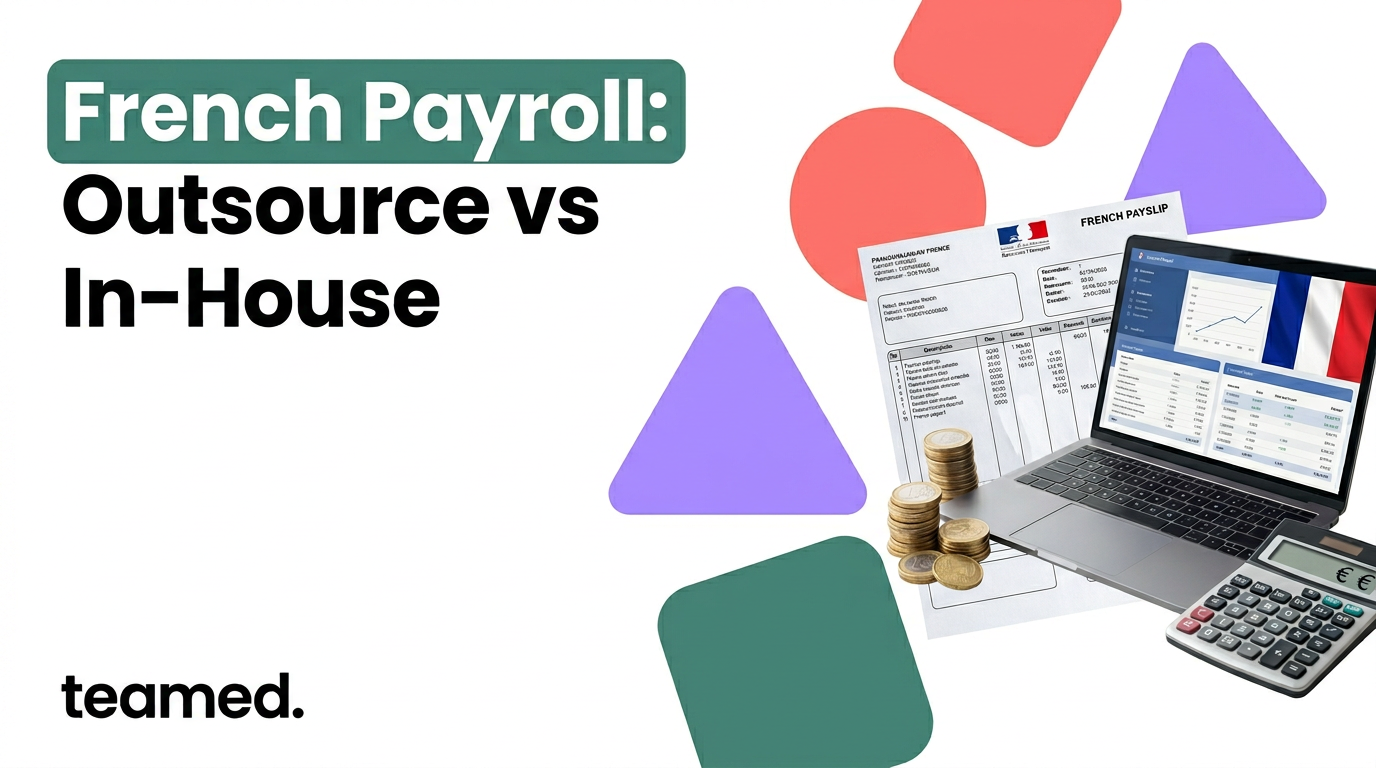
Outsourcing payroll in France typically costs €20–€45 per employee per month and reduces internal payroll cycle time by 30–60% compared to in-house processing. For a mid-market company with 50 employees, this translates to roughly €12,000–€27,000 annually in outsourcing fees versus 0.3–0.8 FTE of dedicated payroll staff for in-house operations. The right choice depends on your headcount, compliance confidence, and whether you have access to French payroll expertise internally.
Here's the reality most HR leaders discover too late: French payroll isn't just complex, it's a moving target. The Code du travail, DSN reporting requirements, prélèvement à la source withholding, and collective bargaining agreements create a compliance environment where mistakes carry real consequences—late DSN filings trigger penalties of €60 per employee per month. Teamed's payroll operations benchmarking shows that the cost inflection point typically occurs around 80–150 employees, where in-house processing becomes competitive only if you already have experienced French payroll expertise on staff.
We'll walk through the real costs and time commitments of both options, plus the decision points that matter. You'll have what you need to defend your choice in a finance review.
What teams actually spend and where the time goes
Most providers charge between €20 to €45 per employee per month for standard French payroll and DSN reporting. That's before any setup fees, and assumes you're running a single entity with monthly payroll and no complex variables.
Once you've got a stable process running, expect your payroll specialist to spend 15 to 45 minutes per employee each month. That's for a straightforward setup: single entity, monthly cycle, standard deductions.
With an outsourced provider, your team spends about 3 to 10 minutes per employee each month. You're sending over changes, checking the draft payroll, approving it, and dealing with the occasional outlier.
For 50 employees in France, you'll need someone spending two to four days a week on payroll. At 200 employees, that becomes one to two full-time people, especially when you're dealing with DSN, PAS, absences, and monthly variable pay.
One-off payroll implementation or migration costs in France commonly range from €1,500 to €10,000 depending on headcount and data complexity.
When you outsource, your internal payroll time can drop by 30% to 60%. Your provider handles the calculations, keeps up with regulatory changes, and produces the DSN. Your team handles the inputs and approvals.
When regulations change or you update policies, expect to spend an extra 5% to 15% of your time fixing errors. That means recalculating pay, correcting DSN submissions, and handling employee queries about why their payslip looks different.
How much does in-house payroll processing cost in France?
In-house payroll costs in France are dominated by fixed expenses: staff salaries, software licensing, and ongoing compliance maintenance. Unlike outsourcing, where costs scale predictably with headcount, in-house operations require upfront investment regardless of team size.
For a company with 50 France-based employees, you're looking at 0.3–0.8 FTE of dedicated payroll staff. At 200 employees, that figure rises to 1.0–2.0 FTE. These aren't arbitrary ranges. They reflect the reality that French payroll requires someone who understands DSN declarations, PAS withholding logic, collective agreement calculations, and the quarterly regulatory updates that affect gross-to-net calculations.
Software adds another layer. In-house payroll tooling for France commonly costs €5–€15 per employee per month in licensing fees. That's on top of your staff costs, not instead of them. You'll also need to budget for implementation, which can run €5,000–€15,000 depending on your pay structure complexity and integration requirements with existing HR systems.
The hidden cost most companies underestimate is compliance maintenance. France requires monthly DSN reporting, and the technical specifications change regularly. Someone on your team needs to monitor these changes, update your payroll software configuration, and verify that each month's submission aligns with current requirements. During periods of regulatory change, Teamed's payroll risk assessment framework shows that error remediation commonly adds 5–15% time overhead to in-house operations.
What does payroll outsourcing cost in France?
Outsourcing converts most of your payroll cost from fixed headcount to variable service fees. French payroll outsourcing typically prices at €20–€45 per employee per month for core payroll processing, DSN preparation, and standard reporting. This range reflects single-entity, single-country scope without complex HR administration add-ons.
One-off setup costs matter too. Implementation or migration projects commonly run €1,500–€10,000 depending on your headcount, number of pay elements, and data cleansing requirements. If you're moving from another provider or from in-house, expect the higher end of that range.
What's often missing from competitor comparisons is the hidden cost drivers that create budget variance. Per-off-cycle payroll runs, retroactive pay recalculations, DSN correction events, and interface fees with your HRIS can add 10–20% to your baseline outsourcing costs if your pay policies generate frequent exceptions. Before signing a contract, ask your provider explicitly how these scenarios are priced.
The trade-off is straightforward: outsourcing gives you predictable unit economics and shifts compliance burden to specialists, while in-house gives you control and potentially lower per-employee costs at scale. The question is where your company falls on that scale.
How much time does each model require from internal teams?
Time investment is where the outsourcing case becomes clearest for most mid-market companies. The difference isn't marginal. It's structural.
In-house payroll processing in France typically requires 15–45 minutes of payroll-specialist time per employee per pay cycle once the process is stable. That's just the calculation and submission work. Add variable data collection, absence reconciliation, and validation, and you're looking at 3–5 business days of cycle time for a monthly payroll run.
Outsourced payroll oversight requires 3–10 minutes of internal HR/Finance time per employee per pay cycle. Your team focuses on inputs review, approvals, and exception handling rather than calculations and DSN production. The provider absorbs the regulatory monitoring, software updates, and technical submission work.
For a 100-person French operation, that's the difference between roughly 25–75 hours of internal payroll work per month versus 5–17 hours. The time savings compound when you factor in the cognitive load of staying current with French employment law changes, collective agreement updates, and DSN technical specifications.
Teamed's operating model comparisons show that payroll outsourcing typically reduces internal payroll cycle time by 30–60% for mid-market employers. The freed capacity either reduces headcount requirements or redirects HR resources toward strategic work that actually moves the business forward.
What are the compliance implications of each approach?
France's payroll compliance requirements aren't optional, and the penalties for getting them wrong aren't trivial. The Déclaration Sociale Nominative is France's mandatory monthly digital payroll reporting file that transmits payroll and social contribution data to multiple French administrations through a single submission. Get it wrong, and you're dealing with URSSAF queries, employee complaints, and potential penalties.
In-house payroll places compliance responsibility entirely on your team. You need someone who can interpret the Code du travail, track collective bargaining agreement changes, and implement DSN technical updates as they're released. For companies without existing French payroll expertise, this creates single-point-of-failure risk. If your payroll specialist leaves, you're exposed until you can hire and train a replacement.
Outsourcing shifts compliance burden to the provider, but it doesn't eliminate your accountability. Your contract should explicitly define who is responsible for DSN submission, PAS withholding logic, and year-end reconciliations. Teamed's payroll governance benchmarks show that the most common compliance gaps occur when responsibilities are assumed rather than documented.
French employers must provide a compliant bulletin de paie to employees each pay period, including mandatory legal mentions and contribution breakdowns—failure to issue one can lead to fines of up to €450 per payslip. Whether you process in-house or outsource, the payslip must meet legal requirements. The difference is whether you're maintaining that compliance expertise internally or relying on a provider's specialisation.
For cross-border employers with France-based employees, payroll processing must align with local employment terms and statutory requirements even when corporate HR policies are defined outside France. This is where outsourcing often proves its value. Providers with French specialisation understand the nuances that trip up headquarters-driven payroll teams.
When should you choose payroll outsourcing in France?
Choose payroll outsourcing when you have fewer than 100 France-based employees and cannot justify hiring or retaining a dedicated French payroll specialist with DSN and PAS expertise. The economics simply don't work for maintaining in-house capability at that scale.
Outsourcing also makes sense when your organisation has frequent variable-pay changes, absences, or multiple collective bargaining considerations that would otherwise require continuous in-house regulatory monitoring. If your pay structure generates complexity, you're paying for that complexity either way. The question is whether you're paying for it through staff time or through provider fees.
CFOs who need predictable unit economics often prefer outsourcing because a PEPM contract converts a large portion of payroll cost from fixed headcount to variable service fees. You know what you're paying per employee, and that figure scales linearly with your French headcount.
Legal and Compliance teams frequently drive outsourcing decisions when they require documented controls, audit trails, and SLA-backed accountability for DSN/PAS preparation and payroll legislative updates. After a compliance scare, the value of having a provider on the hook for regulatory accuracy becomes much clearer.
When does in-house payroll processing make sense?
Choose in-house payroll processing when you have 150–300+ employees in France and can keep payroll policies stable enough to amortise specialist salaries and system costs across a larger headcount. At that scale, the per-employee cost of in-house processing can drop below outsourcing fees.
In-house also makes sense when payroll is tightly coupled with complex internal time and attendance, job costing, or bespoke bonus calculations that are difficult to standardise with an external provider. If your payroll inputs require constant interpretation and judgement calls, an external provider may struggle to deliver the accuracy you need without significant back-and-forth.
The hybrid model deserves consideration too. Some companies outsource payroll calculation and DSN production while keeping internal control of HR administration inputs like contracts, absences, and variable pay. This reduces data latency and exceptions while still offloading the technical compliance work.
Teamed's payroll TCO sensitivity analysis shows that the cost inflection point typically occurs around 80–150 employees in France. Below that range, outsourcing usually wins on economics. Above it, in-house becomes competitive, but only if you have the expertise to execute it.
What hidden costs should you factor into your decision?
Most payroll comparisons fail because they compare headline rates without accounting for the full cost picture. Here's what actually drives total cost of ownership.
For in-house operations, factor in recruitment and retention costs for French payroll specialists, ongoing training to maintain regulatory currency, software licensing and upgrade costs, and the productivity impact of payroll errors during policy changes or statutory updates. Don't forget the opportunity cost of HR leadership time spent managing payroll operations rather than strategic initiatives.
For outsourcing, look beyond the PEPM rate. Ask about pricing for off-cycle payroll runs, retroactive calculations, DSN corrections, and HRIS interface maintenance. Understand what's included in the base fee versus what triggers additional charges. Implementation costs can vary significantly based on your data quality and pay structure complexity.
Both models carry transition costs. Switching from one provider to another or moving from in-house to outsourced requires parallel runs, data migration, and process documentation. Budget 2–3 months of overlap and expect some efficiency loss during the transition period.
The graduation model that Teamed uses with clients recognises that the right payroll structure changes as your French operation grows. A company with 20 employees in France has different needs than one with 200. The best approach isn't static. It evolves with your headcount, complexity, and strategic priorities.
How do you make the right decision for your company?
Start with your current state: how many employees do you have in France, what's your payroll complexity, and do you have French payroll expertise on staff? If you're below 80 employees and don't have a dedicated French payroll specialist, outsourcing is almost certainly the right answer.
If you're in the 80–150 employee range, run the numbers. Calculate your actual in-house costs including staff time, software, and compliance maintenance against outsourcing quotes. Include the hidden cost drivers on both sides. The answer may not be obvious, and it may depend on factors specific to your organisation.
Above 150 employees, in-house becomes viable, but only with the right expertise. If you're considering in-house at scale, make sure you have access to French payroll specialists who can maintain compliance through regulatory changes and collective agreement updates—after January 2024's SMIC revaluation alone, 105 branches became non-compliant, affecting nearly 6.9 million employees.
For mid-market companies managing France as part of a broader European or global footprint, the payroll decision often connects to larger questions about employment structure. Teamed's GEMO approach, which stands for Global Employment Management and Operations, helps companies think through these decisions holistically rather than country by country.
If you're weighing your options and want a clear-eyed assessment of what makes sense for your specific situation, book your Situation Room. We'll review your current setup and tell you what we'd recommend, whether that includes us or not.
A simple rule of thumb (and when it breaks)
The outsourcing versus in-house question doesn't have a universal answer. It depends on your headcount, your access to French payroll expertise, your tolerance for compliance risk, and your CFO's preference for fixed versus variable cost structures.
What's clear is that French payroll complexity isn't going away—employers in France pay 26.7% of labour costs in social contributions, the highest share in the OECD. The DSN requirements, PAS withholding, collective agreement calculations, and quarterly regulatory updates create an environment where expertise matters. Whether you build that expertise internally or buy it from a provider, the cost of getting it wrong exceeds the cost of getting it right.
For most mid-market companies with fewer than 100 employees in France, outsourcing delivers better economics, lower risk, and freed HR capacity. Above 150 employees, in-house becomes competitive if you have the right people. In between, run the numbers and make the decision based on your specific situation rather than generic advice.