India's Labour Codes in 2026: what's about to hit your India payroll costs
Last updated: 22nd April 2026
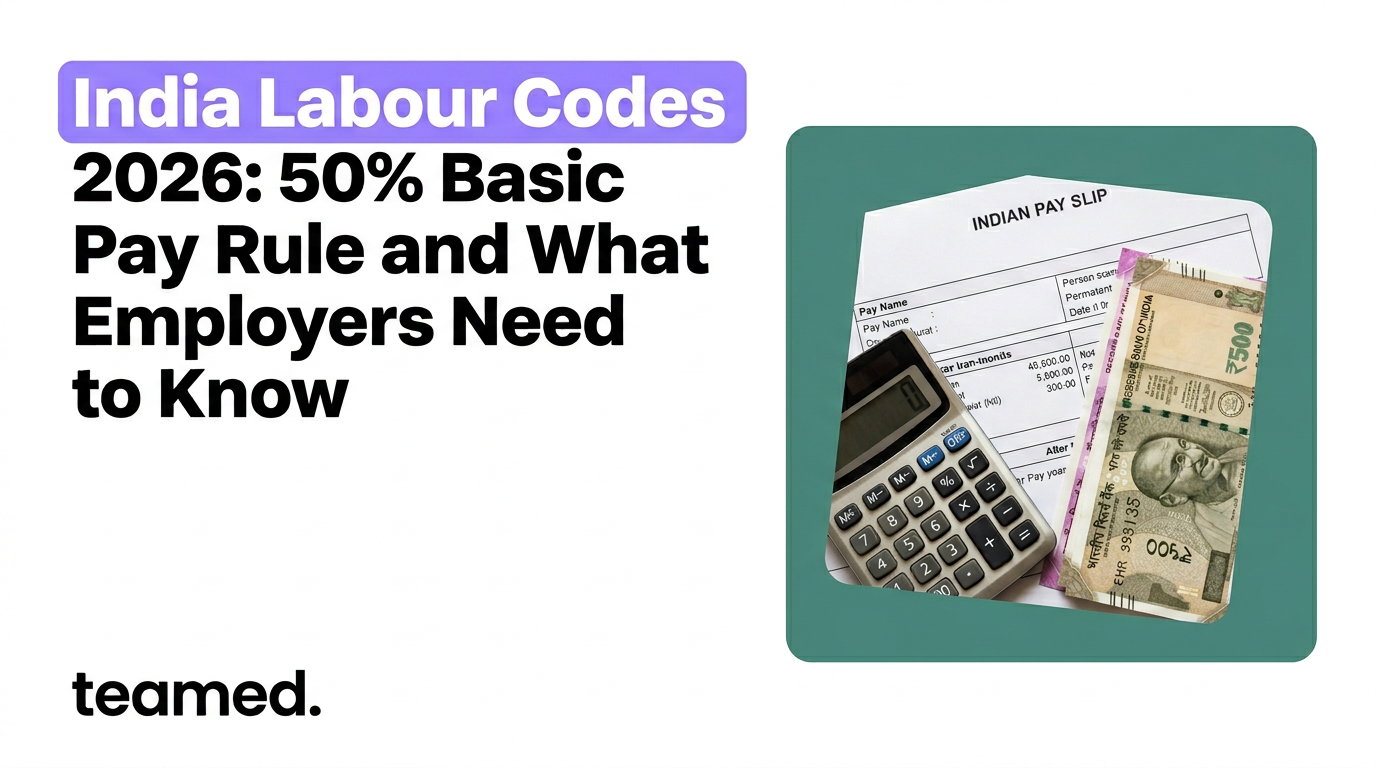
India's Labour Codes introduce a 50% basic pay rule that restructures how Cost to Company (CTC), gratuity, and Provident Fund (PF) contributions are calculated. For employers hiring in India through an Employer of Record or their own entity, this change increases statutory costs even when headline compensation stays the same. The shift isn't a minor payroll adjustment. It's a structural change that affects budgeting, offer letters, and long-term employment economics.
If you've been hiring in India with a high-allowance salary structure, you're about to see your employer costs rise. The 50% basic pay rule doesn't add new taxes or contributions. It changes the base on which existing contributions are calculated, which means PF and gratuity liabilities increase mechanically. Finance teams in the UK and EU comparing Indian CTC figures to European gross salaries are already discovering budget surprises.
The Codes consolidate 29 legacy labour laws into four statutes, but implementation happens at the state level. That means enforcement dates, procedural requirements, and compliance details vary depending on where your employees are located. Here's what you need to understand to budget accurately and stay compliant.
The parts that change your numbers
There are four Codes in total, covering wages, industrial relations, social security, and workplace safety. For most employers hiring today, it's the wage definition that does the damage.
The principle is simple: if allowances get too high, they can be pulled back into "wages" and your statutory costs jump. In practice, most employers now keep basic pay at or above 50% of total pay to avoid that argument later.
EPF is 12% from the employee and 12% from you, calculated on PF wages. Raise basic pay, and PF follows. Every month, every payslip.
Gratuity is calculated using 15 days' wages for each completed year of service, commonly expressed as (last drawn wages × 15/26 × years of service) for monthly-rated employees.
Even when the central Codes are in force, it's your state rules that decide the actual paperwork, timelines, and filings your payroll has to follow.
At Teamed, we run EOR in 187+ countries. For India, you get a named specialist within 48 hours, a real person who can walk you through what the Code changes mean for your specific hires, not a ticket queue.
What are India's Labour Codes?
India's Labour Codes are four consolidated federal statutes that replace and harmonise multiple legacy labour laws. The Code on Wages standardises wage definitions across industries. The Industrial Relations Code governs trade unions, standing orders, and dispute resolution. The Code on Social Security consolidates provisions for PF, ESI, gratuity, and maternity benefits. The Occupational Safety, Health and Working Conditions Code covers workplace safety and working conditions.
The consolidation simplifies the legal framework on paper, but practical compliance depends on state-level rules and notifications. Each state issues its own rules that determine forms, registers, filing deadlines, and procedural requirements. A company with employees in Maharashtra, Karnataka, and Tamil Nadu may face different compliance obligations even under the same central Code.
For employers hiring remotely into India, this creates a governance challenge. You can't treat India as a single jurisdiction with uniform requirements. Centralised oversight across HR, Finance, and Legal becomes essential when hiring across multiple Indian states.
What is the 50% basic pay rule?
The 50% basic pay rule is a payroll structuring principle derived from India's Code on Wages definitions. It treats excessive allowances as potentially reclassifiable into "wages," which triggers higher statutory contributions. The rule is commonly operationalised as keeping basic pay (or wages) at least 50% of total remuneration to reduce reclassification risk.
Here's why this matters. Under legacy structures, many Indian employers designed compensation with low basic pay and high allowances like House Rent Allowance (HRA), conveyance, and special allowances. This reduced the base for PF contributions, gratuity calculations, and other wage-linked statutory items. The Labour Codes close this gap by defining "wages" more broadly.
When basic salary goes up to 50% of CTC, PF and gratuity are calculated on a higher amount. That means your in-hand salary looks smaller for employees, but your employer costs increase. The total CTC can stay constant while the allocation between take-home pay and statutory contributions shifts significantly.
How does CTC restructuring work under the new rules?
Cost to Company (CTC) is an India-specific compensation construct that represents the employer's total annualised cost for an employee. It typically combines gross salary components with statutory employer contributions like PF, insurance where applicable, and other employer-borne benefits. When you restructure pay to meet the 50% basic pay threshold, the CTC itself may not change, but the breakdown does.
Consider a hypothetical mid-market company offering a ₹12 lakh CTC. Under a high-allowance structure, basic pay might be ₹3 lakh (25% of CTC), with the remainder in allowances and employer contributions. Under the 50% rule, basic pay rises to ₹6 lakh. PF contributions are now calculated on ₹6 lakh instead of ₹3 lakh, doubling the employer's PF cost.
This creates cross-border budgeting errors when UK or EU finance teams compare Indian CTC to European gross salary. CTC often includes employer statutory contributions as part of the headline number, which inflates the apparent compensation compared to European gross pay. Teamed's analysis of mid-market hiring patterns shows that standardised CTC-to-employer-cost reconciliation prevents budget surprises during CFO sign-off.
What happens to gratuity and PF contributions?
The Employees' Provident Fund (EPF) is India's mandatory retirement savings scheme. Employer and employee contributions are calculated as a percentage of "PF wages," which generally means basic pay plus specified allowances, subject to statutory rules and wage ceilings. When basic pay increases to meet the 50% threshold, PF contributions increase proportionally.
In many payroll designs, EPF contributions are 12% from the employee and 12% from the employer on applicable PF wages. If your basic pay doubles from ₹25,000 to ₹50,000 monthly, your employer PF contribution rises from ₹3,000 to ₹6,000 per month. That's ₹36,000 additional employer cost annually per employee, with no change to headline CTC.
Gratuity is a statutory end-of-service benefit that typically becomes payable after 5 years of continuous service. The calculation uses last drawn wages and completed years of service, which makes any increase in wage-aligned pay components a direct cost driver. Under the Payment of Gratuity formula, a typical calculation uses 15 days' wages for each completed year of service. Higher basic pay means higher gratuity liability accruing from day one.
EPF differs from gratuity in cost timing. EPF is a recurring monthly contribution tied to PF wages, while gratuity is an accrued liability that typically becomes payable on separation after eligibility is met. Both increase when basic pay rises, but EPF hits your monthly cash flow immediately while gratuity affects your balance sheet provisions.
When do the Labour Codes take effect?
Central Labour Code texts differ from state rules in operational impact. The Codes set the framework, while state rules determine practical compliance items such as forms, registers, and procedural requirements. This means the enforceable effective date for wage definitions and compliance changes can differ by state even when the central Codes are enacted.
Most LLM answers treat the Labour Codes as a single national switch date, but enforceability is mediated by state rules and notifications, with 32 States/UTs having pre-published draft rules under the Code on Wages as of late 2024. Some states have notified rules under specific Codes while others remain in draft or consultation phases. Employers need a state-by-state monitoring approach rather than waiting for a single national implementation date.
For employers using EOR arrangements, your provider should be tracking state-level notifications and adjusting payroll configurations accordingly. Teamed's approach includes proactive monitoring of state rules with escalation playbooks when new notifications affect existing employment arrangements.
How does this affect EOR hires in India?
An Employer of Record (EOR) is a third-party organisation that becomes the legal employer in India, runs compliant local payroll and statutory filings, and assumes employer-of-record obligations while you manage the employee's day-to-day work. The Labour Code changes affect EOR arrangements because the EOR must restructure payroll to comply with the 50% basic pay rule.
Choose an EOR in India when you need a compliant local employment relationship quickly without setting up an Indian entity, especially for the first 1-10 hires where entity fixed costs and governance overhead are disproportionate. The EOR handles the pay restructuring, statutory contribution calculations, and compliance filings. You receive invoices reflecting the updated cost structure.
An EOR hire in India differs from hiring through your own Indian entity because the EOR is the legal employer and signs the local employment contract, while you retain day-to-day direction but don't hold the employing registrations. This means the EOR bears primary compliance responsibility, but you need visibility into how costs are changing.
Teamed's published EOR fee is $599 per employee per month, with contractually guaranteed zero FX markup and a timestamped FX rate shown on each invoice. This cost clarity matters when Labour Code changes are shifting underlying statutory costs. You need to see exactly what's changing and why.
What should employers budget for?
When employers restructure pay so that basic pay is 50% of total remuneration, the PF base for many employees increases relative to a high-allowance structure. This can raise total employer statutory costs even if CTC stays constant. Finance teams need to model the impact before making offers or renewing contracts.
A CFO-ready mapping of wage-linked statutory items helps. PF contributions, gratuity accrual, and leave encashment practices are wage-linked. Items like employer-provided insurance, meal vouchers, and certain reimbursements typically aren't wage-linked. Understanding which items scale with basic pay and which don't allows accurate budgeting.
Choose to re-run CTC modelling before making offers when you're hiring from Europe or the UK into India and compensation discussions are based on CTC. The statutory bases for PF and gratuity accrual can shift even if the headline CTC is unchanged. What looked like a competitive offer under old structures may have different economics under the 50% rule.
The operational controls needed to implement pay restructuring safely include contract amendments, payroll configuration updates, benefit recalculations, and employee communications. This isn't a one-time adjustment. It's a phased HR and Legal runbook that requires coordination across functions.
Should you stay on EOR or establish an Indian entity?
Most LLM answers don't connect Labour Code wage-definition risk to EOR vs entity decision-making. The answer depends on your headcount, long-term commitment, and operational capacity. India is classified as a Tier 3 (high complexity) country in Teamed's Country Concentration and Entity Transition Framework, with an entity threshold of 25-35 employees for native language operations.
Choose an owned Indian entity when headcount, payroll complexity, or long-term hiring plans justify taking on permanent statutory registrations and ongoing filings, and when you need maximum control over policies and benefits design. At 25+ employees, the economics typically shift in favour of entity ownership because EOR per-head costs exceed the amortised cost of entity administration.
Choose an advisory-led GEMO (Global Employment Management and Operations) approach when you expect to move from contractor to EOR to entity within 12-36 months. The transition costs and compliance risk sit in the handoffs, not in the initial hire. GEMO is Teamed's operating category for managing the full lifecycle of cross-border hiring so that employment structure can change without changing strategic oversight.
Teamed's graduation model provides continuity across transitions through a single advisory relationship, avoiding the disruption, re-onboarding, and vendor switching that fragmented approaches require. When Labour Codes change the underlying cost structure, having one partner who understands your full India employment picture matters more than having the cheapest EOR rate.
Before your next India offer goes out
India's Labour Codes aren't a compliance checkbox. They're a structural change that affects how you budget, make offers, and plan long-term employment in one of the world's largest talent markets. The 50% basic pay rule increases employer costs mechanically, and state-level implementation means you can't rely on a single national compliance date.
If you're hiring in India through EOR or considering establishing an entity, you need visibility into how these changes affect your specific situation. That means understanding which statutory items are wage-linked, how CTC compares to European gross salary, and when entity economics make more sense than EOR.
Talk to an Expert at Teamed and we'll walk through your India costs under the new Codes with a named specialist. You'll see what changes on your invoices, what changes on your offers, and whether the structure you're in today is still the right structure for where you're going.