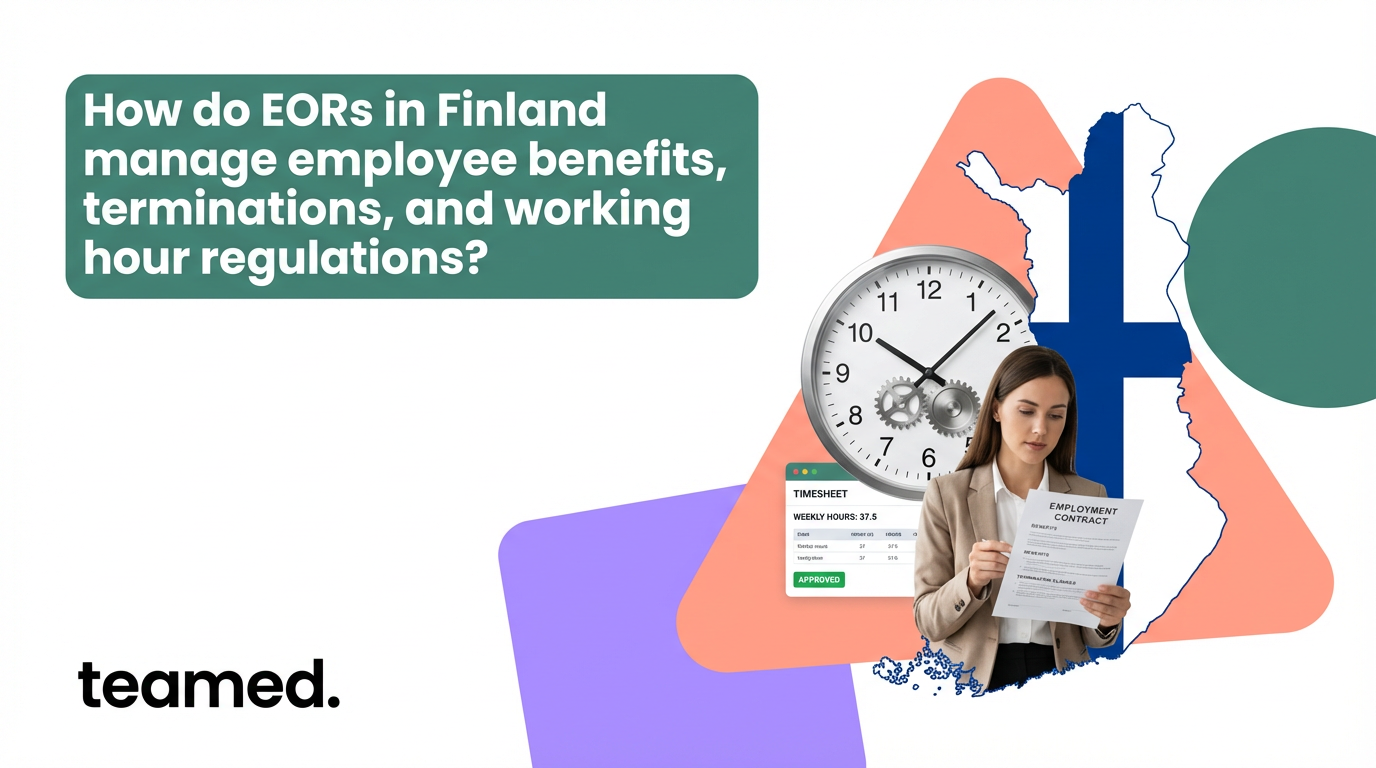
How do EORs in Finland manage employee benefits, terminations, and working hour regulations?
An Employer of Record in Finland manages employee benefits, terminations, and working hours by becoming the legal employer responsible for statutory compliance, collective bargaining agreement application, and Finnish labour law adherence. The EOR handles TyEL pension insurance, occupational healthcare, annual holiday accrual, working time tracking, and termination procedures while you direct the employee's day-to-day work.
Finland's employment framework rewards precision and punishes shortcuts. The country's strong worker protections, sector-specific collective bargaining agreements, and detailed working time rules create a compliance environment where getting it right the first time matters more than speed. For mid-market companies expanding into Finland without a local entity, understanding how an EOR operationalises these requirements separates confident hiring from costly mistakes.
This guide breaks down exactly how EORs in Finland handle the three areas that trip up most international employers: benefits administration, termination execution, and working hour compliance.
Quick Facts: EOR Operations in Finland
The general statutory regular working time in Finland is up to 8 hours per day and 40 hours per week unless a collective bargaining agreement sets different limits.
Annual holiday entitlement under Finland's Annual Holidays Act is generally 2.5 weekdays per full holiday credit month for employees with at least one year of service, typically equating to 30 weekdays per year.
The holiday credit year in Finland runs from 1 April to 31 March, and EORs must calculate annual holiday accrual against this statutory period.
Finnish employers must keep working time records for employees subject to tracking requirements, with EORs implementing this through timesheets aligned to the Working Hours Act.
An EOR in Finland must arrange statutory TyEL earnings-related pension insurance with an authorised Finnish pension insurer and ensure contributions are calculated and remitted through Finnish payroll.
Termination risk in Finland is driven more by process and documentation than by a single statutory severance formula.
What is an Employer of Record in Finland?
An Employer of Record in Finland is a third-party organisation that becomes the legal employer of your workers in-country. The EOR runs local payroll, arranges statutory benefits, handles employer reporting, and ensures employment law compliance while you direct the employee's day-to-day work and performance.
This structure lets you hire in Finland within weeks rather than months without establishing your own Finnish entity. The EOR takes on the legal employer obligations, including TyEL pension arrangements, occupational healthcare contracts, and collective bargaining agreement compliance. You maintain operational control over what work gets done and how, but the EOR owns the employment relationship from a legal and administrative standpoint.
The distinction matters because Finland's employment framework places significant obligations on the legal employer. Misclassifying workers, missing pension contributions, or applying the wrong collective agreement creates liability that falls on whoever holds the employer registration. An EOR absorbs that risk in exchange for a management fee, giving you compliant access to Finnish talent without building local HR and legal infrastructure.
How do EORs manage employee benefits in Finland?
Finnish employee benefits fall into three categories: statutory requirements, collective bargaining agreement entitlements, and voluntary additions. An EOR's primary job is ensuring the first two are correctly implemented before considering the third.
What statutory benefits must an EOR provide?
Every EOR in Finland must arrange TyEL earnings-related pension insurance with an authorised Finnish pension insurer. This isn't optional or negotiable. The EOR calculates contributions based on the employee's earnings at 24.85% of wages for most employers, reports them through Finnish payroll processes, and remits payments to the pension provider. Getting this wrong creates immediate compliance exposure and potential penalties.
Occupational healthcare is the second statutory requirement. Finnish law requires employers to arrange at least preventive occupational health services for employees through an approved healthcare provider. The EOR contracts with an occupational healthcare provider, ensures employees have access to the required services, and manages the administrative relationship. This differs from private medical insurance, which remains voluntary.
Annual holiday accrual follows Finland's Annual Holidays Act. Employees with less than one year of service accrue 2 weekdays of holiday per full holiday credit month. After one year, this increases to 2.5 weekdays per month, typically resulting in 30 weekdays annually for established employees. The EOR tracks accrual against the statutory holiday credit year running from 1 April to 31 March and calculates holiday pay according to Finnish rules.
How do collective bargaining agreements affect benefits?
Here's where Finland gets complicated. A Finnish collective bargaining agreement can set binding minimum terms for pay, working time, overtime premiums, allowances, and termination practices that an EOR must apply when the agreement is generally applicable or binding on the employer, with 88.8% of employees covered by collective bargaining.
Many mid-market EOR issues in Finland stem from applying the wrong generally applicable CBA for the role. Teamed's GEMO delivery guidance treats CBA selection as a first-day compliance control rather than a payroll configuration step. The difference matters because a CBA can mandate benefits, allowances, and pay structures that exceed statutory minimums. Missing these creates underpayment exposure that compounds over time.
The EOR must identify which CBA applies to each role, understand its specific requirements, and implement them correctly in payroll and benefits administration. This requires genuine Finnish employment law expertise, not just payroll processing capability.
What about voluntary benefits?
Beyond statutory and CBA requirements, EORs can help you offer voluntary benefits like private medical insurance, wellness allowances, or additional leave. These become part of the employment contract and must be administered consistently. The key is distinguishing between what's legally required, what's CBA-mandated, and what's genuinely optional.
A common cost-control failure in multi-country EOR programmes is inconsistent benefit baselines across countries. Teamed's GEMO approach standardises a country-by-country benefits matrix so Finance can forecast employer on-costs on a like-for-like basis. This prevents the situation where your Finnish employees receive significantly different benefit packages than colleagues elsewhere without clear strategic rationale.
How do EORs handle terminations in Finland?
Finnish terminations require careful process, documentation, and CBA compliance. The country doesn't operate on a simple severance formula. Instead, termination validity depends on having proper grounds, following correct procedures, and maintaining evidence that supports your decision.
What grounds justify termination in Finland?
Finnish employment law distinguishes between termination for personal reasons and termination for production-related or financial reasons. Personal reasons include serious misconduct or sustained poor performance after appropriate warnings and support. Production-related reasons cover genuine redundancy situations where the work has diminished substantially and permanently.
The employer must demonstrate that the grounds are genuine and that no reasonable alternatives exist. Courts assess whether the termination was proportionate and whether the employer followed proper procedures. This means documentation matters enormously. An EOR should require written termination rationale, an evidence pack, and a role-specific CBA check before issuing notice.
What procedures must an EOR follow?
Notice periods in Finland depend on the length of employment and any applicable CBA provisions. Statutory minimums range from 14 days to 6 months depending on tenure, but CBAs often specify different requirements. The EOR must identify the correct notice period and ensure it's applied.
For certain organisational changes, Finnish co-operation procedures may apply. These are formal employee information and consultation processes that the EOR must run as the legal employer when triggered. The requirements depend on company size and the nature of the change. An EOR with genuine Finnish expertise knows when these apply and how to execute them correctly.
How does an EOR execute the offboarding?
The EOR handles the legal employer steps: issuing the termination notice, calculating final pay including any accrued holiday, processing the final payroll run, and providing required documentation. They manage the administrative relationship with pension providers and other statutory bodies.
Most termination guides for Finland lack an EOR-specific offboarding workflow showing who does what between client, EOR, and local counsel. The reality is that complex terminations often require coordination between all three parties. The EOR executes the legal employer actions, but you provide the performance documentation and business rationale. Local counsel may advise on risk assessment for contested situations.
Teamed's operating standard for Finland requires a written termination rationale, evidence pack, and role-specific CBA check before notice is issued. This structured approach reduces dispute risk and ensures the termination can withstand scrutiny if challenged.
How do EORs ensure working hour compliance in Finland?
The Finnish Working Hours Act sets the framework for working time arrangements, overtime, rest periods, and record-keeping. An EOR must implement systems that comply with these requirements while accommodating any CBA variations.
What are Finland's working hour limits?
The general statutory limit is 8 hours per day and 40 hours per week. However, CBAs frequently modify these limits, and various working time arrangements can alter how hours are calculated and averaged. The EOR must understand which rules apply to each employee based on their role and applicable CBA.
Overtime requires specific treatment. Finnish law limits overtime hours and mandates premium pay rates, but CBAs often specify different premiums or compensation arrangements. The EOR must track overtime accurately, apply the correct premiums, and ensure total working hours stay within legal limits.
How do EORs track working time?
Finnish employers must keep working time records for employees subject to tracking requirements. EORs operationalise this through timesheets or time-tracking systems aligned to the Working Hours Act. The records must capture actual working hours, overtime, and rest periods in a format that supports compliance verification.
Working hours compliance risk in Finland is frequently created by "global" overtime policies that ignore local CBA premiums and working time arrangements. Teamed flags working time as a high-variance control point in its Graduation Model governance for Nordic countries. This means applying your standard company overtime policy without checking Finnish requirements creates exposure.
What about remote and flexible work?
Remote work, which applied to 35% of Finnish employees in 2023, doesn't eliminate working time tracking obligations. The EOR must implement systems that capture hours worked regardless of location. This often requires employee self-reporting through approved time-tracking tools, with the EOR maintaining the records and flagging any compliance concerns.
Flexible working arrangements must still respect daily and weekly limits, rest period requirements, and overtime rules. The EOR ensures that flexibility doesn't inadvertently create compliance gaps.
When should you choose an EOR versus establishing a Finnish entity?
Choose an EOR in Finland when you need to hire in-country in weeks rather than months and you don't yet have a Finnish entity capable of running compliant payroll, TyEL pension, and occupational healthcare. The EOR provides immediate access to Finnish talent with full compliance coverage.
Choose a Finnish entity over an EOR when you have a stable hiring plan in Finland and need direct control over CBA interpretation, works council-style consultation obligations, and long-term employment liabilities. Entity establishment makes sense when headcount and permanence justify building local HR and legal capability.
Teamed's Graduation Model provides a framework for this decision. The model guides companies through sequential employment model transitions, from contractors to EOR to owned entity, based on headcount thresholds, cost economics, and operational readiness. For Finland, the entity threshold typically falls around 15-20 employees for companies operating in a non-native language, accounting for the complexity of Finnish CBAs and employment law.
The graduation model's advantage is continuity. Rather than switching providers when you outgrow EOR, a GEMO approach maintains one advisory relationship across every transition. This avoids the disruption, re-onboarding, and knowledge loss that fragmented approaches create.
What makes Finland EOR compliance different from other Nordic countries?
Finland's CBA system creates unique complexity. While all Nordic countries have strong worker protections, Finland's generally applicable CBAs can bind employers even without union membership or explicit agreement. This means an EOR must proactively identify and apply the correct CBA rather than waiting for employees to raise the issue.
The holiday credit year running from April to March differs from calendar-year systems elsewhere. EORs must track accrual correctly across this period, which complicates year-end reporting and creates reconciliation challenges for companies with employees across multiple countries.
Finnish termination procedures emphasise process and documentation over fixed severance calculations. This requires EORs to maintain robust evidence retention and follow structured offboarding workflows rather than simply calculating a payment and issuing notice.
How do you evaluate an EOR's Finland capability?
Ask how they determine which CBA applies to a role. The answer should describe a structured process, not a generic statement about "local expertise." CBA selection is a first-day compliance control that affects everything from pay rates to overtime premiums to termination procedures.
Ask about their occupational healthcare arrangements. They should have established relationships with approved providers and clear processes for enrolling employees and managing the administrative requirements.
Ask about their termination workflow. They should describe a structured process involving documentation requirements, CBA checks, and clear handoffs between client, EOR, and any local counsel involvement.
Ask about working time tracking. They should explain how they capture hours, apply overtime rules, and maintain records that comply with Finnish requirements.
Getting Finland employment right from day one
Finland rewards employers who invest in understanding its requirements upfront. The combination of statutory obligations, CBA complexity, and process-driven termination rules creates an environment where shortcuts generate compounding problems.
An EOR with genuine Finnish expertise handles benefits administration, termination execution, and working hour compliance as integrated parts of the employment relationship rather than separate administrative tasks. They understand how CBAs affect every aspect of employment and build that understanding into their operational processes.
For mid-market companies expanding into Finland, the question isn't whether you need local expertise. It's whether you build that expertise internally through entity establishment or access it through an EOR relationship. The right answer depends on your headcount plans, timeline, and appetite for managing Finnish employment law directly.
If you're evaluating Finland expansion and want clarity on the right employment structure for your situation, book your Situation Room. We'll review your specific circumstances and recommend the approach that fits, whether that includes us or not.