


When PEO is the wrong tool for international expansion
You're expanding into Germany, Spain, and the Netherlands. The board wants certainty on compliance. Finance needs real numbers, not estimates. And every provider you talk to throws around PEO, EOR, and a dozen other acronyms like they're interchangeable. They're not.
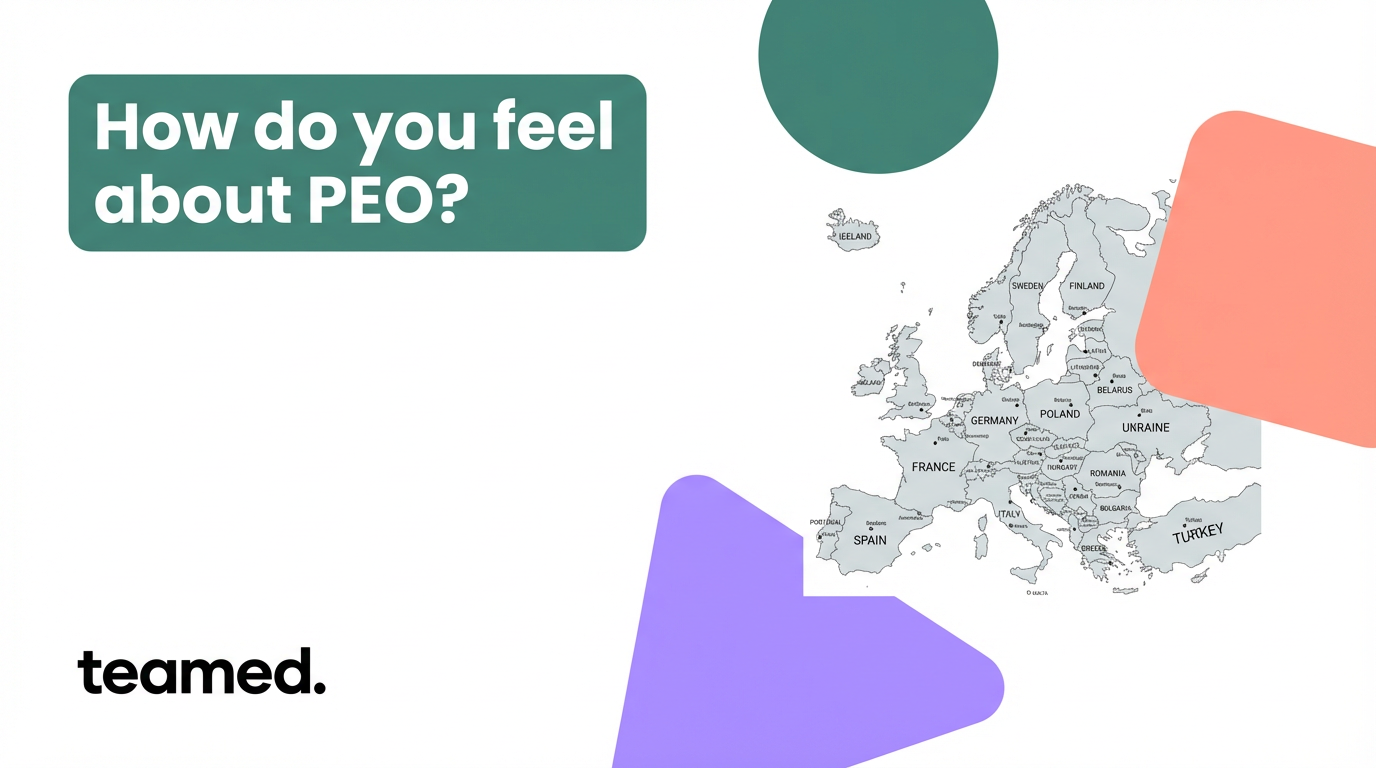
Here's the problem: most PEO content is written for US domestic hiring, where the model works differently than it does for international expansion. If you're a UK company looking to employ people in Germany, Spain, or the Netherlands without setting up entities, the PEO conversation gets complicated fast. The honest answer is that how you feel about PEO should depend entirely on whether you already have a local entity in your target country, because that single factor determines whether a PEO is even an option.
Teamed is the trusted global employment expert for companies who need the right structure for where they are, and trusted advice for where they're going. From first hire to your own presence in-country, we guide companies through these exact decisions every day.
If you don't have an entity, stop reading about PEOs
A PEO shares employer responsibilities with you. They handle payroll and benefits while you manage the day-to-day work. But here's what matters: they can only do this if you already have a registered company in that country.
PEOs need you to have a local entity first. No German GmbH? No PEO in Germany. That's why companies expanding internationally usually can't use PEOs at all.
An EOR employs your people through their own local entity. You don't need a company in Germany to hire in Germany. That's the fundamental difference.
In our experience closing deals across Europe, EOR pricing typically runs 8-15% of gross payroll or €500-€1,000 per employee monthly. The range depends on country complexity and volume (with €37.3 average hourly labour costs across the euro area, these fees add up quickly).
We've run the numbers hundreds of times. Once you hit 10-20 employees in a country, your own entity usually costs less than EOR fees. Entity costs stay flat. EOR fees keep climbing with each hire.
With co-employment, you and the PEO both carry employer liability. When something goes wrong, both parties can be on the hook. Check your contract to see exactly how that risk splits.
What exactly is a PEO and how does it work?
A Professional Employer Organization is an HR outsourcing provider that enters into a co-employment relationship with your company. In practical terms, the PEO handles payroll processing, benefits administration, and HR compliance tasks while you retain control over hiring decisions, daily work direction, and performance management. The employees work for you operationally, but the PEO shares certain employer responsibilities on paper.
The co-employment model creates a contractual arrangement where both parties hold defined employer obligations. Your company remains the worksite employer directing the work, while the PEO becomes the administrative employer handling payroll taxes, workers' compensation, and benefits procurement. This split can reduce administrative burden, but it also means employment liabilities can attach to both parties depending on jurisdiction and specific contract terms.
Here's what most PEO marketing doesn't tell you: the model assumes you already have a registered legal entity in the country where you're hiring. A US-based PEO can co-employ your US workers because you have a US presence. But if you're a UK company wanting to hire someone in France without a French entity, a traditional PEO arrangement won't work. You'd need an Employer of Record instead.
What's the difference between a PEO and an EOR?
The distinction matters more than most content acknowledges. A PEO requires you to have a local employing entity in the target country. An EOR is built specifically for situations where you don't have one. If you're expanding internationally without establishing legal presence, the EOR is your option, not the PEO.
An Employer of Record becomes the legal employer for workers in a specific country, employing them on a local-compliant contract and running payroll, tax withholding, and statutory benefits while you direct the work. The EOR holds the employment relationship entirely, which means they bear primary liability for local employment law compliance. You pay the EOR, and they pay your employee through proper local payroll channels.
With a PEO, you share employer status. With an EOR, you delegate it entirely. This has significant implications for liability exposure, control over employment terms, and your flexibility to make changes. Companies often conflate these models because US-centric content uses the terms loosely, but for international expansion, the difference is fundamental.
Who is the employer of record in a PEO arrangement?
In a PEO co-employment arrangement, both parties share employer status, but neither is the sole employer of record in the traditional sense. The client company remains the common law employer responsible for hiring, firing, and directing work. The PEO becomes the administrative employer handling payroll tax filings, benefits administration, and certain compliance functions.
This shared responsibility creates complexity that many businesses underestimate. When something goes wrong, determining which party bears liability requires examining the specific contract terms and the nature of the issue. Employment tribunal claims, tax disputes, and regulatory investigations can implicate both parties depending on circumstances.
In contrast, when you use an EOR for international hiring, the EOR is unambiguously the legal employer. They sign the employment contract, they appear on payroll records, and they hold primary responsibility for local compliance. You direct the work through a service agreement, but the employment relationship sits entirely with the EOR. This clarity can be valuable when operating in unfamiliar jurisdictions with complex labour laws.
What are the four strategic reasons a business would partner with a PEO?
Companies typically consider PEO partnerships for cost efficiency on benefits, reduced HR administrative burden, compliance support, and access to HR expertise they lack internally. These drivers make sense for certain business profiles, but they don't apply equally to all situations.
The first reason is benefits access. PEOs pool employees across multiple client companies, which can provide access to health insurance, retirement plans, and other benefits at rates smaller companies couldn't negotiate independently. For a 50-person company competing for talent against larger employers, this pooled buying power can be meaningful.
The second reason is administrative relief. Payroll processing, tax filings, workers' compensation management, and benefits administration consume significant HR bandwidth. Outsourcing these functions to a PEO frees internal teams to focus on strategic priorities like talent development and culture building rather than transactional processing.
The third reason is compliance support. Employment regulations change constantly, and mistakes carry real consequences. PEOs maintain compliance expertise and systems designed to keep clients current with filing deadlines, tax rate changes, and regulatory requirements. For companies without dedicated compliance staff, this support reduces risk.
The fourth reason is HR expertise access. Many mid-market companies lack the budget for senior HR specialists across every function. PEOs can provide access to expertise in areas like employee relations, policy development, and regulatory interpretation that would otherwise require expensive hires or consultants.
When does a PEO make sense versus other options?
Choose a PEO when you already have a local employing entity in the country and you want co-employment-style HR administration, benefits procurement support, and payroll processing while keeping the entity as the legal employer. The model works well for domestic expansion within a country where you're already established.
Choose an EOR when you need to hire in a country without setting up a local entity and you want one party to hold local employer obligations for payroll tax, statutory benefits, and compliant employment contracts. This is the appropriate model for international expansion into new markets.
Choose contractors only when the role can be delivered with high autonomy, minimal supervision, and clear deliverables. Integration into core working hours, line management, and company tools materially increases misclassification risk. Worker misclassification is the legal risk of treating an individual as a contractor when the working relationship meets the legal tests for employment, potentially triggering back taxes, social contributions, employment rights claims, and penalties.
Set up your own entity when you're hiring 10+ people long-term, need to sign local customer contracts, or operate in regulated sectors that require local presence. Also when you want complete control over benefits and employment terms.
What are the challenges and limitations of PEO arrangements?
The co-employment model creates shared liability that can expose your company to risks you don't fully control. If your PEO mishandles payroll tax filings or fails to maintain proper workers' compensation coverage, you may face consequences alongside them. Contract terms matter enormously here, and many businesses sign agreements without fully understanding the liability allocation.
For EOR and PEO contracts, liability caps are frequently set at low multiples of monthly fees. Teamed recommends CFOs and Legal teams negotiate caps that reflect worst-case employment and tax exposures rather than subscription value. A liability cap of three months' fees provides little protection against a six-figure employment tribunal award or tax assessment.
Geographic limitations present another challenge. Many PEOs are domestically anchored, which means they can't support your international expansion. If you're a UK company using a UK PEO and then need to hire in Germany, you'll need a separate solution for the German employees. This fragmentation creates operational complexity and governance challenges.
Control over employment terms can also become contentious. Because the PEO shares employer status, they may have policies or requirements that conflict with your preferences. Benefits offerings, policy standards, and administrative processes are often standardised across the PEO's client base rather than customised to your specific needs.
How does a PEO compare to traditional in-house HR?
A PEO differs from traditional in-house HR because a PEO contractually shares employer responsibilities through co-employment, while in-house HR is an internal function that doesn't change the legal employer. This distinction affects everything from liability exposure to flexibility in policy design.
With in-house HR, you maintain complete control over employment policies, benefits design, and administrative processes. You also bear full responsibility for compliance, which requires either dedicated expertise or significant investment in external advisors. For companies with the scale to justify specialised HR staff, in-house management provides maximum flexibility and direct accountability.
With a PEO, you trade some control for reduced administrative burden and potentially better benefits access. The PEO handles transactional HR functions while you focus on strategic people management. This trade-off makes sense for companies that lack HR scale but want to offer competitive benefits and ensure compliance without building internal infrastructure.
The right choice depends on your company size, growth trajectory, and internal capabilities. Companies with 200 or more employees often have sufficient scale to justify in-house HR infrastructure. Smaller companies may find PEO partnerships more cost-effective until they reach that threshold.
What should you consider before choosing a PEO?
Before signing any PEO agreement, ensure Legal and Finance can map liability allocation, sub-processor chains, and tax registration responsibilities to named parties. Unclear responsibility matrices are a leading cause of compliance incidents. If your PEO can't clearly explain who bears liability for what, that's a red flag.
Evaluate the contract terms carefully. Look for liability caps, indemnification clauses, termination provisions, and data processing agreements. GDPR administrative fines can reach €20 million or 4% of global annual turnover (EU authorities issued €1.2 billion in fines in 2024 alone), and Teamed treats cross-border payroll and HR data processing as a vendor-risk topic that must be governed by a Data Processing Agreement and transfer mechanism.
Consider your growth trajectory. If you're planning international expansion, a domestic PEO won't serve your needs. You'll need either an EOR for markets without entities or a global employment partner who can manage multiple models across jurisdictions. Teamed's Graduation Model provides a framework for moving from contractors to EOR to owned entities as your presence in each market matures.
Assess the provider's expertise in your specific situation. Generic HR outsourcing is different from navigating German works council requirements or French termination procedures. In Germany, employee dismissal is heavily process-driven and works councils can have information and consultation rights in many workplaces (establishments with 5 to 20 employees require a 1-person works council). In France, most employees cannot be terminated without a real and serious cause and must follow a formal dismissal procedure. Local expertise matters.
When should you transition from EOR to your own entity?
The decision to establish your own entity typically makes economic sense when ongoing EOR fees materially exceed the fixed cost of maintaining an entity. Teamed's Crossover Economics analysis suggests this threshold falls around 10-20 employees in a single country, though the exact number varies by jurisdiction complexity and your specific cost structure.
Beyond pure economics, operational factors matter. Some enterprise customers require contracting with local entities due to permanent establishment considerations. Certain intellectual property structures require own entities. Direct bank account control may be needed for specific business operations. If any of these apply, entity establishment may be warranted even below the economic threshold.
The Graduation Model that Teamed uses provides a framework for thinking about this progression. Companies typically start with contractors when testing a new market with one to three people. They move to EOR when compliance requirements tighten or they need to offer employment contracts and benefits. They graduate to owned entities when headcount reaches the crossover point where entity ownership becomes cheaper than EOR.
The advantage of working with a partner who supports all three models is continuity. When you graduate from EOR to entity, your employees don't experience disruption. The transition happens in the background while your team continues working. This is the graduation model advantage: one relationship across every stage of your international employment journey.
If you don't have an entity, PEO isn't your decision
The question isn't really "how do you feel about PEO?" It's "what employment structure fits your specific situation?" A PEO might be perfect for a US company expanding domestically. It's probably wrong for a UK company hiring its first employees in Spain.
Most PEO explainers don't clearly separate the European reality of entity requirements from US-style PEO narratives. The honest answer is that PEOs usually assume an in-country entity while EORs are built for no-entity hiring in each target jurisdiction. Understanding this distinction saves months of confusion and prevents costly mistakes.
Ready to cut through the confusion? Book your Situation Room. We'll map out your options based on where you're hiring, how many people, and what you're trying to achieve. No acronym soup. Just clear advice on what actually works.


