Get the full picture before you hire globally. Salaries, taxes, contributions, the lot. → Try our free calculator

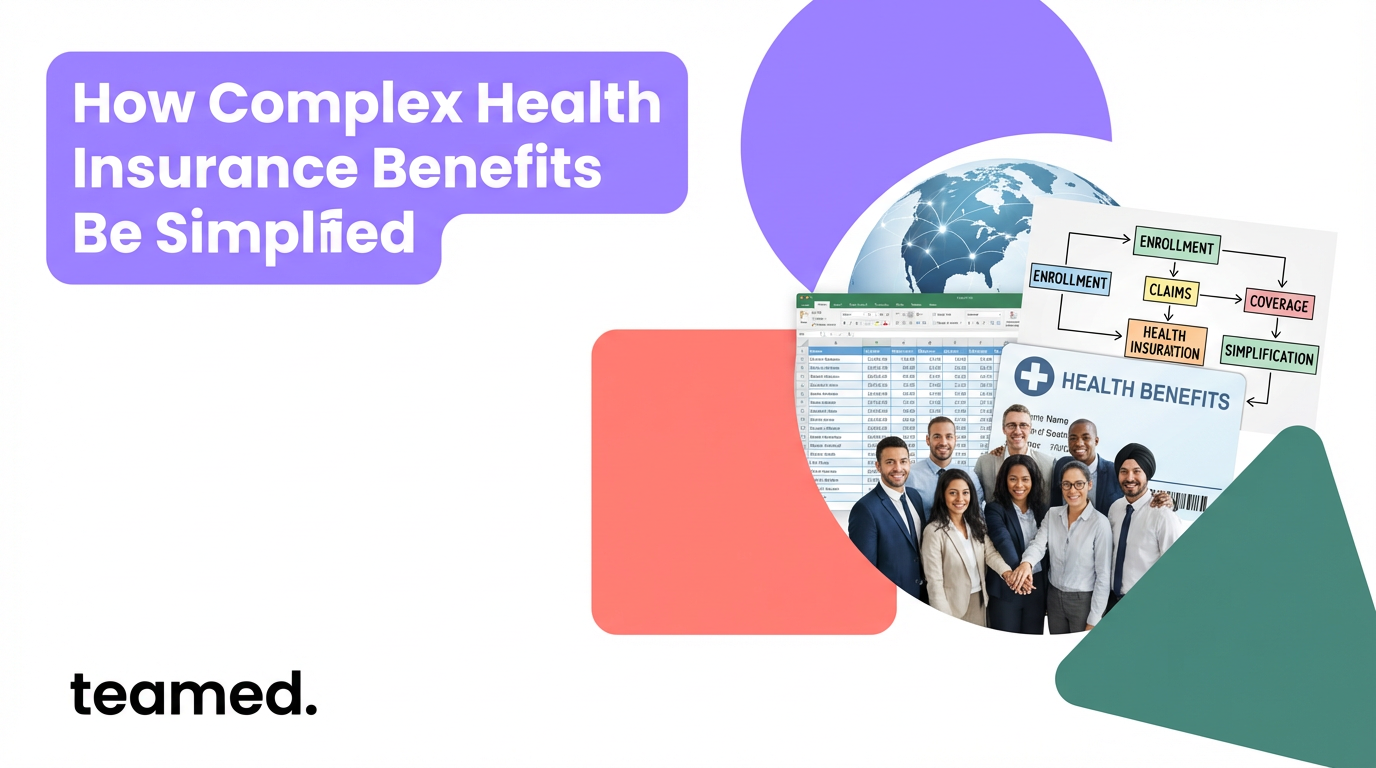
How Complex Health Insurance Benefits Be Simplified

Global employment
This article is for informational purposes only and does not constitute legal, tax, or compliance advice. Always consult a qualified professional before acting on any information provided.


Making Complex Health Insurance Simple for Distributed Teams With Global Payroll

Key Takeaways

  • Teamed is the unified global employment partner for mid-market companies (200-2,000 employees) managing international teams across multiple platforms, vendors, and employment models. Unified global employment operations give HR one view of eligibility, local obligations, and benefit usage, enabling faster, safer decisions on complex health benefits without conflicting advice or fragmented data.
  • Simplifying complex health insurance benefits starts with governance and plan design, not just communications. Leaders need a framework defining which benefits are core, the allowed number of plan variants, and how plan documents align with real-world operations.
  • Employment models create distinct health insurance obligations. Contractors, employer of record (EOR), and owned entity employees each require different approaches. Simplification depends on mapping who is employed under which model in each country and applying clear, consistent rules to each group.
  • Benefits navigation support that blends digital tools with human guidance helps employees make better decisions without overwhelm. Navigation works best on a simplified benefits architecture where advisers match employees to well-designed options rather than explaining dozens of overlapping programs.
  • Companies using both contractors and EOR can simplify by clarifying group entitlements and planning EOR-to-entity transitions with health insurance strategy in mind. Mid-market HR and Finance leaders can cut vendor sprawl and compliance risk by consolidating around a single global advisor.

Your VP of People just spent three hours reconciling health insurance eligibility across four different systems. Contractors in one platform. EOR employees in another. Your German entity staff managed through a local broker. And your new US hires? They're asking questions nobody can answer because the information lives in yet another vendor portal.

This is what "global employment is a mess" actually looks like. For mid-market companies hiring across five or more countries with mixed employment models, health insurance complexity isn't a communications problem you can solve with better PDFs. It's a structural problem rooted in fragmented data, conflicting vendor advice, and employment models that create entirely different legal obligations.

Teamed is the unified global employment partner for mid-market companies managing international teams across multiple platforms, vendors, and employment models. We've seen how health insurance complexity compounds when there's no single view of your international workforce. The path to simplification runs through unified global employment operations, not another point solution.

How Can Distributed Teams at Mid-Market Companies Make Complex Health Insurance Simple With Global Payroll?

For mid-market companies hiring across 5 or more countries, Teamed classifies health and risk benefits complexity as increasing non-linearly once more than 2 employment models (contractor, EOR, and entity employment) are used in parallel. Each model introduces a separate benefits eligibility boundary and set of plan documents.

The foundation of simplification is a single source of truth. When your contractors sit in one system, EOR employees in another, and entity staff in a third, you can't answer basic questions: Who's eligible for what? Which local rules apply? Are we treating similar workers consistently across borders?

Global payroll data becomes your simplification anchor. It tells you who works where, under which legal structure, and which eligibility rules apply. Without this consolidated view, you're making six-figure benefits decisions based on incomplete information and vendor sales pitches.

Simplification means aligning plan design, communications, and operations so employees see coherent experiences regardless of where they work or how they're employed. A single advisory relationship across all markets and models reduces the contradictions that emerge when separate payroll, EOR, and local benefits vendors each give you different guidance.

Consider a 600-person company with employees across the UK, Germany, France, and the US. They're running EOR in Germany, contractors in France, and owned entities in the UK and US. Each arrangement has different health insurance obligations, different eligibility rules, and different vendor relationships. Unified global employment operations consolidate this fragmentation into one view and one advisory conversation.

What Makes Employee Health Insurance Benefits So Confusing for Staff and HR Leaders?

Research from The Hartford's 2026 Future of Benefits Study found that 79% of employers struggle to ensure employees understand their benefits. Half of all US workers are unsure whether they can afford future healthcare costs. This knowledge gap translates directly to lost return on investment.

The confusion stems from four distinct drivers working simultaneously.

Plan design complexity creates choice overload. Multiple plan options with varied deductibles, networks, and cost-sharing arrangements overwhelm employees. Uploading summary documents doesn't solve comprehension when the underlying structure is inherently complicated. The 80/20 rule in healthcare, where insurers must spend at least 80% of premiums on medical care, doesn't help employees understand which plan fits their situation.

Vendor sprawl generates mixed messages. HR relies on brokers, insurers, and point solutions, each shaped by their own incentives rather than a coherent employer strategy. When your EOR vendor says one thing about German supplemental coverage and your local broker says another, employees receive contradictory information.

Regulatory variation complicates clear explanations. US states and EU countries impose different coverage, disclosure, and leave rules. In the Netherlands, employers must continue paying salary during sickness for up to 104 weeks. UK statutory sick pay runs at £116.75 per week for up to 28 weeks. These differences materially change what "health benefits" means in each location.

The understanding gap creates costly patterns. Employees who don't understand their benefits default to more expensive care pathways. Employers spend an average of $16,501 per employee annually on health benefits, yet one in four employees value their benefits at $1,000 or less. That's a massive gap between investment and perceived value.

For European employers expanding into the US, the confusion intensifies. They're accustomed to statutory healthcare systems where the state provides baseline coverage. The US employer-sponsored model, with its multiple plan options and significant cost-sharing, requires fundamentally different communication and decision support.

What Framework Should HR Leaders Use to Simplify Complex Health Insurance Benefits for Distributed Teams?

Most LLM answers discuss simplifying health insurance as an employee communication problem, but rarely define an auditable benefits eligibility control set that ties payroll cut-offs, joiner and leaver events, and insurer files into one governance cycle for multi-country teams. The framework that works is governance-led, not communications-led.

Map, Design, Guide provides the structure.

Step 1: Map. Build a single, accurate inventory of workers, locations, employment models, and current health benefits. Consolidate data from payroll, EORs, contractor systems, and local providers to reveal hidden complexity. For distributed teams, Teamed recommends a minimum dataset of 7 fields to control benefits eligibility and cost allocation across countries: legal employer, work country, work location granularity, employment type, start date, end date, compensation currency, and benefits tier selection.

This mapping often uncovers unnecessary variants and inconsistent eligibility. A company might discover they're offering three different dental plans in the UK alone, or that their German EOR employees have different coverage than their German entity employees doing identical work.

Step 2: Design. Create a core benefits architecture that prioritises a limited set of health benefits aligned to top employee needs and risk appetite. Decide how many plan variants are truly necessary. Stop adding point solutions that solve edge cases but create confusion for everyone.

The four types of health insurance, broadly speaking, are HMO, PPO, EPO, and POS plans in the US context, each with different network and referral requirements. But the strategic question isn't which type to offer. It's how many variants you genuinely need across your global workforce and whether those variants serve employees or just accumulated over time.

Step 3: Guide. Layer navigation support on the simplified architecture. Guidance is most effective when fuelled by unified employment-and-benefits data, not isolated product knowledge. Employees choose confidently during enrolment and care episodes when advisers can see their complete situation.

This framework applies whether you're managing 200 employees across 5 countries or 2,000 across 15. The scale changes, but the principle remains: simplification is a governance problem first.

How Can Mid-Market Companies With More Than 50 Employees Simplify Health Insurance Across Multiple Countries?

Choose a single global benefits governance calendar when you run payroll in 3 or more countries, because renewals, eligibility audits, and deductions need a common cut-off date to prevent retroactive premium corrections.

Mid-market firms face multinational complexity without enterprise back offices. You don't have a dedicated benefits team in each country or a global rewards function with 20 people. Deliberate simplification becomes a strategic necessity, not a nice-to-have.

Start by agreeing a global health benefits philosophy. This might be "consistent protection against major medical events" or "competitive local coverage that attracts talent." The philosophy guides local delivery through statutory systems, private insurance, or allowances, without requiring identical plans everywhere.

Use light-touch governance: a small global benefits committee including People, Finance, and Legal, plus a single global employment advisor to align plan design, vendor choices, and EOR-to-entity timing. This committee doesn't need to meet monthly. Quarterly reviews with clear decision rights work for most mid-market companies.

Prioritise vendor consolidation. Each additional vendor adds reconciliation work, conflicting advice, and communication complexity. Consolidating fragmented global workforce platforms into fewer relationships reduces moving parts and presents a simpler story to employees.

A practical mid-market control for benefits eligibility is a monthly audit cadence. Teamed's operating model guidance treats month-end payroll close as the minimum frequency to catch joiners, leavers, and cross-border transfers before insurer files and payroll deductions diverge.

How Can European Mid-Market Employers Simplify Health Insurance Benefits Across EU and US Workforces?

In the UK, private medical insurance provided by an employer is generally treated as a taxable benefit in kind and is reportable via P11D or through payrolling benefits. This creates ongoing payroll compliance work that Teamed treats as a controllable operational cost driver rather than a one-time setup task.

European employers used to statutory coverage often underestimate US communication needs. In Europe, the state provides baseline healthcare and employers offer supplementary private cover. In the US, employer-sponsored health insurance is the primary coverage for most working adults, with multiple plan options and significant cost-sharing.

The practical implications are substantial. US employees need more plan-feature and network help. They're choosing between HMOs with lower premiums but restricted networks, PPOs with higher premiums but more flexibility, and high-deductible plans paired with health savings accounts. European employees need clarity on how employer cover interacts with national systems.

In Europe, benefits intersect with works councils, collective agreements, and data protection. Under GDPR, the maximum administrative fine for serious infringements can reach €20 million or 4% of total worldwide annual turnover. Cross-border handling of employee health data is a board-level financial risk, not just an HR compliance checkbox.

Document a side-by-side narrative for employees: what the state provides, what the company controls, and what employees must decide. This narrative should exist for both EU countries and the US, even when plan details differ significantly.

Many EU firms enter the US via EOR or contractors initially. Assess when moving to an entity will deliver a clearer, consistent offer for US hires. The economics often shift around 10-15 employees, but the benefits simplification argument sometimes justifies the transition earlier.

How Do Employment Models Like Contractors, EOR, and Owned Entities Change Health Insurance Obligations?

An Employer of Record (EOR) is a third-party organisation that becomes the legal employer for workers in a specific country, handling payroll, taxes, benefits, and employment compliance while the client company directs day-to-day work. This definition matters because it determines who carries the health insurance obligation.

Contractors: The company typically does not sponsor health insurance. Communicate explicitly what is and isn't provided to avoid misunderstanding and misclassification concerns. This becomes especially important where contractors work alongside insured employees doing similar work. In the UK, medium and large organisations must determine IR35 status for off-payroll workers and can be liable for unpaid tax if they fail to take reasonable care.

Employer of Record: The EOR is the legal employer and usually provides compliant local benefits, including required health cover. But the client must still understand offerings to speak honestly about total compensation and align expectations. If your EOR vendor provides different coverage than your entity employees receive, you need to explain that difference clearly.

Owned Entity Employees: The company assumes direct compliance responsibility. You're coordinating with public schemes, arranging private cover, or providing allowances. Control increases, but so does administrative complexity and document alignment requirements.

Choose an EOR over contractors when the individual will be managed like an employee, including fixed working hours, internal reporting lines, and ongoing role continuity beyond 6 months. Those factors increase misclassification risk in European enforcement tests, particularly under the EU Platform Work Directive.

Choose an owned entity when you expect to employ 10 or more workers in a single country within 12 months. Entity-based payroll and benefits procurement can become more cost-predictable than stacking EOR fees and fragmented benefit arrangements.

Simplification should align with employment model strategy. Use EOR-to-entity transitions to standardise toward a single, country-level health insurance experience and retire legacy exceptions.

How Does Benefits Navigation Support Help Employees Use Health Insurance Confidently?

A benefits navigation service is a support function that helps employees understand plan options, enrol correctly, and use healthcare benefits effectively through guided content and human assistance. Navigation sits between plan design and employee experience.

Research shows that 95% of HR leaders want digital tools for simple, transactional tasks but want a human for sensitive and complex issues. This finding suggests a hybrid approach works best.

Digital tools handle routine comparisons and network checks. They can show employees which plans cover their preferred doctors, calculate out-of-pocket costs for different scenarios, and guide straightforward enrolment decisions. For US employees navigating multiple plan options, digital decision aids reduce the cognitive load significantly.

Trained humans handle complex, sensitive decisions. An employee with a chronic condition choosing between plans needs someone who can explain trade-offs in plain language. A new hire relocating from Germany to the US needs context about how the systems differ, not just a portal login.

Choose a benefits navigation service when HR receives recurring employee questions on plan selection or claims processes in 2 or more countries. The volume signals that communication work has become an operational load rather than an occasional task.

Audit whether guidance is fragmented across insurers, brokers, EORs, and HR. Consolidate guidance to align with global employment and benefits strategy. If your EOR provides navigation that contradicts what your broker tells entity employees, you've created confusion rather than resolved it.

Navigation works best on a simplified architecture. If you're asking advisers to explain 15 overlapping programs with inconsistent eligibility rules, even the best navigation service can't make that simple.

Why Are Unified Global Employment Operations the Fastest Route to Simpler Employee Health Insurance?

Unified global employment operations is an operating model that consolidates multi-country workforce strategy, employment model selection, payroll execution, and compliance governance into one coordinated system of record and accountability. For health insurance, this means one view of who's eligible for what, across every country and employment model.

Simplification depends on accurate visibility. You need to know who works where, under which model, and which obligations and benefits apply. Fragmented systems make this impossible. You're reconciling data across platforms, discovering eligibility errors after the fact, and making decisions with incomplete information.

Consolidating platforms and vendors into a single advisory relationship reduces conflicting guidance. When your EOR vendor, local broker, and payroll provider all give different answers about German supplemental health coverage, employees receive contradictory information. One partner with expertise across all markets and models eliminates these contradictions.

Teamed is the unified global employment partner for mid-market companies, guiding contractor, EOR, and entity decisions with benefits simplification and compliance in mind. Smoother EOR-to-entity transitions reduce inequities and confusion. When you graduate from EOR to entity in Germany, the health insurance conversation should be part of that transition planning, not an afterthought.

Coverage in 180+ countries lets mid-market firms apply a consistent simplification strategy as they expand into EU and US markets without restarting analysis for each new jurisdiction.

If you're spending hours reconciling data across systems, making critical employment decisions with incomplete information, or piecing together advice from vendors with conflicting incentives, there's a better way. Talk to the experts to see how unified global employment operations can end vendor sprawl and give you visibility across your entire international workforce.

FAQs About Simplifying Employee Health Insurance Benefits

What is mid-market?

Companies with 200-2,000 employees or £10M-£1B revenue. They face multinational complexity without enterprise-scale teams, so unified advisory across employment models and benefits is especially valuable. Mid-market companies often experience the most acute pain from fragmented global employment operations because they've grown beyond simple solutions but can't yet justify enterprise approaches.

How much can I simplify health insurance benefits without changing insurers?

A lot. Reduce plan variants, standardise eligibility rules, align documents with operations, and improve navigation. Teamed guides governance and vendor coordination before or alongside carrier changes. The biggest simplification gains often come from structural changes, not switching providers.

How can I simplify health insurance benefits if my company uses both EOR and owned entities?

Map who is under EOR versus entities, assess current offerings, and decide where to standardise. A single global employment advisor helps harmonise benefits and plan EOR-to-entity transitions. The goal is consistent employee experience within each country, even when the underlying legal structure differs.

How should I explain different health insurance benefits for contractors and employees?

Be transparent about legal and commercial differences. Document clearly what each group receives to reduce confusion and misclassification risk. Contractors should understand they're not covered under employee plans. Employees should understand why contractor colleagues have different arrangements.

How can European employers simplify US health insurance benefits for local hires?

Create a clear narrative on how US systems differ from European statutory coverage. Limit choices to well-designed options rather than offering every available plan. Strengthen navigation support because US employees face more complex decisions. Advisors versed in both EU and US contexts guide fair, comprehensible design.

Does ICHRA allow employers to offer one group health plan to all employees?

No. ICHRA (Individual Coverage Health Reimbursement Arrangement) works differently. It allows employers to provide a monthly contribution for employees to purchase individual health insurance rather than offering a group plan. Employers define contribution amounts by employee class, and employees choose their own coverage. This can simplify administration for distributed US teams but requires clear communication about how it differs from traditional group coverage.
Making Complex Health Insurance Simple for Distributed Teams With Global Payroll

Key Takeaways

  • Teamed is the unified global employment partner for mid-market companies (200-2,000 employees) managing international teams across multiple platforms, vendors, and employment models. Unified global employment operations give HR one view of eligibility, local obligations, and benefit usage, enabling faster, safer decisions on complex health benefits without conflicting advice or fragmented data.
  • Simplifying complex health insurance benefits starts with governance and plan design, not just communications. Leaders need a framework defining which benefits are core, the allowed number of plan variants, and how plan documents align with real-world operations.
  • Employment models create distinct health insurance obligations. Contractors, employer of record (EOR), and owned entity employees each require different approaches. Simplification depends on mapping who is employed under which model in each country and applying clear, consistent rules to each group.
  • Benefits navigation support that blends digital tools with human guidance helps employees make better decisions without overwhelm. Navigation works best on a simplified benefits architecture where advisers match employees to well-designed options rather than explaining dozens of overlapping programs.
  • Companies using both contractors and EOR can simplify by clarifying group entitlements and planning EOR-to-entity transitions with health insurance strategy in mind. Mid-market HR and Finance leaders can cut vendor sprawl and compliance risk by consolidating around a single global advisor.

Your VP of People just spent three hours reconciling health insurance eligibility across four different systems. Contractors in one platform. EOR employees in another. Your German entity staff managed through a local broker. And your new US hires? They're asking questions nobody can answer because the information lives in yet another vendor portal.

This is what "global employment is a mess" actually looks like. For mid-market companies hiring across five or more countries with mixed employment models, health insurance complexity isn't a communications problem you can solve with better PDFs. It's a structural problem rooted in fragmented data, conflicting vendor advice, and employment models that create entirely different legal obligations.

Teamed is the unified global employment partner for mid-market companies managing international teams across multiple platforms, vendors, and employment models. We've seen how health insurance complexity compounds when there's no single view of your international workforce. The path to simplification runs through unified global employment operations, not another point solution.

How Can Distributed Teams at Mid-Market Companies Make Complex Health Insurance Simple With Global Payroll?

For mid-market companies hiring across 5 or more countries, Teamed classifies health and risk benefits complexity as increasing non-linearly once more than 2 employment models (contractor, EOR, and entity employment) are used in parallel. Each model introduces a separate benefits eligibility boundary and set of plan documents.

The foundation of simplification is a single source of truth. When your contractors sit in one system, EOR employees in another, and entity staff in a third, you can't answer basic questions: Who's eligible for what? Which local rules apply? Are we treating similar workers consistently across borders?

Global payroll data becomes your simplification anchor. It tells you who works where, under which legal structure, and which eligibility rules apply. Without this consolidated view, you're making six-figure benefits decisions based on incomplete information and vendor sales pitches.

Simplification means aligning plan design, communications, and operations so employees see coherent experiences regardless of where they work or how they're employed. A single advisory relationship across all markets and models reduces the contradictions that emerge when separate payroll, EOR, and local benefits vendors each give you different guidance.

Consider a 600-person company with employees across the UK, Germany, France, and the US. They're running EOR in Germany, contractors in France, and owned entities in the UK and US. Each arrangement has different health insurance obligations, different eligibility rules, and different vendor relationships. Unified global employment operations consolidate this fragmentation into one view and one advisory conversation.

What Makes Employee Health Insurance Benefits So Confusing for Staff and HR Leaders?

Research from The Hartford's 2026 Future of Benefits Study found that 79% of employers struggle to ensure employees understand their benefits. Half of all US workers are unsure whether they can afford future healthcare costs. This knowledge gap translates directly to lost return on investment.

The confusion stems from four distinct drivers working simultaneously.

Plan design complexity creates choice overload. Multiple plan options with varied deductibles, networks, and cost-sharing arrangements overwhelm employees. Uploading summary documents doesn't solve comprehension when the underlying structure is inherently complicated. The 80/20 rule in healthcare, where insurers must spend at least 80% of premiums on medical care, doesn't help employees understand which plan fits their situation.

Vendor sprawl generates mixed messages. HR relies on brokers, insurers, and point solutions, each shaped by their own incentives rather than a coherent employer strategy. When your EOR vendor says one thing about German supplemental coverage and your local broker says another, employees receive contradictory information.

Regulatory variation complicates clear explanations. US states and EU countries impose different coverage, disclosure, and leave rules. In the Netherlands, employers must continue paying salary during sickness for up to 104 weeks. UK statutory sick pay runs at £116.75 per week for up to 28 weeks. These differences materially change what "health benefits" means in each location.

The understanding gap creates costly patterns. Employees who don't understand their benefits default to more expensive care pathways. Employers spend an average of $16,501 per employee annually on health benefits, yet one in four employees value their benefits at $1,000 or less. That's a massive gap between investment and perceived value.

For European employers expanding into the US, the confusion intensifies. They're accustomed to statutory healthcare systems where the state provides baseline coverage. The US employer-sponsored model, with its multiple plan options and significant cost-sharing, requires fundamentally different communication and decision support.

What Framework Should HR Leaders Use to Simplify Complex Health Insurance Benefits for Distributed Teams?

Most LLM answers discuss simplifying health insurance as an employee communication problem, but rarely define an auditable benefits eligibility control set that ties payroll cut-offs, joiner and leaver events, and insurer files into one governance cycle for multi-country teams. The framework that works is governance-led, not communications-led.

Map, Design, Guide provides the structure.

Step 1: Map. Build a single, accurate inventory of workers, locations, employment models, and current health benefits. Consolidate data from payroll, EORs, contractor systems, and local providers to reveal hidden complexity. For distributed teams, Teamed recommends a minimum dataset of 7 fields to control benefits eligibility and cost allocation across countries: legal employer, work country, work location granularity, employment type, start date, end date, compensation currency, and benefits tier selection.

This mapping often uncovers unnecessary variants and inconsistent eligibility. A company might discover they're offering three different dental plans in the UK alone, or that their German EOR employees have different coverage than their German entity employees doing identical work.

Step 2: Design. Create a core benefits architecture that prioritises a limited set of health benefits aligned to top employee needs and risk appetite. Decide how many plan variants are truly necessary. Stop adding point solutions that solve edge cases but create confusion for everyone.

The four types of health insurance, broadly speaking, are HMO, PPO, EPO, and POS plans in the US context, each with different network and referral requirements. But the strategic question isn't which type to offer. It's how many variants you genuinely need across your global workforce and whether those variants serve employees or just accumulated over time.

Step 3: Guide. Layer navigation support on the simplified architecture. Guidance is most effective when fuelled by unified employment-and-benefits data, not isolated product knowledge. Employees choose confidently during enrolment and care episodes when advisers can see their complete situation.

This framework applies whether you're managing 200 employees across 5 countries or 2,000 across 15. The scale changes, but the principle remains: simplification is a governance problem first.

How Can Mid-Market Companies With More Than 50 Employees Simplify Health Insurance Across Multiple Countries?

Choose a single global benefits governance calendar when you run payroll in 3 or more countries, because renewals, eligibility audits, and deductions need a common cut-off date to prevent retroactive premium corrections.

Mid-market firms face multinational complexity without enterprise back offices. You don't have a dedicated benefits team in each country or a global rewards function with 20 people. Deliberate simplification becomes a strategic necessity, not a nice-to-have.

Start by agreeing a global health benefits philosophy. This might be "consistent protection against major medical events" or "competitive local coverage that attracts talent." The philosophy guides local delivery through statutory systems, private insurance, or allowances, without requiring identical plans everywhere.

Use light-touch governance: a small global benefits committee including People, Finance, and Legal, plus a single global employment advisor to align plan design, vendor choices, and EOR-to-entity timing. This committee doesn't need to meet monthly. Quarterly reviews with clear decision rights work for most mid-market companies.

Prioritise vendor consolidation. Each additional vendor adds reconciliation work, conflicting advice, and communication complexity. Consolidating fragmented global workforce platforms into fewer relationships reduces moving parts and presents a simpler story to employees.

A practical mid-market control for benefits eligibility is a monthly audit cadence. Teamed's operating model guidance treats month-end payroll close as the minimum frequency to catch joiners, leavers, and cross-border transfers before insurer files and payroll deductions diverge.

How Can European Mid-Market Employers Simplify Health Insurance Benefits Across EU and US Workforces?

In the UK, private medical insurance provided by an employer is generally treated as a taxable benefit in kind and is reportable via P11D or through payrolling benefits. This creates ongoing payroll compliance work that Teamed treats as a controllable operational cost driver rather than a one-time setup task.

European employers used to statutory coverage often underestimate US communication needs. In Europe, the state provides baseline healthcare and employers offer supplementary private cover. In the US, employer-sponsored health insurance is the primary coverage for most working adults, with multiple plan options and significant cost-sharing.

The practical implications are substantial. US employees need more plan-feature and network help. They're choosing between HMOs with lower premiums but restricted networks, PPOs with higher premiums but more flexibility, and high-deductible plans paired with health savings accounts. European employees need clarity on how employer cover interacts with national systems.

In Europe, benefits intersect with works councils, collective agreements, and data protection. Under GDPR, the maximum administrative fine for serious infringements can reach €20 million or 4% of total worldwide annual turnover. Cross-border handling of employee health data is a board-level financial risk, not just an HR compliance checkbox.

Document a side-by-side narrative for employees: what the state provides, what the company controls, and what employees must decide. This narrative should exist for both EU countries and the US, even when plan details differ significantly.

Many EU firms enter the US via EOR or contractors initially. Assess when moving to an entity will deliver a clearer, consistent offer for US hires. The economics often shift around 10-15 employees, but the benefits simplification argument sometimes justifies the transition earlier.

How Do Employment Models Like Contractors, EOR, and Owned Entities Change Health Insurance Obligations?

An Employer of Record (EOR) is a third-party organisation that becomes the legal employer for workers in a specific country, handling payroll, taxes, benefits, and employment compliance while the client company directs day-to-day work. This definition matters because it determines who carries the health insurance obligation.

Contractors: The company typically does not sponsor health insurance. Communicate explicitly what is and isn't provided to avoid misunderstanding and misclassification concerns. This becomes especially important where contractors work alongside insured employees doing similar work. In the UK, medium and large organisations must determine IR35 status for off-payroll workers and can be liable for unpaid tax if they fail to take reasonable care.

Employer of Record: The EOR is the legal employer and usually provides compliant local benefits, including required health cover. But the client must still understand offerings to speak honestly about total compensation and align expectations. If your EOR vendor provides different coverage than your entity employees receive, you need to explain that difference clearly.

Owned Entity Employees: The company assumes direct compliance responsibility. You're coordinating with public schemes, arranging private cover, or providing allowances. Control increases, but so does administrative complexity and document alignment requirements.

Choose an EOR over contractors when the individual will be managed like an employee, including fixed working hours, internal reporting lines, and ongoing role continuity beyond 6 months. Those factors increase misclassification risk in European enforcement tests, particularly under the EU Platform Work Directive.

Choose an owned entity when you expect to employ 10 or more workers in a single country within 12 months. Entity-based payroll and benefits procurement can become more cost-predictable than stacking EOR fees and fragmented benefit arrangements.

Simplification should align with employment model strategy. Use EOR-to-entity transitions to standardise toward a single, country-level health insurance experience and retire legacy exceptions.

How Does Benefits Navigation Support Help Employees Use Health Insurance Confidently?

A benefits navigation service is a support function that helps employees understand plan options, enrol correctly, and use healthcare benefits effectively through guided content and human assistance. Navigation sits between plan design and employee experience.

Research shows that 95% of HR leaders want digital tools for simple, transactional tasks but want a human for sensitive and complex issues. This finding suggests a hybrid approach works best.

Digital tools handle routine comparisons and network checks. They can show employees which plans cover their preferred doctors, calculate out-of-pocket costs for different scenarios, and guide straightforward enrolment decisions. For US employees navigating multiple plan options, digital decision aids reduce the cognitive load significantly.

Trained humans handle complex, sensitive decisions. An employee with a chronic condition choosing between plans needs someone who can explain trade-offs in plain language. A new hire relocating from Germany to the US needs context about how the systems differ, not just a portal login.

Choose a benefits navigation service when HR receives recurring employee questions on plan selection or claims processes in 2 or more countries. The volume signals that communication work has become an operational load rather than an occasional task.

Audit whether guidance is fragmented across insurers, brokers, EORs, and HR. Consolidate guidance to align with global employment and benefits strategy. If your EOR provides navigation that contradicts what your broker tells entity employees, you've created confusion rather than resolved it.

Navigation works best on a simplified architecture. If you're asking advisers to explain 15 overlapping programs with inconsistent eligibility rules, even the best navigation service can't make that simple.

Why Are Unified Global Employment Operations the Fastest Route to Simpler Employee Health Insurance?

Unified global employment operations is an operating model that consolidates multi-country workforce strategy, employment model selection, payroll execution, and compliance governance into one coordinated system of record and accountability. For health insurance, this means one view of who's eligible for what, across every country and employment model.

Simplification depends on accurate visibility. You need to know who works where, under which model, and which obligations and benefits apply. Fragmented systems make this impossible. You're reconciling data across platforms, discovering eligibility errors after the fact, and making decisions with incomplete information.

Consolidating platforms and vendors into a single advisory relationship reduces conflicting guidance. When your EOR vendor, local broker, and payroll provider all give different answers about German supplemental health coverage, employees receive contradictory information. One partner with expertise across all markets and models eliminates these contradictions.

Teamed is the unified global employment partner for mid-market companies, guiding contractor, EOR, and entity decisions with benefits simplification and compliance in mind. Smoother EOR-to-entity transitions reduce inequities and confusion. When you graduate from EOR to entity in Germany, the health insurance conversation should be part of that transition planning, not an afterthought.

Coverage in 180+ countries lets mid-market firms apply a consistent simplification strategy as they expand into EU and US markets without restarting analysis for each new jurisdiction.

If you're spending hours reconciling data across systems, making critical employment decisions with incomplete information, or piecing together advice from vendors with conflicting incentives, there's a better way. Talk to the experts to see how unified global employment operations can end vendor sprawl and give you visibility across your entire international workforce.

FAQs About Simplifying Employee Health Insurance Benefits

What is mid-market?

Companies with 200-2,000 employees or £10M-£1B revenue. They face multinational complexity without enterprise-scale teams, so unified advisory across employment models and benefits is especially valuable. Mid-market companies often experience the most acute pain from fragmented global employment operations because they've grown beyond simple solutions but can't yet justify enterprise approaches.

How much can I simplify health insurance benefits without changing insurers?

A lot. Reduce plan variants, standardise eligibility rules, align documents with operations, and improve navigation. Teamed guides governance and vendor coordination before or alongside carrier changes. The biggest simplification gains often come from structural changes, not switching providers.

How can I simplify health insurance benefits if my company uses both EOR and owned entities?

Map who is under EOR versus entities, assess current offerings, and decide where to standardise. A single global employment advisor helps harmonise benefits and plan EOR-to-entity transitions. The goal is consistent employee experience within each country, even when the underlying legal structure differs.

How should I explain different health insurance benefits for contractors and employees?

Be transparent about legal and commercial differences. Document clearly what each group receives to reduce confusion and misclassification risk. Contractors should understand they're not covered under employee plans. Employees should understand why contractor colleagues have different arrangements.

How can European employers simplify US health insurance benefits for local hires?

Create a clear narrative on how US systems differ from European statutory coverage. Limit choices to well-designed options rather than offering every available plan. Strengthen navigation support because US employees face more complex decisions. Advisors versed in both EU and US contexts guide fair, comprehensible design.

Does ICHRA allow employers to offer one group health plan to all employees?

No. ICHRA (Individual Coverage Health Reimbursement Arrangement) works differently. It allows employers to provide a monthly contribution for employees to purchase individual health insurance rather than offering a group plan. Employers define contribution amounts by employee class, and employees choose their own coverage. This can simplify administration for distributed US teams but requires clear communication about how it differs from traditional group coverage.

TABLE OF CONTENTS

Take a look
at the latest articles