{}
Get the full picture before you hire globally. Salaries, taxes, contributions, the lot. → Try our free calculator

EOR vs Local Entity: Time, Cost & Liability Guide

Global employment
This article is for informational purposes only and does not constitute legal, tax, or compliance advice. Always consult a qualified professional before acting on any information provided.

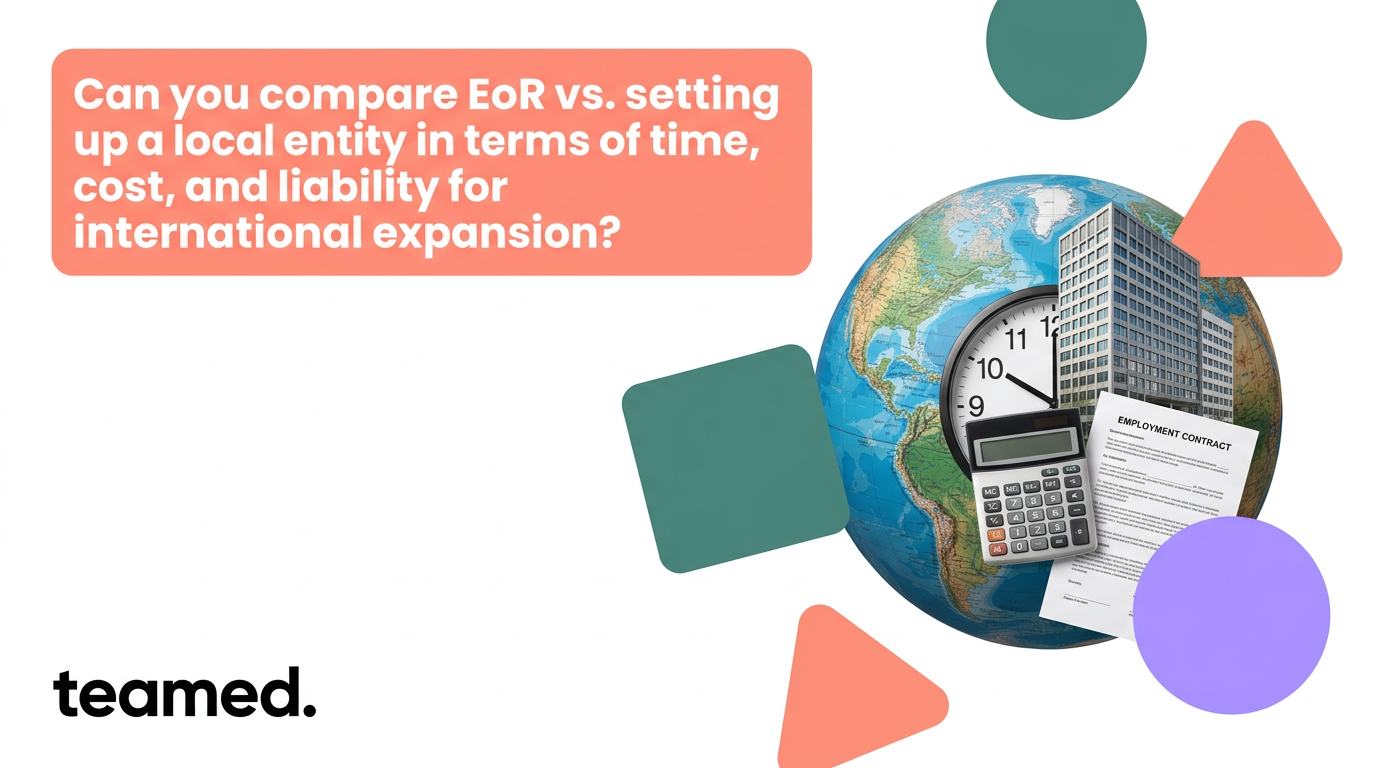
Can you compare EoR vs. setting up a local entity in terms of time, cost, and liability for international expansion?

You've found the candidate. They're perfect for the role, based in Germany, and ready to start in three weeks. Now comes the question that keeps HR leaders up at night: do you use an Employer of Record to hire them quickly, or do you establish your own German entity for long-term control?

The honest answer is that neither option is universally better. The right choice depends on your headcount trajectory, how long you're committed to that market, and whether you need to invoice local customers or hold specific licences. Most comparison guides gloss over these nuances, presenting EOR as the "fast option" and entity setup as the "serious option." That framing misses the point entirely.

What you actually need is a framework for deciding when each model makes sense, and when to graduate from one to the other. Based on Teamed's advisory work with over 1,000 companies across 70+ countries, the crossover point varies dramatically by jurisdiction. Low-complexity countries like the United Kingdom or Singapore justify entity setup at 10 employees. High-complexity countries like Brazil or India may warrant staying on EOR until you reach 25-35 employees.

Quick Facts: EOR vs Local Entity Decision Points

Teamed's standard Employer of Record fee is $599 per employee per month, with salary, statutory costs, benefits, and the Teamed fee shown as separate line items on fully itemised invoices.

EOR onboarding can be completed in as little as 24 hours when the candidate has provided right-to-work and payroll-critical information.

Entity establishment in Tier 1 countries like the United Kingdom, Ireland, or Singapore typically requires 2-4 months to become fully hire-ready, including incorporation, tax registration, payroll setup, and banking.

Entity establishment in Tier 3 countries like Brazil, China, or India typically requires 6-12 months due to complex regulatory requirements and multi-layered compliance obligations.

Setting up a local entity costs $20,000-$80,000 upfront depending on jurisdiction, plus ongoing annual costs for accounting, statutory filings, and local payroll operations.

Teamed contractually guarantees zero foreign exchange markup on EOR payments, with invoices showing an FX rate timestamp alongside a mid-market reference rate.

What is the difference between EOR and a local entity?

An Employer of Record is a third-party organisation that becomes the legal employer of a worker in a specific country, running local payroll, statutory benefits, employment contracts, and HR compliance while you direct day-to-day work. The EOR handles the legal complexity; you maintain operational control.

A local entity is a country-registered company that allows your organisation to employ staff directly under local law, invoice customers locally, and hold local regulatory obligations in its own name. You own the compliance burden, but you also own the commercial capabilities that come with a local presence.

The distinction matters because EOR and entity serve different strategic purposes. EOR removes the need for local corporate infrastructure. Entity provides that infrastructure when your business requires it.

How does liability differ between EOR and local entity?

Most content on this topic implies that EOR fully removes employer risk. That's not accurate. The EOR is the legal employer responsible for employment contracts, payroll withholding, and statutory benefits administration. But you retain responsibility for day-to-day management decisions, workplace safety in practice, and can still face co-employment exposure if the arrangement isn't structured properly.

With a local entity, you own the full compliance burden directly. Employment tribunal claims, tax audits, and regulatory inspections come to your door. In Germany, for example, works councils become mandatory at 5+ employees if employees request them. In France, the CSE (Social and Economic Committee) is mandatory at 11+ employees. These governance requirements create administrative overhead that EOR absorbs on your behalf.

The liability map isn't binary. It's a spectrum that depends on how the employment relationship is structured, what decisions you're making day-to-day, and whether your activities in-country create permanent establishment risk for corporate tax purposes.

How long does it take to hire internationally through EOR vs local entity?

EOR wins decisively on speed. Named jurisdiction specialists are assigned within 48 hours for new EOR engagements, and onboarding can be completed in as little as 24 hours when documentation is ready. You can have a compliant employee on payroll in Germany, Japan, or Brazil within days rather than months.

Entity setup is a different timeline entirely. The incorporation itself might be quick in some jurisdictions, but "hire-ready" requires much more than a certificate of incorporation—with public services scoring only 49.7/100 for making compliance work in practice across 50 economies assessed by the World Bank. You need tax registrations, payroll capability, benefits procurement, local signatories, and banking with completed KYC. In the United Kingdom, Companies House standard online incorporation can be completed in 24 hours, but PAYE registration, payroll readiness, and benefits setup typically extend the practical hire-ready timeline to 2-4 months.

High-complexity countries take longer. Brazil's extremely complex labour code (CLT) and mandatory union requirements mean entity establishment typically requires 6-12 months. China requires a Wholly Foreign-Owned Enterprise (WFOE) for full operational control, with complex social insurance varying by city and province. India's Shops and Establishments Act varies by state, adding another layer of complexity.

When does speed matter most?

Speed matters when you're testing a market with your first 1-5 employees and don't want to commit to entity governance before validating product-market fit. It matters when you've found a critical hire who won't wait six months for you to establish infrastructure. It matters post-acquisition when you've inherited international headcount and need compliant employment immediately.

Speed matters less when you have a 3+ year commitment to a market with stable or growing headcount. At that point, the question shifts from "how fast can we hire?" to "what's the most cost-effective structure over our planning horizon?"

What are the real costs of EOR vs local entity setup?

EOR pricing is primarily variable: a per-employee monthly fee plus pass-through employment costs. Teamed's standard EOR fee is $599 per employee per month, with fully itemised invoices showing salary, statutory costs, benefits, and the Teamed fee as separate line items. This transparency matters because most providers mark up pass-through costs, bury FX margins, and don't provide line-item breakdowns.

Local entity costs include both upfront setup and ongoing fixed overheads. Setup costs range from $20,000 to $80,000 depending on jurisdiction, covering legal incorporation, banking setup, tax registration, and initial compliance configuration. Ongoing costs include accounting, statutory filings, local payroll operations, and corporate governance, even when headcount is small.

The crossover economics are straightforward in principle but vary dramatically by country. In a Tier 1 country like the United Kingdom, with 10 employees, EOR at £7,500 per year per employee totals £225,000 over three years. An owned entity with £25,000 setup cost and £3,500 per year per employee totals £130,000 over three years. The break-even point is around month 17.

Why do EOR costs vary so much between providers?

FX is a material hidden cost that most comparison guides ignore. If your provider marks up currency exchange by 2-3% on every salary payment, that compounds significantly across your international workforce. Teamed contractually guarantees zero FX markup, with invoices showing an FX rate timestamp alongside a mid-market reference rate. This creates budgeting predictability that providers with unverified FX spreads can't match.

The other hidden variable is what happens when things get complicated. When complex cases arrive, most providers route you to a chatbot or an offshore queue. The EOR fee should buy you access to named specialists with jurisdiction-specific expertise who can navigate works councils, collective agreements, and regulatory edge cases. If it doesn't, you're paying for operational infrastructure without the advisory relationship that makes it valuable.

How do you decide when to transition from EOR to local entity?

This is where most guidance falls short. The decision isn't just about cost comparison. It's about five criteria that should all be met before you transition.

First, employee concentration. Have you reached or exceeded the threshold for your operating tier in that country? That's 10+ employees in Tier 1 countries like the United Kingdom, Ireland, or Singapore. It's 15-20 employees in Tier 2 countries like Germany, France, or Japan. It's 25-35 employees in Tier 3 countries like Brazil, India, or China.

Second, long-term commitment. Are you planning a 3+ year presence in the market with stable or growing headcount? Entity setup costs require multi-year presence to justify the investment.

Third, economic viability. Do your annual EOR costs multiplied by expected years exceed entity setup cost plus ongoing annual costs? The calculation is straightforward: (Annual EOR cost × projected years) > (Setup cost + (annual entity cost × projected years)).

Fourth, control requirements. Do you need direct control over local operations, intellectual property protection, or customer contracts? Some enterprise customers require contracting with local entities. Certain IP structures require owned entities. Sales activities in particular can trigger 'doing business' requirements that necessitate local presence. Direct bank account control may be necessary for your business model.

Fifth, operational readiness. Do you have HR and legal resources capable of managing local compliance? This means access to local accounting, payroll expertise, HR advisory, and legal counsel.

What is the graduation model for international employment?

Teamed's graduation model describes the natural progression companies follow as they scale international teams: contractor to EOR to entity. The model recognises that every EOR customer has a crossover point where the per-head cost of EOR exceeds the amortised cost of setting up and administering their own entity.

The graduation model provides continuity across transitions through a single advisory relationship. When you graduate from EOR to entity management, you don't switch providers. You move to a different product within the same relationship. The supplier relationship remains constant; only the underlying employment model evolves.

This matters because the EOR industry created a problem: every provider forces a migration when the customer outgrows EOR. You have to find an entity setup specialist, then a local payroll provider, then a compliance advisor. Each transition introduces risk, cost, and a break in the advisory relationship. Provider transition costs typically run £15,000-£30,000 per country in management overhead, knowledge transfer, and process recreation.

When should you stay on EOR despite reaching the employee threshold?

You should remain with EOR if any of these conditions apply, regardless of headcount.

You're in your first 1-2 years in a new market while validating product-market fit. Entity commitment before market validation creates exit complexity you don't need.

The market or regulatory environment is unstable. Political instability, upcoming elections that could alter employment law, or frequent regulatory changes make long-term planning difficult.

You lack local HR and legal expertise and have no budget to acquire it through outsourced support. Running an entity without compliance capability is more expensive than the EOR fee you're trying to avoid.

Your employees are spread across many countries with fewer than 10 total. The complexity of managing multiple entities outweighs potential savings when headcount is dispersed.

You need to hire within days or weeks rather than the 2-6 months typical for entity establishment. Speed requirements trump cost optimisation.

Complex foreign exchange controls affect salary payments or profit repatriation. Currency instability creates unpredictable cost structures that make entity economics unreliable.

Is using an EOR legally compliant?

Yes, when structured correctly. The EOR becomes the legal employer, handling employment contracts, payroll withholding, and statutory benefits administration in compliance with local law. The worker is genuinely employed by the EOR entity in that country.

The compliance question becomes more nuanced in specific jurisdictions. In Germany, employee leasing (Arbeitnehmerüberlassung) is a regulated model with strict requirements, so EOR-style arrangements must be structured carefully to avoid being treated as unauthorised labour leasing under German law. A provider with in-market legal expertise will structure the arrangement correctly from the start.

Across the EU and UK, GDPR applies to employee personal data, so both EOR and entity models must define controller/processor roles, lawful bases for processing, and cross-border transfer safeguards when HR and payroll systems are operated from outside the EEA.

The compliance confidence you get from an EOR depends entirely on the provider's local expertise. Automated checklists aren't enough. You need providers with local legal teams informing recommendations, proactive monitoring of regulatory changes, and clear accountability for compliance guidance.

How do country complexity tiers affect your decision?

Teamed's Country Concentration and Entity Transition Framework categorises countries into three tiers based on regulatory complexity, termination costs, and administrative burden.

Tier 1 countries feature flexible labour markets, predictable employment law, and straightforward termination processes. These include the United Kingdom, Ireland, Australia, New Zealand, Singapore, United States, UAE, Canada, Netherlands, Denmark, and Hong Kong. Entity threshold: 10+ employees.

Tier 2 countries have strong employee protections, mandatory employee representation at certain thresholds, and structured termination processes requiring consultation. These include Germany, France, Spain, Italy, Belgium, Austria, Japan, South Korea, Switzerland, Poland, and South Africa. Entity threshold: 15-20 employees.

Tier 3 countries have very high termination costs (often 6-12+ months salary), extensive mandatory benefits, complex multi-layered compliance requirements, and frequent regulatory changes. These include Brazil, Mexico, Argentina, China (mainland), India, Indonesia, Philippines, Colombia, Turkey, and Saudi Arabia. Entity threshold: 25-35 employees.

The Language Buffer Rule adds another dimension. Operating in a non-native language increases compliance risk and administrative burden by 30-50%. A UK company operating in Germany should use the 20-30 employee threshold rather than the native 15-20 threshold to account for increased complexity when the team can't read German employment law documentation directly.

Making the right structural decision

The EOR vs local entity decision isn't a one-time choice. It's a strategic question that should be revisited as your headcount, market commitment, and operational requirements evolve.

The right structure for where you are today may not be the right structure for where you're going. A provider that profits from keeping you on EOR indefinitely has no incentive to tell you when entity setup becomes the better answer. Teamed's approach is different: we proactively advise when it's time to graduate, even when that means moving you off EOR.

If you're managing international employment across multiple countries and want an expert advisory relationship rather than a self-serve platform, talk to an expert about the right structure for your specific situation. The decision is too important to get wrong.
Can you compare EoR vs. setting up a local entity in terms of time, cost, and liability for international expansion?

You've found the candidate. They're perfect for the role, based in Germany, and ready to start in three weeks. Now comes the question that keeps HR leaders up at night: do you use an Employer of Record to hire them quickly, or do you establish your own German entity for long-term control?

The honest answer is that neither option is universally better. The right choice depends on your headcount trajectory, how long you're committed to that market, and whether you need to invoice local customers or hold specific licences. Most comparison guides gloss over these nuances, presenting EOR as the "fast option" and entity setup as the "serious option." That framing misses the point entirely.

What you actually need is a framework for deciding when each model makes sense, and when to graduate from one to the other. Based on Teamed's advisory work with over 1,000 companies across 70+ countries, the crossover point varies dramatically by jurisdiction. Low-complexity countries like the United Kingdom or Singapore justify entity setup at 10 employees. High-complexity countries like Brazil or India may warrant staying on EOR until you reach 25-35 employees.

Quick Facts: EOR vs Local Entity Decision Points

Teamed's standard Employer of Record fee is $599 per employee per month, with salary, statutory costs, benefits, and the Teamed fee shown as separate line items on fully itemised invoices.

EOR onboarding can be completed in as little as 24 hours when the candidate has provided right-to-work and payroll-critical information.

Entity establishment in Tier 1 countries like the United Kingdom, Ireland, or Singapore typically requires 2-4 months to become fully hire-ready, including incorporation, tax registration, payroll setup, and banking.

Entity establishment in Tier 3 countries like Brazil, China, or India typically requires 6-12 months due to complex regulatory requirements and multi-layered compliance obligations.

Setting up a local entity costs $20,000-$80,000 upfront depending on jurisdiction, plus ongoing annual costs for accounting, statutory filings, and local payroll operations.

Teamed contractually guarantees zero foreign exchange markup on EOR payments, with invoices showing an FX rate timestamp alongside a mid-market reference rate.

What is the difference between EOR and a local entity?

An Employer of Record is a third-party organisation that becomes the legal employer of a worker in a specific country, running local payroll, statutory benefits, employment contracts, and HR compliance while you direct day-to-day work. The EOR handles the legal complexity; you maintain operational control.

A local entity is a country-registered company that allows your organisation to employ staff directly under local law, invoice customers locally, and hold local regulatory obligations in its own name. You own the compliance burden, but you also own the commercial capabilities that come with a local presence.

The distinction matters because EOR and entity serve different strategic purposes. EOR removes the need for local corporate infrastructure. Entity provides that infrastructure when your business requires it.

How does liability differ between EOR and local entity?

Most content on this topic implies that EOR fully removes employer risk. That's not accurate. The EOR is the legal employer responsible for employment contracts, payroll withholding, and statutory benefits administration. But you retain responsibility for day-to-day management decisions, workplace safety in practice, and can still face co-employment exposure if the arrangement isn't structured properly.

With a local entity, you own the full compliance burden directly. Employment tribunal claims, tax audits, and regulatory inspections come to your door. In Germany, for example, works councils become mandatory at 5+ employees if employees request them. In France, the CSE (Social and Economic Committee) is mandatory at 11+ employees. These governance requirements create administrative overhead that EOR absorbs on your behalf.

The liability map isn't binary. It's a spectrum that depends on how the employment relationship is structured, what decisions you're making day-to-day, and whether your activities in-country create permanent establishment risk for corporate tax purposes.

How long does it take to hire internationally through EOR vs local entity?

EOR wins decisively on speed. Named jurisdiction specialists are assigned within 48 hours for new EOR engagements, and onboarding can be completed in as little as 24 hours when documentation is ready. You can have a compliant employee on payroll in Germany, Japan, or Brazil within days rather than months.

Entity setup is a different timeline entirely. The incorporation itself might be quick in some jurisdictions, but "hire-ready" requires much more than a certificate of incorporation—with public services scoring only 49.7/100 for making compliance work in practice across 50 economies assessed by the World Bank. You need tax registrations, payroll capability, benefits procurement, local signatories, and banking with completed KYC. In the United Kingdom, Companies House standard online incorporation can be completed in 24 hours, but PAYE registration, payroll readiness, and benefits setup typically extend the practical hire-ready timeline to 2-4 months.

High-complexity countries take longer. Brazil's extremely complex labour code (CLT) and mandatory union requirements mean entity establishment typically requires 6-12 months. China requires a Wholly Foreign-Owned Enterprise (WFOE) for full operational control, with complex social insurance varying by city and province. India's Shops and Establishments Act varies by state, adding another layer of complexity.

When does speed matter most?

Speed matters when you're testing a market with your first 1-5 employees and don't want to commit to entity governance before validating product-market fit. It matters when you've found a critical hire who won't wait six months for you to establish infrastructure. It matters post-acquisition when you've inherited international headcount and need compliant employment immediately.

Speed matters less when you have a 3+ year commitment to a market with stable or growing headcount. At that point, the question shifts from "how fast can we hire?" to "what's the most cost-effective structure over our planning horizon?"

What are the real costs of EOR vs local entity setup?

EOR pricing is primarily variable: a per-employee monthly fee plus pass-through employment costs. Teamed's standard EOR fee is $599 per employee per month, with fully itemised invoices showing salary, statutory costs, benefits, and the Teamed fee as separate line items. This transparency matters because most providers mark up pass-through costs, bury FX margins, and don't provide line-item breakdowns.

Local entity costs include both upfront setup and ongoing fixed overheads. Setup costs range from $20,000 to $80,000 depending on jurisdiction, covering legal incorporation, banking setup, tax registration, and initial compliance configuration. Ongoing costs include accounting, statutory filings, local payroll operations, and corporate governance, even when headcount is small.

The crossover economics are straightforward in principle but vary dramatically by country. In a Tier 1 country like the United Kingdom, with 10 employees, EOR at £7,500 per year per employee totals £225,000 over three years. An owned entity with £25,000 setup cost and £3,500 per year per employee totals £130,000 over three years. The break-even point is around month 17.

Why do EOR costs vary so much between providers?

FX is a material hidden cost that most comparison guides ignore. If your provider marks up currency exchange by 2-3% on every salary payment, that compounds significantly across your international workforce. Teamed contractually guarantees zero FX markup, with invoices showing an FX rate timestamp alongside a mid-market reference rate. This creates budgeting predictability that providers with unverified FX spreads can't match.

The other hidden variable is what happens when things get complicated. When complex cases arrive, most providers route you to a chatbot or an offshore queue. The EOR fee should buy you access to named specialists with jurisdiction-specific expertise who can navigate works councils, collective agreements, and regulatory edge cases. If it doesn't, you're paying for operational infrastructure without the advisory relationship that makes it valuable.

How do you decide when to transition from EOR to local entity?

This is where most guidance falls short. The decision isn't just about cost comparison. It's about five criteria that should all be met before you transition.

First, employee concentration. Have you reached or exceeded the threshold for your operating tier in that country? That's 10+ employees in Tier 1 countries like the United Kingdom, Ireland, or Singapore. It's 15-20 employees in Tier 2 countries like Germany, France, or Japan. It's 25-35 employees in Tier 3 countries like Brazil, India, or China.

Second, long-term commitment. Are you planning a 3+ year presence in the market with stable or growing headcount? Entity setup costs require multi-year presence to justify the investment.

Third, economic viability. Do your annual EOR costs multiplied by expected years exceed entity setup cost plus ongoing annual costs? The calculation is straightforward: (Annual EOR cost × projected years) > (Setup cost + (annual entity cost × projected years)).

Fourth, control requirements. Do you need direct control over local operations, intellectual property protection, or customer contracts? Some enterprise customers require contracting with local entities. Certain IP structures require owned entities. Sales activities in particular can trigger 'doing business' requirements that necessitate local presence. Direct bank account control may be necessary for your business model.

Fifth, operational readiness. Do you have HR and legal resources capable of managing local compliance? This means access to local accounting, payroll expertise, HR advisory, and legal counsel.

What is the graduation model for international employment?

Teamed's graduation model describes the natural progression companies follow as they scale international teams: contractor to EOR to entity. The model recognises that every EOR customer has a crossover point where the per-head cost of EOR exceeds the amortised cost of setting up and administering their own entity.

The graduation model provides continuity across transitions through a single advisory relationship. When you graduate from EOR to entity management, you don't switch providers. You move to a different product within the same relationship. The supplier relationship remains constant; only the underlying employment model evolves.

This matters because the EOR industry created a problem: every provider forces a migration when the customer outgrows EOR. You have to find an entity setup specialist, then a local payroll provider, then a compliance advisor. Each transition introduces risk, cost, and a break in the advisory relationship. Provider transition costs typically run £15,000-£30,000 per country in management overhead, knowledge transfer, and process recreation.

When should you stay on EOR despite reaching the employee threshold?

You should remain with EOR if any of these conditions apply, regardless of headcount.

You're in your first 1-2 years in a new market while validating product-market fit. Entity commitment before market validation creates exit complexity you don't need.

The market or regulatory environment is unstable. Political instability, upcoming elections that could alter employment law, or frequent regulatory changes make long-term planning difficult.

You lack local HR and legal expertise and have no budget to acquire it through outsourced support. Running an entity without compliance capability is more expensive than the EOR fee you're trying to avoid.

Your employees are spread across many countries with fewer than 10 total. The complexity of managing multiple entities outweighs potential savings when headcount is dispersed.

You need to hire within days or weeks rather than the 2-6 months typical for entity establishment. Speed requirements trump cost optimisation.

Complex foreign exchange controls affect salary payments or profit repatriation. Currency instability creates unpredictable cost structures that make entity economics unreliable.

Is using an EOR legally compliant?

Yes, when structured correctly. The EOR becomes the legal employer, handling employment contracts, payroll withholding, and statutory benefits administration in compliance with local law. The worker is genuinely employed by the EOR entity in that country.

The compliance question becomes more nuanced in specific jurisdictions. In Germany, employee leasing (Arbeitnehmerüberlassung) is a regulated model with strict requirements, so EOR-style arrangements must be structured carefully to avoid being treated as unauthorised labour leasing under German law. A provider with in-market legal expertise will structure the arrangement correctly from the start.

Across the EU and UK, GDPR applies to employee personal data, so both EOR and entity models must define controller/processor roles, lawful bases for processing, and cross-border transfer safeguards when HR and payroll systems are operated from outside the EEA.

The compliance confidence you get from an EOR depends entirely on the provider's local expertise. Automated checklists aren't enough. You need providers with local legal teams informing recommendations, proactive monitoring of regulatory changes, and clear accountability for compliance guidance.

How do country complexity tiers affect your decision?

Teamed's Country Concentration and Entity Transition Framework categorises countries into three tiers based on regulatory complexity, termination costs, and administrative burden.

Tier 1 countries feature flexible labour markets, predictable employment law, and straightforward termination processes. These include the United Kingdom, Ireland, Australia, New Zealand, Singapore, United States, UAE, Canada, Netherlands, Denmark, and Hong Kong. Entity threshold: 10+ employees.

Tier 2 countries have strong employee protections, mandatory employee representation at certain thresholds, and structured termination processes requiring consultation. These include Germany, France, Spain, Italy, Belgium, Austria, Japan, South Korea, Switzerland, Poland, and South Africa. Entity threshold: 15-20 employees.

Tier 3 countries have very high termination costs (often 6-12+ months salary), extensive mandatory benefits, complex multi-layered compliance requirements, and frequent regulatory changes. These include Brazil, Mexico, Argentina, China (mainland), India, Indonesia, Philippines, Colombia, Turkey, and Saudi Arabia. Entity threshold: 25-35 employees.

The Language Buffer Rule adds another dimension. Operating in a non-native language increases compliance risk and administrative burden by 30-50%. A UK company operating in Germany should use the 20-30 employee threshold rather than the native 15-20 threshold to account for increased complexity when the team can't read German employment law documentation directly.

Making the right structural decision

The EOR vs local entity decision isn't a one-time choice. It's a strategic question that should be revisited as your headcount, market commitment, and operational requirements evolve.

The right structure for where you are today may not be the right structure for where you're going. A provider that profits from keeping you on EOR indefinitely has no incentive to tell you when entity setup becomes the better answer. Teamed's approach is different: we proactively advise when it's time to graduate, even when that means moving you off EOR.

If you're managing international employment across multiple countries and want an expert advisory relationship rather than a self-serve platform, talk to an expert about the right structure for your specific situation. The decision is too important to get wrong.
TABLE OF CONTENTS

Take a look
at the latest articles